• Skip to primary navigation
  • Skip to main content
software stack logo

Software Stack

Get your Software Stack together

  • Knowledgebase
    • All Categories
    • Accounting Software
    • Automation & Workflow Software
    • Customer Relationship Management
    • E-Commerce Shopfronts & Payments
    • Marketing Automation
    • Online Courses & Membership
    • Project Management
    • Surveys & Forms
    • Web Hosting
  • Home
  • About Us
  • Contact Us
  • Show Search
Hide Search

Workflow & Automation

Use Cases

Software Stack Editor · September 23, 2025 ·

Governance Risk & Compliance

Experience the friendliest, most flexible enterprise governance, risk and compliance solution. From novice to experienced practitioners, get elegant features and unprecedented cross-team collaboration over a network of interconnected GRC practice areas.


Latest News

Software Stack Editor · September 23, 2025 ·

Governance Risk & Compliance

Experience the friendliest, most flexible enterprise governance, risk and compliance solution. From novice to experienced practitioners, get elegant features and unprecedented cross-team collaboration over a network of interconnected GRC practice areas.

Comparisons

Software Stack Editor · September 23, 2025 ·

Governance Risk & Compliance

Experience the friendliest, most flexible enterprise governance, risk and compliance solution. From novice to experienced practitioners, get elegant features and unprecedented cross-team collaboration over a network of interconnected GRC practice areas.
Operations

Software Stack Editor · September 23, 2025 ·

Governance Risk & Compliance

Experience the friendliest, most flexible enterprise governance, risk and compliance solution. From novice to experienced practitioners, get elegant features and unprecedented cross-team collaboration over a network of interconnected GRC practice areas.

Governance, Risk & Compliance

Software Stack Editor · September 23, 2025 ·

Governance Risk & Compliance

Experience the friendliest, most flexible enterprise governance, risk and compliance solution. From novice to experienced practitioners, get elegant features and unprecedented cross-team collaboration over a network of interconnected GRC practice areas.
Venture Capital

Software Stack Editor · September 23, 2025 ·

Governance Risk & Compliance

Experience the friendliest, most flexible enterprise governance, risk and compliance solution. From novice to experienced practitioners, get elegant features and unprecedented cross-team collaboration over a network of interconnected GRC practice areas.
IT Service Management

Software Stack Editor · September 23, 2025 ·

Governance Risk & Compliance

Experience the friendliest, most flexible enterprise governance, risk and compliance solution. From novice to experienced practitioners, get elegant features and unprecedented cross-team collaboration over a network of interconnected GRC practice areas.

Customer Success

Software Stack Editor · September 23, 2025 ·

Governance Risk & Compliance

Experience the friendliest, most flexible enterprise governance, risk and compliance solution. From novice to experienced practitioners, get elegant features and unprecedented cross-team collaboration over a network of interconnected GRC practice areas.

Product Management

Software Stack Editor · September 23, 2025 ·

Governance Risk & Compliance

Experience the friendliest, most flexible enterprise governance, risk and compliance solution. From novice to experienced practitioners, get elegant features and unprecedented cross-team collaboration over a network of interconnected GRC practice areas.

Connected Workflows

Software Stack Editor · September 23, 2025 ·

Governance Risk & Compliance

Experience the friendliest, most flexible enterprise governance, risk and compliance solution. From novice to experienced practitioners, get elegant features and unprecedented cross-team collaboration over a network of interconnected GRC practice areas.

Project Management

Software Stack Editor · September 23, 2025 ·

Governance Risk & Compliance

Experience the friendliest, most flexible enterprise governance, risk and compliance solution. From novice to experienced practitioners, get elegant features and unprecedented cross-team collaboration over a network of interconnected GRC practice areas.
How to consolidate tools while embracing new tech

Software Stack Editor · September 22, 2025 ·

image

Harnessing the energy of AI

IT leaders find themselves in a tough spot. Senior stakeholders want to cut costs and reduce risks. But employees are sprinting towards new technologies like AI, leaving compliance departments in the dust.

“The curiosity is huge,” said Miro’s Bram Jonker in a recent webinar on tool consolidation with Forrester VP and principal analyst Bobby Cameron. 

“They want to make use of the latest tools that are out there that everyone is talking about,” he continued. “So what happens is that people just put down their own credit cards. They go, ‘You know what? I will pay 15 bucks a month if I can get access to this amazing technology, which is also going to help me learn what is out there and to start mastering it.’”

Obviously that creates risks around shadow IT and security, but that doesn’t mean IT leaders should just stamp out the behavior. Because this kind of enthusiasm for change almost never happens.

Generally speaking, employees hate new technology. That’s a bold statement but consider the data. A few years ago, Gartner found that 60% of workers were occasionally or frequently frustrated by new software, while 56% said they wished management would just bring back their old tools. 

Contrast that with their attitude to AI. According to Miro’s own research, 76% of global workers believe it will benefit their role, and 61% said it makes them feel excited or energized. The question for IT leaders is how they can match that urgency while delivering on the mandate to streamline their tech stack.

Why consolidation starts with collaboration

Forrester’s Bobby Cameron had no doubt about what the strategy should look like. “The key message is not to limit tools, but to make sure the tech organization keeps up with whatever employees are doing,” he said. The simplest (but most often overlooked) way to do that is through collaboration.

Bobby shared an example of how that looks in practice. He recalled “a tier two automotive supplier in the States where the CIO pulled together the hackers from across his company in order to better manage new tool adoption. These  folks – not just in IT but from all over – would be the ones breaking in new tools on their own. They knew what was going on so the CIO encouraged a continuous discussion among them around what was hot. Then the CIO would provide funding for the new tool that was most favored among the hackers and make it available for everyone to use.”

Maybe some people look at that example and see IT leadership that isn’t really leading – just following the whims and demands of employees. But this is servant leadership in action. It’s IT truly collaborating with the business and being responsive to its needs. 

“If you’ve got people who have chosen tools and are trying to make it happen, just shutting them down and saying, ‘No, don’t do that!’ isn’t going to work,” Bobby continued. “Find out what’s new and different that is being effectively used, and maybe that’s a better tool. So pull those people in and make them part of the ongoing analysis.”

Miro’s Bram Jonker was quick to back him up. “It’s about stepping out of isolation, gaining trust from your employees, and engaging with them to get their input on what they need. Then they’ll come to you. They’ll come to you and say, ‘Hey, we’ve tried this tool. Let’s put it into your process.’”

Does that mean you just end up with exactly the kind of tool sprawl you set out to reduce? Not at all. It means you can make decisions about what to keep and what to cut based on an understanding of the value the tool really provides, not just the licensing cost you see on a spreadsheet. 

Welcome! You are invited to join a webinar: Dynamic, AI-Driven Project Management. After registering, you will receive a confirmation email about joining the webinar.

Software Stack Editor · September 17, 2025 ·

.circular {
position: relative;
top: 150px;
left: 50%;
height: auto;
width: 42px;
fill: currentColor;
margin-top: -21px;
margin-left: -21px;
animation: loading-rotate 1.6s linear infinite;
}
@keyframes loading-rotate {
100% {
transform: rotate(360deg);
}
}

image

Announcing the 2025 Webflow Awards winners

Software Stack Editor · September 15, 2025 ·

Across our vibrant community of creatives, strategists, developers, partners, and leaders, Webflow users are pushing boundaries and reimagining the future of website experiences.

The Webflow Awards is our annual tribute to the people and organizations delivering the most creative, technically impressive, and impactful work with Webflow. Their achievements set a new benchmark for excellence and continue to inspire what’s possible on the web.

Dive into the full list of this year’s winners to hear how they continue to raise the bar for digital experiences. To learn more about their incredible work and see all of our finalists and winners, visit our awards page. 

Community Awards

The Community Awards represent a thriving ecosystem of Webflow creators who are contributing to Webflow’s mission and building the future of the web. 

🏆 Community Educator of the Year: Timothy Ricks

Timothy Ricks empowers the Webflow community with generous, high-impact educational content, from free crash courses for beginners to tutorials on the latest Webflow features. He created the Lumos Framework, widely used to scale Enterprise sites with a component-first approach, and continues to ship tools and plugins that make designers’ lives easier. A trusted voice and tireless mentor, Tim consistently elevates the craft across the Webflow ecosystem.

“I’m so thankful for Webflow because of the community it brings together. Every day I get to work alongside, be inspired by, and learn from so many incredible people. And it feels like we’re only just getting started. Webflow opened doors for me that I never imagined possible, and I’m so grateful to be part of this amazing community.” – Timothy Ricks, Webflow Educator

And congratulations to the rest of our finalists: Arnau Ros, Elsa Amri, Francesco Castronuovo, and Michael Wells

🏆 Community Creator of the Year: Ilja van Eck

Ilja van Eck is a powerhouse in the Webflow community, recognized for his award-winning work with multiple Awwwards Site of the Day honors. Always pushing creative boundaries, together with Dennis Snellenberg, Ilja recently launched Osmo, a resource library packed with techniques, components, code, and tools designed to empower both Webflow and non-Webflow users. Through his projects and shared resources, he continues to raise the bar and inspire designers and developers worldwide.

“I’m not sure if it’s wise to start my quote by mentioning that I dropped out of university because of Webflow, but it’s been that impactful in my life. Not just because of how Webflow as a tool pushed me into creative development, but especially because of the incredible humans that make up the community. I’ll always be thankful for the personal and professional connections I’ve made with people all over the world, simply because we obsess over the same thing: building websites with Webflow.” – Ilja van Eck, Co-Founder, Osmo

And congratulations to the rest of our finalists: BYQ Studio, Coraline Guillevic, Kevin Hilgendorf, and Riziki Nielsen

🏆 Developer of the Year: Nkenna Amadi

Nkenna Amadi is redefining what web experiences can be, merging technical complexity with emotional resonance to create work that leaves a lasting impact. In the past year alone, Nkenna has received multiple Awwwards and CSS Design Awards, including 3x Site of the Day and Developer Awards and 6x CSSDA Site of the Day honors. With nominations for both Awwwards Independent of the Year and Studio of the Year, Nkenna continues to inspire the global design and development community with work that is as innovative as it is meaningful.

“Webflow was my first introduction to the world of web design and development. That seamless entry point made the web feel approachable and exciting, and it sparked a curiosity that has since grown into a career where I now push the boundaries of what’s possible digitally. What began as learning how to bring a page to life with Webflow has evolved into building complex, immersive digital experiences, but that first step, that accessible ramp, is what made it all possible. The Webflow community has been a catalyst in my growth; it’s where I’ve met incredible creatives and entrepreneurs who are open and supportive — it’s felt like being part of a circle of friends, sharing ideas and shaping the web together.” – Nkenna Amadi, Co-Founder, The Blackpepper Studio

And congratulations to the rest of our finalists: Dennis Snellenberg, Thomas Carre, Virat Patel, and Vishal Chiniwar

🏆 Global Leader of the Year: Carlos Sepulveda

Carlos Supulveda is a talented Webflow designer and developer who uses his skills to uplift the global community — especially in his home country of Colombia. Through his work, tutorials, and generous spirit, he continues to inspire others in the Webflow Colombia community and expand Webflow’s reach across Latin America.

“The Webflow Community has amazed me time and time again. From connecting online to meeting, collaborating, working, and dreaming together in person — it truly feels like magic. Webflow has not only allowed me to provide for my family and help others explore the art of creating websites, but it has also helped me grow immensely. From becoming the Webflow Speed Challenge Champion in 2023 to being honored as Global Leader of the Year in 2025, the journey has been incredible. I hope that everyone in this space — especially those from Latin America — takes the opportunity to keep learning, growing, and building amazing careers together.” – Carlos Sepulveda, Webflow Developer, Nicer Studio

And congratulations to the rest of our finalists: Chris Skitch, Isabel Edwards, Rick Bossenbroek, and Webflow Peru

🏆 Community MVP: Sebastian Bimbi

Sebastian Bimbi has transformed the Spanish-speaking Webflow community through education, mentorship, and advocacy. As founder of nocode.lat, he’s hosted workshops and meetups, created bilingual resources, and mentored 500+ aspiring developers, 65% of whom landed their first clients within weeks. With this ripple effect, Sebastian continues to inspire and uplift creators across Latin America and beyond.

“The Webflow community transformed my path from struggling with traditional development to building a thriving business and meaningful connections across Latin America. Through founding nocode.lat and mentoring aspiring developers, I’ve witnessed how Webflow democratizes web creation, especially for Spanish-speaking communities who often face barriers in tech education. This platform didn’t just change my whole career; it gave me the tools to empower others to build without the limitations of traditional code. I envision a future where Webflow continues breaking down these barriers, making professional web development accessible to creators worldwide, regardless of their background or formal training. I want to dedicate this trophy to my parents, Nina, Chris, Maksym, and RexZero, whose support made this journey possible.” – Sebastian Bimbi, Co-founder, nocode.lat

And congratulations to the rest of our finalists: Alexandre Lopez, Dan Foster, Danitza Rosas, and Eduardo Quiche

Customer Awards

The Customer Awards represent more than 300,000 of the world’s leading organizations — from growing startups to Fortune 500 companies — who are revolutionizing how they build for the web.

🏆 AI Achievement of the Year: Monday.com

monday.com harnessed the power of Webflow and AI to overcome a critical bottleneck in running product and regional events: building event registration pages quickly and at scale. Through the Webflow MCP integration, monday.com developed an AI-driven event builder that transforms simple inputs into sleek, on-brand pages in just minutes. The result is more campaigns launched on time, fewer bottlenecks, and a major leap forward in how monday.com leverages Webflow to drive agility and growth.

“Winning AI Achievement of the Year is a testament to how we approach AI at monday.com, not as a separate tool, but as an embedded capability that transforms how work gets executed. By building an AI agent within monday.com that connects with Webflow MCP, we’ve made event page creation instant, giving regional teams the speed, consistency, and scale they need to drive global impact.” – Barak Bengad, Software Engineer Team Lead, Monday.com

And congratulations to the rest of our finalists: Aspect, Bevica Fonden (with Webflow Partner, Kvalifik), Dermalogica, and IMB Bank

🏆 Best Animated Experience: Dropbox

Dropbox Brand Studio has created a site that masterfully blends storytelling with functionality, bringing their playful identity to life through animation. The result is a website that does more than showcase Dropbox’s brand. It immerses users in it. With Webflow, Dropbox Brand Studio has crafted a best-in-class digital experience where motion, design, and storytelling work in harmony to elevate the brand.

“Webflow has been absolutely instrumental in getting our web engine up and running for Dropbox Dash. It’s not just about the speed we can achieve with Webflow, it’s also about adaptability. Webflow gave us the tools to gather the right data and iterate in real time. On top of that, it’s been a game changer for injecting motion, emotion, and expressiveness into our brand guidelines site. It’s helped bring our brand to life.” – Michael Chiu, Staff Brand Designer, Dropbox

[embedded content]

And congratulations to the rest of our finalists: Aether1 (with Webflow Partner, OFF+BRAND), ChainGPT, Tripletta Pizza, and Warhol Arts (with Webflow Partner, BL/S®)

🏆 Website Experience of the Year: Checkout.com (with Webflow Partner, Flow Ninja)

Checkout.com, a global leader in digital payments, has transformed its online presence by redesigning and rebuilding its website on Webflow with Webflow Partner, Flow Ninja. The move has empowered marketing and content teams to work with greater independence, accelerated speed to market, and ensured consistency across hundreds of pages spanning case studies, reports, guides, and thought leadership.

“Rebuilding our website in Webflow has transformed how we are able to present ourselves as a brand, and also how we work. Webflow’s platform allows the incredible work of our creative team to shine. Our web and content teams are able to ship updates and create new content at pace. All of this ensures the Checkout.com team can deliver a web experience that best supports the needs of our current and future customers. Our rebuild has already delivered measurable gains in engagement and significantly expanded our brand’s visibility, helping bring Checkout.com’s story to more people.” – Michael Horrocks, Director, Web & Content, Checkout.com

And congratulations to the rest of our finalists: Consilio (with Webflow Partner, BX Studio), dormakaba (with Webflow Partner, Minimum run), Notable, and Ori Scan (with Webflow Partner, KOJI GLOBAL)

🏆 Brand Transformation of the Year: Jasper (with Webflow Partner, OFF+BRAND)

Jasper, the leading AI marketing platform, partnered with OFF+BRAND to reimagine its digital presence on Webflow. Their second net-new site in under 6 months blends bold visual language, Rive animations, scroll-based storytelling, and layered interactions to create an immersive, product-aligned experience. Jasper’s new site sets a benchmark for what’s possible with Webflow at scale.

“My time at Jasper has been all about unlocking speed, creativity, and impact within the Webflow platform. In just two months, our little tiger team (and the incredible gurus at OFF+BRAND) transformed our 100 page site into a bold, immersive digital experience that brings marketing (and marketers) to the forefront. Now our team can launch and iterate in real time without developer bottlenecks, which has been a game-changer for getting new pages into our customers hands faster. The business impact is clear: we’ve seen stronger engagement, faster workflows, and a transformed digital presence that elevates Jasper’s brand beyond our competition. And we couldn’t have done it without Webflow.” – Josh Jacobs, Staff Brand Designer at Jasper

And congratulations to the rest of our finalists: ABM (with Webflow Partner, Whiteboard), Duracell (with Webflow Partner, Edgar Allan), Agora, and Nissin Foods GmbH (with Webflow Partner, Triplesense Reply)

🏆 Technical Achievement of the Year: Porsche (with Webflow Partners, C3 and Edgar Allan)

Porsche partnered with C3 to launch its sustainability report on Webflow Enterprise, meeting the highest standards of compliance, security, and deployment at enterprise scale. With strict EU hosting requirements C3 worked with Edgar Allan to secure asset management protocols, the project demanded precision beyond that of a typical marketing site. Porsche’s experience now stands as a benchmark for enterprise teams seeking flexibility, security, and scale.

And congratulations to the rest of our finalists: Domo (with Webflow Partner, Flow Ninja), Greenhouse, Osmo, and Purpose Brands (with Webflow Partner, Outliant)

🏆 All Star: Typeform (with Webflow partner MakeBuild)

Typeform, a leading platform for interactive forms and surveys, partnered with MakeBuild to migrate their main website to Webflow. With a marketer-first workflow, Typeform reduced publishing time from three days to three hours and now ships hundreds of daily updates, fueling fast campaigns and a refreshed brand identity.

“Ideas remain ideas without the right tools to bring them to life. With Webflow, our CMS became a breakthrough instead of a bottleneck. Marketing is now empowered to launch faster, experiment more, and create at scale, while engineers are freed from routine CMS tasks to focus on innovating our core product. Since embarking on our journey with Webflow, in partnership with MakeBuild, we’ve unlocked a new level of creative freedom and collaboration that’s turning bold ideas into live experiences faster than ever.” – Malinda Sandman, Global VP of Marketing, Typeform

And congratulations to the rest of our finalists: Circle (with Webflow Partner, 8020), Darktrace, LegalShield, and Nursa

Partner Awards

The Partner Awards recognize the Webflow Partners building innovative, high-impact website experiences that help clients elevate their brands, meet critical deadlines, and choose Webflow to accelerate digital transformation. 

🏆 Agency of the Year: Parallax

Parallax is a trusted digital partner with over 15 years of experience delivering creative and engineering excellence. The agency helps global brands solve complex problems and create engaging digital experiences that drive results. By combining expert UX design and software engineering with world-class Webflow expertise, Parallax delivers scalable, reliable solutions. Its strength lies in navigating complex technical environments and building bespoke integrations, making the agency a long-term partner of choice for ambitious enterprises worldwide.

“We’re incredibly proud to be named Webflow Agency of the Year 2025, a huge milestone for our team! As a Webflow Enterprise Partner, we’ve helped clients launch faster, take control of their platforms, and scale with confidence. By reducing the overhead of traditional dev work, Webflow frees our engineers to focus on the complex, high-impact technical challenges that drive real results for our clients. At the same time, it has opened new opportunities for our team to innovate, grow their skills, and push the boundaries of what’s possible.” –  Martyn Lee, Principal Consultant, Client Partner, Parallax

And congratulations to the rest of our finalists: 8020, Candid Leap, Finsweet, Flow Ninja, and Refokus

🏆 Enterprise Partner of the Year: BX Studio

BX Studio is a leading design and development agency specializing in launching and optimizing world-class websites on Webflow. They partner with leading companies such as Verifone, Headspace, NBC, and Pentagram to accelerate growth through digital branding, UX design, and ongoing growth services. Recognized with awards and speaking opportunities from Webflow itself, BX Studio has been a trusted partner of the platform since 2020.

“At BX Studio, we’ve seen firsthand how Webflow transforms what’s possible for enterprise clients—accelerating timelines, simplifying complex workflows, and unlocking new creative possibilities. Being part of the Webflow Partner Program has allowed our team to scale that impact, helping global organizations ship faster without sacrificing design or brand integrity. Winning Enterprise Partner of the Year is a testament to the trust our clients place in us, and to the power of Webflow as the future of enterprise web development.” – Jacob Sussman, CEO, BX Studio

And congratulations to the rest of our finalists: Edgar Allan, MakeBuild, N4, and TAG

🏆 Professional Partner of the Year: Kvalifik

Kvalifik is a Nordic digital agency creating beautiful website experiences by pushing the technical boundaries of Webflow. They partner with ambitious brands — from global companies to C25-listed enterprises — to transform digital presence into business-critical assets. By blending Danish design excellence with advanced development, Kvalifik delivers measurable value for clients worldwide, helping them stand out in competitive markets while unlocking the full potential of the Webflow platform.

“Our clients need to move fast into new markets with new campaigns across new channels. Webflow gives them the power to do just that. No handovers, no bottlenecks — just full control of their digital presence. That’s the real value. But speed alone isn’t enough. In a world where AI is everywhere, the real differentiator is still human. Webflow lets us remove friction so our clients can spend less time stuck in backlogs and more time sparking ideas, building trust, and shaping experiences that stand out. That’s the future we’re building toward. And being a partner means we get to help lead the way.” – Rebecca Busk, Commercial Director & Partner, Kvalifik

And congratulations to the rest of our finalists: Better Mistakes, Code & Wander, Grafit, and One Branding

🏆 Top New Partner of the Year: Iron Horse

Iron Horse Studio is a Webflow Premium Enterprise Partner with 25 years of experience driving marketing-influenced pipeline for enterprise brands. Through audience-centric design and the power of Webflow Enterprise, they deliver secure, high-performing digital experiences for companies like Uber for Business, Korn Ferry, and Nextech.

“Since becoming a Webflow partner, Webflow Enterprise and Webflow Optimize have transformed how we serve growth-focused enterprise clients. Our customers are experiencing unprecedented digital agility: better collaboration and the freedom to scale demand without compromising brand standards. Every touchpoint with the Webflow team has exceeded our expectations, and we’re energized by the opportunity to grow together and create even more impactful client outcomes.”  – Uzair Dada, Founder and CEO, Iron Horse 

And congratulations to the rest of our finalists: Beyond, Ficturo, Flowtrix, and Povio

 🏆 Tech Partner of the Year: Lokalise

Lokalise is the Webflow-native localization platform that helps 3,000+ teams worldwide easily scale their sites globally. Powered by advanced AI orchestration, they automate the entire localization workflow, from content detection to deployment, enabling companies to deliver consistent experiences without compromising quality or speed. Trusted by industry leaders, including Maven Clinic, Cyera, and Hyundai, their result is a faster time-to-market and global revenue growth with reliable, cost-effective localization at scale.

“We are proud to be named Webflow’s Tech Partner of the Year, a recognition of the strong collaboration between our teams and our shared commitment to customer success. From the start of Webflow’s localization journey, our teams across marketing, sales, product, and support have worked side-by-side to build an ecosystem that helps customers easily grow globally. By combining Webflow’s visual-first and composable CMS with Lokalise’s powerful and intuitive localization solutions, we empower product and marketing teams to onboard easily, launch faster, deliver seamless global experiences, and unlock new revenue across markets.” –  Etgar Bonar, CMO, Lokalise

And congratulations to the rest of our finalists: Make, Relume, Smartling Inc., and Smootify

Congratulations to all of our winners!

This year’s winners and finalists reflect the creativity, technical excellence, and impact that define what’s possible with Webflow. We’re honored to celebrate your success and grateful for the inspiration you bring to our entire ecosystem. We can’t wait to cheer you on in what comes next!

Why tool consolidation fails (and 5 ways to succeed)

Software Stack Editor · September 11, 2025 ·

image

Budget season is just around the corner, which means IT leaders are about to take a long, hard look at their vendors and wonder whether they really need all those tools.

In fact, according to the latest research, 82% of enterprises are actively pursuing supplier reduction to cut overlaps and simplify management. But will they be successful?

If it seems like an obvious question, the answer is far from simple. For one thing, definitions of success vary. Organizations may report on headline metrics like lower costs or fewer support tickets but fail to measure downstream impacts like user satisfaction or productivity.

Still, it’s possible to get a sense of the failure rate from a widely cited BCG report, which found that 35% of all digital transformation projects fall short of their goals. 

For IT leaders considering tool consolidation it’s a great reminder that they can’t take success for granted. So it’s no surprise that this was one of the topics of conversation in the recent webinar with Miro’s Bram Jonker and our guest speaker, Forrester VP and Principal Analyst Bobby Cameron.

They talked about the challenges that can derail tool consolidation – and how IT leaders can avoid them. Here are the three key insights they shared.

It’s a team effort

According to Bram, the number one reason tool consolidation projects fail is because they’re planned and executed by IT without any input from the rest of the business. 

“Decisions can’t be made based solely on the data IT has, like cost, usage stats, or license counts. That’s only one part of the picture.” The other part, he says, is “understanding how teams actually use these tools, what role they play in key workflows, the business value they deliver, and how critical they are to their daily operations.”

If IT removes an application based purely on cost or usage metrics without understanding its business context, they risk disrupting essential work and damaging trust. And if that sounds like a hypothetical problem, Bobby Cameron is here to set you straight.

“Decisions can’t be made based solely on the data IT has, like cost, usage stats, or license counts. That’s only one part of the picture.”

Bram Jonker, Principal Product Evangelist, MIRO

He shared the story of a global financial firm whose IT team removed a tool that had very low usage – just a couple of people, maybe once a year. Easy decision. Until tax season came around and the two people responsible for preparing the company’s accounts found they no longer had access to their tool of choice. 

Instead of getting mad at IT they did something much worse. As Bobby tells it: “They went out to a third party, got an online tool to do exactly what they wanted, and broke all the security and privacy rules by dumping a lot of internal data online.” The moral of the story? “It’s the business side, not just the IT budget that makes the difference.”

Don’t get lost in the cost

As Bobby’s example illustrates, if cost reduction is the only lens you apply to tool consolidation you risk making decisions that can backfire in unpredictable ways. 

Many organizations have replaced specialist tools that actually drive speed and innovation, only to replace them with generic versions that don’t fit the way people actually work. As Bobby puts it, “It’s easy to get lost in the cost side, but the benefit side is also quite critical.”

“This is something I’ve seen happening so often,” agrees Bram, “where employees are really upset that they’ve been using a tool for a long time and all of a sudden, they don’t have access to it anymore without  warning or without even having a conversation with the IT department.”

His conclusion? “Innovation needs flexibility. If cost is the only lens, you often end up with slower developments, shadow IT, and less agility.”

Start by building a better business case

As we’ve seen, when it comes to tool consolidation the bigger picture matters. Speed, adaptability, innovation, and employee experience should all make a difference to IT decision making. If they don’t, “What you end up with is a tech stack that looks efficient on paper, but in practice it’s going to slow you down,” explains Bram.

And yet all too often these issues aren’t captured or even considered. The reason for that, according to Bram, is because they’re built on outdated business cases. “In the past, the goal was simple: Reduce costs, standardize tools, and call it a win,” he argues. “But in today’s fast moving and unpredictable environment, that kind of thinking just doesn’t hold up.”

The modern business case for tool consolidation “prioritizes flexibility, scalability, and long term value, not just short term savings,” he says. And if you want to know how to build that business case in a way that appeals to your senior stakeholders, check out our free ROI Estimator.

Of course, Bram and Bobby didn’t just outline the challenges – they also had a few solutions up their sleeve. These are their five top tips for delivering successful tool consolidation outcomes.

  1. Define your goals: Be clear on why you’re consolidating. Is it just to cut costs or is it to drive efficiency and support innovation?
  2. Audit with purpose: IT leaders need to get beyond the surface level data to understand which tools support business outcomes and which don’t.
  3. Prioritize integration: Because tighter connections between tools will drive greater value.
  4. Engage employees: Get input from the people using the tools so you know what’s critical and what’s not. 
  5. Establish ownership: Make tool consolidation a shared responsibility between IT and the rest of the business.

If there’s one thing Bobby recommends organizations set up right away it’s a system of record. “You’ve got to have a place you can point to and say, ‘Here’re my tools, what business capabilities they support, and what business value they deliver. That’s where I determine my tool sprawl.’ That’s the key.”

For Bram, establishing ownership might be the critical step in the whole process. “When done right,” he says, “it leads to better outcomes across the board. Users feel heard. It’s better aligned with business outcomes. And you will make better informed decisions.”

In fact, he concludes, a collaborative tool consolidation process can totally transform the way IT is seen across the organization, from simply supporting the business “to propelling it forward, opening up new opportunities, and building sustainable competitive advantages.” 

How leading agencies are navigating the new era of brand storytelling

Software Stack Editor · September 11, 2025 ·

image

Modern businesses face an unprecedented challenge: their customers consume content across countless channels, formats, and platforms.

In partnership with the Society of Digital Agencies (SoDA), I moderated a panel discussion with three leaders who have been shaping the way agencies create and collaborate in a rapidly changing digital world: Alex Kress (Founding Partner at Sweden Unlimited), Matt Owens (Partner at Athletics), and Ben Langsfeld (Chief Design Officer at BUCK). 

The focus was simple in name but complex in reality: content, collaboration, and connection. How do you tell a compelling brand story in an environment where formats are multiplying, algorithms are rewriting the rules, and in-house teams are more capable than ever? How do you stay true to a brand’s voice when the tools to create — and the channels to share — evolve faster than editorial calendars can keep up?

The session covered a lot of ground: the evolution and expanded scope of content creation, the opportunities and risks of AI, the reality of co-creation with clients, and the balance between running a “content machine” and telling a story that actually matters.

Here is a distillation of that conversation from practical ideas to big-picture perspectives on how agencies can navigate a new era of brand storytelling.

What does content mean today

Agencies have historically thought of content as a supporting element of design and brand identity, but the times have changed. Content is now an integral part of brand building and has evolved to blend copy, design, and brand identity across a multitude of channels and formats. 

For agencies, this means several shifts in perspective:

Create modular content systems that allow for efficient repurposing across platforms. Matt Owens added, “We were designers and creators first, just making stuff. But as we grew, we had to realize content is really in service of a brand’s purpose and business goals.” In order to keep pace with these needs, agencies have to shift their operating-model to build modular content systems that connect to a brand’s mission and measurable objectives. 

Map content types to consumption patterns by analyzing where specific audiences prefer to engage with different formats. Alex Kress pointed out, “Now, clients need an endless stream across multiple channels, each with its own style, but all telling the same story.” Building out a full content strategy now includes channel-specific strategies that work in tandem with creative execution to reach customers where they are.

A brand is more than just content, but content, when seen as a whole, should represent the brand. As Ben Langsfeld said, “Everything is content. The magic is telling one story and expressing it everywhere without trying to sell everything all at once.” 

For modern agencies, there is a need to evolve to treat content as part of the brand storytelling experience, personalized by channel.

Turning creation into collaboration and partnership

In-house teams are talented and increasingly self-sufficient, often viewing agencies as an extension of their ability to create. As a result, the way agencies collaborate with clients is changing. 

Agencies are working to shift the perspective from creator to creative partner and enabler. “We’re not here to drop a 100-slide deck and disappear. We’re building something together, and that means thinking about what will set the client up for success six months after we leave,” Ben said.

Effective partnerships work best when there’s mutual respect, clear roles, and tools that make collaboration seamless. Building a brand requires the sum of many smaller projects. Instead of simply executing requests, agencies should become strategic partners who help clients understand how content can drive business outcomes. 

Alex added, “The most successful relationships have no ego. We’re not here to prove we know better. We’re here to help clients ask better questions, sometimes the ones they didn’t know they needed to ask.”

The partnership model also creates opportunities for agencies to expand their value proposition. By demonstrating expertise in content strategy and execution, agencies can move from project-based work to ongoing retainer relationships that provide more stable revenue and deeper client integration.

Adapting to AI and AEO

The path to brand discovery has changed, especially when it comes to search. AI is changing how content is consumed and brands are found. Large language models (LLMs) reformulate brands’ carefully crafted words, changing content strategy as we know it.

One example I shared was how our Webflow team is optimizing content for AI search and how to adjust focus to optimize for answer engines. Alex expanded on this saying, “Make your site question-centric. Ask: What does our audience want to know? Surface those answers clearly and right away.” 

The key is to find the balance between human curiosity — like what a typical audience member would search — and AI’s affinity for using well-structured, comprehensive answers in its outputs. 

Content strategy in the age of AI for agencies (and in-house teams) is about clarity, authority, and authenticity. As Ben added, “We’ve been shaping content to fit SEO for so long. Now’s the time to go back to heritage and belief systems…” 

The advice for fellow agencies from the panel was to focus on answering what your audience is most curious about in a voice that reflects the brand. 

AI as creative enhancement

Speaking of AI’s impact, creativity in a world impacted by AI was a large topic of discussion point for the panelists. The main focal point from Alex, Ben, and Matt was this: AI isn’t replacing creatives, but it is reshaping how creative work happens. 

Alex came to the conclusion that “younger creatives sometimes think using genAI is cheating. We frame genAI as a tool that removes the blank page, speeds up ideation, and gives you more time to focus on the parts of the work that require human judgment.”

For agencies to really drive value, AI has to be embedded in their workflow in such a way as to show clients that AI and creativity can live harmoniously together to build creative content at scale. Matt shared a bit about this: “Some (clients) are already embedding AI in their workflows. Others are hesitant. We show them safe, focused ways to test it, and then let the results speak for themselves.”

Acting as a guiding force with AI adoption and fluency establishes your agency as a trusted expert and leader in your field — one that can be called upon for content strategies, not just creative execution. 

Ben closed it out by sharing how his team has embedded AI into their culture. “We gave everyone a stipend to try the AI tools they were most skeptical about. Now we have AI Fridays where people share experiments. This investment is building a culture of learning instead of resistance.”

The panel agreed that AI can accelerate creativity without replacing it. By approaching AI with curiosity and strategic clarity, you can fit task-specific AI into your team’s workflow rather than trying to fit your workflow to AI. 

Brand storytelling moving forward

The agencies that thrive in this new content landscape are those that view expanding consumption channels and adopting AI as an opportunity to demonstrate value in new, more strategic ways and to build lasting client relationships. 

By adapting workflows, embracing new collaborative approaches with in-house teams, and positioning content as a strategic driver of business growth, agencies can transform the challenge of diverse content demands into a competitive advantage.

Ready to see how leading agencies are transforming their content strategies and client relationships? See how you and your team can join forces with Webflow to build a better brand for your clients.

‍

Welcome! You are invited to join a webinar: 10 Steps to High-Impact Dashboards. After registering, you will receive a confirmation email about joining the webinar.

Software Stack Editor · September 10, 2025 ·

.circular {
position: relative;
top: 150px;
left: 50%;
height: auto;
width: 42px;
fill: currentColor;
margin-top: -21px;
margin-left: -21px;
animation: loading-rotate 1.6s linear infinite;
}
@keyframes loading-rotate {
100% {
transform: rotate(360deg);
}
}

image

Motion design isn’t just eye candy; it’s UX infrastructure

Software Stack Editor · September 10, 2025 ·

image

Remember the days where we had blinking banners and fully static (sometimes, all too colorful) webpages?

Yeah, we’ve come pretty far with the World Wide Web—hello, AI. 

Now, brands are rethinking user experience with one powerful tool: motion design. Motion design serves both function and feel, which are crucial parts of a user’s digital experience. 

But what constitutes a great digital experience? We believe that would be one that flows effortlessly, is emotionally resonant, and is story-driven; something that motion design can help you achieve. Plus, you only have about 50 milliseconds to make an impression on the web and animations can convey a message quickly. 

On top of that, users now expect fluidity, feedback, and fast-loading digital interfaces. Artificial intelligence (AI) can be part of that picture, but it doesn’t mean it has to dominate the entire process. Now, let’s dive into how motion design can strengthen your entire user experience (UX). 

Motion design serves more than just aesthetics   

Everybody creates content but motion design helps cut through the clutter and noise to get your message heard. 

Want your audience to look at your key features? Use scroll-triggered animations that reveal them one by one. How about creating a brand style for that vibe check? Try slow fluid fades or soft easing curves for a calming, trustworthy feel (perfect for a wellness brand!). Or use snappy and clean transitions if you’d like to suggest efficiency and control for a fintech brand. 

This isn’t new information though. A study from 1996 evaluated how transition smoothness, realism, and interactivity influence decision accuracy, speed, and user satisfaction. It confirmed that gradual and interactive animations support clearer mental models and improve overall performance.

There are also more recent studies that support this. A 2024 study found that techniques like staging and tracing animations in time-series visualizations help users identify patterns more accurately and quickly, effectively reducing cognitive load. 

Plus, animations convey messages much faster than static images would. In fact, Korean food delivery app, Baemin, turned their static icons into animated ones to give users more clarity. For example, their “Order Together” service icon was initially interpreted as a friend-adding icon, but after animating it, it explained the meaning of togetherness and helped users understand its actual function.  

How teams are scaling motion today 

Historically, when thinking of adding animations, we often worried it would compromise our website, especially the load time. Besides that, adding motion also presented bottlenecks like must-have After Effects skills, endless rounds of QA, and developer negotiations. 

But things are different now. 

There are more tools that push motion without having to design from scratch. Even LottieFiles for Webflow allows you to simply drag-and-drop from a library of over 100,000 free and ready-to-use lightweight, scalable Lottie animations into your Webflow site—without needing to code. And if you’re an existing LottieFiles user, you can access your team’s private animations and insert them into your Webflow site too. 

Moreover, LottieFiles for Webflow lets you personalize animations with the app’s color palette. The best part? It also supports trigger-based animations like page load, parallax, and reveal to give you a more connected UX.

Real examples of motion in brand UX

With elements that enter or respond on a page, it can help signal tone, brand personality, and intention. For example, a simple bouncing animation could create a playful tone, while using scale and timing can grab attention. 

But not all motion is created equal. There are different file formats such as Lottie animation, a JSON-based file format, that is more lightweight compared to other formats like GIF or MP4s. Lottie works better for digital experiences as it’s also infinitely scalable without pixelation and has multi-platform support and libraries, as well as interactivity (great for interactions like scrolling, clicking, and hovering). Plus, because it’s small, it doesn’t compromise page load speed. 

Besides Lottie animation, there is an even smaller file format — dotLottie. dotLottie is a more optimized Lottie format that bundles one or more Lottie animations in one, which helps improve load times and memory usage. 

But don’t take just our word for it, here are some other real-life examples of motion in UX: 

CNN Create turns storytelling into a moving experience

[embedded content]

CNN Create’s Booming Bangladesh story used simple Lottie animations to complement the narrative. 

CNN Create saw the value of animations with their ‘Booming Bangladesh’ story as they used animations with a long vertical scroll. Their smooth and subtle Lottie animations guided users through the narrative without causing distractions or breaks in engagement—perfect for an engaging, informative digital experience. 

The result? The average time spent was two and half minutes across 30,000 unique visitors. 

Gojek optimizes performance & app speed with dotLottie

[embedded content]

Photo cap: Gojek uses rich animations to convey their services. 

Gojek, a Southeast Asian multi-service tech platform, uses animations to convey various service elements in their user interface (UI). The team implemented dotLottie which allowed them to include more animations without exceeding app limits. In fact, their “Safe Trip Plus” animation shrank from 844 KB to just 107 KB.

Wise improves customer comprehension with user-friendly animations

[embedded content]

Photo cap: Wise uses dotLottie animations throughout their UI. 

Wise, a global Fintech company, implemented dotLottie animations in their simplified UI, product demos, photography, and storytelling— solidifying Wise’s reputation in providing a user-friendly, dynamic and innovative user experience. Adding these animations ultimately increased user comprehension of Wise’s key features. 

Spoon brings emotional resonance with visually-rich animations

[embedded content]

Photo cap: Spoon translates emotion with Lottie animations. 

Global tech startup, Spoon, redefines social connection through an audio-based content platform. They understood that emotions like gratitude, encouragement, and joy are hard to capture with static visuals, so they turned to animations. But they also needed it to be lightweight and non-disruptive, which led them to Lottie that keeps their files under 1MB. 

Can AI help with adding motion to your website? 

In short: yes, it can help with motion…but in a more supportive role. AI can help with layout ideas, auto-tag content, or even recommend design patterns based on your data. 

The thing is, AI can’t feel the way we do. At least not yet. That’s where designing a screen transition, understanding how elements react to a tap, or how an empty state makes you feel still requires empathy, brand context, and UX thinking— this is where your focus should be. 

AI helps move the creative process along much faster, so you can focus on implementing motion that actually evokes emotion and connects to your audience.  

Motion does more than delight — it delivers results

By now, we’ve established that motion is no longer for just delight. It helps build trust, set the site direction, and enhance brand feel—key factors that help drive results. 

Motion is a language you speak to reach your users. While AI and no-code tools handle the heavy lifting, motion can be your differentiator in any industry. 

Remember, instead of focusing on your projects looking good, make sure they feel good too. Make it intuitive— make it move. 

Onspring Pricing: Is It Worth It? [September 2025]

Software Stack Editor · September 9, 2025 ·

Although Onspring does not disclose its pricing on its website, I was still able to find some reported pricing numbers for Onspring to help you determine if the platform is the right GRC choice for your organization.

In this guide, I’ll cover everything that is known about Onspring’s pricing structure, including how they calculate their pricing and reported numbers.

➡️ I’ll also introduce you to an Onspring alternative that has a more affordable pricing structure, is quick to set up, and comes with premium customer support without paying 6 figures a year.

How Does Onspring Calculate Its Pricing?

Onspring offers 3 different pricing models that you can choose from based on which one better fits your needs: 

  • Pricing per users, where all defined users get access to all products on the Onspring’s platform.
  • Pricing by product, where your team (with unlimited users) selects only a portion of the features to access with implementation included, dependent on the licensing model.
  • A hybrid model, where some users have unlimited access to the platform, while other users have limited access to other features with implementation included, dependent on the licensing model

Source of information and screenshot: Onspring.

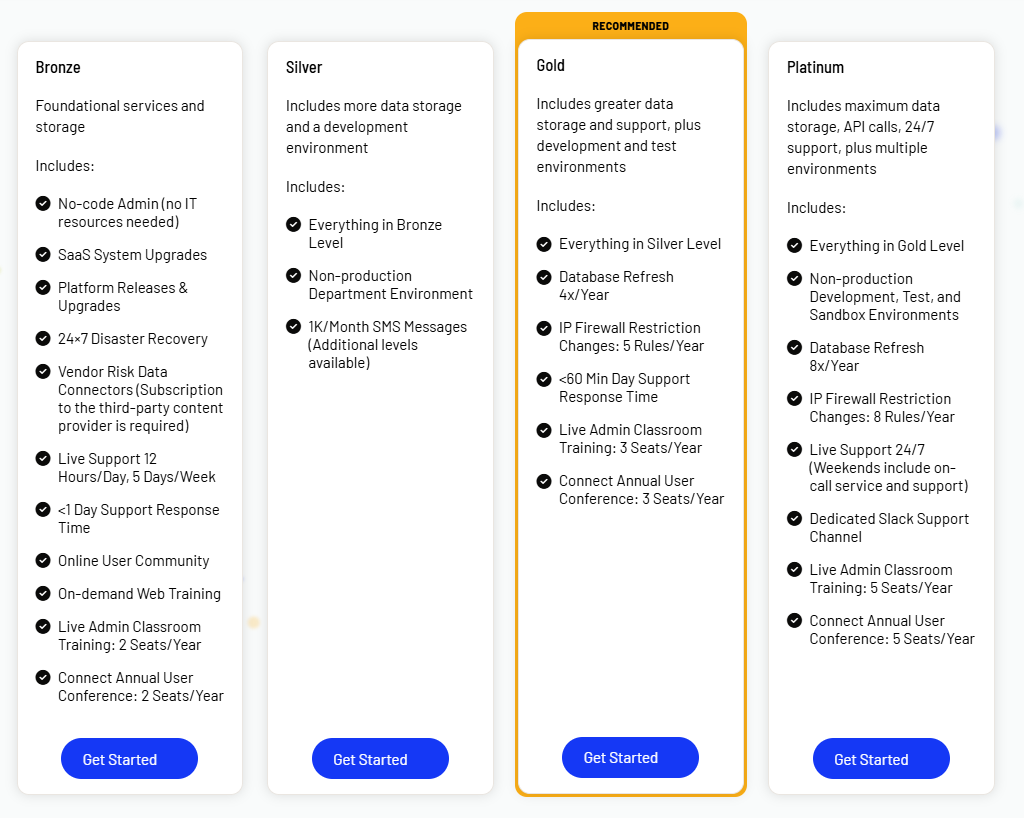
After choosing your pricing model, Onspring offers four paid tiers – Bronze, Silver, Gold, and Platinum – each adding more capacity and features:

  • Bronze plan includes access to the No-code Admin, SaaS System Upgrades, Platform Releases & Upgrades, and more.
  • Silver plan includes more data storage and adds non-production department environment, and 1K/month SMS messages with additional levels available.
  • Gold plan includes greater data storage and support, and adds a database refresh (4x a year), IP firewall restriction changes, <60-min day support response time, and more.
  • Platinum plan includes maximum data storage, API calls, 24/7 support, and adds non-production development, test, and sandbox environments, 8x/year database refreshes, dedicated Slack support channel, and more.

‍

Source of information and screenshot: Onspring.

Does Onspring Have A Free Plan Or A Free Trial?

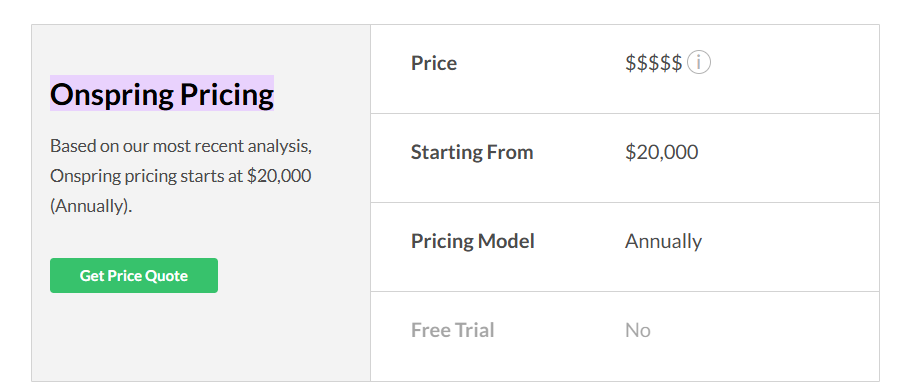
As of September 2025, Onspring does not offer a free trial or a free plan of its enterprise-grade GRC software.

All Onspring plans require contacting sales for a quote.

How Much Does Onspring Really Cost?

Independent sources from insiders report entry-level deployments starting around $20,000/year, while full enterprise installations reach $78,000/year.

Source of information: Vendr and SelectHub.

Any Surprises at Contract Renewal?

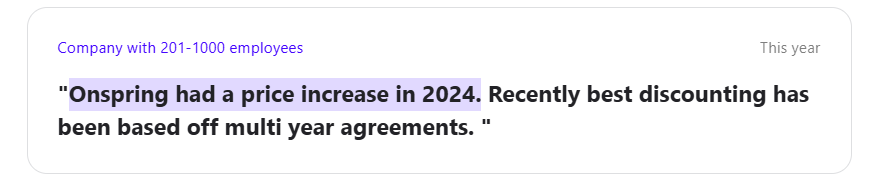
According to an insider on Vendr, Onspring has recently had a price increase in 2024, and the best way for people to secure lower prices has been by signing multi-year agreements.

Source of information: Vendr.

Does Onspring Provide Good Value for Money?

Despite the higher initial cost of the software, users of the platform do argue that it offers good value for money, as its ‘’value for money’’ rating in Capterra is 4.8/5 out of 92 reviews.

Reviewers repeatedly praise the no‑code customizability and intuitive design of the platform. 

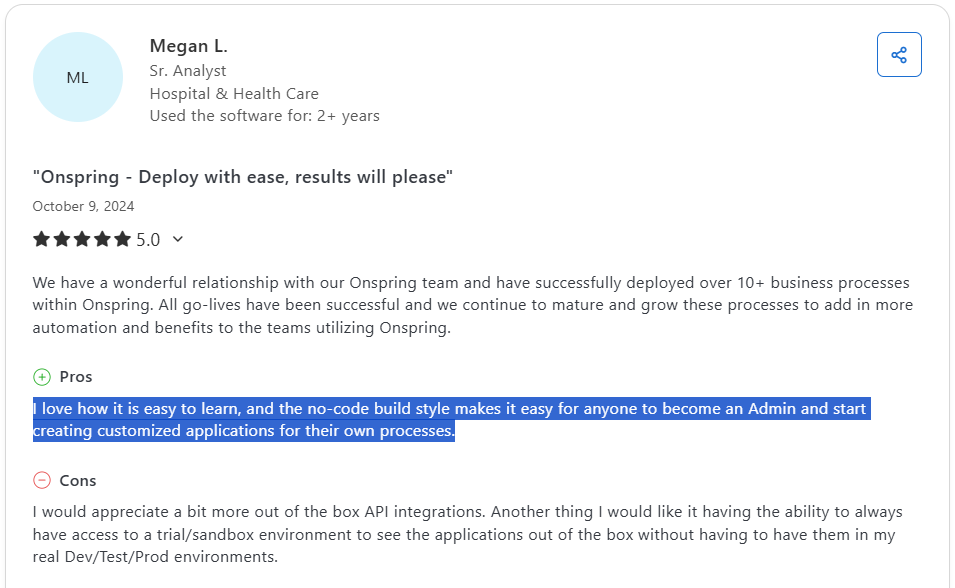
For instance, one Capterra user mentions that the platform is easy to learn and that the no-code build style makes it easy for users to become an Admin and start creating custom applications.

‘’I love how it is easy to learn, and the no-code build style makes it easy for anyone to become an Admin and start creating customized applications for their own processes.’’ – Capterra Review.

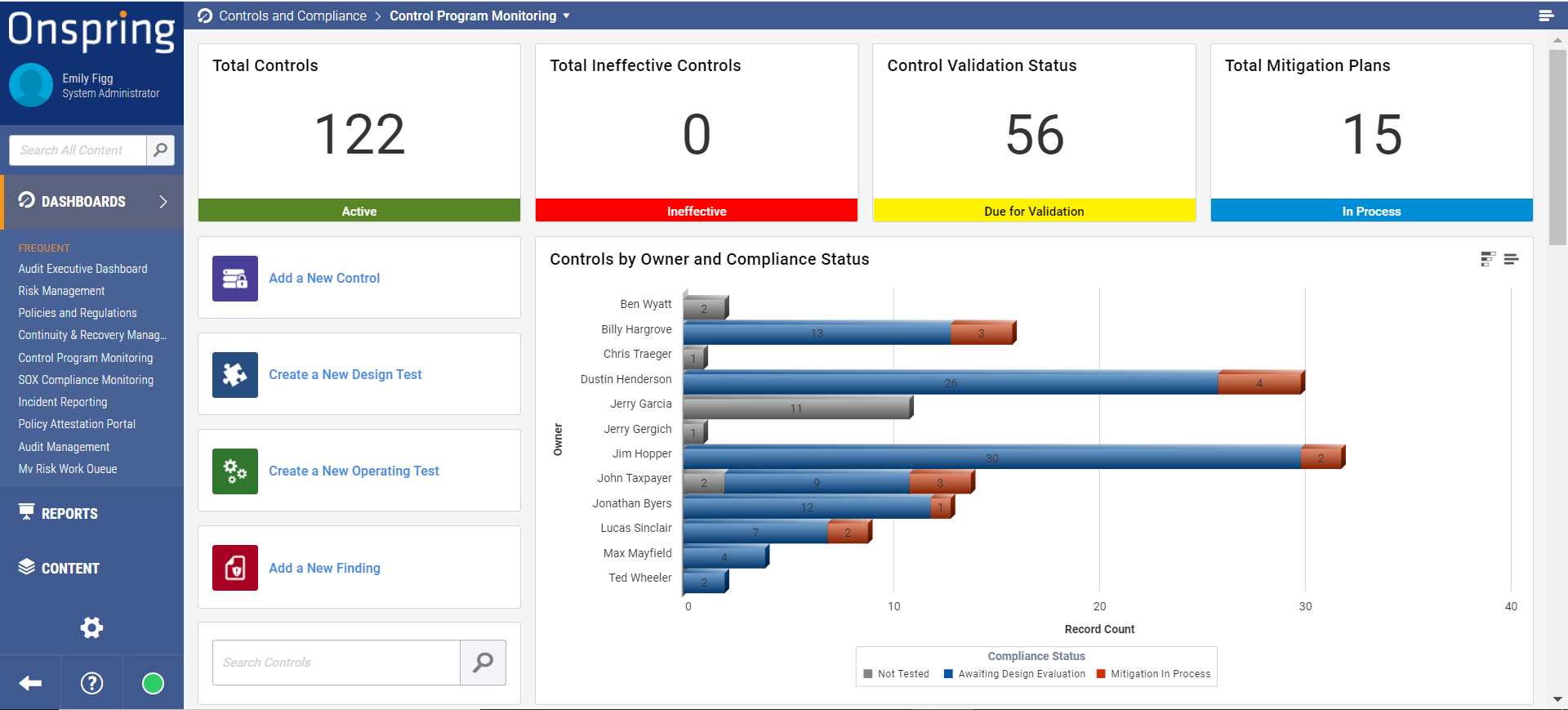
Despite this, there have been some users of the platform who are not satisfied with how outdated the user interface of the platform is.

‘’Some of the UI for dashboard/reports seems outdated.’’ – G2 Review.

Even though its UI has received a recent refresh, some users think that the interface is still not as modern as some of the alternatives on the market.

Control Program Monitoring Dashboard in Onspring GRC Software

Source of image: Capterra.

Apart from this, some users find the platform’s pricing to be expensive, particularly its user license pricing that gives your admins access to the platform’s full functionality.

‘’User licence is a bit expensive.’’ – G2 Review.

Looking For an Onspring Alternative?

SmartSuite offers the best Onspring alternative for GRC in 2025 with our modern, no-code work management solution that simplifies complex regulatory requirements.

Built for Banks and Credit Unions in mind, our GRC software helps you streamline policy creation, approval, and control assessments.

SmartSuite helps compliance teams move faster, manage smarter, and adapt easily, without having to hire expensive consultants or spend hours learning how the platform works.

Let’s go over the features that make SmartSuite the best choice for banks and credit unions looking for an Onspring alternative: 👇

Comprehensive Risk Management Platform

We believe compliance should be simple, automated, and accessible to all financial institutions, regardless of their size.

Our no-code, easy-to-use software empowers compliance managers and CISOs to automate all GRC processes with ease.

Teams can use SmartSuite for:

  • Risk Management: Identify, assess, score, and monitor enterprise risks.
  • Compliance Management: Track regulatory requirements, controls, and evidence.
  • Audit Management: Manage audits, findings, and remediation workflows.
  • Policy Management: Publish, distribute, and track acknowledgement of policies.
  • Third-Party Risk: Evaluate and monitor vendors’ risk and compliance posture.
  • Incident Management: Log, triage, and resolve compliance and risk events.

SmartSuite helps enterprises to achieve and maintain compliance without the expense and complexity of adapting legacy GRC solutions like Onspring to accommodate new compliance requirements.

Here are the features and use cases that you’ll get with SmartSuite:

  • Create reports and dynamic dashboards: Your team can monitor executive views into your company’s overall risk profile with powerful charting and metrics widgets. 
  • Collaborate and respond to risks in real-time: Instantly engage key stakeholders in real-time discussion of potential threats or vulnerabilities.

Our solution will also let you get immediate updates when critical information is available.

  • Streamline policy creation, in real-time approval, and control assessments: You can optimize risk management by building an integrated program on a single platform.
  • Keep risk and compliance data secure: You’ll be able to define your teams and manage access to information across all GRC practice areas.
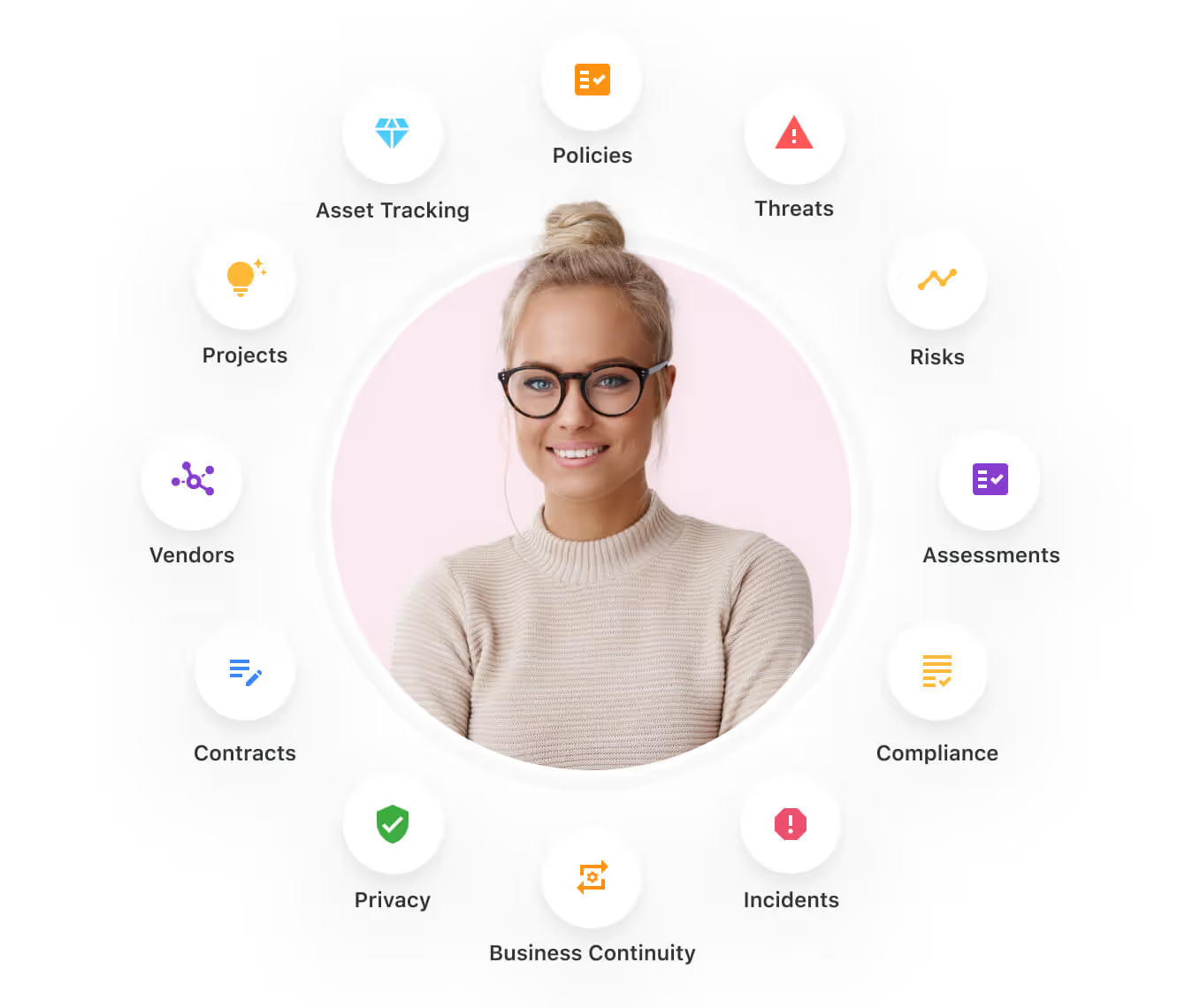
  • Integrate with your existing systems: Our GRC software lets you integrate with existing systems and data to consolidate and centralize your data. 
  • Automate for accuracy and efficiency: You can remove inefficiency and the chance for human error by automating repeatable workflows.

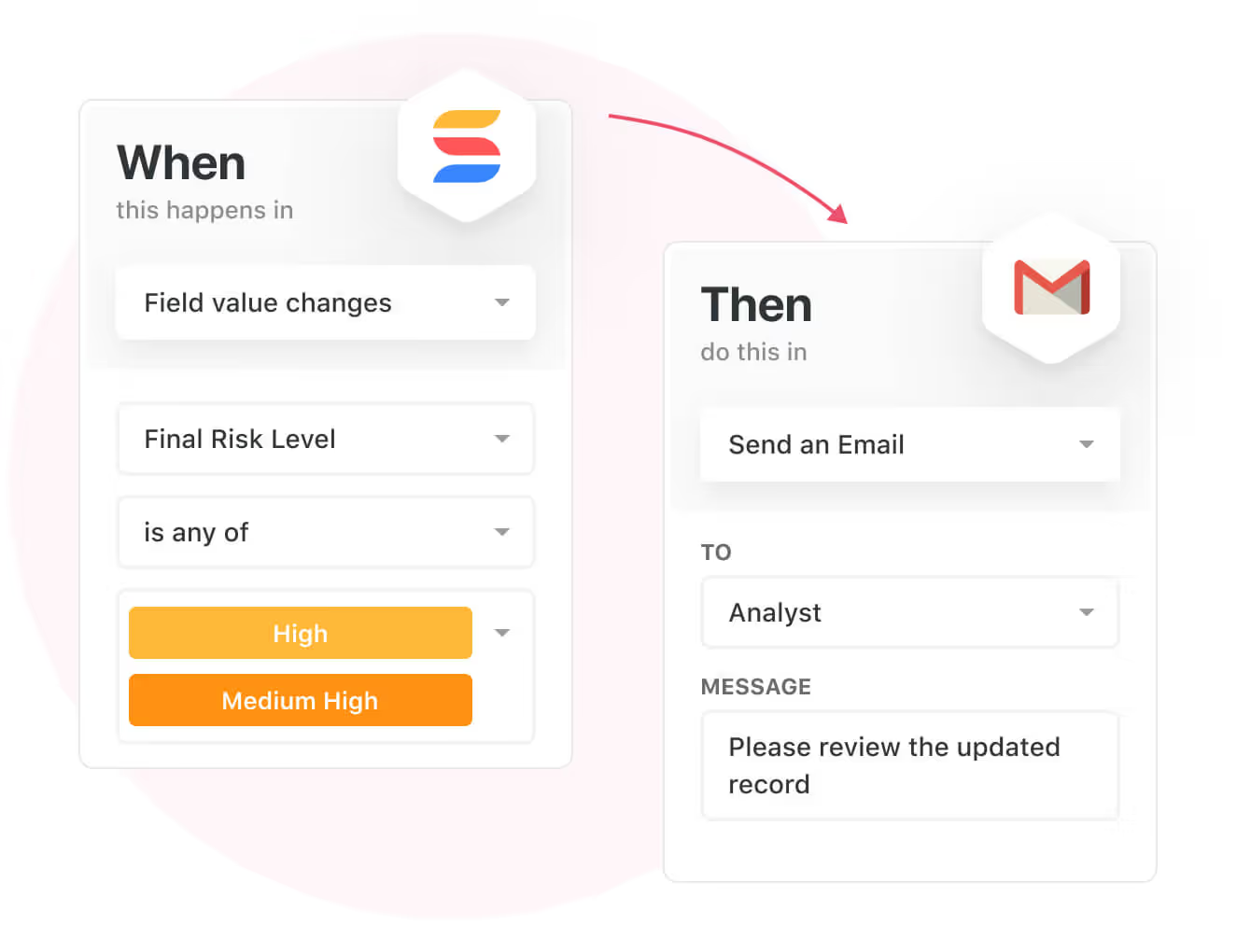
SmartSuite’s no-code automation builder provides organizations with a visual interface that makes it easy to respond to events and take action. That means you can customize your GRC workflows without technical resources.

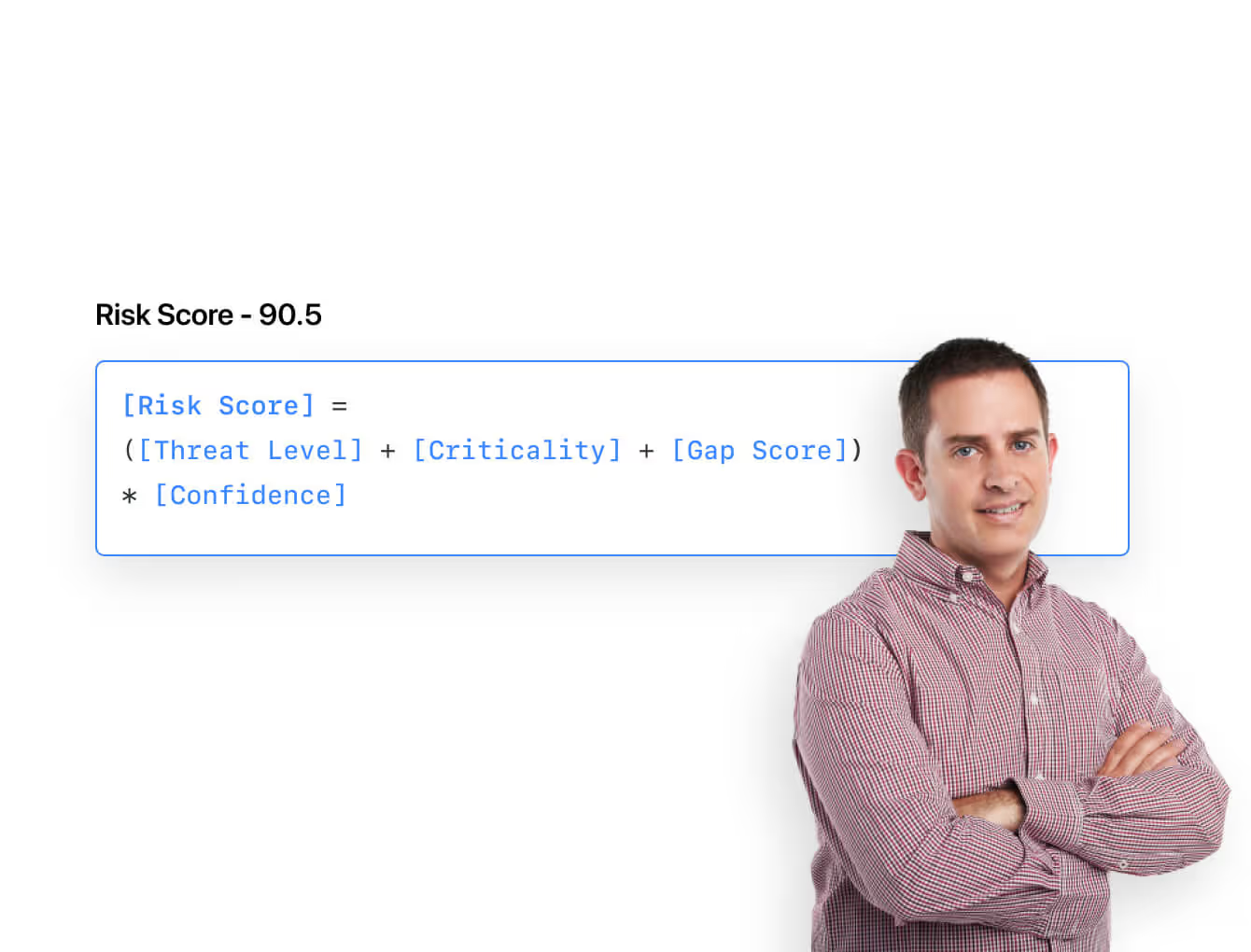
  • Monitor, measure and score: You’ll be able to create your own risk calculations and metrics to evaluate every aspect of organizational risk.

It’s possible to generate risk scores and evaluate key indicators with SmartSuite’s powerful calculation capabilities.

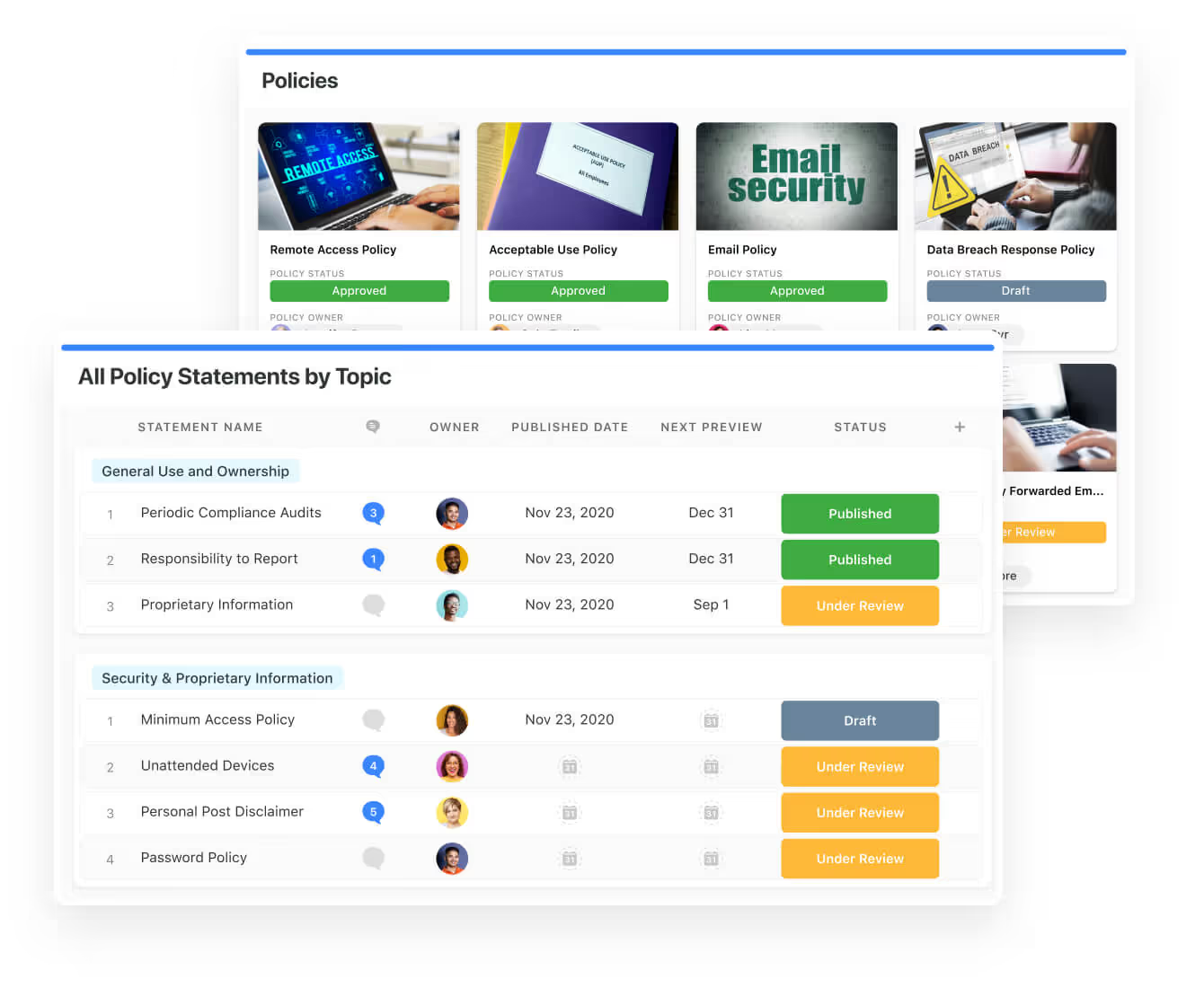
  • Policy management: Your organization will be able to establish a strong foundation with streamlined and flexible policy management. Simplify the entire process, from authoring to review and release.

You can assign ownership, manage revisions, and ensure your policies consistently align with key business initiatives and regulatory requirements.

  • PSTOS Compliance Tracker: Our custom product is designed for regulatory compliance and built on SmartSuite.

This solution focuses on data security as the core of compliance frameworks with services such as compliance readiness, virtual CISO, and IT security implementation.

Learn more about it from our CEO, Jon Darbyshire, who held a webinar on the topic:

[embedded content]

Prioritize & Mitigate Risks With a Centralized Risk Register

SmartSuite lets you create a centralized Risk Register to help you identify potential risks to your organization.

Your team will be able to efficiently assess threats and establish risk mitigation strategies inside SmartSuite.

What’s more, you can ensure that the appropriate controls are in place and measure their effectiveness by evaluating risk indicators and displaying results in SmartSuite’s rollup reports and dashboards.

💡 Pro Tip: You can also use automation to move tasks through defined workflow stages that comply with your policies and procedures.

I know from experience how important threat management is and the need to respond quickly to incidents.

SmartSuite lets you centralize incident response and threat mitigation by linking incidents to assets and organizational data to offer context during your investigations.

Your team can also set up automations with our no-code automation builder to escalate critical events to make sure that your team is aware of active risks to your organization.

Out-of-the-Box GRC Templates

We have prepared GRC templates for different use cases for teams looking to get started right away, instead of spending hours learning how the tool works.

Our general risk management template includes a:

  • Risk register, where you can break down the risks, the risk owner, the annual loss expectancy, risk event category, risk type, volatility, and status.
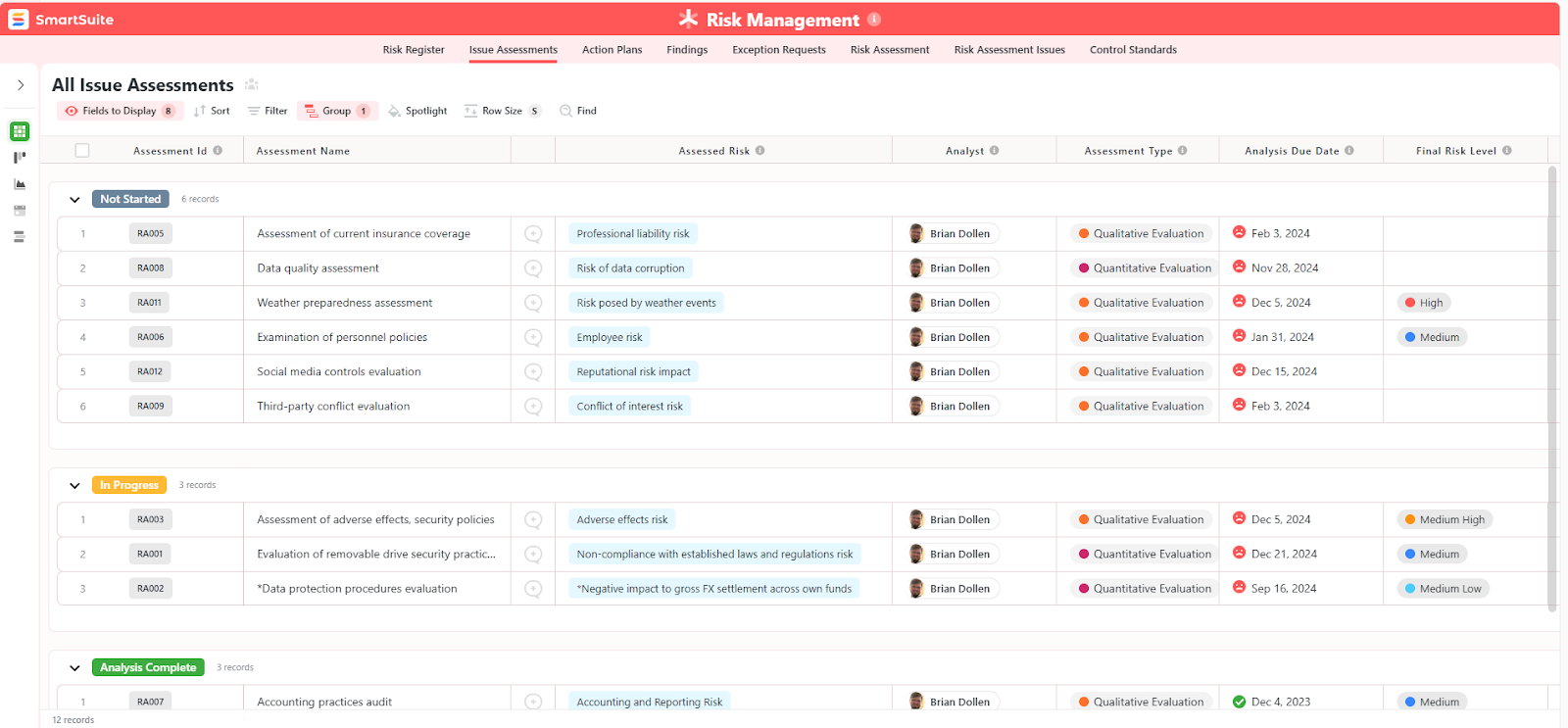
  • Issue assessments, where you’ll be able to see a comprehensive breakdown of each risk.
  • Action plans, where you can describe the actions (best practices) to mitigate the risks.
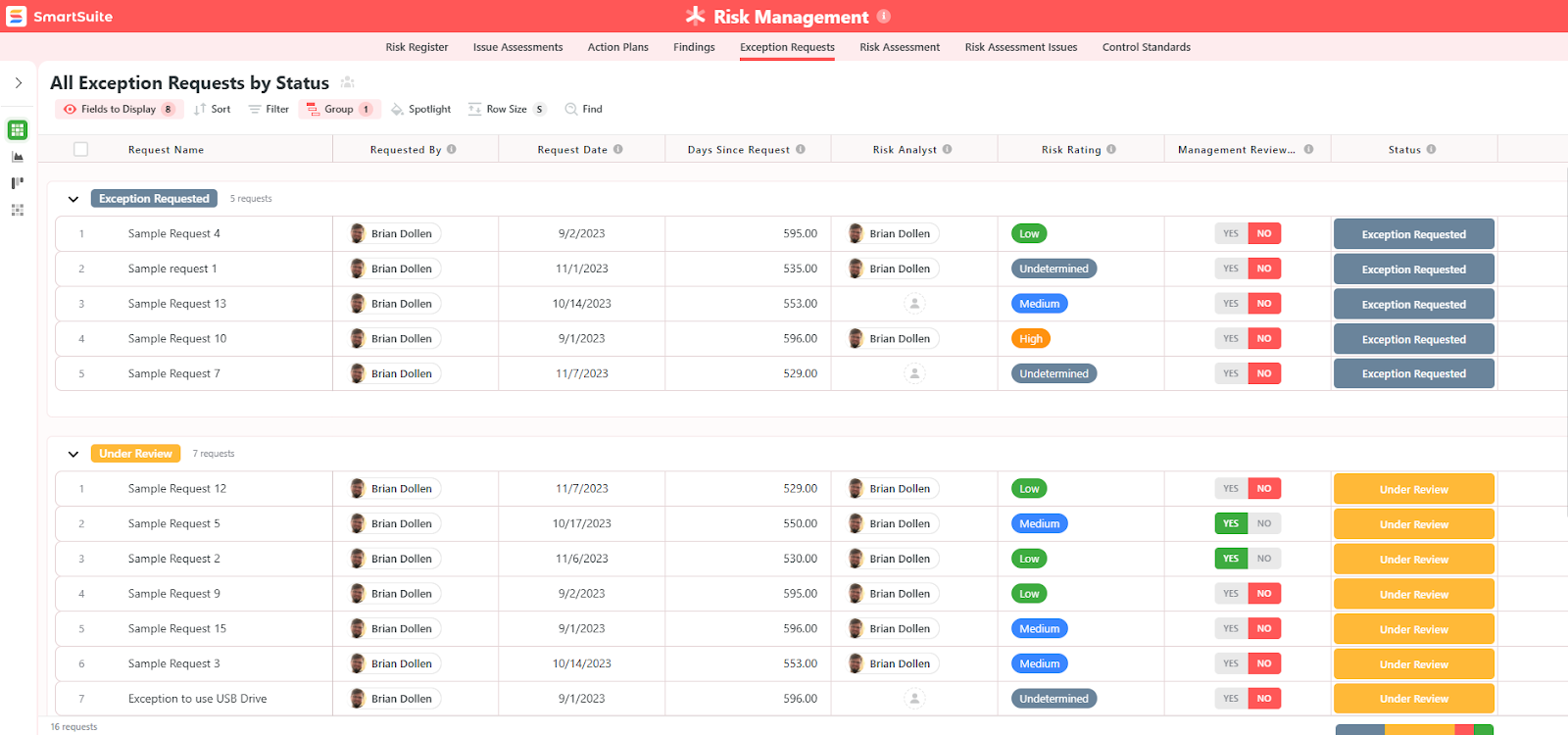
  • A separate tab for control standards, your findings, exception requests, risk assessment by type, and risk assessment issues.

You can customize our risk management template here.

Alternatively, check out and customize our 14 other risk management templates for various use cases, such as contract management, policy management, and incident management.

How is SmartSuite’s Pricing Different From Onspring’s?

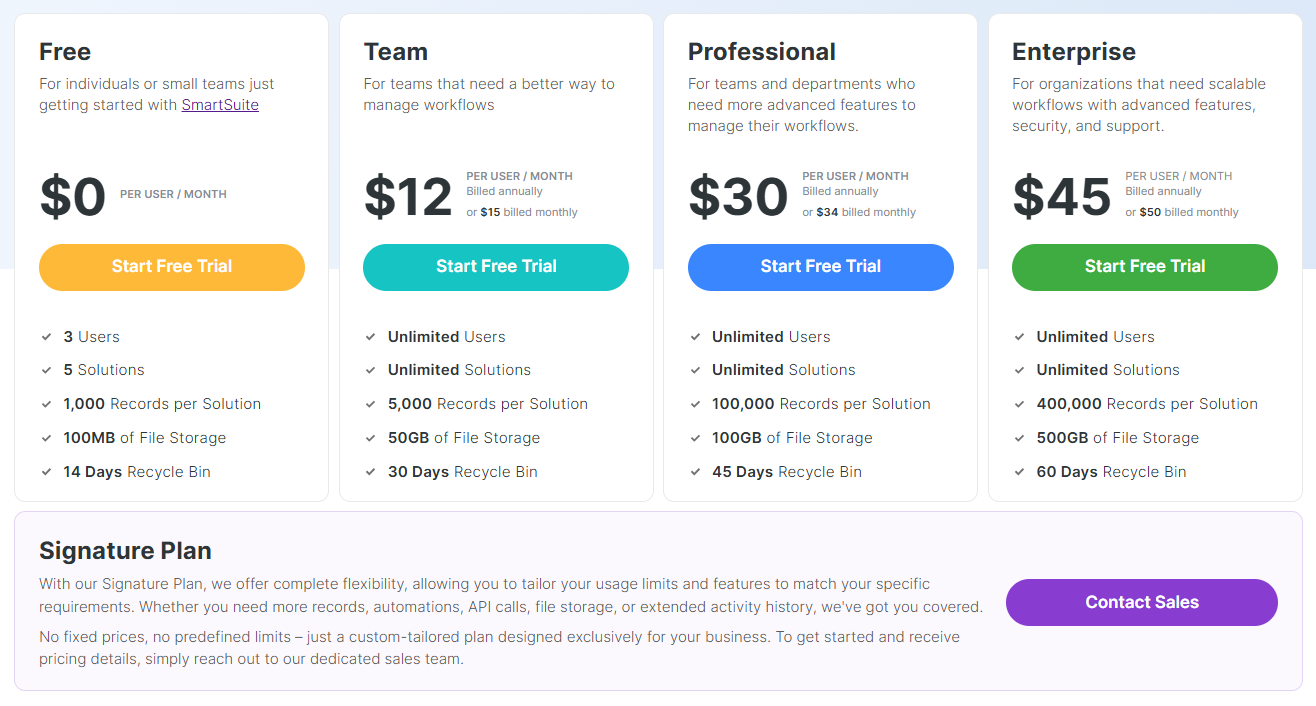
Unlike Onspring, SmartSuite offers a free plan with access to 250+ automation actions, team collaboration, multi-dashboard views, and more.

There are four paid plans with a 14-day free trial (no CC required):

  • Team: Starts at $12/user per month, including Gantt charts, timeline views, 5000 automation runs, and native time tracking.
  • Professional: Starts at $30/user per month and adds two-factor authentication, Gmail & Outlook integrations, and unlimited editors.
  • Enterprise: Starts at $45/user/month and includes access to audit logs, data loss prevention, and 50,000 monthly API calls.
  • Signature: A customized plan tailored to your organization’s needs and team size with no predefined limits.

Next Steps For Compliance Teams: Get Started With SmartSuite & Our Templates For Free

If you’re looking to build governance, risk, and compliance workstreams and effectively prioritize and mitigate risks, you can give SmartSuite a chance with our free plan and ready-to-use GRC templates.

SmartSuite’s platform offers just the right customization, native collaboration capabilities and a library of 200+ project management templates to help compliance teams create and maintain a project management workflow.

Here’s what’s in it for your team when you try SmartSuite:

  • Access to a generous free plan with features including multi-board views (Kanban, Chart, Map, Timeline, Card, and Calendar), 100 automations/month, and 40+ field types, including formula and linked record fields.
  • No-code automation builder to set up to 500,000 trigger/action workflows.
  • Built-in productivity tools, including time tracking, status tracking, and checklists.
  • Team collaboration and planning tools such as whiteboards and SmartSuite docs.
  • Resource management across projects and teams.
  • 40+ field types, including the option to add your custom fields.

Sign up for a free plan to test the water or get a 14-day free trial to explore all its amazing features.

Or, if you’d like to talk to our experts, schedule a demo.

⚠️ Disclaimer: This article was last updated on 09/09/2025 and if there’s any misinterpretation of the information, please contact us and we will fact check it.

Read More

Form follows function: building resilient form submissions at scale

Software Stack Editor · September 9, 2025 ·

Over the last few months, we have been actively investing in our company’s resiliency. This blog post covers how one of those investments helped us with a recent incident where database operations were failing.

Form Submissions

Webflow powers both our customers and their customers. For many businesses, sales pipelines depend on inbound form submissions, so availability and durability of this feature are critical.

A typical form submission comes into the Webflow API, passes through spam checks, and is persisted to the customer’s site. Customers can view and export these submissions in their Webflow dashboard. Oftentimes customers will have webhooks set up with these forms to their own internal systems, allowing them to take custom actions on new form submissions.

Design Goals

We set out to ensure that, even during downstream failures, form submissions would be:

  1. Durable: never lost, even if persisting to the database failed
  2. Non-blocking: recovery mechanisms must not slow the critical request path
  3. Idempotent: safe to replay without creating duplicates
  4. Operable: easy to target a single customer or run system-wide

Phase 1 – Write-Ahead Backups

The first question we needed to ask was, where should backups live? We wanted enough context to replay correctly, without adding downstream dependencies that could fail before a backup was recorded. 

We opted to put this as high up in the API layer as possible, after basic middleware validation, but before any database calls were made. By prioritizing backup availability, we opted to store backups for all submissions, even ones that would be later filtered as spam, as well as ones that would be successfully ingested.

We decided to use Amazon S3 to store these backups. Like any distributed system, we needed to consider what would happen if the backup request itself failed, and if it should be a blocking network call. The priority was serving the form submission in the critical path; protecting live traffic takes precedence over backup success.

Phase 2 – Replay

With backups persisted on disk, we then set out to build a system where we could re-ingest form submissions in the event of a downstream outage that were otherwise not able to be successfully saved to the database. We called this system replay. There were two modes this operation needed to be run in: per customer replay and global replay.

Mode 1 – Per Site Replay

This mode of replay would be run in the event of a single site or a handful of sites that would individually need to be replayed. This would be a faster, targeted approach to replaying a forms submission outage experienced by a single customer.

Mode 2 – Global Replay

This operation would be the heavier-handed mode of running this operation, and would involve traversing backups for all customers, and replaying them across the board. This operation would be slower, but would be used in a systemic outage felt by a large portion of customers.

Submission Hashes

Outages rarely fail 100% of requests. A typical pattern looks like:

✅✅⛔✅⛔⛔✅⛔⛔⛔⛔✅

Such that ✅ represents a successfully processed submission, and ⛔ represents one that failed before being saved into the database. We wanted to make sure that if we replayed from start to finish, we did not duplicate the ✅ form submissions that were already ingested. 

To do this, we decided to implement a concept called submission hashes. Each form submission is represented as a unique, stable hash, where the SHA-256 hash represents everything about the form submission that makes it unique — the timestamp the submission came into our system, the customer details, the form submission body, request metadata, and more. These hashes are serialized in the critical path for every form submission, regardless of replay context. 

We also stored and added a database index on the field, so that we could efficiently query for form submissions by submission hash to determine if the form submission was already successfully ingested.

What this means is that by deduping on submission hashes, we were able to build an idempotent replay process so that we could replay submissions across a broad range, and ensure the only delta of replayed submissions were only those that were not successfully ingested the first time around. It also meant that when choosing the time window on which to replay, we could safely choose timestamps well before the outage and well after the outage, to ensure we cover the entire range, without worrying about scanning over records we’ve already ingested.

Chaos Testing

In addition to unit and integration testing, we needed to simulate a real outage to know that this tool worked. To accomplish this, we ran a test on our staging environment in which we deliberately broke form submissions. We did so by throwing an uncaught exception in the form submission ingestion path, simulating a standard outage.

Then, we attempted to submit several form submissions which, as we expected, did not process correctly. Then we deployed a build that fixed the environment (simulating a revert of a breaking change). After that we had our replay scenario: form submissions that were missing in the customer database but present in our backups.

From there, we ran the replay job. First, outside the outage window to confirm that nothing happened. Then, we ran the job squarely in the outage window to prove that we were able to replay missing submissions. Then we ran a replay job spanning before and after the outage period, proving that only missing submissions were replayed. Lastly, we ran the replay job multiple times, proving that the operation was idempotent and that submission hashes were being deduplicated on submission hash. 

After this, we had confidence that this was a tool we could use in an incident.

Spam Considerations

Forms attract spam. We use multiple defenses at the network and application layers. One app-layer check depends on a downstream token with a 1-hour TTL (time to live); during longer incidents that signal can’t be trusted. Replay falls back to the other layers, but we chose “more data over less” in recovery, meaning some additional spam may reach customers in certain replay scenarios.

Incident Management

During our recent incident we found ourselves in a situation where this resiliency work was tested. Database writes were failing, and we needed to assess if there was replay work to be done. 

To evaluate this, we looked at our metrics. Generally speaking, there should be one backup job per stored form submission; the expected ratio during normal traffic is loosely 1:1. In the event of a service disruption, however, metrics would show a gap between backup volume and persisted submission volume, indicating that there was replay work to be done.

We had a runbook, monitors, and the muscle memory of having run this before. So we went over the state of the world and came up with a plan for executing a global replay operation.

The scale of the issue and need for replay operation was significant, with several hours of backups to go through. Thankfully, the replay operation went off without a hitch, chugging through millions of backups and routing the form submissions correctly across our customers.

What’s Next

There’s more to do here. 

  1. Move backups even earlier in the stack to reduce pre-backup failure windows
  2. Smarter spam filtering during replay and in the critical path
  3. Faster, cheaper replay: streaming pipelines, backpressure, and more granular partitioning to reduce compute, while retaining existing idempotency and resilience

Conclusion

Losing customer form data is catastrophic. Resiliency in this area is critical to our customers, so having systems in place to perform data recovery is essential. Just as critical is having a runbook and muscle memory for running these systems safely. We take service disruptions very seriously. When they do occur, our systems have proven resilient – successfully recovering nearly a million backed up form submissions, ensuring they remained safe and were ultimately delivered to the correct recipients.

Does building resilient distributed systems sound interesting to you? If so, come work with us!

  • « Go to Previous Page
  • Page 1
  • Page 2
  • Page 3
  • Page 4
  • Interim pages omitted …
  • Page 51
  • Go to Next Page »

Get your Software Stack together. softwarestack.tech

Software Stack

© 2024–2025 - Software Stack is a trading name of SouthwestCIO Limited ac ompany registered in England & Wales 11319049

  • Knowledgebase
  • Home
  • About Us
  • Contact Us