
• Skip to primary navigation
  • Skip to main content
software stack logo

Software Stack

Get your Software Stack together

  • Knowledgebase
    • All Categories
    • Accounting Software
    • Automation & Workflow Software
    • Customer Relationship Management
    • E-Commerce Shopfronts & Payments
    • Marketing Automation
    • Online Courses & Membership
    • Project Management
    • Surveys & Forms
    • Web Hosting
  • Home
  • About Us
  • Contact Us
  • Show Search
Hide Search

Shopping Platforms & Marketplaces

Global Brand Management: How To Manage Global Brands (2025)

Software Stack Editor · September 30, 2025 ·

image

Selling products internationally allows you to reach new audiences, add revenue streams, and set yourself up for long-term growth. The challenge, of course, lies in the day-to-day intricacies of managing your brand in diverse markets around the world.

Learn about the common challenges of a global branding strategy and how to develop a plan that sets your team up for success. Plus, get expert tips from Kristen Pumphrey, the co-owner, creative director, and CEO who took P.F. Candle Co. global.

What is global brand management?

Global brand management is the process of managing a company’s brand in multiple countries. Also referred to as international brand management, its goal is to establish a global branding strategy that maintains a consistent brand identity across markets worldwide.

A solid global branding strategy also maximizes profit potential in each market with a plan for increasing brand awareness, decreasing overall marketing expenses, and reducing the cost of market entry.

Sell internationally in minutes with Managed Markets

Managed Markets helps you sell in 150+ countries and scale your business internationally—all from a single Shopify store. Make global shipping hassle-free, with tools to manage store localization, collect duties upfront, simplify customs documentation, and get fast transit times.

Discover Managed Markets

Cultural considerations in global brand management

International brand management involves deciding how you want to represent your brand in foreign markets and making sure your business can deliver on its brand promise worldwide. For some businesses, it’s part of a coordinated international expansion effort. For others—including P.F. Candle Co.—the demand comes first. The company’s international presence grew organically out of the traction they experienced on social media and tourist foot traffic to their San Francisco store. But they chose to work with retail partners and distributors to grow their global reach in Japan and China.

Throughout the process, Kristen learned that culture affects how your brand is perceived in a market. “Cultural difference may be one of the hardest things to grasp and can be a business culture shock,” says Kristen. “What works for marketing in the US is unlikely to work in other countries, and business practices may be different.”

There are two main approaches to this challenge: localization and standardization. Localization adapts brand materials for local markets, and standardization emphasizes unified branding and messaging worldwide. Although they’re strategic opposites, they’re not mutually exclusive; most successful international brands use both strategies.

As you choose your approach, consider language and visual style, and how much you may want—or need—to adjust these to resonate with customers in international markets:

Language 

Effective translations preserve meaning, voice, and tone while accounting for regional idiom and usage differences. You’ll need to bear in mind that your product names and marketing messaging might mean different things in different cultural contexts, so lean on local expertise to advise.

You might also decide to translate your packaging materials or create a localized version of your brand website, even if you’re selling primarily or solely through a distributor.

You can use a translation service or rely on local partners for help with this. Kristen uses local distributors, who have experience selling to local audiences and are familiar with the P.F. Candle brand. 

Visual style

Visual styles or color choices can also mean different things in different cultural contexts. This is another area where a distributor who understands the market can be helpful, but you’ll need to provide them with detailed brand guidelines and a system to check localized assets are correct. 

“If you work with a distributor, the biggest challenge is how they are representing you,” says Kristen. “You need to provide a lot of assets—photos, design guides—and double-check the work to ensure it’s a proper representation.”

Visit the Shopify Partners Marketplace

Find experienced commerce professionals who will help you grow your business. Browse the different services Shopify partners offer, post a job, and hire a professional to work with.

Visit now

How to build a global brand management plan

  1. Know who you are
  2. Conduct local market research
  3. Audit your brand presence
  4. Establish market groups
  5. Vet your strategies
  6. Define your global brand identity

A global brand management plan protects your brand image, maximizes the benefits of selling in foreign markets, and can even help you vet new markets for entry. Here’s how to create one for your ecommerce brand:

1. Know who you are

Your brand isn’t its name, logo, color palette, or even its products or services. All of these things can vary between markets without damaging your credibility or diluting your brand image. What can’t change are your mission, vision, and values—and that’s true whether you sell around the world or just on your own block.

Start by revisiting your:

  • Mission statement. Your mission statement tells new customers what to expect from your brand. It also provides your employees with direction, inspiration, and focus. What is your business setting out to achieve and why? 

  • Vision statement. Your vision statement articulates where you aspire to be once you achieve your mission. What’s the long-term goal of your business beyond making a profit? 

  • Brand values. Your brand values guide how your company operates. How do you source your products, deliver on promises to customers, or treat your employees? Brand values inform how your business operates and fulfills its mission.

Update these pillars as needed so that they accurately represent what you stand for and where you’re headed. These will guide your approach to international brand management. 

2. Conduct local market research

Dive into the research on any new markets under consideration and map out key data points about the target audience that will inform your branding decisions for each. You can start with familiar market research strategies like reading trade journals or interviewing customers. Kristen recommends leaning on local partners for help. “You can read articles or search the internet, but this is where an agent or distributor can really come in handy,” she says.

Assess if your brand ethos and creative will resonate with customers in those markets, or if you may need to make adjustments. You can also frame up your company’s philosophical position on localization as part of this step. P.F. Candle Co., for example, prioritizes standardization wherever possible.

“We are lucky that many of the countries that export us are really interested in the California lifestyle, so they buy into the content and brand identity we’ve already created,” says Kristen.

3. Audit your brand presence

If you’re already selling internationally, assess your current brand presence by performing a multimarket brand audit, starting with your local market and repeating the process in every market in which you operate. Here’s a list of questions to ask yourself as you go:

  • Is there brand consistency within this market?

  • Are the marketing strategies and brand assets my business uses in this market consistent with my larger brand image? 

  • Has my team developed a localization strategy for this market? If so, do current practices align with the written strategy? 

  • Do localized practices correspond with my larger brand strategy? Which elements differ? 

  • Is this the best approach based on local market research findings? If not, do local research findings or performance data suggest that my company might benefit from a more localized approach to branding and marketing strategies? 

Take note of any inconsistencies or areas for improvement. 

4. Establish market groups

International brands increase efficiency by grouping markets with similar needs. Here’s how to develop market groups:

  • Define local strategies. Use your research to define the bare minimum localization efforts necessary to compete in each of your target markets. You might decide that you only need to translate your website, for example, or that you need to localize product and service descriptions and pricing structures.

  • Group target markets. Create target market groups with overlapping characteristics such as region, development stage, or any other factor relevant to strategic branding and marketing practices. A company that sells outdoor gear, for example, might group countries by language, climate, or terrain. 

  • Outline group strategies. For each group, define a strategy that meets the bare-minimum localization needs of the relevant markets. If this is difficult, you may need to restructure your groups or even reconsider the markets you’ve chosen.

Get better ad performance with Shopify Audiences

Shopify Audiences helps you find relevant buyers and lower advertising costs with custom audience lists—powered by Shopify’s unique insights from commerce data.

Discover Shopify Audiences

5. Vet your strategies

Compare group-level strategies to your available branding and marketing resources to determine if your team has the bandwidth to serve the markets you’re considering. If you’ve taken on too much, scale back by eliminating markets or groups.

You can also use market groups to evaluate efficiency. If a current or potential market has distinctive localization needs, decide whether to focus elsewhere or proceed with a one-country group based on the market’s potential. 

P.F. Candle, for example, keeps its social streamlined with one main account per platform. “We try to run one main social media account rather than having diverging accounts,” says Kristen. “I think it’s important for content to be pretty streamlined so you can also see the customer feedback in one place.”

It makes an exception, however, for Japan. “The distributor we’ve worked with for over a decade uses our existing content and his own to represent us in the language of the area,” Kristen says. In general, businesses only create one-market groups when a market’s anticipated revenue offsets the cost of a market-specific strategy.

6. Define your global brand identity

Once you’ve locked in your list of markets and market groups, identify the messages, practices, and assets that are or can be consistent between group strategies and review the results. These are all potential elements of your global brand.

If you’re not happy with the results, you can return to previous steps and make changes. If you want a consistent visual style across markets, for example, you might go back to step four; identify the groups or markets driving the inconsistency, and either standardize your local approach, remove the outlier markets, or rethink the importance of consistent global visuals. Remember that mission, vision, and values are non-negotiable. If your global brand contradicts these, opt for standardization or market exclusion.

When you’re satisfied, draw from your list of consistent elements to create global brand guidelines for your company. The specificity of these guidelines will depend on your approach to localization: If you’re planning for highly localized strategies, your global brand guidelines might include only mission, vision, values, and primary color palette. If your brand is more standardized, your global brand identity might define everything except for the language in which you communicate with customers.

Global brand management FAQ

What is a global brand manager?

A global brand manager oversees a brand’s worldwide identity, ensuring consistency with global brand standards and recommending solutions to international branding and marketing challenges.

What are the advantages of global branding?

A few of the potential advantages of global branding include increased brand awareness, sales growth, increased efficiency, and reduced costs.

What are the main challenges of global brand management?

The main challenges of global brand management include navigating different cultures, economic conditions, and business regulations; coordinating your global branding and marketing teams; balancing consistency with innovation; and the nuances of international logistics, including maintaining brand assets and resources and coordinating with international distributors.
What Is Order History? A Guide for Businesses and Customers in 2025

Software Stack Editor · September 30, 2025 ·

Order history is the complete record of a customer’s past purchases—what they bought, when, and how they paid. For customers, it offers transparency, easier tracking, and faster reorders. But for retailers, it’s like a cheat sheet that reveals buying patterns and informs smarter decisions.

Yet, many retailers overlook this tool in favor of chasing shiny new sales tactics. Research shows retailers who make data-driven decisions see twice the growth and four times the profitability. By analyzing order history, you’re not guessing—you’re doubling down on what’s already working.

Ahead, learn how to evaluate your order history data and turn it into actionable insights for better decision-making.

Speed up fulfillment times with Shopify

Shopify comes with built-in tools to help you track, prioritize, and fulfill orders from one place, so you can get orders out the door sooner and exceed customer expectations.

Explore order management on Shopify

What is order history? 

Your order history is a list of all the orders you’ve received from customers in the past. It includes the specific items they purchased, their cost, when they bought the products, and how the orders were fulfilled.

What information is included in an order history?

Each ecommerce platform records slightly different information. For example, Shopify records every purchase and creates a timeline with a mix of transactional, fulfillment, and customer data: 

  • Customer profile: Name, email, phone number, billing and shipping addresses, and market consent flags 
  • Product line items: SKU, variant, quantity, item-level discounts, and taxability
  • Financial snapshot: Subtotal, shipping, taxes, promotions, payment gateway, and net total
  • Fulfillment trail: Warehouse or store location, carrier, tracking links, and time-stamped status changes 

This order information is logged automatically in the admin and can be exported via CSV. Having a full view of each order can be useful for faster reconciliation, customer support, or safeguarding data during a store migration. 

Understanding order status

Order status gives customers and retailers a clear view of where a purchase currently exists in the supply chain. It helps track order progress and quickly identifies orders that need assistance. 

Shopify organizes order history into four status categories: Order, Payment, Fulfillment, and Return. The groups appear together on the Orders page and can be filtered in combination to identify priority tasks. 

For example, you might filter for “open + paid + unfulfilled” to display orders that are ready to pick and pack, or “open + return requested” to fast-track returns. 

Here are the statuses you’ll find in your Shopify admin:

Order status: Tracks if an order is open, completed, or canceled

  • Open: Order placed or created; still needs payment capture, fulfillment, or returns work.
  • Archived: All work finished and the record is stored for reference.
  • Canceled: Order stopped. If not fully refunded, further action may be required.

Payment status: Shows if payment is pending, captured, or refunded

  • Pending: Payment provider is processing; funds not guaranteed yet.
  • Authorized: Card validated. Capture funds before the authorization period ends.
  • Due / Expired / Unpaid: Capture deadline passed or terms overdue, collect or cancel.
  • Paid: Funds captured (auto or manual). Ready for fulfillment.
  • Partially paid / Partially refunded / Refunded / Voided: Money captured or returned in part or full, update inventory and records as needed.

Fulfillment status: Indicates whether items are packed and shipped

  • Unfulfilled: Items still waiting to be picked and packed.
  • Partially fulfilled: Some items shipped, others pending.
  • Fulfilled: All items handed to the carrier.
  • Scheduled: Prepaid subscription order awaiting its future ship date.
  • On hold: Manual or upsell-related hold; inventory reserved but not yet shippable.

Return status: Follows the progress of customer returns 

  • Return requested: Customer asked to send items back; approve or decline.
  • Return in progress: Goods en route. Restock or refund upon receipt.
  • Returned: Process complete, no further action.
  • Inspection complete: Items checked; decide on refund based on results.

These statuses not only help you manage workflows but can also keep customers informed and confident in their purchase.

Why is order history important for customers?

Customers want transparency when it comes to past and current orders. A 2024 logistics survey found that 90% of customers expect to track every delivery event, and 80% want to receive delivery status updates. 

With order history, customers can effortlessly track shipments, reduce “where is my order” anxiety, and reorder past favorites. Logged-in shoppers on a Shopify storefront can also see personalized product picks or quick reorder buttons based on their purchase history. 

It also lets customers simplify returns without hunting through email receipts. When a product doesn’t meet their expectations, most brands let them initiate returns with just one click. 

Overall, providing detailed order history builds trust. It shows customers you care about a positive customer experience even beyond the transaction, which helps strengthen long-term loyalty. It also lightens the load on customer service teams, since shoppers can answer many of their own questions directly through their order history.

How to view and analyze order history in Shopify

Using unified data from Shopify POS

A point-of-sale (POS) system records every in-store transaction. Unified platforms like Shopify POS take this one step further by bringing together orders from every sales channel. Whether you’ve sold a product in your retail store, through a marketplace, or via your online store, order data feeds back to one centralized management system. 

To find this order history, head to the Orders tab in your Shopify dashboard. From there, filter or browse order history by individual customer, SKU, or date range to spot trends or answer specific questions.

Shopify also lets you tag and add notes to open orders, view an order’s timeline, follow up with customers, and more easily and effectively manage your orders.

Analyzing order history for insights

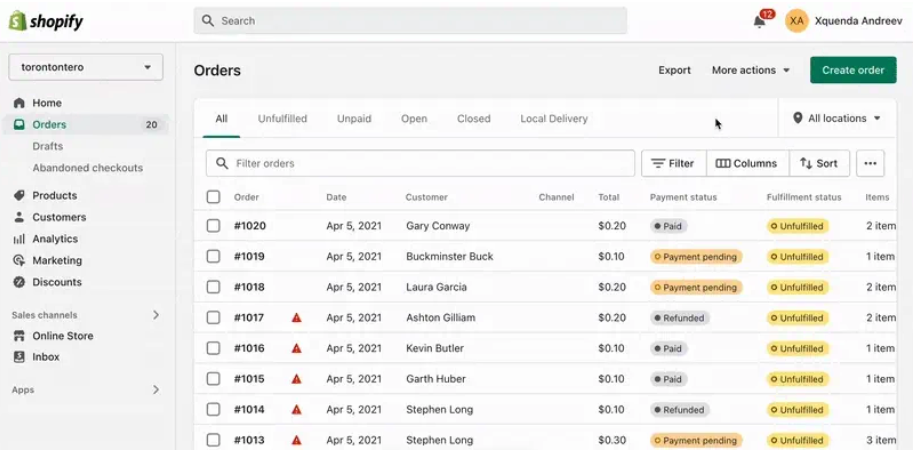
Order tab in the Shopify admin showing three customer orders.
View your order history in the Order tab inside Shopify.

Dates

Analyze order history by month or year to identify peak seasons and slow periods. For example, if beachwear sales spike in May and June, you can stock up earlier in the year and launch marketing campaigns in early spring. 

If October sees minimal activity, plan clearance sales for August. You could also introduce complementary products (like resort wear) or focus on preseason promotions to maintain cash flow during slower seasons. 

Products

Monitor your order history to identify bestsellers, underperforming items, and common purchase combinations. These insights help you offer the right products to the right people. They can also inform how you organize your store (or your website), so that products frequently purchased together are displayed together. 

For example, your coffee shop’s sales data might reveal that medium roast consistently outsells other varieties while the dark roast struggles. Based on this insight, you could adjust your inventory to stock more and strategically place complementary items (like coffee filters and grinders) nearby to boost overall sales.

Customers

Your customers’ shopping habits paint a picture of who they are and what motivates them to buy. Analyze their purchase patterns to identify buying preferences, peak shopping times, and repeat purchase rates. This order data can shape loyalty programs, promotional timing, and fuel targeted marketing campaigns to maximize customer retention and lifetime value.

Clienteling and unified commerce insights

Shopify POS connects your inventory, sales, and customer data across every channel. Its unified commerce system centralizes this data—including order information from accelerated checkouts like Shop Pay. This integration provides valuable insights into how customers prefer to pay and complete their purchases, whether through traditional methods or convenient options like Shop Pay Installments.

You can quickly pull up key information at checkout, like customer purchase history and preferences. Then, clienteling tools integrated with Shopify customer profiles let you offer customized recommendations and personalized experiences, while Shop Pay’s flexibility can help increase average order value (AOV) and conversion rates.

💡Take advantage: Research from a leading independent consulting firm found that retailers using Shopify POS see sales grow by 8.9% on average.

How to boost sales using order history

You can look at the order history for your store and use that data for marketing purposes, too. Here are some ideas you can try once you use your POS to understand sales trends.

1. Upsell and make specific recommendations

Use customers’ order history data to make informed product recommendations grounded in what they’ve already bought. 

Let’s say you filter order history by a specific product: in this case, maybe it’s a white bridesmaid dress. Identify the customers who bought the dress, then send them a follow-up email featuring coordinating shoes or accessories. You can also offer a targeted incentive for the related item to lift conversion.

Product recommendation apps like ReConvert and Selleasy make it easy to show your customers the perfect product pairings right when they’re most excited about their purchase. 

These AI-powered tools integrate with your Shopify customer data and can suggest relevant made-to-match items that will turn a customer’s purchase into something they’ll love.

2. Create personalized marketing messages

Order history makes personalization easier, one customer at a time. Instead of sending generic emails to your entire list, you can tailor your marketing messages based on purchases. 

Again, it’s all about trends: review a repeat customer’s order details to know when they make purchases, what they buy, and how often they shop with you.

Use Shopify’s dynamic segmentation tools to group customers by shared behaviors, then send campaigns that are highly relevant to their interests. This kind of attention to detail leaves them feeling more satisfied and highly valued, encourages brand loyalty, and increases customer lifetime value (CLV).

For example:

  • Send timely replenishment reminders based on typical buying cycles—with a small gift or coupon to encourage a bigger sale in the future.
  • Offer exclusive deals that only “top customers” receive to reward loyalty.
  • Set up automated welcome campaigns for new customers with tailored product suggestions based on their first purchase.
  • Create win-back campaigns with time-limited discounts for lapsed customers.
  • Align seasonal promotions with geographic data and past purchase patterns for higher engagement.
  • Create a streamlined checkout experience for repeat customers with Shop Pay, which saves their preferences, shipping details, and payment information.
  • Develop strategic cart abandonment campaigns that address common purchase barriers with personalized solutions.
  • Launch birthday and anniversary campaigns that celebrate customer milestones with special rewards to create emotional connections with your brand.

“We identified the segment in Shopify, created a discount, communicated with them in a way that was very personalized, and we saw about 30% of those people convert,” says Alex Dashefsky, cofounder of Airsign.

3. Target your promotions and advertisements

Order history can guide your advertising. By using customer demographic data and purchase trends, you can target audiences with more relevant promotions on paid social advertisements. If you know you have a bestselling item that everyone wants around Mother’s Day, for example, an ad you create and run in April and early May will likely get more traction than an ad you run for the same item in September.

Retail media networks like Shopify Audiences can help you find high-intent buyers and optimize your advertising performance across platforms. They use first-party data to reach relevant customers at scale and lower acquisition costs.

Take ecommerce furniture brand Nathan James. The company struggled with marketing inefficiencies due to a lack of ad attribution and targeting. Expanding to a 10% lookalike audience saved money on costs, but drove low-intent buyers, resulting in lower click-through rates (CTR), higher customer acquisition costs (CAC), and cutting return on ad spend (ROAS). 

After switching to Shopify Audiences, Nathan James leveraged precise targeting to:

  • More than double purchase rates
  • Lower customer acquisition costs by 52%
  • Drive a 176% increase in conversion ratios
  • Generate over $100,000 in incremental revenue 

4. Send thank you notes

In the rush to ring up the next sale, you may forget to appreciate customers for purchasing something from you and for their loyalty. Nothing builds that relationship like saying “thank you” at the right time in an unexpected or personal way. 

Use direct mail to send a handwritten note expressing your appreciation for their business, or send a swag bag filled with a few branded goodies. For example, a beauty retailer might send personalized skincare recommendations and samples with a thank you note after a customer’s third purchase.

Sending handwritten notes with every order isn’t scalable, but you can combine automated thank you messages through email and SMS. Reserve handwritten notes for milestone purchases or key customers to maximize efficiency while maintaining authentic connections.

5. Reduce stockouts 

Order history serves as a blueprint for inventory decisions. Instead of guessing, you can make informed choices based on data and trends.

That includes keeping accurate inventory, even during your busiest periods. Maintaining stocked shelves means you don’t run out of stock and miss out on sales opportunities—and you keep customers happy.

Knowing what sells well and creating promotions to feature those items in-store and online encourages even more sales. On the flip side, you can discontinue the products that take up shelf space but aren’t popular with customers.

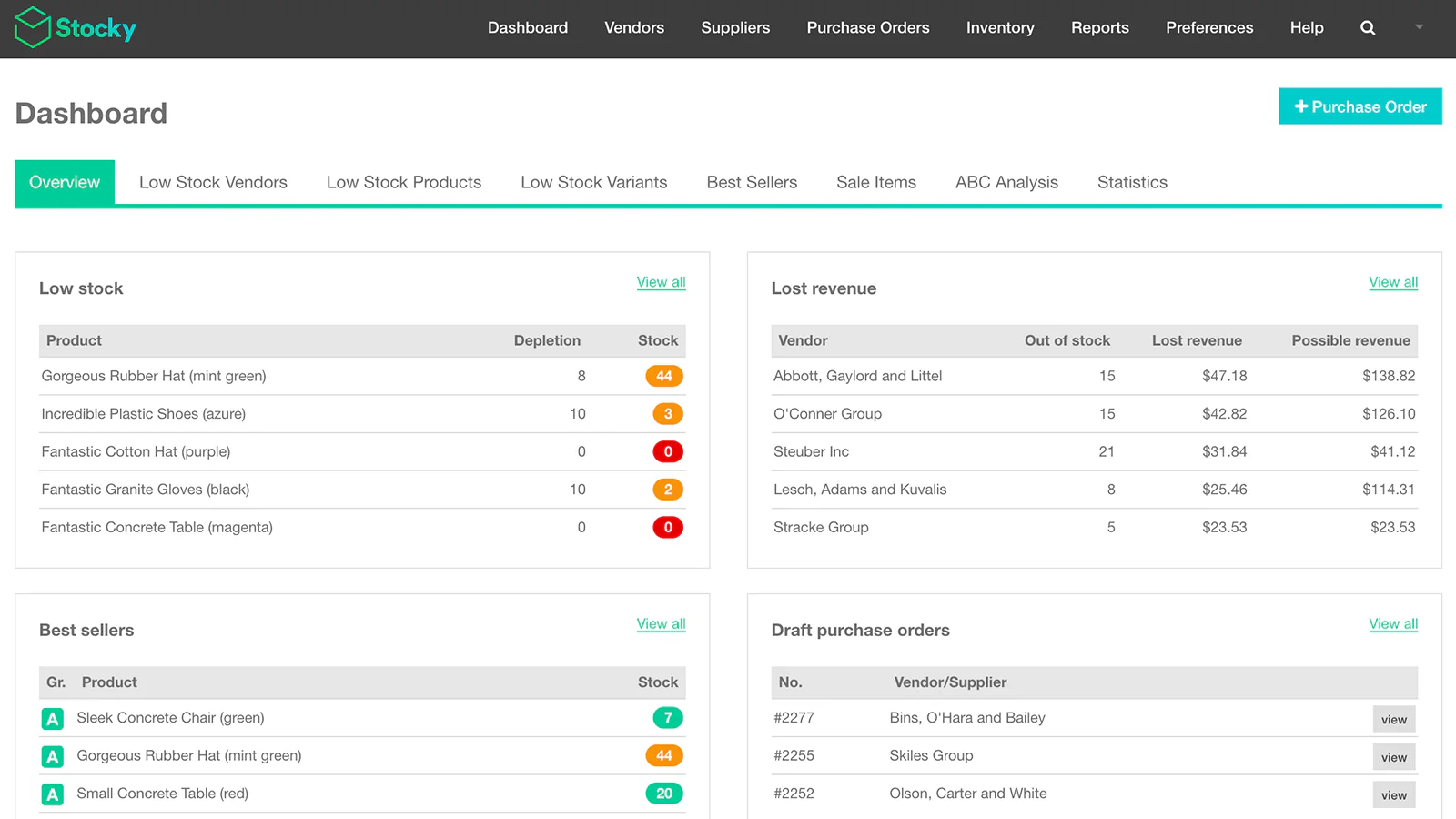
💡Pro tip: The Stocky app for Shopify POS can help you manage inventory and prevent stockouts. Generate reports to find out your optimal stock levels for each SKU, then have the app automatically raise purchase orders with the relevant supplier when quantities dip below your threshold.

Use the Stocky app to manage your inventory and prevent stockouts.

Making the most of order history data 

Order history is more than a record of past purchases—it’s a guide for building trust with customers, planning inventory, and creating personalized marketing. When you use it well, you can reduce uncertainty, strengthen loyalty, and grow sales with less guesswork.

To put these insights into action, you’ll need a system that unifies data across channels. Shopify POS brings together order data from every sales channel—including your retail stores, ecommerce websites, marketplaces, and social media storefronts—to give the full picture of who’s buying what. 

Get started with Shopify POS

Only Shopify gives you all the tools you need to manage your business, market to customers, and sell everywhere in one place. Unify in-store and online sales today.

Discover Shopify POS

Order history FAQ

What is my order history?

Order history is the complete record of customer orders, past and present. It includes product, payment, shipping, and delivery information.

What are the benefits of order history?

Order history makes it easy to track current and past customer orders, including their status. It can help you understand which products are most popular, customer behavior, and times when sales fluctuate so you have the right data to make future business decisions.

How can I check my online order history as a customer?

To check your online order history, log in to your account on the retailer’s website or mobile app. Look for a section labeled “My Account” or “Orders” to view the complete list of your past and current orders.

What’s the difference between order history and order confirmation?

An order confirmation is a one-time notification (usually an email or text) sent immediately after purchase to confirm the transaction. Order history is a complete record of all past purchases with a company.

Limited Drops: A 2025 Guide to Using Scarcity to Drive Sales

Software Stack Editor · September 26, 2025 ·

image

In 2025, shoppers want endless choice—and exclusivity. According to a 2025 survey from Attentive, 56% of shoppers say members-only sale days are a top perk, and nearly half want early access to limited-edition items. That hunger for access has fueled the rise of limited drops: short-run product launches designed to sell out quickly and rarely, if ever, restock.

What started in streetwear has evolved into a broader retail strategy that flips traditional production cycles, drives viral moments, and keeps customers coming back for what’s rare. For brands, it’s more than hype. Limited drops create urgency and scarcity, unlock customer loyalty, and simplify inventory planning in ways traditional launches can’t match.

In this article, you’ll learn why limited drops are so effective, the benefits they bring, and how to launch one successfully in your own store.

What are limited drops?

Limited drops are a release model where new products are available for only a short period, or in very small quantities. Scarcity is the defining feature of these product launches—whether it’s intentionally low production or a limited-time purchase window. Once the window closes, or the inventory sells out, they usually won’t be restocked.

For example, a streetwear brand might issue 1,000 pairs of a special edition sneaker. Customers may only buy the shoe on its app for 24 hours. When the drop window closes or the pairs sell out, they’re gone for good—turning the product into a coveted collector’s item. 

Why are limited drops so effective in 2025?

Limited drops resonate because of today’s shopping reality. 

Shoppers are surrounded by countless, always-available options. That’s great for everyday staples like toothpaste or denim, but it doesn’t create excitement.

A limited drop is more than that. It’s a memorable experience where customers get cool, unique products from their favorite brands. This sense of rarity makes purchases feel special, and from a business perspective, it’s something customers will pay a premium price for. 

Here’s why limited drops are especially effective in 2025. 

They tap into powerful consumer psychology

Instead of using discounts and racing to the bottom with competitors, limited drops offer brands the chance to leverage exclusivity and scarcity. This persuasion technique, sometimes called scarcity marketing, creates a sense of FOMO—fear of missing out—that often justifies a higher price point in customers’ minds. 

According to a 2024 survey from YouGov, 31% of consumers across 17 international markets say they’re more likely to buy clothes, shoes, or accessories when those items carry a “limited-edition” label.

For some, the fear of missing out on a scarce item is so strong they’re willing to pay more on resale marketplaces like Goat and StockX if they missed out on the initial launch date. 

They align with modern shopping habits

Younger shoppers like Gen Z live on their phones and social feeds, where limited drops spread at a viral speed. 

Influenced by collector culture and having to own something they identify with, 39% of Gen Zers say they’re more likely to buy limited edition items—the strongest response of any age group. 

This aligns with broader data on Gen Z shopping behavior. Eighty-four percent of Gen Z shop online at least once a month, and 46% are influenced by social media when deciding what to buy.

That makes limited drops a natural fit for their real-time, mobile, and shareable shopping style. Launching a buzzworthy product and meeting shoppers where they’re already spending their time can lead to higher sales with fewer discounts. 

They simplify inventory and reduce risk

Globally, fashion brands have an inventory management problem. In 2023, they produced between 2.5 and 5 billion surplus garments, with an estimated worth upwards of $140 billion—that’s a ton of unsold merchandise. 

Limited drops help solve this problem. By producing smaller batches designed to sell out quickly, brands remove much of the guesswork around stocking and sales projections. Inventory forecasting becomes simpler, deadstock is minimized, and launches are easier to manage.

Business benefits of a limited drop strategy

Drop culture doesn’t just excite shoppers—it brings significant benefits for brands, too. From generating buzz to simplifying operations, limited drops can drive measurable results for your business. Let’s take a look at a few of the biggest benefits. 

Generate demand and hype

Limited drops create built-in excitement that promises buzz for your brand and drives customers to act fast. It’s scarcity marketing in action: a strategy that uses urgency and limited availability to spark demand and push shoppers off the fence. 

And it’s effective: in a 2025 PYMNTS & Scalefast survey of 2,298 US shoppers, 43% said they had taken part in a limited-time product drop, flash sale, or private sale within the previous month.

For retailers, this means every launch becomes an event. Creative and well-timed promotional campaigns have the potential to spark urgency and make your brand go viral. This is a cultural change for many retailers who’ve long had a semiannual-release mentality. 

Gamify the shopping experience

The human need to belong shapes how people behave, socialize, and shop. Limited drops tap into that instinct by turning shopping into a game of access and exclusivity. 

Each release becomes a challenge—can customers claim the product before it sells out? That feeling of “winning” a drop creates a memorable experience that keeps fans engaged and eager for the next launch.

Create social media buzz

Social media is often one of the core pillars of limited drops. TikTok’s algorithm, in particular, can push content beyond a brand’s existing followers, helping a launch sell out in hours.

One example is when Stanley partnered with Target in early 2024. A single TikTok video of shoppers swarming the shelves for a cosmo-pink tumbler racked up two million likes, and the cups sold out online and in-store within minutes.

Moments like this show why brands build their drops around short-form video content and creator partnerships. A brand collaboration creates free hype, builds trust, and gives proof that your product is worth buying.

Gain customer insights for smarter decisions

Limited drops don’t just generate sales—they generate valuable customer data that helps you understand your target audience. Each release shows you who buys first, where they discovered you, and how they move across your sales channels.

With Shopify, this data—from product drop engagements to transactions and even POS scans—flows into a unified customer profile. You can use it to improve merchandising, marketing, and inventory management.

For example, you can:

  • Refine your product roadmaps. If the green micro-batch hoodie sells out in minutes, you know a core line version deserves bigger production.
  • Personalize shopping experiences.Shoppers who joined a waitlist but missed checkout can automatically receive early-access links to the next product drop.
  • Forecast inventory more easily. With a single view of your stock, planners can order the right quantities and avoid deadstock. 

The payoff from this data is measurable. Retailers that run on a unified commerce stack see up to an 8.9% uplift in sales thanks to clearer, real-time insights. 

Know your audience to grow it

Discover powerful insights about your customers by creating unique segments, then reach out with personalized campaigns to drive sales.

Build your audience

How to launch a successful limited drop in four steps

Do limited drops sound like something you’d like to test? If you want to emulate this strategy, here are four simple steps that will help you with a successful drop release. 

Step 1: Set clear goals and choose the right product

Start by defining what success looks like. Do you want to:

  • Build hype and brand awareness by growing a waitlist or driving social mentions?
  • Clear inventory quickly by turning excess fabric into a capsule collection?
  • Test demand for a core SKU to see if a new colorway merits full production?

With your goals in mind, choose products that naturally fit a limited-drop format. The best drop items make customers feel something, look cool on social media, and can be produced in small runs. 

For first-time drops, brands usually consider:

  • Hero variants: A bestselling style in a seasonal shade or premium fabric
  • Collab capsules: A co-branded piece that merges two audiences for instant novelty
  • Concept tests: Experimental designs or flavors you’re not ready to bet big on

💡 Tip: All successful limited drops have one thing in common: quality. A drop may create buzz, but if you’re not focused on high-quality products, customers won’t come back. 

Once customers get disappointed in your brand, there’s no going back. Don’t be afraid to create a buzz, but make it worthwhile.

Step 2: Plan your inventory

Before you decide on a launch date, determine how many units you’ll need. A drop should sell out quickly, but you don’t want to limit sales revenue and disappoint customers who waited for the drop. 

Review the data you already have:

  • Past launch traffic
  • Waitlist counts
  • Preorders
  • Average conversion rates

Use those numbers to create a conservative forecast, then test scenarios. For example: If we sold 15% more, how would that impact our cash flow and customer sentiment?

If your waitlist has 4,000 people on it for early access and your typical launch converts around 12%, you’ll want to forecast at least 480 units. 

When you approach your factory or co-packer, arrive with specifics:

  • Projected units per size or SKU
  • Ship-by date tied to your public countdown
  • Any special packaging or insert cards that distinguish the drop

This is also the time to check production capacity. Can your supplier hit your date without additional fees? Is a small batch still profitable when minimum order quantities (MOQs) are taken into consideration? 

Knowing these details ahead of time shows stakeholders you’re prepared and sets you up for a smooth drop. 

Step 3: Build a multichannel promotion plan

The retail customer journey for a limited drop is different than always-in-stock SKUs. Traditional tactics like blog posts and nurtured ad funnels won’t drive urgency within a 24-hour window. 

What works better for building scarcity is:

  • Teaser videos that unveil the product and launch date
  • Countdown emails and SMS campaigns that build your waitlist and drive subscribers to your product page on launch day
  • Influencer promotions that create hype around the limited edition items

For example, KITH and Giorgio Armani promoted a recent collection not by showing off product details, but by releasing short TikTok videos set in the cities where the line would launch, like Capri.

A drop’s excitement can also peak offline when fans line up and feel the energy of the release. One-day popups in high-foot-traffic neighborhoods double as photo ops. 

Customers and curious bystanders will post about the event on social media, driving even more online and offline traffic. You can see in the video below how people waited in line for the BÉIS Travel human claw machine. 

The hype was built around two main attractions: the unique experience and the possibility of receiving a free luggage or weekender bag in the brand’s new berry color. 

“Our launch went off without a hitch and the Shopify team was instrumental in making sure that real live people were able to purchase manually.”

Chris Gibbs, owner, Union Los Angeles

Step 4: Get ready for the craze

Preparation is the key to a smooth drop. Customers who are willing to wait in line or pay a lot of money to get your product expect a seamless customer experience from start to finish. 

Make sure your systems can handle a surge in traffic. That means checking site stability, ensuring your enterprise resource planning (ERP) system is solid, and using a versatile retail point of sale (POS) that unifies in-store and online sales. If your ecommerce tech stack is ready to handle increased traffic, your launch has a better chance of success—as Chris Gibbs of Los Angeles-based streetwear shop Union LA found out when they had a well-publicized launch. “Our launch went off without a hitch and the Shopify team was instrumental in making sure that real live people were able to purchase manually,” says Chris.

Shopify is built to handle high-traffic events. Shopify Checkout can handle up to 40,000 checkout starts per minute, per store, while maintaining 99.99% uptime—even during peak events like Black Friday and Cyber Monday (BFCM).

During BFCM 2024, Shopify powered $11.5 billion in sales for 76 million shoppers and handled $4.6 million in GMV every single minute at peak. Behind the scenes, the platform processed 284 million edge requests per minute and 1.19 trillion total edge requests. 

💡 Tip: Automate your launch sequence with Launchpad. This Plus plan tool lets you preload inventory, swap themes, publish discounts, and even throttle bots automatically the moment your countdown hits zero—then roll everything back when the drop ends.

Examples of retailers using limited drops

Brands across industries are using limited drops to create buzz, build loyalty, and boost sales. Let’s look at a few recent examples that show how a limited drops strategy works in practice.

SKIMS x Roberto Cavalli

Kim Kardashian’s brand SKIMS partnered with luxury retailer Roberto Cavalli for a limited-edition swimwear collection. 

The collab featured a 23-piece collection featuring SKIMS’ popular swimwear styles reimagined with Roberto Cavalli’s signature bold animal and floral prints. The drop sold out in a single day after its launch on June 27, 2024—showing the power of pairing exclusivity with a high-profile collection. 

Gymshark’s Onyx Midnight drop

In July 2024, Gymshark introduced an exclusive black colorway called Onyx Midnight, available only to loyalty members in tiers 2–4 (tiers which are earned through spending with the brand). 

In the days leading up to launch, the brand seeded short teaser workouts and “fit checks” through their athlete-creator network on TikTok and Reels, driving followers back to this loyalty-gated announcement.

The combined loyalty-gating and creator promotion generated immediate buzz, evident in tens of thousands of likes and comment threads asking how to secure the link before stock disappeared.

Glossier x Magnolia Bakery

Glossier teamed up with Magnolia Bakery to launch a limited-edition Banana Pudding Balm Dotcom. The collab was first teased on Instagram with the bakery’s signature dessert in the background. 

The caption announces an exclusive release on the Sephora app, with wider availability rolling out on both Glossier and Sephora sites, turning the collab into a multichannel event. 

Early buzz in the comments, like fans asking “What time does it drop?”, shows how teasers successfully primed demand ahead of launch.

Last Crumb

Think limited drops are impossible for industries like food and beverage? Think again. Last Crumb is a luxury cookie company offering Michelin-star-quality desserts sold in limited editions.

Their secret to success is organic marketing through owned channels, such as email and social media, in parallel with influencer marketing campaigns. To get early access, customers have to join the brand’s email list, turning scarcity into a driver of loyalty and community.

Liquid Death Deathberry Inferno 

Liquid Death extended their irreverent brand voice with Deathberry Inferno, a limited-edition sparkling water that riffs on the brand’s “spicy water” meme with a strawberry-and-ghost-pepper flavor. 

Originally sold exclusively at Walmart, the drop came with a tongue-in-cheek heat warning and a promo video featuring brave moms taste-testing the fiery fizz. This drop showcases how playful storytelling can amplify demand for even unexpected categories.

The potential risks of limited drops (and how to avoid them)

Like any strategy, limited drops come with potential pitfalls. Being aware of these risks—and planning for them—can help protect your brand’s credibility and keep customers excited for the next launch.

  • Overstressing urgency: When every launch is advertised as a “can’t miss event,” but products are still available after the countdown ends, customers may lose trust in your brand and wait for discounts instead.
  • Manufacturing scarcity: Artificially capping units can trigger backlash if fans suspect you’re withholding stock just to drive resale prices. Frustrated cart abandons can make the tactic feel manipulative rather than exciting.
  • Social media blowback: The same platforms that drive hype can just as easily amplify frustration. Long queues, checkout glitches, or bot interference can generate negative TikTok stitches before you have time to respond. 
  • Diluting exclusivity: Too-frequent drops weaken the scarcity effect.Weekly or even monthly drops may keep revenue flowing short-term, but risk making releases feel like ordinary events instead of special, brand-building moments.

The future of limited drops

Limited drops may be the next ecommerce battleground, as more tech-savvy brands figure out how to generate hype to stand out within a crowded social media feed. As consumers demand exclusivity and social platforms amplify viral moments, drops will continue to shape how brands build loyalty, manage risk, and create memorable shopping experiences in 2025 and beyond.

Limited edition drops FAQ

What does limited drop mean?

A limited drop is a product release that’s only available for a short time or in small quantities. Many businesses use limited drops to create buzz and hype around new products, increasing short-term sales.

What does drop mean in retail?

In retail, “drop” typically means “launch”—as in a new product launch or collection launch. It’s also another way to describe bringing products to market, often with an emphasis on exclusivity or timing.

Why do brands do drops?

Brands use a product drop strategy in order to generate excitement around their products and create a unique, limited-time offering for their customers. A successful drop can help build brand loyalty by giving customers a memorable shopping experience.

What is a drop strategy?

A drop strategy is a documented plan on how your company plans to create, promote, and release products to your customers in a limited format. It’s best used for occasional launches that feel special, rather than frequent releases that risk making drops feel routine.

Google Trends: Find & Validate Trending Products for Your Store (2025)

Software Stack Editor · September 26, 2025 ·

Can Google predict the future of retail? As it turns out, yes—by as much as three quarters in advance.

New research from K. Ramesh and Gary Lind analyzed Google search patterns for nearly 200 publicly traded US retailers between 2004 and 2019. When search volumes go up, so do revenues—often long before analysts or investors catch on.

In fact, investment strategies built around search trends outperformed traditional models by 2%–3%. That’s big news for retailers like you, too. Google Trends is a free forecasting tool sitting right in front of you. 

Ahead, we’ll show you how to make Google Trends work for you—whether you run an online store or a brick-and-mortar business. You’ll learn what it is, how it helps retailers, which products are trending right now, and common mistakes to avoid.

What is Google Trends?

Google Trends is a free tool from Google that tracks what people are searching for, how interest in those searches changes over time, and where those searches are happening. Instead of giving you exact numbers, it indexes search volume on a scale of 0–100 so you can compare the relative popularity of different topics, products, or keywords.

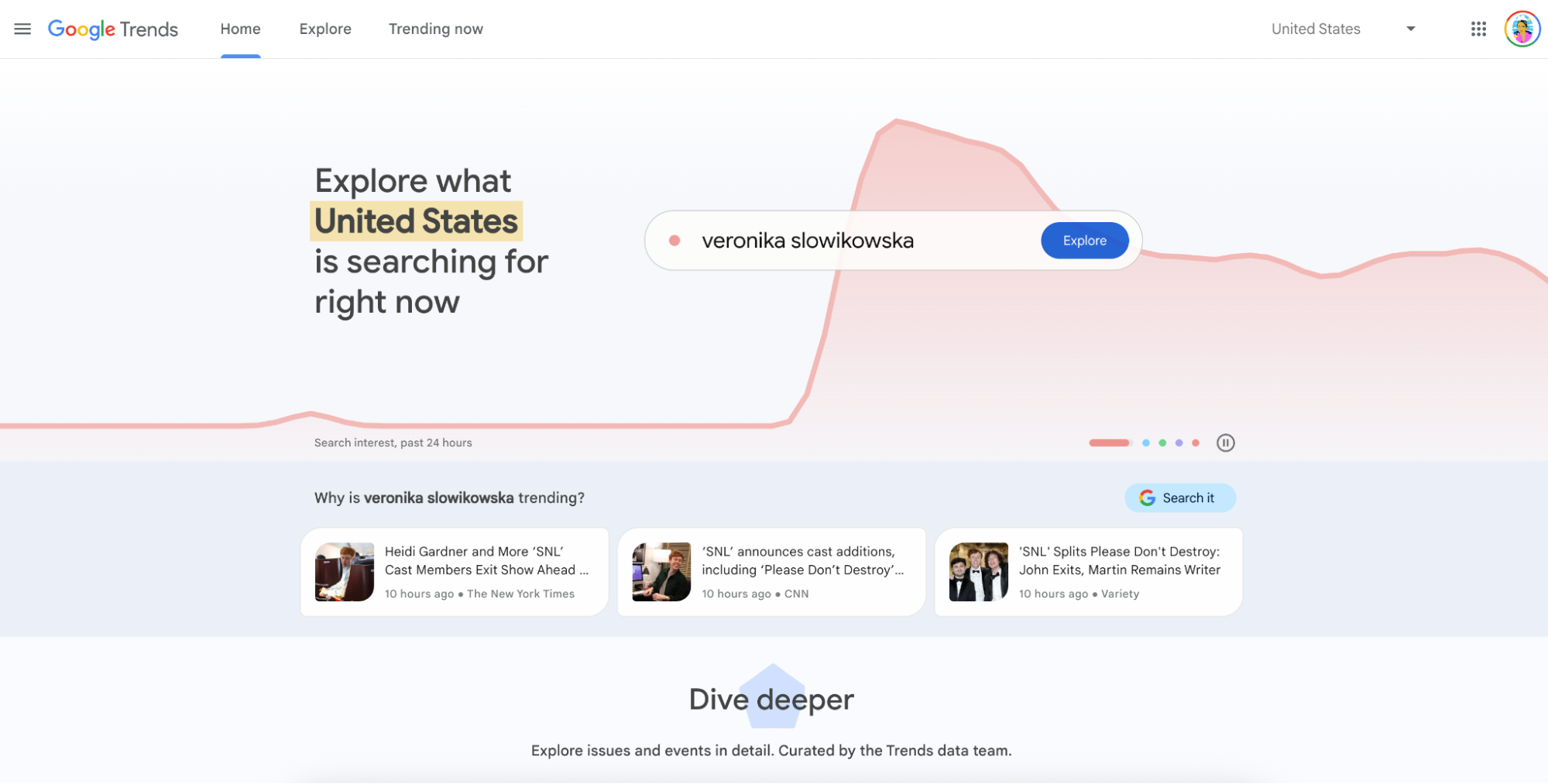
Google Trends homepage showing search interest in “veronika slowikowska” in the United States.
Source: Google Trends

As the world’s leading search engine, Google handles over two trillion search queries annually. Its advanced algorithm effectively makes sense of the search data you and your customers are looking for, making it one of the best places to find near-real-time market research on shopping trends. 

How Google Trends helps retailers

Google Trends is free market research you can put to work today for product discovery and validation. Here’s how:

  • Discover product search volume: Don’t waste time launching something no one’s looking for. A quick Trends search shows whether shoppers are already hunting for your product idea. 
  • Check seasonal demand: Holiday toys, sunscreen, home workout gear—most categories have built-in cycles. Use Trends to plan ahead, balance seasonal items with evergreen ones, and avoid cash-flow surprises. 
  • Nail down your customer’s vocabulary: Should you advertise “hair dryer brush” or “blowout brush”? Trends lets you compare terms side by side to see which words your audience actually types into Google. That insight can make your ad copy, SEO, and marketing campaigns way more effective.

Eight trending products on Google Trends 

Here is some of the data we used to define what is “trending”:

  1. Shopify merchant data: US Shopify merchant sales growth in June 2025 was compared to June 2024 to see which products were taking off this summer. 
  2. Google Trends validation: We validated that momentum on Google Trends to confirm real search demand.
  3. Deloitte’s ConsumerSignals report: This is a longitudinal study of what products households are spending on and why. Their latest findings show that when US consumers splurge, they’re most often driven by comfort (21%), relaxation (16%), and practicality (12%).
  4. National Retail Federation’s 2025 retail forecast: This report, among other things, highlights health and wellness as a top priority for US consumers.

Here are eight trending products backed by sales data, search behavior, and consumer spending trends:

1. Yoga mats

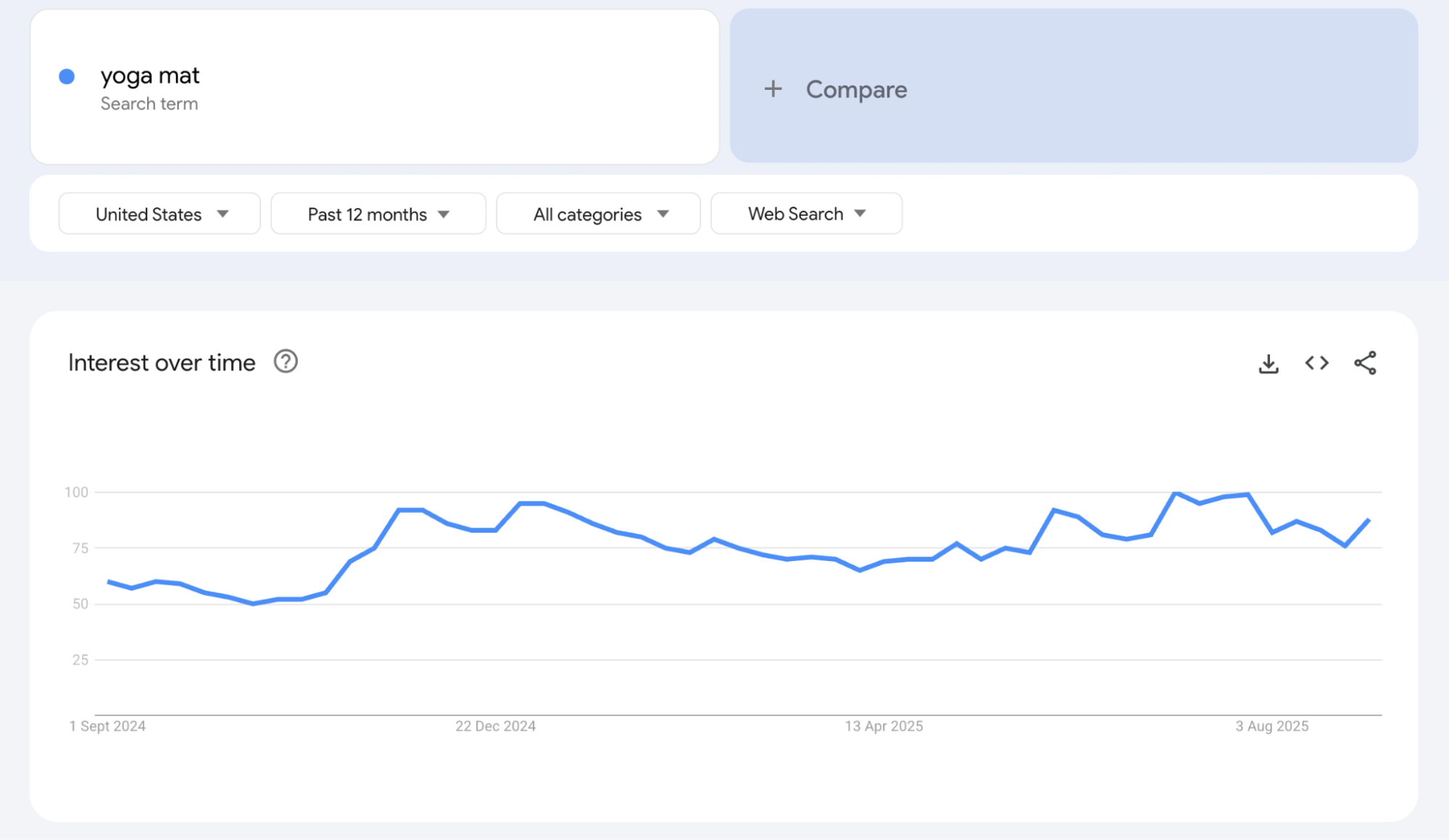
Over the past year, search interest in “yoga mat” has stayed consistently strong in the US, with clear seasonal spikes. Google Trends shows demand climbing to its highest point around December 2024–January 2025 (New Year’s resolution season) and again in spring 2025. The latest data still sits well above the baseline seen a year earlier.

US search interest in “yoga mat” stayed high in 2024–25, peaking in January and spring.
“Yoga mat” searches spike with resolutions and spring workouts, but demand holds steady all year.

This demand lines up with broader consumer behavior. Deloitte’s ConsumerSignals highlights that Americans splurge on purchases that are comforting (21%) and practical (12%)—two boxes a yoga mat ticks. And according to McKinsey, the US wellness sector now exceeds $500 billion in annual spending, growing steadily at 4%–5% per year, even amid broader economic uncertainty.

Yoga mats have become a catch-all symbol of at-home wellness, doubling as bases for Pilates, stretching, meditation, and home workouts. That makes them a resilient product with both seasonal peaks and evergreen demand.

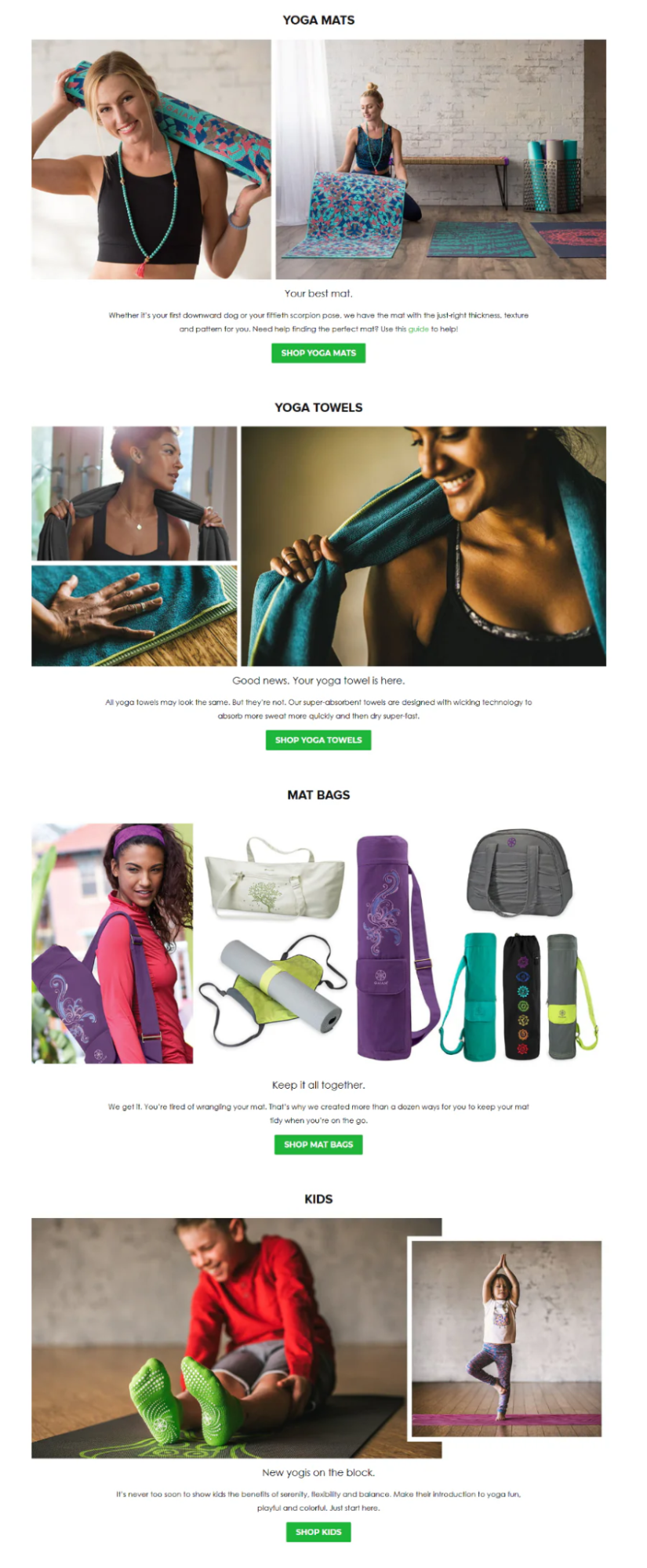
Key insight: Demand is high—but so is competition. Differentiate with eco-friendly materials, functional upgrades, stylish design, or bundles. Take a cue from Gaiam, who migrated to Shopify and boosted conversions with visually navigated, storytelling-driven landing pages instead of standard product grids.

Gaiam’s Shopify store showing yoga mats, towels, mat bags, and kids’ yoga gear.
Gaiam is a lifestyle brand that offers yoga, fitness, and wellness products.

2. Wrap skirts

Over the past year, search interest in “wrap skirt” has steadily climbed in the US, with the strongest spikes between March and May 2025. Google Trends shows a clear seasonal lift, with search volume holding above its 2024 baseline.

US search interest in “wrap skirt” climbed steadily through 2025, peaking in late spring.
Searches for “wrap skirt” in the US rose with spring fashion trends, then eased slightly in summer.

This trend was confirmed in Google’s Spring 2025 Shopping Report, which named the wrap skirt the breakout spring skirt search of the season. 

The fashion media is in sync with the momentum. As Cosmopolitan reported in August 2025, what began as the scarf skirt microtrend—silk bandanas tied as skirts or layered Y2K-style—has evolved into full wrap skirts, bolstered by Spring 2025 runway nods from Miu Miu, Dior, and Salvatore Ferragamo.

Key insight: Fashion moves fast, but it’s also cyclical. Wrap skirts rode the Y2K wave back from their 2000s heyday, proving the value of tracking revivals alongside new microtrends. Stand out by timing limited drops to seasonal peaks and pairing skirts with complementary pieces (like sandals). 

3. Soap

Searches for “soap” have stayed strong and even ticked upward through 2025. Google Trends shows a steady baseline compared with last year, with subtle peaks around seasonal buying moments.

US search interest in “soap” held steady in 2024–25, with a gradual climb through summer 2025.
Searches for “soap” stay consistent year-round, with a slow lift as wellness and specialty soaps trend.

In 2024 alone, Shopify merchants moved more than 23 million bars of soap and over 18 million bottles of shampoo. When you fold in consumer drivers—comfort, practicality, and wellness—it’s easy to see why soap continues to dominate the beauty and personal care aisle.

The bath and body category is evergreen and entrepreneurial. Take Lisa Jolly, founder of The Honeybunch Shop. She taught herself to make soap over a weekend, landed a $100,000 order on her 40th birthday, and eventually scaled to multiple retail stores and a factory.

Even Sydney Sweeney launched her own soap with a “touch” of her bathwater this year. If that doesn’t prove soap is having a cultural moment, what does?

Key insight: Essentials can be elevated. The brands that win in soap lean on eco-friendly packaging, refill systems, natural formulations, and novelty scents like bacon. 

4. Travel pants

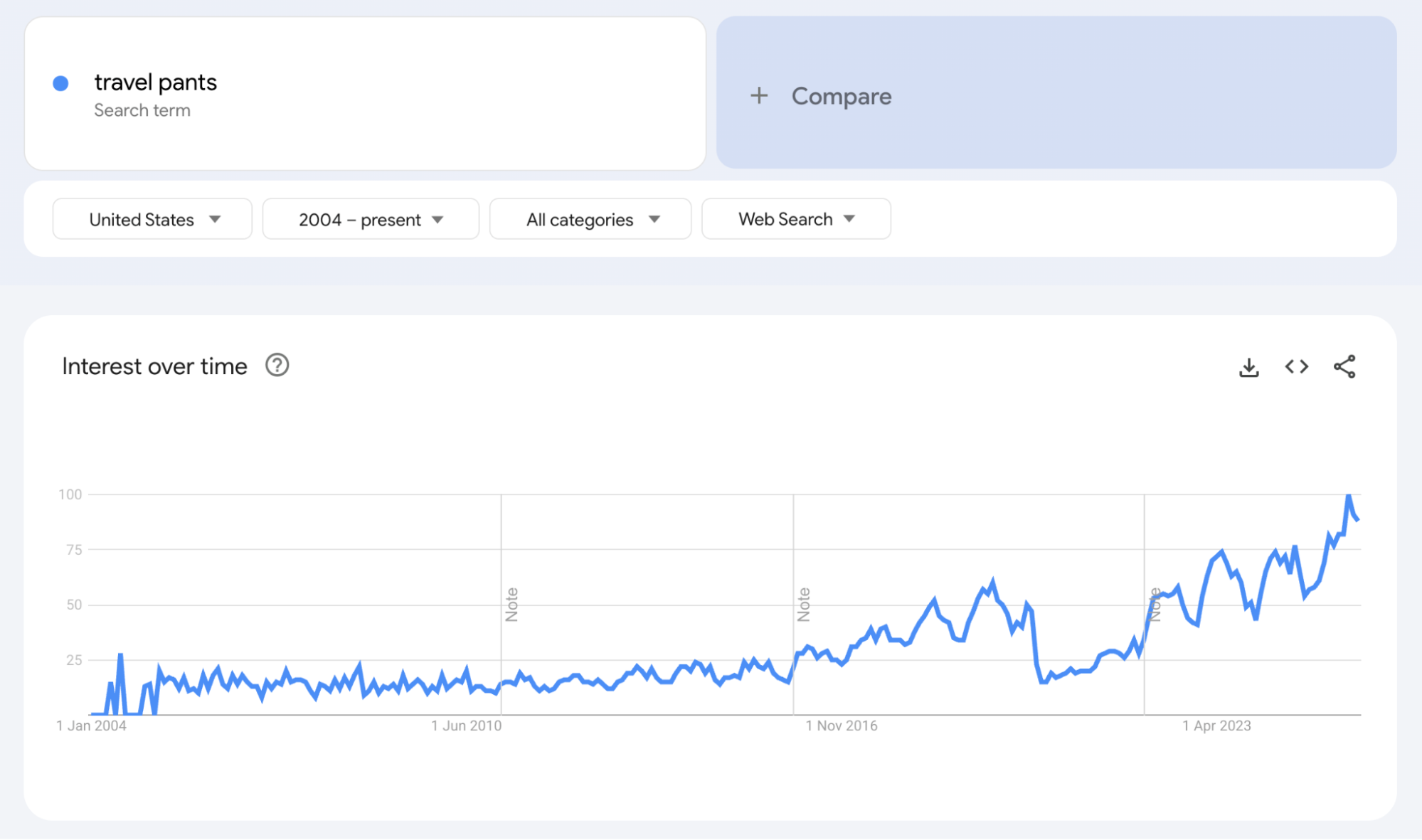
Google Trends data shows a long climb for “travel pants” in the US—steady through the 2000s, a noticeable lift post-2016, and a sharp spike after 2022 as travel roared back. 

In two decades, interest in this product has grown to its highest level, making it one of the clearest examples of a slow-burn product maturing into a mainstream category.

US search interest in “travel pants” has climbed steadily since 2016, hitting record highs in 2025.
“Travel pants” searches are at their strongest ever, fueled by post-pandemic travel and comfort trends.

According to Skift Research’s 2025 Travel Outlook, people are planning 24% more trips than in 2024—and they’re dressing for them. Google’s Spring 2025 Shopping Trends report even named “wide-leg linen pants” as the breakout travel style. 

On the topic of pants, in 2024, Shopify merchants also saw increased sales of “barrel jeans,” matched by a 500% rise in Google searches.

Key insight: Build seasonal edits around travel gear, highlight technical fabrics (breathable, wrinkle-resistant), and target TikTok’s and Instagram’s “#airportoutfit” crowd with styled content drops timed to peak travel months.

5. Reusable water bottles

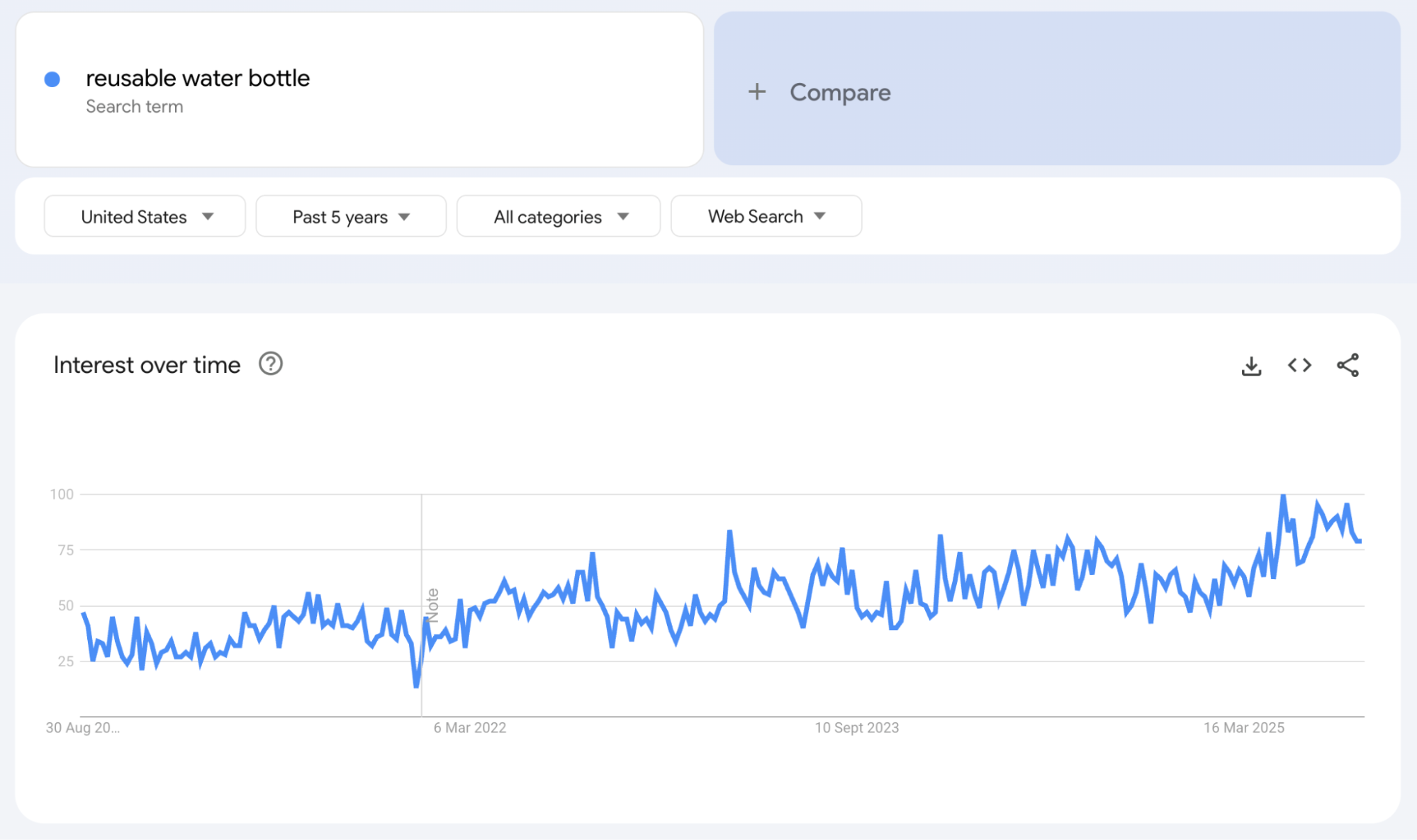
Google Trends shows a steady upward trend for “reusable water bottle” searches over the past five years, with a clear uptick through 2025. A new brand or style goes viral and sparks interest—most recently, Stanley Cups dominated social feeds, and now, alternative styles are vying for attention.

US search interest in “reusable water bottle” rose over the past five years, with peaks in 2025.
Searches for “reusable water bottle” are climbing, boosted by wellness trends and #WaterTok.

The global reusable water bottle category was worth $9.72 billion in 2024, projected to rise to $10.17 billion in 2025 and $15.27 billion by 2034.

Meanwhile, TikTok’s #WaterTok has 2.5 billion views—proof that bottles are more fashion, less function. As The Economist deadpans: “Water bottles, the accessory Gen Z is thirsting after.”

Case in point: memobottle. 

Originally a Kickstarter campaign to reduce single-use plastic, the brand raised over a quarter-million dollars and became a design icon. Thin enough to slip into a laptop bag, it solved a real business traveler’s problem. 

Then it went viral, landing in Oscar nominee gift bags for Leonardo DiCaprio and Matt Damon, cementing its reputation as both a sustainability play and a premium lifestyle accessory. 

Key insight: This category, believe it or not, is less about hydration and more about self-expression. Gen Z treats bottles like fashion drops, not gym gear. Focus on curating bold designs, highlight your sustainability achievements, and ride cultural moments to turn a basic utility into a statement piece.

6. Home décor

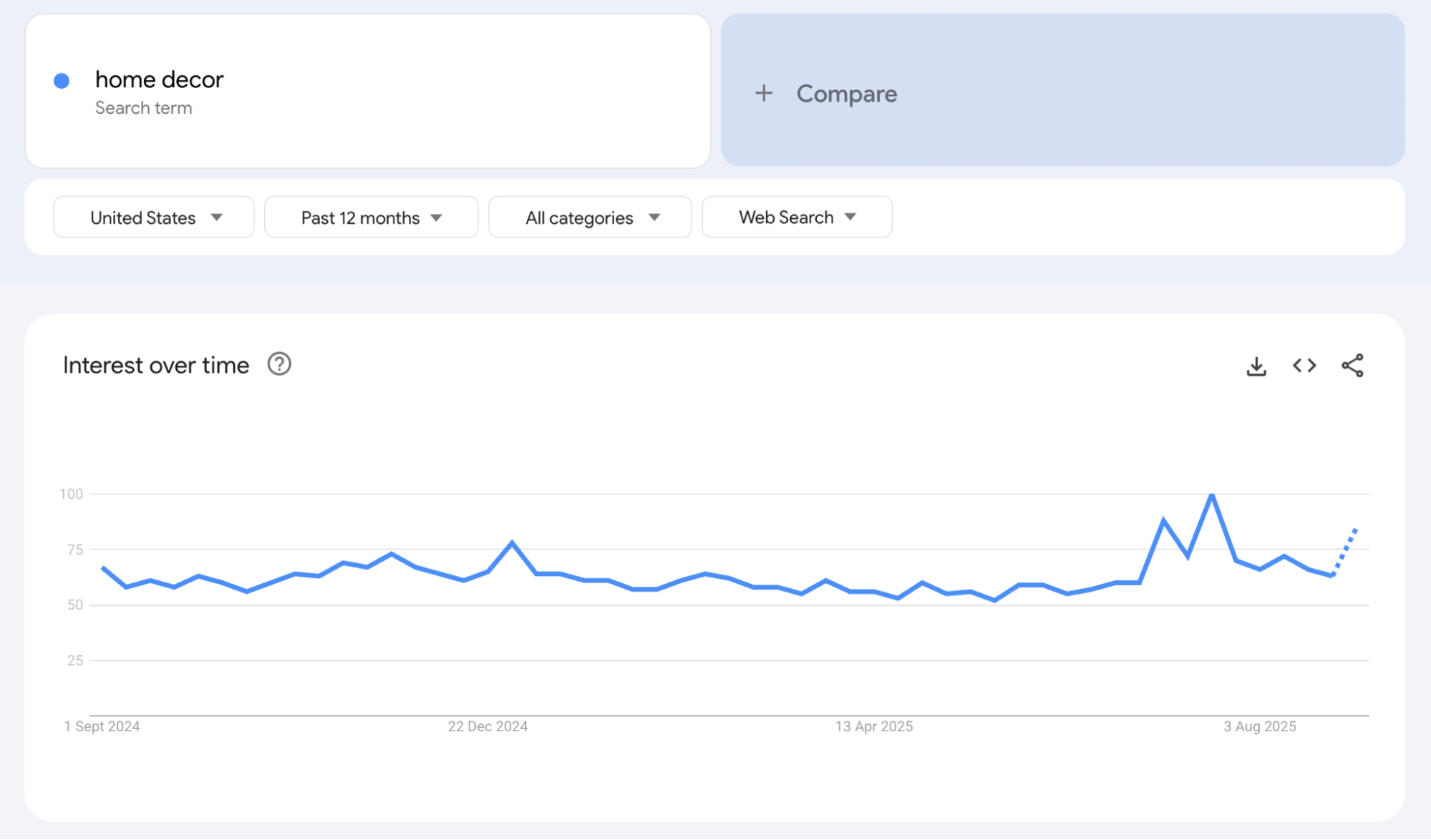
Searches for “home decor” jumped mid-2025, right as Instagram feeds filled with summer refreshes and early holiday mood boards. The curve suggests people are treating décor as a year-round project, not a once-a-year splurge.

US search interest in “home decor” held steady in 2024–25, with sharp spikes in mid-to-late 2025.
“Home decor” searches climb in mid-year and fall, tied to seasonal refreshes and holiday shopping.

The numbers behind the trend are huge. The average US household spends $2,752 a year on home décor, with cities like Seattle topping $3,493 annually.

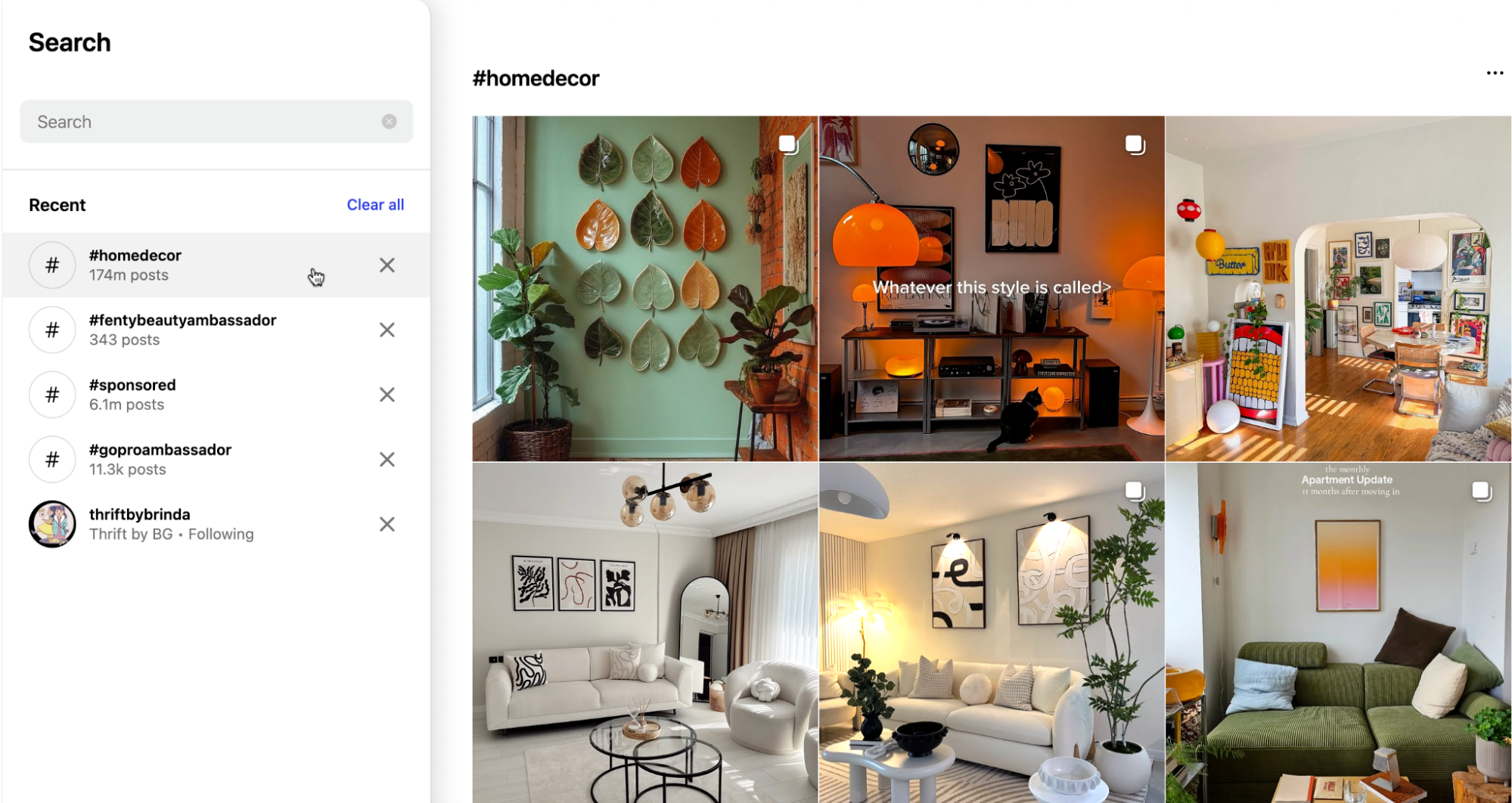
On social, the obsession is even louder: Instagram’s #homedecor tag has 174 million posts, making it one of the platform’s most enduring lifestyle categories.

Instagram search results for #homedecor showing living room styles and 174 million tagged posts.
Source: Instagram

Key insight: Home décor sells when it’s visual and shoppable. Lean into scroll-stopping visuals, seasonal refreshes, and smaller-ticket items that hook buyers early. Shopify merchant Sweet Water Decor nailed this formula, starting with hand-lettered mugs that went viral on Instagram before expanding into candles and other décor staples. Start with one photogenic hero product, then scale into the full room.

7. Pet supplies

A New York judge ruled in 2025 that dogs count as “immediate family,” a historic shift in how pets are treated legally. Beyond legal definitions, the pets-as-family phenomenon directly impacts consumer spending. 

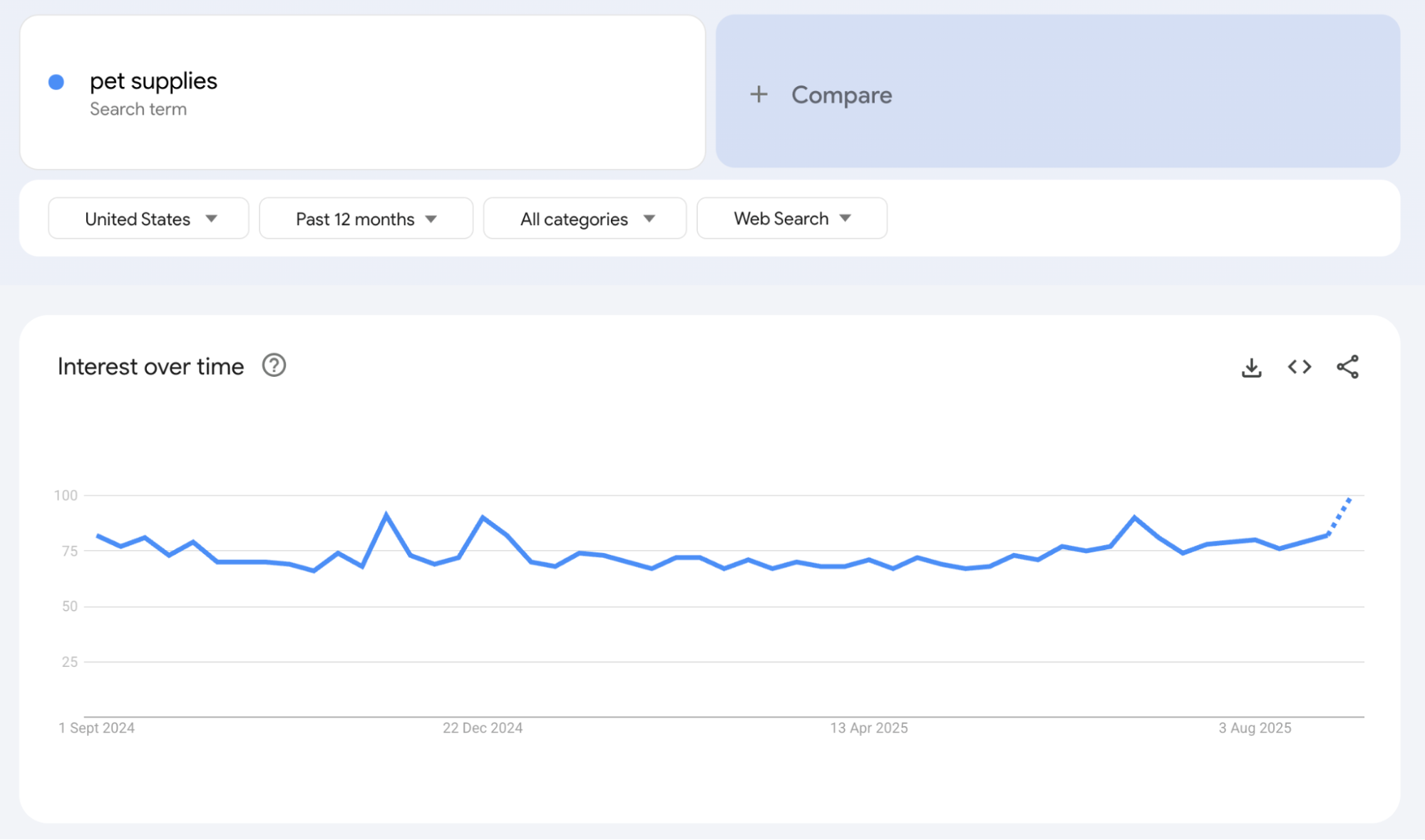
Search interest in “pet supplies” has stayed consistently high over the past year in the US, with a clear lift in late summer 2025.

US search interest in “pet supplies” held steady last year, with late 2025 showing a sharp uptick.
“Pet supplies” demand is steady year-round, but searches climb toward year-end as spending on furry family members surges.

Gone are the days of pet supplies being “discretionary.” In Korea, the pet population has topped 15 million, fueling demand for pet-friendly home appliances. And in the US, veterinarians like Dr. David Jeffrey report a sharp rise in owners asking about CBD treatments for their animals.

Key insight: Capture this market by expanding into wellness (CBD chews for anxiety, joint-support supplements), lifestyle (self-cleaning litter boxes, pet-friendly vacuums, orthopedic dog beds), and premium goods (matching pet-owner apparel sets, designer carriers, subscription treat boxes). 

8. Blushes

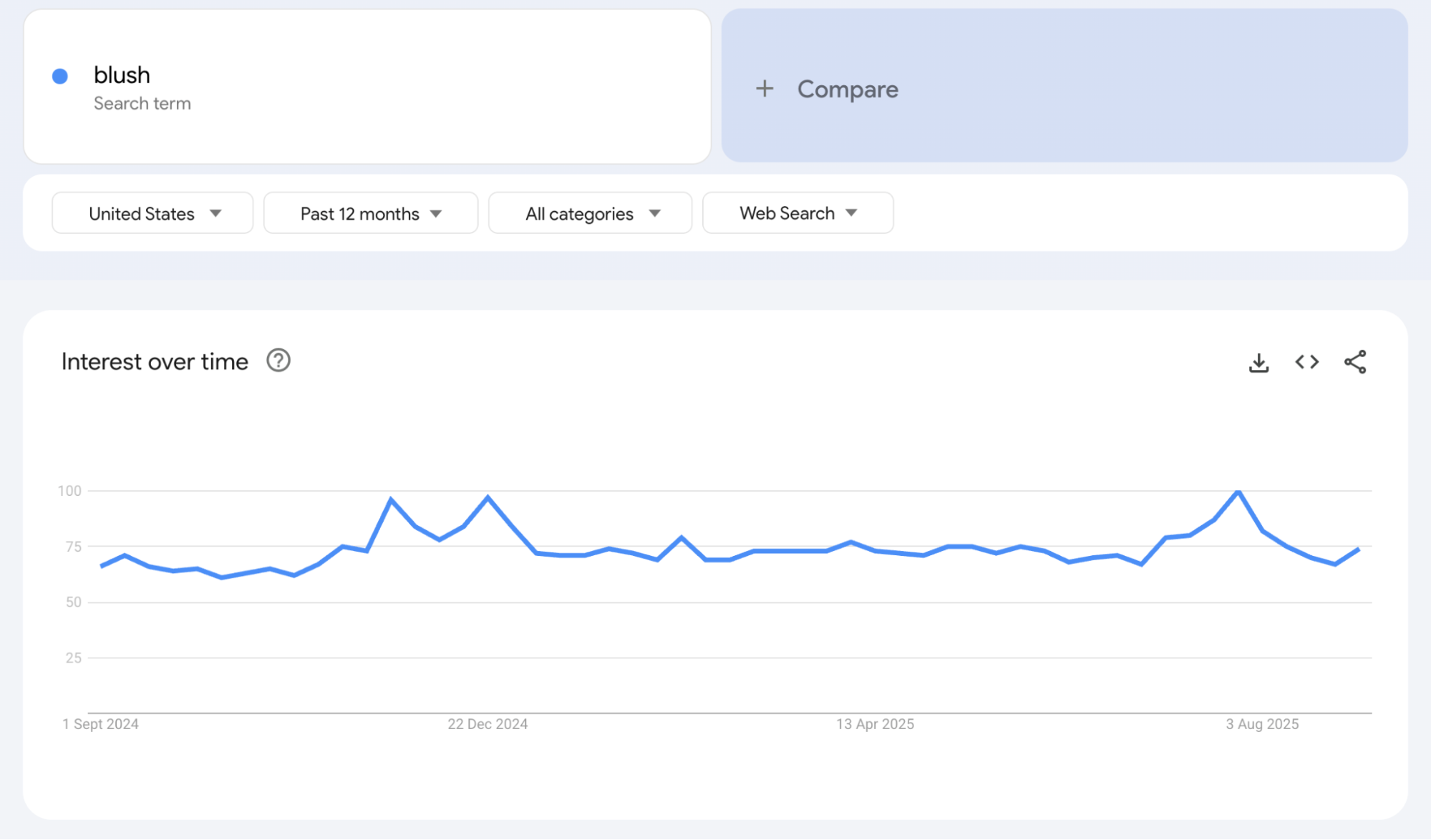
Google Trends shows a continued interest in “blush” over the past year, with spikes around holiday shopping and summer makeup trends. There’s more to that steady curve, because according to Business of Fashion, “blush is having a renaissance.”

US search interest in “blush” spiked in late 2024 and mid-2025, reflecting seasonal beauty trends.
“Blush” searches jump with viral makeup looks and new product launches.

Notably, Rare Beauty’s Soft Pinch Liquid Blush alone drove $2 billion in global revenue in 2023, selling one unit every nine seconds—Vogue called it “makeup’s comeback kid.”

Meanwhile, Rhode’s Pocket Blush, a TikTok darling since launch, became the “most talked-about blush” in August 2024, topping Launchmetrics’ media-impact ranking ahead of both Rare and Benefit.

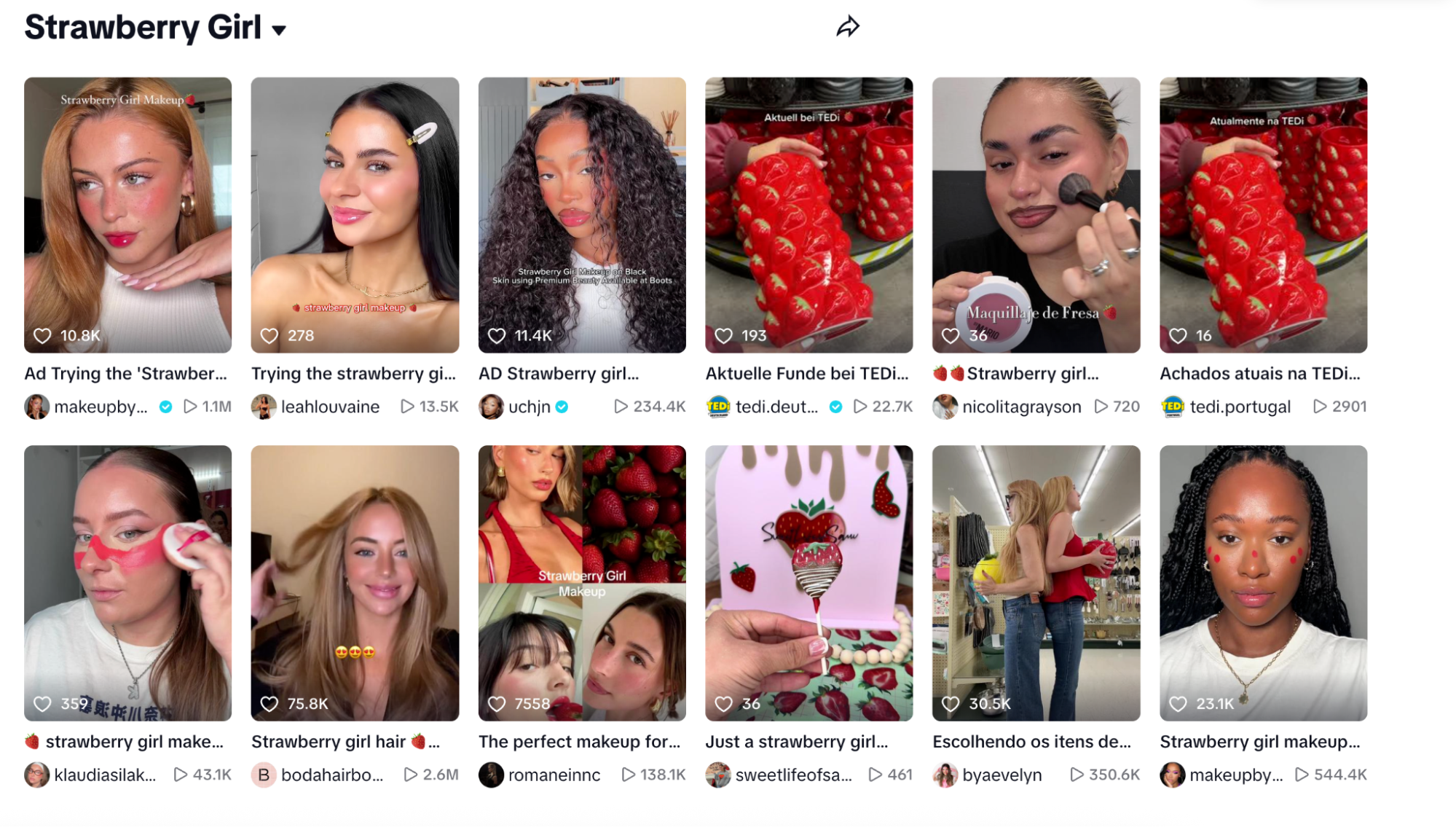
Instagram and TikTok are amplifying this “blush boom.” Trends like “tomato girl” and “strawberry girl” makeup have spotlighted bold, flushed cheeks, while new techniques—blush draping, sandwiching, glazing—keep the category humming.

TikTok search results for “Strawberry Girl” makeup trend showing viral videos and product demos.
Source: TikTok

Key insight: This is what works in beauty: take a product everyone uses, put a spin on it, and you have white space. Consider the Shopify-powered brand Glamnetic. Founder Ann McFerran took magnetic lashes, an innovation on an already popular item, and scaled into Sephora and Ulta. The same strategy applies to blush: reinvent the staple, and it can redefine your brand.

How to use Google Trends for product research

1. Start broad and drill down to niche opportunities

A quick search can show you if interest is rising, flat, or fading before you sink time and budget into inventory.

  1. Search a broad category: Begin with a general term like “moisturizer.” This gives you the lay of the land and a sense of whether demand is steady, seasonal, or fading.
  2. Scan rising queries: Google Trends will surface related searches—think CeraVe, Neutrogena, night, or sunscreen. These show you where shoppers are zooming in.
  3. Spot the niches: Use those related queries to identify sub-categories: cult brands, time-specific routines, or added benefits like SPF.
  4. Act on the data: You could:
    1. Stock trending brands (CeraVe, Neutrogena).
    2. Merchandize “nighttime skincare” as its own category.
    3. Highlight SPF prominently in product packaging or marketing copy.

2. Identify seasonal trends and plan your marketing calendar

Not all products are popular year-round. The most obvious examples are Christmas-related products. People generally don’t buy Santa-themed decorations in June, and high demand for holiday products peaks in the later months of the year.

Products that might not seem seasonal often have cyclical purchase patterns. Google Trends shows searches for “lunchbox,” for example, peak in August—just before the start of a new school year.

To analyze popular products by season on Google Trends: 

  1. Year-over-year analysis: Compare search interest in your product during the same months across different years to identify consistent seasonal trends.
  2. Look for patterns: Notice if search interest peaks around certain events, weather patterns, or some national holidays over others. This may indicate the best times to ramp up your marketing efforts.
  3. Analyze broader seasonal category trends: Look at the overall trends within your product’s broader category during different times of the year to gauge whether interest in the category is rising or waning. This broader perspective can help you distinguish between product-specific seasonal trends and general market movements for better marketing campaigns.

3. Consider customer feedback

Customer feedback, combined with Google Trends data, is always a great starting point for launching a business, new product, or service that’s actually in demand. 

Design open-ended questions that prompt your ideal customers to discuss their pain points and moments of struggle. With powerful tools for advanced search query research like Semrush or Ahrefs, you can even dive deeper into long-tail keywords for users trying to find answers to hyperspecific challenges related to your product idea for further validation. 

4. Leverage related queries and related topics for keyword goldmines

Aside from telling you how popular a term is, Google Trends also reveals the surrounding searches and themes people use alongside it. 

That’s where related queries (the exact phrases people type) and related topics (the broader concepts they’re exploring) come in.

Use this data to uncover the exact language your customers use, along with emerging trends to target in SEO, ads, or product descriptions.

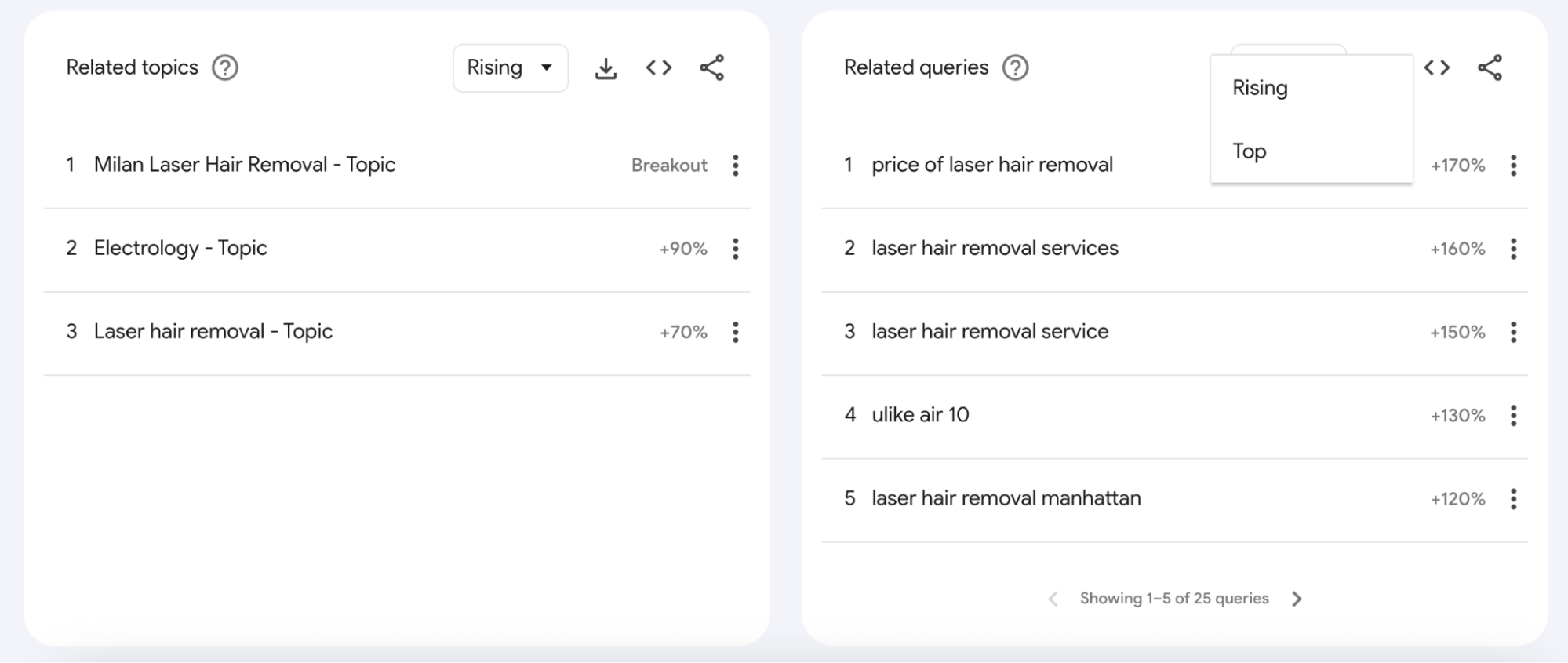
Take “laser hair removal” for example:

  • Rising related queries include “price of laser hair removal” (+170%) and “laser hair removal Manhattan” (+120%). Both suggest strong demand for cost transparency and location-specific services.
  • Related topics like “Milan Laser Hair Removal” and “Electrology” show that consumers are not only weighing providers but comparing alternative treatments.
Google Trends related topics and queries for “laser hair removal,” showing rising searches.
Related queries for “laser hair removal” spotlight cost, service, and local intent—key signals for retailers.

Here’s how to use it:

  1. Search your core product term.
  2. Scan related search queries to surface customer intent—are they price-sensitive? Local-focused? Curious about substitutes?
  3. Use related topics to map your competitive set and find nearby niches worth testing.
  4. Fold these insights into keyword targeting, ad copy, and merchandising strategy. For example, you could build city-specific landing pages or bundling services to address price concerns.

5. Compare product ideas to find your winning edge

Google Trends’ “Compare” feature is a lightweight competitive analysis tool. You can stack two or more products side by side and see which one is gaining faster traction—and where.

Here’s how it works:

  1. Type in your first product or topic.
  2. Click the + Compare button in the search bar.
  3. Add your second product or topic.
  4. The chart will now plot both lines against each other, using the same 0–100 relative scale.

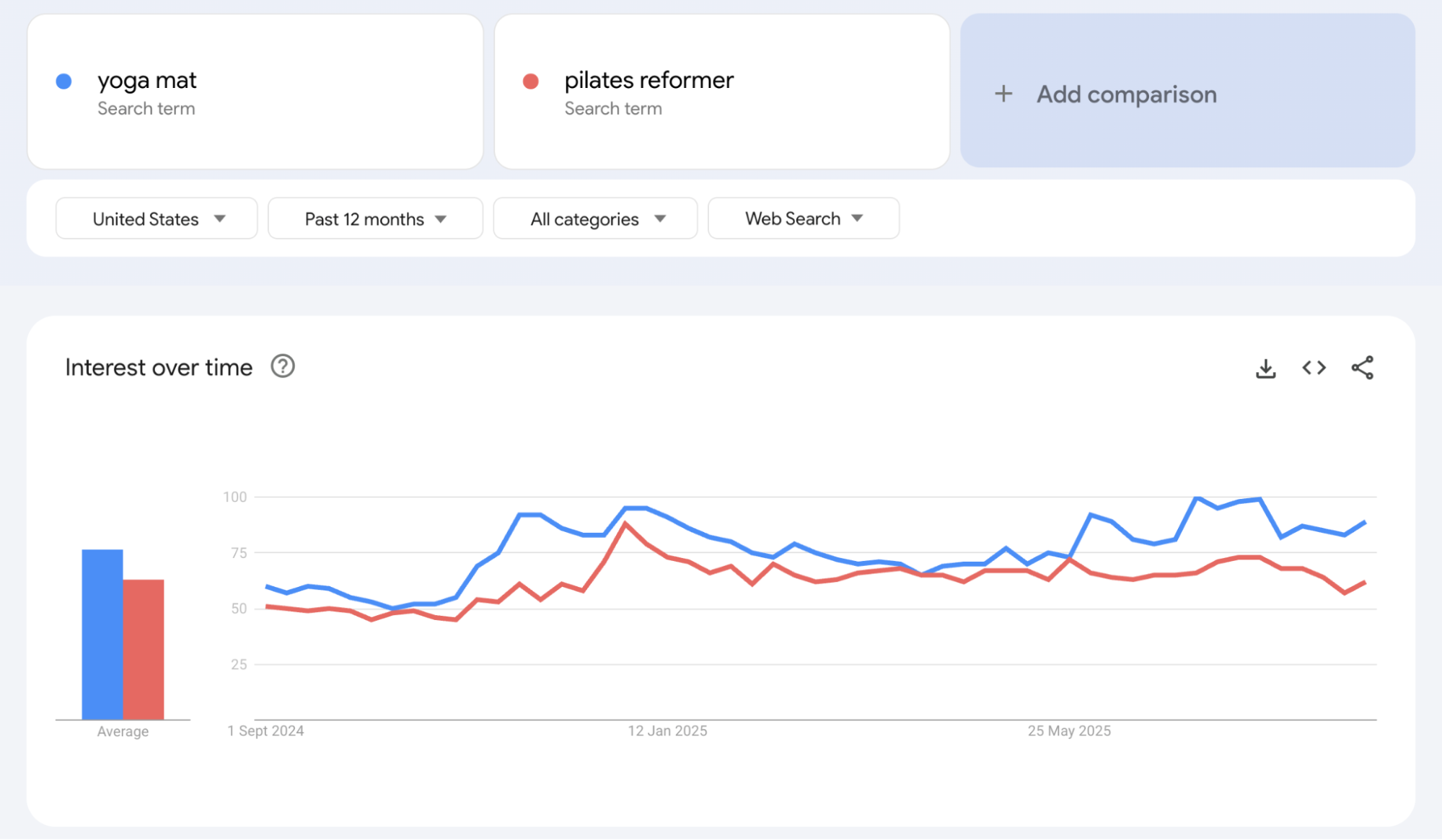
Take the search terms “yoga mat” versus “pilates reformer” in the US over the past year.

  • Yoga mats (blue) consistently outperform pilates reformers (red), with clear spikes in January (New Year’s resolutions) and spring.
  • Pilates reformers have moments of interest but never sustain the same volume.
US comparison of “yoga mat” vs. “pilates reformer” last year, showing yoga mats leading in volume.
“Yoga mats” dominate search volume, but pilates reformers can serve as a niche premium play.

If you’re a retailer in the wellness category, this insight suggests that yoga gear is a safer bet for evergreen inventory, while pilates equipment might be a smart niche upsell for more dedicated fitness shoppers. You could:

  • Stock a wider range of yoga mats (eco-friendly, alignment-printed, bundles with accessories).
  • Test pilates reformers as a premium, higher-ticket product for a smaller, more loyal segment.

Take advantage of Google Trends’ “Compare” feature for a competitive edge:

  • See where demand is strongest: Comparing products side by side shows you which one has higher or more consistent search interest. That helps you decide whether to invest in the bigger, established market—or take a bet on an emerging one.
  • Identify gaps in the market: A comparison highlights not just winners and losers, but also what’s missing. If a niche product is growing but underrepresented, that’s an opening to position yourself differently—whether through pricing, features, or marketing.
  • Prioritize resources: Knowing which product has the higher baseline demand means you can allocate inventory, ad spend, and content creation more strategically—while still leaving room to experiment with the underdog.

6. Validate product demand beyond Google Trends

Google Trends data is a good indicator of search habits, but not all trending topics are products that people buy. Validate your product idea by comparing data from several marketplaces before spending thousands of dollars on product development:

  • Look for competitors selling the same product: Something as simple as observing how many competitors are offering the product can indicate market saturation or opportunities for differentiation.
  • Scour marketplaces: Gauge demand, pricing strategies, and customer reviews on similar products on marketplaces.
  • Analyze social media trends: A quick hashtag search on Instagram or TikTok (e.g., #NighttimeSkincare, #SPFMoisturizer) will show whether the conversation is bubbling over with real engagement—or barely a trickle.
  • Survey your target audience: Feedback from potential customers validates whether the interest shown in Google Trends translates into actual buying intent. It’s one of the best ways to validate whether your product idea will sell. 

Pro tip: Google Trends shows you where interest is heading, but interest doesn’t always equal sales for your business. Once you’ve spotted a promising idea, validate it with real purchase data. Shopify admin gives you a single source of truth across sales, inventory, and customer touchpoints, so you can see whether a trend is actually converting into revenue.

Beyond the basics: Advanced Google Trends features

Once you’re comfortable fiddling around with the basic features, get your hands dirty with the more advanced filters Google Trends offers.

Location-based searches

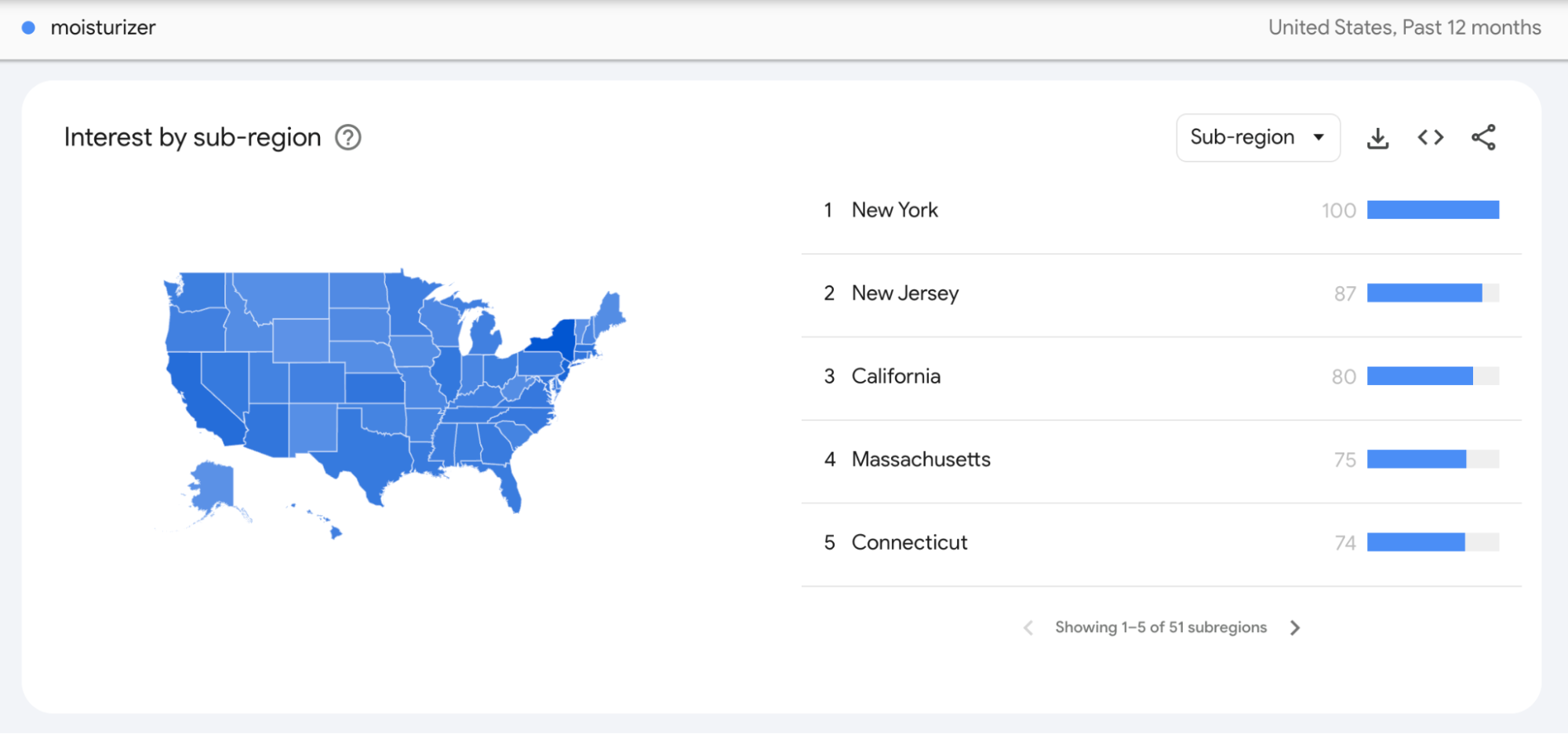
When you search for a term in Google Trends, you’ll see a map shaded by where the keyword is most popular. Darker regions mean higher relative search interest.

US map showing top states for “moisturizer” searches, led by New York, New Jersey, and California.
“Moisturizer” demand skews East Coast, with New York and New Jersey topping search interest.

On the right, you’ll find a ranked list of states, cities, or countries with the strongest demand. Hovering over a region shows more detail on how that search compares to others in the same location.

Location data helps you spot where to lean in. If “moisturizer” peaks in New York and New Jersey, that’s a signal to localize ad campaigns, target ads, or even test popups in those markets.

Shopping-specific phrases

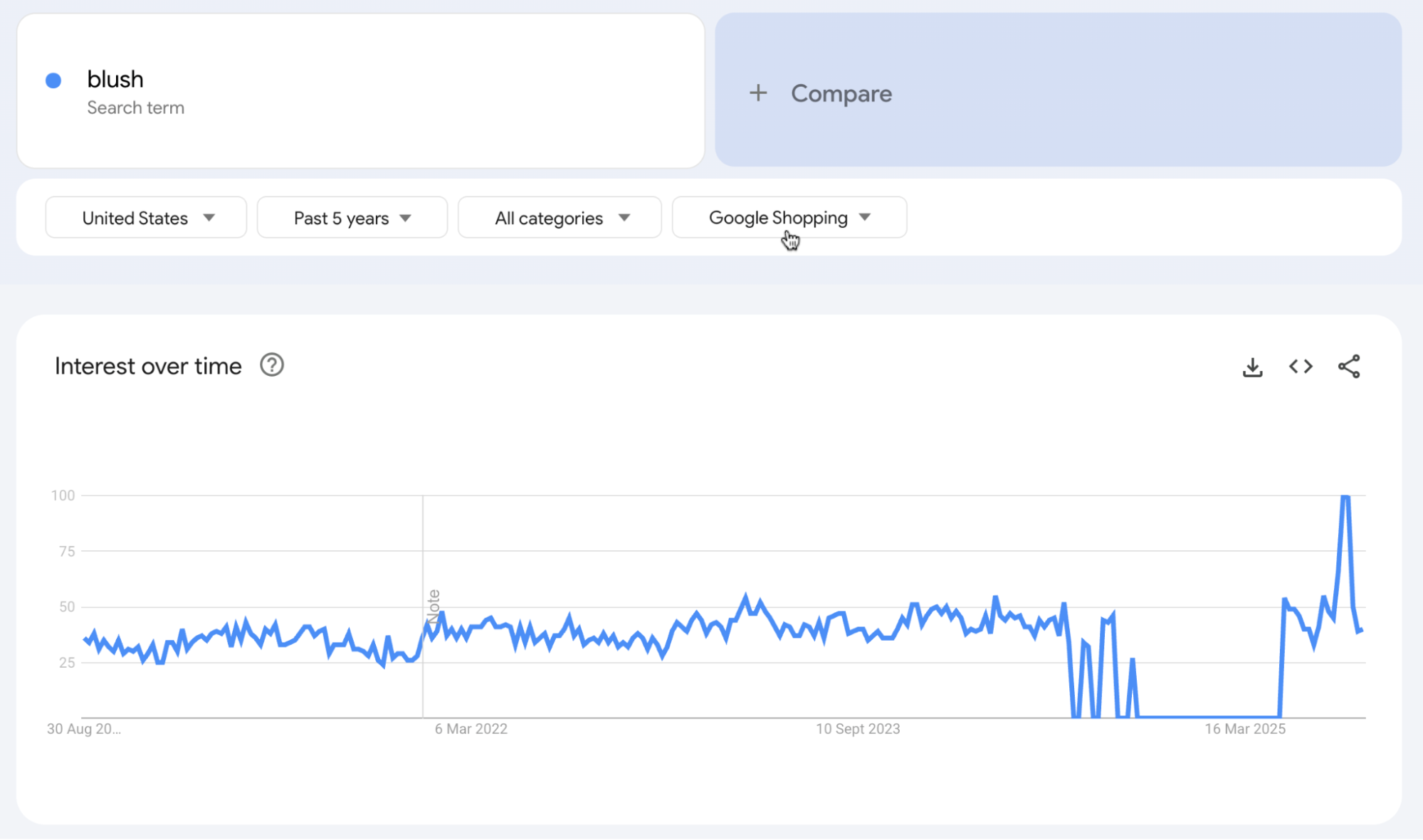
Switch the filter from Web Search to Shopping to cut out casual curiosity searches and spotlight queries with purchase intent. 

Google Shopping search interest in “blush” over the past five years in the US.
Shopping-specific searches for “blush” reveal strong purchase intent, with clear peaks in 2025.

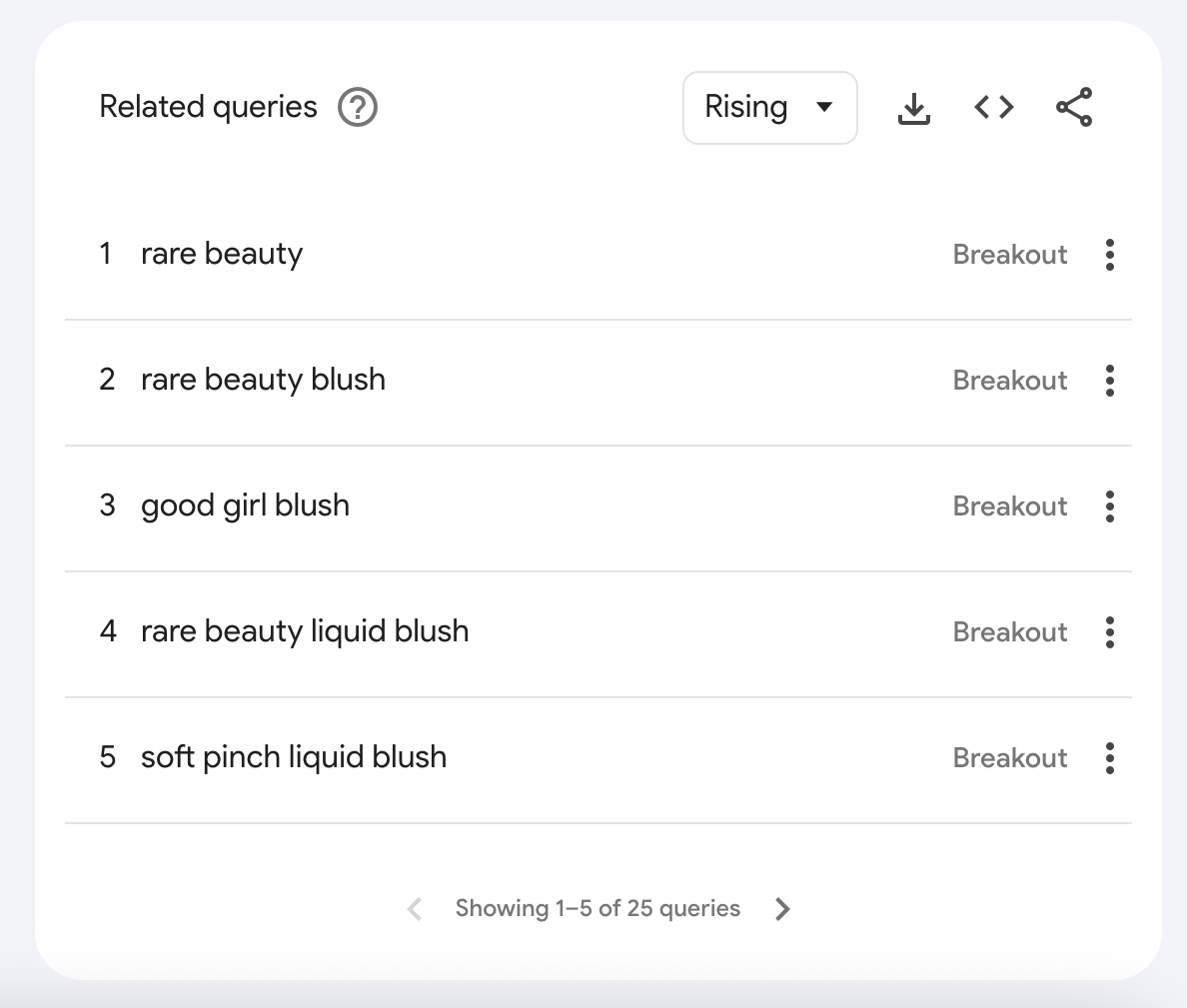
Instead of someone Googling “blush” for inspiration, you’ll see searches like “Rare Beauty liquid blush” or “Soft Pinch liquid blush”—signals that shoppers already know what they want and are primed to buy.

Related shopping queries for “blush” show interest in Rare Beauty and Soft Pinch liquid blush.
Shopping searches reveal high purchase intent, with Rare Beauty blush leading breakout queries.

Rising and breakout terms

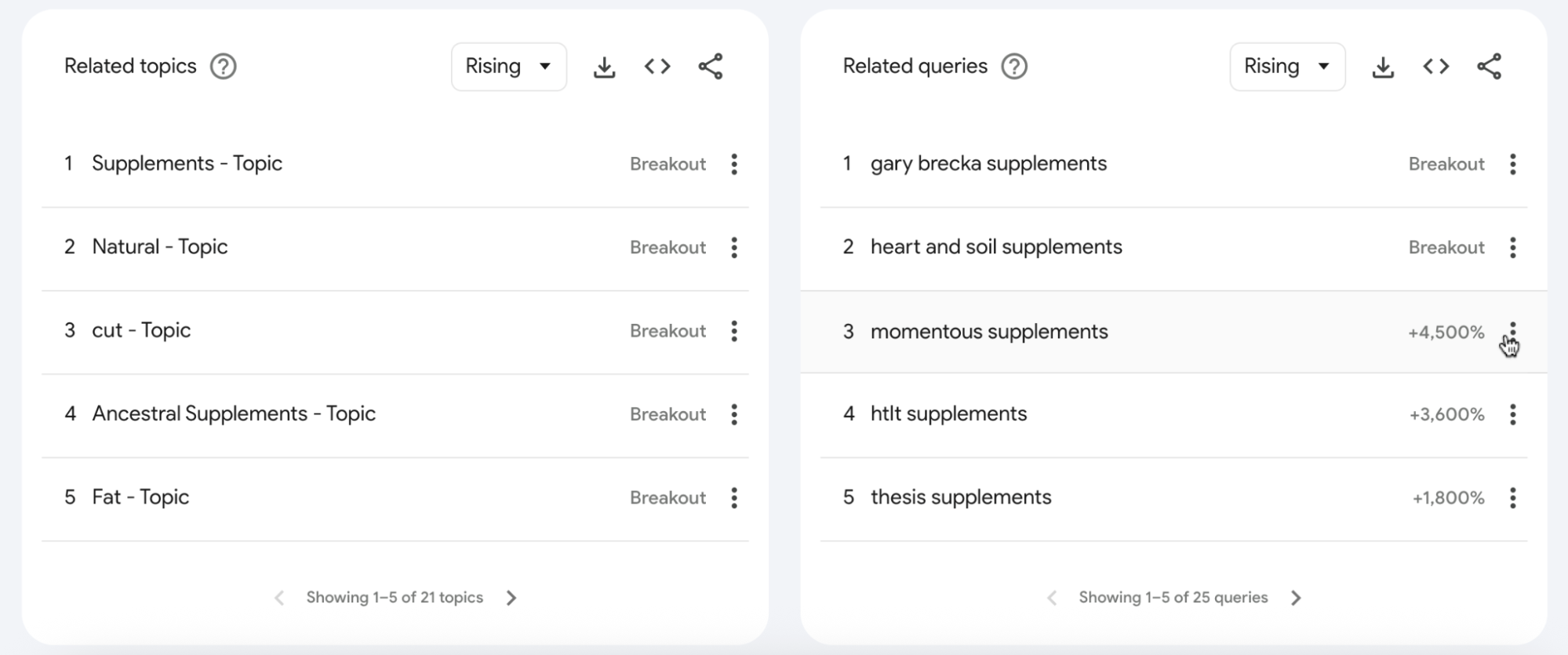
Switch the Related Queries or Related Topics tab to Rising—this should be the option by default. This shows you which searches are gaining the most momentum alongside your keyword. The percentages reflect how much a term has grown compared to the previous time period.

Google Trends related queries for “supplements,” showing rising and breakout searches.
Rising and breakout terms flag explosive growth—like “Momentous supplements,” up +4,500% in 2025.

If you see Breakout instead of a percentage, it means searches grew by more than 5,000%: a strong sign of viral or fast-emerging interest.

Take the supplements category, for example. Terms like “momentous supplements” surged +4,500%, while “gary brecka supplements” hit breakout status.

That tells you two things:

  • Consumer discovery is happening now. These brands are being searched by name for the first time at scale.
  • You can act before the market saturates. Stock the brand, create content around it, or develop alternatives.

Relative vs. absolute search volume 

A big misconception about Google Trends is that the numbers represent raw search volume. They don’t.

Trends uses a relative scale from 0–100 to show how interest in a term changes over time. A score of 100 doesn’t mean 100,000 people searched for it—it just means that’s the peak popularity for that term in the selected time and place.

This matters because:

  • A niche product like “pilates reformer” might never reach the same raw numbers as “yoga mat,” but its relative growth could still signal a profitable trend in a high-spend niche.
  • To understand absolute demand, you’ll need to pair Google Trends data with tools like Shopify Analytics, marketplace search volume (Amazon, Etsy), or ad platforms.

Drive your business forward with Shopify’s analytics

Shopify’s user-friendly reports and analytics capabilities help you make better decisions, faster. Choose from pre-built dashboards and reports, or build your own to spot trends, capitalize on opportunities, and supercharge your decision-making.

Explore Shopify’s analytics

Common mistakes to avoid when using Google Trends for product discovery

Google Trends may be one of the easiest tools to use, but it’s also one of the easiest to misinterpret. Here are three pitfalls to watch out for:

  1. Narrow reporting timeframes: Looking at only the past 30 or 90 days can skew your perspective. A product might appear to be “taking off,” when in reality it’s just experiencing seasonal volatility. Expand to at least 12 months—and ideally 3–5 years—to understand whether you’re spotting a fad or a sustainable trend.
  2. Ignoring context and regional fluctuations: Searches for “humidifier” may spike in Minnesota during winter but stay flat in California. If you’re not filtering by location, you risk making decisions based on demand that doesn’t exist in your target market. 
  3. Focusing on short-term trends: A TikTok microtrend (like “strawberry girl makeup”) can boost searches dramatically, but that doesn’t guarantee staying power. Balance short-term opportunities with long-term demand signals.

Integrating Google Trends into your overall product strategy

Google Trends works best when you fold it into your regular business planning. Here’s how to put the data to work:

  • Marketing: Use search peaks to time your campaigns. For example, searches for “yoga mat” climb every January. That’s your cue to launch promotions, influencer pushes, or bundled offers right after New Year’s resolutions.
  • Inventory: Let multi-year data shape your stock levels. If demand for “reusable water bottles” has grown steadily for five years, that’s a safe category to anchor your product assortment. 
  • Pricing and positioning: Rising or breakout terms signal when interest is heating up. That’s a chance to raise margins, introduce premium options, or bundle related products before the space gets crowded.
  • Long-term planning: Track how categories shift over time. If “home workout equipment” is flattening while “pilates reformer” searches are climbing, you’ve got an early signal of where to expand next.

Find great products to sell with Google Trends 

If you want to find trending products for your retail store, Google Trends is a great tool. Start your research with the data. Then check out market comparisons and customer feedback to validate your ideas. This is the best way to make sure your shortlisted products sell.

Need a helping hand? Shopify POS collates data from every sales channel and displays it in easily digestible reports. Find your bestselling products by location, identify seasonal patterns, and monitor team performance—all from a single dashboard.

Google Trends for retail FAQ

How to search Google Trends for products?

Head to the Google Trends homepage and type the keyword or phrase you want to analyze. You’ll see a graph showing the search trend for that term, alongside localized data and related queries that’ll help you understand the next steps. This is a great starting point for product research, especially for ecommerce businesses that don’t have POS data.

How do you see how popular a product is on Google Trends?

Type the product name into Google Trends, set your region and timeframe, and look at the search interest chart. The score (0–100) shows relative popularity over time, not raw numbers.

What is the most searched niche on Google?

The most common Google searches in the US include utility platforms and entertainment—think YouTube, Amazon, Gmail, and ChatGPT. Vogue Business also confirms that the wellness shift remains dominant heading into 2025, with health-focused products and minimalist luxury taking center stage.

Can Google Trends help with SEO?

Yes. Rising queries reveal the exact language people use, which you can fold into product descriptions, blog posts, and ad copy. It’s a free keyword discovery tool hiding in plain sight.

How do I use Google Trends for my business?

  • Validate demand before adding new products.
  • Time promotions around seasonal spikes.
  • Localize campaigns with regional data.
  • Spot rising terms for SEO and content.

How to find the most searched product?

Enter product categories into Google Trends and switch to the Shopping filter. That way you don’t have to waste time on curious searches and you can see the terms with the highest buying intent.

What Is a Mobile CRM? 8 Best Mobile CRMs in 2025

Software Stack Editor · September 26, 2025 ·

image

Mobile devices are now the primary gateway to the web, with 98% of global internet users accessing it through mobile phones.

This mobile-first reality fundamentally changes how businesses must operate. For small business owners, this means customer interactions span more channels, occur at all hours, and often unfold in real time. Managing these relationships requires tools that give sales reps and customer service teams instant access to critical customer data wherever they work, including on smartphones.

Here are the ins and outs of mobile customer relationship management (CRM) software, how it differs from traditional CRMs, and which tools are worth considering when operating on the go.

What is a mobile CRM?

A mobile CRM is customer relationship management software designed specifically for mobile devices. It lets you access customer data, manage your sales pipelines, and handle customer interactions via smartphones and tablets.

Many platforms work with or without an internet connection, automatically syncing when an internet connection is available. This is an advantage for small business owners or teams working outside a traditional office setting.

Mobile CRMs can take different forms:

  • Operational CRMs. Manage customer interactions and streamline processes.

  • Analytical CRMs. Analyze customer data to reveal trends and insights.

  • Collaborative CRMs. Facilitate team communication and information-sharing.

  • Strategic CRMs. Focus on building long-term customer relationships.

Most mobile platforms focus on operational features like contact management, sales pipeline management, workflow automation, and mobile-optimized dashboards. They offer this while still supporting tools to help nurture customer relationships over time.

Different industries use mobile CRMs in different ways, but all can benefit from faster access and follow-up. Whether it’s logging customer notes in the field or reviewing client histories between on-the-go meetings, mobile access reduces delays and supports a smoother sales process. It also enables more seamless customer interactions and helps businesses deliver more responsive, personalized service.

For example, an online upcycled clothing retailer might use a mobile CRM at trade shows and pop-up markets, where they meet potential customers face to face. Sales reps could instantly access customer profiles, review past purchases, and make detailed notes, such as the customer’s interest in the brand’s limited-edition jacket. Real-time data sync ensures all team members stay updated on customer interactions regardless of when or where they occur.

Mobile CRM vs. traditional CRM: What’s the difference?

Traditional CRM systems are designed for desktop use. Like mobile CRMs, they centralize customer information, track sales pipelines, and store communication history. They may offer more advanced features like marketing automation, analytics, and reporting. 

The key differences between mobile and traditional CRM systems come down to accessibility, interface design, and scope of functionality.

  • Accessibility. Mobile solutions provide real-time access from anywhere, often with offline capabilities and real-time data sync. Traditional CRMs generally require a stable desktop connection. 

  • Interface. Mobile versions use simplified layouts optimized for smaller screens and touch navigation. Traditional customer relationship management software supports more complex dashboards and reporting tools.

  • Functionality scope. Traditional systems typically offer advanced reporting, robust marketing automation, and detailed analytics. Mobile apps focus on core functions like contact management, quick data entry, and instant access to customer information.

In short, mobile CRMs excel at flexibility and field access. The desktop version of a CRM is better suited for handling more comprehensive, data-heavy tasks. These are best done in office environments, where teams have reliable internet access and larger screens to navigate complex dashboards.

Many businesses use both: desktop CRMs for deeper reporting and analytics and mobile CRMs for quick access and updates in the field. And typically, CRM software companies provide both versions. This blended approach creates a seamless customer management ecosystem, ensuring flexibility without compromising on insight.

8 mobile CRM systems

The best mobile CRM software for ecommerce business owners integrates with other business tools, maintains data security, and provides user-friendly interfaces that don’t require extensive training. Here are some of the best mobile CRM apps for iOS and Android mobile devices: 

Pipedrive 

Pipedrive provides visual sales pipeline management for small business owners. The mobile app features deal tracking, activity reminders, contact management, and offline access. Critical customer data syncs automatically across devices.

Pricing: Plans start at $14 per user per month (billed annually), after a 14-day free trial, with add-ons like projects, campaigns, and Smart Docs available separately. 

Zoho CRM 

Zoho CRM’s mobile version connects with Zoho’s broader suite of business tools. It supports robust customer profiles, sales automation, and customer service tools. Zoho CRM’s affordable price point makes it a useful, fully featured mobile tool for small businesses.

Pricing: The Free Edition provides core features for up to three users; paid plans start at $14 per user per month (billed annually). 

Freshsales

Freshsales is a streamlined mobile app with built-in phone and email, event tracking, and automation. From the home screen, you can see daily tasks and appointments, update deal stages, and log calls or emails. It also integrates with Google Maps for meeting directions. All updates sync automatically with the web version.

Pricing: Paid plans start at $9 per user per month (billed annually), after a 21-day free trial. 

Insightly 

Insightly’s mobile customer relationship management app gives you access to core CRM functionalities like contact, task, and opportunity management. You can set up activity notifications and create and assign tasks to your team. The app also includes business card scanning and voice memo features.

Pricing: Plans start at $29 per user per month (billed annually), after a 14-day free trial. 

Copper 

Copper integrates with Google Workspace, automatically logging calls, emails, and text messages for Google Suite users. It also offers automatic data capture, a business card scanner, real-time notifications, speech-to-text transcription, and an activity feed.

Pricing: Plans start at $9 per seat per month (billed annually), after a 14-day free trial.

Build your dream online store today

Join the ranks of the world’s best online stores with Shopify’s powerful tools and features. With the highest-converting checkout, Shopify stores sell more products, lower your costs, and save you time.

Learn more

ActiveCampaign 

ActiveCampaign combines mobile CRM functionality with marketing automation. The mobile app provides access to email reports, customer data, and behavior tracking—suited for ecommerce teams that want an all-in-one platform. You can send emails, make calls, and make notes from your phone.

Pricing: CRM access starts with its Plus plan, which is $49 per month for up to 1,000 contacts (billed annually), after a 14-day free trial. 

HubSpot Smart CRM

HubSpot’s mobile CRM solution lets you create tasks, reminders, and real-time notifications, send information and assets to other apps, and call customers or prospects directly from the app. It also provides a caller ID screen that links your phone’s receiving line with the CRM.

Pricing: The free version includes core CRM features; paid plans start at $9 per user per month (billed annually). 

Salesforce CRM

Salesforce offers a mobile CRM with access to dashboards, reports, tasks, meetings, notifications, and approvals. Its collaboration tool, Chatter, allows teams to share information and enables offline access. 

Salesforce’s mobile CRM also includes AI features like Einstein Analytics and Einstein Search, which can assist with decision-making on the go.

Pricing: Plans start at $25 per user per month (billed annually).

Mobile CRM FAQ

What is a mobile CRM?

A mobile CRM is customer relationship management software designed for smartphones and tablets. It lets you access customer data and manage relationships from anywhere.

What are the four types of CRM systems?

The four main CRM software types are operational (manages customer interactions), analytical (analyzes customer data), collaborative (facilitates team communication), and strategic (focuses on long-term customer relationships).

What does a CRM actually do?

A CRM centralizes customer information, tracks sales activities, manages communication history, and automates business processes to improve customer relationships and increase sales efficiency.

What’s the difference between a mobile CRM and traditional CRM?

Mobile CRM apps are optimized for mobile devices like smartphones and tablets with simplified interfaces and offline access. Traditional CRMs offer more comprehensive features designed for desktop computers.

How can a mobile CRM system benefit your ecommerce business?

Mobile CRM tools enable real-time customer support, allow sales teams to access order history anywhere, facilitate follow-ups, and provide instant access to customer data via mobile devices. All help improve customer satisfaction.

Guide To Passing on Credit Card Fees To Customers (2025)

Software Stack Editor · September 26, 2025 ·

image

Credit card processing fees are a cost of doing business in ecommerce—but they don’t have to cut deeply into your profits. Whether you’re looking to pass these fees on to your customers or find smarter ways to reduce their impact on your business, understanding how processing works can help you make more informed decisions. Here’s a look at what these fees are, how they affect your bottom line, and the most effective (and compliant) ways to manage them.

Start accepting payments fast with Shopify Payments

Skip lengthy third-party activations and go from setup to selling in one click. Shopify Payments comes with your Shopify plan, all you need to do is turn it on.

Discover Shopify Payments

What are credit card fees?

Credit card processing fees are transaction fees you pay when accepting credit and debit card payments. Merchants spend an average of 1.7% to 3.5% of each transaction on these payment processing fees. The amount you pay can vary based on factors like the way the card is processed, the type of card, and the payment processor.

The fee is usually calculated as a small percentage of the total transaction plus a fixed dollar amount, such as 2.9% + 30¢. On a $100 card transaction, for example, the fee would equal $3.20. That amount is split up accordingly:

  • Interchange fee: The interchange portion of the credit card processing fee goes to your customer’s issuing bank (e.g., Chase Bank or Capital One). It helps cover the costs associated with processing card transactions, such as fraud protection, risk management, and the overall infrastructure of the payment system. 

  • Assessment fee: This fee is paid to the card networks, like Discover, American Express, Mastercard, and Visa. It covers the costs of operating and maintaining the payment processing infrastructure. 

  • Payment processor fee: Your payment processor charges you this fee for handling the transaction. Some providers itemize these costs (interchange-plus pricing), while others roll them into a single rate (flat-rate pricing).

div class=”marketing-block marketing-block–light marketing-block–padded”>

Take control of your cash flow with Shopify Payments

Only with Shopify Payments can you track your orders and payments all in one place. Have a complete view of your finances, accept local currencies and payment types for a smooth checkout experience.

Discover Shopify Payments

How to pass on credit card fees to customers

Adding a surcharge to credit card payments allows you to pass along the costs of the credit card processing fees to your customers. A surcharge differs from a convenience fee, which merchants can impose when accepting a payment method outside of their normal checkout flow. 

Consult with an attorney first if you’re considering a surcharge policy. If you decide to proceed with a surcharge policy, you’ll need to follow a few basic guidelines:

Determine whether surcharges are legal in your state

Surcharging a customer’s credit card transaction could make sense for some merchants, but you’ll need to check laws in your state and, if you sell online, the states where your customers live. Three US states (Connecticut, Maine, and Massachusetts) currently ban surcharges. Other states restrict surcharging to a limited degree—and surcharge laws can always change due to court challenges.

You’ll need to comply with the surcharge laws of your state when selling in person. If you sell online and your state allows surcharges, you’ll need to follow the laws in the state or territory where the customer is located. Thus, the same store’s retail POS and online checkout might need to offer different surcharge options.

Follow regulations

The maximum you can charge is the actual cost of accepting credit card payments. Beyond this, credit card networks, federal law, and state laws may also place limits on what you can charge. Within those guidelines, merchants must follow the most restrictive limit that applies to their situation, which is typically the lowest applicable cap:

  • Credit card networks: Visa caps surcharges at 3%, while Mastercard sets a higher limit of 4%. 

  • Federal law: Federal law limits surcharges to 4% of the transaction amount.

  • State laws: Some states set a different maximum or outlaw surcharges altogether. Check your state law (and the state law where the customer lives) for details.

Notify the credit card networks

Visa, Discover, and Mastercard require written notification at least 30 days before you start imposing a credit card surcharge. American Express doesn’t require advance notice. 

Display notices

Merchants must disclose their surcharge policy or the fee itself in three places: 

  • At the customer’s point of entry, such as the front door of your physical store or the first page of your website

  • At the point of sale, such as your shop’s payment terminal or your website’s checkout page

  • As an itemized surcharge fee on the customer’s receipt

Only surcharge credit card payments

All states prohibit surcharging on debit cards or prepaid debit cards. This applies even when the card is run as a signature-based transaction without the PIN.

Choose your surcharge type

Merchants can’t charge a fee for all credit cards and then an additional fee for card products with higher processing costs. You’ll need to choose between “brand-level” or “product-level” surcharge:

  • Brand-level: You’ll impose the same surcharge amount for each brand of credit card—Visa, Mastercard, American Express, or Discover—regardless of issuer. The surcharge can’t exceed your average discount rate for a brand’s credit card transactions or 4%, whichever is less.

  • Product-level: You’ll impose the same surcharge for each type of credit card—such as rewards cards, premium cards, business cards, etc.—regardless of the issuer. The surcharge can’t exceed either 4% or your average discount rate for credit card transactions of that particular product, within guidelines.

Alternative strategies to reduce credit card fees

Surcharging allows you to pass along the costs of credit card processing fees to your customers, but it could impact your business. Customers may switch to a different payment method to avoid the fee—or they may take their business elsewhere if they feel the surcharge is unfair.

If your state outlaws surcharges or you don’t want to impose them on your customers, you still might want to reduce credit card fees where possible. Here are some options: 

Set a minimum purchase amount

You can encourage customers to place larger orders by setting a minimum purchase amount for credit card payments. In the US, businesses are allowed to require a minimum of up to $10 for credit card transactions. While this approach is more common among brick-and-mortar retailers that sell low-cost items, some ecommerce merchants—especially those offering digital goods or inexpensive products—can use it to help offset processing fees.

To use this method, post a clearly visible sign that explains the rule, such as “$10 minimum for credit card purchases,” and decline card payments under that threshold. This reduces fees on low-dollar transactions where interchange costs eat into profit margins. This strategy may also help boost sales and lower credit card processing fees, especially for smaller merchants who can’t easily absorb these costs. But it may also frustrate customers, who may decide to shop elsewhere.

Start selling in-person with Shopify POS

Shopify POS is the easiest way to start selling in-person. Take your brand on the road and accept payments, manage inventory and payouts, and sell everywhere your customers are—farmer’s markets, pop up events and meetups, craft fairs, and anywhere in between.

Discover Shopify POS

Offer a discount or dual pricing

Another option for lowering your card processing fees is offering a small discount to customers who use a cheaper payment method, such as cash or ACH payment. Some businesses use a dual pricing approach, where the regular price includes credit card fees and a discounted price is shown for alternative payment methods.

While this is more commonly seen in person—like at gas stations—some ecommerce merchants apply the same idea by offering a small discount at checkout for customers who pay with bank transfer, PayPal balance, or other low-fee options. With this strategy, merchants aren’t actually passing on credit card fees—they’re avoiding credit cards altogether. And in both cases, the customer can choose how to pay and see the cost difference upfront.

If you want to use the cash discounting or dual pricing methods, you’ll need to use clear signage and train staff to comply with card network rules and avoid confusing customers.

Seek lower credit card processing rates

Instead of passing on credit card fees to customers, you could absorb the fees yourself and use different strategies to offset processing costs:

  • Choose interchange-plus pricing if offered: This pricing model is more transparent and often cheaper than flat-rate models, especially as sales volume grows. 

  • Negotiate a lower rate: Some payment processors are willing to negotiate a reduced rate in agreement with credit card providers. 

  • Compare quotes from multiple processors: Review the fee structure for common processors to determine which best suits your business.

  • Settle transactions promptly: Processing (batching) payments within 24 hours helps avoid downgraded interchange fees from Visa and Mastercard.

Passing on credit card fees to customers FAQ

Can I pass on credit card fees to my customer?

Potentially, yes. You can pass credit card fees to customers in the form of credit card surcharges, as long as your state law (and state law where your customer lives, if selling online) allows it. You might decide against surcharging if your customers can easily get a similar product or service elsewhere, or if you typically handle large transactions.

How do I inform customers of credit card fees?

Visa has sample surcharge disclosure signage. You’ll need to post a sign at the customer’s point of entry, which could be at your physical store’s front door or your website’s welcome page. You’ll also need to include a note at the point of sale, such as your cash register, online payment page, or customer invoice. The surcharge must also be itemized separately on the customer’s receipt.

In what states is it illegal to charge credit card fees?

As of 2025, it’s illegal to impose surcharges on credit card transactions in Connecticut, Maine, and Massachusetts. A handful of other states—California, Colorado, Georgia, Kansas, Minnesota, New York, New Jersey, South Dakota, and Texas—allow surcharges but impose some restrictions.

LinkedIn SEO: How To Optimize for Discovery on LinkedIn (2025)

Software Stack Editor · September 26, 2025 ·

LinkedIn isn’t just for job-seekers. According to a 2023 Statista survey, 79% of business-to-business (B2B) marketers ranked LinkedIn among the most valuable social media platforms, far ahead of Facebook, which came in at just 30%.

A strong LinkedIn presence can help any business build an engaged audience on the platform and increase its reach on the larger Internet. Optimizing your Linkedin profile and content improves visibility both within LinkedIn and in external search results.

Here’s how LinkedIn SEO works, how it can help you get the most out of your LinkedIn marketing efforts, and actionable tips for increasing page visibility and traffic.

What is LinkedIn SEO?

LinkedIn SEO is the practice of applying search engine optimization (SEO) principles to improve the visibility of content published on the LinkedIn platform, such as:

  • Building authority with a detailed profile
  • Producing helpful, high-quality content in post and article format
  • Infusing content with search terms, also called keywords
  • Following platform best practices

A strong, optimized LinkedIn presence can also improve your visibility across the broader Internet through major search engines.

LinkedIn SEO ranking factors

LinkedIn doesn’t disclose its exact search ranking criteria, and its algorithm remains private. However, its help center offers guidance on search performance. Drawing from this, along with expert SEO insights, here are the key factors influencing LinkedIn search rankings.

  • Relevance. Relevance describes how closely page content matches user search intent. If a user searches for “software engineering” jobs, for example, tech companies may be more relevant than industrial engineering firms.
  • Follower count. Pages with large follower accounts have higher search authority.
  • Connections and search history. LinkedIn search rankings are tailored for different individuals—users are more likely to see profiles or pages with shared connections. A user with a history of searching for B2B companies might see B2B specialists at the top of a freelance copywriter search.
  • Profile quality. LinkedIn search favors high-quality, complete profiles. To be considered complete, a profile or company page should include a headline, cover image, profile picture, website link, and company details like industry and employee count.
  • Profile activity. LinkedIn wants to send users to active pages. Keeping your profile up to date and regularly sharing content signals your account is in use.

LinkedIn SEO must-dos

Optimizing your company’s profile means balancing audience interests with LinkedIn’s best practices. Here’s how to build a compelling LinkedIn page that attracts both clients and job seekers:

Complete your profile

According to LinkedIn, complete profiles receive 30% more views than those missing key details. LinkedIn treats complete profiles as higher-quality, boosting their search rankings.

Here’s how to complete your business profile for better visibility:

  • Add your company logo. This builds brand recognition and adds professionalism.
  • Write a clear overview. Summarize what your company does and what sets it apart from the competition. This might include your value proposition.
  • Fill in organization details. Include your industry, company size, and location to help LinkedIn categorize your business.
  • Include a CTA button. A call-to-action (CTA) directs visitors to your website, Contact page, or another key destination.
  • Create a compelling headline or tagline. Use a short phrase capturing your company’s mission statement or values.
A complete LinkedIn profile from Allbirds
Source: LinkedIn via Allbirds

Use relevant keywords

Keywords tell LinkedIn’s algorithm what your page is about. Use them strategically in high-visibility places, such as headlines, taglines, and the top of descriptions. Focus on relevant keywords and avoid adding terms where they don’t feel natural. Overloading your profile with repetitive keywords—known as keyword stuffing—can hurt your visibility within LinkedIn search and make your profile appear unprofessional.

If you’re unsure of which keywords to include on your page, use LinkedIn Search Suggest for inspiration. Just type a basic term associated with your business directly into the search bar on LinkedIn. The dropdown suggestions reflect real user queries, giving you insight into valuable keywords to include in your page or post copy.

LinkedIn Search Suggest results for search query ‘social media marketing’
Source: LinkedIn

Include high-quality profile, background, and content photos

Use high-quality photos that reflect your brand identity. Professional imagery leads to higher engagement, more profile views, and improved visibility in both search and recruiter browsing. For example, research shows profiles with a professional profile photo get 14 times more views and 36 times more messages than those without.

LinkedIn profile photos or brand logos appear as a small circle next to your company name in search results. Preview how your image displays on mobile and in Linkedin feeds to ensure clarity. Blurry or unreadable images can leave a poor impression and reduce clicks. LinkedIn recommends the following image specifications for different image placements:

  • Business LinkedIn profiles. Company logo: 300 pixels by 300 pixels. Banner image or over photo: 1128 pixels by 191 pixels
  • Individual LinkedIn profiles. Profile picture: 400 pixels by 400 pixels. Banner image or background photo: 1584 pixels by 396 pixels

LinkedIn accepts .JPG, .PNG, and .GIF image files. Find a full list of content image specs here.

A LinkedIn search result displaying a small Shopify logo
Source: LinkedIn

Post relevant content

Relevant, resonant posts can drive engagement through likes and comments, signaling value to the platform and adding to your search authority.

For example, a social media marketing agency might optimize its primary LinkedIn page, which explains its services, with general industry keywords to attract a broad audience. At the same time, to reach more niche audiences, it could post about client work using more longtail keywords—like “social media marketing for beauty brands” or “viral campaigns for product launches.”

You can also create content to attract a values-aligned audience, like coffee company BLK & Bold does with regard to sustainability.

A LinkedIn post about Blk & Bold’s sustainable coffee, complete with images
Source: LinkedIn via Blk & Bold

🌟Discover 11 Linkedin post ideas to level up your content strategy and leverage this professional connection tool effectively.

Publish LinkedIn articles

Publishing LinkedIn articles—from industry news and analysis to case studies, tips, how-to guides, and tutorials—can help you or your company appear in more searches. This is one of the best ways to get more off-platform visibility.

Unlike regular posts, these long-form articles are indexed by Google. In 2023, LinkedIn improved how articles are discovered by search engines, making them easier to surface in organic search results, helping you reach target audiences beyond LinkedIn’s walls.

To make this even easier, LinkedIn gives you built‑in SEO tools. You can add custom SEO titles and meta descriptions directly in the article editor so Google can better understand and rank your content.

Set up your socials for success

Schedule your posts and develop a sophisticated content strategy with this free social media calendar template.

Get template

Customize your profile’s URL

To create a custom LinkedIn URL, go to your homepage, click “View Profile,” and select the edit icon next to “Public profile & URL.” Enter your desired text in the field and click “Save.”

Choose a unique, brand-reflective URL. Using your business name in your custom URL can make it easier for users who search for your company directly to find your page.

Glossier’s custom LinkedIn URL featuring the company name
Source: LinkedIn via Glossier

Verify your account

According to LinkedIn, verified accounts, with verification badges, receive more page views and better engagement. Verifying your account establishes credibility and reduces the risk your page could be confused with copycats. Verification can help attract clicks, build search authority, and improve rankings in search results over time.

Business page owners can request verification in account settings. From the super admin view, go to Settings > Verification and click “Verify Now.” LinkedIn guides you through the steps to confirm ownership of your corporate URL. You’ll be notified by email once verification is approved.

LinkedIn SEO FAQ

Can you do SEO on LinkedIn?

Yes. Optimizing your LinkedIn profile can help your page appear higher up in related search results and attract more views. Best practices for LinkedIn SEO include incorporating the right keywords into page copy, building a complete profile, and regularly updating your account.

Are LinkedIn posts good for SEO?

Regularly posting can help bolster your LinkedIn search authority. LinkedIn search prioritizes active accounts with strong engagement rates. Sharing content can generate engagement and prove your account is in use. Posting informative articles also helps showcase expertise and develop a strong brand reputation.

What are SEO keywords on LinkedIn?

LinkedIn SEO keywords are specific words or phrases associated with common user search queries. Including these terms in LinkedIn content can help boost search performance. You can include SEO-friendly keywords in headlines and taglines, on profile pages, and in job titles.

How To Find Customers When You Can’t Afford Marketing (2025)

Software Stack Editor · September 25, 2025 ·

When Arjun Sofat and his mother started cold-calling nutritionists from their kitchen table, they had no idea they were laying the groundwork for what would become an eight-figure women’s health supplement business. 

The spark for Free Soul came from a deeply personal place. While working in banking, Arjun watched his mother struggle through his father’s health crisis, turning to intense exercise as a coping mechanism. “She was doing two or three HIIT classes a day, weightlifting, going for long walks, but she wasn’t really nourishing her body,” Arjun says. As her hair became brittle and her energy plummeted, they searched for supplements designed specifically for women’s health needs—and found a gap in the market. 


At 21, with no business experience and limited savings, Arjun faced the classic startup dilemma: How do you find customers when you can barely afford to make your product? Free Soul’s solution became a blueprint for early-stage customer acquisition that any founder can adapt.

How Free Soul built a global brand using creative customer acquisition strategies 

1. Start with your network (but know its limits)

Arjun initially turned to his immediate circle. “There [were] a lot of LinkedIn posts in the early days, organically sharing stuff through WhatsApp groups, a lot of friends sending friends things,” he explains. But this approach quickly hit its ceiling.

The breakthrough came when Arjun realized a fundamental truth about customer acquisition: “You quickly realize that the network of people that can buy into your products and can benefit from your brand—that pool probably sits outside of your immediate circle.”

This realization forced him to think beyond comfort zones and develop strategies that would work with strangers, not just supportive friends and family.

Arjun (right) and his mother (left) pose smiling for a selfie photo.
Arjun’s determination to solve his mother’s health issues helped him push through business road blocks.Free Soul

2. Make the calls

Before they could even think about customer acquisition, Arjun and his mother had to solve their supply chain puzzle. They contacted hundreds of manufacturers, keeping makeshift Excel sheets tracking every conversation. “My mom had this stack of papers. There were reams and reams of these sheets,” Arjun says. 

Eventually, they found a husband-and-wife manufacturing team willing to work with their limited budget—though it wasn’t without challenges. When the manufacturer raised prices after sensing their enthusiasm, Arjun and his mother started a construction side business—fixing washing machines and installing cupboards—just to afford their first batch of inventory.

A hand pours a spoonful of Free Soul’s Vegan Protein Blend into a Free Soul cup.
Free Soul launched with its iconic vegan protein blend.Free Soul

This hustle mentality extended directly into their customer acquisition strategy. 

3. Go boots on the ground to find customers 

After a failed email launch campaign to their network that led to zero website visits, Arjun and his mother pivoted to a more personal approach. They went straight to where their customers were.

“We ended up waking up at four in the morning every day, driving to gyms in East London and just handing out samples and leaflets,” Arjun says. For months, they spent hours each day at gym after gym, directly engaging with women who might benefit from their products.

This put them in front of their exact target demographic—health-conscious women actively working on their fitness. It allowed for immediate feedback and education about their products, and built genuine relationships rather than anonymous transactions.

The persistence paid off. “Two to three weeks later, we got one sale, and I just remember that signature sound of the Shopify app pinging off and I was brushing my teeth and just toothpaste everywhere, screaming,” Arjun says.

Two models pose on an office desk drinking the Free Soul CortiSoul drink mix.
All of Free Soul’s products are designed based on real-life feedback or requests the team heard from their in-person customer interactions. Free Soul

4. Focus on impact-driven motivation

What kept Arjun and his mother going through months of 4 a.m. gym visits and initial rejections wasn’t the prospect of profit—it was the impact they were having. “I get emails personally every single day at this point where customers are saying they really had a hard time managing their cycle and managing their energy throughout the month, but now thanks to your products, they’re feeling so much better,” Arjun says.

The customer stories became their fuel. Women struggling with fertility who credited Free Soul with helping them conceive. Customers who discovered how proper nutrition could transform their daily energy levels. “There are so many Free Soul babies out there now, which is just the most incredible feeling,” Arjun says.

This mission-driven approach to customer acquisition created something more valuable than transactions—it built a community. When your early customer acquisition efforts are rooted in genuine desire to solve problems, customers become advocates who drive organic growth.

A model holds a Free Soul Wake Coffee Mug.
Free Soul is dedicated to uplifting and empowering women through nutrition. Free Soul

5. Learn through YouTube university

Arjun and his mother became voracious self-learners. “YouTube was very much my gospel. I have a self-proclaimed degree in YouTube or in Shopify thanks to YouTube,” he jokes.

They spent late nights watching tutorials about website optimization, Facebook ads, and Google marketing. Channels like The Nomad Millionaire became their business school, teaching them everything from editing Add to Cart buttons to managing Meta accounts.

This approach had an unexpected benefit for customer acquisition. By learning these skills themselves rather than outsourcing them, they gained an intimate understanding of how their marketing performed. “Because of that, the two of us can run the entirety of our paid media outlets. And that’s so important when you’re trying to understand later on in your journey how to structure your accounts,” Arjun shares. 

When you understand your customer acquisition channels at a granular level, you can optimize and scale more effectively.

6. Maintain a strong unit economics foundation

As they transitioned from purely organic growth to paid advertising, Arjun and his mother maintained strict financial discipline. Their rule was simple: “In the early days, your cost of acquisition must be less than your gross margin. You have to be profitable off that first order if you don’t have money from VCs,” Arjun says.

This constraint forced creative customer acquisition strategies. Rather than pursuing expensive acquisition channels, they focused on tactics that delivered immediate return on investment. Every dollar spent on customer acquisition had to generate profit, not just future potential.

A group of four women sit on a track laughing while holding Free Soul Hydrate powder.
Every business decision is made simpler because the goal is always the same: to help as many women as possible.Free Soul

Free Soul’s customer acquisition journey stresses the power of thinking long term. Rather than pursuing growth at all costs, Arjun and his mother built systems and relationships designed to last. “We’re not here for the short run. We’re here to build, God willing, a business that lasts longer than we do,” Arjun says. 

This long-term perspective influenced every customer acquisition decision, from the quality of their gym floor conversations to their choice of investors who shared their mission. It meant prioritizing customer lifetime value over quick wins, sustainable growth over explosive scaling, and authentic relationships over transactional exchanges.

The supplement industry may be heading toward $120 billion by 2033, but Free Soul’s success came from mastering the fundamentals of customer acquisition that work in any industry. Sometimes the most sophisticated strategy is simply showing up consistently where your customers are, with solutions they actually need. Catch Arjun’s full Shopify Masters interview for more scrappy marketing tactics. 

How To Turn Your Biggest Insecurity Into a Million-Dollar Business (Even Without Industry Experience) (2025)

Software Stack Editor · September 23, 2025 ·

I was standing at my closet on an average Tuesday, reaching for my favorite silk blouse, when I hesitated. Again. I was working as a trader at RBC, my first job out of university, and I had a new wardrobe for my professional career. But after commuting and long days in the office, my silk blouses would be stained with sweat, and the dry cleaning bills were adding up. That moment of hesitation made me realize something ridiculous: I was saving my best clothes for occasions that might never come.

Launching Numi gave women the confidence and strength to show up to work in nice clothing, without having to stress about their body sweat. Numi

This wasn’t just about a shirt. The clothes we wear impact how we feel, and I was letting sweat stains and dry cleaning costs dictate my confidence.


When I searched for a solution—something invisible and comfortable I could wear under my clothes—I found nothing. Women’s intimates offered tank tops and camisoles that were great for layering but didn’t actually keep clothes clean. Athletic brands had performance fabrics, but they were bulky and showed through necklines and sleeves. Men have had undershirts for years. Women didn’t have anything comparable. So I decided to create one myself.

Start with a pain point and ask every question that comes to mind

The best businesses start with a pain point—especially when you are your consumer. You understand the mindset from day one and can develop something that truly solves the problem. And here’s what I’ve learned after building Numi for more than a decade: There’s never only one person with a problem. The more niche your product, the more specific you can be about the solution you’re providing.

When starting Numi, I had zero experience in retail or fashion. I was a history major who became a trader. I didn’t even know another entrepreneur before launching Numi. But I did know how to do an in-depth Google search. I found factories in New York, showed up in person, and got a lot of nos. Most asked what company I was from. When I said I didn’t have one yet, they’d show me the door.

Finally, I found a partner willing to help me design our first prototype. They asked me to bring an example, but nothing like what I wanted existed. So I brought a Lululemon shirt and said, “Like this, but not like this at all.” The neckline needed to be different, the sleeve had to lie flat against the arm, there needed to be a sweat shield for extra protection—there were all these small details I had to figure out as I went.

The number one thing that got me through was asking questions and not being afraid to say I didn’t know something. I’d ask: What’s a prototype? Can you explain that? What’s a tech pack? What do you need from me? You need hang tags—do you know a supplier? I built our entire supply chain through asking questions and getting referrals, slowly building my network one conversation at a time.

Ship at 99% good rather than waiting for perfection

The product we launched on our 2014 crowdfunding campaign (which raised more than $30,000) wasn’t perfect. It had a second layer of fabric to absorb moisture and deodorant, but it didn’t have the technical fabric we use now. By the time we shipped, I already knew we could make it better.

But it still solved the problem. It still added value. And if you’re waiting for everything to be perfect, you’re never going to launch.

It’s important to launch when the product is ready, not when it’s perfect, which is why there have been multiple versions of the sample Sweat Proof Undershirt.Numi

There’s this concept called “the gap”—the space between where you are now and where you want to be. The more you learn and develop, the bigger that gap becomes. The product in your hand today might be 99% good, not the absolute best you could make, because you’ve learned along the way. But you need to get it to market. You can evolve.

Every brand you admire does this. They launch version two, version three. They’re always iterating because the world gets better, materials improve. That’s not failure—it’s growth.

Control your message and product education directly

When I started, I followed the traditional wholesale model. I’d pack up my sample bag and drive around to boutiques across the US. But I realized I was spending 80% of my effort on wholesale while 80% of our revenue came from direct to consumer.

Around 2017, we went exclusively online and started investing in Meta ads. We saw almost 400% growth that year. The shift wasn’t just about numbers—it was about controlling the education journey. In retail, I was relying on salespeople to explain what an undershirt was, why someone needed it, how to style it. And if a salesperson walks up to you and starts talking about sweating, your first instinct is to say, “That’s not me,” and walk away.

Online, someone scrolling through their phone at night sees an ad about sweat stains and thinks, “Yep, that’s me.” It’s anonymous, it’s safe. We can take them through the entire journey—here’s the problem, here’s the solution—without any social stigma. Meta ads are still the best avenue for scale, especially if you have a clear problem-solution fit.

Building email early is another critical piece I wish we’d leaned into sooner. You can talk to your consumer exactly where they’re at, whether they’ve abandoned their cart or they’re going through your welcome flow. You’re educating them on who you are, what you’re doing, why you’re doing it.

Keep your product line tight and learn from every mistake

Inventory is probably one of the most difficult aspects of building an apparel brand. Look at the success stories—Spanx started with one pant, Lululemon had its hero product, True Classic began with one t-shirt. If you have something you can sell season after season, you’re not bound by tight selling windows.

We started with domestic manufacturing, which let us do smaller runs and get payment terms that helped with cash flow. We could buy fabric and adjust cuts based on actual demand. One style would take off unexpectedly while another wouldn’t, and we could pivot.

But I learned quality control the hard way. Once, the lycra content in our fabric was wrong—the shirts literally didn’t stretch. We couldn’t even get them on. I had an entire production run I couldn’t sell. Another time, the yarn tension was too tight and the garments were unwearable. Now we have strict testing protocols. Every fabric goes through testing. We get what’s called “top of production” samples—one of each size in every color and style—before anything ships.

Customer feedback helps us iterate, but it’s a balance. If one person complains, don’t change your whole line. Most people only write reviews when they’re unhappy. I rarely write reviews myself unless something’s wrong. So when feedback comes in, we pay attention to trends, survey other customers, and figure out if a change would actually improve the product or disappoint loyal fans.

Build community before you need it

If I could go back, I’d join a coworking space immediately instead of trying to save money working alone. I’d find consultants and contractors with deep experience from day one—they can cut years and dollars off your learning curve, and you don’t need them full-time. You can hire them on a project basis.

Being a solo founder can be lonely. When I was at RBC, my colleagues were a big part of my social life. As a founder, everything’s on your shoulders. You need to build that mastermind group, whether formal or informal, where you can learn from people who’ve been there.

It doesn’t matter if they’re in your industry. If you’re direct-to-consumer, we’re all facing the same problems. The solution might need tweaking for your business, but the tools and feedback you get from other founders will help you build faster and stronger.

Every day, there’s going to be a problem. That’s what makes us better, what makes us stronger. It has to energize you rather than defeat you. You don’t need to figure out the next 10 years today—just figure out what’s going to take you one step closer to launching, one step closer to solving the problem you’re facing.

I still read customer reviews on the hard days. Women write to us saying they wear color now when they used to only wear black. They feel confident in meetings. They’re not thinking about keeping their arms down or staying in the shadows. We’re solving something that might seem silly—it’s just clothing—but it addresses real anxiety. If we can empower someone to feel comfortable and confident so they can focus on what really matters, that’s what keeps me going. 

Watch Michelle’s full interview on Shopify Masters to discover negotiation tips and strategies for locking in the best suppliers and manufacturers for your business.

Shopify Customization 2025: 5 Ways to Customize Themes

Software Stack Editor · September 20, 2025 ·

When you’re shopping for a Shopify theme, you’re seeing it at its best—preloaded with images, fonts, and colors that make it shine. This is a great way to see a theme at its full potential. 

But once you’ve installed it in your store, it won’t look finished until you dive into Shopify customization with your own design choices. Customization is what transforms a default theme into a branded storefront that builds trust, boosts conversions, and creates a shopping experience customers remember. 

With Shopify’s new Horizon framework, themes are more modular than ever, so you can move faster from out-of-the-box to fully branded. This guide breaks down Shopify theme customization—what it is, how it works and what you can do to promote your brand and drive sales in 2025.

Build an online store with AI

Create a website in minutes with the AI store builder. Describe your brand or products to generate a free custom theme that fits your idea.

Try it now

What is Shopify customization?

Shopify customization is the process of tailoring your online store so it feels unique to your brand. Out of the box, Shopify themes give you a professional, ready-made design. But customization is what lets you adjust that design to match your brand identity and create a shopping experience that feels personal. 

Done right, it’ll help you increase conversions. According to the Baymard Institute, brands that customize their checkout flow can increase conversions by 35%. 

That can mean small tweaks, like changing fonts and colors, or bigger changes, like rearranging sections, adding custom content, or even building something entirely from scratch. With Shopify’s latest design updates, it’s easier than ever to customize your store without needing a single line of code.

Types of Shopify customizations

There are different levels of Shopify customization, depending on the look you want and your technical abilities. Some store owners only want to tweak the color and integrate a few apps, but others might want to code something brand new. 

Here’s what you can do: 

  • Quick theme tweaks. Everyday adjustments, like swapping out fonts and logos, editing banners and images, and choosing whether to show things like stock levels or promo badges. For example, you might use a preset from the Shopify Theme Store and update accent colors to tie in with your latest collection. 
  • Block-based layout changes. Modern Shopify themes are modular, built from “blocks” you can drag and drop anywhere on the page. You can stack image galleries and reviews in the order, hide or reveal blocks, and shape each page’s design without code.
  • AI-assisted customization. Shopify’s summer 2025 update (built into Horizon themes) lets you generate design blocks instantly with a text prompt. For instance, type “add a countdown timer under the product gallery,” and Shopify will create it instantly. 
  • Advanced customization. For more control, a Shopify developer can extend the existing functionality of a store with custom Liquid code and scripts, APIs, and metafields to build bespoke layouts and features. 

Shopify customization: Hire a developer or do it yourself?

One advantage of starting with a Shopify theme is that many structural design decisions are already made for you. You don’t need to worry about page layouts or where to put each image within a complex website builder.

But to make your store reflect your brand, you’ll need to add your own touch. Think of it like decorating a house—the fundamentals are all there, but you get to choose the colors and tweak the décor.

Hire a Shopify developer

If you’re new to the world of web design, the amount of choices you have can feel overwhelming. You can change any color, swap layouts, or update elements with a click—but deciding what works best isn’t always easy. 

For more complex functionality and design, hiring an expert is often more cost-effective than stumbling through it yourself—considering all the other important responsibilities you have.

The Shopify Experts marketplace helps connect you with experienced web designers and developers who know the ins and outs of the platform. They can guide you through decisions or handle the design work for you.

Customize your Shopify theme yourself

In some cases, the DIY route makes sense. Maybe you’re bootstrapping your business or already have the technical and design skills necessary to build a website on your own. Or maybe you just need simple functionality to start, with plans to upgrade later.

Regardless of the reason, Shopify’s theme editor is user-friendly, letting you customize the look and feel of your online store without any coding or design skills. With tools like Sections Everywhere, Shopify app embeds, and page templates, you can add engaging elements to your site with a few clicks.

With the Basic plan or higher, you can create and customize your store’s appearance using Shopify’s built-in theme editor.

5 ways to customize your Shopify store to make it your own

  1. Find the perfect theme in the Shopify Theme Store
  2. Edit your theme settings to adjust the look of your store
  3. Create templates
  4. Customize your store with Shopify apps
  5. Use Shopify app embeds to add more sections

These five approaches give you a flexible toolkit for customization.

1. Find the perfect theme in the Shopify Theme Store

While Shopify will default your store to either its Debut or Dawn theme, depending on whether or not you’re using Online Store 2.0, you don’t have to stick with it. The Shopify Theme Store offers hundreds of options, and choosing the right theme at the start saves time if you need specific features or functionality.

Shopify theme store showing the three most popular Shopify themes.

There are two main categories for Shopify themes: free and paid.

  • Free themes. Best for new or smaller stores getting ready to launch or experiment with ecommerce. There are no additional upfront or recurring costs, but often come with limitations and little customization options. There are over 20 free themes to choose from.
  • Paid themes. Best for growing businesses that need more features. Shopify offers more than 800 paid themes, ranging from $180 to $350 (one-time fee). While they require more money upfront, paid themes offer more graphic design functions, ecommerce tools, and robust features allowing you to further customize your online store.

Shopify’s theme store with industry menu down the side and three templates.

Find the perfect fit

Transform your store’s appearance with fast, flexible themes designed for your business. Add checkout options, branding, navigation menus, product recommendations, reviews, and more with hundreds of themes to choose from.

Discover themes

Shopify custom themes vs. pre-built themes

When you’re setting up or redesigning a Shopify store, one of the biggest decisions is whether to start with a pre-built theme or invest in a custom theme. Both have their strengths, but it really comes down to budget, timeline, and how much control you want over the final look and feel.

Pre-built themes are ready-made in the Shopify Theme Store. You just have to install them, then you can make adjustments in the theme editor. They typically cost $200 to $400 (one-time). Because they’re already designed, you can go live faster, in days or weeks, depending on how much you want to tweak. 

Maintenance is also easier because the theme developer handles updates and bug fixes. The tradeoff is flexibility: you’re confined to the theme’s framework.

Pre-built themes are best for:

  • Small to mid-sized businesses that want a polished design without a big investment
  • Brands aiming to get selling quickly
  • Store owners who prefer built-in support and updates

Thanks to Horizon, today’s pre-built themes are more flexible, often offering customization levels that once required a custom build.

Website design with large red text that says Pitch.
The “Pitch” preset in Horizon

Custom themes, on the other hand, are designed and coded specifically for your brand, which gives you complete creative control. Costs can run from several thousand to tens of thousands of dollars, depending on complexity. 

It also takes a lot longer to launch, because a full custom build can take weeks or months. That being said, you’ll have unlimited flexibility and can tailor every layout and feature so it looks the way you want it to. 

You’ll need a developer (either in-house or freelance) to handle updates, bug fixes, and new features because you won’t get automatic theme updates like you do with pre-built options.

Custom themes are best for:

  • Established brands needing a bespoke look or advanced functionality
  • Stores with unique customer journeys or niche features
  • Businesses with the budget and team to maintain custom code long term

Here’s a quick comparison: 

.tg {border-collapse:collapse;border-spacing:0;}
.tg td{border-color:black;border-style:solid;border-width:1px;
overflow:hidden;padding:9px 15px;word-break:normal;vertical-align:top;}
.tg th{border-color:black;border-style:solid;border-width:1px;
font-weight:normal;overflow:hidden;padding:9px 15px;word-break:normal;}
.tg .tg-wp8o{text-align:center;border-color:#000000;vertical-align:top}
.tg .tg-wkkj{background-color:#efefef;border-color:#000000;
font-weight:bold;text-align:left;vertical-align:top}

Pre-built themes Custom themes
Cost $200–$400 (one-time) $5,000+ (varies by scope)
Time to launch Days to weeks Weeks to months
Flexibility Limited to the theme framework Unlimited
Maintenance Handled by the theme developer You’ll need a developer
Performance Vetted by Shopify for speed Excellent if coded well, but variable
Support Theme dev + Shopify Your dev/agency only

2. Edit your theme settings to adjust the look of your store

Once you know the general structure and functionality of your theme, you can focus on the design aspects of your theme customization. This part of Shopify customization ensures your online store matches your visual branding.

To customize a Shopify theme, navigate to the theme editor from your dashboard by going to Admin > Online Store > Themes > Customize. 

The main areas you’ll want to focus on include:

Color palette

If you already have brand guidelines, adjust your Shopify theme settings to align with them. If not, you can use the colors from your logo.

Starting from scratch? Choosing colors for your brand can be intimidating. Do they look good together? Are bright colors or neutral colors a better fit for your brand? Look for inspiration in the types of products you carry. For example, if you sell wood furniture or leather goods, natural colors like brown, beige, and orange might be a great place to start.

You can also use an online color palette tool, many of which will offer examples of great color palettes created by other people or brands.

Color palette including yellow, green, and blue.
An example color palette, with hexadecimal codes shown on hover, care of Color Hunt.

Once you’ve picked some colors that look good and fit with your products and your business, save the hexadecimal codes that represent your chosen colors. You can use this combo of six letters and numbers on online platforms and design tools to get an exact match anywhere you need to use your colors.


It looks something like this:

  • #FFFFFF (white)
  • #2D2D2D (very dark gray)
  • #50B83C (green)

Fonts

Fonts are also a strong element of branding. Many of the best ecommerce store designs use a combination of different fonts, so you don’t have to stick to just one font or even one style. Find fonts that complement each other and work together without looking repetitive.

It’s generally best to stick to two or three fonts. Any more and you risk diluting your brand, as well as distracting from the flow of information itself. And while it’s tempting to get creative, aim for a balance between legibility, consistency, and clarity.
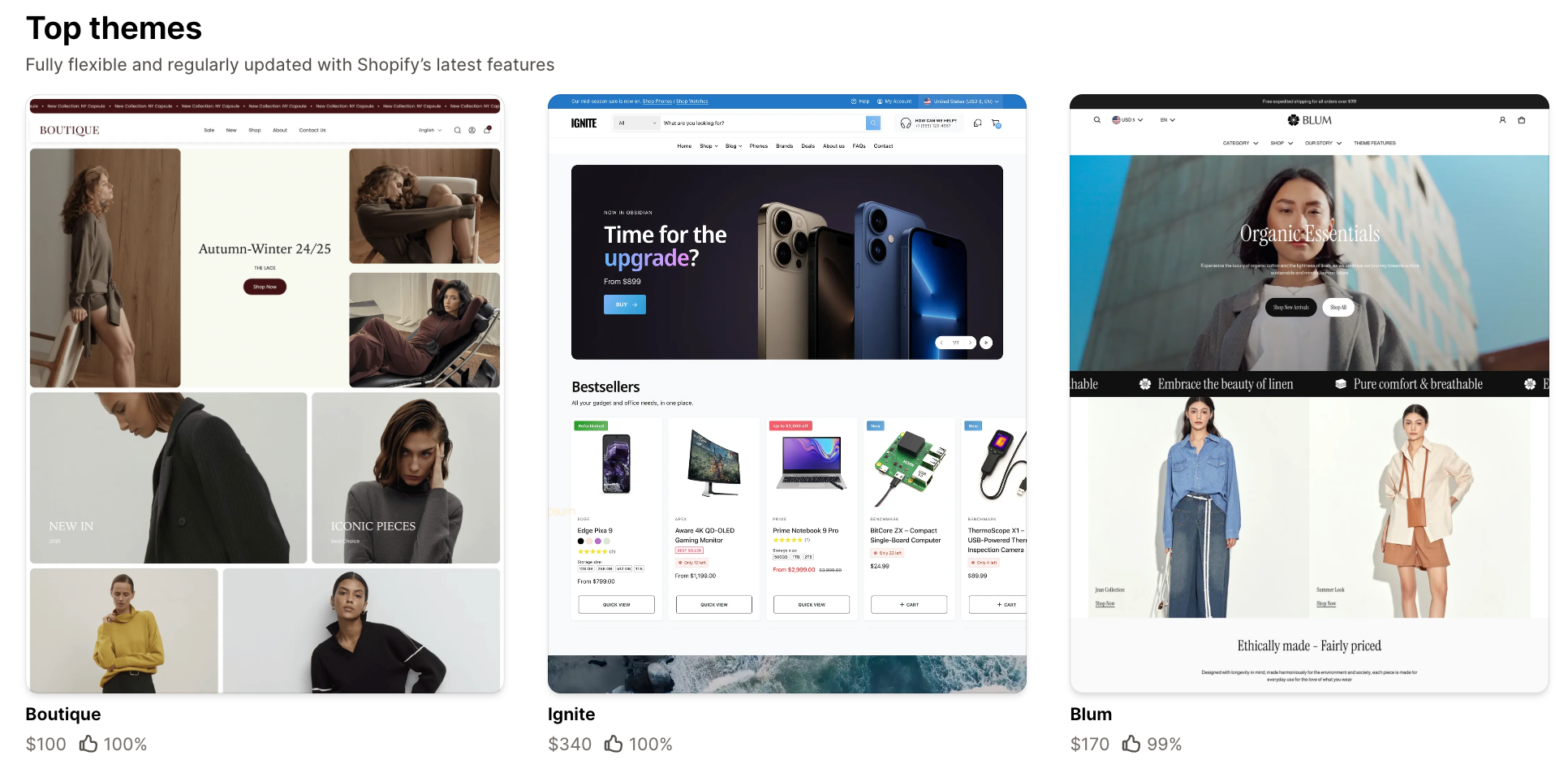
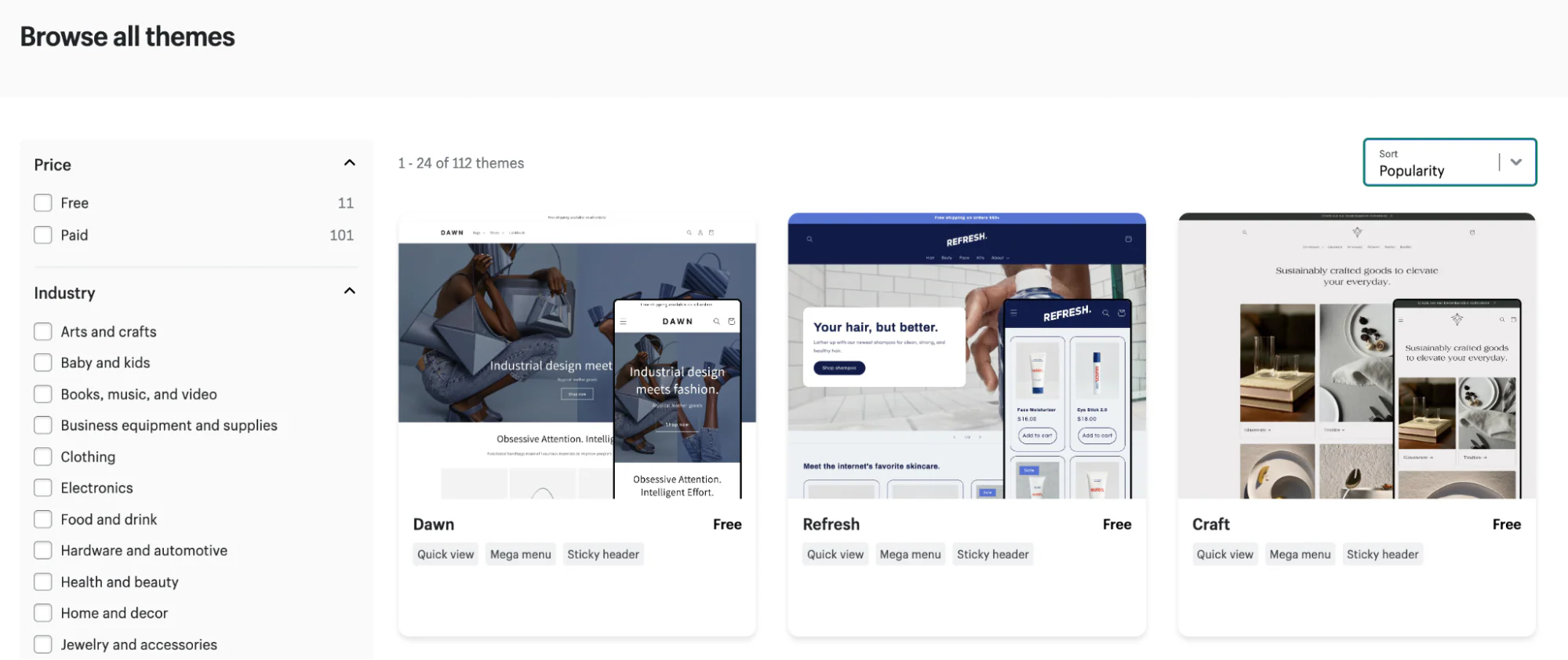
Pick complementary fonts

The quickest way to find perfect font combinations is by choosing styles within the same font family, such as Helvetica or Times New Roman. Font families have a few variations—assorted weights and styles—that already work well together.

A heavier weight font would be something like the bold version of the font for headings, while a style variation might be an all-caps version for subheads.

Font pairing with white text on a dark blue background.
Example of using one font in multiple ways, c/o Canva’s Guide to Pairing Fonts.
Pick compatible typefaces

If you’ve never worked with fonts before, here’s a quick primer on typefaces. There are a few different basic styles of text that you’ll find.

  • Serif. These typefaces, like Times New Roman and Georgia, have the little feet at the ends of letters.
  • Sans serif. These typefaces, like Arial, Helvetica, don’t have the little feet.
  • Script. These typefaces are anything that looks like calligraphy or handwriting.
  • Monospace. These typefaces have equally spaced letters, often seen in computer code. A good example is Roboto Mono.

You can pair fonts from different typefaces to get a strong contrast between them.

Combining typefaces based on contrast is great for establishing hierarchy. Contrasting typefaces makes it clear which paragraphs are headings and subheadings and which are body copy.

Hierarchy guides your customers to the most important information.

Use font sizes intentionally

Use font size intentionally to highlight what’s important and to guide users through your site. The more important your content is, the larger the font size should be.

Once you’ve chosen a font size for your body content and your headings, stick with it so your customers can easily tell what’s a headline and what’s a paragraph. Consistency makes your store easier to read and navigate—and fewer hurdles means faster sales.

3. Create templates

While it can be tempting to indulge in new fonts and colors on different pages, remember that consistency is the cornerstone of building a brand. Customers should be able to identify and navigate your store easily, and sticking to a core set of fonts, colors, and styles can go a long way toward that goal.

That’s why page templates or sections are helpful features for Shopify theme customization.

Page templates are useful for things you reuse frequently—like blog posts, landing pages, sales funnels, or even product pages. When you start with a template, you can maintain consistency as well as reduce the amount of creative brain power—and time—it takes to create each of these pages.

Sections are smaller templatized content blocks—like a contact form, call to action, or newsletter sign-up—that you plan to insert on multiple pages. You only need to update the content in that section once, and changes will automatically appear everywhere that uses that section.

To create and edit sections, go to your theme editor and click “+ Add section.” Choose a new section from the list or search for the section you want to edit. Use the ⋮⋮ icon next to drag and rearrange a section to change the order and layout of the sections on the page. Click Save when you’re finished.

4. Customize your store with Shopify apps

The Shopify App Store has more than 8,000 apps covering everything from design tweaks to advanced functionality. You’ll find apps across major categories like store design, marketing and conversion, orders and shipping, sales channels, store management, selling products, and finding products.

Within the store design category alone, you’ll find subcategories for content, design elements, images and media, navigation, site optimization, and more. It all comes down to identifying what you want to customize and then finding the app that will meet those needs.

Here are some custom changes you can make with store design apps:

  • Change your search bar. Improve search, filtering, and product recommendations; add visual search; and enhance the overall search experience with apps like Shopify Search & Discovery.
  • Add product recommendations. Suggest similar products to boost average order value. See how Thousand uses apps to do so.
  • Incorporate customer reviews. Apps like Okendo and Judge.me will help you optimize for conversions with social proof via customer reviews.
  • Build landing page templates. For more robust landing page customization and templates, use an app like Shogun, which features an easy-to-use drag-and-drop editor.
  • Customize checkout. Match the checkout experience to your visual brand and optimize it to reduce friction and boost sales. Apps like Skip To Checkout and Zipify One Click Upsell can help you do exactly that. All plans from Basic upward support standard checkout. Advanced or full checkout customization—like changing the layout or behavior—is available only on Shopify Plus.

Find the best apps for your business

Look for the Built for Shopify badge to find apps that meet Shopify’s highest standards for performance, trust, and quality. These apps deliver top-tier experiences designed to help drive your business forward.

Learn more

5. Use Shopify app embeds to add more sections

Shopify app embeds are app-provided elements that float on your storefront (like a chat bubble), or add code to your online store without being visible to your customers. They let you extend functionality without cluttering the page design.

Shopify merchant Ora Organic, for example, uses a Gorgias-powered live chat app embed, allowing users to engage with customer support while continuing their website browsing uninterrupted.

Ora Organic’s automated helpdesk powered by Gorgias.

App embeds are managed through the theme editor and work with any theme version.

Like sections, app embeds need to be set up only once. So any change you make to the app embed will automatically be reflected across every page where the embed appears.

To customize Shopify app embeds, click on “App embeds” from the theme editor. Select the app embed you want to manage (or click the search bar and enter a keyword to search through your installed apps). Click the toggle to change its status (activate or deactivate). View app embed settings by clicking the expand icon (▸) to adjust details.

Using the Shopify theme editor

The Shopify theme editor is your main design workspace. It’s where you adjust the look and layout of your store without touching code. 

Here are some helpful tips for making the most of it: 

  • Start with the homepage. Most shoppers land here first, and it sets the tone for the rest of your store. Build out your hero banner, featured products, and a call-to-action before moving onto smaller pages.
  • Think mobile-first. More than half of ecommerce traffic comes from phones. Always preview on mobile before publishing.
  • Duplicate your theme before experimenting. In Themes > Actions > Duplicate, make a backup copy before testing changes.
  • Lean on presets. Many themes (including Horizon) come with multiple polished presets you can use as a base, then refine in the editor. 
  • Watch file sizes. Shopify has a 50 megabyte limit for theme uploads and a 20 megabyte limit for individual files. For images, aim for less than one megabyte each (ideally 500 kilobytes or less) and stick to recommended formats (JPEGs for photos, PNGs for transparent graphics, and SVGs for logos/icons).
Shopify theme editor homepage with a large illustrated banner image.
On each page, you can drill down into specific sections, customizing things like the image banner, buttons, and the footer.

Accessing the theme editor

Getting into the editor is simple:

  1. Log in to your Shopify admin.
  2. Go to Online Store > Themes.
  3. Under your current theme, click Customize.

That opens the theme editor, where you’ll see a live preview of your storefront on the right and a sidebar of editable sections on the left.

Shopify’s theme editor with a list of editable sections on the left.

Key editor features and tools

Once you’re in the Shopify theme editor, here’s what you’ll be working with:

  • Sections and blocks (sidebar). Shopify themes are built in modular sections. Add, remove, reorder, or hide sections, and edit individual blocks (like buttons, images, or headings).
  • Theme settings. Control global styles, like your fonts, colors, favicon, checkout branding, and social links. Changing something here updates it everywhere.
  • Device preview. Toggle between desktop, tablet, and mobile views to make sure your design works across all screen sizes.
  • App embeds. Many apps can plug directly into the editor so you can drop features like reviews, chat widgets, or badges right into your theme.
  • Dynamic sources. Pull in product details, metafields, or other dynamic data directly into your blocks. For example, you could show shipping info or add promotional messages tied to a metafield.
  • Theme presets and styles. Some themes, including Horizon, come with multiple pre-designed “looks” (color palettes, font combinations, layouts) you can switch between for a quick starting point.
  • Language editor. Customize the default text strings that appear throughout your theme (e.g., Add to cart > Buy now).
  • Accessibility and SEO settings (in some themes). Add alt text, headings, and other optimizations to improve both usability and search visibility.

Advanced Shopify customization for developers

For brands with complex needs, Shopify offers ways to go beyond the theme editor, especially if you’re working with a skilled Shopify developer. They can go beyond the limitations of pre-designed website templates using code, APIs, and advanced customization tools. 

Shopify’s dev documentation can help developers build apps, customize themes with code, and even create a framework for headless commerce. 

Introduction to Liquid templating

Liquid is Shopify’s open-source templating language and the foundation of every Shopify theme. It lets developers create dynamic pages by pulling in content from the Shopify back end (e.g., products, collections, customer data) and rendering it in the front-end template.

With Liquid, you can: 

  • Use tags, objects, and filters to output dynamic data (e.g., {{ product.title }})
  • Build reusable snippets and layouts for consistent design
  • Create conditional logic; for example, showing a badge only if a product is on sale
  • Extend or override theme templates with custom code

For example, this simple snippet shows how Liquid can check inventory and display different elements. 

{% if product.available %}

{% else %}

Sold out

{% endif %}

Using metafields for custom data

Metafields let you store and display custom data that doesn’t fit into Shopify’s standard product fields. They extend your store’s functionality without altering the theme.

Some common use cases include: 

  • Adding size charts or care instructions to product pages
  • Storing “back in stock” dates or preorder information
  • Displaying custom icons or labels (e.g., “Vegan” or “Eco-friendly”)
  • Creating unique content fields for blog posts or landing pages

And here’s how they work: 

  • Define a metafield namespace and key in the Shopify admin (e.g., details.material).
  • Assign values to products, collections, or other resources.
  • Call the metafield in your Liquid templates.

For example, the below code pulls in a custom “material” metafield and displays it on the product page.

{% if product.metafields.details.material %}

Material: {{ product.metafields.details.material }}

{% endif %}

Your Shopify, your way

Every Shopify theme meets a high standard, packed with built-in features that let brands offer discounts, recommend products, capture emails, and do more for buyers. Plus, all themes get free updates, so you always have the latest version available.

Optimized for selling online, themes are designed to load fast, work seamlessly on mobile, and provide the best checkout experience around—all while complementing your existing brand. With the right customization, your store becomes more than a template: it builds trust and creates a shopping experience your customers return to.

Build your dream online store today

Join the ranks of the world’s best online stores with Shopify’s powerful tools and features. With the highest-converting checkout, Shopify stores sell more products, lower your costs, and save you time.

Learn more

Shopify customizations FAQ

Does Shopify allow customization?

Yes, you can customize your Shopify. Choose a theme and then navigate to the theme editor to customize settings, checkout, website design, and more.

What is Shopify customization?

Shopify customization involves making changes to the front or back end of your Shopify website. This could include design (fonts, colors, layouts), payment options and checkout process, website navigation, and more.

How do I fully customize Shopify?

You can fully customize Shopify by starting with a theme and using the theme editor for design changes. Extend functionality with Liquid code, metafields, and apps. For complete control, a Shopify developer can build a custom theme or integrate APIs to create tailored shopping experiences.

Is Shopify easy to customize?

Yes, Shopify is easy to customize. You can navigate to the theme editor to make changes yourself or hire a professional to customize your Shopify website for you.

How can I get help with customizing my Shopify store?

The Shopify Experts marketplace helps connect you with experienced web designers you can hire to give you expert guidance on your Shopify store, or even to do the design work for you.

How do you make something customizable on Shopify?

To make a product customizable, you can add options like text fields, dropdowns, or image uploads using Shopify’s built-in custom fields or product personalization apps. Developers can also use metafields or custom code to create more advanced customization options, like engraving requests or bundle builders.

Do I have to customize my Shopify store?

No, you can launch with a pre-built theme that looks professional out of the box. Customization is optional, but even small tweaks (like adding your logo, colors, and fonts) can make your store feel more aligned with your brand and improve the customer experience.

Fenty Beauty and Shop redefine traditional beauty shopping (2025)

Software Stack Editor · September 19, 2025 ·

image

Fenty Beauty shows up for their community by personalizing every touchpoint. Since the brand’s launch in 2017, they’ve set the standard for inclusivity and innovation. This May, they created the Gloss Bomb Shop and partnered with Shop to rethink the traditional beauty shopping experience.

“We’re seeing that these Shop consumers […] are super loyal. They love their reward points and exploring products on the platform,” said Sapna Shah Parikh, Chief Digital Officer SVP at Kendo Brands. “We really thought bringing the new Gloss Bomb shade exclusively to the app, along with the power of the millions of consumers on Shop, would create a win-win launch.” 

wistia-player[media-id=’q2nl93sjud’]:not(:defined) { background: center / contain no-repeat url(‘https://fast.wistia.com/embed/medias/q2nl93sjud/swatch’); display: block; filter: blur(5px); padding-top:56.25%; }

Immersive Gloss Bomb world IRL and in app 

Fenty Beauty launched the Gloss Bomb Shop powered by Shopify, an RSVP-only pop-up in New York, to celebrate their iconic Gloss Bomb products. Guests marveled at giant Gloss Bombs, enjoyed gifts with their purchases, explored content-worthy immersive rooms, and shopped the new, limited-edition Gloss Bomb shade Grape Splash.

Immediately following the pop-up, Fenty Beauty launched Grape Splash exclusively on Shop for 72 hours. Now fans who couldn’t be there IRL could experience the magic of the Gloss Bomb Shop through the digital quiz. Embodying the same larger-than-life personality as the event, the quiz asked shoppers to share their summer plans to find out what shade they should shop. Just a few questions about their style and summer plans revealed to customers the gloss that would perfectly complement their vibe.

“Being able to have the Gloss Bomb quiz on the Shop app was such a major milestone for us. Makeup is there for you to have fun with. I think this quiz is an embodiment of that, it’s why consumers are loving it so much,” shared Nanette Wong, VP of Global Brand Marketing at Fenty Beauty.

Reimagining what’s possible in shopping

Partnering with Shop meant Fenty Beauty could extend the IRL experience for anyone at the event and reach shoppers who couldn’t attend. This innovative approach to reimagining how people engage with brands and their products is central to Shop’s mission to deliver personalized shopping experiences. From a home feed that’s contextual to each shopper, to brand and product recommendations based on how they shop, and AI that’s integrated at the right step of the journey, Shop continually evolves with the cutting-edge of shopping.

“What was really great about the Gloss Bomb quiz on Shop is that it delivered this really highly personalized, curated experience for the consumer. Every consumer who went in could answer questions, and they’d get their own unique personality. This makes it even more fun to shop and feel even more connected to products,” stated Wong. 

Get lost in the gloss

This FOMO-inducing, IRL to digital launch for one of Fenty Beauty’s most popular products resulted in the brand’s highest single-day sales on Shop to date.

“We saw incredible results. The reasons why are pretty clear. You know, the experience is seamless. It’s easy to buy, it’s easy to discover, and it’s easier, it’s easy to interact,” stated Parikh.

Supporting the beauty category through a unique and exclusive Shop experience compelled shoppers to find their perfect shade and share their results with friends. As Health & Beauty is one of Shop’s most popular categories, this focus on innovative shopping experiences wasn’t only a fresh way to shop; it was a way for Fenty Beauty to connect more deeply with their community and create something that was, according to Wong, “fun, gamified, and unique […] for every Fenty fam who shopped.”

How Stratus Turned a $4000 Bet Into 10,000 Orders Shipped (2025)

Software Stack Editor · September 18, 2025 ·

When Ricky Jones first saw the prototype that would later become Stratus’s anti-fog balaclava, he was hooked. A lifelong snowboarder, he immediately understood the product’s value. A few years later, he bought the brand outright and transformed it into a fast-growing winter apparel company, shipping more than 10,000 orders and doubling revenue year over year.

Here, Ricky shares how passion, niche focus, and community helped Stratus carve out space in a crowded industry—and how financial discipline keeps it sustainable.


Turn passion into a business

Ricky grew up spending much of his free time on the slopes, so he knew firsthand how frustrating goggle fog could be. “As somebody who snowboarded three to four times a week throughout all of my teenage years, I immediately understood the solution that it solved,” he says.

Instead of jumping in blindly, Ricky spent a year and a half working for free with the brand’s founder, learning the ropes. He filled his skill gaps intentionally, working in influencer marketing, earning certifications in Facebook and Google advertising, even starting a custom footwear venture. That deliberate path gave him the confidence to eventually acquire Stratus.

Passion made the long hours bearable, but skill-building turned that passion into a profitable business.

Man in ski apparel on mountain
Stratus is committed to reducing its environmental impact, from mindful packaging to designing products built for longevity on the mountain. Stratus

Embrace the power of a niche market

At first glance, building a brand around balaclavas and ski masks might seem narrow, but Ricky saw the upside. As he explains, “Niche is really great in the smaller stages of your business. And you can always expand your product line to have a broader offering.”

Rather than diluting Stratus’s identity with a wide assortment right away, he leaned into a single solution-oriented product. That clarity made it easier to acquire early customers and create targeted ad campaigns.

Big apparel companies often overlook low-ticket categories, so Stratus had room to design a more thoughtful product. By staying laser-focused on a single need, the brand built credibility and momentum without competing directly with industry giants.

Ricky’s strategy is a reminder that what looks like a limitation can actually be a launchpad—a clear solution-oriented niche provides the sharp edge you need to win your first customers and grow from there.

Building an authentic community

For Ricky, growth wasn’t just about running ads—it was about meeting customers where they were—on the mountain. “I really believe in getting into the epicenter of the community, both geographically as well as with your marketing,” he says.

Stratus built trust by hanging out at local ski shops, skiing with staff, and connecting with “ski bums” who might not have big followings but hold deep influence in their communities. That grassroots credibility made larger influencer partnerships more effective without alienating core fans.

The lesson for other founders is clear: Embedding authenticity in your community—whether ski shops, maker spaces, or local events—creates loyalty that outlasts any ad campaign.

Image of anti-fog ski mask
Stratus balaclavas are designed to reduce goggle fog while keeping your face warm in cold conditions. Stratus

Operational discipline fuels growth

Seasonality poses a unique challenge for Stratus in that every winter requires big bets on inventory. Ricky approaches this with rigor. “I really believe that founders should have a tight grip on their finances and on their financial documents and projections,” he says.

He works with factories to stagger shipments and reduce cash flow strain. He also recommends new founders learn financial basics, experiment with AI tools for education, and partner with a professional accountant to build robust forecasting models.

Growth may start with passion and creative marketing, but it’s sustained by financial discipline. Strong forecasting and careful risk-taking give a brand the stability to keep scaling.

Formerly known as North45, the brand reintroduced itself as Stratus to better reflect its connection to the environment and its vision to “rise above”. Stratus

Stratus’s journey proves that a brand doesn’t need to dominate every category to grow. By combining passion, niche focus, community trust, and operational discipline, Ricky built a business that resonates with athletes and casual adventurers alike. As he puts it, “If you’re going to launch a company, you should be living and breathing your niche before trying to launch a business in it.”

For more insight on how to navigate a niche market, check out the full interview with Ricky Jones on Shopify Masters.

The Best Thermal Label Printers for 2025: A Buyer’s Guide

Software Stack Editor · September 18, 2025 ·

.tg {border-collapse:collapse;border-spacing:0;}
.tg td{border-color:black;border-style:solid;border-width:1px;
overflow:hidden;padding:9px 15px;word-break:normal;}
.tg th{border-color:black;border-style:solid;border-width:1px;
font-weight:normal;overflow:hidden;padding:9px 15px;word-break:normal;}
.tg .tg-wp8o{border-color:#000000;text-align:center;vertical-align:top}
.tg .tg-wkkj{background-color:#efefef;border-color:#000000;
font-weight:bold;text-align:left;vertical-align:top}

Clear, scannable labels keep your business moving behind the scenes. They get parcels out the door faster, help staff ring up sales quickly, and keep inventory accurate across channels. 

Thermal printers handle this work in seconds, producing sharp labels without smudges or messy ink cartridges. Because these printers use heat instead of traditional ink, they’re more reliable and cost-effective—making them a smart investment for growing retailers. 

Ahead, you’ll learn about the best thermal label printers for 2025, plus a buying guide to help you choose the right one for your business.

Check out Shopify’s thermal printers

Get everything you need to sell online and in-store with Shopify’s collection of thermal label printers, card readers, and other POS accessories.

Shop now

How does thermal printing work? 

Think of thermal printers like a cash register receipt printer—they use heat instead of ink to create text and images. Two technologies are commonly used:

  1. Direct thermal: Heat reacts with specially coated labels to produce text and barcodes. 
  2. Thermal transfer: Heat melts ink from a ribbon onto labels for longer-lasting results.

Both methods deliver fast, quiet prints with few moving parts and no messy ink cartridges.

Direct thermal vs. thermal transfer: What’s the difference?

Overall, direct thermal printing is for cost-sensitive, short-term labels. They are affordable, easy to set up, and require minimal maintenance. For example, an apparel boutique prints same-day shipping labels for online orders, which then travel with the parcel for a few days before being discarded. 

Thermal transfer is better for durable labels that withstand sunlight, moisture, and rough handling. They are more expensive, but the labels last longer. As an example, a specialty food store may tag frozen meals with durable plastic labels that are scannable through freezer storage, transport, and in-store display. 

Here’s a more detailed look at the differences between each:

1. Direct thermal printing 

  • Prints on chemically treated labels that darken when heated.
  • Hardware is compact and low-maintenance (no ribbons).
  • Labels cost a bit more, fade over time, and are vulnerable to sunlight, abrasion, moisture, and chemicals.
  • Ideal for short-life labels (under six months), such as shipping labels, tickets, receipts, and perishable goods tags.

2. Thermal transfer printing

  • Uses a wax or resin-coated ribbon. The heat fuses the ink to paper, polypropylene, polyester, and other media. 
  • Produces a crisp and durable print that withstands UV, moisture, and chemicals. 
  • Ideal for long-term labeling like cold storage items, asset tags, and outdoor signage.

Choosing between them depends on your business: if you need quick, low-cost shipping labels, direct thermal is enough. If your products need durable labels that last through storage or handling, thermal transfer is worth the investment.

Benefits of using a thermal printer for your business

Thermal printers offer practical advantages that can save money and keep operations running smoothly. Here are a few of the most significant ones.

  • Low costs: Thermal printers don’t rely on ink or toner to print—and require fewer ongoing supplies—which keeps costs low. 
  • Quality results and speed: Many thermal printers offer print speeds between 2 and 8 inches per second (ips), far faster than typical inkjets. You can print over 72 high-clarity labels per minute—ideal for shipping and checkout. 
  • Portable and energy efficient: Thermal printing iscompact, quiet, and energy-saving, which works great for use at the counter or on the go. 
  • User-friendly: Thermal printers have a simple, user-friendly setup that requires minimal maintenance, which means less downtime for staff. 
  • Durable design: Fewer moving parts means fewer things break, making them easier to maintain. Printheads often last up to 10 years. 

The best thermal label printers

Printer Best for Price
DYMO LabelWriter 5XL High-volume shipping $209
Zebra ZD421 Moderate volume cycles $499
Rollo Wireless Wi-Fi label printing $259
Brother QL-1110NWB Shopify POS labels $339
NELKO PL70e Bluetooth printing $109
Zebra ZSB 2” Home offices $88.88
Polono PL60 Budget-friendly $80
MUNBYN RealWriter 403B Mobile versatility $84.99

A thermal label printer is a necessary investment for many businesses. For high-volume work and compact models, these are the top performers that deliver on speed, quality, and reliability:

1. DYMO LabelWriter 5XL

Best thermal label printer for high-volume ecommerce and shipping needs

The DYMO LabelWriter 5XL on a white background.
Shopify

Specs:

  • Size: 7 x 5.5 x 7.375 in
  • Weight: 4.9 lbs (2.2 kg)
  • Printing method: Direct thermal
  • Label size:  4 x 6 in (can print 4 x 8 in)
  • Print resolution: 300dpi
  • Connectivity: Ethernet port
  • Compatibility: Windows, Mac

The DYMO LabelWriter 5XL shipping printer is remarkably easy to set up and use, hitting a sweet spot of print quality, speed, and reliability that most printers can’t match. Its compact, modern design helps it stand out from competitors, and it’s plenty fast at 300dpi with 65% less label waste, which saves you money.

The printer automatically identifies DYMO-branded labels and displays label type, size, and remaining quantity. You’ll get clear, high-quality labels that are extremely easy to peel off and use in any application.

Setup is quick and simple. Once you download the DYMO Connect software, connect your label printer to a power outlet and plug it into a computer to get started. 

The DYMO 5XL LabelWriter works with a wide range of online shipping services, marketplaces, and ecommerce platforms, including UPS, DHL, USPS, FedEx, Shippo, Easyship, Amazon, Poshmark, eBay, and Shopify. This makes it ideal for owners with high-volume ecommerce shipping needs, where speed and cost efficiency directly impact margins.

Pros:

  • High-quality prints
  • Fast
  • Portable 
  • Easy setup 
  • Very intuitive 
  • Swaps label rolls between formats in seconds
  • Prints precise label quantities with ease

Cons:

  • Comparatively bulky to similar thermal printers.
  • Doesn’t print non-DYMO labels.
  • Some users say it jams easily.
  • Doesn’t work with mobile devices.
  • No USB or Bluetooth connectivity.

Price: $209.00

2. Zebra ZD421 Label Printer

Best for moderate-volume printing across retail or warehouse settings

The Zebra ZD421 Label Printer on white background with shadow.
Shopify

Specs:

  • Size: 8.69 x 6.98 x 5.93 in
  • Weight: 3.6 lbs (1.63 kg)
  • Printing method: Dual thermal (direct thermal/thermal transfer)
  • Label size: 4x 6 in 
  • Print resolution: 203dpi (300dpi optional)
  • Connectivity: USB, Ethernet
  • Compatibility: Windows, Android, or iOS

The Zebra ZD421 label printer has a rugged clamshell design for durable, reliable printing.

One thing that sets it apart is its dual thermal printing technology: you can print using direct thermal technology or via thermal transfer. 

It’s loaded with features, like a preinstalled tag cutter and innovative receipt, label, and tag-handling capabilities. Not to mention its fast print speeds, top print quality for different label types, and has Energy Star certification.

It also supports multiple languages and fonts, giving businesses the flexibility to design labels that match their brand identity.

Pros:

  • Easy to use
  • Lightweight and durable
  • Portable 
  • Energy efficient
  • Cost-effective 

Cons:

  • Expensive
  • No Wi-Fi connectivity
  • Limited resolution doesn’t support fine print

Price: $499.00

3. Rollo Wireless Thermal Printer

Best for retailers who need fast, wireless thermal label printing

White and purple Rollo printer on white background printing a label.
Rollo

Specs:

  • Size:3 x 7 x 3.5 in
  • Weight: 3.39 lbs (1.537 kg)
  • Printing method: Direct thermal
  • Label size: 1.57 to 4.1 in
  • Print resolution: 203dpi 
  • Connectivity: Wi-Fi, USB, AirPrint-enabled
  • Compatibility: Windows, Mac, iOS, Android, Chromebook, Linux

The Rollo wireless thermal printer is purpose-built to print wirelessly. 

Its setup process is intuitive and you can integrate the device into your workflow with remarkable ease. Setup is simple: connect via USB, then print wirelessly over Wi-Fi. 

While Rollo uses a patented design to print labels, its cumbersome and clunky plastic tray means it can’t quite land the printer a top slot. That said, it doesn’t require proprietary labels and generates crisp, clear prints at an impressive 150 millimeters per second or one 4 x 6 inch label each second. 

Like Zebra printers, Rollo offers a custom label maker with its app. The app lets you create barcodes, product labels, QR codes, thank you stickers, and more.

For a more streamlined and cost-efficient process, Rollo offers a complimentary Ship Manager app. It connects to any ecommerce platform and automatically imports and groups orders from stores and is compatible with all marketplaces, including Amazon, eBay, Etsy, and Shopify.

Rollo is also compatible with all major shipping platforms, including UPS, FedEx, USPS, ShipStation, and Shippo. It’s a good fit for businesses managing orders from multiple marketplaces.

Pros:

  • Compatible with all major operating systems
  • Works with most thermal labels
  • Compatible with all marketplaces
  • Doesn’t require any driver installations

Cons:

  • No Bluetooth connectivity
  • Requires Rollo app

Price: $259.00

4. Brother QL-1110NWB WiFi Label Printer

Best for retailers using Shopify POS to manage shipping and fulfillment

The Brother QL-1110NWB Label Printer on white background
Shopify

Specs:

  • Size: 6.70 x 8.75 x 5.95 in
  • Weight: 3.83 lbs (1.735 kg)
  • Printing method: Direct thermal
  • Label size:  4 x 6 in (prints up to 4.1 in wide labels)
  • Print resolution: 300dpi
  • Connectivity: USB, Wi-Fi, LAN/Ethernet, Bluetooth
  • Compatibility: Windows, Mac, iOS, Android

The Brother QL-1110NWB is easy to assemble, set up, and operate. To get running, simply download the printer driver from Brother, install it on your computer, and configure your label size. Then, drop in the tape rolls and the printer will automatically detect the size and auto-adjust the onscreen template before printing the labels.

It’s a fast and efficient printer, capable of meeting the demands of today’s ecommerce businesses thanks to its ability to print 69 high-quality labels per minute. This also reduces the time spent waiting for labels for a smooth operation. 

An automatic cutter handles large print jobs, producing clean labels for shipping products to customers. This also makes it an excellent hands-free option if you have your hands full during your project. And with its automatic crop function, you can easily print product and barcode labels on any network with no wastage. 

The wide-format label printer costs more than other options on this list, in part because it offers a variety of connectivity options—Bluetooth, USB, and W-iFi. It also works with iOS and Android operating systems rather than just Windows and macOS.

The Brother QL printer also works seamlessly with Shipping functions on Shopify. For fulfilling orders from a warehouse, pair the printer with your computer to print from the Shopify admin. For fulfilling orders from your retail store, this printer can be paired with Shopify POS on an iOS or Android device in order to turn your stores into mini fulfillment centers.

Pros:

  • Lightweight and portable 
  • Sleek, compact design
  • User-friendly 
  • Crisp, clear, high-quality label prints
  • Lightning-fast speeds
  • Quiet and efficient 
  • Durable and reliable
  • Works with Shopify POS for fulfillment from a retail store

Cons:

  • Occasional issues with connectivity
  • Pricier than similar options 

Price: $339.00

Best budget-friendly thermal printers

Getting your business off the ground doesn’t always mean a huge investment in equipment. There are more affordable options that you can start on without breaking the bank.

5. Zebra ZSB 2” Wireless Label Printer

Best for small businesses and home offices with light shipping needs

The Zebra ZSB 2” label printer on a gray background.

Specs:

  • Size:5.14 x 7.17 x 5.04 in
  • Weight: 1.8 lbs (0.81 kg)
  • Printing method: Direct thermal
  • Label size: 2 in
  • Print resolution: 300dpi 
  • Connectivity: Wi-Fi, Bluetooth, compatible with Apple Airprint and Android PrintService
  • Compatibility: Windows, Mac, Android, and iOS

The Zebra ZSB 2” is a wireless label printer with a compact design that’s functional, yet fashionable. 

If you run your business from a home office, this printer is an excellent choice. Because of its small size, it weighs less than a kilogram and takes up little space on a desk or bookshelf. Plus, it offers great printing quality and reasonable running costs for small business and home office needs. 

Setup is smooth and intuitive. Simply power on the printer, scan the QR code on the automatically printed label to download the ZSB Series app, then follow the guided setup to connect to your printer. You can use Zebra’s Label Designer tool to create your own label designs before printing.

The ZSB 2” works exclusively with eco-friendly compostable ZSB Series label cartridges and prints up to 73 clear, crisp, high-quality prints per minute. Using the ZSB app, you can easily see the remaining number of labels and the current label cartridge size. 

Like most thermal printers, the ZSB 2” works with shipping and ecommerce platforms, including Shopify, Amazon, eBay, Etsy, UPS, FedEx, USPS, and more. It’s also compatible with Google Contacts and Microsoft Office, so you can seamlessly import data to use with your labels on your computer.

Pros:

  • Compact and lightweight 
  • High-quality output
  • Variety of label formats
  • Compatible with major ecommerce and shipping platforms

Cons:

  • Lacks USB connectivity
  • Requires Zebra mobile app and label cartridges

Price: $88.88

6. NELKO PL70e Bluetooth Thermal Printer

Best for businesses that want quick Bluetooth thermal label printing at a low cost

Image of NELKO PL70e thermal label printer.
NELKO

Specs:

  • Size:9 x 5 x 6 in
  • Weight: 3.08 lbs (1.4 kg)
  • Printing method: Direct thermal
  • Label size: 1.54 in to 4.1 in
  • Print resolution: 203dpi 
  • Connectivity: Bluetooth, USB 
  • Compatibility: Windows, Mac, Android, iOS, Chromebook, Linux

The NELKO PL70e makes a good impression right out of the box, starting with its stylish, streamlined appearance. 

Once installed, it continues to impress, cranking out up to 72 clear 4 x 6 inch labels per minute, thanks to its advanced thermal direct technology, which makes it a capable thermal printer for all your daily printing needs. Overall print quality is very good: graphics look vibrant and crisp, while text appears dark and uniform.

The PL70e measures 9 x 5 x 6 inches, which is a fairly compact footprint, but might overwhelm a small desk. You can use fanfold and roll labels ranging from 1.54 to 4.1 inch wide and print labels for virtually any platform, including Amazon, Poshmark, eBay, Shopify, UPS, USPS, Etsy, and more.

NELKO’s setup guide is easy to follow and the overall setup process is about as simple as it gets using the Nelko app, which is available in app stores. Using Bluetooth connectivity, you can connect the printer to a computer or mobile devices. USB connectivity is also available, but only for computers.

Overall, the PL70e is a superb thermal printer that combines stylish looks with fast, high-quality printing. In a perfect world, it would have a feeder tray and support iMacs, but otherwise it’s easy to recommend as a standout in a sea of label printer options. Its simple setup and Bluetooth connectivity make it ideal for retailers who need mobile flexibility without investing in higher-priced models.

Pros:

  • Fast, high-quality printing
  • Works with all major operating systems
  • Compatible with all marketplaces

Cons:

  • No Wi-Fi connectivity
  • Requires the Nelko app to connect

Price: $109.00

7. Polono PL60

Best for new businesses seeking an entry-level thermal printer

The Polono PL60 label printer on a white background with power light on.
Amazon

Specs:

  • Size: ‎6.18 x 6.18 x 10.91 in
  • Weight: 4.95 lbs (2.24 kg)
  • Printing method: Direct thermal
  • Label size:1.57 to 4.65 in
  • Print resolution: 203dpi 
  • Connectivity: USB 
  • Compatibility: Windows, Mac

The Polono PL60 is a budget-friendly option, but it’s much heavier, at almost 5 pounds. So, it’s not really a carry-it-around style printer.

Setting up the PL60 is quick and easy. It also comes with a smart feature that automatically and accurately adjusts label positions and a smart auto-feed function that reduces waste and improves alignment. It prints quietly and fast, firing out 72 high-quality labels per minute, which improves work efficiency and saves you time. 

The printer supports label widths ranging from 1.57 to 4.65 inches and is compatible with all major shipping and ecommerce platforms, including Shopify, eBay, DHL, USPS, FedEx, Amazon, and Etsy. It’s a solid starter choice for newer retailers who want reliable shipping labels without a big upfront spend.

Pros:

  • Fast printing
  • Good quality
  • Quick install and setup

Cons:

  • Not wireless
  • Requires a printer driver

Price: $80

8. MUNBYN RealWriter 403B

Best for retailers that need a portable Bluetooth printer for labeling on the go 

MUNBYN RealWriter 403B printer on white background with Bluetooth symbol.
MUNBYN

Specs:

  • Size: 7.32 x 3.58 x 3.62 in
  • Weight: 1.5 lbs (0.68 kg)
  • Printing method: Direct thermal
  • Label size: 1.57 to 4.3 in
  • Print resolution: 203dpi
  • Connectivity: Bluetooth, USB
  • Compatibility: Windows, Mac, iOS, Android, ChromeOS

The MUNBYN RealWriter 403B is a user-friendly thermal printer for small businesses. It offers Bluetooth and USB connectivity, so you can print from your smartphone, tablet, or computer. 

Setup is quick and easy with integration for major platforms like FedEx, UPS, and Shopify. For mobile use, the MUNBYN Print app offers a large library of templates and design elements like stickers and fonts.

One feature that makes MUNBYN unique is its built-in chip which calibrates and adjusts label positions automatically. Labels come out more aligned, so prints look professional every time. Operating at about 60 decibels, this printer is quiet and compatible with a range of label sizes. 

With its light weight and mobile app, it’s a good fit for sellers who print labels at markets, popups, or small warehouse spaces.

Pros:

  • Wireless printing via Bluetooth
  • Fast printing speed (150 mm/s)
  • High-quality, clear prints
  • Easy to set up and use
  • Broad compatibility with various devices and platforms
  • Feature-rich mobile app

Cons:

  • Mobile app can have a learning curve
  • Requires an external label holder

Price: $84.99

How to choose a thermal label printer

Choosing the right thermal label printer depends on your business needs. Below are some of the key factors to weigh before you invest:

Print quality and resolution

A good, reliable thermal label printer has a sufficiently high resolution—at least 203dpi—which results in high-quality, professional-looking labels. For best results, use quality thermal printing materials tested for print quality, adhesive strength, chemical resistance, and printer wear and tear.

Printing speed

If speed is essential to you, you’ll want a label printer with a high output-per-minute rating. But keep in mind, these speeds are based on optimal conditions. 

Other variables that may affect print speed include the age of the printer, choice of label, color or black ink printing, printer settings, image size, and print resolution or quality.

Label sizes

Most thermal printers support 4 x 6 inch labels, which is standard for shipping platforms and marketplaces. However, some printers, like the Brother 1110NWB, offer wider-format label printing. Consider printer options offering label dimensions that match your sizing needs.

Connectivity 

Most thermal label printers connect via USB to Windows or Mac computers. However, if you rely on Linux, Chromebooks, or want to print labels from a mobile device, look for models with Wi-Fi, Bluetooth, or Ethernet ports. 

You’ll also want to consider if a label printer can connect to your POS device to unify your operation, like the Brother QL printer connects with Shopify POS. 

Ease of use

You don’t want to deal with a label printer that’s hard to figure out. Look for choices that are easy to install, set up, use, and troubleshoot. Watch for connection, print speed, label waste, and how intuitive the printer connection app is to use without extensive training. 

Durability

With fewer moving parts, thermal label printers are built to last—many printheads run for years (10 years on average) with minimal maintenance. 

All you need to change is the label—no costly cartridges or toner subscriptions. Look for models with a sturdy build that won’t easily break when accidentally dropped or placed in warehouses and rough field environments.

Total cost of ownership

The best thermal label printers vary in price. With discounts and coupons, you can find one for less than $100, while others can cost up to $500. 

Besides the price of the printer, you’ll also need to consider running costs, like thermal ribbons, label rolls, and whether you’re locked into buying proprietary supplies. 

Once you identify a thermal printer you like, check similar models from other manufacturers to compare the cost difference.

💡Ready to buy a thermal label printer? Get one of our top picks available in the Shopify Hardware Store.

Thermal printed labels beat Sharpie scribbles every time

A reliable thermal label printer is simple to use, affordable, and produces clear, professional-looking labels. That professionalism and reliability matter, especially when shipping packages to customers or organizing stock. 

Ultimately, the right one for your business will depend on your specific needs and priorities. Weigh the pros and cons of each model against your volume, workflow, and platform needs.

Start selling in-person with Shopify POS

Shopify POS is the easiest way to start selling in-person. Take your brand on the road and accept payments, manage inventory and payouts, and sell everywhere your customers are—farmer’s markets, pop up events and meetups, craft fairs, and anywhere in between.

Discover Shopify POS

Thermal label printer FAQ

Is it worth buying a thermal label printer?

Absolutely. A thermal label printer is fast, generates high-quality labels, cheaper to use owing to its ink-free technology, easier to maintain, and durable. This combination makes it a smart investment for any retail or ecommerce business.

What is the best thermal transfer label printer?

The Zebra ZD421 is a top choice for a thermal transfer label printer. It’s lightweight, durable, and reliable, with features like a built-in tag cutter and flexible label-handling. Plus, it offers fast print speeds, high-quality output for different label types, and supports multiple languages and fonts for various labeling applications.

Do you have to buy ink for a thermal label printer?

No. Thermal label printers don’t need ink or toner. Instead, they use heat—either directly on treated labels or on a ribbon that transfers ink onto the label surface. 

What is the real lifespan of a thermal printer?

The lifespan of a thermal printer is 2-35 years, depending on the printing method it uses. Direct thermal printing can last anywhere from 7 to 25 years, while thermal transfer printing can last anywhere from 2 to 35 years. Regular cleaning, correct heat settings, and using media that matches the printer’s specs can add several years to that service life.

Can I use any brand of labels with my thermal printer?

Most direct thermal and thermal transfer printers accept third-party labels as long as the label size, core diameter, and material match the printer’s specifications. 

But, some models, like DYMO and Zebra ZSB, use proprietary label cartridges or rely on label recognition chips, so mixing brands may result in compatibility errors or void the warranty.

What’s the difference between a shipping label printer and a barcode label printer?

A ”shipping label printer” usually refers to desktop thermal models built for printing standard 4 × 6-inch courier labels from ecommerce platforms. A “barcode label printer” often means industrial or mid-range units that create smaller, high-precision barcodes for inventory, shelf, or asset tags. They often support higher resolutions and more durable ribbon materials.

Guide to Building a Strong Personal Brand on LinkedIn (2025)

Software Stack Editor · September 18, 2025 ·

What if you could offer your brand’s value proposition to one billion people all at once? By building a strong personal brand on LinkedIn, you’re throwing open the doors to potential engagement with the platform’s one billion members.

According to Semrush, LinkedIn saw 1.77 billion visits in February 2025 alone. More than 80% of business-to-business (B2B) social media leads come from LinkedIn and 63% of marketers rate LinkedIn as the most effective platform for B2B marketing. 

Today’s entrepreneurs know building a personal brand on LinkedIn is not simply a “nice-to-have”—it’s a necessity for establishing yourself as an expert in your field and building lasting connections with your audience. But how do you start?

Ahead, find out what it takes to build your LinkedIn personal brand, see inspiring LinkedIn personal branding examples, and learn how to overcome challenges in pursuit of building an authentic personal brand. 

Why personal branding matters on LinkedIn

A personal brand helps build credibility and trust, supports relatability, and sets you apart from your contemporaries. When people resonate with your story as a small business owner, they’re more likely to buy from you and may even recommend your brand to others: data shows 70% of consumers report feeling more connected to a brand when its founder is active on social media platforms.

Although entrepreneurs may assume they need to announce something monumental before they take to LinkedIn, that couldn’t be further from the truth. If you’re starting out, sharing your journey, your wins, and your struggles helps your audience connect with you on a deeper level. Just remember to show your authentic self. Your content doesn’t have to be perfect. It only has to express the real you. Research shows customers crave and value authentic conversations. One NIH study displays a positive correlation between a founder’s perception as agreeable and open with a 5% higher likelihood of attracting funding.

How to differentiate founder-led content from brand-led content

If you run a commerce business and only post on your brand’s LinkedIn page, you’re missing out on an opportunity to directly connect you with your audience. As a founder, posting on your personal LinkedIn increases your visibility while also driving website traffic. And, it can generate sales for your business. 

The impact of sharing content on your personal LinkedIn profile is powerful: 88% of marketers say their audience views personal branding as more genuine than corporate content. Moreover, 69% of consumers trust small businesses more if their founder is posting on social media.

Your brand’s page and your content serve different purposes. While your brand’s page focuses on showcasing your products, your personal content highlights your humanity. “Personal branding is the intentional creation of a brand that is distinctly you. And that carries authority, builds trust with your customer, and feeds into direct business goals,” says Shoaib Ahmed, a LinkedIn expert with more than 56,000 LinkedIn followers. 

For example, your streetwear brand can post photos of a new t-shirt launch while you, as the founder, can share the story behind the designs or the challenges faced during production. Personal storytelling adds emotional depth and can make the launch memorable for readers.

How often should you post to LinkedIn to reinforce your personal brand?

While experts suggest posting on LinkedIn up to five times a week, quantity should not be prioritized over quality. If you post one high-value post per week, that is better than five hasty posts that generate little to no value (and likely will garner little to no engagement). 

“Start with one to two posts a week and build a scalable system that allows you to then scale that up to five posts a week,” says Shoaib. “Don’t just post (or) throw stuff at the wall. Instead, start small, analyze what’s working … and then scale up when you’ve built the confidence and you are writing quality content. It’s always better to be quality driven than quantity.”

What are the types of content that can help you build a strong personal brand on LinkedIn?

There are primarily four types of posts you can create for your LinkedIn content strategy. They fall into four pillars: attraction, authority, affinity, and action. Each content pillar serves a specific purpose. “Attraction” content is optimized for search and sharing, “authority” content positions you as a thought leader, “affinity” content builds emotional connection, while “action” content drives conversions. 

Not sure what to post? Here’s a breakdown to help you get started:

Personal stories

Taking your audience through your journey and sharing personal snippets about your life—such as pivoting careers, bootstrapping the business, or navigating through failures—help build affinity and create an emotional bond with your audience.

Personal storytelling is a great way to help your audience connect with the person behind the brand. For example, the Original Duckhead umbrella was founded in 2012, but it was based on the stylish hand carved duckhead handle umbrella founder Morgan Cros remembered her mother used on rainy days when she was a child.

In this LinkedIn post, Connie Lo, co-founder of Three Ships, shares a powerful personal milestone of finally pitching on Dragons’ Den after manifesting the moment as a teenager. Coupled with a photo of her and her co-founder pitching on the show, her story gave an insight into her personal ambitions and garnered more than 2,200 likes.

Behind-the-scenes (BTS) moments

Launching a new product? Write about it—the good, the bad, the research that shaped it, and the challenges you faced along the way. Sharing unpolished, everyday moments helps build affinity and increases your personal brand’s authenticity. 

Let’s say you’ve been gearing up to fulfill a massive ice cream order for an event but, as the big day arrives, your freezer breaks down. You could write about how you navigated this hurdle. Did you scramble to find a backup freezer? Did it delay the delivery? How did you handle the pressure? Stories like these humanize your brand and allow audiences to share in the ups and downs of your journey.

In this LinkedIn post, Kathryn Kavner Woolf, founder of Heyday Canning Co. shares the story behind launching a scented candle.

Gymshark founder Ben Francis shared a collage of nostalgic photos as part of a LinkedIn post because it captures moments of his days as an entrepreneur. The images included those of him wearing a medieval costume, packing Gymshark products, and working in front of his computer. The post’s relatability lay in the reflection that being a founder is made up of many small moments. It’s something that resonated with his audience, garnering more than 6,000 likes

LinkedIn collage of images of Ben Francis as he has a busy work day. It has high engagement of over 6000 likes, 127 comments, and 32 reposts.

Educational and expert driven content

Sharing your take on social media trends, offering expert advice or teaching through examples establishes your authority and positions you as a trusted thought leader. 

Suppose you have a chocolate brand and spot a new chocolate trend blowing up on another social media channel, such as TikTok. You could write posts analyzing the potential of this chocolate and advising on different types of cocoa if someone wants to try making it themselves. This kind of content sparks conversation, boosting your visibility on LinkedIn.

Client stories and testimonials

Highlighting positive reviews, testimonials, and client success stories is a powerful way to showcase the tangible value your brand delivers. Testimonial type content like this, inspires the audience to take action and drives conversions through sales and leads.

For example, if someone praises your skin care brand’s sunscreen for how smoothly it glides on the skin, you could post that screenshot on your LinkedIn and share the story behind the product: the months you spent in the lab, collaborations with chemists, and the care that went into formulating the perfect sunscreen. 

Khulan Davaadorj, founder of Lhamour, a skin care brand, shares the story of a customer, who soothed her sensitive skin with the brand’s healing balm. 

What type of storytelling format works well on LinkedIn?

From carousels and videos to image posts and long-form articles, each format on LinkedIn has its own strengths. “There’s not one format that works better than others,” says Shoaib. “Try different formats, experiment and see what is helping you achieve your goals and then do more of that.” 

See which format works best for your next LinkedIn post:

Carousel posts

LinkedIn carousels let you share multiple images in one post through a slide-by-slide layout. Carousels are perfect for breaking down complex information, sharing a story in chunks and guiding your audience through a clear, visual flow. 

For example, if you want to share your creative process of making a vanilla-scented candle from scratch, you can easily do it through carousels. On the first slide, you can highlight which beeswax you use and on the following slides, you can show how you melt the wax, add the vanilla fragrance, pour it into container molds, and let it cool. Simply break down each step of the process into its own slide and you will get a captivating carousel.

Image based posts

Imagine reading a plain text post about an entrepreneur speaking at a conference. The words might be captivating but visually bland. Now add a photo of them on stage and the post instantly becomes much more engaging and scroll-stopping.

Images are a great way to add context, emotion, and depth to your content. Need to simplify complex data? Add a colorful infographic. Want to showcase glowing product reviews? Share screenshots. Want to reveal the behind-the-scenes of your creative process? Include photos of your workspace.

Images also take up more space on mobile screens, boosting their chances of being noticed. “If you have a text-based post and the post on the newsfeed before yours and after yours is an image…your first two lines are…sandwiched between two visuals [so no one will notice your content],” says Shoaib, highlighting the importance of imagery in posts. 

Videos

According to LinkedIn’s own data, video posts drive five times more engagement than static posts. Whether explaining complex concepts or showcasing product demos, videos are a powerful medium to connect with your audience.

“(Videos) are a great way to build trust and credibility, because people can see you talk about topics that you’re passionate about, and that carries a different kind of weight,” Shoaib says. “They feel like they get to know you, so that can help be helpful for conversions.” Your LinkedIn video can be up to five gigabytes in size and should be between three seconds and 10 minutes long.

In this LinkedIn post, Dorian Morris, founder of Undefined Beauty, shares a video of her mother using the brand’s products, offering a relatable, real-life demo on mature skin.

Blog posts

Blog posts on LinkedIn allow you to dive deeper into a topic. Long-form writing allows you to provide additional value to an audience that wants more than just quick updates.

For example, if you run a chocolate brand, you can write a blog post about your journey of sourcing cocoa. It’s an opportunity to show how you conduct research on ethical practices to select the right suppliers to manage the challenges of consistent supply. This type of content gives readers insight into your expertise. 

What are some common challenges of building a personal brand on LinkedIn?

If you’re starting out, building a personal brand on LinkedIn can make you feel vulnerable. Putting yourself out there can be intimidating, especially when balancing multiple responsibilities as a founder. While these doubts are common, you shouldn’t let them discourage you from building your personal brand. Below, find some tactics for overcoming the most common challenges small business owners face on LinkedIn.

Staying consistent with posting content

You start strong with a few great ideas and aim to post five times a week. But as time goes on, your ideas either run dry or you start feeling overwhelmed. Those five posts drop to two and then to none.

The key to posting consistently on LinkedIn isn’t about forcing yourself to write more—it’s about building a solid system that focuses on the following:

  • Batch creation: You don’t have to create content daily. Instead, dedicate a specific day and time each week to focus and prepare five posts in advance for the coming week. 
  • Repurposing content: You don’t have to come up with multiple new ideas. One theme can be broken down into chunks of ideas and presented in different formats through a carousel, a video, or a text post. 
  • Setting realistic goals: Start small instead of setting big goals, it’ll make it easier to commit to your goals. If updating your profile five times a week feels overwhelming, post one or two times a week and build from there.

Dealing with low engagement

Consistently publishing posts and barely getting shares, likes, or comments can be demotivating. In these moments, try the following steps to increase engagement:

  • Add a question toward the end: Close your LinkedIn post with a question that motivates your audience to share their own perspectives. For example, if you post about your creative process to maximize productivity, end it with a question: “What’s one habit or routine that’s been a game-changer for your productivity?” This can lead to comments under your post, boosting engagement. 
  • Focus on writing strong hooks: The first two lines of your LinkedIn post are crucial, as it’s what readers see before clicking “See more.” If your hook doesn’t grab their interest, people will scroll past your post without reading it. 
  • Network on LinkedIn: Connect with potential clients, collaborators, and industry peers, and reach out to them with personalized messages. Instead of leaving vague comments like “good point,” share your perspective or experience when they post updates. Thoughtful comments can build a relationship with the original poster, and may also catch the attention of their audience who may identify you as someone worth following. 

Uncertainty around what content to post

Some days, you’re bursting with ideas. Other days, you’re hit with writer’s block. Lack of clarity about what to post can be a blocker when you’re building up your practice to enhance your personal brand on LinkedIn. If you face this dilemma, here are some tips to consider: 

  • Niche down: If you write about everything, you will exhaust yourself. Instead, identify two to three niche topics you’re passionate and knowledgeable about. Focus your content around those areas. 
  • Build an idea bank: Throughout the week, take screenshots of inspiring content or viral trends and save them in a dedicated folder. When creating content, go through this folder to avoid running out of ideas.
  • Study creators in your industry: Which topics and hooks get high engagement? What storytelling styles work for them? Use their posts as inspiration for your own.
  • Remember no one can tell your story like you can: Initially, it can feel cringe to put yourself out there, particularly if you’re not comfortable sharing your writing. Remember, only you can tell your story in your voice. To get more comfortable with writing, pretend you’re corresponding with a friend, and work on your conversational tone. You also can try voice-to-text tools like Google Docs voice typing, Apple Dictation, Otter.ai or Descript to transcribe your spoken thoughts into written posts you can edit.

Are there LinkedIn features and tools that help with content creation?

LinkedIn has built-in tools and features that can simplify your content creation journey. From upskilling and idea generation to helping you stay consistent, these tools are designed to enhance your content strategy.

Here are some tools you can use for an assist in your LinkedIn personal branding journey:

Scheduling content

LinkedIn’s “Schedule for later” feature allows you to schedule content without being online in real time. Not only is it helpful for when you batch-create content and want to schedule it for the week ahead, it can also ensure you post at a time when your community is online to interact with your content. If you’re an entrepreneur struggling to stay consistent with posting content, this feature can be a game-changer.

If you want to schedule your post, just paste your content into the “Start a post” box, then click the clock icon next to Post. You can then select your desired publishing date and time for your posts.

Saving posts for future inspiration

When you come across a high-performing or inspiring post on LinkedIn, you can save it using the Save feature. You can revisit it later for when you have time to thoughtfully comment or have time to study what makes it engaging.

To save a post, just click the three dots in the top-right corner of the post and select Save. When you want to view your saved posts, just click on Saved Items on your LinkedIn homepage.

Joining LinkedIn groups

LinkedIn groups are a valuable resource for expanding your network, staying updated on trending topics, and gathering content ideas.

For example, if you run a baking business, you can join groups focused on baking, chocolates, candies, etc. This will keep you informed about the latest trends in the dessert culinary world and help you discover content ideas based on discussions in those groups.

But how do you join LinkedIn groups? The first step is to use the LinkedIn search bar at the top to type relevant keywords. Using the previous example, type in “chocolate” or “baking.” On the search results page, click the Groups filter to narrow your results. Look for groups to join that have a good number of members and high engagement.

LinkedIn Learning courses

If you’re an entrepreneur beginning your personal branding journey, make sure to explore the courses LinkedIn offers on content marketing, personal branding, and storytelling. To access them, click on the For Business icon in the top-right corner of your homepage, select Learning from the dropdown and then browse the courses offered that focus on creating better content. 

How do you know if your LinkedIn content is working? 

When building your personal brand on LinkedIn, posting content is not enough—you also must evaluate the effectiveness of what you’re posting. Ask yourself: Is your content actually helping with boosting your visibility, growing your presence and generating sales?

The best way to measure if your content is working for you is by looking at keyengagement metrics such as an increase in likes, comments, reposts, and post impressions to decipher if people engage with your posts. But don’t stop there. Is there an increase in your followers and profile visits? Are people saving your posts? Are they messaging you to connect? All these are strong indications that your content is resonating with your audience and increasing your visibility on LinkedIn.

To access these insights, you can click on Analytics on your LinkedIn profile. This data shows you how your content is performing and is visible only to you. You can also click “View analytics” under the bottom-right corner of your post to see how an individual post is performing.

What are some benefits of building up your visibility on LinkedIn?

If you’re a business owner, posting on LinkedIn builds recognition for your brand. It can unlock a plethora of opportunities both personal and professional. Start today. Stay consistent. Share your story and the journey behind your brand with the world. 

Lastly, be patient. Engagement and online recognition take time. Like anything worth building, a LinkedIn personal brand may take time to build, and low engagement is a normal part of the early content journey. 

Build a strong personal brand on LinkedIn FAQ

How can entrepreneurs and small business owners benefit from building their personal brand on LinkedIn?

As an entrepreneur and small business owner, building your personal brand on LinkedIn helps build credibility, trust, and relatability. It helps your audience connect with you and understand your journey. If your story resonates, they are more likely to buy from you and recommend your brand to others.

Which specific types of content are most successful in helping entrepreneurs establish and strengthen their personal brand on LinkedIn?

Kickstart your personal brand on LinkedIn by sharing personal stories about your journey and behind-the-scenes moments that build relatability. Through expert-driven content, you can establish yourself as an authority. To drive action, you can post client testimonials and share anecdotal use cases to highlight the impact of your product or service.

How can I stay consistent with my personal brand and deal with low engagement?

To stay consistent on LinkedIn, consider batch-creating your content in advance, repurposing posts across different formats, and setting small, achievable goals. To boost engagement, actively network on the platform, focus on writing compelling hooks, and invite interaction by asking questions when you close out your posts.

Are there any tools and features on LinkedIn that can help me create content?

You can join LinkedIn groups to spark new ideas and build your network. You can also use LinkedIn’s “Save” feature to bookmark inspiring posts and “Schedule for later” features to plan your content in advance. LinkedIn also offers a range of free courses on storytelling and personal branding that can help you create content. 

How To Outsource Website Design in 2025

Software Stack Editor · September 18, 2025 ·

image

Your website’s been stuck in “I’ll get to it later” mode for months. Every time you open your website, you’re confronted by a clunky block of text and a to-do list longer than your arm. But between managing inventory, helping customers, and handling daily fires, there’s never time to sit down and tackle it.

A full-time web designer could help, but not every company has the bandwidth to hire a dedicated staff member. You may only need help as a one-off and be able to handle recurring updates on your own. 

Outsourcing flips the equation. You hand over the task to talented web designers or experienced developers only when you need them. You get the exact skill sets the project demands, and avoid paying for time you don’t need. Done right, the result is cost savings without sacrificing quality. You have a successful website, delivered on time, that works for your target audience. Here’s all you need to know about outsourcing website design.

What does it mean to outsource website design?

At its core, outsourcing website design is hiring a person or a team outside your company to create or redesign your website. That could mean a freelance designer giving your homepage a facelift, or a full web design agency building your ecommerce store from the ground up. 

Depending on your needs, someone with a proven track record may get the job done faster—and better—than starting from scratch on your own. These professionals come ready with their own tools, services, and knowledge. No need to buy licenses, upgrade hardware, or train your team on platforms they’ll never touch again. And since geography isn’t a barrier, you can hire the right talent for your project needs regardless of where they live—your hiring pool is global.

What kinds of web design services can you outsource?

Nearly any part of your site build can be sent out. Whether it’s a broken page, a feature your in-house team isn’t equipped to handle, or a full-scale redesign, outside help can step in. Here are a few common examples:

User experience (UX)

User experience is the overall feel of the site—how smooth or frustrating it is for users to get from point A to point B. If checkout takes five steps when it could take two, that’s a problem UX can solve.

User interface (UI)

User interface is the visual layer your visitors actually click and tap—the menus, buttons, icons, typography, colors. If your Buy Now button blends into the background or a menu hides key pages, that’s a UI issue.

Layout

If your site looks dated or crawls on a phone, a web developer can give it a modern layout, add more features, and cut down load times. Speed matters—according to Tooltester, pages that load within one second convert three times higher than those that take five seconds. A web developer can also make your site more responsive, so the layout adapts smoothly across devices—for example, a wide desktop navigation menu might collapse into a simple hamburger icon on mobile, making it easier for visitors to browse.

Graphic design

Someone with a deep understanding of branding and graphic design can ensure logos, colors, and fonts stay consistent across your site, emails, and ads. If you want more visual punch, you can bring in help for hover effects, image swaps, or guided steps—subtle details that keep you in line with the latest design trends.

Ecommerce functionality

On ecommerce platforms like Shopify, external web development help might handle theme edits, app integrations, or custom landing pages for smooth ecommerce functionality.

Just remember, design is only half the battle. A polished mock-up or layout doesn’t automatically become a working website. Someone still has to take those designs and translate them into code—languages like HTML (for structure), CSS (for styling), and JavaScript (for interactivity). 

Some freelancers or agencies cover both design and development, but not all. If you’re outsourcing, be clear on whether your hire is handling just the visuals or also building the site itself.

Why outsource web design?

Letting outside experts handle your web work gives you precise support—only when and where you need it. Here are three advantages that stand out:

Cost savings

You avoid the full-time payroll and benefits burden. Smart companies can tap external talent to cut web development costs by as much as 70%.

Faster timelines

Skilled agencies tend to move quickly—many wrap up standard website launches in around 12 weeks. In contrast, internal builds often take longer—even simple professional setups can take eight to 12 weeks or stretch to five to six months when complexity or competing priorities enter the mix.

Advanced features

Outsourced teams bring more than just manpower—they bring specialized expertise you’d be hard-pressed to get from a single internal hire. Think advanced features like custom filters or multilingual layouts. Hiring one full-time developer rarely nets that range of experience, and training someone internally takes time. An outside team has already solved these problems for other clients so they can plug tested fixes and patterns straight into your project.

How to outsource website design

The goal of outsourcing is to get your project done right without adding long-term headcount you don’t need. But there are multiple ways to achieve this objective. The right choice depends on budget, project needs, and how much of the development process you’re ready to manage yourself. Here are three top options:

Freelancing platforms

Upwork, Fiverr, and Toptal are open marketplaces for web talent. You can scroll through portfolios, read reviews, and check feedback for past clients. Pricing is usually listed upfront, though larger projects may require some negotiation. Filters make it easy to sort by skill sets, budget, or even time zone.

A junior web designer might suffice for a quick update or simple fix, but for complex projects, investing in an experienced pro pays off. Just remember—you’re managing the outsourced project. That means writing a clear brief, effective communication, and keeping timelines on track.

Web design agencies

Agencies are the “hand it over” option. You’re not just hiring one person—you’re getting a coordinated team. It usually includes web designers, developers, and sometimes specialists like SEO consultants or copywriters, all working under a project lead. That structure means you don’t have to chase down who’s doing what, and the handoff from design to development happens seamlessly inside the same shop. 

Agencies are also better equipped to handle larger builds or complex features, like a multilingual storefront or custom checkout flow, because they’ve likely done them before. 

A good place to find this kind of agency is the Shopify Partner Program, which can connect you with experienced design and development teams who know the platform inside and out.

Visit the Shopify Partners Marketplace

Find experienced commerce professionals who will help you grow your business. Browse the different services Shopify partners offer, post a job, and hire a professional to work with.

Visit now

Other outsourcing setups

Some companies mix and match. They’ll bring in freelancers for quick fixes—a broken form, a landing page, or a seasonal refresh, then turn to an agency when it’s time for a full rebuild or a complex new feature. Others keep a flat-rate retainer or design-services subscription in place so they have predictable access to a designer or developer every month without hiring in-house. 

This blended approach gives you flexibility: you get the speed and affordability of freelancers, the depth of agencies when the stakes are higher, and the ongoing support of a retainer for more involved day-to-day needs.

Factors when planning to outsource website design

Know what you need—and what it’ll cost—before bringing in outside help:

Scope

Define what you’re outsourcing. Try starting small—hand off a standalone page or a feature to test the quality before entrusting someone with the full site. Many businesses handle minor updates in-house or with individual freelancers and turn to agencies for larger builds. That keeps you and your team from burning out without sacrificing quality.

Budget

Set this early. A small update (like adding a subscription checkout or a seasonal refresh) doesn’t have to be a big-budget item. To give you a ballpark: simple small-business websites can often range between $500 and $5,000 (including building the site), while redesigns or more complex builds can push anywhere from $3,000 up to $75,000 or more, depending on features or agency pricing.

Payment structure

Decide whether you’ll pay a flat project rate or go hourly, and tie payments to clear milestones—like approving a draft page—to keep things on track. 

Prefer to do it all yourself? Shopify offers themes and an AI store builder, so you can design your own website without outside help. And if you choose to hire, the vetted Shopify Partners network connects you with web designers and developers who know the platform inside and out—so they can hit the ground running on your project.

Outsource website design FAQ

What is outsourcing website design?

Outsourcing web design involves bringing in someone outside your company to handle a task related to your website’s look and functionality. Sometimes that’s a freelancer finally fixing the homepage you’ve been ignoring. Other times, it’s an agency building your store from scratch. You’re tapping into their tools, time, and expertise—without the commitment of a full time hire.

How much does it cost to outsource a website?

Small one-off jobs often come in at less than $10,000, but that’s just part of the picture. Websitecosts overall can range from $1,000 to $145,000, depending on how custom a site you need. Redesign costs can vary widely: agencies often charge between $3,000 and $75,000, freelancers usually fall between $3,000 and $10,000, and DIY or in-house builds can start around $800 to $5,000. If you’re working with freelance talent, Fiverr data suggests hourly rates of $20 to $100, typically landing total projectcosts between $500 and $10,000.

Is outsourcing website design a good or bad idea?

Outsourcing website design can be a smart move if you don’t have the time or skills to do it yourself. The key is matching the job to the right person (or team). Lock down the scope before they start, and keep the feedback loop moving so the project remains on course.

What are examples of outsourcing websites?

If you want freelancers, platforms like Upwork, Fiverr, and Toptal have profiles where you can browse portfolios and check reviews. For agencies, the Shopify Partners directory, or DesignRush are good starting points; you can filter by location and the kind of work you need done. And if your store runs on Shopify, theShopify Partners directory lists vetted designers and developers with proven experience building on the platform.

How Merchant Fees Work: Types of Merchant Fees Explained (2025)

Software Stack Editor · September 18, 2025 ·

image

Managing an ecommerce budget means keeping a close eye on every expense—from shipping and fulfillment to marketing and platform fees. But one cost that often slips under the radar is merchant fees: the charges tied to processing credit card payments.

These fees might seem negligible, but as your sales grow, they can add up—and they can seriously affect your bottom line. In 2024 alone, US businesses spent more than $187 billion in fees to process nearly $11.9 trillion in card payments, according to the Nilson Report. Here’s what you need to know to stay informed and in control.

What are merchant fees?

Merchant fees are fees businesses pay to accept debit or credit card transactions. Your payment processor—the company that handles transactions—typically charges a single fee, often a small percentage of the sale plus a flat amount (e.g., 2.5% + 30¢).

Your payment processor then splits the fee accordingly:

  • The payment processor keeps a portion of the fee for its services.

  • The customer’s issuing bank (e.g., Chase Bank or Capital One) gets a cut as compensation for managing the payment card, the associated accounts, and the risk involved in extending credit.

  • The customer’s card network (e.g., Visa or Mastercard) gets part of the fee to cover the costs of maintaining the card networks, network infrastructure, fraud prevention measures, and other services.

These fees are usually deducted from the transaction amount before you receive your funds. Your payment processor may add other fees, too, like an optional monthly subscription for additional features. If you use Shopify Payments, for example, a basic plan starts at $29 per month, which you pay in addition to credit card transaction fees. A higher tier of service entails lower transaction fees.

Start accepting payments fast with Shopify Payments

Skip lengthy third-party activations and go from setup to selling in one click. Shopify Payments comes with your Shopify plan, all you need to do is turn it on.

Discover Shopify Payments

Common merchant fees

Here are some of the common merchant fees you may pay for credit card transactions and debit card transactions:

Assessment fees

Card networks like Visa, Mastercard, and American Express charge merchants this fee for running credit card payments through their rails. You won’t pay this type of fee directly to the card networks. Instead, your payment processor bakes the fee into your total processing costs and routes the appropriate amount to the card network.

Interchange fees

Interchange fees are the transaction fees your customer’s issuing bank charges every time someone makes a purchase with a credit or debit card. These fees are set by the card networks (like Visa and Mastercard) and are paid by your payment processor, which passes the cost on to you.

These rates vary based on factors like your industry, transaction method, and risk level. Online transactions, for example, typically cost more due to a higher fraud risk.

Together, the interchange fee and assessment fee makes up what’s known as credit card processing fees or swipe fees—the total amount that it costs to accept a card payment.

Minimum monthly fees

Some payment processors require you to hit a certain amount in processing fees each month. If you fall short because of a sales slump, you may be charged the difference.

Monthly statement fees

Some processors charge a small monthly fee for generating and sending your transaction summaries. While modern ecommerce platforms have mostly eliminated this, it still lingers with some legacy providers.

Payment gateway fees

A payment gateway securely passes your customer’s card info from your online checkout to the processor. If your processor doesn’t come with a built-in gateway, you may need to pay for one separately. Expect either a per-transaction fee, a monthly charge, or both.

Payment processing fees

Payment processing fees cover the costs of handling card payments and go directly to your payment processing provider (like Shopify Payments).

Some providers charge a flat rate per transaction, others use a percentage-based model, and some combine both. Depending on your provider, you might also pay monthly service fees. 

Setup and equipment fees

Most ecommerce stores don’t need physical point-of-sale (POS) hardware, but you might still run into setup fees if you’re opening a merchant account with a traditional provider. Shopify waives setup fees.

Chargeback fees

If a customer disputes a charge—maybe they didn’t recognize it or claim the item never arrived—you could face a chargeback. On top of refunding the payment, you’ll likely pay a fee to your processor to handle the dispute, which can range from $15 to $25 or more.

Early termination fees

If you signed a long-term contract with your payment provider but decided to switch early, you might face cancellation fees. This isn’t an issue with most modern ecommerce platforms, but is still something to watch for in your payment processor agreement.

Incidental fees

These one-off or add-on charges vary by provider. You may, for example, pay extra for paper statements, batch processing, PCI non-compliance, or even account maintenance. Not all providers charge them, but it’s worth checking the fine print.

Take control of your cash flow with Shopify Payments

Only with Shopify Payments can you track your orders and payments all in one place. Have a complete view of your finances, accept local currencies and payment types for a smooth checkout experience.

Discover Shopify Payments

Merchant fee pricing models

Merchant fee pricing can be flat-rate, interchange-plus, or tiered rates, which dictate how your payment processor charges you for each card transaction. Here’s how they differ:

Flat-rate

Flat-rate pricing is exactly what it sounds like: You pay the same processing fee for every transaction, no matter what card your customer uses. It’s a popular choice for ecommerce businesses because it’s easy to understand and helps estimate costs.

With this model, the payment processor combines the interchange fee, assessment fee, and payment processor markup into a set amount. It includes a fixed percentage of the total card transaction plus a small dollar amount. For example, the Shopify Basic plan starts at 2.9% + 30¢ for online sales.

Interchange-plus

Interchange-plus pricing is one of the most transparent credit card processing models, making it a popular choice for ecommerce merchants who want to see exactly what they’re paying for. With this model, the payment processor charges a consistent, flat markup and passes the interchange fees directly to the merchant.

The fee structure consists of:

  • An interchange fee paid to the cardholder’s bank

  • An assessment fee charged by the card network

  • Payment processing fees, which are the markup or the “plus” part

For instance, if a customer pays $100 with their credit card in person, the fees might be:

  • Interchange fee: 0.15% + 4¢

  • Assessment fee: 0.08%

  • Payment processing fees: 0.2% + 5¢

Each transaction’s fees can vary based on the card type, payment method, and risk factors, but the pricing model itself is straightforward—no hidden fees or confusing rate tiers. In the above example, the total merchant fee would be 52¢.

Tiered

With tiered pricing, your payment processor groups credit card transactions into categories—like “qualified,” “mid-qualified,” and “non-qualified”—and assigns a different rate to each. These categories are based on factors like the type of card used (credit versus debit), how the payment is processed (swiped versus keyed in), and other criteria set by your provider.

Tiered pricing may seem simple at first, but it often results in higher costs and less transparency because processors bundle fees into vague categories, hide true interchange rates, and charge more for common ecommerce transactions. For ecommerce businesses—where most transactions are card-not-present—this unpredictability can make it hard to forecast monthly processing fees.

Boost sales with buy now, pay later

Shop Pay Installments gives customers flexibility at checkout by letting them pay in 4 interest-free payments or monthly installments up to 12 months. Increase average order values, reduce abandoned carts, and turn more browsers into buyers today.

Discover Shop Pay Installments

How to reduce merchant fees

Merchant fees eat into your earnings, but there are ways to mitigate the costs. Try these strategies:

  • Compare payment processor plans. Your processor has the biggest influence on your fees. Look for one with transparent pricing, terms that fit your sales volume, and competitive rates for the transactions you typically handle. Some payment processors are also willing to negotiate rates, especially if you have a high transaction volume.

  • Encourage lower-cost payment methods. Payment methods like debit cards and bank transfers often come with lower processing fees. Encouraging these at checkout—with incentives or discounts—can significantly reduce your overall payment costs. 

  • Stay on top of chargebacks and fraud. Chargebacks come with extra fees and can push your rates up over time. Using address verification tools, screening for fraud, and setting clear return policies can help you reduce disputes. Fewer chargebacks results in lower long-term costs.

  • Monitor your fees regularly. Processing fees aren’t always static—some providers quietly raise rates or tack on extra charges. Reviewing your statements each month helps you catch errors, unnecessary add-ons, or areas where you could switch to a better plan or provider.

  • Ensure PCI compliance and use reliable tech. Staying PCI-compliant protects you from fines and keeps your customers’ data safe. Using trusted ecommerce platforms like Shopify helps automate this, while ensuring your checkout tech is efficient, secure, and optimized for conversions—ultimately improving profitability.

Merchant fees FAQ

Is it legal to charge merchant fees?

Yes. It’s legal for card networks and payment processors to charge fees on your transactions.

How do you avoid merchant service fees?

Avoiding merchant service fees is impossible if you accept credit cards, debit cards, and digital wallets.

Can I pass on credit card fees to customers?

In most states (excluding California, Connecticut, Maine, and Massachusetts), you can pass on credit card processing fees to customers via a surcharge. Note that federal law limits surcharges to 4% of the transaction amount, and many states have their own additional regulations.

Small Business Cloud Computing: A Comprehensive Guide (2025)

Software Stack Editor · September 17, 2025 ·

image

When you run a website—especially an ecommerce site—you can’t afford checkout failures, missing product photos, or crashes that require someone to physically fix your server.

That’s why some small business owners turn to cloud computing for more efficient business operations and cost savings. With cloud infrastructure, you’re no longer dependent on a single machine or person. You can store files remotely in cloud storage, make updates from anywhere, and stop worrying if your private server is still running. Here’s what small businesses need to know about cloud computing.

What is cloud computing? 

Cloud computing means your software, storage, and processing power live online with a cloud provider, rather than on physical servers in your office. In other words, instead of owning and maintaining physical hardware and software, you rent access to computing resources—typically on a pay-as-you-go basis—from a cloud provider like Google, Amazon, or Microsoft. 

Data centers host these resources and deliver them through the internet via cloud computing services. For small business owners, this means fewer tech headaches: no servers to babysit or surprise crashes. Cloud apps in virtual machines remove the need for device-specific software and manual updates. You simply log in and work.

If you’ve used QuickBooks Online or Google Docs, you’re already using cloud-based services. Even Netflix relies on the cloud—running on Amazon Web Services (AWS) to stay available worldwide and scale during traffic spikes.

Why use cloud computing

Cloud computing offers a smarter, more scalable way to manage your IT needs. Whether you’re running a startup or leading a growing company, cloud services can simplify operations. It can also reduce costs and improve collaboration, all while keeping your data secure. Here are the key benefits:

Flexibility and cost-effectiveness

Because cloud platforms are subscription-based, you’re not locked into long-term contracts or expensive hardware upgrades every few years. This flexibility makes cloud computing a good fit for small business owners. Cloud services also ensure cost effectiveness by eliminating the need for upfront hardware investments, allowing you to pay only for the resources you actually use. 

File sharing and storage

Cloud storage is one of the simplest and most useful types of cloud computing services. Instead of saving files to a laptop or office server, they’re stored on remote servers and accessed through cloud-based apps like Google Drive, Dropbox, or OneDrive. Everyone on your team can get to the same up-to-date files from anywhere. No hunting through email chains or creating half a dozen versions named “final_final_revised.”

This is a major win for companies using cloud migration. You get instant collaboration, centralized access, automatic backups, and no hardware to manage, all in an easy-to-use tool.

Data security and governance

Most cloud providers offer tools to help monitor data, track user activity, and reduce the risk of breaches—features that would be costly or complex to do on your own. For example, platforms like AWS and Google Cloud record every login attempt, flag unusual activity, and let you set granular permissions to control who can access what. 

Cloud computing strengthens data security and governance by putting these controls in one place. Instead of securing scattered devices or servers, you manage everything from a unified dashboard. This can make it easier to enforce policies, track data access, and respond quickly if something goes wrong.

Shopify Masters: The ecommerce podcast for ambitious entrepreneurs

Shopify Masters is a business podcast powered by Shopify where successful entrepreneurs and experts share their marketing and sales experience with inspirational stories.

Learn from leaders

Types of cloud computing 

Not all cloud computing models work the same. Some give you your own virtual servers to store data, some share the space with others, and some mix both approaches. Here are the main types of cloud computing:

Public cloud

A public cloud is the most common type of cloud hosting service—and the one most small businesses start with. 

With a public cloud solution, you’re renting space on massive platforms like AWS, Google Cloud, or Azure alongside thousands of other businesses. Your data stays securely isolated, but the cost is far lower than running your own server because you’re sharing infrastructure. 

This format gives you instant access to global infrastructure, built-in scalability, and advanced tools without having to buy or maintain a single server.

Private cloud

With a private cloud, your business uses its own dedicated servers—either physically in your office or by a third-party provider that specializes in private infrastructure. You don’t share these resources with anyone else. 

Unlike public cloud providers like AWS or Google Cloud, which offer shared infrastructure—even in virtual private environments—a third-party provider in this context delivers isolated, single-tenant environments. These environments are tailored specifically to your organization’s needs.

For example, a financial services firm might use a private cloud to meet regulatory requirements and maintain tighter control over sensitive customer data. 

A private cloud is generally more secure than a public cloud solution because it’s built exclusively for your organization. There’s no shared infrastructure and it gives you full control over security protocols, like encryption standards, access controls, and compliance measures.

On the other hand, it typically costs more and takes more work to manage. If you host it on-premises, you’re on the hook for server maintenance, IT staffing, and infrastructure. Even with a hosted private cloud, you may still need internal teams to manage software, updates, and security settings.

Many medium-sized businesses or companies with strict compliance rules go this route—especially when security concerns are top of mind.

Hybrid cloud

A hybrid cloud is a mix of both a public and private cloud. You might run customer-facing systems—like your website, ecommerce store, or marketing tools—on a public cloud. Meanwhile, you keep critical data, like patient records, locked down in a private setup.

A hybrid cloud offers flexibility by securing sensitive data in a private cloud while taking advantage of the scalability of the public cloud. It can improve operational efficiency by keeping core systems stable and offloading high-volume tasks—like analytics, or seasonal traffic—to the public cloud when needed. It leads to fewer delays, quicker deployment, and more efficient use of resources without needing extra hardware.

A hybrid cloud is not just a plug-and-play solution. It recalls internal expertise to manage integration between private and public environments, ensure security, and maintain compatibility. This shared responsibility between cloud providers and your in-house IT team requires ongoing coordination and specialized skills.

Community cloud

A community cloud is a shared cloud infrastructure designed for a specific group of businesses or organizations with common goals, compliance requirements, or security concerns. Instead of each organization building its own private cloud, they share a custom-made environment tailored to their collective needs. It is often managed by a third party.

For example, a network of health care clinics might use a community cloud to ensure they all meet the same HIPAA standards. They jointly own and manage the infrastructure. Everyone follows the same strict security and access protocols to meet shared compliance needs.

Unlike public cloud, a community cloud is restricted to organizations with similar requirements—like regional banks or hospitals. It’s less common among small businesses, but in tightly regulated sectors, offers the control of private cloud and the cost savings of shared infrastructure.

Build an online store with AI

Create a website in minutes with the AI store builder. Describe your brand or products to generate a free custom theme that fits your idea.

Try it now

Small business cloud computing examples 

Many people use the cloud every day without even realizing it. If you run a website, process payments, or send email, you’re already using cloud infrastructure. Same with Google Drive, Asana, Trello, or backing up photos to iCloud. Cloud services power music streaming, ad platforms, and social media, too. 

In other words, if your business is online, you’re already in the cloud one way or another. But not all cloud services are the same. Here’s a breakdown of the key categories:

Software as a service (SaaS)

SaaS—short for “software as a service”—is a type of cloud computing where you access software hosted and maintained by an external provider. You can use it through a web browser or an app, but you don’t manage the infrastructure or update it yourself. Think QuickBooks Online, Notion, or Shopify. You sign in, and you’re up and running—no manual installs, no server maintenance, just software that works wherever you do.

Try Shopify for free

Create a store and bring your idea to life with a free trial. Discover how Shopify helps you manage your business and make sales.

Start free trial

Infrastructure as a service (IaaS)

Infrastructure as a service (IaaS) gives you on-demand access to the raw computing resources—like servers, storage, and networking—you’d normally have to buy and maintain yourself. You’re not renting software—you’re renting the infrastructure to run your own software.

For example, you might use AWS EC2 to host your custom-built web application, managing the operating system, runtime, and application code yourself. Meanwhile, AWS provides the underlying virtual machines and networking.

Platform as a service (PaaS)

Platform as a service (PaaS) is a cloud computing model that gives developers a complete environment to build, run, and manage applications—without dealing with servers, operating systems, or infrastructure. You still write and control the code, but the platform handles everything else behind the scenes: deployment, scaling, runtime, and updates. It’s a faster, simpler way to create custom tools or web apps without having to configure and maintain the back end yourself. 

Unlike IaaS, where you manage the full software stack, PaaS lets you focus only on your application and data. For example, using a platform like Google App Engine, you can deploy code without worrying about managing servers, operating systems, or runtime environments. The platform handles all of that behind the scenes.

How to migrate small business data to the cloud 

  1. Define your goals
  2. Choose your type of cloud solution
  3. Create a data migration plan
  4. Verify compliance and security
  5. Train employees
  6. Migrate your data
  7. Perform updates and patches regularly

Moving to the cloud doesn’t need to be stressful. Here’s how to make the switch without breaking key business systems like your checkout flow, team logins, or customer database.

1. Define your goals

A clear objective can help you choose the right cloud services for your business needs. What are your migration goals?

  • Are you trying to ditch the noisy office server? 

  • Are you trying to work from anywhere? 

  • Are you trying to lock down your files? 

2. Choose your type of cloud solution

For most small businesses, public cloud services work just fine—you log in, use your tools, and skip the setup headaches. But if you handle sensitive data, like patient health records, you may need a more controlled environment. This might be a private cloud, a hybrid setup, or a community cloud that meets specific compliance requirements like HIPAA, PCI DSS, or SOC 2.

3. Create a data migration plan

Don’t just dump everything into the cloud and call it a day. Moving data without a plan can lead to broken links, lost files, or downtime in tools your team relies on. 

Start by deciding what you’re migrating—like docs, photos, or accounting software—and what needs to move first. For example, you might decide to move archived documents first to test the process, then migrate live databases or customer-facing tools overnight to avoid disruptions. A thoughtful rollout can help keep systems running even while the move is happening.

4. Verify compliance and security

Make sure the setup actually protects you, especially if you’re storing customer info. Look for providers that meet recognized security standards like SOC 2 or ISO 27001. These certifications mean the provider has been independently audited to ensure they have strong controls in place for data privacy, access restrictions, breach detection, and system reliability.

SOC 2 focuses on how a provider handles sensitive information across five areas: security, availability, processing integrity, confidentiality, and privacy. ISO 27001 is a global framework for managing information security risk across an organization.

If your provider has these in place, it’s a good sign that they take data protection seriously—and your customer data will remain secure.

5. Train employees

A cloud migration only succeeds if your team knows how to use the new tools—and knows what not to do. Without clear training, people fall back on old habits, misplace files, or, worse, create security risks by sharing data the wrong way. 

Training doesn’t need to be formal, but it does need to be intentional. Walk your team through how to log in, where to find files, and how to collaborate in the new system. Record a short video, host a live screen share, or create a quick internal FAQ.

6. Migrate your data

Now it’s time to set your data migration plan into action. Migrate your data in stages, not all at once. Start small: move low-risk files or old folders first. Use that test run to check for login issues, broken links, or messed-up file permissions. Fix those before anything critical goes live. 

Cloud platforms like Google Workspace, Microsoft 365, and Dropbox have built-in migration tools to help move files and preserve folder structures. If you’re moving from a legacy system, tools like CloudM, MultCloud, or Microsoft’s SharePoint Migration Tool can automate the process and reduce errors.

Say you’re switching to Google Drive: start by moving archived docs, then test access with a few team members. Once you’ve confirmed everything works—e.g., permissions, sharing, version history—migrate active project folders (the files your team is currently working in every day). The goal is to keep day-to-day work running while the migration happens in the background, not bring the whole team to a halt.

If you’re hiring someone to help migrate multiple servers, know that costs vary. A simple lift-and-shift migration for one app will cost a lot less than a full rework, like rebuilding your app to fit the cloud. 

7. Perform updates and patches regularly

Some cloud services update themselves. Others don’t. Either way, make a habit of checking for issues. Schedule time every month to review access, storage, and look out for errors.

Small business cloud computing FAQ

How do small businesses use cloud computing?

Many small businesses run their websites on platforms like Shopify. They store and share files through Google Drive or Dropbox. They manage finances with QuickBooks Online, and use Slack or Microsoft Teams to stay connected. Behind the scenes, cloud services handle hosting, storage, backups, and updates so small teams can work from anywhere without managing their own servers.

How much does a cloud server cost for a small business?

For basic needs like storage or a small website, you can get started for around $7 to $10 a month without purchasing any new hardware. That covers something like a t3.micro instance on AWS, which is enough for low-traffic use or test environments. If you’re running something larger, like a production app or a store with more traffic, expect higher cloud costs. A mid-range setup like a m5.large instance costs about $70 a month, depending on your usage and region.

Is AWS worth it for a small business?

Amazon Web Services can be a useful tool for small businesses, but only if you need the flexibility. If you’re building something from scratch or managing a lot of traffic, AWS gives you tools to handle it. But the setup isn’t beginner-friendly. It’s more like building your own toolkit from parts. If you’re just trying to run your business without getting into the weeds, something like Google Cloud, Azure, or even a basic SaaS tool is easier to get off the ground than traditional web hosting.

How To Set Payment Terms for Healthy Cash Flow (2025)

Software Stack Editor · September 17, 2025 ·

image

A healthy business relies on a stable revenue stream. With supplies to order, rent to cover, and employees to pay, you need predictable payment from your customers whenever you deliver goods or services. As a business owner, you’re ultimately the one responsible for timely payment and thus a steady cash flow. You do this by providing clear contract payment terms when you invoice your customers.

Direct-to-consumer (D2C) ecommerce and retail businesses usually have the luxury of receiving payments immediately upon making a sale. But invoice-based workflows with payment terms is common for business-to-business (B2B) or service-based businesses. Here’s a guide to setting up payment terms, with common invoice payment terms you can apply to your business operations.

What are payment terms? 

Payment terms are a set of rules agreed upon by a seller and a buyer outlining when payment is due, along with accepted payment methods.

Payment terms may include:

  • An invoice date

  • A due date

  • Payment options (e.g., cash payments, credit cards, and money transfer apps)

  • Any early payment discounts

  • Penalties for late payments if applicable

Setting clear, strict payment terms benefits buyer and seller alike. The buyer has a transparent understanding of due dates and late payment fees. The seller improves their chances of receiving payment on time, helping them keep up with their company’s cash flow requirements.

Free invoice generator

Shopify’s online invoice generator makes your life easier when it comes to billing and collecting money.

Create invoices

Elements of payment terms

When you make a sale or deliver goods or services, you’ll issue an invoice with specific payment terms. Here are key elements to include in your terms: 

Invoice amount

The invoice amount is the total sum the buyer is obligated to pay for the products or services provided. It typically includes the base price, applicable taxes, fees (e.g. shipping fees, rush fees), and any additional costs agreed upon in the contract. A seller might also break a lump sum payment into installments, which would be outlined as part of the payment terms.

Payment schedule

The payment schedule outlines when payments are due. Some common payment schedule terms include:

  • Payment in advance. Payment in advance is also called cash in advance (CIA). Common in ecommerce, this means the customer pays before goods are shipped. In a service industry, this means clients pay before the service is rendered.

  • Due on receipt. This means full payment is due as soon as merchandise is delivered or a service is rendered and is sometimes called cash on delivery (COD). It’s common in industries like food delivery, automotive repair, trucking, and manufacturing.

  • Net 30.Net 30 means you, the seller, must receive payment within 30 days of issuing the invoice. Other variations include net 15, net 60, and net 90 (vendor must receive payment in 15, 60, or 90 days).

  • End of month. This means that payment is due by the last day of the month in which an invoice was sent.

  • Staggered payments. Some payment terms allow partial payment over a prescribed period of time. For example, a contract may call for an immediate payment of 25%, with additional 25% sums owed at net 15, net 30, and net 45.

Manner of payment

Your agreed-upon payment terms will also contain accepted payment methods. Some businesses specify a preferred payment method and offer discounts for certain payment terms or types. It’s common for sellers to offer multiple payment options. These include:

  • Cash, for COD or CIA

  • Credit and debit cards

  • Payment apps, such as Venmo and Zelle

  • Bank transfers, such as ACH transfers or wire transfers

  • Personal checks, bank checks, and money orders

Early payment discounts

Any discounts applied to the payment terms should be itemized on the invoice. To incentivize early payments—and optimize cash flow—a seller may offer early payment discount terms. These are conditional discounts providing a small price cut if the buyer pays within a shorter, specified period. Examples of these incentives include:

  • 2/10 net 30. This arrangement offers a 2% discount if the customer pays within 10 days. Otherwise, full payment is due within 30 days.

  • 1/15 net 45. This provides for a 1% discount if the bill is paid within 15 days. The full customer payments are due within 45 days.

  • 2/10 EOM (end of month). This term allows a 2% discount if the buyer pays within 10 days after the end of the month in which the invoice was issued. For example, if a seller sends out an invoice on January 4, the buyer can get a 2% discount if they pay on or before February 10.

Late payment penalties

Late payment penalties are charges applied when a payment is not made within the agreed timeframe. Missed payments can disrupt business operations, so sellers impose penalties to maintain a predictable cash flow. These penalties are often calculated as a percentage of the overdue amount. They can also come with a flat fee on top of the amount due.

How to set up payment terms

  1. Assess your cash flow needs
  2. Research industry standards and legal requirements
  3. Evaluate customer payment history
  4. Clearly define your payment schedule
  5. Detail late payment penalties
  6. Consider early payment discounts
  7. Support multiple payment methods
  8. Automate invoicing and accounts receivable processes
  9. Periodically review and revise your payment terms
  10. Balance your cash flow needs with your customer relationships

Setting and optimizing payment terms is a crucial part of keeping your cash flow steady. Here’s how to create a complete payment and invoicing policy.

1. Assess your cash flow needs

Start by determining your company’s financial requirements. This means reviewing your monthly operating expenses, payroll cycles, and when you need cash on hand. You can also calculate your company’s acid test ratio to assess how quickly you can pay off your short-term debts. You may discover periods of slower cash flow where receiving on-time payments is especially important.

This initial analysis will help you determine a realistic payment schedule that supports your business operations without causing a cash shortfall. For instance, if your company’s own bills are due by the 15th of the month, you could set 2/10 EOM payment terms with your customers. This greatly improves your odds of having the needed funds in your account by the 10th day of a month—in time to cover your expenses.

2. Research industry standards and legal requirements

Look at what your competitors and other businesses in your industry are doing. Understanding common practices, such as whether net 30 or net 60 is the norm. Aligning your terms with these standards can make you more attractive to customers who are used to a particular payment cycle.

For example, your current invoicing standards may require upfront payment for all goods and services. Upon surveying the competition, you may find that your competitors use a 2/10 net 30 payment model. Shifting to these terms may help you compete for new B2B clients and thus maximize cash flow and improve profitability over the long haul.

3. Evaluate customer payment history

Consider the reliability of your customers. For new customers or those with a history of late payments, you might start with stricter terms. For long-term, trustworthy customers, you may offer more lenient terms like net 45 to strengthen your relationship and reward their loyalty.

4. Clearly define your payment schedule

Choose a specific payment schedule (e.g., COD, net 30, 1/15 net 45), and state it clearly on every invoice. This removes ambiguity and sets a firm expectation. Be consistent with your chosen terms to build predictability and professionalism in your business practices.

5. Detail late payment penalties

Include a clause outlining the consequences of late payment. This should specify a penalty fee or interest rate that will be applied to overdue invoices. While you may not always enforce it, its presence encourages prompt payment and legally protects you if a debt becomes seriously past due.

Make sure your payment terms comply with all applicable laws and industry regulations. For instance, while it’s common to charge a percentage-based late fee, stronger measures—like asset seizure—may not be legally permissible. 

6. Consider early payment discounts

To keep your cash flow steady, incentivize your customers to pay sooner. Offering a small discount for early payment, such as 2/10 net 30, can be a win for buyer and seller alike. Such a policy improves the odds that you, the seller, will receive cash when you need it, and it rewards the buyer for invoices paid on time. Beyond this, a skillfully applied discount can incentivize more purchases and strengthen customer loyalty.

Structure your pricing so you can afford such a discount. If you’re working with narrow profit margins, a 2% discount may not make sense. Consider raising your prices so you’re still making an acceptable profit after offering the early payment discount.

Profit margin calculator

Need an effective pricing strategy for your business? First, figure out your markups and profit margins. Use Shopify’s profit margin calculator to find a selling price so your product makes a profit.

Calculate your margins

7. Support multiple payment methods

Make it as easy as possible for customers to pay you. Offer a variety of payment options, including bank transfers, credit cards, buy now, pay later (BNPL), and various forms of online payments. The more convenient you make the payment process, the faster you are likely to get paid.

Offering flexible payment options can also improve your odds of getting the money you’re owed. For instance, you can let customers pay their bills in installments, charging little or zero interest. You can offer discounts for cash transactions, where customers save money on the retail price but you also save on transaction fees.

8. Automate invoicing and accounts receivable processes

Leverage accounting software to centralize all payment data and automatically generate invoices. Such software can set up automated reminders for approaching deadlines and overdue payments. It can also track outstanding invoices and schedule alerts when an account is past due. Automating these processes reduces administrative work and ensures you’re consistently following up, which is a key factor in getting paid promptly.

9. Periodically review and revise your payment terms

Your business is not static; your payment terms shouldn’t be either. As your company grows and your business model evolves, your cash flow needs may change, and market dynamics may shift. Periodically review and update your payment terms to ensure they remain relevant, fair, and aligned with your current business goals.

If you scale up, what might have once been massive orders (e.g., $100,000 for a truckload of merchandise) may become more routine sales transactions. You might be able to adjust your payment terms—such as going from cash in advance (CIA) to cash on delivery (COD)—to reflect your new business dynamics.

10. Balance your cash flow needs with your customer relationships

While it’s important to maximize cash flow and pay your own bills, you must concurrently nurture your customer relationships. Be flexible and open to communication. If a loyal customer is facing a temporary hardship, work with them to set up flexible payment terms rather than imposing a late penalty.

Building a reputation as a fair and reasonable partner is invaluable for long-term success. The most resilient businesses find ways to get paid on time and simultaneously treat their customers with care and respect.

What are payment terms FAQ

What are normal payment terms?

Normal payment terms vary by industry. In business-to-consumer (B2C) ecommerce, it’s common to require cash in advance (CIA), which means the customer pays before goods are shipped. In a B2B transaction, it’s more common for payment to be due a certain number of days after invoicing (e.g., net 15, net 30).

What are the five payment terms?

The five main elements of payment terms are the invoice amount, payment schedule, manner of payment, discount terms, and late payment penalties.

What does the payment term CIA mean?

CIA stands for “cash in advance,” which means a customer must pay in advance before goods are transferred or services are rendered. Sometimes CIA means the payment must literally be in cash, but in other cases, the term covers all forms of payment (e.g., credit cards, debit cards, and checks).

What does it mean when a customer wants payment terms?

If a customer wants payment terms, it means they want to know when payment is due, what payment methods are accepted, any discount options, and any late penalties.

What is a payment term example?

An example of a payment term is net 30, which means that full payment is due within 30 days of invoicing.

Opt-in Email Marketing Guide: Tips for Opt-in Email Campaigns (2025)

Software Stack Editor · September 16, 2025 ·

Opt-in email marketing is when customers or potential customers voluntarily subscribe to a company’s email list. It’s akin to asking permission before you enter someone’s home. You’re much better off as a welcomed guest than inviting yourself inside when you weren’t asked to come over. 

By focusing on consent, opt-in email marketing builds trust. When people voluntarily subscribe, they’re signaling genuine interest in your brand, making them more likely to open, read, and engage with your messages. This isn’t just about etiquette—it’s about effectiveness. A permission-based approach helps you cultivate a stronger, more loyal audience while improving deliverability and long-term results.

What is opt-in email marketing?

Opt-in email marketing is a strategy where customers provide their email addresses—usually through a sign-up form, landing page, or subscription box—in exchange for updates, offers, or other content. It’s also referred to as permission marketing, since it relies on getting explicit consent before sending messages. For example, if you’ve ever entered your email on a company’s website to “Get Updates” or “Unlock 10% Off,” you’ve participated in opt-in email marketing.

Opt-in email sign-up forms provide a way for you to gain traction, clicks, and conversions from a more deeply engaged email list. Unlike cold emails or email lists that you purchase—where potential customers receive messages they never asked for—opt-in email marketing ensures everyone wants to see your content. This reduces the likelihood recipients will mark your emails as spam, which, in turn, helps protect your sender reputation.

What makes a good email opt-in form?

Good email sign-up forms set clear expectations about the types of future emails subscribers can expect to receive, how often, and why they’re valuable. If you’re running a clothing brand, sending a message that says “Join our mailing list!” is a weak opt-in offer. A better approach might be: “Sign up for weekly styling tips and exclusive promotions.” That’s much more detailed and enticing. Consider this example:

Opt-in form from Sigma featuring a 'Subscribe Now' CTA and foundation shades graphic
Source: Sigma Beauty

Savvy opt-ins like this one from Sigma reward subscribers with benefits that make them feel special and give them a sense that they’re part of an elite club. This can include welcome emails, newsletters, promotions, event offers, and discounts.

Single opt-in vs. double opt-in

When someone enters their email into your opt-in form, there are two main ways for them to gain access to your email subscription. 

In a single opt-in approach, the subscriber provides their email, and you add them to your list. This frictionless sign-up approach helps your list grow faster. With that said, there’s still a chance the subscriber isn’t actually interested, in which case you have a higher risk of unengaged subscribers and unwanted spam complaints.

That’s where the double opt-in approach comes in. For this, you add one additional step to the process: After the subscriber shares their email address, you send them a follow-up email to double-check that they want to be on your list. The double opt-in process helps eliminate bots and invalid email addresses, and it also confirms subscriber interest.

For an example, take a look at Recess’s double opt-in confirmation email:

Opt-in email from Recess asking users if they’re sure they want to subscribe
Source: Recess

It opens warmly and maintains a friendly tone throughout, which shows customers they’re immediately valued. It also communicates that subscribers won’t get spammed—you’re checking for consent not once, but twice—which can deepen trust.

Best practices for opt-in email campaigns

Nearly 99% of email users check their inboxes daily—ahead of news and social media. Here are five of the best opt-in email practices to create an engaged list of subscribers.

Offer clear value upfront

Let subscribers know exactly what they’ll receive and deliver on that value consistently. Any tangible offer can become an instant lead magnet—a perk or incentive that encourages customers to share their personal information—whether it’s a discount code, weekly tips, or exclusive content. You may want to follow through with more offers each week. It can build trust and signal to the customer that this is a brand they can rely on to offer them consistent value.

Market your business with Shopify’s marketing automation tools

Shopify has everything you need to capture more leads, send email campaigns, automate key marketing moments, segment your customers, and analyze your results. Plus, it’s all free for your first 10,000 emails sent per month.

Discover Shopify’s marketing automation tools

Get consent

Make sure your customers understand they’ve signed up for your emails. In other words, get their explicit consent. While opt-in consent isn’t required in the US, it is required in the EU under the General Data Protection Regulation (GDPR).

Regardless, receiving a slew of unwanted emails can be a turn-off for your customers, have a negative impact on your brand, and lead to higher spam complaints. By only sending emails to people who’ve consented to them, you’re reaching the audience you want.

Create branded emails in minutes with Shopify Email

With Shopify Email, you can easily create, send, automate, and track email campaigns, all from your Shopify admin—no coding required.

Discover Shopify Email

Keep it short and sweet

The email sign-up form should be simple: A name, email address, and checkbox are usually all you need. The more basic the form, the easier it’ll be to amass opt-ins, plus the form will be easier to design for multiple screen sizes, like a desktop/laptop, tablet, and mobile devices.

A/B test your CTAs and offers

A/B testing, which is when you compare two methodologies to see which one is more successful, can make a big difference in conversion rates. Don’t assume one will work better just because you like it more. You may want to consider testing different offers, copy, design, opt-in process, and location. Here are a few approaches you can try:

  • Be sharp with the writing. Make sure the call to action (CTA) inspires them to sign up by motivating them with an offer. Craft sign-up forms with clear CTAs like “Get Your Free Ebook,” or “Get Your Discount Now.” A/B testing phrases like “Join Our Mailing List” or “Join Our Community” can show you what resonates best with your potential opt-in subscribers.
  • Simplify design. Make your CTA stand out with font size, contrast in colors, and placement. Don’t put it at the very bottom of the page, since users may not scroll long enough to see it. Keep your layout simple and mobile-friendly.
  • Test sign-up forms. It’s also good to find out how much information people are willing to share in the opt-in process. Some customers may feel more comfortable giving you an email instead of a name, email, and phone number.
  • Experiment with location and timing. Test communications beyond emails, like pop-up timing and placements, to see if they improve engagement. By testing these potential points of friction, you get a better understanding of your customers and what they want. This type of information allows you to iterate and improve your overall marketing strategy.
  • Segment your audience. Personalizing messages to resonate with certain audiences may improve your odds of more engaged opt-ins. Email segmenting allows you to offer value to your customers by giving them personalized content they actually want.

Opt-in email marketing FAQ

How do I ask customers to opt in to email marketing?

Customers can opt in to email marketing campaigns by filling out a sign-up form or page you create to effectively capture email addresses. It should contain a clear call to action that highlights the benefits of signing up, such as “Sign up to get 15% off when you join our mailing list.

What’s a good opt-in rate for email marketing?

A good opt-in rate could be anywhere from 2% to 5% depending on your industry.

Is opt-in required for email marketing?

Explicit opt-in is not required in the US. That said, marketing emails must include an opt-out option and adhere to the other requirements in the CAN SPAM Act. Explicit consent to receive marketing emails is legally required in the European Union under the General Data Protection Regulation.

What Is Uber Direct? How Businesses Use Uber Direct for Delivery (2025)

Software Stack Editor · September 16, 2025 ·

image

Since its launch in 2009, Uber has transformed the way we use on-demand transportation. The company has expanded its services to include food delivery through Uber Eats. As an ecommerce business owner, you can also add on-demand delivery services to your own website, app, or other sales channels using another service, Uber Direct.

Learn more about how Uber Direct works and how businesses can use this service to handle last-mile delivery and build stronger customer relationships.

What is Uber Direct?

Uber Direct is an on-demand delivery platform that provides access to Uber’s network of drivers to deliver online orders to customers. The delivery process offers a white-label solution for ecommerce merchants, letting businesses integrate Uber Direct into their own sales channels (like an ecommerce website, app, or online marketplace) without using Uber branding or redirecting customers to the Uber website or app. When a customer places an order, the relevant delivery information is sent to a driver through Uber Direct, and the driver who accepts the delivery picks up and delivers that order to the customer.

A wide range of businesses can use the Uber Direct platform for on-demand delivery, from merchants selling pet supply goods and household items to tech accessories, auto parts, and documents. Uber Direct will accept items no bigger than a large suitcase and no heavier than 50 pounds. You can review what items are prohibited or restricted on Uber’s website. The service provides a range of delivery options for merchants and customers—including express delivery within two hours, same-day delivery, next-day delivery, and scheduled delivery up to 30 days in advance.

Uber Direct doesn’t charge startup costs or monthly minimums; instead, it uses a per-delivery pricing model that may prove cost-effective for your business. The delivery fee for an Uber Direct delivery starts at $7 in the US, but rates vary based on your order type, delivery mileage, and speed of delivery. The size and weight of your package also matter, as well as the market region and integration type—meaning the way Uber Direct is connected to your sales channels, like an application programming interface (API) or channel partner.

How does Uber Direct work?

  1. Create your Uber Direct account
  2. Provide a business pickup location
  3. Integrate Uber Direct with your sales channels
  4. Add relevant users to your account
  5. Create, track, and confirm deliveries
  6. Manage customer support for deliveries

Here’s a breakdown of the Uber Direct process for businesses:

1. Create your Uber Direct account

Sign up for the service on Uber’s website. Provide basic information about your business, including your business name, company address, business type, average monthly orders, email, and phone number. Read the Terms of Use and Privacy Notice and click “I Agree” if you do. Confirm your business address and add a business credit or debit card to pay delivery fees. Under the “Management” section of your Uber Direct Dashboard, you can click on the “Billing” field to edit your payment methods and set one as your default.

2. Provide your business pickup location

Use the Uber Direct Dashboard to specify confirmed business locations where drivers can pick up deliveries (like a retail store or fulfillment warehouse). Click on “New delivery” then “Add location,” and then fill out the “Create location” box by confirming your account, location name, phone number, and address. Uber recommends including your business name and neighborhood name in the location field to give Uber drivers context.

Once you save and confirm your new location, you can include it as a pickup address for delivery requests. Keep in mind that Uber Direct limits on-demand deliveries to local customers within a 10-mile delivery radius of your designated pickup locations.

3. Integrate Uber Direct with your sales channels

After creating an account, you can access your Dashboard and sign in with your phone number or email. The Dashboard lets merchants set up billing information and change user permissions. Merchants can connect their Uber Direct accounts to sales channels using three methods:

  • Uber Direct Dashboard. Businesses can manually submit delivery requests on the Dashboard under the “Deliveries” tab.
  • Uber Direct API. An API is a set of protocols that facilitates communication and technical integration between two software systems (in this case, it integrates a merchant’s order fulfillment system with Uber Direct for automated ordering processing). Under the “Management” section of your Dashboard, you can click on the “Developer” tab to learn more about the API authentication process.
  • Channel partner. If you have an existing order management system that does not naturally integrate with Uber Direct, you can use a third-party software tool as a channel partner to create an integration. For example, even though Uber Direct does not natively connect with Shopify, merchants can download a third-party app like Seeplus to integrate Uber’s service with their Shopify stores.

4. Add relevant users to your account

Under the “Management” section in the Uber Direct Dashboard, you can click on the “Users” tab to add additional team members to the platform. Click the “+ Add” button and enter the name, email address, and role of the team member you need to add. That team member will receive an invitation to join the Uber Direct Dashboard. For example, an ecommerce merchant could add its fulfillment manager to the Dashboard and give them permission to create and track deliveries.

Speed up your shipping

Use Shopify Shipping to save money, convert more buyers, and fulfill orders fast. Take control of your shipping with instant access to the best rates and top carriers.

Learn more

5. Create, track, and confirm deliveries

When you receive an Uber Direct request from one of your sales channels, you can create new on-demand deliveries on the Dashboard by clicking the “+ New Delivery” button. Choose a confirmed store location as a pick-up site, then provide any additional details about the delivery, including package weight and size. Select whether the order is for immediate delivery or scheduled for a future time.

Include the name of the recipient, their phone number, and the designated drop-off point. Beyond a delivery address, include any relevant drop-off instructions provided by the customer. Specify whether the customer requested contactless delivery and decide if you want to select one of the boxes for additional proof of delivery, including a photo, ID verification from the recipient, or a signature.

Finally, you can add a tip for the delivery driver and submit your delivery request. Uber can reject requests if there are problems with your payment method, if it looks like a duplicate of an active order, or if the drop-off location is outside the 10-mile delivery radius of your pick-up location. Uber Direct keeps track of all previous deliveries and offers real-time tracking for in-progress deliveries.

6. Manage customer support for deliveries

Merchants using Uber Direct have two options for customer support:

  • Brand-managed support. Merchants can have their own in-house support team manage communications with customers about delivery, and contact Uber Support themselves if there is anything that Uber needs to handle, such as processing a refund.
  • Uber-managed support. Merchants can also choose to have customers contact Uber Support directly from their app or website if there are any questions or issues with their deliveries.

Uber Direct vs. Uber Connect: What’s the difference?

Both services tap into Uber’s courier network to make local deliveries within 10 miles of the pick-up location. Uber Connect is designed for people to send packages to one another. It’s like a courier service that allows them to request a delivery driver to pick up care packages, gifts, and documents. Uber Direct focuses on delivery orders for businesses.

Uber Connect also allows multiple deliveries within the same trip, whereas Uber Direct limits each trip to one delivery to prioritize speed. Additionally, Uber Connect only offers same-day delivery services, whereas Uber Direct offers scheduling for up to 30 days in advance.

What is Uber Direct FAQ

How does Uber Direct work?

Uber Direct is an on-demand delivery platform that lets businesses use Uber’s network of drivers to deliver orders directly to their customers.

Who uses Uber Direct?

Businesses use the service to offer on-demand shipping for customers within 10 miles from a designated pick-up location for the business (like a retail store or fulfillment warehouse).

What is the difference between Uber Direct and Uber Connect?

Uber Direct is designed for businesses that need last-mile delivery to customers. Uber Connect lets Uber users send packages and documents through their network of drivers.

What types of businesses can benefit from Uber Direct?

Uber Direct offers on-demand delivery services to a range of business types, including retailers, pet supply stores, and grocery stores.

Does Uber Direct charge businesses for using it?

Uber Direct charges businesses a minimum of $7 per delivery with fees increasing based on order type, package size and weight, delivery mileage, speed of delivery, integration type, and market region.

How long does Uber Direct delivery take?

Uber Direct offers several options, including express delivery within two hours, same-day delivery, next-day delivery, and scheduled delivery up to 30 days out—with 80% of same-day deliveries completed within 45 minutes, helping businesses meet customer expectations for fast delivery.

  • « Go to Previous Page
  • Page 1
  • Interim pages omitted …
  • Page 4
  • Page 5
  • Page 6
  • Page 7
  • Page 8
  • Interim pages omitted …
  • Page 75
  • Go to Next Page »

Get your Software Stack together. softwarestack.tech

Software Stack

© 2024–2026 - Software Stack is a trading name of SouthwestCIO Limited ac ompany registered in England & Wales 11319049

  • Knowledgebase
  • Home
  • About Us
  • Contact Us