• Skip to primary navigation
  • Skip to main content
software stack logo

Software Stack

Get your Software Stack together

  • Knowledgebase
    • All Categories
    • Accounting Software
    • Automation & Workflow Software
    • Customer Relationship Management
    • E-Commerce Shopfronts & Payments
    • Marketing Automation
    • Online Courses & Membership
    • Project Management
    • Surveys & Forms
    • Web Hosting
  • Home
  • About Us
  • Contact Us
  • Show Search
Hide Search

Xero

Unlock greater insights with Analytics powered by Syft: Now rolling out in early access to Australia

Software Stack Editor · June 19, 2025 ·

Earlier this year, we announced that Analytics powered by Syft, Xero’s new offering that integrates Syft’s small business features into Xero, was rolling out in early access to a select group of plans in the United States. 

After a very positive response from customers included in that preview, we’re continuing to build on our promise to empower small businesses and their advisors with the tools they need to make more informed business decisions by extending access to all US customers. 

And starting this week, small business customers and their advisors across Australia will also begin to gain early access to the financial clarity and actionable insights provided by Analytics powered by Syft. Customers in early access will be empowered to improve financial management, boost efficiencies, and ultimately save valuable time through Analytics powered by Syft’s visualisation and performance dashboard features. 

“I’m super excited about the integration of [Analytics powered by] Syft with Xero. This actually is going to present an incredible opportunity to unpack what’s happening in the business and to understand where you’re performing well and where you can do better. I’ve had a little bit of experience with Syft, and this integration with Xero is going to be a game changer.” – Australian small business customer.

Analytics powered by Syft transforms complex data into clear, actionable graphs and tables, and enables you to create interactive and customised dashboards – providing immediate oversight of key business trends such as your overall profitability and operating cash flow. All accessed right from within Xero!
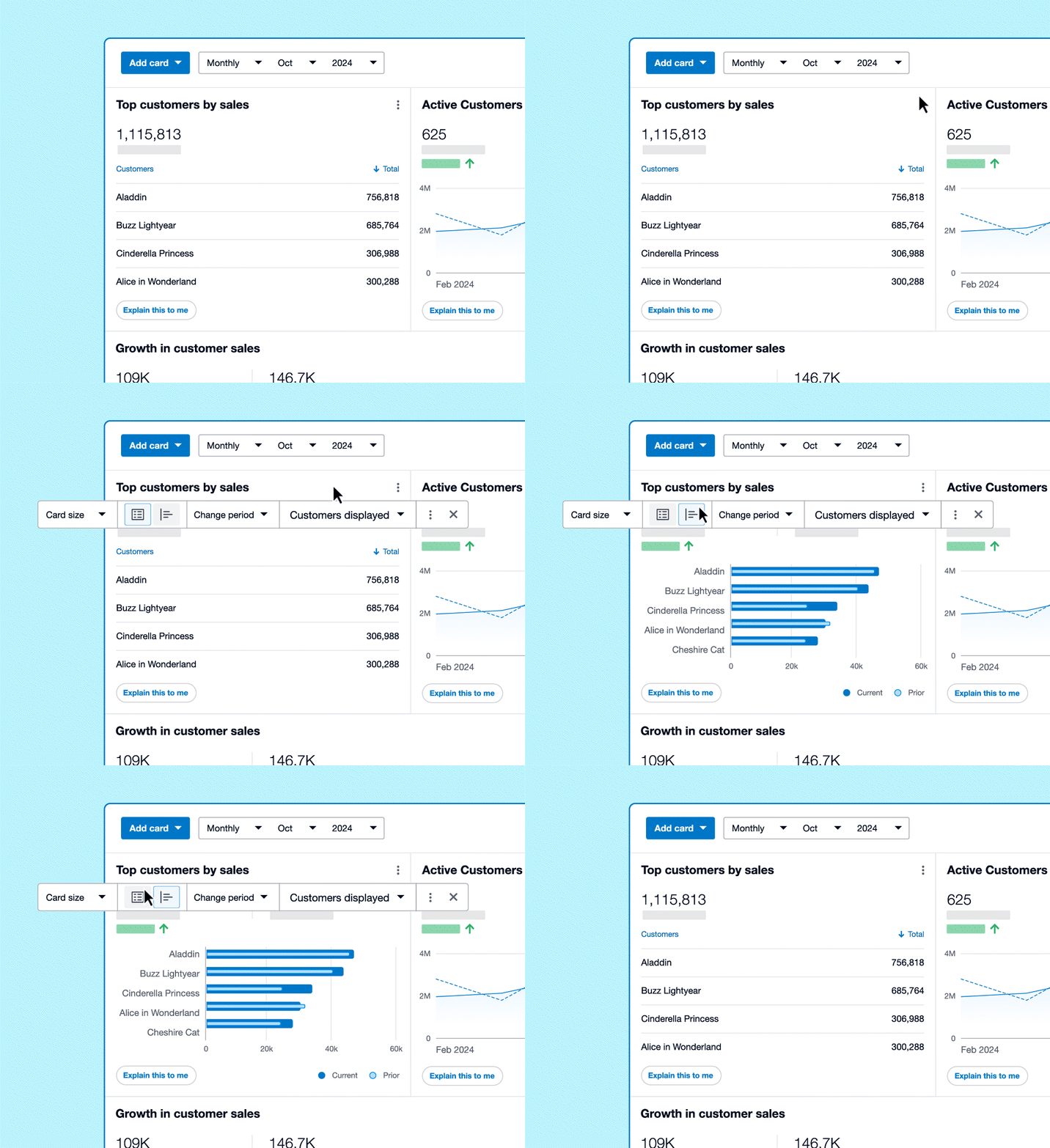
Once you’ve been granted early access to Analytics powered by Syft, you’ll see a banner within your Xero dashboard. You’ll also be able to click through via the report centre; directly within the profit and loss (income statement) report; and through the business snapshot dashboard.

Don’t see any banners on your dashboard yet? Keep an eye out when logging in as the rollout is being staggered over the next few months, and we expect all qualified customers will have access by August.

What’s next for analytics at Xero?

This is just the beginning of the powerful insights to come. As we expand Analytics powered by Syft to more regions, we’ll also continue to add new features, including cash flow manager for a more detailed overview of cash flow position. We’re also working hard to further embed these features into Xero and deliver ongoing additional value to you as part of your existing subscription.

We’re also continually investing in Syft Analytics, our advanced product designed specially for accountants and bookkeepers, with new and enhanced features rolling out this year. These include improvements to our forecasting features, advanced reporting, and multi-entity consolidations. 

Syft Analytics is already used and loved as a standalone app by many partners that want to make advanced analytics a core part of their advisory offering. We’re looking forward to empowering advisors with the tools to deliver management reporting, consolidations, and forecasting services to clients.

This is just the next step towards a more insightful future for small businesses and their advisors, powered by Xero and Syft. Stay tuned for more exciting developments as we continue to invest in advanced analytics for the Xero community.

The post Unlock greater insights with Analytics powered by Syft: Now rolling out in early access to Australia appeared first on Xero Blog.

Meet our new XPAC Australia FY26–27 team!

Software Stack Editor · June 19, 2025 ·

At Xero, our connection to the accounting and bookkeeping community is critical, and XPAC (the Xero Partner Advisory Council) plays a big part in that.

We’re excited to introduce the new Australian XPAC FY26–27 cohort: 14 partners from across the industry who will work closely with us over the next year, providing invaluable insights to help shape how we continue to support our partner community.

The role of XPAC and why it matters

XPAC brings together a dedicated group of accountants and bookkeepers who meet with the Xero team quarterly and stay in close contact throughout the year. They share what they’re seeing in the industry, including the challenges, opportunities, and tools that are helping firms succeed, along with honest feedback on how we can better support our partners and build a great product to help accountants, bookkeepers and small businesses.

These ongoing conversations help us test ideas, stay focused on what matters most, and make well informed decisions grounded in real-world experiences and insight.

A huge thank you to the XPAC AU FY24–25 team!

Our XPAC AU FY24–25 group has been instrumental in helping us move in the right direction over the past twelve months. 

Some members are returning as mentors for FY26–27, while others are concluding their time with XPAC. Together, their input has shaped important conversations, challenged our thinking, and made a real difference. So, on behalf of Xero and our entire community, we want to say a big and sincere thank you to: 

  • Aly Garrett – All In Advisory
  • Amar Latif – MAD Wealth
  • Beau Gaudron – GrowthWise
  • Cassandra Scott – Laurus Bookkeeping
  • Grace Occleshaw – BYO Group
  • Jarrod Morris – Bolden
  • Jason Robinson – Future Advisory
  • Michele Grisdale – Rainforest Bookkeeping
  • Natalie Lennon – Two Sides Accounting
  • Sarah Lawrance – Hot Toast
  • Sarah Pilling – Bramble and Briar
  • Zac Hayes – HA Accounting

Meet the new XPAC AU FY26–27 cohort

The new XPAC AU group includes seven returning mentors and seven new members, bringing a wide range of experience and perspectives across the accounting and bookkeeping industry. 

We’re looking forward to working with this group over the coming year, kicking off with our first quarterly meeting in July.

Returning mentors:

  • Sarah Lawrance – Hot Toast
  • Michele Grisdale – Rainforest Bookkeeping
  • Beau Gaudron – GrowthWise
  • Aly Garrett – All In Advisory
  • Natalie Lennon – Two Sides Accounting
  • Jason Robinson – Future Advisory
  • Amar Latif – MAD Wealth

New members:

  • Katie Williams – The Vault Bookkeeping
  • Krishan Sharma – KNS Accountants & Business Advisors
  • Martine Hoosen – Bookwiz
  • Davie Mach – Box Advisory Services
  • Shaun Stubley – Air Accounting
  • Tracey Rubens – Bookkeeper Connect
  • Rebecca Buchanan – Straight Up Bookkeeping

Thanks again to everyone who applied for XPAC, and to our partner community for continuing to share your feedback, ideas and perspectives with us. We’ll keep the updates coming as the new XPAC chapter gets underway.

The post Meet our new XPAC Australia FY26–27 team! appeared first on Xero Blog.

Xero Asia Awards 2025: Beyond the trophy

Software Stack Editor · June 10, 2025 ·

We’re fast approaching the 2025 Xero Asia Awards ceremony in August! With nominations closing on 20 June, it’s now or never if you’d like to submit your entry and be a part of this highly anticipated night.

What are the Xero Asia Awards? A Quick Recap

Every year, the Xero Asia Awards recognise the very best in our partner community across the region, honouring their efforts to drive digital accounting forward and enable SMEs across the region to thrive.

This year, we’ve evolved the award categories to reflect the diverse achievements within our Xero partner community: 

  • Xero Partner of the Year: Recognising overall commitment and success in leading the way with Xero across Singapore, Malaysia, and the rest of Asia. 
  • Emerging Partner of the Year: Spotlighting newer partners who have made exceptional progress in their first year with Xero. 
  • Total Xero Award: Celebrating practices that have made Xero part of their business DNA, championing its use with clients and running their firm on Xero. 
  • Digital Innovator of the Year: For practices that have revolutionised their operations, culture, and client services through digital innovation. 
  • Advisory Partner of the Year: Recognising partners who have excelled in making a difference in their SME clients’ lives through advisory services. 
  • e-Invoicing Champion of the Year: Celebrating partners in Singapore and Malaysia who have championed e-invoicing adoption and educated clients on its benefits. 

All nominations are to be submitted via a video no longer than three minutes. But it’s less about how professional the production is, and more about how authentically you tell your story. We want to hear all about the genuine impact you’ve made on your clients and their businesses. 

For more guidance on how to put your best foot forward for your video submission, check out our tips and tricks blog post here.

Beyond the trophy: Prestige, growth, morale and community

Winning a Xero Asia Award goes beyond just a single prestigious moment on stage – it’s a chance to elevate credibility, unlock growth opportunities, boost team morale, and be a part of a dynamic community of the best and brightest in the industry.

  • Winning an award means you have Xero’s stamp of approval – which in turn leads to new opportunities for growth. A globally recognised brand known for our commitment to empowering small businesses around the world, Xero’s endorsement distinguishes you from your competitors and enhances your reputation. With your practice now recognised as a trailblazer in your category, you’re well-positioned to pursue new growth avenues and attract new clients.
  • You’ll also get to amplify your brand with a Xero Asia Awards promotional pack full of assets you can add to your digital presence, as well as guidance from the Xero team on how to further promote your business.
  • Crucially, these Awards boost team morale and help attract top talent. When applying for an award, you have the opportunity to reflect on the past twelve months and spotlight some of your business’ greatest wins during that time – as well as the people who’ve helped you achieve them. Winning an award is even more significant – a chance to foster pride and a positive work culture, which in turn serves as a powerful tool to build and keep a high-performing team.
  • Finally, and perhaps most importantly, being an award finalist or winner means belonging to an exclusive community of top-tier Xero partners – the cream of the crop who are truly shaping the future of digital accounting in Asia. All finalists are invited to our exclusive Awards ceremony, a chance to meet like-minded passionate professionals, share insights, and build long-lasting partnerships.

We hope that, like us, you’re just as excited about this year’s Awards and what they can offer to your practice. We’re constantly in awe of everything our partners achieve – accomplishments that deserve to be seen and celebrated. If you’re ready to take the leap, click here to begin your Awards submission. The submission window closes on 20 June, and we can’t wait to hear from you!

The post Xero Asia Awards 2025: Beyond the trophy appeared first on Xero Blog.

Blast past tax time stress this EOFY: Steps to process and finalise payroll

Software Stack Editor · June 6, 2025 ·

The 2025 Financial Year is almost at an end, so there has never been a better time to prepare. A great first step on your EOFY preparation journey is to review your payroll finalisation. Getting a head start on your organisation’s payroll ensures your July is as easy as possible.

Not sure where to start? You’ve come to the right place. Whether this is your first payroll finalisation, or your hundredth, blast past your tax time stress by following our handy list of steps.

1. Review pay items and their settings

With Single Touch Payroll (STP), it is important that the correct reporting categories are used for your earnings, deduction and paid leave pay items. Allowance pay items also need to be assigned an appropriate reporting type.

Because these categories tell the ATO how to treat each type of payment you’re reporting through STP, it’s crucial that all the pay items used in the current financial year are correctly assigned.

For more details on reporting categories, take a look at our guide in Xero Central.

2. Check your employees’ records 

There are key compliance requirements within STP reporting that affect the way employees are set up in Xero.

In Xero Payroll, all active and terminated employees (who will be included in the STP finalisation for the financial year) will need an employment type, income type, and tax scale defined in their records.

Review your employees’ records to ensure they’re STP compliant. You can run the Employee Contact Details report to check for accuracy, keeping a close eye on things like date of birth, email address and postcode.

3. Post and file any pay runs for the 2024/2025 financial year

Any pay runs with a payment date in this financial year will need to be posted and filed before you complete this year’s payroll finalisation. If you have pay runs that need to be reported in the 2025 financial year, ensure the payment date set for the pay run is on or before 30 June 2025.

However, please note that there may be scenarios where your pay run status shows a filing error, rather than the successful ‘Filed’ status. If you see a ‘Filing Error’ status on a pay run, you will need to confirm if the error was fixed or still needs to be addressed. Generally, if the subsequent pay runs for your employees are successful, the filing error seen can be safely ignored. If you are unsure, you can use our handy guide on how to fix a filing error in STP.

4. Process any outstanding superannuation payments

To claim a deduction on superannuation accruals submitted via Auto Super for the current financial year, super batches should be approved no later than 2:00pm AEST, 20 June 2025. We recommend marking this date in your calendar so you don’t forget.

If you’re not registered for Auto Super, you still have time to take advantage of this time saving feature! Check out our support article on how to register for automatic superannuation payments. Alternatively, the payments can be made manually outside of Xero.

5. Reconcile your payroll accounts

After processing all pay runs for the financial year, it’s important to forensically check the accuracy of your reporting. One way to do this easily is by generating the Payroll Activity Summary report and comparing it with the General Ledger report. 

You can specify a custom date range in both reports to help find any discrepancies. For guidance on reviewing payroll transactions at EOFY, take a look at this support article in Xero Central.

If you come across any discrepancies in your payroll accounts, you can use the remove and redo feature to edit the transaction and allocate it to the correct accounts.

Troubleshooting tips

  • If you have multiple payroll expense accounts for earnings or superannuation, be sure to add up the totals for each account when comparing them to the Payroll Activity Summary report.
  • Use the Account Transactions report to identify any transactions that may have been incorrectly reconciled against your Expense Accounts.
  • Check for any manual journals that may have impacted your totals by running the Journal report and clicking on Manual Journals.
  • If you’re unable to locate a discrepancy, try running your reports using a smaller date range to narrow down the issue.
  • If you started using Xero midway through the financial year, double-check that the employee opening balances match your organisation’s conversion balances to avoid any discrepancies.

6. Review the Payroll Activity Summary report against the Payment Summary Details report

Stay with us – you’re almost there. 

It can be easy to get the Payroll Activity Summary report and the Payment Summary Details report confused, so remember you’ll still need to compare this information if you’re completing an STP finalisation. You can run these two reports for a custom date range and make sure the information balances.

It’s important to note here that the Payroll Activity Summary report shows gross earnings, whereas the Payment Summary Details report shows taxable earnings.

If there are salary sacrifice or pre-tax deductions that have been processed during the financial year, they will need to be deducted from the gross wages that show in the Payroll Activity Summary report. The total should then match the Payment Summary Details report (note that this will only show truncated values – the cents will not show in this report).

7. Amend any pay run mistakes you found

If you found any pay runs with incorrect STP reporting or amounts, these can be corrected using an unscheduled pay run. Simply create the pay run for the required period and enter the adjustment you need. When an unscheduled pay run is posted and filed, it will update your employees year-to-date (YTD) amounts and notify the ATO of this change.

You will need to doublecheck the payment date of the unscheduled pay run falls within the correct financial year (for example, on or before 30 June 2025) to ensure it’s reported correctly and updates the correct YTD amounts.

8. Process STP finalisation

You made it! It’s now time to process your STP finalisation.

Take a look at these steps on how to finalise your payroll information with the ATO. There’s also an easy-to-follow checklist to make sure you don’t miss anything.

You’ll need to file at least one pay run before you’re able to complete the STP finalisation process. Your first submission will include all YTD payroll information that has been entered into Xero.

Keep these tips in mind to help you along the way:

  • Information included in the STP finalisation will pre-populate based on the information processed in Xero Payroll – you’ll be able to see gross totals, taxes and super. You can also view and easily edit RFBA and RFBA-E (reportable fringe benefit amounts).
  • If you need to report any leave paid out on termination as ‘Lump Sum A’ or ‘Lump Sum B,’ you can do this by processing an unscheduled pay run. For more information, read this article.
  • If you have terminated any employees on or before 30 June 2025 who need fringe benefit tax (FBT) amounts reported, you can use the toggle Show terminated employees for RFBA at the bottom of the STP finalisation page.
  • Any Employment Termination Payments (ETP) that have been processed can be shown by clicking View Report to see the STP YTD Summary.
  • If you started using Xero part way through the financial year and need to report employee opening balances through STP, take a look at our support article on transferring payroll balances to Xero Payroll.
  • Based on the ATO’s requirements, gross payments are reported as the pre-sacrificed amount. This means salary sacrificed amounts, such as pre-tax deductions and reportable employer super contributions (RESC), are included in gross payments.

Once you click the ‘Submit Finalisation’ button, you can rest easy knowing that your EOFY Payroll is complete for another year. Go take a break, you deserve it!

Looking ahead to FY26

Superannuation: Superannuation guarantee rate is increasing from 11.5 to 12 percent on 1 July 2025. Any employees with a superannuation line set up with a rate type of statutory rate will be automatically updated. If their rate type has been set up as Percentage of Earnings, you will need to ensure you edit this percentage manually.

These changes to income tax rates and thresholds will also be automatically applied in pay runs with a payment date of 1 July 2025.

Superannuation for Government-funded Paid Parental Leave: From 1 July 2025, super will be paid by the Government on its Paid Parental Leave scheme. Superannuation remains optional for employer-funded Paid Parental Leave.

Visit the ATO  website to learn more.

Tax Brackets: No changes – the next change will occur in FY27.

Tax Tables: Changes to study and training support loans weekly, fortnightly and monthly tax tables due to annual indexing and repayment income thresholds changes.

These changes apply to pay runs with a payment date on or after 1 July 2025. If pre-created pay runs have been created for after this date, please review to ensure the correct tax rates have been applied.

Lump Sum and Termination Payments: The $1,200 Lump Sum E threshold is removed. All back payments over 12 months old must now be reported as Lump Sum E, regardless of value. ETP caps and Lump Sum D thresholds have also increased.

If your organisation is impacted by changes to the minimum wage, you will need to update your employees’ pay templates. You can learn how to create or edit a pay template for an employee by checking our Xero Central article.

To find out if these changes could affect you, please refer to the Fair Work Ombudsman.

Looking for more information? Check out our EOFY Resource Hub for everything you need to know (and do) to round out FY25, and set up strong for the new year ahead.

The post Blast past tax time stress this EOFY: Steps to process and finalise payroll appeared first on Xero Blog.

Xero Simple is here for small businesses

Software Stack Editor · June 3, 2025 ·

From April 2026, small businesses, sole traders and landlords will need to change how they report income tax to HMRC. New legislation, known as Making Tax Digital for Income Tax (MTD for IT), is set to be introduced, sparking a shift in financial reporting requirements. 

To comply with MTD for IT requirements, businesses will need to do three things: send quarterly updates on business income and expenses, keep digital records, and submit returns annually using MTD-compatible software. The MTD for IT rollout will happen in phases. Anyone with an annual turnover of over £50,000 for the tax 24/25 year will need to start complying from April 2026. It will then extend to those earning over £30,000 from April 2027 and anyone earning over £20,000 from April 2028.

Master MTD for IT with confidence

MTD for IT will likely feel like a big change for many small businesses. Over two-fifths (42%) of the smallest businesses currently don’t use any finance or accounting tools, and just 27% believe they get their tech and software choices right. For many businesses, MTD for IT may mean investing in digital software or technology for the first time. Although the digital transition might feel daunting, Xero is here to support you. Our easy-to-use online accounting software will give you a clear picture of your finances so you’re more in control. With the right digital tools in place, and a streamlined process for how you manage and submit taxes, you can spend less time doing your taxes and more time on your business.

To help support you in complying with MTD for IT and to help you adopt good digital bookkeeping habits, we’ve added Xero Simple to the range of MTD-ready plans that are available directly to small businesses, sole traders and landlords. Like all our plans, it’s designed to give you confidence and support in mastering MTD for IT:

  • HMRC recognised: Make secure online submissions to HMRC to comply with MTD for IT requirements using a platform trusted by millions
  • End-to-end solution for total compliance: No need for multiple solutions; you’ll have access to everything you need  – from digital record-keeping right through to final submissions – with our cost-effective solution; you can even manage a property and business with one Xero subscription
  • Do MTD for IT easier and faster: Make the transition smooth and hassle-free using automation and AI. Your bank transactions flow into Xero automatically and you can snap receipts and extract data on the go so you have more time to focus on your work
  • Get expert support: With free guides, online courses, live webinars and unlimited free online support 24/7, you can get real human help, whenever you need it. 

We’re here to help you get ready

In a tough economic climate where many businesses are already juggling so much, thinking ahead about how you’ll manage the transition to MTD for IT will help. Start getting ready now and use the next 10 months to test out digital tools so you can get the hang of it in advance. It’s also a good idea to start building habits like capturing receipts instantly and doing daily reconciliation. Having a good bookkeeping routine where your data is up-to-date will set you up well for when the legislation comes into effect. 

If you’re unsure about where to start, your accountant or bookkeeper is an invaluable partner who can help you better understand the changing nature of reporting requirements and the best way to approach MTD for IT compliance. They’ll be able to cut through the jargon and advise what it means when the legislation comes into effect. 

We’re also here to help. Take a look at our range of MTD-for-IT–ready plans and the benefits they deliver, or sign-up for one of our free MTD for IT webinars. In these webinars, we’ll break down what MTD means for you, what you need to do, and show you our MTD solution in action.

For more information take a look at our MTD guide with advice on MTD for IT and insights that you can use to help you prepare.

The post Xero Simple is here for small businesses appeared first on Xero Blog.

Half of Australians fear making a mistake on their tax return this year

Software Stack Editor · May 28, 2025 ·

If the thought of lodging your tax return makes your palms sweaty and you find yourself procrastinating to avoid the inevitable, you’re not alone. Xero’s latest research has found nearly three quarters of Australians are worried or anxious about tax time this year.¹

This end of financial year (EOFY), we wanted to uncover the universal challenges that Aussies face and common knowledge gaps when it comes to tax time, and provide easy-to-understand information to reduce confusion and anxiety at this time of year.

The ‘Xero Tax Confidence Index’ surveyed more than 1000 Australians – including small business owners – to gauge their confidence and knowledge levels around all things tax. We found 73% of Australians report feeling worried or stressed at EOFY, with most small business owners echoing this sentiment. More than half (54%) of Australians are worried about making an error on their tax return: key concerns included owing money to the Australian Taxation Office (33%), following tax rules correctly (28%), and being audited by the ATO (22%).

For Australia’s 2.6 million small business owners, tax season often adds pressure on top of managing day-to-day operations. In fact, Xero research from 2024 revealed 83% of small business leaders find EOFY overwhelming and 71% find it stressful.² 

There are no silly questions

One in five Australians say they have avoided asking tax-related questions because they were worried their question might seem silly or the answer obvious, and our small business research also shows one in three business leaders find tax preparation overwhelming.² But when it comes to tax and finances, there’s no such thing as a silly question! We want people to feel more comfortable, know they are not alone, and feel encouraged to reach out for help.

Tax deductions are a key area of confusion. While 58% of Australians made purchases last year with the intention of claiming them as tax deductions, 51% admitted to being confused about deduction rules. The biggest areas of confusion were car and travel expenses (21%) and working from home costs (21%). Half of those who made a purchase specifically for a tax deduction last year found it didn’t turn out how they wanted, with 21% discovering their purchase was ineligible to claim a deduction for, and 17% not getting the return they wanted.

Putting tax knowledge to the test

To further dig into Australians’ tax knowledge, we presented participants with true or false statements on common tax scenarios.

Finding the right support

Encouragingly, most Australians turn to trusted sources for tax guidance: the official ATO website (51%) and tax agents or accountants (40%) are the leading go-tos. Having the right support in place is critical for both taxpayers and small businesses alike. Not only does it provide confidence that they’re doing the right thing, it alleviates the stress and anxiety that can come with this time of year. Engaging a trusted advisor is invaluable; they’re the experts who can answer any question, no matter how silly it might seem, and guide you through the process. We know from our strong accounting partner community that they’d be happy to help, so the next time you have a question, don’t hesitate, ask your advisor.

Digital tools can also help ease the burden by automating some of the more complex or time-consuming tasks and keeping you organised, whether that’s simply capturing your expenses for claiming deductions, or more complex tasks for small businesses like managing records, financial statements and tax compliance.

For small businesses looking for information and support this tax time, in addition to speaking with your advisor, you can visit Xero’s EOFY resource hub for tools and resources to help you blast past tax-time stress.

About the research

¹  Xero’s Tax Confidence Index research was commissioned by Xero and conducted by Lonergan Research. Lonergan Research surveyed a nationally representative population of 1003 Australians aged 18+. After interviewing, data was weighted to the latest population estimates sourced from the Australian Bureau of Statistics. The survey was conducted online amongst members of an independent and permission-based panel, between 29 April 2025 and 5 May 2025. 
² Small business research was commissioned by Xero and conducted by YouGov. The total sample size was 1077 Australian adults, with 80% from NSW, VIC and QLD, who are small business owners and decision makers in businesses with fewer than 20 employees. Fieldwork was undertaken between 10 and 19 May 2024. The survey was carried out online.

The post Half of Australians fear making a mistake on their tax return this year appeared first on Xero Blog.

Introducing Pay by Bank for UK Small businesses: More payment options, healthier cash flow

Software Stack Editor · May 28, 2025 ·

Late payments pose a significant hurdle for small businesses, frequently disrupting cash flow and complicating the management of daily operations. Recognising this challenge, we’re dedicated to helping you receive payments more efficiently by expanding your payment options.

Building on our existing support for credit cards, debit cards, Apple Pay, and Google Pay, we’re excited to announce the addition of Pay by Bank. Powered by Stripe, this new feature empowers your customers to make payments instantly from their bank accounts straight from their online invoice. By offering your customers a wider range of payment methods, you increase the likelihood of getting paid faster and spending less time chasing payments. Introducing these additional payment alternatives ensures your customers have every convenient opportunity to pay invoices quickly, making it a swift, secure, and cost-effective solution for everyone involved.

What is Pay by Bank?

Pay by Bank is a real-time payment method in the UK that enables you to collect one-time payments from your customers’ bank accounts quickly and securely, and at an affordable cost.  Consider it a modern alternative to traditional direct debits. This integrated digital payment solution allows customers to authorise and approve payments through their mobile banking app or online banking portal. Payment confirmations are immediate within your Stripe account, so you know the money is en route and can confidently manage your cash flow. Once a customer authorises a payment, the corresponding invoice is automatically marked as paid, simplifying bank reconciliation.    

We understand that chasing overdue payments consumes valuable time that could be better spent managing and growing your business. That’s why we’re investing in innovative solutions like Pay by Bank, alongside other payment methods, to help you receive timely payments with minimal effort. By offering your customers more convenient choices, we aim to accelerate invoice settlement, ultimately freeing you from unnecessary cash flow concerns.

Benefits of using Pay by Bank

Here are several advantages of using Pay by Bank for your small business:

  • Quick and convenient for customers: Pay by Bank allows customers to authorise bank payments instantly and securely using their mobile banking app or online banking portal.  They simply select their bank, log in, and approve the payment.    
  • Real-time payment visibility: When your customer makes a payment, the confirmation is visible in your Stripe account instantly, giving you assurance that your funds are on their way.  Typically, Stripe will settle these funds within two business days.    
  • Affordable transaction fees: Pay by Bank facilitates fast and secure transactions with affordable  and, importantly, capped fees, so more money stays in your business.
  • Automated processes: When your customer pays, the invoice is automatically marked as paid for both you and them.  Payment confirmations are instant in your Stripe account, and funds are settled automatically, making reconciliation a breeze.

How to use Pay by Bank in Xero

Pay by Bank is available with a Stripe account.  To activate it:   

  • Go to your Dashboard, select Business, then Online Payments
  • In the Manage payment methods tab, click “Turn On” next to Pay by Bank
  • This will enable the feature for all future invoices and any unpaid invoices you’ve already sent

You have the option to enable or disable this setting as needed directly from your invoice.    

When your customer chooses to pay with Pay by Bank, they will follow these steps:

  • On the online invoice, the customer selects Pay by Bank as their chosen payment method    
  • The customer then selects their bank. It’s important to note that the customer must have a UK bank account with a supported bank to use Pay by Bank. To learn more about eligible banks, click here (Note: payments from non-UK bank accounts, even if the bank is listed, are not supported)
  • The customer is then directed to their bank’s mobile app or online banking portal to authorise the payment
  • Once the payment is authorised, the online invoice will be automatically marked as paid

Pay by Bank enhances Xero’s payment capabilities, providing your customers with more ways to pay, which helps you receive payments promptly and consistently.

Learn more about offering Pay by Bank here. 

The post Introducing Pay by Bank for UK Small businesses: More payment options, healthier cash flow appeared first on Xero Blog.

2025 Xero US Roadshow: What You Need to Know

Software Stack Editor · May 27, 2025 ·

The 2025 Xero US Roadshow is set to deliver a day packed with innovation, networking, and inspiration. Let’s explore what’s on the agenda and why you should care.

Spotlighting Innovation: AI and Advisory Services
The accounting industry isn’t what it used to be; it’s smarter, faster, and more efficient, thanks to AI and advisory services. This year’s Roadshow is focusing on these game-changing tools and strategies. Expect insights from Xero’s team on product enhancements that will redefine your approach to accounting. From core accounting updates to streamlined bank feeds and bill payments, it’s about working smarter, not harder with Xero. 

AI: The Game-Changer in Accounting
Artificial intelligence isn’t just for tech giants anymore. At the Roadshow, see firsthand how AI can transform workflows, marketing strategies, and client interactions. Learn to leverage AI and app stacks to boost efficiency and capitalize on growth opportunities. This isn’t a glimpse into the future; it’s happening now, and it’s changing the game for accounting practices.

Advisory Services: Structuring for Success
Advisory services are essential for any accounting practice aiming to upsell and deliver real value to clients. The Roadshow will delve into practical frameworks for structuring, pricing, and delivering these high-value services. Here, you’ll get the tools needed to add genuine value to your clients.

Tailored Learning Tracks
Whether you’re a seasoned Xero partner or a newcomer curious about what’s possible, the Roadshow offers something for everyone:

  • Existing partners: Dive into product innovations, AI integration, enhancing advisory services, and learn how to build powerful app stacks to streamline your workflow.
  • Prospective partners: Find out how to start with Xero, expand your firm, establish a solid foundation using the right technology, leverage AI to market your practice, and confidently guide clients through change with practical transition strategies.

Networking and Growth Opportunities
It’s not just about what you know; it’s also about who you know. The Roadshow includes plenty of networking opportunities. Enjoy great food and drinks while building connections with Xero experts, app partners, and industry peers. Finish the day with a relaxed cocktail event to continue the conversations and celebrate new collaborations. 

Are You Ready to Lead in Accounting?
The 2025 Xero US Roadshow offers a chance to acquire new skills, future-proof your practice, and connect with a thriving community eager to grow. This isn’t just an event; it’s your gateway to innovative accounting.

For more details and to see the list of cities on the tour, click here.

In a few words—don’t miss it!

The post 2025 Xero US Roadshow: What You Need to Know appeared first on Xero Blog.

Explore the Xero App Store’s 2024 top apps

Software Stack Editor · February 4, 2025 ·

Finding tools to simplify your processes and save time is essential for a small business owner. But with so many apps available to connect to Xero, it can feel overwhelming to sort through them all. 

That’s why we’ve pulled together lists from the Xero App Store in Australia, the US and the UK where you can see the year’s most popular, most recommended, and award-winning apps to help you discover apps that are functional, trusted and loved by businesses and experts alike.

Most popular apps

 Our ‘Most popular apps of 2024’ lists highlight the top apps that Xero users connected to through the Xero App Store. Whether helping to automate tasks, manage inventory, or improve cash flow visibility, these apps are popular among small businesses like yours.

Check out the 2024 most popular app lists:

  • Most popular apps 2024:  Australia
  • Most popular apps 2024:  UK 
  • Most popular apps 2024: US 

Most recommended apps

Our ‘Most recommended by advisors 2024’ lists contain apps trusted by the advisors who know small businesses best. These apps are the ones that accountants and bookkeepers recommended to their clients through the Xero App Store the most. 

Check out the most advisor-recommended app lists:

  • Most recommended apps 2024: Australia
  • Most recommended apps 2024: UK
  • Most recommended apps 2024: US 

Award-winning apps

Finally, our ‘Xero Award-winning apps of 2024’ list showcases the apps that took home a prize from Xero App Awards across the globe this year. These apps were recognised at awards ceremonies in the UK, US, Canada, Asia and South Africa in 2024. 

Check out Xero award-winning apps

How can these apps help you?

Efficiency and simplicity are the cornerstones of a thriving small business. By tapping into these curated lists, you can quickly identify apps that can help you:

  • Boost efficiency: Automate repetitive tasks like invoicing, payroll, and expense tracking so you can focus on growing your business.
  • Improve accuracy: Apps that integrate directly with Xero help reduce double handling to make your financial data more reliable.
  • Stay ahead: With award-winning and highly recommended tools at your fingertips, you’ll be well equipped to embrace new opportunities in 2025.

Make 2025 your most efficient year yet

The Xero App Store is more than just a marketplace: it’s a resource to help your business thrive. These lists put the power of community and expertise in your hands, connecting you to apps vetted by real Xero users and accounting professionals.

Ready to explore? Head to the Xero App Store and make 2025 the year you take your business to the next level with tools designed to support your success.

The post Explore the Xero App Store’s 2024 top apps appeared first on Xero Blog.

Signals of the future: What sci-fi movies can teach us about predicting the direction of technology in small business

Software Stack Editor · February 3, 2025 ·

I remember watching Back to the Future as a kid and looking forward to the future it predicted. Flying cars! Hoverboards! But here we are, 10 years after the movie’s timeline, and I still need roads wherever I’m going.  

It turns out that predicting the future is hard. Really hard. Particularly when trying to do so on an accurate timeline.  But that doesn’t mean we can’t spot signals and patterns emerging today that hint at what’s to come. Looking for these can help us anticipate future scenarios that we can then choose to prepare for in the work we undertake today. 

I think movies can be a valuable resource here.  As John Egan, CEO of L’Atelier, once noted, the bigger challenge to prediction isn’t forecasting technological change, but understanding societal change. Films can often reflect the cultural pulse of their time while also playing with some of the deeper shifts in how we live, work, and connect. 

So, as small business owners look to 2025 and beyond, here are a few movies that I think are worth another look as sources of signals and scenarios of the future, both of which can lead us to ask some interesting questions as we make personal or business plans for the year(s) ahead.

Iron Man: Agentic AI

We can’t all be ‘genius, billionaire, playboy, philanthropist’ superheroes, I guess. Nor can we fly around in high-tech metal suits.  But the team behind the 2008 Marvel movie that introduced J.A.R.V.I.S – Iron Man’s smart and capable AI assistant – were definitely picking up on a signal about the increasing rate of computational power and the evolution of artificial intelligence.  

In 2025, we find ourselves on the verge of the next leap forward in this space: agentic AI. AI assistants like Microsoft’s Copilot, Google’s Gemini and Anthropic’s Claude will be able to take action on behalf of their user. So, for example, rather than just answering questions about our upcoming flight, virtual agents will be able to make changes to our bookings, order inventory for a retail business based on sales projections, or even see what we can see on a screen and move the mouse as we would move it to carry out a process.

What questions does this emerging capability pose to small business owners?  Well, how well do you know your processes? How well documented are they? How digital are they? How could they be scaled or sped up if you had smart agents working alongside you and your human staff? What would you do with the time saved? Could you provide more coverage of customer support queries at odd hours? Is there anything stopping you from rolling out a new product or service that could be resolved with a smart agent? 

Ready Player One: Augmented reality and virtual reality

The immersive virtual world of Ready Player One might still be a way off (as is the timeline of the movie), but the signals pointing to full-sensory virtual reality (VR) are emerging, with headsets like the Meta Quest and the Apple Vision Pro showing increasingly lifelike displays and spatial audio.  

More pronounced is the signal about the blending between physical and virtual worlds. When was the last time you checked the price of a product while standing in front of it in a physical store? Or helped your kids pay for a virtual item using real money? Both the Quest and Vision Pro allow for a mixed reality where virtual items appear overlaid on the physical world. And if you feel goofy wearing something like that, the Ray-Ban Meta smart glasses are showing how interacting with the physical and virtual world in real time can actually be stylish.

Whether it’s called the ‘metaverse’, ‘OASIS’, or something else, this future is emerging today. As a small business owner, it may be worthwhile asking: What’s the next evolution of my website? Does it need to promote more interactivity with my products? Do I have high enough resolution images and videos of my products to thrive in a high definition virtual environment? What changes do I need to make to my promotional content, considering it may be viewed by AI rather than humans (like Apple Intelligence reading your marketing emails, or an AI assistant answering questions about your product)? Could I train my staff (or customers) more effectively, or safely, in a virtual reality environment?  

Star Trek: Ambient compute conversational interfaces

Pushing the timeline even further out, we’ll really have to give Star Trek a lot more time – as in a century or two – to see how accurate its predictions about teleportation, replicators and holodecks really are. But the imaginations of the creative team behind both the TV series and the many movies were right to pick up on the signals about the access to, miniaturisation of, and embedding of computing capability. 

Think about those signals and how they are playing out in capabilities that small businesses can already use. Accessing incredible computing capability from a handheld device is available today. And the signal is only getting stronger as the capability and ubiquity of connectivity continues to develop apace with options like StarLink providing even remote locations with fast internet access.

Moreover, that interaction is increasingly moving beyond screens. Unlocks in natural language processing and the proliferation of smart speakers, smart watches, smart earphones and smart homes means the ability to have a conversation with your computer while your hands are full or while working on a job is definitely within reach.

What, then, are the questions worth asking as these signals of future capability only get stronger? Well, how many of your shop or stockroom processes could be further enhanced by not having to go back to the office laptop or your smartphone to note something, or check something, or start something? If someone is asking their smart assistant about a product or service that you offer, what can you do to be in the consideration set? Is there capability out there in the cloud that you aren’t making use of yet, but would give your business an advantage in the year ahead?  

What sci-fi films can teach us about technology in small business

While we may not have every sci-fi vision realised yet, the signals are clear: technology’s transformative power is here and now. Small businesses can use the signals of the future to prompt strategic questions of themselves in the present.

For example, we don’t yet have Tax Administration 3.0, where reporting, payments, and real-time compliance coincide with taxable events. Yet we are seeing faster digital payments, and automated e-invoicing. AI isn’t sentient, but it’s automating tasks, providing deep insights, and freeing up time for small business owners.

Just as sci-fi authors and filmmakers imagined futures based on the signals of their time, small businesses today can do the same. By understanding the underlying trends and possibilities, they can harness technology’s power to create their own success stories.

The post Signals of the future: What sci-fi movies can teach us about predicting the direction of technology in small business appeared first on Xero Blog.

What’s ahead for your business in 2025?

Software Stack Editor · January 23, 2025 ·

As 2024 came to a close, Xero surveyed small business owners to find out how they were feeling, what was driving their positive or negative outlook, and how recent interest rate cuts had impacted their business.1 As Xero’s economist, I’ve reviewed the results and dusted off my crystal ball to bring you my thoughts on what your business is likely to be facing in 2025 and how you can prepare. 

How are small businesses feeling as 2024 ends?

Almost three quarters (74%) of UK respondents said they were either still positive, more positive, or much more positive about their business than they were in the previous month. 

The top three reasons UK small businesses told us they are positive, or more positive, about the future is that they:

  • have more work available (42%)
  • are making more sales (33%)
  • have seen an improvement in cash flow (24%) 

The first two sentiments likely reflect the fact that the UK economy overall has performed better in 2024 than in 2023, when it spent part of the second half of the year in recession. The reported improvement in cash flow is most likely due to the ongoing downward trend in inflation. This in turn makes it easier to manage costs and eases the squeeze on profits and cash flow.

A smaller group of UK businesses (26%) said that they felt negative, more negative, or much more negative about their business than the previous month. This group is finding that:

  • it’s harder to find new customers (55%)
  • existing customers are buying less (45%)
  • price rises are affecting sales (29%) 

These challenges reflect that, while inflation is lower, prices are still higher than a few years ago. This means cost-of-living pressures have not gone away, leaving some potential customers still dealing with stretched budgets. 

What are the big macro trends in 2025 and how can you benefit from them?

Every year unexpected events happen, and it’s likely 2025 will be no different. Nevertheless, the macro trends that you, as a small business owner, accountant or bookkeeper, need to stay aware of can be grouped into three broad categories: government policies, central bank actions, and productivity. With the right strategy you can turn these big trends, over which small businesses have little control, to your advantage.

New UK government policies

Already, in the first six months of the Starmer government, there have been multiple new policies for small businesses to get across. This includes business rates, National Insurance changes and plans to tackle late payments. With the publication of the modern industrial strategy, and a small business strategy due to be released in the coming months, we’ll no doubt hear more details about the Government’s plans for small-business-related policy.

UK small businesses are also likely to be keeping a close eye on the new Trump administration in the US. At this stage, it’s unclear how much of the campaign platform will be implemented in the first year of the Trump presidency. But any increase in tariffs on UK goods has the potential to negatively impact UK small businesses that export to the US. 

What can you do: To take advantage of new opportunities from policy change, and limit any potential negative impact, you’ll need to work with your advisors to have a good understanding about how each new policy announcement specifically impacts your business, supply chain, staff, and customers. Don’t wait until the policy has been brought in to respond; plan ahead and work with trusted advisors. 

Cash flow should benefit from lower inflation and interest rates

Higher than normal inflation, and the accompanying higher interest rates, have been challenging for many small businesses over the last two-to-three years. These forces drove up costs, hurt customer spending, and squeezed profits and cash flow. A period of price stability and lower interest rates in 2025 should help ease any cash flow pressures you’ve been dealing with.

The Bank of England has begun its rate-cutting cycle; the question now is, how quickly will rates be cut and to what level? This matters to small businesses like yours directly, as it increases how much you can borrow and/or reduces the cost of repayments. It also benefits you indirectly, due to the impact on your customers’ budgets as they have a little more to spend in your business. 

What can you do: Over three quarters of UK small businesses (80%) say they are yet to see the recent cuts to official interest rates resulting in more sales. As time goes by, more interest rate cuts are likely, as long as inflation follows the path the Bank of England currently expects. This means customers should start to have a little more cash available to spend in your business. Make sure you’re ready to respond with sufficient stock, enough staff, and additional marketing capacity. 

Productivity and digitalisation

Like many advanced economies, the UK has struggled to achieve productivity growth in recent years. The Office of National Statistics estimates labour productivity fell 1.8% year-on-year in the September quarter 2024. This makes the task of getting inflation back under control even harder. It also means the post-pandemic economic recovery has been more difficult, and is at least partly why the UK economy hardly grew in 2023. Small businesses will need to focus on productivity boosting levers in 2025. 

What can you do: If you can boost your business productivity, then you’ll be able to do some combination of offering lower prices to customers, attracting more skilled staff through higher wages, or lifting the profitability of your business. Think about how you could use digital tools, including those powered by AI, to complete those low-value tasks that take time but don’t bring in sales. Review the processes your business uses to make sure you’re operating in the best way possible, not just a way you’ve always done something. Invest in your staff so that they can maximise the benefit of new technology or processes.  

Get more small business insights

If you’re interested in finding out more about how small businesses in the UK are performing, check out the Xero Small Business Insights for the UK.

  1. All figures, unless otherwise stated, are from an online survey commissioned by Xero in November 2024. Responses are from small businesses in Australia (300), Canada (250), New Zealand (154), UK (600) and US (290) during November 2024. Options have been edited for readability ↩︎

The post What’s ahead for your business in 2025? appeared first on Xero Blog.

What’s ahead for your business in 2025?

Software Stack Editor · January 23, 2025 ·

As 2024 came to a close, Xero surveyed small business owners to find out how they were feeling, what was driving their positive or negative outlook, and how recent interest rate cuts had impacted their business.1 As Xero’s economist, I’ve reviewed the results and dusted off my crystal ball to bring you my thoughts on what your business is likely to be facing in 2025 and how you can prepare.

How are small businesses feeling as 2024 ends?

In Canada, 84% of respondents said they were either still positive, more positive, or much more positive about their business than they were in the previous month. 

The top three reasons Canadian small businesses told us they are positive about the future is that they:

  • are making more sales (41%)
  • have more work available (40%)
  • have seen an improvement in cash flow (29%) 

The first two sentiments are consistent with recent commentary from the Bank of Canada that consumer spending is starting to pick up, even though overall GDP growth was soft in the second half of the year. The reported improvement in cash flow is most likely due to the ongoing downward trend in inflation that has been underway in Canada. This in turn makes it easier to manage costs and eases the squeeze on profits and cash flow.

What are the big macro trends in 2025 and how can you benefit from them?

Every year unexpected events happen, and it’s likely 2025 will be no different. Nevertheless, the macro trends that you, as a small business owner, accountant or bookkeeper, need to stay aware of can be grouped into three broad categories: government policies, central bank actions and productivity. With the right strategy you can turn these big trends, over which small businesses have little control, to your advantage.

New government policies

Canada must go to the polls before October 2025, but the exact timing of the election is unknown at this stage and won’t be clear until a new Liberal leader is selected and parliament resumes on March 24. Canadian small businesses are also likely to be closely watching the actions of the new Trump presidency. The most significant proposed new policy measure that could impact Canadian small businesses is higher tariffs on Canadian goods exported to the US. It will be important for small businesses to stay across the potential flurry of activity arising from both the changing Canadian political landscape and the new US administration.

What can you do: To take advantage of new opportunities, and limit any potential negative impact, you’ll need to remain focused on your business objectives. Working with your advisors, aim to have a good understanding of how any new election-related policy announcements will specifically impact your business, supply chain, staff and customers.

Cash flow pressures should start to ease as inflation returns to target and the Bank of Canada’s rate cuts flow through to small business customers

Higher than normal inflation and the accompanying higher interest rates inflicted a lot of pain on many small businesses over the last two-to-three years. These forces drove up costs, hurt customer spending, and squeezed profits and cash flow. A period of price stability and lower interest rates in 2025 should help ease these cash flow pressures. 

Bank of Canada rate cuts matter to small businesses for two reasons. Firstly, it increases how much they can borrow and/or reduces the cost of their repayments. Secondly, there are indirect benefits from their customers, who themselves should have a bit extra cash to spend in small businesses. 

What can you do: Four in five Canadian small businesses (80%) say they are yet to see the recent cuts to official interest rates resulting in more sales. Interest rate cuts, including the more recent one in December, should start to flow through to benefit small business sales more in 2025.  

Productivity and digitalization

Like many advanced economies, Canada has struggled to achieve productivity growth post-pandemic. Statistics Canada estimates labour productivity fell 0.4% quarter-over-quarter in the September quarter 2024, and was down in seven of the eight previous quarters. This means the post-pandemic economic recovery has been more difficult in Canada than the US, where productivity growth has been much stronger.

What can you do: If you can boost your business productivity then you’ll be able to do some combination of offering lower prices to customers, attracting more skilled staff through higher wages, or lifting the profitability of your business. Think about how you could use digital tools, including those powered by AI, to complete those low-value tasks that take time but don’t bring in sales. Review the processes your business uses to make sure you’re operating in the best way possible, not just a way you’ve always done something. Invest in your staff so that they can maximize the benefit of new technology or processes.  

Get more small business insights

If you’re interested in finding out more about how small businesses in Canada are performing, check out the Xero Small Business Insights for Canada.

  1.  All figures, unless otherwise stated, are from an online survey commissioned by Xero in November 2024. Responses are from small businesses in Australia (300), Canada (250), New Zealand (154), UK (600) and US (290) during November 2024. Options have been edited for readability. ↩︎

The post What’s ahead for your business in 2025? appeared first on Xero Blog.

What’s ahead for your business in 2025?

Software Stack Editor · January 23, 2025 ·

As 2024 came to a close, Xero surveyed small business owners to find out how they were feeling, what was driving their positive or negative outlook, and how recent interest rate cuts had impacted their business.1 As Xero’s economist, I’ve reviewed the results and dusted off my crystal ball to bring you my thoughts on what your business is likely to be facing in 2025 and how you can prepare. 

How are small businesses feeling as 2024 ends?

In the US, 88% of respondents said they were either still positive, more positive, or much more positive about their business than they were in the previous month. 

The top three reasons US small businesses told us they are positive, or more positive, about the future is that they:

  • are making more sales (45%)
  • have more work available (39%) 
  • have seen an improvement in cash flow (38%) 

The first two sentiments likely reflect the better-than-expected performance of the overall US economy in 2024. Headline economic data, such as GDP, CPI and the unemployment rate, suggests the US has achieved the much-sought-after sweet spot of bringing inflation back under control while avoiding a recession and a surge in unemployment. The reported improvement in cash flow is most likely due to the ongoing downward trend in inflation. This likely makes it easier to manage costs, easing the squeeze on profits and cash flow.

What are the big macro trends in 2025 and how can you benefit from them?

Every year unexpected events happen, and it’s likely 2025 will be no different. Nevertheless, the macro trends that you, as a small business owner, accountant or bookkeeper, need to stay aware of can be grouped into three broad categories: government policies, central bank actions and productivity. With the right strategy you can turn these big trends, over which small businesses have little control, to your advantage.

New government policies

As with all new governments, it is unclear how much of the campaign platform will be implemented in the first year of the Trump presidency. There are many significant proposed policy measures that could impact small businesses – both positively or negatively – including higher tariffs, reduced immigration, lower taxes, significant tax changes, and deregulation.

What can you do: To take advantage of new opportunities, and limit any potential negative impact, you’ll need to remain focused on your business objectives. Working with your business advisors, aim to have a good understanding of how any new election-related policy announcements will specifically impact your business, supply chain, staff and customers.

Cash flow should benefit from lower inflation and interest rates 

Higher than normal inflation, and the accompanying higher interest rates, inflicted a lot of pain on many small businesses over the last two-to-three years. These forces drove up costs, hurt customer spending and squeezed profits and cash flow. A period of price stability and lower interest rates in 2025 should help ease any cash flow pressures you’ve been dealing with.

The Federal Reserve has begun its rate-cutting cycle, so the question now is, how quickly will rates be cut and to what level? This matters to small businesses like yours directly, as it increases how much you can borrow and/or reduces the cost of repayments. It also benefits you indirectly, due to the impact on your customers’ budgets as they have a little more to spend in your business. 

What can you do: Around three-quarters of US small businesses (72%) say they are yet to see the recent cuts to official interest rates resulting in more sales. As time goes by, more interest rate cuts are likely, as long as inflation follows the path the Federal Reserve currently expects. This means customers should start to have a little more cash available to spend in your business. Make sure you’re ready to respond with sufficient stock, enough staff, and additional marketing capacity. 

Productivity and digitalization

Unlike almost every other developed nation, the US has had solid productivity growth post-pandemic, which has contributed to it avoiding a recession. The Bureau of Labor Statistics estimates US productivity growth was 2% in the year to September 2024. This year’s productivity performance has given US small businesses a good base to work from heading into 2025.

What can you do: If you can boost your business productivity, then you’ll be able to do some combination of offering lower prices to customers, attracting more skilled staff through higher wages, or lifting the profitability of your business. Think about how you could use digital tools, including those powered by AI, to complete those low-value tasks that take time but don’t bring in sales. Review the processes your business uses to make sure you’re operating in the best way possible, not just a way you’ve always done something. Invest in your staff so that they can maximize the benefit of new technology or processes.

Get more small business insights

If you’re interested in finding out more about how small businesses in the US are performing, check out the Xero Small Business Insights for the US.

  1. All figures, unless otherwise stated, are from an online survey commissioned by Xero in November 2024. Responses are fromsmall businesses in Australia (300), Canada (250), New Zealand (154), UK (600) and US (290) during November 2024. Options have been edited for readability. ↩︎

The post What’s ahead for your business in 2025? appeared first on Xero Blog.

How to thrive after the busy season

Software Stack Editor · January 22, 2025 ·

While it’s often referred to as ‘self assessment season’ we know in reality most of you spend 10 months of the year preparing for the 31 January deadline. However, there’s always that last minute rush of chasing missing data from clients which makes January a stressful time. 

We recently teamed up with Accounting Web to put together a special report with some helpful tips for making self assessment season less stressful and more efficient. We talked to firms who have found ways to streamline their workflows, reduce pressure, and free up time for things like growth, cash flow planning, and team wellbeing.

Now, let’s look ahead to the new tax year and explore some practical ways to boost wellbeing after the busy season.

Time to celebrate and reflect

First things first, take a moment to celebrate! You made it through another stressful January. Now it’s a good time to reflect on what worked well and what could be improved.

Think about your practice’s processes and technology, but don’t forget about your team’s wellbeing and stress levels. As we head into a new tax year, consider what small changes you could make to improve things for yourself and your team. Here are a few ideas:

1. Connect with your community

Don’t underestimate the power of community. Connect with fellow accountants and bookkeepers at networking events, industry conferences, online groups and forums.

Beyond providing emotional support, your community can help you achieve your work goals. If you’re feeling overwhelmed, having a network of trusted accountants and bookkeepers you can talk to or collaborate with can help balance client obligations and take the pressure off.

With more people working remotely or in hybrid setups, it’s important to be intentional about staying connected. Schedule time for social activities within your practice and consider off-site days, retreats, and conferences. It’s often easier to check in on each other’s wellbeing when you’re face-to-face.

2. Embrace flexibility

Flexible working hours can make it much easier to balance your work and personal life. You can save hours of time by reducing your commute, either by avoiding peak times or working remotely. But one of the biggest benefits to your wellbeing is that you don’t have to pick between practice and personal life. If you’re supporting a loved one or recovering from a restless night, you can adjust your hours to match your energy levels.

Traditional 9-to-5 hours don’t work for everyone. Some people are more productive in the evenings, while others prefer to get things done early. Work with your natural rhythms to make the most of your day.

A change of scenery can also do wonders. Why not take your laptop on your travels and work from somewhere new? Whether it’s a short break or a longer trip, combine work with some well-deserved downtime.

Just remember to set boundaries when you’re working flexibly. It’s easy to overwork or blur the lines between work and personal time. Be clear with clients and colleagues about your working hours.

3. Keep learning and growing

Continuous learning is essential for wellbeing. Gaining new skills can grow your confidence and help you feel equipped to respond to changes in the industry. 

You could try incorporating skill sharing within your practice. Invite team members to give short talks or workshops on their areas of expertise. You could even set up an internal coaching program to help junior staff develop specialised skills and encourage more experienced team members to mentor and build connections.

4. A healthy mind leads to a healthy practice

By addressing mental health and wellbeing through small changes, you can build a healthier mind and a healthier practice. Take advantage of all the support that is available to ensure you can thrive not just through the end of tax season but all year round.

The post How to thrive after the busy season appeared first on Xero Blog.

Xero wins IDC 2024 SaaS CSAT Award for Finance

Software Stack Editor · January 15, 2025 ·

We’re thrilled to share some exciting news! Xero has just been awarded the IDC 2024 SaaS CSAT Award for Finance. Xero placed in the highest scoring group for vendors serving the financial application market. 

International Data Corporation (IDC) is the premier global provider of market intelligence, advisory services, and events for the information technology, telecommunications, and consumer technology markets. The CSAT Awards are IDC’s annual customer satisfaction awards, which recognise leading software-as-a-service (SaaS) vendors in each application market who receive the highest customer satisfaction scores based on IDC’s SaaS Path Survey. IDC surveyed 2900 organizations across all geographic regions and company sizes, where customers are asked to rate their vendor on more than 30 different customer satisfaction metrics.

Read the report

How Xero helps you shine

We believe this award is a testament to our commitment to helping our small business customers and our  accounting and bookkeeping partners succeed. You’re the ones who inspire us to innovate and push the boundaries of what’s possible with our product and customer experience. We’re constantly striving to make Xero the best it can be, so you can work on your business and focus on what you love. 

Thank you for being a part of the Xero community! We couldn’t have achieved this without you.

The post Xero wins IDC 2024 SaaS CSAT Award for Finance appeared first on Xero Blog.

From hype to habit: Where AI is headed in 2025

Software Stack Editor · January 14, 2025 ·

Remember when the world shifted from paper to computers? Or from desktops to mobile devices? 

We’re on the cusp of a similar revolution with AI. What once felt like a futuristic, magical tool is quietly weaving itself into our daily lives. In the same way we now wonder how we ever lived without the internet, soon we’ll wonder the same about AI.

While there’s still plenty of buzz surrounding the latest AI advancements, the real revolution lies in how AI is steadily becoming embedded into our daily tasks. It’s increasingly seamlessly enhancing our productivity, learning, and decision-making. What we’re seeing today isn’t just a phase of hype but the groundwork for a future where AI is as commonplace as the internet itself.

In 2025, AI will no longer be something we discuss in abstract terms. It will be something we interact with as naturally and routinely as checking an email or getting directions. It will become the new normal, so embedded in our lives, humming along in the background, that it will hardly be noticed.

Here’s how I see AI playing out for small businesses in 2025.

AI becomes invisible

Think about the early days of GPS, when it changed how we get around. Remember the sense of wonder at being able to navigate without pulling out a physical map or stopping to ask for directions? Now, seamless navigation is an invisible tool we rely on constantly – a quiet but essential part of our daily routines. 

AI is on the same path. Tasks that were once seen as futuristic, like automatic meeting summaries or real-time suggestions to improve our emails, are now everyday conveniences and increasingly commonplace. And, instead of engaging with AI through dedicated chatbots, we’ll encounter it passively, woven into conversations and experiences across our devices, applications, and workflows. 

AI is moving from a tool that stands out to being one that just works, improving our experiences without drawing attention to itself. The shift will be gradual, but next year, AI will become so seamlessly integrated into our lives we won’t think twice about its presence. It will simply be a tool that helps us get things done – like turning on the lights or autocorrect – without a second thought.

For small businesses, this could mean AI is embedded in their accounting software, automatically reconciling transactions or flagging anomalies in real time, without requiring direct input. It will work quietly in the background, providing insights, making decisions, and taking actions, all while letting us focus on what matters most.

This evolution marks a pivotal moment, where AI isn’t just a tool we use, but how we live and work just becomes more naturally artificially intelligent.

Value over specifications

In the tech world, we’ve traditionally been obsessed with specs: processing power, storage capacity, or in the case of cameras, megapixels. But over time, we’ve come to realise these only tell part of the story. What really matters is how a device fits into our lives and helps us achieve our goals. When was the last time you considered the number of megapixels on a camera? Now, we care more about the photos it takes and the memories it helps capture.

Similarly, AI will shift from being judged by its technical specifications to the real-world value it brings. It won’t matter if your AI uses the latest LLMs; what will matter is whether it makes your life easier. That’s the new benchmark. 

For businesses, this means shifting focus from AI’s flashiness to its outcomes; asking questions like, how can I use AI to improve customer service? How can I save time in administrative tasks? How can I use AI to streamline workflows and reduce costs? 

Return on investment (ROI) isn’t just about dollars and cents. For small businesses, AI’s non-financial ROI – like freeing up an hour to watch your kid’s soccer game or reducing the mental load of repetitive work – can be just as valuable. 

The question for small businesses isn’t just ‘Does this save money?’ but also ‘Does this help me live and work better?’ AI’s true value lies in its ability to do both. 

Regulation finds its balance

As with any major technology shift, regulation will start to catch up. Building trust and striking a balance between protecting users and empowering them is the foundation for AI’s adoption as the new normal. For AI, this will mean addressing significant concerns around privacy, bias, and misuse. 

There is broad agreement that AI harms should be mitigated and innovation should be supported, but no jurisdiction or country has completed its legislative efforts yet. The European Union leads the way with its AI Act, adopting a risk-based approach to ensure high-risk applications meet stringent safety and fairness standards. In 2025, we can expect AI regulation to address critical issues like bias, disinformation, copyright infringement, and job displacement. 

Businesses will need to prioritise transparency in their AI use, such as disclosing AI-generated content or customer interactions, while keeping pace with new compliance requirements. Staying compliant means auditing AI tools for bias, ensuring ethical data practices, and selecting vendors with robust governance frameworks. Proactive measures, like embedding ethics into workflows and investing in employee training, can not only mitigate risks but also build trust with customers and employees, turning compliance into a competitive advantage.

Throughout 2025, AI will still make headlines, thanks to the massive investments fuelling innovation in the industry, but the way we use it will evolve from novelty to routine. It won’t feel like the future anymore; it will simply be part of our everyday lives, quietly enhancing our days with the same ease as checking the weather or flipping on a light. This shift from hype to habit will be subtle, but its impact will be undeniable.

The post From hype to habit: Where AI is headed in 2025 appeared first on Xero Blog.

How to turn your New Year’s resolutions into solutions with apps

Software Stack Editor · January 13, 2025 ·

Got aspirations for your small business in 2025? The most important part of making New Year’s resolutions is creating a plan on how you will achieve them – and then taking action. 

Whether you want to grow your business or take a step back and spend less time at work, apps might just be the secret weapon to reaching your goals. This year, turning your business resolutions into solutions might be as simple as connecting a new app to Xero. 

Resolution 1: Spend less time on admin

Whether you’re trying to free up time to invest back into your business or spend more time outside of work, you’re not alone if you want to cut down the hours of your week spent on administrative tasks. 

Apps that connect to Xero can help small businesses spend more time on what matters by automating processes like filing documents, reconciling expenses, tracking project costs and even managing employees. With apps, you may even find you have better visibility over your business and improved accuracy. 

Discover apps that can:

  • Streamline your processes and paperwork
  • Simplify employee scheduling, leave, and HR
  • Easily manage projects and jobs

Resolution 2: Grow my business

Ready to expand in 2025? Whether adding new sales channels, locations or focusing on customer loyalty, growth can be important for a small business to stay competitive. 

With growth comes complexity – and that’s where apps can make this resolution more manageable. You can launch an online store, open a new location, or expand your marketing, using apps that sync with Xero to keep your accounting simple and streamlined. 

Discover apps that can:

  • Boost your sales and manage your inventory
  • Amplify your brand and customer experience
  • Easily manage multiple entities

Resolution 3: Control my cash flow

Whether you’re thinking about spending more this year to fund a new development, bringing on new staff, or if you’re wanting to get paid faster, getting a good grasp on your cash flow will give you more control over your business. You’ll also gain more confidence when making financial decisions. 

Apps can automate payment workflows with Xero to help reduce late payments, and can even help you get finance for new opportunities. With apps that connect seamlessly and send data to Xero, you can generate detailed, accurate reports and cash flow forecasts in just a few clicks. 

Discover apps that can:

  • Give you actionable cash flow insights
  • Get you paid faster
  • Finance your next move

Will you be making any of these resolutions for your business this year? Explore the Xero App Store to find more ways to kick your New Year’s goals into action.

The post How to turn your New Year’s resolutions into solutions with apps appeared first on Xero Blog.

Your ultimate payroll year-end 2024/25 checklist: steps and deadlines

Software Stack Editor · December 17, 2024 ·

It’d be one thing if payroll year-end meant a single last pay run. But this busy period involves meeting multiple deadlines and submission dates, all while following HMRC rules. Whether you’re a seasoned payroll manager or doing it for the first time, payroll year-end can be tricky. Here’s a step-by-step guide to the process. 

What is HMRC payroll year-end?

Payroll year-end is when a business finalises payroll records for the tax year. Think of it as closing out your payroll for the period: you’re reporting to HMRC the total amount you’ve paid your employees and the deductions you’ve made, which is necessary admin before starting a new tax year.

Every twelve months following your final pay run, you’ll need to send specific information to HMRC: a Full Payment Submission (FPS) and possibly an Employer Payment Summary (EPS). You’ll also need to issue P60s to your employees and make any adjustments to tax codes for the new tax year.

A step-by-step guide to year-end

1. Check when your payroll ends

The usual payroll year-end date falls on 5 April. However, each business pays their staff over pay periods that work for them, meaning that some pay monthly and some weekly, or within a weekly multiple. You can do payroll year-end before 5 April. You must submit reports to HMRC on or before your employees’ final pay day of the year (which will most likely be before 5 April). 

Keep in mind: it’s better not to rush these processes. Make sure you have the right, complete information so you don’t need to make adjustments after submitting.

2. Verify leavers and new starters

New employees might have joined the business, and others might have left. Now, more than any other time in the year, is the time to know exactly who is on the payroll. Make sure to communicate clearly with managers so that nobody gets missed or any dates confused. 

Timing is important. This task needs to be done before submitting your Full Payment Submission (FPS) or Employer Payment Summary (EPS) or else you’ll likely tie yourself in knots trying to go back and change these details. 

3. Conduct your final pay run

Just as you’ve been doing throughout the tax year, you’ll need to complete a final pay run. If you no longer have employees to pay, you must process a pay run for nil payments. 

It’s worth noting: the payment date must fall in month 12 (generally between 6 March and 5 April). 

Once you’ve done your final pay run, and made sure you’re up-to-date on your starters and leavers, you need to send the final FPS and, if needed, EPS by 19 April. Double check your submissions before the deadline to try and avoid any possible errors. 

4. Finalise your payroll year-end process

Most payroll software will help process your year-end. For example, if you’ve done your final pay run before 19 April, Xero will automatically submit your final EPS to HMRC for you. This will happen between days 12 and 19 of the month, in time to meet the 19 April deadline. When you set a cease date, Xero will record this in your EPS. 

If you need to make a correction or forget to make a claim, it’s important to do so by 19 April. See more info here.

5. Prepare and give out P60s 

A P60 is a document that summarises how much an employee has earned, plus how much tax and National Insurance Contribution they have paid, in a year.

All employees who worked for a business on the final day of the tax year must receive a P60 by 31 May. It’s the employer’s legal duty to provide the document by this deadline. Once the final payslip and any corrections are complete, it is time to issue P60s.

P60s will be available in Xero payroll from the end of March. 

6. Transition to the new payroll year

So you’ve taken care of your HMRC submission and P60s. Now you can prepare for your new payroll year by looking at the P9X. This government document tells you the latest personal allowance and tax codes so you can update your processes starting from 6 April. 

It’s a good idea to check certain thresholds and processes, even if these are included in your software. That way you can feel confident everything is under control. For example, pay attention to the following:

  • The threshold for student loan and postgraduate loan repayments
  • CA2700 certificates for deferred National Insurance which must be renewed each year before you can process an employee’s pay for the next tax year
  • Childcare vouchers that might need to be reviewed – double-check employees don’t need a change in the value they are eligible to receive. HMRC asks employers to complete a Basic Earnings Assessment (BEA) in advance of each first pay period in a new tax year

Key dates and deadlines for payroll year end 2025

Calendar reminders can save a lot of stress when keeping track of important deadlines. Consider setting up alerts to give yourself enough warning for the following:

  • 5 April 2025: 2024/25 tax year-end 
  • 5 April: The last day to update your employee payroll records and your payroll software
  • 6 April: The new tax year for 2025/26 begins
  • 19 April: The deadline for the final submission of the 2024/25 tax year
  • 22 April: The deadline for month 12 PAYE
  • 31 May: The deadline to send your employees their P60s
  • 6 July: The deadline to report on expenses and benefits (using your payroll software if applicable)
  • 6 July: The deadline to submit your P11D and P11D(b) forms
  • 22 July: The deadline for payments of class 1A National Insurance Contributions on benefits in kind to HMRC (If you’re not using digital systems, the deadline is 19 July)

Streamline year-end payroll 

Navigating year-end payroll requires preparation. Understanding common challenges and knowing how to overcome them for a smoother year-end process can be a big help in getting started. 

Using software that is HMRC-recognised, like Xero, can streamline payroll and simplify compliance. Features such as automated RTI submissions, simple adjustments and automated payroll calculations keep records accurate and up-to-date. With all necessary data securely stored in one place, you and your team can access it anytime, from anywhere, for seamless collaboration. This results in a smoother payroll process with less stress and greater confidence.

​​For more info, check out our payroll software for small businesses.

The post Your ultimate payroll year-end 2024/25 checklist: steps and deadlines appeared first on Xero Blog.

An update on payroll in our new plans

Software Stack Editor · December 12, 2024 ·

I wanted to give you a quick update on a decision we’ve made about payroll after listening to customer feedback.

Earlier this year we launched our new plans: Ignite, Grow, Comprehensive and Ultimate.

We designed the plans to give everyone more access to some of the most useful tools for running a business. For employers, payroll is obviously one of those critical tools. So we decided to build it in as an integral part of the package. 

That was the thinking and, as a result, many customers now have access to payroll for the same or lower price. However, we acknowledge this wasn’t right for everyone.

We listened to the feedback: bundling of payroll doesn’t give you the flexibility you need for additional employees, and we know that has meant some large jumps in pricing. Thank you. Your feedback is critical in helping us get it right for you.

We’re changing things so that you can add employees to any plan for £1.50 per employee, except for Ultimate which will remain at £1.

This decision has just been made, and we’re now working through the technical adjustments needed.

We’ll be in touch in the new year when timing is confirmed.

Nothing changes for now. Your existing migration plan still stands. If this still works for you and you want access to the full suite of features within that plan, you don’t need to do anything.

However, if you want to move to a different plan and add further employees for payroll, you’ll have the flexibility to do so. We’ll be in touch in the new year as to when this will be possible.

Thank you for your patience as we work to get this right, and thank you again for your feedback, and for being a Xero customer.

The post An update on payroll in our new plans appeared first on Xero Blog.

Malaysia’s National E-invoicing Initiative: What SMEs need to know

Software Stack Editor · December 10, 2024 ·

With the Malaysian government’s push towards a digital economy, small and medium enterprises (SMEs) must adapt to new requirements. One key development is the National E-invoicing Initiative. This initiative aims to modernize how businesses manage invoices, helping to streamline operations, improve compliance, and enhance efficiency across industries.

If you’re an SME in Malaysia, here’s what you need to know to prepare for the transition.

What is the National E-invoicing Initiative?

The National E-invoicing Initiative is a government-led project designed to implement a nationwide electronic invoicing (e-invoicing) system. It’s part of Malaysia’s broader digital transformation strategy to promote transparency, reduce tax evasion, and improve the efficiency of financial processes.

At its core, e-invoicing replaces traditional paper-based invoices with digital versions that are transmitted in real-time between suppliers, customers, and the Inland Revenue Board of Malaysia (IRBM).

Key benefits for SMEs

Adopting e-invoicing offers several advantages for SMEs:

  1. Improved cash flow: Faster invoice processing means quicker payments from customers. By reducing manual errors and delays, your business can maintain healthier cash flow.
  2. Reduced administrative burden: Automating the invoicing process frees up valuable time for your finance team, allowing them to focus on more strategic tasks.
  3. Enhanced compliance: E-invoicing ensures that all transactions are recorded and reported accurately, helping SMEs stay compliant with tax regulations and avoid potential penalties.
  4. Cost savings: By eliminating paper-based invoices, businesses can reduce printing, postage, and storage costs.

Timeline for implementation

The rollout of the National E-invoicing Initiative will occur in phases based on annual turnover:

  • Phase 1: Mandatory e-invoicing begins on 1 August 2024 for businesses with an annual turnover exceeding RM100 million.
  • Phase 2: Businesses with an annual turnover between RM25 million and RM100 million will need to comply starting 1 January 2025.
  • Phase 3: The initiative will extend to all taxpayers on 1 July 2025.

SMEs should start preparing now to ensure a smooth transition when it becomes mandatory for their business size.

How to prepare for e-invoicing

Here are a few steps you can take to get ready:

  1. Evaluate your current invoicing system: Assess whether your current software can handle e-invoicing. Cloud-based accounting solutions like Xero offer seamless e-invoicing capabilities, ensuring compliance with new regulations.
  2. Train your yeam: Make sure your finance and accounting teams are familiar with the new e-invoicing requirements and how to use the necessary tools effectively.
  3. Engage with your suppliers and customers: Inform your business partners about the upcoming changes and work together to ensure a smooth transition to e-invoicing.
  4. Consult with experts: If you’re unsure about how the initiative will impact your business, consider seeking advice from a tax advisor or accounting professional.

How Xero can help

At Xero, we understand that regulatory changes can be challenging, especially for SMEs. Our cloud-based accounting platform is designed to simplify financial management and help businesses adapt to new requirements like e-invoicing.

With Xero, you can:

  • Generate and send e-invoices effortlessly.
  • Track payments and manage cash flow in real-time.
  • Ensure compliance with the national e-invoicing mandate through automated reporting.

Final thoughts

The National E-invoicing Initiative is a significant step towards a more digital and transparent economy in Malaysia. While the transition may require some effort, the long-term benefits for SMEs are undeniable. By starting your preparations now, you can position your business for success in this new era of digital finance.

Ready to embrace e-invoicing? Explore how Xero can help your business stay ahead of the curve.

Disclaimer: This article is for informational purposes only and does not constitute financial or legal advice.

The post Malaysia’s National E-invoicing Initiative: What SMEs need to know appeared first on Xero Blog.

  • « Go to Previous Page
  • Page 1
  • Page 2
  • Page 3
  • Page 4
  • Page 5
  • Interim pages omitted …
  • Page 8
  • Go to Next Page »

Get your Software Stack together. softwarestack.tech

Software Stack

© 2024–2025 - Software Stack is a trading name of SouthwestCIO Limited ac ompany registered in England & Wales 11319049

  • Knowledgebase
  • Home
  • About Us
  • Contact Us