• Skip to primary navigation
  • Skip to main content
software stack logo

Software Stack

Get your Software Stack together

  • Knowledgebase
    • All Categories
    • Accounting Software
    • Automation & Workflow Software
    • Customer Relationship Management
    • E-Commerce Shopfronts & Payments
    • Marketing Automation
    • Online Courses & Membership
    • Project Management
    • Surveys & Forms
    • Web Hosting
  • Home
  • About Us
  • Contact Us
  • Show Search
Hide Search

Freshbooks

How Accounting Pro Rebecca Works Better With Clients in FreshBooks

Software Stack Editor · March 10, 2023 ·

Meet Rebecca Kittel, MBA. She’s an accountant and owner of , which specializes in providing virtual accounting to small businesses.

For some small business owners, it can be intimidating to work with an accounting professional. That couldn’t be further from the truth for Rebecca and her clients. As a small business owner herself, Rebecca knows firsthand the challenges of working alone.

Rebecca and her client, Alexis, are both small business owners, and they exemplify what a looks like and how it helps them meet their shared goal: Accurately tracking and managing Alexis’s business finances.

Rebecca and Alexis have been working (and using FreshBooks) together for more than 2 years. Here’s what Rebecca had to say about how the she follows with Alexis has impacted their relationship day to day and the value she’s able to provide her client.

What led you to start your own accounting firm?

Rebecca: I have degrees in accounting, finance, and an MBA. I worked at a Fortune 100 financial services company before I even graduated college. While I loved what I did, I started to burn out after 7 years. I thought I’d take time off to be a stay-at-home mom but quickly learned that I feel most fulfilled when I’m working, too. I started doing contract work, and once I fell into the world of small business accounting, I really found my passion. Now, I’ve been working as a small business accountant and strategic partner for 5 years, and running my business, Ledger Sense, for almost a year.


Related Articles


How did you get started with FreshBooks?

Rebecca: The short answer is it was referral-based. A potential client approached another client of mine and asked if their bookkeeper would be interested in cleaning up their books. I’m a QuickBooks Pro Advisor, so when I found out it was a completely different system, I thought, “Accounting systems, for the most part, have a lot of the same functionality. I can take this on.”

To be very honest, I essentially agreed to do it before I’d really had the chance to complete all the FreshBooks training that was available. At the time, I had a small panic attack, thinking, “Wow, what did I agree to? This is different than what I’m used to!” But then once I got into it, and with help from the excellent Support team and Laura [Senior Partner Program Specialist], I learned the system really quickly. Then it was off to the races and I was able to do my first cleanup job in FreshBooks. That’s how I just dove right in, got to know the system, and haven’t stopped since then.

After that initial referral, what was it that made you continue using FreshBooks?

Rebecca: I really like that it’s focused on the same type of person I enjoy working with—small business owners, solopreneurs, and creative individuals. It’s streamlined, and it’s to use. I like that FreshBooks focuses on the most common functionalities for that type of business owner. We’ve got Time Tracking, Invoicing, and Projects, and that really relates to so much of that market space. I didn’t want to miss out on having that under my tool belt.

I really like that FreshBooks is focused on the same type of person I enjoy working with—small business owners, solopreneurs, and creative individuals.

How do you and your client Alexis work together in FreshBooks on a day-to-day basis?

Rebecca: Alexis is one of those business owners [who] doesn’t necessarily want to be involved with every single step. She spends her time in FreshBooks doing time tracking, and she [will] create invoices for some clients.

I do the bookkeeping: I’ll go into her FreshBooks account, review everything, and handle the transactions that come in. For invoicing, I’ll check in with Alexis to make sure we’re on the same page as far as the hours that we’re invoicing. I’ll go in and review the invoice—making sure that the mechanics, like payment terms or payment type, are as they should be.

We come together once a quarter, and we go over the reports. And that’s our process. It’s been many months in the making, and now it’s just second nature, and it’s been working well.

Do you notice a difference when you’re working with a client who’s more involved in their accounting and actually using the software?

Rebecca: I would say business owners who are more involved with their accounting systems have a better understanding of their finances and their cash flow. When they’re logging in, seeing what their bank balance is, and making decisions based off of that.

How does this collaborative approach in FreshBooks support you as an accountant?

Rebecca: I feel pretty strongly that financial planning and tax advice should be coming from someone who is licensed in that specific area. I am able to be that strategic partner that comes to the table and lets them know that this is what the reports are saying and how that applies for their vision for the business. It’s more of a strategic strategic partnership in their business.

The quarterly meetings I have with Alexis are more strategic, where I share all the reporting information from FreshBooks, and we talk about the bigger picture and goals she has for the business. This is my favorite meeting—where it’s not just about the numbers, it’s about where the business is for now and where her vision is headed.

Of course, like any small business owner, any time that she wants to go in, she can run her reports, and she has the assurance that things have been completed for previous periods.

Do you think that it’s reassuring for clients to work in FreshBooks with their accounting professionals?

Rebecca: I would say so, in the respect that it’s easy to delegate the correct access that somebody needs. As a business owner myself, I can imagine that it feels really secure to be able to dictate what somebody has access to or doesn’t have access to. I have some clients who prefer for me to really only have traditional accountant access. Whereas there are others who want me to be more involved and assist in all different areas. So I think that gives business owners a lot more comfort.

As a small business owner yourself, how do you bring that into serving other small business clients?

Rebecca: I’ve found that there’s a slight coaching aspect to what I do. There’s definitely been a lot of listening, and sometimes there is some reassurance from me as a small business owner that it’s a wild rollercoaster. They’re not alone, and I am supporting them—yes, as an accounting professional, but also just cheering them on.

I think for me, maybe the hardest part of being a small business owner is it’s just you. Being on my own, I have found a couple of communities—the community being a great example—where you can connect with other small business owners and share the aches and pains and celebrate the successes. I feel like I come to the table with clients and understand not just the accounting but the hard decisions you make as a small business owner.

Practical Busy Season Advice, From Accounting Professionals

Software Stack Editor · March 10, 2023 ·

Once the clock strikes Q1, tax season is dead ahead. Or, as accounting professionals call it, game time.

The accounting busy season is like the Super Bowl meets March Madness meets Boston Marathon. You need strategy, endurance, and the best advice you can get.

Speaking from their own experiences, here are tips from FreshBooks Accounting Partners on staying sharp, working smart, and finding motivation during the busy season.

Table of contents icon

Table of contents iconTable of Contents

    Plan Ahead and Start Early

    Every athlete will tell you that success starts long before game day. That’s why the best plan is to have a plan, which includes getting everything you need in place as early as you can.

    Most accounting professionals start tax season prep at year-end to help clients wrap up one fiscal year and move on to the next. One of the best ways to make every tax filing process routine is to use checklists.

    This and comprehensive list of the will help you build a solid game plan before it’s crunch time.


    Related Articles


    Set Boundaries

    Setting boundaries with clients can feel kind of formal, but it’ll go a long way in helping with your time management. Having rules of engagement also makes for a healthier and more functional relationship for you and your clients.

    Managing client expectations is a crucial part of . It helps you avoid dreaded scope creep and starts the moment you and continues throughout the entire customer lifecycle.

    During busy season, the last thing you need is more work on your plate. Be clear and kind (but firm) with your clients about what’s expected. Let them know the and communicate your expectations clearly before, during, and after tax season.

    Many accountants outline their planned tax season working hours, including when they’ll check incoming communications and answer questions.

    Lashanda, a bookkeeper and FreshBooks Accounting Partner, stays on top of things by being clear about her tax season work hours. She sets additional boundaries for herself by only working on tax returns until a set time.

    “I am only available to my clients from 9 to 5 on Mondays to Fridays,” says Lashanda. “I will only answer clients within those hours and will work on returns up until 9 p.m. It’s best to have a cut-off, or you will neglect other duties such as family, self-care, etc.”

    Work Smarter, Not Harder

    Building out your tech stack can help you cut down on how many hours you work in a week. FreshBooks Accounting Partners and the greater accounting community have plenty of tips on using a range of technology tools.

    “I use and to keep me on track and set habits for things that just need to happen, like time blocking around meetings and decompressing right after,” says Megan Justice, founder of .

    Develop an effective accounting workflow to help you earn back precious time and keep your focus on higher-level tasks and advisory services. Using accounting software like FreshBooks gives you and your clients a leg up with a central source of truth for business finances. like Tallyfor and Gusto are other tax season lifesavers for you and your clients.

    eliminates up to 90% of your manual data entry by automating book-to-tax reconciliation. tracks your payroll incomes and deductions, including payroll taxes, making tax preparation faster and easier. For businesses with W2 employees, , powered by Gusto, was released in 2024 as an add-on to your FreshBooks subscription. Look for enhancements to FreshBooks Payroll, including processing payroll for contractors.

    Put First Things First

    It’s called the accounting busy season for a reason. No matter how much planning and prep you do, chances are that you’ll be faced with distractions. Prioritizing the things that matter most is a great way to manage your time to avoid working more hours than you need to.

    “When prioritizing the most important activities, I made a list of everything I do in a day,” said Cason Benham, CPA, and FreshBooks Accounting Partner. “Then I removed all nonessential activity that didn’t add value to my life. For example, instead of scrolling on social media, I go to the gym or play tennis.”

    Get Advice From Trusted Peers

    The ups and downs of the busy season rollercoaster can get a little lonely. But it doesn’t have to be! Reaching out to peers helps you connect, problem-solve, and, most importantly, know you’re not alone.

    Accounting is not an easy job. Tax laws are some of the most complex legislation, and these regulations are constantly changing. Having a sounding board keeps you from working in a vacuum.

    “There are some things that I just need to talk through with others,” said Rebecca Kittel, owner of . “Otherwise, I can waste so much mental energy on what was really a 5-minute task.”

    You can search #TaxTwitter to get advice, voice frustrations, or share a few cheesy accounting jokes. Explore LinkedIn, FaceBook, Instagram, and other social media platforms to connect with your peers.

    Joining connects you with close-knit peer communities.

    Prioritize Mental Health

    During tax season, taking care of your mental health and are just as important as tackling your to-do list. When you burn out, no one wins. Not you, your family, your clients, your friends—not anyone. Make time for the activities that help clear your mind and maintain a sense of stability.

    “I still make time to walk away from office work,” shares Rebecca Weingartner, founder of . “It’s good to take opportunities to step away and connect with nature or other living beings. Whether it’s walking the dog or grabbing a coffee with

    Find Your Balance

    Whether it’s your first busy season or you’re a seasoned professional, working longer hours over the busy season can take its toll. Eventually, you may get to a point where you realize you need some extra help—from your team or even from someone outside the profession.

    “For maintaining work-life balance, many years ago, I went from working 12-16+ hours a day to working around 8–9 hours a day,” said Cason. “I realized that I needed to surround myself with strategic partners (i.e., lawyers, CPAs, etc.) to outsource some of the work and then hire assistants to prepare the routine work that didn’t require advanced experience and technical knowledge.

    After implementing this change, I found an extra 5–6 hours in my day to spend on everything else that wasn’t work-related. Meanwhile, the business grew really well each year.”

    Schedule a Break After the Busy Season

    Give yourself time to . Taking a vacation improves your health and helps you return more refreshed, mindful, and productive. It even . When you’re back from your vacation, the post-tax season is also a good time to work on your professional development and earn CPE credits.

    Get Ready to Do It All Again Next Year

    Once you’ve made it through your busy season, . Evaluate your workload and identify friction points that made it hard to get things done.

    Set yourself up for a less stressful busy season by finding ways to address those pain points throughout the year. If you struggled to get clean data from your clients, then it might be worth looking at options for how to help them manage their books better throughout the year. Or, if time was your biggest enemy, it might be time to think about growing your firm and hiring more employees. Whatever solution you choose, you’ll be glad you did when the next busy season rolls around!

    This post was updated in March 2024.

    How to Set Up a Bank Transfer (ACH Payment) on FreshBooks in a Few Easy Steps

    Software Stack Editor · February 8, 2023 ·

    As a business owner or independent contractor, you understand the importance of accommodating your clients’ preferred payment methods. Dealing with a diverse portfolio of clients means you encounter a range of payment preferences, from traditional checks to online transactions.

    To simplify and streamline the payment process for you and your clients, FreshBooks has introduced Bank Transfers (aka Automated Clearing House or ACHΩ payments). By accepting Bank Transfers (ACH payments) with FreshBooks, your clients can send payments in seconds, and you can say goodbye to manual payment tracking and time-consuming trips to the bank.

    Table of contents icon

    Table of contents iconTable of Contents

      What Is a Bank Transfer (ACH Payment)?

      Bank Transfers, or ACH payments (which stands for Automated Clearing House), allow your clients to transfer money online from their bank to yours. ACH in particular connects financial institutions across the U.S. for seamless transfers.

      Are Bank Transfers (ACH Payments) Secure for My Business and My Clients?

      Yes! The ACH network, which facilitates Bank Transfers through FreshBooks, follows strict security protocols to ensure the integrity and confidentiality of the transferred funds and all sensitive information.

      These transfers use encryption, which protects the information sent between banks and keeps it private and safe. Additionally, ACH transactions require strong authentication to ensure only authorized individuals can initiate or approve payments.

      The ACH network has built-in security measures, like firewalls, to prevent unauthorized access. Moreover, there are regulations in place to ensure that financial institutions take the necessary steps to protect customer data.

      By using ACH transfers, small business owners can have peace of mind knowing that their payment transactions are secure and their sensitive information is well-protected.

      Why Should I Enable Bank Transfers (ACH Payments)?

      Here are some great reasons:

      • Only a 1% flat fee, lower than a credit card payment
      • Get paid 2x faster than by check
      • More flexibility and convenience for clients
      • No setup fees, monthly fees, or minimum charges
      • A good, reliable option for recurring payments

      How Long Do Bank Transfers Take?

      Good question! Bank transfers are often completed in 1 business day. But they can take up to 5 days, depending on which payment gateway you use and how long it takes the financial institution to process the transaction from your bank account.

      How Do I Enable Bank Transfers (or ACH Payments)?

      To enable Bank Transfers:

      1. Log into your FreshBooks account and click the gear icon in the top left corner.
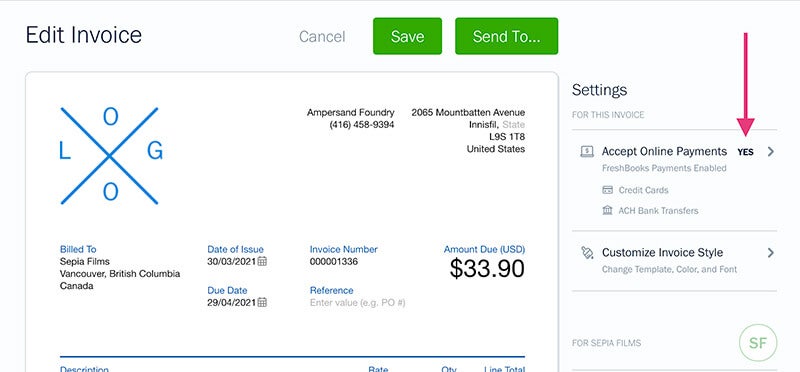
      2. Click on Online Payments Settings. Here’s what it looks like in-app:
        ach payment
      3. Click Get Started with Online Payments and then click Continue
      4. Verify your email, business information, and add a bank account
      5. Now, you’ll have the option to accept Bank Transfers on an invoice

      You can also enable ACH payments directly on an invoice:

      1. Click on the right of the invoice.
      2. Select the checkbox beside ACH.
      3. Click Done. That’s it!

      Here’s what it looks like in-app:

      ach payments 2

      ach payments 2

      Note: to be able to accept Bank Transfers (ACH), you first need to set up Online Payments. You can .

      How Do ACH Transactions Work?

      ACH payments are similar to bank transfers or wire transfers (the sending of money from one bank account to another). So let’s say a client wants to use ACH payments on an invoice. When you send the invoice out to be paid, your client can provide their bank account information to you (their account and routing number) and sign an authorization for ACH transactions.

      Then, when it’s time to pay, your bank will send their bank a request to transfer the money they owe from the provided account. And the two banks will then communicate to ensure that there are sufficient funds to process the ACH transaction into your bank account (similar to a direct deposit).

      All of this is done through the Automated Clearing House network, which handles the transactions for a variety of banks and financial institutions.

      Need Help With Bank Transfers (ACH Payments)?

      If you have any questions about getting started with Bank Transfers or ACH payments (like how to set up ACH payments, what are the ACH transaction fees, or how exactly do ACH payments work) feel free to .

      Plus, learn more about accepting online payments with , , and .

      [embedded content]

      This post was updated in September 2023.

      What’s New in FreshBooks – 2023

      Software Stack Editor · January 30, 2023 ·

      image

      FreshBooks releases new features and updates every month – designed to make accounting even easier for your business. And this post is the best place to check in on all the latest changes.

      January 2023

      Change Time Zones for Both Your Business and User Accounts

      Work with team members in different parts of the world? You can now adjust the time zones associated to both , as well as . This allows employees to log time entries in their time zone, and have it reflected in yours.

      Easily Update Business Information From Within Documents

      While on an Invoice, Estimate or Proposal, you can now hover over your Business Details and click on the Edit Business Information button to change your details directly inside a document.

      Show or Hide Your Phone Number and Address on Documents

      On Invoices, Recurring Templates, Estimates, Proposals and Credits, you can now show or hide your Business’ Phone Number and/or Address.

      🇬🇧 VAT Filing Is Now Available to Those on a Flat Rate Scheme

      Making Tax Digital for VAT allows you to submit VAT Returns digitally to HMRC using FreshBooks. And now, the integration is available to businesses on a Flat Rate Scheme.

      February 2023

      Create Custom Due Dates on the iOS App

      You can now create a custom invoice due date via the FreshBooks Mobile App for iOS – giving you more control over how and when you get paid.

      Easily Share Invoice Links From the FreshBooks Android App

      Need to send an invoice link on-the-go? The Share Link now generates a shorter unique link on the FreshBooks Mobile App for Android.

      When Exporting a CSV, Address Line 2 Is Now Included

      If you’re exporting a list of Clients or Vendors, the second address line is now included if it has been filled in. This will make your CSV exports more detailed and accurate.

      March 2023

      Payments Are Now Easier to Create and Edit

      We have made improvements to the input fields on Payments, making them easier to deal with when creating or editing.

      Track the History of Your Documents More Accurately

      When viewing the history on an Invoice, Estimate, or Proposal, the year is now displayed next to any date stamp if the event did not occur in the present year.

      Track Your Team Members’ Capacity At-A-Glance

      As part of Project Profitability, you can now set your Team Members’ and track the utilization rate on the .

      States and Provinces Are Now Abbreviated on Documents

      If the Country is set to Canada or the US for any address, the Province or State is automatically abbreviated (two letters) on Invoices, Estimates and Proposals.

      The is now updated to reflect all functionality while creating or editing Invoices on the FreshBooks Mobile App for iOS.

      April 2023

      Find Potential Expense Matches for Scanned Receipts

      If a matches the Date and Amount of an existing Expense or Bill, this is flagged as a Potential Match for you to attach the image to instead.

      Change the Date Your Calendar Week Starts On

      You can now choose whether you want calendars to start on Sunday or Monday in your account. Just go into the to make the change.

      Assign Income Accounts to Items & Services

      Items & Services can now be assigned to Income Accounts in your Chart of Accounts. This will make it easier to more accurately track all your numbers.

      Payments and Partial Payments Just Got Easier on iOS

      Set up online payments and manage them in the new , as well as accept partial payments while creating or editing Invoices on the .

      May 2023

      Easily Search Through Bank Transactions

      You can now by amount, date, or description. This will make it easier to find the entry you’re looking for.

      Specify Currency When Importing a CSV for Expenses

      When importing a list of Expenses, you can now choose the format your currency is in. It’s a small change that will make it easier to organize all your numbers in your preferred currency.

      Address Line 2 Added to CSV Imports

      When importing a list of Clients or Vendors, Address Line 2 can now be included in the CSV file.

      Updated Invoice Options Menu on the Android App

      The options menu is now updated to reflect all functionality while creating or editing Invoices on the FreshBooks Mobile App for Android.

      June 2023

      Add Your Team for Free on FreshBooks

      Add Team Members as to store their information at no extra cost.

      Multi-Language Emails Templates

      Email Templates can now be customized in other languages based on your Client’s language. Email Template defaults are provided for French and Spanish (Latin America).

      Use FreshBooks in Spanish

      In your Account settings, you can now choose to use your FreshBooks account in Spanish and as the default language for all Client communications.

      Accountants: Manage Clients More Easily With the Accountant Hub

      Easily add clients, manage their books, and toggle between client accounts from one central location with the free FreshBooks .

      July 2023

      FreshBooks in Spanish on Android

      Set your Android device to , and the FreshBooks Mobile App for Android will be displayed in Spanish.

      Balance Sheet in Collected (Cash-Based)

      You can now run the .

      August 2023

      Archiving Income Accounts

      When , Items and Services will be reassigned to the Sales Account under the Revenue Parent Account instead.

      Updated Business Switcher

      The  now includes links to the Accountant Hub and Developer Hub, as well as updates to support keyboard navigation.

      Time Format

      Choose to have your time displayed in 12 hour or 24 hour format in your  settings.

      September 2023

      Verify By Code

      When signing up for FreshBooks, you have the option to  by code or by email.

      Accountant Hub Log in to Client’s Account Opens in Frame

      When using  as an Accountant Hub user, the Client’s FreshBooks account now opens in the same window in a frame.

      Estimate and Proposal Share Links

      Send Estimates and Proposals using  to share outside of email.

      October 2023

      FreshBooks in English (Canada)

      In your , you can now choose to use your FreshBooks account in either English (United States) or English (Canada).

      Updated Profit and Loss Report Filters

      View a breakdown of your Income by Transaction Type or by Account on the .

      November 2023

      Updated Navigation and New Settings Section

      In Beta: The navigation experience has been updated along with a new Settings page for all business settings, and a new top menu for account settings.

      Retained Earnings on Balance Sheet

      Retained Earnings is now displayed on the Balance Sheet.

      Coming Soon

      FreshBooks Payroll powered by Gusto

      In Beta:Businesses in the US can sign up for  and payroll for employees, file payroll taxes, and maintain labor compliance.

      Interested in trying FreshBooks Payroll? Join the .

      For a full changelog and list of upcoming releases check out our .

      FreshBooks Saves This Canadian Filmmaker More Than $2,750 a Year

      Software Stack Editor · January 5, 2023 ·

      As a young entrepreneur starting a Canadian film production company, Chris Gaudry learned two important lessons quickly.

      The first lesson: Getting clients is good, but getting the right kind of clients is better. So when Gaudry—a musician who wanted to fill his creative bucket with art and music-focused projects—found himself producing an endless chain of corporate videos for agricultural clients, he knew he needed to redirect his ship.

      The second lesson: Arguably an extension of the first, was that you have to make investments in your small business to make it into an even bigger business. Gaudry decided to sacrifice revenue to spend time rebranding his Winnipeg-based company, . It paid off when he landed the gig that changed his company’s trajectory. An RFP to direct what would end up being nearly 90 music videos for Manitoba Music over the course of six years. Since then, Gaudry has kept a firm hand at the helm, writing and producing shows such as APTN’s  and the 2017 feature-length documentary, .

      But even when it feels like smooth sailing ahead, administrative tasks can make for rough seas. Yet, it took Chris nearly a decade to learn his most recent lesson: Just as it’s important to invest in yourself, investing in software that helps your business run smoothly can be a game-changer too.

      We spoke more with Chris to learn more about how FreshBooks has helped transform his business.

      How did Four Four Films get started?

      Chris: The entrepreneurial spirit has been in my body forever. Back in my early 20s, I was in a rock band. I knew that if we wanted to go from being a GarageBand project into an actual business that toured and made CDs, I would have to take us to the next level. So, I became the band’s manager and booking agent.

      I’ve always just followed my passions, as cheesy as that sounds. But it’s honestly true. If you want to do something, you have to grab the reins and take control of it. So, going off on my own [into film production]—even though I’d just had my first child and had a newborn at home—wasn’t always easy. Yet, it wasn’t as scary for me as it might be for someone who’s never taken that leap before.


      Related Articles


      Prior to FreshBooks, how did you manage your books?

      Chris: When you’re working on your company, you’re doing all the work for your company. It’s so hard to be the administrator and the marketing person too. Any entrepreneur will tell you that you get lost in doing the work, and you forget you have to work on your business as well. That was definitely the case for my accounting system.

      Most of my revenues come and go through a process of invoicing. I was keeping a tally of things that were coming and going just in an Excel spreadsheet and manually entering everything in.

      The part that would just kill me was the end of the year. I’d print up actual invoices and then stick them in a pile, and I’d lay out all these papers on the floor. I’d have a January stack and a February stack [and so on], and then I’d transfer everything into my spreadsheet in Excel. For expenses, I’d have to manually enter all the different categories of stuff I’d charged to my business credit card. And then I’d still have to hire an accountant and then take that crappy bookwork and turn it into a tax return every year.

      It was a tedious and painful two days of work. Just an absolute nightmare.

      FreshBooks is integrated into pretty much everything I do from a financial standpoint, from all my invoices to my projections.

      What’s changed in your business since you made the switch to using FreshBooks?

      Chris: I was having a beer with a buddy who is a photographer and was saying, “I gotta do my taxes. I’ve been putting it off. I don’t want to do it.” And he said, “I use FreshBooks.” I went home, Googled FreshBooks and that day, I was just like, “I’m doing this. I have to do this, and I have to start now.”

      Now, FreshBooks is integrated into pretty much everything I do from a financial standpoint, from all my invoices to my projections.

      One feature I really love is that it allows me to link my credit card to my FreshBooks account for my expenses. So, if I’m paying for gas or booking a hotel, all those individual expenses are now automatically tracked inside the software. I also do all of my invoicing directly from FreshBooks.

      I use the app too, which is nice because I’m either on the road or away for three weeks on production, and I don’t have my laptop handy. But with the app, I can quickly just resend invoices or update contact details on the fly.

      I also use the reports to glance at how much money I’m making and how much tax to pay. I have the luxury of sometimes being able to defer invoices to fit different fiscal quarters or years, so this allows me to be smart about how I’m managing my revenues and paying my taxes. Something like this is impossible when you’re just using a spreadsheet. The reports [in FreshBooks] allow you to make informed decisions about managing your cash flow and income.

      One of my accounting goals for 2023 is to start using FreshBooks’ mileage tracking. I’m still doing that manually. Right now, I use Google Maps to calculate how many kilometres I drive for work.

      What’s tax time like for you now that you’ve switched to FreshBooks?

      Chris: Because I also have a corporation, which enables me to get film tax credits, I work with an accountant to file to the CRA. She connects directly to FreshBooks, so I don’t have to do anything. She’s able to literally pull all the info she needs from FreshBooks, file it, then upload everything to the CRA directly. It’s really a one-stop shop.

      Taxes can be such a burden in your life when you realize you’ll have to buckle down and spend those two days on your taxes. Now, I don’t have a big crunch at the end of the year.

      When it’s time to file my taxes, I just email my accountant: “Hey, everything’s good to go. You can download the file and file for me now.” That peace of mind is invaluable.

      What advice would you give to other creative individuals who are interested in starting their own business?

      Chris: Accounting software isn’t free. And so, oftentimes, entrepreneurs may not be busy enough to feel they can justify the cost.

      But there’s a degree of accuracy and immediacy that using a software program brings to the table that you, yourself, cannot provide. I think that peace of mind goes a long way. Accounting software is an expense worth making early on in terms of organization. It’s worth it, even if you think you’re not big enough.

      What’s next for you and Four Four Films?

      Chris: My friend and I just collaborated on a passion project to produce a short film that I wrote and directed. A screener of it just premiered at Quebec’s Cinemania Film Festival in November 2022. It’s a project that’s particularly near and dear to me, as there isn’t really any major funding to make short films, especially more experimental ones. I’m super proud of it for its artistic merit.

      I’m also working on a 26-episode kids’ TV show for the French version of the CBC. It highlights the work a wildlife haven in Manitoba does to rescue and rehabilitate wild animals with an Indigenous lens.

      How does your identity as a Métis filmmaker play into your work?

      Chris: It’s a privilege to be part of the media landscape that’s part of the solution of Reconciliation. It’s also great to be part of what I hope is a true Indigenous Renaissance in Canada. We’re helping them tell their stories and giving them a chance to be louder and be heard. Working in Métis communities and meeting Métis people who live traditional lifestyles added to my own personal experience as an Indigenous person, and understanding of who I am on a way more profound level.

      I feel like I won the jackpot by being able to work in the niche sector of Indigenous filmmaking.

      FreshBooks Blog – Resources & Advice for Small Business Owners

      Software Stack Editor · January 1, 2023 ·

      Wondering How to Record Overpayment in Accounting Software? Credits on FreshBooks Makes It Easy

      Software Stack Editor · December 16, 2022 ·

      In a perfect world, every project would go off without a hitch. You deliver great work, and your customer pays the invoice straight to your bank account. But in reality, working with different on different projects makes every invoice a little different too.

      Sometimes a client wants to pay for your work before you’ve even created an invoice. Other times you may want to reward a loyal customer with a discount on their next invoice. And sometimes, you need to refund a client after an invoice has been paid (for a customer overpayment).

      To help with all of this, FreshBooks just launched the new feature. It’s a powerful addition that allows you to track overpayments, refunds, and discounts, and easily apply them to invoices, so you know exactly how much a client owes.

      What Are Credits?

      Credits allow you to track prepayments and overpayments from clients, that you can easily apply to future invoices. This allows you to keep track of discounts, refunds, and service credits.

      Why Should I Use Credits?

      Credits are a great way to ensure you’re tracking every transaction between you and your clients – even when you don’t have an invoice created.

      It also allows you to build better relationships by offering discounts, service credits, and even refunds for your work – so you can be more flexible with your payments.

      It also allows you to carry forward a credit balance for any subsequent invoice payment – making a potential invoice payment on a future invoice super easy for you and your client.

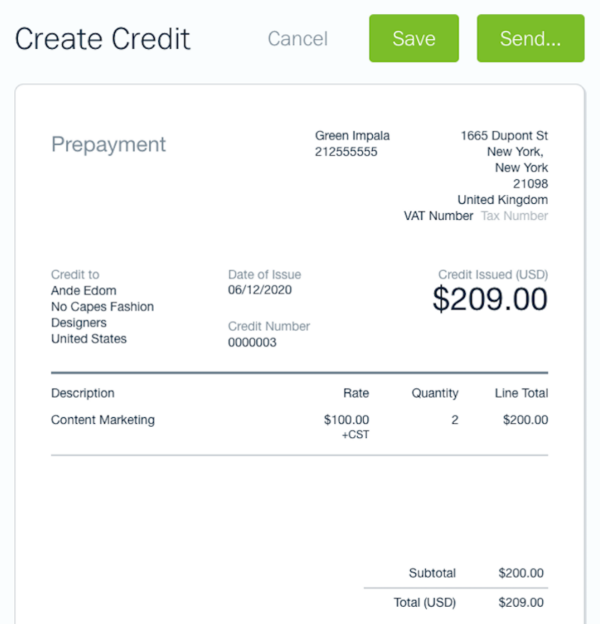
      How Do I Create A Credit?

      Creating a Credit is simple:

      1. Log into your FreshBooks account
      2. Once on your Dashboard, click Create New in the top right corner
      3. Select Credit
      4. Choose a Credit Type
      5. Click on Add a Client to choose a Client
      6. Click on Date of Issue to change the date if needed
      7. Click on Add a Line to add Items or Services you’re giving a credit for
      8. Click Save to create the Credit, or click Send to email it directly to your Client

      That’s it. Plus, once you’ve created a Credit, you can then View, Edit or Delete it. .

      credits

      credits

      How Do I Apply a Credit to an Invoice?

      After creating a Credit, you can quickly apply it to an Invoice:

      1. Click Invoices in your left navigation
      2. Click on the Invoice you want to apply the Credit to
      3. Click on the More Actions button
      4. Select Add a Payment
      5. If there is Credit available, it will automatically be selected for you
      6. Add Payment Notes if needed and click Add Payment to finish


      Note: If a client has a Credit tied to their account, you’ll have the option of automatically applying it when creating your next new invoice for them.

      Plus, when you run a you can match any existing Credits with your bank transactions (so that your bank account and FreshBooks account are in line).

      What Types of Credits Are There?

      There are 3 types of Credits that you can create on FreshBooks:

      • Prepayments: For when a client has prepaid for a service, before an invoice has been created (think of it as an advance payment)
      • Overpayments: For when a customer overpays an invoice, and you want to carry the amount forward (for use on a future invoice)
      • Credit Note: For when you want to apply an offer, service credit or refund for a client

      Wait: How Are Prepayment Credits Different Than Deposits?

      Prepayment Credits can be used when a client voluntarily pays for your product or service ahead of time. can be used when you ask for on a specific project.

      What Else Can Credits Do?

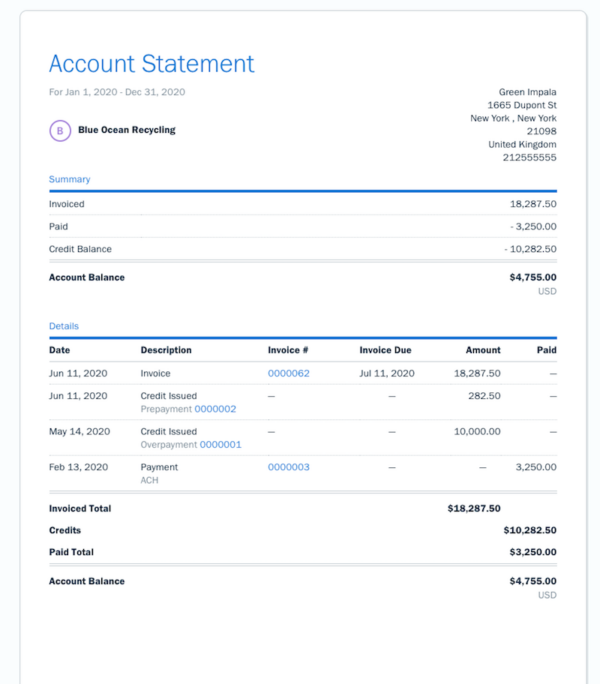
      Credits are also directly linked to each of your client’s Account Statements. This makes it easier for you to keep track of all Credits and credit balance tied to specific clients, so you’ll know exactly where they stand financially. This makes it easy to ensure your accounts receivable is accurate for each customer account.

      credits

      credits

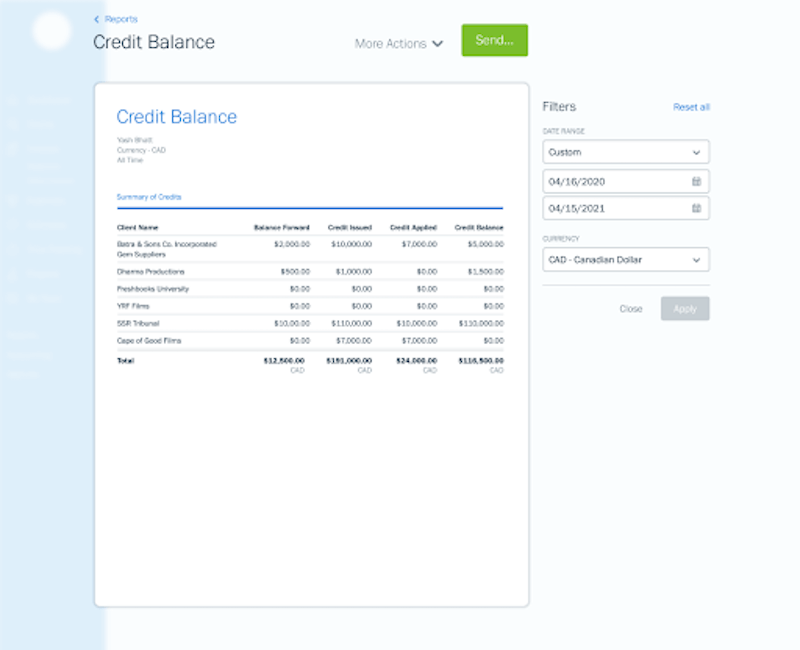
      Alternatively, you can run a Credit Balance Report to see any balances, credits issued, and applied amounts tied to a particular client. Here’s what it looks like:

      credit balance

      credit balance

      If You Need Help, FreshBooks Is Here

      Your business’ success is always top of mind for us. So if you have any questions on how to use Credits, or anything else, our support team is here to help.

      Ready to use Credits? to learn more or !

      This post was last updated in December 2022.

      Create 1-Step Online Payment Links, With FreshBooks Checkout Links

      Software Stack Editor · December 14, 2022 ·

      Getting paid is something to celebrate. It means someone loved your product or service enough to hand over their hard-earned money for it.

      And when it comes to getting paid, both you and your clients want transactions in as few steps as possible. When working on big projects spanning a few weeks the traditional process of creating invoices, sending them to , and accepting payment fits the bill. That doesn’t mean it’s one-size-fits-all. Collecting payment for a single item like an initial consultation or an event ticket doesn’t necessarily need to be invoiced, and can be done much quicker without having to invoice.

      Enter a really simple, invoice-free, way to accept client payments online: A new one-off payment solution called Checkout Links. Now, you can create payment links, post them anywhere online—as a URL, text, or button link—and without having to create an invoice.

      What Are Checkout Links?

      Checkout Links, or payment links, are an amazing new way to get paid in FreshBooks. They let your customers pay in a single click with bank transfers or credit cards. Post them anywhere you want to accept payments like a website, blog, or social channels. You can create an unlimited number of Checkout Links to be reused indefinitely or deactivated when you’re done with them.

      What Can I Use Checkout Links For?

      Checkout Links are designed to help you quickly collect payment for fixed-price items, whereas invoices are a record of work against a project or highlight the details of services rendered. They allow you to create custom payment links that can be used for as long as you want them – and avoid the need to collect copious amounts of payment details or invoice data. Overall, how you use payment links really depends on your business, but here’s a hit list of possibilities vs what might be commonly invoiced:

      Checkout Links

      Invoicing

      • Collecting payment for an initial consultation
      • Selling individual or groups of products on your website or blog
      • Collecting deposits for
      • Selling products you might not have sold previously, like eBooks.
      • Selling tickets to an event like a webinar or online class
      • A project involving multiple staff members
      • A project with a varied amount of time tracked against it that needs a record to show for it
      • Services that are outsourced and rebilled
      • Projects that involve retainers, milestones, and specific timelines
      • A number of project-related expenses

      [embedded content]

      Where Can I Find Checkout Links?

      You can find a dedicated page for Checkout Links nestled in the main navigation under Payments (aka your payment page). Which means, Payments is now its own category in the main navigation, and within it are tabs for Invoice Payments, , and now Checkout Links Payments.

      checkout links

      checkout links

      How Do I Create Checkout Links?

      1. Log into your FreshBooks account
      2. From your dashboard click Payments in the main navigation and then click Checkout Links when it appears underneath
      3. On the Checkout Links page click on the New Checkout Link button
      4. Fill out all fields that apply – don’t forget about the setting on right for Online Payments and Notifications
      5. Click Done to apply the payment settings
        payment links
      6. That’s it! Just click the Create button to make your new Checkout Link (which will generate a unique, secure payment link)

      7. A pop-up will appear with the link – click Copy to Clipboard and then Done. Now you can paste it anywhere you want to accept payment.

      payment links

      payment links

      What Do My Clients See?

      When a Checkout Link is clicked, your customer is presented with a payment page/box asking them to fill out all the pertinent payment information and their contact information (including shipping address if you want to request it). They have the option to pay with a credit card or bank transfer. Then, all they have to do is click. A receipt is automatically generated on a checkout page right after they submit payment.

      payment links

      payment links

      What Payment Gateways Are Available With These Payment Links?

      Your customers can pay by either credit card or bank transfer, which means you can choose to accept through . Each payment provider then gives you other payment methods/options including Visa, Mastercard, Discover, AMEX, Apple Pay, and so on. Which allows your customers to use payment links with their preferred payment methods.

      How Else Do Checkout Links Help With Clients?

      When a new client of yours pays by Checkout Link, they’ll automatically be added as a Client within your FreshBooks account. This makes it easier to track and manage every payment you receive, and means less time spent adding new client profiles every time you get paid. It’s a simple, barrier-free payment process that allows you to sell products and collect payments super fast.

      Where Are These Transactions Reflected in My Reporting?

      You’ll see all the financial information for Checkout Link transactions reflected under Sales > in the Profit & Loss Report. This number doesn’t include the tax, which is available separately in the Sales Tax Summary Report.

      payment links

      payment links

      FreshBooks Is Always Here to Help

      Payment links are an exciting function we hope you find helpful. But if you have any questions, or you just need a hand getting started, a team is ready to help you out. .

      to create your first link or .

      This post was last updated on December 14, 2022.

      6 Reasons for Accounting Professionals to Get FreshBooks Certified

      Software Stack Editor · November 8, 2022 ·

      Is it time to add a new skill to your toolkit? When you support clients with accounting software, taking the time to level up your skills goes a long way in helping you work more efficiently and reach new customers.

      As a firm or business owner, you want to be where your clients are. FreshBooks has an entire training program to help accounting professionals who work with small businesses learn the ins and outs of the platform.

      Don’t just take our word for it! We asked Accounting Partners to let us know what they thought of the FreshBooks certification.

      “Being FreshBooks-certified has changed the entire course of my business,” said , owner of Heritage Business Services. Read on to get the full story and learn why it might be time to add another certification to your skillset.

      Table of contents icon

      Table of contents iconTable of Contents


        Related Articles


        What Is the FreshBooks Certification in the Accounting Partner Program?

        The is an online, self-paced training program designed to give accountants and bookkeepers the tools they need to work better with their clients in FreshBooks.

        It walks you through everything you need to know about FreshBooks to serve your small business clients, from setting up your to running reports and managing your clients’ chart of accounts. It also covers the FreshBooks Collaborative Accounting™ framework, a process that can transform the way you and your clients work together.

        (👋 Already a FreshBooks Accounting Partner? You can access the certification through the learning management system.)

        What Is Collaborative Accounting?

        FreshBooks Collaborative Accounting is a technology-enabled accounting model anchored in a shared workflow between accounting professionals and their clients. Business owners focus on completing front-end tasks in an easy-to-use software platform, and their accountants pick up where they leave off, providing in-depth financial insights and advisory work that has increased value for clients. When you and your clients each take on parts of the financial workflow, you’re both more confident and better informed.

        Your client has more agency over their own business and a deeper understanding of their financials. And you have time to do more astute analysis that can help them make those big-picture business decisions.

        This model and workflow are designed for future-focused accounting professionals who want to add more value to their firm and give clients a deeper level of service. It’s ideal if you have looking for guidance and more agency over their financial future.

        “ not only gives the clients transparency into our tasks but it gives us transparency into the client’s workflow and how they’re going to earn money. And so, that can now help us to advise them on how to get paid,” says Kristen Keats, CPA, of Breakaway Bookkeeping & Advising.

        What Are the Benefits of Collaborative Accounting?

        Collaborative Accounting makes it possible for accountants to offer higher-value services to clients. When you’re locked into advisory or niche accounting work that has real value for your clients, you can build your expertise and reputation, bringing in more revenue with less administrative burden.

        You can expect to:

        Deliver value at scale. By freeing your team of time-consuming compliance tasks and focusing on advisory services, you can expand those services without having to grow your team.

        Attract forward-thinking talent. Firms that focus on advisory services vs. strictly bookkeeping tasks will naturally bring in the best and the brightest team members who have a growth mindset for their clients and their company.

        Streamline processes and improve overall efficiency. A shared workflow in a single system is more efficient overall. It removes the friction of following up on missing information and managing day-to-day bookkeeping tasks from your client interactions.

        Draw in and retain the right long-term clients. Your practice can differentiate itself by building a depth of experience and advisory knowledge in an area aligned with your ideal clients. Distilling your expertise into a higher-level tier will attract clients who match.

        Enjoy a competitive advantage in the marketplace. Service-based business owners looking to grow their companies are hungry for accounting solutions that empower them to understand their financial operations better. FreshBooks is the only software that offers Collaborative Accounting, where clients and accountants work together.

        Deliver an enhanced client experience. Collaborative Accounting simplifies client interactions by letting you and your clients work together in a single system, so you both have the insights and information you need (and when you need it).

        Elevate client relationships. As an advisor, you can minimize the time spent fine-tuning client financials and maximize the time guiding your clients as they grow. This builds strong, lasting relationships. You’ll meet regularly to discuss the financial insights you’re observing that they can use to optimize their business and prepare for sustainable growth.

        FreshBooks Accounting Partner Program: Why Get FreshBooks Certified?

        Okay, you now understand what Collaborative Accounting is, and why it’s important for your clients. But that doesn’t answer the million-dollar question: Why should my team get certified?

        Glad you asked! Let’s dig into it.

        1. It’s Made for Modern Accounting Professionals

        Are you ready to shake up the accounting industry just a little (or a lot)? The traditional way of working with clients can be transactional and impersonal. It leaves accounting professionals frustrated with chasing data and spending too many hours on basic bookkeeping work. Meanwhile, clients feel removed from their business financials and aren’t getting the insights they need to grow.

        “Now, with Collaborative Accounting, we’re able to spend much more time nurturing the client relationship, providing advisory and not just on the financial level but also the personal level,” says Nicole Davis, CPA.

        If you’re excited to try a new, collaborative way of working with clients that’s focused on and showcasing your value as an accounting professional, this is the certification for you.

        2. Become a FreshBooks Product Expert

        Your clients’ businesses aren’t static, and yours shouldn’t be, either. Getting your FreshBooks certification is an easy, free way to level up your skill set and keep your firm up-to-date on accounting software platforms.

        “Being FreshBooks-certified gives my clients (and prospects) peace of mind that I am not devoted entirely to only 1 company’s software,” said Susie Fergus, FreshBooks Accounting Partner. “Instead, I am customer-focused—recommending what is best for their unique business. This software is well-supported, user-friendly, and ever-evolving to meet the needs of business owners.”

        In the certification, you’ll explore the FreshBooks platform and features, learn how to onboard clients, and gain a deep understanding of how to use the Collaborative Accounting framework with your clients; thus, benefits both of you.

        This allows you to optimize workflows for your clients and get the most out of the technology.

        “The best part of the certification is the insight into how the software thinks and acts,” said , owner of Crayon Advisory. “We’re trained to think one way by other software, and it’s not always the best, most efficient, or most business owner-centered way of thinking.”

        3. Get Practical Hands-On Resources

        At the heart of the FreshBooks certification are actionable tactics and resources you can use immediately to expand your advisory practice, without adding more staff.

        The modules walk you through the platform and give you training and practical tips on product features and advisory-centric workflows via:

        • videos
        • downloadable templates and checklists
        • peer reviews
        • interactive case studies you can use with your clients
        • onboarding documents to guide your clients

        4. Access Dedicated Accounting Support

        FreshBooks-Certified Partners get dedicated support from our Accounting Specialists, who have accounting backgrounds and know the ins and outs of the FreshBooks platform.

        But even if you haven’t completed your certification yet, the FreshBooks team is here to support you! As an Accounting Partner, you’ll be connected with your Partner Consultant, who will become your go-to person at FreshBooks.

        5. It’s Simple to Get Certified

        You’ve got enough on your plate, so we totally understand that any product certification has to work around your schedule. The entire FreshBooks certification process takes under 4 hours, but you learn at your own pace. You can always pause and pick it back up if you need a break.

        The training comprises of modules with video lessons, so you can see how to do pretty much everything in FreshBooks. You’ll get step-by-step instructions on tasks like adding journal entries, creating an invoice, using time tracking, and doing .

        You’re not a robot, so no one’s expecting you to remember every tiny detail from the certification. You can always go back to review lessons if you need a refresher.

        “The certification modules are like a library for me,” said Kate. “I know that I can’t remember everything that’s taught in each module after only one listen. But, I have a strong grasp of the overall platform, and I know I can search through the module titles when I need to be reminded of how a specific feature works or how to do a specific task.”

        “The certification is easy for me to go back and re-watch the thing I need to know or have a question about,” said Megan.

        6. Get a New Badge (And Other Free Stuff)

        One of the best reasons to get FreshBooks Certified is to demonstrate to your clients that you have the skills to support them across various accounting platforms. When you complete the training, you’ll get a badge signifying your expertise as a Collaborative Accountant to on your website or social media platforms.

        “Being FreshBooks Certified gives me one more way to show my clients I’m competent at what I do and with the products I use,” said Megan.

        Plus, as a certified partner, you’ll get:

        • 3 CPE credits
        • exclusive discounts for you and your clients
        • dedicated, accountant-specific support
        • data migration support
        • inclusion in the FreshBooks Certified-Partner directory

        Your First Step to Becoming a FreshBooks Certified Accounting Partner…

        Ready to get started on your training? Great! The first step to getting FreshBooks certified is to .

        From there, our team will be in touch to find out your goals and get you on your way to getting certified. I can’t wait for you to join us!

        This post was updated in September 2024.

        Why This Scaling Digital Marketing Agency Made the Switch to FreshBooks—Twice

        Software Stack Editor · September 20, 2022 ·

        To look at The Influence Agency now, it’s hard to believe it came from humble beginnings only a short time ago.

        Based in Toronto, the full-service marketing and creative agency specializes in influencer and social media marketing. In just five years, its team has grown to 45 (including Chief Happiness Officer Joy, a rescue dog from Costa Rica), and it’s amassed an impressive client list that includes names like Staples, Jamieson Vitamins, the Skill Trades College of Canada, and HelloFresh.

        “The big names are feathers in our cap, but we also really care about the SMBs that come to us and entrust us with their entire marketing budgets,” says Michael Landry, Co-Founder and Vice President of Strategy.

        This values system is likely the result of own roots as a start-up. Back in 2017, a team of five crammed into a small one-bedroom condo in downtown Toronto to make its first sales. Landry usually rode his bike to work to save money, and meetings sometimes took place inside his car.

        “Once, it was so cold, but we didn’t want to turn on the engine because we didn’t want the client to know we were making the call in a car,” recalls Landry. To make it, Landry knew the agency needed to appear as professional as possible. But when The Influence Agency did land its first major sale, a previous accounting software provider refused to release the funds, undermining the team’s hard-won efforts.

        Since then, The Influence Agency has made the switch to FreshBooks. We spoke with Landry to learn more about the agency’s early days and how FreshBooks is now helping it support its clients—of all sizes.

        How did The Influence Agency get its start?

        Michael: As we [the four founders] did research into influencer marketing, we saw that it was an emerging advertising method, and there weren’t a lot of players in it. We felt we could find a way to offer something unique that would appeal to us, the consumers. We also stuck true to the services we knew were in demand, including content writing, search engine optimization, Google ads, Facebook ads, and web development.

        Today, we’re a full-service digital marketing agency. With every new person we hire, we’re hiring a unique set of skills and talent, which sometimes creates a runway for new things. It unlocks new possibilities and new things that we can do.

        Why did you make the switch to FreshBooks—twice?

        Michael: We started on QuickBooks. And with one of our very first big sales that we made, QuickBooks decided that we were too small for them to send us the money. They said, “We’re not sure your business could sustain a chargeback because you’re so new.”

        So, we had to send them the contract, along with our financial records, to show them it was valid. We waited three weeks for the statements to come through so that we could start work for one of our first clients ever.

        And at the end of the long process, QuickBooks said they couldn’t release the money. So, we had to go to the client and say, “Hey, look, we’re going to have to refund the money. Can you please send us a cheque?” It was really embarrassing. We had hustled to get our business off the ground and make that transaction.


        Related Articles


        So, we moved on and got FreshBooks. The price point made trying it out very easy. It didn’t seem to have any of these issues. We used it for about a year and a half, then one of our accountants said, “You know, we have got to try QuickBooks again. They won’t give you trouble because you’re a more established business now.”

        And again, QuickBooks pulled the same stuff. They questioned a $20 web hosting fee. They held our money hostage, and again, we had to produce contracts. And on top of that, they told us they wouldn’t authorize the $5,000 a month worth of recurring charges and that it could get flagged. So being successful or having a high volume of transactions could cause us more issues.

        We had to spend hours upon hours dealing with something that should really be super turnkey when meeting or exceeding our clients’ expectations is what we should be focused on. You don’t need other friction when you’re starting a new business.

        How has FreshBooks supported your needs as a scaling business?

        Michael: We’re an 8-figure company now. We’ve never had a chargeback. We’ve never had debt as a company.

        We’re continuing to grow our team, and now we’re on Stirling Road, where we have a 5,000-square-foot office that we fully renovated. We’re starting to delve into commercial production, print, and out-of-home advertising. As an agency, we’re evolving to meet all the advertising needs of our clients and become a one-stop shop.

        With FreshBooks, I was able to operate my business effortlessly from day one. It took that stress off.

        For us, visibility into our business and accounts receivable continues to be so important. Making sure that payments are deposited on time for reliable cash flow is really important. With FreshBooks, I was able to operate my business effortlessly from day one. It took that stress off. The support has been awesome, and it’s so fast and easy to use.

        We got to the point where we were billing enough that we wanted to get our fees down on credit card transactions. We also needed to add more clients, which is a great problem to have. FreshBooks set us up on a custom Select plan, which includes an unlimited number of clients and helps keep fees down. FreshBooks has always made life easy.

        What FreshBooks features do you use most frequently

        Michael: FreshBooks has the best user interface, in my opinion. I enjoy the automated report section. It’s one click, and I can get a pretty good understanding of where I’m at.

        Every month, we take all of the line items that we sell and categorize each item by department in terms of revenue. And based on that, I can deliver Profit and Loss statements very quickly to our department managers, so they can understand how their individual departments are working. It allows each department to take ownership over its profitability.

        Keeping tabs on every department’s individual performance can raise the whole company’s profitability. If you understand how they’re functioning, you can zero in on the ones that need some adjustment, which can really move the needle on the whole organization.

        We also built a tool that lets our clients log in and see the results of their marketing efforts. And we included FreshBooks in that tool as an API so that customers can look at their bills anytime. This is just one of the ways we leverage FreshBooks to add value to our customers.

        What accounting advice would you give to other start-ups?

        Michael: Since starting The Influence Agency, I’ve started another business—a recruiting company—and FreshBooks was the system I decided to use.

        My advice is to go with the system that gives you the most visibility as to where you’re at. You want to make sure that when you invoice somebody, they can pay it, and you can receive those funds in a timely manner. When you get your first big deal, you want to be able to grow your business and not be hampered by a long and arduous process to prove that you’re worthy enough.


        Attorney Samantha Is a Software Expert—and FreshBooks Is Her Accounting Software of Choice

        Software Stack Editor · June 9, 2022 ·

        Once exclusively the domain of software developers, data privacy and regulation has been making front-page headlines in the past few years.

        “I went from nobody ever really understanding what I do to everyone now telling me what I do,” says Samantha Simms, CEO of , a U.K.-based digital compliance consultancy.

        Samantha, an attorney by trade, has spent roughly two decades working on data privacy and compliance for large corporate legal departments. In 2017, she set out on her own.  “I’m a bit of a tech geek,” she says,  “I love tech and love to see new software developed and brought to the market.”

        Today, she works with clients to help them develop new technology products and scale in an ethically compliant way while remaining commercially viable. Her focus is on helping businesses that have some social impact and on supporting underrepresented communities, including Black software developers.

        We spoke with Samantha to learn what makes a great piece of software—and why she thinks FreshBooks fits the profile.

        Can you tell me a bit about why you started the Information Collective?

        Samantha: The more expertise I gained in my area of law, the less I felt I knew about everything else. I felt there was much more than I could bring to the global table, and I wanted to explore more of myself as a leader. I was looking for a certain freedom, as well, to live my life on my own terms. I also wanted to have more impact—for myself and the wider world.

        My clients are largely what I call Black tech and big tech. My focus is on giving underrepresented communities who are trying to enter the tech world the professional support that they may not have access to otherwise. I also work with big tech to ensure that there is fairness built into their tech products.

        With so many data privacy legislation changes recently, I can imagine you’ve had a big couple of years!

        Samantha: The Information Collective started in the boom time of digital privacy. was just about to be brought into force, harmonizing the European data privacy landscape. With the new legislation, people have recognized the need for digital privacy, so my services don’t require as much of a “sell” as pre-GDPR.

        We’re now at the frontier of a newer digital era, where I help clients be prepared for a lot more than data privacy compliance requirements. Our team also assists clients with e-commerce regulations, advertising and marketing rules, and compliant e-communications. We make sure those are handled in a fair, transparent, and secure way.

        What surprised you about starting your business?

        Samantha: I remember somebody saying to me, “You will always work for someone.” At that time I didn’t understand it, because I was thinking, “Well, if I’m running my own company, I’m not working for anyone.” But I get it now. I am working for my clients. And that is not a problem. That is exactly what I love. But it does mean that I have to be fully present and available As the leader and the principal consultant of my business, everyone looks to me. There is a lot more required of me now than ever before. So now I have more work-life harmony, but I’m not as focused on achieving work-life balance.

        Some of the other accounting software seems to have been designed with big business in mind. FreshBooks has been designed with a small business in mind from its DNA. That simplicity saves me a lot of time.

        What was your accounting experience prior to starting your own business?

        Samantha: I had absolutely no clue about accounting or cash flow or anything like that for a small business when I first started out. When I first started The Information Collective, I had been working in large corporate organizations for a very long time. I knew how large enterprises operated, but I had very little knowledge of the operations of small businesses.

        How did you find out about FreshBooks?

        Samantha: I literally did a Google search for “small business accounting software.” What came up was a range of options. I read through a lot of marketing materials and comparative studies. What jumped out at me was that people talked about FreshBooks being simpler to use. And it was more suited to my needs because I only work with a handful of clients at any one time. I didn’t typically need to invoice more than 4 clients in a given month.

        It was also easier for my personal assistant, trainees, and the contractors I work with to come onto FreshBooks. They charge their time to me through FreshBooks, and that works really well for us.

        Which FreshBooks features do you use the most?

        Samantha: I love the Dashboard. When I go in, I’m immediately able to see exactly what’s going on and get a snapshot of the financial health of my business. I love the invoicing function as well. I was able to create a more-or-less bespoke invoice straight out the gate. As a fledgling small business working with enterprise clients, branding my own invoice was really important to me. FreshBooks was able to give me a more professional look and feel, even when I was just starting out.

        I also use Expenses, Proposals, Time Tracking, and Projects. All those features have really helped me to quantify and qualify effectiveness in my business.

        For instance, since the U.K. has allowed , I’ve linked my bank account and my expenses are automatically imported and categorized in FreshBooks. So when it comes to doing the accounts, or looking at disbursements for my clients, I can easily link those back to the actual expense itself. It’s very seamless.

        And then, as I continued to grow I started using the Retainers, which is linked to Time Tracking, and also Projects. Those have worked fantastically for me.

        Can you talk a bit about how you use Projects?

        Samantha: After I, say, send a proposal, within a new project I’m able to see—because of the tight time-tracking system—how effective my team has been against the number of hours we set for the delivery of the project. Using the (Team Cost Rates, Project Estimates, Profitability Reports) I can see what it actually costs to deliver a project versus the profit made. And I can then use that information for other projects of a similar nature. So it’s helped me a great amount with my as a result.

        As a U.K.-based business operating globally, how have you found payments with FreshBooks?

        Samantha: I run my business across the U.K., U.S., Canada, and the Caribbean, and get paid in U.S. dollars, Canadian dollars, and British pounds. Using the integration with Stripe for means that my clients who are not in the U.K. have a familiar way to make payments quite easily and simply. I know funds are coming in and we don’t have to go through convoluted banking systems. It’s really enabled me to expand the business beyond the U.K. market.

        Since business accounting was new to you, I’m guessing you’ve had a question or two! How has your experience been with FreshBooks’ Support?

        Samantha: That’s one thing I liked about FreshBooks from the very beginning. Early on I had a query. The FreshBooks staff member I spoke with was very friendly and helpful, and able to get things done to the extent that I actually assumed I was one of the only people using it. To be honest with you, I was like, “Oh bless, he’s probably the CEO.” And then not long after that, I realized, “Oh, FreshBooks has been around for a long time and they have quite a few customers, so that couldn’t possibly be true.”

        A year-and-a-half into my time using the software, FreshBooks invited me to a dinner in London where I met other FreshBooks users and the executive team. I just thought that was such a nice touch—bringing us all together and showing interest in us as clients and customers.

        I work with a lot of software companies. I’ve helped to develop a lot of software on the legal side of things. That customer care is not something that you often see in the software business.

        Why would you recommend FreshBooks?

        Samantha: I’m not an accountant; I’m a lawyer. I have to spend a lot of time either doing client delivery or learning or marketing. I have little interest in learning accounting, beyond what I need to do to keep my business operating. FreshBooks built something because they understood where their customers were coming from. Some of the other accounting software seemed to have been designed with big business in mind, whereas FreshBooks has been designed with a small business in mind from its DNA. And that simplicity, I think, saves me a lot of time.

        I’ve been at the forefront of developing a large number of consumer-facing and business-facing software technologies as a specialist in digital compliance. I would say I’m a very good test use case for whether something works well or doesn’t work well. If it feels simple to use, it gets my tick in the box. And for me, that’s FreshBooks.

        [embedded content]

        Accountants: What Is the Best FreshBooks Plan for Your Client?

        Software Stack Editor · May 5, 2022 ·

        Thinking of FreshBooks for your clients but not sure where to start? You’re in the right place.

        You already know that the right accounting software will help clients keep track of their day-to-day finances and give you the information you need to offer expert accounting services. Which might be what led you to consider a different software option. Many business owners who aren’t “numbers people” —and even .

        At FreshBooks, there are multiple plans to suit businesses at any stage, whether they’re just getting started or are scaling up fast. Read on to find the plan that’ll work best for your clients.

        Table of contents icon

        Table of contents iconTable of Contents

          Is FreshBooks Accounting Software a Fit for My Client?

          Before comparing plans, it’s important to understand who is a fit for FreshBooks and why.

          FreshBooks is ideal for:

          • Small businesses looking for an easy-to-use software
          • Service-based or project-based businesses
          • Businesses with light or no inventory
          • Businesses with up to 25 employees (Although larger businesses can still thrive and with FreshBooks.)

          You know that the right software is not just about your tech stack and your proficiency or level of comfort. It’s about your client being able to use the software comfortably, too. That’s why the works so well for accounting professionals who use FreshBooks with their clients. Now let’s compare plans and see which works best for your clients.

          Now let’s compare plans and see which works best for your clients.

          All Plans: Not-So-Basic Standard Features

          Each FreshBooks plan has its own unique features and benefits. As a cloud accounting and invoicing software, there are tons of great features available on all .

          Key Features

          • Unlimited invoices, estimates, and expenses
          • Online payments
          • Projects
          • Time Tracking
          • Reporting

          All of our plans allow business owners to send unlimited invoices and estimates and track unlimited expense entries. Growing businesses particularly like how easy it is to and send their clients payment reminders.

          Speaking of getting paid, FreshBooks plans allow business owners to with credit cards and bank transfers.

          FreshBooks’ and Time Tracking features are great project management tools. Users can review all time tracked from their team members, as well as see all invoices and expenses associated with a specific project.

          While FreshBooks may have started as an invoicing software company, today’s small business owners turn to us for help with their day-to-day bookkeeping and accounting tasks. All of our plans include financial reporting tools so users can generate invoicing and payments reports, , and .

          Plus Plan: Our Most Popular Plan

          Key Features

          • Free Accountant roles
          • Bank reconciliation
          • Accounting reports

          Chances are that most of your small business owner clients will find that Plus is the best FreshBooks plan for their business.

          With a generous limit of 50 billable clients, they’ll be able to invoice their regular customers and still have room to grow their client base.

          As an accounting professional, you can feel comfortable recommending the Plus plan because it’ll capture the financial data you need to help your clients. And it’s priced competitively for them to boot.


          Related Articles


          Dedicated Accountant Role

          Whether you need to set up your client’s FreshBooks account from day 1, or you only need access at tax time, FreshBooks has two that allow this to happen.

          By setting up your client’s account from the Accountant Hub, you, as the can set up their Chart of accounts, and connect their bank account to start automatically importing transactions. You can also decide if you or your client will pay for their FreshBooks subscription (if included in your list of offered services). In the advanced accounting settings, both accounting roles allow you to make accounting changes within the account, like creating custom accounts in the chart of accounts and creating and editing journal entries, The Accountant Hub will allow you to manage your clients’ FreshBooks accounts in one place.

          Bank Reconciliation

          The feature lets you match account activity in your client’s bank account against entries recorded to their FreshBooks account. While the tool does a lot of the heavy lifting by automatically scanning the account and providing a list of likely matches, you can also manually match account activity to further ensure accuracy and consistency.

          You can also record transfers and contributions to or draws from owner’s equity to cut down on the need for manual journal entries. Imagine the time-saving potential for your accounting processes!

          Accounting Reports

          Speaking of financial data, let’s dive into the information clients can easily track with the Plus plan, and what it’ll look like on your end. FreshBooks’ double-entry accounting features allow you and your clients to get a full-picture view of money earned versus money spent.

          The double-entry accounting reports on the Plus plan that make this possible are:

          • Balance Sheet
          • Profit & Loss
          • Cash Flow
          • Trial Balance
          • General Ledger

          Premium Plan: For Tracking Payables

          Key Features

          • Unlimited billable clients
          • Customizable email templates
          • Accounts payable features
          • Track Project Profitability

          The Premium plan has all the features of the Plus plan and then some. It’s ideal for owners who are scaling up and starting to outgrow the Plus plan.

          Typically, most owners who choose the Premium plan do so because it supports an unlimited number of clients, which is a step up from the 50 available on the Plus plan.
          It also offers owners additional email settings, including automated client emails with dynamic fields and customized email templates and signatures.

          From an accounting perspective, the Premium plan also includes the and the Project Profitability features. Clients can use Project Profitability to easily track and record their bills for various vendors all in one place–giving you the visibility to accurately advise on cash flow at any time. By comparing the profitability of standardized services, businesses can get accurate and real-time insights to all the revenues, expenses, and employee costs associated with the client or project.

          Select Plan: For Big(ger) Businesses

          Key Features

          • Dedicated account manager
          • Customized onboarding services
          • Dedicated customer support
          • Access to lower credit card transaction rates
          • Data migration services
          • Revenue forecasting

          The Select plan is our highest-tier plan and should be considered for clients whose businesses are at a stage that requires specialized support.

          Select plan members can expect a dedicated account manager, customized onboarding services, and data migration services.

          It’s also a good option for businesses that process a lot of online payments as it’ll allow them to take advantage of lower credit card and debit card processing fees.

          Along with the accounting tools included on the Plus and Premium plans, the Select plan also offers a greater level of insight into a business’s finances with additional reports. Recurring revenue reports, for example, help with revenue forecasting. In particular, the can be run from the present date to any date in the future to see future projected recurring revenue at any given time.

          Lite Plan: For Those Just Getting Started

          The Lite plan tends to be the best fit for businesses that are just getting started and have less than 5 active clients. While the Lite plan definitely punches above its weight as an invoicing tool, it doesn’t offer the same accounting tools as our other plans.

          That’s not to say the Lite plan is short on features! For example, the ability to import expenses as a CSV file into FreshBooks is available on all plans. Clients also get unlimited invoices.

          However, you might find that a different plan is the better fit for your client if they’d benefit from the dedicated Accountant role, double-entry accounting, accounting reports (other than the P&L Report and Sales Tax Summary Report), or bank reconciliation features.

          Just for You: The Accounting Partner Program

          When saying that FreshBooks is built for owners, that also includes accountants and bookkeepers, too. The was designed to support accounting professionals build up their own businesses with access to great tools, education resources, and a peer network to collaborate (and sometimes commiserate) with.

          Switching a client to a new accounting software can feel daunting. Our team is equipped to help accounting partners migrate their clients’ full general ledger (GL) to FreshBooks as seamlessly as possible.

          Partners also get dedicated support from our partner support specialists, who have accounting backgrounds and know FreshBooks features through and through.

          Want know more? Email us at accountants@freshbooks.com to set up a call with one of our partner consultants.

          With Any Plan Your Client Chooses…

          We know that your top priority is to provide your clients next-level service by helping them track their finances and make sound financial decisions. At FreshBooks, we have the same commitment to unbeatable service.

          With any plan your client chooses, you can count on FreshBooks to deliver outstanding service from our award-winning Support team.

          Every small business is different. Their accounting needs vary by business type, size, and industry. We know there’s no one-size-fits all solution when it comes to accounting software, which is why we don’t try to be!

          Get your clients started with a or contact our award-winning Support team at 1-866-303-6061 or for more information.

          This post was updated in March 2024.

          How Aliya Uses FreshBooks to Scale Her Communications Firm and Stay Confident During Tax Season

          Software Stack Editor · March 17, 2022 ·

          Aliya Jiwan-Thawer is a seasoned media trainer and media relations consultant who brings over 20 years of communications experience to the table. After working 10+ years as a television and radio news reporter for major Canadian broadcast networks, Aliya transitioned into the world of public relations.

          While in public relations, she had the chance to work with both large and boutique PR agencies, creating and executing public and media relations campaigns in a variety of industries including financial, health, IT, education, childcare, corporate and non-profit sectors.

          Aliya’s insight into the workings of a newsroom allows her to identify the qualities that make stories stick. She understands the science of generating media interest, and her rapport with media connections enables her to secure media interviews for clients on a wide range of topics.

          Today, using her experience as a television news reporter, Aliya has also trained countless CEOs and company spokespeople for some of the toughest media interviews. She’s used her platform and company to help successfully launch a variety of products and charities for her . She has also media trained a wide range of spokespeople and managed numerous fundraising events while positively positioning her clients in ways that have raised awareness and brought attention to their stories.

          As Aliya found herself making a career transition from journalist to media trainer and media relations consultant, she found herself in pursuit of added flexibility to help her dedicate more time to motherhood, “When I really needed that flexibility, I didn’t have it. So I left, and it was scary. I was very lucky that I had the support of my parents and my spouse because it’s a scary thing to go from making really good money on a consistent basis to not being sure how much money is coming in”.

          Today, Aliya is able to maintain a balance that suits her professional profile while also carving out enough time to spend time with her family. As she continues to scale her , she remains focused on her passions while allowing FreshBooks to take over the parts she’s happy to spend less time on.

          Was the transition from journalism to media relations consulting slow and natural, or something that sort of happened overnight?

          Aliya: After spending over a decade as a TV news reporter and anchor, and a little bit of time as a producer with various news outlets at places like CBC and CTV, the natural progression from journalism for me was to move into media relations. I got a job working at a large PR agency, and there was so much I learned there about just the actual job and media relations, media training, writing, editing, and managing teams. Then I got an opportunity to work at a smaller agency, which involved a lot of leadership, as it was a smaller firm. The biggest perk there was I got to work from home most of the time.

          After a lot of commuting from the suburbs to the city with that job, I found myself having to endure a struggle that a lot of parents face when their kids first start daycare–being at an age where they are changing socially and sick often—you need a very understanding employer who is comfortable with you stepping away and go pick up your kid first, and putting the grind second.

          After a while, I realized I didn’t really have that flexibility, and I felt like I was constantly walking on eggshells. With both of my parents being self-employed, they would say time and time again that consulting or starting my own business would be the right move. With that in the back of my head, when I really needed that flexibility I decided to leave and transition to working for myself, which was very scary initially. I was extremely lucky to have the support of my family and go from making really good money on a consistent basis to not being sure how much money I’m going to make.

          With FreshBooks, it’s hard for me to fall behind on invoices and lose grip of my income projections since everything is tracked month to month. That makes tax time especially painless.

          What unforeseen challenges hindered you early on in your journey as a small business owner?

          Aliya: The actual client services part came naturally to me because I was already managing clients, and I knew exactly what the clients needed. Having the taste level with the writing and the editing along with having that news judgment of what will help clients get media coverage, all of that came naturally to me. But knowing how to run a business? That was tougher to handle.

          Making sure I was the person who was client-facing and doing the work wasn’t an issue at all, but also being the person sending out invoices and making sure the money came through was not something that came naturally to me. I was lucky to have the guidance of my parents who were both self-employed and both accountants. They kind of guided me through the process of and tracking my billable hours to make sure I was ready for tax time.

          What was your old accounting process like, and how do you think it changed over time?

          Aliya: For me, it was a series of spreadsheets and Word documents. Microsoft Office was my best friend initially because that’s all I knew. And when you only have a handful of clients, you can get away with it. As soon as I started ramping up clients, it became apparent that I needed a better way to do things.

          The other challenge when you’re a consultant is, you need to really be prepared for the ebbs and flows of the business. Some months can be very, very busy, and suddenly other months can be very quiet. You need to really manage your cash flow properly so that you not only have the money when it comes time to pay your taxes and and all that fun stuff, but also so that you have the income to carry you during those slower months.

          How does the seasonal nature of your business translate into tax prep? Is tax time an especially intense period?

          Aliya: When it comes time for tax season, I basically give my accountants access to my FreshBooks account and they see everything at a glance. What I have to stay on top of are expenses, and incurring any mileage. With FreshBooks, it’s hard for me to fall behind on invoices and lose grip of my income projections since everything is tracked month to month. That makes tax time especially painless.

          At what point did FreshBooks become the clear solution to help you streamline your accounting?

          Aliya: It was really when I started scaling and adding more clients to my business. In the beginning, when you only have a handful of clients, tracking in a spreadsheet and having a column for billables and another for taxes felt sufficient. But at scale, those things were impossible to sustain. I started working with agencies who would subcontract work, and when I was getting 10-12 invoices per month, I knew it was time to find a better way—I was taking way too long to process them. I went from spending hours upon hours with my invoices to spending maybe two minutes tops. It was such a breeze to track billables in FreshBooks and then simply press “Generate Invoice”. It’s the best!

          What sets FreshBooks apart in your mind?

          Aliya: From the moment I first used FreshBooks it was immediately apparent that it was quite user-friendly. I didn’t really want to go through a steep learning curve with a new platform, I just wanted to use something that I know works. What I really needed was to be able to track billable hours. It was important for me to make sure that I was billing my clients accurately. At the same time, if I had a , I wanted to be able to let my clients know in advance that this was going to be a slow month, but that we had some money to carry over. Or, if it was going to be a really, really heavy month, maybe we want to scale back a bit next month, just to balance things out. FreshBooks gives me a level of foresight that I couldn’t achieve before.

          [embedded content]

          Which features are you the biggest fan of? Do you use some FreshBooks features more than others?

          Aliya: I use invoicing literally all of the time. Every single project that I do with every client that I service involves invoicing through FreshBooks. I also put all of my expenses in there which includes monthly expenses like newspaper subscriptions, but also includes parking or any purchases I make for my business—software, subscriptions, etc. The one thing I still want to implement would be using the feature more. With COVID, I haven’t had as many excuses to travel!

          Invoicing was a very manual process and something that took a lot of time for me before. I was tracking the time on a spreadsheet and then manually creating an invoice, whereas now I spend a couple of seconds generating invoices directly in FreshBooks.

          Today, I can probably block off an hour at the end of every month and get all my invoices and expenses sorted. That’s a game-changer for me, and it helps me put that time back into my business, or spend more time with my family.

          Your 5-Step Checklist to Closing the Books in FreshBooks

          Software Stack Editor · February 8, 2022 ·

          If you want to avoid stress at tax time, it all comes down to one thing: Preparation.

          Even before you or your client (whoever is doing the hands-on bookkeeping) can , some housekeeping is in order. That means making sure all financial data is accurate and compliant.

          There are many moving parts, and it can be easy to overlook something, especially when you’re working with , or you’ve got clients on multiple platforms. Unless that is, you have a handy-dandy checklist like this one that covers the steps you need to get tax-ready.

          Et voilà! Here are all the end-of-year processes to complete in FreshBooks so you’re ready to file.

          Table of contents icon

          Table of contents iconTable of Contents

            First, Get Set Up With the Accountant Role in FreshBooks

            First things first: To gain access to your client’s account in FreshBooks, you’ll need them to from within the platform. (Note that there is no cost to your client to do this.)

            Once you accept the invite, you can . In the Accountant role, you can access all your client’s accounting reports and expenses. You’ll also be able to create Journal Entries and custom Sub-Accounts in the Chart of Accounts.

            However, only can request admin-level permissions (the Accountant – Full Access role in FreshBooks), which allows you to complete many tasks, like setting up your client’s account for them, doing day-to-day tasks like invoicing and managing bank connections for bank feed.

            If you are a FreshBooks Accounting Partner and need these permissions turned on, contact your Partner Consultant directly.

            Reconcile Your Bank and Credit Card Accounts

            Step one is ensuring that FreshBooks balances match up with the bank and credit card balances. This task is done using our Bank Reconciliation feature. If the balances still don’t match, it is time to review the bank accounts!

            Using the , start at the opening balance date of the bank account and go month by month. If you find a place where the FreshBooks balance doesn’t match the bank statement, a transaction was missed. If you run into any problems, check out the answers to .

            Check Your General Ledger’s Petty Cash Account

            If you’ve done step 1, your petty cash balance should be $0. But I recommend double-checking the Trial Balance to be sure. If petty cash is not $0, you can drill down into the Petty Cash balance and view all transactions that make up the balance in the .

            The only transactions you should see under the Petty Cash account in the General Ledger are transactions marked as transfers. (Transfers between connected business accounts and credit card payments, for example.)

            Expense Allocation, Including COGS, Uncategorized Expenses, and Expense Refunds

            For a full view of last year’s expenses, run the (P&L). Viewing either month-on-month or quarter-on-quarter is a great way to quickly spot spikes in spending/expenditure. You can drill down into what makes up the expense category total and easily to fields like merchants or expense categories.

            If you need more explanation on expense categories or expense refunds, you can run the . You can email your client directly from FreshBooks to ask for additional expense information to complete your year-end tasks.

            In FreshBooks, any expense refunds (located at the bottom of the Expense report) are deducted from the refunded expense category.

            Calculate Owner’s Equity and Personal Expenses

            Consistency is key and helps keep the business owner’s personal expenses separate from business expenses.

            Run the General Ledger report or Trial Balance report for transactions that are in the personal expense category or marked as Owner’s Equity in the Bank Reconciliation screen.

            If business expenses paid for with the business owner’s personal credit card were added here accidentally, this will need to be fixed manually. on how to do that in FreshBooks from one of our Accounting Partners, Kate Josephine Johnson.

            Run These Key Accounting Reports

            You’ll want to run all of the following reports. I recommend running them in the order listed below.

            Make sure you run your reports with your preferred accounting basis: Billed (Accrual Basis) vs. Collected (Cash Basis). And be sure to set the filters consistently when you run each report.

            All reports are available on accrual and cash basis except for the Trial Balance and General Ledger reports, which are accrual-basis only.

            FreshBooks UI - report filters

            FreshBooks UI - report filters

            Profit & Loss Report (P&L)

            You know it, you love it, you need it for tax filing. It’s the P&L report! has general info and FAQs about how to access and run this report in FreshBooks.


            Related Articles


            Invoice Details Report

            While your P&L summarizes revenue from invoices on a single line, the gets into the nitty-gritty. In this report, you can dig into which items and services make up the revenue amount, whether sales tax was applied, and more details. This report can be exported to Excel.

            Expense Report

            If you’ve been following the steps to this point, you’ve already run your . Done and done!

            Sales Tax Summary Report

            The shows the amount owing to the government in sales taxes. For each sales tax set up in FreshBooks, you can see the total sales tax collected minus sales tax paid for expenses.

            These amounts can be reconciled/matched to your Invoice Details and Expense reports to see which transactions have sales tax applied.

            Accounts Aging Report (and Accounts Payable, If Applicable)

            Run the to confirm whether invoices have truly not been paid or to determine if they are due to be paid in the following period. (See the , if needed.)

            A Note About Payroll

            Businesses with employees or contractors have additional tax requirements. Be sure you and/or your client know the deadlines and understand which forms to file. In the U.S., it’s 1099 forms for contractors and W-2 forms for employees.

            For businesses with W-2 employees, in 2024, we launched , powered by Gusto, as an add-on to your FreshBooks subscription. Look for enhancements to this add-on, including processing payroll for contractors.

            One, Two, Five…File!

            Once you or your client have ticked off each box on this checklist, you’re ready to file all your paperwork. If you rely on your clients to do their bookkeeping, share this for clients with them as a next step.

            Keep in mind that FreshBooks Accounting Partners receive comprehensive training in all the platform’s business tools, accounting features, and reports. In addition, Accounting Partners get 1:1 support from FreshBooks Partner Support Specialists, which can be extremely helpful during tax time. If you haven’t considered becoming a partner yet, .

            Thanks to  for inspiring this post.

            This post was updated in March 2024.

            Sara Uses FreshBooks Because She Knows Accounting and Getting Paid Are Tough

            Software Stack Editor · November 11, 2021 ·

            Throughout her career, Sara Lobkovich has honed in on her expertise in adult learning, instructional design, and helping teams understand their strengths to work together and achieve peak performance. She has oscillated between being an entrepreneur and holding full-time positions across technology, law, marketing, and strategic ops.

            Her latest passion is her own company, . The company focuses on OKR coaching, business strategy, conflict resolution, and sustaining organizational momentum.

            “OKRs are about increasing organizational performance and results, and, done with integrity, help organizations improve inclusion, belonging, and increase well-being and humane conditions in the workplace,” Sara said.

            With Red Currant, Sara was looking to translate her passions and career experience into a viable business, but scaling her business quickly while starting with no revenue was quite the challenge. By seeking out FreshBooks to , invoices, and expenses, and to fill in her , Sara was able to focus on growing her business with confidence that her books and finances were in good hands.

            Talk to me about Red Currant. What made you decide to start your own business after stints of full-time employment?

            Sara: Red Currant Collective is a strategic impact consultancy. The main services we’re focused on are around objectives and key results (OKRs) for organizations to build momentum throughout all areas of their business.

            I formed the business in January of 2020, but I took on some full-time work amidst the pandemic and officially opened Red Currant in March of 2021. We’re relatively new, but we’ve exceeded my own expectations in terms of revenue and growth so far, so I’m really happy and excited about where we are headed.

            Accounting tends to be an afterthought for small business owners. How did you initially feel about handling your finances? Empowered? Terrified?

            Sara: The scariest part for me of starting my own business is the financial operations of it. It’s not my zone of genius or competence. I knew I needed help with this area, and my husband is also a small business owner on the blue-collar side.

            I learned through his business that outsourcing what isn’t in my area of expertise could only make things run smoother, and I made that decision to immediately look for a good way to outsource both the bookkeeping and the financial component of my business before I actually needed to. It was important to me to find a platform I trusted and the best tool for the job.

            So you knew you were gapped when it came to finances, and finding a solution was more of an exercise in foresight?

            Sara: Exactly. There wasn’t a pain point necessarily. It was more just the awareness of knowing the and financial side of things was not my strong suit. For me, it was important to invest in a tool like FreshBooks to fill that gap and give me confidence on that side of my business.

            I don’t have to spend a moment worrying about my finances. I know this is not super sexy to say, but it just works.

            How did you hear that FreshBooks and Bench work so well together?

            Sara: I used FreshBooks at a previous business years ago and loved it, and Bench was also recommended to me by a colleague. Knowing I needed help in this area, I didn’t even do a trial. I just signed up and took the leap of faith, and I have absolutely been blown away by the effectiveness of

            We’re trying to get my husband to move over to FreshBooks, but there are some industry-specific details in his inventory management which make that tedious. It’s so much less of a hassle using FreshBooks, though! We’ll migrate him eventually, [laughs].

            Being a new business owner at the time, did you look at other solutions in your search for an accounting tool?

            Sara: I looked at a few other options, but considering where my business was starting from zero, anticipating rapid growth, and needing an extremely easy-to-use tool, FreshBooks stuck out to me, and I’m so glad I went that way.

            How has FreshBooks fast-tracked your business growth?

            Sara: I knew I needed it for invoicing, and I knew I needed expense tracking management, so basically bookkeeping. I also really wanted something I could accept online payments through, and that’s been of tremendous value for me. Lately, I’ve actually been really annoyed when won’t use the online payment option, [laughs]. I have a client right now who’s asked me to send them my bank routing number and account numbers so they can pay me. And I’m like, come on, just pay me through FreshBooks!

            You mention the tremendous value you get from FreshBooks with tools like online payments. What would you tell other business owners considering FreshBooks?

            Sara: With FreshBooks and Bench, I don’t have to spend a moment worrying about my finances. I know this is not super sexy to say, but it just works. And for a business owner to subscribe to platforms and services and then have them over-deliver on their promises, it just makes a huge difference.

            I would say it’s never too early and never too late to get on board with FreshBooks. When I wrote the first check for that first month of service, I didn’t have any real revenue yet. It was difficult because it felt like I was spending money before I was making money. However, worked with me going back to the very beginning of my business, only a month or two after I really started operations. They helped me account for everything from my owner contributions, to the startup of the business, from my personal finances before the business was formalized and held my hand through that transition from being a personal project, spending money on my future business all the way to being an up and running LLC with .

            So, when I think about tax time coming up and my overall readiness, I have so much peace of mind. I’m thrilled that I signed on early because things were so simple in the first couple of months. But now, as things get a little more complex, I have a solid foundation with a few months of finances that are crystal clear and accounted for.

            With FreshBooks, Victoria’s Marketing Agency Is Invoicing 5 Times Faster 🇨🇦

            Software Stack Editor · June 28, 2021 ·

            When Victoria launched her Ottawa-based marketing agency 16 years ago, she expected to ease into entrepreneurship. Instead, on day 1 her former employer called up to hire her as a contractor and she was off to the races. From that day, has seen consistent organic growth.

            Rapid growth is the dream, . Victoria didn’t have systems in place—everything was done manually. And it was just her. She was the designer, the marketing expert, the accounts, the admin. It only took a few months to realize that she needed help.

            Today, Excentric Agency is a full-service marketing firm specializing in branding with B2B in Canada, the U.S., and the UK. Victoria’s 15-person team is a mix of graphic designers, web designers, website developers, marketing strategists, and SEO/PPC experts, plus contract writers and other freelancers.

            We spoke with Victoria to learn more about why and how she uses FreshBooks for her agency.

            Why did you first look into FreshBooks?

            Victoria: We had a client using FreshBooks and she was telling us how great it was. At that time, we were using Excel. And then we had to do our invoices in another program. Because we’re a branding company, our invoices had to look nice. So we had Excel for tracking the financials and then we had another program to make them look pretty and then another system for people to track their time. And it was just it was so cumbersome.

            And that’s okay if you’re just starting out and you have just a few invoices. But as the company started to grow, the team members started to grow, the client base started to grow, keeping track of receivables just was not easy. And end-of-month invoicing was very time-consuming. It was a real chore. End-of-month invoicing was taking 5 times as long as it needed to.

            We can actually say within a Project how many hours we have as a team and we can monitor where we are. [It] gives us really good intel for quoting future projects.

            Which features in the app are most useful for you?

            Victoria: I like that we can set up Projects. We do have clients that use us on a monthly basis, but we also win project-based work. So we know based on the price tag of the job, we know how many hours, if we’re estimating correctly, it should take us combined as a team. And it’s important that we know where we are in the hours that we have allotted to that project.

            So [in FreshBooks] we can start a Project and we can actually say within the Project, how many hours do we have combined as a team and we can monitor where we are. And then also it gives us really good intel for quoting future projects. Because we can go back into FreshBooks and we can say, “Oh, wow, we were way under on that one, or we were way over on that one.”

            And because our team members are logging specific tasks of what they’re doing…we can actually see even where we need to allot more or less time on similar future Projects. So it’s really, really good in that respect.

            So it sounds like you’re a fan of the features built for project-based work. Are you using Proposals in FreshBooks too?

            Victoria: Yes, and I like that there’s a choice between Estimates and Proposals. The Estimates are great for smaller project-based work, but the Proposal is nice because you can actually do a long-form Proposal in FreshBooks with an overview of the Project.

            Sometimes we have 30- to 40-page proposals that we do, say, in Google Docs. We PDF them and we can actually embed the 30- to 40-page long-form in the FreshBooks Proposal, so we can just put the pricing and everything for signature in FreshBooks with the attached 40-pager. And then it acts as a service-level agreement. And it’s more like a contract because we can request an actual signature.

            How has using FreshBooks changed how you run your business?

            Victoria: Now it’s just so much more efficient. It’s just easy. The Dashboard alone. Just to go and see: How much do I have in receivables? What’s in U.S. dollars, what’s in Canadian dollars? What’s [owing] past 30 days? Just to see that at a glance—it’s fantastic. And to be able to sort. I do that often, for example, when I’m at the end of Q1, I can go and look at, okay, well, what are our earnings for Q1? And then I can see what are our taxes collected so that we know how much of that is tax.

            End-of-month invoicing is a breeze now, it really is. We can see the number of hours each team member has worked on a project. I would say end-of-month invoicing saves us a full day of time each and every month. It also reduced our bookkeeping costs because our bookkeeper has access to our FreshBooks account.

            How has it been working with your bookkeeper in FreshBooks?

            Victoria: My bookkeeper is added [with the Accountant role] so she can go in and see, what have we invoiced, what have we collected, what tax have we collected. So she just is invited to that. And then every month… I mean, in the old days, I used to have to send her all these attachments of files and now she’s just she can go in and she can just look. So that is really great, too.

            End-of-month invoicing is a breeze now, it really is.

            For businesses like yours that are growing quickly—or hoping to grow—what would you say about investing in FreshBooks?

            Victoria: Well, we actually had a record year this past year. And so, you know. Could we have done it without a platform like FreshBooks? I don’t know how we would have, to be honest with you; because as you grow, you need to have processes in place. [There’s] no way we could have grown without the tools in place.

            So I would say if they want to keep a pulse on how their company is doing financially, that’s key. And if they want to spend less time on admin, then they should try it out… And honestly, I wouldn’t even say “invest”, because it’s not a lot of money, and the time that you’ll save alone is— your time is more valuable.

            Any parting words to share about FreshBooks—good or bad?

            Victoria: I know this sounds like a silly thing, [but] I love the new feature of the motivational quotes. You’ve added this is a kind of a new feature where when you’re waiting, instead of looking at a spinning wheel, they serve you with a motivational quote. And I know it’s such a small thing, but I like it. It’s a nice touch.

            How FreshBooks Makes Accounting Easier for Global Entrepreneur Carolina

            Software Stack Editor · June 1, 2021 ·

            Carolina Ramirez Herrera is a digital nomad and dot connector with brands and people in the travel agency, amassing an incredible portfolio of work and collaborations around the world with her namesake agency

            Prior to flying solo with her own venture, Carolina cut her teeth as a Global PR Director for the Oasis Collections team specializing in strategic partnerships and business development. She has mastered the art of collecting memories without sacrificing her knack for business, but her initial introduction to being a solopreneur was accidental.

            “I started consulting kind of by accident,” said Carolina. “I said, ‘OK, let me start freelance consulting until I know what I want to do’. One thing led to another, and four years later, here I am. Today, Carolina specializes in consulting across public relations, marketing, and digital media with clients ranging from real estate, hospitality, travel, art, and health and wellness.

            Born and raised in Miami, Florida, with Colombian heritage, Carolina is fluent in English, Spanish, and Italian, and truly embodies a worldly perspective in her business and private life. We sat down with her to understand how she has been able to scale her business with the help of and balance her jet-set lifestyle.

            Why Miami for your business?

            Carolina: I’m Colombian originally. My parents and I grew up in Miami. My parents live in Miami, and I grew up there, went to school there. I moved to New York after college and traveled a ton. But my base, I guess, for a while has always been Miami just because my family is there. I guess it’s also a great place to “hub,” in terms of travel. It’s super close to travel to Latin America and to Europe. It was only later in life when I noticed people were like, oh, of course, Florida. That’s where you have your company. Taxes. Duh.

            How did FreshBooks first get on your radar?

            Carolina: I remember it was around the time I was doing my first invoice for my company, and I was thinking it would be easy to just do them in Excel. After using Excel for about a month or so, my business began to grow quickly, and it was hard to keep up. I even tried writing down expenses and owing amounts in my physical notebook. Finally, I realized it just wasn’t the way to move forward.

            And then, it was actually one of my really good friends who said, “Wait, you don’t have accounting software?!”

            After some Googling, I looked at my options and bounced around between FreshBooks and QuickBooks. QuickBooks, for me, was too expensive, and the user interface of FreshBooks stuck out as it was very simple to navigate. The competitive pricing of FreshBooks and the user interface…it’s just very user-friendly. For someone in branding and marketing PR, that’s important.

            What FreshBooks features have been most useful in your day-to-day business?

            Carolina: Invoicing and are a lifesaver for me. The invoices dashboard is so useful; the fact that it shows you overdue amounts right away keeps me organized. Rather than stressing about it, I basically look at it once or twice a day and know what’s coming in and what’s going out.

            I love the offered as well because I work with clients in different countries with multiple currencies constantly. It shows me euros and dollars separately, and it’s easy to stay organized and takes away a lot of manual work.

            What does that added boost in efficiency do for your business?

            Carolina: Consulting in marketing and PR, every client is different in their needs and what they’re looking for. For example, I use many contractors, and then I kind of build mini-teams with the people I am working with.

            For example, there might be one client that needs a social media manager and a copywriter, so I need to find a way of tracking that. Now I use the FreshBooks Bills and Vendors tabs in the Accounts Payable section. Before, I would just write things down ad-hoc!

            What would you tell other small business owners and solopreneurs about investing in accounting software?

            Carolina: Well, you should definitely invest in accounting software because will murder you if you don’t, for starters!

            Taxes can be really difficult if you’re not an accountant. If there’s one thing you should be organized with, it’s and your finances because it’s your money. And there’s no way you’re going to grow, especially when you work with larger clients with full-on accounting departments. They don’t have time to deal with your invoice mayhem.

            How do you and your business plan to evolve and grow in the future with FreshBooks?

            Carolina: Honestly, there’s a lot more I could be doing with FreshBooks for my business. I love Recurring Invoices and some other features, but there’s a lot more I have to learn.

            What makes it easy with FreshBooks is the customer service. Not to sound like a cheerleader, but support is always so supportive and quick on calls and emails. Since I’m always traveling, sometimes I need quick answers and quick fixes, and FreshBooks is very supportive.

            [embedded content]

            What Are Accounting Advisory Services? Here’s What You Need to Know

            Software Stack Editor · May 7, 2021 ·

            The term “advisory services” gets thrown around a lot, so it can be hard to know exactly what it means. “Is this something new?” “Is it different from what I’m already doing?” “I feel like I advise my clients all…the…time!”

            So what is it really?

            I believe advisory services will be the future of accounting and bookkeeping for firms and solo practitioners. Why? One reason is that technology is making compliance work easier. Increasingly, businesses can automate accounts receivable processes, expense management, and more, making outsourcing less appealing.

            Another reason is that the post-pandemic economic uncertainty has prompted business owners to keep a close eye on cash flow. More than ever, businesses need the advisory services a professional can offer.

            So, let’s break down what accounting advisory services really are, what they mean to your firm, and what they can do for your clients.

            Table of contents icon

            Table of contents iconTable of Contents

              But First, Do You Have What It Takes to Be an Advisor?

              Want to hear a secret? No degree or credential is required to offer advisory services. What is required is the ability to help your clients solve their problems and improve their business.
              Delivering on a value proposition like that requires you to continually grow and develop these skills:

              • big-picture thinking to envision solutions for your clients’ problems
              • research and evaluation skills so you can poll current clients, evaluate industry and market trends, and follow tech advances
              • empathy, curiosity, good communication, and change management to guide clients through these recommendations and develop deeper client relationships

              You don’t need to be born with these skills. You can identify your strengths and weaknesses and create your own path through books, training courses, and mentorship to fill out your advisory toolbox.

              The key here is to realize your clients don’t need someone with all the answers. What they need is someone willing to ask the right question (sometimes a lot of questions). They need someone who understands how stressful and isolating it can be to run a business and who will come alongside them and help them solve problems. What they need is a human being. What they need is you!

              What Advisory Services Are (and Are Not)

              Most of the traditional services we think of as accounting and bookkeeping are compliance services. These include keeping up with the books, generating financial reports, and filing taxes—all compulsory for business owners. These services are focused on historical data.

              Advisory accounting goes beyond this by examining the present or looking to the future and providing guidance to business owners. With the right direction, owners can make better-informed business decisions, increase their profits and cash flow, and avoid potential problems — but more on that later.

              Consulting Versus Advisory

              Consulting services are typically provided on an as-needed basis, often as one-time engagements. When the client runs into a problem, they call you up to ask for your help. You consult until the issue is solved, and then go back to compliance. You may collect a consulting fee, or—far too often—your client may just assume these 911 phone calls are part of the deal when they hired you.

              Advisory services, on the other hand, are built into your engagement with the client. Your client knows you’ll provide guidance in certain areas, and they understand that they’re paying a higher fee for the added value of your advice.

              In a study conducted by CPA.com, nearly . So, it’s likely that you’ve already been offering advisory in one form or another.

              However, if you want the best results for you and your clients, it’s important to make it integral to your offering.

              Compliance Versus Advisory

              Compliance services are increasingly becoming a commodity. There’s little differentiation between the tax returns or financial statements produced by one firm versus another. The result is a race to the bottom in terms of pricing. This is why you see so many firms marketing themselves with phrases like “trusted” or “accurate,” which are standard expectations.

              A way to set your firm apart is with advisory services.. You can add real value to a client’s business and help them reach new levels of success, and it all starts with your greatest areas of expertise.


              Related Articles


              So, What’s Your Specialty?

              Start by asking yourself:

              • What do you do best?
              • What do you know that your client doesn’t?
              • Where do they need the most help?
              • What matters to your clients?

              Through advisory services, you can help answer those questions by offering support such as:

              • tech stack implementation
              • budgeting
              • business planning
              • financing and loan applications
              • operations reviews
              • HR, payroll, and employee benefits
              • KPIs and metrics
              • pricing analysis
              • technology training
              • tax planning
              • improving workflows

              It can also mean helping your clients understand complex business issues based on their accounting data. For example: Advising on increasing revenue, reducing costs, determining the right time to hire, or renegotiating a bank loan.

              Again, consider what matters to them.

              What Advisory Can Do for Your Clients

              A few years ago, I was working with a fitness studio owner looking to expand to more locations across the country. We went into our meeting with plans to review the previous quarter’s financial results, followed by an examination of the forecasts I had prepared for the next 3 locations they wished to open. (You can see that I was dabbling in advisory by forecasting.)

              When the meeting started, instead of getting right into the numbers, we ended up spending 20 minutes talking about our children, business travel, and the mom guilt that we both felt as with children who sometimes have to be away from our families. We spent the next 20 minutes discussing staffing challenges they were facing and developing a plan to kick off a program that would help motivate employees.

              Only then did we discuss the forecasts and opportunities for their 3 new locations to determine the capital required to grow their business.

              That may sound like wasted “free time” chatting with a client and fielding questions, but it wasn’t wasted at all. It was an essential piece of developing trust and understanding. At that moment, she didn’t need just accounting expertise, she needed me to be human.

              By empathizing, listening, asking questions, and contributing to the conversation in a relatable and authentic way, I was able to uncover the client’s biggest pain points and, ultimately, developed a better financial plan for her that aligned with her goals and values.

              It’s Not All About the Accounting

              As an advisor, it’s important to remember that clients don’t primarily value the spreadsheets, numbers, or the effort you put into creating them. What makes a real impact is the outcome. The partnership and relationship you bring to the table are a huge part of helping them get where they want to go. Financial reports and data should support client conversations, not monopolize them.

              The fitness studio owner I previously mentioned initially came to me for bookkeeping and taxes, but she became an ongoing advisory client. She later confided that there was no way she would have been able to expand her business and add new locations without us. Developing that “partnership” plus the financial insight made it happen.

              Key Advisory Advantages for Clients

              When clients recognize you as a partner or integral part of their team, it can alleviate their stress about income and expense concerns and give them a sense of financial security for the future.

              “The intersection of your client’s needs and your skills forms the basis of advisory.”

              They can simplify their business and better understand their finances by or another platform. A powerful aspect of advisory services is helping clients design suitable workflows and coaching them to effectively use tools to streamline their day-to-day financial tasks.

              Ultimately, advisory services are all about to overcome their biggest problems and achieve their biggest goals. These are unique to every business, and the intersection of their needs and your skills forms the basis of advisory.

              It’s crucial to remember that many businesses don’t know what they need or what’s causing their biggest problems. They may also be floating downstream, headed toward a waterfall, and be blissfully unaware of the trouble coming their way. This is why it’s vital to build advisory into your . Often, clients don’t know they need to ask for these services and won’t ask for your help in a consultative capacity until it’s too late.

              What Advisory Can Do for You

              Advisory services are a fantastic opportunity to grow, both in terms of income and professional development.

              By embracing the , you can revolutionize client interactions and enhance your capacity to deliver scalable advisory solutions.

              Collaborative Accounting is a technology-driven approach to accounting, supported by a shared workflow between accountants and their clients. It streamlines front-end tasks for business owners through an intuitive software platform, leaving accountants the space to focus on high-value advisory services.

              This approach offers numerous benefits, including:

              • client experience
              • pricing (explained below)
              • niching
              • scalability
              • advisory

              With Collaborative Accounting, the possibilities for enhancing client experiences and delivering impactful advisory solutions are endless.

              The Benefits of Value-Based Pricing

              Advisory allows you to create more value for your clients and increase your prices. If your clients still pay by the hour (), it might be time to reconsider your price structure. Value-based pricing ensures that your clients know exactly what it will cost each month and lets them clearly see the return they’re getting from your services.

              Hourly rates, on the other hand, punish you for getting better at your job and don’t reflect what clients are actually paying for.

              Ready to Get Started?

              If you’re an accounting professional interested in offering advisory services but you aren’t sure where to start, begin by taking small steps.

              The best thing to do is to get educated by obtaining the . In under 4 hours, this program will guide you through various advisory opportunities related to the everyday tasks of business owners. It covers the framework in detail, including shared workflows for each front-end accounting tasks, tips on advisory conversations, and much more.

              Remember, every journey begins with a single action. Your path to becoming an indispensable advisor for your clients starts today.

              This post was updated in May 2024.

              Welcome to the FreshBooks Accounting Partner Program

              Software Stack Editor · August 20, 2020 ·

              For Lindsay Darby, CMA, using FreshBooks with her small business clients has been transformative. Why? They love the automation and the ease of using FreshBooks compared to other tools.

              Once she became a FreshBooks-Certified Accounting Partner, Lindsay realized how valuable the community behind the program is:

              “I just really love being able to bounce ideas off the other accountants. The other FreshBooks Accounting Partners have been so helpful. … I’ve received great feedback from them—and from the FreshBooks Accounting Specialists. It’s been really collaborative.”

              (Read more about as a FreshBooks Accounting Partner.)

              What Sets It Apart (Why Partner With Us?)

              Not all accounting partner programs are created equal. Our program is designed for accountants and bookkeepers who are seeking deeper connections with their clients and want to work with clients in a more strategic and advisory capacity. We make this happen through what we call Collaborative Accounting.

              Collaborative Accounting™ Model

              In a Collaborative Accounting model, your business-owner clients manage some or all of their day-to-day operations, like invoicing, expenses, and payments. This frees up your time to provide high-value services, including strategy, analysis, and coaching.

              You and your clients work together in the software, each handling part of the workflow. That way, you both have visibility into the business and a deeper understanding of it. The goal is a seamless experience where the accounting professional becomes a true partner in their client’s business.

              User-Friendly Platform

              FreshBooks was built for small business owners. Again and again, they to use FreshBooks compared with other accounting software. They tell us how by their bookkeeping. And that their accountants are relieved to no longer wade through piles of receipts at tax time.

              That creates a ripple effect that makes the collaborative accounting approach possible.

              “When business owners have access to the technology they’re comfortable with, accounting professionals get timely data that enables them to provide so much more than bookkeeping or compliance support,” said , CPA and Head of the FreshBooks Accountant Channel.

              “Businesses benefit immensely when their accountant or bookkeeper offers forward-looking analysis and advice. It sets the stage for success.”


              Related Articles


              What Is the FreshBooks Accounting Partner Program?

              The mission of the Accounting Partner Program is twofold:

              • To promote collaborative accounting between accounting partners and their
              • To empower accounting partners—through knowledge, community, and support—to provide more  strategic and to clients (which, in turn, empowers clients)

              Our mission centers around the FreshBooks’ 4E philosophy: “Execute extraordinary experiences every day.”

              Partner Program Benefits

              Just looking for the master list of partner program benefits? Okay, you’ve got it!

              Comprehensive Collaborative Accounting™ certification and ongoing education. Starting with our comprehensive FreshBooks accounting professional certification and training, you’ll have many opportunities for learning and development.

              Human-centric account management. Work with a Partner Consultant who will help you reach your goals as a FreshBooks Accounting Partner.

              Dedicated support. Get help when you need it from Accounting Specialists on our industry-defining support team. These FreshBooks experts understand the needs of accountants and bookkeepers.

              Client discounts. Offer your clients access to exclusive FreshBooks discounts, including a 15% discount on new subscriptions.

              Free data conversion. We’ll help you migrate client data from another accounting platform to ensure a smooth transition to FreshBooks.

              Free FreshBooks Account. Receive a personal subscription to use for your own books
              or as a demo environment.

              Client referrals. ​​Want more clients? Through our FreshBooks-Certified Accounting Partner Directory, you can get connected with our small businesses seeking your services.

              In addition to these program benefits, as an accounting partner, you also have opportunities to provide product feedback and contribute to the FreshBooks feature roadmap.

              Who Is the Program For?

              The Accounting Partner Program is best suited to modern accountants and progressive bookkeepers who are interested in a and are actively building a cloud-based practice.

              The Collaborative Accounting model makes it that much easier to plan proactively. So, the program is also for accounting professionals who are investing in working with scaling businesses and want to grow alongside them.

              How Do I Become a FreshBooks Accounting Partner?

              Curious to learn more and connect with the program? We can’t wait to hear from you.

              First, to apply online. Then, we’ll be in touch directly so you can:

              • Complete your FreshBooks certification
              • Access all your , including your discounts and referral bonuses
              • Share your goals for the program
              • Connect with your dedicated Partner Consultant
              • Join the FreshBooks Accounting Partner Community

              Ready to begin your journey?

              [embedded content]

              • « Go to Previous Page
              • Page 1
              • Page 2
              • Page 3

              Get your Software Stack together. softwarestack.tech

              Software Stack

              © 2024–2026 - Software Stack is a trading name of SouthwestCIO Limited ac ompany registered in England & Wales 11319049

              • Knowledgebase
              • Home
              • About Us
              • Contact Us