• Skip to primary navigation
  • Skip to main content
software stack logo

Software Stack

Get your Software Stack together

  • Knowledgebase
    • All Categories
    • Accounting Software
    • Automation & Workflow Software
    • Customer Relationship Management
    • E-Commerce Shopfronts & Payments
    • Marketing Automation
    • Online Courses & Membership
    • Project Management
    • Surveys & Forms
    • Web Hosting
  • Home
  • About Us
  • Contact Us
  • Show Search
Hide Search

Webflow

Announcing Webflow’s AEO Maturity Model

Software Stack Editor · July 23, 2025 ·

Imagine waking up tomorrow to discover that someone, or something, has rewritten your brand’s story.

Not just anyone, but an AI engine, confidently yet incorrectly articulating your brand narrative to thousands of potential customers. The ultimate question isn’t whether AI will tell your brand’s story. It will. The ultimate question is: will you help write that story or let the machines do it for you?

For many marketers, this unsettling scenario isn’t futuristic speculation. It’s happening today. For years, marketing has carefully crafted every word on your website, every campaign message, every piece of content. This messaging served as the source of truth for your brand, showing up in search results as-is.

Now, Large Language Model (LLM) answer engines are rapidly becoming the gatekeepers to your message, your brand perception, and your digital traffic. Forrester found that 95% of B2B buyers plan on using generative AI in their buying process this year.

Today, we’re giving you the roadmap to regain control of your brand narrative using Webflow’s Answer Engine Optimization (AEO) Maturity Model, a comprehensive framework to help marketers navigate this seismic shift in how brands are discovered.

This isn’t about following the hype, it’s about staying ahead of real change. AI is already transforming how buyers discover and evaluate brands. The question isn’t if you should adapt, but rather how fast can you act before others take the lead?

Three challenges AI search creates for marketers

AI is rewriting the rules of digital discovery. ChatGPT reached 100 million users in just two months, faster than any other product in history, reflecting users’ demand for concise, helpful, and personalized answers. Zero-click searches now account for more than half of all queries, starving some brands of traffic. Answer engines are reimagining how buyers find information, and they’re creating three challenges for marketing leaders:

1. Loss of brand narrative control: AI models describe brands with generic descriptions that omit key differentiators you’ve spent years building. Worse, AI might confidently get things wrong about your brand, especially if you (or another site talking about you) have outdated or inconsistent content. Columbia University found that eight top models, including ChatGPT and Gemini, gave wrong answers to more than 60 percent of queries. LLMs are telling your story, and they’re often getting it wrong.

2. Declining traffic: As users get their answers directly from AI, zero-click search volumes are growing. HubSpot, considered the gold standard of B2B blogs, saw traffic decline 36% in one month. Bain estimates overall SEO traffic has declined 15-25%. The silver lining? LLM visitors convert between 4.4x and 23x more than typical SEO traffic. Traffic is down, but it is more qualified.

3. A sea of sameness: When everyone draws inspiration from the same LLMs, we get predictable results: indistinguishable brands all claiming to be “the best,” “the first,” “the leader.” Linkedin revealed that viewers correctly attributed B2B ads to the right brands only 19% of the time. How can AI tell our unique stories when we aren’t doing so ourselves?

Introducing the AEO Maturity Model

Webflow’s AEO Maturity Model provides a framework broken out by four different categories, each containing five different levels to maturity.

A visual framework from Webflow comparing traditional SEO to Answer Engine Optimization (AEO) across five maturity levels: Keywords, Answers, Structure, Pillar, and Authority. Each level is evaluated across four categories — Content, Technical, Authority, and Measurement — showing progression from basic keyword-focused strategies to advanced, AI-ready, programmatic approaches. The chart highlights increasing sophistication in content creation, technical implementation, brand authority, and analytics as organizations move from SEO to AEO.
Webflow’s AEO Maturity Model

Content: From keywords to personalized answers

At earlier maturity stages, shift from counting keywords in posts to developing complete answers to the real questions your prospects ask throughout their buying journey. Move from a collection of keywords to a cluster of questions.

Advanced strategies involve regularly updated content and comprehensive topic ownership, systematically covering subjects your prospects care about. At Webflow, we leaned into AI to accelerate our content refreshes and went from manually updating less than 50 articles per year to automatically optimizing dozens every month. Within days, we saw a 40% uplift in total organic traffic for updated content.

The endgame? Highly personalized content that speaks to distinct segments, accounts, and unique individuals while maintaining brand voice. NerdWallet exemplifies this approach, reporting 35% revenue growth despite 20% less traffic by focusing on expert answers.

Technical: From basic SEO to automated site structure to speed

The biggest technical shift is making your site more easily understandable to LLMs. This involves adding explicit structure to your site, especially using industry-standard schema.org markup. 

Real opportunity exists here since 88% of sites haven’t implemented schema.org markup yet, ceding visibility to more optimized rivals. However, 73% of first-page Google results use schema.

As technical maturity progresses, sites become super-fast globally and automate their structure, supporting both LLM visibility and user experience. Rotten Tomatoes got this right and saw 25% higher click-through rates simply by adding structured data.

Authority: From backlinks to widespread, positive mentions

Traditional authority building has relied heavily on backlinks.

With AEO, your goal is to establish your brand as a definitive industry voice through genuinely valuable content. This means active engagement through podcasts, speaking engagements, and strategic presence on platforms AI systems prioritize such as Reddit, Quora, and YouTube.

Advanced authority means your brand is consistently cited as an authoritative source across industry publications, your research influences industry conversations, and your expertise shortens sales cycles because prospects already trust your knowledge.

You’ve also started to tell visually engaging, emotionally evocative stories on your site, maximizing the impact of the traffic you do receive. This matters not only to create an emotional connection to your prospects but because 94% of first impressions are design related.

Measurement: From keyword ranking to share of voice

Traditional keyword rankings show where you already appear. With AEO, you should track your presence in AI-generated answers and associated sentiment.

Your end goal is to measure your share of voice against competitors for the clusters of questions you care about. The most sophisticated capabilities enable predictive decision-making, anticipating shifts in AI-driven behaviors and allocating resources for maximum advantage rather than reacting after competitors have captured opportunities.

The five levels of AEO maturity

To help assess your overall maturity in each of the categories outlined above, we’ve developed a five-level scale:

Level 1: Keywords 

Search strategy relies primarily on brand or main category keywords.

This foundational approach drives basic visibility where prospects already know you exist, but limits reach to users actively searching for your product category.

Level 2: Answers

Content begins focusing on answering typical prospect questions.

At this level, you’re creating genuinely valuable, original content around clusters of questions, widening your reach into earlier buying stages when prospects are exploring problems and solutions.

Level 3: Structure 

Systematically creating answers and auto-generating AI-friendly site structure that helps LLMs understand the meaning of your content.

You’re now owning entire topics and making it easy for LLMs to consume your website, moving beyond ad-hoc content to organized, structured expertise.

Level 4: Pillar 

Your brand becomes an acknowledged authority in your space.

At this advanced stage, you’re attracting high-value links and regular AI citations, creating a compounding effect for visibility while owning your brand narrative as much as is possible.

Level 5: Authority 

Programmatic AEO and continuous adaptation to answer engine changes.

Your comprehensive content program personalizes for each segment, persona, use case, account, and unique individual, ensuring your brand maintains authority.

As the AEO landscape evolves, we’ll continue refining this model based on new industry learnings.

How Webflow accelerates your AEO journey

The opportunity is massive because it’s still early. ChatGPT and other AI tools represent less than 2% of search share. And the threat and impact are both already material.

The brands that take action now will shape how they’re discovered, trusted, and chosen tomorrow.

As an AI-native Website Experience Platform, Webflow provides the technical foundation and capabilities to accelerate your AEO maturity:

  • Content: Generate on-brand content with AI, and  personalize by segment, account, language, or unique individual.
  • Technical: Make it easy for marketers by delivering high-performance websites powered by our global CDN, auto-generating LLM-friendly code and site structure, optimizing for mobile, and maintaining security without plugin vulnerabilities.
  • Authority: Create the visually stunning, engaging experiences that establish thought leadership and build the compelling content that earns widespread recognition.‍
  • Measurement: Access real-time analytics to understand visitor behavior, content consumption, and experiment results.

Take action: Assess your AEO maturity

The AEO Maturity Model is your framework to navigate the three challenges answer engines create. Use it to benchmark your current position, then build your plan to move forward. Because in this new world of AI-driven discovery, the choice, and the competitive advantage, is yours.

Start with a free AEO maturity assessment to see where your organization stands across all four categories. We’ll share specific recommendations to guide your team to the next level of maturity and take the first step toward controlling your brand’s AI narrative.

The full agenda for Webflow Conf 2025 is live!

Software Stack Editor · July 22, 2025 ·

image

We’re less than two months away from Webflow Conf 2025, and we’re thrilled to share our exciting lineup of programming for leaders and creators alike.

Whether you’re a CMO thinking about the big picture of web strategy and brand excellence or a creative looking for practical insights and opportunities to sharpen your skills, Webflow Conf 2025 has something for everyone who contributes to the art, science, and strategy behind digital experiences that drive growth.

The September event is an opportunity to learn from industry leaders who will be sharing their expert perspectives, covering topics ranging from answer engine optimization (AEO) and animation design to conversion rate optimization (CRO) and building a sustainable business. And of course, attendees will have the opportunity to get a first look at the latest Webflow product releases directly from our team.

Our full 2025 Webflow Conf agenda is now live, and below, explore a preview of the amazing programming we have in store for all attendees joining us virtually from around the world and in-person in New York City.

Digging into our 2025 Webflow Conf programming

This year, we’re extremely excited to welcome Seth Godin to Webflow Conf as our Luminary speaker. As a bestselling author (“This is Strategy,” “This is Marketing,” “Purple Cow”) and teacher, he’s spent over three decades helping marketers level up and build work that matters. You won’t want to miss the one-time-only livestream of his session, Strategy, AI, and the chance to innovate on September 18.

Content crafted for every attendee

No matter what you come to Webflow Conf 2025 seeking, we have content on the docket specially tailored for the plethora of personas who are building the future of the web: creators, marketers, agency leads, execs, and developers. Here are a few sessions we think you’ll want to save a spot for, curated by persona.

For creators

Without designers, beautiful, high impact web experiences wouldn’t exist. Whether you’re looking to hone your craft, grow your Webflow skills, or shape the future of the web through boundary-pushing work, there’s something for everyone. 

‍Sessions creators won’t want to miss: 

  • Designing at the speed of thought: Vibe coding with Relume
  • The new rules of UX/UI: Human intuition in the AI era 
  • The strategic advantage of a design system in Webflow

For marketers

As the digital landscape continues to rapidly shift, marketers need strategies and tools to not only keep up but to stay ahead of the curve. If you’re looking for practical use cases around AI search, tips for optimizing their web experiences, and insights from best-in-class brands redefining how digital experiences can drive growth, Webflow Conf 2025 is the place to be. 

Sessions marketers won’t want to miss: 

  • Searching for the answer: Best practices to win at Answer Engine Optimization (AEO)
  • From click to close: Building personalized account-based marketing pages with Clay + Webflow
  • Reimagining marketing: How AI agents are reshaping the modern team 

For agencies

Agencies unlock enormous value for world-class brands, and the talented folks behind them are eager to consistently deliver great client work. At Webflow Conf 2025, you’ll explore how to execute projects even faster, keep their tech stack cutting edge, and grow their book of business without sacrificing quality. 

Sessions agency leaders won’t want to miss:

  • How digital agencies are evolving in the age of AI, platforms, and post-pitching
  • Be a client magnet: Building a sustainable Webflow Partner business
  • Stack impact: 5 tips to improve your martech stack with Webflow

For execs

Today more than ever, execs need to deliver digital experiences that drive both brand excellence and business results. Equip yourself with the strategies you need to confidently forge forward — from how to reduce the total cost of ownership of your MarTech investments to firsthand accounts in scaling a global business and practical insights from industry-leading brands. 

Sessions execs won’t want to miss: 

  • The 10-day redesign: Inside Verifone’s global digital transformation
  • Building for growth: Optimizing your enterprise site to drive results
  • Reimagining the enterprise website: How ABM scaled brand at the speed of business

For developers

Technical experts are on the front lines of web innovation, efficiency, and extensibility. Empower yourself with Webflow Conf sessions ranging from how your team can launch faster to how you can turn websites into full-stack web experiences. 

Sessions dev won’t want to miss: 

  • Beyond acceleration: Advanced MCP applications
  • Webflow University: Design meaningful motion with GSAP-powered interactions

Register for Webflow Conf today!

We have so much in store for Webflow Conf 2025, and we can’t wait to see you at this year’s event. If you haven’t already, register today to attend the online event, taking place on September 17th and 18th. It’s completely free — and packed with exciting content and programming you won’t want to miss!

Understanding Webflow Cloud pricing and new usage-based limits

Software Stack Editor · July 21, 2025 ·

We’re excited to bring powerful, scalable web app hosting infrastructure to all Webflow customers — without managing separate hosting services or complex DNS configurations required.

As Webflow Cloud becomes generally available, we’re introducing a few important updates to how usage is measured across Webflow site plans. These changes reflect the flexible, usage-based nature of Webflow Cloud and are designed to scale with your app, whether you’re building a lightweight calculator or a full-featured dashboard.

Here’s everything you need to know.

How Webflow Cloud pricing works

Webflow Cloud is now available to customers across all Webflow site plans, unlocking the ability to deploy dynamic, logic-based web apps alongside your visual front-end. While all customers can take advantage of Webflow Cloud, feature access and usage limits will vary by site plan.

Webflow Cloud limits and features across Webflow site plans

Since Webflow Cloud pricing is usage-based, your costs are based on how your app is actually used — ensuring a cost structure that scales with your business.

To support this flexible model, we’re updating how bandwidth is calculated and introducing two new limits that to measure Webflow Cloud usage across all site plans:

  1. Bandwidth: Previously, bandwidth was measured based on static site delivery. Going forward, it will also include data transferred from your hosted Webflow Cloud apps. This means that sites can expect to see an increase in bandwidth usage once Webflow Cloud apps are published to the site’s domain.
  2. Requests: Site plans now include monthly request limits which represent the number of requests your Webflow Cloud application handles each month. This means that sites with higher-traffic, or more interactive, apps will naturally consume more requests, and may require higher site limits.
  3. CPU Minutes: You’ll also now see limits for CPU minutes on site plans representing the total compute time used by your hosted Webflow Cloud apps. This means that sites with Webflow Cloud apps relying on heavy custom logic may reach CPU limits more quickly and require upgrade.

These new limits for Requests and CPU minutes only apply to sites with hosted Webflow Cloud apps.

Webflow Cloud is also included for all Webflow Enterprise customers — with generous usage tiers designed to support high-traffic, mission-critical web apps at scale. Enterprise customers benefit from higher default thresholds ensuring even the largest teams can build without limits and scale without compromise.

Surge protection and tracking your usage

As with other usage-based limits on Webflow, if your site exceeds any of the usage limits associated with Webflow Cloud, you will be notified and given a grace period where temporary overages won’t result in extra charges thanks to  Surge Protection.

Webflow Cloud usage data will be visible under the “Usage” tab of your site dashboard

If usage returns to normal the next month, no action will be taken — but if your Webflow Cloud usage exceeds your site’s limits for two consecutive months, your site plan will be automatically upgraded to match your usage at the start of your next billing month.

You can view detailed usage metrics for bandwidth, requests, and CPU minutes on your site usage dashboard so you can monitor performance and scale with confidence.

‍For a full breakdown of usage tiers, pricing details visit our pricing page.

Build with confidence

Webflow Cloud is designed to scale with your ambition, whether you’re shipping a prototype or building production-grade web apps. These new pricing updates reflect our commitment to a transparent, flexible platform that grows with you, without unexpected limits or locked-in complexity.

Ready to get started? Check out our developer docs.

‍

10 best app integrations to extend Webflow CMS

Software Stack Editor · July 18, 2025 ·

image

The best Webflow CMS apps integrate well and enable designers and developers to do their greatest work.

The Webflow CMS offers a host of resources for creating visually stunning websites. One of its greatest strengths is that you can integrate additional plugins and apps to expand on its features. If you use third-party tools for automating workflows, syncing data, or enhancing your SEO, you can integrate those into your Webflow setup seamlessly. 

Here, you’ll find 10 of the best CMS apps for Webflow.

Top 10 apps that integrate with Webflow CMS

The App Marketplace is filled with valuable Webflow integrations that enable you to optimize your site. Here are ten Webflow apps to get started with:

1. Cookie Consent

With privacy regulations finally catching up with user demand, cookie consent banners have become the norm. While it’s straightforward enough to make one in Webflow, the Cookie Consent app makes it even faster.

Key features:

  • Customizability: Quickly adapt the Cookie Consent template with images and behaviors that fit into your website’s design style.
  • Compliance: The app offers everything you need to ensure your site is GDPR-compliant.
  • User control: Users can customize their preferences with interactive sliders, providing a sense of data ownership that safeguards the user experience.

2. n8n

N8n is a comprehensive automation tool that helps you sync real-time data, share analytics, and publish online. It’s an excellent way to level up your content management by integrating all the tools you use to collaborate and measure success. 

The n8n Webflow app enables powerful workflow automation that connects the Webflow CMS with your other tools, like Airtable and Supabase.

Key features:

  • Workflow automation: Use n8n to automate everything from creating content to onboarding new employees, offloading tedious processes.
  • Data query: With AI-enhanced data aggregation, you can query your own data with natural language questions like “When is our next content meeting?” and “How many monthly active users do we currently have?”

3. Asset Bae

Alt text is one of several major contributing factors to good SEO practices, but adding it to every image in a layout is time-consuming. Enter the Asset Bae Webflow CMS app, which can edit file names and alt text in bulk.

It puts all the images in your CMS in one view, streamlining the writing process. And, with its AI text generation, it can even automatically write alt text for you.

Key features:

  • Enhanced accessibility: Asset Bae improves your site’s accessibility with quality alt text.
  • Versatility: After your first 15 free AI-generated alt texts, you can still use Asset Bae to quickly select and add alt texts in its intuitive user interface.

4. GradientFlow

Creating perfect gradients can be a hassle in HTML/CSS due to the complexity of getting the colors just right. The GradientFlow Webflow CMS app simplifies color scaling by adding a gradient tool directly to the Webflow Editor. It’s a great way to enhance your designs with attractive color gradients that make your layouts stand out.

Key features:

  • Direct Webflow integration: GradientFlow adds a section to the Webflow Editor specifically for customizing gradients and copying the necessary CSS. 
  • Versatility: The CSS styles it creates are compatible with any Webflow design tool you use.

5. Schema Flow

Structured, rich data helps your web content appear at the top of search engine results pages and get more clicks. Schema Flow enhances your SEO by automatically generating structured data and publishing it without requiring you to write any code.

You start with a pre-built form, map the CMS fields and collections to each property, and let Schema Flow handle the rest.

Key features:

  • Automation: Once configured, Schema Flow handles all your structured data automatically, even publishing it, so you don’t need to copy and paste HTML or know JSON-LD code.
  • Customizability: If you want to use special properties, such as “author” or “department,” you can enable the custom mode to create schemas from scratch.

6. Lummi

Lummi helps designers and developers find and generate royalty-free AI stock photos they can use in their layouts. It’s a fast, cost-efficient way to enhance web designs with the high-quality visuals you need to attract users.

Key features:

  • A vast library: Select from hundreds of AI-generated photos and graphics from over 20 categories that cover everything from illustrations to sports.
  • AI generation: With a Pro subscription, you can generate your own AI visuals to get the right custom image for your needs.

7. ReviewsJet

Reviews add social proof to your website and help customers understand their options. Integrating a review feature can be tricky, though, since it requires a lot of backend work for developers. ReviewsJet aids in that process by providing user-generated content from services like Google and Yelp.

Key features:

  • Import reviews: Sync reviews from other services so you don’t have to support the data needed to enable them.
  • Customizable widgets: Customize how reviews appear, such as in carousels, sliders, or tabs.

8. Phrase

Webflow already has an end-to-end localization feature, but if you’re currently using Phrase to translate your content, the Phrase app integrates your translations from the service directly into the Webflow CMS to speed up this process.

Key features:

  • Workflow efficiency: Create and manage translation jobs quickly when you integrate it directly into your CMS.
  • Built-in analytics: Phrase offers granular analytics about the status, speed, and cost of all your translation projects.

9. Sass

Sass helps you write CSS for media queries, animations, and custom properties. With auto-complete and a live preview, it augments the HTML/CSS editor so you can quickly and accurately write code.

Key features:

10. AltTextLab

Like Asset Bae, AltTextLab generates alt text for every image in your layouts. Since alt text is an essential accessibility check for SEO, it can significantly improve your search rankings while enhancing the user experience for visually impaired users.

Key features:

  • One-click generation: With a single button in the Webflow Editor, designers can tell the generator to write and publish alt text for every image.
  • Multi-language support: AltTextLab supports over 130 languages, broadening your reach across global audiences.

How to choose the best apps for Webflow’s CMS

The above apps are excellent examples of integrations that can enhance your Webflow CMS website. Here are a few factors to consider when choosing which apps to integrate:

  • Workflow needs: Apps that enable automation or enhance SEO can streamline associated workflows, especially when your chosen program leverages existing features like Webflow templates, content management, and the visual canvas.
  • Compatibility: The best apps are compatible and stable long-term, requiring little, if any, updating or maintenance.
  • Ease of use: Choose apps that integrate well with Webflow’s visual canvas, including windows that open quickly when you need them and minimize when you don’t.
  • Scalability and flexibility: Every app you add to your Webflow setup should scale smoothly. Alt text generators, for example, are best when they can do bulk edits to every new image you add.
  • Security and compliance: If your chosen app needs to gather user data for preferences, analytics, or personalization, ensure it follows applicable security standards like SOC Type II and HIPAA.

Unlock smarter workflows with CMS-ready apps

Verified apps and integrations on Webflow’s App Marketplace can help you significantly improve your workflows with automation, programmatic SEO, and real-time syncing. These integrations are a great way to expand what’s possible with Webflow and bring even more efficiency to your stack as you scale your website.

Already using other content management tools? Browse the App Marketplace to see if there’s an integration ready to go. Don’t see the app you need? Let us know what you’re looking for by submitting an app request — your input helps shape what we build next.

How CTOs can future-proof their tech stack with a modern CMS

Software Stack Editor · July 17, 2025 ·

image

Even though content is increasingly critical in driving business outcomes, CTOs still don’t treat content management systems (CMSs) as a strategic technical asset.

Without a modern CMS in place, CTOs end up investing significant engineering resources in maintaining existing systems and websites rather than building new capabilities or innovative experiences. Development teams are constantly juggling security patches, plugin updates, server maintenance, compliance requirements, and content performance optimizations — just to keep the lights on. This creates a “maintenance-first” mindset that forces CTOs to be reactive rather than strategic when choosing a CMS. 

To overcome this mindset, CMS providers have introduced new offerings to reduce maintenance overhead, but these often create new trade-offs. For example, headless CMSs and digital experience platforms (DXPs) promise maintenance efficiency through minimal plugin dependencies and modular architecture, but limit marketing agility and creative freedom. This leaves CTOs in a lurch: should they prioritize lower maintenance overhead or operational velocity and flexibility? 

With Webflow’s Website Experience Platform (WXP), CTOs don’t have to choose — they can finally treat their CMS as strategic infrastructure. The platform handles security, performance, and updates automatically, while giving marketing teams the independence to publish or update content without requiring significant engineering resources, freeing up bandwidth for innovation.

What CTOs need from a CMS

For CTOs, a CMS is a critical component of their technical infrastructure, providing marketing agility (e.g., quickly shipping content, viewing campaign analytics) without introducing significant technical risks, resource allocation concerns, and operational overhead (e.g., performance challenges, security breaches). Specifically, they want: 

  • Minimal maintenance overhead: A CMS that’s easy to integrate and maintain saves development time on tech debt or maintenance. This makes it simpler for CTOs to staff against the CMS and manage budgets, creating room for innovation. 
  • Enterprise-grade performance and scalability: As traffic grows, CTOs want a CMS that scales with them, rather than requiring custom database optimizations or hosting management. 
  • Built-in compliance and security: Many teams lack the expertise to handle specialized security and meet standards such as GDPR or SOC2. Therefore, CTOs want a platform that already meets these requirements. 
  • Seamless collaboration: Modern teams need real-time collaboration capabilities to effectively work together and ship more quickly, rather than stringing together other tools. 
  • Developer-friendly APIs: To innovate, development teams need full-featured, developer-friendly APIs to extend CMS functionality and integrate with other key systems. 

Common CMS challenges CTOs face

Unfortunately, most CMSs fail to meet the above requirements. Instead, CTOs must navigate persistent scalability and security concerns, tech debt, cross-functional collaboration friction, and limited integration flexibility. 

Performance and scalability constraints

As traffic increases, many websites encounter performance constraints, leading to slow page loads that negatively impact conversion rates and SEO rankings. There’s also a risk of downtime, which can cost as much as $1 million per hour for large enterprises. 

Some development teams solve this problem by modifying core CMS files or adding performance optimization plugins. However, this patchwork solution requires deep expertise and results in fragile systems that can break during updates (creating more technical overhead) or limit functionality (limiting marketing agility). 

Additionally, as content volume grows, marketing teams might struggle to manage their content pipeline independently. As a result, CTOs need to make staffing tradeoffs between supporting marketing teams or slowing down marketing initiatives (which can have a negative business impact).  

High maintenance overhead and technical debt

Traditional CMSs are often built on legacy systems (like old PHP codebases) and rely heavily on plugins and integrations to extend basic functionality. As a result, the CMS becomes a complex web of patches, plugins, and custom code, forcing development teams to manage compatibility across dozens of components that were not designed to work together. For instance, CMS core upgrades are rarely simple tasks, requiring a backward compatibility audit of all the plugins, themes, and custom integrations, as well as workarounds for any incompatibilities. 

This maintenance overhead also extends to hosting. Traditional CMSs often require development teams to manage their entire hosting stack, including maintaining web servers, databases, and runtime environments, to ensure optimal performance and security. Teams are also responsible for backup and disaster recovery planning, including setting up automatic backup and monitoring (and fixing any issues). 

As a result, CTOs must invest more engineering resources and budget towards servers, premium plugins, and security tooling to keep the existing CMS functional. Over time, this makes seemingly affordable solutions expensive. 

Security and compliance risks

CMS platforms present attractive targets for attackers because a single vulnerability can simultaneously impact thousands of websites. Further, these systems are often built on open-source frameworks, which makes it easy for attackers to study the code and uncover vulnerabilities. This results in a persistent security risk: according to research by Storyblok, 32% of enterprises suffer a CMS-related security breach every single week.

Therefore, CTOs must allocate engineering resources to continually monitor threats across CMS platforms and third-party plug-ins and patch any discovered vulnerabilities. However, many teams lack the expertise or bandwidth to handle all of these responsibilities at onc, creating gaps that increase the likelihood of a security breach. When breaches occur, the consequences are severe. On average, a breach costs $4.88 million while damaging the brand’s reputation (which can take years to rebuild). 

Additionally, traditional CMS platforms weren’t designed with modern regulatory compliance in mind. They lack built-in support for meeting the key requirements of regulations such as GDPR, HIPAA, and SOC2. For example, these platforms can’t typically generate audit trails showing who accessed what data or handle user deletion requests, required by GDPR. 

Limited integration and API support

Marketing teams often want to add third-party integrations (like a CRM, analytics software, and automation tools) to measure outcomes of campaigns and iterate on marketing strategy. However, traditional CMSs have limited plugins and APIs that don’t fully support the marketing integration use case. To bridge this gap, CTOs must allocate significant resources to build and maintain custom integrations, which takes away resources from innovation and core product development. 

For example, let’s say that the marketing team wants to build a personalized experience to show customized content based on visitor attributes (stored in a CRM). This would require custom development to integrate the CRM and CMS, unless the CMS supports content personalization based on CRM data. 

Cross-functional collaboration friction

Modern marketing, design, and development teams must collaborate effectively to ship content quickly. Oftentimes, teams work across multiple tools: Slack for communication, Figma for design handoffs, Google Docs for content review, and email for final approvals. This creates a fragmented workflow where important details get lost between platforms, resulting in inefficient handoffs and miscommunication, which can introduce or deepen cross-collaboration friction. 

To avoid this challenge, teams can use real-time collaboration tools to work together directly in the CMS. However, most traditional CMSs lack in-built support for handoff workflows, version history, or collaborative editing, making it challenging to create streamlined workflows. For CTOs, this results in decreased developer productivity and slower velocity. 

How Webflow solves common CMS challenges

Traditional CMSs force CTOs into an impossible choice: reduce maintenance overhead to free up developer resources for innovation, or enable marketing teams to move quickly and independently. 

Webflow eliminates this tradeoff through an integrated platform that automatically handles security, performance, and compliance while empowering marketing teams to publish or update content independently. As a result, development teams can focus on innovative projects and website experiences in and out of the CMS, treating it more like a strategic asset rather than a burden. Other benefits include: 

  • Consolidated platform: Everything in Webflow lives in one integrated platform, eliminating the constant cycle of plugin updates, security patches, and compatibility fixes that plague traditional CMSs. The platform simplifies the tech stack, as organizations no longer need subscriptions for other design, CMS, hosting, and optimization tooling. This translates to cost savings with some Webflow customers reporting savings of up to $850,000 by decommissioning outdated systems, eliminating subscription costs, and reallocating resources. 
  • Reduced engineering tickets: Webflow’s visual, composable CMS empowers marketers to create and update content without developer support. As a result, engineering teams can focus on core product development and innovation, leading to faster deployment cycles and measurable business value. 
  • Built-in security and compliance: Webflow is backed by enterprise-grade security, including SSO, advanced DDoS protection, a reliable hosting infrastructure, and more. Additionally, we meet common compliance requirements, like SOC2 Type 2, ISO 27001, and GDPR, making it seamless to meet regulatory requirements. 
  • Enterprise-grade performance and hosting: Webflow manages hosting for your CMS through partnerships with AWS and Cloudflare, ensuring 99.99% uptime and automatic site backups. This optimization extends to performance as well. Webflow Enterprise supports over 100,000 CMS items (along with built-in performance optimizations like lazy loading images and CDN hosting), so your site’s performance scales with your content. 
  • Developer-friendly APIs and integrations: Install an app from the Webflow Apps marketplace or utilize our full-featured headless CMS APIs to build custom integrations. For instance, common actions like creating, reading, updating, and deleting content are optimized for performance. 
  • Streamlined cross-functional workflows: Technical teams can feel secure with Webflow’s built-in version control that allows for quick rollbacks when needed. This way marketers are empowered to own their projects while technical teams know everything will flow smoothly. 

Scale content without scaling technical complexity

A modern CMS like Webflow can uplevel both marketing and development teams. Through real-time collaboration workflows and a visual, composable CMS, technical teams can focus on complex projects while feeling secure in knowing their site is easily managed. Meanwhile, the platform automatically handles security, compliance, and maintenance (without incurring additional fees), freeing up developers to focus on core product development and website innovation. This enhanced marketing agility and streamlined tech stack deliver measurable cost savings, driving business growth.

Ready to transform your team’s workflows? Learn more about Webflow for developers and technical teams.

Building with AI: How Webflow engineers move faster, think deeper, and ship smarter

Software Stack Editor · July 16, 2025 ·

image

At Webflow, AI isn’t an experiment. It’s how we build. We are designing an environment where engineers partner with AI tools to extend their capabilities, solve problems more creatively, and deliver more value to customers.

Our mission is to create a place where high-leverage thinking meets high-velocity execution, and AI is a key part of how we achieve that. We believe that increasing our pace is a key element in today’s market. That does not mean typing faster, but using the tools to make informed decisions and move faster.

We’ve made a company-wide commitment to bring AI into every engineer’s daily workflow. Every engineer at Webflow is equipped with the most advanced AI tools available, helping them reduce complexity, eliminate repetitive tasks, and build systems that are both elegant and scalable. It’s how we move fast without sacrificing depth or quality.

AI-enhanced engineering from day one

From the moment an engineer joins Webflow, they get access to a complete AI toolkit built to maximize productivity and insight. This includes a ChatGPT Enterprise license for every employee, unlocking shared rules, collaborative discussions, and customized GPTs that reflect the way our teams work. 

We also provide access to Cursor, a context-aware IDE that acts as an engineering co-pilot. Cursor understands the structure of our codebase and can orchestrate sophisticated refactors across hundreds of files. We also leverage Augment Code to bring the best of LLM assisted engineering into VSCode, WebStorm or Cursor. It answers long-context questions, finds bad assumptions developers are making, helps find logic flaws, scaffolds unit tests, highlights regressions, and more.

To work alongside these IDEs, we built a pull request (PR) bot that automatically suggests clear PR descriptions in our preferred format, helping reviewers assess changes faster with less manual effort. Using this bot is optional, the descriptions are editable, and they update automatically as the PR evolves. Developers just need to add the “ai-pr-description” label to their PR, and a suggested description will appear within about a minute. If the developer provides an initial PR description, this is taken into consideration alongside the code changes to generate the PR description.

We also built an opt-in AI-powered PR linting tool that engineers can trigger by tagging a PR with “ai-linter” on GitHub. This starts a GitHub Action to gather internal documentation on best practices and design guidelines. The action then invokes Claude Code to automatically leave an informed code review comment. These tools are not fringe or experimental and are part of our core engineering stack, and nearly everyone uses them daily.

We’re now also using remote agents in combination with tools like Cursor and Augment Code. This setup enables parallelism for our engineers making it possible for them to work on many PRs concurrently as they manage a team of remote agents. We see this integrated approach as a promising and exciting development that opens the door to entirely new ways of working and amplifies what our engineers can accomplish.

These tools are only as good as the context you provide them which is why we’ve invested deeply in maintaining Cursor rules and Augment guidelines versioned within the codebase. We also rely on MCP servers for integrating context outside of our codebase like Confluence and remote documentation. Whether an engineer is writing a tricky regular expression, exploring architectural tradeoffs, or summarizing a design doc, they are never starting from scratch.

These capabilities help engineers spend less time managing complexity and more time building high-impact solutions. They give our team real leverage, and the impact is clear. 

In the last 90 days:

  • Cursor usage is up 80%
  • Cycle Time is down 21%
  • Deployment rates have risen 11% (off an already high baseline)
  • Change failure rate remains below 2%

This is what AI at full scale looks like. Engineering productivity and pace continues to improve week after week.

From prototyping to production, AI at every step

We believe AI should be involved in every stage of the software development lifecycle. That starts with prototyping, analyzing data and user research, doing competitive analysis, and structuring product requirements that are translated directly into working outlines for engineers to review. Engineers can quickly validate assumptions, share early implementations with designers and PMs, and iterate with speed and confidence. The use of AI at each of these steps helps us continue to move at the pace we desire. 

Testing is another area where AI makes a measurable difference. We use AI code generation tools to generate unit, smoke, and functional tests based on recent code changes. These tests are automatically inserted into our CI pipelines and reviewed for coverage and quality. This gives our engineers confidence in every deployment without slowing down release velocity.

In production, we use internal anomaly detection systems powered by machine learning to monitor deployments and system behavior. These systems help us catch issues early, understand their root causes, and respond before they affect customers. AI keeps our systems healthy and our engineers focused on what matters most: building innovative and great products for our customers.

Even as AI plays a growing role in development, we continue to rely on human judgment where it matters. Code reviews remain an essential part of our process. Every change, whether written by a human or generated by AI, is reviewed by an engineer. We treat code review as a core engineering practice and expect everyone to continuously sharpen this skill, including the ability to evaluate AI-generated code with precision and accountability. AI-generated code is held to the same standards as human-authored code. Our philosophy of “you build it, you deploy it, you run it in prod” applies no matter how the code is written.

Accelerating collaboration and knowledge flow

Great engineering isn’t just about code but also about communication, coordination, and shared understanding. At Webflow, AI supports these dimensions as well.

We use AI-powered meeting assistants to automatically capture, summarize, and distribute action items from discussions. This makes every meeting more actionable and dramatically reduces overhead. Engineers stay aligned without having to rewatch calls or dig through scattered notes.

We’re using AI to help with our interviewing process (and candidates can opt-out). This helps us have better interviews by automatically generating timestamped highlights and providing summary transcriptions. The system also creates concise notes, making it easier to review and share key insights from each session. Engineers spend more time actively engaging in the interview instead of focusing on taking notes.

Our documentation and knowledge management systems are augmented by intelligent summarization and enterprise search. With tools that span Slack, Google Docs, Jira, Confluence, and task trackers, engineers can ask a question like “what was decided about the new Designer API?” and instantly find the relevant context, decisions, and implementation plans. This eliminates the cognitive overhead of digging through siloed systems and ensures everyone can move forward with clarity. Finding the relevant document or dashboard or Jira is easy and fast. 

We also rely on AI-driven operational tools to run incident response workflows, streamline coordination during incidents, and automate post-mortem generation. This brings speed and consistency to high-pressure moments, while ensuring every incident becomes a learning opportunity for the entire team.

These capabilities free our teams from friction and create a culture where insight flows naturally. Engineers spend less time looking for information and more time building the future.

A culture of intentional innovation

We don’t view AI as a trend. We see it as a new operating system for how software teams function. At Webflow, innovation is intentional, and AI is a central part of how we design that future. We constantly evaluate and adopt new models, new tools, and new ways of working. This is not passive adoption but an active, deliberate integration of AI into our engineering DNA. 

By creating an environment where experimentation is encouraged and excellence is expected, we help engineers do the best work of their careers. AI doesn’t replace engineers but rather it multiplies what they’re capable of every day.

Why this matters

At Webflow, we are building more than a product. We are building a new standard for how software teams work, collaborate, and scale. The result is faster iteration, clearer thinking, and more ambitious product outcomes.

For engineers who want to shape the future of development, Webflow offers a rare opportunity. Here, you’ll work with cutting-edge tools, build with amazing leverage, and contribute to a culture that values craft and creativity in equal measure. Be prepared to speak to your experience with AI, including how you’ve applied it in your work, what tools or models you’ve used, and how you see it shaping the future of software development.If you’re drawn to deep technical challenges, high-quality systems, and tools that make you better every day, come build with us. This is where engineering moves fast and thinking runs deep. It’s where you can do your best work and level up your career like never before.

Secure by design, fast by default: How we use automation to scale SCA at Webflow

Software Stack Editor · July 15, 2025 ·

In this article, we share how the Application Security (AppSec) team at Webflow successfully implemented a Software Composition Analysis (SCA) program. We’ll walk through the tools and processes we built, how we rolled them out, and the key insights we gained along the way.

Background

Software Composition Analysis (SCA) is a critical security control for managing vulnerabilities introduced through third-party software dependencies. While scanning codebases for known issues is foundational, a mature security program goes further, by operationalizing those findings and enabling teams to act on them efficiently and effectively. Incorporating SCA into a security program often presents significant challenges, including the overwhelming volume of alerts and false positives, inconsistent coverage across diverse tech stacks, and difficulty integrating seamlessly into existing Software Development Lifecycle (SDLC) pipelines, all of which can hinder timely remediation and reduce overall program effectiveness.

We wanted to shift left SCA to allow developers to receive timely, actionable feedback within their existing tools, reducing friction and response times. Shifting SCA left enables greater visibility, faster triage, and alignment with secure-by-design principles. It paves the way for a mature and proactive Application Security program that scales effectively across the organization.

One of the most valuable lessons we learned while implementing SCA was the importance of building a solution that aligned with both engineering needs and company culture. Flexibility was the key. For every control or process we proposed, we offered multiple implementation options and empowered teams to choose what worked best for them.

We also embraced an incremental rollout strategy. Every new initiative started small, targeting one to five teams, repositories, or Jira tickets. We gathered feedback, made adjustments, and only proceeded once we received 100% positive feedback. With that confidence, we gradually expanded the scope, onboarding additional teams, repositories, or issuing broader ticket coverage. Once we achieved full coverage for that phase, we repeated the same measured approach for the next step in the process.

A diagram outlining the six steps of Webflow's software composition analysis, which are detailed in this post.

‍

SCA challenges

Implementing a Software Composition Analysis (SCA) solution brings significant benefits for securing software supply chains, but there are several challenges we had to face. Here are some examples:

  • False positives and noise – Many SCA tools report vulnerabilities that are:
    • Not actually exploitable (e.g., only in test/dev code).
    • Already mitigated by application logic or configuration.
    • This leads to alert fatigue, reducing developer engagement.
  • Vulnerability context and prioritization
    • Not all CVEs are equal. Without context (e.g., reachable code paths, in-use libraries), it’s hard to know what to fix first.
    • Teams need help triaging real vs. theoretical risk.
  • Version conflicts and fixability
    • Even when a vulnerability has a fix, upgrading a library might break other parts of the system.
    • Dependency complexity and tight coupling slow remediation.
  • Developer adoption and workflow integration
    • If the tool isn’t integrated into CI/CD or developer tools (e.g., GitHub, VS Code), adoption suffers.
    • Manual processes for reviewing or suppressing issues create friction.
  • License compliance issues
    • Many teams focus on CVEs but overlook open-source license violations, which can introduce legal risk.
    • Managing license policies (GPL, MIT, BSD, etc.) across dependencies is a separate layer of complexity.
  • Inconsistent policies across teams
    • Without centralized governance, each team may handle vulnerabilities differently, some patch immediately, others ignore or delay.
    • Lack of standard SLOs, suppressions, or exception processes leads to inconsistent results.

In the following section, we walk through how we successfully implemented an SCA program at Webflow, overcoming the key challenges that came with it.

‍

Implementation steps

Step 0: Inventory – you can’t protect what you don’t know

A fundamental starting point for any SCA program is establishing an accurate, continuously updated inventory of repositories. In a fast-moving engineering organization, engineers create and retire repositories regularly, so our SCA solution needed to adapt dynamically to these changes.

To identify which repositories should be covered by SCA, the AppSec team proposed three inventory approaches:

  1. GitHub topics: engineering teams tag their repositories with predefined topics (e.g., business-critical-yes or business-critical-no) at creation time.
  2. Metadata file: each repository maintains a metadata.json file containing fields like “enable SCA scanning”, associated microservice, deployment info, etc.
  3. External database: a centralized spreadsheet, jointly managed by engineering teams, listing all repositories with ownership and SCA-related metadata.

Engineering picked the GitHub topics option. Based on that, we automated this process with a bot that runs weekly and compiles three lists:

  • All repos tagged business-critical-yes
    • These repos are added to our SCA scanning tool if not already scanned.
  • All repos tagged business-critical-no
    • Those Repos are removed from the scanner.
  • New repos with no business-critical topic and inferred ownership (via CODEOWNERS file or repo creator)
    • AppSec reaches out to the owners to have the appropriate topics assigned. We follow a “trust but verify” model, engineering teams are encouraged to tag repos at creation, and AppSec only steps in when tags are missing.

The automation consumes the metadata to also generate an inventory.json config file to be used during the SCA scanning process (More about the inventory.json in the next sections).

Step 0.1: Ownership – knowing who’s responsible

Accurate ownership is essential for effective SCA, particularly when it comes to reporting and remediation. For most repos, ownership can be derived from the CODEOWNERS file or the original creator. However, in monorepos or shared codebases, ownership must be more granular, down to the level of specific third-party dependencies.

We proposed three options for capturing ownership:

  1. CODEOWNERS file
  2. Metadata file
  3. External source of truth (e.g., Google Sheets, Confluence, Renovate)

Our automation was designed to be agnostic to the source of ownership data. No matter which option a team selected, the script would parse and normalize the data before passing it to the reporting module.

By allowing engineering teams to choose the ownership mechanism that best suited their workflow, we significantly increased adoption and accuracy. In our case, the preferred approach was an open source tool called Renovate, that our Developer Productivity teams introduced for automated patching. Our scripts pull the Renovate data (renovate.json) via API to correlate package ownership before issuing any reports.

This flexibility helped establish stronger partnerships between AppSec and engineering, by solving problems together instead of enforcing rigid processes.

Step 1: Onboarding – scanning for vulnerable dependencies

While most modern SCA tools support the necessary API integrations to automate repo onboarding, scan execution, and results retrieval, we ensured our SCA scanner would also provide good value regarding:

  • False positive rate and tuning capabilities
  • Scan result quality
  • Ease of integration and configuration‍

We built our automation layer to be vendor-agnostic, replacing the underlying scanner would simply require updating the API calls within our scripts. The SCA tool scans every new PR looking for dependencies being added to the codebase. On top of that, it also runs a daily full scan with the goal to catch new vulnerabilities that might have been disclosed after the dependency has been added to the codebase. 

Step 2: Integration – bringing scan results into the software development lifecycle (SDLC)

Once repositories are onboarded and scanned regularly (daily full scans and at every PR for new dependencies), the next step is to integrate the results into the engineering workflow in a way that aligns with existing processes and minimizes friction.

At Webflow, engineering teams use Jira for work tracking, organizing items into epics, tasks, bugs, etc. To integrate SCA into their SDLC naturally, we designed our automation to generate findings as Jira tickets, formatted and categorized in a way that matches how teams already operate. The integration lambda will cover every single repo from the inventory.json and run at least one synchronization per month to ensure SCA scanner data and Jira tickets are consistent. 

A flowchart showing AWS lambda integration for jira ticket creation. Invoker Lambda, then read inventory.json. If repos are in the list, call Jira integration lambda, then pull and process findings.

Rather than flooding teams with tickets immediately after onboarding a new repo, we take an incremental and controlled approach to avoid overwhelming them.

Dry run mode by default

When a repo is first onboarded to SCA, it enters a “dry run” mode according to the default config in the inventory.json file. During this phase, scans are executed, but instead of creating tickets, the results are compiled into an internal report. This gives the AppSec team a chance to:

  • Review critical findings before escalating them.
  • Weed out false positives.
  • Adjust severity ratings if needed.
  • Validate the signal-to-noise ratio before handing it off to engineering.

If we confirm any Critical issues, we notify the owning team and issue a ticket immediately. Otherwise, we queue findings for later triage or de-prioritize them accordingly.

Syncing with engineering teams

AppSec maintains monthly syncs with each engineering pillar. These touchpoints serve two purposes:

  1. Hear about upcoming changes on their roadmap (e.g., features needing security input).
  2. Share updates from AppSec, such as new tooling, initiatives, or findings.

We also discuss dry run findings during these meetings. Giving teams a heads-up allows them to plan ahead and allocate resources in upcoming sprints. When the repo is ready to exit dry-run mode, we enable ticket generation, starting only with Critical and High severity issues.

A flowchart showing integrating SCA can results into SDLC. Repository onboarded to SCA, then dry run, then monthly syncs with engineering to discuss upcoming changes, then appsec review of critical findings, then switch from dry run to live scans, then create jira tickets and assign to teams

Once the high-priority backlog is under control, we gradually start surfacing Medium and Low severity findings, helping teams continuously improve without being buried in alerts from day one. We put the settings in place by customizing the inventory.json config file. The snippet below shows a “dry run” config for the Webflow monorepo that is run every second day of the month and only reports P0 and P1 findings (Critical and High).

"jira_dryrun AppSec webflow/webflow:package.json": {
  "input_args": {
    "jira_dryrun": true,
    "min_priority": "P1",
    "project_name": "webflow/webflow:package.json",
    "day_of_month": 2
  }
},

Step 3: Automation – reporting findings at scale

At this stage, we’ve identified the repositories to scan, integrated our SCA software to scan them continuously, and established a review process for findings. Now, the challenge becomes: how do we efficiently report these findings across many teams, while maintaining centralized visibility and control?

The solution was to automate ticket creation in Jira, enriched with custom metadata using labels and custom fields. This allows us to both integrate with engineering teams’ workflows and maintain AppSec oversight.

Metadata-driven tickets

Our automation scripts parse the SCA scanner findings and create Jira tickets with metadata-driven fields. For example:

  • A high-severity issue with a CVSS score of eight automatically gets tagged as sec-sev-high and the due date is set according to the severity.
  • Tickets may also be tagged with the affected package name, repo name, and scan source.
An example of a Jira ticket created by the SCA scanner

This structured tagging and custom fields allows AppSec to:

  • Track vulnerability trends across teams or services.
  • Build dashboards and heatmaps to visualize open issues by severity or location.
  • Monitor remediation progress per team or per vulnerability class.

The AppSec team organizes its work in sprints. After each stand-up, we review Jira linters to track new vulnerabilities identified by SCA scanners, as well as monitor the status of issues already assigned to engineering teams. In addition to these linters, Jira dashboards provide a broader view of trends. If we spot anomalies, such as an unexpected increase in vulnerabilities, we proactively investigate the root cause and take action before the situation escalates.

Routing and workflow control

Instead of immediately assigning tickets to engineering teams’ Jira projects, we first create tickets for all new findings in an intermediary Jira project used for overall Vulnerability Management (eg: VULN jira project). This  step allows for a manual review before pushing bulk tickets into a team’s SDLC.

This review helps ensure accuracy and relevance. For instance:

  • A high-severity issue in a package used only by a service scheduled for deprecation might be downgraded.
  • A finding could be flagged as a false positive or reclassified based on external business context unavailable to the scanner.

Once reviewed and approved, we move the ticket  to the appropriate engineering team’s Jira project, based on metadata or routing rules.

Engineering autonomy

While AppSec owns and controls the security metadata, engineering teams retain full control over their SDLC-specific fields, such as priority, effort estimation, or sprint planning tags. This separation of concerns ensures alignment without stepping on team-specific processes.

This structured automation approach gives AppSec a central view of SCA vulnerabilities while seamlessly embedding remediation workflows into engineering pipelines.

While engineering teams vary, we found that the vast majority consistently resolved SCA findings within the AppSec SLA. This has enabled the AppSec team to bring critical findings down to zero and confidently project similar progress on high-severity issues within the next one or two quarters. For the few outliers unable to meet the SLA, we provide support through follow-up syncs, as detailed in the following sections.

Step 4: Corner cases – can we patch everything?

Most SCA workflows focus on severity, vulnerable versions, and remediation status, but real-world scenarios often introduce edge cases that don’t fit neatly into those categories. At Webflow, we built our program to handle these corner cases effectively, avoiding unnecessary friction with engineering teams while still maintaining a strong security posture.

Reachability: Not all criticals are equal

One key metadata field we leverage is reachability, whether the vulnerable code is actually invoked in the application.

A finding marked Critical by the SCA scanner would typically trigger a high-priority response, possibly even a security incident. But if reachability is marked as false, we treat it as a non-exploitable vulnerability. In that case, we may downgrade the severity to High, allowing it to remain urgent but avoiding disruption to team workflows.

This approach helps us balance risk with pragmatism, ensuring we focus incident-level urgency only on exploitable issues.

Third party licenses and end of life

Even if a third-party package has no known vulnerabilities, that doesn’t mean it’s automatically approved for use. To address this, the AppSec team collaborated with Webflow’s Legal team to define a standard for third-party library usage. Our automation also creates Jira tickets for packages that use unauthorized licenses, as well as those flagged by Renovate as end-of-life or unmaintained. This process enables the AppSec team to review these edge cases and partner with Engineering to ensure only approved third-party packages are adopted.

No fix available: don’t spin wheels

Another important field is “Is fix available”. If a confirmed Critical vulnerability has no available fix, that’s an immediate concern. AppSec and the owning engineering team work together on mitigation strategies, such as replacing the dependency, implementing compensating controls, or isolating affected components.

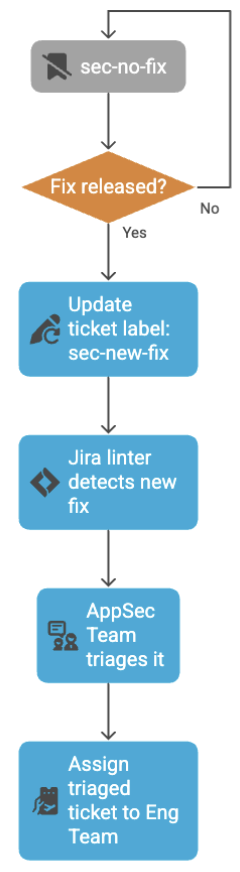
However, if the issue is non-critical and unpatchable, it doesn’t make sense to create noise. These are tagged as sec-no-fix and tracked as inactive Jira tickets in the VULN project.

Our automation re-checks these findings regularly. If a patch becomes available, the script updates the ticket with the fix version and a sec-new-fix tag and reactivates it for review.

Linter-drive triage for late fixes

We also maintain Jira linters that monitor for tickets tagged with sec-new-fix. These represent previously unfixable vulnerabilities that now have a patch available, meaning the window of exposure is finally closable.

During AppSec sprint standups, we review these flagged tickets multiple times a week. Once verified, we triage and assign them immediately to the correct engineering team for remediation.

Why this matters

SCA tools will always surface edge cases. If not handled carefully, these can:

  • Generate friction between AppSec and Eng Teams.
  • Lead to unnecessary back-and-forth.
  • Cause delays in remediation or weaken engagement.

‍SCA findings – corner case triaging

Flowchart for triaging corner cases. Is the SCA finding critical and reachable? If yes, check if fix is available and label as sec-no-fix. If no, downgrade the finding to high. If fix is available, create Jira ticket. If no, label sec-no-fix.
if fix released, update ticket label to sec-new-fix. Jira linter detects this fix, AppSec team triages it, then assign triage ticket to engineering team. If fix is not released, continue to label sec-no-fix.

By combining smart process design with custom automation, we’ve created a system that accounts for these nuances, filtering out noise and ensuring only actionable findings make it to engineering.

Step 5: Supporting the eng team – be a partner, not a blocker

Once SCA findings are flowing into engineering teams’ Jira pipelines through automation, the real work begins. A mature AppSec program doesn’t stop at ticket creation. Security isn’t just about identifying issues, it’s about enabling teams to fix them effectively.

Findings are the start, not the end

Expecting engineering teams to handle every vulnerability on their own is unrealistic. Even with good tooling and clear severity tags, real-world development introduces complexity:

  • Upgrading a package may cause breaking changes.
  • The vulnerable dependency might be scheduled for deprecation in an upcoming roadmap item.
  • Fixing a vulnerability immediately might delay a larger refactor that would eliminate it entirely.

If AppSec wants to raise the security bar, it must be ready to engage beyond detection.

Shift the mindset: enable the mission

The AppSec mindset should be:

“We’re here to protect the company’s mission and its customers, not to patch everything blindly.”

This means understanding the context behind each issue. Security must align with business and engineering goals, not disrupt them.

What support looks like in practice

AppSec teams should be prepared to:

  • Collaborate on prioritization when a fix isn’t feasible right away.
  • Propose alternatives, like safer libraries, or recommend compensating controls (e.g., Web Application Firewalls, HTTP headers, etc.) to reduce risk while buying time.
  • Contribute directly to the codebase by helping write PRs, or offering guidance on implementation challenges for shared packages.

Being willing to dive deep, whether that’s joining an engineering planning session or helping troubleshoot a failing build, transforms AppSec from a policy enforcer to a trusted partner.

Why it’s worth the effort

Yes, this model adds more responsibility and pressure to the AppSec team. That’s why it’s so important to tune the earlier steps, especially filtering out noise, so that only the most meaningful and actionable vulnerabilities reach engineering.

But the payoff is huge: engineering teams will start to see AppSec not as a bottleneck, but as a valuable ally, a team that doesn’t just flag problems, but helps solve them.

Over time, this trust leads to stronger security culture, faster response times, and better adoption of secure development practices across the organization.

Step 6: Closing the loop – validating fixes and strengthening Webflow’s security posture

One more thing before we can call the SCA work done. We need to validate that reported issues were actually resolved, and use it to drive continuous improvement. This approach has strengthened the SCA program, reducing critical findings to zero and ensuring any new ones are addressed within days. It also sets the stage for achieving the same level of control over high and medium findings. We estimate this will be accomplished in the next 3 to 6 months.

Automated validation after ticket closure

A new validation ticket is automatically issued to AppSec once the original Engineering ticket is closed whenever the severity is high or critical. This ticket prompts the AppSec team to verify the fix, checking that the patch fully mitigates the reported vulnerability and that the repo’s next scan reflects a clean result.

Proactive monitoring of SLA and stale tickets

The same automation also tracks SCA tickets that are approaching or exceeding SLA thresholds, or are marked as open but show no recent activity.

Rather than letting these issues linger, we proactively surface them in our regular check-ins with engineering teams. The check-ins are performed monthly between AppSec and engineering team leadership. Among several routine topics in the agenda, we go over a Jira linter and discuss all tickets that need attention due to their due dates. 

This final step ensures accountability and follow-through, preventing critical issues from falling through the cracks. Most importantly, it reinforces that SCA is not just a compliance checkbox, it’s a collaborative, continuous process that raises the organization’s security posture over time.

Conclusion: building a sustainable SCA program that engineers will actually use

Implementing a successful Software Composition Analysis (SCA) program is not about pushing tools into the pipeline and hoping for the best. It’s about building trust, creating flexibility, and embedding security into the way engineering teams already work.

At Webflow, we approached SCA not as a one-size-fits-all mandate, but as a collaborative effort. By designing processes that were incremental, customizable, and automation-friendly, we enabled security at scale, without disrupting developer velocity. Every step in the workflow, from repo inventory and ownership mapping, to ticket triage, validation, and follow-up, was crafted to reflect a single principle: security should be an enabler, not a blocker.

The payoff? Engineering teams are more responsive to security issues, more confident in the tools and processes we’ve built together, and more open to working with AppSec as a strategic partner. And that, more than any dashboard metric or vulnerability count, is what real AppSec maturity looks like.

If you’re building or scaling your own SCA program, start with the people, then build the automation. Empower engineers with context and support. And always aim for meaningful, actionable findings, not noise.

Special thanks

This project succeeded thanks to the support and collaboration of many individuals and teams who not only helped build the solution, but also adopted it, provided feedback, and reported issues along the way. I’m especially grateful to the Webflow Engineering teams for embracing our SCA program and strengthening our security posture.

Special thanks to Topher Chung, Ankit Agrawal, Albert Chang, and Matias Altman for leveling up the SCA efforts at Webflow.

Brand design: Craft an iconic visual identity

Software Stack Editor · July 15, 2025 ·

image

Design speaks before your brand does — and leaves a longer impression.

Brand design is the face your company shows to the world. It’s the combination of visual elements, from your logo to your color palette, that makes your brand instantly recognizable and, ideally, unforgettable.

For in-house designers, brand design sets the foundation for consistent and compelling marketing across your website, social channels, packaging, and beyond. Read on to learn how to create a cohesive brand design that reflects your business and leaves a lasting impression.

What is brand design?

Brand design is a visual representation of your company’s identity, including your objectives, values, and products. Every design element, from the fonts to the colors in your advertisements, must align with and underscore the company’s mission.

Why is brand design important?

Translating a company’s identity and mission into visuals may sound challenging, but with the right approach, you can accurately communicate your brand without words. When brand design is executed successfully, the results are marketing touchpoints — a website, social media presence, and traditional offline advertising — that people instantly recognize as belonging to your brand.

Branding vs. brand identity vs. brand design

While closely connected, brand design, brand identity, and branding each serve a different purpose regarding how people perceive your company.

Branding

Branding is the strategy of shaping perceptions about your business. It’s the intentional work your company does to define its public image through a mission statement, values, voice, positioning, and the emotional response you aim to evoke through visual design.

Brand identity

Brand identity is a system of visual and verbal elements that represent your brand, guided by your mission and values. It includes your logo, typography, color palette, and tone of voice.

Brand design

Brand design is the visual execution of your identity. While brand identity defines the system — your logo, typography, color palette, and tone of voice — brand design is how you apply those elements across real-world touchpoints.

Brand design is the process of translating your brand identity into a consistent set of visuals that people see and interact with, like your website, social media, packaging, and marketing materials. Brand identity is like a blueprint, while brand design is the execution of that blueprint.

The elements of brand design

Strong branding is the foundation of every successful company, regardless of industry, and it starts with smart, intentional brand design. These elements are must-haves for building a unique, consistent, and memorable brand identity:

Logo

A brand logo is a meaningful artwork or design that conveys your company’s essence to those looking at it. Aside from the name, the logo is often the most identifiable visual element of a brand. It appears everywhere, including your website, social media platforms, and advertisements.

A logo design should have an aesthetic that fits your brand. For example, a sustainable coffee brand might avoid bright, neon colors and sharp edges, opting instead for organic shapes and earthy tones, such as brown and olive, which evoke the brand’s commitment to the environment.

Typography

Typography is the process of creating and arranging text that’s both readable and visually appealing. Fonts are an essential aspect of typography, so it’s important to choose ones that suit your brand.

Every font has design elements that contribute to a different aesthetic; different fonts evoke distinctive personalities. For example, script-style fonts add a homemade, personal feel to a brand, while serif fonts appear crisp and professional. You can find a free diverse collection of fonts to mix and match before settling on the right combination for your brand.

Colors

Like fonts, each color evokes different feelings and impressions. For example, green symbolizes growth, health, and tranquility, and may inspire feelings of calmness or thoughts about nature.

It’s important to consider how colors appeal to your target audience. An older demographic may prefer neutrals and trustworthy classics, while millennials gravitate toward more vibrant colors. Tailor your palette to the people you want to connect with.

You can choose your brand’s colors based on your preferences, but it’s worth learning color theory before finalizing your palette. That way, you can feel confident you’ve made an informed and effective choice.

Iconography

Iconography is the art of creating icons. It involves using simple graphic designs to convey complex information by condensing a concept into a format everyone can understand.

For example, a shopping cart icon on an e-commerce website doesn’t need the words “shopping cart” next to it. The icon itself is enough to let a customer know what it represents — a link to a place where you can view items before checkout.

You can create icons unique to your brand, but be sure they’re easy to understand. Consider how icons will appear in your website’s visual hierarchy and on social media, as well as how they’ll add to your brand’s aesthetic.

A news blog with a minimalist design might have an envelope-shaped icon made of simple linework to link to their newsletter, while a modern jewelry company might use a playful, full-color illustration for the same purpose.

Illustrations

Illustrations are graphic interpretations of text, processes, messages, or concepts. They add context and a unique personality to your brand, especially if you have iconic illustrations, such as a mascot or a logo rendition.

A consistent illustration style that complements your brand goes a long way toward developing identity and creating a cohesive design. As with icons, be thoughtful about how the style of your illustrations conveys your brand. For instance, abstract human shapes work well for a fashion blog but might appear unprofessional on a medical site.

How to design a brand identity: 4 steps

A strong brand identity goes beyond visuals; it’s also strategic. It should communicate who you are, who you serve, and why your target audience should take notice. Here are four best practices to help you create a winning brand design:

1. Understand your audience and competitors

Before making any design decisions, you need a clear picture of your target audience — who you’re designing for — and what already exists in your space.

Understanding your audience helps you develop a brand personality that speaks their language. And competitor content can reveal how to differentiate your brand and avoid a design that blends into a crowded market. Without well-researched context, your brand identity risks missing the mark or being easily forgotten.

Talk to your users or recurring website visitors through pop-up forms and surveys. Review their feedback, stay current with visual design trends, and run competitor analyses. Look for gaps or patterns in overused elements to determine where your brand can stand out.

2. Define your mission and brand purpose

A clear mission statement is the “why” behind what you do. It sets the tone for how your brand looks as well as its messaging, behavior, and how it scales across online and offline platforms.

Purpose-driven brands tend to have stronger positioning and more consistent messaging across their identity and marketing. That clarity of purpose creates the foundation for your visual elements and the story they tell. And that helps you connect emotionally with your audience and build a loyal, long-term customer base.

First, create a simple, focused mission statement. Define your core values and what makes your brand different. That sense of purpose will guide every design and messaging decision you make.

3. Build your visual identity

This is where your brand starts taking shape in the real world. Your visual identity includes your logo, color palette, typography, iconography, and supporting illustrations or graphic design elements.

Design a versatile logo with variations that are recognizable across different formats and screen sizes. Choose colors and typefaces that reflect your brand personality and work well together. For example, a clean sans-serif font might suit a minimalist, modern brand, while a serif font could suggest heritage or formality.

Also, prioritize a responsive user experience. Whatever elements you choose, make sure your visual identity feels cohesive and adaptable across web, mobile, and print.

4. Establish brand guidelines

Once you’ve designed your visual and verbal identity, document it in a clear set of brand guidelines. This ensures that everyone, from internal teams to external partners, presents your company consistently and understands how to apply your visual identity correctly.

Include specifications for logo usage, hex color codes, font styles, imagery, tone of voice, and layout rules. Make it easy to follow, with real-world examples that show the identity in context. You might also make dedicated style guides for your website and social media, leaving no room for confusion.

Create a memorable brand identity with Webflow

Strong brand design starts with a clear system that captures your company’s purpose and personality to create a lasting impression across every touchpoint. From foundational elements like logo and typography to broader identity systems and guidelines, the right design choices shape how people recognize and remember your brand.

With Webflow, you can turn that identity into a fully realized online experience. Use our visual design platform as your canvas, and build a scalable visual language that connects your business to the right audience.

Blending content and ecommerce: How Webflow Apps help businesses deliver powerful digital experiences

Software Stack Editor · July 14, 2025 ·

Businesses selling products or services need powerful tools to help them sell online — from product pages and inventory management to checkout and fulfillment.

But many dedicated ecommerce platforms fall short when it comes to storytelling. Products get boxed into cookie-cutter templates, and brands lose the chance to stand out. That’s why modern businesses are turning to platforms like Webflow, where they can combine best-in-class ecommerce tools with rich, expressive content experiences.

With Webflow, businesses can craft websites that don’t just captivate, but convert. And thanks to our ecosystem of top-tier ecommerce Apps like Shopyflow, CartGenie, Stripe, and Smootify, marketers can scale sophisticated ecommerce experiences without complexity.

Here’s how four innovative brands are leveraging ecommerce Webflow Apps to blend content and ecommerce, accelerate time-to-market, and deliver more powerful, conversion-driving experiences.

Bond & Grace x Shopyflow: Pairing the art of storytelling with ecommerce design and development

Bond & Grace isn’t your typical publisher. It’s a lifestyle brand redefining what it means to engage with classic fiction with a delightfully unique business model. Customers can take a beloved public domain novel, like The Secret Garden, commission original artwork inspired by the text, and produce a coffee-table-worthy Art Novel that pairs timeless storytelling with high-end design. Each title also inspires a broader collection of products — think candles, prints, and curated gifts — transforming literature into a sensory, shoppable experience.

A Bond & Grace product page featuring the Shopyflow app UI mocked up over it to display how CMS syncing looks.
Bond & Grace provides helpful information on their product page, drawing from their Shopify backend.

For a brand so rooted in visual storytelling, Webflow was the obvious choice. “Previously we were running a headless setup, but it was too rigid,” says Ana, Head of Operations, and lead developer. “Now I can build a new product showcase in a day. The flexibility has been game-changing.” Webflow lets them highlight product nuances — like the texture of a book’s cover or the glow of a candle — in immersive, editorial ways that static platforms can’t replicate.

To power ecommerce experiences, Bond & Grace integrated Webflow App, Shopyflow, which bridges Webflow with Shopify’s backend. With real-time data sync, Shopify data is imported into Webflow CMS collections, and ecommerce components, like “buy now” buttons, are available as native Webflow elements. 

For teams like Bond & Grace who work in Webflow every day, Shopyflow feels instantly familiar — giving them the tools and confidence to build, manage, and scale rich ecommerce experiences with ease, and since integrating it with their website, they’ve cut their time-to-launch in half.

“Shopyflow’s documentation is great, but what really impressed us was the team. We collaborated closely to create custom filters, improve product search, and manage complex syncs between platforms.”

‍— Ana Garza, Head of Operations and lead developer, Bond & Grace

As Bond & Grace expand their product offerings,, they’re exploring which Webflow features can help them better showcase premium inventory. “We’re excited to build more immersive pages that bring a tactile experience and help customers feel products, and we’re exploring GSAP animations, user reviews, and even VR,” Ana explains.

Zip Running x CartGenie: Streamlining the path to purchase 

Zip Running was born out of a simple insight: there are people who want to run to work, but lack the gear to do it. An industrial designer by trade, founder John Swain spent four years perfecting a run-commute backpack that’s as refined as it is rugged. Now, with the brand finally scaling, the website plays a vital role: it’s the product showroom, the conversion funnel, and the brand’s emotional handshake with new customers.

Zip Running’s audience is urban professionals who care deeply about performance, design, and sustainability. These are not impulse buyers, but rather detail-oriented, values-driven consumers who expect premium experiences, which is why the brand needed a platform that could match the product’s ambition.

John chose Webflow for its professional-grade design control and responsive flexibility. “I’m not a web designer,” he says, “but I knew what I needed: a site that looks amazing on every device, loads fast, and builds trust instantly.” With Webflow, he was able to translate the product’s story into an online experience that communicates its value clearly and convincingly.

The Zip Running site with the CartGenie app running on it.
With CartGenie, Zip Running doesn’t only add ecommerce functionality; it also improves the brand experience.

The Zip Running website is highly visual and designed to tell a story, showcasing well-known community members such as Harvey Lewis, an ultra-runner who has run to work as a school teacher every day for over ten years. Activations drive visitors to the website, which must engage them and direct them to the product page for checkout.

For its ecommerce engine, Zip Running uses CartGenie to fine-tune every touchpoint. It ensures every buyer has a smooth, confidence-building path to purchase and offers a number of features. CartGenie supports a variety of payment options, including credit card, Klarna, and offline payments, as well as custom checkout fields and address validation for international customers, and even enables embedded reviews. 

“Moving to CartGenie cut my time spent on order fulfillment in half. Their shipping integration is more advanced than competitors, plus the ability to collect custom information at checkout streamlined our entire ecommerce process. Ecommerce isn’t just functionality — it’s part of the brand experience, and CartGenie helped us make it ours.” 

— John Swain, founder of Zip Running

SportsVisio x Stripe: Transforming highlights into high-converting content

SportsVisio brings computer vision technology to sports, transforming raw game footage into highlight reels, advanced stats, and coaching insights. Their customers include leagues, tournaments, coaches, and players — some chasing scholarships, others just celebrating a child’s passion. Spanning basketball, volleyball, and baseball, their now 200+ customers across 16 countries need clarity, ease, and trust from the insights generated.

That’s why the website is so central to SportsVisio’s strategy. “It has to educate, inspire, and sell  — sometimes all at once,” says Seán O’Connor, Chief Revenue Officer. Their previous site on their legacy CMS couldn’t keep up, but with Webflow, they’ve been able to build a modular, design-friendly platform that works for everyone: from sales-led enterprise prospects to solo-coach parents.

Offering one-off purchases and subscriptions, SportsVisio needed the ability to easily create and update flexible offers, as well as provide information to help customers understand pricing and complete a purchase.

The SportsVisio homepage with the Stripe Webflow App in view to manage payments and ecommerce functionalities..
With Stripe, SportsVisio offers one-off purchases and subscriptions for a range of sporting league services.

At the heart of their ecommerce setup is the Stripe App for Webflow, enabling instant and secure self-serve purchases through embedded links and landing pages. But this isn’t just about payment; it’s about conversion. “We’re creating pages tailored to very specific personas, high school basketball coaches, so we needed something flexible and fast to iterate,” the team says. Webflow’s visual canvas and Stripe’s global-ready infrastructure made it happen.

With Webflow, SportsVisio can spin up new product flows in hours — not weeks — and tell a brand story that evolves with every highlight reel, and as a result, SportsVisio has boosted conversion rates by 150%.

Wizard Pi and Alcester Schoolwear x Smootify: Ecommerce that fits just right

Webflow Certified Partner Wizard Pi is a UK-based design and marketing agency that builds exclusively with Webflow. When they teamed up with Alcester Schoolwear, they saw an opportunity to transform a utilitarian and sometimes complex shopping task — buying school uniforms — into something intuitive and even delightful.

Alcester Schoolwear serves busy parents across dozens of schools, helping them find exactly what their child needs, fast, and the ideal customer journey starts with one question: which school does your child attend? 

From there, the experience becomes completely personalized thanks to Webflow’s flexible CMS and a front-end, designed with GSAP animations and a thoughtful UX. “This was about creating a site that feels helpful, not transactional,” Alex Williams, Lead Designer for the project, explains.

The Smootify app running on the Alcester Schoolwear site, highlighlight how products and collections are managed through the CMS.
The Smootify App for Webflow makes it easy for Alcester’s team to add and edit their school uniform collections.

To handle inventory, checkout, and logistics, the site uses the Smootify App, which bridges Shopify and Webflow seamlessly. Products and collections live in Shopify but are surfaced and styled through Webflow, enabling full creative control without the usual synchronization headaches. Smootify’s library contains over 150 pre-configured components that are fully customizable in Webflow and integrate seamlessly with Shopify.

“The best part is how easy it is to update. Adding a new school is done by creating a new collection in Shopify. Once added, it automatically syncs with Webflow and adds the school as a new CMS item. This takes just a few minutes, not hours.”

— Helen Sharkey, Head of Digital Design, Wizard Pi

Alcester Schoolwear also benefits from Shopify’s point-of-sale (POS) system in-store, connecting their online and offline experiences. This makes stock management and customer experience fully unified across channels. 

By leveraging custom metafields and real-time syncing via Smootify, Wizard Pi eliminated the need for manual updates, giving the client greater autonomy and accelerating time-to-launch. The result is a storefront that evolves as fast as the academic year progresses — without sacrificing design or performance.

Unlock greater ecommerce potential with Webflow Apps

When content and ecommerce are seamlessly integrated, brands are able to achieve more than just clicks. They are able to design ecommerce websites with more intention, build more engaging digital experiences, and scale in a fraction of the time.

Webflow and our ecosystem of ecommerce Apps unlock that advantage. Whether you’re selling art books, performance backpacks, AI sports analytics, school uniforms, or any other product, service or subscription, you don’t have to compromise between storytelling and scalability. You can have both. And in today’s market? That’s a major win.

To get started with Webflow Apps today, visit our App Marketplace.

Celebrating Disability Pride Month: Building for everyone, by everyone

Software Stack Editor · July 10, 2025 ·

July is Disability Pride Month, a time to celebrate the strength and contributions of the disabled community. At Webflow, this is also a time to reaffirm our commitment to building an accessible web.

Our platform empowers people to create for the internet without needing to write code. Behind the scenes, our engineering team works every day to ensure what we — and our customers — build is perceivable, operable, and understandable for people with any permanent, temporary, or situational disability (WCAG 2.2 principle).

Accessibility is not a feature toggle or compliance checklist. It’s a core engineering requirement that influences our platform architecture, UI design systems, and frontend frameworks and necessitates ownership, responsibility, and empathy in the software we ship.

Engineering accessibility into Webflow

Our engineering team integrates accessibility directly into Webflow and Webflow’s generated site code and embodies a culture of continuous education and improvement. 

Semantic HTML and structural landmarks

Webflow generates semantic HTML5 tags based on the element type selected. Headers are mapped to

through

, containers can use

,

, or

, and dynamic elements are accessible via proper ARIA roles. Users can assign landmark roles (

,

,

,

,

) via the HTML Tag dropdown. This ensures screen readers and other assistive devices can accurately interpret the structure and meaning of content.

Built-in keyboard navigation support

Every interactive primitive that Webflow renders is keyboard-navigable out of the box (using Tab, Enter/Space, and Arrow keys where applicable). When you build advanced widgets (e.g., custom modals, multi-level dropdowns, or composite menus), you can hook into our event system to maintain the same Tab/Shift-Tab order and to expose Escape-to-close behavior. 

Where a stricter focus model is required, you can use custom attributes to set tabindex, add aria-haspopup, or implement a managed focus trap to ensure keyboard users never lose context.

ARIA labels and roles

You can set custom aria-label, aria-labelledby, and aria-describedby attributes on any element. This is essential for dynamic components like sliders or tabs that need descriptive labeling for screen readers. These attributes persist in both preview and exported code to support consistent accessibility across build and production environments.

Color contrast checker

Our color contrast checker appears in the Style panel’s color picker while editing text or background colors. Using relative-luminance math (ISO 9241-3), the checker computes and measures contrast against WCAG 2.2 AA/AAA thresholds and provides real-time feedback. The tool flags failures so you can make design choices that improve readability for users with low vision or color blindness without the need for external tooling. 

Focus indicators and visual states

Focus states are automatically applied to interactive elements like links, buttons, and form inputs. Designers and developers can customize the Focused and Focused (keyboard) states in the Style panel. The CSS also includes a :focus-visible fallback polyfill, so high-contrast focus rings remain visible in all evergreen browsers for users navigating with a keyboard or alternative input device.

Accessible components and templates

Our library of components includes accessible templates and pre-configured widgets that follow ARIA best practices. Engineers working on product surfaces can leverage these internally for speed and consistency, while users creating in Webflow or visitors to sites created in Webflow benefit from elements that are usable out of the box. This includes accessible form elements with proper labels, programmatically understandable error messages, and validation feedback — all of which are critical for users relying on assistive technologies to navigate the web.

Responsiveness and mobile accessibility

Webflow’s responsive design breakpoints allow designers to build layouts that adapt to various screen sizes and device types — for example, to resize text for readability or ensure tap targets are large enough at smaller viewport sizes.

Inclusive teams build inclusive products

Accessibility starts with empathy, but it scales with process. Our engineering culture supports a wide spectrum of abilities and working styles. This is reflected across our tooling choices, onboarding practices, and communication norms. Our documentation and technical specs are written for clarity, using accessible language and consistent structures that support diverse neurotypes. Async communication and flexible working hours make room for people with disabilities and chronic health conditions to contribute effectively. Engineers with lived experience of disability help shape our accessibility roadmap, tooling, and internal guidelines.

We also conduct internal training sessions and provide educational resources to our teams to ensure awareness of current accessibility guidelines and best practices. Feedback from disabled users — gathered through usability testing and community forums — plays an integral role in shaping how we prioritize and validate accessibility improvements. These practices help ensure that we’re solving real problems for real users.

By investing in a team that reflects the people we’re building for, we increase our capacity to solve complex, nuanced problems that a homogenous team might overlook.

What’s next

Accessibility is not static. It evolves with user needs, browser capabilities, and regulatory standards. Our engineering team is actively exploring support for reduced motion preferences, accessible data visualizations, and accessibility audits in our automated CI pipeline.

If you are building with Webflow or contributing to our ecosystem, check out our accessibility checklist, learn how to make your Webflow sites more accessible, explore our developer forums, and join our thriving Webflow community to share your insights and needs.

Disability Pride Month is about more than awareness. It’s about action. At Webflow, we’re proud to be engineering with empathy and contributing to a more inclusive web for everyone.

‍

Unlock GSAP-powered motion — visually in Webflow

Software Stack Editor · July 10, 2025 ·

image

Beginning today, we’re rolling out the newest version of Webflow Interactions, unlocking GSAP-powered motion, a brand new horizontal timeline, and much more — at no additional cost to Webflow users.

We’ve been busy since announcing the acquisition of GSAP last fall. At the end of April, we were thrilled to make GSAP 100% free for the entire web community. And today, we’re excited to begin rolling out a new version of Webflow Interactions, replatformed on GSAP. This empowers all Webflow designers and developers to visually build smooth, expressive, and performant animations powered by the best animation engine on the web.

Webflow was one of the first platforms in the world to make it possible for anyone to build robust web interactions and animations — visually. Now, with GSAP directly built into Webflow, we’re delivering unprecedented power and creative control without requiring the use of code. You can achieve complex, custom animations like stagger effects and granular text splitting more easily than ever before — and on an intuitive horizontal timeline that sets a new standard for visual-first motion development. Webflow Interactions with GSAP empowers our customers to build top-tier animations without sacrificing creation speed, and we’re just getting started!

Thoughtful motion is the pinnacle of creative and brand differentiation 

As visuals continue to flood digital channels, static experiences often fall short of building fast, meaningful connections with users. Coupled with the rising popularity of homogeneous AI design in web development and shrinking online user attention spans, businesses are feeling the pressure to stand out. 

Strategic motion and interactive elements are no longer optional; they’re fundamental to how brands tell their stories, convert visitors, and create lasting connections. When a visual storyteller hand-crafts these interactions, they offer an unmistakable quality that stems from human intention and care — something no AI can authentically reproduce. While AI excels at speed, only human creators can bring the nuanced judgment needed to craft motion that feels purposeful, guides visitors intuitively, and creates the kind of elevated experience that turns casual browsers into engaged customers.

This is why together, Webflow and GSAP are democratizing sophisticated, visual-first motion development. And today, we’re laying the groundwork for the next generation of Webflow Interactions with a major first release that will serve designers, developers, and agencies alike. 

What’s launching today

[embedded content]

In this initial release of Webflow’s new Interactions with GSAP, we’re delivering:

  • The ability to craft sophisticated and performant animations powered by GSAP — without writing a single line of code.
  • A completely reimagined workflow featuring a horizontal timeline and purpose-built controls that give designers and developers surgical precision over their animations — without compromising speed. 
  • The ability to reuse interactions across your entire site, eliminating repetitive work and driving consistency. 

For more details and to see what our customers and partners are already saying about Interactions with GSAP, read on.

Visually build GSAP-powered interactions

Webflow designers and developers can now visually build smooth, reliable, and performant interactions with the confidence that best-in-class GSAP code is running under the hood for all of them. And with this first release, you’ll be able to animate with some of GSAP’s most in-demand capabilities without writing a single line of code, including:

  • SplitText, letting you precisely animate each character, word, or line independently, such as gradually revealing content to build suspense, or drawing the reader into key words or phrases for emphasis. 
  • Staggers, enabling you to effortlessly animate groups of elements (like cards or nav links) with a delayed, sequential effect, creating a sophisticated entrance and guiding the visitor’s eye.
  • ScrollTrigger, empowering you to transform even the most static page into a dynamic experience, unfolding and intuitively controlled by your visitor’s scroll. 

Check out what Joseph Berry, a Certified Webflow Partner, built using Interactions powered by GSAP, leveraging all of the aforementioned features! 

“GSAP and Webflow coming together feels like a dream I’ve had for years finally becoming a reality. Right out of the box, this latest version of Webflow Interactions is a total game-changer; nothing else even comes close. It completely shifts our workflow, allowing us to focus on delivering next-level animations for our clients faster and more creatively, without diving deep into complex custom development. The possibilities feel endless, and it’s truly just the beginning.”

‍ — Joseph Berry, Founder of JB Studio and SkinGame Media

Animate faster on a new horizontal timeline with intuitive, advanced controls

We’ve completely transformed the user experience for building interactions, featuring a horizontal timeline for creating extended interactions and sequences — an industry standard for motion design experts. With this more intuitive interface, users have a clear visual representation of animation sequences, timings, and easing curves. Here’s what it unlocks:

  • Intuitive visual sequencing: A horizontal timeline with action blocks makes it easier than ever to sequence and orchestrate complex animations, whether in parallel or series.
  • Precision timing & control: Gain precise control over animation timing, playback, and scrubbing directly on the timeline, with easy drag-and-resize of action blocks and numerous keyboard shortcuts for efficiency and accessibility.
  • Effortless exploration & refinement: Navigate complex animation sequences with fluid zoom, pan, and drag functionalities, enabling rapid iteration and refinement of motion effects.

Within this new experience, we’re also introducing a number of powerful new capabilities.

  • Fine-tuned interaction triggers: Get your interactions just right with robust, event-type-specific configuration for click, hover, page load, and scroll triggers. And for even more creative control, after visually crafting an animation, developers can programmatically trigger it in custom code. 
  • Advanced element targeting: Target elements with CSS combinators to animate specific descendants, ancestors, or siblings in complex layouts — allowing for highly sophisticated and nuanced interactions. 
  • Purpose-built controls for repeating and staggering animations: Easily create engaging, repetitive animations or sequential reveals in just a few clicks, like a pulsating arrow or cards unveiling one by one.
  • Class-based animations: Trigger entire style changes with a single interaction by adding, removing, or toggling classes — making it fast and scalable to apply custom states or themes.

Reuse pre-built interactions across your site

You spoke, we listened. Interactions are now reusable across your Webflow site. With this newest version of Interactions, you’ll be able to define an interaction once, then apply it to various elements or classes across your website — saving valuable time and helping you maintain design consistency.

But that’s not all! You can now save your own custom actions as reusable presets through the Interactions panel. This means you won’t be limited to triggering or targeting a single interaction on multiple elements; you have the flexibility to apply the very same animation effect across entirely different interactions. Imagine designing a unique fade effect just once. Now, you can seamlessly reuse that exact preset for a page scroll animation, a hover interaction, or any other dynamic element on your site. 

We’re excited to start getting this initial launch into your hands and hearing what you think. Your feedback will directly shape how we continue expanding these GSAP-powered capabilities — always with a focus on performance, scalability, and reusability. We want great web animation to be your competitive advantage, not a technical burden.

“Integrating GSAP directly in Webflow is a revolutionary leap that feels like a cheat code: the GSAP ecosystem is just one click away, in a delightful visual and code-free interface. I can prototype next-level animations in minutes, preview everything live in the viewport — no republishing needed — and spin up reusable interactions that power hundreds of pages in an instant. It’s a massive productivity and creativity boost that has reshaped our entire workflow.”

‍— Thomas Bosc, Lead Webflow Developer at Lattice

What’s next

This launch lays the foundation for the next generation of Webflow Interactions, which will unlock visual-first animation superpowers for all — whether you’re a designer, marketer, developer, or agency. By the end of July, it will be available to all users, and in the coming months, we’ll continue to expand on Interactions with more GSAP features and strengthen integrations with both Webflow’s Website Experience Platform and third party design tools. This includes:

  • Inclusive motion design: Support accessibility and honor your site visitors’ motion preferences —like “reduced motion”— from directly within the Interactions panel.
  • Ability to enable/disable interactions based on different design contexts — such as specific breakpoints.
  • Deeper interoperability with Webflow’s scalable design systems, such as the ability to set individual component instances as animation triggers or targets, set a variable value on an interaction, Shared Libraries support, and more.
  • Compatibility with advanced collaboration workflows like page branching and site activity logs. 
  • Integration with popular third-party design tools like Spline, Lottie, and Rive. 
  • Support for additional in-demand GSAP tools like ScrambleText, Text, ScrollSmoother, ScrollTo — with much more to come.

Webflow and GSAP have joined forces to revolutionize web animation, empowering everyone with the tools to bring their most creative visions to life. Today’s launch is just the beginning, and we have many more exciting updates planned for Webflow Interactions in the coming months. Stay tuned!

Get started today

Webflow Interactions with GSAP has begun rolling out to Webflow users today and will be available to all users by the end of July at no additional cost from Starter through Enterprise plans. If you have access, you’ll see a Versions dropdown at the bottom of your Interactions panel and have the ability to select Interactions with GSAP (new). To learn how to get started animating with this new version of Interactions, visit our Help Center.

How to improve your website’s performance: Best practices and tips

Software Stack Editor · July 10, 2025 ·

image

For businesses to compete online, optimum website performance is no longer nice to have — it’s non-negotiable.

If visitors encounter slow-loading pages or laggy interactions, they won’t hesitate to leave your website. This poor experience leads to high bounce rates, which harm your search engine optimization (SEO) efforts and negatively affect your brand’s reputation, causing potential customers to turn to competitor platforms.

To maintain user trust and stay ahead of competitors, focus on improving website performance to deliver experiences visitors expect. Here’s how to identify common site issues and five strategies to fix them.

Why is website speed optimization important?

Performance optimization helps you retain customers and boost your reputation by increasing site efficiency and reducing user frustration. Optimal website performance:

Improves customer satisfaction

Fast-loading websites keep users engaged and satisfied by allowing them to interact with content immediately, minimizing wait times and frustration. The stakes are high — research reveals that when pages take longer than three seconds to load, you’ll lose a staggering 53% of visitors. This shows exactly why optimizing load times isn’t just technical housekeeping — it’s essential for keeping your audience engaged.

When a website loads quickly, it signals reliability and professionalism, showing users you respect their time.

To reduce page load times and retain users, focus on areas like image optimization, server responsiveness, and browser caching. Optimizing these elements helps you deliver a smoother user experience.

Reduces bounce rates

To combat high bounce rates, prioritize essential content to appear above the fold to capture visitor attention and encourage further engagement, guiding visitors deeper into your site. You can also use browser optimization techniques, such as lazy loading, to delay loading non-critical resources until they’re needed, speeding up initial page times. To gauge effectiveness, regularly review bounce rate metrics in your analytics tool before and after implementing changes and refine your strategies accordingly.

Boosts search engine rankings

Google and other search engines determine your search engine results page (SERP) ranking based on the quality and relevance of your site’s content and performance. Additionally, core web vitals serve as performance signals, factoring into search results. Websites that appear higher have more visibility, translating to increased clicks and organic traffic.

Increases conversion rates

Smooth and snappy site experiences prompt users to take desired actions, such as check out or sign up, by minimizing distractions and eliminating navigation barriers. For every second you reduce page load times, you potentially increase conversion rates by 17%.

You can also optimize checkout pages and use browser caching to accelerate loading. Meanwhile, A/B testing helps you compare design tweaks and see which approach yields higher conversions.

How to measure your website’s performance

Use these tools to diagnose and improve site speed:

  • Google PageSpeed Insights highlights areas like image optimization, server responsiveness, and browser caching that need attention.
  • Google’s Core Web Vitals report tracks your essential performance metrics like load speed, interactivity, and visual stability.
  • Pingdom provides a quick way to gauge overall website performance and pinpoint bottlenecks.
  • GTmetrix offers in-depth performance analysis with a waterfall breakdown of your site’s loading process.

What are the main factors affecting website performance?

A business website must have top-notch performance; even a slight bottleneck can affect the entire website’s usability. Here are a few factors to consider:

Server quality

A server’s hardware and location directly determine its performance. Commercial servers, designed to handle high demand, often provide more reliability and uptime than DIY hosting options. Opting for servers closer to most of your users can drastically reduce latency, delivering smoother and faster browsing experiences and improving site responsiveness.

Network latency

Internet connections vary depending on user location. While you can’t control internet speeds, you can use Content Delivery Networks (CDNs) to deliver content faster, storing copies of your site’s resources on servers closer to your users. This reduces the distance data travels, speeding up page loads and improving the user experience.

Code efficiency

Bloated code, such as redundant CSS styles, excessive JavaScript libraries, and improperly structured HTML, can slow page speeds. The more unnecessary or heavy elements servers and browsers must process, the slower they respond to user requests. Optimizing your code delivers a smoother and more responsive experience, increasing user engagement.

Third-party scripts

While third-party scripts and plugins — such as comment systems, social media widgets, and embedded content — enhance your site’s features, they can also introduce lag. Each script adds extra resources to fetch, download, and execute, slowing load time. Limiting these scripts preserves functionality while minimizing performance impacts so you strike a balance between features and speed.

5 ways to improve your website’s speed and performance

Here’s how to speed up your website with five essential practices to enhance speed and performance:

1. Minify HTTP requests, CSS, and JavaScript

When browsers request resources from servers via HTTP requests, multiple stages in the process can introduce latency. You can streamline this loading process by minifying HTTP requests through tools like cssnano for CSS and UglifyJS for JavaScript. By consolidating files, eliminating redundant code, and removing script comments, you reduce the total number of HTTP requests, boosting your site’s performance.

2. Optimize images

Large, uncompressed images can significantly reduce page load speeds by requiring servers to transfer more data to browsers. When a user visits a web page, the browser downloads all the content, including images, from the server. The larger the file size, the more time browsers need to render them.

You can use software such as Adobe Photoshop and TinyPNG to compress images without compromising quality. Photoshop offers “Save for Web” options for precise control over image quality and format, while TinyPNG automatically compresses images while preserving clarity. You can also use WebP images instead of PNGs and JPEGs to further reduce file sizes.

3. Set custom browser caching limits

When visitors download assets such as images and files, browsers temporarily save these resources locally. If they return to the site, the browser uses saved assets instead of redownloading them, speeding up the experience.

Content management systems (CMS) like Webflow enable custom cache duration settings, letting you strike a balance between quick load times and fresh content. Longer cache durations generally offer faster load times but delay displaying updated material. Regularly review and fine-tune these settings to deliver optimal browsing experiences and ensure visitors receive timely updates.

4. Leverage Content Delivery Networks

Content Delivery Networks (CDN) spread content across global servers to provide faster delivery to website visitors. By serving content from the nearest server to a user, CDNs reduce latency and speed up access.

Streaming companies like Netflix and Amazon Prime Video often use CDN to rapidly deliver shows and movies worldwide. CDN providers like Cloudflare, Fastly, and KeyCDN can enhance your site’s loading speeds if you’re aiming for similar reach.

5. Choose reliable web hosting providers

Reliable providers host your website on high-performance servers optimized for speed, uptime, and security. These providers invest in infrastructure and technologies that reduce server response times, handle high traffic efficiently, and prioritize content delivery, leading to faster website loading and smoother user experiences.

For example, Webflow’s hosting solution handles 10 billion web pages across six continents, providing features such as global CDN, image compression, Secure Sockets Layer (SSL) certificates, and advanced Distributed Denial of Service (DDoS) protection.

With Webflow’s visual development approach, you can streamline design while tapping into built-in performance tools like global hosting and responsive image handling.

Discover more optimization techniques on Webflow

By implementing best practices and using the right resources in your design process, you can provide visitors with a smooth and speedy user experience that meets their preferences.

Ready to supercharge your site performance? Webflow offers a powerful suite of built-in optimization tools to help you measure website performance and implement data-driven improvements without writing a single line of code.

Take your web presence to the next level with Webflow’s visual canvas, craft compelling content with our flexible CMS, and scale seamlessly as your business grows — all on our enterprise-grade visual development platform. Dive into expert-crafted tutorials at Webflow University and explore our comprehensive resource library to create lightning-fast, visually stunning experiences that transform visitors into loyal customers.

10 best website design systems, plus cloneable examples

Software Stack Editor · July 9, 2025 ·

Optimize for consistency with a website design system that organizes your UI elements, typography, and style guide in one place.

A great design process prioritizes consistency, accessibility, and a cohesive user experience, and there’s no better way to achieve that than with a robust website design system. 

A website design system is the best way to lay out all the components you need to assemble in your layouts, from UI elements like icons and buttons to typography styles for headings and body text. It creates a library of building blocks you can use to piece together your UI design.

Below are several examples of popular design systems like Google’s Material Design and IBM’s Carbon Design System. These established systems help these companies maintain a consistent design pattern for their brands’ digital products. And when you’re ready to make your own, you can start with any of the cloneable design systems we’ve provided.

What’s a design system?

A design system is a library of components you plan to use when building your website. Designers generally organize them into UI elements, typography, and a style guide, so they can quickly access these elements whenever they need to create a new web page. 

For example, if you need to make a landing page for a new feature, you’d open your design system, then copy and paste all needed UI elements from it, such as icons, buttons, and menus. You’d also do the same with heading styles, containers, and even code snippets if necessary.

Since you already pre-configured these components, they should work together seamlessly. If you use the same design system for your whole website, you’ll achieve a cohesive user experience with a UI that follows the same consistent design pattern.

Key components of a website design system

Website design systems generally follow the atomic design methodology, where designers break down every needed component into its smallest parts. That way, they can assemble those pieces in any way they see fit without diverging from established design patterns.

Here are some of the high-level categories most designers use in their website design systems:

  • UI elements: Reusable items like buttons and icons that designers can drag and drop into their layouts, organized by size, platform, and color scheme.
  • Typography: Text styles for headings, body text, and UI text, with variations for different platforms and content types.
  • Modals: Complete windows, such as contact forms, that combine UI elements and text styles to create pre-assembled, reusable assets.
  • Style guide: A list of UX/UI design principles that designers should follow, such as accessibility guidelines.

Why use a design system?

It might seem like a hassle to create a design system, especially for a smaller website, but it’s well worth the effort. Doing so provides the following benefits:

  • Faster design and development: With pre-configured building blocks, you can create or update layouts in less time than it would take to recreate UI elements from scratch.
  • Consistency across pages and teams: Having a single source for all reusable components ensures that your layouts follow consistent design principles.
  • Better UX: A design system with a clear visual hierarchy enhances the user experience and creates more intuitive navigation.
  • Improved collaboration and reference: Designers can show developers precisely how each component in the finished product design should look.
  • Scalability for future growth: The design system grows as you add new components and guidelines, steadily supporting your website as it scales up in size and complexity.

10 popular website design system examples

Before you start building your own design system or UI kit, it’s smart to review examples of systems from other digital products. Your design system likely won’t need to be as complex as all these examples, but it’s helpful to know what you’re building toward.

1. Webflow

The Webflow brand homepage begins with the headline, “Crafted for creators. Powered by code. Driven by innovation.”
Source: Webflow

Webflow’s brand design system offers design guidelines and user interface components that establish how Webflow branding works. It’s a library that uses visual examples and concise descriptions to demonstrate how to make digital experiences that accurately convey Webflow’s style.

You don’t need to be a Webflow developer to understand it; anyone with a passing interest in UI/UX design can use Webflow’s tools. That makes it a great resource for onboarding new designers and teaching veterans design trends.

2. Google’s Material Design

A screenshot of Google’s Material Design system showcasing a section for UI components.
Source: Google

Google’s Material Design system is an open-source design library that’s optimized for accessibility and versatility. It takes atomic design to the extreme, with reusable components for everything from UI elements like sliders and buttons to text styles for headings and code snippets.

Google built its Material Design system over several years, making it the most comprehensive one on this list. Yours will likely never need to get as complex, but Google demonstrates how far you can take a project when designing it for a massive audience.

3. The Atlassian Design System

A screenshot of the Atlassian Design System showcasing a section for all of their design tokens.
Source: Atlassian

Keeping with the theme of massive, comprehensive design libraries is the Atlassian Design System. It’s a vast collection of components and features you can use on apps and websites.

While it offers a great deal of versatility, it’s also very dense, with every page presenting over a dozen code snippets for different variations. Its saving grace is the search function at the top, which you should include in your design system to help users find precisely what they’re looking for.

4. IBM’s Carbon Design System

The IBM Carbon Design System is broken into three categories: Design, Develop, and Migrate.
Source: IBM

The standout feature of IBM’s Carbon Design System is its intuitive navigation. The homepage showcases high-level categories you might be looking for, like migration guidelines, UI kits, and design principles. This streamlined user experience helps designers quickly navigate the design system. If anyone aside from yourself will be using your design system, consider creating a UX like this.

5. Apple’s Human Interface Guidelines

Apple’s Human Interface Guidelines page begins with definitions of three design principles: Hierarchy, Harmony, and Consistency.
Source: Apple

Apple’s Human Interface Guidelines are a design library for all things Apple. They demonstrate what makes the Apple software ecosystem a well-kept garden: unique design choices, a strong visual style, and all the documentation you could ever need.

With such clear guidelines and an inviting, action-oriented tone, it’s very approachable and gives designers the confidence to deliver on Apple’s design patterns.

6. Salesforce’s Lightning Design System

A screenshot of Salesforce’s Lightning Design System showing a section about visual design principles.
Source: Salesforce

Salesforce’s Lightning Design System provides a wealth of guidelines to maintain a consistent, accessible, and visual-first user experience. Every example offers useful visuals that show how components fit into the user interface, adding valuable context for everything designers and developers do.

This level of detail is harder to scale, but it’s well worth it to create an enterprise design system, which is a single source of truth for all the visual design principles that a large product design team should understand.

7. eBay Playbook

The eBay Playbook design system is divided into three categories: Tokens, Components, and Patterns.
Source: eBay

With a brand history as extensive as eBay’s, it’s a great idea to treat a design system as a living document. The eBay Playbook design system is just that, helping usher designers and developers into a new future for the brand. In 2024, they radically updated their brand guidelines, and their new design system provides all the documentation needed to transform their existing digital experiences. 

Treating your design system as a living, flexible document is important even when you’re not fully re-branding. Set an audit schedule for approximately every six months to make sure all your guidelines are up to date.

8. Dropbox Brand Guidelines

The Dropbox design system is divided into several categories, like Typography, Motion, Imagery, and more.
Source: Dropbox

The Dropbox Brand Guidelines website provides an inviting user experience that guides designers and developers through all the components of their design system. However, it can be a little convoluted and doesn’t earn high marks for accessibility; there’s no search bar, too much motion, and not enough content.

Still, they deserve credit for thinking outside the box to create something unique and memorable that readers want to explore. It’s a good example of how to incorporate brand design into the system itself.

9. Adobe’s Spectrum

Adobe’s Spectrum design system is broken into three categories: Principles, Resources, and Implementations.
Source: Adobe

Adobe built its Spectrum design system for advanced designers and developers, offering guidelines and documentation for visual and backend features. Everything comes with screenshots and diagrams that show how a finished interface should look and where each component should live.

Scaling this amount of documentation presents a significant challenge. To make this smoother, Adobe included changelogs and known issue pages that keep everything current and help with troubleshooting. You should do the same if you intend to add highly detailed documentation.

10. GitLab’s Pajamas Design System

A screenshot of GitLab’s Pajamas Design System showcasing a section describing how to use their design tokens.
Source: GitLab

Pajamas is GitLab’s open-source design system, which contains all the patterns, components, and brand guidelines they use. It’s helpful for both internal and external developers who need a single source of truth for design decisions, as well as GitHub enthusiasts interested in their code.

By writing it for a broad audience, GitLab created a versatile design system that adds to their brand appeal and recognition, inviting third-party developers and fans alike.

Why clone an existing design system?

While it’s great to have guidelines to follow, not every design system warrants the complexity of the above examples. But as you’re building, you can clone an existing design system that provides a strong foundation. It should come prepared with UI elements, design tokens, and text styles optimized for accessibility and visual cohesion.

Of course, you can also change everything about the design system you clone. But starting with a pre-made template means you won’t miss any crucial components, like a navigation menu or content guidelines, when adding customization.

5 cloneable design systems for your next Webflow project

Here are five cloneable design systems that include all the design tokens, text styles, and reusable components you need to begin a website design project. Explore them all to find one that closely resembles your site’s visual style.

1. Carbon Design System

The homepage for the Carbon Design System begins with a section listing all its building blocks.
Source: Carbon Design System

The Carbon Design System from CJ Hersh provides a comprehensive design library for Webflow designers. The components are rather plain, but they’d work well for a minimalist site with few embellishments.

What’s especially impressive is the breadth of what CJ has baked into this design system example: a UI kit, style guide, changelog, grid examples, and all the reusable components you might need.

2. Simple Design System

The Simple Design System page opens with a section providing typography styles.
Source: Simple Design System

This Simple Design System by Benjamin Prigent offers an excellent starting point for a colorful, visual design that’s still optimized for accessibility. Striking this balance is tricky, but the color contrasts and text styles found here are all pre-configured for maximum usability. It’s a great design system to start with if you want a shortcut to a highly usable toolset right out of the box.

3. Starter Design System

The Starter Design System begins with a welcome page that lists branding components.
Source: Starter Design System

The Starter Design System from Yuriy Sharunov is a versatile and consistent UI kit for mobile apps and websites. It includes platform-agnostic design tokens that you can quickly adapt for many use cases. Best of all, it comes with downloadable component files that’ll immediately set you up for success.

4. Startr Style Guide

The Startr Style Guide begins with a list of typography styles.
Source: Startr Style Guide

The Startr Style Guide, created by Nikolai Bain, is lightweight but well-curated. It’s a tight library of compatible visual styles and components that prioritize consistency and accessibility.

The text styles are readable, the color contrasts pass WCAG tests with flying colors, and the patterns are recognizable. This sturdy foundation makes it a great starting point for building your own design system.

5. basicsam Style Guide

The basicsam Style Guide includes four possible color palettes.
Source: basicsam

Sam Basic created a Webflow Style Guide that’s more than a simple design system — it also includes guidelines about rich text and CSS classes with sources for more components. However, you’ll likely want to trim it down once you decide on a direction, since many of the components offer competing styles and patterns. Everything you need is there; select what you want to keep and get rid of the rest.

Build smarter and scale faster with Webflow

Cloneable designs help whether you’re building something as complex as the Atlassian Design System or a small-scale library of interface components. Whatever your goal, a strong starting point and the right design tools let you establish and maintain the design patterns you intend to follow.

As you discover the need for new icons, text styles, and other UI elements, you’ll want a platform that lets you scale up your design system. Webflow’s reusable components provide modular additions to any web design style, and its Shared Libraries let you carry those components over to all your sites.

Check out Webflow University to explore more resources on creating an effective design system.

How to create visual user flows for your website

Software Stack Editor · July 9, 2025 ·

User flows chart how visitors navigate your site to uncover opportunities to reduce friction.

All well-structured websites have one thing in common: Their design process considers flow as much as visual detail. But to do that, you must first understand how people experience your site as a whole.

User journeys provide a high-level view of how visitors move through the interface, while user flow diagrams highlight key decision points and interactions along the way. When you understand how users navigate your website, you’re better set to fine-tune each step and optimize the overall experience.

What’s a user flow?

A user flow is a visual representation of the precise steps people take as they journey through your website. It includes important decision points, like signing up for a newsletter or completing an onboarding sequence, and reveals how users interact with your site along the way. It’s more of a diagram than a document, but not as fully fleshed out as a UX wireframe. 

Including user flows early in the design process gives you the context to define how small-scale interactions should occur, before you begin creating other elements, such as the layout or visual hierarchy.

User journey vs. user flow

User journeys and user flows serve similar, yet subtly distinct, purposes in UX design:

  • User journeys (or customer journeys) capture the big picture. They illustrate the full experience, from a visitor’s entry point to exit, and often include emotions, touchpoints, and areas of friction users may encounter along the way.
  • User flows focus on the step-by-step actions visitors take, the specific paths they follow as they interact with your site. They’re more detailed and task-oriented than experiential, and ideal for charting specific routes and user choices.

Together, user journeys and user flows give perspective and precision to designing web experiences that make sense at every level.

Why are user flows important?

User flows help designers turn a tech specs document into a real, actionable UX design process. For example, you might plan to make a homepage that “excites users about the product and invites them to create an account.” A user flow diagrams how to make that happen by mapping the actions they’ll take, the decision points they’ll encounter, and the UI interactions that guide them toward creating an account.

Well-structured user flows set the foundation for better UX and lead to several benefits, such as:

  • Stronger collaboration: A visual map offers a shared reference for discussing and refining decisions as a team.
  • Smarter wireframing: When building a wireflow, your user flow serves as the outline for each screen and state along the path.
  • Clearer communication: User flows are a great way to show what you’re building and why, which is especially helpful when presenting to non-design teams or stakeholders.
  • Better user research assets: User flows can guide early prototypes for card sorting and tree testing to validate your design decisions with real users.

How to create a user flow

User flows happen early in the design process, before wireframes, UI elements, or mockups. The challenge is to turn abstract ideas into a visual sequence of screens, actions, and decision points. It may feel daunting to imagine how your finished website will work, but remember, a user flow is meant to evolve — you can always revise it as your design takes shape.

To get started, choose one interaction with a clear entry point and objective, like signing up for an account or navigating from the homepage to account settings, and follow this process to turn it into a visual user flow diagram:

1. Set up a simple design system

Choose a digital whiteboard or diagramming tool like Figma or LucidChart, and create a dedicated page for your flow elements. Define reusable components, like rectangles for screens, diamonds for interactions, and arrows for direction. A consistent system makes every new flow faster to build and easier to follow.

2. Define the user’s objective and main path

Create a new page and add a brief description of the task your flow represents, such as “onboarding new customers” or “navigating to privacy settings.” Next, drag in your prebuilt shapes and label them (for example, “homepage,” “sign-up modal,” and “email verification”).

3. Add interactions

Place interaction shapes between your screens to represent user actions, like “click sign-up button” or “enter email address.” Many designers use diamonds, but you can use whatever shapes make the interaction clear to you. You can also color-code them to distinguish between on-site actions and external tasks, like confirming an email.

4. Connect the steps 

Use arrows to connect the interaction shapes in the intended order. If there are optional paths or skips, draw separate lines to show those possible routes. Label each variation clearly so it’s easy to understand where and how the user’s path might change.

User flow diagram examples

Below are three user flow examples by UX writer Rob Harper. They’re slightly more developed than typical flow diagrams, but the core structure is the same. If you have design assets ready, you can achieve a similar level of detail. If not, a simpler diagram still maps paths and decision points well enough to guide early planning.

1. Approving an access request

A website user flowchart showing how a manager grants another user the manager role in the ArmorLock app.
Source: Figma

ArmorLock is a firmware-locked storage device that HBO and Disney film crews use to securely store raw footage. Its companion app lets managers approve access requests and assign permissions.

In this user flow, a manager authorizes another user’s request to access a drive. The flow includes several decision points, such as whether the user has already been approved, whether biometric authentication is enabled, and if the drive is connected. Color-coded markers and connected screens visually map the steps needed to grant access successfully.

2. Connecting a device

A user flow mapping out how users move from the pre-welcome screen to the sign-in screen in My Cloud.
Source: Figma

This user flow maps how to sign in to My Cloud, a home server that connects to users’ devices via the cloud. It shows the ideal entry point for the best user experience and what happens when users stray from that path. For example, closing the pre-welcome screen before the device reaches “ready” status disables the sign-in CTA, preventing access until setup is complete.

3. Onboarding

Two screens from an onboarding user flow for EdgeRover, with several lines connecting interface options.
Source: Figma

EdgeRover consolidates media libraries across cloud storage platforms, with a personalized onboarding flow as one of its standout features.

These screens show part of that experience, where users select how they use their devices and what they want help with, such as backing up data, editing content, or organizing photos. Based on their responses, each branching line leads to a screen where the interface adjusts to match the user’s goals, creating a customized experience from the start.

Design journeys that keep users moving

You can create user flows with almost any tool that lets you draw shapes, add text, and apply color. For apps, digital whiteboards like Figma or Sketch are a solid choice. In Webflow, you can design user flows directly on the visual canvas, using the same components and text styles you’ll carry through to your final UX.

Already have a user flow in Figma? You can easily import it with the Figma to Webflow plugin. 

Turn your user flows into functional sites with Webflow.

Visual analytics: Now available in Webflow Analyze

Software Stack Editor · July 8, 2025 ·

Powerful performance insights directly in the canvas, where you’re already working.

As websites grow more essential to business success, the pressure to understand what’s working (and what’s not) has grown too. But getting those insights still proves to be difficult.

Most analytics tools live outside the creative workflow, in separate dashboards (and sometimes separate teams), built for postmortems, not real-time decisions. The result? Teams miss key windows of opportunity for adjustments or worse — they miss optimization opportunities entirely.

With the launch of visual analytics, now available in Webflow Analyze, we’re changing that.

What are visual analytics?

Visual analytics bring behavioral data to life, by layering it directly onto your site. Instead of digging through dashboards or interpreting abstract metrics, you get a clear, visual understanding of how people interact with your pages.

At its core, visual analytics are a way to see user behavior in context. Clickmaps show you exactly where visitors are clicking, revealing what’s attracting attention, what’s being ignored, and if visitors are taking the actions you intended. Scrollmaps, on the other hand, indicate how far down the page visitors are scrolling. They help answer questions like: Is important content visible? Are visitors dropping off before reaching a critical call to action?

Together, these tools offer an intuitive, real-time look at performance directly in the Webflow canvas. It’s analytics that speaks the same visual language as your design.

Your site, from their perspective

Visual analytics are now live in Webflow Analyze. They include:

  • Clickmaps to highlight exactly where visitors are clicking on your site‍
  • Scrollmaps to understand how far visitors scroll down a page before leaving
a website mockup showing on page clickmap and scrollmap data to visualize where visitors are engaging with the page
Clickmap and scrollmap data available directly on the Webflow canvas with Webflow Analyze

From guesswork to growth

For years, Webflow has helped teams visually build and launch sites with speed and flexibility. Visual analytics expands on that foundation, unlocking performance insights that were out of reach for the teams closest to the actual website work. 

Teams can now see key behavior data — like where people are clicking or how far they’re scrolling — in the context of their design, right on the page. There’s no tagging or setup required, just direct visual feedback that helps answer questions like:

  • Are visitors reaching the content we expect?
  • Are certain elements being ignored?
  • Where are visitors dropping off?
  • Is a certain button placement getting more clicks than another?
  • What are points of friction we can address?

Example: After launching a new mid-page feature section, a team noticed 70% of visitors dropped off just before reaching it. With scrollmaps, they identified and fixed the issue by repositioning the content for better visibility.

The result is less guesswork and fewer delays, plus a tighter connection between what you’re building, how it’s performing, and how it’s meeting (or not meeting) your audiences’ needs.

Made for teams who ship fast

We built visual analytics for designers, content editors, and marketers who care about performance but may lack a dedicated analytics function or easy access to the data they need. It empowers these teams to move fast and measure performance at a granular level — understanding engagement with individual components, navigation elements, and content blocks — so they can make real-time, data-backed decisions.

With visual analytics there is:

  • No learning curve: Insights are embedded in the canvas and mapped to real elements.
  • No setup required: It works out of the box without tagging or scripting.
  • No invasive tracking: Privacy-conscious by design, with no session replay. 

It’s analytics built to match your speed, work with your tools, and align with your goals.

Launch, learn, ideate, iterate.

For many teams, shipping a site is just the beginning. The real work is what comes next — understanding how the site is performing and optimizing for the outcomes that matter.

Visual analytics make optimization a continuous part of your workflow. Track how a new layout performs, test different button placements, or fix a friction point as soon as it appears.

It’s a faster feedback loop with fewer blockers. No more waiting for reports, translating data across teams or context switching from different tools. Just actionable insight, in context, as part of your design process.

And because it surfaces behavior visually, like where visitors are clicking, pausing, or dropping off, it sparks instant ideas for what to try next, helping teams see their site from a visitor’s perspective. Let’s explore how this situation played out on our own site, where visual analytics uncovered a friction point and unlocked a substantial lift in conversions:
How visual analytics drove a 10% lift in signups on our pricing page

Insight

Using visual analytics on our own site, our Growth team discovered that visitors weren’t engaging with our plan CTAs as expected. After digging in, they noticed that a long header was pushing CTAs too far down the page, placing them below the fold for most visitors.

Change

They shortened the header copy to reduce the vertical space and pull the CTAs higher up on the page.

Result

This quick adjustment led to a 10% lift in signups — no A/B testing or complex analysis. Just a fast, impactful change driven by clear visual behavior data. 

the webflow pricing page featuring five pricing columns and corresponding ctas to buy or sign up
Webflow pricing plans now clearly visible above the fold

The future of data is visual

Visual analytics from Webflow is the first step in reimagining how data insight fits into the creative process. It’s analytics that speak your language, built into the environment where you already work. 

And we’re just getting started. Watch this space for more news — including deeper insights (right on the canvas) into how visitors are interacting with your site, and AI-powered recommendations to help you identify what to improve next.

Sites with the Analyze add-on can now access clickmaps and scrollmaps. If you’re new to Analyze, you can get started or learn more here.

Behind the build: Inside the minds of our Webflow x GSAP Community Challenge winners

Software Stack Editor · July 8, 2025 ·

We recently acquired GreenSock Animation Platform (GSAP) and made it completely free for everyone to use, unleashing new inspiration and creativity.

To build on this momentum, we launched the Webflow x GSAP Community Challenge, which encouraged designers to build with GSAP, take creative liberties, and push the limits of what the tool can do for them. 

Over four weeks, we gave designers four prompts to challenge their skills and push the boundaries of animation. Let’s take a look at some of the standout creative on display from our winners and finalists.

Prompt 1: Breaking typography boundaries

The first prompt challenged designers to create a creative animation that breaks apart or reveals text — think typewriter effects or scrambled poetry. 

Thomas Carré, a freelance creative developer specializing in frontend interactions and animations, won this prompt and brought humor to his creation, Hover Killer. It’s a play on the death of hover effects, where users enter text that they “kill” by hovering over it, complete with sound effects. 

When approaching the challenge, Thomas focused on GSAP’s SplitText feature in a new creative direction. To make this come to life, he built the full structure and styling in Webflow over the course of a single day, and added a loader to guide users through the experience. 

The loader experience was especially important to hook users right from the start. Thomas adds: “I’m proud of the little storytelling moment that helps keep people engaged right from the start. It sets the tone, builds some anticipation, and then I just went all in with the endless private jokes.”

Here’s a look into how he created Hover Killer:

A few other submissions worth checking out came from Isaac Farrow with Black Terminal and Kabarza with Nothing Is Original!

Prompt 2: Playing with interactivity and dragging

For the second prompt, we asked designers to create an experience that involves flicking, spinning, snapping, or dragging something across the screen. Ilja van Eck, the co-founder of design platform Osmo and a freelance designer and Webflow developer, won the prompt by combining the Draggable and Inertia plugins with their engaging cannonball game, Osmo Alt Text Minigame.

In the game, the user’s objective is to match the alt texts to empty image boxes, but there’s a twist — they have to use a cannonball launcher to fire alt text into boxes, revealing the corresponding images. The game shows how designers can creatively use technology to get people to care about important topics, like web accessibility. This submission won for its technical competency and the idea itself. Triggering actions when elements intersect requires clever logic. 

Honorable mentions for this prompt to view are from Filip Zrnzevic with Audio Visualizer Experiment and Dennis Snellenberg with 404 Error Minigame

Prompt 3: Transforming visuals into something new

The third challenge required designers to morph shapes or bring line drawings to life using DrawSVG and MorphSVG. Youness Benammou, a freelance Webflow developer, and his 16-year-old daughter Ambreen worked together on their project to reimagine a typical memory/match game with his Mini Memory Game. In the game, users must match cards of custom objects (like a four-leaf clover), animated with MorphSVG. Users can flip cards to reveal and match them.

“This win feels especially meaningful because I worked on the project with my 16yo daughter, who’s aspiring to become a web designer,” says Youness. “Sharing this moment with her makes it truly special.”

This project uses smooth morphing which requires careful asset preparation. The morph from the Webflow logo to the GSAP flair shapes flow smoothly. 

More submissions for this prompt came from Maria Karava with The core and Dennis Snellenberg with Logo Quiz

Prompt 4: Building momentum with animation

The last prompt encouraged designers to animate using velocity, acceleration, and friction. We really wanted them to go beyond the traditional exploding confetti!  

Dave Post, a DevOps director at creative and digital agency Junction, built a fun, interactive Pong-style CTRL ALT DELETE game. To save time, he leveraged Cursor’s Agent mode and built a simple playable prototype within a few hours. Then he created interactions with GSAP’s Physics2D plugin, reworked the color-shifting grids, calibrated hand tracking, and made the gameplay feel responsive and crisp with acceleration curves. 

Dave is most proud of the dynamic pixel-grid animation and the hand-tracking paddle control. These two features, one visual and one experimental, represent what excites him most about web animation: marrying bold design with novel interactivity to create a memorable and fun experience. 

This is especially true for the dynamic pixel-grade animation, which gives the game its personality. He adds, “Every time the ball makes contact or a bonus is triggered, the grid ‘detonates’ in a burst of colour and motion. Because those reactions are driven by live game events, the screen never looks the same twice, and the feedback makes each rally feel more dramatic.”

When asked about the hand-tracking paddle control, he admits it took the longest time to get right. “Turning a webcam feed into precise, low-latency paddle movement, complete with a quick-start calibration step, lets players ditch the keyboard and control the game with subtle wrist motions. It’s an unusual interaction for a browser-based Pong clone, and pulling it off in such a short timeframe felt like a real win.”

You can see an example of CTRL ALT DELETE here

More honorable mention submissions for this prompt came from Filip Zrnzevic with 8-Bit Snake Exploding Game and James Vreeken with PageInvader

Continuing to explore creative GSAP projects

Beyond individual winners, this challenge showcased our community’s incredible depth of talent. From accessibility-focused games to hand-tracking experiments, creators proved that GSAP isn’t just an animation library. It’s a platform for innovation.

This challenge marks just the beginning. Stay tuned for the next GSAP challenge, and in the meantime, see all the submissions and explore GSAP websites by the Webflow community.

How AI-powered prototyping is changing design at Webflow

Software Stack Editor · July 2, 2025 ·

image

I’ve been building prototypes for as long as I’ve been a designer.

Over the years, I’ve learned Swift to build real iOS apps at Airbnb, created Chrome extensions to test new interfaces at Google, and constantly pushed Figma to its limits trying to communicate complex interactions — creating enough prototype spaghetti to feed a small Italian village. 

I believe that while a picture is worth a thousand words, a prototype is worth a thousand meetings. There’s something magical about building and showing how things actually feel, rather than just talking about them.

But traditional prototyping always had limits. Testing complex enterprise scenarios with multiple user roles and system states required enormous setup. Dialing in fine-grained interaction details that bring ideas to life meant weeks of development work. Validating usability across realistic end-to-end flows was time-consuming and often came too late in the process. These constraints meant we often had to imagine how experiences would work rather than actually experiencing them.

Over the past few months, we’ve been experimenting with AI coding tools like Cursor, Augment, and Copilot for prototyping. The results convinced us to build something more systematic: a prototyping platform that transforms how our entire design team works.

What we built (and why)

We created a dedicated prototyping platform that bridges the gap between design ideas and functional prototypes. At its core, it’s a GitHub repository that packages our Spring design system into AI-friendly conventions, complete with educational materials and Webflow Cloud deployment infrastructure. The vision was simple: enable any designer to go from concept to shareable prototype in under an hour.

Rather than using our existing production codebase to start, we built this as a separate repository partly for speed (no complex build processes slowing down experimentation), and partly for AI optimization given the current performance expectations of frontier models. Modern models excel at commonly used web patterns like Next.js, React, and Tailwind, while our custom design system conventions require additional fine tuning.

The prototyping platform itself is deceptively simple but strategically designed:

  • Pre-configured foundation: A Next.js app with our Spring design system components, already styled with Tailwind classes that AI understands. No more explaining custom CSS conventions. The AI can immediately use familiar patterns that it has been pre-trained on.
  • Smart constraints: Cursor Rules that guide AI toward good design system usage. The AI knows to use our icon library, follows our spacing conventions, and structures layouts according to our patterns.
  • Basic app structure: Pre-built navbar, canvas area, left sidebar, and right panels that mirror our product structure for Design and Dashboard experiences. Designers can focus on their specific feature without rebuilding UI chrome from scratch every time. It also allows designers to contribute to improvements to the base structure for others to reuse similar to our design templates.
  • Deployment pipeline: Integrated with Webflow Cloud so prototypes can be shared with a URL instantly. No more screen recordings or static screenshots. Stakeholders, colleagues, and research participants can get a real feel for the software by interacting with the actual prototype. We’ve also taken the opportunity to “eat our own ice cream” and give feedback to the engineering team about ways to improve Webflow Cloud deployment workflows.
  • Educational materials: Step-by-step setup guides, prompting best practices, and video walkthroughs were published to ramp the team smoothly. We discovered that the setup process is as important as the platform itself. We organized a Build Day to encourage the whole team to onboard and create their ideas. We plan to continue hosting full day sessions with more team members on Design and beyond.

The entire workflow is: Clone repo → Open in Cursor (or other IDE) → Start prompting → Deploy and share.

Real examples from our team

The best way to understand this approach is through the prototypes we’ve actually built. Each one solved a different design challenge and taught us something new about what’s possible when you can build functional experiences instead of describing them.

AI Assistant state management

How do you communicate a complex, multi-surface assistant experience to stakeholders? We built a working prototype with real Anthropic API integration, conversation state management, and contextual entry points. Instead of explaining how an AI Assistant might work across our platform, we could show it and build it faster than creating static screens in Figma.

Interactions timeline behavior

We needed to validate complex animation controls for our new interactions timeline. We built a working version with sophisticated multi-track controls that looked like basic wireframes. This taught us that interaction fidelity can be independent of visual fidelity. We could validate the interaction model without getting distracted by visual details. Those patterns are now shipping in production.

Access control simulation

Testing granular permission states in our CMS seemed impossible to document clearly. One team member built a working simulation that let us experience how complex permission hierarchies would actually feel to users. We discovered UX issues that would have been invisible in written specs—this was functional exploration of complex product concepts, not just interface mockups.

Scrollmaps

How do you validate whether a complex analytics visualization will actually be useful to designers? We needed to test scrollmaps— a visual, page-by-page view of how far visitors scroll with heat-style gradients and dynamic overlays. We built a working prototype that let us experience the actual interaction patterns, test the visual clarity of different gradient approaches, and validate whether the persistent scroll ruler would feel helpful or intrusive. This helped us dial in the interactions and experience of such a visual feature before committing to the full implementation.
Each prototype taught us something new about this approach and gave us some great demos for design crits and org level show-and-tell meetings.

Getting started: What we’ve learned

Start with setup 

The technical setup is crucial but often overlooked. Invest time in creating a smooth onboarding experience because friction can kill adoption. You’ll need to help your team get comfortable with using the terminal and some basic git commands.

Design system integration 

AI needs consistent patterns. Teach it about your design system, add components, typography, and color rules. You will find yourself experimenting and updating the rules and system prompts to get better results with fewer shots. 

Prompting is a skill 

Good prompting requires understanding both the design problem and how AI models processes context. We’ve developed internal best practices and share them through training. For example:

  • Avoid: “Build a commenting system,” that’s like ordering ‘coffee’ when you actually want a ‘venti-iced-brown-sugar-oatmilk-shaken-espresso with extra cinnamon.’ 
  • Try: “Create a commenting feature with a toggle in the nav bar that switches to comment mode, hides the left toolbar, replaces the right panel with a comments list, and lets users click canvas elements to add threaded comments with timestamps.” Planning the interaction details upfront — state changes, UI behavior, data structure — leads to much better results than iterating through vague requests.

Think interactive-first

The biggest mindset shift is starting with behavior rather than appearance. What should this feel like? How should it respond? Visual polish can come later (nothing wins over a skeptical PM like a prototype that actually responds to their clicks).

Encourage sharing 

We created a dedicated Slack channel where team members share their prototypes, techniques, and learnings. This motivates others to get over the initial setup hurdle, teaches effective prompting strategies, and gets everyone excited about what’s possible. Seeing colleagues build impressive prototypes is the best advertisement for the platform.

The bigger picture

We’re sharing this approach because we believe it represents a fundamental shift in how digital products get built. As AI makes execution easier, ideas become more valuable—but not just any ideas. The Designers and Builders who can rapidly translate user-centered concepts into working prototypes, then validate them with real user interactions, will have an enormous advantage.

This isn’t about replacing traditional design tools either. It’s about adding a new capability to our ever expanding, always evolving, toolkit. Figma remains essential for visual design, design systems, and collaboration. But when we need to validate complex user flows, test how customers will actually experience new features, or communicate sophisticated interactions, our prototyping platform has become indispensable.

The lines between design and development are blurring, and that creates opportunities for designers willing to expand their toolkit. We’re not becoming developers. We’re becoming builders who can combine design thinking with technical capability while maintaining our focus on user needs to create better products for the people who use them.

What’s next

We’re continuing to evolve the platform based on team feedback and exploring ways to share our learnings with the broader design community. We’re also investigating how to better connect our prototyping platform with production development, creating stronger pathways from validated prototype to shipped feature leveraging our product design system. The future of design is interactive, collaborative, and built on the foundation of rapid experimentation. 

The question isn’t whether AI will change how we design — it’s whether we’ll embrace that change to amplify our creative capabilities or watch the world move forward without us. At Webflow, we’re choosing to build the future. What about you?

‍

Working with Cloudflare to give website owners more control over AI bots

Software Stack Editor · July 1, 2025 ·

With millions of sites built on Webflow, we’ve had a unique vantage point into the rapid rise of AI crawlers and how they are transforming the way websites are discovered and indexed. Over the past few months, we’ve seen firsthand how this surge in bot traffic is challenging the limits of the traditional tools that were not designed for the scale and complexity of today’s AI systems in mind.

In the first part of this year, AI and LLM crawler traffic to our hosted websites surged by over 125%, quickly becoming the second-largest category of bot traffic behind traditional SEO crawlers–highlighting a significant change in the nature of web traffic across the Internet.

As AI agents become increasingly sophisticated at crawling, understanding, and summarizing web content, businesses need to rethink how they structure and present information. The good news is that the fundamentals of creating useful, well-organized content remain just as important. The difference is that, now more than ever, you’re optimizing for both human visitors and AI agents at the same time. 

That is why Webflow has provided clear guidance to help customers manage how AI crawlers and modern search engines interact with their sites. Whether you want to block specific bots, or improve how your content appears in AI-driven experiences, we are making it easier to take control. 

This is an exciting time for the future of the web, and while Webflow’s priority is to help you stay ahead, stay visible, and succeed in this new landscape–we are not tackling this challenge alone. Recently, our partner Cloudflare, the leading connectivity cloud company, announced a new evolution in how website owners can manage AI crawler access to their site content and determine how this information is used. 

Going forward, AI companies working with Cloudflare will verify their crawler activities and specify whether they are crawling content for training, content generation, search purposes, or assistant-related operations. This is a significant step forward in transparency and control over AI crawler access to websites and will be a key strategic lever for all website owners in the near future.

While there are no immediate changes for Webflow sites, we’re collaborating with Cloudflare to develop new functionality that will soon give our customers advanced control over how their work is accessed and reused online. This reinforces our commitment to providing best-in-class tools that help teams build, manage, and optimize their web experiences.

Managing search engines crawlers and AI bots in Webflow

Given all that is changing on the web with this announcement, it felt like an opportune moment to resurface some details about how Webflow customers can effectively manage access to, and usage of, their site content by AI bots today.

Webflow gives you direct control over how your content is indexed by both traditional search engines and AI crawlers and our SEO tools as well as our marketplace of AI SEO apps and partners give you a number of ways to prevent search engines and AI bots from indexing pages, folders, your entire site, CMS items, or just your webflow.io subdomain. This can be useful for hiding pages, like your site’s 404 page, from being indexed and listed in search results, or controlling which parts of your site an AI bot can use, and for which purpose.

Webflow provides control over how content is indexed by both traditional search egnines and AI crawlers

For example, you can block your entire site from being indexed by enabling “Disable Webflow subdomain indexing” in the SEO section of your Site Settings on the Webflow Dashboard. Or you can get more targeted and disable indexing on specific pages by unchecking “Index this page” in the SEO section of your Page Settings. You can learn more about configuring your site’s settings here. 

Webflow also lets you define a custom robots.txt file under Site Settings > SEO, giving you the ability to block specific bots by user-agent. Your `robots.txt` file is crucial for controlling how AI tools interact with your website. It allows you to protect sensitive content, manage bandwidth, and guide the ethical use of your content by automated systems.

For example, to request that OpenAI’s GPTBot doesn’t crawl your any page on your site:

User-agent: GPTBot
Disallow: /

Another example would be if you want to prevent Google’s Gemini and AI model training services (not the traditional Search or Ads products that use User-agent: Googlebot) from crawling a specific part of your site, such as the /drafts/ directory: 

User-agent: Google-Extended
Disallow: /drafts/

These rules are respected by most well-behaved crawlers, including search engines and leading AI agents. While they don’t remove previously indexed content immediately, they are standard signals that prevent future indexing. 

With Webflow’s SEO and bot control tools, you have the flexibility to protect sensitive content, manage search visibility, and control how AI systems interact with your site. You can learn more about customizing your robots.txt rules in our user docs.

Looking forward

We are thrilled to continue working alongside Cloudflare to provide our customers with the tools and control they need as the web continues to evolve faster than ever before – so keep your eyes peeled for more updates as we continue shipping the features your team needs to excel in an increasingly AI-driven digital landscape. 

Smart B2B personalization: How to focus your efforts where they matter most

Software Stack Editor · July 1, 2025 ·

As a demand gen marketer, I’m always thinking about ways I can make the journey smoother and more intuitive for my target audiences.

My ultimate goal is to hand off high-quality leads in our ideal customer profile (ICP) to Sales. To do this, I spend a lot of time understanding the needs and pain points of buyers at our target accounts so we can develop content and messaging that resonates with them. If we’re successful, these things work together to bring the right buyers to our website. 

But the work doesn’t stop when a buyer arrives on our website. Personalization is the strategy I use to make sure the journey continues once they’re there. 

Website personalization gives you more control — and influence — over the buyer experience

For enterprise marketers who are used to waiting weeks for site changes, personalization with Webflow Optimize is a dream come true. It lets you have more control over the experience specific buyers have — even when they’re unknown to you. It’s also a scalable way to tune a single page to multiple segments. 

If you’re not used to this agility, figuring out where to start can be daunting. At Iron Horse, the question we hear most from our enterprise clients is, “How can I make sure we’re using personalization effectively?”

In this article, I’ll walk you through a 3-step framework for incorporating personalization in a meaningful and impactful way. Then I’ll show you a concrete example of how it works.

A framework for creating a high-impact personalization strategy

The easiest way to get started with website personalization is to look for opportunities in your existing buyer’s journey and campaigns.

1. Identify campaign gaps and journey drop-offs 

Look at your current marketing efforts and find the places where you’re not seeing the results you expect. This could be:

  • Low conversion rates on high-traffic landing pages. This usually means the initial pieces of your campaign are working, but something on the landing page isn’t connecting with your audience. In this scenario, it’s important to A/B test messaging, CTA placement, and other aspects of the page structure, but it’s also a prime opportunity to create a more tailored experience for different audience segments.
  • High bounce rates from specific traffic sources. Social media’s driving a lot of traffic, but the LinkedIn audience isn’t converting as well as your email audience. Activating those folks can have a big impact on your bottom line.
  • Drop-offs at specific points in your buyer journey. Is there a clear point in your funnel where your audience disconnects? Turning a one-size-fits-all experience into something more targeted may make the difference.
  • Content that gets consumed but doesn’t drive next steps. Making it easy for buyers to find and take the next action after consuming a piece of content can really make a difference in how fast they move down the funnel. 
    2. Ask whether personalization can help

Webflow’s integrations mean you can think creatively about audience segmentation. For example, you might segment visitors based on intent from your ABM platform, previous engagement from your adtech platform, traffic source, or a specific UTM. 

For each opportunity you’ve identified, ask yourself:

  • Could segmenting visitors and serving different experiences help improve this metric? 
  • What visitor segments could benefit from a different experience here?
  • Do I have the data in my martech stack to identify and target these segments?

If you can’t answer these questions with confidence, the opportunity might not be right for personalization.

3. Prioritize based on impact and effort

Now that you’re armed with a list of areas where personalization could help, evaluate the ideas in these three areas:  

  • Impact: Will this directly move the needle on your campaign or company goals? 
  • Reach: Will this personalization be seen by a significant portion of your target audience?
  • Effort: Do you have the data in your martech stack to identify and target the audience segments that will benefit most? How much work will this require from your team and other departments?

The best personalization projects are high-impact, high-reach, and relatively low-effort. After you’ve identified where you want to start, it’s time to get to work. 

Putting the personalization framework into practice

Here is an example of how to use this framework to address a common challenge and  increase pipeline velocity. 

The challenge: High-value deals going silent

There’s nothing more frustrating than a promising high-value deal that starts with momentum but suddenly hits a wall. When decision makers stop responding to emails and calls, those opportunities can languish in your CRM for weeks or months. These stalled opportunities represent significant untapped revenue potential.

Passive nurture sequences often fall short in these situations. Generic follow-up emails lack the relevance and urgency needed to break through the silence and re-engage dormant prospects.

The solution: Leverage anonymous website activity

Silence doesn’t mean disinterest. Even when prospects stop responding directly, they often continue researching your solution behind the scenes. They visit your site, browse your resources, and continue to evaluate your offerings — they’re just staying anonymous while they do it.

This presents a unique opportunity to re-engage at exactly the right moment when they’re actively consuming your content. By leveraging CRM data in Webflow Optimize, you can create targeted interventions that feel timely and relevant rather than pushy or generic.

How to implement it

Here’s how to identify and reactivate these stalled opportunities:

Step 1: Create the segment. Start by creating a segment within Webflow Optimize of the stalled opportunities in your CRM that have been open for 30 days. (Or whatever length of time works for you.) Then layer in return visitors from these accounts.

Step 2: Create the experiment. Decide what experience you will use to target these visitors and set it up using the page editor. When we did this on our own site, we chose to edit our Hello Bar, but a modal or banner could work as well. You can see the copy we used in the image below. The key is to come up with something that feels right for the user — without being creepy. 

Iron Horse's homepage featuring a banner message reminding visitors to book time with the sales team
Example of a re-engagement personalization play in action.

‍Step 3: Run the experiment. Give it enough time to see trends. KPIs to look for include a lift in the reactivation rate for stalled opportunities and an increase in account velocity to the next stage. Based on what you see, consider these optimizations:

  • Try out different copy, button text or colors.
  • Use a different personalization experience. If the Hello Bar didn’t produce the results you wanted, a modal or banner still might. 
  • Experiment with a different CTA. If they’re still not ready to talk to Sales, maybe surfacing a sales enablement asset like a case study, ROI calculator or buying guide, or pointing them to an FAQ,  would encourage forward movement.

The results

This strategy delivered measurable impact in two critical areas. First, we saw significant reactivation for opportunities that had been dormant for months, bringing them back into active sales conversations. Second, we accelerated the movement of existing opportunities through our pipeline stages, reducing overall sales cycle time.

This worked because we were treating website personalization not just as a tool for generating clicks, but as a strategic method for reigniting genuine sales momentum. By timing our outreach to coincide with demonstrated interest, we were able to restart conversations that might otherwise have been lost forever.

The bottom line

As you get more comfortable with personalization, you’ll begin to incorporate it more into your campaign planning, the same way you think about ads, nurtures, and other tactics. The goal isn’t to personalize everything; it’s to personalize the right things in service of the real business outcomes that matter most to you. When you take that approach, personalization becomes a strategic advantage.

If you’re ready to do more with personalization, check out the B2B Website Personalization Playbook for 9 more proven plays for improving marketing ROI and driving sales.

Architecting AI workflows for AEO, accessibility, and impact

Software Stack Editor · June 30, 2025 ·

image

The web is experiencing its biggest transformation in decades, and AI-driven workflows are at the center of this shift.

In the recent Webflow webinar Architecting for AI: Strategies to drive AEO, conversion, and impact, industry experts Steven Male (Head of Growth Marketing, AirOps), Sarah Mendham (Technical Lead, Beyond), and Dan Locke (Head of Digital, IMB Bank) shared practical strategies for adapting to this new reality. Their insights reveal how businesses can balance AI automation with human expertise to create content that performs well in both traditional search and emerging answer engines.

The stakes are high: research from Semrush shows that visitors from large language models (LLMs) are worth 4.4 times more on average than traditional organic search traffic. This dramatic shift in user behavior demands new approaches to content creation, structure, and optimization.

Optimize for answer engines

AI-powered search prioritizes up-to-date, deeply valuable, well-structured content.

Steven Male, Head of Growth Marketing at AirOps, believes that while the tactics for SEO and answer engine optimization (AEO) will eventually merge, the quickly growing traffic from LLMs represents a huge new opportunity for brands. He recommends grounding AEO efforts in five pillars — freshness, structure, authority, snippet extractability, and brand alignment — to deliver value to both users and LLMs.

Data in a recent AEO report by AirOps shows that sites with content updated every 90 days receive 4.8 times more citations than those that update less frequently, while pages with visible last-updated schema get 1.8 times more citations than those without.

To optimize for answer engines, regularly update pages, include visible timestamps and schema recency signals, and ensure concise formatting for snippet extractability. Also:

  • Schedule quarterly content audits to refresh existing pages.
  • Add visible “last updated” timestamps to all content pages.
  • Implement schema markup for articles, FAQs, and dates.
  • Structure content with clear H-tags and concise paragraphs.
  • Create easily extractable snippets using lists and Q&A formats.
  • Focus on brand alignment and author personas with proper schema.

The shift from keyword-based searches to conversational queries — averaging 23 words on LLMs versus 4 words on Google — means your content structure and unique insights matter more than ever. Pages need to answer specific, contextual questions while maintaining the clarity and organization that makes information easy for both humans and bots to extract.

Automate accessibility improvements

AI tools can also be used to ensure that the websites you’re building are accessible. 

Sarah Mendham, Technical Lead at Beyond, highlighted how AI tools excel at accessibility tasks that have always been important, but are often neglected due to resource constraints. 

“A lot of the things that are important for AEO have always been important for creating an accessible website, like the semantic structure of the page,” she explained. 

Sarah’s team uses AI to retrofit legacy pages where the structure of the site may be off, or where heading levels are based on styling rather than semantic structure. AI-generated alt text and automated bulk uploads can transform legacy content into structured pages. This saves manual effort while maintaining quality.

Key accessibility automation opportunities include:

  • Batch-processing images to add descriptive alt text
  • Restructuring pages to follow proper heading hierarchies
  • Converting styling-based layouts to semantic HTML
  • Validating content structure before client handoffs
  • Testing templates with bulk AI-generated content
  • Ensuring consistent accessibility standards across large sites

Sarah also emphasized using AI for bulk content uploads during testing phases. This approach helps teams validate that templates work correctly across all content scenarios before going live, which prevents the accessibility issues that often arise when clients add their own content later.

Accelerate migrations and accessibility improvements with MCP

Sarah also breaks down how Model Context Protocol (MCP) servers enable AI applications to connect with website services, and can be used to accelerate workflows and migrations. Pre-built options, like Webflow’s MCP, offer immediate value for content-heavy workflows.

“Webflow’s MCP server lets developers securely pull site structure and content into local AI environments (IDEs or tools like Claude Desktop),” Sarah explains.

With your site’s content and structural data readily accessible from the MCP server, you can utilize AI to support in:

  • Content migration: Transform unstructured data into organized collections.
  • Accessibility updates: Generate alt text for images at scale.
  • SEO optimization: Restructure content for better search visibility.
  • Quality assurance: Identify broken links or missing metadata across pages.

The MCP setup process is straightforward:

  1. Authenticate your connection. Add an API key to your local mcp.json file to allow connections to your website.
  2. Pull your site structure. Download your current content organization.
  3. Apply AI transformations. Let AI analyze and restructure your content.
  4. Review and deploy. Check AI suggestions before pushing changes live.
“MCP is how AI tools communicate with services, whether that’s querying an internal database or using APIs,” Sarah explained. 

This means you can connect multiple services — your CMS, analytics platform, and customer database — through a single MCP implementation.

For teams managing legacy websites, pre-built MCP servers offer a path to modernization without complete rebuilds. You can gradually improve content structure, enhance accessibility, and optimize for AI-driven search while maintaining your existing design and functionality.

Build strategic AI frameworks

Develop a framework that maps AI use cases — such as call-transcript analysis or social listening — to business objectives. This clarifies governance requirements and ensures focused investment.

Dan Locke, Head of Digital at IMB Bank, discusses how regulated industries can successfully adopt AI by linking every initiative to strategic outcomes. His team partnered with a local university to conduct multi-year research, combining academic rigor with practical application. 

“We built a framework that […] said, there are significant benefits if we can unlock […] what people are saying through calls, through chats, through searches, through customer feedback,” he shared.

Essential framework components:

  • Map AI use cases directly to business strategy.
  • Assess data sensitivity for each application.
  • Start with low-risk applications like content creation.
  • Build stakeholder confidence through education.

Dan’s team discovered that AI-powered listening, including call and chat transcript analysis, could surface insights within hours that previously took weeks of research through manual sampling. By establishing clear governance early, they were able to move quickly on low-risk initiatives while maintaining compliance and a safe path to including sensitive customer data applications.

Transform your workflows with Webflow

The convergence of AI-driven content creation, AEO, and accessibility automation represents a fundamental shift in how we build for the web. Success requires balancing AI efficiency with human creativity, maintaining content freshness while ensuring accessibility, and building governance frameworks that enable, rather than restrict, innovation.

These strategies work best when implemented on a platform designed for rapid iteration and optimization. Webflow’s visual development platform empowers teams to quickly update content structures, implement schema markup, and maintain the accessibility standards that both users and AI systems demand.

As search behavior continues to evolve and AI becomes more integrated into content workflows, the businesses that thrive will be those that adapt their strategies now. The insights shared by Steven, Sarah, and Dan provide a roadmap for that transformation.

Watch the full webinar to discover more practical tips for optimizing your content workflows and preparing for the future of search.

  • « Go to Previous Page
  • Page 1
  • Page 2
  • Page 3
  • Page 4
  • Interim pages omitted …
  • Page 29
  • Go to Next Page »

Get your Software Stack together. softwarestack.tech

Software Stack

© 2024–2026 - Software Stack is a trading name of SouthwestCIO Limited ac ompany registered in England & Wales 11319049

  • Knowledgebase
  • Home
  • About Us
  • Contact Us