• Skip to primary navigation
  • Skip to main content
software stack logo

Software Stack

Get your Software Stack together

  • Knowledgebase
    • All Categories
    • Accounting Software
    • Automation & Workflow Software
    • Customer Relationship Management
    • E-Commerce Shopfronts & Payments
    • Marketing Automation
    • Online Courses & Membership
    • Project Management
    • Surveys & Forms
    • Web Hosting
  • Home
  • About Us
  • Contact Us
  • Show Search
Hide Search

Shopify

T Accounts Explained: How T Accounts Work in Accounting (2025)

Software Stack Editor · August 8, 2025 ·

Running a successful business means keeping track of every dollar that flows in and out of your company. T accounts—simple, two-sided tools—make this task manageable by showing you exactly how each transaction affects your individual accounts. Whether you’re tracking cash, inventory, or liabilities, this clear visual approach transforms confusing financial data into an easy-to-understand picture of your business’s financial health.

Manage your money where you make it with Shopify Balance

Shopify Balance is a free financial account that lets you manage your business’s money from Shopify admin. Pay no monthly fees, get payouts up to seven days earlier, and earn cashback on eligible purchases.

Discover Shopify Balance

What is a T account?

A T account, also called a general ledger account, is an informal term for a financial record that you create using a double-entry accounting system. Every individual financial account within a business—whether a specific bank account, business credit card, or an asset like equipment—corresponds to a separate T account. The name derives from its appearance: a large, capital “T” that divides an account into two distinct sides. Debits and credits are recorded on the left side and right side, respectively.

This simple structure provides a clear and immediate way to track increases and decreases in a specific financial account, such as cash, accounts payable, or sales revenue.

Why do accountants use T accounts?

Accountants use T accounts because they transform complex financial data into clear, visual representations. The benefits of a T account include:

  • Clarity and visualization. T accounts offer an instant visual representation of individual account balances. Instead of sifting through long lists of transactions, you can quickly see the total debits and credits for an account and determine its ending balance.

  • Understanding debit and credit rules. The T account is the ultimate training ground for mastering credit and debit rules. By consistently placing debits on the left and credits on the right, users learn how different types of accounts increase or decrease.

  • Analyzing transactions. T accounts allow you to trace the flow of value. Every financial transaction has a dual impact, meaning it increases one account while decreasing another. The T account format visually displays these corresponding debit and credit entries across at least two affected accounts, ensuring the accounting equation (Assets = Liabilities + Equity) remains balanced.

  • Error detection. Due to their structured nature, T accounts can aid in identifying errors. If the debits and credits within a T account don’t add up correctly or if the overall accounting equation is out of balance, T accounts provide a starting point for investigation.

  • Simplification of complex scenarios. For multipart transactions, sketching out T accounts can simplify the process of figuring out which accounts are affected.

How double-entry accounting is represented in T accounts

T accounts are directly connected to the fundamental principle of double-entry accounting. A double-entry system dictates that every financial transaction has two equal and opposite effects on the accounting equation: Assets = Liabilities + Equity.

This equation states that everything a business owns (assets) must be financed either by what it owes to others (liabilities) or by what the owners have invested in the business (equity). You record every transaction to maintain this balance. T accounts perfectly demonstrate this double-entry accounting system. When a transaction occurs, it affects at least two accounts. One account receives a debit while another receives a credit.

Let’s say an online clothing boutique receives a payment of $75 from a customer for a sale through a payment processor, which is deposited into the business’s bank account. The business’s “Cash” asset account would be debited for $75 (increasing the asset). The business’s “Revenue” account would be credited for $75 (increasing its revenue).

In T account format, the transaction would look like this:

Example of two T accounts, showing the T as a diagram that separates debits and credits.

Notice how the $75 debit to cash is perfectly balanced by the $75 credit to sales revenue. This mirroring of entries across T accounts ensures that the accounting equation always remains in equilibrium.

How to set up a T account entry

Understanding how to construct a T account entry helps you track exactly how financial transactions impact your individual accounts. Follow these steps to organize debits and credits within a T account:

1. Identify the account. Determine which account you want to analyze (e.g., cash, accounts payable, sales revenue, equipment). Each T account represents only one general ledger account.

2. Draw the T. Draw a large capital T on a piece of paper. This forms the basic structure.

3. Add the account title. Clearly write the account name above the horizontal line of the T.

4. Label the credit and debit sides. Label the left side of the T “Debit” and the right side “Credit.” This convention is universal in accounting.

5. Record transactions. For each transaction that affects this specific account, record the amount on the appropriate side (debit or credit). Follow the rules for each main account type (described below).

6. Calculate the balance. Once you’ve recorded all relevant transactions for a period, sum the debit side and credit side separately. Then, subtract the smaller total from the larger total. The resulting balance will be on the side that had the larger total. This is the ending balance for that specific account.

Here’s a T account example:
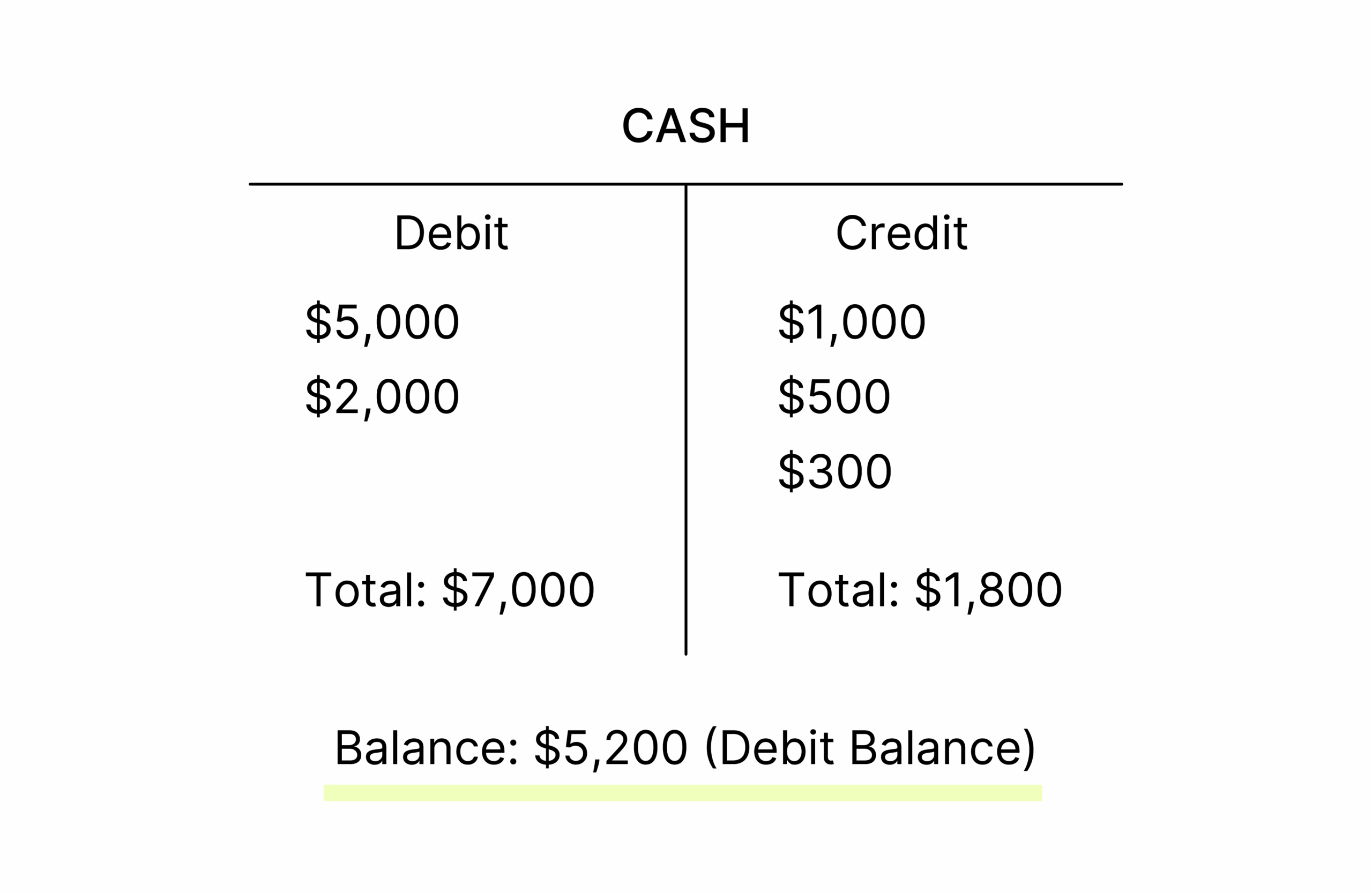
A sample T account for cash shows a debit balance.

In the above T account example, the account name is “Cash.” The initial $5,000 and $2,000 on the debit side represent cash received. The $1,000, $500, and $300 on the credit side represent cash paid out.

To calculate the balance:

  • Total debits: $5,000 + $2,000 = $7,000

  • Total credits: $1,000 + $500 + $300 = $1,800

  • Since debits are greater than credits, the account has a debit balance.

  • Balance = $7,000 – $1,800 = $5,200

Remember, this debit balance will be offset by an equivalent credit balance on a different account.

Take control of your cash flow with Shopify Payments

Only with Shopify Payments can you track your orders and payments all in one place. Have a complete view of your finances, accept local currencies and payment types for a smooth checkout experience.

Discover Shopify Payments

How are the main accounts represented in T accounts?

All types of accounts have a “normal balance.” This “normal” side—which can be either the debit or the credit side—is the side on which you always record increases to that specific account type. For example, asset accounts increase with a debit and thus normally have a debit balance.

Understanding an account’s normal balance is important because it dictates how you record transactions: You always record an increase on the normal balance side, while you record a decrease on the opposite side. This rule ensures you correctly apply debit and credit rules and maintain the accounting equation.

Here’s how the main accounts are represented and where their balances typically fall:

Assets

An asset account represents economic resources owned by a business (cash, accounts receivable, equipment).

  • Normal balance: Debit

  • Increases in assets are recorded as debits; decreases in assets are recorded as credits

  • Example: When cash is received, the cash account is debited. When cash is paid out, the cash account is credited.

Liabilities

A liability account represents a business’s obligations to external parties (accounts payable, salaries payable).

  • Normal balance: Credit

  • Increases in liabilities are recorded as credits; decreases in liabilities are recorded as debits

  • Example: When a company incurs debt, accounts payable is credited. When the company pays off debt, accounts payable is debited.

Equity

An equity account either represents owner’s equity or shareholders’ equity. It records the owner’s claim on the assets of a business (owner’s equity, retained earnings).

  • Normal balance: Credit

  • Increases in equity are recorded as credits; decreases in equity are recorded as debits

  • Example: When an owner invests capital, owner’s capital is credited. When dividends are paid, retained earnings (a component of equity) is debited.

Revenue

A revenue account represents increases in economic benefits from the ordinary activities of the business (sales revenue, service revenue).

  • Normal balance: Credit

  • Increases in revenues are recorded as credits; decreases in revenues are recorded as debits

  • Example: When a sale is made, sales revenue is credited.

Expenses

An expense account represents decreases in economic benefits from the ordinary activities of the business (rent expense, utilities expense).

  • Normal balance: Debit

  • Increases in expenses are recorded as debits; decreases in expenses (rare but possible; for example, an expense refund) are recorded as credits

  • Example: When rent is paid, rent expense is debited.

T accounts FAQ

Do accountants still use T-accounts?

Yes, accountants still use T accounts, though not always in a physical, hand-drawn sense. They remain an important visual tool for understanding how debits and credits affect individual accounts and are especially helpful for analyzing business transactions. Modern accounting software automates ledger entries, but the underlying principle of debits on one side and credits on the other—mirroring a T account—remains central.

What does a T account represent?

A T account represents an individual ledger account and is shaped like the letter T. It separates debits on the left side from credits on the right side, showing the increases and decreases to that specific account. It helps illustrate the dual effect of every transaction to help you determine the balance of an account at any given time.

What is the difference between a ledger and a T account?

A ledger is a complete record of all financial transactions of a business, organized by individual accounts. A T account, on the other hand, is a simplified representation of a single account within that ledger (e.g., accounts payable). You can think of the ledger as the entire book of accounts, and a T account as just one page from that book.

End-to-End Supply Chain: How E2E Supply Chains Work (2025)

Software Stack Editor · August 8, 2025 ·

image

When a shipment of components gets lost, your final product delivery gets delayed. Each stage of your business’s supply chain feeds into the next, and a disruption at one stage affects everything downstream. Many businesses still rely on a fragmented supply chain model, where each step is an isolated segment. Increasingly, companies are embracing coordination between every stage of their supply chain—sometimes even across industries. The public-private Freight Logistics Optimization Works initiative, for example, shares data between supply chain participants, including ports, shippers, and major retailers.

One approach to increasing visibility in your company’s supply chain is end-to-end supply chain planning. As the name implies, an end-to-end supply chain is a holistic, collaborative approach to supply chain management, integrating the entire supply chain process from beginning to end. Here’s what you need to know.

What is an end-to-end supply chain?

An end-to-end (E2E) supply chain is a fully integrated approach to managing your product’s entire life cycle—from forecasting demand to post-sale customer service.

Instead of viewing supply chain segments—like procurement, manufacturing, and fulfillment—as separate, unrelated steps with limited visibility into what came before or after, the E2E model treats them as interconnected components of a single unified process. This enables companies to see their supply chain as one big-picture operation, rather than a series of isolated functions.

A successful E2E supply chain is typically achieved using enterprise resource planning (ERP) software like Tableau, Armstrong, or Qlik, which provides real-time visibility. Collaboration tools like Slack, Microsoft Teams, and Google Workspace also play an essential role. That said, there’s no one-size-fits-all E2E structure, as every business has different goals, customers, production scopes, and product complexities.

The most common steps in the E2E process include: 

Unify your inventory management with Shopify

Only Shopify helps you manage warehouse, pop-up shop, and retail store inventory from the same back office. Shopify automatically syncs stock quantities as you receive, sell, return, or exchange products online or in-person—no manual reconciling necessary.

Explore inventory management on Shopify

End-to-end vs. traditional supply chain

The key difference between E2E supply chain operations and a more traditional approach is the integrated, holistic approach that spans the entire supply chain process—from concept to post-delivery customer care. In an E2E supply chain, each segment communicates with the others via connected systems. A large business might use a sophisticated ERP system across multiple teams to share information, while a small business might opt to use Slack and Google Workspace.

Take, for example, a coat brand facing a delayed shipment of zippers. An effective end-to-end supply chain would mean everyone involved knows where the zippers are held up, why they’re stuck, and how the delay will impact the manufacturing process and product delivery. 

In traditional supply chains, each segment—such as shipping zippers—is handled separately and passed to the next siloed step. If your shipment ends up in the wrong location, you need to scramble to trace it through your various disconnected systems and relay that information down the chain, instead of relying on visibility shared by all parties.

Benefits of an end-to-end supply chain

The E2E supply chain fosters collaboration and communication across all of its segments, helping your business operate more efficiently. Here are the main advantages:

Reduced costs

When segments of the supply chain are isolated from each other, redundancies such as duplicate orders, overbuying, and overlapping logistics can arise. For instance, poor communication might lead your procurement team to order supplies that are already sitting in your warehouse.

A well-designed E2E supply chain can reduce costs by eliminating these kinds of inefficiencies. Integrating procurement of raw materials, inventory management, and distribution into a unified E2E system can create immediate savings by minimizing excess purchasing, storage, and waste. It can also help ensure your investments in new technology pay off through long-term savings.

The result is a lean supply chain that can quickly adapt to changing market conditions while saving money.

Increased customer satisfaction

Isolated supply chain segments can lead to delays in critical communications, and when the end of the chain is the last to know, customers can be left in the dark for too long. An E2E approach creates more opportunity for real-time collaboration that improves the customer experience.

For example, if there’s a delay or other hiccup in the procurement of raw materials, all other teams are notified through shared communication platforms at the same time. Sales teams can notify customers who have preordered the product that there may be a delivery delay or a change in material provenance, and they can offer remedial options to offset any potential disappointment.

Speed up fulfillment times with Shopify

Shopify comes with built-in tools to help you track, prioritize, and fulfill orders from one place, so you can get orders out the door sooner and exceed customer expectations.

Explore order management on Shopify

Tips for implementing an end-to-end supply chain

Implementing and managing an E2E supply chain is not a one-size-fits-all business strategy, but there are universal best practices that apply whether you’re a small artisanal chocolate maker, a boutique outerwear company, or a global automotive brand. Here are three key tips for supply chain leaders:

Foster collaboration

Create an atmosphere of collaboration, whether it’s internally within a company or department, or across the entire supply chain with outside vendors. This might take the form of a virtual “lunch and learn” series that engages teams across the supply chain, from procurement to sales, or cross-functional information sharing in company-wide meetings.

Go digital and automate

Modern software enables E2E supply chains by enhancing communication between teams. Many larger companies use ERP systems for supply chain planning and coordination across segments. But end-to-end visibility is important for businesses of all sizes. According to a 2023 McKinsey report, 79% of respondents implemented dashboards to gain end-to-end visibility. To get the most out of your technology systems, maximize opportunities for them to speak to each other via integrations. Many ecommerce platforms used primarily by small businesses—like Shopify—integrate with a variety of software applications.

Predict customer needs

Sharing customer data up and down the supply chain allows decision-makers at every stage of the process to adjust their projections. Customer surveys and feedback can predict customer needs and signal shifts in demand that impact suppliers and retailers alike. Clear communication keeps your supply chain working like a well-oiled machine, and it can eliminate redundancy, boost efficiency, and ensure you’re prepared to take disruptions in stride.

End-to-end supply chain FAQ

What is an end-to-end supply chain?

An E2E supply chain is an integrated approach to supply chain management—a coordinated process from start to finish. Each portion of the supply chain is a piece of a whole, rather than segmented and siloed, then linked together. The E2E supply chain is often tracked through software and other digital tools.

What are the differences between end-to-end and traditional supply chains?

In a traditional supply chain, each segment—often operated by separate businesses with their own teams and practices—hands off its part of the process to the next, whether it’s market research, manufacturing operations planning, shipping methods, or customer service. An E2E supply chain keeps all segments in active communication with others, creating a cohesive process where every participant has visibility and understanding of the broader process.

What is end-to-end supply chain segmentation?

End-to-end supply chain segmentation is when each segment of the chain is broken down further into smaller segments.

14 Merch Ideas To Inspire Your Next Merch Line (2025)

Software Stack Editor · August 8, 2025 ·

Merchandise is a powerful way to extend your brand’s reach, build community, and create new revenue streams. From musicians selling tour tees to CPG brands creating collectible items, smart businesses use custom merch lineups to amplify their values and connect with customers on a deeper level.

“Make merch that’s collectible, memorable, and giftable,” says Amrit Richmond, founder of the consumer-insights platform Supermercato and the CPG newsletter and community Indie CPG.

In brand merchandise, there is no limit for inspiration, and the options are endless. Here are the benefits of custom merchandise, plus 14 creative ideas to inspire your next launch.

Benefits of custom merch

Selling merch online is more than an extra revenue stream. Here’s why brands create, make, and sell merch:

Extend brand reach

Custom physical merch acts like a megaphone for your brand. You can finish a can of seltzer in a few gulps, but you’ll wear the branded t-shirt of the company that makes that seltzer for years. What’s more, merch takes the idea behind your main product(s) into other rooms of the house. When a canned bean brand sells collectible bowls, a drinkware product makes fruit-shaped hair clips, or an olive oil brand makes reusable swizzle sticks, they all widen their reach.

Signal community

Just like in the case of music and genre-entertainment fandom, owning merchandise signals kinship and builds community. Fans love brands that create exclusive items—think Beyoncé’s online merch store’s custom physical merch, which includes seasonal drops, vinyl records, custom hoodies, and custom bags. Even college athletes are getting in on the merch game, with Campus Ink and its line of custom jerseys creating new ways to show support.

Expand into new product categories

Creative merch items allow you to test category expansions. What can start as a limited-edition run can then become part of the permanent product line. This happened with Glossier’s sweaters and hoodies, which became part of Glossiwear in 2019.

When you understand your target audience well enough to know what kind of brand collaborations they’d be interested in, you can expand your product line—and audience—with strategic partnerships. Collaborating on a limited-edition merch collection keeps your company top of mind with audiences that might not have discovered you otherwise.

14 creative merch ideas

  1. Apparel
  2. Embroidered hats
  3. Performance socks
  4. Hair accessories
  5. Makeup and toiletry bags
  6. Reusable totes
  7. Blankets and throws
  8. Towels
  9. Vinyl records
  10. Drinkware
  11. Kitchen accessories
  12. Puzzles
  13. Custom stickers
  14. Zines and books

Merch sells across countless categories. Whether you’re looking for unique band merch ideas, a branded product line for your ecommerce store, or gifts for fans of your restaurant, here’s some inspiration for your own custom merchandise:

1. Apparel

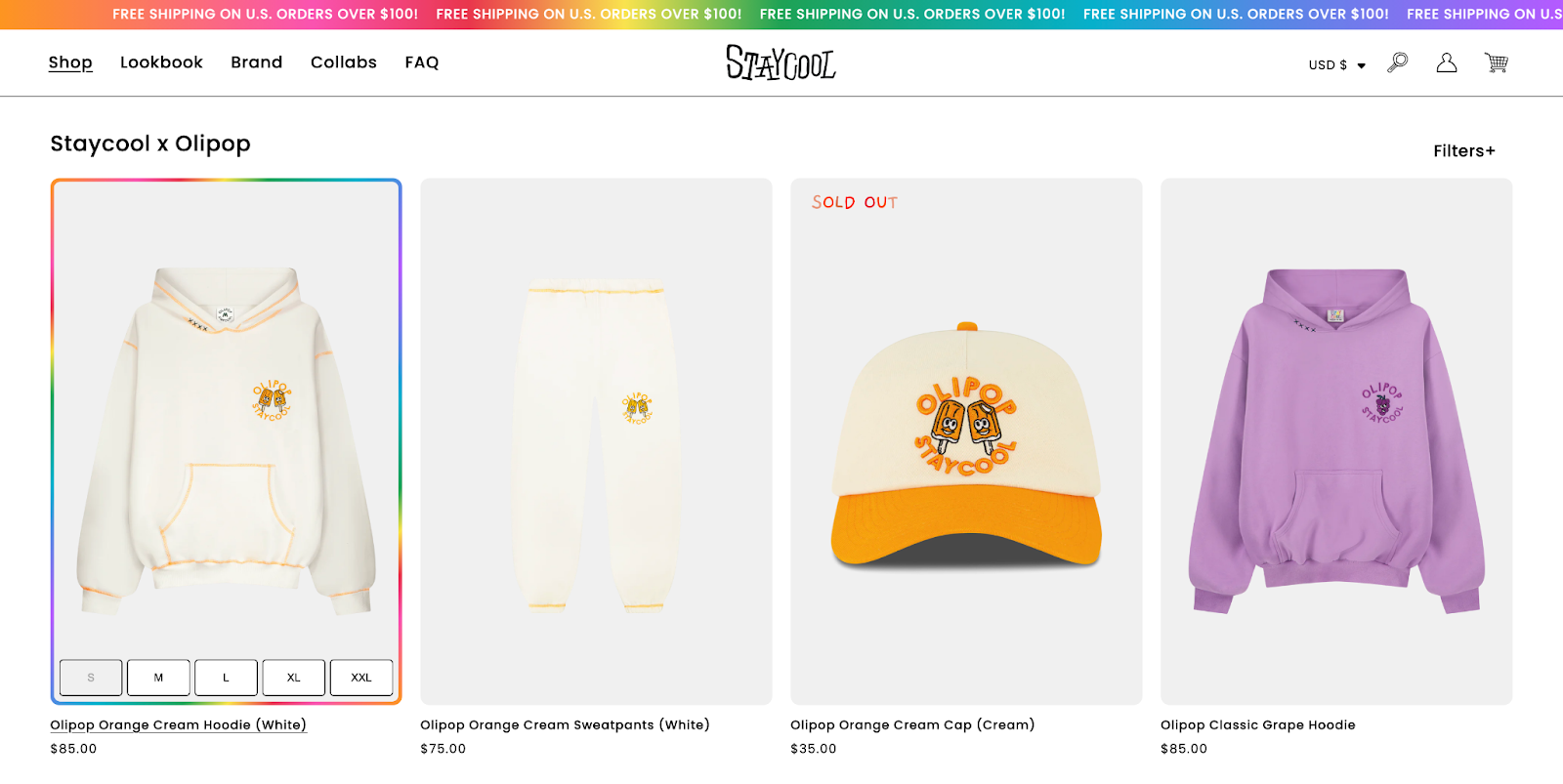
Custom hoodies, sweatshirts, and t-shirts can feature materials, colors, embroidery, and design details that reflect your brand personality. Soft drink maker Olipop partnered with Stay Cool for a line of embroidered sweaters and hoodies that follow the bright color palette of its own lineup, plus a hidden pocket that perfectly fits an Olipop can.

As part of a brand collab, clothing brand Stay Cool created merch for soda company Olipop.
Source: Stay Cool

2. Embroidered hats

Whether they’re baseball hats, trucker hats, or even bucket hats, custom hats are highly giftable. Good Girl Snacks’ Hot Girls Eat Pickles cap put them on the map even before they launched their first product, and Dirt’s Girl Moss hat—a riff on the Girl Boss trope—took the digital entertainment newsletter into the real world.

3. Performance socks

Forget basic crew socks featuring your brand’s logo. “If they’re compression socks that you can use on a flight, that’s a very clever merch idea,” says Amrit. Brands in the fitness, performance, or outdoor spaces find performance socks a natural fit. Outdoor and performance-apparel brand Grin27’s socks have toe and heel reinforcement for durability and performance.

4. Hair accessories

Scrunchies, barrettes, headbands, and claw clips are an easy and affordable option that combines fashion-forward shapes and materials with everyday utility. For example, haircare brand Crown Affair’s green silk scrunchies recreate the brand colors, and Ghia’s clips (limited edition) convey the brand’s Mediterranean-lifestyle aspirations.

5. Makeup and toiletry bags

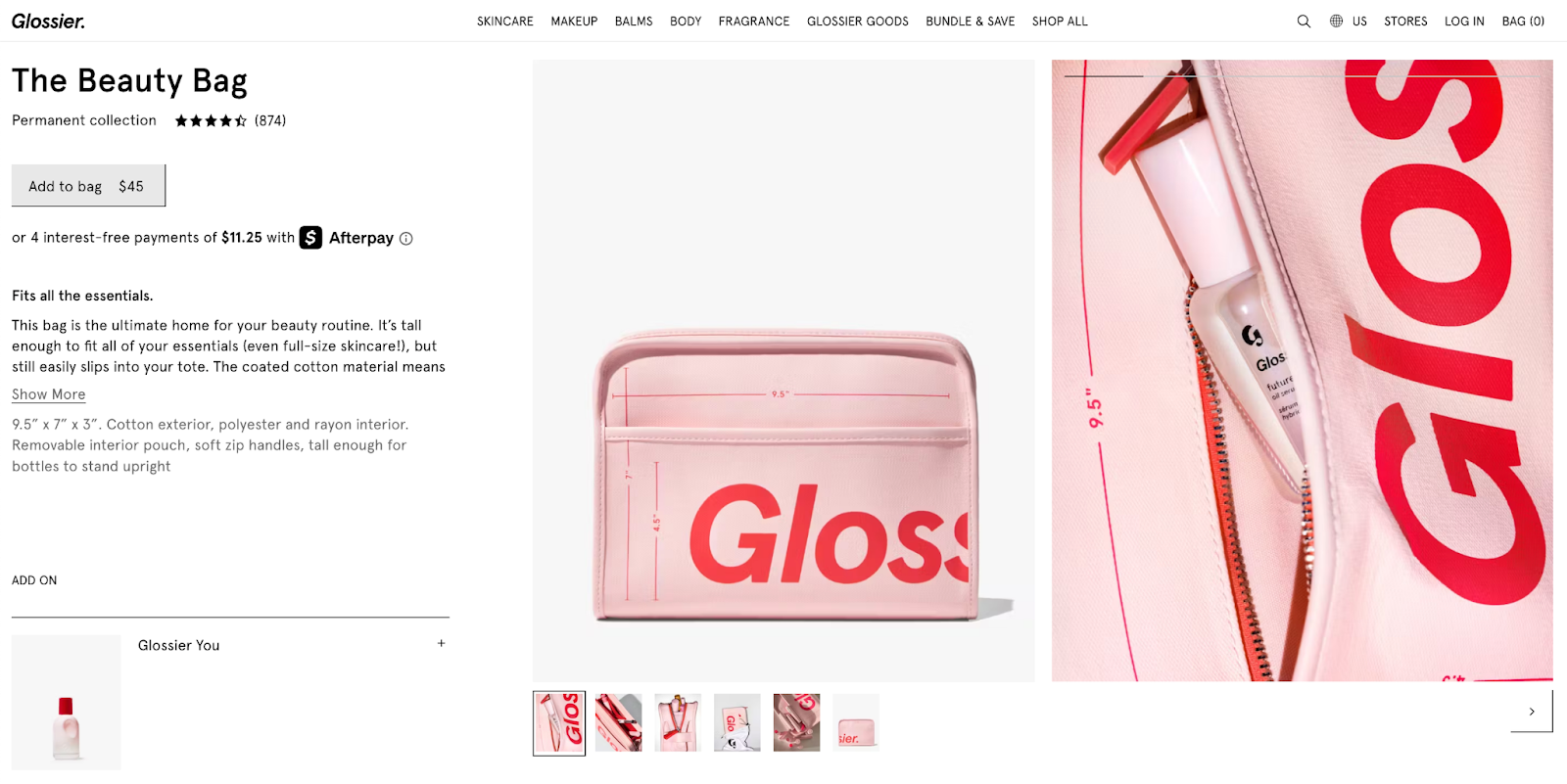
Makeup, skincare, and toiletry essentials need storage, and sturdy toiletry bags are the ideal canvas for your company’s visual elements on an everyday staple. Two makeup and skincare brands excelled in that. Glossier’s Beauty Bag and Ami Colé’s Ami Cosmetics Bag seamlessly showcase the companies’ lead colors in sturdy items.

Glossier’s beauty bag is an example of practical merch with distinctive branding.
Source: Glossier

6. Reusable totes

Forget plain tote bags. Since everybody needs bags, making them in innovative shapes can lead to marketing buzz, if not virality. Think Panera’s elongated BAGuette or gluten-free pasta maker Senza’s LIL Tote, designed to only fit one box of their pastina (or your keys and wallet).

7. Blankets and throws

Custom blankets and throws immediately add texture and coziness to any living space, while letting you play with your company’s color scheme and design system. This works even if home goods aren’t your main category—non-alcoholic drinkware Ghia’s Totem Throw Blanket and condiment brand Fly By Jing’s To The People, Food Is Heaven blanket expand those CPG brands into home décor.

8. Towels

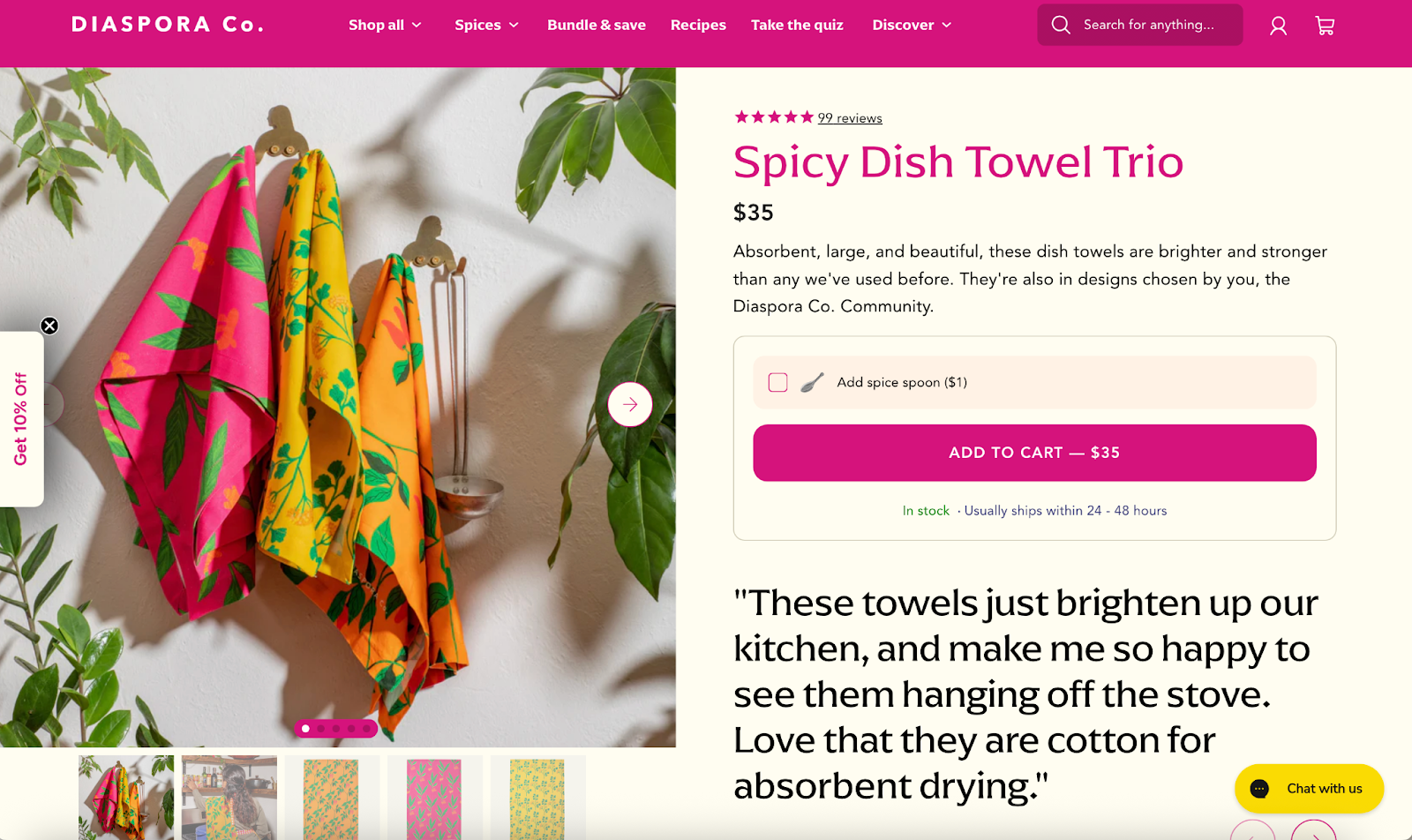
A custom towel can amplify your brand in parks, beaches, and other outdoor areas. Think of retro-inspired sunscreen brand Vacation Inc. and makeup brand Glossier’s signature towels. On a smaller scale, a kitchen towel like spice purveyor Diaspora Co.’s Spicy Dish Towel Trio can brighten even the most minimal kitchen space.

Diaspora Co.’s merch includes a collection of dish towels in vibrant colors and patterns.
Source: Diaspora Co.

9. Vinyl records

If you’re a digital-first business with video and video-game releases plus a fan base that loves collectibles, vinyl records of your soundtrack create the ideal analog companion to your main product line. Follow the lead of (or directly collaborate with) the American merch company iam8bit, or even film-production company A24 and its vinyl releases. Plus, album covers become the perfect canvas for custom art.

10. Drinkware

There’s an art to artfully mismatched tablescapes, and a set of drinking glasses—such as Ghia’s Totem Glasses—and custom mugs make perfect housewarming and hostess gifts.

For Gen Z in particular, hydration is paramount, as is sustainability. Customize bottles, flasks, and portable, insulated tumblers with your company’s colorways and key art for optimized hydration on the go.

11. Kitchen accessories

“Art for your kitchen” is what Amrit calls branded spatulas, cutting boards, pots, cutlery sets, and even smaller items such as salt cellars and pinch bowls. She references the 2023 Fly By Jing x The Caker chocolate-cake kit as an example, which features a red spatula and Fly By Jing’s signature oil in the kit, and one of Senza’s PR kits, which came with a red spatula. “It was a name-brand spatula, but it didn’t have their logo on it, and I used it all the time,” she says. “But their brand was something that now I think about when I see this red spatula.”

12. Puzzles

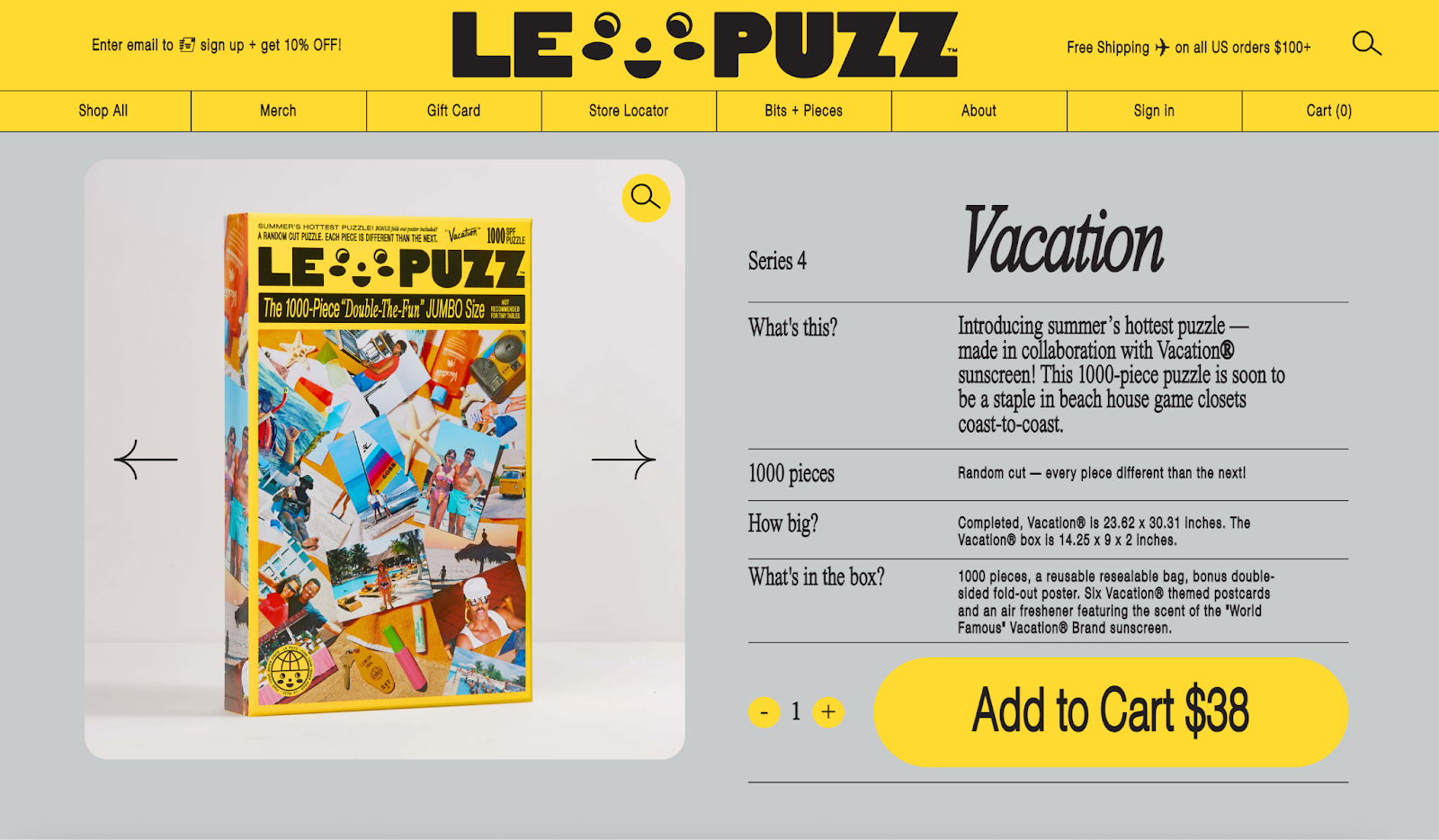
Puzzles combat doomscrolling, benefit the brain, and double as home décor once finished. Forget landscapes and renditions of paintings. Brands like Le Puzz have retro-kitsch, high-camp artwork, and also collaborate with beloved DTC brands such as the sunscreen brand Vacation Inc.

Le Puzz created custom merch for sunscreen brand Vacation as part of an exclusive collaboration.
Source: Le Puzz

13. Custom stickers

Custom designs can find a perfect home in stickers that promote your business, brand, band, or event, encouraging experimentation with design and art direction. You might use stickers to show off your brand mascot or album art. Consider the viral success of Glossier’s sticker collections and drops, which started as free add-ons to any purchase and are now coveted collectibles. 

14. Zines and books

From a brand’s perspective, zines and books deepen brand storytelling and allow for creative experimentation with lower production costs compared to other limited edition items. From a customer’s point of view, these make for great gifts. Consider A24’s behind-the-scenes screenplay collection, or a zine showcasing drink options, like Diaspora’s Drinklet zine? “A [brand] book is a fantastic gift for the holidays, for birthdays, for Mother’s Day,” says Amrit.

Merch ideas FAQ

What are the best merch ideas to sell?

While novelty items generate buzz and lend themselves to viral moments, high-quality staples such as apparel and accessories strike the perfect balance between design, brand awareness, and versatility. Cool merch ideas include hoodies, t-shirts, and sweatshirts. Hats can be elevated with custom artwork, materials, and cuts, and can outsell novelty limited-edition items. Industry-adjacent categories are also a great way to expand into merch, like Vacation Inc.’s beach-appropriate accessories.

What are examples of merch?

While one brand’s merch is another brand’s main product line, examples include hoodies, sweatshirts, t-shirts, hats, tote bags, jigsaw puzzles, keychains, mugs, and water bottles. Film, TV, and video-game companies release merch in the form of art books, figurines, plush toys, and vinyls.

What merch does Gen Z like?

Gen Z—the first generation to grow up with the internet—has preferences shaped by online subcultures, the COVID-19 pandemic, nostalgia, and a keen eye for sustainability. Think reusable bottles, insulated coffee mugs, and reusable bags that align with their values while serving practical purposes.

What Does a Digital Marketer Do? 5 Essential Responsibilities (2025)

Software Stack Editor · August 8, 2025 ·

image

Even a great retail product with a compelling brand can get lost among competitors. To help yours stand out in a crowded field, digital marketing can make a big difference. Honey Pot, an herbal feminine care company, promoted its brand on digital platforms by addressing taboo topics with honest, humorous content. Magnolia Bakery—a famous New York City–based dessert chain—used detailed customer segmentation to increase the likelihood of repeat sales.

Understanding what a digital marketer does can help you grow your own brand—and decide if and when you may need to bring in some expert help. Here’s a look at what digital marketers do every day, plus the real-world strategies that powered Honey Pot’s buzz and Magnolia Bakery’s surge in online sales.

What is a digital marketer? 

A digital marketer is a professional who concentrates on the online side of a business’s marketing presence, ensuring brands are visible and appealing where customers spend time online. Digital marketers focus on promoting businesses through online marketing channels such as websites, search engines, email, and social media. A digital marketer’s job also involves building relationships and community with customers, often by creating useful content or conversations that draw people in.

What does a digital marketer do?

Digital marketers wear multiple hats to help businesses connect with customers online. Depending on the business size, one person might handle all these tasks, or a team may split the responsibilities. Here are the key responsibilities a digital marketer might take on for a small business or ecommerce brand:

Social media marketing campaigns

This involves creating and posting content on Instagram, Facebook, TikTok, or Pinterest, and interacting with followers. For example, a boutique shoe store owner might share behind-the-scenes videos on Instagram and reply to customer comments or DMs. Some organizations may hire a social media manager to run this specific type of digital strategy.

Content marketing

A content marketing specialist produces content (like blog posts, videos, or product guides) that attracts people through search engines and helps them learn more about the brand. An online pet supply store might have a blog with tips for new pet owners that contains keywords for search engine optimization (SEO). This helps it rank higher on Google searches for questions like “how to train a puppy.” In turn, this content draws in potential customers and subtly promotes the brand’s products.

Email marketing and customer retention

Many digital marketers manage email lists and craft newsletters or email campaigns to welcome new faces, keep the curious coming back, and turn readers into customers who buy first and tell their friends second.

Digital advertising campaigns

While all social media marketing initiatives are online advertising campaigns, not all online advertising campaigns happen on social media. For example, a local artisan soap company might run Google ads shown only to users in its shipping areas who are interested in natural skin care.

Get better ad performance with Shopify Audiences

Shopify Audiences helps you find relevant buyers and lower advertising costs with custom audience lists—powered by Shopify’s unique insights from commerce data.

Discover Shopify Audiences

Data analysis

Digital marketers look at data and metrics—think website visits, email open rates, and conversion rates—to see what strategies are working. By continually testing and refining—from tweaking website copy to trying new ad images—they discover important customer behaviors, so they can spot a photo, word, or button that flips a scroll into a sale.

How to improve your brand’s digital marketing

You don’t need an infinite budget or a full-time team of marketing veterans to run great initiatives across digital platforms. Many small ecommerce business owners begin by doing it all themselves. But over time, these tasks can pile up or require more expertise than you can manage alone.

Whether you decide to create digital marketing positions at your organization or keep doing the work yourself, these tips may come in handy.

Boost organic visibility

If you want customers to find your store without you shelling out money for pay-per-click (PPC) ads, you need to show up in search results. A sizable share of online experiences begin with a search engine, so creating valuable blog posts, product guides, and other content can drive organic traffic. Digital marketing can also help you boost organic traffic across multiple content marketing formats:

  • A coffee maker brand could create a series of YouTube videos with brewing tutorials and recipe ideas, becoming a go-to authority for coffee enthusiasts.

  • A fitness apparel company might run a blog featuring workout tips, healthy recipes, and athlete interviews, which naturally incorporate its products and improve SEO for fitness-related searches.

  • A home improvement retailer could design infographics on DIY projects (e.g., “5 Steps to Build a Backyard Fire Pit”), with shareable content that links back to its website.

Finding your unique angle is key to standing out organically. For Honey Pot’s VP of marketing, Giovanna Alfieri, it involves taking customers’ individual experiences and using them to identify universal trends that competitors haven’t addressed. “We all have a desire to look immediately to the competition and be like, ‘Ooh, what are they doing? Is there anything that we can plug and play from there?’ I think that just breeds more sameness,” she says on an episode of the Shopify Masters podcast. “That’s personally not interesting to me as a consumer, nor as a marketer.” By tapping into consumers’ experiences, she’s able to create content around the fundamental things her audience cares about.

Engage and build your online community

Building a community means going beyond one-way marketing and fostering two-way conversations with your audience. If you’d rather stay elbows-deep in tasks like product development and financial modeling, hire someone who can build a lively Discord, turn every DM into a miniature focus group, and keep the conversation humming while you focus elsewhere.

A digital marketer should establish a consistent, authentic presence where your customers spend time—whether that’s LinkedIn or a niche community on Reddit. They might post content that invites interaction, such as questions, polls, live Q&As, contests, or behind-the-scenes peeks at your business. Over time, these interactions cultivate brand loyalty.

Segment your audience 

One-size-fits-all marketing is outdated. Dividing your audience into meaningful segments, such as by demographics, purchase history, interests, or engagement level, can tailor your digital marketing campaigns and messages to be far more relevant.

Adam Davis, Magnolia Bakery’s senior marketing manager, emphasizes the power of tagging and segmenting shoppers for future outreach, on an episode of Shopify Masters: “If a customer’s ordering a pie for Thanksgiving, we want to make sure that Shopify is tagging that customer as such. Next Thanksgiving, we import that list into our email database and send an email about pies to people we know who have purchased pies in the past.”

Put your customer data to work with Shopify’s customer segmentation

Shopify’s built-in segmentation tools help you discover insights about your customers, build segments as targeted as your marketing plans with filters based on your customers’ demographic and behavioral data, and drive sales with timely and personalized emails.

Discover Shopify segmentation

Connect with micro-influencers

Not all social media influencers have millions of followers. Micro-influencers—who are people with a few thousand tuned-in listeners—can have comment threads that feel like a group chat with friends. Partnering with smaller-scale influencers can give your brand an authentic form of reach and credibility that bigger influencer endorsements sometimes lack.

Giovanni says smaller content creators are often naturally funny without thinking twice about it, and that’s good for business. “We want content that connects with people and is funny and is educational,” Giovanna explains. “Humor opens up an opportunity to simply laugh or to have that moment of reflection.” This allows the brand to connect with its audience on an emotional level.

A digital marketing specialist should spot niche micro-creators, slide into their DMs with a crisp pitch, and seal a deal with expected deliverables (e.g., one post, two Stories, and/or a discount code) while measuring the ROI on every click with web analytics software.

Adopt a continuous test-and-learn approach 

Successful marketing campaigns are never static. The best brands adopt a culture of continuous improvement across their digital marketing efforts—constantly testing, learning, and optimizing their online presence.

For website optimization, regularly run experiments such as A/B tests on your site’s pages and features. You might test two versions of a website header to see which drives more clicks, or experiment with different call-to-action button colors, layouts, or copy to increase conversions. A seasoned digital marketing manager can help your organization understand all the different approaches you can take to meet key performance indicators (KPIs). 

Adam says Magnolia Bakery has a culture of trying new ideas to optimize results. “There’s nothing off limits for us when it comes to our website and testing and learning new things.” Even small tweaks—like adjusting a landing page layout or call-to-action—can reveal why some visitors buy and others bounce.

Invest in targeted paid advertising

Building organic reach is vital, and paid advertising is an accelerant that can drive quick visibility and results for digital marketing efforts. Digital marketers should know their way around ad platforms and be strategic with the budget. By focusing your budget on the right customers—those most likely to be interested in your product or service—you can increase the efficiency of your campaigns.

Effective paid advertising also needs clear goals. Are you aiming to boost brand awareness, drive traffic to a landing page, or generate immediate sales? A skilled digital marketer uses eye-catching visuals or concise, impactful copy to grab attention. Most of all, they continually monitor, adjust, and optimize your ads, tracking metrics like click-through rates, conversion rates, and cost per acquisition.

What does a digital marketer do FAQ

What are the duties of a digital marketer?

Digital marketers promote brands, products, and services online through multiple digital channels. They generate interest in a company through blog posts, Facebook ads, and email campaigns. A big part of the job involves digging into data to see which strategies are working and which ones aren’t.

What skills are needed for digital marketing?

Digital marketers need a mix of creative and analytical digital marketing skills. They’re comfortable with content creation such as writing, design, and video; they understand social media and advertising platforms; they have some knowledge of SEO; and they can interpret data to make decisions and adjustments.

How do I pursue a digital marketing career?

To become a digital marketer, you can learn through on-the-job training within a brand’s marketing department, pursue a formal degree in marketing, or take online courses that focus on Google Ads certification, Facebook advertising, or SEO fundamentals. Networking can also help you meet digital marketing professionals at events and through online communities, which can open doors to job opportunities.

What are common types of digital marketing?

There are many different types of digital marketing strategies, including:

  • Search engine marketing. Using SEO and paid ads to appear in search results.
  • Content marketing. Creating blogs, videos, and guides to attract customers.
  • Social media marketing. Connecting with audiences on platforms like Facebook and Instagram.
  • Email marketing. Building relationships and driving repeat business through email campaigns.

How Two Founders Turned Curation Into a Competitive Edge (2025)

Software Stack Editor · August 7, 2025 ·

Byron and Dexter Peart had already made their mark in the fashion world with WANT Les Essentiels when they decided to walk away from the industry. In 2019, they launched Goodee, an online marketplace for home goods built on their belief in good people, good design, and good impact. Since then, the Montreal-based twins have expanded their platform to include products from more than 40 countries, opened a flagship retail store, and maintained a return rate well below industry average.

Handmade blanket and basket
Goodee’s makers span more than 40 countries, yet every partnership begins with the same hands-on assessment process to ensure alignment in craft and values. Goodee

Here’s how Byron and Dexter built a business that’s as resilient as it is responsible, and why they believe success starts with staying true to what you value most.


Prioritizing people and purpose from the start

Before they sourced a single product, the Pearts wrote down what would become Goodee’s North Star: “Good people, good design, good impact.” As Byron explains, “Our driving force behind everything we do always comes back down to people and design.”

Every maker or brand partner in their network must align with these standards and demonstrate thoughtful production and ethical labor practices. Goodee tags each product with icons representing one of 11 social or environmental causes, helping customers shop with clarity and confidence. “People actually do want to make a better choice,” Dexter says, “but they just don’t necessarily know how to.”

That clarity translates into consumer confidence—and results. Goodee’s return rate is just 5%, compared to an industry average of 17%, according to a 2024 report by the National Retail Federation (NRF) and Happy Returns.

Assorted handmade crafts on bookshelf
Every product on Goodee’s site is photographed and described in-house to ensure thoughtful storytelling at every touchpoint. Goodee

Honing and trusting your curatorial eye

Goodee offers a tightly edited assortment of goods rather than a massive catalog. The team discovers makers themselves, assesses their processes, shoots original product photography, and writes descriptions from scratch for each item on the site. It’s labor-intensive, but it builds deep trust with customers.

Byron likens curation to cooking: some people naturally know how to combine flavors. He believes many entrepreneurs have that same innate sense of taste, but risk watering it down by chasing trends instead of trusting their instincts.

He encourages founders to build on their strongest style instincts first, then layer on new elements once they feel confident. Goodee’s philosophy around taste is rooted in consistency over trends, helping customers cultivate their own design language.

That strategy has made Goodee a tastemaker, not just a marketplace. When gardening unexpectedly became a fast-growing category post-pandemic, the team responded by curating tools like Japanese cutting shears and nesting pots, showing that good curation also means staying close to customer behavior.

Redefining growth on your own terms

The Pearts are clear-eyed about growth: Yes, they want Goodee to scale. But not for growth’s sake. “It’s 100% growth for all the right reasons,” Dexter says. “If more people start shopping more intentionally for better products, buy less of it, but buy better—that is a great growth strategy.”

At Goodee, growth means expanding impact. More sales means more orders for their partners, more jobs for makers, and more opportunities for customers to align their spending with their values. “If we grow, those makers’ opportunities grow,” says Byron.

Rather than chasing niche appeal or short-term sales spikes, the Pearts aim to shift consumer behavior one thoughtful purchase at a time. “That is probably fundamentally what we get up out of bed every day to do,” says Byron.

Custom-made blanket on bed
Sustainability at Goodee includes product longevity, with the team prioritizing goods that are built to last and made with environmentally conscious materials. Goodee

Resilience through uncertainty

Goodee launched in 2019 and went remote just nine months later due to the pandemic. Rather than stall, the team used that time to deepen customer relationships and sharpen internal processes.

“If you stay curious and you accept that you have to keep rolling, shifting, moving—those are the things that create opportunity,” says Dexter.

Their resilience also stems from building a business that’s human-first. They stay connected to customers through surveys, reviews, and now face-to-face retail at their Montreal flagship. These insights inform everything from sourcing to marketing and merchandising. The physical store isn’t their largest revenue driver—but it’s a valuable source of learning.

Another key to their staying power is pacing. “Good things take time,” Byron says. “And if you build trust over time, you’ll have a good business.”

Goodee is proof that good business starts with good values. Byron and Dexter Peart have built a profitable, purpose-driven marketplace not by chasing trends or scale, but by betting on integrity, trusting their instincts, and staying human at every step. For more advice and insight from the Peart brothers, check out the full interview on Shopify Masters, wherever you get your podcasts.

Customer Experience Automation: 6 Ways To Implement CXA (2025)

Software Stack Editor · August 7, 2025 ·

image

When you’re a founder, managing every customer touchpoint feels overwhelming. From sending marketing emails to fulfilling orders and responding to customer inquiries, you’re juggling countless tasks while trying to deliver personalized communications that build trust. But there’s good news: You don’t have to handle it all manually forever.

Customer experience automation (CXA) tools can transform how you connect with customers, handling routine interactions while you focus on growing your business. Learn about these applications and how Niel Hoyne, Google’s chief strategist for data and measurement, thinks about using tools like these to improve customer satisfaction.

What is customer experience automation?

Customer experience automation (CXA) uses technology and software tools to automate exchanges between businesses and consumers. CXA tools can send SMS text messages, deliver emails, and automate back-end data collection. CXA streamlines workflows and enables faster communication without requiring constant human input. 

CXA applies to the entire customer journey, or the path a customer takes from considering a product to purchasing it. While marketing automation focuses on drawing customers into the sales pipeline, CXA encompasses those beginning, consideration stages as well as customer support and post-purchase communications. For example, an ecommerce business could use a CXA tool to ensure a positive delivery experience by automating shipping updates, letting customers know that their order is on track.

Customer experience automation vs. customer experience management

Customer experience management (CXM) addresses the entire customer lifecycle, or the entire relationship a customer has with a business. It involves mapping the complete customer journey and making strategic decisions to improve the customer experience. Customer experience automation, on the other hand, falls under the CXM umbrella and covers the day-to-day execution of customer support tasks. CXA helps implement the strategy and deliver the messages that CXM experts craft.

Elements of customer experience automation

Customer experience automation isn’t about bombarding consumers with constant communication. In Niel’s experience, “Advertisers that immediately start messaging, emailing, serving up advertising to customers as soon as they leave the website actually see a decrease in interest.” Effective CXA delivers the right message to the right person at the right time to make the customer journey smoother.

Here are the essential elements of successful CXA implementation: 

  • Audience segmentation.Customer segmentation groups users together based on commonalities, such as shared interests or similar demographics. Creating distinct customer segments helps marketing and communication teams tailor messages for each audience’s unique needs. 

  • Orchestration. Even straightforward customer interactions require communications across multiple channels. Orchestration ensures that all your communication channels work together during the customer journey. It involves leveraging existing customer data to make informed decisions about when to communicate on which channel.

  • Automation. CXA tools automate communications, including emails, push alerts, and SMS notifications. They also simplify back-end operations by analyzing data and automatically updating customer profiles or routing support tickets to relevant teams. 

  • Personalization. For customers, personalization can mean the difference between a helpful update and an irritating, disruptive notification. This involves analyzing customer data and using audience segmentation to deliver personalized messages tailored to user needs. “Don’t collect information just for the sake of collecting it,” Neil says. “Think about how you might use it to personalize your emails, experiences, or deliver better value to users.”

Put your customer data to work with Shopify’s customer segmentation

Shopify’s built-in segmentation tools help you discover insights about your customers, build segments as targeted as your marketing plans with filters based on your customers’ demographic and behavioral data, and drive sales with timely and personalized emails.

Discover Shopify segmentation

6 ways to implement customer service automation

  1. AI chatbots
  2. Automated emails
  3. Automated SMS messages
  4. Customer profile maintenance
  5. Communication routing
  6. Customer surveys

Here are the most effective CXA processes businesses use to streamline operations and improve the customer experience:

1. AI chatbots

AI chatbots are instant messaging tools for handling simple customer queries. Chatbots often appear on the bottom right-hand corner of a website, denoted by a speech bubble icon. These tools use natural language processing to interpret inquiries.

They gather information from resources like internal databases, FAQ pages, and product instructions to provide basic customer support with details about products or company policies. Chatbots are available 24/7 and deliver responses within seconds, but they can’t replace human agents when customers need help with sophisticated issues.

Turn chats into sales with Shopify Inbox

Shopify Inbox is a free app that lets you chat with shoppers in real-time, see what’s in their cart, share discount codes, create automated messages, and understand how chats influence sales right from your Shopify admin.

Discover Shopify Inbox

2. Automated emails 

Email automation tools can enhance the customer journey, respond to consumer actions, and help deliver personalized campaign messages. To enable automation, create rules that dictate when CXA tools send emails. For example, you could create a series of welcome emails triggered by first-time purchases to build a seamless onboarding experience.

You can also set behavior-based rules where specific customer actions trigger emails. Abandoned shopping cart emails are a common example of behavior-triggered emails. With automated abandoned cart emails, customers who leave your website midway through a purchase receive a timely follow-up.

3. Automated SMS messages

SMS automation works similarly to email automation. Account owners use rules and conditions to determine when messages are delivered. Like email, rules can be tied to the customer journey, specific actions, or customer segments.

4. Customer profile maintenance 

CXA tools can help create and maintain customer profiles. Customer profiles contain user-selected preferences, such as newsletter opt-ins and saved searches. To build richer profiles, businesses collect first-party data generated by customer interactions. Transactional history is an important part of this dataset, but it’s not the only component. 

CXA tools ingest data from multiple sources and update customer profiles automatically. Connecting information from your other marketing tools, like customer relationship management (CRM) systems and email marketing software, helps create a comprehensive view of customer preferences. Automation ensures that profiles are always up-to-date and accurate; if customer behaviors change, they’ll be reclassified as the program syncs data. 

Niel emphasizes the importance of observing other customer behaviors, saying, “There are going to be customers that come to your website, but they’re not sure if they want to buy right away. Those relationships are just a natural part of doing business. Only tracking clicks and conversions may be a little bit shortsighted because you lose touch with those customers who may come back multiple times and contribute a lot of value.”

5. Communication routing 

Automated routing can improve operational efficiency. CXA routing analyzes customer queries and directs messages to customer service agents or relevant teams based on a set of predefined rules. Routing rules can be based on conditions such as customer type, issue type, purchase history, and geography. Automated routing can enhance customer satisfaction by helping businesses resolve issues quickly. 

6. Customer surveys

Automation helps build feedback collection into your standard workflow. With CXA, businesses can set feedback surveys to run at regular intervals. Automation tools collect customer responses and organize data. Reviewing up-to-date feedback can reveal valuable insights and help teams make data-informed decisions.

Customer experience automation FAQ

What is customer experience automation?

Customer experience automation (CXA) streamlines and personalizes how your brand interacts with customers throughout their entire journey—from first contact to repeat purchase and beyond. Rather than just storing data like a traditional customer relationship management (CRM) system, CXA uses that data to trigger automated, behavior-based interactions for managing client relationships. In ecommerce, CXA platforms help businesses deliver timely, relevant experiences at scale—boosting engagement, loyalty, and conversion rates without manual effort.

What are automated experiences?

An automated experience is any customer interaction that technology executes without human intervention. AI chatbots are a common example of automated experiences. When users submit questions, these tools automatically supply relevant information from a database or redirect the question to a customer service representative for additional assistance.

What is automated customer service?

Automated customer service refers to using technology and automation to handle aspects of customer support. Automated tools can supply basic information at any time, but complex customer issues may require assistance from a customer service representative.

What Is a PR Campaign? 7 Real-World PR Campaign Examples (2025)

Software Stack Editor · August 7, 2025 ·

image

If you want to build brand awareness and get noticed, launching a public relations campaign, also called a PR campaign, can be a great way to do it. It’s a strategic way to get people talking about your brand, generate buzz around a new product, amass media coverage, and spark a conversation about topics related to your brand values. When you execute PR campaigns successfully, they can lead to positive outcomes like increased sales, improved brand reputation, media mentions, or customer loyalty.

Here’s what you should know about launching a PR campaign, how it can help your business, plus real-world PR campaign examples from successful brands.

What is a PR campaign?

A PR campaign is a series of marketing tactics designed to generate publicity. An effective PR campaign can come in many forms, from celebrity and influencer partnerships to ads that spotlight a specific product or message. All public relations campaigns aim to drive real-world and online engagement, getting more consumers interested in your brand identity, goods, and services.

A successful PR campaign requires a carefully planned marketing strategy to meet your specific business goal, such as boosting brand awareness or driving traffic to your company’s site. You need to determine the campaign’s message, timing, and duration. Identify your target audience, the best channel or platform, and draft a compelling press release to let everyone know what you’re up to.

What can a good PR campaign accomplish?

When you or your team execute a well-planned, comprehensive PR campaign, it can lead to one or more positive outcomes for your brand, including but not limited to:

  • Increased brand recognition. A successful PR campaign raises brand awareness, earns media coverage, and sparks conversation—whether it be in real life, on social media platforms, or both. The resulting PR metrics can be used to inform every component of your next PR campaign.

  • Boosted website traffic and sales. You can use a public relations campaign to create a connection with consumers, but the best PR campaign examples all prompt people to not only check out a brand’s website or app but also purchase its products.

  • Enhanced credibility. A PR campaign featuring trusted third-party sources (such as celebrities, respected influencers, or media outlets endorsing your brand) can bolster consumers’ trust in your products and services. 

  • Improved brand reputation. A compelling press release highlighting the positive aspects of your brand can help shape or reshape your brand reputation and public perception.

4 main models of a PR campaign

The four main models of a PR campaign include:

  • The press agent/publicity model. Using this one-way communication model, public relations professionals focus on creating a positive image of the company by highlighting a brand’s products or services, as well as its core values. 

  • Public information model. This one-way model aims to inform people about brand news and updates through press releases and other forms of media distributed directly to the public. 

  • Two-way asymmetrical model. PR professionals use this two-way communication model to coax people into supporting a company’s products or values, though they don’t necessarily collect feedback in the process.

  • Two-way symmetrical model. This two-way communication model gives customers a voice and fosters conversation, brand engagement, and community building in addition to spreading the word about a brand.

7 real-world examples of successful PR campaigns

  1. Allbirds
  2. Fly By Jing
  3. Dove
  4. Honey Pot
  5. Burger King
  6. Then I Met You
  7. Gillette Venus

Famous PR campaigns come in many different shapes and forms, but they all have a common outcome: attracting attention. Here are seven examples demonstrating what goes into creating successful PR campaigns:

1. Allbirds

In 2018, the sustainable footwear brand Allbirds launched a PR campaign called Meet Your Shoes featuring its Wool Runner sneakers (made from merino wool) and Tree Runner sneakers (made with eucalyptus tree fiber). The public relations campaign ran across multiple media platforms—including Instagram and YouTube.

A classic public information campaign, it encouraged its target audience to visit an interactive website, where they could learn more about the sheep and trees behind their shoes. These public relations videos not only created buzz around the sneakers but also highlighted Allbirds’ commitment to making sustainable products. 

2. Fly By Jing

In 2021, condiment company Fly By Jing created waves when it launched a public relations campaign on OnlyFans in which it used the cheeky phrase “hot noods” to refer to their noodles. The PR strategy prompted its target audience to subscribe for free to its OnlyFans community to learn more about the brand and its products.

For each new subscriber the digital PR campaign gained, the brand pledged to donate $1 to organizations supporting and protecting sex workers. The public relations campaign got people talking about the brand and highlighted Fly By Jing’s brand values—a great example of a two-way symmetrical campaign. 

3. Dove

The personal care brand Dove’s Real Beauty initiative is still relevant two decades after it debuted in 2004. The Real Beauty public relations campaign and ad strategy highlighted a diverse group of real women rather than models, aiming to challenge society’s unrealistic beauty standards and promote self-acceptance among women. Dove has continued to iterate on the initial public relations campaign over the years and work with media professionals to spread the word about its initiatives.

For instance, in 2024, the brand released a press release pledging to never use AI to represent real women in their ads. While Dove’s Real Beauty PR strategy doesn’t directly relate to the brand’s products, it continues to generate earned media attention and shape consumers’ perception of Dove as a body-positive brand. 

4. Honey Pot

In 2017, feminine care brand Honey Pot launched its Humans With Vaginas campaign on social media channels. The goal was educating its target audience and normalizing conversations about vaginal health and human rights. The two-way symmetrical PR strategy featured real women sharing their stories and experiences of living with a vagina. It established the brand as a pioneer in vaginal health education and female empowerment. According to The New York Times, the PR efforts also helped Honey Pot increase its sales and exposure.

5. Burger King

In 2024, Burger King launched its Million Dollar Whopper campaign. The highlight of this public relations event was a contest that prompted current and future customers to design their dream Whopper with a fresh mix of different toppings. The brand selected three finalists and made their Whopper creations available on Burger King’s menu for a limited time.

After customers had the chance to taste-test and vote on the burgers, the winner received a $1 million prize. Their creation became available in Burger King stores nationwide, generating a lot of buzz. With over a million submissions to the contest, the fast food company successfully enhanced its real-world and social media engagement.

6. Then I Met You

In 2025, Korean skin care brand Then I Met You launched a mobile pop-up campaign in New York City in collaboration with Sephora to increase brand engagement and attract new customers. The pop-up shop gave the brand’s target audience the chance to get one-on-one time with the brand’s founder, Charlotte Cho. It featured free skin care consultations, samples, snacks, and merch. The store was open for only one weekend, driving demand and prompting people to shop for Then I Met You’s products at Sephora. 

7. Gillette Venus

In 2021, shaving brand Gillette Venus launched a two-way asymmetrical campaign called #SayPubic. It aimed to reject the taboo perception around pubic grooming and destigmatize the term. The brand timed the campaign to run around the launch of its Pubic Hair & Skin Collection and released a video in which an animated pubic hair sang a funny tune called The Pube Song.

The brand cultivated media relationships to help the video go viral. Ultimately, the PR efforts drew attention to Gillette Venus’s new product line and showed the brand’s commitment to empowering women and shifting societal norms.

PR campaign FAQ

What does PR mean?

PR stands for public relations. It refers to managing the public’s perception of either an individual or a brand. PR firms focus on implementing marketing campaigns to drive brand awareness and increase sales for their clients. The best PR campaigns do this by highlighting what’s unique about their client or products.

What is PR in advertising?

Unlike traditional advertising, which often includes paid media channels, PR-driven marketing campaigns focus on getting free publicity (earned media coverage). This is done through strategic communication via media relations, press releases, influencer and editor outreach, and other organic tactics. Instead of paying for an ad, you influence outlets and creators to talk about your brand organically.

What are the models of a PR campaign?

The four main models of a PR campaign include a press agent/publicity model, a public information model, a two-way asymmetrical model, and a two-way symmetrical model.

How Database Marketing Works + How To Use It Effectively (2025)

Software Stack Editor · August 7, 2025 ·

image

Successful generic marketing and unicorns have one thing in common: They’re both myths. While it’s easier to share the same marketing materials and email blasts with all your customers, a one-size-fits-all marketing approach won’t be nearly as effective as personalized marketing tactics. Customers who feel seen and heard tend to grow an affinity for the brands that make them feel that way. One way to foster this kind of relationship between brand and customer is through database marketing.

The benefits of database marketing are plentiful. By collecting and leveraging customer data, you can create personalized marketing campaigns that feel far more relevant to your target audience. These efforts build stronger customer relationships and lead to a higher chance of converting potential customers into loyal buyers. 

Whether you’re tapping into consumer data or working with business databases, using the right database marketing strategies can fuel real business growth. Here’s how your business can take advantage of this approach to supercharge your growth and outreach.

What is database marketing?

Database marketing is a process that involves gathering customer data (such as demographic data, transaction data, or purchase history) and categorizing it into specific customer segments for targeted marketing campaigns. Customer segmentation, when done well, makes your marketing efforts more relevant and increases customer engagement by meeting people where they are. The more relevant customer data you collect, the better you can tailor your marketing communications to fit the needs and preferences of individual customers.

Database marketing enables businesses to make informed decisions based on real-time insights. That’s what Krisi Smith of Bird & Blend Tea Co. was able to do, as she explained on an episode of the Shopify Masters podcast. “We had a customer database … and we saw some pockets of cities where those customers were,” Krisi says. “We knew we had students that were interested. We knew that [university] towns and people who worked in creative jobs shopped with us a lot.” This data informed one of their most important business decisions: choosing where to open and advertise retail locations.

How database marketing works

Successful database marketing programs typically follow these steps: 

Collect data from customers

Data collection is foundational to effective database marketing. It allows you to gather valuable insights about customer behavior, customer preferences, and even acquisition data. There are a variety of ways to collect data, including building your email list, using pop-ups and surveys on your website, and analyzing engagement on social media. These touchpoints serve as both internal and external sources of data.

Krisi’s approach offers a great real-world example. When her brand was just starting out, she and her team interacted directly with shoppers in person, offering tips and gathering contact information. This early effort laid the foundation for deeper customer relationships. Whether you’re a startup or an established brand, gathering rich customer data is a key first step.

Typical data points include names, email addresses, phone numbers, customer service interactions, purchase history, browsing behavior, and feedback from surveys. All of this customer information helps build more robust marketing databases.

Get better ad performance with Shopify Audiences

Shopify Audiences helps you find relevant buyers and lower advertising costs with custom audience lists—powered by Shopify’s unique insights from commerce data.

Discover Shopify Audiences

Organize and sort the information

Once you’ve gathered your collected data, it’s time to organize it. First, ensure you’re complying with regional regulations—whether that’s the California Consumer Privacy Act (CCPA) or the EU General Data Protection Regulation (GDPR)—when storing consumer data. Then, use a customer relationship management (CRM) system to house everything in one place. CRM tools allow you to sort customers by shared traits, such as location or behavior, and make it easier to implement personalized marketing messages.

Depending on your needs, you can use marketing automation tools or analytics platforms to structure your customer base effectively. Sorting by interest, geography, or interaction type makes it easier to optimize multiple marketing channels and streamline your direct marketing strategy.

Implementing data validation processes at this stage is also essential. These steps ensure data accuracy, prevent data decay, and help with maintaining data quality by flagging duplicates or outdated entries.

Market your business with Shopify’s marketing automation tools

Shopify has everything you need to capture more leads, send email campaigns, automate key marketing moments, segment your customers, and analyze your results. Plus, it’s all free for your first 10,000 emails sent per month.

Discover Shopify’s marketing automation tools

Analyze your findings

After you’ve sorted your marketing databases, the next step is analyzing customer data to find trends and outliers. This will show you the aspects of your marketing campaign that are resonating, and which ones aren’t. Some businesses might zero in on age and gender; others might look at cart abandonment rates or how often customers contact support.

To make the most of big data, many companies rely on software or specialists for data analysis. These tools sift through your marketing spend, identify patterns, and make your marketing strategies smarter. This is where you begin turning raw information into targeted marketing campaigns.

To maintain quality, businesses often set up recurring checks using data validation processes to keep everything current. That way, the insights remain accurate, helping your marketing teams operate more effectively.

Create segments and personalized marketing

With your data analyzed, it’s time to build specific customer segments. You can segment by purchase habits, location, job title—anything relevant to your brand. This applies to both consumer database marketing and business database marketing, depending on whether your focus is business to consumer (B2C) or business to business (B2B).

After this customer segmentation process, you can launch personalized marketing tactics like email flows, SMS campaigns, or targeted social media ads. And don’t forget about the human element. Krisi said one of the biggest surprises was how customers engaged with their brand story. “We noticed people really got behind the story of the brand,” she says, and that transparency helped foster stronger customer relationships.

Build and grow customer relationships

Armed with relevant customer data, you can create tailored content and offers that show customers you know what they care about. This form of direct marketing strengthens the bond between company and customer, enhancing retention and increasing customer lifetime value.

Understanding why people abandon carts, linger on certain pages, or reach out to support helps you address inquiries effectively. That means you’re not only boosting customer engagement but also improving customer service. This is useful for optimizing conversion and understanding how to cultivate a more successful database marketing strategy.

Ways to use database marketing

After going through the steps to collect, sort, and analyze your data, you’ll want to review the different options for using it. Here are a few ideas for turning this information into direct marketing strategies:

  • Send targeted emails. Instead of sending generic blasts, leverage segmented marketing databases to send emails that are customized and timely.

  • Create personalized experiences. Use insights about customer behavior to create tailored marketing messages and landing pages.

  • Build better products or services. Use consumer data to identify new opportunities or inform where your marketing efforts should be focused.

  • Launch loyalty programs. Segment your existing customers and build loyalty program tiers that appeal to different kinds of buyers.

  • Solve common issues. Improve customer service interactions by tracking repeat problems and automating proactive responses.

  • Understand buyer behavior. Adapt the experience across multiple marketing channels—digital, physical, and hybrid—by identifying how customers shop.

Database marketing FAQ

What is data-based marketing?

Data-based marketing, also known as database marketing, is an approach that enables businesses to gather, sort, and act on customer information to create personalized marketing efforts that resonate more deeply with their audience than one-size-fits-all marketing messages.

What is the primary goal of database marketing?

The main objective of database marketing is to understand individual customers better so that marketing communications can be more relevant, personal, and effective, ultimately optimizing marketing spend.

What are the different types of database marketing?

There are two main types of database marketing: consumer database marketing and business database marketing. The former focuses on direct marketing to customers interested in products and services through different details like location or purchasing habits. The latter is B2B marketing, which appeals to businesses rather than individuals.

A Guide to Consignment Inventory for Retailers and Suppliers (2025)

Software Stack Editor · August 7, 2025 ·

image

When Original Duckhead launched its eco-conscious umbrellas with handles made from recycled plastic bottles, it focused on establishing retail partnerships that would get its products in front of customers. To reduce the risk for retailers, founder Morgan Cros agreed to take back any unsold pieces, a sales strategy known as selling on consignment.

Consignment inventory involves suppliers placing goods at retail locations but retaining ownership until items sell. Retailers pay only for what moves off the shelves and return unsold goods after a specified period. It’s part of a broader supply chain strategy that can optimize inventory flow and reduce financial risk for retailers and suppliers.

Let’s take a deeper dive into how consignment inventory enables suppliers and retailers to make the best of their mutual arrangements.

What is consignment inventory? 

Consignment inventory is a business arrangement where a retailer (or consignee) agrees to stock and sell a product, but the supplier (or consignor) retains ownership of that product until a customer purchases it.

This means the retailer isn’t stuck with needless inventory costs. Instead, if the product doesn’t sell, you can simply return the excess stock at the end of the consignment period.

From the supplier’s perspective, consignment is an opportunity to meet customer demand and get your product in front of customers, particularly if it’s a new product. You can start consignment selling to test a product’s viability before committing to large-scale production and wholesale deals. It’s also more likely that retailers will be willing to stock your new product if there are no upfront costs for them.

Find a product to sell

Connect with Shopify brands to sell their products. Use Collective to browse thousands of items, list them in your store, and ship them directly to customers.

Learn more

Consignment inventory vs. wholesale inventory

In a traditional wholesale model, retail stores buy products upfront in bulk—typically at a discounted unit cost—and take full ownership of the inventory, assuming the risk if the products don’t sell. This allows retailers to profit by reselling items at higher retail prices.

One of the advantages of consignment inventory models, by contrast, is that the supplier retains ownership of the products until they’re sold, meaning the retailer pays only after a sale occurs. This flips the usual risk equation and shifts the risk from the retailer to the supplier, who takes on the uncertainty of whether the products will sell.

How consignment inventory works 

  1. Consigned inventory delivery
  2. Accounting treatment
  3. Sales processing
  4. Payment
  5. Handling unsold items

Now that we have a broad overview of what this specific supply chain model involves, let’s break it down a little more thoroughly. Here’s how consignment management works step by step:

1. Consigned inventory delivery

The supplier (consignor) delivers the agreed-upon inventory to the consignee’s store or warehouse, based on the terms stipulated in a consignment inventory agreement. The retailer (consignee) then displays and markets the consigned products as they would their own inventory. 

2. Accounting treatment

Because the retailer hasn’t purchased the items, they usually aren’t recorded as assets in the retailer’s consignment inventory accounting just yet. Instead, the supplier accounts for them in their own inventory records (often under a special “consignment” category). The inventory systems in place ensure that all consignment stock is tracked in real time when it comes to vendor-managed inventory.

3. Sales processing

When a customer buys a consigned product, the retailer processes the sale. The retailer then remits the pre-arranged portion of the price to the supplier and keeps the remainder as their commission for facilitating the sale. For instance, if a consigned item sells for $120 and the contract stipulates a 60/40 split, the retailer would keep $72 and pay $48 to the supplier.

4. Payment

Payments to the supplier might occur immediately per transaction or on a regular payout schedule—like biweekly, monthly, or quarterly—as specified in the consignment agreement. 

5. Handling unsold items

If the consignment period ends or the retailer decides they can’t sell certain items, unsold goods are returned to the supplier. This return is generally at no cost or loss to the retailer—the retailer simply doesn’t earn a commission on the items since they didn’t sell. The supplier then takes back the unsold stock, which they can then try to sell through other sales channels or in different stores on consignment.

Unify your inventory management with Shopify

Only Shopify POS helps you manage warehouse and retail store inventory from the same back office. Shopify automatically syncs stock quantities as you receive, sell, return, or exchange products online or in store—no manual reconciling necessary.

Discover Shopify POS

Consignment inventory best practices 

To maximize the benefits of a consignment model, both the supplier and retailer need to collaborate and maintain clear communication throughout the partnership. Here’s how to manage consignment inventory well:

Craft a consignment agreement 

This type of contract spells out each party’s responsibilities and expectations, including the commission rate or profit split, the consignment period (e.g., three or six months), the payment schedule, who covers shipping costs, and how unsold or damaged goods are handled.

When you write an agreement like this, include contract clauses on insurance—who bears the risk in case of theft or fire—and options to extend the consignment period or discount items if they aren’t selling. Clearly documenting these details helps prevent misunderstandings and ensures both parties are legally protected.

Use proper inventory tracking systems

Since the retailer doesn’t own the inventory, track it separately from owned inventory with a consignment inventory management system. In this type of software, both parties track consigned, sold, and returned units. Clear records help prevent disputes over unsold inventory or missing returns.

Consider robust inventory management software—like ConsignCloud and Ricochet—that bake in features for consignment tracking. To keep a continuous flow, set up reorder points and replenishment processes for consigned goods. When inventory levels of a consigned product get low at the retailer’s store, a system should automatically notify the supplier or even trigger a reorder. Many inventory apps—and Shopify’s inventory features—let you set minimum stock thresholds. Once reached, the supplier is alerted to send more units.

Inventory management tools also help you automatically update balances and notify parties when it’s time to reconcile sales.

Start small and assess performance

If you’re wading into a new partnership or trying consignment with a new product, start with a small quantity and a shorter consignment period. This acts as a trial for both parties: The supplier can see if the product sells well, the retailer can test whether this is a good fit for their needs, and both can gauge customer interest.

After the trial period—say, 90 days—review the sales performance together. If the retailer sells well, it’s a sign the partnership is working and you may want to consign more units or extend the consignment inventory arrangement. If the product barely sold, discuss why: Was it the wrong customer segment? Was it a lack of promotion? Making these assessments means more informed decisions on whether to continue, adjust pricing, swap out products, or end the consignment deal.

Explore modern platforms to find partners

Consignment isn’t limited to local, in-person arrangements. Online platforms now connect brands and retailers for consignment-style partnerships. For example, Shopify Collective lets Shopify store owners partner up—a retailer can import products from a supplier’s Shopify store and sell them without buying inventory upfront.

Common consignment mistakes to avoid 

Even well-intentioned consignment partnerships can go sideways without basic safeguards, costing both the supplier and retailer money, time, and business relationships. Here’s what to avoid:

Not tracking your own numbers

Trust is the foundation of a partnership, but blind trust without verification can ruin consignment arrangements. A common mistake is when suppliers fail to audit the store’s sales records against their own, only to discover later that some sales were unreported or inventory counts were inaccurate.

Don’t just trust—cross-check. For instance, inventory management software that logs each item’s movement offers an objective source of truth, helping ensure suppliers are paid for every sale. Similarly, retailers should verify that what they received from the supplier matches what was agreed. 

Handing over inventory without safeguards

Suppliers want to be accommodating to get their products in stores, but they must also protect their property. Common pitfalls include delivering inventory without confirming secure storage or on-site insurance coverage. Remember, until it’s sold, that stock is still the supplier’s—they need to know it’s in good hands.

Ideally, both parties address these details in the agreement and during handoff. This means walking through how consigned stock will be managed, documenting inventory receipt, and clarifying who bears which risks.

Ignoring hidden costs

Consignment can be a great opportunity—increased sales for the supplier, more products for the retailer—but don’t lose sight of the financial risk and reality. Avoid focusing solely on gross sales and forgetting to calculate net margins for the consignment deal.

For suppliers, it’s not just about how much product you’re moving through consignment, but whether the net profit makes sense after all the costs. You’re locking up capital in inventory sitting at the retailer’s location, possibly handling extra logistics, and waiting for payment until things sell.

For retailers, even though consignment lowers risk, it’s still extra work to manage someone else’s inventory, and you only earn a percentage of each sale—so verify that the commission is worth the shelf space and effort.

Consignment inventory FAQ

What is an example of a consignment inventory?

A mom-and-pop bookstore might display novels from a small publisher without paying upfront, only remitting payment when customers actually buy the books. If the books don’t sell within 90 days, the bookstore simply returns them at no cost.

How do you keep track of consignment inventory?

Businesses use inventory management software that can separate consigned goods from owned inventory, tracking which items belong to which suppliers and when payments are due. Regular reconciliation between the consignor and consignee ensures both parties agree on what’s been sold and what’s still on the shelves.

What are the risks of consignment inventory?

For the consignor (supplier), the main risk is that their cash flow is tied up in inventory sitting in someone else’s store with no guarantee it will sell. For the consignee (retailer), consigned items take up valuable floor space that could be used for products they own and control, plus they risk being liable for damaged or stolen goods that don’t actually belong to them.

How To Get a Business Phone Number: Quick and Easy Guide (2025)

Software Stack Editor · August 6, 2025 ·

image

With the ubiquity of texts, emails, and chatbots, it can be refreshing for customers to pick up the phone and call a business directly. You can take advantage of that fact by setting up your very own business phone number. In the process, you ensure that your personal number stays private.

Setting up a business phone line is a fairly straightforward process, but there are several options to consider depending on the size of your company and exactly what you want to use it for. Let’s get into it.

Reasons to have a business phone number

A business phone number can be a useful tool if you run a small business or an ecommerce store. Here are a few of the main reasons to set up a business phone number:

  • Keeps business communications organized. Setting up a business number keeps your personal calls separate, so you don’t have to dig through your inbox for work-related messages.

  • Keep your personal number private. Though it can be tempting to use an existing phone line like your personal cellphone, setting up a business number can help maintain your privacy and safety.

  • Keep customer-facing communication professional. A dedicated business number projects a professional image and allows you to set company-specific auto-response and voicemail greetings.

  • Gives employees access. For small business owners with several employees, it’s not wise (or possible) to run a business on your personal phone number. A separate business number means the whole company can access and interact with customers from a dedicated point of contact.

  • Scales up along with your business. Setting up a dedicated number means that you can continue to use it as the business grows, rather than trying to switch down the line.

Types of business phone numbers 

Just like there are several types of phones, there are several types of business phone numbers. The one you choose will depend on your budget and how you plan to use it:

Local phone numbers

As the name implies, a local business phone number is a number tied to a specific place. These numbers, which will include a local area code, are great for brick-and-mortar shops, restaurants, and a whole range of services, including house cleaning, construction, catering, wedding services, and more—any business with a local presence. Though a local number is great for local companies, it may not work as well if you’re primarily selling online and receiving calls from all over the country, or even fielding international calls.

Virtual phone numbers or VoIP

Virtual phone numbers, also known as VoIP (Voice over Internet Protocol), are internet-based phone numbers that are not specifically tied to a physical location or device. Though they function like a regular phone number for people calling them, as a business owner, you’ll primarily access your virtual phone service online through a service provider. One popular and simple version of this is Google Voice, which allows you to set up a phone number. It works similarly to an email address, but allows customers to call, text, and leave voice messages. 

Toll-free numbers

A toll-free phone number will typically start with a toll-free area code like 1-800, though that has expanded to other prefixes starting with 8 (like 888 and 877) and more. In the days of long-distance charges, these numbers were free to call. Though most people don’t encounter long-distance fees anymore, these numbers are still free to call and are best suited for companies looking to establish themselves as national brands. 

Phone menu systems

For more advanced business phone systems, services like Twilio offer the ability to set up a phone menu (or phone tree) that lets a caller navigate with spoken commands or by hitting buttons (i.e., “For customer service, press 1”; “For business hours, press 2.”). This kind of virtual phone system can be a little complicated to set up, but it allows you to filter certain types of calls, offer answers to frequently asked questions, or split callers to relevant departments.

DID numbers

If you have a company with multiple departments and employees, directed inward dialing (DID) allows callers to call each other directly without having to navigate a menu. Instead, individuals or departments can set up distinct numbers or extensions so callers can reach them directly. 

Vanity phone numbers

A vanity phone number is a number that uses the alpha-numeric code on the telephone to spell a word or company name. For instance, 1-800-GOT-JUNK. This kind of vanity number can be a great marketing opportunity, and can be particularly easy for customers to memorize, so they don’t have to look it up each time they plan to call.

How to get a business phone number

  1. Identify your needs and budget
  2. Pick a provider or service
  3. Set up your phone number and account
  4. Publicize your number

Here’s how to set up your own business phone number: 

1. Identify your needs and budget

The type of business phone number you choose will depend entirely on the scope of your business and budget. Do you have a business with a dozen employees that needs to handle a lot of incoming calls? Do you only occasionally get customer service-related calls? And how much money can you allocate to the service? These are all questions to answer before you can decide on the right choice.

2. Pick a provider or service

If you plan on running a large company with several departments, employees, or multiple locations, you may consider getting an account with a larger phone service provider like:

  • Twilio.Twilio offers 10-digit long codes, toll-free numbers, short codes, vanity phone numbers, and national numbers. Pay-as-you-go plans start at 1.4¢/minute after you finish your free trial. 

  • Grasshopper.Grasshopper offers toll-free numbers, local numbers, and vanity phone numbers, or you can transfer an existing number for free. Plans start at $18/month and come with unlimited business texting, call forwarding, and call reports. 

  • Traditional phone company. Depending on where your business is located, you can get business lines from companies like AT&T (starting at $35/line), Verizon (starting at $25/line), and T-Mobile (starting at $23/line). Plans often come bundled with other features like unlimited texting and Wi-Fi, but you often need to sign up for multiple business numbers to get the lowest price per line.

Alternatively, small businesses and entrepreneurs could use a free service like Google Voice, which you can connect to your Google account and run online. With Google Voice, you can also set up call forwarding to your mobile phone. Though this won’t help you separate your work from your personal life, it will provide privacy and give your clients and customers a separate number to call.

Turn chats into sales with Shopify Inbox

Shopify Inbox is a free app that lets you chat with shoppers in real-time, see what’s in their cart, share discount codes, create automated messages, and understand how chats influence sales right from your Shopify admin.

Discover Shopify Inbox

3. Set up your phone number and account

Once you’ve chosen a provider, you’ll need to choose a phone number and set up your account. For simpler lines like Google Voice numbers, this will mainly be setting up your voicemail message, and deciding if you want to forward calls and texts to your personal number or forward voicemails as emails. For a full phone menu through a company like Twilio, this may take some time to learn.

4. Publicize your number

Once you’ve set up your business number, you’ll want to make sure it rings. It’s important to post your number on your business website, ecommerce store, social media accounts, email marketing campaigns, or even local business directories so that people know how to find you. You can also start putting the number on business cards, and if you run an ecommerce shop, you can put those business cards in each package so customers know how to get in touch.

How to get a business phone number FAQ

How can I get a free business phone number?

One way to set up a free business number is through Google Voice. Google will give you a choice between numbers, and then you can manage the account as if it’s an email account, or choose to forward calls, texts, voicemail transcription, or any combination of those to your personal accounts.

How do you create a business phone number?

Before you set up a business phone number, you’ll want to assess your company’s needs and budget. Once you do that, you can choose from a host of services, including Google Voice, Twilio, or Grasshopper, or by contacting your personal service provider to set up a second line or business line through them.

How much does it cost to set up a business phone number?

The cost of your business phone number will depend on the type of service you choose. There are free services like Google Voice, more complicated services like Twilio, which charge around 1.4¢ per minute of use, and local landline business options which run more like a traditional number and will depend entirely on your place of business. For a local business number, a business line from AT&T in Los Angeles starts around $85/month, which includes an internet connection.

What Is Content Promotion? 8 Content Promotion Strategies (2025)

Software Stack Editor · August 6, 2025 ·

image

Building an online store is just the beginning. You’ve designed your site, set up checkout and shipping, and launched—but the customers you expected? They’re not automatically showing up. Success requires intentional effort to attract and engage your audience.

The same principle applies to your content marketing efforts. Publishing blog posts, tutorials, and resources on your website is only half the battle. Without a content promotion strategy, even your most valuable content may never reach the right audience.

Content promotion bridges the gap between creation and connection, ensuring your carefully crafted content finds its intended audience and drives meaningful business results. Here’s how it works.

What is content promotion?

Content promotion—sometimes called content amplification—is the process of getting your content in front of your target audience. It includes content distribution, or sharing your content across multiple channels (potentially repurposing it for different formats), and content syndication, where you publish your content on third-party platforms, such as social media networks and partner websites. Content promotion can also include paid strategies like advertising campaigns that expand your content’s reach, boost visibility, and increase engagement.

For example, bike brand Cowboy’s video series exploring the lives of its customers (Cowboy Cycle Club Presents) lives on its YouTube page, but the company also promotes each new video across its social media, including Instagram and LinkedIn.

An effective content promotion strategy works hand in hand with your overall content marketing efforts. When you start with high-quality, valuable content focused on your target audience, it becomes much easier to amplify its impact.

Channels for content promotion

Marketing and advertising are complex strategic processes. The good news is that they’re also transferable skills: You can deploy many of the same tactics and channels you use to promote your products or services as part of your content promotion strategy.

Here’s how businesses use six common channels for content promotion efforts:

Blogs

A blog is a versatile long-form publication channel fully controlled by your business (i.e., an owned media channel). You write articles, share videos, or showcase collections of photographs on your blog, and use other promotional channels to drive customers to your posts. Because your blog is under your domain name, increasing blog traffic also results in more organic traffic to your site and can boost your domain authority.

Social media

Social media platforms are also popular content promotion channels. Although social media use spans all demographic groups, different social channels cater to distinct audiences, content formats, and communication styles. For example, Facebook is an all-purpose social media platform particularly popular with individuals aged 25 to 44, while TikTok is a video-based social media platform popular among 18- to 34-year-olds.

Social media marketing proves especially effective for businesses targeting younger consumers. A 2024 Forbes Advisor and Talker Research study found that 46% of Gen Z consumers use social media as their main search engine.

You can create content specifically for social media in video, text, or image formats, or use these platforms to direct followers to your blog, YouTube channel, or other content pages.

Email marketing

Your email marketing list is another owned media content promotion channel. Common strategies include building an email marketing list and using it to provide customers with informational, entertaining, educational, or promotional content. Many businesses also use it to drive audiences to other content promotion channels. You might include a link to a recent blog post or social media post and a prompt to follow your business’s social media accounts, for example.

Email marketing can be a particularly effective channel for ecommerce businesses that use email for two-way communication with customers. Since customers are already in their inbox when they receive your content, they can easily navigate to your site on the same device or reach out to your business directly.

Online communities

Online forums like Reddit, Quora, 4Chan, and Medium provide internet users a space to discuss shared interests. Many smaller sites also host popular forums: The Long Hair Care Forum has nearly 200,000 users, and BabyCenter’s Pregnancy community has more than 420,000.

Forums can be a great place to connect with customers experiencing the problem your company solves, and they’re an effective content promotion strategy for businesses that serve niche target audiences. You can use a search engine to find relevant communities: “plant care forum” returns Reddit’s r/houseplants and various National Gardening Association forums, among other results.

Search engines

Search engines are another key content promotion channel. Any business can use search engine optimization (SEO) or search engine advertising to promote content, but these content promotion tactics are particularly valuable for businesses with clients who conduct extensive research during the customer journey. Examples include B2B businesses and companies that sell technology products, appliances, financial services, or any other complex, high-dollar, high-stakes product or service.

Paid advertising

Paid media is an effective way to accelerate your business’s content promotion efforts. This includes social media advertising, native advertising that blends in with the other content on a page, pay-per-click advertising, and paid search. Paid strategies are particularly popular with businesses that have difficult-to-reach target audiences and high average customer lifetime value.

8 content promotion strategies

  1. Repurpose content
  2. Cross-promote
  3. Scale your social media content
  4. Guest post
  5. Pursue content partnerships
  6. Partner with influencers
  7. Become a forum authority
  8. Perform an SEO audit

Content promotion success can boost awareness and help you build authority with your target audiences. Here are eight effective content promotion strategies for ecommerce businesses.

1. Repurpose content

Creating valuable content requires significant time investments. You can maximize return on investment for your content creation efforts by repurposing content across platforms, which saves time while expanding your content’s reach.

You might reformat resource center documents, frequently asked question (FAQ) sheets, and infographics into blog posts, for example, or turn a blog post titled “11 Science-backed Tips for the Perfect Chocolate Cake” into multiple social media posts that go into detail on how different leavening processes work, when room-temperature ingredients matter, and why you should always weigh with a scale instead of measuring. You could also create a brief informational video, a podcast, and a handy infographic for your newsletter subscribers.

Erika Geraerts, founder of Australian beauty brand Fluff, explains how repurposing content helps her small business maximize marketing dollars. “There are so many platforms and so many mediums that a brand can participate in,” Erika says on a recent Shopify Masters podcast. “It’s just so much to ask, especially for a small business with limited resources or funding.”

Fluff focuses on maximizing content reach for its podcast, Pretty Hard. “For us, it’s all about repurposing that content: filming all of our podcasts so that we can put them up as Reels or on TikTok, taking some of those conversations and repurposing them into blog content, etc.”

2. Cross-promote

Cross-promotion is a content promotion tactic that works hand-in-hand with content repurposing. You’ve probably seen it in action: You encounter a social post about innovations in running shoe technology that prompts you to click through to the company’s blog for more info.

Most companies use social posts to drive their social media audience to owned media channels like websites or blogs. You can also cross-promote between owned channels or even within a channel. This practice is known as internal linking, and it helps users who are already engaging with your brand find more content.

For example, that blog about next-generation super shoes might contain internal links to related articles (such as one about deploying shoe tech in training), a link to a resource that helps runners choose the best shoe, and an invitation to follow the company on social media for more relevant content.

3. Scale your social media content

Social media reaches diverse audiences across different channels. Users stay highly active on their preferred platforms, making a social media promotion strategy one of the most effective ways to get your content in front of a broad target audience.

To successfully scale your social media content, identify which platforms your target audience uses and prioritize those channels. Audience research can help you hone your efforts. Then, activate your team to create genuinely appealing content that showcases your expertise and is entertaining. While (AI) content creation tools can help you brainstorm ideas, if you want to encourage people to engage with your content, focus on creating real moments—highlighting the human elements of your business. 

You can also promote content through paid social as a quick way to increase reach. This can help you build your social following, boost engagement with key resources, and, in some cases, target specific objectives like newsletter sign-ups. Paid promotion programs vary by platform, so review your channel programming for specifics. 

4. Guest post

Guest blogging involves partnering with other brands to share blog posts (and other content types) by creating valuable content for their audience. Also known as guest posting, guest blogging involves reaching out to other brands and offering to create unique, relevant content for their site in exchange for a backlink.

You can also propose a content exchange. Instead of creating content from scratch, you provide content from your archive. Your partner posts it along with a backlink, and you do the same for them. 

5. Pursue content partnerships

Content partnerships are another collaborative content promotion tactic. You team up with a brand with aligned or complementary interests and work together to create content that provides value to both target audiences.

A woman’s multivitamin seller might collaborate with an app that tracks menstrual cycles to create a series of articles about the changes that occur in a woman’s body and how specific activities and nutritional choices meet certain needs during each cycle phase. They might even add a partner specializing in wearable tech for women to produce an extensive guide to athletic performance and recovery in menstruating women.

6. Partner with influencers

Influencer marketing is a powerful and flexible paid promotion channel. You’ll identify relevant influencers, collaborate with them to create content that complements their tone and style while delivering value to their audience segments, then pay them to share these posts with their followers. This tactic can be particularly effective with hard-to-reach niche audiences.

Although Fluff doesn’t rely on traditional influencer partnerships to promote content, Erika recommends connecting with influencers who share your brand’s value system. “I think it’s about finding what your definition of an influencer is and different ways to work with them,” she says.

Gifting is one strategy that works for Fluff. “We gift on the basis that we just want people to have our product who we think align with our values and brand representation or aesthetic,” says Erika, adding, “we have no expectation that they will post.”

Find influencers to drive sales with Shopify Collabs

Shopify Collabs makes it easy to partner with creators, promote your products, reach new customers, grow your sales, and track affiliate performance all from Shopify admin.

Discover Shopify Collabs

7. Become a forum authority

Many forums restrict promotional activities (such as linking to your site), and some ban promotional content entirely, so research a forum’s rules before posting to understand both explicit and unwritten guidelines around self-promotion.

For forums that prohibit promotion, create unique, valuable content specifically for the platform. Responding to a user query about how to reduce hair breakage with a link to your hair strengthening serum won’t earn you any fans in the Long Hair Care Forum (and it could get you banned), but a detailed response in which you share your knowledge of the compounds clinically proven to reduce breakage, how they work, and what to look for on an ingredient list provides real value to potential customers.

The key is to establish yourself as a business owner and speak from that position of authority, naturally motivating audiences to seek out your other content. 

8. Perform an SEO audit

SEO involves improving your site’s structure and content to increase relevant organic traffic. An SEO audit can help you identify issues with your site and provide a plan to boost search engine performance.

You can optimize on-page SEO by conducting search volume and keyword research, improving off-page SEO with guest-posting and other backlink-building strategies, and using a free site analyzer like Screaming Frog to identify and fix technical SEO problems.

Content promotion FAQ

What is content promotion?

Content promotion is the strategic process of getting your business’s content in front of its target audience. Social media marketing, email marketing, guest posting, and paid ads are all popular content promotion strategies.

What is an example of promotional content?

Promotional content is any content that endorses or highlights a product, service, event, or brand. Sustainable lifestyle and accessories brand United by Blue’s blog post on how it makes its soy wax candles is an example of promotional content.

What is the role of content marketing?

Effective content marketing establishes a brand as an authority in its field, communicates personality and values to potential customers, and maintains top of mind awareness with relevant audiences. By giving away something of value, it helps businesses build rapport with their ideal customers and encourages word-of-mouth marketing.

The Iterative Process: 5-Step Guide + Examples (2025)

Software Stack Editor · August 6, 2025 ·

image

Some project managers start a project with a clear vision of the final outcome. Others start with a looser plan of attack, making adjustments as the process unfolds. The advantage to the former is confidently knowing how the project will proceed, no matter what happens. The advantage to the latter is agility. Through trial and error, checkpoints for feedback, and rapid prototyping, a team may find itself able to work more nimbly as it surges toward a final product.

This adaptive approach is known as an iterative process. It’s for teams that like to evaluate work while it’s happening, subjecting products to processes like usability testing. If the first iteration of a product doesn’t work, the team creates an alternative right away, rather than waiting for the development cycle to conclude.

If you’re intrigued by the iterative process and want to understand how it works, read on to learn more.

What is the iterative process?

The iterative process is a method of problem-solving, product development, or project management that emphasizes repeated rounds of planning, executing, evaluating, and refining. Teams following an iterative process model don’t aim for a perfect final version on their first attempt. Rather, they consciously build and improve step-by-step, learning from feedback or testing at each incremental development stage. An iterative development process allows for flexibility, continuous improvement, and faster identification of issues.

Many project managers push their teams to follow iterative methodologies like agile, scrum, lean, or kanban, which break work into smaller segments. The iterative approach grants teams the opportunity to assess their work at various stops along the way. They can test and gather feedback from team members, focus groups, and industry peers. Once they’ve processed their feedback, they can apply it to the next iteration, delivering incremental value at every stage in the development cycle.

The iterative cycle ends when the development team produces a final product. Yet, even from here, a business can continue to use the iterative process. They might use it to respond to customer feedback and add new features and improvements. This is particularly common in software development, where customers expect updates for several years after initially purchasing a software product.

What is a non-iterative process?

A non-iterative process, also known as a linear process or sequential process, follows a rigid, step-by-step approach where each phase must be complete before the next one begins. There is typically little to no room for going back to previous stages once they are finished.

One of the best-known non-iterative processes is called the waterfall model, which follows a fixed set of steps. You fully define project requirements in the initial planning phase. Design, implementation, testing, and deployment follow—always in that order. Each phase of the waterfall model strictly flows into the next without overlap or feedback loops to earlier stages.

If you need to make changes late in a non-iterative process, they may be extremely difficult and costly to implement. This is why many project managers prefer an iterative model; it’s more forgiving when you need to adjust your tactics.

5 steps of the iterative process 

  1. Planning
  2. Design
  3. Development
  4. Testing
  5. Retrospection

There are multiple interactive processes used by business leaders and project managers. These include lean project management, agile project management, scrum project management, and kanban project management.

To show how the iterative process works, we’ll break down the agile methodology into five steps. The agile method is based on a statement of values called the Agile Marketing Manifesto, which emphasizes working quickly and responding to change. The agile approach uses short development cycles, which in this case are called sprints. Teams use these sprints to plan, build, review, and refine their work.

Here are the five steps of an agile iterative approach, as imagined for an ecommerce business.

1. Planning

At the start of an iteration, you and your team review what work you can realistically complete in the upcoming sprint. This is your project scope. You’ll review a prioritized list of business processes and tasks known as a product backlog. You’ll select items and break them down into smaller, actionable tasks.

Let’s say that your ecommerce sales team defines your sprint goal as: “Increase conversion rate for first-time visitors on the product page.” You select tasks such as: 

  • A/B test product image layouts

  • Implement customer review widgets

  • Optimize product description copy for SEO

You also develop a project timeline for executing this iteration cycle.

2. Design

Your team now pivots to the iterative design process. Because you’re employing an iterative and incremental approach, your design may draw upon previous iterations. In our ecommerce website example, this might mean you aren’t redesigning each webpage from scratch. It’s more likely that you’ll use the iterative method to alter your existing website.

Sometimes the iterative process involves large, sweeping changes, like when a business isn’t close to meeting its goals. But even in these scenarios, the workflow is flexible, and the design phase may cycle back to the planning phase before proceeding forward.

3. Development

In the development phase, you work on the tasks you committed to during your planning sprint. You may hold daily meetings to check progress, discuss any roadblocks, and ensure alignment.

At this point in your ecommerce redesign, your marketing specialist drafts new product copy, your web developer implements the A/B test for image layouts, and your content manager integrates the review widget.

You might discover the review widget clashes with a pop-up, which you discuss in the daily meeting to find a quick resolution. Iterative and incremental development gives you this luxury. If you can’t produce deliverables that achieve your desired outcome, you have the flexibility to pivot back to your planning and design phases.

4. Testing

In the testing phase, you’ll present your ostensibly completed project for stakeholder feedback. In an ecommerce business, stakeholders might include the company owner, marketing director, and members of the sales team. This is an informal session where you gather feedback on your work.

In an ecommerce context, you can also move the testing beyond internal stakeholders. You could show your revamped website to customers and solicit user feedback. Even with careful planning, it often takes multiple iterations to fully execute the goals you set forth when planning.

5. Retrospection

It’s now time for a project evaluation. Gather your team and discuss your sprint. Did you meet your project goals and achieve your desired result? You can steer the conversation by asking questions like:

  • “What went well?”

  • “What could be improved?”

  • “What will you commit to doing differently in future iterations?”

In our ecommerce example, your team might realize it underestimated the time for A/B test setup, or communication between marketing and development could be better. You commit to changes for future sprints, such as allocating more time for testing setup or implementing a shared document for design specifications. The goal is to make subsequent iterations more efficient and cost-effective.

Applications of the iterative process 

Countless business owners have reaped the benefits of an iterative, incremental approach to their work, using techniques like the kanban, scrum, agile, and lean methodologies. Here are five specific ways you can apply the iterative process to your business strategies, with examples of how businesses have done it.

Design

You can use iteration to test product layouts, refine visual elements, and improve user experiences through rounds of feedback and usability testing. Sometimes feedback comes from your customers, sometimes it comes from industry professionals, and sometimes you need to involve stakeholders within your own organization.

Electric toothbrush company SURI’s development process was based on, in founder Gyve Safavi’s words, “feedback-driven innovation.” Since SURI is a toothbrush brand, it made sense for Gyve and his cofounder, Mark Rushmore, to speak to actual dentists.

“We would reach out to get their feedback,” Gyve explains on an episode of Shopify Masters, “and we were able to get real insights like: ‘Oh, so, a lighter brush actually is better because people don’t have to strain holding it.’ And: ‘Actually having a softer mode for people who are just getting started on it will be important.’”

Product development

Iterative development lets your team release product features in small increments. You can test the performance of each iteration and adapt quickly to make the product better. You can make big changes with each redesign or aim for smaller iterations to speed up your turnaround time.

For Thousand founder Gloria Hwang, listening to customers and partners is a crucial element of the product development cycle.

“I would say in terms of introducing new products or even modifications on our current products, the learnings have involved listening to feedback,” she said in an interview with Shopify Masters. “We’re always listening to feedback on an ongoing basis. But we also have an orchestrated attempt once or twice a year to get all the feedback from major partners, distributors, and customers.”

Gloria says they use the feedback every single year to update products or develop new ones.

The iterative process was also crucial for pickle brand Good Girl Snacks. Prior to launching, founders Leah Marcus and Yasaman Bakhtiar worked with a food scientist, altering the product multiple times before landing on the recipe. They launched with large-sized pickles, then leveraged their customers to make improvements.

“Due to this large community that we’ve built, we were able to garner a lot of customer feedback and decided to switch to smaller gherkin cucumbers for pickles,” Leah said in an interview with Shopify Masters. “So now there’s a lot more pickles in a jar. They’re smaller, they’re crunchier, they’re saltier. And we then launched this glowed-up Hot Girl Pickles. And we’ve been running with those.”

Get your free product development worksheet

Create a product that meets your customers’ needs with our easy-to-follow, 7-step product development worksheet.

Learn more

Marketing

As an iterative marketer, you can run A/B tests, tweak messaging, and revise campaigns based on analytical reports and key performance indicators (KPIs). It’s quite common for brands to refine their marketing tactics over time. An iterative approach often lets you test new messages much more nimbly than you could with a non-iterative approach. You can track crucial marketing metrics like open rates, cost per click, and customer acquisition cost to understand how your marketing assets are performing and make adjustments based on user data.

Sales

You convert prospective clients with outreach, pitches, and custom offers. Invariably, some of these efforts will be more effective than others. An iterative approach lets you adjust messaging in the middle of a sales cycle, rather than wait for a campaign to end. A mid-stream pivot might benefit your final outcome because you’re processing and responding to customer needs with more effective messaging.

Perhaps you’re selling direct-to-consumer (DTC)furniture made from eco-friendly materials, shipped to arrive within a week of purchase. You’re focusing on the environmentally friendly aspects of the brand. Talking with customers, you learn your real selling point is speedy shipping. You can pivot the messaging to emphasize your excellent shipping policy and potentially win more business in the middle of a campaign.

Brand culture

Sometimes an iterative mindset extends beyond one single project or department. For Blume founder Karen Danudjaja, the iterative spirit drives all aspects of the beverage company’s operations.

“The products that we have today are so different than what I had that first month or the first sale,” Karen said in an interview with Shopify Masters. “Like, even though we still have the turmeric latte product, the formulation is different, the ingredients sourcing is different, and how we package it is different.”

“And so I think of Blume in the same way. It’s like an iterative journey. It’s a progression, and we’re getting clearer and clearer and who we should be and how we can support customers by listening.”

Not only did Blume adjust its formulation and packaging, it also adjusted Blume’s entire identity as a brand.

“Despite Blume being like a health product that would sit in a supplement store, it almost presents like a beauty brand,” Karen says. “So the way that Blume is positioned, it really feels like a lifestyle beauty brand while still having the benefits that are typically reserved for the supplement aisle.”

Karen observes that her willingness to iterate on the fly helped her get the company off the ground, whereas a non-iterative approach might have kept her paralyzed with doubt.

“I don’t think, in those first few months, I felt like I had the perfect idea, the perfect product, which I know holds a lot of people back from starting,” says Karen. “It was more like I had to develop the confidence in myself to iterate, to listen, to adapt. And Blume is a product of that today.”

Iterative process FAQ

What is meant by an iterative process?

An iterative process is a cyclical approach where you break work into smaller, repeated cycles of planning, execution, evaluation, and refinement, with insights from each cycle feeding into the next for continuous improvement. Anyone can employ an iterative process in their work, whether you’re part of a large organization that can leverage project management tools and database models or a one-person operation running a business from your apartment.

What are the five parts of the iterative process?

While there isn’t a universally accepted five-part process for iteration, many project managers embrace an approach that features planning, design, development, testing, and retrospection. This process helps development teams go from a minimum viable product, with only basic functionality, to a full-fledged market offering that meets the needs of consumers.

Is agile iterative or incremental?

Agile is both iterative and incremental. It is iterative because it involves repeating cycles of development (often called sprints or iterations). It is incremental because it focuses on delivering working, usable pieces of the product in each iteration.

What role does failure play in an iterative process?

Failure plays an integral role in an iterative process because it teaches teams what isn’t working and what they must pivot away from.

What Is a Courier? How To Choose The Right Courier Service (2025)

Software Stack Editor · August 6, 2025 ·

image

Getting your delivery process right can make a significant difference in your ecommerce success. Shipping cost is only part of the equation—speed and reliability are just as critical. According to a 2024 McKinsey & Company survey, nearly 90% of online buyers will wait up to three days for a shipment, yet they’d rather accept a longer delivery time than receive a late package. Balancing these factors in a solid shipping strategy is essential for customer satisfaction and profitability.

That’s why many merchants mix delivery options. When delivery speed and reliability are particularly important, courier services are often a smart choice. This guide explains what couriers do, the types available, and how to choose the best fit for your business.

Speed up your shipping

Use Shopify Shipping to save money, convert more buyers, and fulfill orders fast. Take control of your shipping with instant access to the best rates and top carriers.

Learn more

What is a courier?

A courier is a person or company paid to transport parcels, documents, or packages directly to the recipient—often faster and with more tracking detail than standard mail. Couriers collect items from homes, warehouses, or fulfillment centers and ship them via delivery vehicles, such as vans, bikes, trucks, planes, or ships. Merchants lean on courier services for valuable, confidential shipments, or time-sensitive packages.

Courier service vs. postal service: What’s the difference?

Ecommerce businesses often use both postal services (like the US Postal Service or Canada Post) and courier services (like UPS, FedEx, or DHL) to deliver products to customers, depending on the product type, destination, and customer requests. Understanding the trade-offs between the two services can help you select the right option for the situation.

Here are the key differences between a courier service and a postal service:

Speed

Courier services tend to offer faster delivery options than postal services. FedEx and UPS, for example, both offer courier options for next-day and two-day delivery (among other timeframes). For particularly time-sensitive shipments, there is even same-day delivery, usually at an additional charge. Businesses shipping medical devices or supplies that a patient urgently needs may want to choose a courier service, for example.

By contrast, the US Postal Service (USPS) operates through an extensive network and must make specific stops along its delivery routes, which slows deliveries. Although it also offers faster services, those are typically premium services. Ecommerce shops selling clothing, books, or other durable goods that don’t require immediate delivery may find postal service offerings a good fit.

Cost

While courier services offer fast delivery, they charge higher prices, often including fuel surcharges and other fees. For example, FedEx charges $21 for a medium box through its flat-rate program with two-day shipping. Regular mail services offer some of the lowest rates, especially for lighter-weight, non-urgent products. For example, USPS Ground Advantage is a cost-effective option for packages weighing less than 70 pounds (with rates starting as low as $6.80 for a delivery window of two to five days).

Security

While postal services like the USPS provide basic tracking, updates are typically limited to when packages arrive at destinations to be scanned (like when they arrive at warehouses, fulfillment centers, or final addresses). Courier services tend to offer more comprehensive real-time tracking features. For example, FedEx offers SenseAware, a tracking program that provides shippers with the exact location of a shipment along with other tracking information like temperature, humidity, light exposure, and even the amount of pressure placed on a package in transit. 

Types of courier service companies 

DHL, FedEx, UPS, and other well-known courier businesses offer multiple services within these main categories:

Local courier services

Local couriers focus on making deliveries in a specific area, such as a city, town, or county. For example, RDS Delivery is a courier service that primarily makes deliveries in New York City. Businesses that have local customers, or several locations in the same vicinity (like a separate office, warehouse, and retail storefront) may use local courier services to move and deliver goods.

Local couriers can save businesses time because packages go directly from sender to recipient without processing at a traditional shipping carrier’s distribution center.

Express couriers

Express couriers offer expedited shipping for time-sensitive deliveries in exchange for a higher shipping fee than standard delivery. Express couriers can offer same-day delivery services or next-day delivery (also known as overnight delivery). 

Standard courier services

Courier companies can offer standard delivery for shipping packages across regions, typically using ground transportation. Standard courier services offer lower shipping costs than express couriers, but delivery takes longer. Whereas express couriers can deliver items within one to two days, standard courier deliveries take between one to seven days or more, depending on the distance of a delivery and the size of a package.

Specialized courier companies

Couriers often offer specialized services, like secure delivery of important documents. For example, legal couriers specialize in the quick delivery of legal documents for law firms. Similarly, medical couriers transport medical supplies like catheters and pacemakers or even lab specimens like blood samples, operating under strict regulations set by the Health Insurance Portability and Accountability Act (HIPAA). Another common type of specialized courier service is food delivery, which uses temperature-controlled vehicles to transport food safely.

International courier services

International courier companies handle shipping items across borders. Ecommerce companies using a service like Shopify Markets to sell internationally need to use reliable international shipping services to deliver their products to customers in different countries. International couriers can fill that need.

For example, a US-based business selling cosmetic products to markets like the UK or Italy could use an international courier service to guarantee a certain shipping time frame for customers in those markets.

International deliveries through a courier service can take anywhere from one day to two weeks, depending on the size of the delivery and its travel distance. Since international couriers use air and sea shipping methods, shipping costs for merchants are generally higher than with local or standard courier services.

How to choose a courier

Follow these steps to find the best courier service for your small business. Keep in mind that most ecommerce merchants use multiple shipping providers to handle order fulfillment.

Evaluate your own shipping needs

Start by identifying your company’s specific shipping requirements. Consider these key factors:

  • Budget. Can you afford a courier service? Is your priority saving money or saving time with deliveries?

  • Delivery speed. What delivery speed do your customers expect? How long will customers wait for your products?

  • Volume. Calculate the number of shipments you make, and what kind of shipping capacity you will require from a courier. High-volume shipping may qualify you for discounted rates.

  • Tracking. How important is real-time tracking to your business? If you’re selling higher-ticket items, such as jewelry or paintings, you might prioritize finding a courier that offers real-time tracking services.

  • Service area. Research couriers operating in your territory, region, country, or state. 

  • Specializations. Do your products require any specialized shipping services like refrigeration?

  • Insurance. How much insurance do you need based on the expense of your products?

Research potential courier services

Create a spreadsheet that lists all the relevant courier services that offer what your business needs. Include information about shipping costs, package size restrictions, and accessibility (noting how easy it is for you to either drop off a shipment or have the courier pick something up from your business). Research couriers’ reputations by reading reviews and customer testimonials. Visit official courier websites and call those businesses for more information if you still have questions.

Compare services, pricing structures, and fees

Once you’ve collected all the necessary information about couriers that could fit your requirements, evaluate differences in their offerings. What pricing structure are different couriers using? For example, one courier service might charge a flat rate up to a certain size, whereas a different service could charge based on physical weight or dimensional weight (based on the volume of the package).

Identify which courier services are open to negotiating rates, especially if you ship a lot of items (many couriers offer volume discounts). Evaluate and compare insurance prices. Does a potential courier automatically include a certain amount of insurance, or does it cost extra to add insurance? Based on your research, how do different courier services handle damaged or lost shipments?

Use software tools to manage the shipping process

Once you choose a reliable courier service, consider using shipping software to manage shipments with that courier. Since shipping can be a major pain point for merchants, using a simple software tool to manage the whole process can save you time.

For example, Shopify Shipping is a built-in feature on Shopify that lets merchants manage their order fulfillment process from one dashboard. You can set up automatic order fulfillment to send orders to couriers as soon as customers place them through your online store. Shopify Shipping also offers prenegotiated discounted rates with couriers like UPS and DHL.

Shopify Shipping carriers

Depending on where your business is based, you can choose one of these carriers to get your products safely into the hands of your customers. Note that with the European carriers (based in the UK, France, Germany, Italy, and Spain), Shopify Shipping only works for domestic deliveries.

  • United States

  • Canada

  • Australia

  • United Kingdom

  • France

  • Germany

  • Italy

  • Spain

What is a courier FAQ

What is an example of a courier?

A courier provides shipping services for its customers, offering secure and efficient delivery of parcels, documents, and packages. DHL Express is an example of a courier. It offers express shipping to and from more than 200 countries and territories.

How does a courier work?

A courier picks up deliveries from paying clients, sorts them by location, and delivers them directly to their final destination via bike, car, truck, van, and other transportation methods. Additionally, couriers generally provide tracking and related services.

What is delivered by courier?

Couriers deliver documents, packages, and parcels, as well as specialized items like food or medical supplies.

How do I choose a courier?

Start by identifying your unique shipping requirements and researching couriers in your area. Choose a courier based on factors like budget, reputation, and delivery speed. Use software tools like Shopify Shipping to purchase shipping labels from couriers and manage shipments from one dashboard.

What Is an App? 7 Types of Apps + Examples (2025)

Software Stack Editor · August 6, 2025 ·

image

Nearly everyone uses apps to work, play, shop, read, watch movies, chat, and so on. But do we really know what they are or how they work? How is a native application different from just using the website? And what is a web app? 

If you need to create an app for your business or want to understand how to choose the right apps and tools for your workflow, understanding the fundamentals helps. Read on to learn about how different types of apps function, and find examples of useful, powerful apps that are helping ecommerce business owners like Raven Gibson of Legendary Rootz build and scale their businesses more effectively.

What is an app?

Before smartphones, we referred to a piece of software as an “application” or a “program” if it ran on computers. But after Steve Jobs introduced the iPhone, he began referring to all the programs it ran—email, the Safari web browser, and games—as “apps.” Apple doubled down on the term “app” with the “There’s an App for That” ad campaign in 2009, and the word entered into the common lexicon.

But is an app any different from an application? No—both are software programs. The term “app” is a shorter, catchier term to refer to applications on mobile devices. But really, they’re all the same thing. You can run a lot of so-called “iPhone apps” on Mac desktops and laptops.

How are apps built?

Programmers build apps by writing software (i.e., code in a programming language) to tell the hardware (i.e., smartphones, tablets, or laptops) what to do. The instructions specify the layout of the app, where to display images and buttons, and what to do when a user clicks or taps those buttons.

In practice, most app developers use an integrated development environment (IDE) as their workspace, a specialized word-processor for writing software—like Visual Studio or Xcode, for example. These tools organize and structure your app’s code, offer autocomplete, and generally make the job easier. They often utilize an AI assistant to help write the code.

Once developers compile the app, they run it, test the user interface, check specific functionalities, test compatibility with different devices, and submit it to an app store. And then they start working on the next version.

Types of apps

While there are apps for all sorts of different purposes—gaming, communicating, posting social media content—there are also different types of apps for distinct browsers or computer hardware. Here are the most common types of apps:

Desktop apps

In the context of apps, “desktop” has come to refer to desktop or laptop computers. Desktop apps run on computers rather than tablets and smartphones, and are often more complex and capable than their mobile counterparts. Initially, this was because phones and tablets were less powerful than computers, but now it’s more about the user interface differences (e.g., touch versus mouse/trackpad or screen size).

Desktop apps can spread out over multiple windows, organize extensive features into menu items, and interact more easily with other apps. Adobe Photoshop, for example, is an app that would be difficult to use on a small touchscreen, versus Lensa, an AI-powered free photo editing tool built for mobile.

Mobile apps

Mobile applications work specifically on mobile devices like smartphones and tablets. The best mobile apps prioritize a smooth user experience, forgo excessive complexity, and revolve around touch interaction. If you’re building a mobile shopping app, then you might prioritize fast search, easy browsing, and platform-integrated payments.

For example, the Shop app is designed for easy mobile shopping in Shopify-powered stores, and also provides order tracking and shipping status updates via mobile notifications.

Native apps

A native app is written specifically for a particular platform. A native iOS (iPhone’s operating system) app, for example, will use Apple’s programming languages (Swift or Objective-C) and Apple’s application programming interfaces (APIs). Native apps typically follow the design principles of the platform they’re written for, such as how menu items align or dialogue boxes look. They will also adopt operating system conventions, like ⌘+comma to bring up app settings on the Mac, or Ctrl+P to print on Windows. Numbers is Apple’s take on Excel, and showcases how deeply native an app can be.

“’I’m a spreadsheet girly,” says Raven. On an episode of the Shopify Masters podcast, she talks about the apps she uses to run her business. “I use Numbers. I love to be able to export and import CSVs. That really helps me with bulk importing products.” Raven uses bulk import on her Numbers spreadsheet to visualize all of her orders and customer profiles at once. This helps her ensure everything is in order on the back end of her website and aligns with the customer’s order.

Cross-platform apps

In contrast to a native app, a cross-platform app works across different platforms, like Windows, macOS, iOS, Android, and a variety of web browsers. You don’t need a specialized developer for each platform, and you only have to maintain one app and one code base. Cross-platform apps can also refer to software applications with cross-platform compatibility. In this case, the vendor maintains several versions for various platforms. 

Modern cross-platform apps usually use Electron, a framework that’s essentially a custom Chrome web browser in which the app runs. Electron apps are often huge compared to other native apps, because each one includes a Chrome browser along with the app’s code. The downside is that the app may not feel perfectly designed for any platform, and it won’t be able to take advantage of the deep-level features of the host operating system.

“Notion is probably my favorite software. I have a database where I keep all of my ideas,” says Raven. Notion is a cross-platform workspace app that runs in the browser, as a desktop app, and as a mobile app. “Ideas spark, and instead of rushing into them, I take that idea and I put it in Notion. I have a database where I keep track of all my ideas, who I envision wearing a design, and how I want to market it.”

Web-based apps

Web applications run in the browser and can run on multiple platforms. A web app uses modern web technologies like JavaScript to create an app-like experience. Web apps are often optimized for a dominant browser—oftentimes, Google Chrome—but should also run mostly fine in Safari and Firefox. 

Web apps offer several significant advantages. You can interact with them on mobile devices without having to access an app store, and since the app exists on servers, instead of on the user’s device, it’s always up-to-date. Web apps can rely on powerful web servers instead of relatively limited phone hardware. For example, Canva, a free web-based photo editing and graphics app, works entirely on your internet browser.

Web apps are great, but they don’t offer offline access. Progressive web apps solve this by downloading themselves onto your device and storing their data locally. They also add an icon to your home screen, system tray, or dock, and allow push notifications.

Progressive web apps use modern web technologies and are as responsive as local apps. Technically, they are still running in a browser, but unlike a cross-platform Electron-based app, they use the browser engine that’s already built into your OS.

Hybrid apps

Hybrid apps feel like regular apps that run on your device, but much of their functionality runs inside a custom web browser window. Businesses find hybrid apps convenient to develop because you can more easily tailor them to work across different platforms, and you can update the apps’ contents without having to update the app itself. Hybrid apps require a persistent internet connection.

Pay-later service Klarna uses hybrid apps, which allow its web technologies and APIs to be seamlessly deployed inside apps, including third-party apps.

Legacy apps

In the context of apps, “legacy” means outdated or that the app runs on older architectures. For example, when Apple launched its Apple Silicon Macs, all the apps made for Intel Macs were incompatible and became legacy apps. Apple created Rosetta 2, a translator that allowed all those old legacy apps to run on the new machines. Legacy apps can also be old apps that are no longer supported, either because they have been replaced, discontinued, or the company that makes them no longer exists.

Practical app examples

A quick peek at the Shopify App Store shows you that there truly is an app for everything. The suite of apps you choose to help run your business will vary depending on your needs. While a cross-platform app might be best for some purposes (ubiquitous communication via Slack, for example), sometimes a short and sweet web app is a better choice. Here are some examples:

  • Atlas Pickup Points.Atlas Pickup Points integrates directly into your Shopify store and lets buyers choose pickup points for their shipped parcels. It won a 2025 Shopify Build Award for its user experience, and one look at the demo site will tell you why—it’s clean, easy to understand, and focused.

  • Zendesk. Customer service app Zendesk makes it easy to access customer data centrally and offers an integration for Shopify. “It was able to pull in an email, along with the customer’s information, orders, shipping information, and order number,” Raven says. This made it easier to respond to customer inquiries, eliminating the need to check orders separately. “My motto is ‘The better the structure, the easier it is to solve the problem.’”

  • Printful.Printful lets you set up a print-on-demand store that’s integrated with Shopify, and run everything from its mobile app. “I’ve worked with a couple of dropshipping and print-on-demand companies. I really appreciate Printful’s ability to connect everything together,” says Raven.

  • TikTok Shop. TikTok has its own shopping service, which lets businesses, merchants, artists, and influencers curate lists of products for sale via the social media platform.

Connect with shoppers on TikTok

Shopify comes with powerful tools to help you tell your brand story and create TikTok in-feed ads in minutes. Make sales on TikTok and manage all your orders, returns, and payments from Shopify.

Start selling on TikTok

What is an app FAQ

What is an app, and how does it work?

An app is software that runs on a computer to allow the user to perform specific tasks. It consists of a user interface (the part you see, with the buttons that you tap or click on), the code (a set of instructions that one or more developers have written, which tell the computer what to do), and the data (what the computer acts upon). It works by calling on any or all of the built-in features of the computer’s operating system, adding its own custom features, and presenting them to the user via the screen.

Are free apps really free?

Yes, some apps really are free, though there are other ways to monetize them. For example, free game apps, news apps, and social media apps often feature ads or in-app purchases. Ecommerce platforms may have free apps because they want customers to use those apps to shop for products or services.

What is the difference between an app and a mobile website?

A mobile website is a website optimized for a small-screen phone web browser, such as Chrome or Safari. The browser loads it every time you visit the website, and you need internet access to use it. An app is software that lives locally on your phone and offers offline functionality. It can also offer a richer experience and more features than a mobile website.

The Strategy That Took Three Ships From Basement Startup to $8.5 Million (2025)

Software Stack Editor · August 5, 2025 ·

When Laura Thompson and Connie Lo launched Three Ships with just $4,000, they had no business plan, no market research budget, and no guarantee natural skin care would resonate with consumers. Seven years later, they’ve built an $8.5 million run-rate brand that’s projected to double revenue in 2025.


The path to their first $1 million in revenue wasn’t the result of a perfect plan. It came down to persistent execution, real-time learning, and a willingness to pivot.

A stack of Three Ships next to their natural ingredients.
All Three Ships products are made from ingredients derived from plants or minerals.Three Ships

Laura Thompson joined the Shopify Masters podcast to share the key strategies that helped Three Ships cross the $1 million annual revenue milestone—an achievement fewer than 5% of founders reach.

1. Start with the problem 

Laura was drawn to natural skin care after studying chemical engineering, but found the options on the market lacking.

“The term ‘natural’ actually isn’t regulated, so brands will claim this without anything to back it up. And that frustrated me to my core. I felt like I was being lied to by these big multinational companies,” Laura says. “And on the flip side, once you did find a product that was actually natural, oftentimes it didn’t deliver results … or it was really, really expensive, like $200 for one cream.” 

That personal frustration became the foundation for Three Ships’ value proposition: effective, accessible, truly natural skin care. 

2. Find a true partner, not just a cofounder 

Laura and Connie met over dinner in 2019. What was meant to be a 45-minute conversation stretched into hours, as they discovered complementary strengths and shared values.

“I’m an introvert. She’s an extrovert. I’m a numbers person. She’s a people person,” Laura says. “She loves systems but doesn’t like risk. I appreciate systems but love taking risks. And so we balance each other out really, really well.”

Laura and Connie agreed on a 50/50 equity split, even though many advisers questioned the decision. This partnership structure created the accountability and shared commitment that’s carried them through the inevitable challenges they’ve faced. 

3. Get close to your customers

With no budget for ads or research, Laura and Connie started selling at farmers markets. They were able to generate $1,500 to $2,000 in a single day. They also gained something even more valuable: customer insights.

“We were able to interact with them in person,” Laura says. “We could see how they were engaging with the product. We were like, OK, yeah, after every single person applies this to their hand, they’re smelling their hand instantly. So clearly scent is a really important thing.”

Today, Three Ships avoids polarizing ingredients like lavender—a decision rooted to those early, direct customer observations.

4. Don’t be afraid to pivot 

One of the most crucial milestones in Three Ships’ journey to $1 million was the team’s decision to rebrand from the original name, Niu Body. 

“We thought our consumers would be really, really young,” Laura says. “They ended up being a lot older than we expected, and so our branding, which was really cheeky—lots of pink and florals—didn’t resonate with the more mature audience.”

“I’d say the key turning point was transitioning to the new brand, Three Ships.” 

The rebrand gave the business new life and better aligned with its evolved customer base.

5. Scale distribution slowly and strategically 

Three Ships’ path to retail began when Connie had a chance encounter with a national buyer for Whole Foods at a trade show. “Connie is an incredible relationship builder,” Laura says “And so she kept that lead really, really warm until we were at a point that we felt we were really ready for that.”

When they finally launched with Whole Foods, they started with just 13 stores in Southern California. “A lot of entrepreneurs are chomping at the bit,” Laura says. “They want to launch into all 600 or 500 stores from day one. But it was really smart of the buyer to launch us in this way,” Laura says. 

This measured approach allowed them to prove the product, refine retail operations, and gradually expand across California, then to Canada, and eventually nationwide. By resisting the temptation to scale too quickly, Three Ships has been able to maintain growth at a healthy pace.

Not every retail partnership succeeded. Three Ships launched in 800 Target stores but pulled out within six months—a decision that required significant courage but demonstrated important strategic thinking. “We could see the writing on the wall. We were like, our product is not moving. We don’t have nearly enough brand recognition within the US to support a rollout of this size. And also our products are probably too premium for Target.”

Knowing when to walk away saved the business time and money—and reinforced the importance of product-channel fit.

6. Master slow growth

Three Ships’ revenue growth followed a familiar pattern: slow initial growth that accelerated as product-market fit improved.

“In our first year in 2017, we did $40,000 [in revenue],” Laura says. “We were actually profitable that year, but we wouldn’t be profitable again for another four or five years. The next year we did a little over $100,000, then we did $500,000, and then that fourth year, is when we did over a million.” 

This four-year timeline to $1 million demonstrates sustainable revenue growth takes time. The key is maintaining momentum through the challenging middle years when growth feels slow and the initial excitement wanes.

Models smiling and holding Three Ships products against a white backdrop.
Laura and Connie have always been in it for the long haul, after they saw how happy and satisfied the customers were with the products.Three Ships

Three Ships focused heavily on customer acquisition in its early years, emphasizing retention and community building. It now has an email list of 150,000 engaged subscribers, and email accounts for 30% to 35% of its revenue.

“Email is such an underrated channel,” Laura says. “One of the formats that works best for us is actually long form, more of written content of founder notes, so people feel really, really connected to what’s going on with the business.”

Laura believes founders still working toward their first $1 million in revenue need to be aware that it’s not about waiting for perfect conditions.

“It’s a lot of grit and hustle. Even when we were on Dragons’ Den, we were still hand-making products,” she says. “It was not as glamorous as I think a lot of people imagine it is to have a $1 million company. It’s often very, very gritty.”

That grit, combined with strategic thinking and genuine customer focus, ultimately separates the 5% of founders who reach $1 million from the 95% who don’t. 

Watch the full interview on Shopify Masters to learn how to fund your growth, build customer loyalty, and scale with intention.

The Strategy That Took Three Ships From Basement Startup to $8.5 Million (2025)

Software Stack Editor · August 5, 2025 ·

When Laura Thompson and Connie Lo launched Three Ships with just $4,000, they had no business plan, no market research budget, and no guarantee natural skin care would resonate with consumers. Seven years later, they’ve built an $8.5 million run-rate brand that’s projected to double revenue in 2025.


The path to their first $1 million in revenue wasn’t the result of a perfect plan. It came down to persistent execution, real-time learning, and a willingness to pivot.

A stack of Three Ships next to their natural ingredients.
All Three Ships products are made from ingredients derived from plants or minerals.Three Ships

Laura Thompson joined the Shopify Masters podcast to share the key strategies that helped Three Ships cross the $1 million annual revenue milestone—an achievement fewer than 5% of founders reach.

1. Start with the problem 

Laura was drawn to natural skin care after studying chemical engineering, but found the options on the market lacking.

“The term ‘natural’ actually isn’t regulated, so brands will claim this without anything to back it up. And that frustrated me to my core. I felt like I was being lied to by these big multinational companies,” Laura says. “And on the flip side, once you did find a product that was actually natural, oftentimes it didn’t deliver results … or it was really, really expensive, like $200 for one cream.” 

That personal frustration became the foundation for Three Ships’ value proposition: effective, accessible, truly natural skin care. 

2. Find a true partner, not just a cofounder 

Laura and Connie met over dinner in 2019. What was meant to be a 45-minute conversation stretched into hours, as they discovered complementary strengths and shared values.

“I’m an introvert. She’s an extrovert. I’m a numbers person. She’s a people person,” Laura says. “She loves systems but doesn’t like risk. I appreciate systems but love taking risks. And so we balance each other out really, really well.”

Laura and Connie agreed on a 50/50 equity split, even though many advisers questioned the decision. This partnership structure created the accountability and shared commitment that’s carried them through the inevitable challenges they’ve faced. 

3. Get close to your customers

With no budget for ads or research, Laura and Connie started selling at farmers markets. They were able to generate $1,500 to $2,000 in a single day. They also gained something even more valuable: customer insights.

“We were able to interact with them in person,” Laura says. “We could see how they were engaging with the product. We were like, OK, yeah, after every single person applies this to their hand, they’re smelling their hand instantly. So clearly scent is a really important thing.”

Today, Three Ships avoids polarizing ingredients like lavender—a decision rooted to those early, direct customer observations.

4. Don’t be afraid to pivot 

One of the most crucial milestones in Three Ships’ journey to $1 million was the team’s decision to rebrand from the original name, Niu Body. 

“We thought our consumers would be really, really young,” Laura says. “They ended up being a lot older than we expected, and so our branding, which was really cheeky—lots of pink and florals—didn’t resonate with the more mature audience.”

“I’d say the key turning point was transitioning to the new brand, Three Ships.” 

The rebrand gave the business new life and better aligned with its evolved customer base.

5. Scale distribution slowly and strategically 

Three Ships’ path to retail began when Connie had a chance encounter with a national buyer for Whole Foods at a trade show. “Connie is an incredible relationship builder,” Laura says “And so she kept that lead really, really warm until we were at a point that we felt we were really ready for that.”

When they finally launched with Whole Foods, they started with just 13 stores in Southern California. “A lot of entrepreneurs are chomping at the bit,” Laura says. “They want to launch into all 600 or 500 stores from day one. But it was really smart of the buyer to launch us in this way,” Laura says. 

This measured approach allowed them to prove the product, refine retail operations, and gradually expand across California, then to Canada, and eventually nationwide. By resisting the temptation to scale too quickly, Three Ships has been able to maintain growth at a healthy pace.

Not every retail partnership succeeded. Three Ships launched in 800 Target stores but pulled out within six months—a decision that required significant courage but demonstrated important strategic thinking. “We could see the writing on the wall. We were like, our product is not moving. We don’t have nearly enough brand recognition within the US to support a rollout of this size. And also our products are probably too premium for Target.”

Knowing when to walk away saved the business time and money—and reinforced the importance of product-channel fit.

6. Master slow growth

Three Ships’ revenue growth followed a familiar pattern: slow initial growth that accelerated as product-market fit improved.

“In our first year in 2017, we did $40,000 [in revenue],” Laura says. “We were actually profitable that year, but we wouldn’t be profitable again for another four or five years. The next year we did a little over $100,000, then we did $500,000, and then that fourth year, is when we did over a million.” 

This four-year timeline to $1 million demonstrates sustainable revenue growth takes time. The key is maintaining momentum through the challenging middle years when growth feels slow and the initial excitement wanes.

Models smiling and holding Three Ships products against a white backdrop.
Laura and Connie have always been in it for the long haul, after they saw how happy and satisfied the customers were with the products. Three Ships

Three Ships focused heavily on customer acquisition in its early years, emphasizing retention and community building. It now has an email list of 150,000 engaged subscribers, and email accounts for 30% to 35% of its revenue.

“Email is such an underrated channel,” Laura says. “One of the formats that works best for us is actually long form, more of written content of founder notes, so people feel really, really connected to what’s going on with the business.”

Laura believes founders still working toward their first $1 million in revenue need to be aware that it’s not about waiting for perfect conditions.

“It’s a lot of grit and hustle. Even when we were on Dragons’ Den, we were still hand-making products,” she says. “It was not as glamorous as I think a lot of people imagine it is to have a $1 million company. It’s often very, very gritty.”

That grit, combined with strategic thinking and genuine customer focus, ultimately separates the 5% of founders who reach $1 million from the 95% who don’t. 

Watch the full interview on Shopify Masters to learn how to fund your growth, build customer loyalty, and scale with intention. 

Why This Michelin Chef Quit Momofuku & Alinea to Build His Million-Dollar Startup (2025)

Software Stack Editor · August 5, 2025 ·

When Wallace Wong walked into a Toronto shop for Chef René Redzepi’s book signing in 2018, he wasn’t there just for an autograph—he was executing a master class in relationship building. Armed with his résumé, a cover letter, and enthusiasm, he introduced himself to the chef. It was a move that would change his career trajectory forever, as Wallace transformed that meet-and-greet into a job at Noma, one of the world’s most prestigious restaurants.

Wallace Wong poses holding one of his knives in his hands.
Wallace Wong holds 11 Guinness World Records for his knife skills and speed.Spatula Foods

Years later, in 2022, Wallace’s calculated yet authentic approach to networking became the blueprint for building Spatula Foods, his gourmet meal kit company. Spatula Foods has since raised more than $1.5 million and secured retail partnerships across Canada.


Wallace Wong holding a bag of Spatula Foods Truffled Mushroom Risotto.
Wallace Wong has been cooking his entire life, and has food memories since he was a young child.Spatula Foods

For Wallace, relationship building is about creating value for others while positioning yourself for future opportunities. His philosophy offers a roadmap for entrepreneurs who want to connect with others while building their business. 

Creating lasting relationships 

At age 17, Wallace Wong was battling cancer. Watching family and friends struggle with his diagnosis taught him that “very, very few people are actually really great actors. Authenticity is hard. A lot of times … we all wear our emotions on our biggest organ, our skin, and we can see it.” 

After he made this realization, Wallace decided he would try to be authentic in his connections. Rather than putting on a facade, he leads with his genuine story and interests. His cancer experience gave him the perspective that “I don’t know if I have another tomorrow,”” which translates into fearless relationship-building where rejection becomes irrelevant compared to regret or missed opportunities.

Wallace Wong uses a torch on top of food.
Wallace has always had a competitive spark when it comes to his cooking skills.Spatula Foods

Wallace’s authenticity and shameless ability to connect guides every interaction, from volunteering at culinary events to daily grocery shopping. He understands people connect with genuine enthusiasm and shared values, not polished elevator pitches or vanity metrics.

Connecting before asking

Wallace’s breakthrough moment with Chef René Redzepi exemplifies his value-first approach. Instead of simply attending the expensive book event, Wong contacted the bookstore directly: “I reached out and I was like, ‘Hey, I’m a student at university and everything. I’d love to attend. Can I volunteer to help out?’”

By volunteering, he was given access he couldn’t otherwise afford. His support of the event demonstrated his commitment to the culinary world and gave him an opportunity to meet one of the world’s most influential chefs. When he finally approached Chef René, he wasn’t a random fan asking for favors—he was someone who had already contributed value.

“I saved up to buy the book so I could get him to sign it,” he explains. The approach worked, because, months later, he got an email from Noma offering him a summer position.

Wallace Wong places the green garnish on top of his dishes.
Wallace Wong has worked at some of the world’s most popular restaurants, including Noma in Copenhagen, Alinea in Chicago, and Momofuku in Toronto.Spatula Foods

Showing up consistent in unexpected places 

Some of Wallace’s business relationships began in the most unexpected places. While working as a private chef in Muskoka, Canada, Wallace developed relationships with everyone at the local supermarket. “Every day I would be there saying hi, and it’s that human nature side of it—I go in and I’d always [make a point to] say hi to everybody,” Wallace says. 

He found that relationships with the cashier who reminded him to bring reusable bags or the store manager who knew him by name seemed insignificant at the time, but became crucial when Spatula Foods needed retail partners.

Approaching every interaction as an opportunity to connect is a great way to begin building a strong network. The person scanning your groceries today might be the store manager making purchasing decisions tomorrow.

Working together as a team for a wider network 

Wallace has two cofounders, Shela Kwong and Ian Weng. Together, the three fulfill different sides of the business. The team’s broad range of expertise in turn results in a broader range of advisers, potential investors, and board members. 

When Spatula Foods began looking for investment funds, Wallace’s strategy of connecting evolved to leverage his cofounders’ different relationship networks too. The division of networking labor proved especially crucial during investor pitches. Wallace handled relationships with food industry contacts and culinary professionals, while Ian, coming from corporate tech, managed connections with VCs and business investors. Shela brought marketing and demographic expertise to relationship building with potential partners.

“The three of us were able to answer any question that someone would ask us,” Wallace says. Investors felt confident in the team’s collective network and expertise, making them more likely to invest.

Spatula Foods also benefitted from Wallace’s established reputation as The Six Pack Chef. With more than two million followers across TikTok, Instagram, and YouTube, his engaged audience trusts his culinary expertise.

“Everything I do in my life always connects,” Wallace says. “And that’s what makes it authentic, if you will, ’cause it’s not coming out of like left field, out of nowhere.”

Relationships built during his culinary school days are still strong. Competition judges are his industry advisers. Restaurant colleagues are now brand partners. Early customers are vocal advocates.

Rather than focusing on immediate benefits, Wallace considers how important it is to build connections today for the future. “You swing, swing for the fence. You shoot your shot,” he explains. 

Understanding “I don’t know if I have another tomorrow” creates urgency around relationship building. It also increases appreciation for the relationships we already have. “Relationships are everything,” Wallace concludes. “With relationships, you can build everything else.” In a world where products can be copied and strategies can be replicated, authentic relationships remain the ultimate competitive advantage. 

Watch Wallace’s full interview on the Shopify Masters podcast for more life changing advice and inspiration.

How Shopify POS turns Black Friday crowds into year-round growth (2025)

Software Stack Editor · August 5, 2025 ·

image

Most retailers measure Black Friday-Cyber Monday success by weekend sales alone, missing the larger opportunity to convert seasonal shoppers into year-round customers. While the immediate revenue matters—last year’s BFCM weekend generated $41.1 billion, with Shopify merchants capturing $11.5 billion—the true differentiator between good and great performance is what happens after the holiday rush ends.

In our recent webinar, 3 new best practices for BFCM & beyond, Shopify retail experts Nichole Dyer and Zack Lukosius revealed how leading retailers are transforming their approach to holiday sales. Rather than treating BFCM as a four-day sprint, these merchants use it strategically as a foundation for sustained growth.

This recap breaks down three high-impact, low-effort strategies that help you automatically capture customer data, keep sales flowing when lines get long, and offer the flexible fulfillment options that win today’s demanding holiday shoppers. 

📺 Watch now: 3 new best practices for BFCM & beyond

Turn anonymous transactions into lasting relationships

BFCM brings you 3-4x your normal foot traffic, but most retailers treat every customer like a stranger. The difference between surviving the holiday rush and thriving year-round comes down to one thing: turning seasonal shoppers into customers you can reach again and again.

The foundation of post-BFCM success starts with SMS and email capture at checkout. When customers pay with credit cards, Shopify POS automatically matches their information to Shop Pay’s 150+ million buyer network and prompts opt-ins during payment—no extra steps for staff, no separate apps to manage. This means you’re building your marketing list with customers who’ve already demonstrated purchasing intent.

But basic contact information is just the beginning. Customer metafields let you capture the data that really matters for your business, like clothing sizes, birthdays, style preferences, allergies, or pet names. These merchant-defined fields automatically flow into unified customer profiles that work across online and in-store, building richer customer profiles with every interaction. Your staff can quickly access past purchases and preferences to provide personalized service that turns a generic “Can I help you find something?” into a “I see you’re training for another marathon—those running shoes you bought are due for replacement after 300 miles, and we just got the new model in your size 9.”

Retail segments takes this data one step further and automatically groups customers based on shared attributes. Create segments like “holiday gift buyers” or “high-value local customers” for targeted post-BFCM campaigns. The AI-powered insights identify retail-specific patterns you might miss otherwise.

“Every transaction builds and updates these profiles in real-time,” explains Zack Lukosius. “When someone shops with you in-store, that data immediately enhances their online profile, and vice versa.”

Keep revenue flowing when crowds get overwhelming

Picture this: It’s 2 PM on Black Friday, your store is packed, and there’s a line forming at checkout. Traditional retail says close every sale right now, in person. The smartest retailers recognize that sometimes the best approach is capturing customer interest now and completing the sale later.

Send cart solves the indecision problem perfectly. When customers are browsing but hesitant to commit, your staff can send their cart directly to their email with just a few taps. The customer gets a link to complete purchase online whenever they’re ready, maintaining all in-store pricing and promotions. You’ve captured their interest at peak engagement—when they’re physically in your store, engaged with products, and have invested time in the shopping process.

Draft orders handle complex sales and high-consideration purchases. Whether it’s custom orders, bulk purchases, or situations requiring internal approval, staff can save all purchase details and create orders to be completed later. These sync instantly between POS and Admin for follow-up with invoices, email reminders, or online checkout links.

Gift cards solve multiple challenges simultaneously. They’re perfect when customers want to give someone choice or found something they love but aren’t ready to buy. From your perspective, gift cards increase average order value, guarantee future visits, and provide immediate cash flow during BFCM while driving traffic when things typically slow down. Shopify’s built-in gift cards work across all channels with minimal setup required.

“The key thing to notice is how effortless this is for your staff,” notes Zack during the demo. “They’re not slowing down checkout or juggling multiple systems. Everything happens naturally as part of the sales process.”

Train your team on these three “pressure release” options and create simple scripts for common scenarios. For indecisive customers: “I can send this cart to your email so you can complete the purchase whenever you’re ready.” For gift buyers: “Would a gift card work perfectly for this? They can choose exactly what they want.”

Offer flexible fulfillment options when they matter most

Holiday shopping is fundamentally different from regular shopping. Customers are buying for multiple people, stressed about timing, and juggling specific deadlines. The best retailers understand this and offer flexible delivery and pickup options to help customers during the busy holiday season.

Local pickup gives customers complete control over timing while reducing your shipping costs and delivery pressure. Customers can buy online and pick up in-store, adding more flexibility when shipping deadlines are tight. For customers, it means avoiding delivery delays and shipping costs. For you, it means guaranteed foot traffic and additional sales opportunities.

Buy online, pick up in-store (BOPIS) is perfect for customers who want to shop from home but need items quickly. Instead of overwhelming shipping operations, you’re using physical locations as fulfillment centers. Shopify’s real-time inventory sync means when someone buys online for pickup, inventory is immediately reserved and unavailable for other sales until pickup—preventing the frustrating scenario where customers arrive for items that have been sold.

Ship to customer gives you access to your entire inventory network, not just what’s in each store. When customers find something they love, but you’re out of stock locally, staff can access online inventory and ship directly to them or gift recipients. This works for any reason—out of stock items, bulky products, or direct gift shipping—all built right into POS with preferred shipping methods and real-time costs.

“What makes Shopify’s local pickup special is the real-time inventory visibility,” explains Nichole. “Customers can see exactly what’s available at which location, and you can offer pickup from multiple stores if you have them.”

Ready to level up your POS before busy season?

Don’t let this year’s holiday traffic go to waste. See how Shopify POS can help you capture customer data, streamline checkout, and offer the flexibility that wins today’s shoppers.

Watch the webinar Explore Shopify POS

These BFCM best practices are just the beginning

You’ve got the playbook: capture customer data like a pro, keep checkout moving when your store’s packed, and give shoppers the pickup and delivery options they want. These three moves can turn BFCM chaos into your biggest growth opportunity of the year.


Shopify POS makes it all work together. Track what’s selling across channels, manage inventory in real-time, and give your team everything they need to create those “wow, that was easy” moments customers remember. When your entire business runs on one system, you spend less time juggling tools and more time doing what you do best: selling.

Actionable next steps

  1. Enable email capture and define custom metafields that matter most for your business before BFCM begins.

  2. Train your team on send cart, draft orders, and gift cards with simple scripts for common scenarios.

  3. Set up all fulfillment options (local pickup, BOPIS, ship to customer) and train staff to offer them proactively.

  4. Create post-BFCM marketing campaigns using the customer segments and data you’ll capture during the holiday rush.

Customer Happiness Tips: How To Measure and Improve (2025)

Software Stack Editor · August 4, 2025 ·

image

When you send flowers to a friend, you probably hope that, at a minimum, the bouquet arrives on time and the flowers look fresh. But when the florist follows up with a thank you and a discount on your next order, they’re not just trying to meet your expectations; they’re trying to make you happy. They realize your entire experience is as important as the quality of the product itself.

Marketing experts call this type of connection customer happiness. It’s a powerful driver of business growth. Here’s why customer happiness is important, how to cultivate it, and the importance of measuring and tracking it.

What is customer happiness?

Customer happiness is a gauge of a customer’s emotional connection with a company. It goes beyond customer satisfaction (which focuses on meeting basic expectations) to describe feelings of delight, joy, affection, and kinship with a brand or its representatives.

Cultivating customer happiness can boost customer retention rates and encourage repeat purchases, which increases revenue and customer lifetime value (CLV). In fact, according to a Harvard article, 90% of customers who are highly satisfied with a brand say they are highly likely to return to that brand to make more purchases. Customer happiness improves brand loyalty, and loyal customers are more likely to engage in word-of-mouth marketing and actively look for ways to engage with and support your business. Making customers happy creates a virtuous cycle of positive reinforcement.

Factors that make customers happy

Understanding what makes customers happy starts with how to shape positive customer experiences. Here are six factors that contribute to customer happiness:

Exceptional communication

Provide timely, transparent, and consistent communication throughout the customer journey, particularly at these key touchpoints: 

  • Post-purchase. Check in with your customers in the days or weeks following an order to offer product or service support, gauge purchase satisfaction, and request customer feedback. 

  • After a complaint. Following up on a complaint—and again after a resolution is made—is an excellent customer service opportunity. Reaching out to thank a customer for contacting your support team and confirming you’ve solved their problem shows a genuine investment in the customer experience.

  • Special occasions. Celebrate birthdays, anniversaries, and purchasing milestones with special discounts or exclusive access to let your customers know you value them.

Reward loyalty everywhere customers shop

Only Shopify’s integrated loyalty apps let customers collect and redeem loyalty rewards when shopping with you both online and in store—no complicated workarounds required.

Explore loyalty apps

Responsiveness

Consistent engagement makes customers feel special, and responsive brands make that communication a two-way street. “In an audience, one person has the mic and other people are listening,” says entrepreneur Nadya Okamoto, founder of sustainable menstrual products company August, on a recent episode of Shopify Masters. “In a community, they’re all talking. Everybody has the mic.” 

Beyond engaging in a back-and-forth conversation, other strategies to help make your brand more responsive include:

  • Offering multiple ways to contact your business, such as through social media, email, and a phone number. For instance, Shopify Inbox conversations with shoppers considering a purchase converts at 17% over no contact.

  • Inviting direct inbox responses to marketing and promotional emails (as opposed to sending through no-reply emails). 

  • Implementing loyalty programs that reward your most loyal customers with perks like exclusive discounts or thank-you gifts.

  • Thanking happy customers who recommend your products and services through word of mouth.

Quality

Customers appreciate a quality product or service, especially at a reasonable price point. When you’re still in the design process for your product, incorporate focus groups and usability testing to create high-quality products that exceed customer expectations. And once you have customers or clients, send out customer surveys to keep learning how to make your goods or services even better. 

Value

When thinking about value, it’s not just about the number on the price tag. A product can be perceived as a good value if it’s seen as best in class, rigorously studied, or exclusive—even if it’s one of the most expensive products of its type. 

Nadya relied on extensive audience listening to develop products for August, citing her nonprofit background as the basis for this approach. “In nonprofits, you’re there to serve a community,” says Nadya, “and so everything you’re doing is in response to hearing what those needs are.” She held consumer interviews and community feedback sessions to gather data about customer preferences and pain points. 

“In campaign politics, it starts with listening tours,” Nadya says. “When I look at building a consumer brand, it’s that same mentality: Who are we serving? Who’s the end user? What do they need? What are they not currently getting? And how can we do it in a way that is unique and different?”

Personalized experiences

It’s hard for customers to form a deep emotional connection to your brand when they feel like a number. Personalizing your shopping, marketing, and customer service experiences can increase customer happiness by making them feel valued and seen. 

You might include handwritten cards in customer orders, provide personalized product recommendations, or send meaningful notes or gifts around major dates like birthdays or customer anniversaries.

Personalized customer experiences start with knowing who your customers are. Consider using a customer relationship management (CRM) system to consolidate customer data across channels, allowing team members to personalize an increasing number of customer interactions. 

For example, when a customer calls or writes for help with an order, your CRM can identify who they are and pull up their recent orders. So instead of asking, “May I have your order number?” your rep can immediately offer a personalized greeting like, “Hello, Shirley! I’m happy to help. Are you calling about your recent order of champagne glasses?”

Excellent customer service

Whether you have a one-person department (you) or a team of representatives, skilled customer service can help increase customer retention rates, encourage customer loyalty, and boost customer lifetime value. Here are five qualities of exceptional customer service:

  • Authenticity. Positive experiences come from a customer-centric culture, which is when customer service representatives, business leadership, and company policies demonstrate an authentic commitment to achieving customer happiness.

  • Empathy. Skilled service reps listen closely to customer concerns, demonstrate empathy for unhappy customers, and use communication techniques like parroting, which is repeating back the last few words or phrases someone has spoken, to build rapport and increase brand trust.

  • Resourcefulness. Effective customer support reps think on their feet to provide a positive experience, even when the solution to a problem isn’t immediately clear.

  • Diligence. Brand loyalty doesn’t happen overnight. Good customer support teams focus on long-term satisfaction. That involves retaining customers and building a loyal customer base through persistent and thoughtful effort. 

  • Happiness. Employee satisfaction can help you earn happy customers. Happy employees facilitate pleasurable customer interactions and provide a fun, lighthearted customer experience.

Turn chats into sales with Shopify Inbox

Shopify Inbox is a free app that lets you chat with shoppers in real-time, see what’s in their cart, share discount codes, create automated messages, and understand how chats influence sales right from your Shopify admin.

Discover Shopify Inbox

How to measure customer happiness

Businesses use quantitative and qualitative analysis to measure customer satisfaction and customer happiness. Here are four common approaches:

Customer satisfaction score (CSAT)

Customer satisfaction scores (CSAT) measure customer satisfaction on a 10-point scale. Customer satisfaction is a precursor to customer happiness, so if you’re earning 10s across the board, there’s a good chance you have happy customers. Scores of 7 or 8 point to satisfied customers, but not necessarily happy ones. Lower scores suggest your customer experience, products, or services don’t yet meet expectations.

Net Promoter Score (NPS)

Net Promoter Score (NPS) is a customer loyalty metric that measures a customer’s self-reported probability of recommending a company’s products or services. Brand advocacy like this is an excellent gauge of customer happiness. A NPS sorts customers into three groups: detractors, passives, and promoters. The last group represents customers who gave a 9 or 10 when asked how likely it was that they’d recommend a business to a friend. 

Customer retention rate

Your customer retention rate is the percentage of your current customer base that makes regular purchases over a given period of time, and it correlates with customer happiness. If you have few repeat buyers, it’s a red flag that your customers aren’t likely to be happy or satisfied. Repeat business means satisfied customers. For example, if you have customers who have ordered costumes from you every October for the past 10 years, you might infer you have happy customers. 

Sentiment analysis

Social listening and brand tracking are two types of sentiment analysis that can help you follow larger conversations about your brand and monitor your reputation. Your customers’ attitudes toward your brand—known as customer sentiment—say a lot about how happy they are overall. Checking review sites for mentions of your company and processing customer reviews, customer feedback, and email communications with a sentiment analysis tool can help you gauge whether the overarching tone toward your business is positive, negative, or neutral.

Customer happiness FAQ

What does customer happiness mean?

Customer happiness is a measure of the positive feelings a customer has after engaging with a product, service, or company. It’s sometimes confused with customer satisfaction, but they’re not the same thing. Satisfied customers think a brand met their expectations, and happy customers feel like their expectations were exceeded.

What are five qualities of good customer service?

Great customer service teams can help turn your business’s dissatisfied customers into happy customers. Authenticity, empathy, resourcefulness, diligence, and patience are five qualities that help representatives provide excellent customer service.

How do you measure customer happiness?

Measure customer happiness with metrics and tools like customer satisfaction scores, Net Promoter Scores, customer retention rates, and customer feedback.

55 Insightful Small Business Statistics (2025)

Software Stack Editor · August 4, 2025 ·

image

Small businesses are drivers of global and domestic economies.

Small businesses provide 70% of global employment and generate 70% of output, and experts agree that they play a critical role in employing the world’s growing workforce.

In the US, small businesses provide just under half of private sector jobs. They’re also a major social force: US small businesses enjoy a more favorable public reputation than the military and public schools. They’re one of the few types of institutions with broad popularity across the partisan divide. According to the Pew Research Center, 86% of US adults believe small businesses have a positive influence on the country, significantly more than say the same of the military, religious institutions, labor unions, the public school system, and colleges and universities.

Use the following statistics to see what matters for small businesses. See how organizations like yours are positioning themselves to succeed and grow in the future. 

What is a small business? 

A small business refers to a company that meets the US Small Business Administration’s standards for total annual revenue or total number of employees. Although size standards vary by industry, most small businesses employ fewer than 500 people and bring in less than $7.5 million in annual revenue.

According to the latest data published in 2024, the US has more than 34 million small businesses and 99.9% of US businesses are classified as small.

Small business statistics 

Here’s what you need to know about small businesses—including who owns them, what they do, and how they’re dealing with contemporary business challenges. 

Ownership and demographics

1. According to a 2025 survey by Guidant Financial, members of Generation X own nearly half (49%) of all US small businesses. Baby boomers own 30%, and millennials own 21%.

2. The same survey found that 70% of small business owners hold a bachelor’s degree and that 27% of all small business owners also hold a master’s.

3. Individuals from underrepresented racial groups are the majority owners of 33.6% of all small businesses in the US, according to the most recent US Small Business Administration data.

4. The same report found women hold majority ownership of 39.4% of US firms and that men hold majority ownership of 57.7%.

5. US Census Bureau data also shows that Black entrepreneurs are the majority owners of 3.84 million firms in the US and that Black-owned businesses make up 11% of the US total.

6. According to 2022 data, Hispanic entrepreneurs are the majority owners of more than five million US small businesses, and Hispanic-owned businesses represent 14.5% of all US small firms.

7. US Census Bureau data in 2021 counted more than 1.6 million veteran-owned businesses in the US, and small businesses owned by veterans make up 5.5% of total US firms.

8. Retail is the leading industry for small businesses, with 15% of small businesses operating in the sector, followed by 13% in food and restaurants and 10% in health, beauty, and fitness services.

9. Many small business owners turned to entrepreneurship because of frustration with their previous employment: 28% of American small business owners say they started their business to be their own boss, and 22% cite dissatisfaction with corporate life. Only 13% claim pursuing a passion as their primary motivation.

🏬 Success story: Community is at the heart of this small town’s commercial success

Emily Arbour paired up with other local business owners to bolster Main Street’s appeal.

Read Emily’s Story

Small business employment statistics

10. Although only 18% of small firms have paid employees, these small businesses employ 45.9% of all US workers.

11. According to a Pew Research Center report, 49% of small employer firms have four or fewer paid employees. Just over a quarter of small businesses have between five and 19 employees, 8% have between 20 and 99, and only 1% employ between 100 and 499 workers.

12. According to 2021 data from the Small Business Administration, women own 21.6% of all US employer firms. Individuals from racial minority groups own 20.9%, and veterans own 5.2%.

13. According to the most recent data from the US Census Bureau, the 134,000 Black-owned employer businesses in the US employ nearly 1.3 million people and represent an annual payroll of $40.5 billion.

14. A survey from the National Federation for Independent Business found that 56% of small businesses were hiring or attempting to hire employees as of April 2025. The same survey found that the vast majority (85%) of hiring businesses experienced difficulty attracting qualified applicants.

15. Business expansion and new business openings generated nearly 16 million total new jobs between March 2022 and March 2023, a net increase of 3.3 million jobs after accounting for business closures. Small businesses were responsible for 2.2 million net new jobs, or 80% of the total. 

16. Small firms created 61.1% of net new private sector jobs between 1995 and 2023.

17. A 2024 survey from Fed Small Business found 19% of employer firms reported growth during the prior year and 61% of growing firms considered hiring and retaining qualified staff as their biggest challenge.

Create pay stubs quickly

Use Shopify’s pay stub generator to instantly create accurate paychecks for your employees. Include essential details like year-to-date income and deductions.

Create paycheck

New business statistics

18. The US Chamber of Commerce reports new business application numbers doubled in 2020. Much of the rise was attributed to the pandemic, and applications have increased ever since.

19. A 2024 report from the Center for American Progress noted a surge in entrepreneurship during the last few years, marked by increasing startup activity: Aspiring business owners filed 20. 5.2 million “likely employer” new business applications between 2021 and 2023, a 34% increase from 2017–2019 levels.

21. US entrepreneurs filed 5.2 million new business applications in 2024, a 48.6% increase from 2019.

22. The US Census Bureau’s Q1 2025 Economic Bulletin reports that the total number of new business applications increased in both the fourth quarter of 2024 and the first quarter of 2025.

23. In May 2025, the US Census Bureau reported 446,993 new business applications and 28,303 projected business formations, which is a seasonally adjusted prediction of the number of filings that will result in new businesses within the next four quarters.

Economic growth

24. In an April 2025 survey of small business owners by the National Small Business Association (NSBA), 41% of owners reported generating at least $1 million in annual revenue in the most recent year. Only 18% reported bringing in less than $100,000.

25. According to the NSBA, 59% of small business owners describe the nation’s economic health as worse today than it was six months ago.

26. Among these owners, 69% told the NSBA they expect their businesses to grow in the coming year. 

27. The US Chamber of Commerce reports that as of the first quarter of 2025, 65% of small firm owners describe their businesses as in good or very good health.

28. The 2025 Small Business Credit Survey (SBCS) found 46% of small firms with employees earned a profit in 2023. 

29. According to Federal Reserve Bank data, credit cards, loans, and lines of credit are the three most popular capital sources for small businesses less than two years old. 

30. New businesses are more likely to use the owner’s personal funds than established ones. According to the SBCS, 29% of businesses less than two years old used the owner’s personal capital as a source of business funding, and 19% of businesses more than 21 years old did the same.

Survival and failure rates

31. One in five small businesses fail within the first year. A quarter of new businesses fail before the end of their second year, and nearly half fail within the first five years.

32. Insufficient demand for a product or service causes 35% of small business failures.

The construction industry has the highest failure rate for small firms: Only 30% of these small businesses survive for five years.

33. Agriculture, forestry, hunting, and fishing has the lowest five- and 10-year failure rates of any industry: More than 65% of these small businesses succeed for at least five years.

34. Accommodation and food services has the lowest one-year failure rate: 86.4% of new businesses in this industry survive their first year.

Small businesses and new technologies

35. A 2025 survey from the Public Private Strategies Institute found 25% of small businesses already use artificial intelligence (AI) for daily operations and an additional 51% of small businesses are exploring or experimenting with AI tools.

36. The same survey found marketing is the most popular AI use case: 91% of small businesses with AI use it for marketing tasks. Increasing worker productivity came in second at 76%.

37. A preponderance of small businesses (87%) using AI say AI adoption is critical to competing in their market.

38. A quarter of small businesses struggle to customize new technologies to meet their needs.

39. Almost half of small businesses using AI say it improves productivity, and 48% say it helps them provide a better client experience.

40. Eight in 10 small business leaders using AI expect it to reconfigure their operations.

41. Almost all small businesses (95%) use at least one technology platform.

42. A quarter of small businesses see maintaining digital security as a major barrier to adopting new technologies.

Unlock the power of automation

Say goodbye to repetitive tasks and hello to efficiency! With Shopify Flow, you can automate everything from inventory management to fraud prevention, no-coding needed.

Learn more

Operations

43. According to the NSBA, supply chain disruptions (19%), cost of employee health benefits (14%), and cost of employee salaries (11%) are three leading operational challenges for small businesses.

44. The NSBA also found 40% of small businesses report difficulty securing financing.

45. A 2023 survey found 65% of small businesses reported carrying liability insurance, 39% property insurance, and 32% professional liability insurance.

46. According to Federal Reserve Bank data, 51% of new businesses (those less than two years old) rent a physical location for their business headquarters, and 29% use a residence.

47. As of 2025, S corporations and limited liability companies (LLCs) are the two most popular legal structures for small business owners, representing 39% and 34% of surveyed entities, respectively.

48. According to the US Chamber of Commerce, 60% of small business owners rank cybersecurity threats as a top concern.

49. More than 72% of all businesses were affected by a ransomware attack in 2023.

50. According to IBM, the average cyberattack cost a business $4.9 million in 2024.

🍬 Success Story: Community is Central to This Marshmallow Brand’s Growth

When the founders of XO Marshmallow moved their business from farmers markets to their online store, they brought their in-person touch with them. Their robust social communities help them gain valuable feedback and win new business through positive word of mouth.

Read Their Story

Ecommerce small business statistics

51. Small businesses are four times more likely than big businesses to sell through physical channels only. The average small business sells on 1.9 digital platforms, and the average large business uses 2.6.

52. Among small businesses, 44% sell online only, 16% sell in-person only, and 41% sell online and in person. 

53. The top three reasons small businesses sell online are to expand customer reach, increase sales, and respond to customer preferences.

54. The four biggest challenges of selling online for small businesses are maintaining digital security, paying marketing costs, managing website development and maintenance, and handling fulfillment. 

55. Of small businesses that sell to online shoppers, 85% use at least one ecommerce platform, with Shopify being the world’s leading ecommerce platform. In the US, Shopify has a market share of around 30%.

Small business statistics FAQ

What are the statistics on small business success?

Here’s an overview of small business survival rates:

  • 21.5% of small businesses fail within the first year.
  • 24.9% of small businesses fail within two years
  • 48.4% of businesses fail within five years
  • 65.1% of businesses fail within 10 years

What percentage of small businesses are actually profitable?

Are 99.9% of businesses small businesses?

Yes. Almost all businesses, or 99.9%, in the US are classified as small businesses. Although only 18% of small businesses have employees, small firms are responsible for 46.4% of US private sector employment.

What percent of small businesses survive five years?

Just over half (51.6%) of new businesses survive for at least five years, and 35.9% survive for 10 years.

Why do 90% of small businesses fail?

The idea that 90% of small businesses fail is misleading. According to the US Bureau of Business and Labor Statistics, which calculates survival rates by age of firm, just 65.1% of businesses fail within their first 10 years, and 86.9% fail within 30.

What is the average lifespan of a small business?

Recent analysis from the University of Connecticut found that the average lifespan of US small businesses ranges from 4.8 years in Washington state to 6.6 years in North Dakota.

  • « Go to Previous Page
  • Page 1
  • Interim pages omitted …
  • Page 11
  • Page 12
  • Page 13
  • Page 14
  • Page 15
  • Interim pages omitted …
  • Page 75
  • Go to Next Page »

Get your Software Stack together. softwarestack.tech

Software Stack

© 2024–2026 - Software Stack is a trading name of SouthwestCIO Limited ac ompany registered in England & Wales 11319049

  • Knowledgebase
  • Home
  • About Us
  • Contact Us