• Skip to primary navigation
  • Skip to main content
software stack logo

Software Stack

Get your Software Stack together

  • Knowledgebase
    • All Categories
    • Accounting Software
    • Automation & Workflow Software
    • Customer Relationship Management
    • E-Commerce Shopfronts & Payments
    • Marketing Automation
    • Online Courses & Membership
    • Project Management
    • Surveys & Forms
    • Web Hosting
  • Home
  • About Us
  • Contact Us
  • Show Search
Hide Search

Online Learning & Community

Thinking about selling memberships online? There’s an easier way to get that money

Software Stack Editor · July 8, 2024 ·

You don’t need a membership program to have a great online business. Here’s how to build consistent recurring revenue without a membership in just 4 steps.

Jump ahead

In this article

Most people think that selling memberships online will be the key to unlocking the kind of lifestyle that they want and that’s very understandable. A membership business is a very attractive business model.

At Podia we’ve seen many people build online communities as another revenue stream. Because the revenue is recurring, once you’ve sold the membership, it’s money in the bank every month, right? 

Wrong! 

Selling memberships online is a really hard business to build and none of the guides that you find by searching how to build a membership will tell you that. 

But with over 150,000 people building online businesses on Podia, we see a lot of data about what works and what doesn’t. 

In this article, we’ll look at: 

  • The challenges of building a membership program online

  • How there are other much easier ways to get to the outcome that you want

  • A practical step-by-step guide to building a business that gets you money while you sleep (without building a membership!)

By the end of this article, you’ll have all the tools and frameworks you need to build a truly great business with all the perks of regular monthly income but without all the pain of trying to sell online memberships.

Sound attractive? Read on!

All that glitters is not gold: the challenges of building a membership site

A business that makes money while you sleep sounds like an entrepreneur’s dream. And if you can get it, that’s true. 

When creators and business owners start thinking about how to get it, though, they often think about adding a membership site to their offering.

You’re here on this page, which means that maybe you’ve felt the same: You already create content on social media. People seem to like you. So it should be easy to get people to pay them every month to receive bonus content, tutorials, access to special live events, and more.

Perhaps you’ve even said those fateful words to yourself: 

“I’ve got 10,000 followers on Instagram. If only 1% of those sign up to my membership, I’ll be rolling in dough.” 

But there are two major challenges that almost everyone who tries to build an online membership comes across very quickly: 

  1. Most people who launch memberships find that their focus shifts from doing what they love – creating content – to working out why more people aren’t buying from them

  2. Even when it’s going well, you spend so much time trying to keep your existing members that you don’t have time to do what got you those members in the first place. That means fewer new members.

Selling memberships online is actually a really hard business model. 

The first hurdle is where most people fall down: you have to create a value proposition that’s compelling enough for a stranger on the internet to go from liking your free content to paying you every month.

If you’re like most people, you’re probably thinking of adding the following to a membership tier: 

  • Exclusive tutorials and content

  • Access to invite-only webinars or other events

  • Behind-the-scenes content from your business

  • A 1:1 session coaching when someone joins your top tier

  • Member-only podcast

Woof! That sounds exhausting to me. 

That actually leads us to the second problem: Let’s say you can convince enough people to do that so that you’re happy with the income you’re getting, now you have to spend the majority of your time creating the exclusive content that’s behind your paywall so that people can get the value you promised them. 

Not only do you have to create all that stuff once, but you have to keep going month after month without ever taking a break. 

Let me ask you this: when was the last time you enjoyed running on a treadmill? 

A treadmill is exactly what a membership is like – retention becomes a major challenge to figure out. You have to continually add value and if they don’t feel like they’re getting that value, your members are likely going to churn. That means your revenue is dependent on spending the majority of your free time trying to make sure they don’t. 

Not to mention what happens when someone’s credit card expires and they ghost you (it happens an unbelievable amount). That’s totally out of your control but it also means your revenue goes down without any way to fix it. 

On the off chance that you manage to avoid all of those pitfalls, you’ll probably still realize that you no longer have any time to create the content that’s going to get you new customers for your membership program. 

You’re spending so much time making content and creating value for your members, that there’s no chance you have the energy and headspace to nail your social media or appear on podcasts/events etc. 

Thinking of writing a blog post? No chance! 

Want to launch a new product?! Maxed out! 

OK. So. This probably wasn’t what you wanted to hear when you came to a blog post about selling memberships online and we don’t want to leave you feeling down and helpless. 

After all, we’ve seen tens of thousands of people like you build beautiful businesses that they love to manage. Businesses that give them the lifestyle they want from their side hustle or, hopefully, their main job! 

In the next section, we’ll share a framework for building a business that gets you everything you want with none of the hassle that comes with running an online membership program. 

The online business flywheel: this no-hacks system makes millions of dollars every month 

If building a membership business sounds exhausting to you, you’re not alone. latforms like Patreon or ConvertKit that specialize in membership functionality are definitely incentivised to show you the sunny side of membership sales: everything goes perfectly and everyone’s making a living doing what they love. 

And even if you don’t follow the logic of our argument above, at least follow the example of the more than 150,000 people who are building businesses on Podia without building a membership program. 

In this section, we’re going to share a much easier path to growing an online business that actually makes money while you sleep and lets you have the time to do what you first loved about building that business: being an expert in what you do and sharing that expertise with others. 

This framework is the same framework that the most successful entrepreneurs and solo business owners on Podia are using in their businesses. While it looks different for everyone, the core components are almost always the same ones. They are: 

  • Start with a simple lead magnet that you can use to collect email addresses

  • Add an email newsletter for your subscribers to build trust with them

  • Launch a paid product to get them to buy from you

  • Add blog content to your website to help more people discover you organically

  • Start the process again to level up your revenue

Let’s work through this process step by step.
You can get your free Podia account
and get started building today – you only upgrade when you’re ready.

Step 1 – Start with a simple lead magnet

A lead magnet is a simple resource that you offer to your audience for free in exchange for their email address. 

Almost every successful online business owner starts off with a lead magnet. 

Practically speaking, a lead magnet can be as simple or as complex as you want it to be, but we recommend making it easy. The best lead magnets help your audience do something that solves a problem or create something within a very short period of time (say 20 minutes) 

Here’s some quick ideas of lead magnets you could create easily: 

  1. A checklist of steps to follow while doing a specific process 

  2. A cheat sheet 

  3. A template for a document that your audience might use a lot

  4. An idea generator

  5. A collection of quotes about a topic (this is one of our best-performing lead magnets!) 

[embedded content]

Practically speaking, you can make your lead magnet in Google Docs, Sheets or Canva and save it as a PDF. 

Once you’ve done that, you’re going to need somewhere to send people so that they can sign up for it. 

Setting up your lead magnet

Luckily, on Podia you can set up your lead magnet, get a web page to send people to sign up, and also send it whenever anyone signs up. The best news is you can do it all for free. 

Go ahead and sign up for your free account here
. 

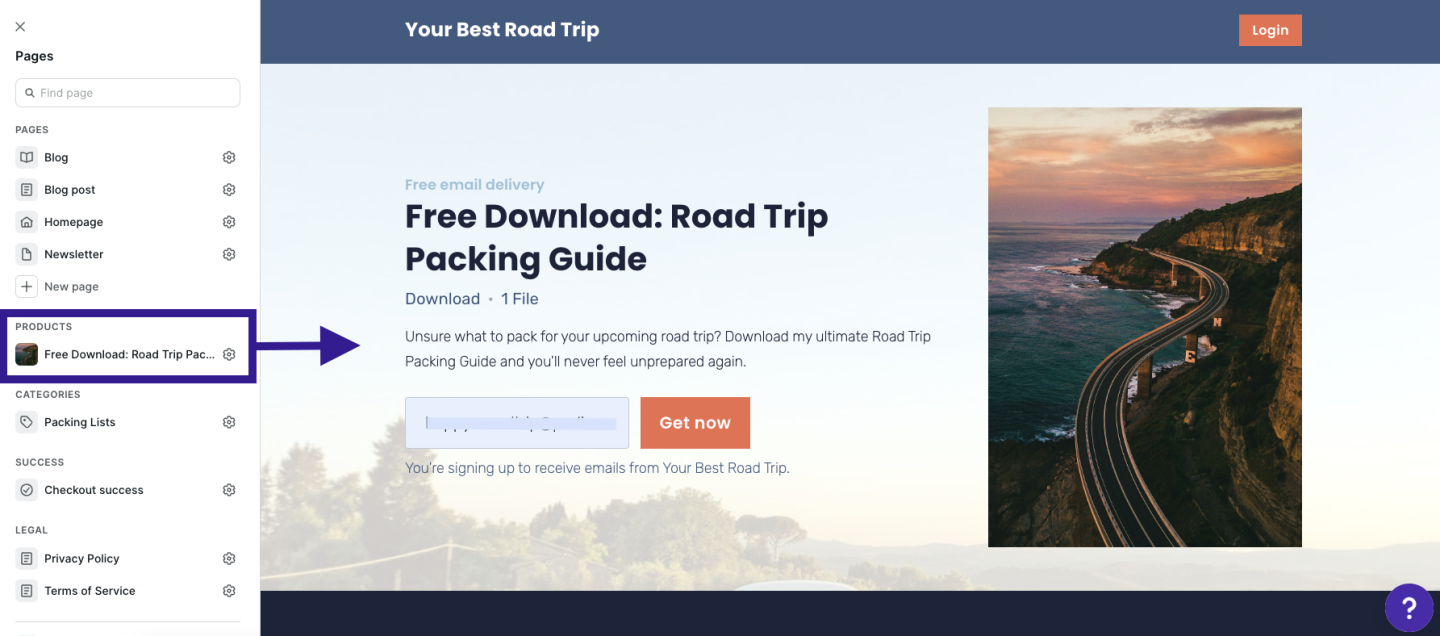
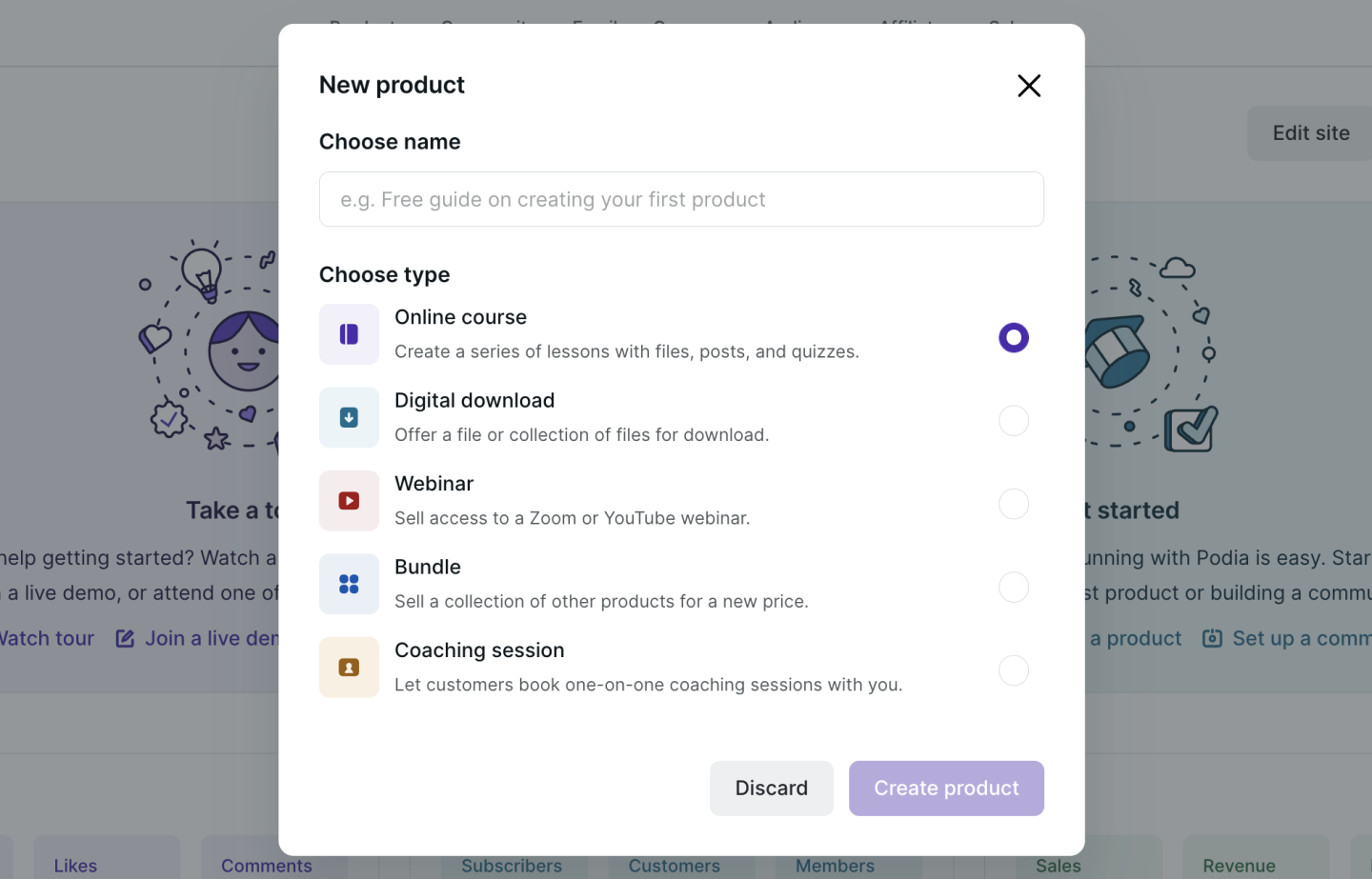
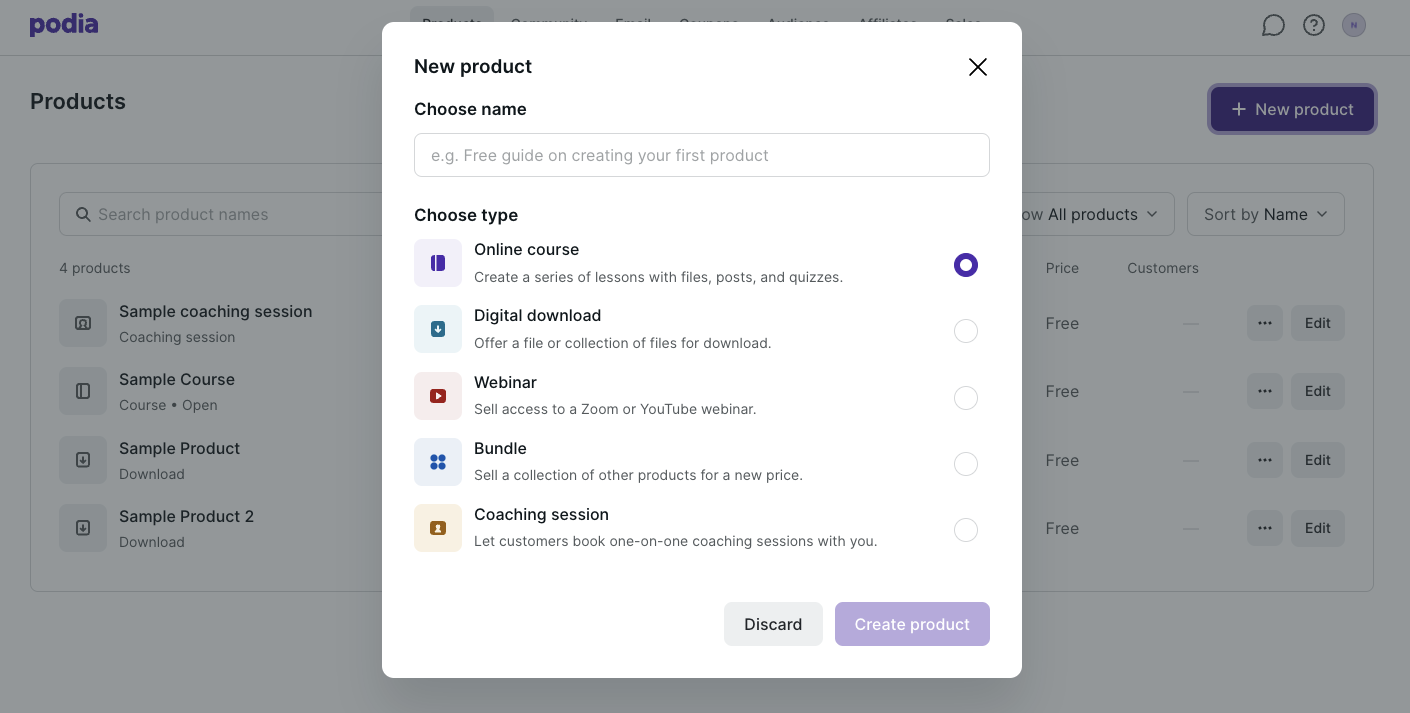
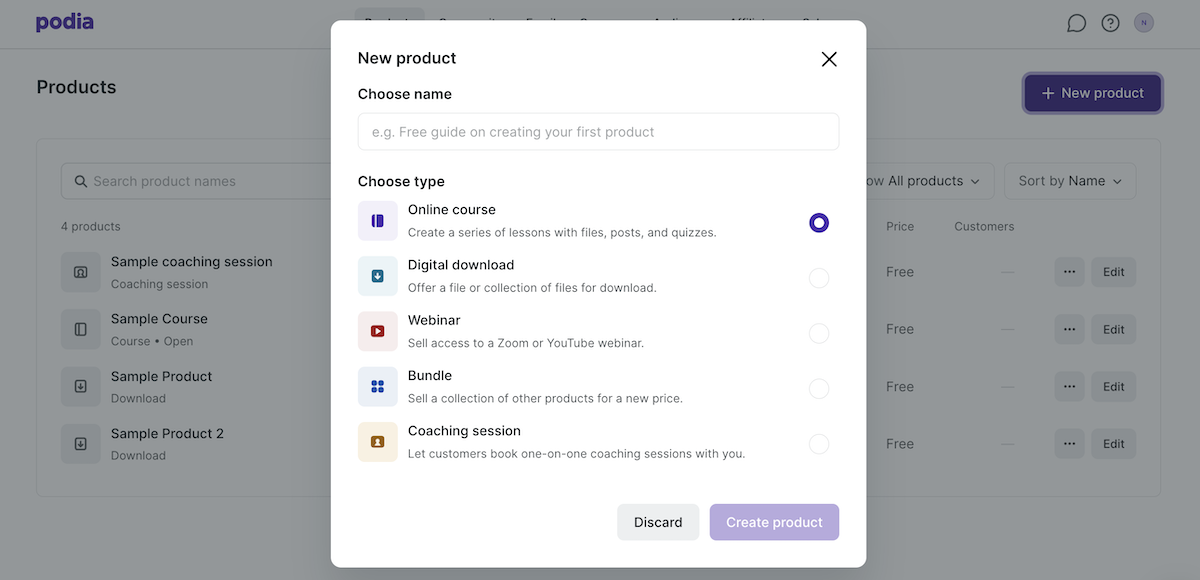
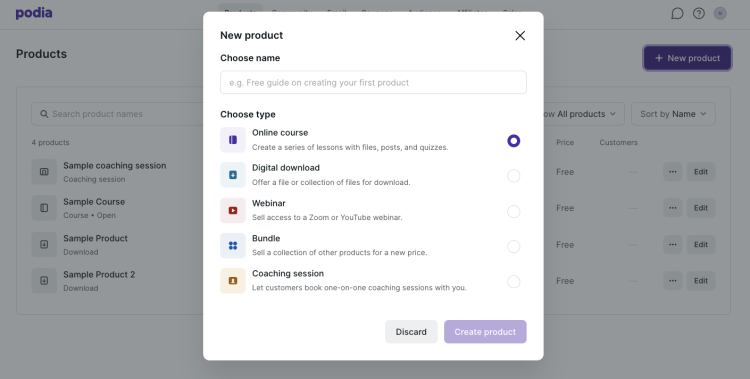
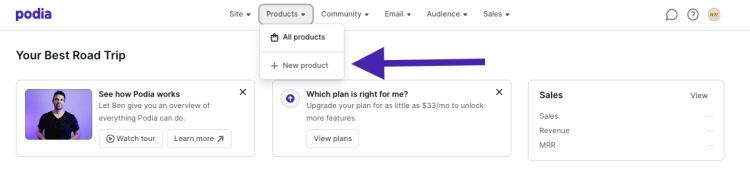
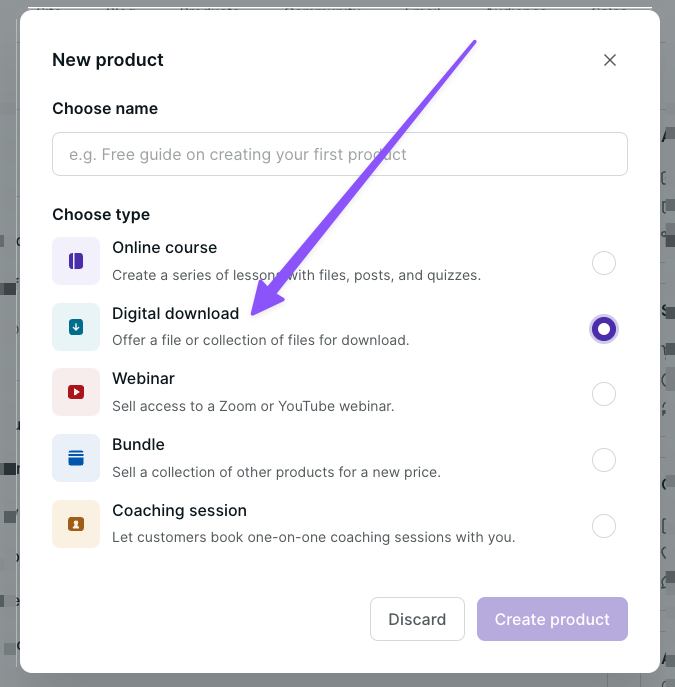
Once you’ve done that, click on Products in the navigation bar of your Podia account and choose ‘New Product’: 
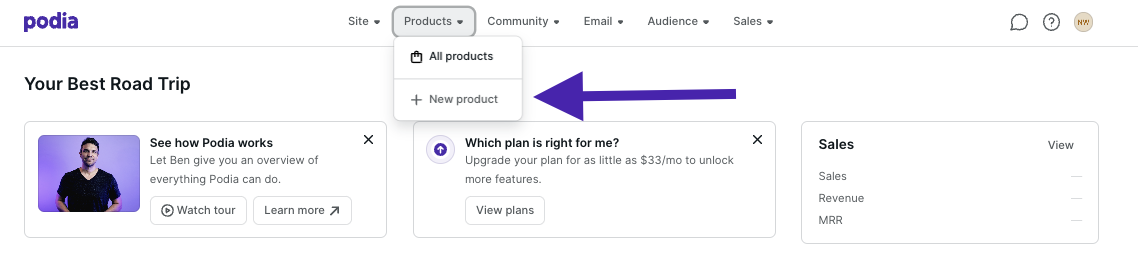
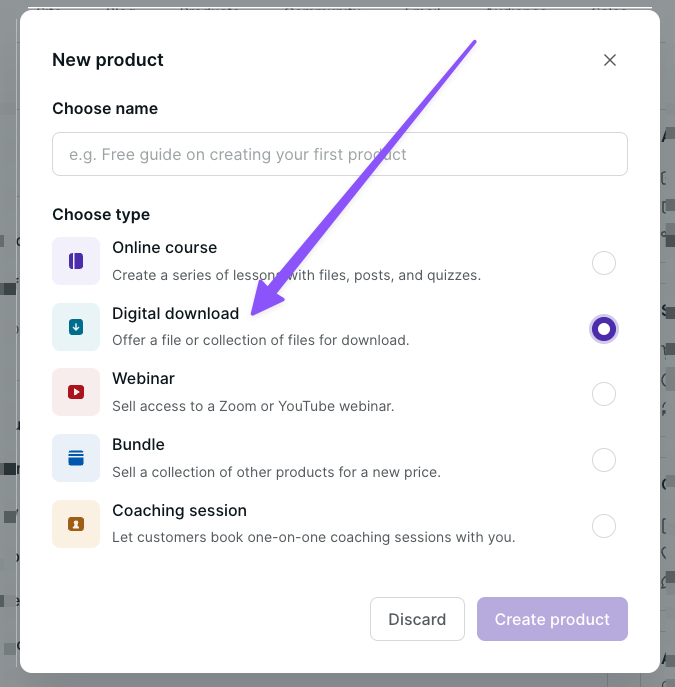
A popup will appear. Here you can enter a name for your lead magnet (you can change it later.) 

Be sure to select ‘Digital Download’ as the product type as this has a ‘Free Email Delivery’ option later on (bear with us!)
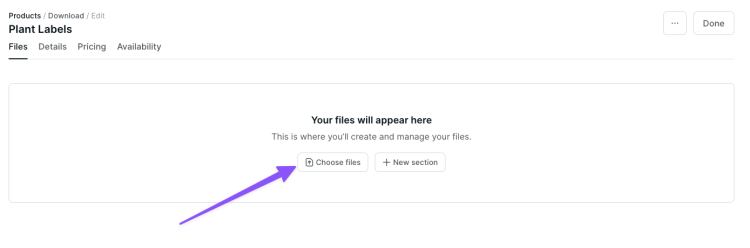
In the digital download editor, you can add files to your digital download product. You can upload as many files as you like. If you upload multiple files, these will be automatically zipped by Podia’s system once they’re downloaded by your customers.
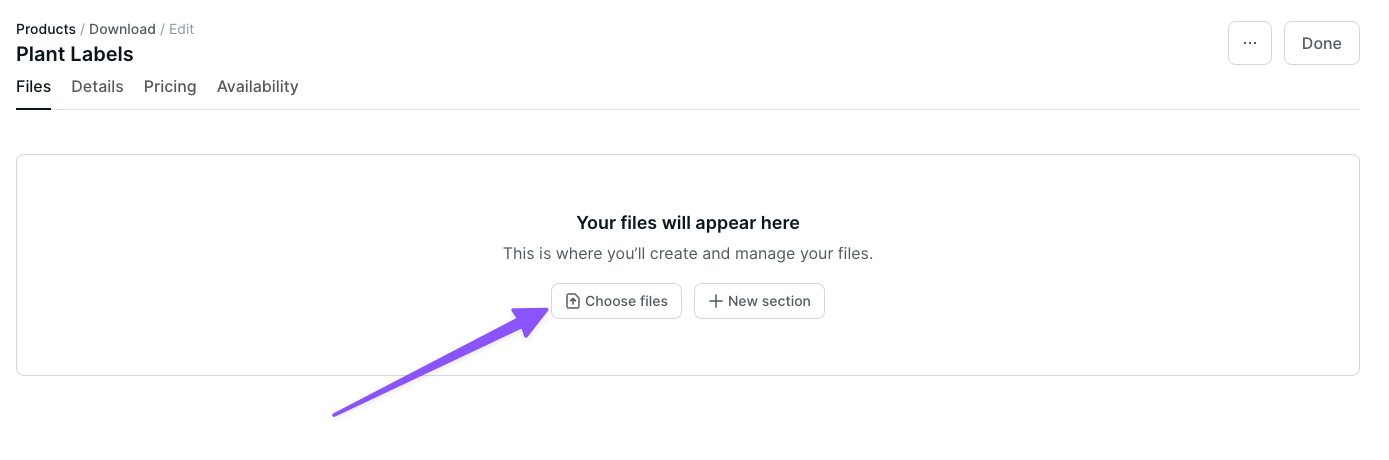
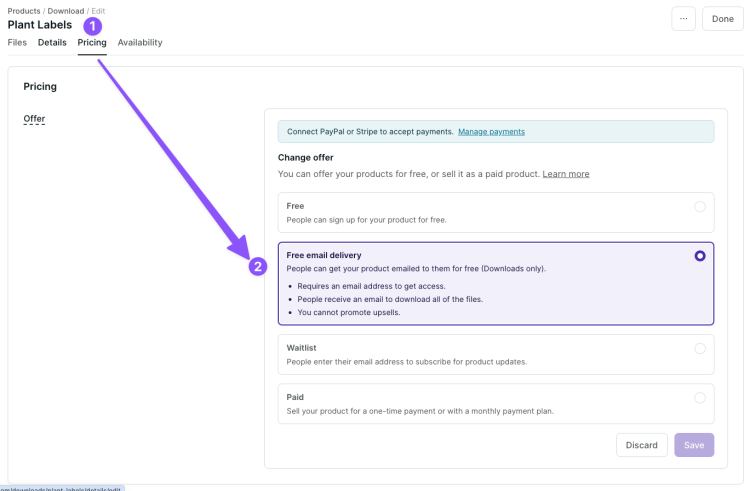
Once your files are uploaded, you need to select Pricing and then choose ‘Free Email Delivery’: 
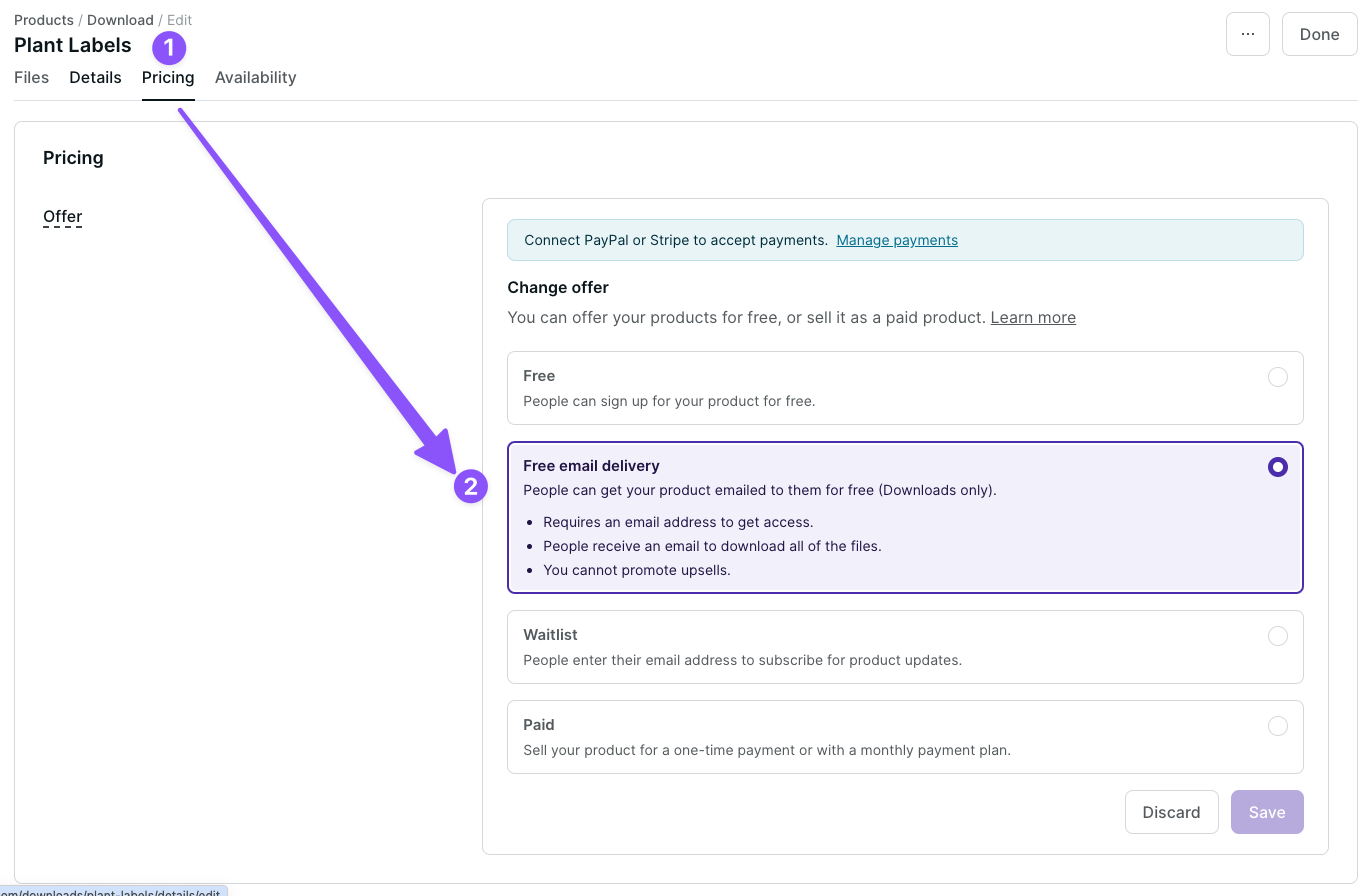
This will ensure customers need to enter their emails to sign up for your lead magnet without needing to create an account. 

When you’re ready, hit publish on your product. 

Designing your lead magnet landing page

Now that you’ve got a lead magnet and a way to deliver it (we’ll do all the work for you!), you’re going to need somewhere to direct people to where they can enter their email. 

MORE GOOD NEWS! 

With your free account on Podia, you get a free website and a really easy place to edit it and make it look exactly how you want it without needing to work with a designer or developer. 

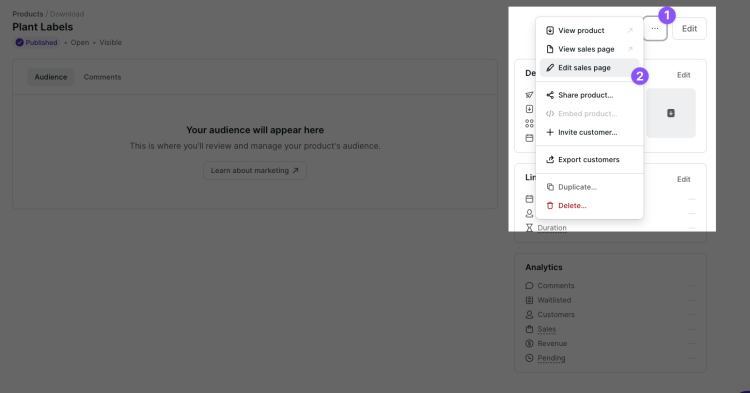
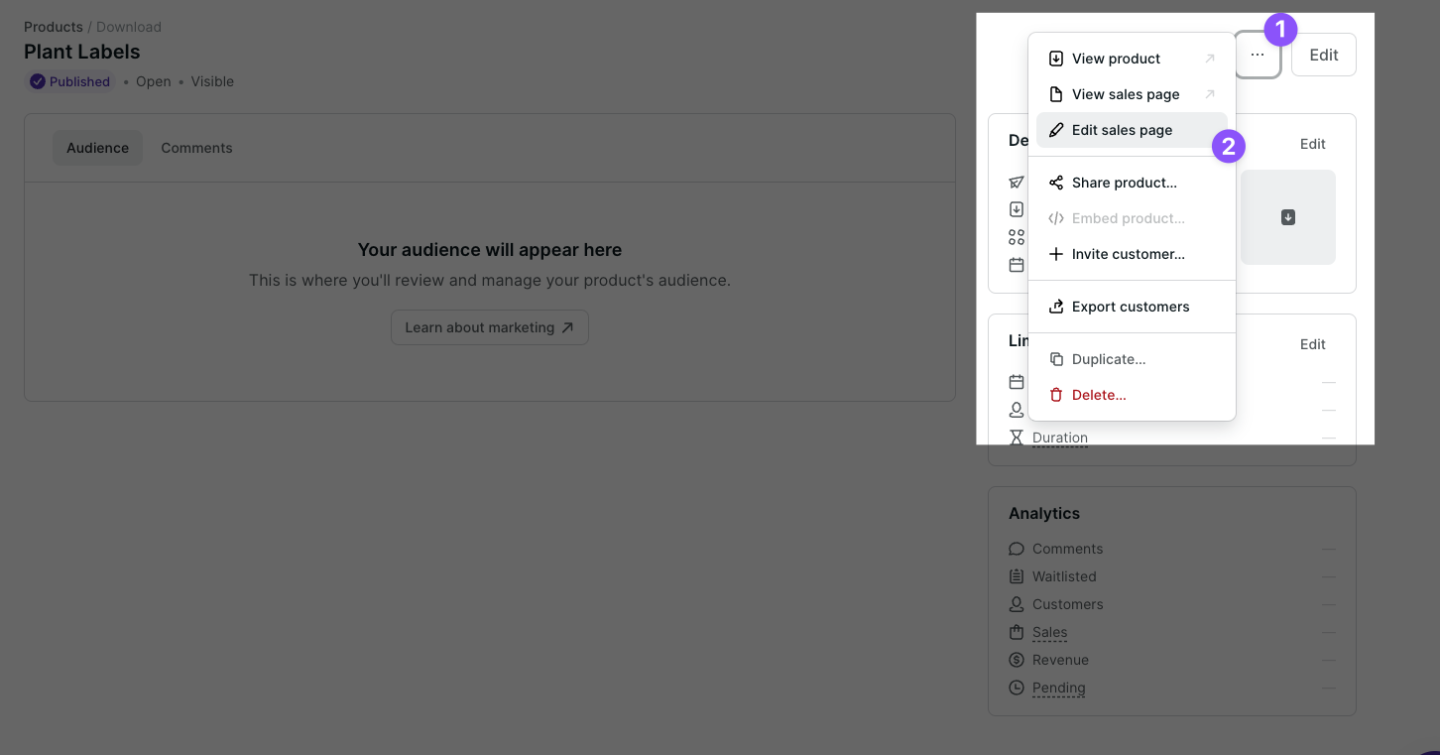
To quickly get to your lead magnet landing page and start designing, click the […] button and then select ‘Edit Sales Page’
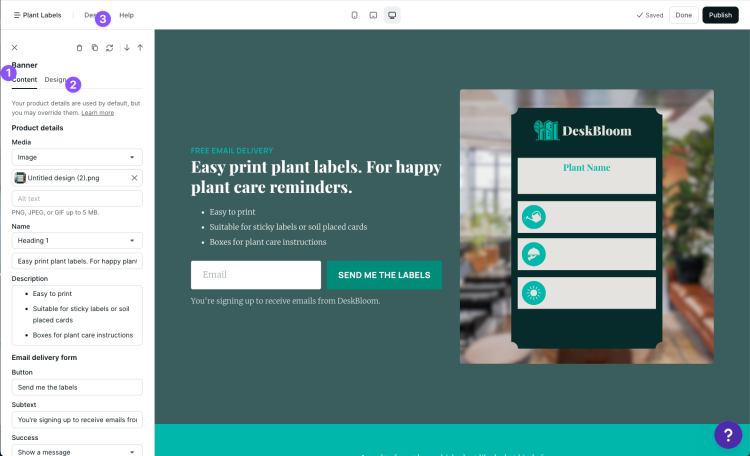
Editing your landing page on Podia is easy. This page took me just two minutes to build: 
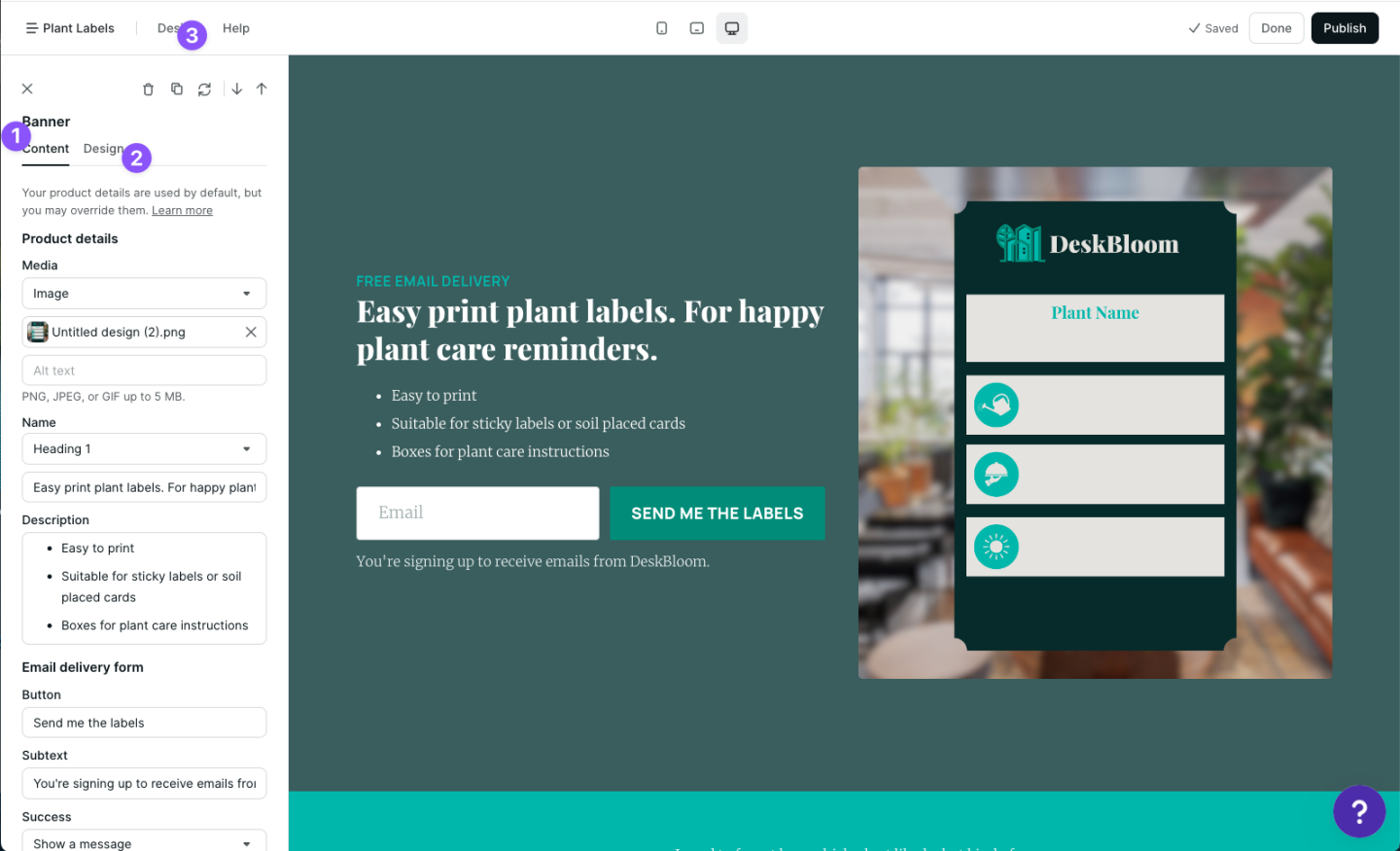
In the example above, I’ve added a few numbers to help you navigate easily: 

  1. On the content tab of each section, you can edit the text, add the images, and generally configure what you want visitors to see

  2. On the design tab, you can choose from a number of different options including a series of predefined layouts, spacing, image styles and select a color palette (or create one that’s custom to this page)

  3. If you don’t love the default design options (although they already look better than other website builder software) you can click the design tab marked by the number 3 on the image above which will allow you to set up fonts, colors, and more for your brand

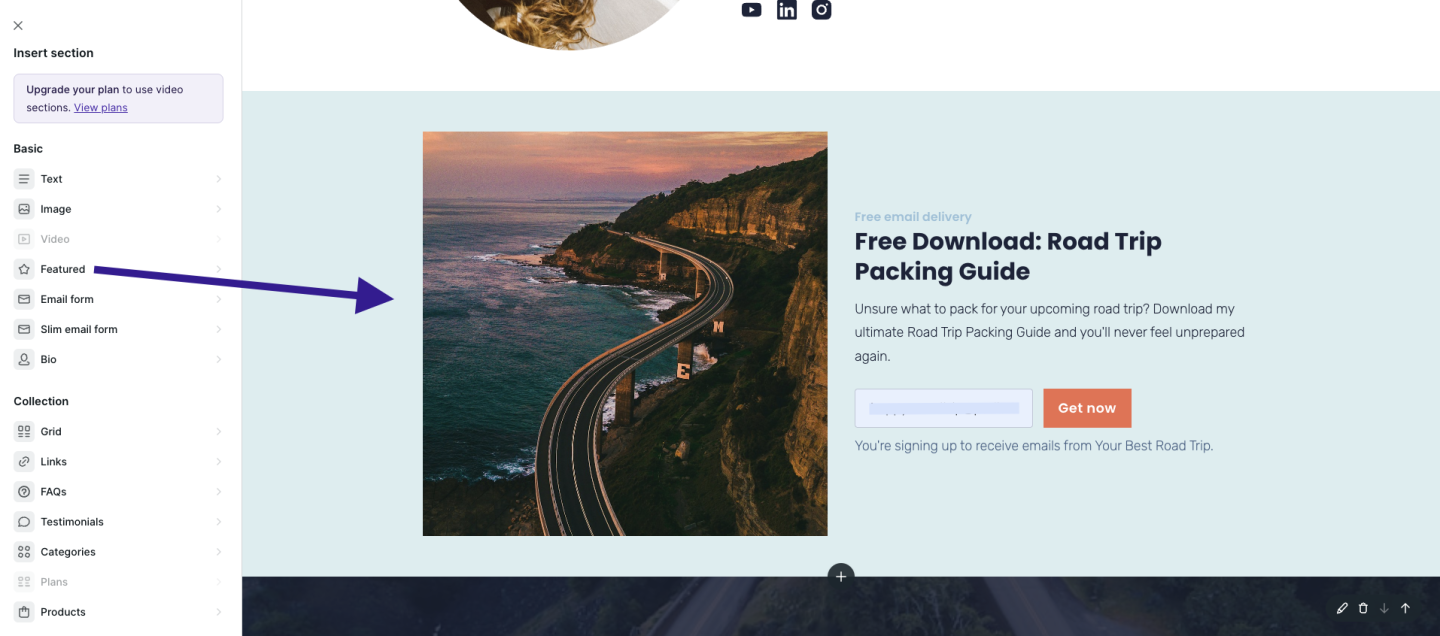
You can also add additional sections by hovering over the designer and clicking the plus button that appears:
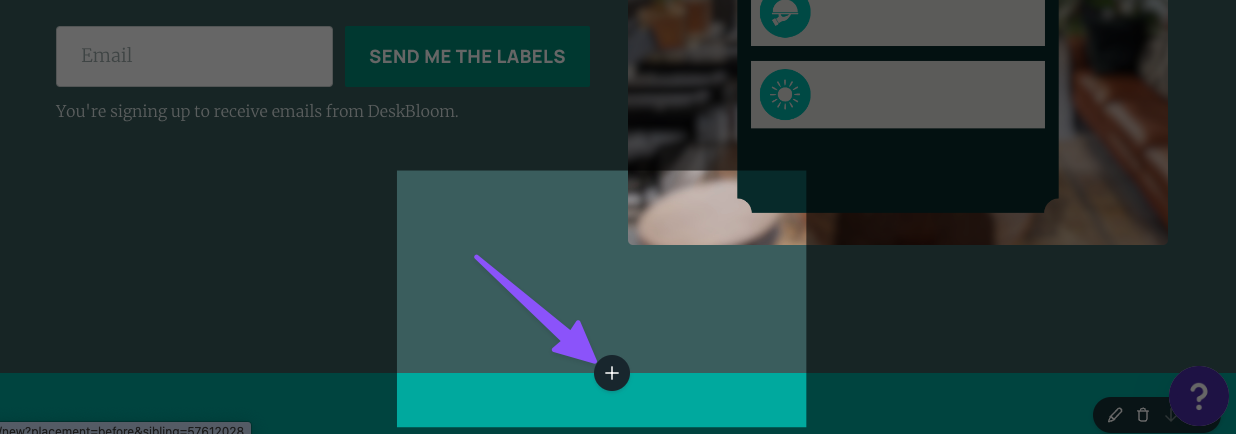
Before you finish designing, you’ll also want to set your page address. All Podia sites come with a free subdomain where you can access your website (e.g. [yoursite].podia.com) but if you want to add your own domain name, you can upgrade to the Starter plan from $4/mo (which is great value!) 

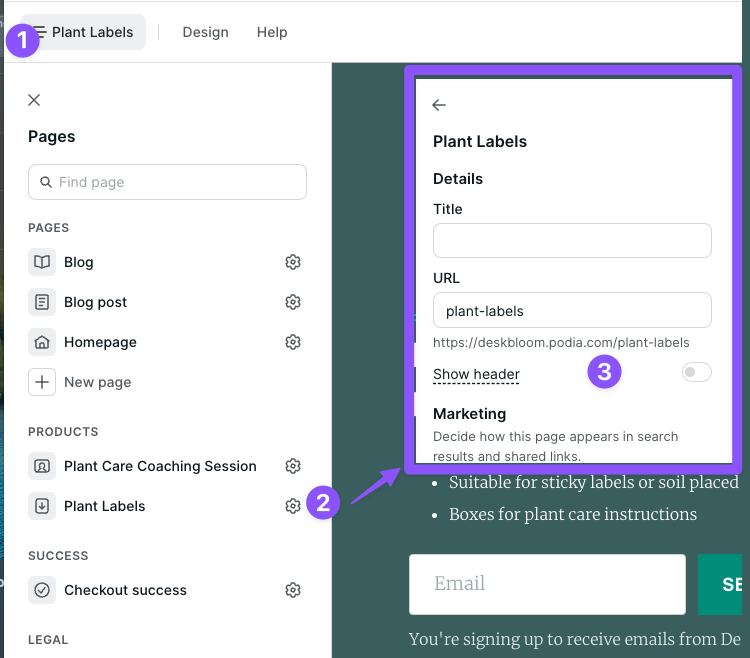
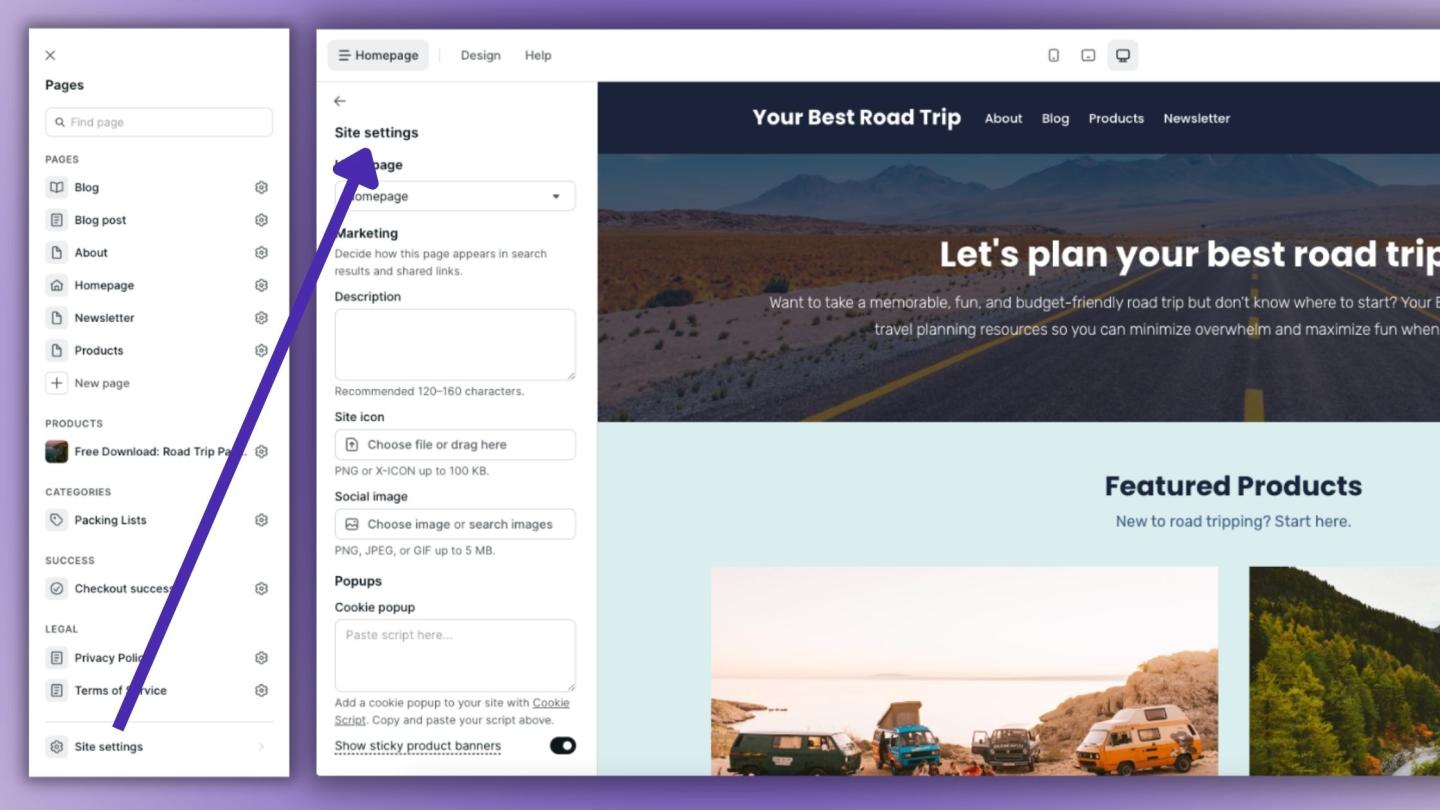
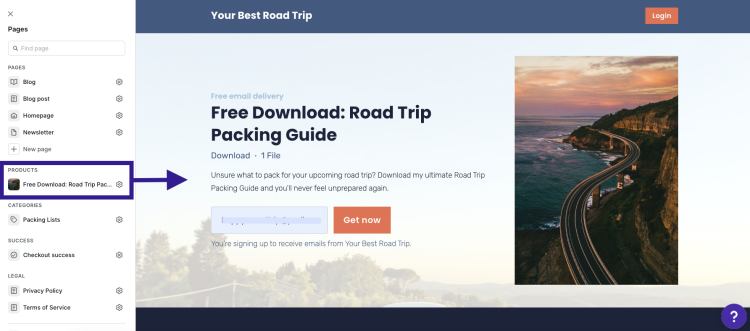
To grab the link to your current landing page, you can click the following things:
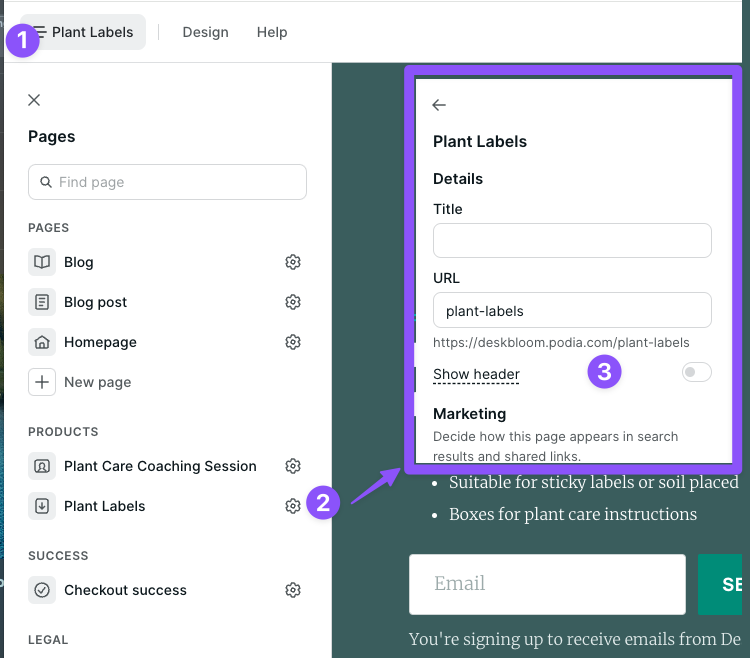
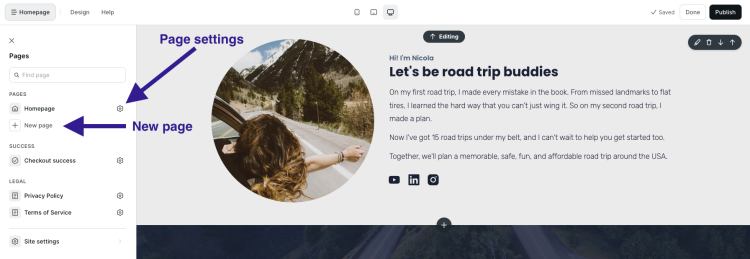
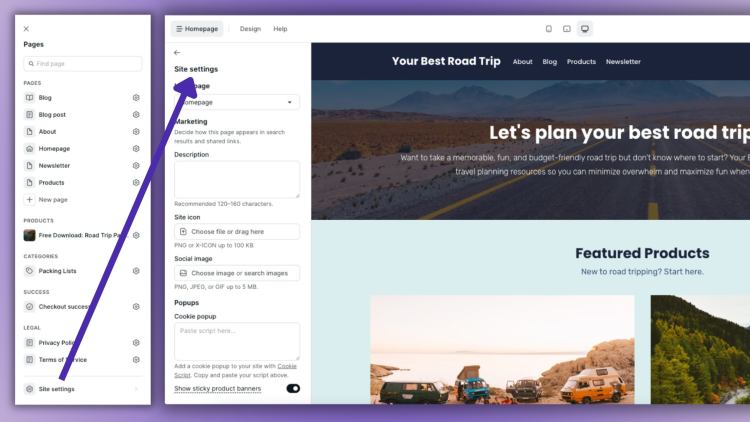
  1. Click the menu in the top left corner of your website builder 

  2. Find the page you’re designing and click the cog symbol next to it (indicated by the number two on the image above) 

  3. The menu will reload to show you the settings of your current page. You can either copy the URL and start sending your audience to it to sign up or you can edit the URL if you want a different name for it (this is called a page slug – I know, gross) 

Tip: some people like to hide the header on landing pages for their lead magnet. If that’s you, you can toggle the header on and off here too. 

What do you do with this URL? 

How do you get people to download your lead magnet?

Besides sharing it at every opportunity possible you can add your lead magnet to your social profiles. On almost every social network, you can add a link to your bio (BTW – you can set up a link in bio page on Podia too!)
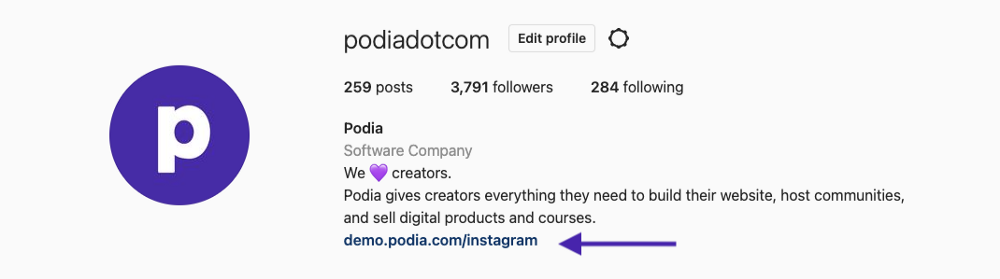
Memberships Podia Instagram Link in Bio

Doing this makes sure that anyone checking out your profile gets an offer of a valuable resource from you. You’ll quickly see the signups racking up.

The other place you can share your lead magnet is as a call to action if you ever appear on a podcast or speak at an event. When the host asks ‘Where can people find you’ just tell them to go download your free resource – it’s a lot more effective than saying ‘Follow me on Instagram’

Step 2 – Add an email newsletter for your subscribers

The goal of setting up a lead magnet is to provide enough value to your audience for free that they’ll give you an email address. 

In 2024, an email address is the most valuable thing an audience member can give you (besides, you know, cash – but we’ll get to that later). If you have an email address, you can use email marketing to continue to own the relationship with your subscribers so that you’re never at risk of losing out when a social network changes its algorithm. 

But how do you stay in touch with your audience members? An email newsletter! 

The beauty of an email newsletter is that it’s kind of like a membership except you can use it as a tool to sell much higher ticket items than a membership – and it’s available to everyone so you’ll never have to prioritize creating for a tiny segment of your audience. 

With your free Podia account, you can have 100 subscribers for free which is enough to start making some money in the next step. 

Every person who downloads your lead magnet automatically gets added to your Podia account and you can send them email marketing.
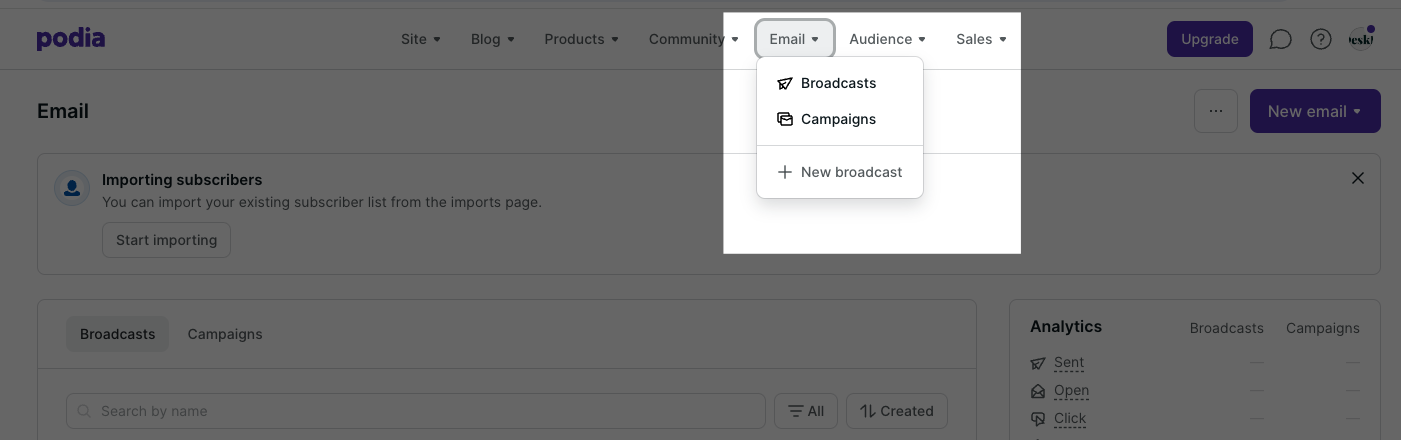
There are two kinds of email you can send with Podia: 

  1. Broadcasts – one-off emails that are used for things like regular newsletter updates or time-limited offers

  2. Campaigns – automated sequences of emails that you can trigger when a subscriber takes a specific action like buying a product or getting added to your audience for the first time 

If you’re following along with this, we’d recommend you start by trying to send a regular newsletter where you share some of your expertise. 

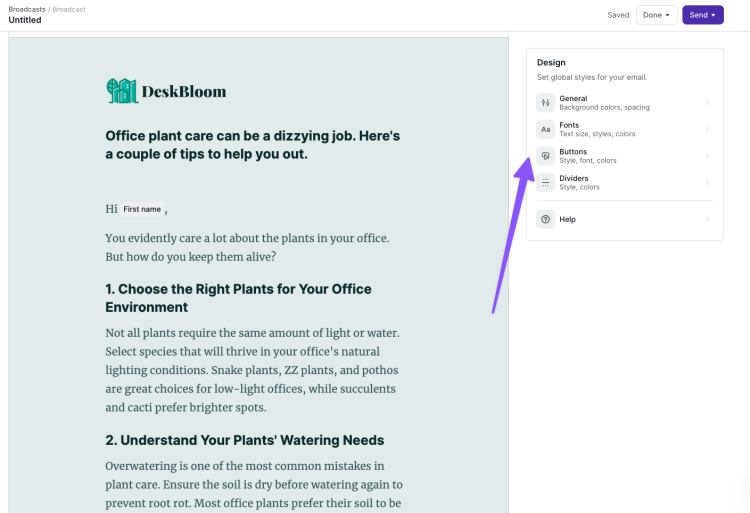
It’s extremely easy to build a beautiful looking email on Podia and it works in a similar way to the website builder. 

Here’s an example that I made earlier: 
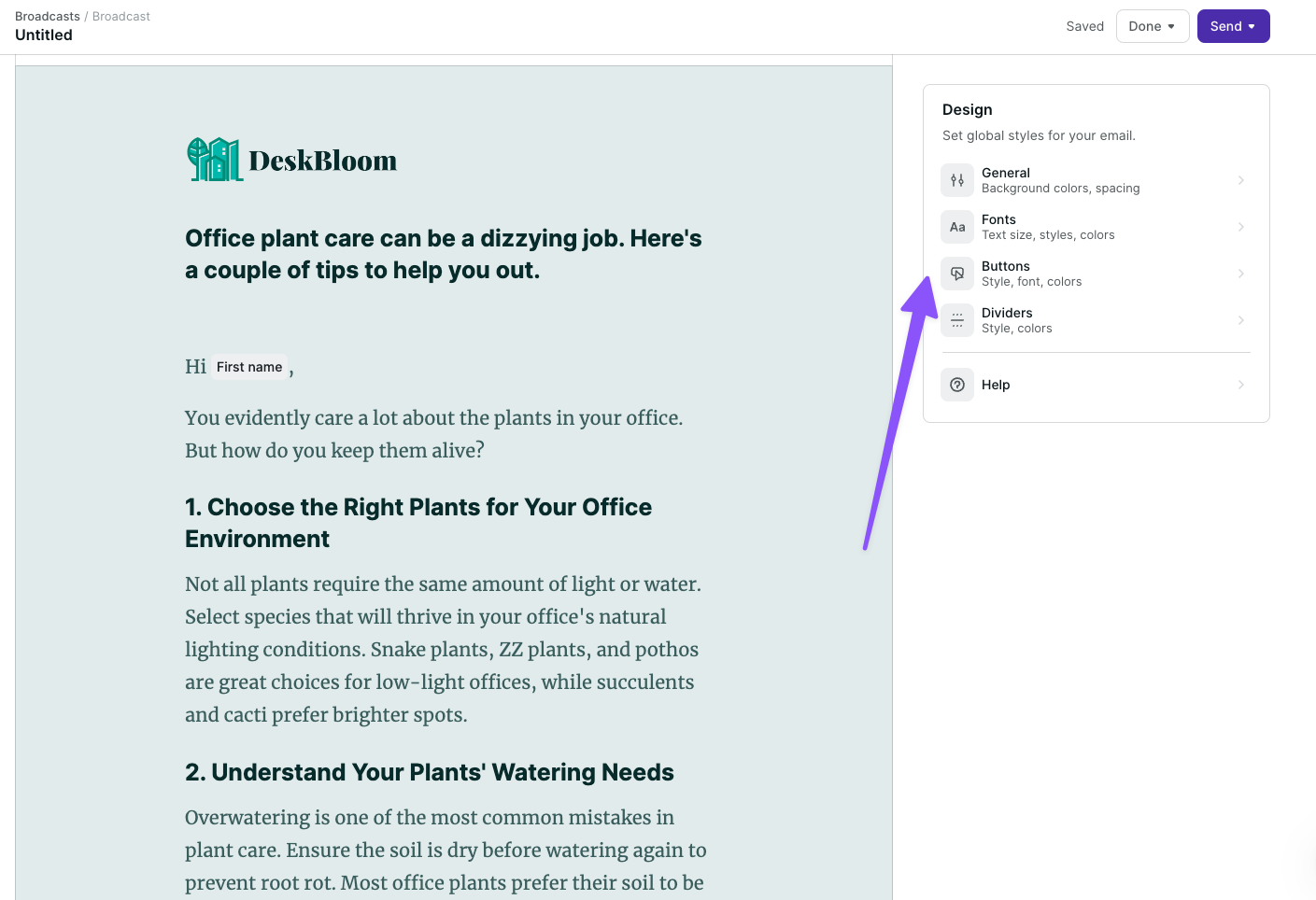
Tip: If you’re not feeling like designing your own, you can choose one of the many pre-made templates available in your Podia account and adjust it to your needs (or send it at is) 

Here’s a few email topics that you could try out: 

  • 5 tips to help you get better at [your topic] 

  • A story of how I [achieved the outcome your subscribers want] 

  • Quick guide to [specific task your subscriber needs to do] 

Don’t overthink it at this stage. The goal is simply to remain in contact with your audience so that at a later date (pretty soon hopefully) you can tell them about the paid product you just launched – which is where you start making the real money. 

Set and forget: use a new subscriber campaign to quickly engage your audience

A campaign to welcome new subscribers – the people who downloaded your lead magnet – is a great way to engage them and give them a taste of what’s to come. 

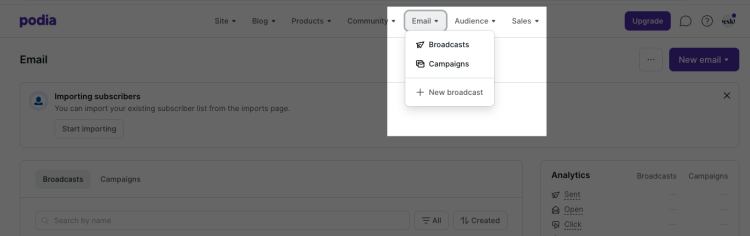
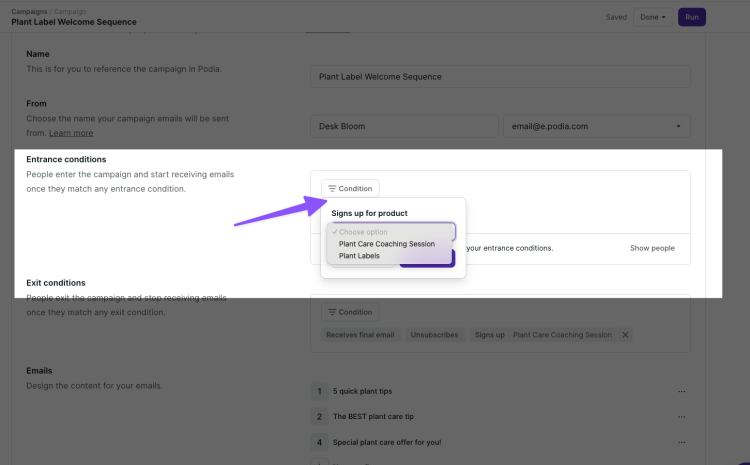
To do that, just hover over ‘Email’ in your navigation bar on Podia and select ‘Campaigns’. Then create a new campaign and set the entrance condition to ‘Signs up for Product’ and select the name of the Lead Magnet you made.
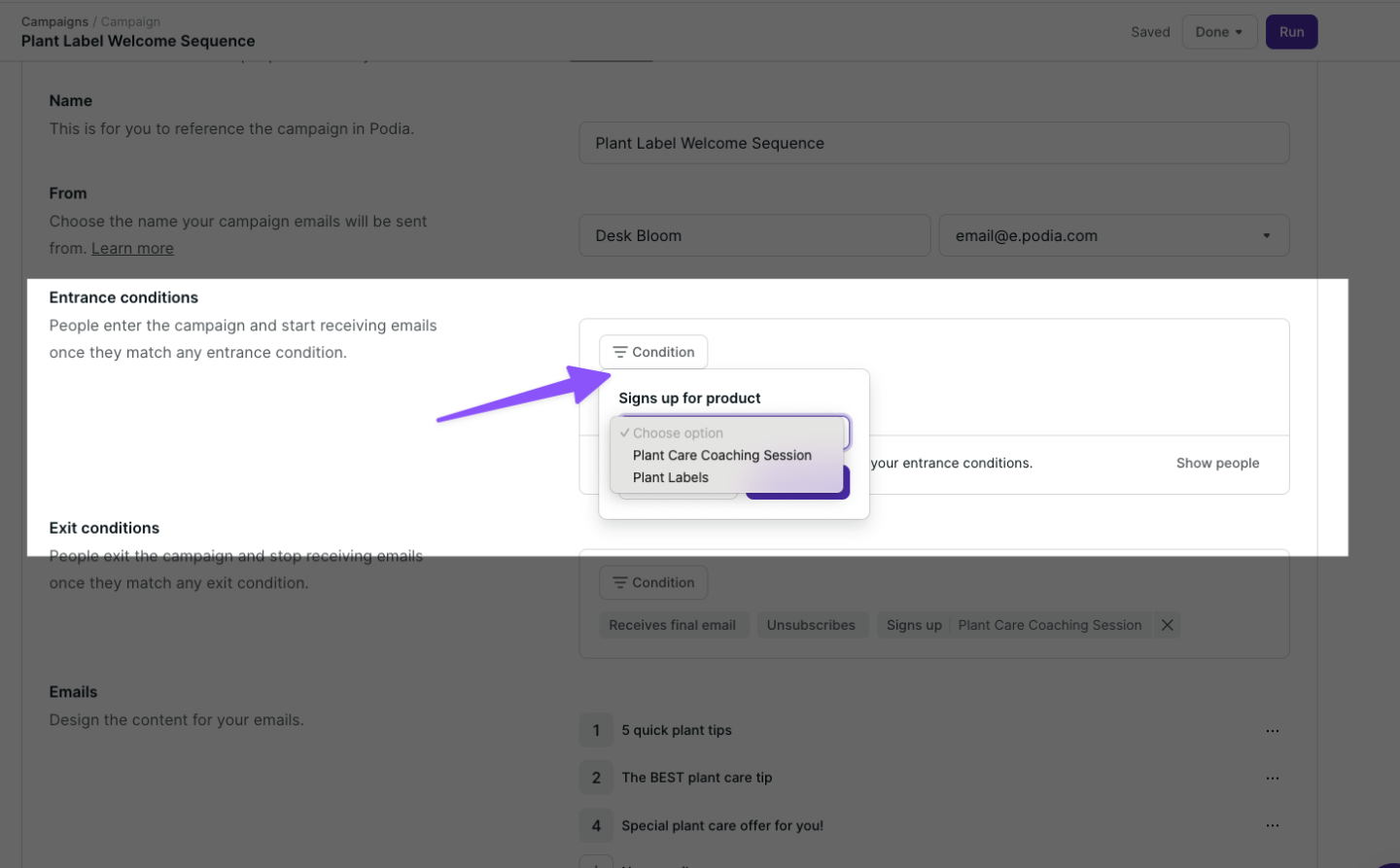
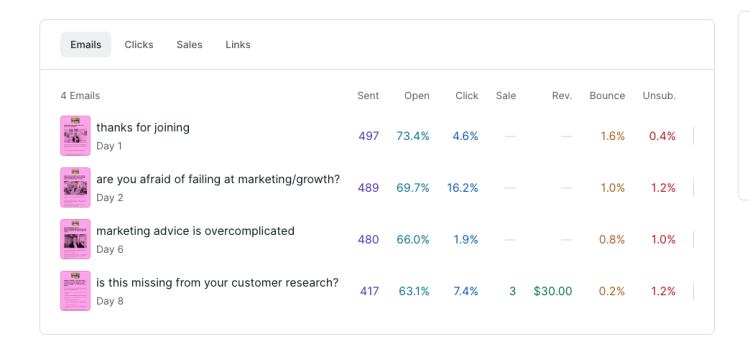
Then you can add a series of emails that send over time to welcome your new signups. Here’s the lead magnet welcome sequence I have set up for my personal side-project:
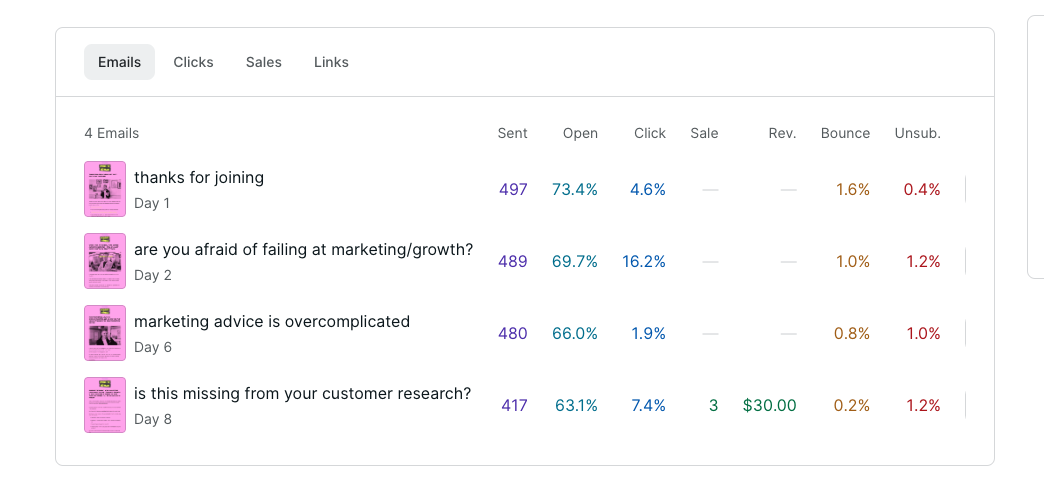
On day 1, I welcome them to my newsletter and tell them a bit of my story. On day 2, I dive a lot deeper into the topic I talk about. Day 6 is where I present them with a world view that I hold, that they might find surprising. Day 8 is where I offer them a product and start making money. 

And on that note, let’s move on to the key piece of this whole framework: MAKING MONEY! 

Step 3 – Launch a paid product

So far, we’ve created a lead magnet to help us convert strangers to subscribers and an email newsletter to help us build trust – now we need a way to turn this into sufficient revenue that you don’t feel the need to build a membership which is going to drain all your energy and time from you. 

How do we do that? 

We launch a product that’s related to the problem solved by our lead magnet! 

With your free Podia account, you can launch 1 product (that’s been covered off by the lead magnet you set up) so you have two options: 

  • You can either launch a coaching session – our free plan allows you to launch 1 of those too

  • Or you can create another product and upgrade to our Mover or Shaker plan when you’re ready to launch (both plans include unlimited courses, downloads, and coaching sessions) 
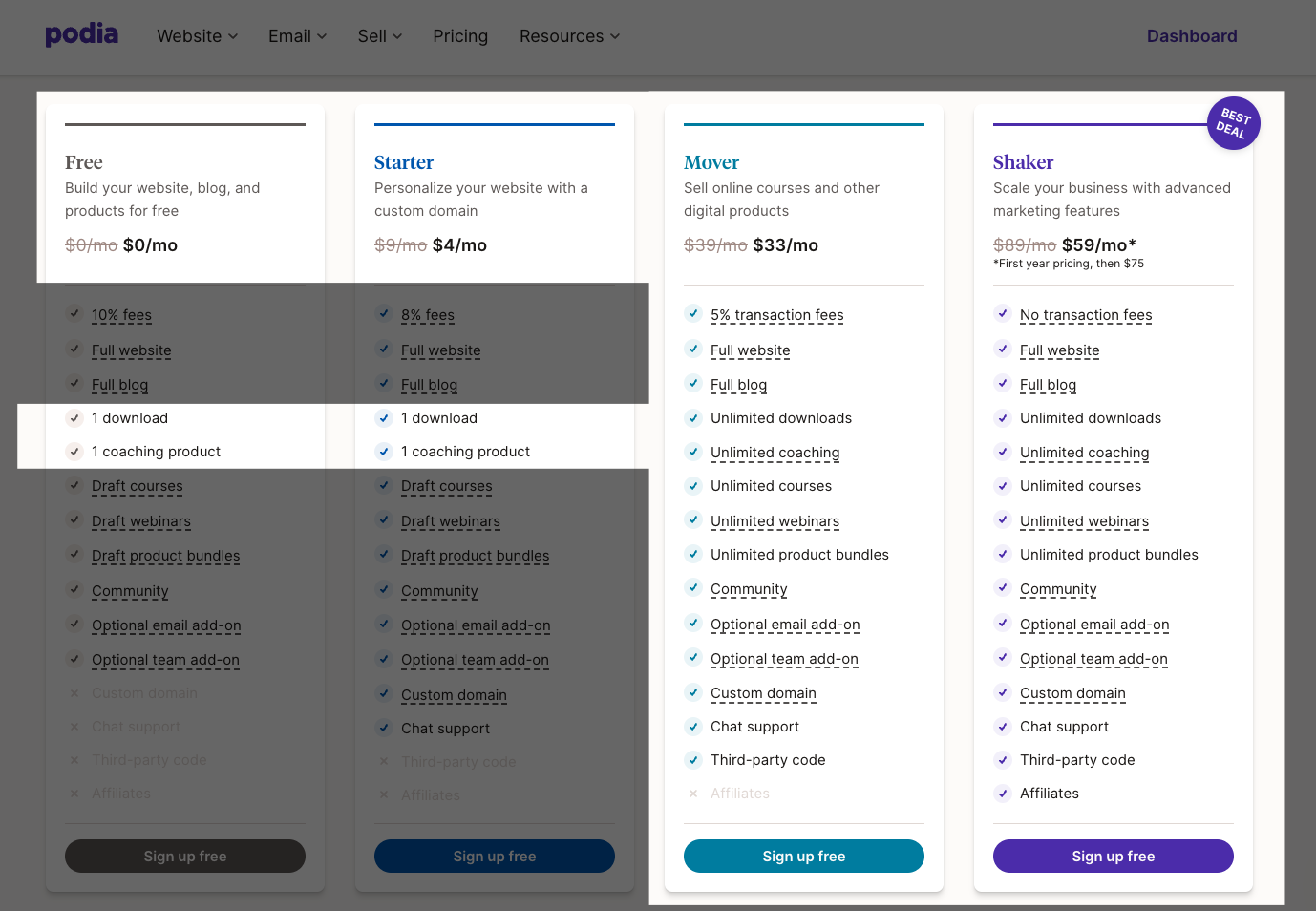
We’ll walk you through both here so you can make the choice for yourself: 

Set up a coaching session

Once you have built trust with your audience, offering a coaching session can be a very effective way of converting the effort you’ve put into your content into sales. 

For example, when I showed you the lead magnet I set up earlier, you’ll have noticed that it was for my fictional business DeskBloom which specializes in helping office managers create green environments in their offices. 

My lead magnet was a downloadable of ‘Plant Care Labels’ which help them know when to water, what conditions the plants like and recall the names of each plant. 

Then my email sequence was geared towards simple plant care tips that they could use to improve their offices. 

For my coaching session, I’ll set up a simple coaching session where my subscribers can pay me for a 15-minute call where they use their camera phones to show me around their plants and I offer them advice. 

Let’s dive in.

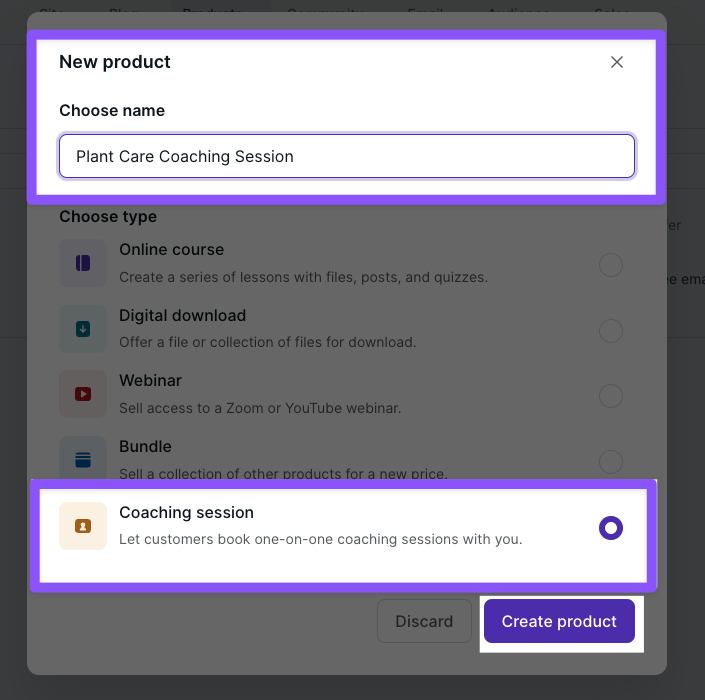
I start by creating a new product in the same way I did earlier except this time I’ll choose ‘Coaching Session’:
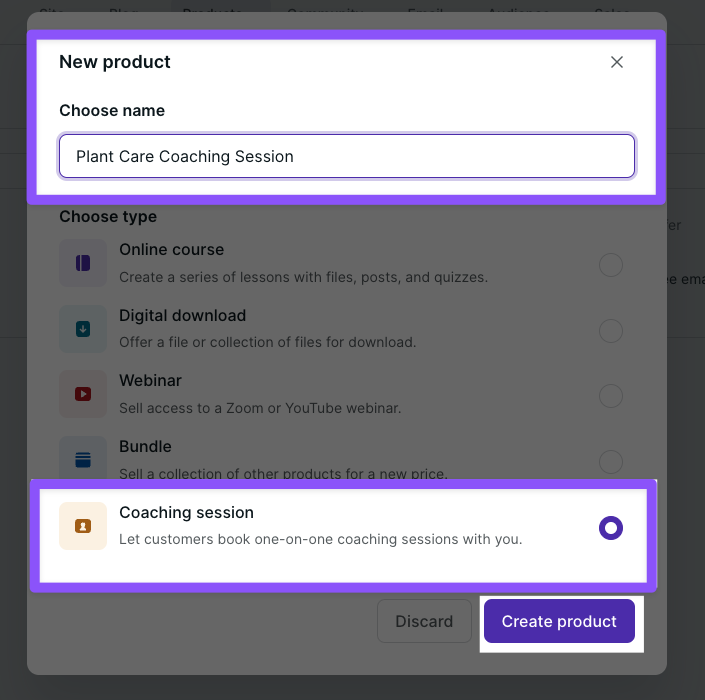
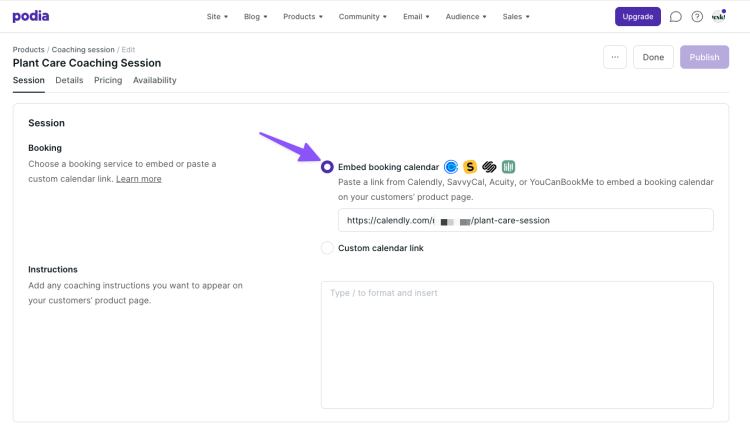
The setup of a coaching course is slightly different to other products because you actually paste a link from Calendly, SavvyCal, Acuity, or YouCanBookMe to embed a booking calendar on your customers’ product page. 

Here’s how it looks with my calendar link in it: 
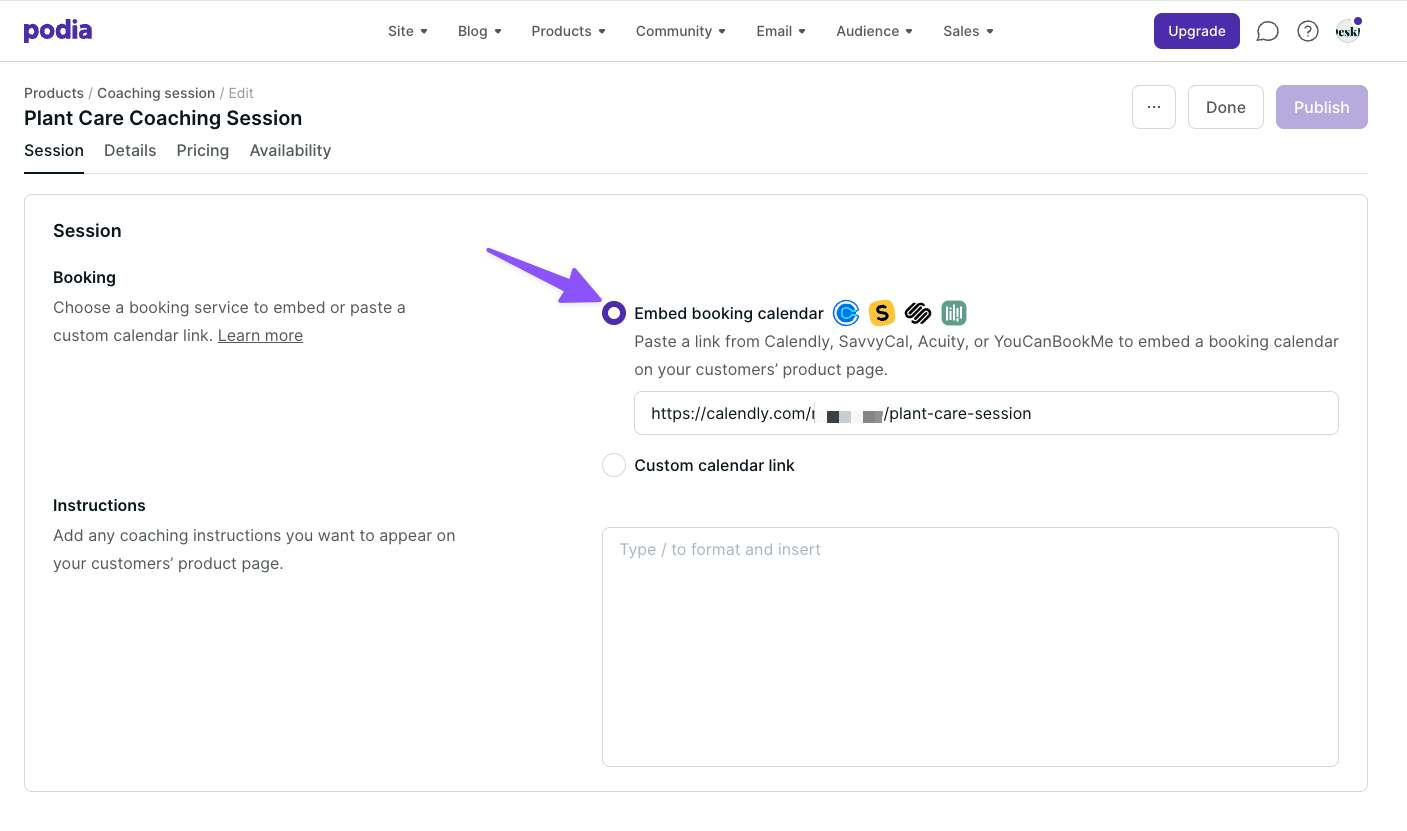
I can set my pricing and then publish. This is the moment where I can design the landing page but as we’ve already done that above and it’s the exact same process, I’ll skip it here. 

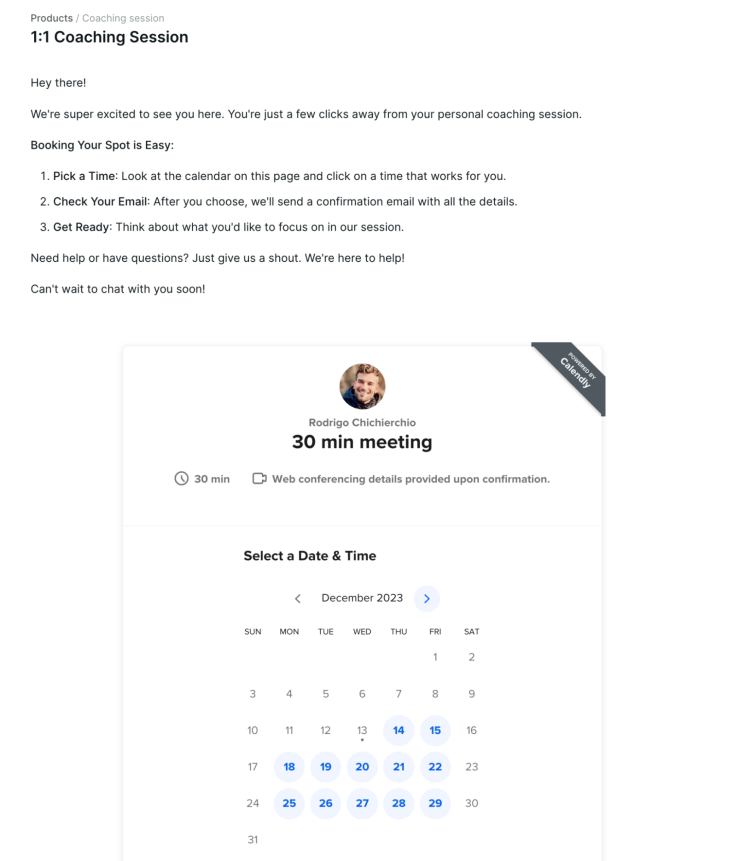
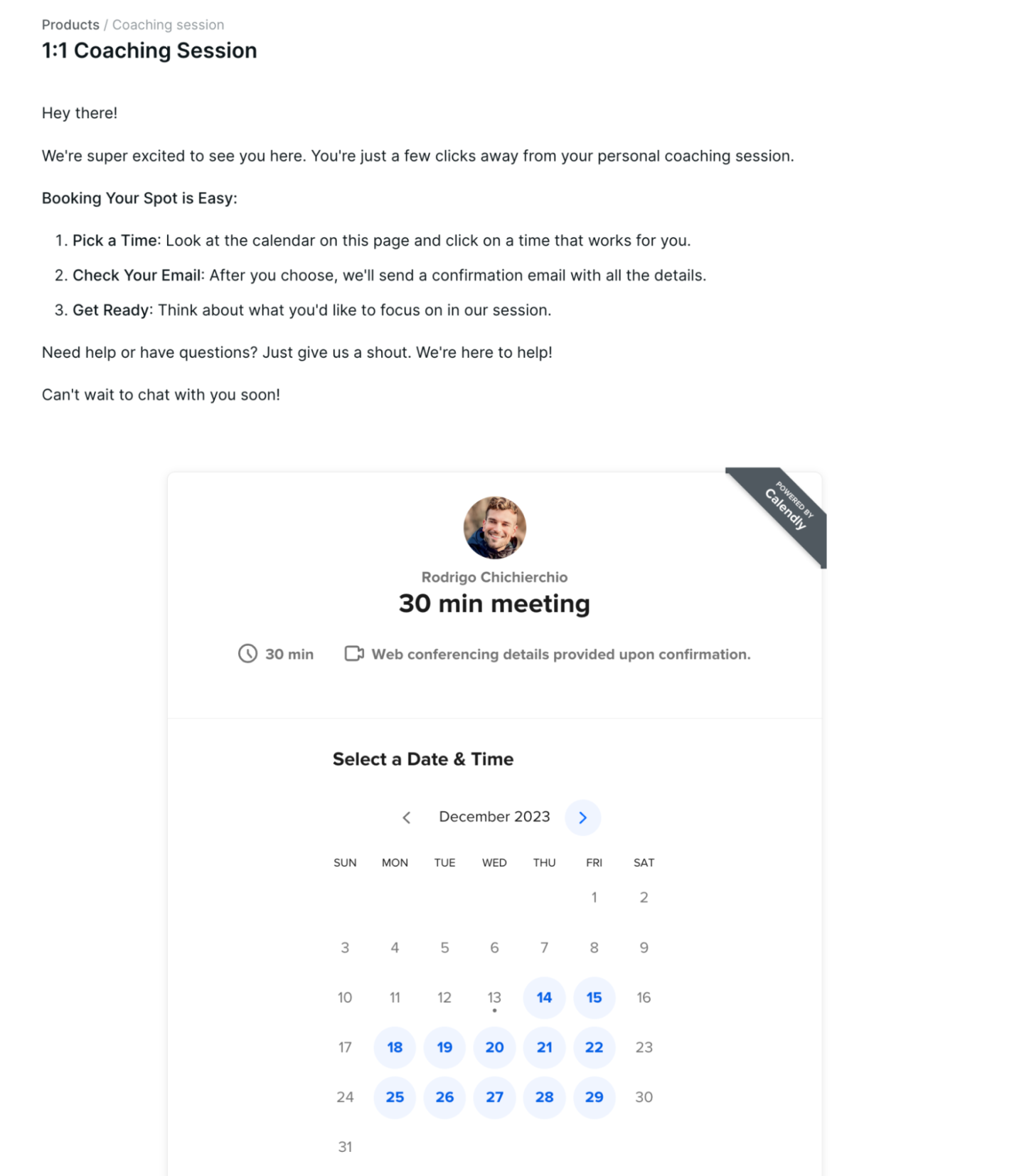
Once your subscribers have bought your product, they’ll be taken to the customer only area where they’ll see your calendar widget embedded. Here’s my colleague Rodrigo’s page as an example: 
Tip: Not only is selling a coaching course a great way to get paid for providing value but it’s also a brilliant way to build more trust which can turn into your customers recommending you to others. You can also take the insights you gather from speaking to your customers and use them to create more content as part of your flywheel.

Set up another downloadable or course 

If 1:1 facetime isn’t your thing or you just don’t want to do coaching sessions, there are many other kinds of products you could sell as your first paid offer. 

The most successful people tend to start out with a downloadable that builds on the thing that their lead magnet helped their subscribers get done. 

Some good examples of downloadables: 

  • Template packs

  • Planner documents 

  • Project plans

  • Technical files 

  • Short ebooks 

Any of these could work for you and you’re not limited to them either. 

Setting up a course is another option but remember that this takes time and a lot of people get hung up on getting the content perfect. 

Creating a course is easy in Podia. You just choose ‘Online Course’ from the new product menu in the same way we’ve outlined above. 

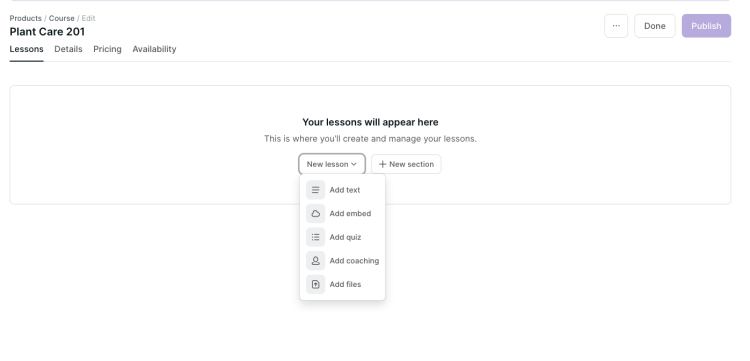
From there you can set up your course by adding Sections (like modules) and Lessons which could be text, embeds, quizzes, coaching sessions, or files. 
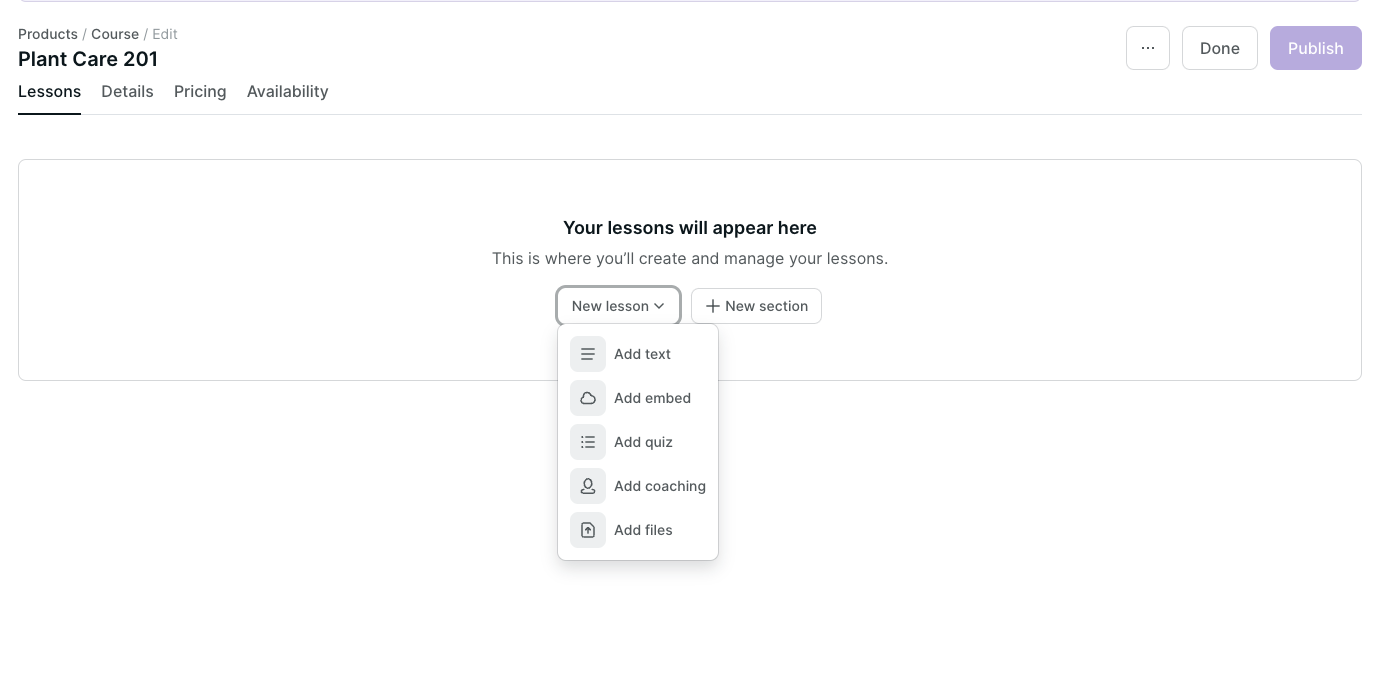
You won’t be able to publish your course or your second product until you’ve chosen a Mover or Shaker plan but you can get everything ready and then upgrade. 

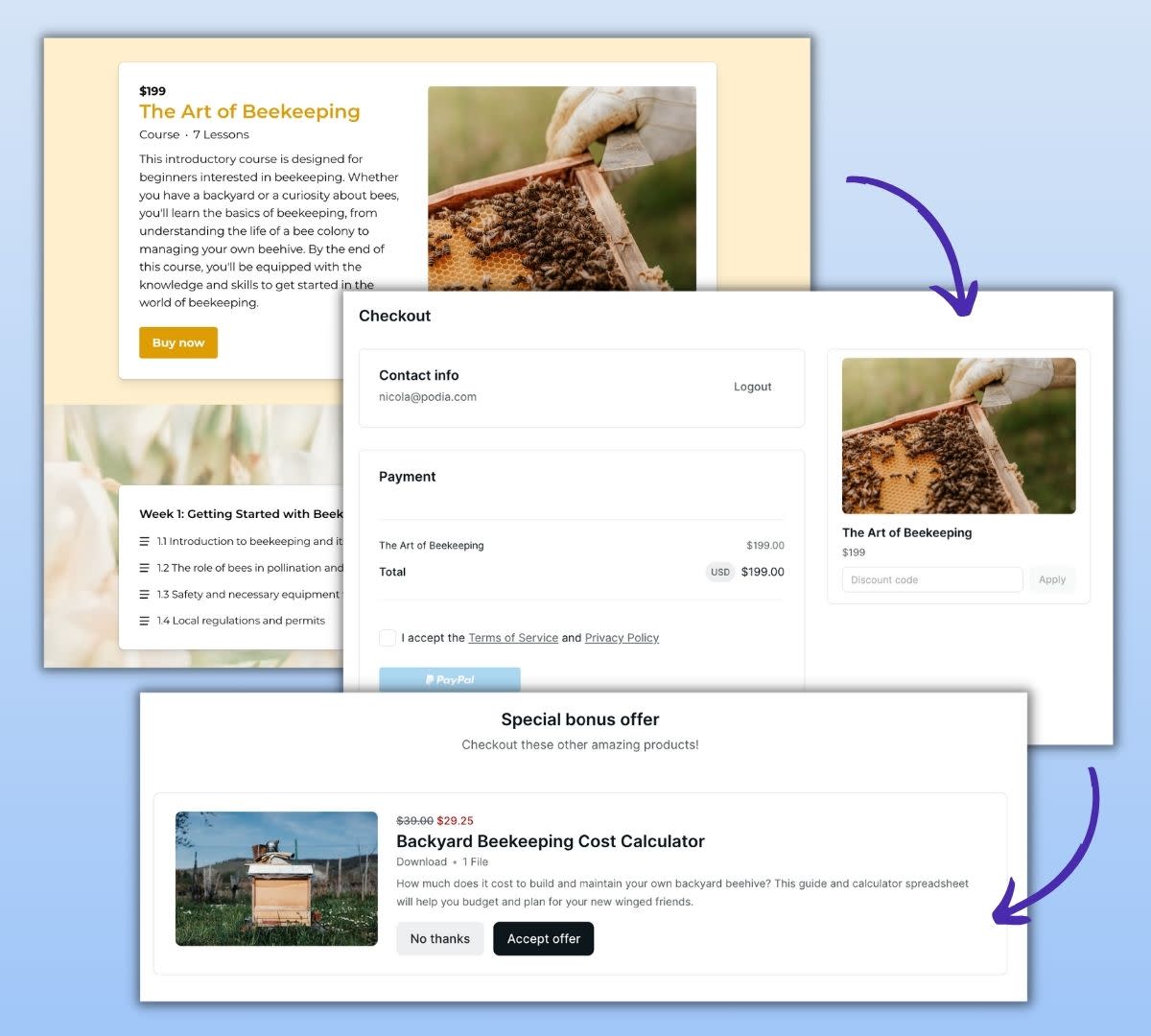
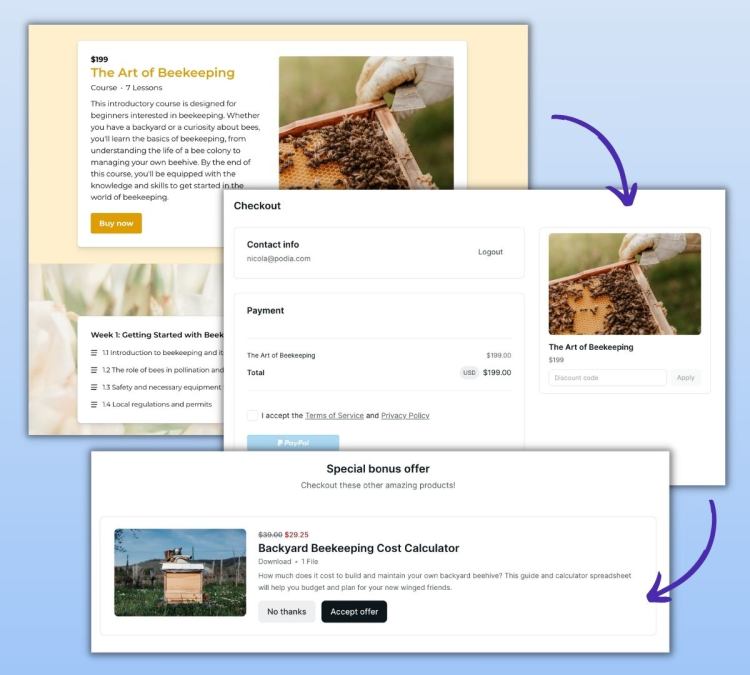
Tip: With Podia you can also offer upsells of additional products at your checkout. This is a great way to increase your revenue with no extra effort. 

Step 4 – Add blog content to your website

We’re really rolling now. So far you’ve got: 

  1. A lead magnet – A way to encourage your audience to give you their email address

  2. An email newsletter and automated welcome campaign – to build trust with your subscribers

  3. A paid product – that you can use to turn that trust into cash 

But what’s missing? A way to get more and more people to discover you without you needing to create content all the time. 

The simplest of all marketing strategies is to create a few pieces of content that help people who are looking for solutions to specific problems that you could solve for them with the things in steps 1,2 and 3 of this process. 

With your free Podia site, you also get a free SEO-optimized blog that looks great out of the box and you can manage without fussing with plugins or themes. 

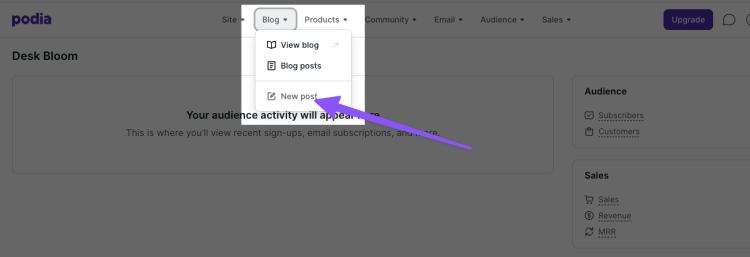
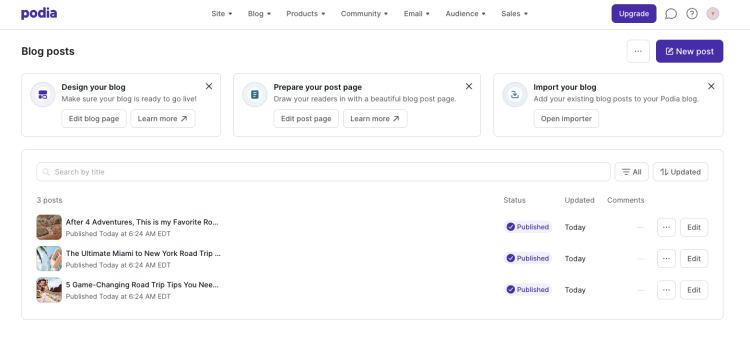
To get started with setting up your blog, simply click ‘Blog’ in the navigation of your Podia account and then choose ‘New Post’ from the drop down menu: 
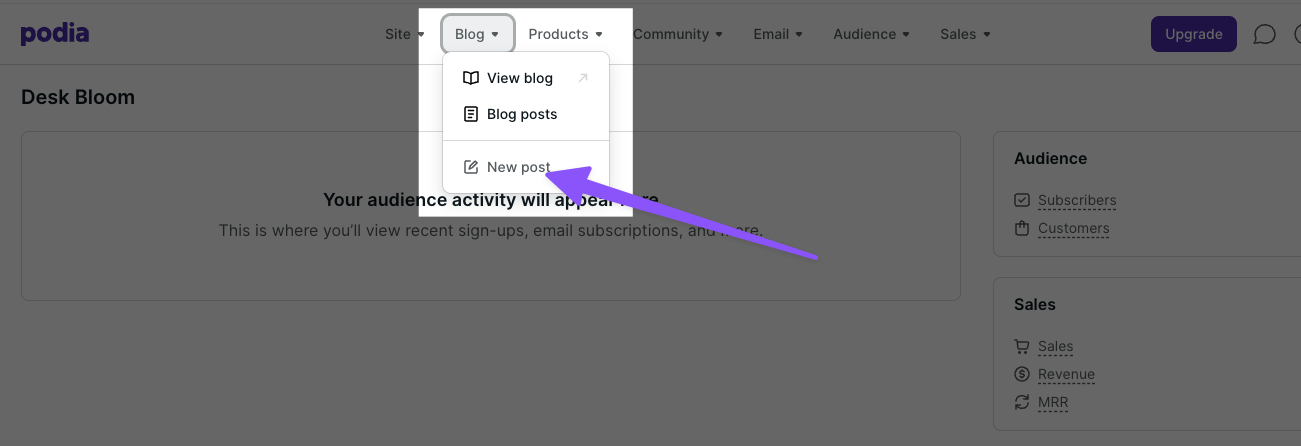
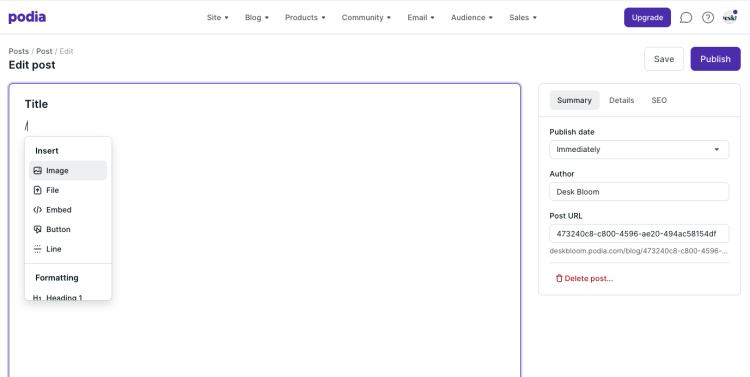
You’ll notice how simple the New Post page looks when it loads. You can write your content in the big box on the left hand side. 

To add an image, file, embed, button, line or to manage the text formatting options, you can just type ‘/’ on a new line and you’ll be offered a menu of those choices: 
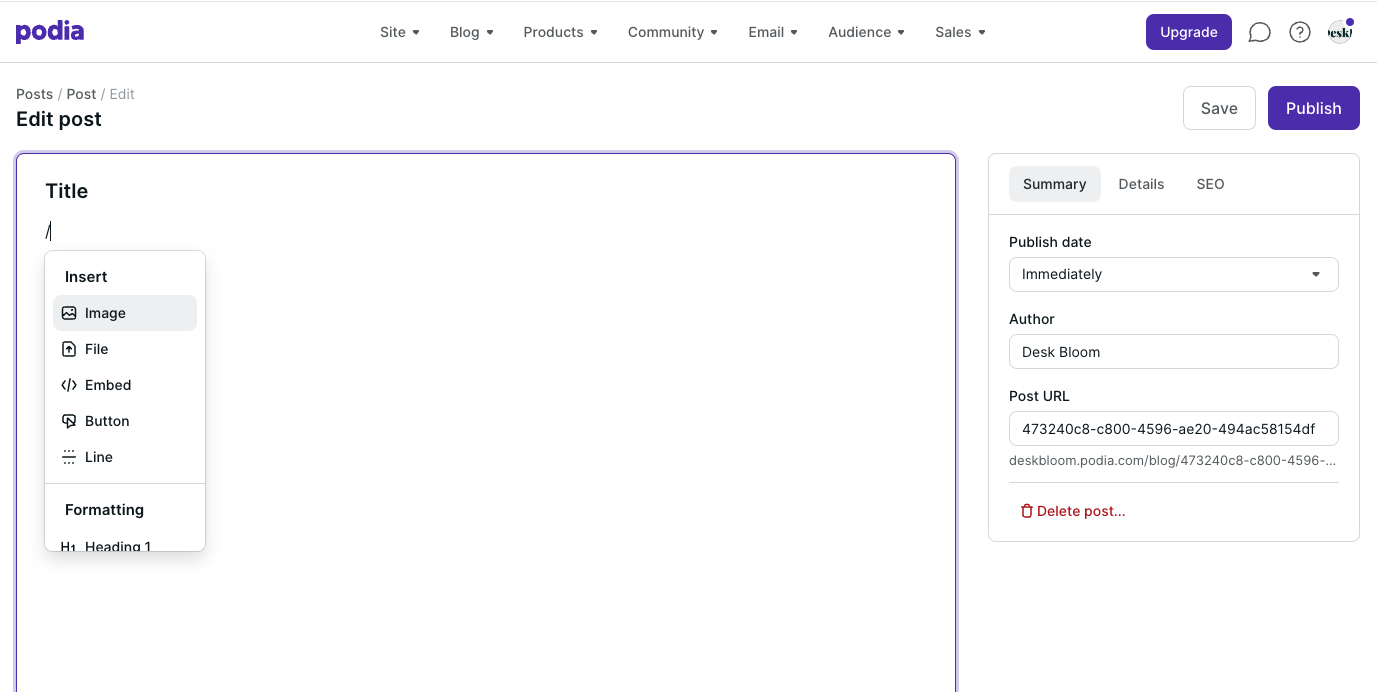
If you already have content written in a document or anywhere on the internet, you can copy and paste it directly into this space. Podia will match your text formatting and import images as best it can but you may have to make some adjustments depending on what you’re copy pasting. 

TIP: You can also use our built-in blog importer if you have a blog elsewhere and you want to add your posts in one go.
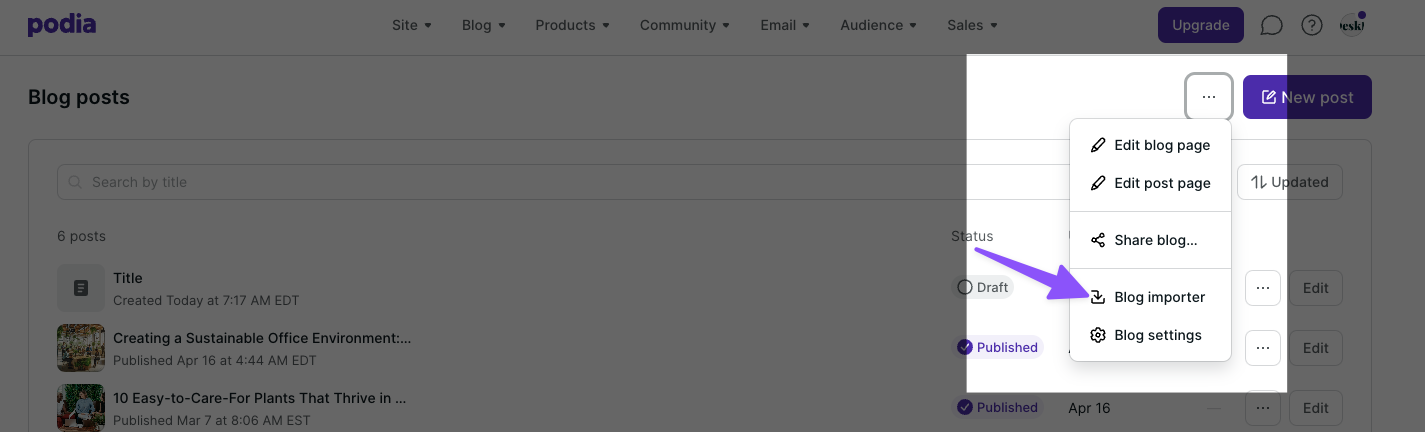
Memberships Blog Importer

The goal here is not to always have another place to create content – remember that’s what we’re trying to get away from by avoiding creating an online membership site.

Instead, we want to keep our content focused at this stage so that it does the most work for us. 

How do we do that? By writing posts about the most common problems your ideal customers have that you can solve with your content (and ideally your paid products!) 

Here are some thought starters that we have found to be particularly helpful: 

  • How to {subject} – how to guides are a time tested classic for helping people find you in search and solve their problems. Be helpful (like this post, hopefully!) and people will realize they could use your products to solve their problem (BTW – hopefully you’ve taken this as a prompt to
    sign up for your free Podia account
    . Meta. We know.)

  • Expert guides – this kind of content works really well when a person doesn’t have a specific problem to solve but they’re thinking about undertaking a process. In my example, maybe I could create an ‘expert guide to designing office plant installations’ 

  • 5 top tips for {subject} – a mix of the how to content and expert guide content. Providing actionable lists of hard-earned advice frames you as the person who could solve your audience’s problems

A lot of guides tell you that you should create large posts – and, look, this one’s currently about 4K words long – but it’s not always necessary. We’ve seen people do really well with how-to articles that are under 500 words. We’ve also seen our own content sometimes get a lot of sign ups when we go deep and long on a subject. 

After you’re done writing the content and you’ve got some posts published, you can design your blog page in the Podia website builder. 

There are two things to design: 

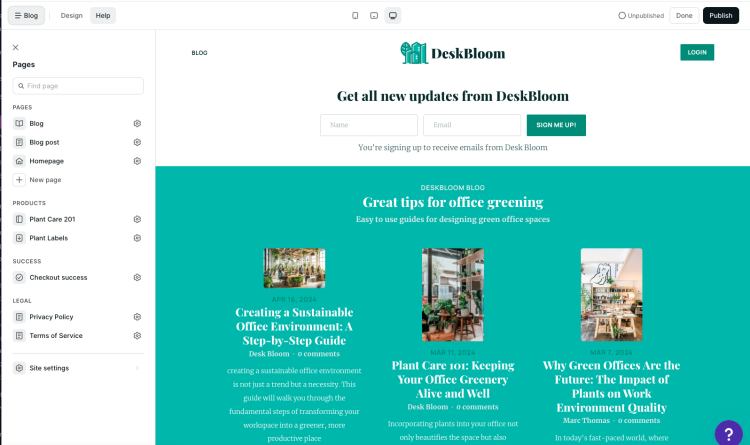
The blog archive page – this is where you’ll see all of your blog posts in a list. Here’s how mine looks after 2 minutes of adjusting design options like the layout and image size:
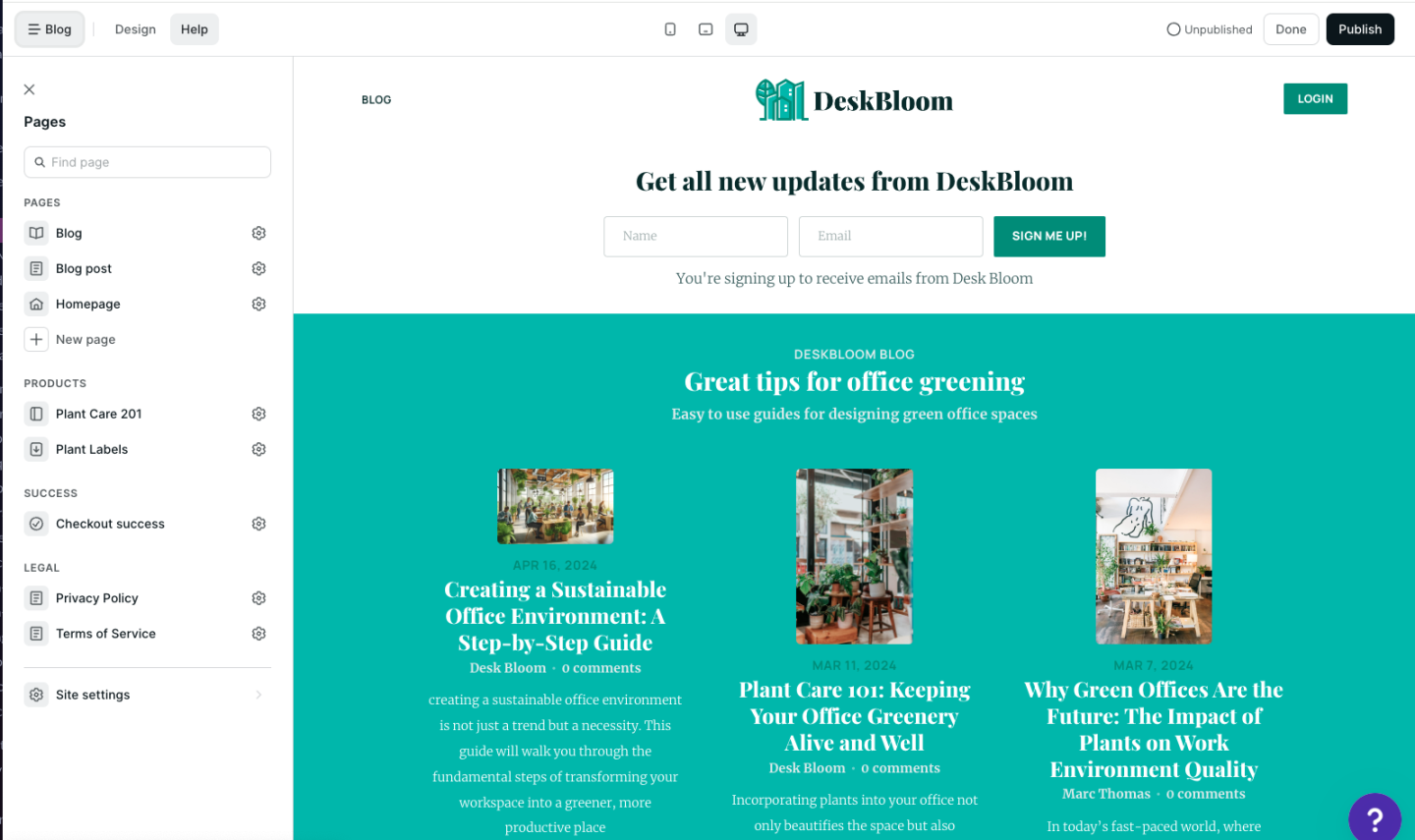
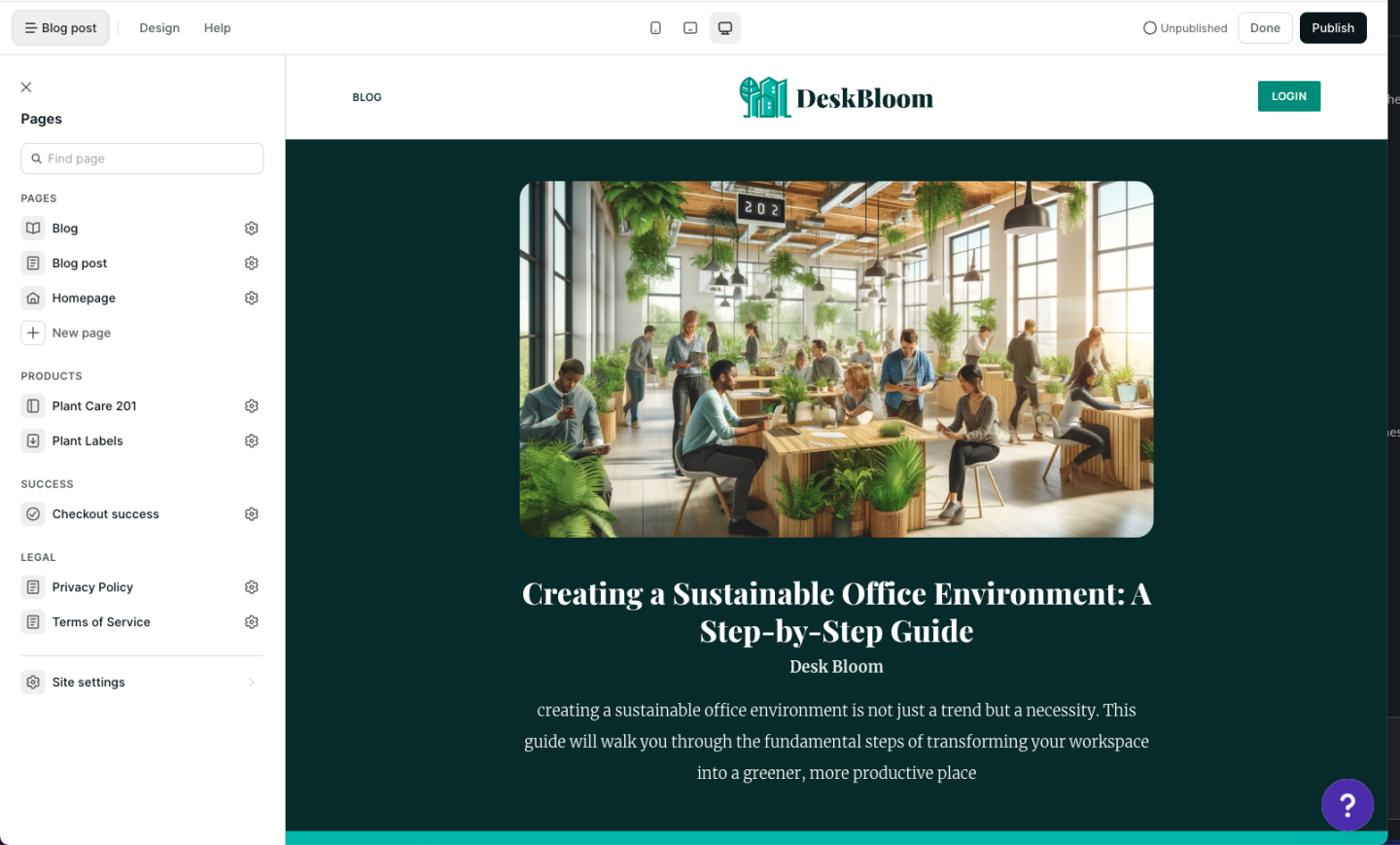
And also the individual blog post page template which is the template used by all your blog posts. It contains an example of the content from one of your blog posts to give you an idea of how all your posts will look when you publish: 
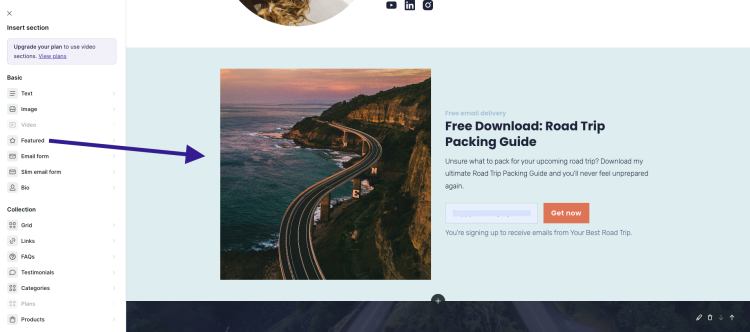
To really make the most of this whole system, you should add an email signup form for your newsletter. You can do that by clicking on the + button anywhere on the page preview and selecting ‘Slim Email Form’ or ‘Email Form’ as the new section: 
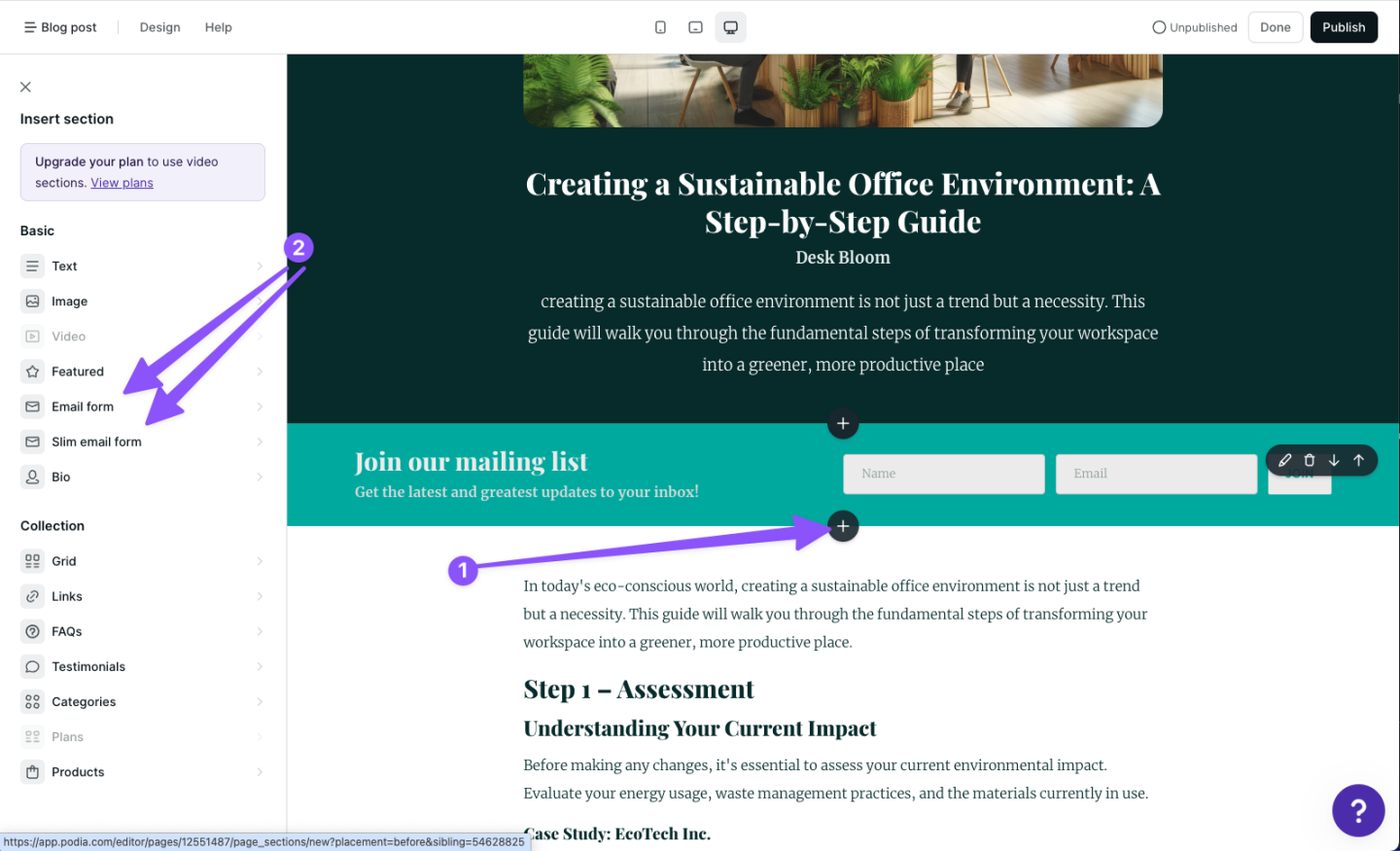
This form will add anyone who signs up by finding your blog to your Podia Email newsletter. 

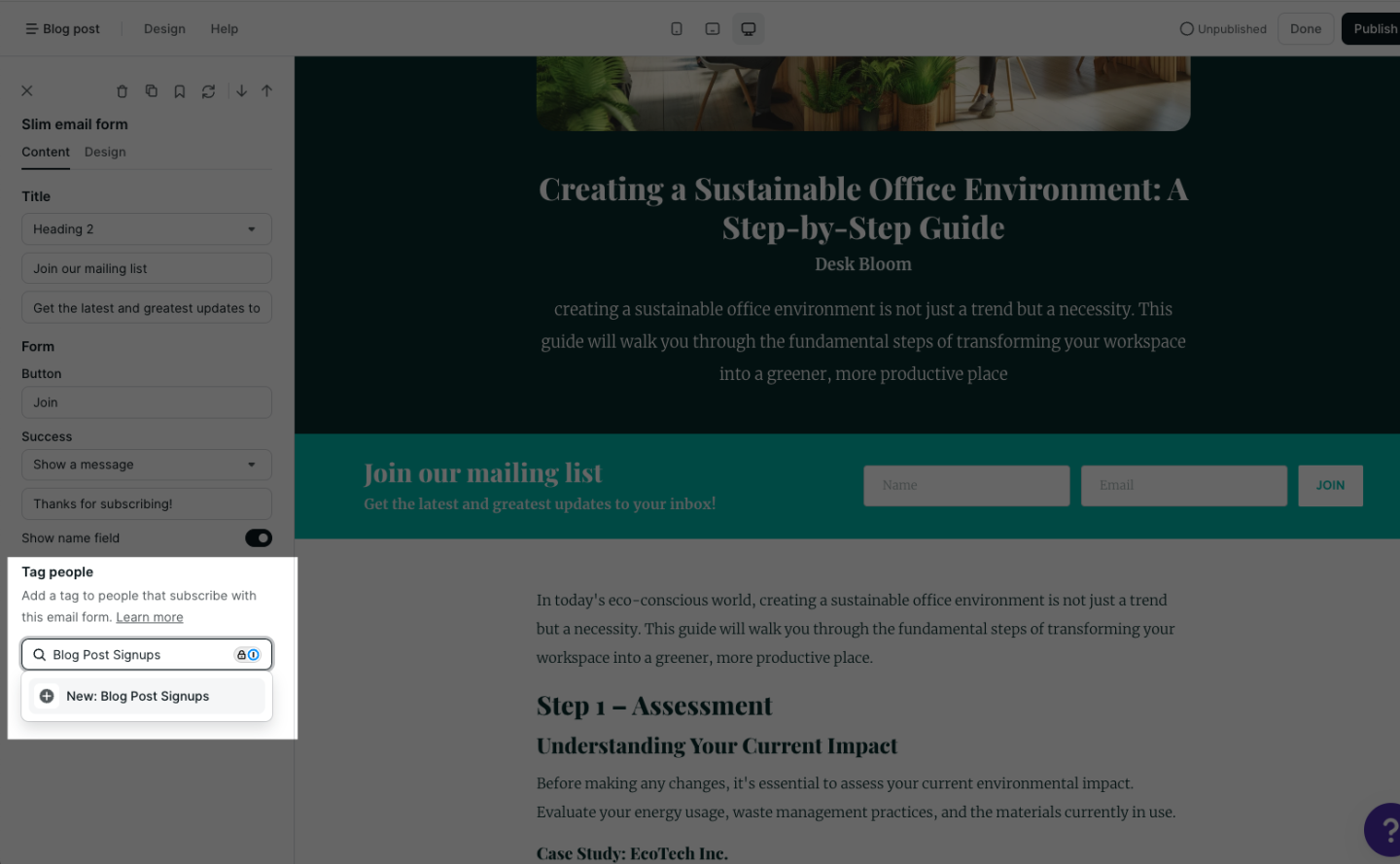
You could think about creating a new campaign to welcome your blog post subscribers and then add a tag to them automatically by adjusting your form’s settings: 

This would give you a way to trigger the automated campaign directly from your Podia account as ‘Tag added’ is one of the entrance conditions available in Podia Email: 
Step 5 – Start the process again to level up your revenue

That’s the whole framework. And while it might feel like a lot of work to get set up, we promise it’s a better long-term win than having to create content on a treadmill just to improve retention and stop your membership subscribers from canceling. 

The cool thing about this system is that it gets better and better every time you run it. 

Let’s say you’ve done one iteration of the flywheel and you made a good amount of money from your subscribers. 

If you add an additional free resource that triggers a nurture campaign and a CTA to buy a new paid product, you can earn additional revenue from the same people. 

A lot of people price memberships at a low price like $9/mo, but if you sold a low-priced product like a $100 download to your subscribers once every 6 months, you’d actually end up with $92 extra a year. 

That’s before you factor in that many people add more and more premium offers to this kind of business. By not needing to focus on creating exclusive content for your membership, you can focus on driving more and more people to signup for your free offering… which means… more people for your paid offering! 

Incremental revenue!

Don’t build an online membership — build a business flywheel instead

The dream sold by online membership tools is very attractive: you do what you love and you get money while you sleep. 

But the reality is a lot different for the majority of people because it’s hard to get subscribers to give you their credit card details. Then you have to keep delivering on your value proposition and providing value with exclusive membership content. 

Even if you do a perfect job of that, you’ll barely have time to acquire new subscribers which means that all that passive income is really just a pipe dream. 

But there’s an easier way. 

By building a flywheel in your business that acquires new subscribers, provides value for them on autopilot, and then monetizes them with one-time products and services, you can actually get paid for your expertise and still have time to grow your business. 

You won’t ever have to worry about making sure your subscribers don’t churn or chasing up expired credit cards. 

On our free plan, you can: 

  • Build a beautiful website complete with a blog

  • Offer a lead magnet that gets delivered automatically

  • Set up email marketing for up to 100 subscribers that helps you drive more sales

  • Set up additional paid digital products and upgrade when you’re ready to sell them

It won’t be easy but it is simple and you can do it all on Podia starting for free.
Create your free account today.
Thinking about selling memberships online? There’s an easier way to get that money

Software Stack Editor · July 8, 2024 ·

Most people think that selling memberships online will be the key to unlocking the kind of lifestyle that they want and that’s very understandable. A membership business is a very attractive business model.

At Podia we’ve seen many people build online communities as another revenue stream. Because the revenue is recurring, once you’ve sold the membership, it’s money in the bank every month, right? 

Wrong! 

Selling memberships online is a really hard business to build and none of the guides that you find by searching how to build a membership will tell you that. 

But with over 150,000 people building online businesses on Podia, we see a lot of data about what works and what doesn’t. 

In this article, we’ll look at: 

  • The challenges of building a membership program online

  • How there are other much easier ways to get to the outcome that you want

  • A practical step-by-step guide to building a business that gets you money while you sleep (without building a membership!)

By the end of this article, you’ll have all the tools and frameworks you need to build a truly great business with all the perks of regular monthly income but without all the pain of trying to sell online memberships.

Sound attractive? Read on!

You don’t need a membership program to have a great online business. Podia has tens of thousands of successful business owners who have built their website, lead magnets, digital products and email marketing using Podia’s all-in-one platform for solo creators. Get your website, storefront, and email marketing started today with a free 30-day trial.

All that glitters is not gold: the challenges of building a membership site

A business that makes money while you sleep sounds like an entrepreneur’s dream. And if you can get it, that’s true. 

When creators and business owners start thinking about how to get it, though, they often think about adding a membership site to their offering.

You’re here on this page, which means that maybe you’ve felt the same: You already create content on social media. People seem to like you. So it should be easy to get people to pay them every month to receive bonus content, tutorials, access to special live events, and more.

Perhaps you’ve even said those fateful words to yourself: 

“I’ve got 10,000 followers on Instagram. If only 1% of those sign up to my membership, I’ll be rolling in dough.” 

But there are two major challenges that almost everyone who tries to build an online membership comes across very quickly: 

  1. Most people who launch memberships find that their focus shifts from doing what they love – creating content – to working out why more people aren’t buying from them

  2. Even when it’s going well, you spend so much time trying to keep your existing members that you don’t have time to do what got you those members in the first place. That means fewer new members.

Selling memberships online is actually a really hard business model. 

The first hurdle is where most people fall down: you have to create a value proposition that’s compelling enough for a stranger on the internet to go from liking your free content to paying you every month.

If you’re like most people, you’re probably thinking of adding the following to a membership tier: 

  • Exclusive tutorials and content

  • Access to invite-only webinars or other events

  • Behind-the-scenes content from your business

  • A 1:1 session coaching when someone joins your top tier

  • Member-only podcast

Woof! That sounds exhausting to me. 

That actually leads us to the second problem: Let’s say you can convince enough people to do that so that you’re happy with the income you’re getting, now you have to spend the majority of your time creating the exclusive content that’s behind your paywall so that people can get the value you promised them. 

Not only do you have to create all that stuff once, but you have to keep going month after month without ever taking a break. 

Let me ask you this: when was the last time you enjoyed running on a treadmill? 

A treadmill is exactly what a membership is like – retention becomes a major challenge to figure out. You have to continually add value and if they don’t feel like they’re getting that value, your members are likely going to churn. That means your revenue is dependent on spending the majority of your free time trying to make sure they don’t. 

Not to mention what happens when someone’s credit card expires and they ghost you (it happens an unbelievable amount). That’s totally out of your control but it also means your revenue goes down without any way to fix it. 

On the off chance that you manage to avoid all of those pitfalls, you’ll probably still realize that you no longer have any time to create the content that’s going to get you new customers for your membership program. 

You’re spending so much time making content and creating value for your members, that there’s no chance you have the energy and headspace to nail your social media or appear on podcasts/events etc. 

Thinking of writing a blog post? No chance! 

Want to launch a new product?! Maxed out! 

OK. So. This probably wasn’t what you wanted to hear when you came to a blog post about selling memberships online and we don’t want to leave you feeling down and helpless. 

After all, we’ve seen tens of thousands of people like you build beautiful businesses that they love to manage. Businesses that give them the lifestyle they want from their side hustle or, hopefully, their main job! 

In the next section, we’ll share a framework for building a business that gets you everything you want with none of the hassle that comes with running an online membership program. 

The online business flywheel: this no-hacks system makes millions of dollars every month 

If building a membership business sounds exhausting to you, you’re not alone. Platforms like Patreon or ConvertKit that specialize in membership functionality are definitely incentivised to show you the sunny side of membership sales: everything goes perfectly and everyone’s making a living doing what they love. 

And even if you don’t follow the logic of our argument above, at least follow the example of the more than 150,000 people who are building businesses on Podia without building a membership program. 

In this section, we’re going to share a much easier path to growing an online business that actually makes money while you sleep and lets you have the time to do what you first loved about building that business: being an expert in what you do and sharing that expertise with others. 

This framework is the same framework that the most successful entrepreneurs and solo business owners on Podia are using in their businesses. While it looks different for everyone, the core components are almost always the same ones. They are: 

  • Start with a simple lead magnet that you can use to collect email addresses

  • Add an email newsletter for your subscribers to build trust with them

  • Launch a paid product to get them to buy from you

  • Add blog content to your website to help more people discover you organically

  • Start the process again to level up your revenue

Let’s work through this process step by step. You can get your free 30-day trial and get started building today.

Step 1 – Start with a simple lead magnet

A lead magnet is a simple resource that you offer to your audience for free in exchange for their email address. 

Almost every successful online business owner starts off with a lead magnet. 

Practically speaking, a lead magnet can be as simple or as complex as you want it to be, but we recommend making it easy. The best lead magnets help your audience do something that solves a problem or create something within a very short period of time (say 20 minutes) 

Here’s some quick ideas of lead magnets you could create easily: 

  1. A checklist of steps to follow while doing a specific process 

  2. A cheat sheet 

  3. A template for a document that your audience might use a lot

  4. An idea generator

  5. A collection of quotes about a topic (this is one of our best-performing lead magnets!) 

Practically speaking, you can make your lead magnet in Google Docs, Sheets or Canva and save it as a PDF. 

Once you’ve done that, you’re going to need somewhere to send people so that they can sign up for it. 

Setting up your lead magnet

Luckily, on Podia you can set up your lead magnet, get a web page to send people to sign up, and also send it whenever anyone signs up. The best news is you can do it all for free. 

Go ahead and sign up for your free 30-day trial here. 

Once you’ve done that, click on Products in the navigation bar of your Podia account and choose ‘New Product’: 

Membership: Add a new product

A popup will appear. Here you can enter a name for your lead magnet (you can change it later.) 

Be sure to select ‘Digital Download’ as the product type as this has a ‘Free Email Delivery’ option later on (bear with us!)

Membership Digital Download Selector

In the digital download editor, you can add files to your digital download product. You can upload as many files as you like. If you upload multiple files, these will be automatically zipped by Podia’s system once they’re downloaded by your customers.

Membership Upload Files

Once your files are uploaded, you need to select Pricing and then choose ‘Free Email Delivery’: 

Membership Free Email Delivery

This will ensure customers need to enter their emails to sign up for your lead magnet without needing to create an account. 

When you’re ready, hit publish on your product. 

Designing your lead magnet landing page

Now that you’ve got a lead magnet and a way to deliver it (we’ll do all the work for you!), you’re going to need somewhere to direct people to where they can enter their email. 

MORE GOOD NEWS! 

With your account on Podia, you get a website and a really easy place to edit it and make it look exactly how you want it without needing to work with a designer or developer. 

To quickly get to your lead magnet landing page and start designing, click the […] button and then select ‘Edit Sales Page’

Membership Edit Sales Page

Editing your landing page on Podia is easy. This page took me just two minutes to build: 

Membership Sales Page

In the example above, I’ve added a few numbers to help you navigate easily: 

  1. On the content tab of each section, you can edit the text, add the images, and generally configure what you want visitors to see

  2. On the design tab, you can choose from a number of different options including a series of predefined layouts, spacing, image styles and select a color palette (or create one that’s custom to this page)

  3. If you don’t love the default design options (although they already look better than other website builder software) you can click the design tab marked by the number 3 on the image above which will allow you to set up fonts, colors, and more for your brand

You can also add additional sections by hovering over the designer and clicking the plus button that appears:

Memberships Plus Sign

Before you finish designing, you’ll also want to set your page address. All Podia sites come with a free subdomain where you can access your website (e.g. [yoursite].podia.com) or you can connect a custom domain.

To grab the link to your current landing page, you can click the following things:

Membership sales page settings

  1. Click the menu in the top left corner of your website builder 

  2. Find the page you’re designing and click the cog symbol next to it (indicated by the number two on the image above) 

  3. The menu will reload to show you the settings of your current page. You can either copy the URL and start sending your audience to it to sign up or you can edit the URL if you want a different name for it (this is called a page slug – I know, gross) 

Tip: some people like to hide the header on landing pages for their lead magnet. If that’s you, you can toggle the header on and off here too. 

What do you do with this URL? 

Besides sharing it at every opportunity possible you can add your lead magnet to your social profiles. On almost every social network, you can add a link to your bio (BTW – you can set up a link in bio page on Podia too!)

Memberships Podia Instagram Link in Bio

Doing this makes sure that anyone checking out your profile gets an offer of a valuable resource from you. You’ll quickly see the signups racking up.

The other place you can share your lead magnet is as a call to action if you ever appear on a podcast or speak at an event. When the host asks ‘Where can people find you’ just tell them to go download your free resource – it’s a lot more effective than saying ‘Follow me on Instagram’

Step 2 – Add an email newsletter for your subscribers

The goal of setting up a lead magnet is to provide enough value to your audience for free that they’ll give you an email address. 

In 2024, an email address is the most valuable thing an audience member can give you (besides, you know, cash – but we’ll get to that later). If you have an email address, you can use email marketing to continue to own the relationship with your subscribers so that you’re never at risk of losing out when a social network changes its algorithm. 

But how do you stay in touch with your audience members? An email newsletter! 

The beauty of an email newsletter is that it’s kind of like a membership except you can use it as a tool to sell much higher ticket items than a membership – and it’s available to everyone so you’ll never have to prioritize creating for a tiny segment of your audience. 

With your Podia account, you can have 100 subscribers for free which is enough to start making some money in the next step. 

Every person who downloads your lead magnet automatically gets added to your Podia account and you can send them email marketing.

Memberships Email Marketing

There are two kinds of email you can send with Podia: 

  1. Broadcasts – one-off emails that are used for things like regular newsletter updates or time-limited offers

  2. Campaigns – automated sequences of emails that you can trigger when a subscriber takes a specific action like buying a product or getting added to your audience for the first time 

If you’re following along with this, we’d recommend you start by trying to send a regular newsletter where you share some of your expertise. 

It’s extremely easy to build a beautiful looking email on Podia and it works in a similar way to the website builder. 

Here’s an example that I made earlier: 

Membership Email Example

Tip: If you’re not feeling like designing your own, you can choose one of the many pre-made templates available in your Podia account and adjust it to your needs (or send it at is) 

Here’s a few email topics that you could try out: 

  • 5 tips to help you get better at [your topic] 

  • A story of how I [achieved the outcome your subscribers want] 

  • Quick guide to [specific task your subscriber needs to do] 

Don’t overthink it at this stage. The goal is simply to remain in contact with your audience so that at a later date (pretty soon hopefully) you can tell them about the paid product you just launched – which is where you start making the real money. 

Set and forget: use a new subscriber campaign to quickly engage your audience

A campaign to welcome new subscribers – the people who downloaded your lead magnet – is a great way to engage them and give them a taste of what’s to come. 

To do that, just hover over ‘Email’ in your navigation bar on Podia and select ‘Campaigns’. Then create a new campaign and set the entrance condition to ‘Signs up for Product’ and select the name of the Lead Magnet you made.

Membership Entrance Condition

Then you can add a series of emails that send over time to welcome your new signups. Here’s the lead magnet welcome sequence I have set up for my personal side-project:

Memberships Email Campaign Examples

On day 1, I welcome them to my newsletter and tell them a bit of my story. On day 2, I dive a lot deeper into the topic I talk about. Day 6 is where I present them with a world view that I hold, that they might find surprising. Day 8 is where I offer them a product and start making money. 

And on that note, let’s move on to the key piece of this whole framework: MAKING MONEY! 

Step 3 – Launch a paid product

So far, we’ve created a lead magnet to help us convert strangers to subscribers and an email newsletter to help us build trust – now we need a way to turn this into sufficient revenue that you don’t feel the need to build a membership which is going to drain all your energy and time from you. 

How do we do that? 

We launch a product that’s related to the problem solved by our lead magnet! 

With your Podia account, you can launch your product (that’s been covered off by the lead magnet you set up) so you have two options: 

  • You can either launch a coaching session

  • Or you can create another product (both Mover and Shaker plans include unlimited courses, downloads, and coaching sessions) 

We’ll walk you through both here so you can make the choice for yourself: 

Set up a coaching session

Once you have built trust with your audience, offering a coaching session can be a very effective way of converting the effort you’ve put into your content into sales. 

For example, when I showed you the lead magnet I set up earlier, you’ll have noticed that it was for my fictional business DeskBloom which specializes in helping office managers create green environments in their offices. 

My lead magnet was a downloadable of ‘Plant Care Labels’ which help them know when to water, what conditions the plants like and recall the names of each plant. 

Then my email sequence was geared towards simple plant care tips that they could use to improve their offices. 

For my coaching session, I’ll set up a simple coaching session where my subscribers can pay me for a 15-minute call where they use their camera phones to show me around their plants and I offer them advice. 

Let’s dive in.

I start by creating a new product in the same way I did earlier except this time I’ll choose ‘Coaching Session’:

Membership Coaching Session

The setup of a coaching course is slightly different to other products because you actually paste a link from Calendly, SavvyCal, Acuity, or YouCanBookMe to embed a booking calendar on your customers’ product page. 

Here’s how it looks with my calendar link in it: 

Membership Calendar

I can set my pricing and then publish. This is the moment where I can design the landing page but as we’ve already done that above and it’s the exact same process, I’ll skip it here. 

Once your subscribers have bought your product, they’ll be taken to the customer only area where they’ll see your calendar widget embedded. Here’s my colleague Rodrigo’s page as an example: 

Membership Coaching Landing Page Example

Tip: Not only is selling a coaching course a great way to get paid for providing value but it’s also a brilliant way to build more trust which can turn into your customers recommending you to others. You can also take the insights you gather from speaking to your customers and use them to create more content as part of your flywheel.

Set up another downloadable or course 

If 1:1 facetime isn’t your thing or you just don’t want to do coaching sessions, there are many other kinds of products you could sell as your first paid offer. 

The most successful people tend to start out with a downloadable that builds on the thing that their lead magnet helped their subscribers get done. 

Some good examples of downloadables: 

  • Template packs

  • Planner documents 

  • Project plans

  • Technical files 

  • Short ebooks 

Any of these could work for you and you’re not limited to them either. 

Setting up a course is another option but remember that this takes time and a lot of people get hung up on getting the content perfect. 

Creating a course is easy in Podia. You just choose ‘Online Course’ from the new product menu in the same way we’ve outlined above. 

From there you can set up your course by adding Sections (like modules) and Lessons which could be text, embeds, quizzes, coaching sessions, or files. 

Membership Sell Online Courses

Tip: With Podia you can also offer upsells of additional products at your checkout. This is a great way to increase your revenue with no extra effort. 

Step 4 – Add blog content to your website

We’re really rolling now. So far you’ve got: 

  1. A lead magnet – A way to encourage your audience to give you their email address

  2. An email newsletter and automated welcome campaign – to build trust with your subscribers

  3. A paid product – that you can use to turn that trust into cash 

But what’s missing? A way to get more and more people to discover you without you needing to create content all the time. 

The simplest of all marketing strategies is to create a few pieces of content that help people who are looking for solutions to specific problems that you could solve for them with the things in steps 1,2, and 3 of this process. 

With your Podia site, you also get a free SEO-optimized blog that looks great out of the box, and you can manage without fussing with plugins or themes. 

To get started with setting up your blog, simply click ‘Blog’ in the navigation of your Podia account and then choose ‘New Post’ from the drop-down menu: 

Membership Blog New Blog Post

You’ll notice how simple the New Post page looks when it loads. You can write your content in the big box on the left hand side. 

To add an image, file, embed, button, line or to manage the text formatting options, you can just type ‘/’ on a new line and you’ll be offered a menu of those choices: 

Membership Blog Adding Text

If you already have content written in a document or anywhere on the internet, you can copy and paste it directly into this space. Podia will match your text formatting and import images as best it can but you may have to make some adjustments depending on what you’re copy pasting. 

TIP: You can also use our built-in blog importer if you have a blog elsewhere and you want to add your posts in one go.

Memberships Blog Importer

The goal here is not to always have another place to create content – remember that’s what we’re trying to get away from by avoiding creating an online membership site.

Instead, we want to keep our content focused at this stage so that it does the most work for us. 

How do we do that? By writing posts about the most common problems your ideal customers have that you can solve with your content (and ideally your paid products!) 

Here are some thought starters that we have found to be particularly helpful: 

  • How to {subject} – how to guides are a time tested classic for helping people find you in search and solve their problems. Be helpful (like this post, hopefully!) and people will realize they could use your products to solve their problem (BTW – hopefully you’ve taken this as a prompt to sign up for your free 30-day trial with Podia. Meta. We know.)

  • Expert guides – this kind of content works really well when a person doesn’t have a specific problem to solve but they’re thinking about undertaking a process. In my example, maybe I could create an ‘expert guide to designing office plant installations’ 

  • 5 top tips for {subject} – a mix of the how to content and expert guide content. Providing actionable lists of hard-earned advice frames you as the person who could solve your audience’s problems

A lot of guides tell you that you should create large posts – and, look, this one’s currently about 4K words long – but it’s not always necessary. We’ve seen people do really well with how-to articles that are under 500 words. We’ve also seen our own content sometimes get a lot of sign ups when we go deep and long on a subject. 

After you’re done writing the content and you’ve got some posts published, you can design your blog page in the Podia website builder. 

There are two things to design: 

The blog archive page – this is where you’ll see all of your blog posts in a list. Here’s how mine looks after two minutes of adjusting design options like the layout and image size:

Memberships Blog Archive Page

And also the individual blog post page template which is the template used by all your blog posts. It contains an example of the content from one of your blog posts to give you an idea of how all your posts will look when you publish: 

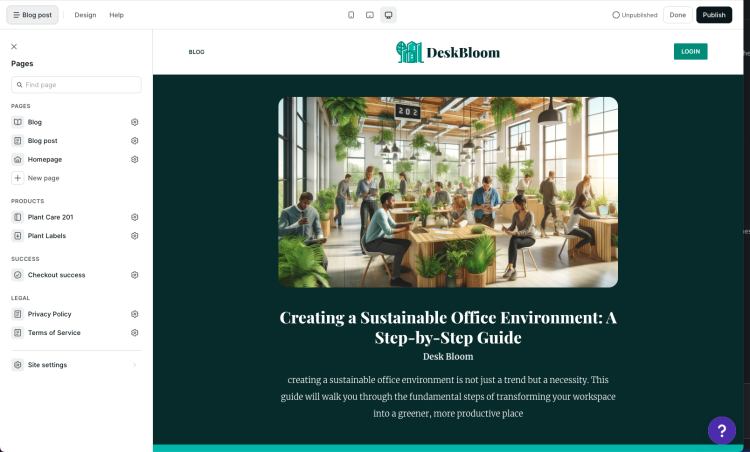
Membership Blog Post Page

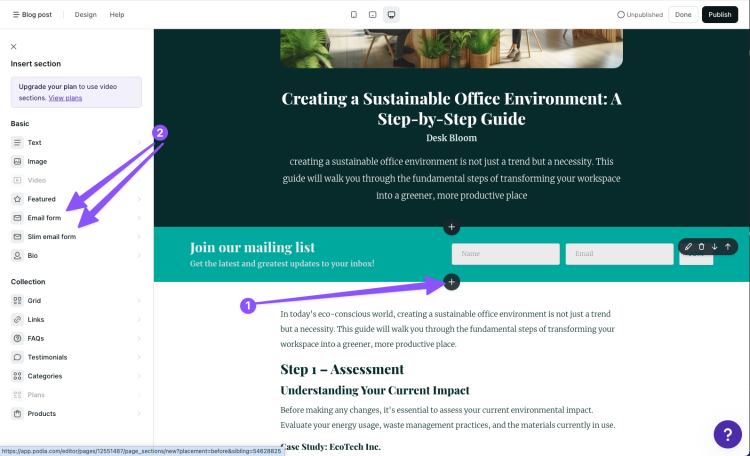
To really make the most of this whole system, you should add an email signup form for your newsletter. You can do that by clicking on the + button anywhere on the page preview and selecting ‘Slim Email Form’ or ‘Email Form’ as the new section: 

Membership Blog Email Signup

This form will add anyone who signs up by finding your blog to your Podia Email newsletter. 

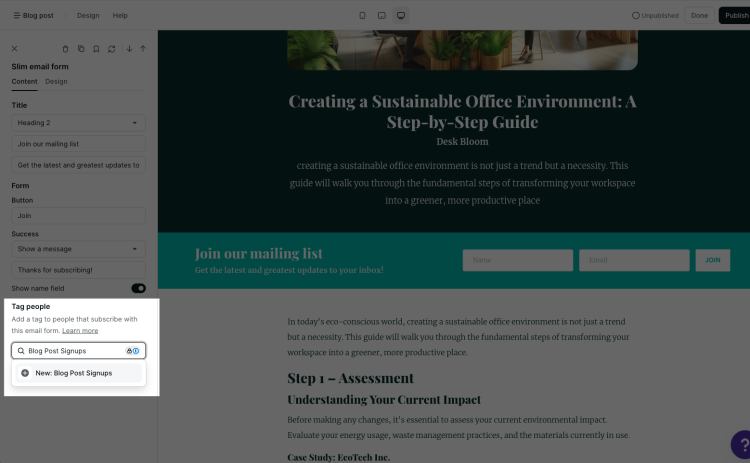
You could think about creating a new campaign to welcome your blog post subscribers and then add a tag to them automatically by adjusting your form’s settings: 

This would give you a way to trigger the automated campaign directly from your Podia account as ‘Tag added’ is one of the entrance conditions available in Podia Email: 

Membership Blog Tag Added

Step 5 – Start the process again to level up your revenue

That’s the whole framework. And while it might feel like a lot of work to get set up, we promise it’s a better long-term win than having to create content on a treadmill just to improve retention and stop your membership subscribers from canceling. 

The cool thing about this system is that it gets better and better every time you run it. 

Let’s say you’ve done one iteration of the flywheel and you made a good amount of money from your subscribers. 

If you add an additional free resource that triggers a nurture campaign and a CTA to buy a new paid product, you can earn additional revenue from the same people. 

A lot of people price memberships at a low price like $9/mo, but if you sold a low-priced product like a $100 download to your subscribers once every 6 months, you’d actually end up with $92 extra a year. 

That’s before you factor in that many people add more and more premium offers to this kind of business. By not needing to focus on creating exclusive content for your membership, you can focus on driving more and more people to signup for your free offering… which means… more people for your paid offering! 

Incremental revenue!

Don’t build an online membership — build a business flywheel instead

The dream sold by online membership tools is very attractive: you do what you love and you get money while you sleep. 

But the reality is a lot different for the majority of people because it’s hard to get subscribers to give you their credit card details. Then you have to keep delivering on your value proposition and providing value with exclusive membership content. 

Even if you do a perfect job of that, you’ll barely have time to acquire new subscribers which means that all that passive income is really just a pipe dream. 

But there’s an easier way. 

By building a flywheel in your business that acquires new subscribers, provides value for them on autopilot, and then monetizes them with one-time products and services, you can actually get paid for your expertise and still have time to grow your business. 

You won’t ever have to worry about making sure your subscribers don’t churn or chasing up expired credit cards. 

On our plans, you can: 

  • Build a beautiful website complete with a blog

  • Offer a lead magnet that gets delivered automatically

  • Set up email marketing that helps you drive more sales

  • Set up additional paid digital products

It won’t be easy, but it is simple, and you can do it all on Podia. Try it for yourself with a free 30-day trial today.

How toHow to create, sell, and profit from an online courseThis guide is everything you need to know about creating, launching, and selling a course this year.

Software Stack Editor · July 6, 2024 ·

This guide is everything you need to know about creating, launching, and selling a course this year.

Jump ahead

In this article

No matter who you are, you have something to teach the world.

Maybe it’s a long-time passion of yours – something you’ve always loved to teach and answer questions about – or maybe it’s something you’ve only considered creating content for in your most far-flung dreams.

Either way, you know if you could just find a way to bottle up that spark and deliver it to the world, to customers, you’d be unstoppable.

Luckily, today it’s easier than ever to turn your knowledge into revenue-driving online courses that can change the lives of your customers.

No matter what subject matter or topic you want to teach, how much experience you have in creating videos and lessons, or whether you’ve ever put together a marketing campaign in your life, creating an online course can be accomplished in a few simple, easy steps.

Sound good? Then let’s get started.

Who should create an online course and what are the benefits? 

The rewards of creating an online course – making more money, earning passive income, reaching more people, making a bigger impact – can be tempting.

But getting there takes work. And the only way to stay motivated to do the work (and actually enjoy it) is to know that you’re doing something that you should be doing.

Here are two questions to help you decide if making an online course is the right move for you:

“Do I have something to teach?”

There’s a very good chance that for the people in your circle, you’re an expert on something. Maybe you’re great at managing money, or computer skills, or cooking, or finding cheap travel deals, or home decorating. Maybe you’re super-organized and can do magic with spreadsheets.

You might already know what gift or skill people come to you for. Or you might not (though chances are, the people around you do!), in which case, we’ll help you figure it out.

If there’s something that you can teach others that will help them in their life or work, creating an online course is a great way to get it out there.

“Do I want to start an online business?”

You’ve probably seen the photos on Instagram. An inspirational guru posting a snapshot of their “daily life” in the form of a cocktail on the beach on a Tuesday.

“Start an online business,” they tell you, “you’ll make money in your sleep. Just buy my coaching program and I’ll show you how.”

In reality, building an online business looks nothing like that Instagram photo. It can be hard work and a lot more time consuming behind the scenes. But it’s incredibly rewarding work, too. When a student who completes your course tells you that you changed their life, it will be one of the most gratifying things you ever hear. 

So ask yourself, do you really want to start an online business and put in the work required to get the results you want? 

“There are so many ways to make a living online – how do I know if courses are the right fit for me?” 

These days, you can build a business selling digital products, coaching, blogging, YouTubing, getting brand sponsorships, and about a million other ways. So how do you know if courses are the right call for you? Try making a small, simple course and see how it goes. You’ll… 

  • Overcome any mental barriers before sinking tons of time into a big project. Even building a small course and getting it in front of people will show you that these concerns can’t hold you back from success.

  • Get valuable student feedback without much time invested. The very best courses aren’t first versions; they’re courses that have been iterated on over time, incorporating student feedback along the way. The most important step in this process is simply to get started.

  • Learn a lot along the way! Everything that may seem challenging to you now, like creating content and writing a sales page, will get much, much easier after you do it for the first time.

How to come up with ideas for your online course

[embedded content]

To come up with an idea for your online course, start by thinking about your ideal audience – or the people who you think would buy your course one day. 

If you already have a blog, email list, or social media following, look at your followers. If you don’t have an audience already, simply look to the people around you: your friends and co-workers. 

Try asking the people you have access to these 5 questions, either over email, on 1:1 calls, through a survey, in your social media comments, or any other way that you can do today. 

  • “Tell me about your experiences with [topic].”

  • “What’s your biggest challenge with [topic]?”

  • “How are you currently dealing with those challenges?”

  • “What would solving these challenges allow you to achieve?”

  • “What blogs do you read frequently? What communities are you a part of online?”

Keep a note of any common trends you hear. If multiple people are experiencing the same challenges and pain points, there might be an opportunity for you to share a solution. 

Another way to do this is to head to public channels and forums like YouTube or Reddit and search for questions around your course idea. Remember: Any problem worth solving in a course has probably already been written about. And if it’s a real problem for people, they’re probably seeking solutions online. So head to the comments section and see what you can find. 

Do you see any patterns or recurring ideas?

By now you should have a list of potential online course topics that you could tackle based on what you’re good at and what you’ve learned from your research, so let’s hone in on the best ones.

We’ll be judging all of the ideas based on two factors:

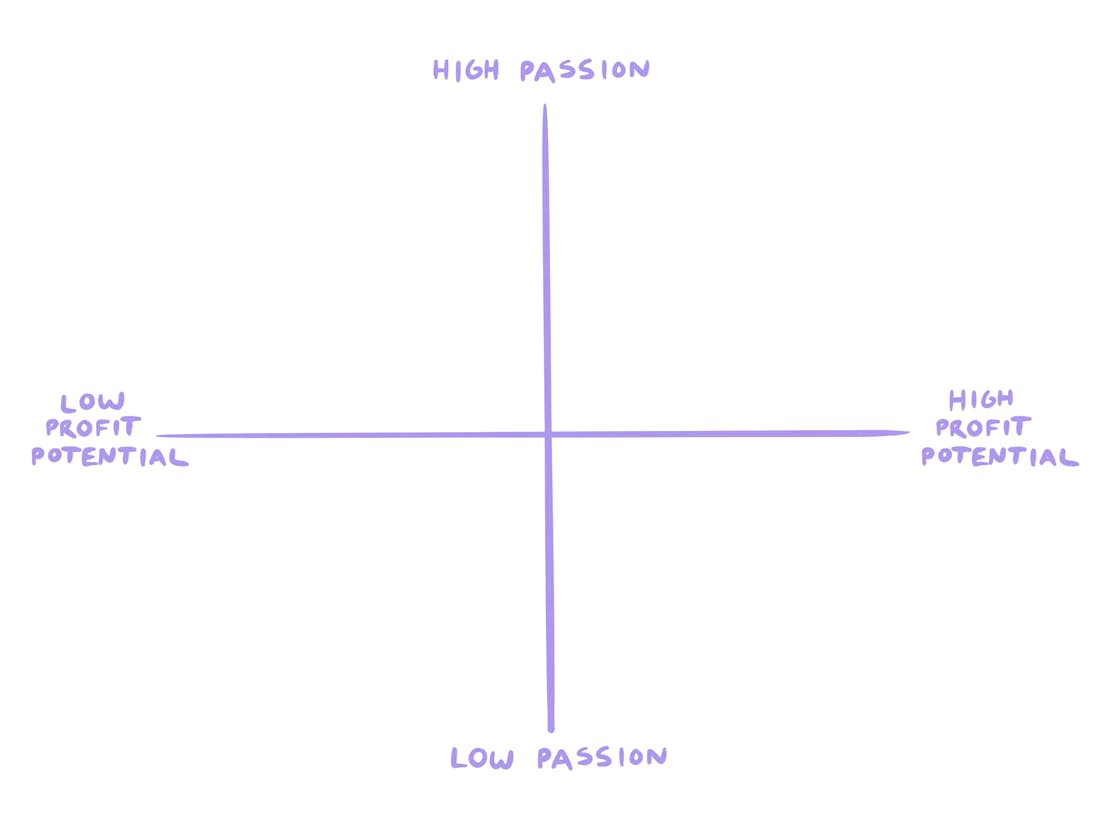
  • Passion: How excited are you to work on this? If you hate working on something, its’ profit potential doesn’t matter, because you’re likely to quit before you get there!

  • Profit potential: Is it a problem that people would pay to have solved for them? A good framework for thinking about this is “do people already spend money to solve this problem, in the form of books, apps, services, etc…?”.

Plot the ideas from your list on the Passion/Profit Matrix.

We’re looking for the ideas that land in the top right quadrant: the ones that you’re excited to work on and that you’ll be able to sell.

Once you have your idea chosen, it’s time to get to work on building your course.

How to plan and build your course content

The first time you make a course, it’s tempting to sit down and brain dump everything you can think of into a list, then use that as your course outline. But this can quickly lead to information overwhelm for you and your students, so we have another approach you can try. 

Start with the end result.

You don’t need to teach your students everything you know about a topic. You just need to teach them exactly what they need to know to achieve the result you promised.

At Amazon,
they write a press release announcing a product launch
before they even start working on the product. They don’t publish the release, of course. But the internal process of writing the press release makes them focus on what’s most important: the elements of the product that are exciting and useful for their customers.

Amazon starts with the end result and builds backward from there. And that’s how we’re going to approach your course, too.

What is the end result you want your students to achieve?

When you begin to build your outline, the answer to the question above goes at the top.

Then, your first module or course section will get your student excited about why they’re taking the course.

After that, break down the end result into the various steps that need to be taken to achieve it.

Remember that your goal is not to teach everything you know. It’s to teach everything your student needs to achieve a result.

Once you have the end result broken down into its component parts and dropped into an outline, you’re ready to make your course content.

Online courses typically have the following components. You can mix and match these media types depending on what makes sense for each lesson, so don’t overthink this step. 

Use the tools you already have (like a smartphone, your computer webcam, your headphones, and anything else that you’ve got on hand. You don’t need the most fancy equipment to share what you know, and getting too caught up in the logistics of “perfect” content will only slow things down. Plus you can always go back later and update modules as your business grows. 

  • Video

    • Pro: Engaging, multi-sensory, builds the strongest relationship between the student and teacher.

    • Con: Can be more time-consuming to create.

  • Audio:

    • Pro: Students can take the content “on the go” and listen anywhere.

    • Con: Easier to get distracted while listening to, can be harder for non-native speakers to understand.

  • PDF:

    • Pro: PDF guides are easier to go back to and reference than audio/video, and PDF worksheets help walk students through doing the work.

    • Con: Typically lower engagement than audio/video.

  • Text:

    • Pro: This is the “easiest” to produce for creators that are comfortable with writing. Requires no additional tools or skills.

    • Con: Writing well can be difficult (but anyone can learn!)

  • Quizzes:

    • Pro: You can use quizzes as a way to see how well learners are grasping the course material.

    • Con: Not every topic lends itself well to quizzes, so it might not make sense for your program.

A note on accessibility: When publishing video and audio content, consider that you may have students who are hearing-impaired or who don’t natively speak your language. Make sure that everyone has a good learning experience by including transcripts of any video/audio files. 

As for the online course creation process, this video tutorial will show you exactly how to set up your course in Podia in about 10 minutes.

[embedded content]

Still need an online course platform? You can create unlimited online courses and digital products, as well as your website, landing pages, blog, email marketing, and affiliates with Podia’s Mover plan. (
The Mover plan costs $39/month paid monthly or $33/month paid annually.
)

The pitch: pricing and packaging your online course

Well done! By this point, your content is complete and the course is nearly ready to ship.

There are just two critical steps left: naming and pricing your course.

The name is the first thing that anyone who encounters your course will see.

If you get it right, it will pique their curiosity, draw them in, and make them eager to learn more.

If you get it wrong, they’ll move on and ignore your course.

  • Great course names are targeted. The name makes clear exactly who this course is for. “Knife Skills 101: Learn To Cut With Confidence” is a better name than “Knife Skills”, because it tells the prospective student what level of skill the course is geared toward.

  • Great course names are results-oriented. The name conveys the result that the student can expect by taking the course. “Knife Skills 101: Learn To Cut With Confidence” is also a better name than “Knife Skills” because it tells the prospect what outcome they’ll see at the end of the course.

  • Great course names are unambiguous. The name doesn’t use fluffy language or jargon that confuses the prospect and makes them think hard about what the course is really about. “Knife Skills 101: Learn To Cut With Confidence” leaves no question as to what the course is about.

Pricing is a deep, complex topic, but you don’t have to make it one.

We recommend a simple model of goal-based pricing. What is it that you want out of your course?

  • Do you want to reach the highest number of people? If you just want to reach as many people as possible (for example, if you’re using the course as a lead generation tool), then offer it for free. If there’s no barrier to enrolling, you’re likely to see more signups.

  • Do you want to make the highest total number of sales? Then price your course low enough to make it a “no-brainer” for as many people as possible, which is something under $30 depending on your niche (look at competing courses for some benchmarks).

  • Do you want to earn the most total revenue? This is where you get to charge the big bucks. For most creators, it’s a lot easier to earn $1,000 selling a $1,000 to one person than by selling a $20 course to 50 people. Go high with your pricing, and test to see what the market will pay for.

You’re not setting your pricing in stone, and you can — and should! — always try different pricing as you grow your online business.

Writing an online course sales page that converts

You’ll need a great sales page to show your product off to the world and make it easy for interested customers to buy. This is the page that your emails and social posts will link to, and it’s a great place to share all the details about your course.

Writing a great sales page is a lot like writing great marketing emails: if you’ve done the deep work to understand your audience and the language that they use, then the hardest part is already finished.

There are plenty of copywriting formulas out there, but the one we recommend is the simple and straightforward PAS Formula by legendary copywriter
Dan Kennedy
.

PAS stands for:

  • Problem

  • Agitate

  • Solution

To use the PAS formula, write your sales page in the following order:

Section 1: Problem – What’s the problem that your course solves for your customer?

State it at the very top. That’s your headline.

Remember: don’t worry about “wordsmithing” anything…just use the words that you’ve seen your audience using to describe their challenges!

Section 2: Agitate – What are the pains that having this problem causes for your prospect?

List them here, both as a reminder and a warning of what the cost of not solving the problem could be.

Section 3: Solution – The big reveal!

Share your solution to the reader’s problem, and why they should act on it now.

And there it is!

After you’ve got the foundation of your sales page down, you can add other elements like testimonials, FAQs, and promo videos, as well as any other information that will help your target audience make a decision. 

Here’s how you’ll set up a landing page in Podia step-by-step. 

  1. In the “Products” tab, click “Edit” next to the name of your course

  2. Click on the three dots int he top right corner and select “Edit sales page” 

  3. Podia makes a default sales page for every product you create that looks great out of the box, but you can also customize it however you want. 

  4. Click the plus sign anywhere on the page to add more sections, like images, text, CTAs, FAQs, testimonials, grids, links, and anything else you like.

Launching your course

You’ve researched, drafted, built, and packaged your course, and now it’s time to launch it to the world. 

When Podia creator Em Connors launched her first online course, she did a live launch window where people could only buy the course for a short period of time. Before the course was ready, she spent months building an email list and an audience on Instagram, and in the weeks leading up to the launch she told them about the course that was coming soon. 

The result? Em made 5 figures in just a few days!
You can read more about Em’s live launch strategy in this creator story
. 

While live launching can be fun, it’s also a lot of work for a burst of time. Another option is to set up an evergreen course, which is always available for purchase. With an evergreen or self-paced course, anyone who learns about your course can buy it any time, which can work well when you’re first starting out and growing your audience.   

No matter which approach you choose, keep these marketing ideas in mind to keep sales flowing long into the future: 

  • Email marketing: Growing an email list is something you can do right now for
    free with Podia
    . Start growing your list and building connections with subscribers so when you have something to sell, you’ve already got an audience built in. 

  • Promote your course on your social media channels and in your YouTube content

  • Link to your course from your blog posts so people who enjoy your content have the option to sign up and see more of your work.

  • Set up an affiliate program so your students can sell your course for you in exchange for commission.

  • Work with other small business owners in your niche. You can cross-promote each other’s products so everyone gets a larger audience.

Building an online course can feel like a big project, but you already have everything you need to get started! You can build your online course, sales pages, affiliate program, and email list in Podia,
so grab your account today to start building
. 

We can’t wait to see what you make!

SIGN UP NOW

Get your free Podia account

Join the 150,000+ creators who use Podia to create websites, sell digital products, and build online communities.

Start free →

How toHow to make a website you love in an afternoon This step-by-step guide shows you how to make a website for your small business that looks and feels like you.

Software Stack Editor · July 6, 2024 ·

This step-by-step guide shows you how to make a website for your small business that looks and feels like you.

Jump ahead

In this article

“I think I need to… build a website,” you think to yourself, already exhausted and overwhelmed by the six-month, six-figure coding project ahead of you. 

Well, you’re right about one thing. You do need a website. And I’m happy to report that setting one up doesn’t have to be complicated, stressful, expensive, or scary. It can even be free.

Your website is a virtual storefront for your business. It’s your little slice of the internet where you can find your target audience, connect with customers, make sales, and share your knowledge. It’s a space that you get to design and control – no weird ads or algorithms to steal your audience’s attention.

But setting up a website for the first time, or updating your existing website if you already have one, can feel like a massive chore. You have to be a web developer, graphic designer, copywriter, photographer – but all you really want to do is run your online business. 

That’s why I put together this DIY guide on how to set up a website that’s free, beautiful, and won’t take a hundred years to build – so you can get back to doing what you do best. 

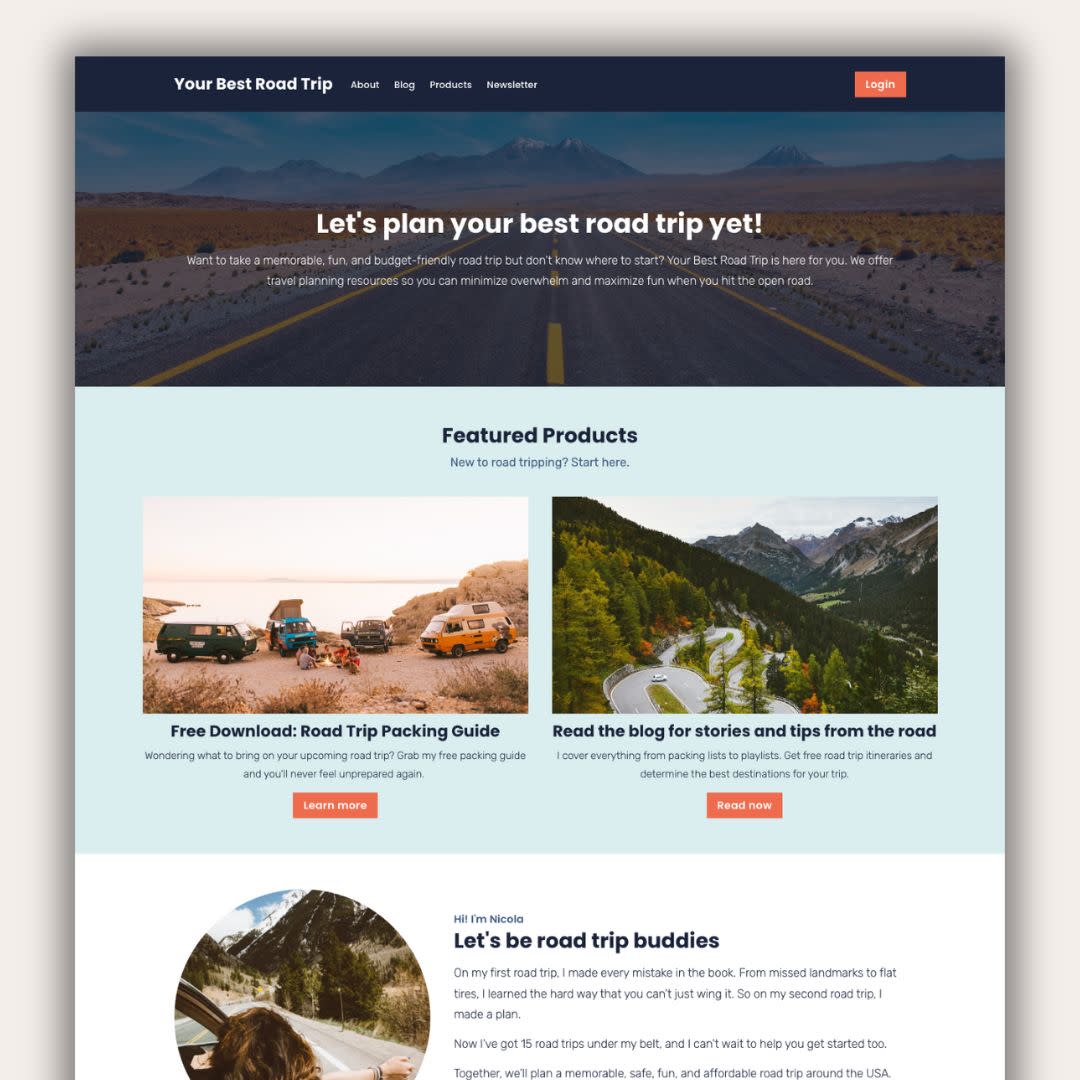
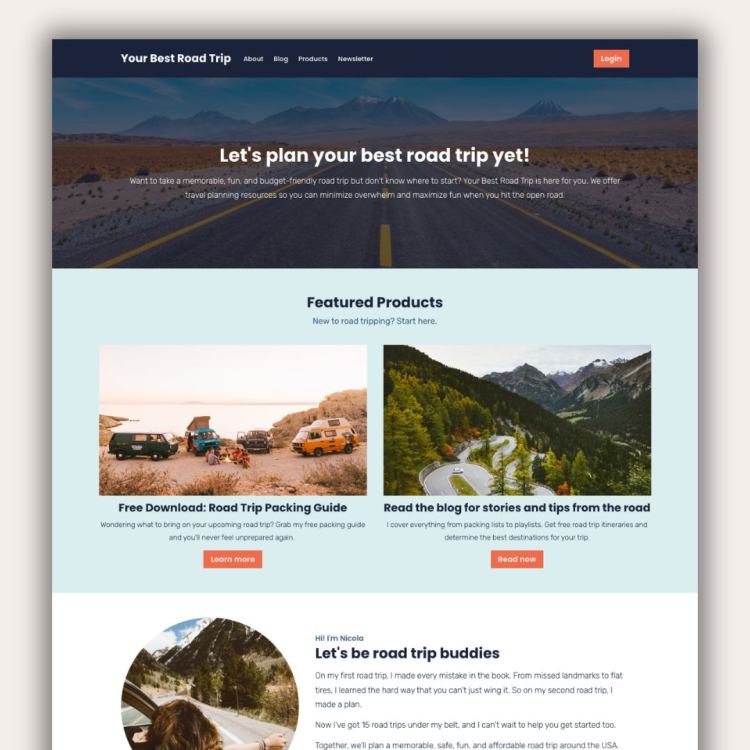
Throughout the article, you’ll see video tutorials about how to set up your website step-by-step. I’ve been wanting to make a website about one of my favorite hobbies, planning road trips, so I’ll build my new site along with you. That way you can see exactly what to do and get ideas for your own pages. 

I’m using the
Podia website builder
for these demos, but you can build your website on any platform you like. To follow along with me, grab your
free Podia account here
. 

Okay, you’ve got things to do so let’s jump right into it. Up first, what tool should you use to build a website? 

Choosing the best website builder for your business

Back in the day, setting up a website meant you had to hire a developer, learn some code, and configure all kinds of tech behind the scenes. You can still do that today if you want to, but thankfully, you don’t have to. 

Website builders are tools that let you build what you want without coding. You can set up your website pages visually and move things around however you like, then press publish. 

Some website builders also come with more features for running your online business like built-in digital products, email marketing, and content management systems. 

Here are four solid website builders to consider, starting with my personal favorite:

Podia: No surprises here!
Podia
is an all-in-one platform for running your creative online business. In less than a weekend, you can set up your website, landing pages, blog, email list, digital products, courses, affiliates, and everything else you need to start and grow a business. 

Your website, blog, and landing pages are included on the free plan and there are tons of beautiful pre-built website sections to choose from – no coding or web design experience required. Plus, website hosting, your SSL certificate, and a free Podia subdomain name are included. 

Squarespace:
Squarespace
comes with a website builder, blog, website templates, and web hosting. You can also add ecommerce website features to sell products and courses. Squarespace doesn’t have a free plan, and paid plans start at $16 per month. 

Wix:
Wix
is a free website builder that lets you set up a basic site and blog using templates. It’s a drag-and-drop builder so you don’t need to know how to code, which makes this a suitable option for beginners. You can also upgrade to a paid plan for more features like selling products, managing bookings, and basic email marketing. 

WordPress:
WordPress
is a free, open-source website-building software. Out of all the options on this list, WordPress gives you the most control and customization options, but it’s also the most technically challenging to work with. You can build pretty much anything you want, but you’ll need to use plugins and add-ons to get the most functionality. 

Even though WordPress is free, you have to pay for website hosting and your domain name. You’ll need to find a hosting provider, set up an account, install WordPress, and then add your theme and plugins to get your site up and running. 

Podia is the best website builder for beginners, small business owners, and experienced entrepreneurs because it grows with you.

  • Start a website for free
  • Sell products on the free plan
  • Build a blog with unlimited landing pages
  • Upgrade for more features (like courses and affiliates) when you’re ready

Get my free Podia account →

After you’ve picked your website builder, the next step is planning what you want your site to say. 

Planning your website content

It’s tempting to jump right into your new website builder. (Anyone else love tinkering?) But taking some time to plan makes the setup process go much smoother. Set aside an hour or two to do the following things: 

Research your audience: Who is your ideal customer or reader? Try to narrow it down and think about who exactly you’d like to work with. Then, head to YouTube, Reddit, Google reviews, or social media and look for common questions, desires, and pain points. You can use this in your website copy. 

If you want to dive deeper into audience research, check out our free Get Noticed course.

Learn how to build an audience that loves your work and with in-depth research ideas.

Join Get Noticed! for free →

Decide on your brand elements: Podia makes it super easy to customize your fonts and colors so your website feels like you. Pick your brand colors or choose from one of the color palettes built into Podia. If you have a logo, photos, headshots, or other brand assets, gather those now too. 

Outline your website structure: Decide what pages you want to have on your business website. For most people, these core pages are a great place to start: 

Pro tip: Start with less – you can always add more later.

Draft your page copy: It’s helpful to have an idea of what you want to say on each page as you set up your content in your site builder. This doesn’t have to be your final copy, but it will help you see how your website design and text work together.

Now that you’ve got a plan, it’s time to set up your website. Don’t worry if you change your mind along the way, that’s totally fine. You’ve got a starting point, so let’s do this.

Let’s build your website

The moment you’ve been waiting for. Now that you’ve picked your site builder and drafted your game plan, it’s time to build your very own website. No web development skills are needed.

I’m using Podia for my website in the examples here.
Grab your free account and we can build together
.

Setting up your main website pages

To start, let’s open up your home page by clicking on “Site” and “Edit site.” You should see a mostly empty page, and when you hover your mouse over it you’ll see a little plus sign. Click it to open the left-hand editing menu. 

In the left-hand menu, you can choose what section you’d like to add. Podia has pre-made sections for images, text, testimonials, FAQs, product features, CTAs, email sign-ups, and pretty much anything else you need. You can customize the content and design of each section you add using that left-hand sidebar. 

For this basic homepage, let’s add the following sections. 

  • Text hero that says what your business is about

  • A grid with your featured products or services

  • Bio to information about you

  • Email opt-in form

Of course, there’s way more you can do with this. When you add products to your Podia account, you’ll automatically get access to more sections like featured products and categories, but for now this this basic page works great. 

Once you’ve added the homepage sections you want, there’s one more step to make your site look and feel like you. Click on the “Design” tab in the very top menu to adjust your site-wide colors, fonts, width, images, buttons, and padding. These changes will take effect everywhere so your pages all look cohesive.

In this video, I’ll set up the homepage for my road trip website: 

[embedded content]

You can follow these same steps to set up your About page, Products page, Services page, and any other page you want to have on your website. 

To add new pages, click on the page name at the very top of the left-hand sidebar.  Click “Add new page” to create a new page. You can click the gear next to your new page to customize the URL and page name. 

Set up your blog to attract new visitors

Next, let’s
set up your blog
. Even if you’re not a blogger, I always recommend having a blog since it’s a great way to get discovered in search, share what you know, and connect with audience members.  

In Podia, click on “Blog” in the upper navigation to turn the free blog feature on. 

You’ll automatically see four sample posts loaded into your blog post page. You can delete these and add your own posts. 

Then, head back to the website editor and you’ll see two new pages in the left-hand sidebar – a “Blog” page and a “Blog post” page. Click on each one to customize the layout of your individual blog posts and your blog landing page. 

In this video, I’ll set up my road trip blog step by step so you can follow along: 

[embedded content]

Again, a blog can give you more ways to connect with your audience members and get discovered online. 

When people search for the topics you cover, your blog could be the search results that show up. That gives you an evergreen way to attract new readers, and you can include featured products and email opt-in forms in your blog posts to make more sales and stay in touch. 

Need some blogging tips? These articles can help:

Set up your email newsletter to stay in touch

It’s one thing to attract new visitors to your webpage, it’s another thing to keep them engaged with your brand. 

One of the best ways to make sure visitors don’t disappear into the wild west of the internet is to have an
email newsletter
. With email, you can communicate directly with your audience in their inbox, away from ads, distractions, and algorithms. 

Podia comes with
email marketing built in
so you don’t need to connect another tool, and you get your first 100 subscribers plus all email features for free.

(If you’re using another website platform or would like to use a different email service provider with your Podia website, you can use integrations to connect everything.)

You can add email sign-up forms throughout your website using the “Email form” and “Slim email form” sections, and you can also add a landing page for your email newsletter to make sure people don’t miss it.

To set up your email landing page, here’s what to do: 

  1. Go back to the website editor and add a new page

  2. Click the plus sign on the page and add an email sign-up form section

  3. In the text areas, tell people what they can expect when they sign up for your newsletter. What value will they get? Make it interesting for them.

  4. If you like, you can add other sections like your bio or FAQs

Once your page is set up, we’ll add it to the header in just a minute. 

Here’s the video so you can follow along: 

[embedded content]

Adding your digital products to earn income

If you plan to
sell digital products
and
courses
from your website, let’s get those set up now too. 

Podia makes it super easy to add products, and you can sell one digital download and one coaching product on the free plan. If you’d like to sell more products in your online store (like courses, webinars, unlimited downloads, and unlimited coaching products), you can upgrade to the Mover plan for unlimited everything. 

To set up your digital products, click on “Products” and click “New Product” in the upper menu. Select what type of product you’d like to add, and then you can adjust the details like title, featured image, description, pricing, availability, category, and included files. 

(Make sure to add a photo and short description for your product because Podia’s website builder can automatically show this information to save you time.)

Now when you work on your website, you can use the “Featured”, “Products,” and “Categories” sections to display your products. 

Podia automatically generates a sales page for each product, and you can customize these too. To find your product sales pages, you can scroll down to the “Products” section in the website builder and click on the product name to edit it. Then you can add sections, content, and design elements just like you did on your home page and core pages. 

Building your navigation and footer to keep everything organized

You’ve got your pages. You’ve got your blog. You’ve got your email newsletter. You’ve got your products. Now we’ll tie it all together in your header and footer so website visitors can find their way around. 

Hot take – please don’t include every single link on your website in your header. 

This is valuable real estate, so it should only direct people to your most important pages. 

When you’re starting out, I recommend linking your about page, product or service page, blog, and newsletter landing page. As you add products, you can also add a link or two to your most popular products, or whichever products you want people to start with when they’re new to your brand. 

The footer is also prime space on your website and it shows up on every page. You can add links to important pages and socials here, as well as an email newsletter sign-up form. Add a sentence about your business in the footer so people know who you are and what you do, no matter what page they land on. 

Let’s set up the header and footer together in Podia.

[embedded content]

Boring but important – domains, analytics, and other website settings

You’re almost done setting up your beautiful new website, but there are a few technical things to do before we share it with the world (I know, I know, you were hoping there would be no technical things, but these aren’t that scary.)

First, your domain. Your domain name is the website name that people type into the search bar to find your site. Podia’s domain name is
www.podia.com
, for example. 

Most free website builders include a free subdomain name. With Podia, your free subdomain is [yourbusinessname].podia.com. You can customize this in your account settings, and you can use this free domain for as long as you want – it’s already built into your account. 

If you’d like to use a custom domain name, you’ll need to purchase your own domain name from a domain registrar like GoDaddy, NameCheap, or Bluehost, and connect it to your website. 

Your website platform can give you instructions on how to connect a custom domain to your account after you’ve purchased the domain. Domains typically cost around $20/year. 

For most website builders, connecting a custom domain is available on paid plans. With Podia, you can connect a custom domain on the Starter plan which starts at $4/month. 

Next, analytics. No matter what website tool you’re using, it’s a good idea to connect Google Analytics so you can see your website traffic and learn more about your audience. You can do this by creating a free Google Analytics account. They’ll provide a little tiny piece of code that you can paste into your website tool. 

In Podia, you can connect Google Analytics in the “Settings” tab on the Starter plan and above. 

Last, set up your site-wide SEO and display settings like your website description, favicon, and SEO image. 

  • Meta description: Your meta description should be short, no more than 1-2 sentences, and include a high-level synopsis of the work you do.

  • Default image: This is the image that appears in the preview when your website is shared. It might also appear alongside your website in search results. You can create a generic brand image using Canva or use your logo.

  • Favicon: Look at the tabs you have open in your browser. Do you see the little images next to each one? These are called favicons. You can use Canva to create one of your own.

These small details can make your page look more professional. To edit these in Podia, click on the “Site settings” button at the bottom of the left-hand editing menu. 

7 Step website launch checklist

You’re almost there. I know it’s so exciting to have your online presence all set up, so let’s run through this quick website launch checklist before spreading the good news. 

#1 Check your page URLs: Go to the page settings for each page on your site (click the gear next to the page name in the site builder) and make sure the URL link is what you want it to be. No random numbers and letters. Concise and descriptive. Remove dates unless your page is time-sensitive so your URLs don’t look outdated in the future.

#2 Check your page descriptions and SEO images: While you’re in there, make sure you have a page description and SEO image that makes sense for your page. This can help tell search engines what your content is about, which can improve your rankings and give your site a more professional look. 

#3 Check your buttons: Make sure all your buttons and links go where you want them to go. When I went through my sample website, I found several places where I’d left a button pointing nowhere, so really do try to click on everything.

#4 Delete filler text: If you used filler text (like Lorem ipsum) delete it before going live. When you insert a new section into your site, it will autofill text so you can see what the section looks like. Make sure you’ve swapped in your own words or deleted any text you’re not using. I’ve even seen huge corporate sites that forget to do this.

#5 Check your website on different devices: Pull up your website on your mobile device and desktop. Try to view it on as many different screen sizes as possible. Are there any areas that look wonky? Now’s the time to adjust.

#6 Run your entire site through Grammarly or another online proofreader: Grammarly is a free online spelling and grammar checker. I highly recommend copying and pasting every bit of text you’ve written into Grammarly before publishing. (Confession time, I just pasted my road trip website text into Grammarly and found some very silly errors… Don’t skip this step!)

#7 Ask for feedback: Finally, send your website to a few trusted friends or loved ones for feedback. They can let you know if something’s hard to read, the navigation is confusing, a product needs more explanation, or a page is showing up funny on their devices. Sometimes looking at something for hours makes us miss details others see right away. 

If you don’t have anyone you feel comfortable asking, head to the
Podia Community
. It’s free for all Podia users, and you can post your website in the “I made this” topic to get feedback from other small business owners.  

Remember, done is better than perfect. The beautiful thing about websites is that you can update them whenever you want. If you notice a typo next week, you can hop in and fix it. If you want to change your About page or decide that a picture isn’t working for you anymore, that’s an easy fix too. Don’t let perfectionism prevent you from launching. Let’s get your work out there.

You have a beautiful professional website. Now what?

You didn’t think you were done, did you?

Just kidding. Kind of. 

You’ve got an amazing website, and that’s just the beginning. There’s so much you can do as a small business owner with an online presence, and here are some ideas for how you can keep growing and taking your business to the next level. 

  • Grow your email list with a lead magnet: Entice new visitors to join your list with a freebie. You can set this up by adding a digital product and setting the price to “Free Email Delivery.” (
    Learn more here
    )

  • Set up a welcome email for new subscribers: Automatically send a welcome message when new subscribers join your list. You can build this in the “Campaigns” section of your Podia Email tab. (
    Step-by-step instructions here
    )

  • Create a link in bio page for your social media accounts: Add a new page to your website that directs people to your most important content. You can link this page on all your social media platforms with just a click. (
    Step-by-step guide here
    )

  • Experiment with different digital products: Courses, downloads, coaching, webinars, bundles – brainstorm different digital products that could work for your audience and give them a try. (
    Read tutorials here
    )

I want to extend an enthusiastic double-high-five to you for the work you’ve done on your website. Building a website is no small task, and you’ve done an amazing job. Websites ultimately act as an extension of ourselves in the digital world, and now you’re ready to share yours with pride. 

And if you’re still looking for a place to call home, we’d love to have you at Podia. Podia lets you build your entire website for free, and you can set up your email list, blog, landing page, and digital products too.
Sign up for free to get started
. 

That’s all there is to it. Now you’re ready to delight, inspire, inform, entertain, and educate your friends, fans, and customers. Have fun out there!

Get your free Podia account

Join the 150,000+ creators who use Podia to create websites, sell digital products, and build online communities.

Sign up free

8 best alternatives to Thinkific for online creators (Features & pricing)

Software Stack Editor · July 6, 2024 ·

Find the best alternative to Thinkific for selling digital goods, building online courses, and growing communities.

Jump ahead

In this article

Looking for a place to sell online courses? You might have heard about an e-learning platform called Thinkific.

With Thinkific, creators can offer free and paid programs to unlimited students. You can upload as much course content as you want and even build a storefront to promote your offerings.

Thinkific is well-established in the course creation space, but it might not be the best fit for creators who want to branch out with other product types.

In this guide, we’ll cover the pros and cons of Thinkific as well as eight Thinkific alternatives to consider if it’s not right for your business.

Note: All pricing is accurate at the time of writing, but this is subject to change over time.

Thinkific pros and cons

Thinkific pros

Free plan: One of the biggest upsides of Thinkific is their free plan. Without paying anything upfront, you can sell a limited number of courses to unlimited students. There aren’t any transaction fees, and if you need more features, you can upgrade to a paid plan when you’re ready.

Here’s a look at the full Thinkific pricing breakdown:

Unlimited courses: If you choose to upgrade to a paid plan, you’ll be able to make unlimited courses and host as much content as you like. Some plans include helpful features like
course completion certificates
, assignments, and lesson prerequisites.

Website builder: Creators can use Thinkific’s drag-and-drop page builder to set up a website or storefront for their products. There are also website templates you can use to jumpstart your creativity.

Thinkific app store: If you need more functionality, the Thinkific app store comes with additional integrations and features. But be aware that some of these come at an extra cost.

Thinkific cons

It’s difficult to sell digital products other than courses: Courses are Thinkific’s bread and butter, but these days, there are countless ways to share your knowledge. If you plan to sell digital downloads, memberships, live streams, webinars, coaching programs, or services, Thinkific isn’t the best fit since it’s primarily optimized for online courses.

You never know where your creator business will take you, and only being able to offer one type of product could be a severe limitation as you grow.

Thinkific’s free and Basic plans lack key features: Thinkific offers a free plan and a $49 per month Basic plan, but these options are missing important tools that might make them unusable for some creators.

You can only make three courses on the free plan, and to access many essential features, you’ll need to use Thinkific’s $99 per month Pro plan or above.

The Growth add-on: Creators will need to pay more for Thinkific’s Growth add-on to use premium tools. This can only be purchased as an addition to the $99/month Pro plan, and it costs an extra $50/month.

Advanced integrations, the ability to remove Thinkific branding, Zapier actions, unlimited communities, student segmentation tools, and bulk student messaging are some features that are only accessible with the Growth add-on.

Limited email functionality: Email marketing is essential for many online businesses, but Thinkific’s email tools may be too basic for many creators. You must be on the Pro plan with the Growth add-on to access features like
email segmentation
and bulk messages, or you’ll need to integrate with a
third-party email service
which likely has additional fees.

Ultimately, the course platform you choose depends on the unique needs of your business. If you determine that Thinkific is not right for you, here are eight alternatives you can check out instead.

8 Thinkific alternatives for creators

1. Podia (Best all-in-one platform for online creators)

Podia is an all-in-one tool for bringing your online business to life. While Thinkific mainly focuses on course creation, Podia lets creators sell
courses
,
digital downloads
,
webinars
, and
coaching sessions
. You can also manage email marketing, affiliates, and your website under one roof.

Want to sell online courses? With Podia’s course builder, you can design a clean, visually appealing learning experience for your students in minutes. You can also offer multiple payment plans, message students through our on-page chat widget, and embed content from 1,900+ third-party platforms like SoundCloud, Typeform, and Github directly into your courses.

Want to sell dozens of printables and PDF files? Go for it! There are no product limits on Mover and Shaker plans, so you can let your creativity soar.

Want to build a website? Podia has a generous free plan that includes
a full website for your business
. You don’t need to learn code or hire a developer. Simply use our intuitive page builder to create a digital home you love, complete with unlimited sales pages for your products and offerings.

According to
Podia creator
and
piano instructor Joseph D’Amico
, “Podia makes website building so fun. I feel like I could set up a site in an afternoon, and it would look great. And if there’s something to be said for how pretty it is. It’s the best-looking one by far.”

But Podia’s free plan doesn’t stop there. You can also set up your blog, build unlimited landing pages, start your email list, and sell one digital download and one coaching product. You can even make draft courses, webinars, and product bundles which can be launched whenever you’re ready to upgrade your plan.

Beyond the free plan, Podia’s Starter, Mover, and Shaker plans are competitively priced and packed with all the tools you need to run your business. Compared to Thinkific, you get a wider range of resources for a lower price with Podia.

Bottom line: Podia was built to grow with you no matter where your creator journey takes you.

Podia features:

  • All-in-one alternative to Thinkific

  • Sell unlimited courses, digital downloads, webinars, communities, and coaching sessions on Mover and Shaker plans

  • Build a full, SEO-friendly website on all plans

  • Email marketing
    ,
    affiliate marketing
    , upsells, coupons, and
    customer messaging

  • Free migrations
    for annual Mover and Shaker plan participants

  • Fast and friendly
    customer support

  • Payment integrations with Stripe and PayPal

  • Instant payouts

  • Custom domains on paid plans

Podia pricing:

  • Free plan: (10% transaction fee)

  • Starter: $9/month or $4/month when paid annually (8% transaction fee)

  • Mover: $39/month or $33/month when paid annually (5% transaction fee)

  • Shaker: $89/month or $75/month when paid annually

Learn more about how Podia compares to Thinkific
.

Get your free Podia account now
to see these features in action.

Get your free Podia account

Join the 150,000+ creators who use Podia to create websites, sell digital products, and build online communities.

Sign up free

2. Teachable

Teachable is an online course platform where you can sell unlimited courses and
coaching programs
on all plans, including their free plan. Creators get access to course design templates, you can build a storefront for all your product offerings, and sales made through Teachable’s payment gateway are eligible for instant payouts.

Teachable features:

  • Sell courses and coaching

  • Build customizable
    sales pages
    for your courses and products

  • Coupons, subscriptions, one-time payments, memberships, and bundles

  • Basic email functionality

  • Affiliate management
    resources

Teachable benefits: When you build courses with Teachable, you can enable course completion certificates and add interactive elements like quizzes. There are helpful integrations you can connect with if you need more functionality. In addition to letting you sell unlimited courses and coaching products, Teachable handles behind-the-scenes financial tasks like paying you, your affiliates, and other authors.

Teachable downsides:Teachable is not ideal for
selling digital downloads
or building a brand community. To sell communities, you must integrate with a third-party online community platform called Circle, which comes with additional costs. Also, Teachable charges high transaction fees on the free plan ($1 per sale plus 10% transaction fee).

Teachable pricing:

3. Kajabi

Kajabi is an all-in-one alternative to Thinkific, where you can sell courses, digital products, coaching, memberships, and
podcasts
. You can also use Kajabi to handle your email marketing, run your affiliate program, build your website, and track your analytics.

Kajabi also offers in-depth
sales funnels
called pipelines. Pipelines are automation templates that help you achieve a specific goal, like nurturing leads or
launching a new product.

Kajabi features:

  • Sell courses, downloads, coaching, memberships, podcasts, and communities

  • Email marketing
    , affiliates, and analytics

  • Website builder and templates

  • For podcasters: Sell members-only podcasts and manage your podcast subscribers

  • Create advanced sales funnels

Kajabi benefits: Like Podia, Kajabi is an all-in-one alternative to Thinkific, which means you’ll get access to a robust suite of tools for one monthly rate. There are no transaction fees on any plans, and Kajabi has a mobile app so students can view their courses on the move.

Kajabi downsides: Kajabi comes at a higher price point than similar tools in this space. In addition to the cost, Kajabi limits the number of products you can make on all plans and the number of active members in your programs.

Here are the limits on Kajabi plans:

  • Kickstarter: one pipeline, one product, 50 active customers

  • Basic: three pipelines, three products, 1,000 active members

  • Growth: 15 pipelines, 15 products, 10,000 active members

  • Pro: 100 pipelines, 100 products, 20,000 active members

Our survey of over 900 creative entrepreneurs found that creators have an average of 10.95 products, which would mean many have to use the pricey Growth plan.

Kajabi pricing:

  • Kickstarter: $69/month

  • Basic: $149/month

  • Growth: $199/month

  • Pro: $399/month

4. Teachery

Teachery makes course building simple. This software was made by course creators, for course creators, and provides just the things you need without extra bells and whistles.

With Teachery’s white-label course platform, you can upload your content into two sleek layouts, create unlimited lessons, and house helpful resources for your students in one place. When selling your courses, you’re free to make unlimited payment pages and charge a one-time fee, a recurring rate, or nothing at all.

Teachery features:

  • Unlimited courses, lessons, and students

  • Straightforward course builder with two templates

  • Sell memberships and bundle products

  • Create sales pages and
    landing pages

  • Integrations with Mailchimp, ConvertKit, and Zapier

  • Affiliate program

Teachery benefits: Teachery offers two payment plans, monthly and annual. Both options come with everything, so you don’t have to upgrade your plan or pay for additional add-ons as you grow.

Teachery also has a Zapier integration that allows you to connect the tool with other software in your technology stack.

Teachery downsides: Teachery is primarily used for selling courses, and it’s not optimized for selling digital downloads or services like coaching. There’s no community feature, and plans don’t include video or audio hosting. Instead, you’ll need to work with a third-party tool like Wistia, Vimeo, or YouTube.

Teachery pricing:

  • Monthly plan: $49/month

  • Annual plan: $470/year

5. LearnDash

With LearnDash, you can
sell unlimited courses to unlimited students from your WordPress site
. Create self-study programs, drip content over time, run a course forum, and gamify your program with leaderboards, course points, and badges.

You can list your courses as memberships, subscriptions, one-time payments, or product bundles. On the design front, LearnDash has customization options and works alongside most WordPress themes and page builders like Elementor.

LearnDash features:

  • Sell courses from your own website

  • Drag and drop course builder

  • One-time payments, subscriptions, memberships, bundles, and bulk licenses

  • Gamification, quizzes, certifications, badges, leaderboards, and evaluations

  • Drip feeds, prerequisites, and required videos to improve course completion rates

LearnDash benefits: The LearnDash online course platform can be used with almost any WordPress theme. Creators who love using WordPress can add course functionality to their existing site with just a few clicks. To use the LearnDash software, you simply pay a flat rate per year based on how many site licenses you need. There are no transaction fees.

LearnDash downsides: On the feature front, LearnDash doesn’t have a webinar tool or a way to teach live. You can only send basic email notifications to students, so you’ll need to connect another tool for advanced email marketing features.

If you want to
build an affiliate program for your course
, you’ll also need additional software since this isn’t a LearnDash feature. Most importantly, LearnDash is a WordPress learning management system (LMS) plugin that must be used with a WordPress website.

While this is fine for creators who already have WordPress experience, beginners might face a steep learning curve. You may need to hire a developer for advanced customizations and functionality. You’ll be responsible for connecting, maintaining, and paying for add-on tools to make your site function the way you want.

On top of that, you’ll need to pay for your domain registration and third-party WordPress hosting, as well as any premium themes you may be using. Check out this guide to learn more about
website hosting
.

LearnDash pricing:

6. LearnWorlds

Like Thinkific, LearnWorlds puts online course creation at the forefront. Creators can sell unlimited courses with different payment options and elevate their content with LearnWorlds’s unique interactive video features. LearnWorlds lets you generate subtitles, automatic transcripts, and eye-catching overlays for your course videos. Content annotation tools are available to help your students engage deeply with your materials.

Also, LearnWorlds is a strong Thinkific alternative for creators who want to build their own mobile learning app.In addition to selling courses, subscriptions, and
memberships
, creators can design a white-label mobile learning platform for their students. This functionality is available to creators on the $299/month Learning Center plan for an additional cost.

LearnWorlds features:

  • Sell courses, memberships, subscriptions, and your own mobile learning app

  • Website and sales page builder

  • Pop up builder

  • Drip courses

  • Manage affiliates

  • Create an online community

  • Interactive video and course content tools

LearnWorlds benefits: LearnWorlds offers various interactive course elements like assessments, quizzes, question banks, and course completion certificates. You can edit your videos and generate transcripts directly on the LearnWorlds platform.

LearnWorlds also gives you the ability to create a white-label mobile learning app with notifications and in-app purchases for an extra fee.

LearnWorlds downsides: Since LearnWorlds is so focused on selling courses, it’s not ideal for creators who offer digital downloads, coaching, communities, and services. There’s no free plan, and the $29/month Starter plan has some limitations. You can’t offer free courses at this level, and you’ll pay a $5 fee on each course sale you make, which could add up fast.

Also, the Starter plan only comes with a three-page website. You must be on the Pro Trainer plan to build a complete website and offer free courses, memberships, subscriptions, and webinars.

LearnWorlds pricing:

  • Starter: $29/month (+$5 fee per course sale)

  • Pro Trainer: $99/month

  • Learning Center: $299/month

  • Corporate: Custom pricing

7. Mighty Networks

Mighty Networks is designed for running free and paid online communities. While creators can sell courses on the Business plan, the community feature is clearly the star of the show. Users like the sleek community interface and top-notch features like unlimited members, notifications, live streaming, events, and API integrations with Zapier.

If you upgrade to unlock the course creation tools, you can drip content, add additional instructors, and build a special community area for course participants.

Need a mobile app for your brand? Larger companies and businesses can sign up for Mighty Pro to design their own white-label mobile app.

Mighty Networks features:

  • Run a free or paid community with unlimited members and moderators

  • Communication features for community members like group chats and messaging

  • Create a membership site to house premium content

  • Business plan participants can create live or cohort courses

Mighty Networks benefits: On Mighty Networks’ Business plan, you can create courses with designated community areas. Communities come with advanced features like virtual and in-person events, rich member profiles, and a Discovery page for members to find new content.

Mighty Networks downsides: Mighty Networks is not optimal for selling services and coaching. It’s primarily for creators who want their community to be front and center, which may mean more real-time work than a traditional self-paced course.

You can only sell courses on the Business plan, and Mighty Networks charges transaction fees on all plans. The platform also lacks email marketing features and a website builder, but you can make a landing page to promote your community.

Mighty Networks pricing:

  • Free trial: (5% transaction fee)

  • Community plan: $39/month (3% transaction fee)

  • Business plan: $119/month (2% transaction fee)

  • Mighty Pro: Custom pricing

8. Udemy

Unlike the other platforms in this post, Udemy is an online learning marketplace where you can sell your courses to a wider audience. All you need to do is upload your
course videos
and content, and Udemy handles the bulk of the marketing for you.

Considering that they have a sizable audience of 40+ million worldwide students, this is a good option for creators who want to take a hands-off approach to selling courses.Udemy pays out using a revenue-sharing model.Udemy’s revenue-sharing plan:

Simply put, Udemy can be a good fit if you’d rather not mess with digital marketing, but you’ll earn significantly more if you send students to your course using your referral code.

Udemy features:

  • The platform has approximately 185,000 online video courses available

  • Intuitive course builder

  • Revenue sharing plan

  • Students can leave course reviews

Udemy benefits: Udemy makes it easy for new creators to get started, and you won’t need a ton of extra
marketing tools to share your course
with a broad audience. Students can find you directly through the platform, and Udemy has a popular affiliate marketing program. Affiliates you don’t know may promote your course to their audience, earning you extra cash.

Udemy downsides: With Udemy, you have less control over your course format and pricing. Udemy will essentially control the learning experience, and you can’t create cohorts, drip courses, or real-time offerings.

There are caps on how much you can charge for your course, and it could be sold for a fraction of the usual price if you choose to participate in site-wide deals. Udemy must approve video lessons, and there are requirements for length and quality. While a hands-off platform may sound enticing, you may earn less than if you use a creator platform that gives you control over your course sales and audience.

For example, Podia creator
John D. Saunders
earned $1,100 in revenue on Udemy with 1,900 customers.
When he switched to Podia
, he earned $10,000 on launch day alone and has since earned over $200,000.

Finally, Udemy doesn’t include a website, sales pages, email tools, or the ability to sell diverse product types like memberships, coaching, and digital downloads.

Udemy pricing:

  • Free for instructors

Which alternative to Thinkific is right for your business?

Best free alternative to Thinkific:

More affordable Thinkific alternatives:

  • Podia: Paid plans start at $4/month with an 8% transaction fee

  • LearnWorlds: Plans start at $29/month

  • Teachery: The annual plan comes out to about $39/month, with no transaction fees

  • LearnDash: Plans start at $199/year

  • Mighty Networks: Plans start at $39/month

Best Thinkific alternatives that integrate with WordPress:

Best all-in-one alternative to Thinkific: Podia

With Podia, you can easily sell courses, webinars, coaching, and digital downloads without limits on Mover and Shaker plans. To connect with your audience, you can create a lively free or paid online community as a stand-alone offering or a complement to your courses.

Because Podia is an all-in-one tool, you also get access to email, affiliates, a website builder, and customer messaging. Podia is the ideal option for creators who want their entire online business in one place, without a steep price tag.

Make your free Podia account today.

Get your free Podia account

Join the 150,000+ creators who use Podia to create websites, sell digital products, and build online communities.

Sign up free

8 best alternatives to Thinkific for online creators (Features & pricing)

Software Stack Editor · July 6, 2024 ·

Looking for a place to sell online courses? You might have heard about an e-learning platform called Thinkific.

With Thinkific, creators can offer free and paid programs to unlimited students. You can upload as much course content as you want and even build a storefront to promote your offerings.

Thinkific is well-established in the course creation space, but it might not be the best fit for creators who want to branch out with other product types.

In this guide, we’ll cover the pros and cons of Thinkific as well as eight Thinkific alternatives to consider if it’s not right for your business.

Note: All pricing is accurate at the time of writing, but this is subject to change over time.

Thinkific pros and cons

Thinkific Alternatives: Image 1

Thinkific pros

Free plan: One of the biggest upsides of Thinkific is their free plan. Without paying anything upfront, you can sell a limited number of courses to unlimited students. There aren’t any transaction fees, and if you need more features, you can upgrade to a paid plan when you’re ready.

Here’s a look at the full Thinkific pricing breakdown:

Thinkific Alternatives: Image 2

Unlimited courses: If you choose to upgrade to a paid plan, you’ll be able to make unlimited courses and host as much content as you like. Some plans include helpful features like course completion certificates, assignments, and lesson prerequisites.

Website builder: Creators can use Thinkific’s drag-and-drop page builder to set up a website or storefront for their products. There are also website templates you can use to jumpstart your creativity.

Thinkific app store: If you need more functionality, the Thinkific app store comes with additional integrations and features. But be aware that some of these come at an extra cost.

Thinkific cons

It’s difficult to sell digital products other than courses: Courses are Thinkific’s bread and butter, but these days, there are countless ways to share your knowledge. If you plan to sell digital downloads, memberships, live streams, webinars, coaching programs, or services, Thinkific isn’t the best fit since it’s primarily optimized for online courses.

You never know where your creator business will take you, and only being able to offer one type of product could be a severe limitation as you grow.

Thinkific’s free and Basic plans lack key features: Thinkific offers a free plan and a $49 per month Basic plan, but these options are missing important tools that might make them unusable for some creators.

You can only make three courses on the free plan, and to access many essential features, you’ll need to use Thinkific’s $99 per month Pro plan or above.

The Growth add-on: Creators will need to pay more for Thinkific’s Growth add-on to use premium tools. This can only be purchased as an addition to the $99/month Pro plan, and it costs an extra $50/month.

Advanced integrations, the ability to remove Thinkific branding, Zapier actions, unlimited communities, student segmentation tools, and bulk student messaging are some features that are only accessible with the Growth add-on.

Limited email functionality: Email marketing is essential for many online businesses, but Thinkific’s email tools may be too basic for many creators. You must be on the Pro plan with the Growth add-on to access features like email segmentation and bulk messages, or you’ll need to integrate with a third-party email service which likely has additional fees.

Ultimately, the course platform you choose depends on the unique needs of your business. If you determine that Thinkific is not right for you, here are eight alternatives you can check out instead.

8 Thinkific alternatives for creators

1. Podia (Best all-in-one platform for online creators)

All-in-One Platform

Podia is an all-in-one tool for bringing your online business to life. While Thinkific mainly focuses on course creation, Podia lets creators sell courses, digital downloads, webinars, and coaching sessions. You can also manage email marketing, affiliates, and your website under one roof.

Want to sell online courses? With Podia’s course builder, you can design a clean, visually appealing learning experience for your students in minutes. You can also offer multiple payment plans, message students through our on-page chat widget, and embed content from 1,900+ third-party platforms like SoundCloud, Typeform, and Github directly into your courses.

Want to sell dozens of printables and PDF files? Go for it! There are no product limits on Mover and Shaker plans, so you can let your creativity soar.

Want to build a website? Podia plans include a full website for your business. You don’t need to learn code or hire a developer. Simply use our intuitive page builder to create a digital home you love, complete with unlimited sales pages for your products and offerings.

According to Podia creator and piano instructor Joseph D’Amico, “Podia makes website building so fun. I feel like I could set up a site in an afternoon, and it would look great. And if there’s something to be said for how pretty it is. It’s the best-looking one by far.”

But Podia doesn’t stop there. You can also set up your blog, build unlimited landing pages, start your email list, and sell unlimited digital downloads and coaching products. You can even make courses, webinars, and product bundles which can be launched whenever you’re ready.

Podia’s Mover and Shaker plans are competitively priced and packed with all the tools you need to run your business. Compared to Thinkific, you get a wider range of resources for a lower price with Podia.

Bottom line: Podia was built to grow with you no matter where your creator journey takes you.

Podia features:

  • All-in-one alternative to Thinkific

  • Sell unlimited courses, digital downloads, webinars, and coaching sessions on Mover and Shaker plans

  • Build a full, SEO-friendly website on all plans

  • Email marketing, affiliate marketing, upsells, coupons, and customer messaging

  • Free migrations for annual Mover and Shaker plan participants

  • Fast and friendly customer support

  • Payment integrations with Stripe and PayPal

  • Instant payouts

  • Custom domains

Podia pricing:

Learn more about how Podia compares to Thinkific.

Get your free 30-day trial from Podia now to see these features in action.

2. Teachable

Thinkific Alternatives: Image 7

Teachable is an online course platform where you can sell unlimited courses and coaching programs on all plans, including their free plan. Creators get access to course design templates, you can build a storefront for all your product offerings, and sales made through Teachable’s payment gateway are eligible for instant payouts.

Teachable features:

  • Sell courses and coaching

  • Build customizable sales pages for your courses and products

  • Coupons, subscriptions, one-time payments, memberships, and bundles

  • Basic email functionality

  • Affiliate management resources

Teachable benefits: When you build courses with Teachable, you can enable course completion certificates and add interactive elements like quizzes. There are helpful integrations you can connect with if you need more functionality. In addition to letting you sell unlimited courses and coaching products, Teachable handles behind-the-scenes financial tasks like paying you, your affiliates, and other authors.

Teachable downsides: Teachable is not ideal for selling digital downloads or building a brand community. To sell communities, you must integrate with a third-party online community platform called Circle, which comes with additional costs. Also, Teachable charges high transaction fees on the free plan ($1 per sale plus 10% transaction fee).

Teachable pricing:

3. Kajabi

Thinkific Alternatives: Image 9

Kajabi is an all-in-one alternative to Thinkific, where you can sell courses, digital products, coaching, memberships, and podcasts. You can also use Kajabi to handle your email marketing, run your affiliate program, build your website, and track your analytics.

Kajabi also offers in-depth sales funnels called pipelines. Pipelines are automation templates that help you achieve a specific goal, like nurturing leads or launching a new product.

Kajabi features:

  • Sell courses, downloads, coaching, memberships, podcasts, and communities

  • Email marketing, affiliates, and analytics

  • Website builder and templates

  • For podcasters: Sell members-only podcasts and manage your podcast subscribers

  • Create advanced sales funnels

Kajabi benefits: Like Podia, Kajabi is an all-in-one alternative to Thinkific, which means you’ll get access to a robust suite of tools for one monthly rate. There are no transaction fees on any plans, and Kajabi has a mobile app so students can view their courses on the move.

Kajabi downsides: Kajabi comes at a higher price point than similar tools in this space. In addition to the cost, Kajabi limits the number of products you can make on all plans and the number of active members in your programs.

Here are the limits on Kajabi plans:

  • Kickstarter: one pipeline, one product, 50 active customers

  • Basic: three pipelines, three products, 1,000 active members

  • Growth: 15 pipelines, 15 products, 10,000 active members

  • Pro: 100 pipelines, 100 products, 20,000 active members

Our survey of over 900 creative entrepreneurs found that creators have an average of 10.95 products, which would mean many have to use the pricey Growth plan.

Kajabi pricing:

  • Kickstarter: $69/month

  • Basic: $149/month

  • Growth: $199/month

  • Pro: $399/month

4. Teachery

Thinkific Alternatives: Image 10

Teachery makes course building simple. This software was made by course creators, for course creators, and provides just the things you need without extra bells and whistles.

With Teachery’s white-label course platform, you can upload your content into two sleek layouts, create unlimited lessons, and house helpful resources for your students in one place. When selling your courses, you’re free to make unlimited payment pages and charge a one-time fee, a recurring rate, or nothing at all.

Teachery features:

  • Unlimited courses, lessons, and students

  • Straightforward course builder with two templates

  • Sell memberships and bundle products

  • Create sales pages and landing pages

  • Integrations with Mailchimp, ConvertKit, and Zapier

  • Affiliate program

Teachery benefits: Teachery offers two payment plans, monthly and annual. Both options come with everything, so you don’t have to upgrade your plan or pay for additional add-ons as you grow.

Teachery also has a Zapier integration that allows you to connect the tool with other software in your technology stack.

Teachery downsides: Teachery is primarily used for selling courses, and it’s not optimized for selling digital downloads or services like coaching. There’s no community feature, and plans don’t include video or audio hosting. Instead, you’ll need to work with a third-party tool like Wistia, Vimeo, or YouTube.

Teachery pricing:

  • Monthly plan: $49/month

  • Annual plan: $470/year

5. LearnDash

Thinkific Alternatives: Image 11

With LearnDash, you can sell unlimited courses to unlimited students from your WordPress site. Create self-study programs, drip content over time, run a course forum, and gamify your program with leaderboards, course points, and badges.

You can list your courses as memberships, subscriptions, one-time payments, or product bundles. On the design front, LearnDash has customization options and works alongside most WordPress themes and page builders like Elementor.

LearnDash features:

  • Sell courses from your own website

  • Drag and drop course builder

  • One-time payments, subscriptions, memberships, bundles, and bulk licenses

  • Gamification, quizzes, certifications, badges, leaderboards, and evaluations

  • Drip feeds, prerequisites, and required videos to improve course completion rates

LearnDash benefits: The LearnDash online course platform can be used with almost any WordPress theme. Creators who love using WordPress can add course functionality to their existing site with just a few clicks. To use the LearnDash software, you simply pay a flat rate per year based on how many site licenses you need. There are no transaction fees.

LearnDash downsides: On the feature front, LearnDash doesn’t have a webinar tool or a way to teach live. You can only send basic email notifications to students, so you’ll need to connect another tool for advanced email marketing features.

If you want to build an affiliate program for your course, you’ll also need additional software since this isn’t a LearnDash feature. Most importantly, LearnDash is a WordPress learning management system (LMS) plugin that must be used with a WordPress website.

While this is fine for creators who already have WordPress experience, beginners might face a steep learning curve. You may need to hire a developer for advanced customizations and functionality. You’ll be responsible for connecting, maintaining, and paying for add-on tools to make your site function the way you want.

On top of that, you’ll need to pay for your domain registration and third-party WordPress hosting, as well as any premium themes you may be using. Check out this guide to learn more about website hosting.

LearnDash pricing:

6. LearnWorlds

Thinkific Alternatives: Image 12

Like Thinkific, LearnWorlds puts online course creation at the forefront. Creators can sell unlimited courses with different payment options and elevate their content with LearnWorlds’s unique interactive video features. LearnWorlds lets you generate subtitles, automatic transcripts, and eye-catching overlays for your course videos. Content annotation tools are available to help your students engage deeply with your materials.

Also, LearnWorlds is a strong Thinkific alternative for creators who want to build their own mobile learning app.In addition to selling courses, subscriptions, and memberships, creators can design a white-label mobile learning platform for their students. This functionality is available to creators on the $299/month Learning Center plan for an additional cost.

LearnWorlds features:

  • Sell courses, memberships, subscriptions, and your own mobile learning app

  • Website and sales page builder

  • Pop up builder

  • Drip courses

  • Manage affiliates

  • Create an online community

  • Interactive video and course content tools

LearnWorlds benefits: LearnWorlds offers various interactive course elements like assessments, quizzes, question banks, and course completion certificates. You can edit your videos and generate transcripts directly on the LearnWorlds platform.

LearnWorlds also gives you the ability to create a white-label mobile learning app with notifications and in-app purchases for an extra fee.

LearnWorlds downsides: Since LearnWorlds is so focused on selling courses, it’s not ideal for creators who offer digital downloads, coaching, communities, and services. There’s no free plan, and the $29/month Starter plan has some limitations. You can’t offer free courses at this level, and you’ll pay a $5 fee on each course sale you make, which could add up fast.

Also, the Starter plan only comes with a three-page website. You must be on the Pro Trainer plan to build a complete website and offer free courses, memberships, subscriptions, and webinars.

LearnWorlds pricing:

  • Starter: $29/month (+$5 fee per course sale)

  • Pro Trainer: $99/month

  • Learning Center: $299/month

  • Corporate: Custom pricing

7. Mighty Networks

Thinkific Alternatives: Image 14

Mighty Networks is designed for running free and paid online communities. While creators can sell courses on the Business plan, the community feature is clearly the star of the show. Users like the sleek community interface and top-notch features like unlimited members, notifications, live streaming, events, and API integrations with Zapier.

If you upgrade to unlock the course creation tools, you can drip content, add additional instructors, and build a special community area for course participants.

Need a mobile app for your brand? Larger companies and businesses can sign up for Mighty Pro to design their own white-label mobile app.

Mighty Networks features:

  • Run a free or paid community with unlimited members and moderators

  • Communication features for community members like group chats and messaging

  • Create a membership site to house premium content

  • Business plan participants can create live or cohort courses

Mighty Networks benefits: On Mighty Networks’ Business plan, you can create courses with designated community areas. Communities come with advanced features like virtual and in-person events, rich member profiles, and a Discovery page for members to find new content.

Mighty Networks downsides: Mighty Networks is not optimal for selling services and coaching. It’s primarily for creators who want their community to be front and center, which may mean more real-time work than a traditional self-paced course.

You can only sell courses on the Business plan, and Mighty Networks charges transaction fees on all plans. The platform also lacks email marketing features and a website builder, but you can make a landing page to promote your community.

Mighty Networks pricing:

  • Free trial: (5% transaction fee)

  • Community plan: $39/month (3% transaction fee)

  • Business plan: $119/month (2% transaction fee)

  • Mighty Pro: Custom pricing

8. Udemy

Thinkific Alternatives: Image 15

Unlike the other platforms in this post, Udemy is an online learning marketplace where you can sell your courses to a wider audience. All you need to do is upload your course videos and content, and Udemy handles the bulk of the marketing for you.

Considering that they have a sizable audience of 40+ million worldwide students, this is a good option for creators who want to take a hands-off approach to selling courses. Udemy pays out using a revenue-sharing model. Udemy’s revenue-sharing plan:

Simply put, Udemy can be a good fit if you’d rather not mess with digital marketing, but you’ll earn significantly more if you send students to your course using your referral code.

Udemy features:

  • The platform has approximately 185,000 online video courses available

  • Intuitive course builder

  • Revenue sharing plan

  • Students can leave course reviews

Udemy benefits: Udemy makes it easy for new creators to get started, and you won’t need a ton of extra marketing tools to share your course with a broad audience. Students can find you directly through the platform, and Udemy has a popular affiliate marketing program. Affiliates you don’t know may promote your course to their audience, earning you extra cash.

Udemy downsides: With Udemy, you have less control over your course format and pricing. Udemy will essentially control the learning experience, and you can’t create cohorts, drip courses, or real-time offerings.

There are caps on how much you can charge for your course, and it could be sold for a fraction of the usual price if you choose to participate in site-wide deals. Udemy must approve video lessons, and there are requirements for length and quality. While a hands-off platform may sound enticing, you may earn less than if you use a creator platform that gives you control over your course sales and audience.

For example, Podia creator John D. Saunders earned $1,100 in revenue on Udemy with 1,900 customers. When he switched to Podia, he earned $10,000 on launch day alone and has since earned over $200,000.

Finally, Udemy doesn’t include a website, sales pages, email tools, or the ability to sell diverse product types like memberships, coaching, and digital downloads.

Udemy pricing:

  • Free for instructors

Which alternative to Thinkific is right for your business?

Best free alternative to Thinkific:

More affordable Thinkific alternatives:

  • Podia: Plans start at $33/month with a 5% transaction fee

  • LearnWorlds: Plans start at $29/month

  • Teachery: The annual plan comes out to about $39/month, with no transaction fees

  • LearnDash: Plans start at $199/year

  • Mighty Networks: Plans start at $39/month

Best Thinkific alternatives that integrate with WordPress:

Best all-in-one alternative to Thinkific: Podia

With Podia, you can easily sell courses, webinars, coaching, and digital downloads without limits on Mover and Shaker plans.

Because Podia is an all-in-one tool, you also get access to email, affiliates, a website builder, and customer messaging. Podia is the ideal option for creators who want their entire online business in one place, without a steep price tag.

Check it out yourself with a free 30-day trial from Podia.

Top 12 Customer Training Software in 2024

Software Stack Editor · July 4, 2024 ·

Offering customer education helps customers discover and master your product’s features. Not only that – a customer education program gives your sales team one more argument to close a sale and improves the post-purchase customer experience big time!

But how do you roll out a successful program that will effectively support your business goals and contribute to achieving the much-desired customer loyalty and customer retention? Well, for this, you’ll need a reliable customer training LMS.

9000+ brands trust LearnWorlds to train their people, partners & customers.

Start a FREE Trial

The market is filled with worthwhile options. To make your search a bit easier, have picked and reviewed the most notable platforms for you based on user feedback and the following criteria:

✅ Ease of use
✅ Customer support
✅ Branding & customization capabilities
✅ Integrations & APIs
✅ Multi-tenancy & user segmentation/access controls
✅ AI tools
✅ Website builder
✅ Content authoring capabilities

Who Made the Cut? The 12 Best Customer Training Software

Before deep-diving and seeing in detail every customer training software on the list, here’s a quick feature overview:

Platform Best for Unique Features Starting Price
LearnWorlds Small Business/Mid-Market Advanced AI assistant, Copyrights protection, Branded mobile app, eCommerce tools $99/month
Gainsight Customer Education Mid-Market Downloadable video, Liquid templates, Media library Not disclosed
TalentLMS Small Business/Mid-Market Advanced gamification, AI Assistant, Files repository Free plan
WorkRamp Mid-Market WorkRamp Communities, AI tool, Collaborative administration Not disclosed
Docebo Mid Market/Enterprise Docebo Community, eCommerce, AI assistant, White-label mobile app $25,000/year
Absorb LMS Mid Market/Enterprise Absorb Create, eCommerce, Gamification, Advanced AI Not disclosed
Thought Industries Mid-Market/Small Business Panorama (branded portals), Native content authoring, Adaptive learning paths, Central asset manager Not disclosed
LearnUpon Mid-Market AI-powered learning, Branded learning portals, Centralized resource center Not disclosed
Skilljar Mid-Market Advanced certificates, eCommerce, deep Salesforce integration Not disclosed
Trainn Mid-Market/Small Business Advanced built-in video tool kit, Screen recording, No-code academy builder $49/mo
Cloudshare Mid-Market, Enterprise Virtual labs, Communication tools, Cloudshare folder Not disclosed
Intellum Enterpise, Mid-Market Built-in content authoring, Assets library, Advanced gamification, Content recommendation engine Not disclosed
Best for Unique Features Starting Price
LearnWorlds
Small Business/Mid-Market Advanced AI assistant, Copyrights protection, Branded mobile app, eCommerce tools $99/mo
Gainsight Customer Education
Mid-Market Downloadable video, Liquid templates, Media library Not disclosed
TalentLMS
Small Business/Mid-Market Advanced gamification, AI Assistant, Files repository Free plan
WorkRamp
Mid-Market WorkRamp Communities, AI tool, Collaborative administration Not disclosed
Docebo
Mid Market/Enterprise Docebo Community, eCommerce, AI assistant, White-label mobile app $25,000/year
Absorb LMS
Mid Market/Enterprise Absorb Create, eCommerce, Gamification, Advanced AI Not disclosed
Thought Industries
Mid-Market/Small Business Panorama (branded portals), Native content authoring, Adaptive learning paths, Central asset manager Not disclosed
LearnUpon
Mid-Market AI-powered learning, Branded learning portals, Centralized resource center Not disclosed
Skilljar
Mid-Market Advanced certificates, eCommerce, deep Salesforce integration Not disclosed
Trainn
Mid-Market/Small Business Advanced built-in video tool kit, Screen recording, No-code academy builder $49/mo
Cloudshare
Mid-Market, Enterprise Virtual labs, Communication tools, Cloudshare folder Not disclosed
Intellum
Enterpise, Mid-Market Built-in content authoring, Assets library, Advanced gamification, Content recommendation engine Not disclosed

1. LearnWorlds – Our Choice

a screenshot of LearnWorlds landing page showing two young people working on laptop

CUSTOMER REVIEWS:
4.7 out of 5

LearnWorlds stands out as the leading customer education platform for SMEs, packed with all the essential features to support on-demand and live training. The platform is SCORM-compliant and supports multimedia and interactive training content, ensuring an engaging learning experience.

Our advanced AI assistant with pre-built prompts supports content creation and optimization, assessments and feedback, course outlines, and marketing material. With our drag-and-drop website builder, you can easily create a custom-branded site for your eLearning program (not just an after-login page as is the case with most LMSs!) and use our rich eCommerce toolkit to monetize your courses.

If you need to train multiple audiences, whether employees, customers, or partners, our Multiple Schools functionality that allows for customizable branding will come in super handy. Plus, with the Clone & Sync capabilities you will build your schools in no time!

LearnWorlds additionally supports API, multiple languages, in-depth reporting & metrics, B2B licensing, automation and bulk actions, custom user roles, and various popular integrations, including CRM tools, allowing you to tailor and scale your training program as needed and offer the best training experience.

Advantages

  • Content authoring tools
  • Website Builder
  • Full eCommerce capabilities
  • Custom User Roles and User groups for easier administration and access control
  • Clone & Sync for fast school creation and content repurposing
  • Multiple schools to manage multiple academies from one location
  • AI tools for course outline, learning objective, assessment, and feedback generation
  • Copyrights protection
  • CRM & customer service integrations (Hubspot & Zendesk)
  • Community for better customer engagement
  • API, Webhooks & SSO
  • Native, white-label mobile app
  • Stellar customer support and customer success teams

Disadvantages

  • Learning curve
  • Limited gamification

Pricing plans

  • Starter – $29 per month ($24 billed yearly)
  • Pro – $99 per month ($79 billed yearly)
  • Learning Center – $299 per month ($249 billed yearly)
  • High-Volume & Corporate – Get a customized quote

9000+ brands trust LearnWorlds to train their people, partners & customers.

Start a FREE Trial

2. Gainsight Customer Education

a screenshot of Gainsight landing page showing a young man holding a laptop while standing and smiling

CUSTOMER REVIEWS:
4.6 out of 5

Gainsight Customer Education (formerly Northpass) is a dedicated customer education platform. The initial setup requires some help from the Gainsight team but, overall, the platform is known for its intuitive navigation and pleasant UI that offers a seamless user experience and its advanced customization and branding capabilities.

Gainsight seamlessly integrates learning analytics with data from your CRM, HRIS, and product to provide in-depth insights. Other standout features include a centralized media library to store your assets for quick access, the ability to add videos directly into slide presentations, and downloadable videos.

Advantages

  • Intuitive UI
  • Embed in App capability
  • Media library
  • Built-in course authoring tool
  • Downloadable videos

Disadvantages

  • Lacks in-depth reporting
  • No course templates available
  • Lacks customization options for learning paths
  • No AI content creation
  • Needs more detailed content versioning

Pricing plans

Gainsight has a fixed price for unlimited learners, admins, and content. The pricing is not disclosed on the website.

3. TalentLMS

a screenshot of TalentLMS landing page showing a young woman sitting by the sofa with a top in her lap

CUSTOMER REVIEWS:
4.6 out of 5

TalentLMS is an intuitive, feature-rich Learning Management System that supports customer learning programs and is reasonably priced. The platform has recently been enriched with AI tools and is also known for its rich gamification. It offers branding capabilities, custom user types, and branches (different learning environments), although design customization is limited.

Talent LMS supports several integrations and APIs and offers basic eCommerce capabilities. It also offers in-depth reporting, assessment, and certificate builders. It’s available in 40 languages and adheres to WCAG-2 accessibility requirements for inclusive customer training programs, helping you create brand advocates and expand your customer base.

Advantages

  • Intuitive
  • Advanced gamification
  • Excellent customer support
  • Reasonably priced
  • TalentCraft (AI tool)

Disadvantages

  • Lacks advanced assessment builder
  • Lacks advanced course editing tools
  • Occasional issues during integration setup
  • Lacks advanced course and website customization
  • Complex admin tasks

Pricing plans

  • Free
  • Starter – Starting at $69.00/mo
  • Basic – Starting at $149.00/mo
  • Plus – Starting at $279.00/mo
  • Premium – Starting at $459.00/mo

4. WorkRamp

a screenshot of WorkRamp landing page showing a company tagline

CUSTOMER REVIEWS:
4.4 out of 5

WorkRamp is another SaaS platform that empowers you to create a frictionless new customer onboarding experience and beyond. Its user-friendly interface allows you to craft engaging learning content and courses with various media formats – no coding required! You can build structured learning paths and manage all content in one location. The platform also offers a quiz builder and analytics on learner progress and course completion rates.

WorkRamp integrates with your existing tech stack for a unified learning experience. WorkRamp Communities enable you to connect customers through forums and discussions to receive feedback and product feature requests and share product announcements.

Advantages

  • Quick setup
  • Responsive customer support
  • Reasonable price
  • AI tool
  • WorkRamp communities

Disadvantages

  • Confusing navigation
  • Lacks robust reporting
  • Limited design/branding customization
  • Limited assessments
  • Limited user roles & controls

Pricing plans

Not disclosed.

5. Docebo

a screenshot of Docebo landing page showing people in several settings, in the office and on the street

CUSTOMER REVIEWS:
4.3 out of 5

Docebo is a longstanding LMS platform that can effectively address your customer education and product training needs through a variety of features, like AI-powered content recommendations and adaptive learning paths, eCommerce, automated communication campaigns, certifications, multiple integrations with CRMs and other business and customer success systems.

Docebo enables you to build and brand different schools, facilitating administration & scalability with automations and AI content creation and localization. The platform also has social learning capabilities that enable product experts and customers to interact directly via the platform.

Advantages

  • Highly customizable & scalable
  • AI-powered
  • Beautiful User Interface
  • Helpful Customer Success team
  • Rich social learning & gamification

Disadvantages

  • Learning curve
  • Pricey new addons
  • Lacks robust reporting
  • Lacks streamlined workflows
  • Limited interactive features

Pricing plans

  • Engage – STARTING AT $25,000/year (3-year contract)
  • Elevate – 40,000
  • Enterprise – Custom

6. Absorb LMS

a screenshot of Absorb LMS landing page showing a young woman smiling

CUSTOMER REVIEWS:
4.6 out of 5

Absorb LMS is a platform for crafting impactful customer education experiences. Its user-friendly interface allows you to develop engaging courses with various media formats – videos, quizzes, and documents. It’s SCORM compliant for seamless integration of existing eLearning modules. Absorb also offers a robust mobile app for offline learning and on-the-go accessibility.

Absorb has advanced AI functionalities, including adaptive learning and personalized course recommendations based on individual performance. Absorb’s Intelligent Assist can also process natural language and assist with admin tasks. Finally, Absorb’s comprehensive analytics provide valuable insights into learner progress, knowledge retention, and overall program effectiveness in real time, although there are some complaints regarding its ease of use.

Advantages

  • Very intuitive
  • Advanced AI
  • Built-in content authoring
  • Feature-rich
  • LinkedIn Learning integration

Disadvantages

  • Limited built-in integrations
  • Few bulk actions
  • Features are hard to locate
  • Limited shopping cart functionality
  • Reporting is not intuitive and lacks filters

Pricing plans

Not disclosed.

7. Thought Industries

a screenshot of Thought Industries landing page showing a young woman worker looking ahead

CUSTOMER REVIEWS:
4.1 out of 5

Thought Industries is a flexible learning platform with a beautiful UI and a drag-and-drop website builder that allows you to create branded portals. The platform supports a variety of interactive training content, such as videos and flashcards, and offers rich assessment options. It also enables the creation of flexible learning paths. The Central Asset Manager feature helps streamline content management.

For monetization, Thought Industries offers storefront and landing pages, a built-in shopping cart, the ability to create coupons, and the option to sell subscriptions. It also offers several automations and a tagging system to facilitate admin tasks.

Advantages

  • Full-featured
  • Central asset library
  • Beautiful UI
  • Branded portals
  • Great customer service

Disadvantages

  • Confusing and inaccurate reporting
  • Pricey addons
  • Limited built-in content authoring (only video and quizzes)
  • Limited assessment builder
  • No mobile app

Pricing plans

Not disclosed.

8. LearnUpon LMS

a screenshot of LearnUpon landng page showing a young man standing and typing on a laptop in his hands

CUSTOMER REVIEWS:
4.6 out of 5

LearnUpon is an intuitive cloud-based LMS with versatile applications, including customer onboarding. It integrates with webinar tools to support ILT training, complete with scheduling, attendance tracking, and reminder notifications. Its advanced AI assists with content creation and offers interactive bots as coaches. LearnUpon also allows you to create branded learning portals and storefronts to sell your courses.

The platform offers various question types, assignments, and a survey feature to gauge learner feedback. It includes a Resource Center for storing training materials in a centralized knowledge base and supports user segmentation for better access control and task automation. It integrates with your CRM, so users are added to the LMS automatically. Its advanced certificate feature alerts learners when it’s time to re-certify, which is ideal for expiring certificates.

Advantages

  • AI-powered learning
  • Excellent customer support & CSMs
  • Budget-friendly (based on reviews)
  • Multiple portals with access control
  • Centralized resource portal

Disadvantages

  • Limited UI customization
  • Learning paths are not flexible
  • Limited bulk actions
  • Lacks robust reporting
  • Limited built-in course authoring

Pricing plans

LearnUpon offers 3 plans (Essential, Premium, and Enterprise), but the pricing is not disclosed.

9. Skilljar

a screenshot of Skilljar landing page showing a glimpse of a training academy built with the platform

CUSTOMER REVIEWS:
4.6 out of 5

Skilljar is a scalable platform that focuses on boosting product adoption and comes equipped with valuable features like multi-tenancy, white labeling, advanced user roles, eCommerce, and advanced analytics features to keep your customer education efforts on track. You can sell subscriptions, integrate payment gateways, and utilize flexible pricing and packaging options.

The platform boasts a solid assessment engine with robust quizzing options and supports live sessions. Unique verification URLs and LinkedIn certification sharing are standout features that add significant value to your program. It also offers the ability to add training seats to Salesforce contracts, granting access and tracking progress for clear revenue recognition.

Advantages

  • Intuitive for learners
  • Multi-tenancy
  • eCommerce ready
  • Advanced certificate builder
  • Excellent support

Disadvantages

  • Complex course setup
  • The reporting tool lacks customization options
  • Limited design customization
  • Not enough options for lesson types and quiz questions
  • Limited social interactivity

Pricing plans

Not disclosed.

10. Trainn

a screenshot of Trainn landing page showing a customer testimonial from a young woman

CUSTOMER REVIEWS:
4.7 out of 5

Trainn is a customer training platform that specializes in video-based training. It offers a complete video tool kit that allows you to create and edit videos (some of the capabilities: voice-overs and subtitles, automatic voice overs, branding), share videos with one click, and access video analytics.

You can also record any workflow, and Trainn will automatically generate screenshots, write descriptions, and deliver a shareable link for your brand-new guide. Its zero code academy builder allows you to design your own academy complete with a knowledge base, quizzes, and certifications.

Advantages

  • Intuitive
  • Excellent customer support
  • Video toolkit
  • Academy builder
  • Automatic voice overs in multiple languages

Disadvantages

  • Lacks in-depth reporting
  • Video editor has some limitations
  • Occasional bugs
  • Lacks built-in integrations
  • Learning curve

Pricing plans

Trainn offers a 14-day free trial and the following plans:

  • Starter – $49/mo
  • Plus – $149/mo
  • Business – request quote
  • Enterprise – request quote

11. CloudShare

a screenshot of CloudShare landing page showing a smiling young man holding a beverage

CUSTOMER REVIEWS:
4.6 out of 5

CloudShare is a cloud-based customer education software that enables you to create virtual learning environments (labs) and engaging experiences with built-in chat functionality and file-sharing capabilities. It is easy to set up – you can even clone environments with just a click. CloudShare is ideal for onboarding as it allows you to build training environments that replicate your product, so customers can play around with it and reset everything with just one click.

CloudShare offers multiple integrations. It also offers real-time updates on user activity and allows you to set up an automation to automatically suspend or delete your customer environments when they’re not in use.

Advantages

  • Easy set up
  • Lab environment
  • Rich communication tools
  • Good customer support
  • Cloudshare folder

Disadvantages

  • Frequent slowdowns/laggy
  • Clunky UI
  • Limited UI design customization
  • Occasional bugs
  • Limited features

Pricing plans

Not disclosed.

12. Intellum

a screenshot of Intellum landing page in bright blue and yellow showing glimpses of academies built with the platform

CUSTOMER REVIEWS:
4.4 out of 5

Intellum is a powerful customer education platform with a beautiful, user-friendly UI. The platform lets you segment your customers, create branded learning environments, and design personalized learning experiences based on user activity and profiles. It offers a centralized asset library from where you can mix and match content to create learning paths and collections.

The recommendation engine automatically suggests content, topics, and events based on the individual user’s activity, history, and preferences. The platform also offers advanced gamification like reputation, credentials, leaderboards, and challenges, and a built-in community. Intellum supports permissions and versioning to help streamline content creation.

Advantages

  • Beautiful User interface
  • Highly customizable design
  • Content recommendation engine
  • Assets library
  • Built-in content authoring

Disadvantages

  • Not very intuitive for admins
  • Limited design customization
  • Needs more integrations
  • Needs more customizable reporting
  • No AI

Pricing plans

Not disclosed.

Moving Forward With Customer Training

Customer education is critical for improving customer satisfaction and preventing churn. But in order to build a successful customer training academy that will satisfy your customers and meet your evolving needs, you’ll need a feature-rich and flexible platform.

LearnWorlds is the customer training software you’ve been looking for – easy to use, customizable, and scalable. Join thousands of happy customers and try LearnWorlds now with a 30-day free trial!

9000+ brands trust LearnWorlds to train their people, partners & customers.

Start a FREE Trial

Further reading you might find interesting:

  • The 19 Best Learning Management Systems
  • SCORM 101: The Definitive Guide to Choose a SCORM Compliant LMS
  • 10 Best WordPress LMS Plugins Comparison
  • 7 Top Budget-Friendly Learning Management Systems
  • 10 Best Customer Education Platforms
  • 10 Best Mobile Learning Management Systems

The post Top 12 Customer Training Software in 2024 appeared first on LearnWorlds.

How to make a website you love in an afternoon

Software Stack Editor · July 4, 2024 ·

This step-by-step guide shows you how to make a website for your small business that looks and feels like you.

Jump ahead

In this article

“I think I need to… build a website,” you think to yourself, already exhausted and overwhelmed by the six-month, six-figure coding project ahead of you. 

Well, you’re right about one thing. You do need a website. And I’m happy to report that setting one up doesn’t have to be complicated, stressful, expensive, or scary. It can even be free.

Your website is a virtual storefront for your business. It’s your little slice of the internet where you can find your target audience, connect with customers, make sales, and share your knowledge. It’s a space that you get to design and control – no weird ads or algorithms to steal your audience’s attention.

But setting up a website for the first time, or updating your existing website if you already have one, can feel like a massive chore. You have to be a web developer, graphic designer, copywriter, photographer – but all you really want to do is run your online business. 

That’s why I put together this DIY guide on how to set up a website that’s free, beautiful, and won’t take a hundred years to build – so you can get back to doing what you do best. 

Throughout the article, you’ll see video tutorials about how to set up your website step-by-step. I’ve been wanting to make a website about one of my favorite hobbies, planning road trips, so I’ll build my new site along with you. That way you can see exactly what to do and get ideas for your own pages. 

I’m using the
Podia website builder
for these demos, but you can build your website on any platform you like. To follow along with me, grab your
free Podia account here
. 

Okay, you’ve got things to do so let’s jump right into it. Up first, what tool should you use to build a website? 

Choosing the best website builder for your business

Back in the day, setting up a website meant you had to hire a developer, learn some code, and configure all kinds of tech behind the scenes. You can still do that today if you want to, but thankfully, you don’t have to. 

Website builders are tools that let you build what you want without coding. You can set up your website pages visually and move things around however you like, then press publish. 

Some website builders also come with more features for running your online business like built-in digital products, email marketing, and content management systems. 

Here are four solid website builders to consider, starting with my personal favorite:

Podia: No surprises here!
Podia
is an all-in-one platform for running your creative online business. In less than a weekend, you can set up your website, landing pages, blog, email list, digital products, courses, affiliates, and everything else you need to start and grow a business. 

Your website, blog, and landing pages are included on the free plan and there are tons of beautiful pre-built website sections to choose from – no coding or web design experience required. Plus, website hosting, your SSL certificate, and a free Podia subdomain name are included. 

Squarespace:
Squarespace
comes with a website builder, blog, website templates, and web hosting. You can also add ecommerce website features to sell products and courses. Squarespace doesn’t have a free plan, and paid plans start at $16 per month. 

Wix:
Wix
is a free website builder that lets you set up a basic site and blog using templates. It’s a drag-and-drop builder so you don’t need to know how to code, which makes this a suitable option for beginners. You can also upgrade to a paid plan for more features like selling products, managing bookings, and basic email marketing. 

WordPress:
WordPress
is a free, open-source website-building software. Out of all the options on this list, WordPress gives you the most control and customization options, but it’s also the most technically challenging to work with. You can build pretty much anything you want, but you’ll need to use plugins and add-ons to get the most functionality. 

Even though WordPress is free, you have to pay for website hosting and your domain name. You’ll need to find a hosting provider, set up an account, install WordPress, and then add your theme and plugins to get your site up and running. 

Podia is the best website builder for beginners, small business owners, and experienced entrepreneurs because it grows with you.

  • Start a website for free
  • Sell products on the free plan
  • Build a blog with unlimited landing pages
  • Upgrade for more features (like courses and affiliates) when you’re ready

Get my free Podia account →

After you’ve picked your website builder, the next step is planning what you want your site to say. 

Planning your website content

It’s tempting to jump right into your new website builder. (Anyone else love tinkering?) But taking some time to plan makes the setup process go much smoother. Set aside an hour or two to do the following things: 

Research your audience: Who is your ideal customer or reader? Try to narrow it down and think about who exactly you’d like to work with. Then, head to YouTube, Reddit, Google reviews, or social media and look for common questions, desires, and pain points. You can use this in your website copy. 

If you want to dive deeper into audience research, check out our free Get Noticed course.

Learn how to build an audience that loves your work and with in-depth research ideas.

Join Get Noticed! for free →

Decide on your brand elements: Podia makes it super easy to customize your fonts and colors so your website feels like you. Pick your brand colors or choose from one of the color palettes built into Podia. If you have a logo, photos, headshots, or other brand assets, gather those now too. 

Outline your website structure: Decide what pages you want to have on your business website. For most people, these core pages are a great place to start: 

Pro tip: Start with less – you can always add more later.

Draft your page copy: It’s helpful to have an idea of what you want to say on each page as you set up your content in your site builder. This doesn’t have to be your final copy, but it will help you see how your website design and text work together.

Now that you’ve got a plan, it’s time to set up your website. Don’t worry if you change your mind along the way, that’s totally fine. You’ve got a starting point, so let’s do this.

Let’s build your website

The moment you’ve been waiting for. Now that you’ve picked your site builder and drafted your game plan, it’s time to build your very own website. No web development skills are needed.

I’m using Podia for my website in the examples here.
Grab your free account and we can build together
.

Setting up your main website pages

To start, let’s open up your home page by clicking on “Site” and “Edit site.” You should see a mostly empty page, and when you hover your mouse over it you’ll see a little plus sign. Click it to open the left-hand editing menu. 

In the left-hand menu, you can choose what section you’d like to add. Podia has pre-made sections for images, text, testimonials, FAQs, product features, CTAs, email sign-ups, and pretty much anything else you need. You can customize the content and design of each section you add using that left-hand sidebar. 

For this basic homepage, let’s add the following sections. 

  • Text hero that says what your business is about

  • A grid with your featured products or services

  • Bio to information about you

  • Email opt-in form

Of course, there’s way more you can do with this. When you add products to your Podia account, you’ll automatically get access to more sections like featured products and categories, but for now this this basic page works great. 

Once you’ve added the homepage sections you want, there’s one more step to make your site look and feel like you. Click on the “Design” tab in the very top menu to adjust your site-wide colors, fonts, width, images, buttons, and padding. These changes will take effect everywhere so your pages all look cohesive.

In this video, I’ll set up the homepage for my road trip website: 

[embedded content]

You can follow these same steps to set up your About page, Products page, Services page, and any other page you want to have on your website. 

To add new pages, click on the page name at the very top of the left-hand sidebar.  Click “Add new page” to create a new page. You can click the gear next to your new page to customize the URL and page name. 

Set up your blog to attract new visitors

Next, let’s
set up your blog
. Even if you’re not a blogger, I always recommend having a blog since it’s a great way to get discovered in search, share what you know, and connect with audience members.  

In Podia, click on “Blog” in the upper navigation to turn the free blog feature on. 

You’ll automatically see four sample posts loaded into your blog post page. You can delete these and add your own posts. 

Then, head back to the website editor and you’ll see two new pages in the left-hand sidebar – a “Blog” page and a “Blog post” page. Click on each one to customize the layout of your individual blog posts and your blog landing page. 

In this video, I’ll set up my road trip blog step by step so you can follow along: 

[embedded content]

Again, a blog can give you more ways to connect with your audience members and get discovered online. 

When people search for the topics you cover, your blog could be the search results that show up. That gives you an evergreen way to attract new readers, and you can include featured products and email opt-in forms in your blog posts to make more sales and stay in touch. 

Need some blogging tips? These articles can help:

Set up your email newsletter to stay in touch

It’s one thing to attract new visitors to your webpage, it’s another thing to keep them engaged with your brand. 

One of the best ways to make sure visitors don’t disappear into the wild west of the internet is to have an
email newsletter
. With email, you can communicate directly with your audience in their inbox, away from ads, distractions, and algorithms. 

Podia comes with
email marketing built in
so you don’t need to connect another tool, and you get your first 100 subscribers plus all email features for free.

(If you’re using another website platform or would like to use a different email service provider with your Podia website, you can use integrations to connect everything.)

You can add email sign-up forms throughout your website using the “Email form” and “Slim email form” sections, and you can also add a landing page for your email newsletter to make sure people don’t miss it.

To set up your email landing page, here’s what to do: 

  1. Go back to the website editor and add a new page

  2. Click the plus sign on the page and add an email sign-up form section

  3. In the text areas, tell people what they can expect when they sign up for your newsletter. What value will they get? Make it interesting for them.

  4. If you like, you can add other sections like your bio or FAQs

Once your page is set up, we’ll add it to the header in just a minute. 

Here’s the video so you can follow along: 

Adding your digital products to earn income

If you plan to
sell digital products
and
courses
from your website, let’s get those set up now too. 

Podia makes it super easy to add products, and you can sell one digital download and one coaching product on the free plan. If you’d like to sell more products in your online store (like courses, webinars, unlimited downloads, and unlimited coaching products), you can upgrade to the Mover plan for unlimited everything. 

To set up your digital products, click on “Products” and click “New Product” in the upper menu. Select what type of product you’d like to add, and then you can adjust the details like title, featured image, description, pricing, availability, category, and included files. 

(Make sure to add a photo and short description for your product because Podia’s website builder can automatically show this information to save you time.)

Now when you work on your website, you can use the “Featured”, “Products,” and “Categories” sections to display your products. 

Podia automatically generates a sales page for each product, and you can customize these too. To find your product sales pages, you can scroll down to the “Products” section in the website builder and click on the product name to edit it. Then you can add sections, content, and design elements just like you did on your home page and core pages. 

Building your navigation and footer to keep everything organized

You’ve got your pages. You’ve got your blog. You’ve got your email newsletter. You’ve got your products. Now we’ll tie it all together in your header and footer so website visitors can find their way around. 

Hot take – please don’t include every single link on your website in your header. 

This is valuable real estate, so it should only direct people to your most important pages. 

When you’re starting out, I recommend linking your about page, product or service page, blog, and newsletter landing page. As you add products, you can also add a link or two to your most popular products, or whichever products you want people to start with when they’re new to your brand. 

The footer is also prime space on your website and it shows up on every page. You can add links to important pages and socials here, as well as an email newsletter sign-up form. Add a sentence about your business in the footer so people know who you are and what you do, no matter what page they land on. 

Let’s set up the header and footer together in Podia.

Boring but important – domains, analytics, and other website settings

You’re almost done setting up your beautiful new website, but there are a few technical things to do before we share it with the world (I know, I know, you were hoping there would be no technical things, but these aren’t that scary.)

First, your domain. Your domain name is the website name that people type into the search bar to find your site. Podia’s domain name is
www.podia.com
, for example. 

Most free website builders include a free subdomain name. With Podia, your free subdomain is [yourbusinessname].podia.com. You can customize this in your account settings, and you can use this free domain for as long as you want – it’s already built into your account. 

If you’d like to use a custom domain name, you’ll need to purchase your own domain name from a domain registrar like GoDaddy, NameCheap, or Bluehost, and connect it to your website. 

Your website platform can give you instructions on how to connect a custom domain to your account after you’ve purchased the domain. Domains typically cost around $20/year. 

For most website builders, connecting a custom domain is available on paid plans. With Podia, you can connect a custom domain on the Starter plan which starts at $4/month. 

Next, analytics. No matter what website tool you’re using, it’s a good idea to connect Google Analytics so you can see your website traffic and learn more about your audience. You can do this by creating a free Google Analytics account. They’ll provide a little tiny piece of code that you can paste into your website tool. 

In Podia, you can connect Google Analytics in the “Settings” tab on the Starter plan and above. 

Last, set up your site-wide SEO and display settings like your website description, favicon, and SEO image. 

  • Meta description: Your meta description should be short, no more than 1-2 sentences, and include a high-level synopsis of the work you do.

  • Default image: This is the image that appears in the preview when your website is shared. It might also appear alongside your website in search results. You can create a generic brand image using Canva or use your logo.

  • Favicon: Look at the tabs you have open in your browser. Do you see the little images next to each one? These are called favicons. You can use Canva to create one of your own.

These small details can make your page look more professional. To edit these in Podia, click on the “Site settings” button at the bottom of the left-hand editing menu. 

7 Step website launch checklist

You’re almost there. I know it’s so exciting to have your online presence all set up, so let’s run through this quick website launch checklist before spreading the good news. 

#1 Check your page URLs: Go to the page settings for each page on your site (click the gear next to the page name in the site builder) and make sure the URL link is what you want it to be. No random numbers and letters. Concise and descriptive. Remove dates unless your page is time-sensitive so your URLs don’t look outdated in the future.

#2 Check your page descriptions and SEO images: While you’re in there, make sure you have a page description and SEO image that makes sense for your page. This can help tell search engines what your content is about, which can improve your rankings and give your site a more professional look. 

#3 Check your buttons: Make sure all your buttons and links go where you want them to go. When I went through my sample website, I found several places where I’d left a button pointing nowhere, so really do try to click on everything.

#4 Delete filler text: If you used filler text (like Lorem ipsum) delete it before going live. When you insert a new section into your site, it will autofill text so you can see what the section looks like. Make sure you’ve swapped in your own words or deleted any text you’re not using. I’ve even seen huge corporate sites that forget to do this.

#5 Check your website on different devices: Pull up your website on your mobile device and desktop. Try to view it on as many different screen sizes as possible. Are there any areas that look wonky? Now’s the time to adjust.

#6 Run your entire site through Grammarly or another online proofreader: Grammarly is a free online spelling and grammar checker. I highly recommend copying and pasting every bit of text you’ve written into Grammarly before publishing. (Confession time, I just pasted my road trip website text into Grammarly and found some very silly errors… Don’t skip this step!)

#7 Ask for feedback: Finally, send your website to a few trusted friends or loved ones for feedback. They can let you know if something’s hard to read, the navigation is confusing, a product needs more explanation, or a page is showing up funny on their devices. Sometimes looking at something for hours makes us miss details others see right away. 

If you don’t have anyone you feel comfortable asking, head to the
Podia Community
. It’s free for all Podia users, and you can post your website in the “I made this” topic to get feedback from other small business owners.  

Remember, done is better than perfect. The beautiful thing about websites is that you can update them whenever you want. If you notice a typo next week, you can hop in and fix it. If you want to change your About page or decide that a picture isn’t working for you anymore, that’s an easy fix too. Don’t let perfectionism prevent you from launching. Let’s get your work out there.

You have a beautiful professional website. Now what?

You didn’t think you were done, did you?

Just kidding. Kind of. 

You’ve got an amazing website, and that’s just the beginning. There’s so much you can do as a small business owner with an online presence, and here are some ideas for how you can keep growing and taking your business to the next level. 

  • Grow your email list with a lead magnet: Entice new visitors to join your list with a freebie. You can set this up by adding a digital product and setting the price to “Free Email Delivery.” (
    Learn more here
    )

  • Set up a welcome email for new subscribers: Automatically send a welcome message when new subscribers join your list. You can build this in the “Campaigns” section of your Podia Email tab. (
    Step-by-step instructions here
    )

  • Create a link in bio page for your social media accounts: Add a new page to your website that directs people to your most important content. You can link this page on all your social media platforms with just a click. (
    Step-by-step guide here
    )

  • Experiment with different digital products: Courses, downloads, coaching, webinars, bundles – brainstorm different digital products that could work for your audience and give them a try. (
    Read tutorials here
    )

I want to extend an enthusiastic double-high-five to you for the work you’ve done on your website. Building a website is no small task, and you’ve done an amazing job. Websites ultimately act as an extension of ourselves in the digital world, and now you’re ready to share yours with pride. 

And if you’re still looking for a place to call home, we’d love to have you at Podia. Podia lets you build your entire website for free, and you can set up your email list, blog, landing page, and digital products too.
Sign up for free to get started
. 

That’s all there is to it. Now you’re ready to delight, inspire, inform, entertain, and educate your friends, fans, and customers. Have fun out there!

Get your free Podia account

Join the 150,000+ creators who use Podia to create websites, sell digital products, and build online communities.

Sign up free

How to make a website you love in an afternoon

Software Stack Editor · July 4, 2024 ·

“I think I need to… build a website,” you think to yourself, already exhausted and overwhelmed by the six-month, six-figure coding project ahead of you. 

Well, you’re right about one thing. You do need a website. And I’m happy to report that setting one up doesn’t have to be complicated, stressful, expensive, or scary.

Your website is a virtual storefront for your business. It’s your little slice of the internet where you can find your target audience, connect with customers, make sales, and share your knowledge. It’s a space that you get to design and control – no weird ads or algorithms to steal your audience’s attention.

But setting up a website for the first time, or updating your existing website if you already have one, can feel like a massive chore. You have to be a web developer, graphic designer, copywriter, photographer – but all you really want to do is run your online business. 

That’s why I put together this DIY guide on how to set up a website that’s beautiful and won’t take a hundred years to build – so you can get back to doing what you do best. 

Throughout the article, you’ll see video tutorials about how to set up your website step-by-step. I’ve been wanting to make a website about one of my favorite hobbies, planning road trips, so I’ll build my new site along with you. That way you can see exactly what to do and get ideas for your own pages. 

How to make a website Road Trip Example

I’m using the Podia website builder for these demos, but you can build your website on any platform you like. To follow along with me, grab your free 30-day trial from Podia here. 

Okay, you’ve got things to do so let’s jump right into it. Up first, what tool should you use to build a website? 

Choosing the best website builder for your business

Back in the day, setting up a website meant you had to hire a developer, learn some code, and configure all kinds of tech behind the scenes. You can still do that today if you want to, but thankfully, you don’t have to. 

Website builders are tools that let you build what you want without coding. You can set up your website pages visually and move things around however you like, then press publish. 

Some website builders also come with more features for running your online business like built-in digital products, email marketing, and content management systems. 

Here are four solid website builders to consider, starting with my personal favorite:

Podia: No surprises here! Podia is an all-in-one platform for running your creative online business. In less than a weekend, you can set up your website, landing pages, blog, email list, digital products, courses, affiliates, and everything else you need to start and grow a business. 

Your website, blog, and landing pages are included on both plans and there are tons of beautiful pre-built website sections to choose from – no coding or web design experience required. Plus, website hosting, your SSL certificate, and a free Podia subdomain name are included. 

Squarespace: Squarespace comes with a website builder, blog, website templates, and web hosting. You can also add ecommerce website features to sell products and courses. Squarespace doesn’t have a free plan, and paid plans start at $16 per month. 

Wix: Wix is a free website builder that lets you set up a basic site and blog using templates. It’s a drag-and-drop builder so you don’t need to know how to code, which makes this a suitable option for beginners. You can also upgrade to a paid plan for more features like selling products, managing bookings, and basic email marketing. 

WordPress: WordPress is a free, open-source website-building software. Out of all the options on this list, WordPress gives you the most control and customization options, but it’s also the most technically challenging to work with. You can build pretty much anything you want, but you’ll need to use plugins and add-ons to get the most functionality. 

Even though WordPress is free, you have to pay for website hosting and your domain name. You’ll need to find a hosting provider, set up an account, install WordPress, and then add your theme and plugins to get your site up and running. 

  • Create a website
  • Sell unlimited products
  • Build a blog with unlimited landing pages
  • Upgrade for more features (like affiliates) when you’re ready

After you’ve picked your website builder, the next step is planning what you want your site to say. 

Planning your website content

It’s tempting to dive right into your new website builder. (Anyone else love tinkering?) But taking some time to plan makes the setup process go much smoother. Set aside an hour or two to do the following things: 

Research your audience: Who is your ideal customer or reader? Try to narrow it down and think about who exactly you’d like to work with. Then, head to YouTube, Reddit, Google reviews, or social media and look for common questions, desires, and pain points. You can use this in your website copy. 

Learn how to build an audience that loves your work and with in-depth research ideas.

Decide on your brand elements: Podia makes it super easy to customize your fonts and colors so your website feels like you. Pick your brand colors or choose from one of the color palettes built into Podia. If you have a logo, photos, headshots, or other brand assets, gather those now too. 

Color Palettes in Podia

Outline your website structure: Decide what pages you want to have on your business website. For most people, these core pages are a great place to start: 

Pro tip: Start with less – you can always add more later.

Draft your page copy: It’s helpful to have an idea of what you want to say on each page as you set up your content in your site builder. This doesn’t have to be your final copy, but it will help you see how your website design and text work together.

Now that you’ve got a plan, it’s time to set up your website. Don’t worry if you change your mind along the way, that’s totally fine. You’ve got a starting point, so let’s do this.

Let’s build your website

The moment you’ve been waiting for. Now that you’ve picked your site builder and drafted your game plan, it’s time to build your very own website. No web development skills are needed.

I’m using Podia for my website in the examples here. Grab your free 30-day trial and we can build together.

Setting up your main website pages

To start, let’s open up your home page by clicking on “Site” and “Edit site.” You should see a mostly empty page, and when you hover your mouse over it you’ll see a little plus sign. Click it to open the left-hand editing menu. 

In the left-hand menu, you can choose what section you’d like to add. Podia has pre-made sections for images, text, testimonials, FAQs, product features, CTAs, email sign-ups, and pretty much anything else you need. You can customize the content and design of each section you add using that left-hand sidebar. 

For this basic homepage, let’s add the following sections. 

  • Text hero that says what your business is about

  • A grid with your featured products or services

  • Bio to information about you

  • Email opt-in form

Of course, there’s way more you can do with this. When you add products to your Podia account, you’ll automatically get access to more sections like featured products and categories, but for now this this basic page works great. 

Once you’ve added the homepage sections you want, there’s one more step to make your site look and feel like you. Click on the “Design” tab in the very top menu to adjust your site-wide colors, fonts, width, images, buttons, and padding. These changes will take effect everywhere so your pages all look cohesive.

In this video, I’ll set up the homepage for my road trip website: 

You can follow these same steps to set up your About page, Products page, Services page, and any other page you want to have on your website. 

To add new pages, click on the page name at the very top of the left-hand sidebar.  Click “Add new page” to create a new page. You can click the gear next to your new page to customize the URL and page name. 

How to make a website - New page and page settings

Set up your blog to attract new visitors

Next, let’s set up your blog. Even if you’re not a blogger, I always recommend having a blog since it’s a great way to get discovered in search, share what you know, and connect with audience members.  

In Podia, click on “Blog” in the upper navigation to turn the free blog feature on. 

You’ll automatically see four sample posts loaded into your blog post page. You can delete these and add your own posts. 

How to make a website | Add your blog posts

Then, head back to the website editor and you’ll see two new pages in the left-hand sidebar – a “Blog” page and a “Blog post” page. Click on each one to customize the layout of your individual blog posts and your blog landing page. 

In this video, I’ll set up my road trip blog step by step so you can follow along: 

Again, a blog can give you more ways to connect with your audience members and get discovered online. 

When people search for the topics you cover, your blog could be the search results that show up. That gives you an evergreen way to attract new readers, and you can include featured products and email opt-in forms in your blog posts to make more sales and stay in touch. 

Need some blogging tips? These articles can help:

Set up your email newsletter to stay in touch

It’s one thing to attract new visitors to your webpage, it’s another thing to keep them engaged with your brand. 

One of the best ways to make sure visitors don’t disappear into the wild west of the internet is to have an email newsletter. With email, you can communicate directly with your audience in their inbox, away from ads, distractions, and algorithms. 

Podia comes with email marketing built in so you don’t need to connect another tool, and you get your first 100 subscribers plus all email features for free.

(If you’re using another website platform or would like to use a different email service provider with your Podia website, you can use integrations to connect everything.)

You can add email sign-up forms throughout your website using the “Email form” and “Slim email form” sections, and you can also add a landing page for your email newsletter to make sure people don’t miss it.

To set up your email landing page, here’s what to do: 

  1. Go back to the website editor and add a new page

  2. Click the plus sign on the page and add an email sign-up form section

  3. In the text areas, tell people what they can expect when they sign up for your newsletter. What value will they get? Make it interesting for them.

  4. If you like, you can add other sections like your bio or FAQs

Once your page is set up, we’ll add it to the header in just a minute. 

Here’s the video so you can follow along: 

Adding your digital products to earn income

If you plan to sell digital products and courses from your website, let’s get those set up now too. 

Podia makes it super easy to add and sell unlimited products in your online store (like courses, webinars, downloads, and coaching products).

To set up your digital products, click on “Products” and click “New Product” in the upper menu. Select what type of product you’d like to add, and then you can adjust the details like title, featured image, description, pricing, availability, category, and included files. 

(Make sure to add a photo and short description for your product because Podia’s website builder can automatically show this information to save you time.)

Now when you work on your website, you can use the “Featured”, “Products,” and “Categories” sections to display your products. 

How to make a website | Featured product section

Podia automatically generates a sales page for each product, and you can customize these too. To find your product sales pages, you can scroll down to the “Products” section in the website builder and click on the product name to edit it. Then you can add sections, content, and design elements just like you did on your home page and core pages. 

How to make a website | Product sales page

Building your navigation and footer to keep everything organized

You’ve got your pages. You’ve got your blog. You’ve got your email newsletter. You’ve got your products. Now we’ll tie it all together in your header and footer so website visitors can find their way around. 

Hot take – please don’t include every single link on your website in your header. 

This is valuable real estate, so it should only direct people to your most important pages. 

When you’re starting out, I recommend linking your about page, product or service page, blog, and newsletter landing page. As you add products, you can also add a link or two to your most popular products, or whichever products you want people to start with when they’re new to your brand. 

The footer is also prime space on your website and it shows up on every page. You can add links to important pages and socials here, as well as an email newsletter sign-up form. Add a sentence about your business in the footer so people know who you are and what you do, no matter what page they land on. 

Let’s set up the header and footer together in Podia.

Boring but important – domains, analytics, and other website settings

You’re almost done setting up your beautiful new website, but there are a few technical things to do before we share it with the world (I know, I know, you were hoping there would be no technical things, but these aren’t that scary.)

First, your domain. Your domain name is the website name that people type into the search bar to find your site. Podia’s domain name is www.podia.com, for example. 

Most free website builders include a free subdomain name. With Podia, your free subdomain is [yourbusinessname].podia.com. You can customize this in your account settings, and you can use this free domain for as long as you want – it’s already built into your account. 

If you’d like to use a custom domain name, you’ll need to purchase your own domain name from a domain registrar like GoDaddy, NameCheap, or Bluehost, and connect it to your website. 

Your website platform can give you instructions on how to connect a custom domain to your account after you’ve purchased the domain. Domains typically cost around $20/year. 

Next, analytics. No matter what website tool you’re using, it’s a good idea to connect Google Analytics so you can see your website traffic and learn more about your audience. You can do this by creating a free Google Analytics account. They’ll provide a little tiny piece of code that you can paste into your website tool. 

In Podia, you can connect Google Analytics in the “Settings” tab.

Last, set up your site-wide SEO and display settings like your website description, favicon, and SEO image. 

  • Meta description: Your meta description should be short, no more than 1-2 sentences, and include a high-level synopsis of the work you do.

  • Default image: This is the image that appears in the preview when your website is shared. It might also appear alongside your website in search results. You can create a generic brand image using Canva or use your logo.

  • Favicon: Look at the tabs you have open in your browser. Do you see the little images next to each one? These are called favicons. You can use Canva to create one of your own.

These small details can make your page look more professional. To edit these in Podia, click on the “Site settings” button at the bottom of the left-hand editing menu. 

How to make a website | Site Settings

7 Step website launch checklist

You’re almost there. I know it’s so exciting to have your online presence all set up, so let’s run through this quick website launch checklist before spreading the good news. 

#1 Check your page URLs: Go to the page settings for each page on your site (click the gear next to the page name in the site builder) and make sure the URL link is what you want it to be. No random numbers and letters. Concise and descriptive. Remove dates unless your page is time-sensitive so your URLs don’t look outdated in the future.

#2 Check your page descriptions and SEO images: While you’re in there, make sure you have a page description and SEO image that makes sense for your page. This can help tell search engines what your content is about, which can improve your rankings and give your site a more professional look. 

#3 Check your buttons: Make sure all your buttons and links go where you want them to go. When I went through my sample website, I found several places where I’d left a button pointing nowhere, so really do try to click on everything.

#4 Delete filler text: If you used filler text (like Lorem ipsum) delete it before going live. When you insert a new section into your site, it will autofill text so you can see what the section looks like. Make sure you’ve swapped in your own words or deleted any text you’re not using. I’ve even seen huge corporate sites that forget to do this.

#5 Check your website on different devices: Pull up your website on your mobile device and desktop. Try to view it on as many different screen sizes as possible. Are there any areas that look wonky? Now’s the time to adjust.

#6 Run your entire site through Grammarly or another online proofreader: Grammarly is a free online spelling and grammar checker. I highly recommend copying and pasting every bit of text you’ve written into Grammarly before publishing. (Confession time, I just pasted my road trip website text into Grammarly and found some very silly errors… Don’t skip this step!)

#7 Ask for feedback: Finally, send your website to a few trusted friends or loved ones for feedback. They can let you know if something’s hard to read, the navigation is confusing, a product needs more explanation, or a page is showing up funny on their devices. Sometimes looking at something for hours makes us miss details others see right away. 

Remember, done is better than perfect. The beautiful thing about websites is that you can update them whenever you want. If you notice a typo next week, you can hop in and fix it. If you want to change your About page or decide that a picture isn’t working for you anymore, that’s an easy fix too. Don’t let perfectionism prevent you from launching. Let’s get your work out there.

You have a beautiful professional website. Now what?

You didn’t think you were done, did you?

Just kidding. Kind of. 

You’ve got an amazing website, and that’s just the beginning. There’s so much you can do as a small business owner with an online presence, and here are some ideas for how you can keep growing and taking your business to the next level. 

  • Grow your email list with a lead magnet: Entice new visitors to join your list with a freebie. You can set this up by adding a digital product and setting the price to “Free Email Delivery.” (Learn more here)

  • Set up a welcome email for new subscribers: Automatically send a welcome message when new subscribers join your list. You can build this in the “Campaigns” section of your Podia Email tab. (Step-by-step instructions here)

  • Create a link in bio page for your social media accounts: Add a new page to your website that directs people to your most important content. You can link this page on all your social media platforms with just a click. (Step-by-step guide here)

  • Experiment with different digital products: Courses, downloads, coaching, webinars, bundles – brainstorm different digital products that could work for your audience and give them a try. (Read tutorials here)

I want to extend an enthusiastic double-high-five to you for the work you’ve done on your website. Building a website is no small task, and you’ve done an amazing job. Websites ultimately act as an extension of ourselves in the digital world, and now you’re ready to share yours with pride. 

And if you’re still looking for a place to call home, we’d love to have you at Podia. Podia lets you build your entire website, and you can set up your email list, blog, landing page, and digital products too. Sign up for a free 30-day trial to get started. 

That’s all there is to it. Now you’re ready to delight, inspire, inform, entertain, and educate your friends, fans, and customers. Have fun out there!

How to Sell Your Course on Udemy and What Alternatives to Consider

Software Stack Editor · July 3, 2024 ·

Udemy has over 70 million learners, making it a first choice for anyone looking to launch their initial courses.

This said, one of the biggest benefits of using Udemy is that it allows you to test different course formats and topics before you venture into investing more in your courses.

That’s also why I started using Udemy at some point. Despite being a marketer myself, I didn’t have the time to market my own courses. On top of this, I wasn’t sure some of the more unique topics I was tackling would attract students.

Udemy seemed like the perfect option to get rid of these challenges. And it did. Except I got to a point where I simply needed to scale to see the profit. And Udemy was taking a huge chunk of my earnings while putting the popular course creators in the forefront.

Small, up-and-coming instructors had no chance of scoring a top spot within their course page results for popular topics. I did, however, manage to get one of my topics for beginners to be popular. For a short while, though. So, I was stuck creating lots of smaller courses for lesser-known topics. A huge waste of time since the earnings were minimal.

What I wish I knew at the time is that I should have invested straightaway in an Udemy alternative like LearnWorlds that would let me create and sell online courses from my website and keep 100% of the profits from course sales.

Your professional looking Academy in a few clicks

Start FREE Trial

So, in this guide, I’m showing you how to sell your courses on Udemy, given the competitive market. Plus, I’ll be covering some of the better options you have to make sure you’re not losing out on the profits.

Step-by-Step Guide to Sell Your Course on Udemy

To make this list easy to use, I’ve broken down the process of selling your course on Udemy into actionable steps:

1. Setting up an Udemy Instructor account

To become an Udemy instructor you first need to create a regular student account. You’ll then have to go through a series of quick steps that are meant to give Udemy more insights into your teaching background.

Step 1 out of 3 in Udemy's onboarding sequence to become an instructor, where you have to specify what teaching you have done before.
Udemy instructor’s initial onboarding questions

And that’s it. You’re in! Udemy is built for experienced and beginner instructors alike, so there’s no gated process or pre-approvals needed so you can create your first course.

Remember your new profile will come with a public bio page:

Example instructor profile by Alexandra Cote on Udemy.
Udemy instructor profile example

You can add the basics now and edit it later once you’ve picked out a niche and have a rough idea of what makes you stand out as an Udemy instructor.

2. Choosing a niche

Choosing a niche is important for two core reasons:

  1. It helps you build trust, positioning you as a go-to expert in your field.
  2. You simply won’t have the time to focus on multiple niches at the same time. Or rather, you can’t do it all well.

For me, picking a niche was easy. I took what I was best at and stuck with it. In my case, that was organic digital marketing, but there are hundreds of niches to pick from:

  • Programming languages
  • Web development
  • Data science and machine learning
  • Mobile app development
  • Cybersecurity
  • Entrepreneurship
  • Project management
  • Productivity
  • Leadership
  • Career development
  • Graphic design
  • Photography
  • Music
  • Art and drawing
  • Fitness training
  • Nutrition
  • Mental health
  • Language
  • Finance
  • Sales

Tip: You can even create a new niche yourself or leverage upcoming trends to be the first to tackle the topics with a Udemy course. This will give you a headstart in that space and also prompt students to follow your courses if they want to stay on top of trends.

3. Preparing your equipment

You should invest in basic equipment even at the beginning. A decent camera, mic, and video editing program will do.

It all depends on your course’s format, though. My first courses were screen-shared. I took a presentation and just talked on top of it. While years ago, when I started, this was enough, simply having good information to share isn’t enough. You need the professional camera and audio setup to convince students to choose you over other instructors — in other words, to look like a pro.

Besides this, there are also Udemy’s own quality requirements you need to follow.

I learned this the hard way and ended up with an entire set of videos that weren’t recorded at the right size. And yes, I had to film it all again.

Here’s what Udemy’s minimum course requirements checklist looks like:

  • At least 30 minutes of video content
  • At least 5 separate lectures
  • Valuable educational content (learn more)
  • HD video quality (720p or 1080p): videos exceeding an aspect ratio of 16:9 are automatically re-modified to 16:9. If the quality is poor, Udemy’s Quality Review Team may reject the video.
  • Audio that comes out of both channels and is synced to video
  • Audio quality that is not distracting to students
  • A unique course landing page
    • A course image in line with Udemy image standards
    • A course title and subtitle that includes relevant keywords
    • A course description with more than 200 words
    • A completed intended learners section
    • A complete instructor bio and profile picture
List of requirements for becoming an Udemy Instructor.
Udemy minimum course requirements checklist

4. Relying on the Udemy Marketplace Insights to choose topics

On Udemy, you can’t just create a course for the topics you’re best at. You need to go beyond this and analyze what Udemy’s student base actually wants to learn.

Unfortunately, I didn’t use Udemy Marketplace Insights because the tool wasn’t ready at the time. Still, this is a very useful tool for understanding if investing your time into a course is worth it.

Let’s take a widely covered course topic like Digital Marketing as an example:

Showing how the Udemy Marketplace Insights gives information about different courses, how profitable they are, the demand, and competition.
Udemy Marketplace Insights results for Digital Marketing courses

You’ll immediately get Udemy’s best recommendations for this topic, and trust me, they’re accurate.

For Digital Marketing, despite the high demand, there are already too many courses out there. So, while Udemy recommends getting high ratings to succeed in the topic (and this is super true!), it’s practically impossible to do this as a beginner.

You’d either need pre-existing credibility on Udemy or an external audience you can bring into Udemy. Note you wouldn’t really do the latter since having an audience means you could sell your own courses on your platform without having to share profits with Udemy.

That’s why only 8.2% of enrollments for courses on Digital Marketing come from outside sources:

Insights on the channels coming from each channel for an online course on Udemy.
Udemy Marketplace Insights results on enrollments by channel

You could use the same tool to get some better ideas for topics of interest, though:

How Udemy shows other topics of interest to instructors for the interests of their students.
Udemy Marketplace Insights showing other topics of interest

The problem is that Udemy has over 75000 instructors. So most of the big topics with a higher demand have already been covered. There’s no solution to this problem besides the extreme ones:

  • Only creating a course when a new topic appears OR
  • Finding an alternative to Udemy that won’t burry you behind thousands of other courses

Tip: Just before you hit search, Udemy’s Marketplace Insights will give you a list of promising topics you can focus on:

Topics of interest with growing importance by Udemy.
Udemy Marketplace Insights showing promising topics

5. Take a look at your competition and find what makes you unique

The same Udemy Marketplace Insights will showcase the top-earning courses for a given topic:

Examples of top digital marketing courses in Udemy.
Examples of top-earning courses for the Digital Marketing space

I analyzed competitors a lot whenever I felt like I wasn’t getting the traction I wanted. Your courses can always be tweaked after you’ve published them to make sure they stand out. Your competitors are already doing this, and it would be great for your online business.

Plus, looking at other course offerings means you can identify what makes you stand out. I recommend doing this even before you create your new course strategy. This will allow you to incorporate some of these unique elements into the courses’ curriculum and subsequent promotion strategies (such as offering a free course).

I kept it simple and focused on delivering a step-by-step, detailed approach to everything. This meant my students could immediately apply the courses’ learnings. Plus, I was getting this feedback from their reviews. A lot of reviews will TELL you why you’re unique, so you don’t even have to worry about determining the value of your online course.

Still, here are some other ways in which you can stand out on the Udemy platform:

  • Bring on a co-instructor
  • Invest in good audio and video equipment
  • Focus on the way you engage with your students
  • Keep your course content updated
  • Use case studies, practical examples, and real-world scenarios
  • Provide additional resources (e.g. PDFs, templates, links)
  • Focus on niche topics within your area of expertise

6. Creating your course

Drop an eye over our guide to a successful online course creation first.

When it comes to an Udemy course in particular, remember to stick to their minimum requirements checklist and try to deliver more than competing courses do.

Start by creating your course outline, and gradually build your course content, adding your learning activities to each section based on topic relevance.

7. Choosing how you’ll market your course

You have endless marketing opportunities to sell your course on Udemy. This means you can use any traditional and digital marketing opportunity like social media, email marketing, content marketing, ads, coupon sharing, PR, and more.

Udemy does offer its own tools for promoting your courses within its platform.

The most important part? Building a community.

On the left side of your Udemy instructor dashboard, you’ll find an entire Communication section:

How an instructor communication works internally in Udemy. Communicating with Students.
Messages displayed in the Communication section of the Udemy platform

This is where you can keep in touch with your students, answer their questions, review assignments, and, above all, send instructor announcements.

Always read their communication rules and guidelines before sending anything, though.

External links you add should always lead to educational content. You can’t use Udemy’s announcements to promote other products you sell or lead students to gated content.

You do have some level of freedom to experiment with these announcements though. For instance, you can link to Google Hangouts on Air, Spreecast, or GoToMeeting and host your own webinars. These are a fun idea if you want to build a one-on-one relationship with students and give them an extra opportunity to learn. Plus, live events can be a unique selling point too if you have the time to host them regularly.

💁🏻 Here are 30 popular ideas on how to promote your online courses.

8. Updating your courses regularly

This is where I stopped.

Hosting my courses on Udemy was becoming more of an active job as opposed to earning me the passive income I was hoping for.

However, having up-to-date content is what’s going to keep you at the top of the course results for years. How often you update an Udemy course depends on how fast-paced your industry is. This paid course in marketing, for example, gets updated every single month:

Example of a Digital Marketing course that is being updated constantly by the creators on Udemy.
Example of a popular course with regularly updated content

Core points you should update regularly in your Udemy course include:

  • Content accuracy in every tutorial
  • Videos, quizzes, assignments, and extra resources
  • Case studies and examples
  • References to software, tools, and technologies
  • Legal and compliance Information

The Best Alternative to Sell Your Courses

While Udemy is a great place to test your first courses and even create an initial audience, it’s not the best option once you scale.

If Udemy isn’t the right fit for you, then an online course platform or a course-only marketplace might be the right option.

LearnWorlds, the Best Cloud-Based Course Platform

LearnWorlds stands out as the best eLearning solution; you can create, market, and sell online courses. With its suite of cutting-edge features, LearnWorlds provides everything you need to effectively monetize your expertise and engage with your students.

At its core, LearnWorlds boasts a powerful AI assistant that streamlines course creation. It also features a robust no-code Website Builder and a Mobile App Builder, enabling you to craft fully branded mobile learning experiences.

While Udemy keeps a significant percentage of sales, LearnWorlds takes a different approach:

  • You keep all the profit from course sales.
  • Complete control over pricing.
  • Allows you to collect and keep all your students’ data.
  • Allows you to host your course on your own website.
  • You keep control of your brand & content.

Take a look at LearnWorlds with a 30-day free trial and start building your first course.

Your professional looking Academy in a few clicks

Start FREE Trial

Frequently Asked Questions (FAQs)

Is it worth selling courses on Udemy?

Think of Udemy as better suited for testing out your instructor’s capabilities and market demands. There are no upfront costs, but Udemy takes a significant cut of your course sales, which can be as high as 50% or more, depending on how students find your course (e.g., through Udemy’s own promotions or your marketing efforts).

How much can you make selling on Udemy?

The Udemy Marketplace Insights will give you an estimate of how much you can expect to earn. A Web Design course, for instance, has a median monthly revenue of $20/month and a top monthly revenue of $3,672/month. This said, with the massive chunk of money Udemy takes from your earnings, you’ll need to become one of the top instructors to earn significant sums.

What courses make the most money on Udemy?

As long as you have one of the most popular courses for your topic of choice, you’re all set. However, some courses in high-demand categories, such as Web Development, Marketing, or Finance, will help you earn more. For Web Development, the top monthly revenue is $42,106/month, but there’s a lot of competition. With so many instructors, the median monthly revenue is a mere $18/month.

The post How to Sell Your Course on Udemy and What Alternatives to Consider appeared first on LearnWorlds.

How to Sell Your Course on Udemy

Software Stack Editor · July 3, 2024 ·

Udemy has over 70 million learners, making it a first choice for anyone looking to launch their initial courses.

This said, one of the biggest benefits of using Udemy is that it allows you to test different course formats and topics before you venture into investing more in your courses.

That’s also why I started using Udemy at some point. Despite being a marketer myself, I didn’t have the time to market my own courses. On top of this, I wasn’t sure some of the more unique topics I was tackling would attract students.

Udemy seemed like the perfect option to get rid of these challenges. And it did. Except I got to a point where I simply needed to scale to see the profit. And Udemy was taking a huge chunk of my earnings while putting the popular course creators in the forefront.

Small, up-and-coming instructors had no chance of scoring a top spot within their course page results for popular topics. I did, however, manage to get one of my topics for beginners to be popular. For a short while, though. So, I was stuck creating lots of smaller courses for lesser-known topics. A huge waste of time since the earnings were minimal.

What I wish I knew at the time is that I should have invested straightaway in an Udemy alternative like LearnWorlds that would let me create and sell online courses from my website and keep 100% of the profits from course sales.

Your professional looking Academy in a few clicks

Start FREE Trial

So, in this guide, I’m showing you how to sell your courses on Udemy, given the competitive market. Plus, I’ll be covering some of the better options you have to make sure you’re not losing out on the profits.

Step-by-Step Guide to Sell Your Course on Udemy

To make this list easy to use, I’ve broken down the process of selling your course on Udemy into actionable steps:

1. Setting up an Udemy Instructor account

To become an Udemy instructor you first need to create a regular student account. You’ll then have to go through a series of quick steps that are meant to give Udemy more insights into your teaching background.

Step 1 out of 3 in Udemy's onboarding sequence to become an instructor, where you have to specify what teaching you have done before.
Udemy instructor’s initial onboarding questions

And that’s it. You’re in! Udemy is built for experienced and beginner instructors alike, so there’s no gated process or pre-approvals needed so you can create your first course.

Remember your new profile will come with a public bio page:

Example instructor profile by Alexandra Cote on Udemy.
Udemy instructor profile example

You can add the basics now and edit it later once you’ve picked out a niche and have a rough idea of what makes you stand out as an Udemy instructor.

2. Choosing a niche

Choosing a niche is important for two core reasons:

  1. It helps you build trust, positioning you as a go-to expert in your field.
  2. You simply won’t have the time to focus on multiple niches at the same time. Or rather, you can’t do it all well.

For me, picking a niche was easy. I took what I was best at and stuck with it. In my case, that was organic digital marketing, but there are hundreds of niches to pick from:

  • Programming languages
  • Web development
  • Data science and machine learning
  • Mobile app development
  • Cybersecurity
  • Entrepreneurship
  • Project management
  • Productivity
  • Leadership
  • Career development
  • Graphic design
  • Photography
  • Music
  • Art and drawing
  • Fitness training
  • Nutrition
  • Mental health
  • Language
  • Finance
  • Sales

Tip: You can even create a new niche yourself or leverage upcoming trends to be the first to tackle the topics with a Udemy course. This will give you a headstart in that space and also prompt students to follow your courses if they want to stay on top of trends.

3. Preparing your equipment

You should invest in basic equipment even at the beginning. A decent camera, mic, and video editing program will do.

It all depends on your course’s format, though. My first courses were screen-shared. I took a presentation and just talked on top of it. While years ago, when I started, this was enough, simply having good information to share isn’t enough. You need the professional camera and audio setup to convince students to choose you over other instructors — in other words, to look like a pro.

Besides this, there are also Udemy’s own quality requirements you need to follow.

I learned this the hard way and ended up with an entire set of videos that weren’t recorded at the right size. And yes, I had to film it all again.

Here’s what Udemy’s minimum course requirements checklist looks like:

  • At least 30 minutes of video content
  • At least 5 separate lectures
  • Valuable educational content (learn more)
  • HD video quality (720p or 1080p): videos exceeding an aspect ratio of 16:9 are automatically re-modified to 16:9. If the quality is poor, Udemy’s Quality Review Team may reject the video.
  • Audio that comes out of both channels and is synced to video
  • Audio quality that is not distracting to students
  • A unique course landing page
    • A course image in line with Udemy image standards
    • A course title and subtitle that includes relevant keywords
    • A course description with more than 200 words
    • A completed intended learners section
    • A complete instructor bio and profile picture
List of requirements for becoming an Udemy Instructor.
Udemy minimum course requirements checklist

4. Relying on the Udemy Marketplace Insights to choose topics

On Udemy, you can’t just create a course for the topics you’re best at. You need to go beyond this and analyze what Udemy’s student base actually wants to learn.

Unfortunately, I didn’t use Udemy Marketplace Insights because the tool wasn’t ready at the time. Still, this is a very useful tool for understanding if investing your time into a course is worth it.

Let’s take a widely covered course topic like Digital Marketing as an example:

Showing how the Udemy Marketplace Insights gives information about different courses, how profitable they are, the demand, and competition.
Udemy Marketplace Insights results for Digital Marketing courses

You’ll immediately get Udemy’s best recommendations for this topic, and trust me, they’re accurate.

For Digital Marketing, despite the high demand, there are already too many courses out there. So, while Udemy recommends getting high ratings to succeed in the topic (and this is super true!), it’s practically impossible to do this as a beginner.

You’d either need pre-existing credibility on Udemy or an external audience you can bring into Udemy. Note you wouldn’t really do the latter since having an audience means you could sell your own courses on your platform without having to share profits with Udemy.

That’s why only 8.2% of enrollments for courses on Digital Marketing come from outside sources:

Insights on the channels coming from each channel for an online course on Udemy.
Udemy Marketplace Insights results on enrollments by channel

You could use the same tool to get some better ideas for topics of interest, though:

How Udemy shows other topics of interest to instructors for the interests of their students.
Udemy Marketplace Insights showing other topics of interest

The problem is that Udemy has over 75000 instructors. So most of the big topics with a higher demand have already been covered. There’s no solution to this problem besides the extreme ones:

  • Only creating a course when a new topic appears OR
  • Finding an alternative to Udemy that won’t burry you behind thousands of other courses

Tip: Just before you hit search, Udemy’s Marketplace Insights will give you a list of promising topics you can focus on:

Topics of interest with growing importance by Udemy.
Udemy Marketplace Insights showing promising topics

5. Take a look at your competition and find what makes you unique

The same Udemy Marketplace Insights will showcase the top-earning courses for a given topic:

Examples of top digital marketing courses in Udemy.
Examples of top-earning courses for the Digital Marketing space

I analyzed competitors a lot whenever I felt like I wasn’t getting the traction I wanted. Your courses can always be tweaked after you’ve published them to make sure they stand out. Your competitors are already doing this, and it would be great for your online business.

Plus, looking at other course offerings means you can identify what makes you stand out. I recommend doing this even before you create your new course strategy. This will allow you to incorporate some of these unique elements into the courses’ curriculum and subsequent promotion strategies (such as offering a free course).

I kept it simple and focused on delivering a step-by-step, detailed approach to everything. This meant my students could immediately apply the courses’ learnings. Plus, I was getting this feedback from their reviews. A lot of reviews will TELL you why you’re unique, so you don’t even have to worry about determining the value of your online course.

Still, here are some other ways in which you can stand out on the Udemy platform:

  • Bring on a co-instructor
  • Invest in good audio and video equipment
  • Focus on the way you engage with your students
  • Keep your course content updated
  • Use case studies, practical examples, and real-world scenarios
  • Provide additional resources (e.g. PDFs, templates, links)
  • Focus on niche topics within your area of expertise

6. Creating your course

Drop an eye over our guide to a successful online course creation first.

When it comes to an Udemy course in particular, remember to stick to their minimum requirements checklist and try to deliver more than competing courses do.

Start by creating your course outline, and gradually build your course content, adding your learning activities to each section based on topic relevance.

7. Choosing how you’ll market your course

You have endless marketing opportunities to sell your course on Udemy. This means you can use any traditional and digital marketing opportunity like social media, email marketing, content marketing, ads, coupon sharing, PR, and more.

Udemy does offer its own tools for promoting your courses within its platform.

The most important part? Building a community.

On the left side of your Udemy instructor dashboard, you’ll find an entire Communication section:

How an instructor communication works internally in Udemy. Communicating with Students.
Messages displayed in the Communication section of the Udemy platform

This is where you can keep in touch with your students, answer their questions, review assignments, and, above all, send instructor announcements.

Always read their communication rules and guidelines before sending anything, though.

External links you add should always lead to educational content. You can’t use Udemy’s announcements to promote other products you sell or lead students to gated content.

You do have some level of freedom to experiment with these announcements though. For instance, you can link to Google Hangouts on Air, Spreecast, or GoToMeeting and host your own webinars. These are a fun idea if you want to build a one-on-one relationship with students and give them an extra opportunity to learn. Plus, live events can be a unique selling point too if you have the time to host them regularly.

💁🏻 Here are 30 popular ideas on how to promote your online courses.

8. Updating your courses regularly

This is where I stopped.

Hosting my courses on Udemy was becoming more of an active job as opposed to earning me the passive income I was hoping for.

However, having up-to-date content is what’s going to keep you at the top of the course results for years. How often you update an Udemy course depends on how fast-paced your industry is. This paid course in marketing, for example, gets updated every single month:

Example of a Digital Marketing course that is being updated constantly by the creators on Udemy.
Example of a popular course with regularly updated content

Core points you should update regularly in your Udemy course include:

  • Content accuracy in every tutorial
  • Videos, quizzes, assignments, and extra resources
  • Case studies and examples
  • References to software, tools, and technologies
  • Legal and compliance Information

The Best Alternative to Sell Your Courses

While Udemy is a great place to test your first courses and even create an initial audience, it’s not the best option once you scale.

If Udemy isn’t the right fit for you, then an online course platform or a course-only marketplace might be the right option.

LearnWorlds, the Best Cloud-Based Course Platform

LearnWorlds stands out as the best eLearning solution; you can create, market, and sell online courses. With its suite of cutting-edge features, LearnWorlds provides everything you need to effectively monetize your expertise and engage with your students.

At its core, LearnWorlds boasts a powerful AI assistant that streamlines course creation. It also features a robust no-code Website Builder and a Mobile App Builder, enabling you to craft fully branded mobile learning experiences.

While Udemy keeps a significant percentage of sales, LearnWorlds takes a different approach:

  • You keep all the profit from course sales.
  • Complete control over pricing.
  • Allows you to collect and keep all your students’ data.
  • Allows you to host your course on your own website.
  • You keep control of your brand & content.

Take a look at LearnWorlds with a 30-day free trial and start building your first course.

Your professional looking Academy in a few clicks

Start FREE Trial

Frequently Asked Questions (FAQs)

Is it worth selling courses on Udemy?

Think of Udemy as better suited for testing out your instructor’s capabilities and market demands. There are no upfront costs, but Udemy takes a significant cut of your course sales, which can be as high as 50% or more, depending on how students find your course (e.g., through Udemy’s own promotions or your marketing efforts).

How much can you make selling on Udemy?

The Udemy Marketplace Insights will give you an estimate of how much you can expect to earn. A Web Design course, for instance, has a median monthly revenue of $20/month and a top monthly revenue of $3,672/month. This said, with the massive chunk of money Udemy takes from your earnings, you’ll need to become one of the top instructors to earn significant sums.

What courses make the most money on Udemy?

As long as you have one of the most popular courses for your topic of choice, you’re all set. However, some courses in high-demand categories, such as Web Development, Marketing, or Finance, will help you earn more. For Web Development, the top monthly revenue is $42,106/month, but there’s a lot of competition. With so many instructors, the median monthly revenue is a mere $18/month.

The post How to Sell Your Course on Udemy appeared first on LearnWorlds.

9 best Gumroad alternatives for small business owners (Features & pricing)

Software Stack Editor · July 3, 2024 ·

Looking for a Gumroad alternative? Discover popular Gumroad competitors that make selling digital downloads and growing your online business a breeze.

Jump ahead

In this article

You’ve created a fabulous digital download that’s perfect for your audience, but you need a place to sell it. In your research rabbit hole, you come across an option called Gumroad.

Gumroad is an online marketplace platform for selling digital and physical products. Creators can sell videos, files, software, PDFs, ebooks, subscriptions, and memberships about any topic that makes their eyes sparkle.

Users can quickly build a basic storefront page and list as many products as they want. Gumroad also makes it easy to set up an affiliate program, offer discount codes, and generate software license keys.

Getting started is simple, and there’s no monthly fee to use the platform, making this a popular option among entrepreneurs who hope to make their first sale without a big upfront investment. But just like how there are dog people and cat people, morning birds and night owls, cilantro fans and cilantro foes, no tool is perfect for every creator.

In this post, we’ll look at some popular Gumroad alternatives to help you choose the best option for your growing business.

Note: All pricing is accurate at the time of writing, but this is subject to change over time.

Shortcomings of Gumroad

Every creator business is unique, and the tools you use to power your online empire will vary based on your priorities. While Gumroad does make it easy to list items for sale and accept payments, there are some limitations.

First, there aren’t many design options for product listings. Each product page comes with space to add photos, a description, and details like file size, but beyond that, there are minimal layout and style customizations available.

If you’d like to
create a full-blown sales page
or customized website, you’ll need to use an additional tool.

Second, Gumroad is primarily geared toward selling digital downloads, not
courses
or
coaching
. In our study of 900+ creators,
33.6% sold courses, and 13.8% sold coaching
. Even if you don’t have those product types now, you might want to add them in the future.

While it’s possible to sell courses by uploading several video and text files into a listing, there’s no dedicated Gumroad course viewer. Using a platform that’s made for online courses instead could give your customers a better experience.

Likewise, you can use workarounds to sell coaching sessions using Gumroad, but the software isn’t specifically built for this. You might need to connect other programs to get the results you want, which could be cumbersome and costly to implement.

Third, some Gumroad customers report that accessing customer service is challenging. There’s a help center and a support email address, but no live chat support.

90% of people feel that customer service is important
when choosing and staying with a brand, and getting speedy answers when tech issues arise can mean fewer headaches.

Finally, Gumroad charges a 10% transaction fee on all sales, whether you’re a new creator or selling thousands of products per month. While it’s true that Gumroad users don’t have to pay a monthly rate to use the platform, the transaction fees on each sale can add up quickly — especially as your sales increase.

Ideally, you would have the option to upgrade and remove transaction fees as your business grows, but with Gumroad that’s not possible.

Again, there’s no cookie-cutter mold for creator businesses, and there’s no one platform that works for everyone. If you determine that Gumroad isn’t the best fit for your needs, here are 9 Gumroad alternatives to try instead.

9 best alternatives to Gumroad

1. Podia

Podia is an all-in-one creator platform for selling your digital work, running your brand community, and offering services like coaching and mentorship. It comes with a sleek course builder, full website functionality, unlimited sales pages, and built-in email marketing features so you can communicate with your audience in one place.

Teach virtual trombone lessons. Run a membership community for sticker collectors. Create a course on how to knit matching outfits for you and your dog. No matter your passion, you can build, sell, market, and manage your entire creative business with Podia.

In addition to selling unlimited courses, digital downloads, and coaching sessions, creators get sophisticated business features like
affiliate functionality
,
email marketing
, product bundles, and upsells.

We even handle
lead magnet
delivery, and you can
grow your email list
by
offering free resources
directly from your Podia website.

And did we mention that your Podia website and sales pages will look really pretty?

According to Podia creator and
Flex Lessons
founder
Joseph D’Amico
, “Podia makes website building so fun. I feel like I could set up a site in an afternoon, and it would look great. And there’s something to be said for how pretty it is. It’s the best-looking one by far.”

Podia is also known for having friendly
customer support
through chat and email. If you get stuck at any point, we’re only a few clicks away.

With Podia, everything lives under one roof. No need to connect (and pay for) 8,000 different tools to make your business function properly. We’ve got you covered behind the scenes so you can focus on what you do best.

Podia features:

  • Sell digital downloads, courses, coaching, communities, and webinars

  • Unlimited students, products, and bandwidth with video and file hosting

  • Give customers several payment options like recurring memberships, subscriptions, one-time-payments, and payment plans

  • Offer
    real-time and pre-recorded webinars

  • Complete website and blogging functionality

  • Make
    beautiful landing pages
    to promote your products with our
    website editor

  • Premium course features like quizzes,
    drip content
    , live cohorts, and
    course completion certificates

  • Payment gateway integrations with PayPal and Stripe

  • Sell in your
    local currency
    and
    manage sales tax
    (including VAT) automatically

  • Integrations with Facebook Pixel, Pinterest Tag, and Google Analytics

  • Live
    messaging and chat features

  • Email marketing tools

  • Affiliate management

  • Custom domains

Podia pricing:

  • Free (10% transaction fee)

  • Starter: $9/month or $4/month when paid annually (8% transaction fee)

  • Mover: $39/month or $33/month when paid annually (5% transaction fee)

  • Shaker: $89/month or $75/month when paid annually

Learn more about how Podia compares to Gumroad
.

Get your free Podia account now
to see these features in action.

Get your free Podia account

Join the 150,000+ creators who use Podia to create websites, sell digital products, and build online communities.

Sign up free

2. SendOwl

SendOwl is a platform designed for creators who sell digital products and services from their own websites. SendOwl takes care of payment processing, checkout, and file delivery so you can focus on your creative pursuits.

Because SendOwl handles everything that goes on behind the scenes, you can easily transform your existing online presence into a storefront by adding an embedded checkout button. You can also generate links to specific products to share on social media.

SendOwl features:

  • Customizable shopping cart

  • Sell memberships
    and subscriptions

  • Generate license keys

  • Drip content

  • Embeddable checkout

  • Offer coupons and discounts

  • One-click upsells

  • Cart abandonment

  • Affiliate marketing

  • Email features and templates

SendOwl benefits: SendOwl is great for creators who sell a combination of digital products and services like coaching and
tutoring
. You can customize the checkout process and sell through payment links, your own website, Shopify integrations, or SendOwl’s API.

People can buy gift purchases for others, and you can also use SendOwl to collect donations from supporters on a recurring basis.

SendOwl downsides: While you can create product cards and checkout links, you can’t build a storefront or detailed landing pages with SendOwl. Also, SendOwl isn’t ideal for selling courses since there’s no course builder or player.

SendOwl pricing:

  • Basic: $9/month

  • Standard: $15/month

  • Premium: $24/month

  • Business: $39/month

3. Sellfy

Sellfy is an ecommerce storefront software where you can run your own online shop and sell digital products, physical products, print-on-demand items, streaming, and subscriptions.

You can sell directly from Sellfy or embed purchase buttons and product cards on your own website. Create a customized shopping experience for your customers with upsells, discount codes, email marketing, shopping cart features, and cart abandonment.

Sellfy features:

  • Build an online store or sell from your own page

  • Sell digital, physical, streaming, or subscription products

  • Email marketing

  • Abandoned cart features

  • Discounts and coupons

  • Upsells

  • Facebook and Twitter Pixel integration

Sellfy benefits: Sellfy doesn’t charge any transaction fees, even on the free plan. The platform has built-in print-on-demand functionality, making it easy for creators to sell a combination of
digital and physical products
. You’ll also get 24/7 email support on all plans.

Sellfy downsides: This platform was not built for selling courses, so there isn’t a dedicated course viewer. There’s no community feature, and it also lacks affiliate marketing tools for sellers, so you’ll need to invest in additional software if you want
affiliates to promote your products
.

On Sellfy’s free plan, you’re only able to sell physical products and you’re limited to ten. The Starter plan allows you to sell unlimited physical and digital products, but they cap your annual revenue at $10,000. Earn more, and you’ll need to upgrade to the Business plan. Features like cart abandonment and product upsells are only available on the Business plan and above.

Sellfy pricing:

4. Payhip

Payhip can be used to sell online courses, memberships, and digital downloads like
ebooks
, software, and videos. Like Gumroad, Payhip users get a simple storefront and a product listing page for each item they sell.

Unlike Gumroad, Payhip comes with a dedicated course builder. You can add different media types like videos, text, quizzes, and drip content, and you can customize your course style to match your branding.

Creators can also
sell memberships
on Payhip. Add different tiers and include custom content with each plan, and offer free trials to let customers explore before they buy. You can even offer physical products in addition to traditional digital downloads.

Payhip features:

Payhip benefits: Thanks to the built-in course viewer, creators aren’t limited to just selling digital downloads. Payhip also offers low transaction fees and a simple pricing structure. All plans come with full features. Creators can choose what transaction fees and monthly payments they’re comfortable with.

Payhip downsides: Payhip doesn’t offer blogging, email newsletters, or website building features. By default, product listings have a simple layout. If you want to create in-depth sales pages or a full website to showcase your work, you’ll need additional tools.

Payhip pricing:

  • Free: 5% transaction fee

  • Plus: $29/month + 2% transaction fee

  • Pro: $99/month, no transaction fee

5. SamCart

With SamCart, creators can sell and market unlimited courses, coaching sessions, digital downloads, services, and memberships. The software also comes with a drag and drop sales page builder that makes it easy to design a custom landing page for each item.

On top of that, SamCart creators can use handy features like pre-sale order bumps, varied subscription types, and one-click upsells to increase their sales.

SamCart features:

  • Unlimited products, courses, memberships, and pages

  • Bundle products

  • Custom checkout fields

  • Abandoned cart recovery

  • A/B testing

  • Affiliate center

SamCart benefits: SamCart comes with an intuitive store builder and templates so creators can design sales pages for their products. There are also exciting marketing mechanisms that can help improve conversion rates.

SamCart downsides:The SamCart affiliate management center is only available on the Scale plan and above, which could be cost-prohibitive for some creators. Also, there’s no built-in community feature. If you want to create a community around your brand, you’ll need to use a separate service.

SamCart pricing:

  • Launch: $49/month

  • Grow: $99/month

  • Scale: $199/month

6. ThriveCart

ThriveCart is a feature-rich cart platform where creators can make sales pages and build a streamlined checkout experience, complete with offer bumps, one-click upsells, and A/B testing.

Recently, ThriveCart Learn was released to all ThriveCart customers. This tool makes it possible to create courses and memberships that seamlessly connect with the ThriveCart ecosystem. ThriveCart also provides embeddable checkout boxes and pop-ups so you can sell your products from your own website.

ThiveCart features:

  • Top-notch checkout cart features

  • ThriveCart Learn is included with all plans

  • Sell courses or memberships

  • Offer free trials

  • Upsells, offer bumps, and tripwires

  • Abandoned cart recovery

  • Create automations to speed up your workflows

  • Customizable login pages

ThiveCart benefits: With ThriveCart, you’ll pay a one-time fee for lifetime access. This tool is great for creators who want to
build sales funnels
and customize their checkout experience through offer bumps and upsells. If your desired checkout experience is more elaborate, ThriveCart can make it happen.

Pro plan users also get access to premium
affiliate program
features, like shareable assets, multiple links, and detailed analytics.

ThriveCart downsides: Video hosting isn’t included with ThriveCart Learn, so you’ll have to house your videos separately if you’re selling courses or memberships that include this media type.

ThriveCart has a ticket system for getting help with your account, but real-time chat support isn’t available for creators. Also, paying for ThriveCart in full can be pricey for some business owners. It’s a big investment to make upfront, and it may make more sense to start with a less expensive option while your business is emerging.

ThriveCart pricing:

  • One time pricing

  • ThriveCart: $495

  • ThriveCart Pro: $690

7. Etsy

Etsy is a virtual marketplace where people sell their handmade creations. Creators can sell unique physical goods like crafts, furniture, textiles, and jewelry, as well as digital goods like templates, graphics, presets, and
printables
.

Customize your storefront and use Etsy tags and categories to organize your work. Customers can leave reviews of your products as social proof, and Etsy displays how many sales you’ve made alongside your average rating.

Etsy features:

  • Create a storefront for selling physical and digital items

  • Product listings with multiple images

  • Unlimited products

  • Social sharing features

  • Shoppers can “like” items and place them in their cart

  • Customers can leave reviews and star ratings

  • Built-in Etsy search and SEO features

Etsy benefits: Etsy is good for discoverability. Because it’s a well-known platform, customers may find your work while casually browsing or searching for the items you sell.

Setting up your page and listing your first product is easy. Etsy is a household name, and hundreds of third-party videos, tutorials, and courses are available to help you optimize your shop and avoid common pitfalls.

Etsy downsides: Etsy is not an ideal place for selling courses, memberships, or services. Sellers also have to pay a small listing fee of $0.20 per item, which could add up if you have many products available.

While Etsy’s popularity is great for getting your work out there, some
niches can become oversaturated
. Creators might be tempted to lower their prices to stay competitive, which can seriously dent your bottom line.

Etsy pricing:

8. Shopify

Shopify is a powerful ecommerce platform where creators can build a website to promote their products. With over 2,000,000 active users, Shopify is a popular choice for selling both physical and digital goods.

Shopify has an
app store
with over 6,000 apps to make your store function how you like. There are digital download apps, membership apps, and course apps to give you extra features, but some come with a cost.

Shopify features:

  • Sell digital or physical goods

  • Email marketing tools

  • Full website on basic plans and above

  • Website templates

  • Embeddable buy buttons

  • Allow buyers to purchase products using Apple Pay

  • Marketing automations

  • Run your business from your smartphone with the
    Shopify Mobile App
    for iOS and Android

  • 24/7 support

Shopify benefits: Shopify offers several different plans and price points for creators of all sizes. Because Shopify has a massive array of possible features, you can customize it however you want.

This is great for creators who want to formulate their online business to their exact specifications, but it could be overwhelming if you just want a simple selling platform.

Shopify downsides:Shopify is a full-scale ecommerce solution, so it may not be the best fit for someone just starting as a creator. It’s primarily used for selling physical products, there’s no free plan, and Shopify charges a transaction fee when sellers don’t use Shopify Payments.

Shopify pricing:

  • Shopify Lite: $9/month

  • Basic: $29/month, transaction fee if not using Shopify payments: 2%

  • Shopify: $49/month, transaction fee if not using Shopify payments: 1%

  • Advanced: $299/month, transaction fee if not using Shopify payments: 0.5%

  • Shopify Plus: Custom plans starting at $2000/month

9. WooCommerce

WooCommerce is free, open-source software that helps you sell your creative work on your WordPress site. Like Shopify, WooCommerce is mainly used for selling physical products, but you can connect additional apps and plugins to accept bookings, run memberships, sell courses, and beyond.

Simply purchase the add-ons you want and skip the things you don’t. While WooCommerce works well for creators who want lots of customizations, keep in mind that some of these extra tools come with hefty price tags.

Let’s say you wanted to sell product bundles and memberships using WooCommerce. You’d need the WooCommerce product bundles extension which costs $49/year and the WooCommerce memberships tool which costs $199/year.

WooCommerce features:

WooCommerce benefits: Sellers can use WooCommerce’s basic functionality for free. Because WooCommerce is built on WordPress, there are dozens of themes and templates you can use to design your storefront.If a creator needs more advanced features, they can add them on through integrations and plugins. This structure gives you more control over the selling experience, but it can be more complex to manage.

WooCommerce downsides: If you decide to use WooCommerce for your online store, you’ll need a WordPress website. You should have a decent understanding of how WordPress works and feel comfortable managing different tools, plugins, and integrations.

Using WordPress to sell digital products
has a steep learning curve, and while you certainly don’t need to be a pro, having some technical know-how will help you get up and running faster.

Even though the base functionality is free, WooCommerce can get expensive if you use multiple add-ons. Remember that you’ll also have to
pay separately for WordPress hosting
and your website domain.

WooCommerce pricing:

  • The basic platform doesn’t take any transaction fees, and it’s free to use

  • Additional costs to consider:

Find the right Gumroad alternative for you

Here’s a quick look at the best alternatives to Gumroad for different creator needs:

Gumroad competitors without transaction fees:

  • Podia: Sell your work without transaction fees on the Shaker plan

  • SendOwl: Sell digital downloads from your own website

  • Sellfy: Sell physical and digital products

  • SamCart: Access advanced marketing tools

  • ThriveCart: Pay once and use the tool for life without fees

  • Payhip: No transaction fees on the Pro pricing plan

  • WooCommerce: Free, open-source software for WordPress sellers

  • Shopify: No transaction fees on some plans if you use Shopify payments

Best Gumroad alternatives that integrate with WordPress:

Cheaper alternatives to Gumroad:

  • Podia: Depending on how much you sell, it can be significantly cheaper to go with Podia’s flat rate Shaker plan.

  • Payhip: The transaction fee on the free plan is 5%

  • Etsy: Etsy has lower fees than Gumroad until you reach over $10,000 in sales

  • WooCommerce: WooCommerce is free to use without transaction fees

Best alternatives to Gumroad for selling physical products:

  • Sellfy: Sell physical and digital items from your own site or a Sellfy storefront

  • Shopify: Sell physical and digital goods from your Shopify website

  • WooCommerce: Sell physical and digital products from your WordPress site

  • Etsy: Sell handmade items on a well-known marketplace

Best Gumroad alternative for creators who want an all-in-one solution: Podia

Podia has all the tools you need to run your online business in one place. No more connecting dozens of plugins, widgets, payment gateways, and sales page builders – everything you need plays nicely together. And you only have to remember one password.

Since Podia allows creators to sell digital downloads, courses, memberships, coaching, and communities, you won’t have to switch platforms as your business grows.

No matter what creative new idea you come up with next, we’ll be here to make it happen.
Get started today with a free Podia account
.

Get your free Podia account

Join the 150,000+ creators who use Podia to create websites, sell digital products, and build online communities.

Sign up free

8 best Teachable alternatives for course creators (Features & pricing)

Software Stack Editor · July 3, 2024 ·

Find the best alternative to Teachable for building online courses, selling digital products, and growing your online business.

Jump ahead

In this article

The e-learning market is bigger than ever, and its growth shows no signs of slowing down.

From in-person classes moving online, to experts in nearly every field making their knowledge more accessible, there’s never been a better time for creators to build and sell online courses.

There are dozens of tools available for creators who want to teach what they love online. One of the most popular options is Teachable, a platform that lets creators sell online courses and coaching.

In this guide, we’ll discuss the pros and cons of Teachable for course developers and online creators, plus eight Teachable alternatives to help you start selling your work.

Note: All pricing is accurate at the time of writing, but this is subject to change over time.

Teachable pros and cons

Teachable is a platform dedicated to selling online courses and coaching. Creators can sell ebooks and services as course add-ons, and set up workshops and conferences.

The biggest benefit of using Teachable is how easy it is to get started with course creation on the free plan. You can set up your first course without coding knowledge, and the platform takes care of all of the technical pieces.

That said, Teachable is very limited in the product types and customization options it offers creators. Most of the successful course creators on Teachable use third-party tools for email marketing,
landing page builders
, building a website, or selling memberships.

Teachable’s pricing and transaction fees can also get complicated.

Teachable pricing:

If you’re looking for a different feature set, or a more “all-in-one” option, here are eight alternatives you can try instead.

8 best alternatives to Teachable

1. Podia

Podia is an all-in-one platform where creators can build an online home for their business. With Podia, you can create a website and
sell online courses
, coaching, digital downloads, webinars, and community memberships – all from one dashboard.

Unlike Teachable, Podia also offers built-in
live chat
,
email marketing
, and
affiliate marketing
features, making it easy to market your courses and connect with your audience.

You can also use Podia to build a beautiful website for your online business – without learning to code or paying for additional website tools. Piano instructor and Podia creator
Joseph D’Amico
explains: “Podia makes website building so fun. I feel like I could set up a site in an afternoon, and it would look great. And if there’s something to be said for how pretty it is. It’s the best-looking one by far.”

With Podia, Joseph has built an innovative system for classical piano instruction. Through his business,
Flex Lessons
, students can learn from pre-recorded lessons in his membership community and live one-on-one classes.Here are some of the features that make Podia stand out.

Podia features:

Podia pricing:

  • Free (10% transaction fee)

  • Starter: $9/month or $4/month when paid annually (8% transaction fee)

  • Mover: $39/month or $33/month when paid annually (5% transaction fee)

  • Shaker: $89/month or $75/month when paid annually

All in all, Podia offers a scalable solution that your business won’t grow out of.
Learn more about how Podia compares to Teachable
.

Get your free Podia account now
to see these features in action.

Get your free Podia account

Join the 150,000+ creators who use Podia to create websites, sell digital products, and build online communities.

Sign up free

2. Thinkific

Like Teachable,
Thinkific
is designed for course creators. You can sell live lessons, pre-recorded videos, self-paced courses, and cohort programs. Thinkific also offers
course completion certificates
, assessments and assignments, and lesson prerequisites. You can even use Thinkific to build a storefront or website for your courses.

Thinkific features:

  • Video and content hosting on all plans

  • Create a website and sales pages for your products

  • Unlimited course content and communities on some plans

  • Sell courses, communities, products, bundles, and memberships

  • Voiceover PowerPoint presentation tool built-in

  • Student surveys

  • Students can leave course reviews

  • Exam integrations on higher plans

Thinkific benefits: Thinkific users pay no transaction fees on any plan, and creators get unlimited courses, content, and students on paid plans. Creators on higher tiers can also add custom CSS and HTML to their websites.

Thinkific downsides: Memberships, product bundles,
payment plans
, and subscriptions are only available to creators on the Start plan and above. Many of these features, like the email marketing and community tools, are quite limited.

Thinkific pricing:

  • Free

  • Basic: $49/month

  • Start: $99/month

  • Grow: $199/month

  • Expand: $499/month

3. Kajabi

Kajabi
is an all-in-one platform where you can sell courses, downloads, coaching,
podcasts
, memberships, and communities. You can also use Kajabi to handle email marketing, create a website,
build sales funnels
(called pipelines), and manage affiliates.

Kajabi features:

  • Create built-in sales funnels

  • Email marketing and
    affiliate marketing tools

  • No transaction fees

  • Upsells

  • Podcast features

  • Website builder with themes and blog functionality

  • Landing pages

  • Mobile app for an on-the-go learning experience

Kajabi benefits: Kajabi is one of the most feature-rich all-in-one platforms for creators. Three particularly unique features are the mobile app, blog functionality, and podcast features. Plus, there are no transaction fees on any Kajabi plan.

Kajabi downsides: The biggest downside to Kajabi is its premium price tag. Kajabi is one of the most expensive
online course platforms
, making it cost-prohibitive for many creators who are just getting started.In addition to charging a more expensive monthly rate, Kajabi imposes product limits on all plans:

  • Kickstarter plan: one product and one pipeline

  • Basic plan: three products and three pipelines

  • Growth plan: 15 products and 15 pipelines

  • Pro plan: 100 products and 100 pipelines

Our +900 creator survey revealed that creators have an average of 10.95 products, which means many would have to use Kajabi’s pricey Growth or Pro plan.

Kajabi pricing:

  • Kickstarter: $69/month

  • Basic: $149/month

  • Growth: $199/month

  • Pro: $399/month

4. Udemy

Udemy is an online course marketplace where creators can upload and sell their courses to a wide audience.
Udemy
handles the marketing of your course, but in turn, you have less control over your content, branding, and income.

Instructors on Udemy are paid through a revenue-sharing plan. If students find your course organically on Udemy, you only keep 37% of the course fee. However, when students enroll using your referral code, you keep 97%.

Udemy features:

  • Over 40 million students from around the world

  • Free to use

  • User-friendly course builder and uploader

  • Learners can leave course reviews

  • Instructors can create coupons for their courses and be included in site-wide deals

Udemy benefits: After you upload your course content, selling on Udemy is largely hands-off. This can be an excellent option for instructors who want to earn passive income on their courses without running their own marketing. With over 40 million users, Udemy can make it easier to get your course in front of a large audience.

Udemy downsides:Udemy’s features are extremely limited. There is no website builder, digital marketing tools, email features, membership sites, or digital download functionality.

When you sell your courses on Udemy, you have no control over your brand or marketing on the platform. Udemy also takes a large percentage of your sales unless your students use your referral code. At the end of the day, this can mean less money in your pocket.

Podia creator
John D. Saunders
sold his course to over 1,900 customers on Udemy, but only earned $1,100 in revenue. When he switched to Podia, he earned $10,000 on launch day alone and has earned over $200,000 on the platform since.

Udemy pricing:

  • Free for instructors

  • Revenue sharing plan:

5. Teachery

Teachery is a simple online learning platform without the bells and whistles of Teachable. In addition to creating and selling courses, you can sell bundles, build sales pages, and
launch an affiliate program
.

Both pricing plans include unlimited students and courses, and one flat rate gives you access to all Teachery features, with no hidden costs or add-ons.

Teachery features:

  • Unlimited courses, lessons, and students on both plans

  • Simple course editor with two templates

  • Memberships

  • Product bundles

  • Sales pages and landing pages to promote your products

  • Whitelabel course provider

  • Mailchimp and ConvertKit integrations

  • Affiliate program tools

Teachery benefits: Teachery is best for course creators who want to quickly get things up and running and don’t need a super customized or branded site. The minimalist platform makes it easy to get started. Plus, there are no transaction fees on either plan.

Teachery downsides: Creators who use Teachery don’t get access to a website builder or email marketing features. Teachery also doesn’t include video hosting – you’ll need to embed content through third-party tools like YouTube and Vimeo.

Teachery pricing:

  • Monthly plan: $49/month

  • Annual plan: $470/year

6. LearnDash

LearnDash
is a learning management system (LMS) plugin for WordPress. With LearnDash, creators can
sell courses directly from their WordPress site
. The plugin includes a drag-and-drop course builder and dozens of customization options for your courses. LearnDash is focused 100% on selling and hosting courses, meaning that there are no community or membership features.

LearnDash features:

  • Drag and drop course builder with dozens of customizable content styles

  • Works with any WordPress theme, or you can choose custom LearnDash themes

  • Gamification and leaderboards

  • Quizzes, certifications, and evaluations

  • Can require people to upload assignments

  • Unlimited courses and users on all plans

LearnDash benefits: The biggest benefit of LearnDash is the opportunity for customization. You can create your own branded website on WordPress, then add LearnDash for online course functionality. With WordPress, you can also use additional plugins and integrations on your site. LearnDash also charges no transaction fees.

LearnDash downsides: You need a WordPress site to use LearnDash, which means paying for web hosting and a domain in addition to LearnDash and dealing with WordPress’s steep learning curve. To make the most of LearnDash, you should be familiar with WordPress and comfortable connecting multiple plugins and integrations. You might also want to
hire a developer
or web designer to get things up and running.

In addition to the cost of website hosting and domain fees, you may need to pay for marketing tools, custom themes, membership features, and any other add-ons you need for your business. Those expenses can add up quickly.

LearnDash pricing:

7. LearnWorlds

LearnWorlds
is a platform that lets creators create and sell online courses, memberships, and even mobile learning apps. You can also build your own website with a custom domain name. The LearnWorlds mobile app builder lets you offer in-app purchases, send notifications, and even create a white-label experience with a branded app.

LearnWorlds features:

  • Sell online courses, memberships, subscriptions, and bundles

  • Website builder with custom domains and blog features (on Pro Trainer plans and up)

  • Mobile app with in-app purchases and notifications (additional fee)

  • Assessments, quizzes, question banks, and course completion certificates

  • White-label options

  • Built-in video editing and transcription tools

  • Note-taking features in the course editor (highlights/sticky notes) and interactive ebooks

LearnWorlds benefits: If your main priority is selling courses, LearnWorlds is one of the most comprehensive online learning platforms for educators and entrepreneurs. The mobile app builder gives creators a unique opportunity to create an on-the-go learning experience for their students.

LearnWorlds downsides: LearnWorlds focuses first and foremost on online courses, making it a limited choice for creators who want to sell additional digital products, downloads, coaching packages, or services.

The $29/month Starter plan may seem like a great deal, but creators pay a flat transaction fee of $5/course sale, which can add up quickly. Plus, features are limited. You can only build a three-page website, and free courses, memberships, and subscriptions can only be offered on the $99/month Pro Trainer plan and above.

LearnWorlds pricing:

  • Starter: $29/month (+$5 fee per course sale)

  • Pro Trainer: $99/month

  • Learning Center: $299/month

  • Corporate: Custom pricing

8. Mighty Networks

Mighty Networks is an online community platform that includes online course features for higher-tier plans. Creators on all plans can create and run free and paid membership communities. When you build a community on
Mighty Networks
, you can charge for memberships with recurring billing or one-time subscriptions. Advanced community features include live streams, direct messaging, virtual events, and member profiles.

Mighty Networks features:

  • Community and membership site features

  • Live streams, live events, and event calendar functionality

  • Group and private chat messaging between members

  • Unlimited members and moderators

  • Create live or cohort courses on the Business plan and up

Mighty Networks benefits: Mighty Networks was designed for running communities, which means its membership features are fairly robust. You can build landing pages, create courses with a dedicated community area, access analytics, and use other helpful membership tools.

Mighty Networks downsides: Online course features are only available on the $119/month Business plan and above. If you plan to sell coaching, consulting, or
tutoring services
, you may need to pay for additional tools. Mighty Networks users also pay a 3% or 2% transaction fee, depending on the plan.

Mighty Networks pricing:

  • Free trial: (5% transaction fee)

  • Community plan: $39/month (3% transaction fee)

  • Business plan: $119/month (2% transaction fee)

  • Mighty Pro: Custom pricing

Find the right Teachable alternative for you

Best free alternative to Teachable:

  • Podia and Thinkific offer free plans

  • Mighty Networks has a free trial

  • If you’re looking for a hands-off way to sell courses without building your own brand, Udemy is free forever

More affordable Teachable alternatives:

  • Podia: Paid plans start at $4/month with an 8% transaction fee

  • Teachery: No transaction fees, annual plan comes out to about $39/month

  • LearnWorlds: Plans start at $29/month

  • LearnDash: Plans start at $199/year

  • Mighty Networks: Plans start at $39/month

Best alternatives that integrate with WordPress:

Best all-in-one alternative to Teachable: Podia

Podia is an excellent platform for beginners and experienced creators alike. It offers everything you need to get started without the technical headache, plus all of the customization options and additional features you’ll need as your business grows.

Get started with Podia for free today
.

Get your free Podia account

Join the 150,000+ creators who use Podia to create websites, sell digital products, and build online communities.

Sign up free

9 best Gumroad alternatives for small business owners (Features & pricing)

Software Stack Editor · July 3, 2024 ·

You’ve created a fabulous digital download that’s perfect for your audience, but you need a place to sell it. In your research rabbit hole, you come across an option called Gumroad.

Gumroad is an online marketplace platform for selling digital and physical products. Creators can sell videos, files, software, PDFs, ebooks, subscriptions, and memberships about any topic that makes their eyes sparkle.

Users can quickly build a basic storefront page and list as many products as they want. Gumroad also makes it easy to set up an affiliate program, offer discount codes, and generate software license keys.

Getting started is simple, and there’s no monthly fee to use the platform, making this a popular option among entrepreneurs who hope to make their first sale without a big upfront investment. But just like how there are dog people and cat people, morning birds and night owls, cilantro fans and cilantro foes, no tool is perfect for every creator.

Gumroad Alternatives Image 1

In this post, we’ll look at some popular Gumroad alternatives to help you choose the best option for your growing business.

Note: All pricing is accurate at the time of writing, but this is subject to change over time.

Shortcomings of Gumroad

Every creator business is unique, and the tools you use to power your online empire will vary based on your priorities. While Gumroad does make it easy to list items for sale and accept payments, there are some limitations.

First, there aren’t many design options for product listings. Each product page comes with space to add photos, a description, and details like file size, but beyond that, there are minimal layout and style customizations available.

Gumroad Alternatives Image 2.1

If you’d like to create a full-blown sales page or customized website, you’ll need to use an additional tool.

Second, Gumroad is primarily geared toward selling digital downloads, not courses or coaching. In our study of 900+ creators, 33.6% sold courses, and 13.8% sold coaching. Even if you don’t have those product types now, you might want to add them in the future.

While it’s possible to sell courses by uploading several video and text files into a listing, there’s no dedicated Gumroad course viewer. Using a platform that’s made for online courses instead could give your customers a better experience.

Likewise, you can use workarounds to sell coaching sessions using Gumroad, but the software isn’t specifically built for this. You might need to connect other programs to get the results you want, which could be cumbersome and costly to implement.

Third, some Gumroad customers report that accessing customer service is challenging. There’s a help center and a support email address, but no live chat support.

90% of people feel that customer service is important when choosing and staying with a brand and getting speedy answers when tech issues arise can mean fewer headaches.

Finally, Gumroad charges a 10% transaction fee on all sales, whether you’re a new creator or selling thousands of products per month. While it’s true that Gumroad users don’t have to pay a monthly rate to use the platform, the transaction fees on each sale can add up quickly — especially as your sales increase.

Ideally, you would have the option to upgrade and remove transaction fees as your business grows, but with Gumroad that’s not possible.

Again, there’s no cookie-cutter mold for creator businesses, and there’s no one platform that works for everyone. If you determine that Gumroad isn’t the best fit for your needs, here are 9 Gumroad alternatives to try instead.

9 best alternatives to Gumroad

1. Podia

Gumroad Alternatives Image 5

Podia is an all-in-one creator platform for selling your digital work, running your webinars, and offering services like coaching and mentorship. It comes with a sleek course builder, full website functionality, unlimited sales pages, and built-in email marketing features so you can communicate with your audience in one place.

Teach virtual trombone lessons. Create a course on how to knit matching outfits for you and your dog. No matter your passion, you can build, sell, market, and manage your entire creative business with Podia.

In addition to selling unlimited courses, digital downloads, and coaching sessions, creators get sophisticated business features like affiliate functionality, email marketing, product bundles, and upsells.

UPSELLS Hero Image Beekeeping Example

We even handle lead magnet delivery, and you can grow your email list by offering free resources directly from your Podia website.

And did we mention that your Podia website and sales pages will look really pretty?

According to Podia creator and Flex Lessons founder Joseph D’Amico, “Podia makes website building so fun. I feel like I could set up a site in an afternoon, and it would look great. And there’s something to be said for how pretty it is. It’s the best-looking one by far.”

Gumroad Alternatives Image 7

Podia is also known for having friendly customer support through chat and email. If you get stuck at any point, we’re only a few clicks away.

With Podia, everything lives under one roof. No need to connect (and pay for) 8,000 different tools to make your business function properly. We’ve got you covered behind the scenes so you can focus on what you do best.

Podia features:

  • Sell digital downloads, courses, coaching, communities, and webinars

  • Unlimited students, products, and bandwidth with video and file hosting

  • Give customers several payment options like subscriptions, one-time-payments, and payment plans

  • Offer real-time and pre-recorded webinars

  • Complete website and blogging functionality

  • Make beautiful landing pages to promote your products with our website editor

  • Premium course features like quizzes, drip content, live cohorts, and course completion certificates

  • Payment gateway integrations with PayPal and Stripe

  • Sell in your local currency and manage sales tax (including VAT) automatically

  • Integrations with Facebook Pixel, Pinterest Tag, and Google Analytics

  • Live messaging and chat features

  • Email marketing tools

  • Affiliate management

  • Custom domains

Podia pricing:

Learn more about how Podia compares to Gumroad.

Get your free 30-day trial from Podia now to see these features in action.

2. SendOwl

Gumroad Alternatives Image 8

SendOwl is a platform designed for creators who sell digital products and services from their own websites. SendOwl takes care of payment processing, checkout, and file delivery so you can focus on your creative pursuits.

Because SendOwl handles everything that goes on behind the scenes, you can easily transform your existing online presence into a storefront by adding an embedded checkout button. You can also generate links to specific products to share on social media.

SendOwl features:

  • Customizable shopping cart

  • Sell memberships and subscriptions

  • Generate license keys

  • Drip content

  • Embeddable checkout

  • Offer coupons and discounts

  • One-click upsells

  • Cart abandonment

  • Affiliate marketing

  • Email features and templates

SendOwl benefits: SendOwl is great for creators who sell a combination of digital products and services like coaching and tutoring. You can customize the checkout process and sell through payment links, your own website, Shopify integrations, or SendOwl’s API.

People can buy gift purchases for others, and you can also use SendOwl to collect donations from supporters on a recurring basis.

SendOwl downsides: While you can create product cards and checkout links, you can’t build a storefront or detailed landing pages with SendOwl. Also, SendOwl isn’t ideal for selling courses since there’s no course builder or player.

SendOwl pricing:

  • Basic: $9/month

  • Standard: $15/month

  • Premium: $24/month

  • Business: $39/month

3. Sellfy

Gumroad Alternatives Image 10

Sellfy is an ecommerce storefront software where you can run your own online shop and sell digital products, physical products, print-on-demand items, streaming, and subscriptions.

You can sell directly from Sellfy or embed purchase buttons and product cards on your own website. Create a customized shopping experience for your customers with upsells, discount codes, email marketing, shopping cart features, and cart abandonment.

Sellfy features:

  • Build an online store or sell from your own page

  • Sell digital, physical, streaming, or subscription products

  • Email marketing

  • Abandoned cart features

  • Discounts and coupons

  • Upsells

  • Facebook and Twitter Pixel integration

Sellfy benefits: Sellfy doesn’t charge any transaction fees, even on the free plan. The platform has built-in print-on-demand functionality, making it easy for creators to sell a combination of digital and physical products. You’ll also get 24/7 email support on all plans.

Sellfy downsides: This platform was not built for selling courses, so there isn’t a dedicated course viewer. There’s no community feature, and it also lacks affiliate marketing tools for sellers, so you’ll need to invest in additional software if you want affiliates to promote your products.

On Sellfy’s free plan, you’re only able to sell physical products and you’re limited to ten. The Starter plan allows you to sell unlimited physical and digital products, but they cap your annual revenue at $10,000. Earn more, and you’ll need to upgrade to the Business plan. Features like cart abandonment and product upsells are only available on the Business plan and above.

Sellfy pricing:

4. Payhip

Gumroad Alternatives Image 12

Payhip can be used to sell online courses, memberships, and digital downloads like ebooks, software, and videos. Like Gumroad, Payhip users get a simple storefront and a product listing page for each item they sell.

Unlike Gumroad, Payhip comes with a dedicated course builder. You can add different media types like videos, text, quizzes, and drip content, and you can customize your course style to match your branding.

Creators can also sell memberships on Payhip. Add different tiers and include custom content with each plan, and offer free trials to let customers explore before they buy. You can even offer physical products in addition to traditional digital downloads.

Payhip features:

Payhip benefits: Thanks to the built-in course viewer, creators aren’t limited to just selling digital downloads. Payhip also offers low transaction fees and a simple pricing structure. All plans come with full features. Creators can choose what transaction fees and monthly payments they’re comfortable with.

Payhip downsides: Payhip doesn’t offer blogging, email newsletters, or website building features. By default, product listings have a simple layout. If you want to create in-depth sales pages or a full website to showcase your work, you’ll need additional tools.

Payhip pricing:

  • Free: 5% transaction fee

  • Plus: $29/month + 2% transaction fee

  • Pro: $99/month, no transaction fee

5. SamCart

Gumroad Alternatives Image 14

With SamCart, creators can sell and market unlimited courses, coaching sessions, digital downloads, services, and memberships. The software also comes with a drag and drop sales page builder that makes it easy to design a custom landing page for each item.

On top of that, SamCart creators can use handy features like pre-sale order bumps, varied subscription types, and one-click upsells to increase their sales.

SamCart features:

  • Unlimited products, courses, memberships, and pages

  • Bundle products

  • Custom checkout fields

  • Abandoned cart recovery

  • A/B testing

  • Affiliate center

SamCart benefits: SamCart comes with an intuitive store builder and templates so creators can design sales pages for their products. There are also exciting marketing mechanisms that can help improve conversion rates.

SamCart downsides:The SamCart affiliate management center is only available on the Scale plan and above, which could be cost-prohibitive for some creators. Also, there’s no built-in community feature. If you want to create a community around your brand, you’ll need to use a separate service.

SamCart pricing:

  • Launch: $49/month

  • Grow: $99/month

  • Scale: $199/month

6. ThriveCart

Gumroad Alternatives Image 15

ThriveCart is a feature-rich cart platform where creators can make sales pages and build a streamlined checkout experience, complete with offer bumps, one-click upsells, and A/B testing.

Recently, ThriveCart Learn was released to all ThriveCart customers. This tool makes it possible to create courses and memberships that seamlessly connect with the ThriveCart ecosystem. ThriveCart also provides embeddable checkout boxes and pop-ups so you can sell your products from your own website.

ThiveCart features:

  • Top-notch checkout cart features

  • ThriveCart Learn is included with all plans

  • Sell courses or memberships

  • Offer free trials

  • Upsells, offer bumps, and tripwires

  • Abandoned cart recovery

  • Create automations to speed up your workflows

  • Customizable login pages

ThiveCart benefits: With ThriveCart, you’ll pay a one-time fee for lifetime access. This tool is great for creators who want to build sales funnels and customize their checkout experience through offer bumps and upsells. If your desired checkout experience is more elaborate, ThriveCart can make it happen.

Pro plan users also get access to premium affiliate program features, like shareable assets, multiple links, and detailed analytics.

ThriveCart downsides: Video hosting isn’t included with ThriveCart Learn, so you’ll have to house your videos separately if you’re selling courses or memberships that include this media type.

ThriveCart has a ticket system for getting help with your account, but real-time chat support isn’t available for creators. Also, paying for ThriveCart in full can be pricey for some business owners. It’s a big investment to make upfront, and it may make more sense to start with a less expensive option while your business is emerging.

ThriveCart pricing:

  • One time pricing

  • ThriveCart: $495

  • ThriveCart Pro: $690

7. Etsy

Gumroad Alternatives Image 17

Etsy is a virtual marketplace where people sell their handmade creations. Creators can sell unique physical goods like crafts, furniture, textiles, and jewelry, as well as digital goods like templates, graphics, presets, and printables.

Customize your storefront and use Etsy tags and categories to organize your work. Customers can leave reviews of your products as social proof, and Etsy displays how many sales you’ve made alongside your average rating.

Etsy features:

  • Create a storefront for selling physical and digital items

  • Product listings with multiple images

  • Unlimited products

  • Social sharing features

  • Shoppers can “like” items and place them in their cart

  • Customers can leave reviews and star ratings

  • Built-in Etsy search and SEO features

Etsy benefits: Etsy is good for discoverability. Because it’s a well-known platform, customers may find your work while casually browsing or searching for the items you sell.

Setting up your page and listing your first product is easy. Etsy is a household name, and hundreds of third-party videos, tutorials, and courses are available to help you optimize your shop and avoid common pitfalls.

Etsy downsides: Etsy is not an ideal place for selling courses, memberships, or services. Sellers also have to pay a small listing fee of $0.20 per item, which could add up if you have many products available.

While Etsy’s popularity is great for getting your work out there, some niches can become oversaturated. Creators might be tempted to lower their prices to stay competitive, which can seriously dent your bottom line.

Etsy pricing:

8. Shopify

Gumroad Alternatives Image 19

Shopify is a powerful ecommerce platform where creators can build a website to promote their products. With over 2,000,000 active users, Shopify is a popular choice for selling both physical and digital goods.

Shopify has an app store with over 6,000 apps to make your store function how you like. There are digital download apps, membership apps, and course apps to give you extra features, but some come with a cost.

Shopify features:

  • Sell digital or physical goods

  • Email marketing tools

  • Full website on basic plans and above

  • Website templates

  • Embeddable buy buttons

  • Allow buyers to purchase products using Apple Pay

  • Marketing automations

  • Run your business from your smartphone with the Shopify Mobile App for iOS and Android

  • 24/7 support

Shopify benefits: Shopify offers several different plans and price points for creators of all sizes. Because Shopify has a massive array of possible features, you can customize it however you want.

This is great for creators who want to formulate their online business to their exact specifications, but it could be overwhelming if you just want a simple selling platform.

Shopify downsides: Shopify is a full-scale ecommerce solution, so it may not be the best fit for someone just starting as a creator. It’s primarily used for selling physical products, there’s no free plan, and Shopify charges a transaction fee when sellers don’t use Shopify Payments.

Shopify pricing:

  • Shopify Lite: $9/month

  • Basic: $29/month, transaction fee if not using Shopify payments: 2%

  • Shopify: $49/month, transaction fee if not using Shopify payments: 1%

  • Advanced: $299/month, transaction fee if not using Shopify payments: 0.5%

  • Shopify Plus: Custom plans starting at $2000/month

9. WooCommerce

Gumroad Alternatives Image 21

WooCommerce is free, open-source software that helps you sell your creative work on your WordPress site. Like Shopify, WooCommerce is mainly used for selling physical products, but you can connect additional apps and plugins to accept bookings, run memberships, sell courses, and beyond.

Simply purchase the add-ons you want and skip the things you don’t. While WooCommerce works well for creators who want lots of customizations, keep in mind that some of these extra tools come with hefty price tags.

Let’s say you wanted to sell product bundles and memberships using WooCommerce. You’d need the WooCommerce product bundles extension which costs $49/year and the WooCommerce memberships tool which costs $199/year.

WooCommerce features:

WooCommerce benefits: Sellers can use WooCommerce’s basic functionality for free. Because WooCommerce is built on WordPress, there are dozens of themes and templates you can use to design your storefront. If a creator needs more advanced features, they can add them on through integrations and plugins. This structure gives you more control over the selling experience, but it can be more complex to manage.

WooCommerce downsides: If you decide to use WooCommerce for your online store, you’ll need a WordPress website. You should have a decent understanding of how WordPress works and feel comfortable managing different tools, plugins, and integrations.

Using WordPress to sell digital products has a steep learning curve, and while you certainly don’t need to be a pro, having some technical know-how will help you get up and running faster.

Even though the base functionality is free, WooCommerce can get expensive if you use multiple add-ons. Remember that you’ll also have to pay separately for WordPress hosting and your website domain.

WooCommerce pricing:

  • The basic platform doesn’t take any transaction fees, and it’s free to use

  • Additional costs to consider:

Find the right Gumroad alternative for you

Here’s a quick look at the best alternatives to Gumroad for different creator needs:

Gumroad competitors without transaction fees:

  • Podia: Sell your work without transaction fees on the Shaker plan

  • SendOwl: Sell digital downloads from your own website

  • Sellfy: Sell physical and digital products

  • SamCart: Access advanced marketing tools

  • ThriveCart: Pay once and use the tool for life without fees

  • Payhip: No transaction fees on the Pro pricing plan

  • WooCommerce: Free, open-source software for WordPress sellers

  • Shopify: No transaction fees on some plans if you use Shopify payments

Best Gumroad alternatives that integrate with WordPress:

Cheaper alternatives to Gumroad:

  • Podia: Depending on how much you sell, it can be significantly cheaper to go with Podia’s flat rate Shaker plan.

  • Payhip: The transaction fee on the free plan is 5%

  • Etsy: Etsy has lower fees than Gumroad until you reach over $10,000 in sales

  • WooCommerce: WooCommerce is free to use without transaction fees

Best alternatives to Gumroad for selling physical products:

  • Sellfy: Sell physical and digital items from your own site or a Sellfy storefront

  • Shopify: Sell physical and digital goods from your Shopify website

  • WooCommerce: Sell physical and digital products from your WordPress site

  • Etsy: Sell handmade items on a well-known marketplace

Best Gumroad alternative for creators who want an all-in-one solution: Podia

Podia has all the tools you need to run your online business in one place. No more connecting dozens of plugins, widgets, payment gateways, and sales page builders – everything you need plays nicely together. And you only have to remember one password.

Since Podia allows creators to sell digital downloads, courses, webinars, and coaching, you won’t have to switch platforms as your business grows.

No matter what creative new idea you come up with next, we’ll be here to make it happen. Get started today with a free 30-day trial.

8 best Teachable alternatives for course creators (Features & pricing)

Software Stack Editor · July 3, 2024 ·

The e-learning market is bigger than ever, and its growth shows no signs of slowing down.

From in-person classes moving online, to experts in nearly every field making their knowledge more accessible, there’s never been a better time for creators to build and sell online courses.

There are dozens of tools available for creators who want to teach what they love online. One of the most popular options is Teachable, a platform that lets creators sell online courses and coaching.

In this guide, we’ll discuss the pros and cons of Teachable for course developers and online creators, plus eight Teachable alternatives to help you start selling your work.

Note: All pricing is accurate at the time of writing, but this is subject to change over time.

Teachable pros and cons

Teachable is a platform dedicated to selling online courses and coaching. Creators can sell ebooks and services as course add-ons, and set up workshops and conferences.

The biggest benefit of using Teachable is how easy it is to get started with course creation on the free plan. You can set up your first course without coding knowledge, and the platform takes care of all of the technical pieces.

That said, Teachable is very limited in the product types and customization options it offers creators. Most of the successful course creators on Teachable use third-party tools for email marketing, landing page builders, or building a website.

Teachable’s pricing and transaction fees can also get complicated.

Teachable pricing:

Teachable Pricing

If you’re looking for a different feature set, or a more “all-in-one” option, here are eight alternatives you can try instead.

8 best alternatives to Teachable

1. Podia

Teachable Alternatives: Image 3

Podia is an all-in-one platform where creators can build an online home for their business. With Podia, you can create a website and sell online courses, coaching, digital downloads, and webinars – all from one dashboard.

Unlike Teachable, Podia also offers built-in live chat, email marketing, and affiliate marketing features, making it easy to market your courses and connect with your audience.

You can also use Podia to build a beautiful website for your online business – without learning to code or paying for additional website tools. Piano instructor and Podia creator Joseph D’Amico explains: “Podia makes website building so fun. I feel like I could set up a site in an afternoon, and it would look great. And if there’s something to be said for how pretty it is. It’s the best-looking one by far.”

Teachable Alternatives: Image 4

With Podia, Joseph has built an innovative system for classical piano instruction. Through his business, Flex Lessons, students can learn from pre-recorded lessons in his membership community and live one-on-one classes. Here are some of the features that make Podia stand out.

Podia features:

Podia pricing:

All in all, Podia offers a scalable solution that your business won’t grow out of. Learn more about how Podia compares to Teachable.

Get your free 30-day trial from Podia now to see these features in action.

2. Thinkific

Teachable Alternatives: Image 5

Like Teachable, Thinkific is designed for course creators. You can sell live lessons, pre-recorded videos, self-paced courses, and cohort programs. Thinkific also offers course completion certificates, assessments and assignments, and lesson prerequisites. You can even use Thinkific to build a storefront or website for your courses.

Thinkific features:

  • Video and content hosting on all plans

  • Create a website and sales pages for your products

  • Unlimited course content and communities on some plans

  • Sell courses, communities, products, bundles, and memberships

  • Voiceover PowerPoint presentation tool built-in

  • Student surveys

  • Students can leave course reviews

  • Exam integrations on higher plans

Thinkific benefits: Thinkific users pay no transaction fees on any plan, and creators get unlimited courses, content, and students on paid plans. Creators on higher tiers can also add custom CSS and HTML to their websites.

Thinkific downsides: Memberships, product bundles, payment plans, and subscriptions are only available to creators on the Start plan and above. Many of these features, like the email marketing and community tools, are quite limited.

Thinkific pricing:

  • Free

  • Basic: $49/month

  • Start: $99/month

  • Grow: $199/month

  • Expand: $499/month

3. Kajabi

Teachable Alternatives: Image 6

Kajabi is an all-in-one platform where you can sell courses, downloads, coaching, podcasts, memberships, and communities. You can also use Kajabi to handle email marketing, create a website, build sales funnels (called pipelines), and manage affiliates.

Kajabi features:

  • Create built-in sales funnels

  • Email marketing and affiliate marketing tools

  • No transaction fees

  • Upsells

  • Podcast features

  • Website builder with themes and blog functionality

  • Landing pages

  • Mobile app for an on-the-go learning experience

Kajabi benefits: Kajabi is one of the most feature-rich all-in-one platforms for creators. Three particularly unique features are the mobile app, blog functionality, and podcast features. Plus, there are no transaction fees on any Kajabi plan.

Kajabi downsides: The biggest downside to Kajabi is its premium price tag. Kajabi is one of the most expensive online course platforms, making it cost-prohibitive for many creators who are just getting started.In addition to charging a more expensive monthly rate, Kajabi imposes product limits on all plans:

  • Kickstarter plan: one product and one pipeline

  • Basic plan: three products and three pipelines

  • Growth plan: 15 products and 15 pipelines

  • Pro plan: 100 products and 100 pipelines

Our +900 creator survey revealed that creators have an average of 10.95 products, which means many would have to use Kajabi’s pricey Growth or Pro plan.

Kajabi pricing:

  • Kickstarter: $69/month

  • Basic: $149/month

  • Growth: $199/month

  • Pro: $399/month

4. Udemy

Teachable Alternatives: Image 7

Udemy is an online course marketplace where creators can upload and sell their courses to a wide audience. Udemy handles the marketing of your course, but in turn, you have less control over your content, branding, and income.

Instructors on Udemy are paid through a revenue-sharing plan. If students find your course organically on Udemy, you only keep 37% of the course fee. However, when students enroll using your referral code, you keep 97%.

Udemy features:

  • Over 40 million students from around the world

  • Free to use

  • User-friendly course builder and uploader

  • Learners can leave course reviews

  • Instructors can create coupons for their courses and be included in site-wide deals

Udemy benefits: After you upload your course content, selling on Udemy is largely hands-off. This can be an excellent option for instructors who want to earn passive income on their courses without running their own marketing. With over 40 million users, Udemy can make it easier to get your course in front of a large audience.

Udemy downsides: Udemy’s features are extremely limited. There is no website builder, digital marketing tools, email features, membership sites, or digital download functionality.

When you sell your courses on Udemy, you have no control over your brand or marketing on the platform. Udemy also takes a large percentage of your sales unless your students use your referral code. At the end of the day, this can mean less money in your pocket.

Podia creator John D. Saunders sold his course to over 1,900 customers on Udemy, but only earned $1,100 in revenue. When he switched to Podia, he earned $10,000 on launch day alone and has earned over $200,000 on the platform since.

Udemy pricing:

  • Free for instructors

  • Revenue sharing plan:

5. Teachery

Teachable Alternatives: Image 8

Teachery is a simple online learning platform without the bells and whistles of Teachable. In addition to creating and selling courses, you can sell bundles, build sales pages, and launch an affiliate program.

Both pricing plans include unlimited students and courses, and one flat rate gives you access to all Teachery features, with no hidden costs or add-ons.

Teachery features:

  • Unlimited courses, lessons, and students on both plans

  • Simple course editor with two templates

  • Memberships

  • Product bundles

  • Sales pages and landing pages to promote your products

  • Whitelabel course provider

  • Mailchimp and ConvertKit integrations

  • Affiliate program tools

Teachery benefits: Teachery is best for course creators who want to quickly get things up and running and don’t need a super customized or branded site. The minimalist platform makes it easy to get started. Plus, there are no transaction fees on either plan.

Teachery downsides: Creators who use Teachery don’t get access to a website builder or email marketing features. Teachery also doesn’t include video hosting – you’ll need to embed content through third-party tools like YouTube and Vimeo.

Teachery pricing:

  • Monthly plan: $49/month

  • Annual plan: $470/year

6. LearnDash

Teachable Alternatives: Image 9

LearnDash is a learning management system (LMS) plugin for WordPress. With LearnDash, creators can sell courses directly from their WordPress site. The plugin includes a drag-and-drop course builder and dozens of customization options for your courses. LearnDash is focused 100% on selling and hosting courses, meaning that there are no community or membership features.

LearnDash features:

  • Drag and drop course builder with dozens of customizable content styles

  • Works with any WordPress theme, or you can choose custom LearnDash themes

  • Gamification and leaderboards

  • Quizzes, certifications, and evaluations

  • Can require people to upload assignments

  • Unlimited courses and users on all plans

LearnDash benefits: The biggest benefit of LearnDash is the opportunity for customization. You can create your own branded website on WordPress, then add LearnDash for online course functionality. With WordPress, you can also use additional plugins and integrations on your site. LearnDash also charges no transaction fees.

LearnDash downsides: You need a WordPress site to use LearnDash, which means paying for web hosting and a domain in addition to LearnDash and dealing with WordPress’s steep learning curve. To make the most of LearnDash, you should be familiar with WordPress and comfortable connecting multiple plugins and integrations. You might also want to hire a developer or web designer to get things up and running.

In addition to the cost of website hosting and domain fees, you may need to pay for marketing tools, custom themes, membership features, and any other add-ons you need for your business. Those expenses can add up quickly.

LearnDash pricing:

7. LearnWorlds

Teachable Alternatives: Image 10

LearnWorlds is a platform that lets creators create and sell online courses, memberships, and even mobile learning apps. You can also build your own website with a custom domain name. The LearnWorlds mobile app builder lets you offer in-app purchases, send notifications, and even create a white-label experience with a branded app.

LearnWorlds features:

  • Sell online courses, memberships, subscriptions, and bundles

  • Website builder with custom domains and blog features (on Pro Trainer plans and up)

  • Mobile app with in-app purchases and notifications (additional fee)

  • Assessments, quizzes, question banks, and course completion certificates

  • White-label options

  • Built-in video editing and transcription tools

  • Note-taking features in the course editor (highlights/sticky notes) and interactive ebooks

LearnWorlds benefits: If your main priority is selling courses, LearnWorlds is one of the most comprehensive online learning platforms for educators and entrepreneurs. The mobile app builder gives creators a unique opportunity to create an on-the-go learning experience for their students.

LearnWorlds downsides: LearnWorlds focuses first and foremost on online courses, making it a limited choice for creators who want to sell additional digital products, downloads, coaching packages, or services.

The $29/month Starter plan may seem like a great deal, but creators pay a flat transaction fee of $5/course sale, which can add up quickly. Plus, features are limited. You can only build a three-page website, and free courses, memberships, and subscriptions can only be offered on the $99/month Pro Trainer plan and above.

LearnWorlds pricing:

  • Starter: $29/month (+$5 fee per course sale)

  • Pro Trainer: $99/month

  • Learning Center: $299/month

  • Corporate: Custom pricing

8. Mighty Networks

Teachable Alternatives: Image 11

Mighty Networks is an online community platform that includes online course features for higher-tier plans. Creators on all plans can create and run free and paid membership communities. When you build a community on Mighty Networks, you can charge for memberships with recurring billing or one-time subscriptions. Advanced community features include live streams, direct messaging, virtual events, and member profiles.

Mighty Networks features:

  • Community and membership site features

  • Live streams, live events, and event calendar functionality

  • Group and private chat messaging between members

  • Unlimited members and moderators

  • Create live or cohort courses on the Business plan and up

Mighty Networks benefits: Mighty Networks was designed for running communities, which means its membership features are fairly robust. You can build landing pages, create courses with a dedicated community area, access analytics, and use other helpful membership tools.

Mighty Networks downsides: Online course features are only available on the $119/month Business plan and above. If you plan to sell coaching, consulting, or tutoring services, you may need to pay for additional tools. Mighty Networks users also pay a 3% or 2% transaction fee, depending on the plan.

Mighty Networks pricing:

  • Free trial: (5% transaction fee)

  • Community plan: $39/month (3% transaction fee)

  • Business plan: $119/month (2% transaction fee)

  • Mighty Pro: Custom pricing

Find the right Teachable alternative for you

Best free alternative to Teachable:

  • Thinkific offers a free plan

  • Podia and Mighty Networks have a free trial

  • If you’re looking for a hands-off way to sell courses without building your own brand, Udemy is free forever

More affordable Teachable alternatives:

  • Podia: Plans start at $33/month with a 5% transaction fee

  • Teachery: No transaction fees, annual plan comes out to about $39/month

  • LearnWorlds: Plans start at $29/month

  • LearnDash: Plans start at $199/year

  • Mighty Networks: Plans start at $39/month

Best alternatives that integrate with WordPress:

Best all-in-one alternative to Teachable: Podia

Podia is an excellent platform for beginners and experienced creators alike. It offers everything you need to get started without the technical headache, plus all of the customization options and additional features you’ll need as your business grows.

Try Podia free for 30 days.

Kajabi vs Thinkific: Which is the best choice for creators?

Software Stack Editor · July 2, 2024 ·

See how Kajabi and Thinkific compare to each other (and to Podia) to help you decide what is the best platform for you.

Jump ahead

In this article

Finding the right home for your online business can be challenging, especially with so many platform options and competing information online.

While it’s tempting to just pick whatever platform you stumble on first, we recommend exploring independent reviews, talking with other creators, and reading through comparison articles like this one. The information in this article is based on public information, including customer reviews and information from each of the platforms’ websites.

While it may seem a little tedious, investing even just a few minutes of research will help you understand the core differences between the various platforms out there so you can make a confident, informed decision that’s right for you and your business.

Before we dive in, we just want to say that we believe our competitors are great and this is not about tearing anyone down — if anything, it’s about highlighting the best parts of each (and yes, the downsides), so the right creators can get matched with the right platforms.

With that said, let’s dive into our honest review of Kajabi vs Thinkific!

Kajabi: A quick overview

Kajabi is one of many “all-in-one” platforms for creators who sell online courses, memberships, and coaching.

Kajabi has been around for just over ten years and according to their website, they serve about “40,000+ serious experts, entrepreneurs and influencers around the world.”

On their website, Kajabi emphasizes the “all-in-one” aspect of their platform, while also focusing on key features including their customization templates (for websites, courses, and emails), as well as their robust, built-in analytics feature and marketing automation tools.

Based on their online reviews, Kajabi’s customers often highlight the “all-in-one” aspect with customers saying things like “Kajabi has everything you need all in one place. No more piecing together various platforms to build your business” and “Kajabi sells itself as the one home for your whole business – websites, courses, checkout, membership, landing pages, email. And all those features are pretty decent. Not best in class, but pretty good.”

And even though Kajabi is known as one of the more expensive online course creation platforms out there, one reviewer says, “when you consider that you can run online programs, host your website and blog, have emails, and more, it’s really pretty reasonable.”

Reviewers also like the fact that Kajabi provides a helpful onboarding experience to new users, as one reviewer put it: “They have the ‘onboarding a new customer’ process down. From the training to the welcome video from the founder, they do make you feel like you have made a good choice right from the start.”

Finally, customer reviews also called out the fact that Kajabi is constantly improving their product with people saying things like “They really are making it better all the time” and “I’ve been with them since the launch of the new Kajabi a couple years ago and there has been constant improvement.”

Kajabi is rated
4.3/5 stars on Capterra
and
4.4/5 stars on G2
.

Who is Kajabi best for?

Within the industry,
Kajabi
is typically considered the more “premium” option for more advanced course creators who want an all-in-one platform with a focus on analytics and marketing automation.

Because Kajabi is one of the more expensive online course platforms (and there are limitations on products, customers, etc), we believe Kajabi is best for advanced creators who:

  • Have a small number of products

  • Are not constrained by budget or price

  • Are more focused on automation and analytics

  • Are more technically savvy and comfortable with a learning curve

  • Have an established online business and want to scale their success

Kajabi’s key features

We know comparing platforms can be challenging, especially when they seem so similar, so we’ve pulled out the key features of Kajabi below (and Thinkific further down the page) so you can get a clearer sense of what each platform has to offer.

Products

Kajabi supports all kinds of products, from online courses and digital downloads to membership sites, subscriptions, coaching, and more.

As with many online course platforms, there are limits on the number of products you can host/market/sell within each of Kajabi’s plans. For example, the Basic plan ($149/month) has a limit of 3 products while the Pro plan ($399/month) allows for up to 100 products.

Websites/landing pages

With unlimited, dynamic landing pages, you can build your whole website on Kajabi or create as many landing pages as you like.

Templates

Kajabi offers “blueprints” (which are essentially pre-designed themes or templates) so you don’t have to build your product or pages from scratch (though you can if you like). Each template can be customized to fit your aesthetic and content needs.

Payment processing

Kajabi offers a payment gateway that integrates with Stripe and PayPal to make payments quick and seamless. Kajabi also offers instant payouts and does not take any additional transaction fees.

Email marketing tools

Kajabi offers advanced, built-in email marketing tools, including one-time and automated email sequences, email templates, a visual editor (for fast and easy customization), as well as audience segmentation and email analytics.

Pipelines

Kajabi offers ready-to-use “pipelines” (or sales funnels) you can customize and use to automatically capture email addresses, nurture leads, make sales, re-engage customers who abandon during the cart or checkout process, and more.

Analytics

Kajabi offers built-in analytics and reporting so you can easily track your growth across a variety of KPI’s like customers, revenue, churn rate, pageviews, and more. They also offer integrations with a variety of analytics tools including
Google Analytics
, Facebook Pixel, and more.

Customer management

Kajabi offers built-in customer management tools to help you organize/segment your contacts, communicate with your customers, automate key interactions, track student progress, and more.

Webinars/events

With “Kajabi Events” you can host webinars, live trainings, virtual conferences, pre-recorded events, and more (ideal for coaches).

Quizzes and surveys

Kajabi calls them “assessments,” but they’re essentially just quiz and survey tools that you can use to engage your students, gauge their progress, or assess how well they understand a lesson.

Chat support

Previously, live chat was only available on Kajabi’s most premium plans, but they now offer live chat support to all of their customers, regardless of which plan they’re on (available Monday-Friday, 6AM-5PM PST).

Kajabi university training

If you have a question, need help, or just want to learn more about a particular topic, check out Kajabi University which has free bootcamps, trainings, and resources.

Kajabi pricing: A quick breakdown

In comparison to all online course platforms, Kajabi is definitely one of the more expensive options, with plans starting at $69/month and going all the way up to nearly $400/month.

That being said, when you compare Kajabi’s plans to Thinkific’s Pro and Premier plans, they are not all that different in terms of pricing (though they do vary in terms of feature restrictions, product limitations, etc — more on that later in this article).

Below is a breakdown of Kajabi’s pricing across their three core plans and a high-level overview of what’s included in each:

  • Kickstarter ($69 per month): 50 landing pages, 1 product, 1 funnel, 250 contacts, 50 customers

  • Basic ($149 per month): Unlimited landing pages, 3 products, 3 funnels, 10,000 contacts, 1,000 customers

  • Growth ($199 per month): Unlimited landing pages, 15 products, 15 funnels, 25,000 contacts, 10,000 customers

  • Pro ($399 per month): Unlimited landing pages, 100 products, 100 funnels, 100,000 contacts, 20,000 customers

Thinkific: A quick overview

Like Kajabi, Thinkific also markets itself as an “all-in-one online course platform” that “empowers anyone to quickly create and deliver stunning courses on their own branded site.”

Thinkific has been around for about a decade and according to their website, their platform “makes it easy to share your knowledge, grow your audience, and scale your business” and they serve over 50,000 creators.

On Thinkific’s website, they emphasize the “all-in-one” aspect of their product as well as the “exceptional student experiences” they help their customers deliver with customers saying, “I love how easy and straightforward it is to use! Students have also shared that it is user-friendly” and “I love the simplicity of Thinkific from an administration standpoint and that it’s so user-friendly for those who take my courses. I’ve never once had a participant email me with any issues navigating this platform!”

Based on their recent reviews, customers seem to love the fact that Thinkific is easy to learn and use with customers saying things like “Thinkific was easy to use right from the start,” “I love the simplicity and ease of setting things up in Thinkific,” and “[Thinkific is] easy to use and set up. I am not a tech person and I set up a whole online course in 3 days so it’s pretty cool.”

Thinkific also emphasizes the ease of use and have a whole section on their website dedicated to their customer support with claims such as “we don’t go home until every question has been answered” and “90% of questions answered in less than 5 hours.”

Customers seemed to echo this claim on review sites saying things like “ I appreciate the helpful support from the Thinkific team. They do a great job of answering our many questions, “customer service was outstanding and helpful” and “the Thinkific Helpdesk is genuinely helpful, and their response time is lightning fast.”

Thinkific is rated
4.6/5 on Capterra
and
4.7/5 on G2
.

Who is Thinkific best for?

While
Thinkific
claims they are best for “everyone from small businesses, creatives, consultants, coaches, authors, speakers, and trainers to professional associations, larger companies and universities use Thinkific today,” we think their ideal audience is:

  • Creators who are more budget conscious

  • Creators who don’t want to spend a ton of time on design

  • Beginners who want to test the waters with a limited, but free plan

  • Creators who want very customized courses/student experiences

  • Creators who want to get up and running quickly without a steep learning curve

  • Creators who are more focused on the course/student experience vs growing/scaling their businesses

Thinkific’s key features

Just like we covered Kajabi’s key features above, it’s time to shine a spotlight on everything Thinkific has to offer so you can get a clearer sense of which online course platform is best for you.

Course builder

Like many online course platforms, Thinkific offers a drag-and-drop course builder that makes it easy to add content to your course, including video, audio, pdf, text, quizzes, and assignments. Thinkific also has pre-built course templates you can use to get set up faster and more efficiently.

Course website/landing pages

With Thinkific, you can build a site for your course using customizable course landing pages. Thinkific’s course websites includes 3 primary pre-designed themes you can choose from (with 3-4 styles for a total of 12 theme + style combos) and features such as a pre-built instructor, curriculum, key learnings, and course review sections.

Live lessons with Zoom

With Thinkific, you can offer live lessons (individual or group) with Zoom Meetings or Zoom Webinars, directly from within the platform (requires a paid Zoom account).

Integrations with email service providers

While Thinkific does not offer advanced built-in email marketing tools, they do offer native integrations with popular email service providers such as Aweber, Mailchimp, ConvertKit, Constant Contact, and ActiveCampaign.

Communities

Create conversations in a supportive environment with Thinkific’s Community feature. Communities live as a dedicated page on your Thinkific site and act like a Facebook group in that students and instructors can converse via written posts and comments.

Assignments

Just like in a real classroom, you can require your students to submit assignments that need to be approved before they can complete your course.

Quizzes

Test your students’ knowledge and recall with multiple choice quizzes at the end of your learning modules.

On-Lesson discussions

Allow your students to create conversation, ask questions, or provide feedback within your course. Discussions can be public or hidden and admins and/or students can be notified when there is activity on discussion threads.

Exams integration

Create highly customizable exams and surveys with a variety of question types including multiple choice, ranking and more (please note that this feature does require a third-party integration and also has limitations on how many responses you can collect).

Student surveys

Collect feedback from your students at the beginning and end of your course or anytime you want specific insight into their experiences.

Course completion certificates

Reward and motivate students with built-in course completion certifications. Thinkific offers a few different templates you can customize and automatically send to students who complete your courses.

Automated student messages

While Thinkific doesn’t offer advanced built-in email marketing tools, they do offer the ability to send customizable messages to students which could be helpful for welcoming new students, progress notifications, and more.

Student course reviews

Capture feedback and testimonials by automatically requesting reviews after students complete your courses.

Student progress tracking

With Thinkific, both you and your students can track progress within the student experience, and within your activity feed as well as in progress reports which include when a student last signed in, quiz and survey results, and video performance metrics.

Deliver self-directed, group, or hybrid courses

Thinkific supports all types of courses, including self-guided courses (where students start and end on their own schedules), group courses, and hybrid courses which may include interactive and self-directed lessons.

Evergreen vs scheduled courses or lessons

Create courses and classes that are always available (evergreen) or courses and classes that have a specific start and end date.

Private or hidden courses

Control who has access to your courses with private or hidden courses, which are only visible to specific students (perfect for when you want to market a course, but don’t want students to enroll yet).

Prerequisite courses or lessons

Require students to complete certain courses, lessons, or assignments before starting a new module or course.

Require video completion

Similar to perquisite courses or lessons, you can require students to watch certain (or all of your) videos before moving on to the next lesson.

Drip courses

Deliver your course content over time with drip courses. Drip courses are perfect for when you want to pre-launch a course (and have an official start date) or whenever you’d like to control how fast or how slowly your students consume your content.

Coupons + promotions

Entice students to buy with evergreen or limited-time only coupon codes that can be applied to your course or subscription offering.

Payment processing + Instant payouts

Like most online course platforms, Thinkific also offers a secure payment gateway for accepting student payments and also offers creators instant payouts.

Integrations with analytics providers

While you can use Thinkific to track student progress, you’ll need to integrate with a third-party analytics tool (like Mixpanel, Google Analytics, etc) to get access to more robust tracking, analytics & reporting.

Affiliates

Make your students your biggest advocates by creating your own affiliate program through Thinkific. An affiliate program is a great way to promote your online course (and hopefully make more sales) without doing the promotion yourself.

Thinkific pricing: A quick breakdown

Thinkific offers 5 plans ranging from $0 (Free plan) all the way up to $499/month (Expand plan), which is actually more expensive than Kajabi’s “Pro” plan, which is their most expensive.

In terms of pricing, the main differences between Thinkific and Kajabi are that Thinkific offers a free plan and two plans that are more affordable than Kajabi’s least expensive plan, making Thinkific the better options for creators who are just getting started or for those who are more budget conscious.

That being said, once you get past Thinkific’s first two plans, their “Grow” and “Expand” plans start to feel more similar to Kajabi, at least in terms of price.

They both have similar limitations on features and number of products, admin users, etc., but it is important to know that in general, you will get more features/functionality with Kajabi (i.e. – more customization, better reporting/analytics, advanced email marketing tools, etc.) than with Thinkific.

Kajabi vs Thinkific pros and cons

Now that you know the basic elements of Kajabi vs Thinkific, let’s breakdown the pros and cons of each.

Above we covered the basics of Kajabi vs Thinkific, from how they present themselves online and what their customers think about them, to their key features, plans, and pricing.

In this section, we dive deeper into the pros and cons of both platforms, giving you more insights to consider during your decision-making process.

Kajabi Pros

There’s a lot to love about Kajabi, from the robust feature set to advanced customization and analytics features, however, there are a few specific pros about Kajabi that may be important to keep in mind comparing it to Thinkific or other all-in-one course platforms.

Built-in email marketing tools (even on the “Basic” plan)

Unlike Thinkific, Kajabi offers advanced, built-in email marketing tools with one-off emails or complex drip sequences, advanced segmentation capabilities, robust email analytics, and more (they even include email marketing on their “Basic” plan, which Thinkific does not).

While you can send student messages in Thinkific, you’d need to use one of their email integrations with ConvertKit, MailChimp, and others to leverage more advanced email marketing strategies.

Built-in pipelines/sales funnels

Unlike Thinkific, Kajabi offers a robust “Pipelines” feature which includes ready-to-use funnels that you can use to automatically capture email addresses, nurture leads, make sales, re-engage customers who abandon during the cart or checkout process, and more.

Built-in membership tools

While Thinkific allows you to create a membership site, it’s not a “native” feature and does require a couple of workarounds within the product (i.e. – creating a bundle, setting up recurring payments with Stripe, creating a community, etc).

Kajabi, on the other hand, offers a built-in Membership feature which allows you to instantly create a polished, professional membership site in one click.

More design/customization options

While Thinkific offers some “expertly designed templates” for both courses and sales pages, Kajabi offers more of them with more customization options.

That being said, both Kajabi and Thinkific offer advanced customization options (access to code editor for customizing HTML/CSS), which means you have the ability to get granular with your design if you so choose (for access to the code editor, you’d have to pay at least $199/month with Kajabi and $99/month with Thinkific, plus the cost of a designer/developer, if needed).

More robust reporting + analytics

While Thinkific offers some reporting, it’s focused more on tracking student engagement, though it does provide some light analytics around sales, revenue, etc.

Kajabi, on the other hand, offers much more advanced reporting and analytics covering all ends of your business, from page views and site traffic to student progress, revenue, and more. That being said, Thinkific does offer integrations with analytics tools such as Mixpanel, Google Analytics, etc.

Built-in blog

While you can use Thinkific to create a site for your course, you won’t be able to add a blog, which is something you can absolutely do with Kajabi.

14-day free trial

Like many all-in-one online course platforms, Kajabi offers a 14-day free trial, but it does require a credit card to get started (compare to Thinkific which offers a free plan).

Zero transaction fees

Like Thinkific, Kajabi does not charge transaction fees, which allows creators to keep more of what they earn.

Kajabi Cons

No all-in-one course platform is without its drawbacks and Kajabi is no exception. Below we cover some of the potential cons of Kajabi to keep in mind when comparing Kajabi vs Thinkific.

Expensive

With Kajabi, you’re getting a robust, all-in-one platform for building, marketing, and selling your digital products, but it comes with a hefty price tag. Kajabi’s “least expensive” plan is $149/month and goes all the way up to $399/month (though it’s important to know that Thinkific’s pricing structure is not all that different).

No free plan

While Thinkfic offers a free plan Kajabi only offers a 14-day free trial that requires a credit card, which is not ideal for budget-conscious creators or those who are just getting started.

More focused on the “business” side vs the student experience

While Thinkific is laser-focused on helping creators deliver an exceptional education experience, Kajabi is more focused on providing creators with the tools they need to turn their knowledge into a thriving business.

That’s not to say that Kajabi doesn’t offer a high-quality student experience, but it just doesn’t offer the same level of customization for courses/the student experience as Thinkific does (and vice versa, Thinkific is lacking when it comes to the sales/marketing/analytics side of things).

No built-in course completion certificates

Unlike Thinkific (which offers native course completion certificates that can be customized and automatically delivered to students when they complete a course), Kajabi does not offer built-in course completion certificates (you’d have to use a third-party tool like Canva to create them then set up automated emails to deliver them upon course completion).

Limits on just about everything

Kajabi’s plans have restrictions on just about everything, from the number of products you can sell to the number of pipelines, emails, contacts, admin seats, and more. That being said, Thinkific’s plans also have limits around things like admin seats, and access to specific features, so they’re not all that different in that respect.

May be too complicated for certain creators

While Kajabi offers a ton of amazing features, learning how to use each one (and how they work together) can be time-consuming and overwhelming, especially if you’re just getting started and aren’t as tech-savvy (Thinkific, on the other hand, seems to have less of a learning curve, with customers lauding their simplicity and ease of use).

Thinkific pros

Like Kajabi, Thinkific also has a lot of pros that may be important to consider when comparing Kajabi vs Thinkific. Let’s get into the pros first to see how they stack up against Kajabi.

Offers a free plan

While Kajabi does offer a 14-day free trial, it requires a credit card and once the trial is over, the plans are quite expensive. Thinkific, on the other hand, offers a free plan and a “Basic” plan ($49/month) which are much more accessible to new creators or creators who are more budget conscious.

Unlimited courses, students, and video/content hosting on all paid plans

Like Kajabi, Thinkific allows creators to have an unlimited number of students and unlimited video and content hosting for all courses (or other products) you create. However, unlike Kajabi, Thinkific allows creators to sell an unlimited number of courses (Kajabi has limits on every plan).

Focused on educators and the student experience

While Kajabi is laser-focused on providing creators with the tools they need to build, market, and sell their products, Thinkific is laser-focused on providing creators with the tools they need to build and deliver exceptional education experiences for their students.

Of course, there is overlap, but if the student experience is very important to you (and you want to customize a lot about it), Thinkific is going to be the better choice.

Large suite of student engagement tools

If interacting with students and keeping them engaged is important to you, you’ll love the large suite of student engagement tools Thinkific has to offer, including discussions, assignments, student course reviews, quizzes, surveys, automated student messages, and more. Kajabi offers some of these features, but not all.

Ability to customize course content

While Kajabi also offers the ability to customize your course content, Thinkific seems to offer the most options, from the type of course and the lessons you offer (self-directed, group, hybrid, evergreen, scheduled, etc) to controlling visibility (private vs hidden courses), having prerequisite lessons or courses, adding quizzes, surveys, and assessments into the content, video course compliance features, and more.

No transaction fees

Like Kajabi, Thinkific also does not charge transaction fees, which means creators get to keep more of what they earn without being dinged by hefty fees.

Advanced CSS/HTML editing available

Like Kajabi, Thinkific offers advanced customization options for creators on their “Start” plan ($99/month), however, on Kajabi, you have to upgrade to their most expensive plan (“Pro” plan, $399/month) to get access.

Affiliate features available on Basic plan

With Thinkific’s Basic plan ($49/month), you can have your own affiliate program complete with affiliate reporting. To get those same features on Kajabi, you’d have to upgrade to their Growth plan ($199/month) which is significantly more expensive.

Phone + email support

Like Kajabi, Thinkific also offers email support, but unlike Kajabi, Thinkific also offers phone support which may be a big plus for certain creators. That being said, Kajabi does offer live chat support 5 days a week while Thinkific does not offer live chat support at all.

More third-party integrations

While both Kajabi and Thinkific offer many third-party integrations, Thinkific has their own “app store” with similar integrations as Kajabi offers, plus unique integrations with Sumo, Mixpanel, CartStack, and Shopify (which are not available on Kajabi).

Intuitive and easy to use

After reading through hundreds of public reviews, it’s clear that the majority of Thinkific’s customers love that the platform is intuitive and easy to use.

This lack of a learning curve makes it an ideal option for newer creators or those who just want to get set up and running quickly and without delay (compare to Kajabi which may be more time-consuming and difficult to learn for certain creators).

Thinkific cons

Just like Kajabi, Thinkific has drawbacks that may be important to consider when comparing the two all-in-one online course platforms. Keep in mind, some of the cons listed below may not be an issue for some creators, but may be deal-breakers for others. It’s up to you to decide!

Primarily for courses, not memberships, digital downloads, or webinars

While one of Thinkific’s pros is being laser-focused on courses, that is also a downside in that they don’t offer the same level of quality or support for other digital products, including memberships and digital downloads.

Thinkific does not allow you to sell digital downloads directly and to sell a membership, you have to leverage several “workarounds” to create it, as it’s not a native feature the same way it is on Kajabi.

Free plan has major limitations

While having access to a free plan is awesome (especially for new creators), it’s not going to give you everything you need to build, market, and sell your courses.

For example, the free plan only allows you to host one course and does not include key features like email integrations, analytics integrations, a custom domain, drip content, or most of the other things you’d need to scale and grow.

Think of the free plan more as a “free sample,” which is great for testing out the product, but not great if you’re trying to build a successful, thriving business.

“Email marketing” is very basic (no robust functionality)

While Thinkific offers email marketing integrations with Aweber, Mailchimp, ConvertKit, Constant Contact, and ActiveCampaign, the email tools they offer are very basic and do not allow you to send complex drip sequences nor do they offer robust analytics or segmentation (like Kajabi does).

If email is a big component of your business (and for many creators, it is), you’ll have to use one of their third-party email integrations and pay for the software in addition to your Thinkific monthly subscription.

No built-in pipelines/sales funnels

Similar to above, Thinkific does not offer built-in pipelines/funnels, which means no “ready-to-use” templates for capturing email addresses, nurturing leads, re-engaging customers, and more.

No ability to add a blog to your course website

Using Thinkific, you can create a website for your course with as many pages as you like, but one thing you cannot add to your site is a blog, which is an important component for SEO, organic discoverability, lead capture, showcasing authority, and more (compare to Kajabi which does allow you to add a blog to your website).

Limited reporting + analytics

While Thinkific does offer student progress reports (tracking metrics such as log in dates/times, course completion status, video views, and more), it does not offer advanced analytics for your site, email marketing, sales, etc.

That being said, Thinkific does offer integrations with analytics tools like Google Analytics and Mixpanel, but it does not offer the robust tracking or analytics available within Kajabi.

No VAT processing

Thinkific markets itself as a “tax inclusive platform” which means “taxes are included in all of the prices,” however, they do not offer built-in VAT processing.

If you serve a lot of European based customers, you’ll need to use one of their workarounds, such as incorporating tax into the price (which isn’t ideal if you serve customers from a variety of locations) or integrating with Quaderno to help you calculate tax at different rates.

Dated aesthetics + UI

When reading through recent customer reviews, a good number of Thinkific customers complained that the Thinkific UI is not as modern and sleek as they’d like with reviewers saying things like “I find the surface a little outdated and for me it’s complicated to find my way through to set everything up” and “the design/interface of the course pages is not very modern when compared to other alternatives” and others calling the platform “clunky to work with” and “confusing to navigate.”

That being said, there were plenty of reviewers who did not mention that at all (or said the opposite), so take this “con” with a grain of salt.

Limits on design options/customization

Similar to the note above, some reviewers love the design and customization options Thinkific has to offer, while others complained of the limitations and that things like landing pages were difficult to build.

For example, one 2021 reviewer said “needs more functionality for the landing page. Not as easy to build. Limited features for adding text and images” and another said “Although you can build your landing pages, the level of customization is limited to only a few options.”

As mentioned above, there were plenty of reviews that did not mention this issue (or said the opposite), so take this “con” with a grain of salt.

Issues with “Discussions” feature

A few reviewers also called out issues with the “Discussions” feature within Thinkific, noting that “it doesn’t have an easy-to-use built-in discussion area” and that the “discussion forum definitely needs some work.” This review from 2021 said the Discussions feature was her “biggest disappointment” because the “functionality is really lacking.”

Again, this was only a handful of reviews, but may be important to consider if student discussions are particularly important to you.

Not “cheap” (especially in comparison to Kajabi)

While it’s true that Thinkific does offer a free plan and a Basic plan at just $49/month, both plans are very limited, which means if you really want to scale your business, you’re going to have to upgrade to one of the more expensive plans.

A third online course platform for comparison: Podia

As mentioned at the beginning of this article, we are here to provide an honest and straightforward review of some of our
our top competitors
, as well as our own platform (yes, even the downsides) to help you make the right decision for you and your business.

While it’s true that we have more insight into our own product than we do for Kajabi or Thinkific, we’ll do our best to put our biases aside and just focus on what we know to be true about our product and what people say about it in independent reviews.

Podia: A quick overview

Like Kajabi and Thinkific, Podia is also an all-in-one online course platform that gives creators everything they need to sell courses, webinars, downloads, and memberships.

Podia was founded in 2014 and the platform serves “50,000+ creators,” which is similar to both Thinkific and Kajabi in terms of audience size. Like
Kajabi
, Podia also emphasizes the “all-in-one” aspect of the platform (and relieving the hassle of the “duct tape solution”) while emphasizing the fact that you can sell any kind of digital product on the platform, including online courses, webinars, memberships, and digital downloads (it’s worth noting that
Thinkific
is much more focused on online courses vs all types of digital products, which is one of Podia’s main selling points).

The Podia site also highlights their marketing tools, including our site builder (which allows you to build beautiful, modern, mobile-friendly websites or landing pages), their email marketing tools, live chat widget (a feature that’s totally unique to Podia), and their affiliate marketing feature.

Finally, Podia has a free plan that includes a full website, an online community, one digital download, and one coaching product. You don’t have to pay anything to get started and you’ll only pay a 10% transaction fee if you make a sale.
Podia’s free plan
makes it easy for creators to start their online business without a huge upfront investment.

In terms of reviews, Podia’s customers tend to focus on the simple, intuitive design with customers saying things like “PODIA hands down is SIMPLE to use. No muss, no fuss, SIMPLE” and “I can say so many good things about Podia. It has helped me build my business with so much ease. I love how simple it is to build a course.”

One person also loves how the simplicity saves him time: “In using Podia for these past few days, I’m seeing how the simplicity can help me take more action faster & get more value to my people without getting hung up in the tech.”

Customers also seem to love the lack of limits on everything from products and customers to pages and emails, saying things like “looove the fact that you get unlimited everything, so no more tiers to squeeze through” and “I like the fact that Podia gives its users unlimited hosting of video content through one of the premium video platforms. This means that you can upload all kinds of videos, as well as PDF and other types of learning materials, without having to worry about potentially ‘running out of storage’.”

Finally, Podia customers seem to love Podia’s stellar customer service, saying things like “The customer service is absolutely amazing!” and “they have exceptional chat customer service. If you have any problem, you can just ask them and they answer really fast.”The
free migration service
is also a helpful bonus for those switching platforms and is mentioned throughout the reviews (“the team were able to migrate me in less than 24 hours and the support is so personal and caring”).

While very close, it’s also worth noting that Podia is rated
4.8/5 stars on Capterra
, while Kajabi is rated 4.3/5 stars and Thinkific is rated 4.6/5 stars on Capterra.

Who is Podia best for?

At its core, Podia is for creators who are looking for a simple, intuitive, and affordable all-in-one platform that supports all types of digital products while providing seamless content delivery. It’s also ideal for creators who want the flexibility to grow their businesses without limitations and to get the helpful and responsive support they need to succeed.In a nutshell, we believe Podia is best for creators who:

  • Want a simple, intuitive, and affordable all-in-one course platform

  • Sell (or plan to sell) online courses, webinars, memberships, communities, coaching, and/or digital downloads

  • Want the option of getting started with a free plan

  • Want to offer live chat on their own website and sales pages

  • Want fast, helpful, and friendly customer support

  • Don’t want limits on the number of products they can create

Podia’s key features

While there’s a lot of love about Podia, below are the key features that are highlighted prominently on the Podia Features page and throughout the site, as well as what was mentioned most frequently in public reviews.

Podia’s free plan

Podia makes it easy for creators to start their online businesses without breaking the bank. Podia’s free plan comes with a full website, one digital download, one coaching product, and an online community where you can connect with your followers.The free plan also enables you to start growing and communicating with your email list. Free plan users only pay a 10% transaction fee on sales.
Create your free account today.
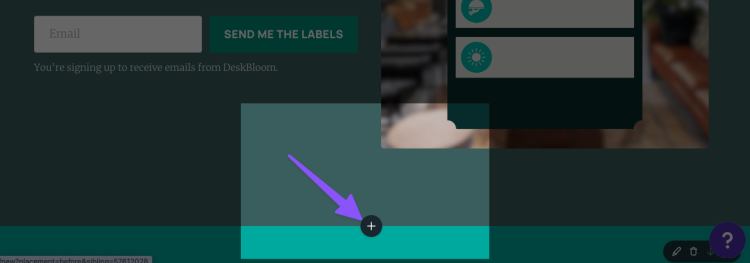
Online courses

Podia offers creators a simple and intuitive
course builder
that makes course creation easy. With Podia, you can build beautiful and modern standalone courses, drip courses, bundled courses, and more. You can even pre-sell courses, allowing you to validate ideas and earn sales before putting in any work.

Digital downloads

Podia supports every type of
digital download
you can imagine, for eBooks and PDFs to templates, music, audio, video, and more. Sell downloads on their own, use them as lead magnets to capture emails, or bundle them together with others products.

Webinars with live or pre-recorded videos

Host live or pre-recorded
video sessions
with unlimited participants by connecting your YouTube Live or Zoom accounts, and your audience will be able to register – and pay – for access through your Podia site.

Membership sites

With Podia, you can create as many
membership plans
– for as many members – as you want, with each featuring different perks, content, and prices.Membership sites include public and members-only posts, product bundling with your memberships, recurring subscriptions for members, and integrations with Facebook, Slack, or Palapa.You can set up all the details of your membership through our
community feature.

Coaching

Run your coaching business directly from Podia! Sell one-to-one coaching sessions with built-in scheduling integrations with many popular platforms, including Calendly, Acuity, YouCanBookMe, and Savvycal.You can also integrate coaching directly into your courses, which is especially helpful for student satisfaction and course completion rates.

Affiliate programs for your customers

Turn your fans into sales reps by launching your own affiliate program. Within your
affiliate program
, you can set custom commission terms, invite affiliates, and reward them for helping you grow your business (only available on “Shaker” plan).

Beautiful, easy-to-build custom website/pages (no coding required)

Using
Podia’s site editor
, you can quickly and easily build a custom, professional-looking website for your online business (as well as custom landing/sales pages) without design or technical knowledge.

Built-in email marketing tools

Send one-off emails or automated, multi-touch sequences with Podia’s built-in
email marketing tools
. The built-in marketing tools also include email capture, segmentation capabilities, email analytics, and more. Bonus: Podia is also the only online course platform that gives you complete revenue metrics for every email you send.

Live chat messaging to interact with visitors and customers (exclusive to Podia)

The same way Podia offers chat support to potential and current Podia customers, you can also offer
live chat
to your potential and current customers by enabling the “live chat” widget on your website and sales pages. This functionality is unique to Podia and is not available through Thinkific or Kajabi.

Embedded checkout

Sell in more places (and increase your chances of conversion) with
Podia’s embedded checkout feature
, which features a fast and simple checkout process that’s been tested and optimized for conversion (available on “Shaker” plan).

Automatic VAT calculation for EU customers

If you’re in the EU, Podia will calculate the amount of VAT due from each customer, add the VAT to the customer’s bill, collect that money to your Stripe or PayPal account, and store all the tax data you need to make an accurate VAT return.

Payment plan options

If your customers prefer to pay in installments (vs all upfront), you can allow your students to pay over time with Podia’s simple payment plan options.

Coupons

Entice customers to buy (and make more sales) by creating custom coupons for individual customers, one-time purchase, limited-time deals, and more.

Pre-sell courses

If you have a course idea (or your course is WIP), you can use Podia to pre-sell your course, which means you can promote it, capture email addresses, and even collect payments before putting in any of the work (great for validating ideas, as well).

Bundles

Have similar products you want to sell together? Use Podia’s Bundle feature to sell complementary products together at a discounted rate as a way to increase sales.

Upsells

Increase the size of every order by offering relevant upsells (like additional products or a mix of products and live trainings, webinars, etc) to customers who purchase your digital downloads.

Quizzes

Test your students’ knowledge and ensure concepts are being properly absorbed by incorporating quizzes throughout your online courses.

Drip content

Want your content to arrive at specific intervals? Use Podia’s Drip Content feature to automatically deliver specific content at specific times throughout the customer journey.

Student comments

See student questions, get their feedback, or just start a conversation by allowing customers to “like” and comment directly within your course content.

Course completion certificates

When students complete a course, automatically recognize and reward their effort with a simple yet elegant course completion certificate (available on Mover and Shaker plans).

Podia pricing: A quick breakdown

With
paid plans
starting at just $4/month (and only going up to $89/month), Podia is considered much more accessible to creators at every level, which is why “good value for the money” tends to be a highlight across public reviews.

Kajabi, on the other hand, is much more expensive and far more limiting in comparison to Podia’s plans, even though Podia offers over 90% of the same features as Kajabi.

And speaking of limits, Kajabi has limits on just about everything, and while Thinkific has fewer limits on things like number of courses, students, etc., they have considerable limitations when it comes to email marketing and membership tools, lack of support for digital downloads, and more.

Podia, by comparison, gives you unlimited products on Mover and Shaker plans, built-in email marketing and membership tools, support for digital downloads, and everything else you could need to run your online business. Below is a high-level breakdown of what’s included in each of Podia’s four plans:

Now that you know a bit more about Podia, let’s dive further into the pros/cons, so you can compare them to the pros/cons of Kajabi vs Thinkific

It wouldn’t be a fair evaluation of all three online course platforms without a review of Podia’s pros and cons. Our honest assessment is below, but we encourage you to check out reviews sites and independent reviews of Podia to form your own conclusions.

Podia Pros

In addition to all of the key features listed above, below are some of the reasons creators love Podia, according to our internal data as well as public data on review sites.

A true “all-in-one” online course, website, and email platform

Podia supports every type of digital product you can imagine (including online courses, digital downloads, community, coaching, memberships, and webinars), plus, the platform offers built-in tools for building your own website/landing pages, capturing leads, sending emails, processing payments, tracking revenue, student progress, and so much more.

Simple, intuitive, and easy to use

There’s a reason Podia is rated so highly for “ease of use” in independent reviews — it’s dead simple. And it was intentionally designed that way, making it a great choice for creators at every level, regardless of their design or technical ability.

Affordable monthly plans

From the outside, it may seem like Thinkific is the most affordable option, given that they have a free plan, and their first paid plan starts at $49/month. But if you’re serious about growing your business, at some point, that free plan isn’t going to work for you anymore, which means you’d have to upgrade to Thinkific’s $99/month plan.

The problem is, that plan has fewer features and more restrictions than Podia’s Mover plan which is just $39/month and Podia’s Shaker plan which is just $89/month.

Unlimited creativity

Podia allows you to create unlimited products on all Mover and Shaker plans.

In contrast, Kajabi has limits on nearly everything.

Thinkific has fewer limits than Kajabi, but they’re more limited in terms of functionality, especially when it comes to email marketing tools, membership tools, support for digital downloads, and more.

Chat + email support 7 days a week on all plans

Podia provides chat and email support 7 days a week for all users, which means there’s always someone there if you have questions or need help.

Free migrations

If you’re moving from another online course platform, Podia will migrate all of your content for free if you become a paying customer on one of the Mover and Shaker annual plans. Neither Kajabi nor Thinkific offer free or paid migrations, which means you have to make the time-consuming (and sometimes confusing) transition on your own.

Built-in live chat on your website/sales pages

Podia is the only all-in-one online course platform that offers a built-in, live chat widget that you can use to communicate with potential customers and paying customers who are logged in to Podia. With live chat on your website and sales pages, you can answer questions and offer tailored content to your leads, enticing them to buy or engage your students, answer questions, get feedback, and more.

Kajabi nor Thinkific offers built-in live chat, which means if you want that feature for your online business, you’ll have to pay an additional fee every month for expensive live chat software.

Podia Cons

As with all online course platforms, Podia also has a few downsides you be aware of when comparing it to other all-in-one online course platforms like Kajabi and Thinkific.

No advanced CSS/HTML customization options

While Thinkific and Kajabi both offer advanced customization options (which means you can access the code editor), Podia does not.

This means Podia is not ideal for creators who have a very specific design aesthetic that requires custom coding and is a much better fit for creators who want a sleek, modern, and professional-looking online business, but don’t want to spend a ton of time or money trying to get it.

No pre-set templates for website, courses, or landing pages

While these are all in the works, Podia does not currently offer a robust set of templates or themes that creators can use to create their websites, landing pages, or courses (compare to Thinkific and Kajabi which offer pre-design templates for courses and websites/pages).

That being said, Podia does offer plenty of easy-to-use design options (including changing colors, fonts, adding a logo and favicon, images, videos, adding sections, etc) that allow creators to build modern, professional-looking websites/landing pages that can be customized to fit your branding or aesthetic.

No phone support

While Thinkific offers email and phone support, Podia and Kajabi do not. That being said, both Kajabi and Podia offer email and chat support (though it’s worth noting that Podia offers support 7 days a week for all their plans while Kajabi only offers support 5 days a week for their Basic plan).

Some limitations with email

Like Kajabi, Podia also has email marketing tools built directly into the product, but also like Kajabi, Podia’s email tools are not perfect, especially in comparison to email service providers that are only focused on email (vs Podia or Kajabi which are “all-in-one” tools focused on multiple features).

Both Kajabi and Podia offer very similar email capabilities, including the ability to send one-time emails or automated drip sequence and the ability to segment your audiences, however, Kajabi does offer some email templates and a “visual editor,” which allows you to move design components around (this is not currently available in Podia).

The good news is, if you don’t want to use the native email tools, both Kajabi and Podia offer integrations with popular email service providers like Mailchimp, ActiveCampaign, ConvertKit, Drip, and many others.

In comparison, Thinkific does not have an advanced, built-in email marketing system, as you’re really only able to send messages to students (vs leads) and cannot send more complex sequences (or track performance) without integrating with an email service provider like Mailchimp, ConvertKit, Aweber, etc.

How does Podia compare to Kajabi vs Thinkific?

Now that you know more about each of the three course platforms (including key features as well as their pros/cons), we’ll now compare Kajabi vs Thinkific to Podia so you can clearly see the differences between each platform.

Kajabi vs Podia

How do these two platforms stack up against each other? Check out the pro/con highlights below to see which platform might be the better choice for you.

Podia is simpler and easier to use

When you compare Podia vs Kajabi on Capterra, Kajabi has 4.0/5 stars for “ease of use” while Podia is rated 4.6/5 for the same category. It’s close, but Podia edges out Kajabi just slightly and we believe that’s due to the simplicity of the product.

While it is true that many Kajabi customers also find Kajabi easy and intuitive, we’ve also seen reviews (and heard from previous Kajabi customers) that it can be very time-consuming and difficult to learn, even if you have experience and some technical skill.

Podia is more affordable (better value)

As you can see from the chart further down the page (in the section “Let’s compare all three across every feature and offering”), Podia offers over 90% of the same features as Kajabi, but Kajabi costs significantly more than Podia (the range depends on
the plan
).

Yes, Kajabi offers advanced customization options, more templates, and slightly better analytics (more on that below), but for some creators, that’s not a reason to pay hundreds more than they would pay with Podia for nearly the same features.

That being said, every creator is different and some are absolutely willing to pay more for those few extra options — it just depends on your business, goals, and budget.

Podia offers more flexibility — Kajabi has limits on every plan

While Podia allows you to make unlimited products on the Mover and Shaker plans, Kajabi has restrictive limits on just about everything you need to run a successful online business (including number of products, marketing pipelines, and contacts.

This is not only restrictive, but can become very expensive as your business grows, as you’ll need to keep upgrading to more expensive plans in order to remove limitations.

Kajabi offers more templates

It’s no secret that Kajabi offers pre-designed templates for products, websites, and pipelines/funnels, which makes it easy for creators to get up and running quickly.

While Podia does not offer templates for products, Podia does offer basic website/page templates that can be customized (i.e. – changing colors, fonts, adding visuals, videos, logo, favicon, sections, etc) to fit your needs. Podia also has several beautiful
email templates
that are equally easy to customize.

Podia offers live chat on storefronts and sales pages — Kajabi does not

Unlike Kajabi or Teachable, Podia is the only online course platform that offers
on-page live chat
so you can answer questions and close deals with site visitors and converse with customers who are logged in to their Podia accounts.This feature is exclusive to Podia and it will give you many more opportunities to sell without having to spend additional money every month on expensive live chat software.

Podia offers course completion certificates — Kajabi does not

Like Thinkific, Podia offers built-in course completion certificates, but Kajabi does not (you’d have to use a third-party tool like Canva to create them then set up automated emails to deliver them upon course completion).

Podia offers free migrations — Kajabi does not

For anyone coming from another online course platform, Podia offers
free migrations
with any annual Mover and Shaker plans.All you have to do is provide Podia with your login information and the Podia team will handle the rest for you. Kajabi does not offer a migration service of any kind, which means you’ll have to handle the time-consuming transition on your own.

Thinkific vs Podia

Now that you know how Kajabi compares to Podia, let’s compare Thinkific to Podia (including the top pros and cons) so you can clearly see which is the best choice for you and your business.

Podia supports ALL digital products, not just courses

While Thinkific’s marketing site emphasizes “courses and membership sites” once you look under the hood, it becomes clear that Thinkific is really focused on online courses. Podia, on the other hand, is focused on all types of digital products, from courses and digital downloads to webinars, coaching, and memberships.

If you’re a creator who sells more than just online courses (or plans to in the future), this is an important differentiator, as Thinkific simply does not offer the features and functionality you need to expand your product offering.

Because Podia supports all types of digital products, you can start with any kind of product then continue to expand your product inventory over time (which is a typical growth trajectory of successful online businesses).

Podia offers advanced email marketing tools — Thinkific does not

While Thinkific allows you to send messages to your students and gives you the ability to integrate with email service providers like Mailchimp, ConvertKit, and others, Thinkific does not offer advanced, built-in email marketing tools like Podia does.

With
Podia’s built-in email marketing tools
, you can send unlimited one-time emails or more complex automated campaigns, segment and tag your list, track performance, and more — all in the same place you do everything else.

If you prefer to use your own email service provider, Podia also offers native email integrations with ConvertKit, Mailchimp, Drip, AWeber, ActiveCampaign, GetResponse, and MailerLite.

Thinkific offers more robust course customization

One of the benefits of Thinkific being so laser-focused on online courses is the fact that they offer so many customization options for your course/student experience. With Thinkific, you can offer different types of courses and lessons (i.e. – self-directed, group, hybrid, evergreen, scheduled, etc), prerequisite lessons or courses, you can require video completion, control the visibility of your courses (public, private, hidden), and more.

While Podia does offer some of the above (such as self-directed, evergreen, dripped, and scheduled courses) Podia does not yet offer prerequisites, multiple course creators or revenue sharing options. Creators can, however, use our
Zoom
integration to organize group lessons as part of the course, or embed coaching to any course lesson for your students.

Thinkific has a few more student engagement tools than Podia

Similar to the above, Thinkific also has a slight advantage over Podia when it comes to student engagement tools. With Thinkific, you can include quizzes, assignments, exams (requires integration), student course reviews, surveys, automated check-ins, and more — all of which are great for keeping students engaged.

While Podia does offer some of the above (quizzes, ability to comment/like content within the course, progress indicators, and the ability to set up drip sequences for onboarding, check-ins, etc), Podia does not currently offer assignments, exam integrations, student course reviews, or student surveys.

Thinkific and Podia offer free plans

Both Thinkific and Podia offer free plans so you can start selling your knowledge online without a big upfront budget.

On Thinkific’s free plan, you can create one course and a website, but you won’t be able to offer things like email marketing, live lessons, drip content, and affiliates.

On Podia’s free plan, you can build a complete website and an online community, and sell one coaching product and one digital download. You can also start building your email list and set up drafts of as many products as you like, so they’re ready to go the minute you decide to upgrade.

Podia offers VAT processing — Thinkific does not

If you’re in the EU, Podia will calculate the amount of VAT due from each customer, add the VAT to the customer’s bill, collect that money to your Stripe or PayPal account, and store all the tax data you need to make an accurate VAT return.

Thinkific, on the other hand, does not offer built-in VAT tax processing, which means you’ll have to use a workaround or a third-party tool to help you.

Podia offers free migrations — Thinkific does not

Any creator who’s migrated from another online course platform knows how time-consuming and frustrating that process can be, which is why Podia offers a free, white-glove
migration service
for customers on any annual Mover and Shaker plan. Neither Thinkific nor Kajabi offer this as a paid or free service, which means the entire transition is on your shoulders.

Podia has a built-in message feature between creators and students — Thinkific does not

If you don’t have live chat on your website or sales pages, you could be missing out on potential sales (not to mention engaging with and learning from potential and current customers, helping leads overcome objections, and more).

Knowing how important live chat is to the sales process, Podia offers a
built-in live chat feature
which allows creators to converse directly with leads and customers who are logged in to their Podia accounts. Neither Thinkific nor Kajabi offer a live chat feature.

TL;DR: Why choose Podia over Kajabi and Teachable as your online course platform?

Whether you read through the entire piece or jumped down to this section, you may still be wondering: Which of these all-in-one online course platforms is the best choice for me?

While we can’t make the decision for you, we recommend reading through public reviews and each section above so you can get a clearer sense of how the platforms compare to each other.

But if you just want a few quick reasons for choosing Podia over Thinkific or Kajabi, check out the list below or simply give Podia a test drive yourself by
creating a free account
.

Simple and easy to use, regardless of experience or skill

On Capterra, Podia is rated highest for “ease of use” with a 4.6/5 rating (Thinkific is rated 4.5/5 and Kajabi is rated 4.0/5), making it a great choice for creators of all levels who want a platform that’s simple, intuitive, and easy to use.

With Podia, there’s no technical or design skills required, and if you do happen to have questions, you can always reach Podia’s world-class support team 7 days a week on
chat or email
.

Just about everything is unlimited

With Kajabi, just about everything is limited including restrictions on the number of products you can sell, who you can sell to, how many websites you can have, and more. While it’s true that Thinkific has fewer limitations in terms of courses, students, hosting, etc, they are lacking in terms when it comes to email marketing, memberships, and support for digital downloads.

Podia, on the other hand, gives you unlimited students, sales, products, hosting, and website pages. You can get started for free, and when you need more features, you can upgrade to a Mover or Shaker plan for unlimited everything.

Podia also offers robust email marketing and a community feature, as well as support for digital downloads.

More bang for your buck

As you may have seen from the price comparison chart above, Podia offers the most
affordable plans
with the most features and least limitations, making it an ideal choice for beginners and advanced creators alike.

With Kajabi, you could pay hundreds more for over 90% of the same features Podia offers. With Thinkific, you will pay similar prices to Kajabi to get the same (or fewer) features and more restrictions than what you’d get with Podia OR Kajabi.

A true “all-in-one” platform with more built-in tools

While Kajabi is certainly on par with Podia in terms of being an “all-in-one” product, Thinkific is not quite up to snuff when it comes to built-in product and marketing tools.

For example, Podia offers built-in support for all products — courses, digital downloads, memberships, and webinars — while Thinkific is really more focused on courses with some support for membership sites and webinars (but both require workarounds).

Podia also offers robust, built-in
email marketing tools
complete with broadcast and drip sequences, segmentation, and analytics, whereas Thinkific really only offers “student messaging” that’s framed as “email marketing,” as it doesn’t have the robust functionality you need to go beyond simple “welcome” or “check-in” style messages.

In our opinion, Thinkific is more focused on the course/student experience, which is great, but that alone isn’t going to help you build or scale a thriving business.

Live chat included on YOUR website and sales pages

There’s a reason live chat is featured on the websites of the world’s most successful companies — it’s an effective tool that can help you engage your visitors, overcome objections, and make more sales.

Knowing this, Podia has a
live chat messaging feature
built into the product that you can add to your website and sales pages, so you can offer a more personalized customer experience and close more sales. This feature is exclusive to Podia and is not available through Kajabi, Thinkific, or other “all-in-one” online course platforms.

Free migration included on annual Mover and Shaker plans

If you’re moving from another platform to Podia, you’ll love Podia’s
free migration service
which is included on all annual Mover and Shaker plans. Simply provide your login information to the Podia team and they’ll move all of your products, customers, and more to the Podia platform for free.

There’s no headache, frustration, or wasted time — you can just pick right back up where you left off. Neither Thinkific nor Kajabi offers a migration service of any kind, which means you have to make the time-consuming and sometimes frustrating “move” on your own.

Always evolving to accommodate industry trends & customer requests

If you want a platform that’s always open to your feedback and
constantly making updates
to the product, Podia is the right place for you.

Every month, the team ships updates to existing products while building out new ones to accommodate industry trends and customer requests, ensuring the product is always up-to-date and secure.

Try Podia for free to see how it compares to Kajabi and Thinkific

You could read all of the reviews and comparison articles in the world, but you won’t truly know which platform is right for you until you give them a try.

Try Podia today for FREE
to see exactly how it stacks up against Kajabi, Thinkific, and other online course platforms. You can set up your website, community, and first product without paying a dime, and you can even make drafts of other product types to see how things work behind the scenes.

While we hope you become a Podia customer, we also want you to select the online course platform that’s right for you and your business, so no matter what you decide, we wish you the best of luck on your journey and hope you find success!

Get your free Podia account

Join the 150,000+ creators who use Podia to create websites, sell digital products, and build online communities.

Sign up free

Kartra vs Kajabi: Which is the best choice for creators?

Software Stack Editor · July 2, 2024 ·

See how Kartra and Kajabi compare to each other (and to Podia) to help you decide what is the best platform for you.

Jump ahead

In this article

Whether you’ve just started your online business or you’re looking to switch platforms, the question of “which platform is right for me?” will inevitably come up.

To get answers, you’re doing the sensible thing: checking ratings, reviews, and reading blog posts like this which may not have all of the answers, but can hopefully point you in the right direction.

In this blog post, we’ll be evaluating two popular “all-in-one” business solutions — Kartra and Kajabi — so you can see what they’re all about, how they compare to one another, and which one will be the best fit for you and your business.

This article is informed by our knowledge of the industry (more on that in a moment) as well as the information we found on the Kajabi and Kartra websites, in public reviews on comparison sites like Capterra and G2, and even in other comparison articles like the one you’re reading now.

Before we dive in, we’d like to call attention to the fact that this article was written by the Podia team, another “all-in-one” solution for digital content creators that may also be on your radar (if we’re not on your radar, you’re in luck, as we’ll also be covering our platform as a third option for comparison).

While it may seem like it would be impossible to conduct an unbiased evaluation of our competitors and our own platform, we really did our best to assess each platform honestly and transparently, using public information vs our own perceptions and biases.

We also want to make it clear that this article is not about tearing any of our competitors down — if anything, it’s about highlighting the best parts of each (and yes, the downsides), so the right creators can get matched with the right platforms.

With that said, let’s get into our honest review of Kartra vs Kajabi, starting with Kajabi.

Kajabi: A quick overview

According to the Kajabi marketing site, Kajabi is an “all-in-one business platform to create and scale your knowledge business” with “a full suite of world-class online business tools working seamlessly together.”

In terms of history, Kajabi has been around for a little over a decade (they came on the scene in 2010) and according to their website, they serve about “40,000+ serious experts, entrepreneurs and influencers around the world.”

Throughout their marketing, Kajabi focuses on the “all-in-one” aspect of the platform, while also promoting key features including the “customizable templates” (which can be used to build “personalized websites, theme-based landing pages, and emails”), their robust analytics feature, and marketing automation features (which can help you gain insight into your customer base and provide more personalized customer experiences).

Based on their public reviews across sites like Capterra and G2, Kajabi’s customers seem to love the “all-in-one” aspect of the product, as it allows them to consolidate their toolsets while saving them money and making their day-to-day processes more efficient. As one reviewer from Capterra put it: “Kajabi has everything you need all in one place. No more piecing together various platforms to build your business.”

And while Kajabai tends to be known as one of the more “pricey” online course platforms out there, one reviewer says, “when you consider that you can run online programs, host your website and blog, have emails, and more, it’s really pretty reasonable.”

Reviewers also like the fact that Kajabi provides a helpful onboarding experience to new users, with one Capterra reviewer saying “I also thought the onboarding process was pretty strong in that they sent you email trainings which helped with the setup” and “they have the ‘onboarding a new customer’ process down. From the training to the welcome video from the founder, they do make you feel like you have made a good choice right from the start.”

Reviewers also highlighted the fact that Kajabi is constantly improving their product (multiple people said things like “they are always innovating to improve things”), which is important, as according to one of their customers, “[Kajabi] does everything. But it’s not the best at anything.”

Kajabi is rated
4.3/5 stars on Capterra
and
4.4/5 stars on G2
.

Who is Kajabi best for?

When you compare
Kajabi
to all of the other online course platforms out there, it’s one of the more expensive options and is generally viewed as a more “premium” solution. For this reason, it tends to attract more advanced creators who’ve struggled with the “duct tape solution” and are in need of an “all-in-one” course platform complete with an in-depth CRM, analytics, advanced marketing features, and more.

But a more robust solution like Kajabi also comes more complexity, a heftier price tag, and limitations on products, customers, and more; for these reasons, we believe Kajabi is most ideal for advanced creators who:

  • Have a small number of products

  • Are not constrained by budget or price

  • Are more focused on automation and analytics

  • Are more technically savvy and comfortable with a learning curve

  • Have an established online business and want to scale their success

Kajabi’s key features

From their beautiful templates and student engagement tools to their pipelines and automations, there’s a lot to love about Kajabi. Below we highlight their core features so you can get a clear comparison between Kartra vs Kajabi.

Products

Kajabi supports nearly every type of digital product you can think of including online courses, digital downloads, membership sites, subscriptions, coaching, and more.

There’s just one catch: With every Kajabi plan comes strict limits on the number of products you can offer within each of Kajabi’s plans. For example, the Basic plan ($149/month) has a limit of 3 products while the Pro plan ($399/month) allows for up to 100 products.

Websites / landing pages

With Kajabi, you can build your whole website (including a blog, about page, homepage, more) and create as many beautiful landing pages as your heart desires (there are no limits on landing pages and a good number of templates to choose from).

Templates

Speaking of templates, Kajabi includes a nice library of them within their Page Builder so you don’t have to build your pages from scratch. Simply select your page type (like lead capture, sales policy, etc) then easily customize it to fit your branding or desired aesthetic.

Payment processing

Like most all-in-one online course platforms, Kajabi offers a secure payment gateway that integrates with Stripe and PayPal to capture customer payments quickly, safely, and efficiently. Kajabi also offers instant payouts and does not take any additional transaction fees.

Email marketing tools

Send one-time or automated email sequences with Kajabi’s built-in email marketing tools. The system also includes email templates and a visual editor for quick customization, plus audience segmentation tools and analytics so you can track growth and engagement.

Pipelines

Similar to Kartra, Kajabi offers pre-made “pipelines” (or funnels) you can customize and use to automatically capture email addresses, nurture leads, make sales, re-engage customers who abandon during the checkout process, and more (great for building sales funnels).

Analytics

Track your performance at every step of your marketing funnel with Kajabi’s built-in analytics and reporting tools. Within your dashboard, you’ll be able to easily track revenue, churn, pageviews, subscriber rate, and more.

Customer management (CRM)

With Kajabi’s built-in CRM, you can keep track of all your subscribers/customers/students, organize them into segments, review purchasing history, progress, send notifications, and more.

Webinars/Events

Host webinars, live trainings, virtual summits, pre-recorded events, and more with Kajabi Events (perfect for coaches or anyone who is selling 1-on-1 or group services).

Quizzes and surveys

Engage your students, track progress, test student knowledge, gain insight into leads, and more with Kajabi “Assessments” which are easy-to-use quizzes and surveys.

Live chat support

Have questions or need help? Kajabi is available to answer your questions and provide helpful guidance on live chat and email 5 days a week (Monday-Friday, 6AM-5PM PST) on their Basic plan and 24/7 on their Growth and Pro plans.

Kajabi University training

Whether you’re just getting started or want to learn something specific, Kajabi University has tons of free bootcamps, in-depth guides, training videos, webinars, and more to help their customers succeed.

Kajabi pricing: A quick breakdown

With plans starting at $69/month and going all the way up to nearly $400/month, Kajabi is certainly one of the more expensive online course platforms out there, but it’s still cheaper than ClickFunnels (more on that later).

Below is a breakdown of Kajabi’s pricing across their 4 core plans and a high-level overview of what’s included in each so you can get a sense of which plan might be the right choice for you:

  • Kickstarter ($69 per month): 50 landing pages, 1 product, 1 funnel, 250 contacts, 50 customers

  • Basic ($149 per month): Unlimited landing pages, 3 products, 3 funnels, 10,000 contacts, 1,000 customers

  • Growth ($199 per month): Unlimited landing pages, 15 products, 15 funnels, 25,000 contacts, 10,000 customers

  • Pro ($399 per month): Unlimited landing pages, 100 products, 100 funnels, 100,000 contacts, 20,000 customers

Kartra: A quick overview

Like Kajabi, Kartra also markets themselves as an “all-in-one platform” that has “everything you need, all in one place!”

But unlike Kajabi, Kartra has only been around for a few years (Kartra was founded in 2018 while Kajabi was founded in 2010); it’s unclear exactly how many customers Kartra serves, but their Facebook group has over 20,000 members in it, which may give you a sense of their size.

On their website, Kartra emphasizes their robust feature set and alleviating the “duct tape problem” that so many creators struggle with when it comes to running a cohesive online business. They also emphasize their support, intuitiveness, and the fact that the “all-in-one” nature of the platform can save you lots of time and money.

On public reviews on sites like G2 and Capterra, customers echo these statements, particularly around the “all-in-one” aspect, with 2021 reviews saying things like “it has everything in one, email, funnels, memberships, and so much more,” “it’s a one stop shop for all marketing and CRM and lead generation needs” and referring to Kartra as “a comprehensive, all-in-one-business solution.”

Customers also noted the money and time-saving benefits that come along with an “all-in-one” solution like Kartra, saying things like “I was able to deactivate other CRMs and apps that we were using. In fact, at the end of the day, I was able to save money,” and “I do not need any other software to host or market my online courses. Everything ties together. So much time and money saved!”

Outside of the “all-in-one” and time/money-saving benefits, some reviewers also highlighted Kartra’s ease-of-use saying things like “everything is easy to learn and straightforward to use” and “I love how easy it is to set up sales pages and start selling straight away. Before Kartra I would battle with my wordpress pages and setting up forms, but with Kartra I started to sell products and services almost instantly.”

Some reviewers were also impressed with the tagging/automations functionalities, saying things like “the way the leads are classified and able to be tagged are definitely awesome!” and “it also manages my database with ease and I can send follow up email sequences with ease. It’s made my marketing so easy and follow up sales are set on auto-pilot.”

While there was a lot of positive comments about the software, there were also a lot of negative comments about the lack of customer support and complexity of the platform with reviewers saying things like “extremely slow UI and terrible customer support,” “support is just awful!” and “the customer support function has recently deteriorated very significantly.”

We’ll get into this more later in the article, but we thought it might be worth mentioning as Kartra’s overall ratings (see below) seemed to be brought down by these recurring negative comments and may be important to consider if reliable customer support is important to you.

Kartra is rated
3.9/5 stars on G2
,
4.5/5 stars on Capterra
, and
2.9/5 stars
on Trustpilot.

Who is Kartra best for?

As an “all-in-one” solution with a robust feature set including advanced automations, funnels, tagging, and more, we believe
Kartra
may be best for more advanced business owners who have a solid grasp of the aforementioned and are looking for ways to consolidate their toolsets and make their processes more efficient (and to save time/money in the process).

However, with the robustness of the platform comes more complexity and a steep learning curve (we’ll get more into this later in the article), so be sure to take that into consideration when making your decision.

To recap, we believe Kartra is best for:

  • Those looking to consolidate their toolsets

  • Businesses that sell a variety of products: services and digital/physical products

  • Beginners who can invest time and resources into learning a more complex system

  • More advanced business owners who can handle a steeper learning curve

  • More established businesses that have a need for advanced automations, funnels, etc.

  • Business that would like to save money by consolidating tools (however, not everyone will save money by using Kartra, but it may be possible depending on your current toolset, business, etc)

Kartra key features

With the high-level intro’s out of the way, let’s get into the meat of the Kartra platform. What’s under the hood? What makes it special and unique? Below we dive into their core features, starting with Checkouts.

Kartra Checkouts

In addition to being fast, easy, and secure, Kartra’s Checkout feature is highly customizable, allowing you to sell any type of product, accept a variety of payment methods, offer multiple payment options (i.e. – one-time, recurring, free trials, etc), custom checkout fields, and more.

The Checkout feature also has free templates, the ability to serve up different offers based on on-site or purchasing behavior, cart abandonment tagging (for easy follow-ups), the ability to add upsells, downsells, cross-sells, add-ons, special promotions, and more.

Kartra Pages

Like Kajabi, Kartra also offers a drag and drop page builder/editor that comes with 500+ professionally designed, mobile-optimized page templates, as well as pop-up templates for capturing leads, promoting special offers, and more.

Along with being able to build beautiful landing pages, you can also build a full site through Karta (though it doesn’t offer robust blogging capabilities), conduct split tests, customize each page by device types, and track performance across all pages.

Kartra Leads

Kartra Leads is essentially their version of a CRM, which allows you to see detailed information on each of your contacts. You can organize, tag, and even score each contact based on their on-site or purchasing behavior and track their journeys with robust historical data (this gives you more visibility into the journeys of your customers, allowing you to more easily identify patterns, detect issues, adjust your approach based on data, and more).

Kartra Funnels & Campaigns

Build multi-page flows that span the whole customer journey, including capturing leads and converting them into customers, repeat business, brand advocacy, and more.

Funnels & Campaigns also sync with your CRM tagging system and email marketing tools (and have robust “if this” “then that” style automations), making it easy to build complex sequences designed to make you more sales. This feature also includes pre-made marketing campaigns you can use as is or customize according to your goals and needs.

Kartra Mail

Send one-off or automated email/SMS campaigns or build more complex, automated email sequences. It also includes built-in segmentation that syncs with their Funnels & Campaigns feature (for building more advanced automations funnels), split testing (for testing content and subject lines), and email analytics for tracking KPI’s including open rates, clicks, revenue, and more.

Kartra Memberships

Organize and share your content with your members using Kartra’s drag and drop membership portal builder. The builder includes membership site templates that, once set up, you can use to deliver your content, training material, courses, and more (you can also offer different membership tiers for different customer types). This feature includes progress tracking (for you and members), engagement tools, analytics, and a robust CRM for managing members.

Kartra Surveys & Quizzes

Learn more about your leads/customers/subscribers by sending a survey or test your students’ knowledge with a custom quiz. This feature includes a variety of question types and templates you can use to quickly and easily gather insight into your audience.

Kartra Videos

Unlike a traditional video player, Kartra’s video player allows you to add calls-to-action, pop-ups with special offers, and checkout buttons directly into the video experience. It also allows you to assign tags based on consumption so you can send more targeted messages, follow-ups, rewards for completion, and more.

Kartra Help Desks

Instead of paying for customer service software, Kartra includes a fully integrated Help desk portal with support ticketing and live chat so you can communicate directly with customers whenever there’s an issue that needs your attention.

Kartra Calendars

If you offer coaching services like one-on-one or group training sessions, Kartra’s Calendar feature is perfect for you, as it will allow leads/customers to book scheduled sessions with you when it’s convenient for them.

Kartra Forms

Kartra’s Forms include a variety of form templates for capturing leads and collecting specific information with custom fields. You can also tag leads and add automation rules for specific types of leads, ensuring each lead has a more personalized journey/experience.

Kartra Affiliates

Get your products in front of more people with Kartra’s Affiliate feature, which allows you to recruit, manage, and track your affiliates, all from one convenient dashboard. Use the affiliate management tools to offer flexible commission structures and tiers, use payment milestones, send instant commissions, and more. You can also vet your affiliates by sending out a questionnaire to interested parties and approving them manually.

Integrations & API

While Kartra markets themselves as an “all-in-one” solution, they also offer a variety of native and custom integrations with major payment gateways, email service providers, membership platforms, calendar apps, and more. You can also use their API to build custom integrations for whatever tools or systems you may need.

Kartra Analytics

Track your performance from one convenient dashboard with Kartra’s Analytics feature, which tracks everything from traffic and conversions to subscriptions, email performance, Help desk analytics, and more.

Kartra Agency

If you’re an agency or business that runs multiple Kartra accounts for clients, Kartra Agency consolidates all of your accounts into one “master” account, so there’s no need for multiple logins or confusion. From this one account, you can handle all billing, reports, analytics, credentials, and more, making it a simpler and more streamlined solution.

Kartra Marketplace

Whether you want to hire an expert to help you learn and/or manage your Kartra account or sell your services (like consulting, marketing, design services, and more), you can do it all from the Kartra Marketplace.

Kartra pricing: A quick breakdown

It doesn’t take much to see that both Kartra and Kajabi are more “pricey” and that alone could be a reason to pass for certain businesses, but if you’re able to pay at least $119/mo, either platform could be a good fit.

But rather than comparing on price alone, it may be more important to look at the limitations within each plan and to assess them within the context of what’s important to you and what you need for your business to succeed.

For example, if you’re just starting out and you are more budget conscious, Kartra’s starter pricing plan at $119/mo may be an attractive option for you, especially in the beginning when you’re trying to grow. However, you may feel limited by the bandwidth and video limitations (among other things), which could ultimately lead to you paying $229/mo in order to lift those restrictions.

Of course, Kajabi’s base plan at $149/mo also has restrictions around products, pipelines, contacts, and members, BUT, it doesn’t have restrictions around bandwidth, the number of emails you can send, or video, which depending on what you’re selling (i.e. – video-heavy online courses or training programs or email training courses), could be incredibly important to you.

Kartra vs Kajabi pros and cons

Now that you know the basic elements of Kartra vs Kajabi, let’s breakdown the pros and cons of each

By now, you should have a high-level sense of each platform, including their positioning, who they serve, what their customers say about them, and the core features they offer. Now let’s dive into the specific pros and cons of each platform so you can see which may be a better fit for you.

Kajabi Pros

You know what features Kajabi offers, but what are some of the reasons you may want to choose them over Kartra or another platform? Below we dive into Kajabi’s pros.

Designed specifically for those selling online courses and other digital products

Unlike Kartra which is designed for all types of businesses, Kajabi was designed specifically for those who sell specific types of products, including online courses, digital downloads, webinars, memberships, and more.

This means Kajabi is an ideal choice for digital product creators, as the product and features will be tailored specifically to the needs of your business. While Kartra can still be a good choice for creators, it’s not going to have the same features and functionality around certain things like building your online course, engaging with your students, conducting webinars, and more.

Similar CRM and tagging/segmentation/automation capabilities as Kartra

Like Kartra, Kajabi also has a robust CRM with detailed information on each user (including contact info, purchasing history, date of last activity, and so much more) as well as advanced segmentation and tagging capabilities that allow you to set up complex automations. Kartra’s version may be just slightly more advanced, but it’s a close call.

Native webinar feature

Speaking of conducting webinars, Kajabi has a built-in webinar feature which is perfect for creators who are using (or want to use) webinars as a marketing or educational tool. And because it’s built directly into the product, using it will feel seamless and integrated.

Kartra, on the other hand, does not have a webinar feature (that being said, they do have a built-in calendar feature which could be great for individual or group coaching sessions, but it’s not quite the same as a true webinar feature).

Unlimited landing/sales pages on every plan

While Kajabi does have strict limits on products, pipelines, contacts, members, websites, and admin users, it does allow you to create unlimited landing/sales pages, which is great if you’d like to create a full website with a variety of landing pages, a complex funnel with multiple sales pages, and more.

In comparison, you can only host up to 100 pages on Kartra’s Starter plan ($119/mo), though you can get unlimited pages if you upgrade to their $229/mo plan or above.

Unlimited emails on every plan

With Kajabi, you can send unlimited emails to your subscribers no matter which plan you’re on, which is a big pro if email marketing is a core component of your business (and let’s be honest, what successful business doesn’t use email marketing?).

In contrast, you can only have up to 2,500 leads and send up to 15,000 emails/month on Kartra’s Starter plan, which again, is not ideal if you have a bigger email list and want the freedom to contact those subscribers as often as you like.

Community tools to engage with students

As a true platform for digital content creators, Kajabi comes complete with community engagement tools including assessments, course comments, progress tracking, and community management tools that you simply won’t find on Kartra.

True “quiz” feature for assessing student knowledge

While Kartra does offer a “Surveys & Quizzes” feature, it’s really more of a survey tool you can use to conduct quizzes. In contrast, Kajabi offers “Assessments” with separate surveys and quizzes you can use to either gather insights or assess (and grade) your students’ knowledge.

More premium look-and-feel (more user-friendly, less clunky)

Kajabi is known for being a modern and premium solution in the industry not only on the outside, but on the inside, as well; this translates into a more intuitive and user-friendly interface and experience for customers and students.

For some, this may also be true of Kartra, but we also saw a few online reviews saying the opposite, particularly in reference to the page designer (more on that in the “Kartra Cons” section below).

Helpful, reliable support (5+ days/week) + access to Kajabi University

Kajabi is known for having great customer support, which is available 5 days a week on both email and live chat for their Basic plan and 7 days a week on their Growth and Pro plans. Kajabi also offers customers access to their library of free resources and trainings, which are no doubt helpful, as the platform has also been known for complexity and a bigger learning curve.

While Kartra advertises great customer support, public reviews tell a totally different story with more negative reviews about their customer service than positive (more on that in the “Kartra Cons” section below).

Has a free mobile app

With Kajabi’s free mobile app, you can easily manage your content, students, notifications, and more all from your phone. And students can quickly and easily get updates, consume content, engage with you or other community members, make purchases, and more. In contrast, Kartra does not offer a free mobile app.

True FREE trial (no money down)

Unlike Kartra which charges $1 for their trial, Kajabi offers a true 14-day free trial, which gives potential customers a full two weeks to try the product totally risk free (however, Kajabi does require a credit card to sign up).

Kajabi Cons

Now that you know what’s good about Kajabi, let’s cover some of the potential downsides so you can get a clear and accurate understanding of the platform.

Very expensive

With plans starting at $149/mo and going all the way up to $399/mo, Kajabi is definitely one of the more pricey options out there; for some creators that price point will be attainable, but for others it will be totally out of reach, regardless of how many flashy features or awesome benefits are included.

That’s not to say that Kartra is “cheap” or even more affordable (in fact, the pricing options across both platforms aren’t all that dissimilar), but Kartra has a $119/mo plan which could be more attainable and affordable for certain creators (again, there are a lot of limitations with that plan, so be sure to take that into consideration).

Limits on nearly everything across all plans

While you can send an unlimited number of marketing emails and create an unlimited number of landing pages, every Kajabi plan has strict limitations on products, pipelines, contacts, members, websites, and admin users.

If you’re just starting out, this may not seem like a huge deal, but as your business grows, so will your product offerings, customers, pipelines, and more, which means you’ll have to keep upgrading (and paying more) just to lift restrictions and get access to basic things your business needs.

Fewer templates

While Kajabi certainly has a nice library of beautifully designed page and email templates, it’s not as robust as the hundreds of templates you’ll find within Kartra (or within their marketplace if you want even more). And there are templates for pretty much everything: landing pages, membership sites, checkout forms, pop-ups, emails, and more.

No native calendar integration

Unlike Kartra which has a calendar feature built directly into the product (for coaching or training sessions), Kajabi does not offer a direct calendar integration. That being said, Kajabi does have their “Events” feature, which would allow you to create an event (like a webinar or training session), allow people to register for it, have it launch at a specific time, etc.

Does not natively/automatically handle VAT

While Kartra automatically calculates and adds the sales tax or VAT to your checkout process, Kajabi does not add sales tax natively into your pricing, which means you’d have to either do it manually or use a separate tool to help you do that. For some, this may not be a big deal, but if you’re based in the EU, this could be a dealbreaker.

No native A/B split testing

While Kartra has split testing built directly into the product (allowing you to test different versions of your pages and emails), Kajabi does not (though you can still run split tests by creating two versions of the page and then sending them out via email or linking to different social media campaigns, then comparing stats after a period of time).

May be difficult to learn and use for some creators

With any software, there’s always going to be a learning curve, but Kajabi is known to be a bit more complex and can be difficult to learn for certain creators (this is especially true with an “all-in-one” solution that has a large feature set and robust functionality).

Of course, according to public reviews, Kartra seems even more complex and difficult to learn (more on that in the “Cons” section for Kartra), so the learning curve could be an issue with either platform. The one upside to Kajabi is they offer great customer support via email and live chat and also have a robust library of training resources.

Kartra Pros

Now that we’ve covered Kajabi’s pros and cons, let’s do the same for Kartra so you can more easily compare and contrast the two options.

Sell unlimited products

No matter which Kartra plan you choose, you can sell an unlimited number of products — this is not true of Kajabi. Kajabi has strict product limitations across all three of their plans, which could be an issue depending on the number of products you are selling (or plan to sell).

Sell any type of product: services, digital, or physical

With Kartra you can sell any kind of product you like, including digital products (like online courses, digital downloads, memberships, and more), physical products (including items that have multiple SKU’s), and services (like training or coaching sessions). This is not true of Kajabi, which really only supports digital products and services.

Slightly more advanced email automation system

While both Kartra and Kajabi offer advanced email marketing tools, Kartra’s toolset is slightly more advanced with a visual builder for their email automations, as well as built-in split testing which would allow you to test different variations of your subject lines and email content (compare to Kajabi which has more of a “linear” email builder and no built-in split testing).

Native calendar feature

If you sell consultations or training sessions, you’ll love Kartra’s built-in calendar feature which will allow leads and customers to book time with you (and pay you for it!). In contrast, Kajabi does not offer a built-in calendar feature, but they do have an “Events” feature which would allow you to do something similar (like host a webinar or training session that requires registration and payment, etc), but it’s not an exact one-to-one comparison.

Native Help desk system for live chat/tickets

Another cool feature Kartra has is their native Help desk feature which includes live chat and a ticketing system for you to communicate with your customers when they have questions or issues (this is particularly helpful for anyone who may be paying for customer support software and wants to consolidate their toolset).

Kajabi, on the other hand, does not offer a Help desk feature complete with live chat or a ticketing system (if you want that, you’d need to pay for separate software which could be expensive).

Built-in Behavioral Adaptive Marketing capabilities

With Kartra, you can market and sell products to specific groups or individuals based on specific criteria, including past purchasing behavior, on-site behavior, or by other ways that you’ve tagged your contacts within the Kartra CRM system. This allows you to market and sell more relevant products to your audience and hopefully, make more sales (while Kajabi has similar functionalities, the feature is not exactly the same).

Affiliate program available on all plans

Unlike Kajabi which only offers their affiliate program on their Growth plan ($199/mo) and above, Kartra offers their built-in affiliate program across all plans, regardless of price. This can be helpful if affiliates are central to your business or if you want to start an affiliate program without upgrading beyond the $119/mo plan.

Automatically handles VAT

If you live in the EU, you’ll be happy to know that Kartra automatically calculates and adds the sales tax or VAT to your checkout process so you don’t have to use a workaround or pay for a separate tool. In contrast, Kajabi does not natively add sales tax to your offers, making it a bit more work for you (and potentially more expensive if you have to spend more time and money on a tool to help you do it).

Built-in A/B split testing for pages and emails

If you’re all about optimizing your marketing/sales experiences (like testing different landing pages, different page elements, subject lines, and email content), Kartra may be ideal for you as they offer built-in AB split testing for your landing pages and emails.

Kajabi, on the other hand, does not offer built-in AB split testing, though (as mentioned above) you can still run split tests by creating two versions of the page and then sending them out via email or linking to different social media campaigns, then comparing stats after a period of time.

Kartra Cons

Now that you know more about what makes Kartra special and unique, let’s cover some of the potential downsides so you can compare them to Kajabi or any other options you may be considering.

Significant limitations on Starter plan, particularly around bandwidth

Even though Kajabi also has limitations on each of their plans, so does Kartra, particularly on their Starter plan.

At just $119/mo, the Starter plan may seem attractive at first, but when you look at the limitations within the plan — including limits on leads, custom domain, number of emails per month, bandwidth, videos, pages, products, memberships, admin seats, and more — that $119/mo doesn’t actually get you all that much.

These kinds of limitations would be especially detrimental for any business with an email list of more than 2,500 or those who rely heavily on video within their marketing or products.

Not focused on online course creators specifically

While you can use Kartra to sell any kind of product, the product itself is not built specifically for digital products or digital content creators. This means that you won’t get the same features and functionalities that come standard in a platform like Kajabi that’s built specifically for those who sell digital products.For example, Kartra doesn’t support webinars, it doesn’t have an online course builder or robust student engagement tools. Again, this may not be an issue if you’re not selling courses, webinars, etc., but if you are, this may be an important factor to consider.

No built-in blogging platform

With Kartra, you can build a full website for your business, but there is no blogging feature (complete with SEO functionality) which means you’d need to either forgo a blog from your site (which could hurt your organic discoverability, ability to build trust and showcase authority, etc.) or you would need to use a separate tool, which could be more headache, cost, etc.

Becomes very expensive as your customer base grows

As noted above, the $119/mo Starter plan may seem attractive at first, but as your business grows, you’ll need to keep upgrading (and paying more) in order to lift basic restrictions around the number of leads you can have (and as Kartra notes on their website, leads are the “bloodstream of your business”).For example, once you go beyond 2,500 leads, your monthly premium almost doubles to $229/mo and once you surpass 12,500 leads, your monthly premium goes up to $339 (and so on and so forth).

No native webinar functionality

While Kajabi has a built-in webinar feature that’s included with all plans, Kartra does not. It’s true that you could use Kartra’s calendar feature to book training sessions, but you won’t be able to use that to run true “events” like conferences, summits, live or pre-recorded events, and more.

May be more clunky/less intuitive/less user-friendly

While some Kartra users find the platform simple and easy to learn/use, many public reviews say the opposite, complaining that the software can be buggy, clunky, and not as user-friendly or intuitive as other options out there.Here’s a quick snapshot of what people are saying (reviewers seemed to focus a lot on the page builder and the email system):

  • “Building landing pages is sometimes tedious and loading times in the backend are relatively slow” -Capterra 2021

  • The builders within the software are not the greatest. I feel that they are slow and clunky.” – Capterra, 2020

  • “The Page builder at times is a little clunky” – Capterra 2020

  • “Their page designer is also a bit on the clunky side without a lot of flexibility, and that’s one place where they lost me. I don’t like being held to rigid flows, templates and outlines.” – G2 2019

  • “Not intuitive for email … Trying to send emails, find customer lists, etc. is not intuitive.” -G2 2021

  • “[The email] doesn’t flow as well as other platforms. When editing emails it’s a little bit more cumbersome because it has a pop-up that you put your info in if you [are] copy and pasting, which I can’t stand.” -G2, 2021

  • “Their email editor needs some help” -Capterra 2021

  • “It desperately needs a way to search and find the emails that you have written in the autoresponder sequence. It’s utterly painful trying to find certain emails in the sequence to edit them and specific landing pages.” -Capterra 2020

Poor customer service (according to numerous public reviews)

While Kartra advertises great customer support on their website, public reviews tell a very different story with complaints ranging from unhelpful to totally unresponsive support. Here’s a quick snapshot of just some of the customer support-related reviews we saw on G2, Capterra, and other reputable review sites:

  • “Support was useless.” -G2, 2021

  • “Buggy and poor support … extremely restrictive and poor customer service and support. Probably the worst decision we made was using kartra for our membership … Extremely buggy, constant issues, slow loading pages,” – Capterra 2021

  • “I’ve been trying for over a month and a half to get refunded with ZERO response. But plenty of marketing to get [you] to renew. NO phone support is a disaster. The product is only as good as the company. And the company, unfortunately, is a disaster.” – Capterra 2021

  • “No problem with the software – but a very big problem with the customer support function which has recently deteriorated very significantly” -Capterra 2020

  • “Extremely slow UI and terrible customer support … Customer support was absolutely awful and incompetent, when I tried to get help from the Facebook community they deleted my post and directed me to customer support who was useless. Found out later they know it’s an issue and were hiding it. Knowing what we know now, we would not have signed up for Kartra” -G2 2020

  • “THEIR CUSTOMER SUPPORT IS THE WORST. You have to wait up to 6 days for an answer from their unqualified team. All they do is send you links to their FAQ or Blog and don’t look at your issues.” – G2 2019

Very complex with a sharp learning curve (according to public reviews)

Like the reviews we saw regarding customer support, we saw similar reviews regarding the complexity of the product and time-consuming learning curve associated with getting set up and understanding how the system works. Here’s a quick snapshot of what reviewers are saying:

  • “There’s a bit of a learning curve at the beginning “ -Capterra 2021

  • “Kartra is like a magic lamp. You can not just pay for it, rub it for a while and expect that it will make you a fortune. You have to invest in yourself or hire someone to do it for you. I recommend you to try and see for yourself what you think and how it could work for you and your business. I wish you the best of luck.” – Capterra 2021

  • “Very hard to use and manage for my business to expand … Everything was hard to understand, it was time consuming and they kept asking me to purchase additional stuff I couldn’t afford” – Capterra 2021

  • “It is certainly a learning curve. I eventually had to hire one of their experts in order to implement my course on the platform.” – Capterra 2021

  • “At [the] initial stage it is quite complicated to learn the features.” – Capterra 2021

  • “Very nice, but not as easy as portrayed” -Capterra 2020

  • “[There’s] A fairly steep learning curve to be effective in using everything Kartra has to offer” -Capterra 2020

  • “Kartra is not there yet. Many features, little mastery … I understand that Kartra is a very complex system, but it is far from ideal and the requested upgrades are painfully slow. I’ve been using Kartra for 10 months now and I have two memberships built, numerous pages, and over 10 classes on two calendars. It’s been a frustrating system and difficult company to work with.” -G2 2020

  • “The learning curve is not a curve, it’s more like a 90-degree wall. In spite of the videos and online Wiki, this is a very complicated system to configure. All of the power and flexibility (and there is a whole lot of both) has translated into a system that is not intuitive in the least.” – G2 2019

No true free trial (costs $1)

While Kajabi offers a true 14-day free trial (though there is a credit card required), Kartra charges potential customers $1 to test drive their product. This isn’t terrible, just something to keep in mind when comparing the two trial options.

A third online course platform for comparison: Podia

As mentioned upfront, the purpose of this article is to provide an honest and straightforward review of
our top competitors
, as well as our own platform (yes, even the downsides) to help you make an informed and confident decision.

Obviously we have more insight into our own product than we do for Kajabi or Kartra, but we’ll do our best to put our biases aside and just focus on the facts, as well as what our customers are saying on review sites and in independent reviews.

Podia: A quick overview

Like Kajabi, Podia is also an “all-in-one” online course platform that gives creators everything they need to sell courses, memberships, communities, webinars, digital downloads, and coaching services.

Podia was founded in 2014 (about four years after Kajabi and about four years before Kartra) and the platform serves “50,000+ creators,” which is similar to Kajabi in terms of size (Kartra does not publicly list how many customers they have).

Similar to Kajabi and Kartra, Podia also emphasizes the “all-in-one” aspect of the platform while highlighting the fact that you can sell any kind of digital product on the platform (compare to Kartra which is not a true “all-in-one” online course platform and does not provide all of the same features and support needed for digital product creators).

Beyond digital products, the Podia site also focuses on the marketing tools included within the platform, including the
site builder
(which allows you to build beautiful, modern, mobile-friendly websites or landing pages), the
email marketing tools
(which allow you to send one-off emails or automated sequences), the
live chat widget
(a feature that’s totally unique to Podia), and the
built-in affiliate marketing feature
, among other things.

In public reviews, Podia customers often emphasize the simple, intuitive design with reviewers saying things like “it delivers high value with its simple and intuitive interface” and “I absolutely love Podia’s user interface – it is extremely intuitive and easy to navigate as the creator.”

Reviewers also love the lack of limits on products, customers, and pages, saying things like “I looove the fact that you get unlimited everything, so no more tiers to squeeze through” and “I like the fact that Podia gives its users unlimited hosting of video content through one of the premium video platforms. This means that you can upload all kinds of videos, as well as PDF and other types of learning materials, without having to worry about potentially ‘running out of storage.’”

In comparison, both Kajabi and Kartra have strict limits on things like products, customers, bandwidth, videos, and more. Reviewers also seem to like the accessible price tag (Podia is almost always rated 5/5 stars in the “value for money” category on Capterra) with reviewers saying things like “the price [is] super affordable and simple. No complications like others.”

Finally, Podia customers seem to love Podia’s premium
customer service
, saying things like “best support I’ve ever come across in an online platform. I don’t feel like a number or a statistic – but a real person,” “support is super helpful and responsive. 10 out of 10 in helpfulness” and “the Podia support is particularly amazing. I’ve gotten personal help from the CMO, among others. Can’t speak highly enough of these folks.”

The
free migration service
is also a helpful bonus for those switching from other platforms and is mentioned throughout some of our public reviews (“the team were able to migrate me in less than 24 hours and the support is so personal and caring” and “The team made it easy for me to migrate over”).

While very close, it’s also worth noting that Podia is rated
4.6/5 stars on Capterra
, while Kajabi is rated 4.3/5 stars and Kartra is rated 4.5/5 stars (on Capterra).

Who is Podia best for?

After serving creators for close to a decade, we believe Podia is ideal for creators who are looking for a simple, intuitive, and affordable all-in-one platform that supports all types of digital products, including online courses, digital downloads, communities, coaching services, webinars, and more.

It’s also ideal for creators who want the flexibility to grow their businesses without limitations and to get the helpful support they need when they need it.To recap, we believe Podia is best for creators who:

  • Want a simple, intuitive, and affordable all-in-one course platform

  • Sell (or plan to sell) online courses, webinars, communities, coaching, and/or digital downloads

  • Want to offer live chat on their own website and sales pages

  • Want fast, helpful, and friendly customer support

  • Don’t want to deal with product limits

Podia’s key features

While we encourage you to check out the Podia
Features page
for more information, below is a high-level recap of our core features and what’s great about each one.

Free plan

Podia’s free plan includes a website, online community, one digital download, and one coaching product. You can also build your email list and sending a limited number of broadcasts on the free plan. This means that you can start growing your online business without a huge upfront investment. You’ll only pay a 10% transaction fee when you make a sale and you’re welcome to use the free plan as long as you like.

Online courses

Building online courses is fast, easy, and even fun with Podia’s simple and intuitive
course builder
. Build beautiful and professional-looking courses, drip courses, bundled courses, email courses, and more. If you have an idea you want to test out, you can also pre-sell courses, allowing you to validate ideas and earn sales before doing any work.

Digital downloads

No matter what you’re selling — eBooks, PDF’s, templates, videos, audio files — you can host, market, and sell it on Podia (and you can be sure your products will be delivered to your students automatically and seamlessly). Sell
digital downloads
on their own, use them as lead magnets to capture emails, or bundle them together with other products to increase AOV. The sky’s the limit!

Webinars with live or pre-recorded videos

Hosting a virtual conference? A group training webinar? A one-on-one session? With Podia’s Webinar feature, you can host
live or pre-recorded events
with unlimited participants by connecting your YouTube Live or Zoom accounts, and your audience will be able to register – and pay – for access through your Podia site.

Community

Host your
community
directly on Podia to sync with your online business and offer the engagement tools you need to keep your members active and engaged. Create and sell as many community plans – for as many members – as you want, with each featuring different perks, content, and prices. Podia Community includes public and members-only posts, free trials for potential members, product bundling, recurring subscriptions for members, and more!

Affiliate programs for your customers

Turn your fans into your own little sales army by launching your own fully integrated affiliate program. Set custom commission terms, invite affiliates, and reward them for helping you grow your business.

Podia’s built-in
affiliate program
also includes affiliate management tools including the dashboard (where you can track sales), levels of availability (i.e. – invite-only, closed, open), custom links for your affiliates, and more. Affiliate resources are available on the Shaker plan.

Beautiful, easy-to-build custom websites/landing pages (no technical or design skills needed!)

With Podia’s intuitive
site editor
, you can quickly build a beautiful, professional-looking custom website for your online business, complete with custom landing/sales pages. No coding or design skills needed — just open up the editor and start customizing!

Built-in email marketing tools

Engage your subscribers with one-off emails or automated, complex sequences with Podia’s suite of
built-in email marketing tools
. Email capture, segmentation capabilities, and email analytics are included (and get this — Podia is one of the only online course platforms that gives you complete revenue metrics for every email you send so you can literally see which emails are paying off!).

On-page live chat messaging to interact with visitors and customers (Podia only!)

Live chat is one of the fastest and easiest ways to communicate with leads and customers and it’s now available to you through Podia. Simply enable the
“live chat” widget
on your website and sales pages and you can start engaging leads, answering questions, overcoming objections, and assisting current customers. This functionality is unique to Podia and is not available through Kajabi or Kartra.

Embedded checkout

Use Podia’s simple
embedded checkout feature
to ensure a fast, secure, and seamless “checkout” experience directly on your website (or any other page on the internet). The checkout has also been tested and optimized for conversion and is only available through Podia on the Shaker plan — not available on Kartra or Kajabi.

Automatic VAT calculation for EU customers

No more worrying about tax! If you’re in the EU, Podia will calculate the amount of VAT due from each customer, add the VAT to the customer’s bill, collect that money to your
Stripe
or
PayPal
account, and store all the tax data you need to make an accurate VAT return.

Payment plan options

Sometimes customers prefer to pay in installments (vs one lump sum); with Podia, you can offer payment plan options, giving your customers more financial freedom and flexibility (and more ways to pay means more ways to earn!).

Coupons

Running a special discount or promotion? Create custom coupons for individual customers, a one-time purchase, or a limited-time sale, and more to entice customers and earn more money.

Pre-sell courses

If you have an idea for a course or product, but you want to validate it first, you can use Podia to promote it, capture email addresses, and even collect payments before putting in any work.

Bundles

Have a bunch of similar products you’d like to sell together? Use Podia’s Bundle feature to sell complementary or related products together at a discounted rate as a way to increase sales and average order value.

Upsells

Have a product that would be the perfect add-on to another related product? Offer it as an upsell at checkout to help increase sales and average order value.

Quizzes

Be sure your material is understood by your students with graded quizzes featuring fill-in-the-blank questions, true/false, multiple choice, and more.

Drip content

Want your content to be delivered within a specific timeframe? Podia’s Drip Content feature will automatically deliver specific content at specific times throughout the customer journey.

Student comments

Spark conversation, answer questions, or get feedback by allowing customers to comment directly within your course content.

Course completion certificates

When students complete your courses, give them a virtual “high five” with a course completion certificate that can be customized with your course information and student information.

Podia pricing: A quick breakdown

With a free plan and paid
plans
starting at just $9/month or $4/month when you pay annually (and going up to just $89/month), Podia is considered much more affordable to creators at every level. This is why Podia tends to receive 5/5 stars in terms of value on review sites like Capterra. On price alone, Podia is clearly the least expensive option across the board (in fact, you could pay up to 3x more by going with Kartra or Kajabi — check out the chart below to see what we mean):

Now that you know a bit more about Podia, let’s dive further into the pros/cons, so you can compare them to the pros/cons of Kartra vs Kajabi

We’ve covered the pros and cons of Kajabi and Kartra, but what about Podia? What’s good about Podia? And what’s not so good? Let’s take a closer look together so you can make the right decision for you and your business.

Podia Pros

What’s so great about Podia? What makes it unique or different from Kajabi or Kartra? Let’s find out! Below we dive into the pros of Podia.

Focused on creators who are selling courses, webinars, community & more

Like Kajabi, Podia is also designed specifically for those who sell digital products including online courses, community, webinars, digital downloads, etc. Within Podia, you’ll find plenty of features and functionalities that you need to build, market, and sell your products, including product builders, student engagement tools, sales pages, email marketing, affiliates, and so much more.

Simple, intuitive, and easy to learn/use (for you and your customers)

There’s a reason Podia is rated 4.6/5 stars for intuitiveness (compare to Kajabi which is rated 4.1/5 stars and Kartra which is rated 4.0/5 for intuitiveness on Capterra) — it’s simple, user-friendly, and easy to learn, not only for you, but for your customers, as well.

The secret is in the sleek and modern interface, simplified navigation, clear dashboards, helpful in-app copy, and more. Podia also has helpful and responsive chat and email support 7 days a week for all users, which makes it easy for customers to get answers to any questions they may have along the way.

Sleek and modern with a premium look-and-feel

Not only does Podia look good on the inside, it also looks sleek and modern on the outside, with beautiful landing pages, polished emails, cutting-edge checkouts, smooth lead capture, and more. When you use Podia, you’re guaranteed a clean and professional-looking business.

Affordable monthly plans (great value)

While Podia doesn’t have 100% of the same features as Kajabi and Kartra (more on that in the sections below), it does have a ton of overlap, which means in some cases, you can get over 90% of the same features for a fraction of the cost. Check out the chart below to see what we mean or jump to the “big comparison chart” below to get even more detail.

Create as much as you want

While Kajabi and Kartra place strict limitations on all of their plans, Podia does the opposite with unlimited products, courses, webpages, customers, and hosting on all Mover and Shaker plans.

Native course completion certificates

If you’re selling online courses, you may want to reward your customers with a course completion certificate, which can be done simply and seamlessly through Podia. In contrast, Kajabi and Kartra do not offer native course completion certificates (you’d have to use a third-party tool like Canva to create them then set up automated emails to deliver them upon course completion).

Free migrations

One thing that’s unique about Podia is the free migration service that’s included with all annual Mover and Shaker plans, which means if you’re switching from another platform (like Kajabi, Kartra, or somewhere else), the Podia team can migrate to Podia for free!

Kajabi and Kartra do not offer a migration service of any kind, which means if you’re moving from another platform, you’ll have to do all of that work yourself (which could cost you a lot of time and headache).

True free plan

Both Kajabi and Kartra offer trials of their products, but Podia is the only one of the three to offer a free plan. On Podia’s free plan, you can build your website, set up an online community, and sell one coaching product and one digital download.

Podia Cons

Now that you know what’s to love about Podia, let’s cover some of the potential pitfalls so you can easily compare the three options and make a more informed and confident decision.

Affiliate program only available on Shaker plan

Unlike Kartra which includes their affiliate feature on their Starter plan ($119/mo), Podia only includes the affiliate feature on their Shaker plan ($89/mo); the same is true for Kajabi, which only includes their affiliate feature on their Growth plan ($199/mo) and above.That being said, Podia’s Shaker plan is $30 less than Kartra’s Starter plan, so you could pay less to get access to a built-in affiliate program, plus you’ll get access to a bunch of other features included in Podia’s Shaker plan.

Less advanced CRM

All of your customers, leads, and subscribers within your Podia account will have information attached to them — their names, contact info, when they signed up, purchasing history, and more. However, the CRM features are not as robust as what you’ll find within Kartra or Kajabi, which will provide you with more detailed information, as well as the ability to tag, segment, score, and even send them into specific funnels or automations (Podia has some segmentation and automation capabilities, but they are not as advanced as Kartra or Kajabi).

No built-in Behavioral Adaptive Marketing

With Kartra, you can market and sell products to specific groups or individuals based on things like their past purchasing behavior, on-site behavior, or by other ways that you’ve tagged them within the Kartra system. Podia does not currently offer a feature like this, but if it’s helpful to know, Podia is always evolving to include additional features, including more advanced marketing tools.

No way to natively add offers or CTA’s to videos

Unlike Kartra which gives you the ability to add CTA’s and special offers within the Kartra video player, Podia does not yet offer this type of functionality. That being said, Kartra does have very strict limitations around bandwidth and video on their Starter ($119/mo) plan, which you may want to take into consideration if you’re signing up for this specific feature or if video is a core component of your content or marketing.

No built-in AB split testing

While Kartra offers built-in AB split testing (so you can test different landing page variations, test out different page elements, subject lines, or email content), neither Podia or Kajabi offer a way to do this natively.

No native calendar integration

While Podia does not offer a native calendar feature (like Kartra does), Podia does have a built-in Webinar feature (which you can use for for summits, conferences, trainings, marketing, etc) and also offers integrations with calendar tools like Calendly, Acuity,
YouCanBook.Me
, and SavvyCal (Kajabi also has an “Events” feature which will allow you to host webinars, as well and also offers calendar integrations).

How does Podia compare to Kartra vs Kajabi?

Now that we’ve covered the pros and cons of Kajabi, Kartra, and Podia, let’s compare them to each other so you can get a clear sense of which platform is the right choice for you.

Kajabi vs Podia

How does Podia compare to Kajabi and vice versa? Below we cover the main pros and cons of each platform.

Podia has a free plan, Kajabi has a free trial.

Kajabi offers a 14-day free trial so you can try out their features. Podia, on the other hand, offers an entire free plan that includes your website, online community, and the ability to sell one coaching product and one digital download.

You can stay on Podia’s free plan for as long as you like and you can always upgrade as your business grows. Free plan participants pay a 10% transaction fee on sales, but there are no upfront monthly costs.

Podia is simpler and easier to learn/use

Simplicity, intuitiveness, and ease of use can be a difficult metric to assess, but when looking at Capterra reviews, Podia is rated
4.8/5 stars for intuitiveness
while Kajabi is
rated 4.3
. While that’s not a huge difference, Podia is clearly in the lead, likely due to our simple interface, easy-to-navigate product, clear dashboards, helpful in-app copy, and more.

In public reviews, Kajabi is often applauded for being easy to use, with reviewers saying things like “this platform for online learning is very logical and easy to use” and “it’s easy to learn, setup and manage,” but we also see a few recent reviews saying the opposite: “it can be more user friendly or demo should be there on software itself, so that person may now how to use features” and “clunky, cumbersome to use.”

Podia offers similar features as Kajabi, but for far less money

When you compare the features between Podia and Kajabi (which you can do in the “big comparison chart” below), you’ll find that Podia offers over 90% of the same features as Kajabi, but for a fraction of the price.

Of course, there are things you can get through Kajabi that you won’t find on Podia (like templates, advanced customization options, and pre-made funnels/pipelines/templates), but you have to ask yourself if those features alone are worth the massive price hike.

Kajabi offers more advanced customization options

With both Kajabi and Podia, you can create beautiful, custom sales websites, landing pages, and emails. But with Kajabi, you’ll get more templates for the aforementioned and also access to the code editor if you want more advanced customization options (keep in mind, you’ll still need to know how to code and/or hire someone who can make those changes for you vs Podia which offers beautiful, simple templates without any tech or design skills needed).

Kajabi offers pre-set pipelines/funnels — Podia does not

While you can use Podia to build sales funnels from scratch, Podia does not include any “pre-set” pipelines/funnels to help you get started (compare to Kajabi which does include pre-set pipeline templates you can use to create complex email sequences and automations). This may be an important differentiator for those looking to create more sophisticated marketing funnels while saving time in the process.

Kajabi offers more templates

Like Kartra, Kajabi also offers a library of pre-set templates for websites, landing pages, and emails, which can be helpful if you want a beautiful online business without hiring a tech team or designer to build it for you.

Podia does include email templates
, and the Podia Editor has plenty of customization options available to help you build a clean, modern, and professional-looking online business without getting bogged down in design details (or hiring a team to build it for you).

Kajabi has slightly more advanced analytics

Kajabi and Podia offer almost exactly the same analytics, but Kajabi has two additional analytic options that Podia does not: Tracking pageviews and being able to segment the data by a specific timeframe (but you can get those metrics by integrating your Podia account with Google Analytics).

Kajabi’s analytics Dashboard is also a little clearer and easier to follow, but these are all things Podia is working to actively improve in 2021 and beyond.

Podia offers live chat on websites and sales pages — Kajabi does not

As a business owner, you know how important live chat can be when it comes to learning about your leads, answering questions, overcoming objections, and most important, closing the sale.

For this reason, Podia comes with a
live chat feature
that allows you to converse instantly with leads who visit your website or sales pages, as well as customers who are logged in to their Podia accounts. In contrast, Kajabi does not have a live chat feature of any kind; this means if you want live chat functionality, you’d need to pay for customer support software which can be expensive.

Podia offers course completion certificates — Kajabi does not

One way to reward your students after completing a course is to send them a course completion certificate, and with Podia, you can do this automatically. Kajabi, on the other hand, does not offer native course completion certificates, which means you’d need to use a workaround that can be time-consuming and add more complexity to your student management processes.

Podia offers nearly unlimited everything — Kajabi has limits on every plan

If you go with one of Podia’s Mover and Shaker plans, you can create unlimited products and courses, and host all the content your heart desires.

Like Kartra and Kajabi, Podia also has limits on things like admin seats, but the core components of your business (what you’re selling, who you’re selling to, and how much you can sell) is unrestricted on Mover and Shaker plans.

Podia offers free migrations — Kajabi does not

If you’re moving from another platform (like Kajabi or Kartra) the Podia team will help you migrate to Podia
absolutely free
(with any annual Mover and Shaker plan). Compare to Kajabi which does not offer a migration service of any kind.

Kartra vs Podia

Now that you know how Podia and Kajabi compare, let’s compare Kartra vs Podia so you can get a sense of how the two platforms stack up against each other.

Podia’s free plan vs. Kartra’s $1 trial

Like Kajabi, Kartra offers a 14-day trial so you can test their product. The Kartra trial costs $1. Podia offers an entire free plan that you can use to launch your online business, create your website, and even sell your first product. You’ll only pay a 10% transaction fee when you make a sale.

Podia is designed for course creators who are selling digital products — Kartra is not

Like Kajabi, Podia is designed specifically for those selling things like online courses, digital downloads, community, webinars and more. For this reason, Podia has everything a digital content creator needs, including student management and engagement tools, assessments, course completion certificates, and more.

In contrast, Kartra is designed for any type of business selling any type of product, making it more of a “generalist” vs audience-specific solution. For this reason, Kartra may be missing key features you need for your business today and possibly the features/functionalities you need tomorrow as the industry grows and evolves.

Podia offers native online course and webinar features — Kartra does not

While Kartra does have a calendar feature for selling time, it doesn’t have a native online course or webinar feature, both of which are essential for most digital creators.

Podia, on the other hand, was built for digital creators and therefore has a robust online course feature to help you build, market, sell, and deliver your content seamlessly to your audience. It also has a built-in
webinar feature
for conducting training sessions, conferences, and summits which is not currently available through Kartra.

Podia is simple, intuitive and easy to learn/use — Kartra is very complex and has a steep learning curve

As we’ve covered throughout this article, Podia is known for being simple, intuitive, and easy to learn and use — both for creators and students.

In contrast, Kartra is known for being much more complex and more difficult to learn/use, which is what you’ll see reflected in public reviews and ratings. Kartra even has a marketplace where you can hire Kartra consultants to help you get set up because it can be so time consuming and difficult to learn.

Podia is affordable for creators at every level — Kartra is more expensive

While Kartra has a few features that Podia does not (you can see which in the big comparison chart below), Kartra more expensive than Podia, making it inaccessible to some creators.

Podia, on the other hand, offers a free plan
and three affordable paid plans
that are less expensive than both Kajabi and Kartra, despite offering many of the same features and even some that Kajabi and Kartra do not have.

Podia has built-in email marketing with Podia Email — Kartra does not

If you’d like to run your email in the same place as the rest of your business, you can sign up for Podia Email for unlimited message sends, automations, campaigns, tags, and segments. Your plan only increases as your list grows, so you’ll have all the features of an advanced email marketing platform no matter how many subscribers are on your list.

In comparison, Kartra’s Starter plan only allows you to send up to 15,000 emails per month to up to 2,500 leads, which is not ideal for businesses with larger email lists or those which rely deeply on email marketing (and what online or e-commerce business doesn’t?).

As you upgrade through Kartra, you’ll be able to send unlimited emails, but you’ll always have a limit on the number of leads you can have with each plan (Podia, on the other hand, allows you to have an
unlimited number of subscribers
no matter which paid plan you’re on).

Kartra offers pre-built funnels & automations — Podia does not (but you can build them from scratch)

One of the advantages of Kartra over Podia is the pre-built funnel feature, which allows you to quickly build complex sequences and automations without having to build them completely from scratch. Kartra also offers more robust and advanced segmentation, tagging, and automation options that make complex funnels possible.

Podia Email comes with pre-made email templates. While we do offer much of the same functionality required to build complex sequences and funnels, there aren’t pre-built templates for funnels just yet (you’ll have to build them from scratch, but we believe Podia is so easy to use, building anything from scratch will be a breeze) and you won’t have the exact “automation options” as you’ll find with Kartra or Kajabi.

Kartra has a more robust CRM with advanced tagging/segmentation capabilities

Similar to the above, Kartra has a more robust CRM feature which goes deep on each customer/lead/subscriber with robust tagging/segmentation/automation features that make building complex sequences and funnels (and utilizing their Behavioral Adaptive Marketing features) possible.

In comparison, Podia’s CRM is a bit more basic in that it will provide you similar information about your contacts, but you won’t be able to segment, tag, score, etc in the same ways you can with Kartra or Kajabi (at least not yet).

Kartra offers native A/B split testing — Podia does not

If you’re all about testing and optimization, Kartra may be for you as they offer native A/B split testing capabilities that will allow you to test different page variations, different page elements, email subject lines, and email content — all while tracking performance. Like Kajabi, Podia does not currently offer native A/B split testing capabilities, but that will likely change over time.

Kartra can be used to sell physical products — Podia cannot

With Kartra, you can sell a variety of products including digital or physical products as well as services (like training sessions). In contrast, Podia only supports digital products (like online courses, digital downloads, memberships, webinars, etc.) and services (like training or coaching sessions).

Kartra offers advanced customization options — Podia does not

Along with 500+ templates for landing pages, emails, checkout forms, and pop-ups, Kartra also offers advanced customization options, allowing you to customize the code to your exact specifications.

Podia, on the other hand, does not have advanced customization options, but we believe that Podia’s simple design and
easy-to-use editor
more than makes up for this fact as you can get beautiful, professional-looking websites, landing pages, and emails without getting lost in design details or code.

Podia looks and feels clean/modern — Kartra can feel clunky and not user-friendly

While Kartra may have more features and functionalities, Podia is still rated higher in terms of intuitiveness and reviewers seem to drawn to the aesthetic saying things like “the beautiful and modern layout is what attracted me to Podia!” and “Podia is easy to use and it is BEAUTIFUL.”

In contrast, Kartra tends to get the opposite feedback on public review sites with reviewers saying things like “some things in general with the interface are not that straightforward” and “lacks in the user-friendly department …” and “not quite so user friendly as advertised.”

Podia offers free migrations — Kartra does not

If you’re moving from another platform (like Kartra or Kajabi), Podia offers a
free migration service
with all annual Mover and Shaker plans so you can stay focused on creating/selling (vs getting set up).

In comparison, Kartra does not offer a migration service of any kind, which means the burden of moving all of your content and contacts will fall on your shoulders (this may be even more difficult given the complexity of Kartra and steep learning curve).

TLDR: Why choose Podia over Kajabi and Kartra as your online course platform?

By now, we’ve covered the three platforms (Kajabi, Kartra, and Podia) from a high-level and detailed point of view. We’ve laid out the key features within each system, the pros, the cons, and everything in between. Now it’s time for you to decide which platform is right for you.

But before you do, we’d like to make one final case for why you should choose Podia over Kajabi, Kartra, or any of the other alternatives out there.

Built specifically for content creators who are selling digital products

As we’ve mentioned throughout this article, Podia is (and always has been) designed for content creators who are selling digital products including online courses, communities, webinars, coaching services, and more.

This means you’ll not only have access to the features you need to run a successful online business, but you’ll also be using software that was developed specifically for your needs, including tools that are easy to learn and use (saving you time and headache), a system that’s user-friendly and intuitive (which means more productivity and less frustration), and a team that’s dedicated to helping creators succeed (and is committed to building a product that will do so, today, tomorrow, and into the future).

While Kajabi can claim something similar, the same is simply not true for Kartra, which is a solution for any business that sells any type of product. It’s like going with a generalist vs a specialist; the generalist can provide you with some things, but you’re not going to get the same expertise, knowledge, comfort, and care you can expect from the specialist.

Simple and easy to use, regardless of experience or skill

On Capterra, Podia is rated highest across all 3 platforms for “ease of use” with a
4.6/5 rating
and is lauded in public reviews for being simple, intuitive, user friendly, and easy to use.

In comparison, Kartra is rated 4.0/5 and Kajabi is rated 4.0/5 for “ease of use” on Capterra and both (particularly Kartra) are known for being complex with a steep learning curve that can be so difficult, you may have to hire a consultant to help you get set up and moving on the platform.

In contrast, Podia requires no technical or design skills, and there’s no lengthy training or hundreds of hours worth of resources to get through before you can understand how to use the platform. And if you ever do have questions or need help, Podia’s friendly and helpful customer support team is standing by, plus we have a robust library of HelpDocs and free resources.

Just about everything is unlimited

As an online business owner, there’s no better feeling than to see your sales pouring in; but imagine if as that’s happening, you get an alert from your online business platform telling you that you need to pay them more because you’ve hit your limit on leads, products, members, or something else.

If you go with Kartra or Kajabi, this scenario is entirely plausible, as both platforms have strict limits on the core components of your business, including the number of leads, products, members, websites, funnels, bandwidth, and more.

Podia, on the other hand, gives you options with unlimited students, sales, products, webpages, video hosting, and more, without worrying about suprize overages. This means you can stay focused on growing your business without worrying about arbitrary limitations that are not always within your control.

More affordable and better value

It’s this simple: If you go with Kartra or Kajabi, you will likely pay more than what you’d pay if you were to go with Podia.

Now, if you need code-based customization options or access to more complex marketing automation tools, it may be worth it to pay more for Kartra or Kajabi, but if you don’t need those things (and not every business does), there’s no reason to pay so much more for the same or similar features. Plus, Podia has a few unique features that you won’t find with Kartra or Kajabi.

Live chat included on YOUR website and sales pages

Have you ever noticed that the most successful businesses all use some type of live chat software? Companies will pay exorbitant fees for live chat features because they work, not only in addressing questions from leads, but overcoming sales objections, gathering customer research insights, training staff, and so much more.

For this reason, we’ve built a simple and easy-to-use
live chat feature
directly into the Podia platform, which means you can seamlessly communicate with customers and leads (and make more sales!) without the high cost (or headache) of expensive live chat software.

This is a feature you will ONLY find on Podia — it’s not available through Kajabi or Kartra.

Free migration included on annual Mover and Shaker plans

If you’re moving from another platform (like Kajabi or Kartra) to Podia, the Podia team will help you migrate to the Podia platform absolutely free with all annual Mover and Shaker plans. There’s no headache, frustration, or wasted time and you can get “back to business” much faster.

In comparison, neither Kajabi or Kartra offers a
migration service
of any kind, which means you have to make the time-consuming and sometimes frustrating “move” on your own.

A free plan instead of a free trial

While Kajabi offers a 14-day free trial, it does require a credit card to get started and Kartra will charge you $1 to test drive their platform.

In comparison, Podia’s
free plan
is 100% free and includes a website, an online community, a digital download, and a coaching product.

This means you can focus on assessing the platform and getting your business off the ground without worrying about your trial expiring and getting automatically hit with a hefty monthly fee.

Always evolving to accommodate industry trends & customer requests

In an industry that’s constantly changing, it’s incredibly important to partner with a company that is dedicated to evolving with those changes and constantly making improvements based on technological advances, industry trends, and of course, customer feedback.

Podia always has (and always will be) a creator-first platform, which means we’re always making updates to the product and building innovative features based entirely on what our customers need today, while also thinking to the future for what they’ll need tomorrow.

Try Podia for free to see how it compares to Kajabi and Kartra

When it comes to finding the perfect platform for your online business, there’s no substitute for hands-on experience, which is why we recommend trying out all three platforms before making your final decision. You can sign up for a 14-day trial with Kajabi or Kartra, and with Podia,
you can grab a free plan
.

During your trials, be sure to ask yourself questions like…

  • Is this platform easy for me to learn and understand?

  • Can I quickly create and launch things that work (without bugs or technical assistance)?

  • How reliable and accessible is the support?

  • Am I enjoying the experience or feeling frustrated and overwhelmed?

  • Will I earn enough money selling products to cover the monthly subscription?

  • Will my customers find this platform easy to use? Will they enjoy the purchasing/learning experience?

Having answers to the questions above (coupled with hands-on experience) should give you everything you need to make an informed and confident decision.

While we hope you become a Podia customer, we also want you to select the online course platform that’s right for you, so no matter what you decide, we wish you the best of luck on your journey and hope you find success!

Get your free Podia account

Join the 150,000+ creators who use Podia to create websites, sell digital products, and build online communities.

Sign up free

Kajabi vs Thinkific: Which is the best choice for creators?

Software Stack Editor · July 2, 2024 ·

image

Finding the right home for your online business can be challenging, especially with so many platform options and competing information online.

While it’s tempting to just pick whatever platform you stumble on first, we recommend exploring independent reviews, talking with other creators, and reading through comparison articles like this one. The information in this article is based on public information, including customer reviews and information from each of the platforms’ websites.

While it may seem a little tedious, investing even just a few minutes of research will help you understand the core differences between the various platforms out there so you can make a confident, informed decision that’s right for you and your business.

Before we dive in, we just want to say that we believe our competitors are great and this is not about tearing anyone down — if anything, it’s about highlighting the best parts of each (and yes, the downsides), so the right creators can get matched with the right platforms.

With that said, let’s dive into our honest review of Kajabi vs Thinkific!

Kajabi: A quick overview

Kajabi is one of many “all-in-one” platforms for creators who sell online courses, memberships, and coaching.

Kajabi has been around for just over ten years and according to their website, they serve about “40,000+ serious experts, entrepreneurs and influencers around the world.”

On their website, Kajabi emphasizes the “all-in-one” aspect of their platform, while also focusing on key features including their customization templates (for websites, courses, and emails), as well as their robust, built-in analytics feature and marketing automation tools.

Based on their online reviews, Kajabi’s customers often highlight the “all-in-one” aspect with customers saying things like, “Kajabi has everything you need all in one place. No more piecing together various platforms to build your business” and “Kajabi sells itself as the one home for your whole business – websites, courses, checkout, membership, landing pages, email. And all those features are pretty decent. Not best in class, but pretty good.”

And even though Kajabi is known as one of the more expensive online course creation platforms out there, one reviewer says, “When you consider that you can run online programs, host your website and blog, have emails, and more, it’s really pretty reasonable.”

Reviewers also like the fact that Kajabi provides a helpful onboarding experience to new users, as one reviewer put it: “They have the ‘onboarding a new customer’ process down. From the training to the welcome video from the founder, they do make you feel like you have made a good choice right from the start.”

Finally, customer reviews also called out the fact that Kajabi is constantly improving their product with people saying things like, “They really are making it better all the time” and “I’ve been with them since the launch of the new Kajabi a couple years ago and there has been constant improvement.”

Kajabi is rated 4.3/5 stars on Capterra and 4.4/5 stars on G2.

Who is Kajabi best for?

Within the industry, Kajabi is typically considered the more “premium” option for more advanced course creators who want an all-in-one platform with a focus on analytics and marketing automation.

Because Kajabi is one of the more expensive online course platforms (and there are limitations on products, customers, etc.), we believe Kajabi is best for advanced creators who:

  • Have a small number of products

  • Are not constrained by budget or price

  • Are more focused on automation and analytics

  • Are more technically savvy and comfortable with a learning curve

  • Have an established online business and want to scale their success

Kajabi’s key features

We know comparing platforms can be challenging, especially when they seem so similar, so we’ve pulled out the key features of Kajabi below (and Thinkific further down the page) so you can get a clearer sense of what each platform has to offer.

Products

Kajabi supports all kinds of products, from online courses and digital downloads to membership sites, subscriptions, coaching, and more.

As with many online course platforms, there are limits on the number of products you can host/market/sell within each of Kajabi’s plans. For example, the Basic plan ($149/month) has a limit of 3 products while the Pro plan ($399/month) allows for up to 100 products.

Websites/landing pages

With unlimited, dynamic landing pages, you can build your whole website on Kajabi or create as many landing pages as you like.

Templates

Kajabi offers “blueprints” (which are essentially pre-designed themes or templates) so you don’t have to build your product or pages from scratch (though you can if you like). Each template can be customized to fit your aesthetic and content needs.

Payment processing

Kajabi offers a payment gateway that integrates with Stripe and PayPal to make payments quick and seamless. Kajabi also offers instant payouts and does not take any additional transaction fees.

Email marketing tools

Kajabi offers advanced, built-in email marketing tools, including one-time and automated email sequences, email templates, a visual editor (for fast and easy customization), as well as audience segmentation and email analytics.

Pipelines

Kajabi offers ready-to-use “pipelines” (or sales funnels) you can customize and use to automatically capture email addresses, nurture leads, make sales, re-engage customers who abandon during the cart or checkout process, and more.

Analytics

Kajabi offers built-in analytics and reporting so you can easily track your growth across a variety of KPI’s like customers, revenue, churn rate, pageviews, and more. They also offer integrations with a variety of analytics tools including Google Analytics, Facebook Pixel, and more.

Customer management

Kajabi offers built-in customer management tools to help you organize/segment your contacts, communicate with your customers, automate key interactions, track student progress, and more.

Webinars/events

With “Kajabi Events” you can host webinars, live trainings, virtual conferences, pre-recorded events, and more (ideal for coaches).

Quizzes and surveys

Kajabi calls them “assessments,” but they’re essentially just quiz and survey tools that you can use to engage your students, gauge their progress, or assess how well they understand a lesson.

Chat support

Previously, live chat was only available on Kajabi’s most premium plans, but they now offer live chat support to all of their customers, regardless of which plan they’re on (available Monday-Friday, 6AM-5PM PST).

Kajabi university training

If you have a question, need help, or just want to learn more about a particular topic, check out Kajabi University which has free bootcamps, trainings, and resources.

Kajabi pricing: A quick breakdown

In comparison to all online course platforms, Kajabi is definitely one of the more expensive options, with plans starting at $69/month and going all the way up to nearly $400/month.

That being said, when you compare Kajabi’s plans to Thinkific’s Pro and Premier plans, they are not all that different in terms of pricing (though they do vary in terms of feature restrictions, product limitations, etc. — more on that later in this article).

Below is a breakdown of Kajabi’s pricing across their three core plans and a high-level overview of what’s included in each:

  • Kickstarter ($69 per month): 50 landing pages, 1 product, 1 funnel, 250 contacts, 50 customers

  • Basic ($149 per month): Unlimited landing pages, 3 products, 3 funnels, 10,000 contacts, 1,000 customers

  • Growth ($199 per month): Unlimited landing pages, 15 products, 15 funnels, 25,000 contacts, 10,000 customers

  • Pro ($399 per month): Unlimited landing pages, 100 products, 100 funnels, 100,000 contacts, 20,000 customers

Thinkific: A quick overview

Like Kajabi, Thinkific also markets itself as an “all-in-one online course platform” that “empowers anyone to quickly create and deliver stunning courses on their own branded site.”

Thinkific has been around for about a decade and according to their website, their platform “makes it easy to share your knowledge, grow your audience, and scale your business” and they serve over 50,000 creators.

On Thinkific’s website, they emphasize the “all-in-one” aspect of their product as well as the “exceptional student experiences” they help their customers deliver with customers saying, “I love how easy and straightforward it is to use!” Students have also shared that it is “user-friendly” and “I love the simplicity of Thinkific from an administration standpoint and that it’s so user-friendly for those who take my courses. I’ve never once had a participant email me with any issues navigating this platform!”

Based on their recent reviews, customers seem to love the fact that Thinkific is easy to learn and use with customers saying things like, “Thinkific was easy to use right from the start,” “I love the simplicity and ease of setting things up in Thinkific,” and “[Thinkific is] easy to use and set up. I am not a tech person and I set up a whole online course in 3 days so it’s pretty cool.”

Thinkific also emphasizes the ease of use and have a whole section on their website dedicated to their customer support with claims such as “we don’t go home until every question has been answered” and “90% of questions answered in less than 5 hours.”

Customers seemed to echo this claim on review sites saying things like, “I appreciate the helpful support from the Thinkific team. They do a great job of answering our many questions, “Customer service was outstanding and helpful,” and “The Thinkific Helpdesk is genuinely helpful, and their response time is lightning fast.”

Thinkific is rated 4.6/5 on Capterra and 4.7/5 on G2.

Who is Thinkific best for?

While Thinkific claims they are best for “everyone from small businesses, creatives, consultants, coaches, authors, speakers, and trainers to professional associations, larger companies and universities use Thinkific today,” we think their ideal audience is:

  • Creators who are more budget conscious

  • Creators who don’t want to spend a ton of time on design

  • Beginners who want to test the waters with a limited, but free plan

  • Creators who want very customized courses/student experiences

  • Creators who want to get up and running quickly without a steep learning curve

  • Creators who are more focused on the course/student experience vs growing/scaling their businesses

Thinkific’s key features

Just like we covered Kajabi’s key features above, it’s time to shine a spotlight on everything Thinkific has to offer so you can get a clearer sense of which online course platform is best for you.

Course builder

Like many online course platforms, Thinkific offers a drag-and-drop course builder that makes it easy to add content to your course, including video, audio, pdf, text, quizzes, and assignments. Thinkific also has pre-built course templates you can use to get set up faster and more efficiently.

Course website/landing pages

With Thinkific, you can build a site for your course using customizable course landing pages. Thinkific’s course websites includes 3 primary pre-designed themes you can choose from (with 3-4 styles for a total of 12 theme + style combos) and features such as a pre-built instructor, curriculum, key learnings, and course review sections.

Live lessons with Zoom

With Thinkific, you can offer live lessons (individual or group) with Zoom Meetings or Zoom Webinars, directly from within the platform (requires a paid Zoom account).

Integrations with email service providers

While Thinkific does not offer advanced built-in email marketing tools, they do offer native integrations with popular email service providers such as AWeber, Mailchimp, ConvertKit, Constant Contact, and ActiveCampaign.

Communities

Create conversations in a supportive environment with Thinkific’s Community feature. Communities live as a dedicated page on your Thinkific site and act like a Facebook group in that students and instructors can converse via written posts and comments.

Assignments

Just like in a real classroom, you can require your students to submit assignments that need to be approved before they can complete your course.

Quizzes

Test your students’ knowledge and recall with multiple choice quizzes at the end of your learning modules.

On-Lesson discussions

Allow your students to create conversation, ask questions, or provide feedback within your course. Discussions can be public or hidden and admins and/or students can be notified when there is activity on discussion threads.

Exams integration

Create highly customizable exams and surveys with a variety of question types including multiple choice, ranking and more (please note that this feature does require a third-party integration and also has limitations on how many responses you can collect).

Student surveys

Collect feedback from your students at the beginning and end of your course or anytime you want specific insight into their experiences.

Course completion certificates

Reward and motivate students with built-in course completion certifications. Thinkific offers a few different templates you can customize and automatically send to students who complete your courses.

Automated student messages

While Thinkific doesn’t offer advanced built-in email marketing tools, they do offer the ability to send customizable messages to students which could be helpful for welcoming new students, progress notifications, and more.

Student course reviews

Capture feedback and testimonials by automatically requesting reviews after students complete your courses.

Student progress tracking

With Thinkific, both you and your students can track progress within the student experience, and within your activity feed as well as in progress reports which include when a student last signed in, quiz and survey results, and video performance metrics.

Deliver self-directed, group, or hybrid courses

Thinkific supports all types of courses, including self-guided courses (where students start and end on their own schedules), group courses, and hybrid courses which may include interactive and self-directed lessons.

Evergreen vs scheduled courses or lessons

Create courses and classes that are always available (evergreen) or courses and classes that have a specific start and end date.

Private or hidden courses

Control who has access to your courses with private or hidden courses, which are only visible to specific students (perfect for when you want to market a course, but don’t want students to enroll yet).

Prerequisite courses or lessons

Require students to complete certain courses, lessons, or assignments before starting a new module or course.

Require video completion

Similar to perquisite courses or lessons, you can require students to watch certain (or all of your) videos before moving on to the next lesson.

Drip courses

Deliver your course content over time with drip courses. Drip courses are perfect for when you want to pre-launch a course (and have an official start date) or whenever you’d like to control how fast or how slowly your students consume your content.

Coupons + promotions

Entice students to buy with evergreen or limited-time only coupon codes that can be applied to your course or subscription offering.

Payment processing + Instant payouts

Like most online course platforms, Thinkific also offers a secure payment gateway for accepting student payments and also offers creators instant payouts.

Integrations with analytics providers

While you can use Thinkific to track student progress, you’ll need to integrate with a third-party analytics tool (like Mixpanel, Google Analytics, etc.) to get access to more robust tracking, analytics & reporting.

Affiliates

Make your students your biggest advocates by creating your own affiliate program through Thinkific. An affiliate program is a great way to promote your online course (and hopefully make more sales) without doing the promotion yourself.

Thinkific pricing: A quick breakdown

Thinkific offers 5 plans ranging from $0 (Free plan) all the way up to $499/month (Expand plan), which is actually more expensive than Kajabi’s “Pro” plan, which is their most expensive.

In terms of pricing, the main differences between Thinkific and Kajabi are that Thinkific offers a free plan and two plans that are more affordable than Kajabi’s least expensive plan, making Thinkific the better options for creators who are just getting started or for those who are more budget conscious.

That being said, once you get past Thinkific’s first two plans, their “Grow” and “Expand” plans start to feel more similar to Kajabi, at least in terms of price.

They both have similar limitations on features and number of products, admin users, etc., but it is important to know that in general, you will get more features/functionality with Kajabi (i.e. – more customization, better reporting/analytics, advanced email marketing tools, etc.) than with Thinkific.

Kajabi vs Thinkific pros and cons

Now that you know the basic elements of Kajabi vs Thinkific, let’s breakdown the pros and cons of each.

Above we covered the basics of Kajabi vs Thinkific, from how they present themselves online and what their customers think about them, to their key features, plans, and pricing.

In this section, we dive deeper into the pros and cons of both platforms, giving you more insights to consider during your decision-making process.

Kajabi Pros

There’s a lot to love about Kajabi, from the robust feature set to advanced customization and analytics features, however, there are a few specific pros about Kajabi that may be important to keep in mind comparing it to Thinkific or other all-in-one course platforms.

Built-in email marketing tools (even on the “Basic” plan)

Unlike Thinkific, Kajabi offers advanced, built-in email marketing tools with one-off emails or complex drip sequences, advanced segmentation capabilities, robust email analytics, and more (they even include email marketing on their “Basic” plan, which Thinkific does not).

While you can send student messages in Thinkific, you’d need to use one of their email integrations with ConvertKit, MailChimp, and others to leverage more advanced email marketing strategies.

Built-in pipelines/sales funnels

Unlike Thinkific, Kajabi offers a robust “Pipelines” feature which includes ready-to-use funnels that you can use to automatically capture email addresses, nurture leads, make sales, re-engage customers who abandon during the cart or checkout process, and more.

Built-in membership tools

While Thinkific allows you to create a membership site, it’s not a “native” feature and does require a couple of workarounds within the product (i.e. – creating a bundle, setting up recurring payments with Stripe, creating a community, etc).

Kajabi, on the other hand, offers a built-in Membership feature which allows you to instantly create a polished, professional membership site in one click.

More design/customization options

While Thinkific offers some “expertly designed templates” for both courses and sales pages, Kajabi offers more of them with more customization options.

That being said, both Kajabi and Thinkific offer advanced customization options (access to code editor for customizing HTML/CSS), which means you have the ability to get granular with your design if you so choose (for access to the code editor, you’d have to pay at least $199/month with Kajabi and $99/month with Thinkific, plus the cost of a designer/developer, if needed).

More robust reporting + analytics

While Thinkific offers some reporting, it’s focused more on tracking student engagement, though it does provide some light analytics around sales, revenue, etc.

Kajabi, on the other hand, offers much more advanced reporting and analytics covering all ends of your business, from page views and site traffic to student progress, revenue, and more. That being said, Thinkific does offer integrations with analytics tools such as Mixpanel, Google Analytics, etc.

Built-in blog

While you can use Thinkific to create a site for your course, you won’t be able to add a blog, which is something you can absolutely do with Kajabi.

14-day free trial

Like many all-in-one online course platforms, Kajabi offers a 14-day free trial, but it does require a credit card to get started (compare to Thinkific which offers a free plan).

Zero transaction fees

Like Thinkific, Kajabi does not charge transaction fees, which allows creators to keep more of what they earn.

Kajabi Cons

No all-in-one course platform is without its drawbacks and Kajabi is no exception. Below we cover some of the potential cons of Kajabi to keep in mind when comparing Kajabi vs Thinkific.

Expensive

With Kajabi, you’re getting a robust, all-in-one platform for building, marketing, and selling your digital products, but it comes with a hefty price tag. Kajabi’s “least expensive” plan is $149/month and goes all the way up to $399/month (though it’s important to know that Thinkific’s pricing structure is not all that different).

No free plan

While Thinkfic offers a free plan Kajabi only offers a 14-day free trial that requires a credit card, which is not ideal for budget-conscious creators or those who are just getting started.

More focused on the “business” side vs the student experience

While Thinkific is laser-focused on helping creators deliver an exceptional education experience, Kajabi is more focused on providing creators with the tools they need to turn their knowledge into a thriving business.

That’s not to say that Kajabi doesn’t offer a high-quality student experience, but it just doesn’t offer the same level of customization for courses/the student experience as Thinkific does (and vice versa, Thinkific is lacking when it comes to the sales/marketing/analytics side of things).

No built-in course completion certificates

Unlike Thinkific (which offers native course completion certificates that can be customized and automatically delivered to students when they complete a course), Kajabi does not offer built-in course completion certificates (you’d have to use a third-party tool like Canva to create them then set up automated emails to deliver them upon course completion).

Limits on just about everything

Kajabi’s plans have restrictions on just about everything, from the number of products you can sell to the number of pipelines, emails, contacts, admin seats, and more. That being said, Thinkific’s plans also have limits around things like admin seats, and access to specific features, so they’re not all that different in that respect.

May be too complicated for certain creators

While Kajabi offers a ton of amazing features, learning how to use each one (and how they work together) can be time-consuming and overwhelming, especially if you’re just getting started and aren’t as tech-savvy (Thinkific, on the other hand, seems to have less of a learning curve, with customers lauding their simplicity and ease of use).

Thinkific pros

Like Kajabi, Thinkific also has a lot of pros that may be important to consider when comparing Kajabi vs Thinkific. Let’s get into the pros first to see how they stack up against Kajabi.

Offers a free plan

While Kajabi does offer a 14-day free trial, it requires a credit card and once the trial is over, the plans are quite expensive. Thinkific, on the other hand, offers a free plan and a “Basic” plan ($49/month) which are much more accessible to new creators or creators who are more budget conscious.

Unlimited courses, students, and video/content hosting on all paid plans

Like Kajabi, Thinkific allows creators to have an unlimited number of students and unlimited video and content hosting for all courses (or other products) you create. However, unlike Kajabi, Thinkific allows creators to sell an unlimited number of courses (Kajabi has limits on every plan).

Focused on educators and the student experience

While Kajabi is laser-focused on providing creators with the tools they need to build, market, and sell their products, Thinkific is laser-focused on providing creators with the tools they need to build and deliver exceptional education experiences for their students.

Of course, there is overlap, but if the student experience is very important to you (and you want to customize a lot about it), Thinkific is going to be the better choice.

Large suite of student engagement tools

If interacting with students and keeping them engaged is important to you, you’ll love the large suite of student engagement tools Thinkific has to offer, including discussions, assignments, student course reviews, quizzes, surveys, automated student messages, and more. Kajabi offers some of these features, but not all.

Ability to customize course content

While Kajabi also offers the ability to customize your course content, Thinkific seems to offer the most options, from the type of course and the lessons you offer (self-directed, group, hybrid, evergreen, scheduled, etc.) to controlling visibility (private vs hidden courses), having prerequisite lessons or courses, adding quizzes, surveys, and assessments into the content, video course compliance features, and more.

No transaction fees

Like Kajabi, Thinkific also does not charge transaction fees, which means creators get to keep more of what they earn without being dinged by hefty fees.

Advanced CSS/HTML editing available

Like Kajabi, Thinkific offers advanced customization options for creators on their “Start” plan ($99/month), however, on Kajabi, you have to upgrade to their most expensive plan (“Pro” plan, $399/month) to get access.

Affiliate features available on Basic plan

With Thinkific’s Basic plan ($49/month), you can have your own affiliate program complete with affiliate reporting. To get those same features on Kajabi, you’d have to upgrade to their Growth plan ($199/month) which is significantly more expensive.

Phone + email support

Like Kajabi, Thinkific also offers email support, but unlike Kajabi, Thinkific also offers phone support which may be a big plus for certain creators. That being said, Kajabi does offer live chat support 5 days a week while Thinkific does not offer live chat support at all.

More third-party integrations

While both Kajabi and Thinkific offer many third-party integrations, Thinkific has their own “app store” with similar integrations as Kajabi offers, plus unique integrations with Sumo, Mixpanel, CartStack, and Shopify (which are not available on Kajabi).

Intuitive and easy to use

After reading through hundreds of public reviews, it’s clear that the majority of Thinkific’s customers love that the platform is intuitive and easy to use.

This lack of a learning curve makes it an ideal option for newer creators or those who just want to get set up and running quickly and without delay (compare to Kajabi which may be more time-consuming and difficult to learn for certain creators).

Thinkific cons

Just like Kajabi, Thinkific has drawbacks that may be important to consider when comparing the two all-in-one online course platforms. Keep in mind, some of the cons listed below may not be an issue for some creators, but may be deal-breakers for others. It’s up to you to decide!

Primarily for courses, not memberships, digital downloads, or webinars

While one of Thinkific’s pros is being laser-focused on courses, that is also a downside in that they don’t offer the same level of quality or support for other digital products, including memberships and digital downloads.

Thinkific does not allow you to sell digital downloads directly and to sell a membership, you have to leverage several “workarounds” to create it, as it’s not a native feature the same way it is on Kajabi.

Free plan has major limitations

While having access to a free plan is awesome (especially for new creators), it’s not going to give you everything you need to build, market, and sell your courses.

For example, the free plan only allows you to host one course and does not include key features like email integrations, analytics integrations, a custom domain, drip content, or most of the other things you’d need to scale and grow.

Think of the free plan more as a “free sample,” which is great for testing out the product, but not great if you’re trying to build a successful, thriving business.

“Email marketing” is very basic (no robust functionality)

While Thinkific offers email marketing integrations with Aweber, Mailchimp, ConvertKit, Constant Contact, and ActiveCampaign, the email tools they offer are very basic and do not allow you to send complex drip sequences nor do they offer robust analytics or segmentation (like Kajabi does).

If email is a big component of your business (and for many creators, it is), you’ll have to use one of their third-party email integrations and pay for the software in addition to your Thinkific monthly subscription.

No built-in pipelines/sales funnels

Similar to above, Thinkific does not offer built-in pipelines/funnels, which means no “ready-to-use” templates for capturing email addresses, nurturing leads, re-engaging customers, and more.

No ability to add a blog to your course website

Using Thinkific, you can create a website for your course with as many pages as you like, but one thing you cannot add to your site is a blog, which is an important component for SEO, organic discoverability, lead capture, showcasing authority, and more (compare to Kajabi which does allow you to add a blog to your website).

Limited reporting + analytics

While Thinkific does offer student progress reports (tracking metrics such as log in dates/times, course completion status, video views, and more), it does not offer advanced analytics for your site, email marketing, sales, etc.

That being said, Thinkific does offer integrations with analytics tools like Google Analytics and Mixpanel, but it does not offer the robust tracking or analytics available within Kajabi.

No VAT processing

Thinkific markets itself as a “tax inclusive platform” which means “taxes are included in all of the prices,” however, they do not offer built-in VAT processing.

If you serve a lot of European based customers, you’ll need to use one of their workarounds, such as incorporating tax into the price (which isn’t ideal if you serve customers from a variety of locations) or integrating with Quaderno to help you calculate tax at different rates.

Dated aesthetics + UI

When reading through recent customer reviews, a good number of Thinkific customers complained that the Thinkific UI is not as modern and sleek as they’d like with reviewers saying things like, “I find the surface a little outdated and for me it’s complicated to find my way through to set everything up” and “The design/interface of the course pages is not very modern when compared to other alternatives” and others calling the platform “clunky to work with” and “confusing to navigate.”

That being said, there were plenty of reviewers who did not mention that at all (or said the opposite), so take this “con” with a grain of salt.

Limits on design options/customization

Similar to the note above, some reviewers love the design and customization options Thinkific has to offer, while others complained of the limitations and that things like landing pages were difficult to build.

For example, one 2021 reviewer said, “Needs more functionality for the landing page. Not as easy to build. Limited features for adding text and images” and another said, “Although you can build your landing pages, the level of customization is limited to only a few options.”

As mentioned above, there were plenty of reviews that did not mention this issue (or said the opposite), so take this “con” with a grain of salt.

Issues with “Discussions” feature

A few reviewers also called out issues with the “Discussions” feature within Thinkific, noting that “it doesn’t have an easy-to-use built-in discussion area” and that the “discussion forum definitely needs some work.” This review from 2021 said the Discussions feature was her “biggest disappointment” because the “functionality is really lacking.”

Again, this was only a handful of reviews, but may be important to consider if student discussions are particularly important to you.

Not “cheap” (especially in comparison to Kajabi)

While it’s true that Thinkific does offer a free plan and a Basic plan at just $49/month, both plans are very limited, which means if you really want to scale your business, you’re going to have to upgrade to one of the more expensive plans.

A third online course platform for comparison: Podia

As mentioned at the beginning of this article, we are here to provide an honest and straightforward review of some of our our top competitors, as well as our own platform (yes, even the downsides) to help you make the right decision for you and your business.

While it’s true that we have more insight into our own product than we do for Kajabi or Thinkific, we’ll do our best to put our biases aside and just focus on what we know to be true about our product and what people say about it in independent reviews.

Podia: A quick overview

Like Kajabi and Thinkific, Podia is also an all-in-one online course platform that gives creators everything they need to sell courses, webinars, downloads, and memberships.

Podia was founded in 2014 and the platform serves “50,000+ creators,” which is similar to both Thinkific and Kajabi in terms of audience size. Like Kajabi, Podia also emphasizes the “all-in-one” aspect of the platform (and relieving the hassle of the “duct tape solution”) while emphasizing the fact that you can sell any kind of digital product on the platform, including online courses, webinars, memberships, and digital downloads (it’s worth noting that Thinkific is much more focused on online courses vs all types of digital products, which is one of Podia’s main selling points).

The Podia site also highlights their marketing tools, including our site builder (which allows you to build beautiful, modern, mobile-friendly websites or landing pages), their email marketing tools, live chat widget (a feature that’s totally unique to Podia), and their affiliate marketing feature.

In terms of reviews, Podia’s customers tend to focus on the simple, intuitive design with customers saying things like, “PODIA hands down is SIMPLE to use. No muss, no fuss, SIMPLE” and “I can say so many good things about Podia. It has helped me build my business with so much ease. I love how simple it is to build a course.”

One person also loves how the simplicity saves him time: “In using Podia for these past few days, I’m seeing how the simplicity can help me take more action faster & get more value to my people without getting hung up in the tech.”

Customers also seem to love the lack of limits on everything from products and customers to pages and emails, saying things like, “looove the fact that you get unlimited everything, so no more tiers to squeeze through” and “I like the fact that Podia gives its users unlimited hosting of video content through one of the premium video platforms. This means that you can upload all kinds of videos, as well as PDF and other types of learning materials, without having to worry about potentially ‘running out of storage.’”

Finally, Podia customers seem to love Podia’s stellar customer service, saying things like, “The customer service is absolutely amazing!” and “They have exceptional chat customer service. If you have any problem, you can just ask them, and they answer really fast.” The free migration service is also a helpful bonus for those switching platforms and is mentioned throughout the reviews (“The team were able to migrate me in less than 24 hours and the support is so personal and caring.”).

While very close, it’s also worth noting that Podia is rated 4.8/5 stars on Capterra, while Kajabi is rated 4.3/5 stars and Thinkific is rated 4.6/5 stars on Capterra.

Who is Podia best for?

At its core, Podia is for creators who are looking for a simple, intuitive, and affordable all-in-one platform that supports all types of digital products while providing seamless content delivery. It’s also ideal for creators who want the flexibility to grow their businesses without limitations and to get the helpful and responsive support they need to succeed. In a nutshell, we believe Podia is best for creators who:

  • Want a simple, intuitive, and affordable all-in-one course platform

  • Sell (or plan to sell) online courses, webinars, memberships, coaching, and/or digital downloads

  • Want to offer live chat on their own website and sales pages

  • Want fast, helpful, and friendly customer support

  • Don’t want limits on the number of products they can create

Podia’s key features

While there’s a lot of love about Podia, below are the key features that are highlighted prominently on the Podia Features page and throughout the site, as well as what was mentioned most frequently in public reviews.

Online courses

Podia offers creators a simple and intuitive course builder that makes course creation easy. With Podia, you can build beautiful and modern standalone courses, drip courses, bundled courses, and more. You can even pre-sell courses, allowing you to validate ideas and earn sales before putting in any work.

Digital downloads

Podia supports every type of digital download you can imagine, for eBooks and PDFs to templates, music, audio, video, and more. Sell downloads on their own, use them as lead magnets to capture emails, or bundle them together with other products.

Webinars with live or pre-recorded videos

Host live or pre-recorded video sessions with unlimited participants by connecting your YouTube Live or Zoom accounts, and your audience will be able to register – and pay – for access through your Podia site.

Coaching

Run your coaching business directly from Podia! Sell one-to-one coaching sessions with built-in scheduling integrations with many popular platforms, including Calendly, Acuity, YouCanBookMe, and Savvycal. You can also integrate coaching directly into your courses, which is especially helpful for student satisfaction and course completion rates.

Affiliate programs for your customers

Turn your fans into sales reps by launching your own affiliate program. Within your affiliate program, you can set custom commission terms, invite affiliates, and reward them for helping you grow your business (only available on the “Shaker” plan).

Beautiful, easy-to-build custom website/pages (no coding required)

Using Podia’s site editor, you can quickly and easily build a custom, professional-looking website for your online business (as well as custom landing/sales pages) without design or technical knowledge.

Built-in email marketing tools

Send one-off emails or automated, multi-touch sequences with Podia’s built-in email marketing tools. The built-in marketing tools also include email capture, segmentation capabilities, email analytics, and more. Bonus: Podia is also the only online course platform that gives you complete revenue metrics for every email you send.

Live chat messaging to interact with visitors and customers (exclusive to Podia)

The same way Podia offers chat support to potential and current Podia customers, you can also offer live chat to your potential and current customers by enabling the “live chat” widget on your website and sales pages. This functionality is unique to Podia and is not available through Thinkific or Kajabi.

Automatic VAT calculation for EU customers

If you’re in the EU, Podia will calculate the amount of VAT due from each customer, add the VAT to the customer’s bill, collect that money to your Stripe or PayPal account, and store all the tax data you need to make an accurate VAT return.

Payment plan options

If your customers prefer to pay in installments (vs all upfront), you can allow your students to pay over time with Podia’s simple payment plan options.

Coupons

Entice customers to buy (and make more sales) by creating custom coupons for individual customers, one-time purchase, limited-time deals, and more.

Pre-sell courses

If you have a course idea (or your course is WIP), you can use Podia to pre-sell your course, which means you can promote it, capture email addresses, and even collect payments before putting in any of the work (great for validating ideas, as well).

Bundles

Have similar products you want to sell together? Use Podia’s Bundle feature to sell complementary products together at a discounted rate as a way to increase sales.

Upsells

Increase the size of every order by offering relevant upsells (like additional products or a mix of products and live trainings, webinars, etc.) to customers who purchase your digital downloads.

Quizzes

Test your students’ knowledge and ensure concepts are being properly absorbed by incorporating quizzes throughout your online courses.

Drip content

Want your content to arrive at specific intervals? Use Podia’s Drip Content feature to automatically deliver specific content at specific times throughout the customer journey.

Student comments

See student questions, get their feedback, or just start a conversation by allowing customers to “like” and comment directly within your course content.

Course completion certificates

When students complete a course, automatically recognize and reward their effort with a simple yet elegant course completion certificate.

Podia pricing: A quick breakdown

With plans starting at just $33/month (and only going up to $89/month), Podia is considered much more accessible to creators at every level, which is why “good value for the money” tends to be a highlight across public reviews.

Kajabi, on the other hand, is much more expensive and far more limiting in comparison to Podia’s plans, even though Podia offers over 90% of the same features as Kajabi.

And speaking of limits, Kajabi has limits on just about everything, and while Thinkific has fewer limits on things like number of courses, students, etc., they have considerable limitations when it comes to email marketing and membership tools, lack of support for digital downloads, and more.

Podia, by comparison, gives you unlimited products on Mover and Shaker plans, built-in email marketing and membership tools, support for digital downloads, and everything else you could need to run your online business.

Now that you know a bit more about Podia, let’s dive further into the pros/cons, so you can compare them to the pros/cons of Kajabi vs Thinkific

It wouldn’t be a fair evaluation of all three online course platforms without a review of Podia’s pros and cons. Our honest assessment is below, but we encourage you to check out review sites and independent reviews of Podia to form your own conclusions.

Podia Pros

In addition to all of the key features listed above, below are some of the reasons creators love Podia, according to our internal data as well as public data on review sites.

A true “all-in-one” online course, website, and email platform

Podia supports every type of digital product you can imagine (including online courses, digital downloads, coaching, memberships, and webinars), plus, the platform offers built-in tools for building your own website/landing pages, capturing leads, sending emails, processing payments, tracking revenue, student progress, and so much more.

Simple, intuitive, and easy to use

There’s a reason Podia is rated so highly for “ease of use” in independent reviews — it’s dead simple. And it was intentionally designed that way, making it a great choice for creators at every level, regardless of their design or technical ability.

Affordable monthly plans

From the outside, it may seem like Thinkific is the most affordable option, given that they have a free plan, and their first paid plan starts at $49/month. But if you’re serious about growing your business, at some point, that free plan isn’t going to work for you anymore, which means you’d have to upgrade to Thinkific’s $99/month plan.

The problem is, that plan has fewer features and more restrictions than Podia’s Mover plan which is just $39/month and Podia’s Shaker plan which is just $89/month.

Unlimited creativity

Podia allows you to create unlimited products on all Mover and Shaker plans.

In contrast, Kajabi has limits on nearly everything.

Thinkific has fewer limits than Kajabi, but they’re more limited in terms of functionality, especially when it comes to email marketing tools, membership tools, support for digital downloads, and more.

Chat + email support 7 days a week on all plans

Podia provides chat and email support 7 days a week for all users, which means there’s always someone there if you have questions or need help.

Free migrations

If you’re moving from another online course platform, Podia will migrate all of your content for free if you become a customer on one of the Mover and Shaker annual plans. Neither Kajabi nor Thinkific offer free or paid migrations, which means you have to make the time-consuming (and sometimes confusing) transition on your own.

Built-in live chat on your website/sales pages

Podia is the only all-in-one online course platform that offers a built-in, live chat widget that you can use to communicate with potential customers and paying customers who are logged in to Podia. With live chat on your website and sales pages, you can answer questions and offer tailored content to your leads, enticing them to buy or engage your students, answer questions, get feedback, and more.

Kajabi nor Thinkific offers built-in live chat, which means if you want that feature for your online business, you’ll have to pay an additional fee every month for expensive live chat software.

Podia Cons

As with all online course platforms, Podia also has a few downsides you be aware of when comparing it to other all-in-one online course platforms like Kajabi and Thinkific.

No advanced CSS/HTML customization options

While Thinkific and Kajabi both offer advanced customization options (which means you can access the code editor), Podia does not.

This means Podia is not ideal for creators who have a very specific design aesthetic that requires custom coding and is a much better fit for creators who want a sleek, modern, and professional-looking online business, but don’t want to spend a ton of time or money trying to get it.

No pre-set templates for website, courses, or landing pages

While these are all in the works, Podia does not currently offer a robust set of templates or themes that creators can use to create their websites, landing pages, or courses (compare to Thinkific and Kajabi which offer pre-design templates for courses and websites/pages).

That being said, Podia does offer plenty of easy-to-use design options (including changing colors, fonts, adding a logo and favicon, images, videos, adding sections, etc.) that allow creators to build modern, professional-looking websites/landing pages that can be customized to fit your branding or aesthetic.

No phone support

While Thinkific offers email and phone support, Podia and Kajabi do not. That being said, both Kajabi and Podia offer email and chat support (though it’s worth noting that Podia offers support 7 days a week for all their plans while Kajabi only offers support 5 days a week for their Basic plan).

Some limitations with email

Like Kajabi, Podia also has email marketing tools built directly into the product, but also like Kajabi, Podia’s email tools are not perfect, especially in comparison to email service providers that are only focused on email (vs Podia or Kajabi which are “all-in-one” tools focused on multiple features).

Both Kajabi and Podia offer very similar email capabilities, including the ability to send one-time emails or automated drip sequence and the ability to segment your audiences, however, Kajabi does offer some email templates and a “visual editor,” which allows you to move design components around (this is not currently available in Podia).

The good news is, if you don’t want to use the native email tools, both Kajabi and Podia offer integrations with popular email service providers like Mailchimp, ActiveCampaign, ConvertKit, Drip, and many others.

In comparison, Thinkific does not have an advanced, built-in email marketing system, as you’re really only able to send messages to students (vs leads) and cannot send more complex sequences (or track performance) without integrating with an email service provider like Mailchimp, ConvertKit, AWeber, etc.

How does Podia compare to Kajabi vs Thinkific?

Now that you know more about each of the three course platforms (including key features as well as their pros/cons), we’ll now compare Kajabi vs Thinkific to Podia so you can clearly see the differences between each platform.

Kajabi vs Podia

How do these two platforms stack up against each other? Check out the pro/con highlights below to see which platform might be the better choice for you.

Podia is simpler and easier to use

When you compare Podia vs Kajabi on Capterra, Kajabi has 4.0/5 stars for “ease of use” while Podia is rated 4.6/5 for the same category. It’s close, but Podia edges out Kajabi just slightly and we believe that’s due to the simplicity of the product.

While it is true that many Kajabi customers also find Kajabi easy and intuitive, we’ve also seen reviews (and heard from previous Kajabi customers) that it can be very time-consuming and difficult to learn, even if you have experience and some technical skill.

Podia is more affordable (better value)

Podia offers over 90% of the same features as Kajabi, but Kajabi costs significantly more than Podia (the range depends on the plan).

Yes, Kajabi offers advanced customization options, more templates, and slightly better analytics (more on that below), but for some creators, that’s not a reason to pay hundreds more than they would pay with Podia for nearly the same features.

That being said, every creator is different, and some are absolutely willing to pay more for those few extra options — it just depends on your business, goals, and budget.

Podia offers more flexibility — Kajabi has limits on every plan

While Podia allows you to make unlimited products on the Mover and Shaker plans, Kajabi has restrictive limits on just about everything you need to run a successful online business (including number of products, marketing pipelines, and contacts).

This is not only restrictive, but can become very expensive as your business grows, as you’ll need to keep upgrading to more expensive plans in order to remove limitations.

Kajabi offers more templates

It’s no secret that Kajabi offers pre-designed templates for products, websites, and pipelines/funnels, which makes it easy for creators to get up and running quickly.

While Podia does not offer templates for products, Podia does offer basic website/page templates that can be customized (i.e. – changing colors, fonts, adding visuals, videos, logo, favicon, sections, etc.) to fit your needs. Podia also has several beautiful email templates that are equally easy to customize.

Podia offers live chat on storefronts and sales pages — Kajabi does not

Unlike Kajabi or Teachable, Podia is the only online course platform that offers on-page live chat so you can answer questions and close deals with site visitors and converse with customers who are logged in to their Podia accounts.This feature is exclusive to Podia and it will give you many more opportunities to sell without having to spend additional money every month on expensive live chat software.

Podia offers course completion certificates — Kajabi does not

Like Thinkific, Podia offers built-in course completion certificates, but Kajabi does not (you’d have to use a third-party tool like Canva to create them then set up automated emails to deliver them upon course completion).

Podia offers free migrations — Kajabi does not

For anyone coming from another online course platform, Podia offers free migrations with any annual Mover and Shaker plans. All you have to do is provide Podia with your login information and the Podia team will handle the rest for you. Kajabi does not offer a migration service of any kind, which means you’ll have to handle the time-consuming transition on your own.

Thinkific vs Podia

Now that you know how Kajabi compares to Podia, let’s compare Thinkific to Podia (including the top pros and cons) so you can clearly see which is the best choice for you and your business.

Podia supports ALL digital products, not just courses

While Thinkific’s marketing site emphasizes “courses and membership sites” once you look under the hood, it becomes clear that Thinkific is really focused on online courses. Podia, on the other hand, is focused on all types of digital products, from courses and digital downloads to webinars, coaching, and memberships.

If you’re a creator who sells more than just online courses (or plans to in the future), this is an important differentiator, as Thinkific simply does not offer the features and functionality you need to expand your product offering.

Because Podia supports all types of digital products, you can start with any kind of product then continue to expand your product inventory over time (which is a typical growth trajectory of successful online businesses).

Podia offers advanced email marketing tools — Thinkific does not

While Thinkific allows you to send messages to your students and gives you the ability to integrate with email service providers like Mailchimp, ConvertKit, and others, Thinkific does not offer advanced, built-in email marketing tools like Podia does.

With Podia’s built-in email marketing tools, you can send unlimited one-time emails or more complex automated campaigns, segment and tag your list, track performance, and more — all in the same place you do everything else.

If you prefer to use your own email service provider, Podia also offers native email integrations with ConvertKit, Mailchimp, Drip, AWeber, ActiveCampaign, GetResponse, and MailerLite.

Thinkific offers more robust course customization

One of the benefits of Thinkific being so laser-focused on online courses is the fact that they offer so many customization options for your course/student experience. With Thinkific, you can offer different types of courses and lessons (i.e. – self-directed, group, hybrid, evergreen, scheduled, etc.), prerequisite lessons or courses, you can require video completion, control the visibility of your courses (public, private, hidden), and more.

While Podia does offer some of the above (such as self-directed, evergreen, dripped, and scheduled courses), Podia does not yet offer prerequisites, multiple course creators or revenue sharing options. Creators can, however, use our Zoom integration to organize group lessons as part of the course, or embed coaching to any course lesson for your students.

Thinkific has a few more student engagement tools than Podia

Similar to the above, Thinkific also has a slight advantage over Podia when it comes to student engagement tools. With Thinkific, you can include quizzes, assignments, exams (requires integration), student course reviews, surveys, automated check-ins, and more — all of which are great for keeping students engaged.

While Podia does offer some of the above (quizzes, ability to comment/like content within the course, progress indicators, and the ability to set up drip sequences for onboarding, check-ins, etc.), Podia does not currently offer assignments, exam integrations, student course reviews, or student surveys.

Podia offers VAT processing — Thinkific does not

If you’re in the EU, Podia will calculate the amount of VAT due from each customer, add the VAT to the customer’s bill, collect that money to your Stripe or PayPal account, and store all the tax data you need to make an accurate VAT return.

Thinkific, on the other hand, does not offer built-in VAT tax processing, which means you’ll have to use a workaround or a third-party tool to help you.

Podia offers free migrations — Thinkific does not

Any creator who’s migrated from another online course platform knows how time-consuming and frustrating that process can be, which is why Podia offers a free, white-glove migration service for customers on any annual Mover and Shaker plan. Neither Thinkific nor Kajabi offer this as a paid or free service, which means the entire transition is on your shoulders.

Podia has a built-in message feature between creators and students — Thinkific does not

If you don’t have live chat on your website or sales pages, you could be missing out on potential sales (not to mention engaging with and learning from potential and current customers, helping leads overcome objections, and more).

Knowing how important live chat is to the sales process, Podia offers a built-in live chat feature which allows creators to converse directly with leads and customers who are logged in to their Podia accounts. Neither Thinkific nor Kajabi offer a live chat feature.

TL;DR: Why choose Podia over Kajabi and Teachable as your online course platform?

Whether you read through the entire piece or jumped down to this section, you may still be wondering: Which of these all-in-one online course platforms is the best choice for me?

While we can’t make the decision for you, we recommend reading through public reviews and each section above so you can get a clearer sense of how the platforms compare to each other.

But if you just want a few quick reasons for choosing Podia over Thinkific or Kajabi, check out the list below or simply give Podia a test drive yourself with free 30-day trial.

Simple and easy to use, regardless of experience or skill

On Capterra, Podia is rated highest for “ease of use” with a 4.6/5 rating (Thinkific is rated 4.5/5 and Kajabi is rated 4.0/5), making it a great choice for creators of all levels who want a platform that’s simple, intuitive, and easy to use.

With Podia, there’s no technical or design skills required, and if you do happen to have questions, you can always reach Podia’s world-class support team 7 days a week on chat or email.

Just about everything is unlimited

With Kajabi, just about everything is limited including restrictions on the number of products you can sell, who you can sell to, how many websites you can have, and more. While it’s true that Thinkific has fewer limitations in terms of courses, students, hosting, etc., they are lacking in terms when it comes to email marketing, memberships, and support for digital downloads.

Podia, on the other hand, gives you unlimited students, sales, products, hosting, and website pages.

Podia also offers robust email marketing and a community feature, as well as support for digital downloads.

More bang for your buck

Podia offers the most affordable plans with the most features and least limitations, making it an ideal choice for beginners and advanced creators alike.

With Kajabi, you could pay hundreds more for over 90% of the same features Podia offers. With Thinkific, you will pay similar prices to Kajabi to get the same (or fewer) features and more restrictions than what you’d get with Podia OR Kajabi.

A true “all-in-one” platform with more built-in tools

While Kajabi is certainly on par with Podia in terms of being an “all-in-one” product, Thinkific is not quite up to snuff when it comes to built-in product and marketing tools.

For example, Podia offers built-in support for all products — courses, digital downloads, memberships, and webinars — while Thinkific is really more focused on courses with some support for membership sites and webinars (but both require workarounds).

Podia also offers robust, built-in email marketing tools complete with broadcast and drip sequences, segmentation, and analytics, whereas Thinkific really only offers “student messaging” that’s framed as “email marketing,” as it doesn’t have the robust functionality you need to go beyond simple “welcome” or “check-in” style messages.

In our opinion, Thinkific is more focused on the course/student experience, which is great, but that alone isn’t going to help you build or scale a thriving business.

Live chat included on YOUR website and sales pages

There’s a reason live chat is featured on the websites of the world’s most successful companies — it’s an effective tool that can help you engage your visitors, overcome objections, and make more sales.

Knowing this, Podia has a live chat messaging feature built into the product that you can add to your website and sales pages, so you can offer a more personalized customer experience and close more sales. This feature is exclusive to Podia and is not available through Kajabi, Thinkific, or other “all-in-one” online course platforms.

Free migration included on annual Mover and Shaker plans

If you’re moving from another platform to Podia, you’ll love Podia’s free migration service which is included on all annual Mover and Shaker plans. Simply provide your login information to the Podia team and they’ll move all of your products, customers, and more to the Podia platform for free.

There’s no headache, frustration, or wasted time — you can just pick right back up where you left off. Neither Thinkific nor Kajabi offers a migration service of any kind, which means you have to make the time-consuming and sometimes frustrating “move” on your own.

Always evolving to accommodate industry trends & customer requests

If you want a platform that’s always open to your feedback and constantly making updates to the product, Podia is the right place for you.

Every month, the team ships updates to existing products while building out new ones to accommodate industry trends and customer requests, ensuring the product is always up-to-date and secure.

Try Podia for free to see how it compares to Kajabi and Thinkific

You could read all of the reviews and comparison articles in the world, but you won’t truly know which platform is right for you until you give them a try.

Try Podia today for FREE for 30 days to see exactly how it stacks up against Kajabi, Thinkific, and other online course platforms. You can set up your website, courses, and products without paying a dime to see how things work behind the scenes.

While we hope you become a Podia customer, we also want you to select the online course platform that’s right for you and your business, so no matter what you decide, we wish you the best of luck on your journey and hope you find success!

Kartra vs Kajabi: Which is the best choice for creators?

Software Stack Editor · July 2, 2024 ·

image

Whether you’ve just started your online business or you’re looking to switch platforms, the question of “which platform is right for me?” will inevitably come up.

To get answers, you’re doing the sensible thing: checking ratings, reviews, and reading blog posts like this which may not have all of the answers but can hopefully point you in the right direction.

In this blog post, we’ll be evaluating two popular “all-in-one” business solutions — Kartra and Kajabi — so you can see what they’re all about, how they compare to one another, and which one will be the best fit for you and your business.

This article is informed by our knowledge of the industry (more on that in a moment) as well as the information we found on the Kajabi and Kartra websites, in public reviews on comparison sites like Capterra and G2, and even in other comparison articles like the one you’re reading now.

Before we dive in, we’d like to call attention to the fact that this article was written by the Podia team, another “all-in-one” solution for digital content creators that may also be on your radar (if we’re not on your radar, you’re in luck, as we’ll also be covering our platform as a third option for comparison).

While it may seem like it would be impossible to conduct an unbiased evaluation of our competitors and our own platform, we really did our best to assess each platform honestly and transparently, using public information vs our own perceptions and biases.

We also want to make it clear that this article is not about tearing any of our competitors down — if anything, it’s about highlighting the best parts of each (and yes, the downsides), so the right creators can get matched with the right platforms.

With that said, let’s get into our honest review of Kartra vs Kajabi, starting with Kajabi.

Kajabi: A quick overview

According to the Kajabi marketing site, Kajabi is an “all-in-one business platform to create and scale your knowledge business” with “a full suite of world-class online business tools working seamlessly together.”

In terms of history, Kajabi has been around for a little over a decade (they came on the scene in 2010) and according to their website, they serve about “40,000+ serious experts, entrepreneurs and influencers around the world.”

Throughout their marketing, Kajabi focuses on the “all-in-one” aspect of the platform, while also promoting key features including the “customizable templates” (which can be used to build “personalized websites, theme-based landing pages, and emails”), their robust analytics feature, and marketing automation features (which can help you gain insight into your customer base and provide more personalized customer experiences).

Based on their public reviews across sites like Capterra and G2, Kajabi’s customers seem to love the “all-in-one” aspect of the product, as it allows them to consolidate their toolsets while saving them money and making their day-to-day processes more efficient. As one reviewer from Capterra put it: “Kajabi has everything you need all in one place. No more piecing together various platforms to build your business.”

And while Kajabai tends to be known as one of the more “pricey” online course platforms out there, one reviewer says, “When you consider that you can run online programs, host your website and blog, have emails, and more, it’s really pretty reasonable.”

Reviewers also like the fact that Kajabi provides a helpful onboarding experience to new users, with one Capterra reviewer saying, “I also thought the onboarding process was pretty strong in that they sent you email trainings which helped with the setup” and “They have the ‘onboarding a new customer’ process down. From the training to the welcome video from the founder, they do make you feel like you have made a good choice right from the start.”

Reviewers also highlighted the fact that Kajabi is constantly improving their product (multiple people said things like, “They are always innovating to improve things.”), which is important, as according to one of their customers, “[Kajabi] does everything. But it’s not the best at anything.”

Kajabi is rated 4.3/5 stars on Capterra and 4.4/5 stars on G2.

Who is Kajabi best for?

When you compare Kajabi to all of the other online course platforms out there, it’s one of the more expensive options and is generally viewed as a more “premium” solution. For this reason, it tends to attract more advanced creators who’ve struggled with the “duct tape solution” and are in need of an “all-in-one” course platform complete with an in-depth CRM, analytics, advanced marketing features, and more.

But a more robust solution like Kajabi also comes more complexity, a heftier price tag, and limitations on products, customers, and more; for these reasons, we believe Kajabi is most ideal for advanced creators who:

  • Have a small number of products

  • Are not constrained by budget or price

  • Are more focused on automation and analytics

  • Are more technically savvy and comfortable with a learning curve

  • Have an established online business and want to scale their success

Kajabi’s key features

From their beautiful templates and student engagement tools to their pipelines and automations, there’s a lot to love about Kajabi. Below we highlight their core features so you can get a clear comparison between Kartra vs Kajabi.

Products

Kajabi supports nearly every type of digital product you can think of including online courses, digital downloads, membership sites, subscriptions, coaching, and more.

There’s just one catch: With every Kajabi plan comes strict limits on the number of products you can offer within each of Kajabi’s plans. For example, the Basic plan ($149/month) has a limit of 3 products while the Pro plan ($399/month) allows for up to 100 products.

Websites / landing pages

With Kajabi, you can build your whole website (including a blog, about page, homepage, more) and create as many beautiful landing pages as your heart desires (there are no limits on landing pages and a good number of templates to choose from).

Templates

Speaking of templates, Kajabi includes a nice library of them within their Page Builder, so you don’t have to build your pages from scratch. Simply select your page type (like lead capture, sales policy, etc.) then easily customize it to fit your branding or desired aesthetic.

Payment processing

Like most all-in-one online course platforms, Kajabi offers a secure payment gateway that integrates with Stripe and PayPal to capture customer payments quickly, safely, and efficiently. Kajabi also offers instant payouts and does not take any additional transaction fees.

Email marketing tools

Send one-time or automated email sequences with Kajabi’s built-in email marketing tools. The system also includes email templates and a visual editor for quick customization, plus audience segmentation tools and analytics so you can track growth and engagement.

Pipelines

Similar to Kartra, Kajabi offers pre-made “pipelines” (or funnels) you can customize and use to automatically capture email addresses, nurture leads, make sales, re-engage customers who abandon during the checkout process, and more (great for building sales funnels).

Analytics

Track your performance at every step of your marketing funnel with Kajabi’s built-in analytics and reporting tools. Within your dashboard, you’ll be able to easily track revenue, churn, pageviews, subscriber rate, and more.

Customer management (CRM)

With Kajabi’s built-in CRM, you can keep track of all your subscribers/customers/students, organize them into segments, review purchasing history, progress, send notifications, and more.

Webinars/Events

Host webinars, live trainings, virtual summits, pre-recorded events, and more with Kajabi Events (perfect for coaches or anyone who is selling 1-on-1 or group services).

Quizzes and surveys

Engage your students, track progress, test student knowledge, gain insight into leads, and more with Kajabi “Assessments” which are easy-to-use quizzes and surveys.

Live chat support

Have questions or need help? Kajabi is available to answer your questions and provide helpful guidance on live chat and email 5 days a week (Monday-Friday, 6AM-5PM PST) on their Basic plan and 24/7 on their Growth and Pro plans.

Kajabi University training

Whether you’re just getting started or want to learn something specific, Kajabi University has tons of free bootcamps, in-depth guides, training videos, webinars, and more to help their customers succeed.

Kajabi pricing: A quick breakdown

With plans starting at $69/month and going all the way up to nearly $400/month, Kajabi is certainly one of the more expensive online course platforms out there, but it’s still cheaper than ClickFunnels (more on that later).

Below is a breakdown of Kajabi’s pricing across their 4 core plans and a high-level overview of what’s included in each so you can get a sense of which plan might be the right choice for you:

  • Kickstarter ($69 per month): 50 landing pages, 1 product, 1 funnel, 250 contacts, 50 customers

  • Basic ($149 per month): Unlimited landing pages, 3 products, 3 funnels, 10,000 contacts, 1,000 customers

  • Growth ($199 per month): Unlimited landing pages, 15 products, 15 funnels, 25,000 contacts, 10,000 customers

  • Pro ($399 per month): Unlimited landing pages, 100 products, 100 funnels, 100,000 contacts, 20,000 customers

Kartra: A quick overview

Like Kajabi, Kartra also markets themselves as an “all-in-one platform” that has “everything you need, all in one place!”

But unlike Kajabi, Kartra has only been around for a few years (Kartra was founded in 2018 while Kajabi was founded in 2010); it’s unclear exactly how many customers Kartra serves, but their Facebook group has over 20,000 members in it, which may give you a sense of their size.

On their website, Kartra emphasizes their robust feature set and alleviating the “duct tape problem” that so many creators struggle with when it comes to running a cohesive online business. They also emphasize their support, intuitiveness, and the fact that the “all-in-one” nature of the platform can save you lots of time and money.

On public reviews on sites like G2 and Capterra, customers echo these statements, particularly around the “all-in-one” aspect, with 2021 reviews saying things like, “It has everything in one, email, funnels, memberships, and so much more,” “It’s a one stop shop for all marketing and CRM and lead generation needs,” and referring to Kartra as “a comprehensive, all-in-one-business solution.”

Customers also noted the money and time-saving benefits that come along with an “all-in-one” solution like Kartra, saying things like, “I was able to deactivate other CRMs and apps that we were using. In fact, at the end of the day, I was able to save money,” and “I do not need any other software to host or market my online courses. Everything ties together. So much time and money saved!”

Outside of the “all-in-one” and time/money-saving benefits, some reviewers also highlighted Kartra’s ease-of-use saying things like, “Everything is easy to learn and straightforward to use” and “I love how easy it is to set up sales pages and start selling straight away. Before Kartra I would battle with my WordPress pages and setting up forms, but with Kartra I started to sell products and services almost instantly.”

Some reviewers were also impressed with the tagging/automations functionalities, saying things like, “The way the leads are classified and able to be tagged are definitely awesome!” and “It also manages my database with ease, and I can send follow up email sequences with ease. It’s made my marketing so easy and follow up sales are set on autopilot.”

While there was a lot of positive comments about the software, there were also a lot of negative comments about the lack of customer support and complexity of the platform with reviewers saying things like, “Extremely slow UI and terrible customer support,” “Support is just awful!” and “The customer support function has recently deteriorated very significantly.”

We’ll get into this more later in the article, but we thought it might be worth mentioning as Kartra’s overall ratings (see below) seemed to be brought down by these recurring negative comments and may be important to consider if reliable customer support is important to you.

Kartra is rated 3.9/5 stars on G2, 4.5/5 stars on Capterra, and 2.9/5 stars on Trustpilot.

Who is Kartra best for?

As an “all-in-one” solution with a robust feature set including advanced automations, funnels, tagging, and more, we believe Kartra may be best for more advanced business owners who have a solid grasp of the aforementioned and are looking for ways to consolidate their toolsets and make their processes more efficient (and to save time/money in the process).

However, with the robustness of the platform comes more complexity and a steep learning curve (we’ll get more into this later in the article), so be sure to take that into consideration when making your decision.

To recap, we believe Kartra is best for:

  • Those looking to consolidate their toolsets

  • Businesses that sell a variety of products: services and digital/physical products

  • Beginners who can invest time and resources into learning a more complex system

  • More advanced business owners who can handle a steeper learning curve

  • More established businesses that have a need for advanced automations, funnels, etc.

  • Business that would like to save money by consolidating tools (however, not everyone will save money by using Kartra, but it may be possible depending on your current toolset, business, etc.)

Kartra key features

With the high-level intro’s out of the way, let’s get into the meat of the Kartra platform. What’s under the hood? What makes it special and unique? Below we dive into their core features, starting with Checkouts.

Kartra Checkouts

In addition to being fast, easy, and secure, Kartra’s Checkout feature is highly customizable, allowing you to sell any type of product, accept a variety of payment methods, offer multiple payment options (i.e. – one-time, recurring, free trials, etc.), custom checkout fields, and more.

The Checkout feature also has free templates, the ability to serve up different offers based on on-site or purchasing behavior, cart abandonment tagging (for easy follow-ups), the ability to add upsells, downsells, cross-sells, add-ons, special promotions, and more.

Kartra Pages

Like Kajabi, Kartra also offers a drag and drop page builder/editor that comes with 500+ professionally designed, mobile-optimized page templates, as well as pop-up templates for capturing leads, promoting special offers, and more.

Along with being able to build beautiful landing pages, you can also build a full site through Karta (though it doesn’t offer robust blogging capabilities), conduct split tests, customize each page by device types, and track performance across all pages.

Kartra Leads

Kartra Leads is essentially their version of a CRM, which allows you to see detailed information on each of your contacts. You can organize, tag, and even score each contact based on their on-site or purchasing behavior and track their journeys with robust historical data (this gives you more visibility into the journeys of your customers, allowing you to more easily identify patterns, detect issues, adjust your approach based on data, and more).

Kartra Funnels & Campaigns

Build multi-page flows that span the whole customer journey, including capturing leads and converting them into customers, repeat business, brand advocacy, and more.

Funnels & Campaigns also sync with your CRM tagging system and email marketing tools (and have robust “if this” “then that” style automations), making it easy to build complex sequences designed to make you more sales. This feature also includes pre-made marketing campaigns you can use as is or customize according to your goals and needs.

Kartra Mail

Send one-off or automated email/SMS campaigns or build more complex, automated email sequences. It also includes built-in segmentation that syncs with their Funnels & Campaigns feature (for building more advanced automations funnels), split testing (for testing content and subject lines), and email analytics for tracking KPI’s including open rates, clicks, revenue, and more.

Kartra Memberships

Organize and share your content with your members using Kartra’s drag and drop membership portal builder. The builder includes membership site templates that, once set up, you can use to deliver your content, training material, courses, and more (you can also offer different membership tiers for different customer types). This feature includes progress tracking (for you and members), engagement tools, analytics, and a robust CRM for managing members.

Kartra Surveys & Quizzes

Learn more about your leads/customers/subscribers by sending a survey or test your students’ knowledge with a custom quiz. This feature includes a variety of question types and templates you can use to quickly and easily gather insight into your audience.

Kartra Videos

Unlike a traditional video player, Kartra’s video player allows you to add calls-to-action, pop-ups with special offers, and checkout buttons directly into the video experience. It also allows you to assign tags based on consumption so you can send more targeted messages, follow-ups, rewards for completion, and more.

Kartra Help Desks

Instead of paying for customer service software, Kartra includes a fully integrated Help desk portal with support ticketing and live chat so you can communicate directly with customers whenever there’s an issue that needs your attention.

Kartra Calendars

If you offer coaching services like one-on-one or group training sessions, Kartra’s Calendar feature is perfect for you, as it will allow leads/customers to book scheduled sessions with you when it’s convenient for them.

Kartra Forms

Kartra’s Forms include a variety of form templates for capturing leads and collecting specific information with custom fields. You can also tag leads and add automation rules for specific types of leads, ensuring each lead has a more personalized journey/experience.

Kartra Affiliates

Get your products in front of more people with Kartra’s Affiliate feature, which allows you to recruit, manage, and track your affiliates, all from one convenient dashboard. Use the affiliate management tools to offer flexible commission structures and tiers, use payment milestones, send instant commissions, and more. You can also vet your affiliates by sending out a questionnaire to interested parties and approving them manually.

Integrations & API

While Kartra markets themselves as an “all-in-one” solution, they also offer a variety of native and custom integrations with major payment gateways, email service providers, membership platforms, calendar apps, and more. You can also use their API to build custom integrations for whatever tools or systems you may need.

Kartra Analytics

Track your performance from one convenient dashboard with Kartra’s Analytics feature, which tracks everything from traffic and conversions to subscriptions, email performance, Help desk analytics, and more.

Kartra Agency

If you’re an agency or business that runs multiple Kartra accounts for clients, Kartra Agency consolidates all of your accounts into one “master” account, so there’s no need for multiple logins or confusion. From this one account, you can handle all billing, reports, analytics, credentials, and more, making it a simpler and more streamlined solution.

Kartra Marketplace

Whether you want to hire an expert to help you learn and/or manage your Kartra account or sell your services (like consulting, marketing, design services, and more), you can do it all from the Kartra Marketplace.

Kartra pricing: A quick breakdown

It doesn’t take much to see that both Kartra and Kajabi are more “pricey” and that alone could be a reason to pass for certain businesses, but if you’re able to pay at least $119/mo, either platform could be a good fit.

But rather than comparing on price alone, it may be more important to look at the limitations within each plan and to assess them within the context of what’s important to you and what you need for your business to succeed.

For example, if you’re just starting out and you are more budget conscious, Kartra’s starter pricing plan at $119/mo may be an attractive option for you, especially in the beginning when you’re trying to grow. However, you may feel limited by the bandwidth and video limitations (among other things), which could ultimately lead to you paying $229/mo in order to lift those restrictions.

Of course, Kajabi’s base plan at $149/mo also has restrictions around products, pipelines, contacts, and members, BUT, it doesn’t have restrictions around bandwidth, the number of emails you can send, or video, which depending on what you’re selling (i.e. – video-heavy online courses or training programs or email training courses), could be incredibly important to you.

Kartra vs Kajabi pros and cons

Now that you know the basic elements of Kartra vs Kajabi, let’s breakdown the pros and cons of each

By now, you should have a high-level sense of each platform, including their positioning, who they serve, what their customers say about them, and the core features they offer. Now let’s dive into the specific pros and cons of each platform so you can see which may be a better fit for you.

Kajabi Pros

You know what features Kajabi offers, but what are some of the reasons you may want to choose them over Kartra or another platform? Below we dive into Kajabi’s pros.

Designed specifically for those selling online courses and other digital products

Unlike Kartra which is designed for all types of businesses, Kajabi was designed specifically for those who sell specific types of products, including online courses, digital downloads, webinars, memberships, and more.

This means Kajabi is an ideal choice for digital product creators, as the product and features will be tailored specifically to the needs of your business. While Kartra can still be a good choice for creators, it’s not going to have the same features and functionality around certain things like building your online course, engaging with your students, conducting webinars, and more.

Similar CRM and tagging/segmentation/automation capabilities as Kartra

Like Kartra, Kajabi also has a robust CRM with detailed information on each user (including contact info, purchasing history, date of last activity, and so much more) as well as advanced segmentation and tagging capabilities that allow you to set up complex automations. Kartra’s version may be just slightly more advanced, but it’s a close call.

Native webinar feature

Speaking of conducting webinars, Kajabi has a built-in webinar feature which is perfect for creators who are using (or want to use) webinars as a marketing or educational tool. And because it’s built directly into the product, using it will feel seamless and integrated.

Kartra, on the other hand, does not have a webinar feature (that being said, they do have a built-in calendar feature which could be great for individual or group coaching sessions, but it’s not quite the same as a true webinar feature).

Unlimited landing/sales pages on every plan

While Kajabi does have strict limits on products, pipelines, contacts, members, websites, and admin users, it does allow you to create unlimited landing/sales pages, which is great if you’d like to create a full website with a variety of landing pages, a complex funnel with multiple sales pages, and more.

In comparison, you can only host up to 100 pages on Kartra’s Starter plan ($119/mo), though you can get unlimited pages if you upgrade to their $229/mo plan or above.

Unlimited emails on every plan

With Kajabi, you can send unlimited emails to your subscribers no matter which plan you’re on, which is a big pro if email marketing is a core component of your business (and let’s be honest, what successful business doesn’t use email marketing?).

In contrast, you can only have up to 2,500 leads and send up to 15,000 emails/month on Kartra’s Starter plan, which again, is not ideal if you have a bigger email list and want the freedom to contact those subscribers as often as you like.

Community tools to engage with students

As a true platform for digital content creators, Kajabi comes complete with community engagement tools including assessments, course comments, progress tracking, and community management tools that you simply won’t find on Kartra.

True “quiz” feature for assessing student knowledge

While Kartra does offer a “Surveys & Quizzes” feature, it’s really more of a survey tool you can use to conduct quizzes. In contrast, Kajabi offers “Assessments” with separate surveys and quizzes you can use to either gather insights or assess (and grade) your students’ knowledge.

More premium look-and-feel (more user-friendly, less clunky)

Kajabi is known for being a modern and premium solution in the industry not only on the outside, but on the inside, as well; this translates into a more intuitive and user-friendly interface and experience for customers and students.

For some, this may also be true of Kartra, but we also saw a few online reviews saying the opposite, particularly in reference to the page designer (more on that in the “Kartra Cons” section below).

Helpful, reliable support (5+ days/week) + access to Kajabi University

Kajabi is known for having great customer support, which is available 5 days a week on both email and live chat for their Basic plan and 7 days a week on their Growth and Pro plans. Kajabi also offers customers access to their library of free resources and trainings, which are no doubt helpful, as the platform has also been known for complexity and a bigger learning curve.

While Kartra advertises great customer support, public reviews tell a totally different story with more negative reviews about their customer service than positive (more on that in the “Kartra Cons” section below).

Has a free mobile app

With Kajabi’s free mobile app, you can easily manage your content, students, notifications, and more all from your phone. And students can quickly and easily get updates, consume content, engage with you or other community members, make purchases, and more. In contrast, Kartra does not offer a free mobile app.

True FREE trial (no money down)

Unlike Kartra which charges $1 for their trial, Kajabi offers a true 14-day free trial, which gives potential customers a full two weeks to try the product totally risk free (however, Kajabi does require a credit card to sign up).

Kajabi Cons

Now that you know what’s good about Kajabi, let’s cover some of the potential downsides so you can get a clear and accurate understanding of the platform.

Very expensive

With plans starting at $149/mo and going all the way up to $399/mo, Kajabi is definitely one of the more pricey options out there; for some creators that price point will be attainable, but for others it will be totally out of reach, regardless of how many flashy features or awesome benefits are included.

That’s not to say that Kartra is “cheap” or even more affordable (in fact, the pricing options across both platforms aren’t all that dissimilar), but Kartra has a $119/mo plan which could be more attainable and affordable for certain creators (again, there are a lot of limitations with that plan, so be sure to take that into consideration).

Limits on nearly everything across all plans

While you can send an unlimited number of marketing emails and create an unlimited number of landing pages, every Kajabi plan has strict limitations on products, pipelines, contacts, members, websites, and admin users.

If you’re just starting out, this may not seem like a huge deal, but as your business grows, so will your product offerings, customers, pipelines, and more, which means you’ll have to keep upgrading (and paying more) just to lift restrictions and get access to basic things your business needs.

Fewer templates

While Kajabi certainly has a nice library of beautifully designed page and email templates, it’s not as robust as the hundreds of templates you’ll find within Kartra (or within their marketplace if you want even more). And there are templates for pretty much everything: landing pages, membership sites, checkout forms, pop-ups, emails, and more.

No native calendar integration

Unlike Kartra which has a calendar feature built directly into the product (for coaching or training sessions), Kajabi does not offer a direct calendar integration. That being said, Kajabi does have their “Events” feature, which would allow you to create an event (like a webinar or training session), allow people to register for it, have it launch at a specific time, etc.

Does not natively/automatically handle VAT

While Kartra automatically calculates and adds the sales tax or VAT to your checkout process, Kajabi does not add sales tax natively into your pricing, which means you’d have to either do it manually or use a separate tool to help you do that. For some, this may not be a big deal, but if you’re based in the EU, this could be a dealbreaker.

No native A/B split testing

While Kartra has split testing built directly into the product (allowing you to test different versions of your pages and emails), Kajabi does not (though you can still run split tests by creating two versions of the page and then sending them out via email or linking to different social media campaigns, then comparing stats after a period of time).

May be difficult to learn and use for some creators

With any software, there’s always going to be a learning curve, but Kajabi is known to be a bit more complex and can be difficult to learn for certain creators (this is especially true with an “all-in-one” solution that has a large feature set and robust functionality).

Of course, according to public reviews, Kartra seems even more complex and difficult to learn (more on that in the “Cons” section for Kartra), so the learning curve could be an issue with either platform. The one upside to Kajabi is they offer great customer support via email and live chat and also have a robust library of training resources.

Kartra Pros

Now that we’ve covered Kajabi’s pros and cons, let’s do the same for Kartra so you can more easily compare and contrast the two options.

Sell unlimited products

No matter which Kartra plan you choose, you can sell an unlimited number of products — this is not true of Kajabi. Kajabi has strict product limitations across all three of their plans, which could be an issue depending on the number of products you are selling (or plan to sell).

Sell any type of product: services, digital, or physical

With Kartra you can sell any kind of product you like, including digital products (like online courses, digital downloads, memberships, and more), physical products (including items that have multiple SKU’s), and services (like training or coaching sessions). This is not true of Kajabi, which really only supports digital products and services.

Slightly more advanced email automation system

While both Kartra and Kajabi offer advanced email marketing tools, Kartra’s toolset is slightly more advanced with a visual builder for their email automations, as well as built-in split testing which would allow you to test different variations of your subject lines and email content (compare to Kajabi which has more of a “linear” email builder and no built-in split testing).

Native calendar feature

If you sell consultations or training sessions, you’ll love Kartra’s built-in calendar feature which will allow leads and customers to book time with you (and pay you for it!). In contrast, Kajabi does not offer a built-in calendar feature, but they do have an “Events” feature which would allow you to do something similar (like host a webinar or training session that requires registration and payment, etc.), but it’s not an exact one-to-one comparison.

Native Help desk system for live chat/tickets

Another cool feature Kartra has is their native Help desk feature which includes live chat and a ticketing system for you to communicate with your customers when they have questions or issues (this is particularly helpful for anyone who may be paying for customer support software and wants to consolidate their toolset).

Kajabi, on the other hand, does not offer a Help desk feature complete with live chat or a ticketing system (if you want that, you’d need to pay for separate software which could be expensive).

Built-in Behavioral Adaptive Marketing capabilities

With Kartra, you can market and sell products to specific groups or individuals based on specific criteria, including past purchasing behavior, on-site behavior, or by other ways that you’ve tagged your contacts within the Kartra CRM system. This allows you to market and sell more relevant products to your audience and hopefully, make more sales (while Kajabi has similar functionalities, the feature is not exactly the same).

Affiliate program available on all plans

Unlike Kajabi which only offers their affiliate program on their Growth plan ($199/mo) and above, Kartra offers their built-in affiliate program across all plans, regardless of price. This can be helpful if affiliates are central to your business or if you want to start an affiliate program without upgrading beyond the $119/mo plan.

Automatically handles VAT

If you live in the EU, you’ll be happy to know that Kartra automatically calculates and adds the sales tax or VAT to your checkout process, so you don’t have to use a workaround or pay for a separate tool. In contrast, Kajabi does not natively add sales tax to your offers, making it a bit more work for you (and potentially more expensive if you have to spend more time and money on a tool to help you do it).

Built-in A/B split testing for pages and emails

If you’re all about optimizing your marketing/sales experiences (like testing different landing pages, different page elements, subject lines, and email content), Kartra may be ideal for you as they offer built-in AB split testing for your landing pages and emails.

Kajabi, on the other hand, does not offer built-in AB split testing, though (as mentioned above) you can still run split tests by creating two versions of the page and then sending them out via email or linking to different social media campaigns, then comparing stats after a period of time.

Kartra Cons

Now that you know more about what makes Kartra special and unique, let’s cover some of the potential downsides so you can compare them to Kajabi or any other options you may be considering.

Significant limitations on Starter plan, particularly around bandwidth

Even though Kajabi also has limitations on each of their plans, so does Kartra, particularly on their Starter plan.

At just $119/mo, the Starter plan may seem attractive at first, but when you look at the limitations within the plan — including limits on leads, custom domain, number of emails per month, bandwidth, videos, pages, products, memberships, admin seats, and more — that $119/mo doesn’t actually get you all that much.

These kinds of limitations would be especially detrimental for any business with an email list of more than 2,500 or those who rely heavily on video within their marketing or products.

Not focused on online course creators specifically

While you can use Kartra to sell any kind of product, the product itself is not built specifically for digital products or digital content creators. This means that you won’t get the same features and functionalities that come standard in a platform like Kajabi that’s built specifically for those who sell digital products. For example, Kartra doesn’t support webinars, it doesn’t have an online course builder or robust student engagement tools. Again, this may not be an issue if you’re not selling courses, webinars, etc., but if you are, this may be an important factor to consider.

No built-in blogging platform

With Kartra, you can build a full website for your business, but there is no blogging feature (complete with SEO functionality) which means you’d need to either forgo a blog from your site (which could hurt your organic discoverability, ability to build trust and showcase authority, etc.) or you would need to use a separate tool, which could be more headache, cost, etc.

Becomes very expensive as your customer base grows

As noted above, the $119/mo Starter plan may seem attractive at first, but as your business grows, you’ll need to keep upgrading (and paying more) in order to lift basic restrictions around the number of leads you can have (and as Kartra notes on their website, leads are the “bloodstream of your business”). For example, once you go beyond 2,500 leads, your monthly premium almost doubles to $229/mo and once you surpass 12,500 leads, your monthly premium goes up to $339 (and so on and so forth).

No native webinar functionality

While Kajabi has a built-in webinar feature that’s included with all plans, Kartra does not. It’s true that you could use Kartra’s calendar feature to book training sessions, but you won’t be able to use that to run true “events” like conferences, summits, live or pre-recorded events, and more.

May be more clunky/less intuitive/less user-friendly

While some Kartra users find the platform simple and easy to learn/use, many public reviews say the opposite, complaining that the software can be buggy, clunky, and not as user-friendly or intuitive as other options out there. Here’s a quick snapshot of what people are saying (reviewers seemed to focus a lot on the page builder and the email system):

  • “Building landing pages is sometimes tedious and loading times in the backend are relatively slow.” -Capterra 2021

  • The builders within the software are not the greatest. I feel that they are slow and clunky.” – Capterra 2020

  • “The Page builder at times is a little clunky.” – Capterra 2020

  • “Their page designer is also a bit on the clunky side without a lot of flexibility, and that’s one place where they lost me. I don’t like being held to rigid flows, templates and outlines.” – G2 2019

  • “Not intuitive for email … Trying to send emails, find customer lists, etc. is not intuitive.” -G2 2021

  • “[The email] doesn’t flow as well as other platforms. When editing emails, it’s a little bit more cumbersome because it has a pop-up that you put your info in if you [are] copy and pasting, which I can’t stand.” – G2 2021

  • “Their email editor needs some help.” – Capterra 2021

  • “It desperately needs a way to search and find the emails that you have written in the autoresponder sequence. It’s utterly painful trying to find certain emails in the sequence to edit them and specific landing pages.” – Capterra 2020

Poor customer service (according to numerous public reviews)

While Kartra advertises great customer support on their website, public reviews tell a very different story with complaints ranging from unhelpful to totally unresponsive support. Here’s a quick snapshot of just some of the customer support-related reviews we saw on G2, Capterra, and other reputable review sites:

  • “Support was useless.” – G2 2021

  • “Buggy and poor support … extremely restrictive and poor customer service and support. Probably the worst decision we made was using Kartra for our membership … Extremely buggy, constant issues, slow loading pages.” – Capterra 2021

  • “I’ve been trying for over a month and a half to get refunded with ZERO response. But plenty of marketing to get [you] to renew. NO phone support is a disaster. The product is only as good as the company. And the company, unfortunately, is a disaster.” – Capterra 2021

  • “No problem with the software – but a very big problem with the customer support function which has recently deteriorated very significantly.” – Capterra 2020

  • “Extremely slow UI and terrible customer support … Customer support was absolutely awful and incompetent, when I tried to get help from the Facebook community, they deleted my post and directed me to customer support who was useless. Found out later they know it’s an issue and were hiding it. Knowing what we know now, we would not have signed up for Kartra.” – G2 2020

  • “THEIR CUSTOMER SUPPORT IS THE WORST. You have to wait up to 6 days for an answer from their unqualified team. All they do is send you links to their FAQ or Blog and don’t look at your issues.” – G2 2019

Very complex with a sharp learning curve (according to public reviews)

Like the reviews we saw regarding customer support, we saw similar reviews regarding the complexity of the product and time-consuming learning curve associated with getting set up and understanding how the system works. Here’s a quick snapshot of what reviewers are saying:

  • “There’s a bit of a learning curve at the beginning.“ – Capterra 2021

  • “Kartra is like a magic lamp. You cannot just pay for it, rub it for a while and expect that it will make you a fortune. You have to invest in yourself or hire someone to do it for you. I recommend you try and see for yourself what you think and how it could work for you and your business. I wish you the best of luck.” – Capterra 2021

  • “Very hard to use and manage for my business to expand … Everything was hard to understand, it was time consuming, and they kept asking me to purchase additional stuff I couldn’t afford.” – Capterra 2021

  • “It is certainly a learning curve. I eventually had to hire one of their experts in order to implement my course on the platform.” – Capterra 2021

  • “At [the] initial stage it is quite complicated to learn the features.” – Capterra 2021

  • “Very nice, but not as easy as portrayed.” – Capterra 2020

  • “[There’s] A fairly steep learning curve to be effective in using everything Kartra has to offer.” – Capterra 2020

  • “Kartra is not there yet. Many features, little mastery … I understand that Kartra is a very complex system, but it is far from ideal, and the requested upgrades are painfully slow. I’ve been using Kartra for 10 months now and I have two memberships built, numerous pages, and over 10 classes on two calendars. It’s been a frustrating system and difficult company to work with.” – G2 2020

  • “The learning curve is not a curve, it’s more like a 90-degree wall. In spite of the videos and online Wiki, this is a very complicated system to configure. All of the power and flexibility (and there is a whole lot of both) has translated into a system that is not intuitive in the least.” – G2 2019

No true free trial (costs $1)

While Kajabi offers a true 14-day free trial (though there is a credit card required), Kartra charges potential customers $1 to test drive their product. This isn’t terrible, just something to keep in mind when comparing the two trial options.

A third online course platform for comparison: Podia

As mentioned upfront, the purpose of this article is to provide an honest and straightforward review of our top competitors, as well as our own platform (yes, even the downsides) to help you make an informed and confident decision.

Obviously we have more insight into our own product than we do for Kajabi or Kartra, but we’ll do our best to put our biases aside and just focus on the facts, as well as what our customers are saying on review sites and in independent reviews.

Podia: A quick overview

Like Kajabi, Podia is also an “all-in-one” online course platform that gives creators everything they need to sell courses, memberships, webinars, digital downloads, and coaching services.

Podia was founded in 2014 (about four years after Kajabi and about four years before Kartra) and the platform serves “50,000+ creators,” which is similar to Kajabi in terms of size (Kartra does not publicly list how many customers they have).

Similar to Kajabi and Kartra, Podia also emphasizes the “all-in-one” aspect of the platform while highlighting the fact that you can sell any kind of digital product on the platform (compare to Kartra which is not a true “all-in-one” online course platform and does not provide all of the same features and support needed for digital product creators).

Beyond digital products, the Podia site also focuses on the marketing tools included within the platform, including the site builder (which allows you to build beautiful, modern, mobile-friendly websites or landing pages), the email marketing tools (which allow you to send one-off emails or automated sequences), the live chat widget (a feature that’s totally unique to Podia), and the built-in affiliate marketing feature, among other things.

In public reviews, Podia customers often emphasize the simple, intuitive design with reviewers saying things like, “It delivers high value with its simple and intuitive interface” and “I absolutely love Podia’s user interface – it is extremely intuitive and easy to navigate as the creator.”

Reviewers also love the lack of limits on products, customers, and pages, saying things like, “I looove the fact that you get unlimited everything, so no more tiers to squeeze through” and “I like the fact that Podia gives its users unlimited hosting of video content through one of the premium video platforms. This means that you can upload all kinds of videos, as well as PDF and other types of learning materials, without having to worry about potentially ‘running out of storage.’”

In comparison, both Kajabi and Kartra have strict limits on things like products, customers, bandwidth, videos, and more. Reviewers also seem to like the accessible price tag (Podia is almost always rated 5/5 stars in the “value for money” category on Capterra) with reviewers saying things like, “The price [is] super affordable and simple. No complications like others.”

Finally, Podia customers seem to love Podia’s premium customer service, saying things like, “Best support I’ve ever come across in an online platform. I don’t feel like a number or a statistic – but a real person,” “Support is super helpful and responsive. 10 out of 10 in helpfulness,” and “The Podia support is particularly amazing. I’ve gotten personal help from the CMO, among others. Can’t speak highly enough of these folks.”

The free migration service is also a helpful bonus for those switching from other platforms and is mentioned throughout some of our public reviews (“The team were able to migrate me in less than 24 hours and the support is so personal and caring” and “The team made it easy for me to migrate over.”).

While very close, it’s also worth noting that Podia is rated 4.6/5 stars on Capterra, while Kajabi is rated 4.3/5 stars and Kartra is rated 4.5/5 stars (on Capterra).

Who is Podia best for?

After serving creators for close to a decade, we believe Podia is ideal for creators who are looking for a simple, intuitive, and affordable all-in-one platform that supports all types of digital products, including online courses, digital downloads, coaching services, webinars, and more.

It’s also ideal for creators who want the flexibility to grow their businesses without limitations and to get the helpful support they need when they need it. To recap, we believe Podia is best for creators who:

  • Want a simple, intuitive, and affordable all-in-one course platform

  • Sell (or plan to sell) online courses, webinars, coaching, and/or digital downloads

  • Want to offer live chat on their own website and sales pages

  • Want fast, helpful, and friendly customer support

  • Don’t want to deal with product limits

Podia’s key features

While we encourage you to check out Podia for more information, below is a high-level recap of our core features and what’s great about each one.

Online courses

Building online courses is fast, easy, and even fun with Podia’s simple and intuitive course builder. Build beautiful and professional-looking courses, drip courses, bundled courses, email courses, and more. If you have an idea you want to test out, you can also pre-sell courses, allowing you to validate ideas and earn sales before doing any work.

Digital downloads

No matter what you’re selling — eBooks, PDF’s, templates, videos, audio files — you can host, market, and sell it on Podia (and you can be sure your products will be delivered to your students automatically and seamlessly). Sell digital downloads on their own, use them as lead magnets to capture emails, or bundle them together with other products to increase AOV. The sky’s the limit!

Webinars with live or pre-recorded videos

Hosting a virtual conference? A group training webinar? A one-on-one session? With Podia’s Webinar feature, you can host live or pre-recorded events with unlimited participants by connecting your YouTube Live or Zoom accounts, and your audience will be able to register – and pay – for access through your Podia site.

Affiliate programs for your customers

Turn your fans into your own little sales army by launching your own fully integrated affiliate program. Set custom commission terms, invite affiliates, and reward them for helping you grow your business.

Podia’s built-in affiliate program also includes affiliate management tools including the dashboard (where you can track sales), levels of availability (i.e. – invite-only, closed, open), custom links for your affiliates, and more. Affiliate resources are available on the Shaker plan.

Beautiful, easy-to-build custom websites/landing pages (no technical or design skills needed!)

With Podia’s intuitive site editor, you can quickly build a beautiful, professional-looking custom website for your online business, complete with custom landing/sales pages. No coding or design skills needed — just open up the editor and start customizing!

Built-in email marketing tools

Engage your subscribers with one-off emails or automated, complex sequences with Podia’s suite of built-in email marketing tools. Email capture, segmentation capabilities, and email analytics are included (and get this — Podia is one of the only online course platforms that gives you complete revenue metrics for every email you send so you can literally see which emails are paying off!).

On-page live chat messaging to interact with visitors and customers (Podia only!)

Live chat is one of the fastest and easiest ways to communicate with leads and customers and it’s now available to you through Podia. Simply enable the “live chat” widget on your website and sales pages and you can start engaging leads, answering questions, overcoming objections, and assisting current customers. This functionality is unique to Podia and is not available through Kajabi or Kartra.

Automatic VAT calculation for EU customers

No more worrying about tax! If you’re in the EU, Podia will calculate the amount of VAT due from each customer, add the VAT to the customer’s bill, collect that money to your Stripe or PayPal account, and store all the tax data you need to make an accurate VAT return.

Payment plan options

Sometimes customers prefer to pay in installments (vs one lump sum); with Podia, you can offer payment plan options, giving your customers more financial freedom and flexibility (and more ways to pay means more ways to earn!).

Coupons

Running a special discount or promotion? Create custom coupons for individual customers, a one-time purchase, or a limited-time sale, and more to entice customers and earn more money.

Pre-sell courses

If you have an idea for a course or product, but you want to validate it first, you can use Podia to promote it, capture email addresses, and even collect payments before putting in any work.

Bundles

Have a bunch of similar products you’d like to sell together? Use Podia’s Bundle feature to sell complementary or related products together at a discounted rate as a way to increase sales and average order value.

Upsells

Have a product that would be the perfect add-on to another related product? Offer it as an upsell at checkout to help increase sales and average order value.

Quizzes

Be sure your material is understood by your students with graded quizzes featuring fill-in-the-blank questions, true/false, multiple choice, and more.

Drip content

Want your content to be delivered within a specific timeframe? Podia’s drip content feature will automatically deliver specific content at specific times throughout the customer journey.

Student comments

Spark conversation, answer questions, or get feedback by allowing customers to comment directly within your course content.

Course completion certificates

When students complete your courses, give them a virtual “high five” with a course completion certificate that can be customized with your course information and student information.

Podia pricing: A quick breakdown

With plans starting at just $39/month or $33/month when you pay annually (and going up to just $89/month), Podia is considered much more affordable to creators at every level. This is why Podia tends to receive 5/5 stars in terms of value on review sites like Capterra. On price alone, Podia is clearly the least expensive option across the board (in fact, you could pay up to 3x more by going with Kartra or Kajabi.)

Now that you know a bit more about Podia, let’s dive further into the pros/cons, so you can compare them to the pros/cons of Kartra vs Kajabi

We’ve covered the pros and cons of Kajabi and Kartra, but what about Podia? What’s good about Podia? And what’s not so good? Let’s take a closer look together so you can make the right decision for you and your business.

Podia Pros

What’s so great about Podia? What makes it unique or different from Kajabi or Kartra? Let’s find out! Below we dive into the pros of Podia.

Focused on creators who are selling courses, webinars, & more

Like Kajabi, Podia is also designed specifically for those who sell digital products including online courses, webinars, digital downloads, etc. Within Podia, you’ll find plenty of features and functionalities that you need to build, market, and sell your products, including product builders, student engagement tools, sales pages, email marketing, affiliates, and so much more.

Simple, intuitive, and easy to learn/use (for you and your customers)

There’s a reason Podia is rated 4.6/5 stars for intuitiveness (compare to Kajabi which is rated 4.1/5 stars and Kartra which is rated 4.0/5 for intuitiveness on Capterra) — it’s simple, user-friendly, and easy to learn, not only for you, but for your customers, as well.

The secret is in the sleek and modern interface, simplified navigation, clear dashboards, helpful in-app copy, and more. Podia also has helpful and responsive chat and email support 7 days a week for all users, which makes it easy for customers to get answers to any questions they may have along the way.

Sleek and modern with a premium look-and-feel

Not only does Podia look good on the inside, it also looks sleek and modern on the outside, with beautiful landing pages, polished emails, cutting-edge checkouts, smooth lead capture, and more. When you use Podia, you’re guaranteed a clean and professional-looking business.

Affordable monthly plans (great value)

While Podia doesn’t have 100% of the same features as Kajabi and Kartra (more on that in the sections below), it does have a ton of overlap, which means in some cases, you can get over 90% of the same features for a fraction of the cost.

Create as much as you want

While Kajabi and Kartra place strict limitations on all of their plans, Podia does the opposite with unlimited products, courses, webpages, customers, and hosting on all Mover and Shaker plans.

Native course completion certificates

If you’re selling online courses, you may want to reward your customers with a course completion certificate, which can be done simply and seamlessly through Podia. In contrast, Kajabi and Kartra do not offer native course completion certificates (you’d have to use a third-party tool like Canva to create them then set up automated emails to deliver them upon course completion).

Free migrations

One thing that’s unique about Podia is the free migration service that’s included with all annual Mover and Shaker plans, which means if you’re switching from another platform (like Kajabi, Kartra, or somewhere else), the Podia team can migrate to Podia for free!

Kajabi and Kartra do not offer a migration service of any kind, which means if you’re moving from another platform, you’ll have to do all of that work yourself (which could cost you a lot of time and headache).

Podia Cons

Now that you know what’s to love about Podia, let’s cover some of the potential pitfalls so you can easily compare the three options and make a more informed and confident decision.

Affiliate program only available on Shaker plan

Unlike Kartra which includes their affiliate feature on their Starter plan ($119/mo), Podia only includes the affiliate feature on their Shaker plan ($89/mo); the same is true for Kajabi, which only includes their affiliate feature on their Growth plan ($199/mo) and above. That being said, Podia’s Shaker plan is $30 less than Kartra’s Starter plan, so you could pay less to get access to a built-in affiliate program, plus you’ll get access to a bunch of other features included in Podia’s Shaker plan.

Less advanced CRM

All of your customers, leads, and subscribers within your Podia account will have information attached to them — their names, contact info, when they signed up, purchasing history, and more. However, the CRM features are not as robust as what you’ll find within Kartra or Kajabi, which will provide you with more detailed information, as well as the ability to tag, segment, score, and even send them into specific funnels or automations (Podia has some segmentation and automation capabilities, but they are not as advanced as Kartra or Kajabi).

No built-in Behavioral Adaptive Marketing

With Kartra, you can market and sell products to specific groups or individuals based on things like their past purchasing behavior, on-site behavior, or by other ways that you’ve tagged them within the Kartra system. Podia does not currently offer a feature like this, but if it’s helpful to know, Podia is always evolving to include additional features, including more advanced marketing tools.

No way to natively add offers or CTAs to videos

Unlike Kartra which gives you the ability to add CTAs and special offers within the Kartra video player, Podia does not yet offer this type of functionality. That being said, Kartra does have very strict limitations around bandwidth and video on their Starter ($119/mo) plan, which you may want to take into consideration if you’re signing up for this specific feature or if video is a core component of your content or marketing.

No built-in AB split testing

While Kartra offers built-in AB split testing (so you can test different landing page variations, test out different page elements, subject lines, or email content), neither Podia nor Kajabi offer a way to do this natively.

No native calendar integration

While Podia does not offer a native calendar feature (like Kartra does), Podia does have a built-in webinar feature (which you can use for summits, conferences, trainings, marketing, etc.) and also offers integrations with calendar tools like Calendly, Acuity, YouCanBook.Me, and SavvyCal (Kajabi also has an “Events” feature which will allow you to host webinars as well and also offers calendar integrations).

How does Podia compare to Kartra vs Kajabi?

Now that we’ve covered the pros and cons of Kajabi, Kartra, and Podia, let’s compare them to each other so you can get a clear sense of which platform is the right choice for you.

Kajabi vs Podia

How does Podia compare to Kajabi and vice versa? Below we cover the main pros and cons of each platform.

Podia is simpler and easier to learn/use

Simplicity, intuitiveness, and ease of use can be a difficult metric to assess, but when looking at Capterra reviews, Podia is rated 4.8/5 stars for intuitiveness while Kajabi is rated 4.3. While that’s not a huge difference, Podia is clearly in the lead, likely due to our simple interface, easy-to-navigate product, clear dashboards, helpful in-app copy, and more.

In public reviews, Kajabi is often applauded for being easy to use, with reviewers saying things like, “This platform for online learning is very logical and easy to use” and “It’s easy to learn, setup, and manage,” but we also see a few recent reviews saying the opposite: “It can be more user friendly or demo should be there on the software itself so that person may know how to use features” and “clunky, cumbersome to use.”

Podia offers similar features as Kajabi, but for far less money

When you compare the features between Podia and Kajabi, you’ll find that Podia offers over 90% of the same features as Kajabi, but for a fraction of the price.

Of course, there are things you can get through Kajabi that you won’t find on Podia (like templates, advanced customization options, and pre-made funnels/pipelines/templates), but you have to ask yourself if those features alone are worth the massive price hike.

Kajabi offers more advanced customization options

With both Kajabi and Podia, you can create beautiful, custom sales websites, landing pages, and emails. But with Kajabi, you’ll get more templates for the aforementioned and also access to the code editor if you want more advanced customization options (keep in mind, you’ll still need to know how to code and/or hire someone who can make those changes for you vs Podia which offers beautiful, simple templates without any tech or design skills needed).

Kajabi offers pre-set pipelines/funnels — Podia does not

While you can use Podia to build sales funnels from scratch, Podia does not include any “pre-set” pipelines/funnels to help you get started (compare to Kajabi which does include pre-set pipeline templates you can use to create complex email sequences and automations). This may be an important differentiator for those looking to create more sophisticated marketing funnels while saving time in the process.

Kajabi offers more templates

Like Kartra, Kajabi also offers a library of pre-set templates for websites, landing pages, and emails, which can be helpful if you want a beautiful online business without hiring a tech team or designer to build it for you.

Podia does include email templates, and the Podia Editor has plenty of customization options available to help you build a clean, modern, and professional-looking online business without getting bogged down in design details (or hiring a team to build it for you).

Kajabi has slightly more advanced analytics

Kajabi and Podia offer almost exactly the same analytics, but Kajabi has two additional analytic options that Podia does not: Tracking pageviews and being able to segment the data by a specific timeframe (but you can get those metrics by integrating your Podia account with Google Analytics).

Kajabi’s analytics Dashboard is also a little clearer and easier to follow, but these are all things Podia is working to actively improve in 2021 and beyond.

Podia offers live chat on websites and sales pages — Kajabi does not

As a business owner, you know how important live chat can be when it comes to learning about your leads, answering questions, overcoming objections, and most important, closing the sale.

For this reason, Podia comes with a live chat feature that allows you to converse instantly with leads who visit your website or sales pages, as well as customers who are logged in to their Podia accounts. In contrast, Kajabi does not have a live chat feature of any kind; this means if you want live chat functionality, you’d need to pay for customer support software which can be expensive.

Podia offers course completion certificates — Kajabi does not

One way to reward your students after completing a course is to send them a course completion certificate, and with Podia, you can do this automatically. Kajabi, on the other hand, does not offer native course completion certificates, which means you’d need to use a workaround that can be time-consuming and add more complexity to your student management processes.

Podia offers nearly unlimited everything — Kajabi has limits on every plan

If you go with one of Podia’s Mover and Shaker plans, you can create unlimited products and courses and host all the content your heart desires.

Like Kartra and Kajabi, Podia also has limits on things like admin seats, but the core components of your business (what you’re selling, who you’re selling to, and how much you can sell) is unrestricted on Mover and Shaker plans.

Podia offers free migrations — Kajabi does not

If you’re moving from another platform (like Kajabi or Kartra) the Podia team will help you migrate to Podia absolutely free (with any annual Mover and Shaker plan). Compare to Kajabi which does not offer a migration service of any kind.

Kartra vs Podia

Now that you know how Podia and Kajabi compare, let’s compare Kartra vs Podia so you can get a sense of how the two platforms stack up against each other.

Podia is designed for course creators who are selling digital products — Kartra is not

Like Kajabi, Podia is designed specifically for those selling things like online courses, digital downloads, webinars, and more. For this reason, Podia has everything a digital content creator needs, including student management and engagement tools, assessments, course completion certificates, and more.

In contrast, Kartra is designed for any type of business selling any type of product, making it more of a “generalist” vs audience-specific solution. For this reason, Kartra may be missing key features you need for your business today and possibly the features/functionalities you need tomorrow as the industry grows and evolves.

Podia offers native online course and webinar features — Kartra does not

While Kartra does have a calendar feature for selling time, it doesn’t have a native online course or webinar feature, both of which are essential for most digital creators.

Podia, on the other hand, was built for digital creators and therefore has a robust online course feature to help you build, market, sell, and deliver your content seamlessly to your audience. It also has a built-in webinar feature for conducting training sessions, conferences, and summits which is not currently available through Kartra.

Podia is simple, intuitive and easy to learn/use — Kartra is very complex and has a steep learning curve

As we’ve covered throughout this article, Podia is known for being simple, intuitive, and easy to learn and use — both for creators and students.

In contrast, Kartra is known for being much more complex and more difficult to learn/use, which is what you’ll see reflected in public reviews and ratings. Kartra even has a marketplace where you can hire Kartra consultants to help you get set up because it can be so time consuming and difficult to learn.

Podia is affordable for creators at every level — Kartra is more expensive

While Kartra has a few features that Podia does not, Kartra is more expensive than Podia, making it inaccessible to some creators.

Podia, on the other hand, offers two affordable paid plans that are less expensive than both Kajabi and Kartra, despite offering many of the same features and even some that Kajabi and Kartra do not have.

Podia has built-in email marketing with Podia Email — Kartra does not

If you’d like to run your email in the same place as the rest of your business, you can sign up for Podia Email for unlimited message sends, automations, campaigns, tags, and segments. Your plan only increases as your list grows, so you’ll have all the features of an advanced email marketing platform no matter how many subscribers are on your list.

In comparison, Kartra’s Starter plan only allows you to send up to 15,000 emails per month to up to 2,500 leads, which is not ideal for businesses with larger email lists or those which rely deeply on email marketing (and what online or e-commerce business doesn’t?).

As you upgrade through Kartra, you’ll be able to send unlimited emails, but you’ll always have a limit on the number of leads you can have with each plan (Podia, on the other hand, allows you to have an unlimited number of subscribers no matter which plan you’re on).

Kartra offers pre-built funnels & automations — Podia does not (but you can build them from scratch)

One of the advantages of Kartra over Podia is the pre-built funnel feature, which allows you to quickly build complex sequences and automations without having to build them completely from scratch. Kartra also offers more robust and advanced segmentation, tagging, and automation options that make complex funnels possible.

Podia Email comes with pre-made email templates. While we do offer much of the same functionality required to build complex sequences and funnels, there aren’t pre-built templates for funnels just yet (you’ll have to build them from scratch, but we believe Podia is so easy to use, building anything from scratch will be a breeze) and you won’t have the exact “automation options” as you’ll find with Kartra or Kajabi.

Kartra has a more robust CRM with advanced tagging/segmentation capabilities

Similar to the above, Kartra has a more robust CRM feature which goes deep on each customer/lead/subscriber with robust tagging/segmentation/automation features that make building complex sequences and funnels (and utilizing their Behavioral Adaptive Marketing features) possible.

In comparison, Podia’s CRM is a bit more basic in that it will provide you similar information about your contacts, but you won’t be able to segment, tag, score, etc. in the same ways you can with Kartra or Kajabi (at least not yet).

Kartra offers native A/B split testing — Podia does not

If you’re all about testing and optimization, Kartra may be for you as they offer native A/B split testing capabilities that will allow you to test different page variations, different page elements, email subject lines, and email content — all while tracking performance. Like Kajabi, Podia does not currently offer native A/B split testing capabilities, but that will likely change over time.

Kartra can be used to sell physical products — Podia cannot

With Kartra, you can sell a variety of products including digital or physical products as well as services (like training sessions). In contrast, Podia only supports digital products (like online courses, digital downloads, memberships, webinars, etc.) and services (like training or coaching sessions).

Kartra offers advanced customization options — Podia does not

Along with 500+ templates for landing pages, emails, checkout forms, and pop-ups, Kartra also offers advanced customization options, allowing you to customize the code to your exact specifications.

Podia, on the other hand, does not have advanced customization options, but we believe that Podia’s simple design and easy-to-use editor more than makes up for this fact as you can get beautiful, professional-looking websites, landing pages, and emails without getting lost in design details or code.

Podia looks and feels clean/modern — Kartra can feel clunky and not user-friendly

While Kartra may have more features and functionalities, Podia is still rated higher in terms of intuitiveness and reviewers seem to drawn to the aesthetic saying things like, “The beautiful and modern layout is what attracted me to Podia!” and “Podia is easy to use, and it is BEAUTIFUL.”

In contrast, Kartra tends to get the opposite feedback on public review sites with reviewers saying things like, “Some things in general with the interface are not that straightforward” and “Lacks in the user-friendly department …” and “Not quite so user friendly as advertised.”

Podia offers free migrations — Kartra does not

If you’re moving from another platform (like Kartra or Kajabi), Podia offers a free migration service with all annual Mover and Shaker plans so you can stay focused on creating/selling (vs getting set up).

In comparison, Kartra does not offer a migration service of any kind, which means the burden of moving all of your content and contacts will fall on your shoulders (this may be even more difficult given the complexity of Kartra and steep learning curve).

TLDR: Why choose Podia over Kajabi and Kartra as your online course platform?

By now, we’ve covered the three platforms (Kajabi, Kartra, and Podia) from a high-level and detailed point of view. We’ve laid out the key features within each system, the pros, the cons, and everything in between. Now it’s time for you to decide which platform is right for you.

But before you do, we’d like to make one final case for why you should choose Podia over Kajabi, Kartra, or any of the other alternatives out there.

Built specifically for content creators who are selling digital products

As we’ve mentioned throughout this article, Podia is (and always has been) designed for content creators who are selling digital products including online courses, webinars, coaching services, and more.

This means you’ll not only have access to the features you need to run a successful online business, but you’ll also be using software that was developed specifically for your needs, including tools that are easy to learn and use (saving you time and headache), a system that’s user-friendly and intuitive (which means more productivity and less frustration), and a team that’s dedicated to helping creators succeed (and is committed to building a product that will do so, today, tomorrow, and into the future).

While Kajabi can claim something similar, the same is simply not true for Kartra, which is a solution for any business that sells any type of product. It’s like going with a generalist vs a specialist; the generalist can provide you with some things, but you’re not going to get the same expertise, knowledge, comfort, and care you can expect from the specialist.

Simple and easy to use, regardless of experience or skill

On Capterra, Podia is rated highest across all 3 platforms for “ease of use” with a 4.6/5 rating and is lauded in public reviews for being simple, intuitive, user friendly, and easy to use.

In comparison, Kartra is rated 4.0/5 and Kajabi is rated 4.0/5 for “ease of use” on Capterra and both (particularly Kartra) are known for being complex with a steep learning curve that can be so difficult, you may have to hire a consultant to help you get set up and moving on the platform.

In contrast, Podia requires no technical or design skills, and there’s no lengthy training or hundreds of hours worth of resources to get through before you can understand how to use the platform. And if you ever do have questions or need help, Podia’s friendly and helpful customer support team is standing by, plus we have a robust library of HelpDocs and free resources.

Just about everything is unlimited

As an online business owner, there’s no better feeling than to see your sales pouring in; but imagine if as that’s happening, you get an alert from your online business platform telling you that you need to pay them more because you’ve hit your limit on leads, products, members, or something else.

If you go with Kartra or Kajabi, this scenario is entirely plausible, as both platforms have strict limits on the core components of your business, including the number of leads, products, members, websites, funnels, bandwidth, and more.

Podia, on the other hand, gives you options with unlimited students, sales, products, webpages, video hosting, and more, without worrying about surprise overages. This means you can stay focused on growing your business without worrying about arbitrary limitations that are not always within your control.

More affordable and better value

It’s this simple: If you go with Kartra or Kajabi, you will likely pay more than what you’d pay if you were to go with Podia.

Now, if you need code-based customization options or access to more complex marketing automation tools, it may be worth it to pay more for Kartra or Kajabi, but if you don’t need those things (and not every business does), there’s no reason to pay so much more for the same or similar features. Plus, Podia has a few unique features that you won’t find with Kartra or Kajabi.

Live chat included on YOUR website and sales pages

Have you ever noticed that the most successful businesses all use some type of live chat software? Companies will pay exorbitant fees for live chat features because they work, not only in addressing questions from leads, but overcoming sales objections, gathering customer research insights, training staff, and so much more.

For this reason, we’ve built a simple and easy-to-use live chat feature directly into the Podia platform, which means you can seamlessly communicate with customers and leads (and make more sales!) without the high cost (or headache) of expensive live chat software.

This is a feature you will ONLY find on Podia — it’s not available through Kajabi or Kartra.

Free migration included on annual Mover and Shaker plans

If you’re moving from another platform (like Kajabi or Kartra) to Podia, the Podia team will help you migrate to the Podia platform absolutely free with all annual Mover and Shaker plans. There’s no headache, frustration, or wasted time and you can get “back to business” much faster.

In comparison, neither Kajabi or Kartra offers a migration service of any kind, which means you have to make the time-consuming and sometimes frustrating “move” on your own.

Always evolving to accommodate industry trends & customer requests

In an industry that’s constantly changing, it’s incredibly important to partner with a company that is dedicated to evolving with those changes and constantly making improvements based on technological advances, industry trends, and of course, customer feedback.

Podia always has (and always will be) a creator-first platform, which means we’re always making updates to the product and building innovative features based entirely on what our customers need today, while also thinking to the future for what they’ll need tomorrow.

Try Podia for free to see how it compares to Kajabi and Kartra

When it comes to finding the perfect platform for your online business, there’s no substitute for hands-on experience, which is why we recommend trying out all three platforms before making your final decision. You can sign up for a 14-day trial with Kajabi or Kartra, and with Podia, you can grab a free 30-day trial.

During your trials, be sure to ask yourself questions like…

  • Is this platform easy for me to learn and understand?

  • Can I quickly create and launch things that work (without bugs or technical assistance)?

  • How reliable and accessible is the support?

  • Am I enjoying the experience or feeling frustrated and overwhelmed?

  • Will I earn enough money selling products to cover the monthly subscription?

  • Will my customers find this platform easy to use? Will they enjoy the purchasing/learning experience?

Having answers to the questions above (coupled with hands-on experience) should give you everything you need to make an informed and confident decision.

While we hope you become a Podia customer, we also want you to select the online course platform that’s right for you, so no matter what you decide, we wish you the best of luck on your journey and hope you find success!

How to create a LinkedIn strategy as a creator

Software Stack Editor · June 28, 2024 ·

Are you hoping to use LinkedIn more often this year? If so, you need a proper strategy. A good LinkedIn strategy can help navigate your decisions on the platform, like the content you create and the people you interact with.

To help you get started, we’ve compiled a full guide for creating a LinkedIn strategy as a content creator. Follow along to learn more and create your own strategy.

Why use LinkedIn as a creator?

Platforms typically considered creator hubs include Instagram, TikTok, and YouTube. They’re more consumer-based and have proven engagement rates.

However, LinkedIn is becoming a prime platform for building an engaged audience, no matter what industry you’re in or who your content is geared towards.

Some reasons to consider adding LinkedIn to your social media marketing strategy include:

  • It’s a great place for long-form content
  • You can reach an even wider audience
  • You can generate more digital product sales
  • You can position yourself as a thought leader in your industry
  • Get access to creator tools like a LinkedIn newsletter and live-streaming

Let’s talk strategy if you’re ready to start incorporating LinkedIn.

Related: The Anatomy of a good LinkedIn post

{{nextstep-component=”/blog-shortcodes/call-to-action”}}

What types of posts to create

There are a few different types of LinkedIn posts you might consider adding to your overall social media content creation queue. Let’s go over the main five types of LinkedIn posts you can create, what they look like, and what they can be used for.

Text-only posts

A text-only post is just as it sounds—a post that’s only text. LinkedIn is unique in that it’s the only platform other than X/Twitter that can actually make text-only posts work.

Here’s an example of what this looks like:

LinkedIn is a great place for creators and professionals to share thought leadership content with their peers and potential clients or customers. By writing long-form posts, almost like a micro-blog, creators are able to share in-depth information and gain a large following on LinkedIn.

When to use:

  • You want to share a story
  • You want to put together a list of tips
  • You want to sell your products or services
  • You want to engage your audience

{{freesocialssales-component=”/blog-shortcodes/popups4″}}

Image posts

An image post is exactly how it sounds—a LinkedIn post that shares one or more images. It can be in a single-image format, as we see below:

You can add up to 20 images within a single LinkedIn post, depending on what kind of narrative you need to share within your post.

Keep in mind that you can still create a long-form caption to go along with your image(s). In fact, in many instances, it’s encouraged as that type of post performs well on the platform.

When to use:

  • You want to showcase something visually
  • You want to share behind-the-scenes
  • You want to share an example

Video posts

Video posts share a singular video along with a caption. This is not a commonly used post type by anyone other than brands, however if you believe video is the best format to share what you have to say, feel free to give it a try!

When to use:

  • You want to showcase something visually
  • You already have a video asset created

PDF carousels

PDF carousels are a type of post totally unique to LinkedIn. These are uploaded PDFs that can be sifted through natively in LinkedIn like slideshows, and can be a great way to showcase visual information.

Here’s an example of what this type of post looks like:

PDF carousel posts can be great ways to show off your digital products or services, promote yourself and your creative business, and share detailed information with your audience.

When to use:

  • You want to showcase something visually
  • You want to sell your products or services

Link posts

Link posts are LinkedIn posts that include a link directly in the post. This type of post is one of the platform’s least favorites, so you’ll often see creators sharing links in their post comments instead.

Here’s an example of a basic link post:

These are great ways to share direct links to your content, digital products, service pages, and other interesting information you think is relevant to your audience.

However, you can also choose to create a text-only or image post, then share a direct link in your comments to see if you generate more reach that way.

When to use:

  • You want to promote your products or services
  • You want to link to an external website

Polls

Finally, polls are the last post type we’re going to talk about. These are a fun way to engage your audience and gather insights from those in your network.

You can use polls in a number of ways—to ask silly questions, to get market insights, and more.

When to use:

  • You want to engage your audience
  • You want to understand your audience better

{{guidetosocialsales-component=”/blog-shortcodes/popups3″}}

How to create a posting schedule

Now that you know the types of posts, you can start creating your own posting schedule. To do this, you need to understand how often and when you should be sharing new content on LinkedIn.

While this changes for every creator and creative business, there are some rules of thumb you can start with, adapting your posting schedule as you go based on your own results.

At the very least, you need to publish new content weekly, as LinkedIn itself says this can double your engagement. However, the platform also recommends posting at least once a day to establish a trusted voice. (LinkedIn’s guidelines say even on weekends—but we think you can keep your weekends to yourself and focus on growth during your business days.)

So start planning on creating five to ten posts per week in order to share new content 1-2x each business day.
But when should you post? Sprout Social has analyzed millions of engagements across various social media networks to discover the best times to post on each.

Their data from LinkedIn can be found in graph form below:

Source (Sprout Social)

As we can see, weekends are not a great time to post. If you want to test it, feel free, but the data shows that not a lot of people are engaging on Saturdays and Sundays.

Instead, we see a concentration of engaged users around 10am-12pm on weekdays, with the two best days being Wednesdays and Thursdays. This means you should focus on posting by midday each weekday to start.

From there, you can keep an eye on your LinkedIn analytics to see how your posts perform and adjust your posting schedule accordingly.
How to build a network on LinkedIn

The next step is building a network of engaged peers on LinkedIn. This can include others that work in your industry as well as potential customers. Here are a few ways to start building a network of people who regularly engage with your content.
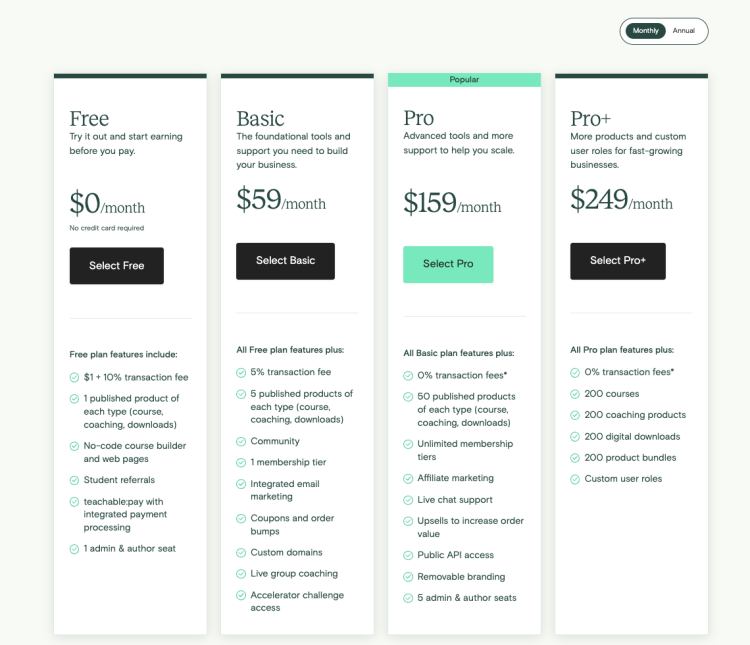
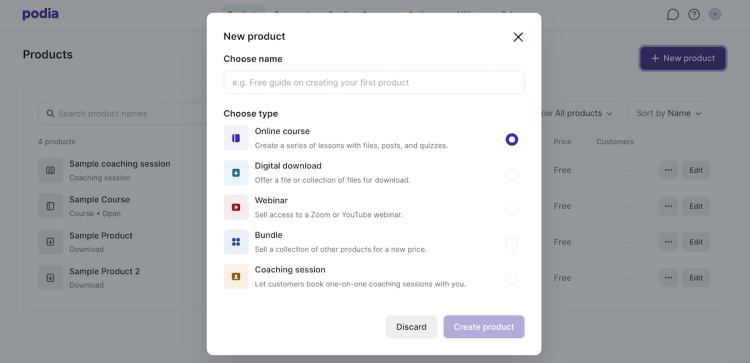
Optimize your profile

Optimizing your profile provides your LinkedIn connections with a better idea of who you are and what you offer. LinkedIn offers a number of sections on your profile for you to fill out that give connections information they need to decide whether to connect with you or to work with you.

Be sure to fill out the following:

  • Add a professional headshot as your profile photo
  • Create a headline that accurately describes what you offer
  • Input your relevant work experience
  • Write a synopsis about you
  • Share any services you offer
  • Add any certifications, skills, courses, or anything else relevant to your work

Make sure all your information is accurate and explains how you started the creative business you currently run. Talk about your digital products or services, who you help, and why you do what you do.

Having an accurate and optimized profile will help increase the number of connection requests you receive.

Post consistently

Next, you need to create your posting schedule and stick to it. Like we mentioned, aiming for at least once per business day is ideal, but at the very least, choose a cadence that will work for you.

For example, if you don’t have the time to create enough content to share every day, choose 2-3 days to post and stick with them. Algorithms enjoy consistency, which means sticking to a schedule can help boost your reach in the feed.

One good idea is to create an entire month’s worth of content ideas before you even start posting. This will give you a library to pull from as the month goes on—then, when you have the time, you can create more content to add to it. But having a solid starting point can help keep you consistent, even when you’re running low on time.

Connect with other users

LinkedIn is all about building connections. When you find someone in your industry, you can send them a connection request in order to add them to your LinkedIn network.

When you find the profile of someone you’d like to add to your network, you can click the button to “Connect” with them. When you do, this prompt will pop up:

As LinkedIn itself states, people are more likely to accept invitations that include a note. Your note can say something like:

  • Who you are
  • What you do
  • Why you sent a connection request

Keep in mind that you only have 200 characters to use for your note, so you want it to be short and sweet.

As you start to grow your own LinkedIn network, you’ll find that you start receiving new connection requests each day as well from others in your industry. Accept the ones that you’d like to build better connections with.

Engage with content regularly

If you want to start seeing more people engage with your content, you have to pay it forward first. Spend a few minutes each day browsing your LinkedIn feed—which will become more and more diverse as your network grows—and engage with posts that interest you or that are posted by people you want to build better relationships with.

React to content you enjoy, leave insightful comments on posts that you have your own thoughts about, and repost content that really resonates with you so that your own connections can see it. 

As you become more active on LinkedIn, you should see an uptick in engagement on your own posts. 

Create your LinkedIn strategy today

LinkedIn isn’t a set it and forget it strategy. You need to be consistent with your content, engagement, and connection requests. Create different types of quality, interesting content and post at the right times to start building an engaged network.

  • « Go to Previous Page
  • Page 1
  • Interim pages omitted …
  • Page 24
  • Page 25
  • Page 26
  • Page 27
  • Page 28
  • Interim pages omitted …
  • Page 35
  • Go to Next Page »

Get your Software Stack together. softwarestack.tech

Software Stack

© 2024–2025 - Software Stack is a trading name of SouthwestCIO Limited ac ompany registered in England & Wales 11319049

  • Knowledgebase
  • Home
  • About Us
  • Contact Us