
• Skip to primary navigation
  • Skip to main content
software stack logo

Software Stack

Get your Software Stack together

  • Knowledgebase
    • All Categories
    • Accounting Software
    • Automation & Workflow Software
    • Customer Relationship Management
    • E-Commerce Shopfronts & Payments
    • Marketing Automation
    • Online Courses & Membership
    • Project Management
    • Surveys & Forms
    • Web Hosting
  • Home
  • About Us
  • Contact Us
  • Show Search
Hide Search

Online Learning & Community

9 Top CEOs Share Favorite Productivity Tools and Apps

Software Stack Editor · July 26, 2024 ·

image

It takes a special type of person to oversee a business with valuations well into the multi-millions. CEOs have spent many years proving that they have the brains, vision, and tenacity to lead companies that are not only profitable, but also bring out the best in their employees. 

Many Creators look up to these influential figures for inspiration. After all, they had to be doing something right to climb up the corporate ladder or pursue their own venture to achieve current levels of success. So we decided to ask nine inspiring CEOs of respected and recognizable brands for the tools that they rely on during the work day to maximize productivity, organization, and creativity. The only catch was that the product, service, or app couldn’t be associated with their own companies. 

Check out the full list below, which ranges from planners and email apps to a whole lotta AI. And if you’re looking for more ideas to take your company to the next level, visit our guide to the best gifts for Creators. 

{{tableofcontents-component=”/blog-shortcodes/table-of-contents”}}

{{habittracker-component=”/blog-shortcodes/popups2″}}

 “As a busy CEO of a green company, it’s important to be organized and environmentally responsible. I love Blue Sky Green Earth planners because they’re sustainably sourced, thoughtfully designed, durable, and beautiful. In a world of digital everything, my Blue Sky planner helps me understand and retain important information as I write by hand, with big-picture views of my schedule and areas for detailed notes and yearly goals. Its textured, natural look inspires me daily and makes me feel more creative as I write. The planners are made with stone-based paper and soy-based ink, and every purchase gives back to One Tree Planted to support reforestation. I rely on strategic plans in my professional life, but I also believe in strategic life planning –— as they say, what gets written, gets accomplished! I’ve been using Blue Sky calendar planners for many years and, although they’re recyclable, I keep them all as a wonderful record of my personal and professional journeys.” – Kelly Blahakis-Hanks, president and CEO of ECOS

“One tool that has been a game changer for me is Calendly. It saves me a lot of back and forth over email when trying to find a mutually acceptable time for meetings. What’s even better is that I can have two calendars with different availability schedules. This ensures that people don’t have free reign over my schedule.” – Disha Gulati, founder and CEO of Here Here Market

“I use ChatGPT daily! It serves as my virtual productivity sidekick by effortlessly transforming ideas into action with speed and by supercharging my Excel spreadsheet game. In that spirit, ChatGPT helped me write this answer as well.” – Rosa Li, founder and CEO of wildwonder 

“My favorite creativity tool is Chopra. I use it for meditation, which creates space and quiet in my mind so creativity can thrive.” – YC CHeng, CEO of Hero Bread

“My weakness has always been organization, so utilizing ClickUp has been a major asset in streamlining our team’s efficiency and keeping me in the loop. As a creative, I’m inspired by everything around me for creating ad campaigns. A lot of times inside jokes with friends and random signs I see in NYC will influence a lot of our digital marketing creatives.” – Chris Bustamante, founder and CEO of Lushful Aesthetics

“While seemingly underrated, this ballpoint pen is one I cannot live without. It has the perfect click with its twisting mechanism, the colors are bright, fun and vibrant, which keeps me feeling creative, and it’s small enough that it fits into a notebook or jeans pocket.” – Paul Voge, co-founder and CEO of Aura Bora

“I love my notebook. It is handbag-sized, has lined pages, a pocket and elastic band to hold it closed. I keep business cards, bills that need paying and, most importantly, my to-do list.” – Christine Faulhaber, founder and CEO of Faulhaber Agency

“This is an amazing app for iPad users. I can sketch, draw, sign documents, keep track of projects, and do practically everything that my business requires on a day-to-day basis. It’s a lifesaver for admin stuff, but also taps into my creativity by allowing me to flesh out different ideas for clients and contractors.” – Anthony Gianacakos, founder and CEO of Anthony George Home. 

“My favorite productivity hack is Superhuman. It’s an email app that has helped me with my inbox zero anxiety because I can process emails in about a 1/3 of the time. Not only is it productive, it makes email a more fun experience.” – Sabeena Ladha, founder and CEO of DEUX

{{likefree-component=”/blog-shortcodes/call-to-action”}}

9 Top CEOs Share Favorite Productivity Tools and Apps

Software Stack Editor · July 26, 2024 ·

image

It takes a special type of person to oversee a business with valuations well into the multi-millions. CEOs have spent many years proving that they have the brains, vision, and tenacity to lead companies that are not only profitable, but also bring out the best in their employees. 

Many Creators look up to these influential figures for inspiration. After all, they had to be doing something right to climb up the corporate ladder or pursue their own venture to achieve current levels of success. So we decided to ask nine inspiring CEOs of respected and recognizable brands for the tools that they rely on during the work day to maximize productivity, organization, and creativity. The only catch was that the product, service, or app couldn’t be associated with their own companies. 

Check out the full list below, which ranges from planners and email apps to a whole lotta AI. And if you’re looking for more ideas to take your company to the next level, visit our guide to the best gifts for Creators. 

{{tableofcontents-component=”/blog-shortcodes/table-of-contents”}}

{{habittracker-component=”/blog-shortcodes/popups2″}}

 “As a busy CEO of a green company, it’s important to be organized and environmentally responsible. I love Blue Sky Green Earth planners because they’re sustainably sourced, thoughtfully designed, durable, and beautiful. In a world of digital everything, my Blue Sky planner helps me understand and retain important information as I write by hand, with big-picture views of my schedule and areas for detailed notes and yearly goals. Its textured, natural look inspires me daily and makes me feel more creative as I write. The planners are made with stone-based paper and soy-based ink, and every purchase gives back to One Tree Planted to support reforestation. I rely on strategic plans in my professional life, but I also believe in strategic life planning –— as they say, what gets written, gets accomplished! I’ve been using Blue Sky calendar planners for many years and, although they’re recyclable, I keep them all as a wonderful record of my personal and professional journeys.” – Kelly Blahakis-Hanks, president and CEO of ECOS

“One tool that has been a game changer for me is Calendly. It saves me a lot of back and forth over email when trying to find a mutually acceptable time for meetings. What’s even better is that I can have two calendars with different availability schedules. This ensures that people don’t have free reign over my schedule.” – Disha Gulati, founder and CEO of Here Here Market

“I use ChatGPT daily! It serves as my virtual productivity sidekick by effortlessly transforming ideas into action with speed and by supercharging my Excel spreadsheet game. In that spirit, ChatGPT helped me write this answer as well.” – Rosa Li, founder and CEO of wildwonder 

“My favorite creativity tool is Chopra. I use it for meditation, which creates space and quiet in my mind so creativity can thrive.” – YC CHeng, CEO of Hero Bread

“My weakness has always been organization, so utilizing ClickUp has been a major asset in streamlining our team’s efficiency and keeping me in the loop. As a creative, I’m inspired by everything around me for creating ad campaigns. A lot of times inside jokes with friends and random signs I see in NYC will influence a lot of our digital marketing creatives.” – Chris Bustamante, founder and CEO of Lushful Aesthetics

“While seemingly underrated, this ballpoint pen is one I cannot live without. It has the perfect click with its twisting mechanism, the colors are bright, fun and vibrant, which keeps me feeling creative, and it’s small enough that it fits into a notebook or jeans pocket.” – Paul Voge, co-founder and CEO of Aura Bora

“I love my notebook. It is handbag-sized, has lined pages, a pocket and elastic band to hold it closed. I keep business cards, bills that need paying and, most importantly, my to-do list.” – Christine Faulhaber, founder and CEO of Faulhaber Agency

“This is an amazing app for iPad users. I can sketch, draw, sign documents, keep track of projects, and do practically everything that my business requires on a day-to-day basis. It’s a lifesaver for admin stuff, but also taps into my creativity by allowing me to flesh out different ideas for clients and contractors.” – Anthony Gianacakos, founder and CEO of Anthony George Home. 

“My favorite productivity hack is Superhuman. It’s an email app that has helped me with my inbox zero anxiety because I can process emails in about a 1/3 of the time. Not only is it productive, it makes email a more fun experience.” – Sabeena Ladha, founder and CEO of DEUX

{{likefree-component=”/blog-shortcodes/call-to-action”}}

How this Business Owner Built a Top-Rated Fitness Membership Site

Software Stack Editor · July 25, 2024 ·

Haiden Hibbert

Haiden Hibbert

I’m a Content Manager at MemberSpace helping entrepreneurs and creators sell digital products.

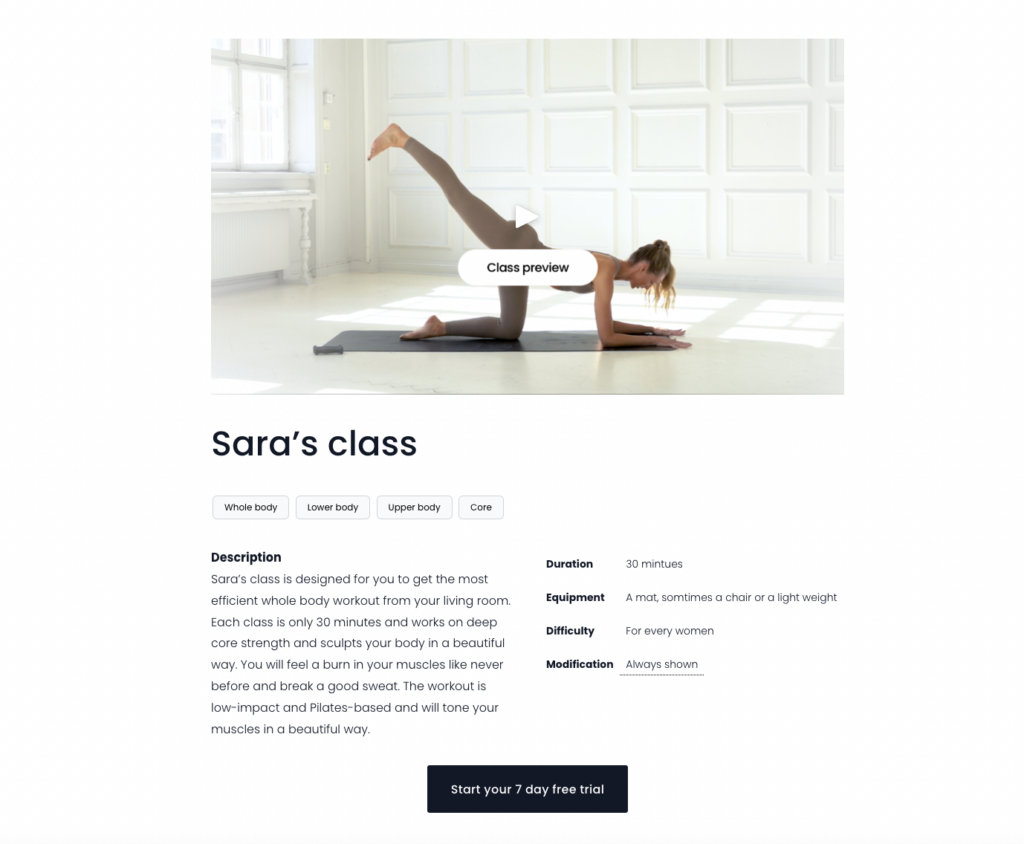
Launching a membership site is one of the best ways for fitness instructors to earn recurring income and build an online community. In this post, we’ll explore how Sara, a successful business owner, built her popular online wellness platform, Withsara. 

We’ll dive into the strategies Sara used to create her video content library, design her website, and attract new members. So whether you’re looking to start your own fitness membership site or just looking for some entrepreneurial inspiration,  Sara’s story offers valuable insights and practical guidance to help you get started.

Launch a fitness membership site!

The easiest way to accept membership payments or one-time charges for digital products like online courses, communities, content libraries, and more — all from your own website!


Start selling now

Get started for free! 5 minutes to set up.

Table of Contents

Meet Sara: fitness instructor, entrepreneur, and mother

Sara started her fitness membership site, Withsara, with the goal of inspiring women to make space for self care and daily exercise.  Over the years, she’s created a massive content library of classes for her members, has built out tailored programs, fun challenges, and weekly schedules to keep her members on track.

Sara fitness membership site owner

✨ Since launching Withsara, Sara’s members have completed over 150,000 workouts on her fitness membership site!

Creating a fitness content library

Sara’s fitness membership site includes an impressive content library of more than 350 workout videos. Here’s how she crafted her content library:

  • A variety of classes: Sara offers a range of classes to cater to different interests and fitness levels, from yoga to meditation to  pregnancy workouts.

  • Tailored programs: She created specific programs designed to meet her members’ various needs and goals. This helps members follow a structured fitness routine that works for them.

  • Engaging challenges and weekly schedules: To keep her members motivated, Sara introduced fun challenges and weekly schedules. These elements add excitement and help members stay committed to their fitness journey.

Fitness membership content library

Designing a fitness membership site

A key part of Sara’s success is her well-designed website. Here’s what makes it work so well:

  • Clean and user-friendly design: The website is easy to navigate, making it simple for members to find what they need.

  • Organized by category: Classes are sorted into categories, so members can quickly find  whatever  they’re looking for.

  • Program previews and trailers: Each program has a trailer and a preview of the included classes. This allows potential members to see what they can expect before they sign up.

  • Clear CTAs: There are call-to-action buttons sprinkled throughout Sara’s website, so no matter where visitors click, it’s easy to signup. 

Withsara fitness program

How to create a fitness membership site

Building a fitness content library like Sara’s is simple with the right software.  Here’s the five-step process:

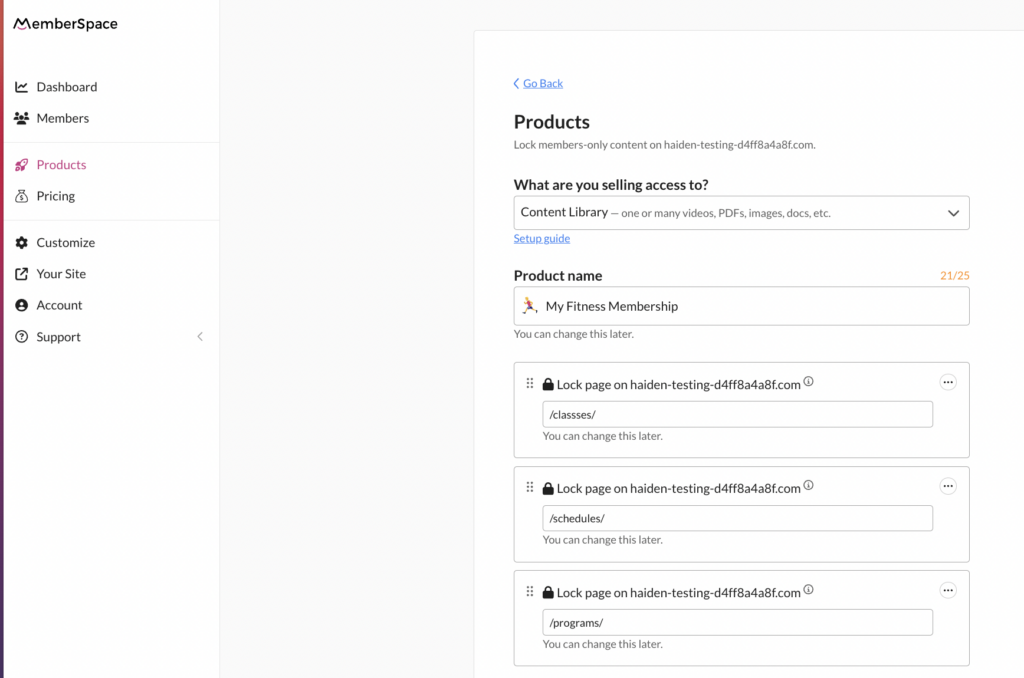
1. Convert your website into a fitness membership site with a tool like MemberSpace. This allows you to lock any page on your website, requiring visitors to sign up and pay to access your fitness content.

2. Add your workout classes to pages on your site, and lock those pages for paying members. You’ll do this by adding the URLs for each of your class pages to MemberSpace. 

Create fitness content library

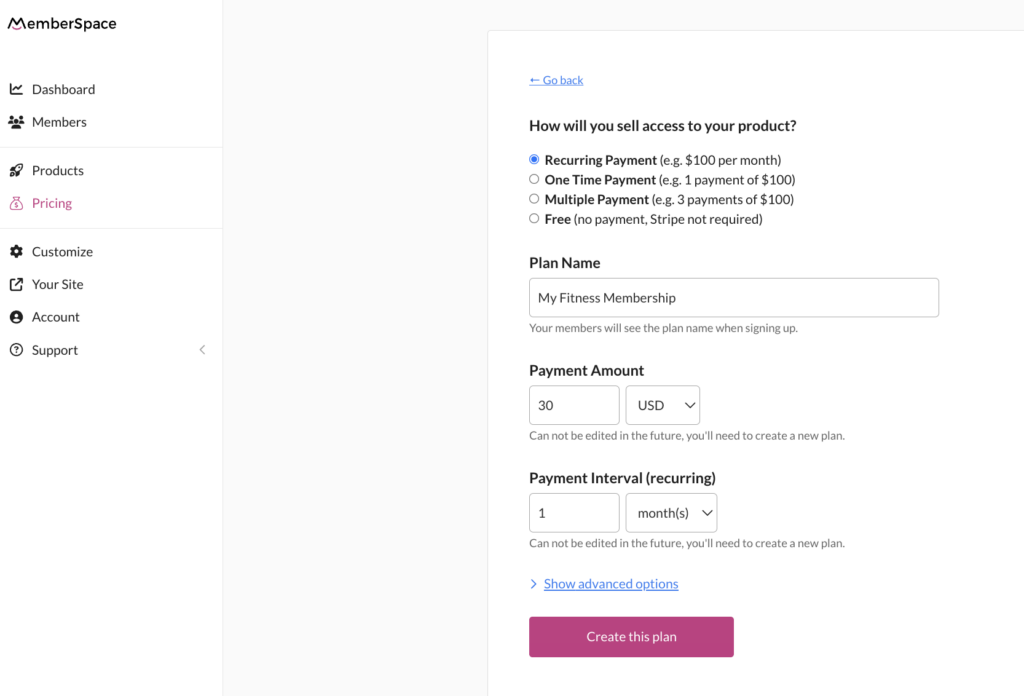
3. Set up your pricing. For fitness memberships, a recurring payment model is usually the most effective approach.

fitness membership site pricing

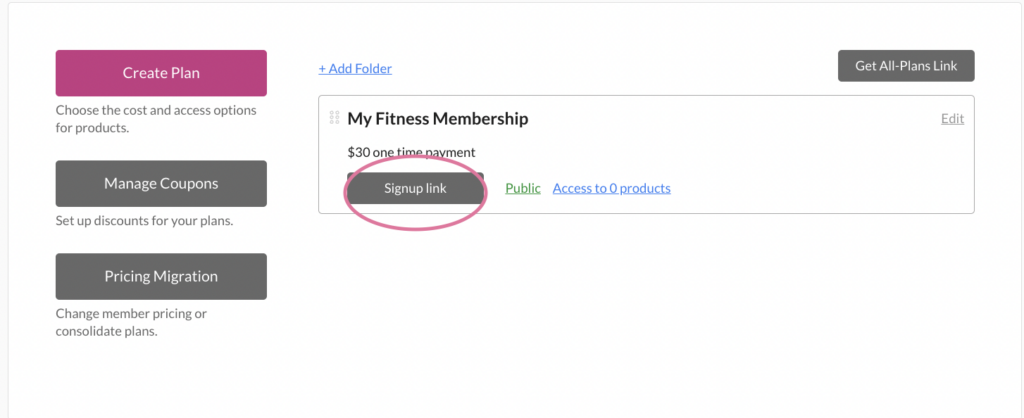
4. Copy your signup link and add it to call-to-action buttons on your site. When someone clicks the link, a form will open, requiring them to sign up and pay before they can access your content.

Fitness membership site signup

Attracting new members

Sara uses a few key strategies to attract a consistent stream of new members:

  • Offering a free 7-day trial: Potential members can try out her content for free for seven days. This gives them a chance to experience the platform before committing to a paid membership.

  • Active social media presence: Sara keeps her Instagram active with free workouts, fitness challenges, and lifestyle content. This not only attracts her target audience but also keeps her current members engaged and motivated.

  • Holistic wellness blog: Sara’s blog is full of free content that her target audience would be interested in, covering topics on exercise, workout routines, nutrition, and physical and mental health.

Final Thoughts

Building a successful fitness membership site, like Withsara, involves strategic planning, user-friendly design, and consistent engagement with your audience. By following the steps outlined in this guide, you can create a thriving membership site that not only generates income but also helps you achieve your mission of inspiring and motivating others.

Need help setting up fitness membership site?

Connect with our friendly team, weekdays 10am – 6pm ET.

Let’s chat!

The post How this Business Owner Built a Top-Rated Fitness Membership Site appeared first on .

Entrepreneurship12 best Kajabi alternatives that are actually affordable (Features & pricing)Discover the best Kajabi alternatives for selling online courses, marketing digital products, and designing beautiful websites—for a fraction of the price.

Software Stack Editor · July 25, 2024 ·

Discover the best Kajabi alternatives for selling online courses, marketing digital products, and designing beautiful websites—for a fraction of the price.

Jump ahead

In this article

Can you think of two creators that are exactly alike?

Some creators go viral on YouTube and make money off ads and sponsorships. Some sell printable planners with funny cat illustrations. Others offer 1:1 online music lessons alongside self-study musical theory courses.

There are endless ways creative businesses can come to life. Entrepreneurial journeys are diverse, and it makes sense that there are hundreds of different tools to support creators behind the scenes.

One of these tools is Kajabi, an all-in-one platform for selling digital products and running an online business.

In this guide, we’ll break down the pros and cons of Kajabi, as well as 12 Kajabi alternatives you can use to help you reach your goals.

Note: All pricing is accurate at the time of writing, but this is subject to change over time.

Kajabi pros and cons

With Kajabi, you can sell courses, downloads, coaching,
podcasts
, memberships, and communities. You can also use Kajabi to handle email marketing, create a website, build sales funnels (called pipelines), and manage affiliates.

Kajabi even comes with a mobile app so students can view courses on the go. On top of that, there are no transaction fees, so you’ll keep everything you earn.

So what’s the catch?

No platform is perfect for every creator, Kajabi included.

Here are some potential downsides of Kajabi:

First, Kajabi comes with a premium price tag. Compared to the other platforms we’ll discuss in this guide, Kajabi is one of the most expensive options for this type of software.

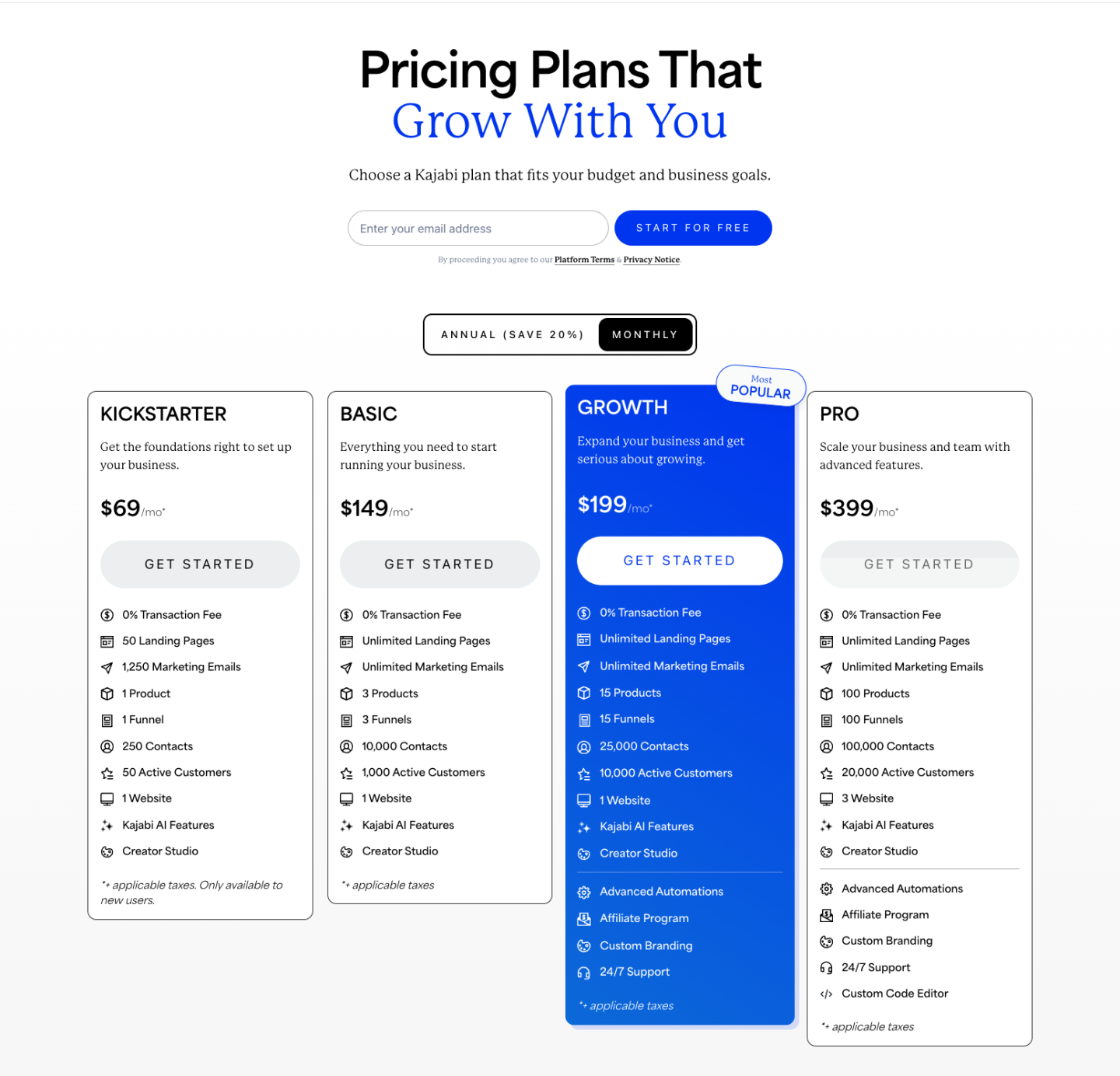
Kajabi costs:

  • Kickstarter: $69/month

  • Basic: $149/month

  • Growth: $199/month

  • Pro: $399/month

Even the lowest-tiered Basic plan is over $100 per month, which could be cost-prohibitive for
creators on a budget
.

In addition to having a higher price point, Kajabi imposes product limits on all plans.

Kajabi product limits:

  • Kickstarter plan: one product and one pipeline

  • Basic plan: three products and three pipelines

  • Growth plan: 15 products and 15 pipelines

  • Pro plan: 100 products and 100 pipelines

According to our
900+ creator survey
, creators have an average of 10.95 products, which means many would have to use Kajabi’s Growth plan or Pro plan to keep selling their work.

Finally, Kajabi doesn’t have
course completion certificates
built-in, so if you want to offer this to students, you’ll need to integrate with a third-party tool.

If you’re on the fence about Kajabi, here are 12 alternatives you can try instead.

12 best alternatives to Kajabi

1. Podia

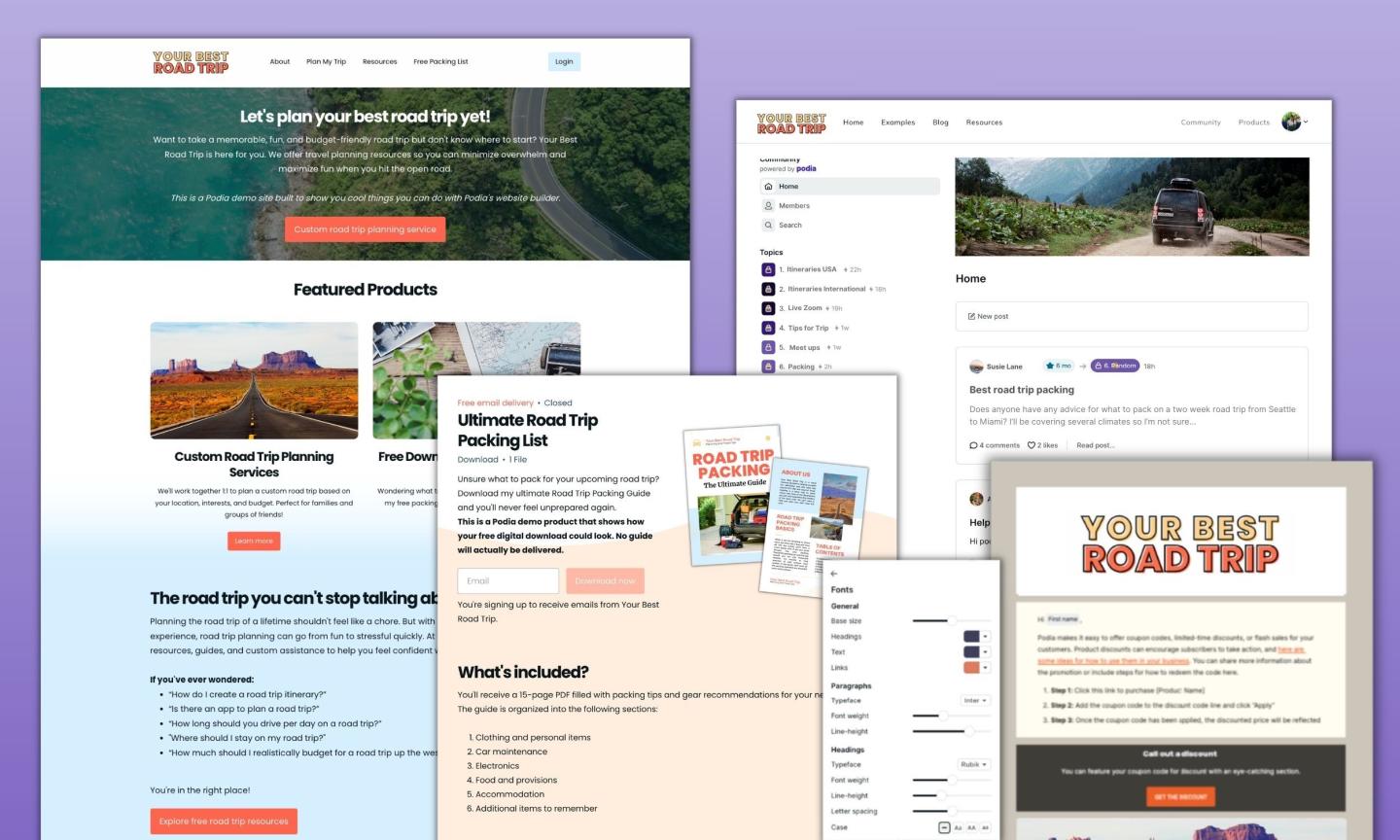
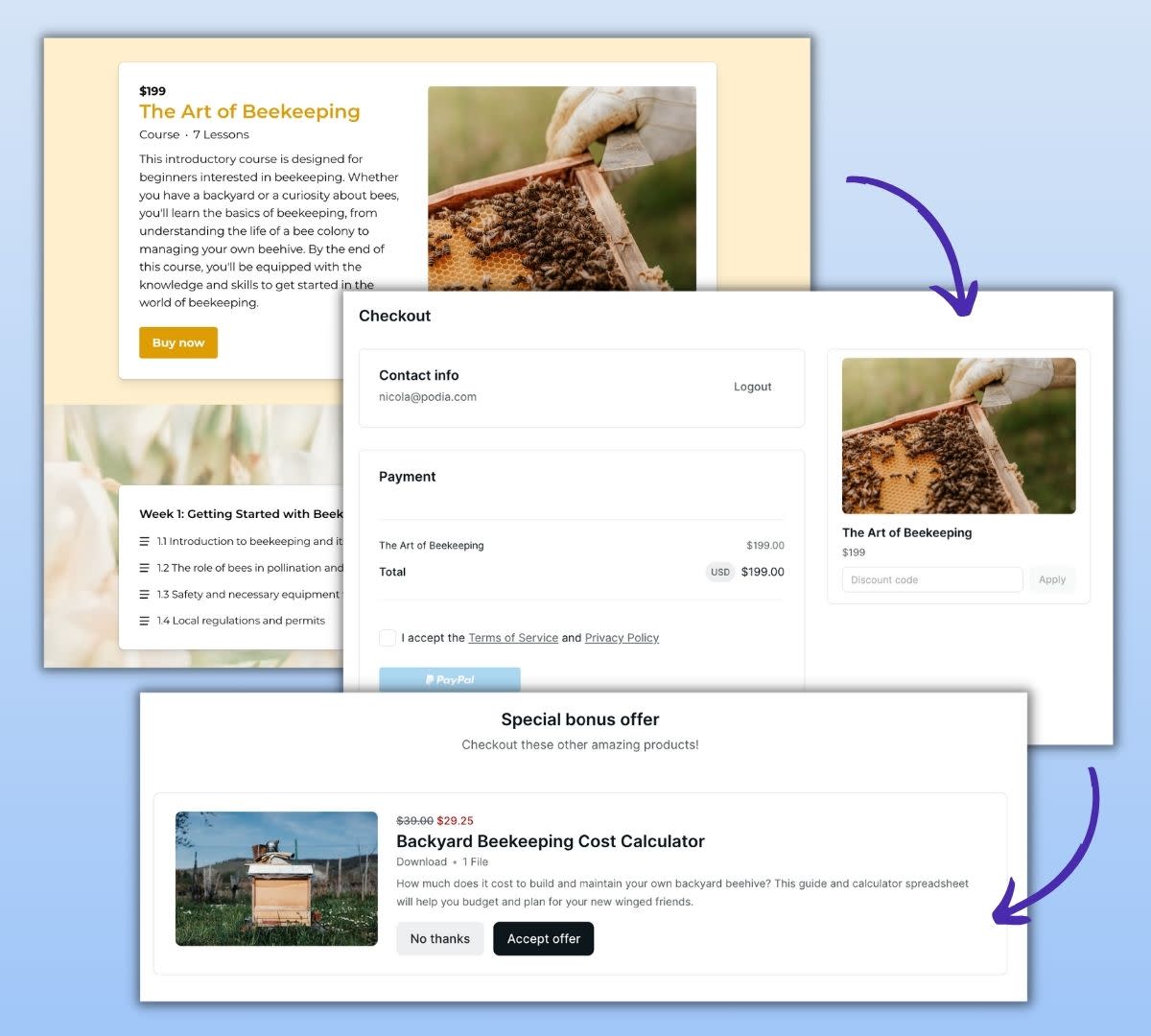
Podia is an all-in-one platform where you can build, host, and manage every aspect of your business. You can create and sell unlimited courses, digital downloads, coaching, community tiers, and more on Podia’s Mover and Shaker plans. With unlimited students, sales, and bandwidth, you won’t have to worry about upgrading as your business grows.

Our intuitive website builder means you won’t need to learn to code or invest in additional website tools to get your business up and running. You can easily create beautiful, effective sales pages for each item you sell.

In addition to selling unlimited products, Podia’s community feature helps creators build a network around their brand, resulting in more connections and happier customers.

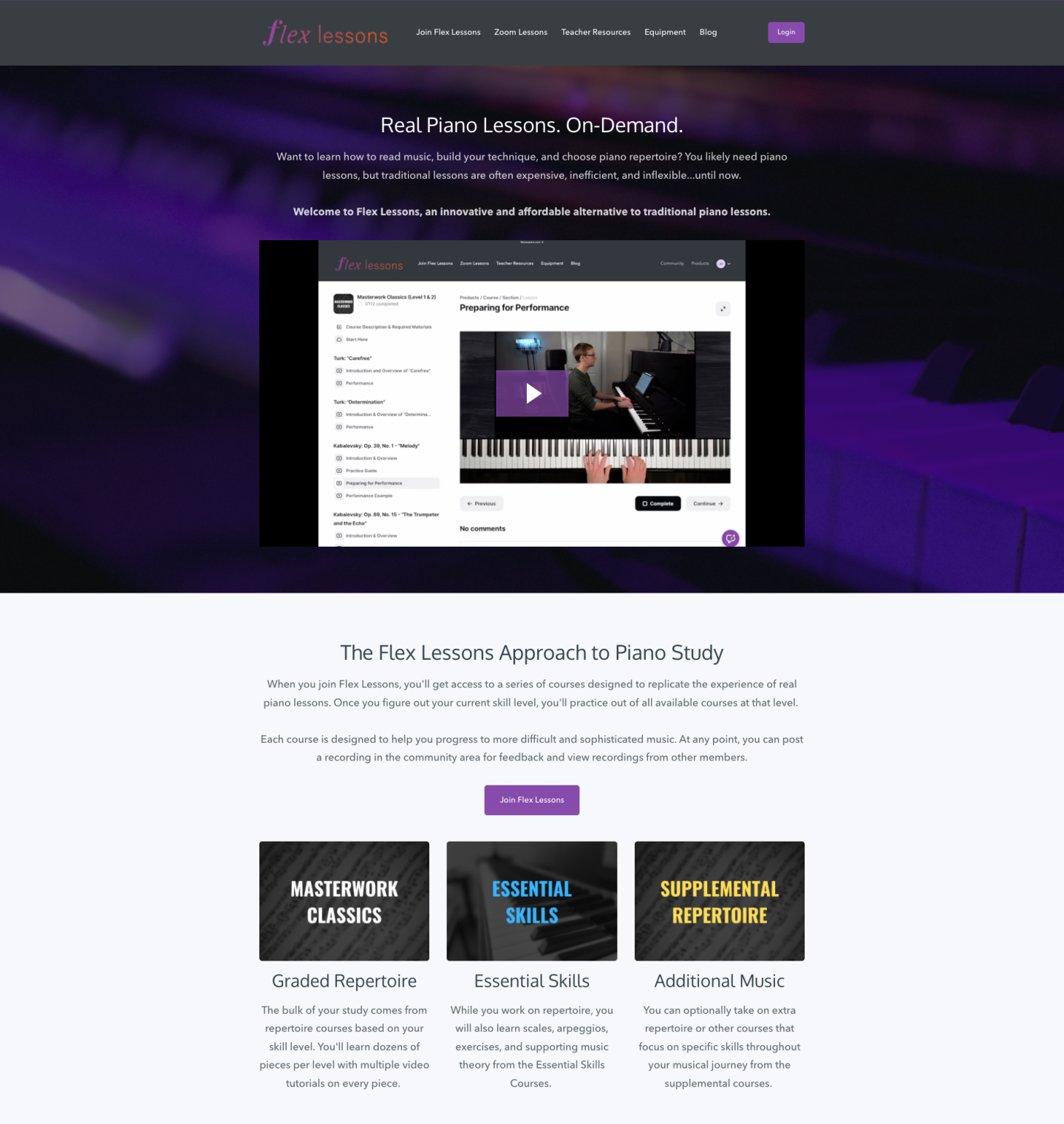
For example, singer and actor Harry Connick Jr. uses Podia to run his paid piano membership,
Piano Party
. Students get access to a series of video lessons and a supportive community to meet friends and share their wins.

Podia creator Emily Mills from
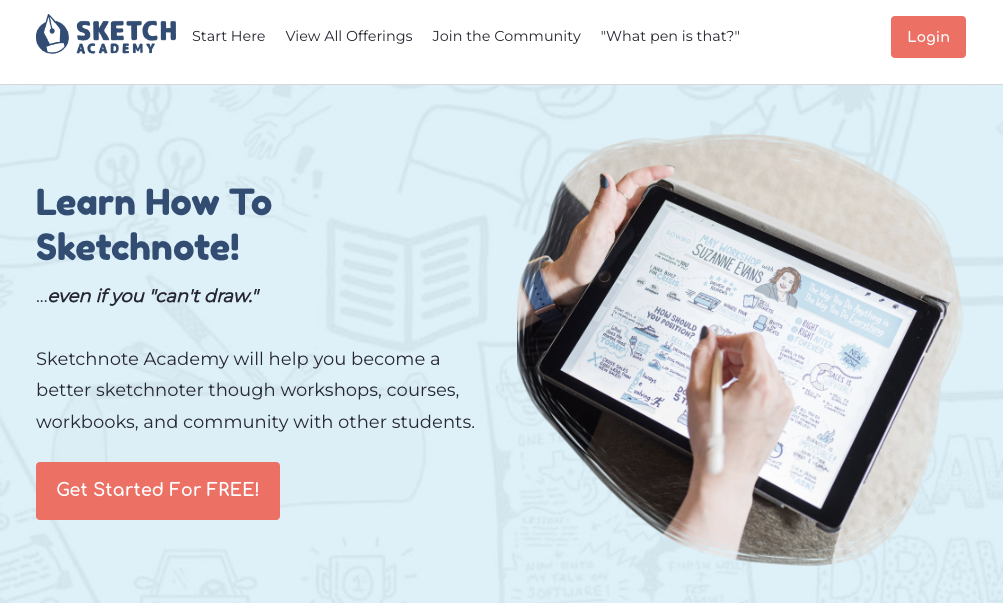
Sketch Academy
uses her free community to share upcoming events with her audience and host monthly hangout calls for sketchnote-enthusiasts. She also uses Podia to sell courses, workshops, workbooks, and 1:1 coaching.

Podia includes email marketing, affiliate management, and the ability to message prospective customers, so you don’t have to pay for extra tools and software. Users can also issue course completion certificates for students.

Here’s a look at some of our creators’ favorite features:

Podia features:

  • Sell unlimited
    courses
    ,
    digital downloads
    ,
    webinars
    , and
    coaching sessions

  • Easy-to-use website builder included on all plans

  • Built-in email marketing, affiliate marketing, and customer messaging

  • Free migrations when you sign up for an annual Mover or Shaker plan

  • Excellent customer support

  • Instant payouts

  • Payment integrations with Stripe and PayPal

  • Custom domains

Whether you’re brand new or a veteran creator, you’ll get everything you need in one affordable platform.

Podia pricing:

  • Free plan (10% transaction fee)

  • Starter: $9/month or $4/month when paid annually (8% transaction fee)

  • Mover: $39/month or $33/month when paid annually (5% transaction fee)

  • Shaker: $89/month or $75/month when paid annually

Learn more about how Podia compares to Kajabi
.

Get your free Podia account now
to see these features in action.

Get your free Podia account

Join the 150,000+ creators who use Podia to create websites, sell digital products, and build online communities.

Sign up free

2. Teachable

Teachable is a popular choice for coaches and course creators. With Teachable, paid plan participants get unlimited courses, coaching products, students, and video bandwidth.

You can build custom
sales pages
, detailed checkout pages, and even a homepage where all your products can live.

There are many ways creators can
price their products and courses
, and it’s possible to receive instant payouts. If you have partners, collaborators, or affiliates, Teachable makes sure everyone gets paid the right amount.

Teachable features:

  • Sell unlimited courses and coaching products

  • Build a custom storefront and sales pages

  • Course competition certificates and progress tracking

  • Affiliate center with automatic payouts

  • Dozens of powerful integrations

  • Email marketing features

Teachable benefits:

Teachable is built for selling courses and coaching, and creators can use design templates, quizzes, drip content, upsells, and course compliance enforcement. Also, Teachable users can add CSS code snippets to their school pages on all plans, including free plans.

Teachable downsides:

Teachable doesn’t come with a built-in community. If you want this functionality, you’ll need to integrate with an additional tool, which may come at an extra cost.

The included email marketing system lacks advanced features, and there are also transaction fees on the Free and Basic plans.

Teachable pricing:

3. Thinkific

Like Teachable, the Thinkific platform serves course creators. Through Thinkific, you can sell self-study courses, live lessons, videos, and cohort programs. Easily add assessments and give students an assortment of payment structures to choose from.

You can also use Thinkific to build a storefront or website for your business, complete with templates to help you get started. Thinkific also offers course completion certificates, assignments, and lesson prerequisites.

Thinkific features:

  • Sell courses, communities, products, bundles, and memberships

  • Voiceover PowerPoint presentation tool built-in

  • Student surveys

  • Students can leave course reviews

  • Exam integrations on higher plans

  • Video and content hosting on all plans

Thinkific benefits:

Thinkific creators get unlimited courses, content, and students on paid plans. For advanced users, custom CSS and HTML are available on Thinkific’s $99/month Pro plan. With Kajabi, this functionality is only available on the $399/month Pro plan.

Thinkific downsides:

Creators can only offer memberships, product bundles, payment plans, and subscriptions on Pro plans and above. Email features are limited, and basic communities are only available on higher-tiered plans.

Also, you can’t use Zapier triggers unless you purchase the Thinkific Growth add-on, which costs $50 and must be used in conjunction with the $99/month Pro plan.

Thinkific pricing:

With Thinkific, there are no transaction fees, even on the free plan.

  • Free

  • Basic: $49/month

  • Pro: $99/month

  • Premier: $499/month

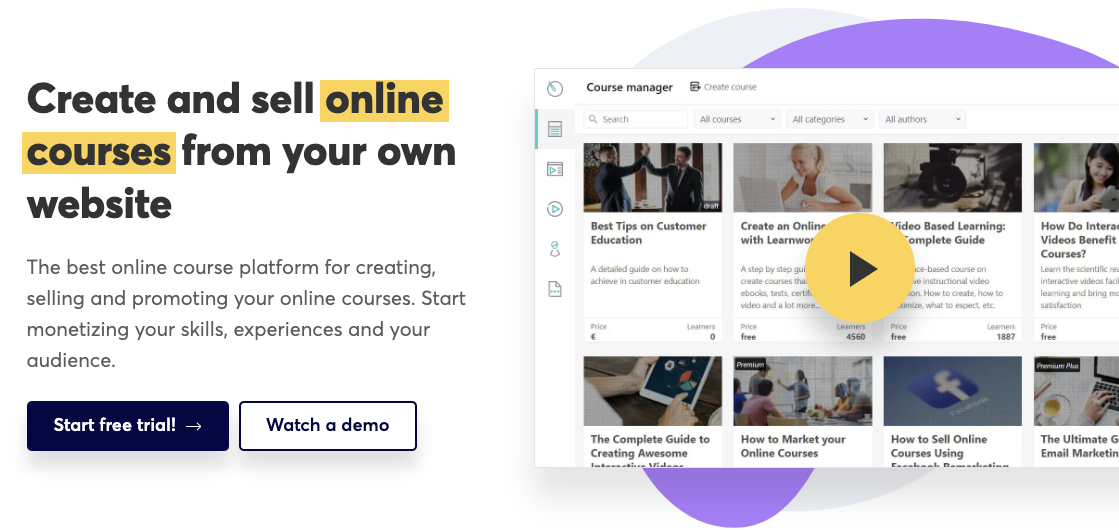
4. LearnWorlds

LearnWorlds is a platform where educators, entrepreneurs, and small to mid-sized businesses can build and sell online courses, memberships, and even mobile learning apps.

LearnWorlds also comes with a handy website builder. Customize your site however you like, and duplicate pages if you want to experiment with a new look.

One of the biggest perks of LearnWorlds is that you can build your own mobile app for your brand or business. You can offer in-app purchases, send notifications, and even create a fully white-label experience.

The LearnWorlds mobile app builder tool is available as a paid add-on for Learning Center members. There’s an extra cost for this service, but the price isn’t listed online.

LearnWorlds features:

  • Sell courses, memberships, subscriptions, and product bundles

  • Manage affiliates

  • Build your own website

  • Built-in video editing tools and transcripts

  • Create a mobile app for your brand (additional fee)

  • Add assessments, quizzes, question banks, and course completion certificates

LearnWorlds benefits:

LearnWorlds makes it easy for content creators to create engaging videos through built-in video editing tools and features. For students, LearnWorlds offers interactive add-ons like note-taking and highlighting within the course viewer.

LearnWorlds downsides:

LearnWorlds heavily focuses on course creation, so it may not be the right fit for creators who plan to sell digital downloads, coaching, communities, and services.

Starter plan members will pay a flat transaction fee of $5 per course sale, which could severely eat into your earnings for lower-priced courses. Also, free courses, memberships, and subscriptions can only be offered on the $99/month Pro Trainer plan and above.

LearnWorlds pricing:

  • Starter: $29/month (+$5 fee per course sale)

  • Pro Trainer: $99/month

  • Learning Center: $299/month

  • Corporate: Custom pricing

5. Teachery

Teachery is a straightforward online course platform for creators who don’t need a lot of bells and whistles. Utilize their user-friendly course builder to create as many lessons and modules as you like, and you can even duplicate courses if you want to run them more than once.

There are only two pricing options, and both pricing plans include unlimited students and courses. There aren’t any product upsells or add-ons; one flat rate gives you access to the entire tool.

Teachery features:

  • Unlimited courses, lessons, and students

  • Simple course editor

  • Build sales pages and landing pages to promote your products

  • Choose from two templates, minimal and sidebar

  • Whitelabel course provider

  • Memberships and
    product bundles

  • Mailchimp and ConvertKit integrations

  • Tools to
    create an affiliate program

Teachery benefits:

Teachery is ideal for course creators who want a minimalist platform that’s simple and easy to use. You’ll have everything you need to sell unlimited courses without a ton of extra features, which keeps costs affordable.

Teachery downsides:

With Teachery, you won’t get a website, storefront, or email marketing features. Teachery also doesn’t include video and audio file hosting. Instead, you’ll need to embed content through third-party tools like YouTube and Vimeo.

Teachery pricing:

  • Monthly plan: $49/month

  • Annual plan: $470/year

6. LearnDash

LearnDash is a WordPress learning management system (LMS) plugin that must be used with a WordPress website. Through LearnDash, you’ll get access to a drag and drop course builder and dozens of customization options to build your learning environment.

Create unlimited courses, host unlimited learners, and
house it all on your WordPress site
. You can also create course content with interactive elements like quizzes, leaderboards, gamification, and assignments.

LearnDash features:

  • WordPress LMS plugin

  • Enroll unlimited students and
    sell unlimited courses from your own website

  • Works with any WordPress theme

  • One-time purchases, subscriptions, memberships, course bundles, and bulk licenses

  • Gamification, quizzes, certifications, and evaluations

  • Send students notifications

LearnDash benefits:

The main benefit of the LearnDash WordPress plugin is how customizable it is. You can build whatever kind of website you want using the WordPress framework, add LearnDash to your existing site, and incorporate other add-ons and plugins to get additional functionality.

You also won’t pay any transaction fees on LearnDash course sales.

LearnDash downsides:

If you sell courses through LearnDash, you should be familiar with WordPress and comfortable connecting multiple plugins and integrations. Since WordPress has a learning curve, it may take longer to get your courses up and running.

You might want to
hire a developer
or web designer to bring your site to life, which comes with additional costs.

While a flat yearly price and no transaction fees might sound enticing, it’s important to remember that some tools are only available as paid add-ons. Combine that with the cost of hosting your website and domain fees, and this option can get pricey.

Also, if your technology starts acting up, you’ll be the one who has to troubleshoot a fix.

LearnDash pricing:

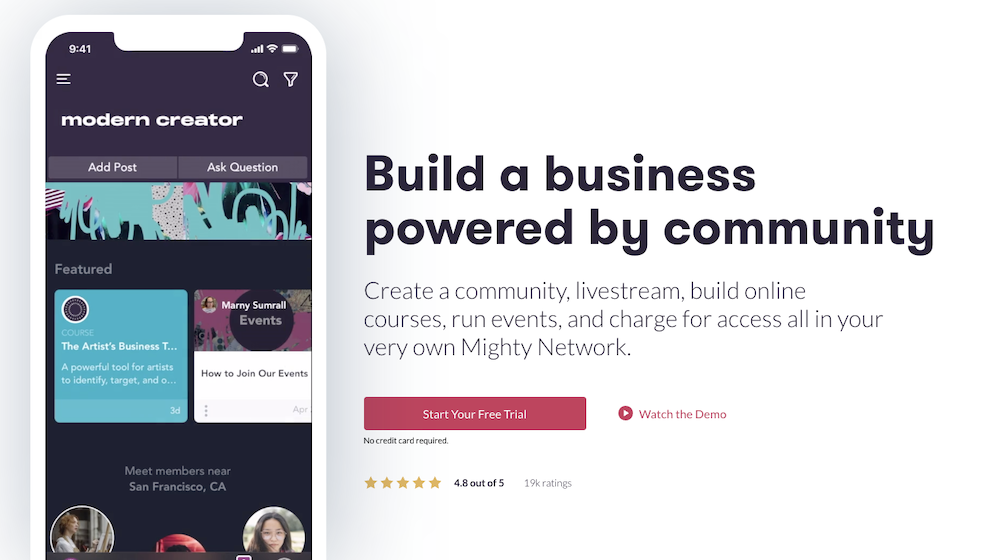
7. Mighty Networks

Mighty Networks is an online community platform. Here, creators can run free and paid membership communities and, on higher-tiered plans, sell online courses.

Mighty Networks makes it possible to create landing pages and offer a variety of payment plans for community access. Advanced community features include live streams, member profiles, direct messaging, virtual events, and calendar functionality.

Mighty Networks features:

  • Community and membership site features

  • Users have unique feeds through personalization technology

  • Communities can have unlimited members and moderators

  • Group and private chat messaging

  • Create live or cohort courses on the Business plan and up

Mighty Networks benefits:

Mighty Networks was designed for running communities, and creators get access to analytics and other helpful membership tools. You can also create courses with a dedicated community area.

Mighty Networks downsides:

The online course creation feature is only available on the $119/month Business plan and above. There isn’t a native way to sell services like coaching and 1:1 tutoring, so you may need additional tools if you plan to offer these products.

Mighty Networks users also pay a 3% or 2% transaction fee, depending on the plan.

Mighty Networks pricing:

  • Community plan: $39/month

  • Business plan: $119/month

  • Mighty Pro: Custom pricing

8. ClickFunnels

ClickFunnels is sales funnel software. Creators can build marketing automations that take visitors through sales pages and email nurture sequences designed to convert them into customers. Creators can also build strategic upsells, order bumps, and tripwires.

ClickFunnels is not marketed as a course provider, but it’s possible to deliver content through the password-protected membership feature. With over 100K users, this is a popular choice for entrepreneurs who depend on sales funnels to automate their business.

ClickFunnels features:

  • Page builder for creating sales pages and shopping cart pages

  • Autoresponders, upsells, cross-sells, order bumps, and tripwires

  • Built-in affiliate system

  • Email marketing tools with advanced
    segmentation capabilities

ClickFunnels benefits:

Creators can use ClickFunnels to build in-depth sales funnels as well as web pages and landing pages. There are also special funnel templates for generating leads, closing sales, and
running webinar events
.

ClickFunnels downsides:

While you can offer courses through the ClickFunnel membership area, this tool wasn’t built for selling courses directly. If you don’t use elaborate sales funnels in your business, ClickFunnels comes with many features you won’t need.

It’s common for creators to use ClickFunnels as their marketing platform and another tool to host their elearning content, which means additional costs.

ClickFunnels pricing:

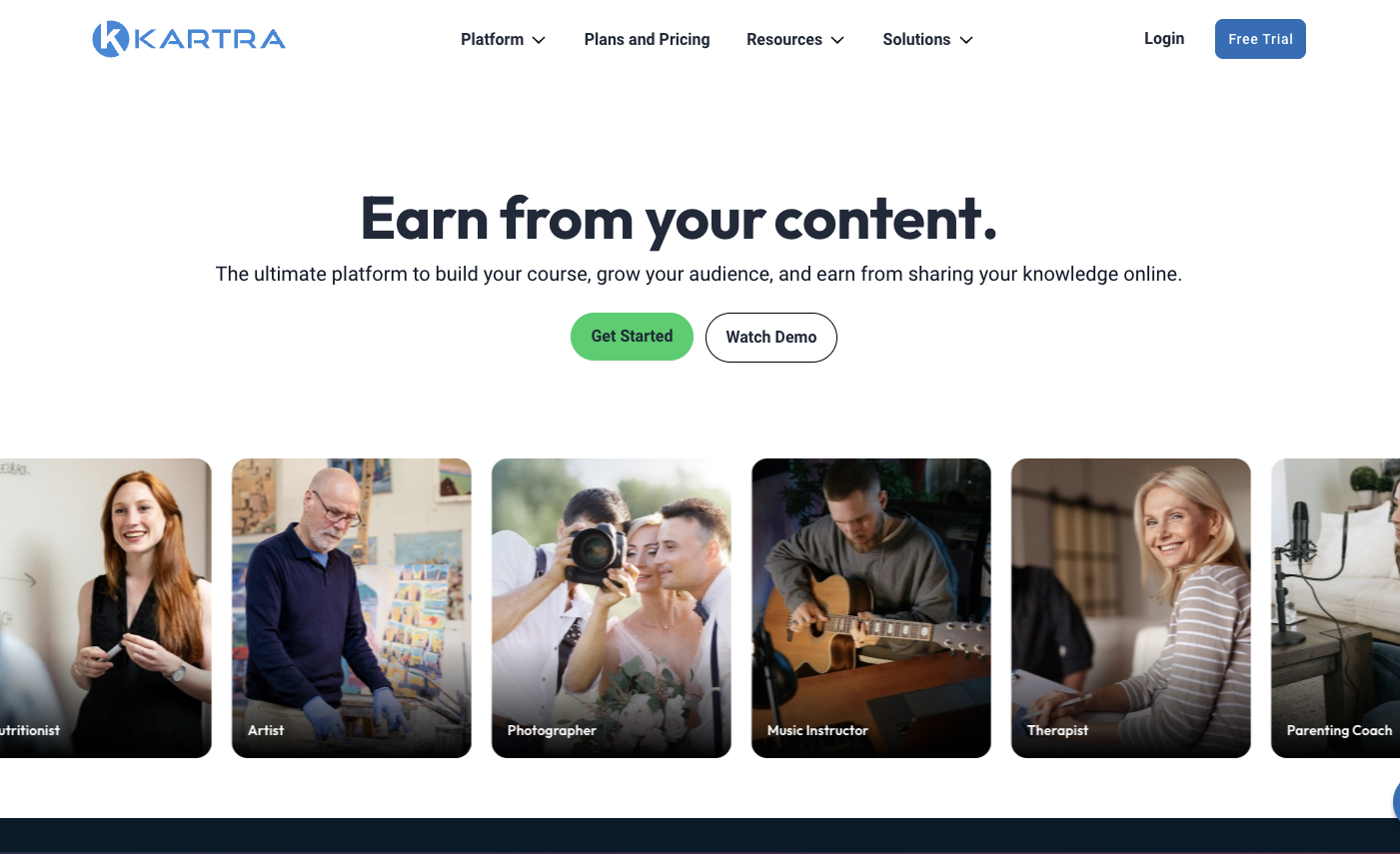
9. Kartra

Kartra is an all-in-one marketing platform where creators can build checkout carts, sales pages, funnels, and campaigns. Sell memberships, gather leads, manage your email list, and schedule live sessions with customers directly on the platform.

While Kartra isn’t specifically designed for selling courses and digital products, it’s possible to do so through
drip content
or adding resources to a
paid membership area
. Kartra also offers extra video enhancements like email capture pop-ups, watermarks, and playlists.

Kartra features:

  • Creators can make a helpdesk for their customers

  • Calendar scheduling tool built-in

  • Built-in surveys and quizzes to do customer research

  • Lead capture forms and client organization tools

  • Affiliate marketing
    tools

  • Agency tools to manage all your clients if you offer services

Kartra benefits:

Compared to Kajabi, Kartra excels because it offers appointment scheduling and calendar tools. There’s also a customer helpdesk feature so creators can provide customer support to their clients.

For affiliates, Karta has pre-screening questions, automated payouts, and an affiliate marketplace to find new promoters.

Kartra downsides:

Kartra doesn’t have a dedicated course builder, so you’ll have to use memberships as a workaround for delivering content. Kartra also lacks a community feature, so you’ll need to use a third-party tool if you want this functionality.

Kartra pricing:

  • Starter: $99/month

  • Silver: $199/month

  • Gold: $299/month

  • Platinum: $499/month

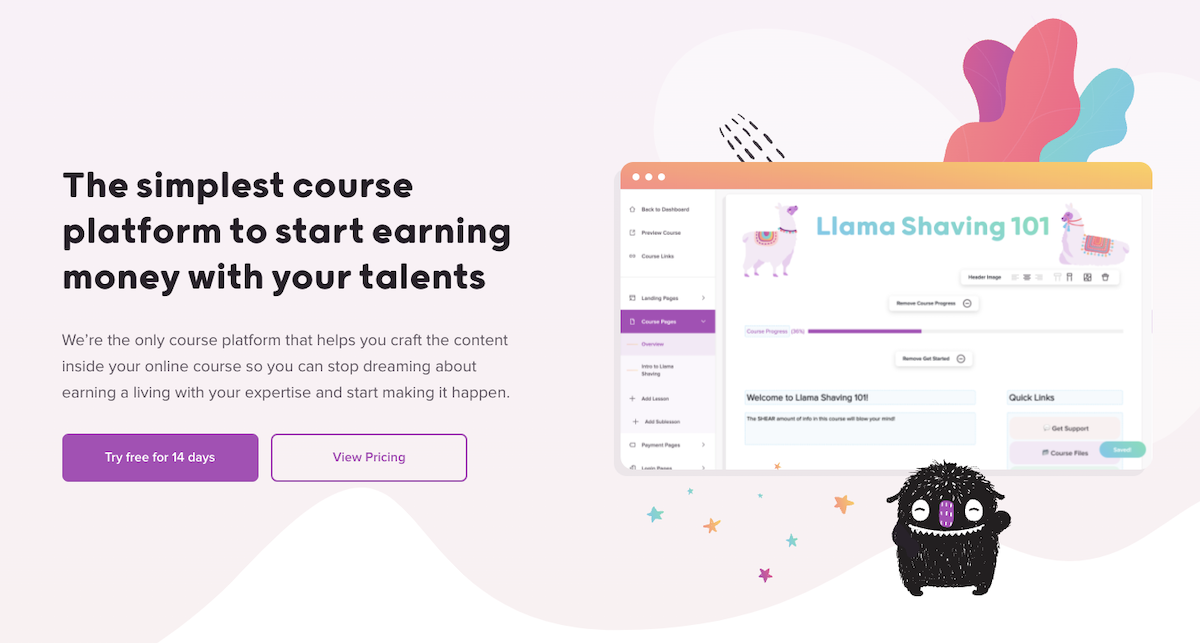
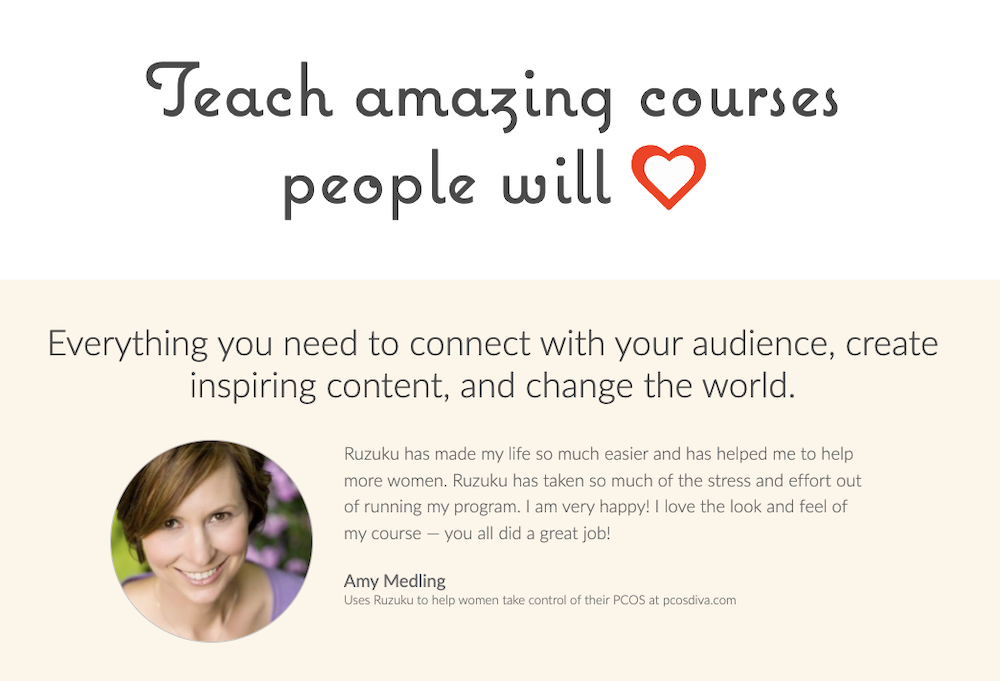
10. Ruzuku

Ruzuku is a simple platform for building and selling online courses. Create any type of course you want with unlimited video, audio, and file hosting using the intuitive Ruzuku course builder.

Courses can be evergreen, self-paced, or live, and you can create a copy of a course if you’d like to use the material again.

Ruzuku features:

  • Unlimited students and courses, data storage, no transaction fees

  • Webinars, polls, and quizzes on some plans

  • Engage students through forums, commenting, and prompts

  • Video hosting is included on all plans

Ruzuku benefits:

Ruzuku has robust features for course sellers, including video and audio hosting, teleconferences, video broadcasts, course completion data, an FAQ forum area, and student discussions.

Across the board, Ruzuku gets great reviews for simplicity and customer service. There are no transaction fees on any plans.

Ruzuku downsides:

Ruzuku is great for creators who want the basics, but you’ll need to connect other tools to offer affiliates, communities, or memberships. Ruzuku doesn’t come with a website builder, so this could be another puzzle piece to consider.

Ruzuku pricing:

  • Bootstrapper: $99/month

  • Up and Comer: $149/month

  • University: $199/month

11. Skillshare

Skillshare is different from the other Kajabi competitors on this list because it’s a learning membership platform. Rather than building a home base for your online business, Skillshare allows you to upload your content and get discovered by their large pool of learners.

To use Skillshare, students pay a monthly fee for unlimited access to all courses on the platform. Creators
record and upload video courses
, and any Skillshare member can enjoy the content.

Courses usually last 30-40 minutes and come with a project or assignment to enhance student engagement. All content also must pass video quality control standards and approval.

Teachers earn royalties based on how many minutes students watch their courses. Teachers can also earn referral bonuses when a student signs up for Skillshare using their unique link.

Skillshare features:

  • Upload video courses and make money through royalties

  • Earn more through the Skillshare affiliate program

  • Creators can be discovered by students already using the platform

Skillshare benefits:

With Skillshare, you don’t have to
do your own marketing
since users can find you by searching for your content on Skillshare. You can earn more by sending students to the platform with your referral code, but it’s still possible to earn royalties without any promotion.

Also, there are no recurring fees or websites to maintain. This is a good option for creators who don’t want to offer live courses and who want minimum work behind the scenes.

Skillshare downsides:

On Skillshare, you can’t set the price for your course, and your content will be hosted on Skillshare’s platform instead of on a website that you own.

You’ll get paid based on how many minutes of content people watch, which could mean lower earnings than if you sold your courses independently.

Skillshare courses must be pre-recorded video sessions with a project for students to complete at the end. This format may be stifling for creators who have another course type in mind, like real-time cohorts or ongoing memberships.

Skillshare pricing:

  • Free for creators

12. Udemy

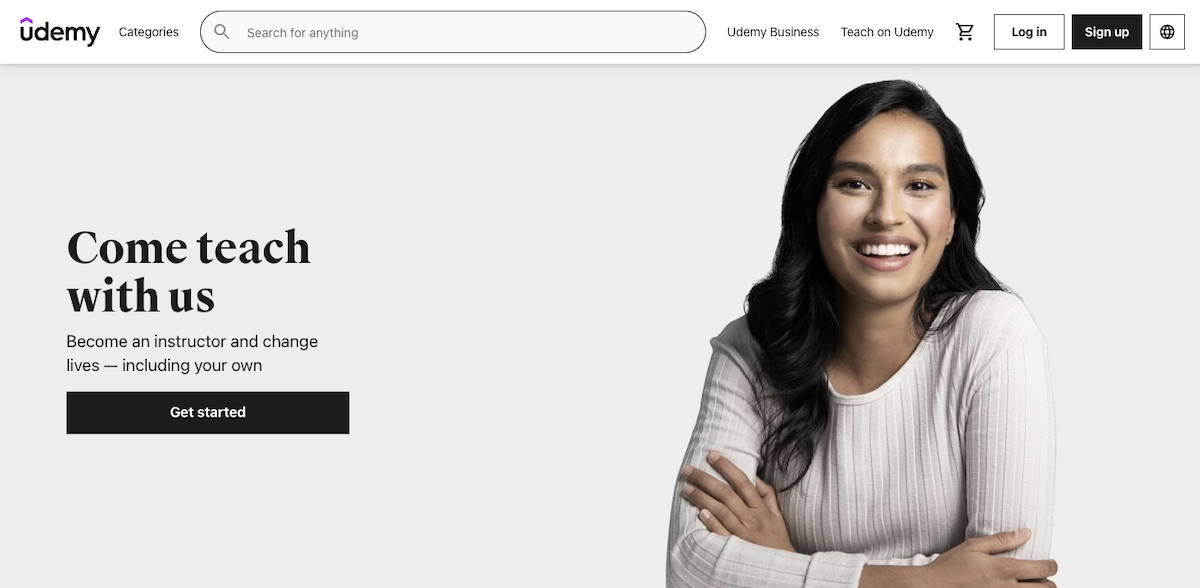
Udemy is a course marketplace website where you can list courses and reach a wide audience. They help with marketing, but in return, you give up control over elements of your course.

Teachers get paid through a revenue-sharing plan. When a student enrolls using the instructor’s referral code, the instructor keeps 97% of the course fee. If a student enrolls without using a referral code, the instructor only keeps 37%.

Udemy is also known for offering price reductions on courses site-wide, but creators can opt out of this if they don’t want their content to be discounted.

Udemy features:

  • Easy course builder and uploader tool

  • World-wide student base

  • Students can leave course reviews to build credibility

  • Users can gift courses to other people

  • Instructors can create coupons for their courses or be included in site-wide deals

Udemy benefits:

Selling courses on Udemy can be hands-off if you don’t want to deal with your own marketing. Because of the platform’s size, you have the potential to get your course in front of a large number of students relatively quickly.

Udemy downsides:

Udemy is free to use, but you won’t get a website, sales pages, email tools, or the ability to sell diverse product types like memberships, coaching, and digital downloads.

Udemy takes a large percentage of your sales unless students use your affiliate code. This can make it difficult to earn a living on the platform and grow your business.

For example,
Podia creator John D. Saunders
had over 1,900 customers buy his courses on Udemy, but he only earned $1,100 in revenue. When he switched to Podia, he earned $10,000 on launch day alone and has earned over $200,000 on the platform since.

Finally, all videos must be approved by Udemy before you can start selling. If they’re not formatted correctly, they could be rejected, and you’d have to start over.

Udemy pricing:

  • Free for creators

Find the right Kajabi alternative for you

Best free alternative to Kajabi:

  • Podia’s free plan includes a full website, landing pages, blogging, one digital download, one coaching product, and email marketing for up to 100 subscribers

  • Teachable and Thinkific have limited free plans

  • Udemy and Skillshare are free forever

More affordable Kajabi alternatives:

  • Podia: Plans start at $4/month

  • Teachable: Limited free plan, paid plans start at $39/month

  • Thinkific: Limited free plan, paid plans start at $49/month

  • LearnWorlds: Plans start at $29/month

  • Teachery: Plans start at $49/month

  • LearnDash: Plans start at $199/year

  • Mighty Networks: Plans start at $39/month

  • ClickFunnels: Plans start at $97/month

  • Kartra: Plans start at $99/month

  • Ruzuku: Plans start at $99/month

Best Kajabi alternatives that integrate with WordPress:

Best all-in-one alternative to Kajabi: Podia

Podia gives you everything you need to run your entire online business, no matter where your creativity takes you. If you’re looking for a place to sell unlimited products without breaking the bank, we’d love for you to join us at Podia.

To see how Podia can meet your creative needs,
sign up for your free account today
.

We can’t wait to see all the awesome things you make.

Get your free Podia account

Join the 150,000+ creators who use Podia to create websites, sell digital products, and build online communities.

Sign up free

The 7 Best Community Management Platforms for Course Creators in 2024

Software Stack Editor · July 25, 2024 ·

@media screen and (max-width: 450px) {
.lw-txt-s-below-450 {
font-size: 1.55rem;
}
}

Building a thriving community around your content is crucial for long-term success. But let’s face it – managing that community can quickly become a full-time job. Not to mention, having a Facebook group here, a forum there, and a whole lot of email threads can be messy, time-consuming, and not very effective.

That’s where community management platforms come in. These tools have been a game-changer for countless educators I know.

In this guide, we will explain what these platforms are, what they can help you do, and which features to look for. We will also list the best platforms and help you choose your favorite.

Your professional looking Academy in a few clicks

Start FREE Trial

Are you looking to take your community to the next level? This article will equip you with the knowledge and tools you need to create a vibrant online community that not only supports your courses but becomes a valuable asset in itself.

Here are the top community management platforms in a nutshell:

Platform Key Features Target Audience Pricing
LearnWorlds Robust course creation tools, Interactive Video Editor, Customizable learning paths, Built-in Community, Advanced Analytics, Mobile app, White-labeling Educators, Trainers, Coaches, Entrepreneurs, Businesses, Non-profits Starts at $29/month
Pro Trainer: $99/month
Learning Center: $299/month
High Volume & Corporate: Custom pricing
Mighty Networks Customizable community spaces, Online courses and events, Member profiles and messaging, Native mobile app, Monetization options Creators, coaches, entrepreneurs Community: $49/month
Courses: $119/month
Business: $219/month
Path-to-Pro: $360/month
Mighty Pro: Custom pricing
Circle Spaces for different topics, Member profiles and directories, Direct messaging, and group chats, Event management, Integrations with other tools Creators, small businesses, online communities Basic: $49/month
Professional: $99/month
Business: $219/month
Enterprise: $399/month Circle Plus: Custom pricing
Hivebrite Event management and ticketing, member directories, Content management system, Customizable branding, Advanced Analytics Professional networks, alumni groups, large organizations Connect: Starts from $799/month
Scale & Enterprise: Custom pricing
Discourse Threaded discussions, Real-time notifications, Moderation tools, Integrations with other tools, Mobile-friendly design Tech-savvy communities, forums, discussion boards Basic: $50/month
Standard: $100/month
Business: $300/month
Enterprise: Custom pricing
Bettermode Customizable community structure, Integrations with various tools, Gamification features, analytics, and reporting, Mobile responsive Brands, businesses, community managers Lite: $24/month
Pro: $59/month
Business: $119/month
Enterprise: Custom pricing
Slack Channels for topic-based discussions, Direct messaging, File sharing and integrations, Searchable message history, Customizable notifications Teams, businesses, collaborative communities Pro: $7.25/user/month
Business+: $12.50/user/month
Enterprise Grid: Custom pricing
Key Features Target Audience Pricing
LearnWorlds
Robust course creation tools, Interactive Video Editor, Customizable learning paths, Built-in Community, Advanced Analytics, Mobile app, White-labeling Educators, Trainers, Coaches, Entrepreneurs, Businesses, Non-profits Starts at $29/month
Pro Trainer: $99/month
Learning Center: $299/month
High Volume & Corporate: Custom pricing
Mighty Networks
Customizable community spaces, online courses and events, member profiles and messaging, native mobile app, monetization options Creators, coaches, entrepreneurs Community: $49/month
Courses: $119/month
Business: $219/month
Path-to-Pro: $360/month
Mighty Pro: Custom pricing
Circle
Spaces for different topics, member profiles and directories, direct messaging and group chats, event management, integrations with other tools Creators, small businesses, online communities Basic: $49/month
Professional: $99/month
Business: $219/month
Enterprise: $399/month Circle Plus: Custom pricing
Hivebrite
Event management and ticketing, member directories, content management system, customizable branding, advanced analytics Professional networks, alumni groups, large organizations Connect: Starts from $799/month
Scale & Enterprise: Custom pricing
Discourse
Threaded discussions, real-time notifications, moderation tools, integrations with other tools, mobile-friendly design Tech-savvy communities, forums, discussion boards Basic: $50/month
Standard: $100/month
Business: $300/month
Enterprise: Custom pricing
Bettermode
Customizable community structure, integrations with various tools, gamification features, analytics and reporting, mobile responsive Brands, businesses, community managers Lite: $24/month
Pro: $59/month
Business: $119/month
Enterprise: Custom pricing
Slack
Channels for topic-based discussions, direct messaging, file sharing and integrations, searchable message history, customizable notifications Teams, businesses, collaborative communities Pro: $7.25/user/month
Business+: $12.50/user/month
Enterprise Grid: Custom pricing

What is a Community Management Platform?

A community management platform is a Swiss Army knife for community builders. It’s a comprehensive software solution designed to help you create, grow, and manage your online community all in one place.

But it’s more than just a fancy forum or a glorified social media community group. These platforms offer tools that help you engage with your community members, moderate discussions, analyze engagement metrics, and even integrate with your course content.

Here are some key characteristics of community management platforms:

  • They provide a centralized hub: All community activities happen in one place, making it easier for you to manage and for members to engage.
  • They offer customizable spaces: You can create different areas for various topics, courses, or user groups.
  • They have engagement tools: Features like polls, Q&As, and challenges to keep members active and involved, increasing retention.
  • They allow content management: Tools to create, schedule, and organize posts and resources.
  • They feature analytics: Insights into community health, member engagement, and growth trends.

For course creators, these platforms offer a way to extend the learning experience far beyond the boundaries of course content creation.

They provide a space where students interact, share insights, support each other, and continue learning long after completing the last module of your course. It’s like creating a living, breathing ecosystem around your educational content.

Benefits of Using a Community Management Software

Using a robust online community management platform can compensate you generously—and by that, I do not only mean revenue-wise. Should you decide to invest in it, you can enjoy several advantages.

These are some of the key benefits you can expect to get in return:

  • Enhanced learner engagement: A well-managed community keeps students motivated and connected throughout their learning journey. We’ve seen course completion rates skyrocket after implementing a community platform.
  • Improved course completion rates: When students feel supported and connected to their peers, they’re more likely to stick with the course. The community becomes a source of motivation and accountability.
  • User-generated content: A vibrant community naturally produces a wealth of user-generated content. Discussions, questions, and shared experiences all contribute to a rich knowledge base that complements your course material.
  • Customer support streamlining: Community members often help each other, reducing the load on your support team. It’s beautiful to see students who’ve mastered a concept helping those who are struggling.
  • Valuable feedback: Your community becomes a goldmine of insights into student needs, preferences, and pain points. This feedback is invaluable for improving your existing courses and developing new ones.
  • Brand loyalty: A strong community fosters a sense of belonging, advocacy, and loyalty to your brand. Students who actively engage in the community are more likely to purchase additional courses and recommend them to others.
  • Additional revenue streams: A thriving community opens up opportunities for upselling, cross-selling, and even premium membership models. Some educators I know have turned their communities into significant revenue sources in their own right.
  • Continuous learning: The community extends the learning experience beyond the course timeline. Students can continue to learn, share, and grow long after they’ve completed your course.
  • Networking opportunities: Your community can become a valuable networking space for your students, adding extra value to your courses.
  • Reduced churn: Engaged community members are less likely to ask for refunds or leave negative reviews. The community adds value that goes beyond the course content itself.

💁🏻 Learn how to motivate and engage your learners to complete your online course.

💁🏻 Here’s why customer satisfaction should be a top priority for your business.

Pro Tip: If you already have an online presence on social networks, consider using a social media management tool like Sprout Social (which offers social listening) to streamline and monitor your community-building efforts. Working closely with influencers can also help you increase customer engagement.

Key Features of Community Management Platforms

If you are looking to create a more dynamic and impactful educational environment for your learners, a community management tool will undoubtedly be an invaluable asset to your online business.

Now, looking closely into what makes a great community management platform, we’ve found that the following functionality and features are absolute must-haves:

  1. User-friendly interface: Ease of use is non-negotiable. If your platform is clunky or confusing, members won’t engage, and you’ll spend more time troubleshooting than building a community. Look for intuitive navigation and clean, modern design to improve your customer experience.
  2. Customizable spaces: Your community should reflect your brand and cater to your needs. The best platforms allow you to customize the look and feel of your community and create tailored spaces for different topics or courses.
  3. Discussion forums: The heart of any community. Look for platforms that offer threaded discussions, easy-to-use formatting options, and the ability to categorize and tag posts for easy navigation.
  4. Content management: You need robust tools to create, schedule, and organize content. This includes the ability to post text, images, videos, and files and scheduling features for consistent content delivery.
  5. Member profiles: Allowing users to create personalized profiles helps foster connections between members. Look for options to customize profile fields relevant to your community.
  6. Notifications: Real-time alerts keep members engaged and informed. The best platforms offer customizable notification settings for both you and your members.
  7. Analytics: You can’t improve what you can’t measure. Look for platforms that offer detailed metrics on engagement, growth, popular content, and other key performance indicators.
  8. Moderation tools: Strong moderation features are essential for maintaining a positive community atmosphere. These features include content filters, user reports, and the ability to manage and moderate posts easily.
  9. Integration capabilities: Your community platform should play nice with your other tools. Look for platforms with robust API access and pre-built integrations with popular course platforms, CRMs, and marketing tools.
  10. Mobile app: In today’s on-the-go world, having an Android and iOS app for your community is crucial for keeping members engaged wherever they are.

But it’s not just about having these features—it’s about how well they work together to create a seamless community experience. The best platforms blend these features in a way that feels natural and intuitive.

As an educator or entrepreneur looking to foster a vibrant learning community, you need a cohesive and efficient community management tool. LearnWorlds checks off all the features from the list and offers everything you need to succeed under one roof. Take it for a spin for free today!

Your professional looking Academy in a few clicks

Start FREE Trial

Top 7 Community Management Platforms for Course Creators

After exploring different platforms, I’ve found that certain ones stand out for course creators. Below is a brief introduction to each platform, highlighting its strengths and limitations to help you choose the best one for your community management needs.

Here’s my rundown of the top contenders:

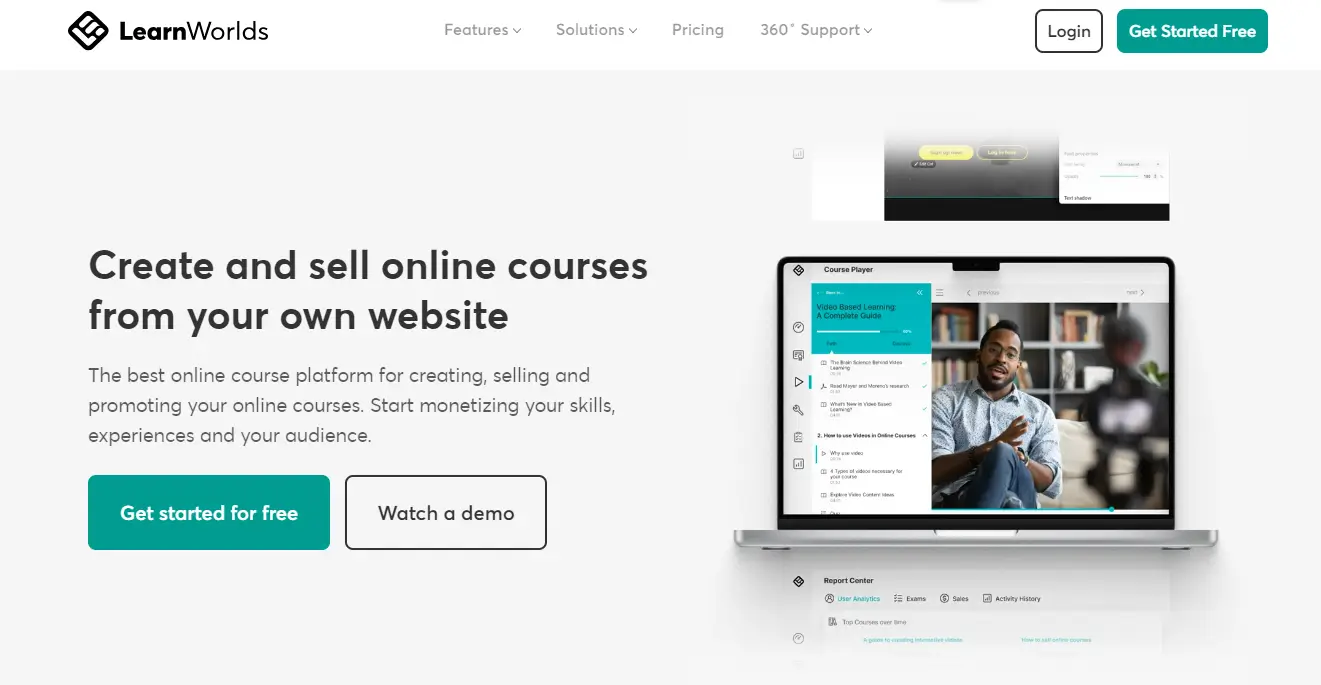
#1 LearnWorlds – Our Top Choice

A screenshot of LearnWorlds platform dashboard.

LearnWorlds is an all-in-one eLearning platform that helps you create and sell online courses. Its powerful built-in community management features make it easy to create communities, membership sites, and course discussions for your learners.

The platform offers a dedicated community space that allows learners to share posts, images, polls, like/react, comment via their timelines, and follow or mention each other. It also comes with a comprehensive suite of tools for course creation, including an AI Course Creator, video editing, assessments, and customizable learning paths, all integrated within a community-focused environment.

Moreover, it offers detailed analytics and reporting, a native mobile app, and a no-code Website Builder with advanced customization abilities.

Key Features

  • Robust course creation tools
  • AI Course Creator
  • No-Code Website Builder
  • Interactive video editor
  • Customizable learning paths
  • Built-in community features
  • Advanced analytics and reporting
  • Native mobile app

Pros & Cons

Pros

  • Comprehensive e-learning tools
  • Highly customizable courses
  • Ready-made website templates
  • E-commerce options
  • Engaging community features
  • Strong analytics and reporting
  • Fully white-label
  • Multiple integrations and payment gateways

Cons

  • Limited gamification options
  • Does not support TinCan
  • Steep learning curve for beginners

Pricing

LearnWorlds offers a 30-day free trial and the following pricing options:

  • Starter: $29/month
  • Pro Trainer: $99/month
  • Learning Center: $299/month
  • High Volume & Corporate: Contact sales

*Pricing information retrieved from LearnWorlds in July 2024.

#2 Mighty Networks

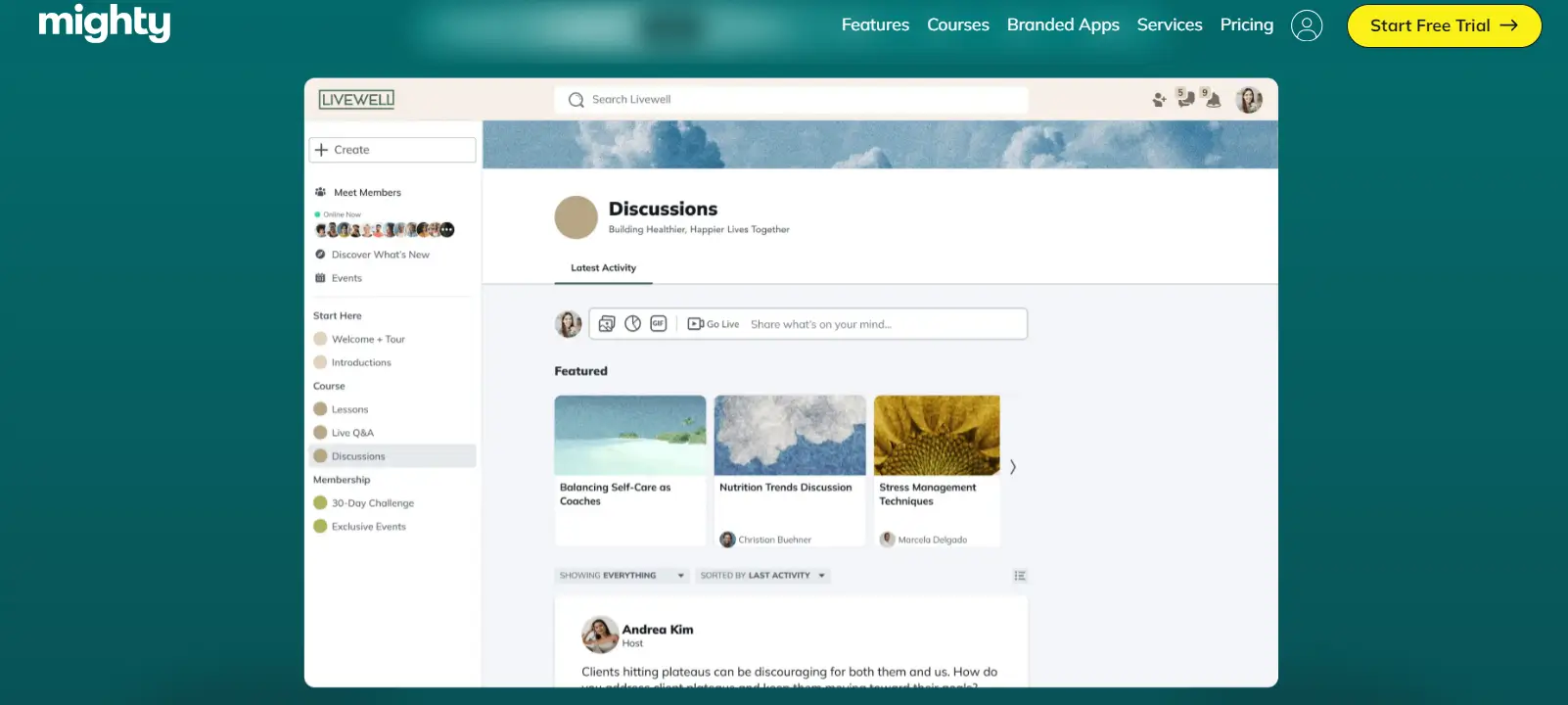
A screenshot of Mighty Networks website showing its discussions dashboard.

Mighty Networks is a versatile platform designed to build niche communities where members can interact, learn, and grow. It supports creators, coaches, and entrepreneurs by providing tools to create online courses, host events, and foster member interaction and engagement.

Its focus on community-building is complemented by its ability to integrate monetization options, making it a popular choice for those looking to build and manage vibrant online spaces. The platform offers features like discussion forums, member networking, and customizable content channels.

Key Features

  • Customizable spaces
  • Live streaming capabilities
  • Seamless online course integration
  • Robust member profiles and networking features

Pros & Cons

Pros

  • All-in-one solution for courses and community
  • Strong focus on member connections
  • Advanced community features
  • AI community builder
  • Native mobile apps

Cons

  • Steep learning curve for some advanced features
  • No support for quizzes, assignments, or certificates
  • Cannot sell courses outside the community
  • Stripe is the only available payment gateway
  • Limited customization, payment, and pricing options
  • Limited integration options compared to other platforms

Pricing

Mighty Networks offers a 14-day free trial and the following pricing packages:

  • Community Plan: $49/month
  • Courses Plan: $119/month
  • Business Plan: $219/month
  • Path-to-Pro Plan: $360/month
  • Mighty-Pro Plan: Custom pricing

*Pricing information retrieved from Mighty Networks in July 2024.

💁 The Best 15 Mighty Networks Alternatives Reviewed

💁 Mighty Networks vs LearnWorlds

#3 Circle

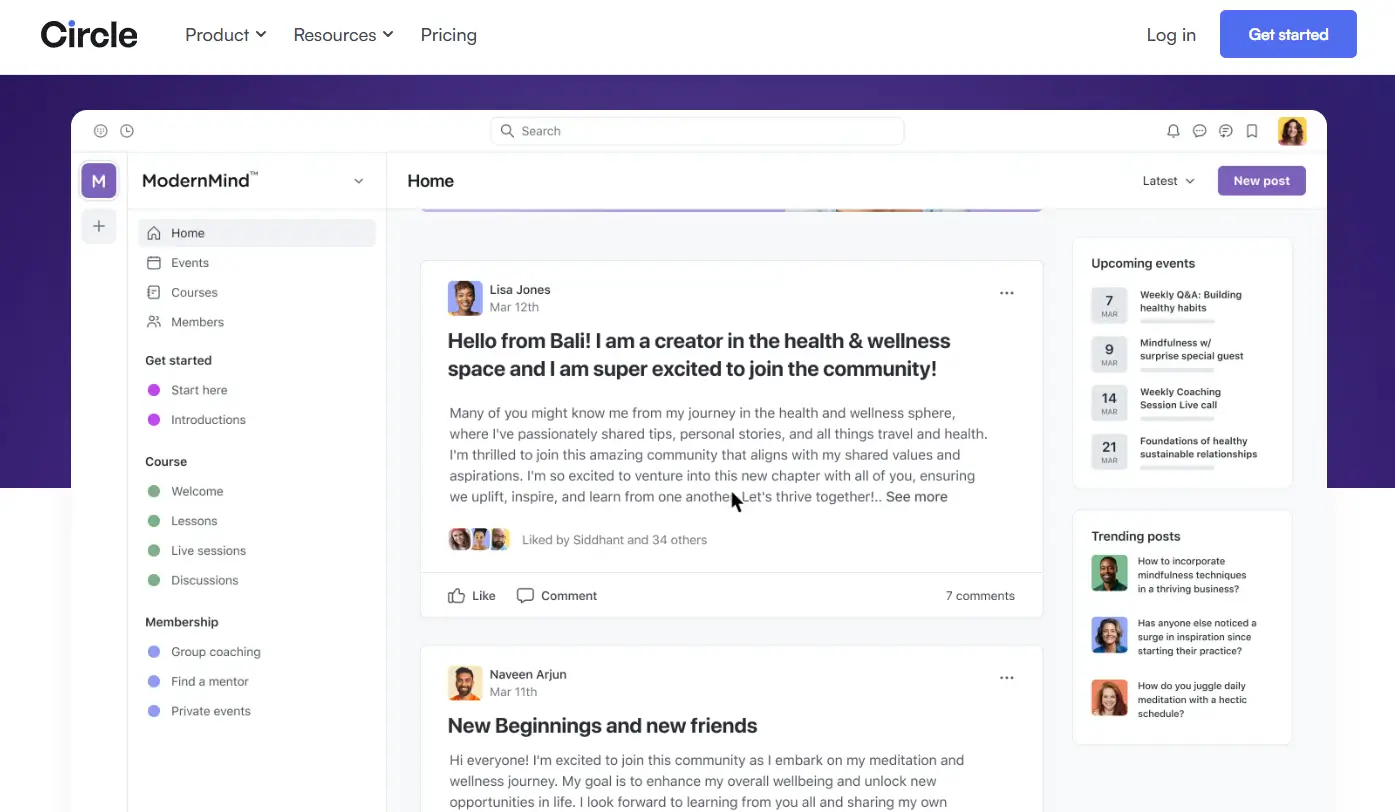
A screenshot of Circle's platform featuring its community page.

Circle is a modern community platform crafted for creators seeking to build engaging spaces for discussions, events, and content sharing. It offers an intuitive interface that supports seamless interaction between members and allows users to create a customized community hub that aligns with their brand.

The platform lets you build both open and private communities, offering added privacy and control access flexibility. It focuses on providing a streamlined experience that integrates well with other tools, making it an attractive choice for those looking to foster active and connected communities.

Key Features

  • Intuitive discussions and spaces
  • Live streaming and events
  • Seamless integration with major course platforms
  • Powerful moderation tools

Pros & Cons

Pros

  • Clean, modern interface
  • White-label option
  • Multiple selling and promotion options
  • Excellent course platform integrations
  • Strong community-building features

Cons

  • Limited built-in gamification options
  • No learning analytics
  • Limited pre-set settings and design customization options
  • Only supports basic learning content

Pricing

Circle offers a 14-day free trial and has the following pricing plans:

  • Basic: $49/month
  • Professional: $99/month
  • Business: $219/month
  • Enterprise: $399/month
  • Circle Plus: Custom pricing

*Pricing information retrieved from Circle in July 2024.

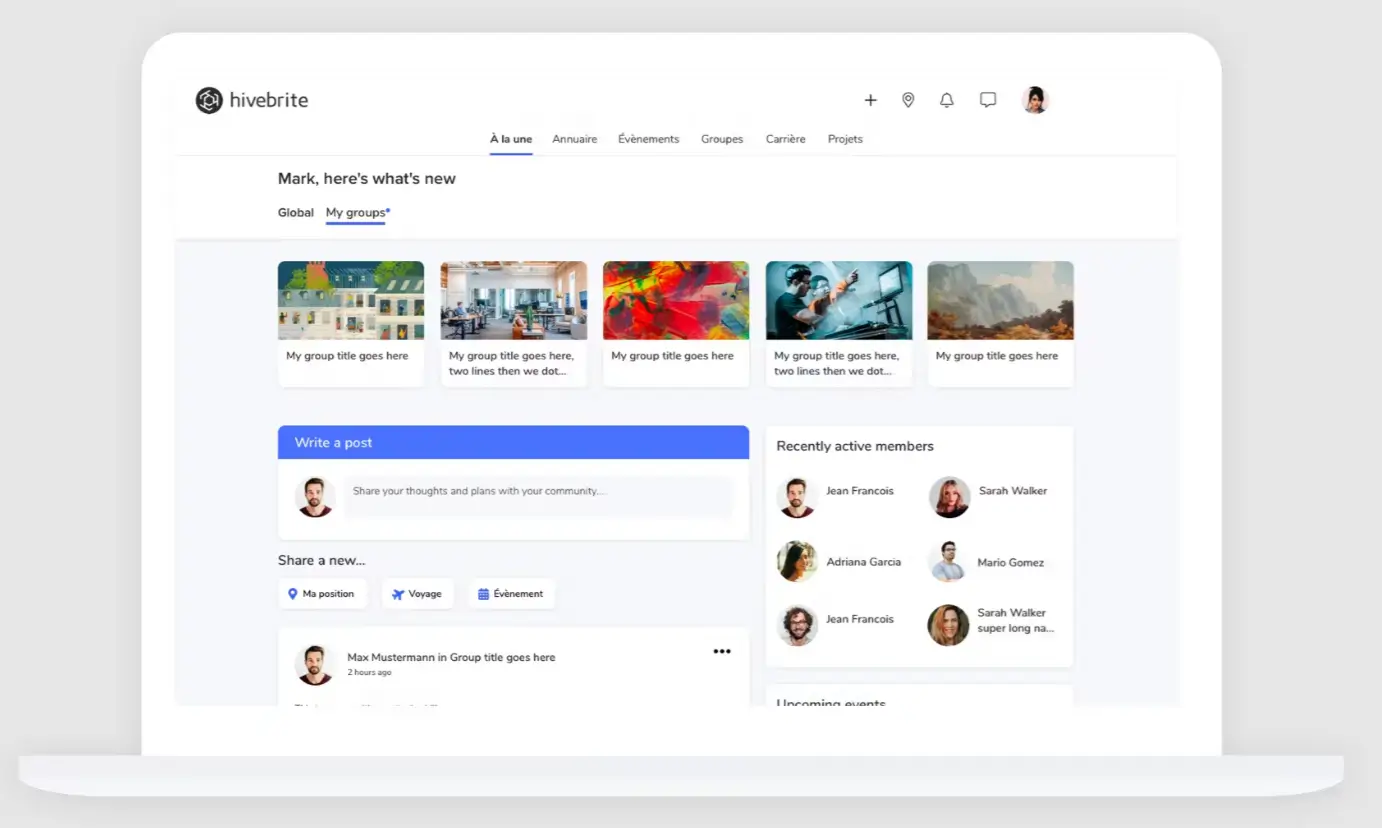
#4 Hivebrite

 A screenshot of the Hivebrite platform featuring its community dashboard.

Hivebrite is a community management platform tailored for professional networks, alumni groups, and large organizations. It offers extensive customization options and a broad range of features, from event management to advanced analytics, rich database filters, and profile update trackers that enhance community administration.

Other handy community features include direct messaging, an RSS feed, and personalized weekly newsletters. The platform is designed to support the complex needs of professional communities, ensuring a highly engaging and interactive experience for members.

Key Features

  • Comprehensive event management
  • Built-in job boards
  • Mentorship program tools
  • Advanced analytics and reporting

Pros & Cons

Pros

  • Robust email and engagement analytics
  • Member profiling and segmentation
  • Highly scalable for large communities
  • Robust features for professional networking
  • Branded mobile app
  • Paid events and privacy settings

Cons

  • Lacks learning features (gamification, gradebook, quizzes, and more)
  • Can be complex for smaller communities
  • No marketing tool integrations
  • No free trial and a high price point
  • Basic customization options
  • No SCORM compliance

Pricing

Hivebrite offers the following three pricing plans:

  • Connect: starts from $799/month (billed annually)
  • Scale: Custom pricing (customized permissions and user access, visibility restrictions, additional membership options, and more)
  • Enterprise: Custom pricing (advanced onboarding, dedicated support, and advanced functionality for groups and sub-communities)

Scale and Enterprise plans offer additional features and custom pricing based on needs and community size. You need to request a demo to get a quote.

*Pricing information retrieved from Hivebrite in July 2024.

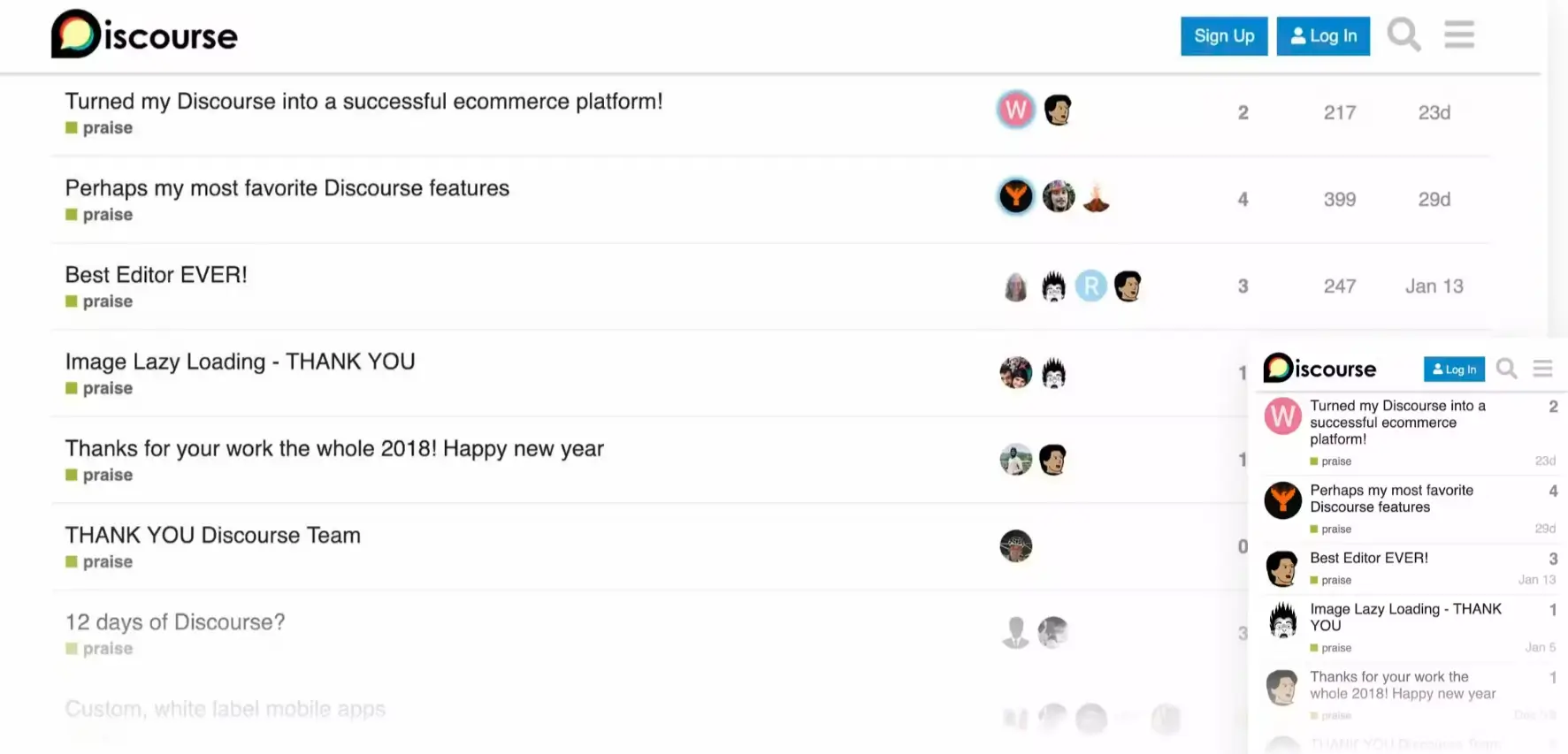
#5 Discourse

 A screenshot of the Discourse platform's discussion forums dashboard.

Discourse is an open-source discussion platform designed to create dynamic, engaging community forums. It supports in-depth conversations with threaded discussions, real-time notifications, and robust moderation tools.

The platform has strong customization options and other valuable features like categorization, badges, and a reputation system, encouraging active participation and member contribution. Its open-source nature allows for extensive customization, making it a favorite for tech-savvy communities looking to host structured and detailed discussions.

Key Features

  • Open-source and highly customizable
  • Excellent for in-depth, threaded discussions
  • Strong SEO capabilities
  • Powerful moderation and trust level system

Pros & Cons

Pros

  • Added flexibility and customization options
  • Engaging analytics per user activity
  • Great for fostering deep, meaningful discussions
  • Strong community governance features
  • Great customer support

Cons

  • Steep learning curve for setup and customization
  • Less intuitive for non-technical users
  • Not ideal for managing workflows
  • Lack of integrations, add-ons, and plugins
  • No live chat option

Pricing

Discourse offers a 14-day free trial and the following pricing packages:

  • Basic: $50/month
  • Standard: $100/month
  • Business: $300/month
  • Enterprise: Custom pricing

*Pricing information retrieved from Discourse in July 2024.

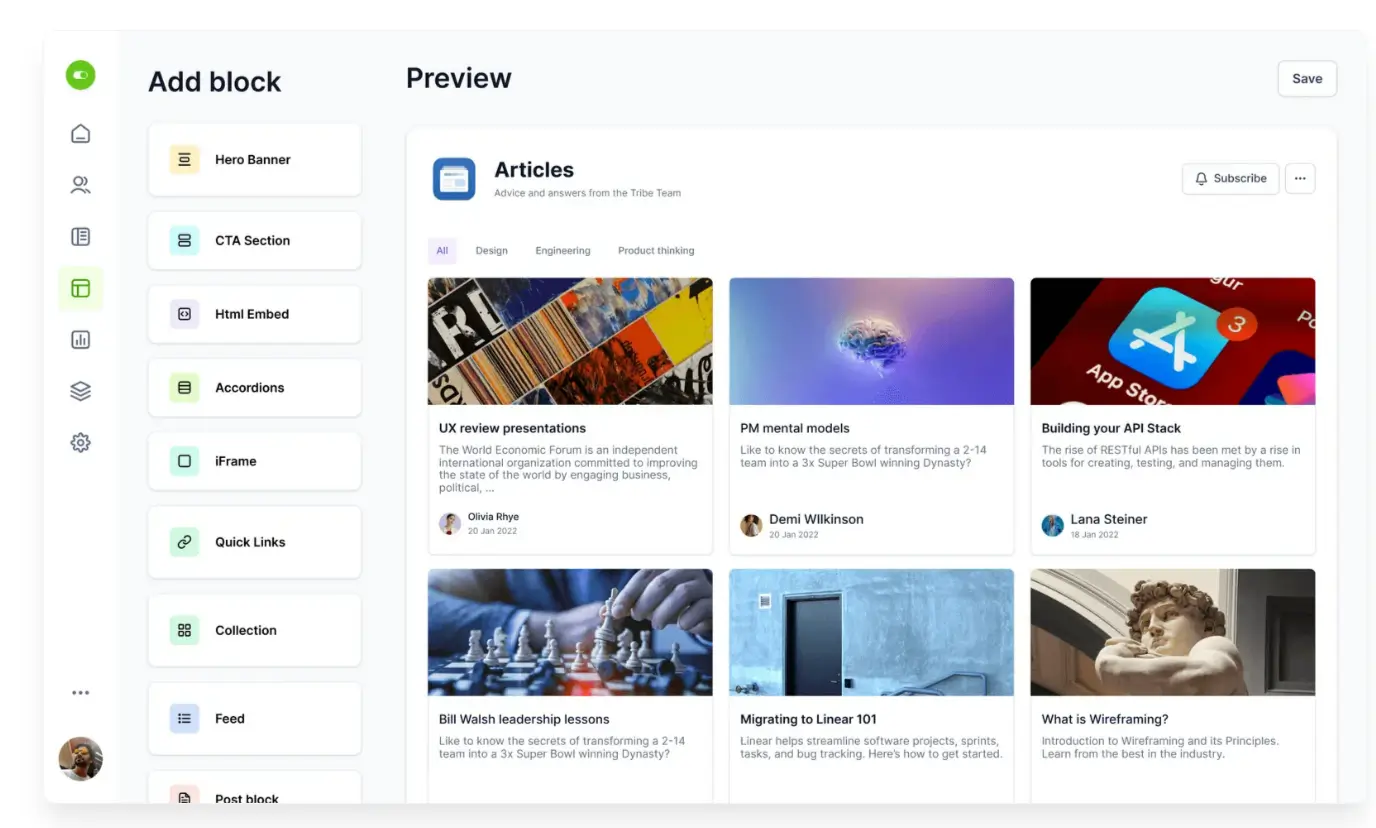
#6 Bettermode (Tribe)

A screenshot of the Bettermode platform's blog dashboard.

Bettermode is a robust community management platform for creating branded, interactive communities. It provides extensive customization options, allowing users to design community spaces with specific branding and layout preferences. Features include discussion forums, detailed member profiles, and a reputation system with badges.

Bettermode also supports content management, advanced analytics, and monetization options. It integrates with various tools and incorporates gamification elements to enhance engagement. While it offers powerful tools for community building, it may require more setup and come with higher costs for advanced features.

Key Features

  • White-label community platform
  • Built-in gamification tools
  • Ideation and Q&A formats
  • Extensive API for custom integration

Pros & Cons

Pros

  • Clean and user-friendly interface
  • Highly customizable
  • Strong focus on driving engagement through gamification
  • Flexible space for various community activities
  • Detailed analytics and great moderation features

Cons

  • Some advanced features only available on higher-tier plans
  • No mobile app
  • Can be expensive for individuals but not suitable for small businesses
  • Limited numbers of account users
  • Lack of monetization features (like landing pages)

Pricing

Bettermode comes with a free plan and the following paid plans:

  • Lite: $24/month
  • Pro: $59/month
  • Business: $119/month
  • Enterprise: Custom pricing

*Pricing information retrieved from Bettermode in July 2024.

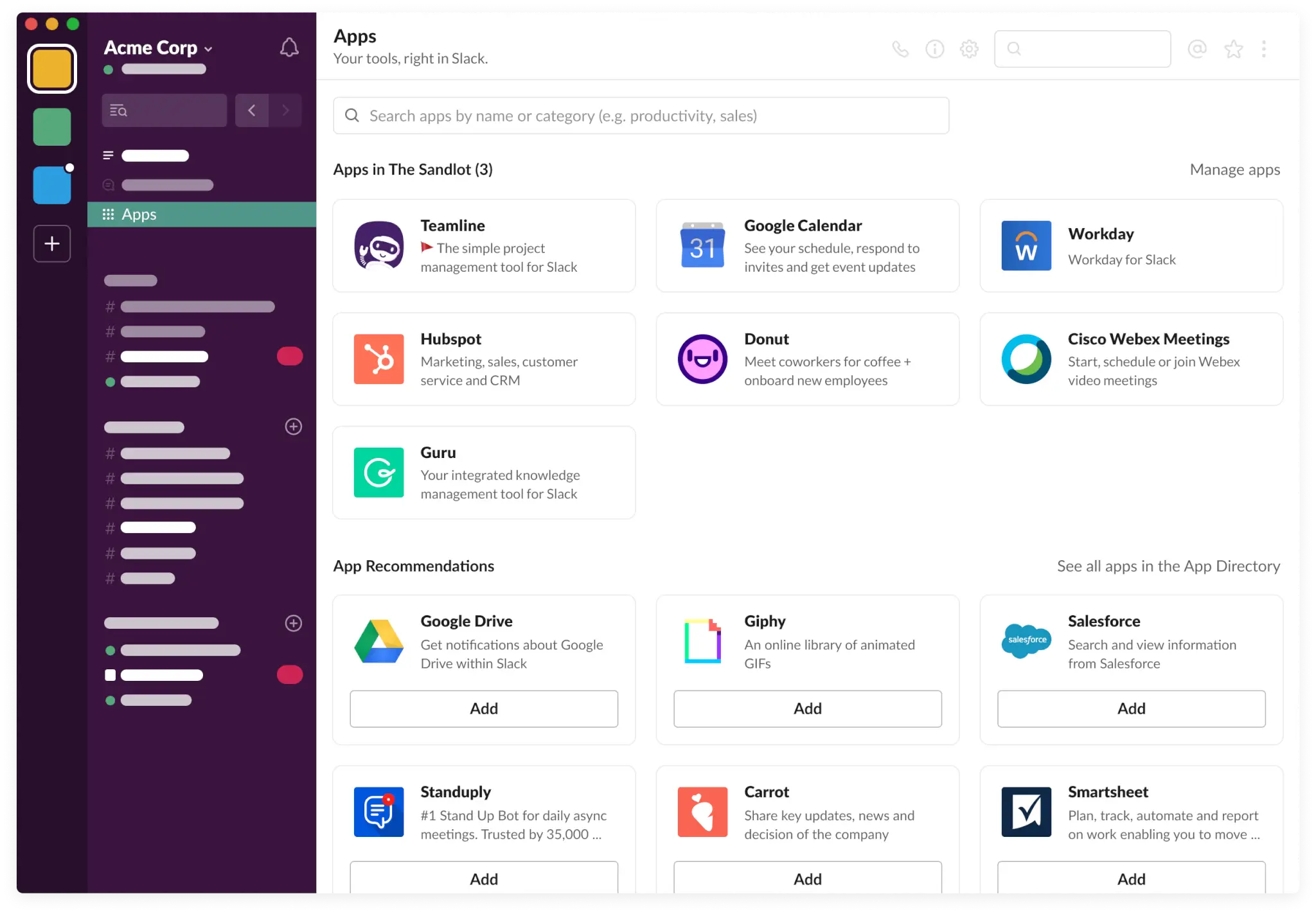
#7 Slack

 A screenshot of the Slack platform showing an example page of its app integrations.

Slack is a widely used communication platform designed for team collaboration but is also effective for community management. It excels in real-time messaging with features like organized channels, threaded conversations, and direct messaging for private interactions.

Users can share files easily, integrate with numerous third-party apps, and utilize bots for automation. However, its primary focus on communication means it lacks some specialized community management tools, and high message volumes can be overwhelming. The platform offers a user-friendly interface but may incur additional costs for advanced features.

Key Features

  • Channels for topic-based discussions
  • Direct messaging
  • File sharing and integrations
  • Searchable message history
  • Customizable notifications

Pros & Cons

Pros

  • Excellent for real-time communication
  • Wide range of integrations
  • Intuitive and user-friendly
  • Scalable for small to large teams

Cons

  • Can be costly for larger communities
  • Limited community management features
  • Notification overload potential

Pricing

Slack offers a free plan with limited features and the following paid ones:

  • Pro: $7.25/user/month
  • Business+: $12.50/user/month
  • Enterprise Grid: Custom pricing

*Pricing information retrieved from Slack in July 2024.

Remember, the “best” platform depends on your specific needs, budget, and community goals. A brand community will differ from a learning community, for example, so I always recommend taking advantage of free trials (if offered) to test-drive different options before deciding.

Choosing the Right Platform for Your Needs

Selecting the best community management platform for your online courses is a crucial decision that can significantly impact the success of your business.

Here’s a step-by-step approach to making this important choice:

Step 1: Assess your community size and growth potential

Consider your current community size and where you expect it to be in 6 months, a year, or even 5 years. You want a platform that can grow with you without requiring a what-could-be painful migration down the line.

Start by looking into your current member count, from your existing email list or social media platforms, like dedicated Facebook or LinkedIn groups. Also, evaluate your projected growth rate so that you can gauge your scalability needs for the future.

Step 2: Identify your integration needs

Make a list of all the tools you currently use and plan to use in the future. The right community platform should complement your existing tech stack. Course platform compatibility should be a priority, so look for a platform that integrates with marketing tools and connects to CRM systems.

Step 3: Determine your budget

Be sure to consider the pricing and any costs associated with setup, customization, or scaling as your community grows. This includes any upfront costs, ongoing monthly or annual fees for the platform, or even additional costs for add-ons or increased usage. Doing so will help you decide if the platform is a viable long-term solution.

Step 4: Prioritize essential features

Create a prioritized list of features based on your community goals and management style. This will help you focus on platforms that offer what’s truly important to you. While comparing your options, it might help to focus on your ‘must-have features’, ‘nice-to-have features’, and ‘features you can live without’.

Step 5: Evaluate user experience

If the platform is difficult to use, engagement will suffer. Consider the learning curve for both you and your community members. Check the platform’s interface intuitiveness to ensure it is user-friendly and easy to use and navigate. Don’t forget to check it on mobile devices too, to test its mobile responsiveness.

Step 6: Assess support and resources

Even the best platforms can have issues, so good support is crucial. Look for platforms with responsive support teams and comprehensive documentation. Reviews can say a lot about the quality of customer support, so make sure you check those first. You can also look for any training resources available or whether the platform has an active user community.

Step 7: Consider customization options

Your community should feel like an extension of your brand. Evaluate how much you can tailor the platform to your unique needs. Opt for a platform that offers extensive customization and branding capabilities. Consider the flexibility of the layout and prioritize the ones that support custom feature development.

Step 8: Test drive top contenders

There’s no substitute for hands-on experience. Set up test communities on your top choices and put them through their paces. Make sure you utilize free trials to the max and set up a test community on the platforms you are interested in to get a feel for how they work. You can always involve your team members in the evaluation.

When searching for a community management platform, finding the best fit for your needs and goals is the only thing that matters.

Contact other course creators or community managers to get their insights on this. But most importantly, trust your instincts. If a platform feels right and meets most of your criteria, then it’s a good choice.

Which Community Management Platform Will You Choose?

Building and managing a thriving online community is no small feat, but with the right tools and strategies, it can be an incredibly rewarding experience. A strong community can be the secret sauce that transforms your online courses from good to exceptional.

It’s not just about delivering content; it’s about creating an ecosystem where learners can connect, support each other, and continue growing.

💁🏻 Read Effective Community Management: Best Practices for Success

As you work on your community, don’t be afraid to experiment, learn from successes and failures, and enjoy the process. The connections you’ll make and your impact on your learners’ lives are truly priceless.

Here’s to building vibrant, engaged, and transformative learning communities! Your future self – and your learners – will thank you for the effort you put in today.

Ready to give it a go? Get your 30-day free trial with LearnWorlds today.

Your professional looking Academy in a few clicks

Start FREE Trial

Further reading

  • How to Create and Sell Profitable Online Courses: Step-by-Step Guide
  • Knowledge Economy: How to Sell Knowledge Online
  • How to Start a Profitable Online Course Business From Scratch
  • 183 Profitable Online Course Ideas With Examples
  • Sell Digital Downloads: The Complete Guide for 2024
  • SCORM 101: The Definitive Guide to Choose a SCORM Compliant LMS
  • How Much Money Can You Make Selling Online Courses?

The post The 7 Best Community Management Platforms for Course Creators in 2024 appeared first on LearnWorlds.

How to Write a Lesson Plan: A Comprehensive Guide

Software Stack Editor · July 24, 2024 ·

A well-crafted lesson plan is the backbone of effective teaching. It’s not just a list of activities but a roadmap guiding you through a learning journey.

It is an incredibly useful tool for both elearning and offline lessons. With a lesson plan, you can create a more effective training session, increase student understanding, and provide better learning experiences guided by the lesson objectives.

All educators must know how to create a lesson plan to ensure their learning sessions run smoothly. Depending on the students they teach and the timeline they have on their hands, educators set learning objectives, break the material up into sections, and choose learning activities that will be suitable for each trainee.

What is a Lesson Plan?

A lesson plan is a detailed step-by-step guide for educators providing materials to learners to accomplish their learning goals during the course.

It outlines the teacher’s objectives for the student’s accomplishments, the material to cover, and the delivery methods, including assignments, exams, and other evaluation forms.

A lesson plan is not a to-do list; it’s a strategic document that considers your students’ needs, your teaching style, and the subject matter at hand.

The key components of a lesson plan typically include:

  • Learning objectives
  • Materials and resources needed
  • The lesson procedure (including introduction, main activities, and conclusion)
  • Assessment methods
  • Time allocations for each part of the lesson
  • Content formats or media (text, video, quizzes, etc.)
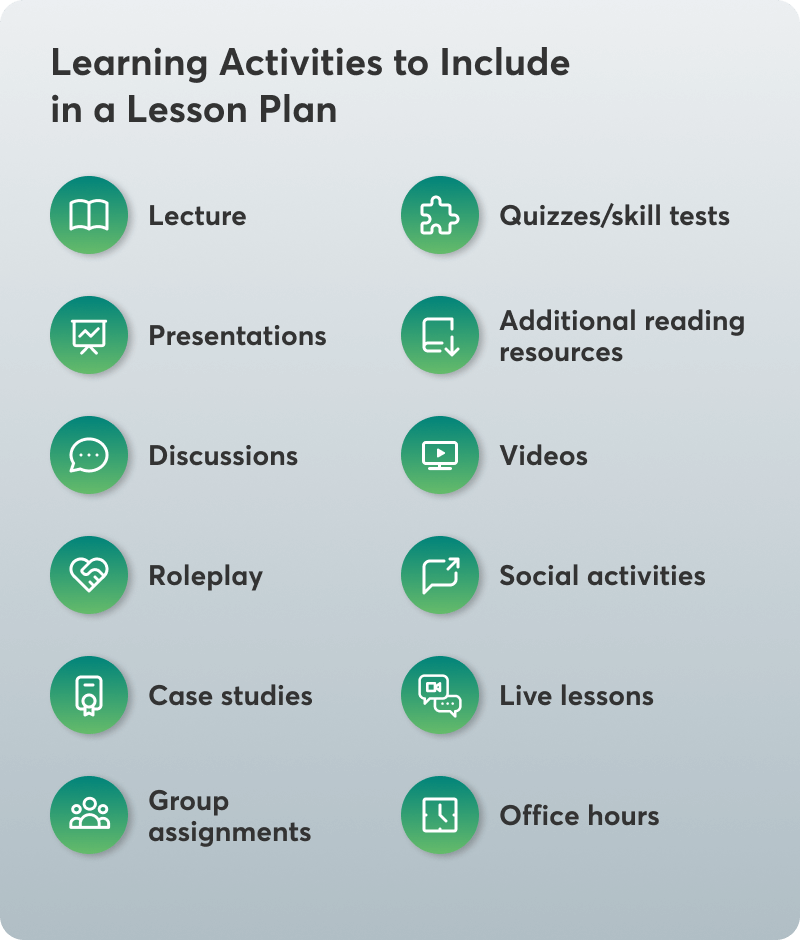
Learning activities to include inside a lesson plan.

The Learning Objectives

The foundation of any effective lesson plan is a set of clear, specific learning objectives. These objectives answer the question: “What should students know or be able to do by the end of this lesson?”

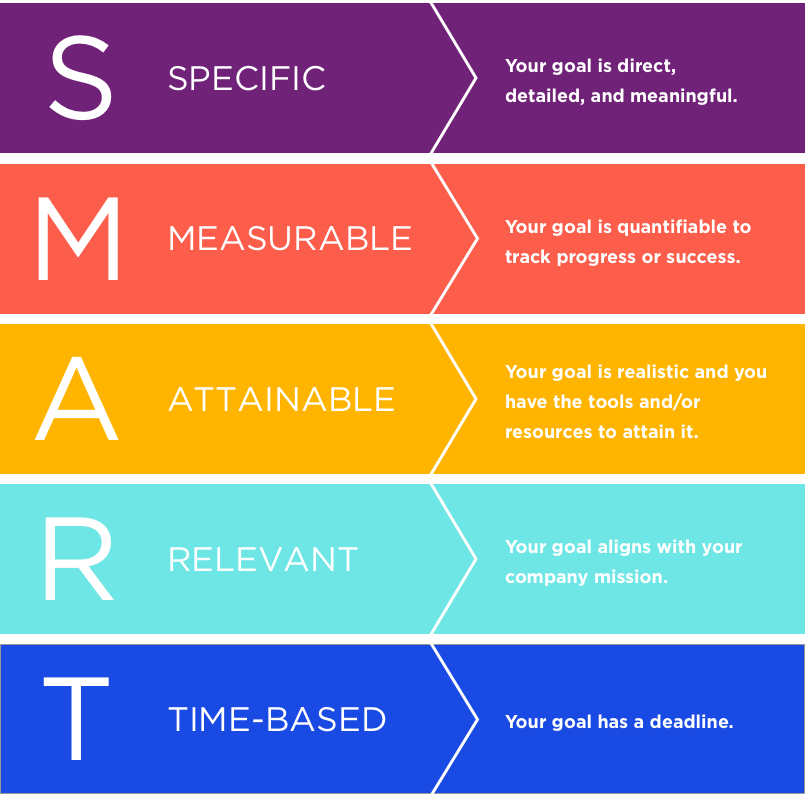
Make sure the learning objectives are SMART:

  • Specific
  • Measurable
  • Attainable by all students
  • Relevant to your students
  • Time-based, aligning with your syllabus
Smart objectives - Specific, Measurable, Attainable, Relevant, Time-based.

It’s crucial to align these objectives with the overall learning outcomes for the course or unit. When setting these objectives, consider your students’ prior knowledge and needs.

Are you building on previously learned skills or introducing entirely new concepts?

Understanding where your students come from helps you set realistic and meaningful objectives. Lesson plans for training may have different learning objectives, such as compliance or work-related skills, over teaching lesson plans that may have a goal of memorizing knowledge.

Planning the Lesson Structure

Planning a lesson structure is like creating a road map for your class time. A typical lesson structure includes an introduction, main activities, and a conclusion.

The top three items to include in your lesson plan for each activity are learning objectives, timing, and materials you’ll use. Your lesson plans may vary depending on the time limit and how many students are in a class.

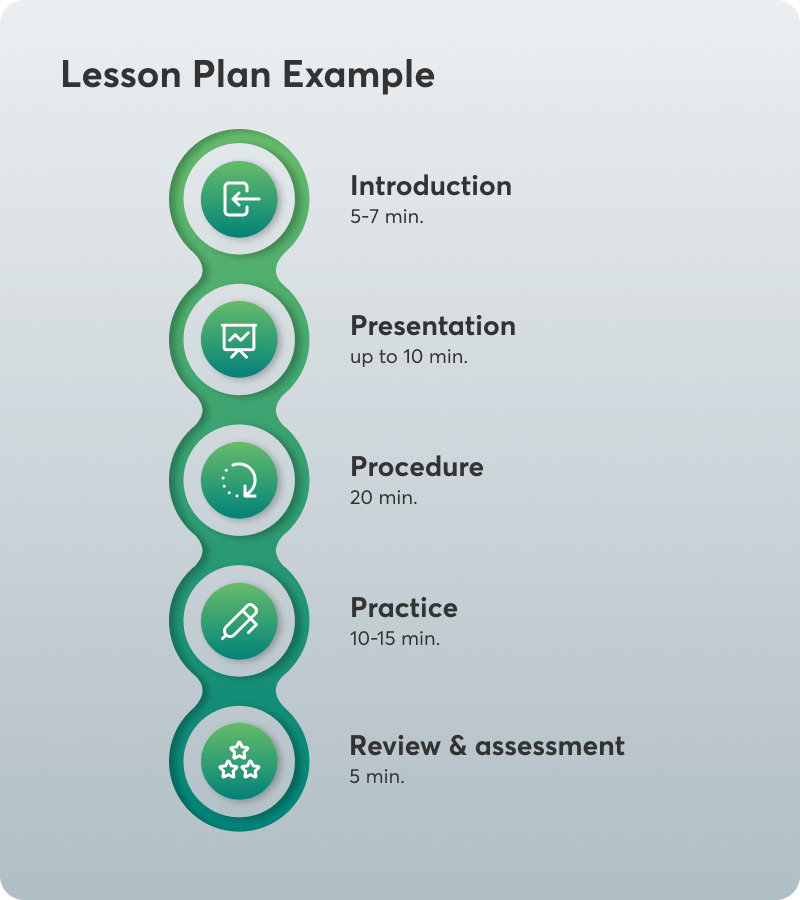
A simple example of a lesson plan is the following:

  • Introduction (5-7 minutes): Get your students interested in what will happen in the class during a lesson; ask a question, come up with a creative name for your lesson, or provide them with some reviews so that they can get involved in the learning process.
  • Presentation (up to 10 minutes): Create the need for students to learn what you will present.
  • Procedure (the remaining class time): Prepare lesson materials, such as digital handouts, videos, visuals, textbooks, and some software platforms, that you’ll use with students to learn the topic.
  • Practice (10-15 minutes): Think about exercises and other activities your students will practice in the lesson with you, individually or in group activities.
  • Review and assessment (5 minutes): Consider how you will finish a lesson; write the takeaways for students to summarize their new knowledge.
An example of a lesson plan based on timing.

Designing the Learning Activities

Learning activities are an essential part of your lesson. Make sure to include various kinds of activities to accommodate the different learning styles in the classroom, like:

Lecture: A lecture involves a teacher speaking to students about a specific topic, providing information, explanations, and sometimes visual aids to help students understand the material.

Presentations: Presentations allow students or teachers to share information on a topic using slides, images, and sometimes videos to make the content engaging and easier to understand.

Discussions: Discussions encourage students to talk about a topic in a group, sharing their ideas, opinions, and questions, which helps deepen their understanding and develop critical thinking skills.

Roleplay: Roleplay involves students acting out scenarios or characters to explore different perspectives and practice skills in a realistic context, making learning more interactive and engaging.

Case studies: Case studies examine real-life situations or problems, allowing learners to analyze, discuss, and learn from actual examples, helping them apply theoretical knowledge to practical situations.

Group assignments: Group assignments require students to work together on a task or project, promoting teamwork, communication, and collaboration while tackling a shared goal.

Quizzes/skill tests: Quizzes and skill tests are short assessments that help measure students’ understanding and retention of the material.

Additional reading resources: Additional reading resources are extra materials like books, articles, or online content that provide more information on a topic.

When teaching online, you can include activities suitable for online learning like:

Videos: Pre-recorded lectures or presentations students can watch at their own pace. For example, you can record your powerpoint presentation.

Social activities: Instead of group assignments, students can interact through the community of the LMS.

Live lessons: Live classes and workshops through Zoom, WebEx, or similar software can substitute for some live lessons and create a stronger connection than self-paced videos.

Office hours: Setting aside time for questions, whether that’s a live chat, phone call, or video call, the lecturer is available to students taking an asynchronous class.

While designing your lesson plan, consider whether you are teaching in a classroom or online or planning a mix of the two. While activities will vary in different settings, you need to keep your learners’ attention equally well in both settings.

Assessment and Evaluation Activities

Assessments help you understand whether your students have achieved the learning objectives and inform your future teaching. They can be smaller knowledge checks like quizzes or more demanding like an assignment or an exam.

Assessments are a very important learning tool as they assist with knowledge retention and test progress.

One type of evaluation is formative assessments, those are ongoing checks for understanding and include:

  • Quick quizzes
  • Exit tickets
  • Observation of student work
  • Class discussions

Summative assessments, on the other hand, evaluate student learning at the end of an instructional unit. These could be:

  • Tests or exams
  • Projects
  • Presentations

Many educators like to use rubrics to evaluate students’ work. Rubrics help evaluate students while being consistent in grading.

An assessment rubric based on a cookbook lesson.
Example of a Rubric, Source

Reviewing and Refining the Lesson Plan

A lesson plan is never finished, and even online courses need reviewing an updating every few months.

You will find yourself coming back and updating various parts. Especially if you are writing a lesson plan for corporate training, where new skills and requirements are constantly being revised, you might end up reviewing your lesson plans often.

You will need to

  • Double-check alignment with curriculum standards
  • Add new skills or evaluate previous lessons
  • Ensuring a logical flow of activities
  • Verifying that all necessary materials are prepared
  • Updating content to match requirements for compliance

Gaining feedback is also important. You can have feedback forms at the end of your lesson for students, or you can ask colleagues to offer feedback before publishing it.

Conclusion

Creating an effective lesson plan is both an art and a science. It requires careful thought, creativity, and a deep understanding of your students’ needs.

By following the steps outlined in this guide, you’ll be well on your way to crafting lesson plans that engage your students and achieve your learning objectives.

Remember, the goal isn’t perfection but continuous improvement. Each lesson you teach is an opportunity to refine your planning skills, so don’t be afraid to experiment with new ideas and approaches. With practice and reflection, you’ll develop a planning process that works for you and your students.

Now, armed with these strategies, it’s time to put pen to paper (or fingers to keyboard) and start planning your next great lesson.

P.S.: You can create your outline directly on LearnWorlds and use the AI Assistant to help plan your next online course. With LearnWorlds’ 30-day free trial, you can create your online course faster.

Your professional looking Academy in a few clicks

Start FREE Trial

The post How to Write a Lesson Plan: A Comprehensive Guide appeared first on LearnWorlds.

From Followers to Fans: Proven Strategies for Building an Engaged Online Community

Software Stack Editor · July 23, 2024 ·

Imagine harnessing the energy of a buzzing marketplace where every interaction sparks innovation and loyalty. That’s the promise of online communities for businesses creating and selling courses today.

In a world where customer retention rates can soar by up to 40% for companies with engaged online communities, and content engagement can see a 30% boost, the growth potential is astronomical.

Picture this: a community where your course members aren’t just passive recipients but active participants, creators, and even evangelists of your content. This transformation can drive course completion rates higher, generate invaluable user-generated content, and ignite powerful word-of-mouth marketing. It’s a game-changer backed by the fact that 68% of branded communities report a surge in new leads due to their efforts!

Your professional looking Academy in a few clicks

Start FREE Trial

In this post, we’ll delve into the cutting-edge strategies that turn followers into fervent fans. From tapping into the psychology of engagement to utilizing the latest AI tools, we’ll explore how to craft a dynamic and thriving online community.

Whether you’re launching a new community or revitalizing an existing one, these insights will empower you to build a vibrant ecosystem around your online courses.

Ready to revolutionize your audience into a dedicated, engaged community? Let’s embark on this journey from followers to fans together.

Understanding the Core Principles of Engagement

Human psychology plays a crucial role in how individuals interact within online communities. Understanding these psychological factors can help you craft strategies that drive deeper engagement.

🔑 Key principles of community engagement include:

  1. Social Identity Theory: People derive a sense of identity and self-esteem from the groups they belong to. When community members feel they are part of a distinct group with shared values and goals, their engagement levels increase. This sense of belonging fosters loyalty and active participation.This idea aligns closely with Maslow’s hierarchy of needs, where belongingness and love are fundamental for psychological well-being. When these social needs are met, individuals are more motivated to engage and contribute to their communities.

💡To apply the Social Identity Theory, create a distinct community identity that emphasizes shared values, goals, and a sense of belonging among members.

Start by defining core values and goals for your community, such as innovation, resilience, and collaboration. Communicate these values consistently across all your community-building interactions and materials (e.g. your community guidelines).

Set common goals, like helping members launch their startups, achieve specific milestones, or master particular skills. This creates a clear, shared purpose that unites like-minded groups of people and makes them feel part of something larger. “Like-minded people” is your focus point in this case.

Next, create a unique identity for your community. Develop a community name, logo, and branding that reflects your core values and helps you build brand awareness.

For instance, you might call your community “Innovative Entrepreneurs Network” and use a logo that symbolizes growth and innovation. Consistent branding across your website, social media platforms, and course materials reinforces this identity and helps members feel connected to the group, building up your brand loyalty at the same time.

💁 Read more on how to build your brand strategy in our Personal Branding Guide

Fostering a sense of belonging is also crucial. Encourage members to introduce themselves and shared interests, their entrepreneurial journeys, challenges, and successes.

Create subgroups or “cohorts” within the community based on specific common interests or stages in their entrepreneurial journey. This allows members to find others with similar experiences and goals, enhancing their sense of belonging and engagement.

Celebrate member achievements to strengthen the community bond. Recognize and celebrate successes such as launching a business, securing funding, or reaching significant milestones.

Highlight these achievements in newsletters, social media, and community forums to foster pride and a sense of belonging. This not only boosts individual self-esteem but also reinforces the group’s identity and values.

The very successful online community, Reddit, known for its vast array of topic-specific layout, leverages Social Identity Theory. Subreddits (individual communities within Reddit) allow users to find niche groups where they feel a strong sense of belonging and identity, leading to higher engagement and loyalty.

2. Reciprocity: The principle of reciprocity, where people feel obliged to return favors or gestures, can also be leveraged in online communities. When community leaders or members provide valuable content or assistance, it encourages others to reciprocate, creating a cycle of positive interaction.

💡Here’s how you can apply reciprocity to your online community:

Let’s say that you run a community for your online course on digital marketing. To leverage reciprocity, you could start by offering valuable, free resources to your community members.

For instance, you might provide free webinars on a regular basis where you share advanced tips and strategies that go beyond the course content. These sessions offer additional value while demonstrating your commitment to your community members’ success.

You can also offer exclusive eBooks, cheat sheets, or case studies that will help the audience of your community in their learning journey. These resources should be highly relevant and actionable.

And if you want to add an even more personalized approach – given that the size of your community audience and your resources allow it – you can even offer personalized feedback.

Spend time reviewing your members on their projects or assignments to help them improve and show that you care about their progress. This will boost customer satisfaction and engagement if you are involved in coaching, mentoring, or consulting.

3. Intrinsic Motivation: Intrinsic motivators such as the joy of learning, the satisfaction of helping others, and the pleasure of being recognized are powerful drivers of engagement. Communities that tap into these intrinsic motivators often see higher levels of participation and contribution.

💡Here’s how you can use intrinsic motivators for your own community:

Let’s say that you run a course on graphic design. To leverage intrinsic motivation, you can create opportunities for members to experience the joy of learning, the satisfaction of helping others, and the pleasure of recognition.

First, foster a culture that celebrates the joy of learning. Offer a variety of challenges and projects that allow members to apply their skills creatively.

For example, you might use your online forum to host monthly design contests where members can submit their work on a specific theme or project. These contests provide a platform for learning and improvement while making the process fun and engaging.

Second, encourage members to help each other by creating mentorship opportunities and turn your community into a true learning community. Pair experienced members with newcomers to guide them through the course content and projects.

This peer-to-peer support system enhances the learning experience for the mentees and provides mentors with a sense of satisfaction from helping others, and helps you build relationships right within your online community platform.

Platforms like Stack Overflow thrive on this intrinsic motivation model, where users earn reputation points for helping others, which in turn motivates them to continue contributing​.

Third, recognize and celebrate member contributions. Publicly acknowledge achievements in newsletters, social networks, and community forums.

For example, you can create a “Member of the Month” feature where you highlight an individual’s contributions, whether it’s exceptional design work, helpful feedback, or active participation in discussions.

You can even incorporate this into your content marketing strategy by adding a section to your regular newsletter. Highlight the extra benefits that come with being a paid customer. This way, leads and potential customers can see the added value of joining your community.

Last, but certainly not least, recognition can also come in the form of badges or points that members earn for their activities, which can be displayed on their profiles.

The language learning platform Duolingo utilizes gamification, which taps into intrinsic motivation and the psychology of achievement. By incorporating levels, rewards, and streaks, Duolingo keeps users motivated to engage regularly.

Infographic on Engagement Strategies

The Role of Authenticity & Trust

Authenticity is a cornerstone of trust in any community. When community leaders and members present themselves genuinely, it fosters a culture of trust and openness. Key aspects of authenticity include transparency, consistency, and responsiveness. Regardless of the type of online community you have or want to build, incorporating these principles into your online community can transform it from a passive group of followers into an active, engaged network of fans who are deeply invested in your business’s success.

Transparency is all about being open about your community’s goals, rules, and any commercial interests. Transparency about data usage, changes in policies, and community direction ensures that members feel secure and valued.

The social media management platform Buffer is known for its transparency. Buffer shares detailed financial reports, salary information, and decision-making processes openly with its community. This level of openness has built a strong foundation of trust and loyalty among its users.

Consistency evolves around consistent behavior and messaging from community leaders to reinforce trust. When members see reliable and steady communication and actions, their trust in the community’s leadership grows.

The outdoor clothing brand Patagonia has built trust through its commitment to environmental sustainability and ethical practices. By consistently aligning its actions with its stated values and being transparent about its business practices, Patagonia has cultivated a dedicated and engaged community.

Responding timely and thoughtfully to member inquiries and feedback demonstrates that the community values its members, thereby building trust and loyalty.

LearnWorlds serves as an exemplary model of a brand that responds timely and thoughtfully to member inquiries and feedback, thereby building trust and loyalty within its community. As a platform dedicated to creating, selling, and managing online courses, we prioritize customer support and community engagement through several key strategies.

Firstly, LearnWorlds maintains a dedicated customer support team available 24/7 to address any issues or questions that course creators and learners might have. Our team is renowned for providing quick, detailed, and personalized responses to ensure that users feel supported and valued.

We also offer a comprehensive Help Center with articles, step-by-step guides, and video tutorials to assist users in navigating the platform.

In addition to these support measures, we actively engage with our community through social media, forums, and webinars. We frequently host live Q&A sessions where users can ask questions in real time and receive immediate feedback from experts addressing their pain points. This proactive engagement helps foster a strong sense of community and ensures that our users feel connected and supported.

Moreover, we take user feedback seriously and often implement changes based on the suggestions and issues raised by our community. This responsiveness not only improves the platform but also shows users that their opinions are valued and acted upon.

By responding promptly and thoughtfully to inquiries and feedback, we demonstrate our commitment to our users, building a strong sense of trust and loyalty within their community.

This proactive approach enhances the overall user experience, making users feel appreciated and heard, which is crucial for long-term engagement and success.

Your professional looking Academy in a few clicks

Start FREE Trial

Crafting a Magnetic Community Culture

Creating a vibrant and engaging community starts with crafting a magnetic culture that attracts and retains members. A well-defined community culture helps build a loyal following and ensures that members feel a deep sense of belonging and connection. This involves defining a unique community identity and fostering inclusivity and belonging.

By establishing clear values, consistent branding, and an inclusive environment, you can create a community that resonates with its members and encourages active participation.

Let’s explore how to achieve this through defining a unique community identity and fostering inclusivity.

Defining a Unique Community Identity

To create a distinctive and appealing community identity you need to take the following 3 key steps:

STEP 1 – Identify Core Values: Define the core values your community stands for. These should resonate with your target audience and reflect the mission of your business.

STEP 2 – Create a Memorable Brand: Develop a unique visual and verbal brand that represents your community. This includes logos, color schemes, and a consistent tone of voice.

STEP 3 – Develop a Community Manifesto: Write a manifesto that outlines the purpose and goals of your community. This document serves as a guiding principle for all members.

💡A renowned example of an online community with a strong unique identity is Lego Ideas, a platform where Lego enthusiasts can submit and vote on new Lego set ideas that can become the next new product for Lego!

This community has a clear identity centered around creativity and innovation, fostering a strong sense of belonging among its members.

Fostering Inclusivity & Belonging

Ensuring every member feels welcome and valued is key to a thriving community, right? So, let’s dive into our top 3 shortlist of the most effective, tried-and-tested strategies to foster inclusivity:

📣Spotlight on All Voices: Make sure your community reflects a wide range of voices and perspectives. Highlight diverse members, feature a variety of content, and actively promote inclusivity.

Here’s an example of a thriving community that’s all about inclusivity, the Black Girls Code. This community aims to increase the number of women of color in the digital space by empowering girls of color to become innovators in STEM fields. Their inclusive approach has created a supportive and thriving community.

🧑‍🤝‍🧑Talk it Out, All About: Encourage respectful and open communication among members. Create safe spaces where people can share their experiences and opinions without fear of judgment or exclusion.

🙌Empower & Support: Provide resources and support for members who may feel marginalized or underrepresented. This includes mentorship programs, dedicated support groups, and accessible content.

A brilliant example of a thriving online community that applies all three of the above key strategies is Twitch, a popular live-streaming platform. Twitch has made significant efforts to promote inclusivity by implementing features like the Safety Advisory Council, which addresses issues of harassment and marginalization within the community.

Engagement Tactics that Wow and Win

Gamification and Rewards: Engage and Excite!

Gamification can significantly boost engagement by tapping into our competitive and achievement-oriented nature. By introducing elements that reward active participation and accomplishments, you can enhance member interaction and motivation in your online community.

You can start by setting up a reward system. This is a crucial step in implementing gamification, after all. Introduce points, badges, and leaderboards to acknowledge and reward your members’ efforts and achievements. This way, you will provide tangible recognition for participation and encourage ongoing engagement of your members.

Who doesn’t love a good challenge? It’s a fantastic way to spice things up! Creating fun and engaging quests is a surefire strategy to get your community buzzing. By developing exciting challenges, you’re inviting members to dive deeper into the content and interact more with each other. Think of these challenges as a blend of education and fun, turning the learning process into an engaging adventure. This way, everyone’s not just learning – they’re also having a blast!

Offering exclusive perks is also a powerful motivator. Providing your members with exclusive access to content, events or merchandise as rewards for high levels of engagement can drive participation. These perks incentivize your members to stay active and contribute more to your online community.

Looking for some inspiration on how to make the trio of rewards, challenges, and exclusive perks work for you? Check out how Calisthenics and Bizhack Academy lead the charge with their successful gamification strategies in online communities.

Calisthenics Academy

Calisthenics Academy has successfully transitioned from a local setup to a global online platform, amassing 40,000 students in under a year. They offer a wide range of fitness programs designed to help students master bodyweight exercises.

Their community features include interactive forums, live Q&A sessions, and a supportive network where members can share progress, challenges, and success stories.

This community-driven approach not only boosts engagement but also fosters a sense of belonging and mutual support among members.​

Calisthenics Academy has successfully leveraged gamification elements to engage its global community of fitness enthusiasts.

Here’s how they incorporate the trio of rewards, challenges, and exclusive perks:

  • Rewards: Members earn badges and certificates for reaching fitness milestones, which provide tangible recognition for their efforts.
  • Challenges: The academy regularly organizes fitness challenges that encourage members to push their limits and engage more deeply with the content. These challenges not only motivate participants to stay active but also foster a sense of community through shared goals.
  • Exclusive Perks: The Calisthenics Academy gives its members access to exclusive workout plans, personalized coaching sessions, and early access to new programs, enhancing their overall experience and incentivizing continued participation.

Bizhack Academy

Bizhack provides digital marketing training to over 1,000 businesses, focusing on practical skills and real-world applications.

By leveraging LearnWorlds’ comprehensive suite of tools, Bizhack has created a dynamic learning environment that includes webinars, interactive courses, and a vibrant community forum.

These features allow students to engage deeply with the content, connect with peers, and receive timely feedback from instructors, enhancing the overall learning experience and building a strong, active community.

Bizhack Academy employs several strategies to keep its community engaged through the use of rewards, challenges, and exclusive perks:

  • Rewards: Bizhack offers digital badges and certificates for course completion and participation in community activities. These rewards help recognize and celebrate members’ achievements.
  • Challenges: The academy frequently hosts interactive challenges, such as marketing strategy contests and project-based assignments, which encourage the practical application of learned concepts and foster collaborative learning.
  • Exclusive Perks: Participants in Bizhack’s programs gain access to exclusive webinars, one-on-one mentoring sessions with industry experts, and premium content not available to the general public. These perks add significant value to the learning experience and motivate members to remain active in the community.

Interactive content and experiences: engage your members

Interactive content is a magnet for engagement. By incorporating dynamic and participatory elements into your community, you can significantly enhance member involvement and satisfaction.

In fact, interactive content is 52.6% more engaging than static content, and 93% of marketers agree that interactive content is effective in educating buyers and enhancing engagement.

Here are some easy-to-follow ideas to get you started, along with some practical examples:

Quizzes and Polls

Fun and informative quizzes or polls allow your members to test their knowledge and share their opinions. These can be used to reinforce learning, gather feedback, or simply engage members in a fun way.

💁How to make it happen: If you’re running an Online Nutrition Course, you can create a series of quizzes that help students identify different types of nutrients and their benefits.

You can then use polls to ask students about their dietary habits, which can then lead to personalized recommendations or group discussions on improving nutrition.

With a flexible learning management system like LearnWorlds, you can build assessments or polls in minutes right inside your online course.

Live Q&A Sessions

Hosting live Q&A sessions with community leaders, experts, or influencers fosters real-time interaction and allows members to get their questions answered directly.

You can even consider repackaging these conversations in an article or podcast format later in your content distribution strategy and provide even more value to your community members.

This enhances their learning experience and builds a stronger connection with your course instructors and community.

💁How to make it happen: For a coding boot camp, schedule monthly live Q&A sessions with industry experts where students can ask questions about career advice, coding challenges, or industry trends. This direct access to experts can be incredibly valuable and motivating for learners.

Hands-on Workshops

Offering interactive workshops or webinars where members can learn new skills and participate actively is a great way to provide practical, hands-on learning experiences.

These workshops can include live demonstrations, group activities, and real-time feedback from instructors.

💁How to make it happen: If you’re running a photography course, conduct hands-on workshops where participants can practice different photography techniques in real time.

Provide immediate feedback and tips during the session (you can use the comment section of your communication platform – Zoom, Google Meet, Microsoft Teams, etc. – to do this, and encourage participants to share their work and experiences with the group.

With a robust learning management system like LearnWolds, you can easily run these sessions via the Live Sessions provided by the platform right from within your online course.

Your professional looking Academy in a few clicks

Start FREE Trial

Collaborative Projects and Challenges: Build Together

Encouraging collaboration on projects and participation in challenges can significantly boost engagement in your online community.

When members work together towards common goals, they form stronger bonds, learn from each other, and feel more connected to the community.

Regardless of whether you are the business owner of your online academy or a community manager, involving your community members in shaping the community will help your business thrive.

Collaborative efforts foster a sense of ownership and investment in the community’s success, leading to increased participation and loyalty.

🔑 The key to making collaboration a cornerstone of your engagement strategy lies in community projects and themed challenges. Sounds complicated? Let’s break it down and see how it works in action.

Community Projects

You can launch community-wide projects that require collaboration, such as content creation or social impact campaigns.

These projects foster a sense of community while leveraging the diverse skills and perspectives of your members.

For instance, you could organize a project where members contribute to a collective eBook or create educational content that can be shared across social media platforms. By involving members in meaningful projects, you tap into their intrinsic motivation and commitment to the community’s goals.

💁Here’s a real-life example: If you’re running a course on environmental science, initiate a project where members collaborate to create a series of informative videos about sustainable practices. Participants can work in teams, share their progress, and provide feedback to each other, resulting in a comprehensive resource that benefits both the creators and the wider audience.

GitHub is a prime example of how collaboration can create a thriving community. As a platform for open-source projects, GitHub allows developers from around the world to collaborate on software development.

This collaborative environment not only accelerates innovation but also builds a strong, supportive community of developers who learn from each other and contribute to shared goals.

Themed Challenges

Organize challenges that align with community interests, encouraging your members to share their achievements.

Themed challenges can range from short-term tasks to long-term projects and can be designed to suit various skill levels and interests. These challenges provide opportunities for members to showcase their skills, fostering a competitive yet supportive environment.

💁Here’s a real-life example: In a graphic design course, set up monthly design challenges where members create artwork based on a specific theme or prompt. Winners can be featured on the community homepage or receive special badges, adding an element of recognition and reward. This keeps members engaged but also helps them build their portfolios.

National Novel Writing Month (NaNoWriMo) is an annual event that challenges writers to complete a novel in a month. This challenge has created a supportive and motivating environment for writers, fostering a sense of camaraderie and shared purpose.

Participants often form writing groups, share their progress online, and encourage each other to reach their goals. NaNoWriMo’s success is evident in its massive participation rates, with over 500,000 writers joining the challenge each year.

Your professional looking Academy in a few clicks

Start FREE Trial

Leveraging Technology and Tools

Use AI and Chatbots for Personalized Engagement

AI and chatbots can significantly enhance member interaction and support by offering personalized, immediate assistance, and automating routine tasks.

Specifically, you can use AI-driven chatbots to offer immediate assistance to your members by answering common questions and resolving issues swiftly.

This instant support is crucial for maintaining a seamless user experience, as it ensures that members always feel supported without having to wait for human intervention.

💁For example, in an online course setting, a chatbot can handle a wide range of inquiries from how to access course materials to troubleshooting technical issues. This reduces frustration and keeps learners focused on their studies.

Furthermore, chatbots can handle multiple inquiries simultaneously, making them highly efficient. They are available 24/7, providing continuous support even outside of regular business hours.

This round-the-clock availability is particularly beneficial for global communities with members in different time zones. According to a study by IBM, businesses can save up to 30% in customer service costs by implementing AI chatbots due to their efficiency and ability to handle high volumes of requests.

💁An online coding bootcamp could use a chatbot to assist students with coding syntax errors or debugging issues in real-time. The chatbot can provide instant code snippets or direct students to relevant documentation, significantly enhancing their learning experience and reducing downtime caused by waiting for instructor responses.

Besides, you can leverage AI technology to analyze member behavior and preferences to tailor content and recommendations to their individual needs.

By analyzing data from past interactions, AI can provide personalized learning paths, suggest courses, and offer resources that align with each member’s goals and interests. This level of personalization increases engagement and satisfaction, as members receive content that is directly relevant to them.

💁For instance, AI can track which topics a learner is most interested in or struggling with and adjust recommendations accordingly. This adaptive learning approach not only keeps learners engaged but also helps them achieve their educational goals more effectively.

According to a report by McKinsey, personalization can lead to a 10-30% increase in customer satisfaction and a 5-15% increase in sales conversion rates.

And let’s not overlook one of the most impactful benefits of AI technology: the efficient streamlining of routine tasks!

Automating repetitive tasks such as onboarding new members or sending reminders frees up time for more meaningful interactions. AI-driven systems can streamline these processes, ensuring that every member receives consistent and timely communication.

💁For example, automated onboarding sequences can welcome new members, guide them through initial steps, and provide essential information about the community.

Additionally, automated reminders can keep members on track with their learning goals. Regular notifications about upcoming deadlines, new content releases, or scheduled events can significantly enhance engagement by keeping the community active and informed.

This automation ensures that important tasks are not overlooked and that members always feel guided and supported.

💁An online fitness academy could use automation to manage its community more effectively. New members receive a series of onboarding emails introducing them to the platform, outlining their fitness journey, and setting initial goals. Automated reminders prompt members to complete their daily workouts, log their progress, and attend scheduled live classes, ensuring consistent participation and engagement.

With these advanced technological integrations at hand, you have the power to create a more engaging and supportive learning environment for your community members and achieve higher satisfaction and retention rates.

Your professional looking Academy in a few clicks

Start FREE Trial

Harness Data Analytics

Data analytics tools are your secret weapon for transforming community engagement and understanding member behavior.

By leveraging these tools, you can unlock powerful insights and drive your community’s success. Here’s how:

  1. Track engagement metrics: Keep your finger on the pulse of your community by monitoring key metrics (key performance indicators, a.k.a. KPIs) like participation rates, content consumption, and interaction levels.
    This real-time data helps you understand how members are engaging, allowing you to pinpoint what’s working and what needs improvement. Imagine being able to see exactly which courses are most popular and which ones need a boost – that’s the power of data.
  2. Identify trends and patterns: Dive deep into your data to uncover trends and patterns in member behavior. Are certain topics sparking more discussions? Do engagement levels peak at specific times?
    By understanding these patterns, you can tailor your content and engagement strategies (and yes, even your pricing strategy) to meet your members’ needs more effectively. It’s like having a roadmap to their interests and preferences.
  3. Optimize content and strategies: Use your insights to make data-driven decisions that optimize your content and engagement strategies. Analyze the effectiveness of different types of content and adjust your approach to maximize impact (e.g. create personalized landing pages that speak to specific niches of your audience).
    Whether it’s tweaking your newsletter format or launching new interactive features, data helps you refine your tactics and ensure you’re hitting the mark every time.

💁LearnWorlds, for example, provides comprehensive analytics tools that allow you to monitor learner and customer engagement as well as course performance. These insights help optimize the learning experience and boost overall community engagement.

Your professional looking Academy in a few clicks

Start FREE Trial

Building a Sustainable Engagement Model

At this point, it’s crucial to emphasize that building an engaged online community is just the beginning. To truly thrive, you need a sustainable engagement model that continuously nurtures and grows your community.

Creating a feedback loop and embracing continuous learning and adaptation are key to this process. By focusing on these aspects, you can create a vibrant, engaged community that evolves and grows over time.

Let’s dive deeper into these two critical components:

  1. Establish a feedback loop
    • Regularly solicit feedback from your community through surveys, polls, and direct interactions. This helps you understand their needs and preferences.
    • Analyze the feedback to identify common themes and areas for improvement.
    • Act on the feedback by implementing changes and updates that address member concerns and enhance their experience.
    • Communicate these updates back to your community, showing them that their input is valued and impactful.
  2. Learn and adapt continuously
    • Stay informed about industry trends, technological advancements, and shifts in community behavior.
    • Experiment with new engagement strategies, content formats, and tools to see what resonates best with your members.
    • Use data and feedback to refine your approach and ensure that your community remains dynamic and responsive to member needs.

💁Examples of communities that successfully evolved over time

  • Facebook Groups have evolved significantly over time, introducing new features such as live video, group insights, and member badges to enhance engagement and foster a sense of community.
  • Stack Overflow continuously adapts its platform to meet the needs of its developer community, adding new features, improving user experience, and expanding its content offerings based on user feedback and industry trends.

Flowchart of Building a Community

Here’s to Fan-tastic Engagement for Your Online Community!

Building an engaged and thriving online community requires a deep understanding of human psychology, a commitment to authenticity and trust, and a willingness to innovate and adapt.

By leveraging the strategies outlined in this article, you can transform your followers into fervent fans who are deeply invested in the success of your courses and business.

When you first start building an online community for your course business, creating that initial spark of engagement may be challenging. However, by focusing on authenticity and continuously iterating based on member feedback, you can cultivate a vibrant and supportive community.

Remember to implement initiatives, like collaborative projects where members can work together to create comprehensive study guides, to increase engagement while creating valuable resources for the entire community.

To achieve this, you need a platform like LearnWorlds that is flexible and robust enough to support your needs and scale with your online business. If you haven’t tried LearnWorlds already, take advantage of our’ 30-day free trial and experience firsthand all the great things you can accomplish!

Your professional looking Academy in a few clicks

Start FREE Trial

The post From Followers to Fans: Proven Strategies for Building an Engaged Online Community appeared first on LearnWorlds.

Teachable sponsors show aimed at helping early stage entrepreneurs succeed

Software Stack Editor · July 23, 2024 ·

In case you haven’t heard, we have some big news over here at Teachable. In partnership with Sonic God Studios, Amazon Prime, and some major players in the creator economy space, Teachable is bringing you the first-ever intense timeframe competition for early-stage entrepreneurs—announcing 60 Day Hustle! 

We believe in creators as game changers in the entrepreneurial world so much that we’ve built a platform and tools to support creators like you monetize your knowledge and build a more impactful business through online courses, coaching, and digital downloads. And now, we’re thrilled to show support for real people taking on real challenges in 60 Day Hustle.

Teachable’s very own Director of Brand, Content, and Creative, Bethany Cantor, is sharing why supporting creators and budding entrepreneurs on 60 Day Hustle was such a no-brainer and powerful moment for Teachable!

‍

Why is a show like 60 Day Hustle important for creators, especially those in the education and knowledge space?

“It all comes down to visibility. Creators and entrepreneurs of all types are changing the economy right in front of our eyes. They’re changing the way people shop, the way they earn money, and the way they learn. We’ve seen glimpses of entrepreneurship on TV before, on shows like Shark Tank, but to go behind the scenes and see what it actually takes to establish a business that will grow and be successful is something really new. I think people will discover a new respect for creators after this show and hopefully they’ll want to support these creators and others as well”

Why is Teachable so excited to sponsor 60 Day Hustle?

“We’ve been supporting creators and listening to their challenges and wins for ten years. When we first heard about the opportunity to be a part of this show it felt like such a win for a community that we feel deeply connected to. We really felt that we were in a position to not only help these contestants succeed, but also, to help viewers learn how they might make their own entrepreneurial dreams a reality. That’s why you’ll see Teachable creators like Chris Do on the show, appearing as a mentor for the contestants. We felt it was important not just to integrate as a sponsor into the show but also to provide true mentorship for the contestants from creators who’ve found success and increased their own impact. Knowledge sharing is a really fantastic way to grow a business and we want more creators to understand that and feel empowered to launch their own knowledge-based products.”

What are you most excited for viewers to see in the show?‍

“The lessons these entrepreneurs learn and how those can be applied to any business. This is more than a reality show, it’s really a master class in scaling a brand and a business, it should be fun to watch but also really informative.”

Some Teachable creators are even on the show as mentors. Why do you think these creators are such amazing picks to help others learn and grow?‍

“Chris Do was such a natural fit for this project. He has such clarity around his business strategies and possesses a real drive to help other creators find similar success.”

[embedded content]

You were on set for some of the filming, what surprised you most about the show?‍

“This might sound funny but the warmth of the judges! This really is a show about learning and growing. It was crystal clear during filming that the judges are deeply invested in the success of these contestants and that’s great to see. Reality TV can be brutal at times but this show is fun and energizing and entertaining.”

If there were one thing you’d hope a current Teachable creator OR a future Teachable creator were to walk away with after watching the show, what would it be?

“That businesses of all types can succeed with focus and commitment. And that monetizing your knowledge is a no brainer. If you’ve been through something and you can demystify it for others, if you’ve got an off-the-wall skill, if you have deep operational knowledge that is hard to find, people are waiting to learn from you! I hope people watch the show and get inspired to level up their businesses and think bigger. Creators are here to stay and this show is just the beginning of more of their success stories being known and celebrated.”

Entrepreneurship9 best Gumroad alternatives for small business owners (Features & pricing) Looking for a Gumroad alternative? Discover popular Gumroad competitors that make selling digital downloads and growing your online business a breeze.

Software Stack Editor · July 22, 2024 ·

Looking for a Gumroad alternative? Discover popular Gumroad competitors that make selling digital downloads and growing your online business a breeze.

Jump ahead

In this article

You’ve created a fabulous digital download that’s perfect for your audience, but you need a place to sell it. In your research rabbit hole, you come across an option called Gumroad.

Gumroad is an online marketplace platform for selling digital and physical products. Creators can sell videos, files, software, PDFs, ebooks, subscriptions, and memberships about any topic that makes their eyes sparkle.

Users can quickly build a basic storefront page and list as many products as they want. Gumroad also makes it easy to set up an affiliate program, offer discount codes, and generate software license keys.

Getting started is simple, and there’s no monthly fee to use the platform, making this a popular option among entrepreneurs who hope to make their first sale without a big upfront investment. But just like how there are dog people and cat people, morning birds and night owls, cilantro fans and cilantro foes, no tool is perfect for every creator.

In this post, we’ll look at some popular Gumroad alternatives to help you choose the best option for your growing business.

Note: All pricing is accurate at the time of writing, but this is subject to change over time.

Shortcomings of Gumroad

Every creator business is unique, and the tools you use to power your online empire will vary based on your priorities. While Gumroad does make it easy to list items for sale and accept payments, there are some limitations.

First, there aren’t many design options for product listings. Each product page comes with space to add photos, a description, and details like file size, but beyond that, there are minimal layout and style customizations available.

If you’d like to
create a full-blown sales page
or customized website, you’ll need to use an additional tool.

Second, Gumroad is primarily geared toward selling digital downloads, not
courses
or
coaching
. In our study of 900+ creators,
33.6% sold courses, and 13.8% sold coaching
. Even if you don’t have those product types now, you might want to add them in the future.

While it’s possible to sell courses by uploading several video and text files into a listing, there’s no dedicated Gumroad course viewer. Using a platform that’s made for online courses instead could give your customers a better experience.

Likewise, you can use workarounds to sell coaching sessions using Gumroad, but the software isn’t specifically built for this. You might need to connect other programs to get the results you want, which could be cumbersome and costly to implement.

Third, some Gumroad customers report that accessing customer service is challenging. There’s a help center and a support email address, but no live chat support.

90% of people feel that customer service is important
when choosing and staying with a brand, and getting speedy answers when tech issues arise can mean fewer headaches.

Finally, Gumroad charges a 10% transaction fee on all sales, whether you’re a new creator or selling thousands of products per month. While it’s true that Gumroad users don’t have to pay a monthly rate to use the platform, the transaction fees on each sale can add up quickly — especially as your sales increase.

Ideally, you would have the option to upgrade and remove transaction fees as your business grows, but with Gumroad that’s not possible.

Again, there’s no cookie-cutter mold for creator businesses, and there’s no one platform that works for everyone. If you determine that Gumroad isn’t the best fit for your needs, here are 9 Gumroad alternatives to try instead.

9 best alternatives to Gumroad

1. Podia

Podia is an all-in-one creator platform for selling your digital work, running your brand community, and offering services like coaching and mentorship. It comes with a sleek course builder, full website functionality, unlimited sales pages, and built-in email marketing features so you can communicate with your audience in one place.

Teach virtual trombone lessons. Run a membership community for sticker collectors. Create a course on how to knit matching outfits for you and your dog. No matter your passion, you can build, sell, market, and manage your entire creative business with Podia.

In addition to selling unlimited courses, digital downloads, and coaching sessions, creators get sophisticated business features like
affiliate functionality
,
email marketing
, product bundles, and upsells.

We even handle
lead magnet
delivery, and you can
grow your email list
by
offering free resources
directly from your Podia website.

And did we mention that your Podia website and sales pages will look really pretty?

According to Podia creator and
Flex Lessons
founder
Joseph D’Amico
, “Podia makes website building so fun. I feel like I could set up a site in an afternoon, and it would look great. And there’s something to be said for how pretty it is. It’s the best-looking one by far.”

Podia is also known for having friendly
customer support
through chat and email. If you get stuck at any point, we’re only a few clicks away.

With Podia, everything lives under one roof. No need to connect (and pay for) 8,000 different tools to make your business function properly. We’ve got you covered behind the scenes so you can focus on what you do best.

Podia features:

  • Sell digital downloads, courses, coaching, communities, and webinars

  • Unlimited students, products, and bandwidth with video and file hosting

  • Give customers several payment options like recurring memberships, subscriptions, one-time-payments, and payment plans

  • Offer
    real-time and pre-recorded webinars

  • Complete website and blogging functionality

  • Make
    beautiful landing pages
    to promote your products with our
    website editor

  • Premium course features like quizzes,
    drip content
    , live cohorts, and
    course completion certificates

  • Payment gateway integrations with PayPal and Stripe

  • Sell in your
    local currency
    and
    manage sales tax
    (including VAT) automatically

  • Integrations with Facebook Pixel, Pinterest Tag, and Google Analytics

  • Live
    messaging and chat features

  • Email marketing tools

  • Affiliate management

  • Custom domains

Podia pricing:

  • Free (10% transaction fee)

  • Starter: $9/month or $4/month when paid annually (8% transaction fee)

  • Mover: $39/month or $33/month when paid annually (5% transaction fee)

  • Shaker: $89/month or $75/month when paid annually

Learn more about how Podia compares to Gumroad
.

Get your free Podia account now
to see these features in action.

Get your free Podia account

Join the 150,000+ creators who use Podia to create websites, sell digital products, and build online communities.

Sign up free

2. SendOwl

SendOwl is a platform designed for creators who sell digital products and services from their own websites. SendOwl takes care of payment processing, checkout, and file delivery so you can focus on your creative pursuits.

Because SendOwl handles everything that goes on behind the scenes, you can easily transform your existing online presence into a storefront by adding an embedded checkout button. You can also generate links to specific products to share on social media.

SendOwl features:

  • Customizable shopping cart

  • Sell memberships
    and subscriptions

  • Generate license keys

  • Drip content

  • Embeddable checkout

  • Offer coupons and discounts

  • One-click upsells

  • Cart abandonment

  • Affiliate marketing

  • Email features and templates

SendOwl benefits: SendOwl is great for creators who sell a combination of digital products and services like coaching and
tutoring
. You can customize the checkout process and sell through payment links, your own website, Shopify integrations, or SendOwl’s API.

People can buy gift purchases for others, and you can also use SendOwl to collect donations from supporters on a recurring basis.

SendOwl downsides: While you can create product cards and checkout links, you can’t build a storefront or detailed landing pages with SendOwl. Also, SendOwl isn’t ideal for selling courses since there’s no course builder or player.

SendOwl pricing:

  • Basic: $9/month

  • Standard: $15/month

  • Premium: $24/month

  • Business: $39/month

3. Sellfy

Sellfy is an ecommerce storefront software where you can run your own online shop and sell digital products, physical products, print-on-demand items, streaming, and subscriptions.

You can sell directly from Sellfy or embed purchase buttons and product cards on your own website. Create a customized shopping experience for your customers with upsells, discount codes, email marketing, shopping cart features, and cart abandonment.

Sellfy features:

  • Build an online store or sell from your own page

  • Sell digital, physical, streaming, or subscription products

  • Email marketing

  • Abandoned cart features

  • Discounts and coupons

  • Upsells

  • Facebook and Twitter Pixel integration

Sellfy benefits: Sellfy doesn’t charge any transaction fees, even on the free plan. The platform has built-in print-on-demand functionality, making it easy for creators to sell a combination of
digital and physical products
. You’ll also get 24/7 email support on all plans.

Sellfy downsides: This platform was not built for selling courses, so there isn’t a dedicated course viewer. There’s no community feature, and it also lacks affiliate marketing tools for sellers, so you’ll need to invest in additional software if you want
affiliates to promote your products
.

On Sellfy’s free plan, you’re only able to sell physical products and you’re limited to ten. The Starter plan allows you to sell unlimited physical and digital products, but they cap your annual revenue at $10,000. Earn more, and you’ll need to upgrade to the Business plan. Features like cart abandonment and product upsells are only available on the Business plan and above.

Sellfy pricing:

4. Payhip

Payhip can be used to sell online courses, memberships, and digital downloads like
ebooks
, software, and videos. Like Gumroad, Payhip users get a simple storefront and a product listing page for each item they sell.

Unlike Gumroad, Payhip comes with a dedicated course builder. You can add different media types like videos, text, quizzes, and drip content, and you can customize your course style to match your branding.

Creators can also
sell memberships
on Payhip. Add different tiers and include custom content with each plan, and offer free trials to let customers explore before they buy. You can even offer physical products in addition to traditional digital downloads.

Payhip features:

Payhip benefits: Thanks to the built-in course viewer, creators aren’t limited to just selling digital downloads. Payhip also offers low transaction fees and a simple pricing structure. All plans come with full features. Creators can choose what transaction fees and monthly payments they’re comfortable with.

Payhip downsides: Payhip doesn’t offer blogging, email newsletters, or website building features. By default, product listings have a simple layout. If you want to create in-depth sales pages or a full website to showcase your work, you’ll need additional tools.

Payhip pricing:

  • Free: 5% transaction fee

  • Plus: $29/month + 2% transaction fee

  • Pro: $99/month, no transaction fee

5. SamCart

With SamCart, creators can sell and market unlimited courses, coaching sessions, digital downloads, services, and memberships. The software also comes with a drag and drop sales page builder that makes it easy to design a custom landing page for each item.

On top of that, SamCart creators can use handy features like pre-sale order bumps, varied subscription types, and one-click upsells to increase their sales.

SamCart features:

  • Unlimited products, courses, memberships, and pages

  • Bundle products

  • Custom checkout fields

  • Abandoned cart recovery

  • A/B testing

  • Affiliate center

SamCart benefits: SamCart comes with an intuitive store builder and templates so creators can design sales pages for their products. There are also exciting marketing mechanisms that can help improve conversion rates.

SamCart downsides:The SamCart affiliate management center is only available on the Scale plan and above, which could be cost-prohibitive for some creators. Also, there’s no built-in community feature. If you want to create a community around your brand, you’ll need to use a separate service.

SamCart pricing:

  • Launch: $49/month

  • Grow: $99/month

  • Scale: $199/month

6. ThriveCart

ThriveCart is a feature-rich cart platform where creators can make sales pages and build a streamlined checkout experience, complete with offer bumps, one-click upsells, and A/B testing.

Recently, ThriveCart Learn was released to all ThriveCart customers. This tool makes it possible to create courses and memberships that seamlessly connect with the ThriveCart ecosystem. ThriveCart also provides embeddable checkout boxes and pop-ups so you can sell your products from your own website.

ThiveCart features:

  • Top-notch checkout cart features

  • ThriveCart Learn is included with all plans

  • Sell courses or memberships

  • Offer free trials

  • Upsells, offer bumps, and tripwires

  • Abandoned cart recovery

  • Create automations to speed up your workflows

  • Customizable login pages

ThiveCart benefits: With ThriveCart, you’ll pay a one-time fee for lifetime access. This tool is great for creators who want to
build sales funnels
and customize their checkout experience through offer bumps and upsells. If your desired checkout experience is more elaborate, ThriveCart can make it happen.

Pro plan users also get access to premium
affiliate program
features, like shareable assets, multiple links, and detailed analytics.

ThriveCart downsides: Video hosting isn’t included with ThriveCart Learn, so you’ll have to house your videos separately if you’re selling courses or memberships that include this media type.

ThriveCart has a ticket system for getting help with your account, but real-time chat support isn’t available for creators. Also, paying for ThriveCart in full can be pricey for some business owners. It’s a big investment to make upfront, and it may make more sense to start with a less expensive option while your business is emerging.

ThriveCart pricing:

  • One time pricing

  • ThriveCart: $495

  • ThriveCart Pro: $690

7. Etsy

Etsy is a virtual marketplace where people sell their handmade creations. Creators can sell unique physical goods like crafts, furniture, textiles, and jewelry, as well as digital goods like templates, graphics, presets, and
printables
.

Customize your storefront and use Etsy tags and categories to organize your work. Customers can leave reviews of your products as social proof, and Etsy displays how many sales you’ve made alongside your average rating.

Etsy features:

  • Create a storefront for selling physical and digital items

  • Product listings with multiple images

  • Unlimited products

  • Social sharing features

  • Shoppers can “like” items and place them in their cart

  • Customers can leave reviews and star ratings

  • Built-in Etsy search and SEO features

Etsy benefits: Etsy is good for discoverability. Because it’s a well-known platform, customers may find your work while casually browsing or searching for the items you sell.

Setting up your page and listing your first product is easy. Etsy is a household name, and hundreds of third-party videos, tutorials, and courses are available to help you optimize your shop and avoid common pitfalls.

Etsy downsides: Etsy is not an ideal place for selling courses, memberships, or services. Sellers also have to pay a small listing fee of $0.20 per item, which could add up if you have many products available.

While Etsy’s popularity is great for getting your work out there, some
niches can become oversaturated
. Creators might be tempted to lower their prices to stay competitive, which can seriously dent your bottom line.

Etsy pricing:

8. Shopify

Shopify is a powerful ecommerce platform where creators can build a website to promote their products. With over 2,000,000 active users, Shopify is a popular choice for selling both physical and digital goods.

Shopify has an
app store
with over 6,000 apps to make your store function how you like. There are digital download apps, membership apps, and course apps to give you extra features, but some come with a cost.

Shopify features:

  • Sell digital or physical goods

  • Email marketing tools

  • Full website on basic plans and above

  • Website templates

  • Embeddable buy buttons

  • Allow buyers to purchase products using Apple Pay

  • Marketing automations

  • Run your business from your smartphone with the
    Shopify Mobile App
    for iOS and Android

  • 24/7 support

Shopify benefits: Shopify offers several different plans and price points for creators of all sizes. Because Shopify has a massive array of possible features, you can customize it however you want.

This is great for creators who want to formulate their online business to their exact specifications, but it could be overwhelming if you just want a simple selling platform.

Shopify downsides:Shopify is a full-scale ecommerce solution, so it may not be the best fit for someone just starting as a creator. It’s primarily used for selling physical products, there’s no free plan, and Shopify charges a transaction fee when sellers don’t use Shopify Payments.

Shopify pricing:

  • Shopify Lite: $9/month

  • Basic: $29/month, transaction fee if not using Shopify payments: 2%

  • Shopify: $49/month, transaction fee if not using Shopify payments: 1%

  • Advanced: $299/month, transaction fee if not using Shopify payments: 0.5%

  • Shopify Plus: Custom plans starting at $2000/month

9. WooCommerce

WooCommerce is free, open-source software that helps you sell your creative work on your WordPress site. Like Shopify, WooCommerce is mainly used for selling physical products, but you can connect additional apps and plugins to accept bookings, run memberships, sell courses, and beyond.

Simply purchase the add-ons you want and skip the things you don’t. While WooCommerce works well for creators who want lots of customizations, keep in mind that some of these extra tools come with hefty price tags.

Let’s say you wanted to sell product bundles and memberships using WooCommerce. You’d need the WooCommerce product bundles extension which costs $49/year and the WooCommerce memberships tool which costs $199/year.

WooCommerce features:

WooCommerce benefits: Sellers can use WooCommerce’s basic functionality for free. Because WooCommerce is built on WordPress, there are dozens of themes and templates you can use to design your storefront.If a creator needs more advanced features, they can add them on through integrations and plugins. This structure gives you more control over the selling experience, but it can be more complex to manage.

WooCommerce downsides: If you decide to use WooCommerce for your online store, you’ll need a WordPress website. You should have a decent understanding of how WordPress works and feel comfortable managing different tools, plugins, and integrations.

Using WordPress to sell digital products
has a steep learning curve, and while you certainly don’t need to be a pro, having some technical know-how will help you get up and running faster.

Even though the base functionality is free, WooCommerce can get expensive if you use multiple add-ons. Remember that you’ll also have to
pay separately for WordPress hosting
and your website domain.

WooCommerce pricing:

  • The basic platform doesn’t take any transaction fees, and it’s free to use

  • Additional costs to consider:

Find the right Gumroad alternative for you

Here’s a quick look at the best alternatives to Gumroad for different creator needs:

Gumroad competitors without transaction fees:

  • Podia: Sell your work without transaction fees on the Shaker plan

  • SendOwl: Sell digital downloads from your own website

  • Sellfy: Sell physical and digital products

  • SamCart: Access advanced marketing tools

  • ThriveCart: Pay once and use the tool for life without fees

  • Payhip: No transaction fees on the Pro pricing plan

  • WooCommerce: Free, open-source software for WordPress sellers

  • Shopify: No transaction fees on some plans if you use Shopify payments

Best Gumroad alternatives that integrate with WordPress:

Cheaper alternatives to Gumroad:

  • Podia: Depending on how much you sell, it can be significantly cheaper to go with Podia’s flat rate Shaker plan.

  • Payhip: The transaction fee on the free plan is 5%

  • Etsy: Etsy has lower fees than Gumroad until you reach over $10,000 in sales

  • WooCommerce: WooCommerce is free to use without transaction fees

Best alternatives to Gumroad for selling physical products:

  • Sellfy: Sell physical and digital items from your own site or a Sellfy storefront

  • Shopify: Sell physical and digital goods from your Shopify website

  • WooCommerce: Sell physical and digital products from your WordPress site

  • Etsy: Sell handmade items on a well-known marketplace

Best Gumroad alternative for creators who want an all-in-one solution: Podia

Podia has all the tools you need to run your online business in one place. No more connecting dozens of plugins, widgets, payment gateways, and sales page builders – everything you need plays nicely together. And you only have to remember one password.

Since Podia allows creators to sell digital downloads, courses, memberships, coaching, and communities, you won’t have to switch platforms as your business grows.

No matter what creative new idea you come up with next, we’ll be here to make it happen.
Get started today with a free Podia account
.

Get your free Podia account

Join the 150,000+ creators who use Podia to create websites, sell digital products, and build online communities.

Sign up free

7 Lesson Plan Templates to Use in Your Online Courses

Software Stack Editor · July 19, 2024 ·

Looking for lesson plan templates to get you started with your own preschool lesson plan for primary, secondary, or higher education or even for your business training? Well, you are at the right place!

Just like every other educator out there, you need to come up with a lesson plan to help you give a basic structure of the class or the live session you will be delivering to your learners.

Effective lesson plans begin with having some learning objectives in place, which can help you organize your instructional materials and teacher resources and prepare the best learning activities for your students.

Whether you are a new teacher in primary education (at a pre-k or elementary or middle school) or a business trainer at a middle-sized company or a large enterprise with special education and training needs, you need a good lesson plan at hand to deliver effective and engaging learning.

In this article, you will learn how to create a good lesson plan and will get access to free printable lesson plan templates that you can use right away.

Let’s go!

    • 1What is a Lesson Plan?
    • 2Most Common Lesson Plan Types
    • 3What Are the Basic Components of a Lesson Plan?

What is a Lesson Plan?

A lesson plan is a detailed guide that outlines the instructional objectives, content, activities, materials, and assessment methods for a specific teaching session or unit. It serves as a roadmap for educators to organize and structure their teaching, ensuring that learning goals are met effectively within a given timeframe.

A good lesson plan typically includes:

  1. Learning objectives: Clear, measurable goals for what students should know or be able to do by the end of the lesson.
  2. Required material and resources: A list of resources needed, such as textbooks, handouts, or technology.
  3. Timeline/duration: A breakdown of how time will be allocated to different activities.
  4. Teaching methods and strategies: Methods the teacher will use to convey information, such as lectures, demonstrations, or group discussions.
  5. Student activities and engagement opportunities: Tasks or exercises students will complete to engage with the material.
  6. Assessment or evaluation techniques: Methods to check student understanding, like quizzes, discussions, or assignments.

A well-crafted lesson plan that includes this information can help you stay organized and focused while remaining flexible enough to adapt to your students’ needs.

What are the Different Types of Lesson Plans?

Many types of lesson plans allow you to structure your class material and make your students’ learning more effective. Creating a lesson planner just for a single session, e.g., for a one-off activity for a small group, may take up to a whole day, a week, a month, or constitute an entire course.

Luckily though, blank lesson plan templates can be of huge help here!

They can help categorize a lesson plan as either detailed, semi-detailed, or understanding by design (UbD) and tell you a bit more about each one’s characteristics:

  • Detailed: a detailed plan includes what you will teach, presenting both the teacher planner and student activities.
  • Semi-detailed: a semi-detailed plan is less complex and offers a general game plan of what you want to cover on a particular day or parts of the lesson.
  • Understanding by design (UbD): this is more of a reversed engineering model, as it focuses on evaluating the outcomes before creating curriculum units for students.

A well-structured lesson plan template is immensely significant, whether for a school classroom or a business training session, as it serves as the cornerstone for effective teaching and learning.

First and foremost, such a template provides a clear roadmap for trainers, ensuring that they cover all essential topics and objectives in a systematic and organized manner. This helps to maintain consistency in training delivery across different sessions and trainers.  Training sessions may become disjointed without a structured plan, leading to knowledge gaps and less clarity among employees.

Moreover, a well-designed training lesson plan template promotes effective learning outcomes. It allows trainers to align their content with specific learning objectives and desired competencies, which in turn helps employees grasp and retain information more efficiently.

This structured approach also facilitates assessments and evaluations, making it easier to gauge the effectiveness of the training program. In essence, a business that invests in creating and utilizing a well-structured training lesson plan template is more likely to see improved employee performance, reduced onboarding time, and enhanced overall productivity, ultimately contributing to its long-term success in a competitive marketplace.

Most Common Lesson Plan Formats 

While every teacher or instructor has their unique approach, certain lesson plan types have emerged as go-to formats across various educational settings. 

This section will explore the most widely used lesson plan structures, each offering distinct advantages for different learning objectives and teaching styles. 

In doing so, it also features some great education lesson plan examples:

Example #1: Daily, Weekly, or Monthly Lesson Plan

A daily, weekly, or monthly lesson plan outlines all the activities you plan to do and all the content you have lined up until the end of the day, week, or month.

The lesson plan starts by listing the focus and goals of the course/lesson, as shown in the daily lesson plan example below. At the end of each class, the lesson plan prepares students for the next class and lists any assessments that need to be completed, such as exercises, chapter exams, projects, etc.

Lesson plan template - daily lesson plan

This type of lesson plan falls into the detailed lesson plan structure and can help you maintain a routine and keep track of your teaching schedule while conforming to any state standards. It’s also handy for distance learning.

Here’s an example of a weekly lesson plan:

Lesson plan template - weekly lesson plan


And, here’s an example of a monthly lesson plan:

Lesson plan template - monthly lesson plan

Best for:

  • Elementary school teachers planning regular instruction
  • Language course instructors offering daily lessons
  • Corporate trainers organizing short-term employee development programs

Example #2: Unit Lesson Plan

Another way to plan your instruction is by using a unit lesson plan. With unit planning, you list all lesson objectives along with a projected completion time frame. Each unit offers certain activities and learning experiences using many types of learning that make up a systematic method of instruction on a subject matter (e.g., social studies, physical science, and so on).

Check out this example of a unit lesson plan:

Lesson plan template - unit lesson plan

Although unit lesson plans tend to follow a systematic approach, there is some flexibility in what is covered each day. As such, it falls in the semi-detailed lesson plan structure.

Best for:

  • High school teachers covering a specific unit in a subject (e.g., Algebra in Maths, World War II in history)
  • College professors planning a multi-week module within a semester
  • Vocational trainers designing a comprehensive skill-building program

Example #3: Topic or Subject Lesson Plan

This lesson plan is structured around a specific topic or subject and falls in the detailed lesson plan format. Whether this is Science, Maths, English, Music, Art, or any other specialty, it can be used to offer thorough knowledge in a specific academic subject or a professional niche.

It is a versatile lesson plan that can be applied to various educational contexts, including homeschooling. It can help teach common core subjects and provide a structure for parents or tutors teaching children at home.

Lesson plan template - common core lesson plan

It also applies to language instruction, particularly useful for teaching English as a Second Language (ESL) or English as a foreign language (EFL), and foreign language education, teaching popular languages such as Spanish, French, Mandarin Chinese, German, Japanese, and others.

lesson plan template - ESL lesson plan

Best for:

  • Guest lecturers preparing for a one-time presentation
  • Conference speakers organizing their talk
  • Tutors focusing on a particular concept or subject area

Example #4: Elearning Lesson Plan

An elearning lesson plan offers a structure that is broken down into smaller parts that help students make sense of the information presented. It can either be detailed or semi-detailed.

However, since online lessons don’t have the immediacy of classroom lessons, a teacher must do a lot to convey this. You can use a simple lesson plan structure (like the example below), but make a note to incorporate various interactive media, such as visuals, video, and audio, in your activities to help students get the most out of the lesson and keep them engaged at all times.

lesson plan template - simple lesson plan

Best for:

  • Online course creators structuring self-paced modules
  • Corporate trainers developing remote learning programs
  • Educational technology companies designing interactive digital lessons

As you can see, each lesson plan is different, and as a teacher, you need to experiment with other formats to find out which works best for you and matches your teaching style.

Other Key Things to Consider: Education Level & Standards

While at it, you must also consider the learning curriculum. This needs to be appropriate for the grade level you are teaching and should align with the geographical standards set by the country where you teach.

Perhaps you can be more specific here as well, targeting a certain student age group and crafting any of the following:

  • Pre-school lesson plan

A preschool lesson plan should be flexible and engaging for the youngest children (3-5 years) not attending school. It consists of activities designed to work throughout the lesson, with the understanding that timing may vary due to the children’s age. 

Resources can be diverse and adaptable, allowing for spontaneity and adjustment based on the children’s interests and attention spans. The focus should be on creating a fun, nurturing environment that promotes early learning through play, exploration, and social interaction.

  • Kindergarten lesson plan

Similarly to preschoolers, kindergarten students (4-6 years) will need much attention. You can work with the standard lesson plan template, but you must be creative and flexible to adjust your plan on the day to ensure continuous participation. 

At the same time, you must align your lesson activities with the core subjects they need to become more familiar with, e.g., math and language arts, science, music, physical education, etc. The goal is to introduce fundamental academic concepts while fostering a love for learning and supporting overall development.

  • Elementary lesson plan

Elementary school lesson plans (for ages 6-11) are structured and subject-focused, aligning with grade-level standards. They balance whole-class, small-group, and individual activities across core subjects. 

Plans integrate technology and hands-on experiences to enhance engagement. Regular assessments and differentiated instruction accommodate diverse learning styles. A typical lesson includes a warm-up, main presentation, guided practice, independent/group work, and assessment wrap-up.

  • High school lesson plan

High school plans (for ages 14-18) are complex and subject-specific, emphasizing critical thinking and career preparation. They incorporate diverse teaching methods, including lectures, discussions, projects, and labs. Plans often integrate current events, digital resources, and cross-curricular connections. 

They provide opportunities for student-led learning and independent research. Lessons may span multiple days and include regular assessments. A typical structure includes a warm-up, review, introduction of new content, guided practice, independent work, and a wrap-up with assessment.

In addition to the education level aspect, you should align your educational content with the geographical standards of the country where you teach.

For example, if you are a K-12 (elementary to high school) teacher and live in the US, you must ensure your teaching materials meet the Common Core* standards.

*Common Core is a set of high-quality standards used in maths and English language arts/literacy (ELA), and they outline what a student needs to know and be able to do at the end of each level.

What are the Basic Components of Lesson Planning?

As we’ve explained, a lesson plan is the teacher’s guide for running a lesson. It includes the lesson goal(s)—what the students need to learn by the end of the class—and the method that describes how the goal will be achieved.

It also includes the way of measuring how the goal was achieved, usually through a test, a worksheet activity, or homework.

A lesson plan ensures that you approach the teaching process effectively and is summed up with the following steps:

Step 1: Set the learning objectives

First, you will need to set the lesson objectives. Ensure these are clear and follow a logical order that is easy to understand and helps students identify meaningful concepts and ideas.

A learning objective is what you want students to learn by the end of the class. Communicating the importance of the lesson you are teaching and focusing on your learning objectives will encourage students to put in the time and effort required.

Step 2: Identify the needs of the students

Let students know what you expect from them; however, make sure you are prepared to help them along the way. Every student is different, and some might need more encouragement or assistance from you than others.

Make time for such interventions or check-ins in your lesson plan. This will motivate them to actually go through the lesson, ask questions, follow your guidelines, and finally complete the assessments (e.g., any assignments you have prepared) more easily.

Step 3: Plan your teaching material

Most teachers may take this for granted, but creating a list of all the necessary teaching resources you will need can help you be more prepared.

From stationary like a pen or paper to technology equipment like laptops, software, or gamified learning tools like apps or any educational website, all these can help you get the most out of what you intend to do with your teaching.

Step 4: Present the outline of the lesson

Your goal throughout the lesson is to keep students engaged. A lesson outline can help them develop a context around the subject you are teaching, letting them know what is coming next, and encourage them to relate to the learning materials.

Don’t forget to draw relevant examples of events or develop creative activities that spark interest and attention.

Step 5: Instruct the lesson

It’s time to start teaching after you have come up with the material you want to instruct. As you go through the lesson plan, follow the order and present the resources you need, but also make sure to involve students in this process.

For example, if you are following a math lesson plan, ask a few students to participate by solving a problem or ask a student a specific question.

You may use as much multimedia as you want to facilitate engagement and give a wealth of examples students can relate to easily – from simple PowerPoint Slides to exciting graphics on a computer. What’s important here is presenting information in a meaningful way.

Step 6: Give students time to practice

Once you finish your instruction, it’s the students’ turn to take the lead. Ask them to show what they have learned through practice.

To help them out, start with guided practice, allowing students to make sense of the information they have just received. Then, follow with the collaborative process, letting students work in groups to explore the main concepts. 

Finally, finish with independent practice, giving each student time to work independently through an assignment (e.g., worksheet, essay).

Step 7: Do a wrap-up

As the lesson ends, give an overview of what has been discussed and what students have learned. Ask them to identify the key takeaways of the lesson, announcing the main ideas and conclusions. Assign homework duties and give them a preview of the next lesson to prepare them.

Step 8: Evaluate the lesson

Once the lesson is over, determine whether the learning objectives have been met, and ensure that students have understood what you taught through a small quiz, test, or exam. The results should give you enough insight into students’ understanding and will help you decide whether the class needs a review or not so that you are ready to move on to the next lesson.

Best Customizable Lesson Plan Templates [Editable Format]

Just like there are many types of lesson plans, there are also many ways to create them.

We have prepared a comprehensive set of unique lesson plan templates in PDF format to help you gather some inspiration to structure your own lesson plan. You can choose to use them right away or customizing them further to suit your needs.

Inside the PDF, you will find the following lesson plan templates:

  • Daily Lesson Plan Template
  • Weekly Lesson Plan Template
  • Monthly Lesson Plan Template
  • Unit Lesson Plan Template
  • Common Core Plan Template
  • ESL Lesson Plan Template
  • Simple Lesson Plan Template

These are all editable lesson plan templates you can easily access, adjust, or save for later. 

PS: We’ve already included the templates for you in the article to check out firsthand.

Download Now!

Every template in this list works as a guiding framework for addressing important lesson information such as learning materials used, essential questions, learning goals, activities, evaluation, feedback, and more!

Choose the sample lesson plan that you prefer and make any adjustments to suit your instructional style.

Alternatively, you can find free lesson plan templates on Microsoft’s PowerPoint, Google Slides, Google Docs or in tools like Canva and Venngage, to name a few, or even create yours from scratch using Microsoft Word.

Ready to Plan Your Next Lesson?

When it comes to elearning, creating a clear-structured lesson plan is always helpful. It enables optimized classroom management, sets the mood, introduces the lesson’s learning objectives, and prepares you and your students for success!

Having access to sample lesson plan templates can also make the creation process easier and quicker. So, take advantage of our free printable lesson plan templates to guide your online instruction and assemble your next well-crafted lesson plan.

If you are ready to plan your next lesson and deliver it to your students using LearnWorlds, make sure to get your 30-day trial for free today!

Your professional looking Academy in a few clicks

Start FREE Trial

The post 7 Lesson Plan Templates to Use in Your Online Courses appeared first on LearnWorlds.

How Can You Improve Customer Education? 5 Common Mistakes & How to Avoid Them

Software Stack Editor · July 18, 2024 ·

Implementing a customer education program is challenging. And as we’ll discuss, these challenges might appear before the implementation phase. Or, despite your best efforts, things might not go as planned, and your program may not bring the results you expected.

A school of thought says it’s best to prepare for every eventuality rather than be caught off guard – when it comes to business, we definitely agree.

9000+ brands trust LearnWorlds to train their people, partners & customers.

Start a FREE Trial

In this post, we won’t explore a dystopian world where everything is doomed. But, we will examine some mistakes you might make and unfavorable scenarios you might encounter when deploying customer training, offering you solutions for each one of them!

Let’s see 5 common issues to fix for an effective customer education strategy.

5 Mistakes to Fix In Your Customer Education Program

We’ve said before that customer education is not for large businesses only – it’s the kind of business you’re in that determines whether you need to offer a customer education program, not the size.

For example, customer training is very common in the SaaS industry. If you’re not sure about whether you need to educate customers or not, read our article on 10 warning signs you need a customer education program.

If you’re planning to offer customer training, or if you already offer, watch out for the following 5 mistakes that might jeopardize the effectiveness of your program!

1

Inefficient Budget & Resource Management

This is one of the most common mistakes – not using your budget and available resources efficiently. But even if you’re working with limited budget and resources, you can still offer an effective customer education program with real impact on your business.

The solution:

  • Offer low-touch onboarding. One solution when trying to control your spending or without a dedicated customer education team is to prioritize must-have training material that customers can access on their own. Examples include a knowledge base with support articles, recorded video tutorials, and emails with tips.
  • Get buy-in from stakeholders for an LMS. Despite the initial investment, an LMS will pay off and help you overcome common customer onboarding challenges as it will allow you to streamline, monitor, and update your training easily – plus, it’s a scalable solution that can grow with you.

💁 Tip: Choose an affordable LMS with AI capabilities, like LearnWorlds, to repurpose proprietary customer education content you already have into more digestible formats for your target audience. This will minimize cost and development time.

2

Not Aligning With Your Business Goals

A customer education program facilitates the customer journey and is closely linked to business goals. Ultimately, improving the customer journey and customer experience aims to foster business growth and financial stability.

So, how can you ensure business and customer education goals are aligned?

The solution:

  • Identify your customer training needs. Launch exit surveys and focus groups and use product analytics tools to identify areas for improvement where customer education could help. For example, track user behavior when using your product. Do they quit or go black and forth when using a particular feature? This means they can’t figure out how to use it, so you need to assist.
  • Then, use the SMART methodology to keep you focused when setting your goals. Here’s how SMART works:

Specific: Your goals should be narrow and concise. For example, the goal to “improve the customer experience” is way too broad. The goal to “improve feature adoption rate” is specific – and it will become even more specific as you add the rest of the parameters below.

Measurable: You should be able to track your goal against a business KPI and metrics. Using the example above, set a desired rate, eg., “by 5%”.

Attainable: The goal should be within reach. Aiming to double or triple feature adoption sounds like a toll order. Increasing by 5% is reasonable and realistic.

Relevant: The goal should be within the scope/context of the training. For example, you can set a goal to reduce incoming tickets – this is something you can achieve through customer education. However, you can’t set a goal to improve your customer support’s communication skills. For this, you need to deploy soft skills training addressed to your customer support team.

Timebound: Set a timeframe for achieving your goal – this will also serve as a milestone for monitoring its progress. Usually, allowing for a few months to pass is a timeframe that gives the program enough time to bring some initial results. Even if your timeframe is wider, you should monitor training impact on a regular basis to catch problems early on.

3

Not Keeping Your Content Fresh

Having a product with rich functionalities and use cases means you must update your knowledge base regularly as you release new features.

The solution:

  • Use AI to assist with content creation. Although AI can’t substitute a subject matter expert in customer education, it can accelerate content creation, editing & proofreading, repurposing, and even translation.
  • Notify customers via email. Keep customers in the loop via email to ensure they do not miss not just the instructions but the new feature itself! Let them know that while you’re working on updating your knowledge base, they can contact your customer support team, and offer them quick tips.

4

Not Analyzing the Training Impact

Not measuring the impact of customer training can lead to missed opportunities for improvement, gaps in training, and inability to demonstrate the program’s value to stakeholders. So here you have another “riddle” to solve: how do you measure the effectiveness of your customer training program?

The solution:

  • Pre- and post-training assessments: Create quizzes and self-assessments to measure learners’ knowledge before and after the training. If you want to offer a certificate, create a final exam as well.
  • Product analytics tools. Use product analytics tools to monitor user behavior and interaction with your product. After the training, they should be able to navigate the product faster.
  • LMS reports. One more reason to deploy customer education using a dedicated platform like an LMS (learning management system) – the data you can pull out to see how learners interact with your content. Not only that; LMSs also report on sales, so that will come in handy if you’re selling your courses.
  • Customer feedback. Conduct surveys (you can include them at the end of the course or send via email, or even add simple popup questions in the product guide (like, did you find this article useful?)

5

Low Customer Engagement & Interactivity

So, you’ve developed training, you’ve tracked it, and the results are disappointing. Your program has failed to engage customers and has low completion rates.

Low customer engagement indicates a poor user experience. Customers don’t get the full benefit of your enablement program and, therefore, your customer education strategy fails to meet its purpose.

For instance, when customers don’t finish their onboarding, they won’t get to leverage all product features, or they’ll still run to your customer support team with requests.

On a second level, customer satisfaction will not get the boost you expected, and customer support costs will not decrease like you were aiming for. The longer the time to value, the higher the chances of customer churn.

Before anything else, ensure that the problem is not your product – a product with bugs or a deep learning curve.

The solution:

Look for alternative methods for customer training to satisfy different preferences.

  • Offer a personalized onboarding process. Some clients expect more than self-paced onboarding. Schedule one-on-one calls for live walkthrough tutorials with customer success managers to ensure customers are fully engaged in the process. If possible, meet them in person as well.
  • Offer self-service onboarding. Simplify things! Not everyone is up for signing up for a lengthy course. Have several on-demand resources like webinars, video tutorials, knowledge base with articles and FAQs, chatbots, wizards, etc. This will not only satisfy the differing customers’ needs and learning styles but also reduce support tickets.
  • Keep the online course engaging. Microlearning modules are more engaging than long-form content. Also, use several content formats and types of content like quizzes, case studies.
  • Offer incentives. A certificate is a great incentive that justifies setting a price on your customer education program. Gamification incentivizes learners by taping on their competitive nature. Even simple gamification techniques like badges can motivate them to keep up!
  • Segment customers. If you have a diverse customer base, segment them per industry, use case, company size, job role, etc. Create different onboarding flows based on customer segments to address their specific pain points and needs per use case. For example, offer a simplified process for experienced users and a more detailed guide for beginners.
  • Personalize communications. This is key to maintaining engagement and also enhancing customer loyalty. Generic emails are annoying. A common mistake is to send the same emails to every customer. Use the customer’s name and specific details in onboarding emails. Send targeted messages based on their segment and progress. Provide content that is relevant to the customer’s needs and interests, such as industry-specific case studies or guides.

💁 Here’s a valuable article from one of our experts, Artemis Karadimas, Customer Success Manager at LearnWorlds: Customer Engagement Amplified: How to Create a Compelling Customer Education Experience

Your Successful Customer Education Program is Within Reach!

One of the most important initiatives you’ll ever take for your business, customer education is quintessential for a positive customer experience and has a huge impact on customer retention and business growth. It does, however, require dedication and ongoing monitoring and effort.

The right LMS is a core ingredient for an effective customer education program. LearnWorlds is a budget-friendly LMS that can meet your customer training needs, offering a full suite of features that will enable you to scale your training.

Discover LearnWorlds with a 30-day free trial now!

9000+ brands trust LearnWorlds to train their people, partners & customers.

Start a FREE Trial

Further reading you might find interesting:

  • The 19 Best Learning Management Systems
  • SCORM 101: The Definitive Guide to Choose a SCORM Compliant LMS
  • 10 Best WordPress LMS Plugins Comparison
  • The Essential Guide on How to Create Cohort-Based Courses
  • 10 Best WordPress LMS Plugins Comparison
  • The Benefits of Mobile Learning: Unveiling Its Power and How It Works

The post How Can You Improve Customer Education? 5 Common Mistakes & How to Avoid Them appeared first on LearnWorlds.

Introducing LearnWorlds’ Training Matrix: Visualize Your Learners’ Progress at a Glance

Software Stack Editor · July 18, 2024 ·

Who doesn’t love to mix, match, and pivot intricate data to extrapolate a “quick” overview of how enrollments and completions are doing in their online academy?

No one, ever. (If you do, our BI team is hiring!)

Not having a clear, easily accessible, real-time status overview of your academy can prevent you from uncovering issues timely. You may fail to identify important patterns or even miss the opportunity to celebrate important milestones for your learners!

You may need to check if all learners have correctly completed compliance or onboarding training and even answer these kinds of questions within seconds. (Have you ever been phoned by your boss or your clients to get numbers on the spot? Fun, huh?).

Your professional looking Academy in a few clicks

Start FREE Trial

Enter the LearnWorlds Training Matrix.

Mixing, matching, and pivoting enrollment data is in the past.

Say hello to LearnWorlds’ new Training Matrix reporting feature, designed to transform how you track and manage learning progress.

With the LearnWorlds Training Matrix, you can quickly see who has completed which courses and spot those who need more help, ensuring every learner gets the support they need. If someone has trouble with a lesson, you’ll know immediately and jump in with personalized assistance.

Whether running an academy, educating customers and partners, or training employees, this tool has your back.

What is a Training Matrix?

A training matrix is a visual chart that displays the training progress status of individuals within an organization or group of learners. It maps out who has completed which training courses, what skills have been acquired, and identifies areas for attention.

It’s like a detailed, always up-to-date checklist that helps you monitor and manage training progress across your entire team or customer base.

Why Use a Training Matrix?

The LearnWorlds Training Matrix feature is designed to optimize how you monitor and track user progress in your academy. By visualizing the training status, the training matrix brings clarity, transparency, and efficiency to your Learning Management System (LMS) reporting.

Plus, seeing all those checkmarks and progress marks can be motivating to keep up the work you’re doing as a training manager!

But it’s not just for platform administrators. If you collaborate with other instructors, team leaders, or B2B clients, you can also monitor their assigned users’ progress. This means more eyes on the prize and better accountability: you’ll easily track compliance and onboarding requirements, keeping everything running smoothly.

With the LearnWorlds Training Matrix, monitoring your vast training programs becomes a breeze, making the whole learning experience more efficient.

Training Matrix in Action: Top Use Cases Explored Across Industries and Scenarios

Let’s see a few examples based on the most common use cases for LearnWorlds Academy.

B2B Course Sellers

For businesses that sell courses to other businesses (B2B), the training matrix helps manage and monitor the training programs provided to various clients. It allows you to customize training paths for different clients, track their progress, and ensure they gain the necessary skills and knowledge.

This personalized approach enhances the value of your training programs and strengthens client relationships. You can also enable your client’s team leads to see the matrix!

  • Gain marketing and sales insights: Analyze training matrix trends to identify popular courses and engaged segments, which will inform targeted marketing strategies.
  • Track progress and compliance: Monitor your clients’ employee progress and completion rates to ensure training milestones and compliance requirements are met.
  • Enhance client communication and support: Use the training matrix to provide regular updates on training progress, address issues, and build client trust.

B2C Course Sellers

In the B2C space, the training matrix can be used to track learners’ progress. You can recommend relevant follow-up training courses, provide timely support when needed, and ensure a high-quality learning journey. This leads to improved training completion rates, customer satisfaction, and loyalty.

Customer Education Academies

For companies focused on customer education, the training matrix is invaluable. It lets you track your customers’ progress through your onboarding and training programs. By visualizing their journey, you can identify common training gaps and proactively offer support.

This ensures your customers are well-equipped to utilize your product, leading to higher satisfaction and retention rates.

  • Customer and partner onboarding: Easily monitor customer and partner onboarding progress and decide when follow-up support is needed.
  • Assess training impact on product usage: Extract data to evaluate training impact on product usage, engagement, feature adoption, and support ticket volume.
  • Track certifications and compliance programs: Monitor compliance completions and product certifications to ensure correct and advanced product usage.

Partners/Resellers/VARs Training Academies

Similarly, when educating partners, resellers, or value-added resellers (VARs), the training matrix provides a clear overview of their training status. You can ensure that all partners are up to date with the latest product knowledge and sales techniques.

This transparency helps maintain a consistent level of competency across your partner network, ultimately driving better sales performance and customer satisfaction.

Employee Training & Internal Academies

The training matrix is a game-changer for internal employee training. It enables HR and team leaders to monitor each employee’s progress, ensuring they meet their training requirements. Whether it’s to compliance, competency, or career development, the training matrix provides a clear roadmap of each employee’s learning path and highlights areas needing attention.

  • Employee onboarding: Easily monitor new employees’ onboarding progress and decide when follow-up support is needed.
  • Ensure compliance: Monitor compliance program completion to ensure proper adherence to industry standards.
  • Check product knowledge and sales enablement: Track training completion to ensure employees are up to date with the latest product updates.

Tracking Learner Progress With the Training Matrix

Understanding and using the training matrix is straightforward and user-friendly: each row represents a learner—whether an employee, customer, or partner—and each column represents a course you offer.

When a lesson is completed, a checkmark or sticker appears in the corresponding box, while empty boxes indicate incomplete lessons. The matrix uses color coding or symbols to show if a course is completed, in progress, not started, or not enrolled, allowing for quick reference and detailed information by hovering over the boxes.

Tailor Your Data Views: Highlight Key Insights

  • Customizable views: Tailor the matrix to show specific user segments or courses based on your needs. You can view all learners or focus on specific segments, choose which courses to display, and concentrate on completion rates or scores. You can use all the segments you created in the ‘advanced user progress reports’ section.
  • Exporting data: Export your current view to an Excel file with one click for detailed reporting, further analysis, and comparisons.

Effectively Track Your Training Programs with LearnWorlds Training Matrix

With the new Training Matrix feature, LearnWorlds is committed to providing the tools you need to manage training more effectively and ensure all learners achieve their full potential. Whether you’re educating customers, partners, or employees, our training matrix offers a comprehensive solution to track, manage, and enhance the learning experience.

Stay tuned for more updates and start exploring the benefits of the LearnWorlds Training Matrix today!

Your professional looking Academy in a few clicks

Start FREE Trial

The post Introducing LearnWorlds’ Training Matrix: Visualize Your Learners’ Progress at a Glance appeared first on LearnWorlds.

9 strategies for hitting six figures as a creator

Software Stack Editor · July 18, 2024 ·

image

Building a six-figure course business might seem like a stretch for many creators, and at first, Brian Kouhi at TOAnimate felt the exact same way.

Recently, we had the opportunity to interview Brian Kouhi, the co-founder of TOAnimate, who shared his nine strategies for building a successful, six-figure course business with us.

If you’re curious about how to share what you know and build a full-time income with it, you’re in the right place.

In this blog post, we’ll explore how Brian started, validated, and grew his business with Teachable.

Whether you’re a seasoned creator or just starting out, you’ll have primed, actionable takeaways after seeing how Brian launched and grew his online education business.

{{tableofcontents-component=”/blog-shortcodes/table-of-contents”}}

[embedded content]

Nine strategies for hitting six figures as a creator

Brian Kouhi, co-founder of TOAnimate Academy, transformed his passion for animation into a six-figure business. From working with over 400 artists on a Netflix top 10 animation, he identified a gap in Blender education and turned it into a thriving venture. Here are nine strategies he used to hit six figures, packed with actionable steps to help you turn your skills into a successful online course business.

Strategy 1: Identify an obstacle you’ve overcome had and build a business around it

Identifying a gap in the market allows you to provide a unique solution that meets an unmet need and positions you as a leader in your niche.

Brian Kouhi’s journey started with a deep love for animation, working with software like Blender and Maya. His work on productions such as “Maya and the Three” showcased his ability to adapt to different animation software. 

Despite initial challenges, he found Blender surprisingly powerful and user-friendly compared to its paid counterpart, Maya. The idea for TOAnimate Academy emerged from a clear market gap: A lack of quality educational content around Blender.

Brian’s frustration with his formal education, which left him $40,000 in debt and without industry-ready skills, fueled his desire to create a better solution for aspiring animators. 

“There wasn’t a lot of educational content on Blender… so we decided to put our knowledge into a laser-focused curriculum for aspiring animators.” -Brian Kouhi

Action Step: Identify a unique challenge you’ve overcome and create a course to help others overcome the same obstacles and achieve a similar transformation as you already have.

{{startsidea-component=”/blog-shortcodes/popups”}}

2. Validate your business idea with crowdfunding

Crowdfunding can provide the necessary funds to start your business and help you validate your ideas by showing that there is a demand for your product. Pre-sales are also a great way to do this.

Brian and his team used a Kickstarter campaign to validate TOAnimate Academy. It helped them test the market and gather initial funds, achieving their funding goal within minutes. This approach allowed Brian and his team to gauge interest and validate their business idea before fully committing to its development. 

“We reached 1400% funded on Kickstarter… 100% funded in two minutes of launching.” –Brian Kouhi

Action Step: Use crowdfunding platforms to gauge interest and secure funds for your course idea. Integrate Teachable’s payment system to transition from funding to enrollment seamlessly.

3. Create a laser-focused outline for your digital product

A well-structured and focused curriculum will help you serve your students at the highest level.

TOAnimate Academy’s curriculum blends industry experience with solid educational principles. It offers practical, hands-on learning with Blender, providing a strong animation foundation while encouraging creativity. 

Beyond the initial course offerings, TOAnimate Academy continuously sought to add value based on student feedback. This commitment to ongoing improvement led to introducing new lessons and assets. Developing specialized courses, such as rigging and character creation, further enriched the academy’s educational offerings.

“We try to give a very strong animation foundation and let the students use their creativity throughout the lessons.” -Brian Kouhi

Beyond the initial course offerings, TOAnimate Academy continuously sought to add value based on student feedback. 

Action Step: Use Teachable’s AI curriculum generator to create a highly effective course curriculum in a matter of minutes.

{{aicoursecurriculum-component=”/blog-shortcodes/call-to-action”}}

4. Use channels like YouTube and email to build an audience

Building an audience through platforms like YouTube and email marketing helps establish credibility and bring in top-of-funnel traffic for your offers.

Brian started sharing his animation knowledge through early YouTube videos, offering tutorials and industry insights. His approach was straightforward, providing value and building trust with his audience. 

Over time, his channel grew from 20,000 subscribers to becoming a significant marketing asset for TOAnimate Academy. 

Brian effectively used email marketing to build and nurture his audience. He attracted a steady flow of new subscribers by offering a free rig and animation lectures. He then used email sequences to nurture these leads with valuable content and gradual sales pitches. 

“We get emails through YouTube, social media, and ads… nurturing leads with valuable content and gradual sales pitches” -Brian Kouhi

Action Step: Take the leap and start—or continue—to consistently publish content on YouTube. Keep your email list fresh by sending a weekly newsletter promoting your published YouTube videos.

{{effectiveemaillist-component=”/blog-shortcodes/popups3″}}

5. Use affiliate programs to drive sales

An affiliate program expands your reach and leverages the networks of others to drive sales, providing a powerful boost to your marketing efforts.

Brian capitalized on Teachable’s affiliate system to boost sales. Affiliates played a significant role in total sales. By creating custom links and effectively tracking sales, Brian made sure that affiliates were rewarded for their efforts.

“The affiliate system is a huge part of our sales… around 30% of our sales come through affiliates.” -Brian Kouhi

Action Step: Set up an affiliate program on Teachable to boost your sales and bring in a wave of raving fans.

6. Start and grow a supportive community

A strong community enhances the learning experience, provides ongoing support, and fosters a sense of belonging among students.

At TOAnimate Academy, building a supportive community is a priority. Active forums ensure that no question goes unanswered, fostering a collaborative learning environment. Partnerships with other companies provide students with discounts and additional resources, enhancing their learning experience.

“Our motto is no question goes unanswered… join the community where no question goes unanswered.” -Brian Kouhi

Action Step: Create a community space using Teachable’s community features to enhance student engagement and support.

7. Maximize impact and income with Teachable

Using an all-in-one digital product platform like Teachable streamlines operations, allowing you to focus on creating quality content and engaging with your students.

Teachable has been a crucial tool for Brian, handling everything from the curriculum and payments to community engagement. Teachable helps Brian simplify many aspects of running an online academy, allowing Brian to focus on content creation and student interaction. Feedback is continuously used to improve and adapt the platform experience.

“Teachable handles 70% of the stuff we need… from curriculum to payments to community engagement.” -Brian Kouhi

Action Step: Start earning more with a free Teachable plan today!

{{joinforfree-component=”/blog-shortcodes/call-to-action”}}

8. Balance earnings and expenses with Teachable’s earning dashboards

Monitoring earnings and expenses is key to allowing your business to grow sustainably while creating opportunities for higher leverage in your business.

Brian and his team have achieved multiple-six-figures in sales in just two years.

This revenue generation has been balanced with careful reinvestment in content development for continuous growth and improvement. 

By using Teachable’s payment dashboards Brian and his team were able to easily track income, payouts, and taxes.

Looking ahead, TOAnimate Academy plans to introduce a digital asset marketplace and expand course offerings. Brian’s plans to enhance marketing efforts will also help to reach a broader audience and increase revenue.

“We’ve achieved nearly $300,000 in sales… it’s about balancing growth and expenses.” -Brian Kouhi

Action Step: Use Teachable’s earning dashboards to monitor your revenue and expenses, ensuring sustainable growth.

{{paymentsbeeneasier-component=”/blog-shortcodes/popups4″}}

9. Face challenges head on

Building TOAnimate Academy was no walk in the park. Brian Kouhi tackled piracy and content protection, keeping their educational material exclusive to paying students.

Piracy threatened their digital business, so they developed robust security measures and vigilant monitoring to combat unauthorized distribution. The aim was to create a secure learning environment for students.

Balancing personal and professional life as a business owner also posed challenges. Growing TOAnimate while maintaining personal relationships required clear boundaries, task prioritization, and delegation.

“The biggest challenge is balancing personal and professional life… but the freedom is worth it.” -Brian Kouhi

Action Step: Use Teachable’s secure platform to protect your course content from piracy. Focus on time management and set boundaries to maintain a healthy work-life balance as you scale your business.

Conclusion

Brian’s journey is a powerful inspiration for aspiring entrepreneurs. His key advice: don’t wait for the perfect moment—start now and refine as you go. The challenges are real, but the freedom and flexibility definitely pay off.

Brian’s success with TOAnimate Academy was powered by Teachable. Teachable handles everything from course curriculum building to payment processing and community engagement, letting creators focus on teaching and creating valuable content.

If you want to build a six-figure online business, you can take the first step by starting a free plan with Teachable. Whether you’re an expert in animation, cooking, marketing, or any other field, Teachable provides the tools to turn your knowledge into a thriving online business.

Start your free plan with Teachable and begin building your six-figure business today.

{{likefree-component=”/blog-shortcodes/call-to-action”}}

How to use Pinterest for affiliate marketing

Software Stack Editor · July 18, 2024 ·

image

Did you know that with Pinterest, every eye-catching image you pin could be a potential paycheck? It’s true, and it’s rooted in the fact that Pinterest isn’t just about discovering your next DIY project; it can also be used to turn creative images into a lucrative stream of revenue. With its giant user base that’s always eager to click and buy, Pinterest is more than just a social network; it could be a significant asset in your sales strategy. 

Well, it can be if you engage in Pinterest affiliate marketing (which we’re talking about today), and if you haven’t heard of that yet, our Pinterest affiliate marketing overview will help you turn pins into profit. Since Pinterest pulled in 518 million monthly active users worldwide in the first quarter of 2024 alone, it’s clear that there are a massive amount of people that you can potentially reach, folks who are ready to engage with your content and click on your links.

So, if you’re ready to build up a winning approach to affiliate marketing, stick around as we explore how to make Pinterest your next best friend in business.

{{tableofcontents-component=”/blog-shortcodes/table-of-contents”}}

[embedded content]

What is Pinterest affiliate marketing?

In a nutshell, Pinterest affiliate marketing is when you make money every time someone shops through your pin. The two main things your Pinterest affiliate marketing strategy needs to be successful are:

  1. Affiliate links: These are specific URLs that track the referrals from your Pinterest account to the merchant’s website
  2. Pins: As your primary tool for promotion, your pins should be both visually-appealing and tailored to the interests of your target audience

Essentially, you are earning a commission every time someone purchases a product, just because they clicked on a pin you posted. Pinterest’s format is well-suited to affiliate marketing because it tends to be visual-stimulating and inspiring, encouraging users to discover and act on new ideas. And by tapping into the platform’s massive, engaged audience, you can earn money by creating pins that not only look good but also lead viewers straight to affiliate products.

Related: How to use Pinterest to grow your business: Strategies to market your brand

{{guidetosocialsales-component=”/blog-shortcodes/popups3″}}

Benefits of using Pinterest for affiliate marketing

Using Pinterest for affiliate marketing has a ton of advantages, from tapping into a ready-made audience to making evergreen campaigns that can have a long life. Let’s take a look at a few key Pinterest affiliate marketing benefits.

High user engagement: The thing to realize is that Pinterest users aren’t just passive scrollers; they’re active searchers. They’re actively engaged in searching for and discovering new products, ideas, and inspirations; this makes them more likely to click on pins that interest them, including those with affiliate links. The platform’s structure encourages users to explore and purchase, which can lead to higher conversion rates for marketers.

Visual appeal: Pinterest is all about visuals, and let’s be honest, we all love something that’s easy on the eyes. High-quality images and well-designed pins can grab attention and drive traffic, making it easier for you to highlight the features and benefits of your affiliate products.  

Niche targeting: Since Pinterest caters to a wide range of niche markets (from fashion to recipes to home decor to fitness to travel, and everything in between), you can tailor your content and affiliate strategies to specific audience interests, enabling your pins to reach audiences who are most likely to click-through and buy.

Longevity of pins: Unlike posts on other social media platforms that quickly lose visibility, pins on Pinterest can continue to drive traffic for months or even years after they are first pinned. Pinterest functions more like a search engine, where content can be discovered repeatedly over time through searches and re-pins; this long shelf-life can provide a sustained flow of traffic and potential income from a single pin.

SEO opportunities: Pinning on Pinterest can be a great boon to your search engine optimization (SEO) efforts, because pins often appear in the search results on Pinterest as well as on broader search engines like Google. So optimizing pin descriptions and profiles with relevant keywords can increase your discoverability and attract more targeted traffic.

Direct link to sales platforms: Pinterest allows you to use direct links in your pin descriptions, which offers the perfect opportunity to embed affiliate links. You can guide potential customers straight from a pin to a purchase page, making the journey from discovery to sale super easy.

Built-in analytics tools: Pinterest provides its own analytics tools, which allow you to measure the effectiveness of your pins in terms of impressions, clicks, and repins. These insights can help you understand what content works best, allowing you to refine your strategy and improve your results over time.

So as you see, using this platform offers a lot of benefits when it comes to affiliate marketing, and you’ve got several options when it comes to successfully monetizing Pinterest.

{{besocial-component=”/blog-shortcodes/popups”}}

Setting up your Pinterest business account

Okay, so, now that you’re ready to start your money-making journey in affiliate marketing, let’s take a look at the step-by-step of Pinterest business account setup.

Step 1: Set up your account 

First things first: you’ll need a business account in order to gain access to professional features like Pinterest Analytics and ad tools, which are essential for tracking your success and refining your strategies. Setting it up is a breeze; just sign in, fill out some details about your business, verify your website, and you’re good to go.

Step 2: Optimize your profile

Once your account is set up, it’s time to make it pop. Your profile should clearly state your niche and what followers can expect from your pins; this helps in attracting an audience that is genuinely interested in your offerings. Use keywords relevant to your affiliate products in your bio to improve visibility in searches.

Step 3: Enable Rich Pins

Rich Pins provide more context because they show extra information directly on the pin itself. There are several types of Rich Pins, including Product Pins, Recipe Pins, Article Pins, and more; for example, Product Rich Pins are particularly useful as they include pricing, availability, and where to buy, which can increase conversion rates. To enable Rich Pins, you’ll need to apply by adding specific meta tags to your site and validating them through Pinterest’s Rich Pins Validator.

Step 4: Start pinning

Now it’s time to start creating and organizing your pins into boards! Make sure your pins and boards are optimized with descriptive, keyword-rich titles and descriptions to improve their discoverability. And don’t forget to make your pins visually-appealing to the audience you’re trying to attract. 

Step 5: Engage and analyze

Engage with other Pinterest users by following relevant accounts, re-pinning their content, and commenting on pins. Use Pinterest analytics to track the performance of your pins and boards, understand what content resonates with your audience, and refine your strategy as needed.

Related: A guide to Pinterest marketing for online courses

Creating engaging pins for affiliate marketing

Keep in mind: not all pins are created equal. When it comes to creating Pinterest pins, it’s important to design pins that look great, resonate with your audience, and are optimized for clicks and conversions.

Start with designing click-worthy pins. To be honest, creating pins that get noticed is part art, part science. Each pin should be visually-appealing, rich in color and style, and speak directly to the desires of your target audience; high-quality images, attention-grabbing titles, and a clear call-to-action (CTA) are essential. 

But it’s not just about looking good; your pins must also be strategic, including enticing descriptions that don’t sound too salesy. So don’t just pin and run; take some time to write effective descriptions that both inform and entice. Your descriptions should tell a mini-story that highlights the benefits of the affiliate product, using keywords to boost your pin’s searchability and personal touches that connect with your audience. Remember, the right words can turn curiosity into clicks. 

Use the right links. When you create a pin, include your affiliate URL in the website section of the pin’s details; this ensures each pin links directly to the product page or a relevant landing page, and reduces the number of clicks required for a user to reach the affiliate product.

{{studenttestimonial-component=”/blog-shortcodes/popups”}}

Pinterest affiliate marketing tips

If you want to really rock your Pinterest affiliate marketing, you’ve got to be smart with your pinning strategy, from planning your content calendar to tapping into group boards. There are a few key Pinterest marketing strategies that’ll help position your pins for greater engagement, so let’s take a look.

  • Plan your content: Consistency is key on Pinterest. Planning your content not only helps keep your feed active but also ensures that you are regularly engaging with your audience, keeping them interested and ready to click. Use a content calendar to map out when to post what, so your pins stay relevant and timely. 
  • Participate in group boards: Expanding your reach on Pinterest can sometimes mean joining forces with others. Group boards are a fantastic way to get your pins in front of a larger audience because they allow multiple users to pin content on the same board. So if you choose boards that align with your niche and have an engaged community, your pins will be visible to all the board members’ followers, too. 
  • Leverage Pinterest SEO: Use keywords in your pin titles, descriptions, and image alt-text to increase the chances of your pins appearing in search results, both on Pinterest and in external search engines. Think about what your target audience might be searching for and integrate those terms naturally into your content, and also use relevant hashtags to further categorize your pins and improve their searchability on the platform. 
  • Be ethical. Always adhere to transparency and ethical marketing by clearly disclosing affiliate links. Pinterest requires that you disclose your affiliate relationship, and this can be done within the pin description or in your profile bio. A simple statement like, “This pin contains affiliate links, which means I may earn a commission if you make a purchase through this link,” should suffice, but always check the latest guidelines.
  • Optimize your pins: Pay attention to how your pins are performing, and use analytics data to regularly tweak them. For example, if you notice that pins with a certain style of image or type of product description perform better, you might focus on creating more pins similar to those.  
  • Consistently update and test: As we all know, the digital landscape is dynamic, and what works today might not work tomorrow. So regularly update and test different aspects of your pins, such as the imagery, the call to action in descriptions, and even the landing pages you link to; you can even try A/B testing by creating two versions of the same pin with different images, descriptions, or links to see which performs better. 
  • Seasonal and trend adjustments: Keep your content fresh and relevant by aligning your pins and links with current trends and seasonal demands. This approach can be particularly effective because Pinterest users often look for ideas and products that align with upcoming holidays and events.

By implementing these strategies, you can use your Pinterest account to drive traffic, conversions, and success in affiliate marketing.

Examples of Pinterest success 

Here are some strategies you can use to create your own Pinterest affiliate marketing success story:

If you’re a home decor enthusiast, you could create pins that showcase before-and-after photos of room makeovers that feature products you love. Each pin can include an affiliate link to purchase the home decor items featured. By focusing on beautiful transformations, you can tap into your audience’s desire to replicate these looks, driving sales through affiliate links.

If you specialize in outdoor gear, you could create themed boards for different outdoor activities like hiking, camping, and cycling. Each board could feature products that you personally test and review, and by embedding affiliate links in your pin descriptions and using enticing imagery, you can attract outdoor enthusiasts ready to buy goodies for their next adventure, resulting in increased affiliate sales.

If you focus on makeup and beauty tips, you could create short video pins that feature products with affiliate links. These video pins capture attention and lead to clicks on your affiliate links, because your videos not only introduce the product but also demonstrate its value, which helps in convincing your audience to make purchases.

If your niche is tech gadgets, you may find that collaborating with other pinners on group boards can boost your affiliate marketing. By sharing your content on group boards that are relevant to your niche and have a large following, you can gain access to a broader audience, which significantly increases the visibility of your affiliate pins. 

If you’re all about seasonal and event-driven campaigns, then you likely love creating pins that align with of-the-moment trends and topics. For example, during the back-to-school season, you could create pins related to school supplies, clothes, and tech gadgets, with each pin including affiliate links to products that are likely to appeal to parents and students preparing for the school year. 

So these are just a few examples of how you can align Pinterest affiliate marketing with your goals and interests!

Related: How to sell your online course on Pinterest 

{{listcheckoff-component=”/blog-shortcodes/popups2″}}

Measuring and optimizing performance

In order to learn what works and what doesn’t, make sure you’re regularly measuring your Pinterest performance. Tap in to data-driven insights to track the effectiveness of your pins and refine your strategies.

Use Pinterest Analytics

Pinterest provides analytics tools that allow you to track the performance of your pins, including how often they are saved, viewed, and lead to website clicks. If these numbers are low, consider whether your images are compelling or if your call-to-action is strong enough. 

Optimize your pinning strategy

Based on the insights gathered, tweak your approach. Perhaps certain types of images or topics resonate more with your audience. Or maybe posting at specific times of the day (or year) yields better engagement. The key is to stay nimble, adapting your strategy based on real-world data to continually refine your approach and maximize your affiliate marketing success on Pinterest.

Using third-party tools

Don’t forget, there are other tools out there that can help you dig even deeper. For instance, Tailwind is a popular choice for pro pinning because it’s like having a personal assistant for your Pinterest account. It not only helps you schedule pins but also analyzes the best times to post and tracks how your pins perform over time. Similarly, you can also use Google Analytics to track how much traffic and how many sales are coming from your Pinterest marketing. 

Measuring and optimizing your Pinterest performance is about making informed decisions, understanding your audience, and refining your approach, so that every pin you drop helps make your affiliate marketing sales get better and better. 

Challenges and considerations

While this platform offers significant opportunities for affiliate marketers, there are definitely Pinterest marketing challenges and considerations to keep in mind. Here are some common ones you might face, and a little insight on how to tackle them.

  1. Staying on top of Pinterest’s rules: The platform has strict guidelines on how you can use affiliate links, and if you don’t keep up the current rules, you might find your pins getting less exposure or your account getting flagged. So make sure you’re always up-to-date with Pinterest’s guidelines, especially regarding affiliate links and promoted content.
  2. Creating fresh and engaging content: Pinterest users are hungry for new and interesting content, but constantly coming up with fresh ideas can be challenging as time goes on! To overcome this, keep an eye on trends, and don’t be afraid to give old ideas new twists. 
  3. Link integrity issues: Sometimes affiliate links break or products become unavailable, and there’s nothing like a dead link to turn a hot lead cold. Regularly check your links to make sure none have changed, are broken, or have been swapped to another destination. 
  4. Standing out in a saturated market: Whether you’re in DIY crafts or gourmet cooking, chances are, there are thousands of others pinning in the same niche. To stand out, you need to define your unique angle; maybe your crafts use only recycled materials, or your recipes are all about cooking in under 10 minutes. Find your niche within the niche! Keep experimenting with different types of content to see what resonates best with your audience.
  5. Driving consistent traffic: Getting a surge of traffic after a pin goes viral feels great… but the real challenge is keeping that traffic consistent over time. This requires regular pinning, engaging with other users, and maybe even a bit of paid promotion. Brainstorm strategies to keep the traffic flowing your way.
  6. Converting pins into profits: Getting someone to look at your pin is one thing, but convincing them to click-through and actually buy something is a bit different! Even if your pins are getting likes and shares, the key to succeeding with Pinterest affiliate marketing is converting that engagement into sales or leads. To improve conversion, use strong calls to action and make sure your pins link directly to effective landing pages.
  7. Optimizing for search: Pinterest is more search engine than social network, and figuring out the best keywords and SEO practices for your pins will do a lot of the heavy lifting in connecting with the right audience. Your content needs to be optimized to show up in searches, so keep up with SEO best practices and continuously tweak your strategy.

So these affiliate marketing considerations may be a bit tricky, but with a bit of creativity, strategic planning, and stick-to-it-tiveness, you can tackle them like a pro. 

{{socialmediapro-component=”/blog-shortcodes/popups2″}}

Pin your way to success with Pinterest affiliate marketing

With its unique advantages and built-in community, Pinterest offers a ton of opportunities for affiliate marketers. If you’re ready to dive in, then start crafting those engaging pins, regularly analyze your performance, and adjust your strategies as needed to keep your affiliate marketing fresh and effective. With the right approach, a bit of creativity, and some strategic planning, your Pinterest account can become a flowing source of affiliate revenue. 

And if you’re inspired by the potential of Pinterest affiliate marketing, why not take the next step and start building your own online course? Teachable makes it easy to create, market, and sell your courses. Sign up for a free plan today and transform your knowledge into a thriving online business.

Get started with Teachable now and see how simple it is to turn your expertise into a successful online course. Your journey to becoming a successful course creator begins here!

Watch Teachable and Creators on the 60 Day Hustle on Amazon Prime Video

Software Stack Editor · July 18, 2024 ·

We’ve been keeping a BIG secret over here at Teachable, and we’re thrilled to finally share it with you! In partnership with Sonic God Studios, Teachable is bringing you the reality competition show for creator-entrepreneurs—announcing 60 Day Hustle streaming on Amazon Prime! 

As a founding partner and pioneer of the creator economy’s first-ever competition series, Teachable is committed to being a partner and advocate for creators everywhere. We firmly believe that the creator economy is here to stay and that creator-founded businesses are the future. That’s precisely why we’re thrilled to help bring this new series to a silver screen near you!

What’s more, we’re excited to share that real creators like Chris Do from The Futur who have made a real impact and income on Teachable will be featured on 60 Day Hustle! Chris steps in to mentor the contestants during a key episode, and you won’t want to miss it.

What is 60 Day Hustle?

A first-of-its-kind, 60 Day Hustle is an intense timeframe competition for early stage entrepreneurs. streaming this summer on Amazon Prime, 60 Day Hustle challenges creators to take their business ideas and grow them beyond their wildest dreams. See real people handle real challenges and get tips you can apply to your own business.

Led by serial entrepreneur, Teachable creator, and global influencer Rudy Mawer, contestants will not only compete for a life-changing investment opportunity, but they will also receive expert mentorship and insight from star-studded industry leaders along the way.

Over a six-week period, entrepreneurs dive headfirst into a series of challenges and gain the knowledge and experience that can sometimes take years to master.

Witness the high-stakes drama and learn alongside the contestants as they get a deep dive into some of the biggest entrepreneurship lessons. Most importantly, find inspiration for your own work and life!

‍

‍

Why “hustle”? 

We know just hearing the word “hustle” can sometimes send a wave of stress crashing down. But the reality is: being a creator is a hustle. Creators wear so many hats from CEO to marketer to social media editor to accountant—and more. 

But we’re here to remove the bad rap that hustle culture gets. Hustling isn’t just about making money or the next big win. It’s not about getting rich quick or pivoting to the latest trend or fad. True hustle is about drive, passion, and creativity. In fact, it’s precisely these qualities that are necessary for business longevity.

We believe it’s this blend of hard work partnered with a genuine sense of compassion for the people and lives they impact that makes the hustle of a creator so important and worth celebrating.

You’ll see all this and so much more on 60 Day Hustle on Amazon Prime.

‍

‍

What does the creator economy have to do with this?

If you know anything about us here at Teachable, you know that we’re passionate about the creator economy. Creators from every industry are not only sharing what they know, but they’re leading the charge and becoming entrepreneurs daily. In fact, you’ll spot a successful Teachable creator as a mentor on 60 Day Hustle.

We believe in creators as game changers in the entrepreneurial world so much that we’ve built a platform and tools to support creators like you monetize your knowledge and build a more impactful business through online courses, coaching, and digital downloads.

‍By the numbers

The creator economy now supports 207 million creators! According to a survey conducted by ConvertKit, nearly 46.7% of creators are full timers, with 88% of creators expecting to earn more money in 2024 than in 2023. 

In Teachable’s own Creator Connections report, which dove into more creator economy insights, we uncovered that 95% of consumers say they have learned something new from a creator. So there’s no better time to embrace the creator economy and make an impact.

‍

‍

What does Teachable have to do with the 60 Day Hustle?

Built for creators and sponsored by your favorite creator platform, we’re excited to help bring to life a first-of-its-kind competition show for creators: 60-Day Hustle with a Teachable creator as a mentor.

Meet the Teachable creators involved:

Chris Do, Founder and CEO of The Futur

Emmy-winning director, designer, and all-around brand expert, Chris offers his marketing secrets in a launch-focused challenge.

‍

Rudy Mawer, host of 60 Day Hustle

Influencer, podcaster, and multi-talented marketer Rudy Mawer steps in as host of 60 Day Hustle, guiding creators through this entire journey. Want to learn directly from Rudy? Sign up for his free course on Teachable, where iIn just four quick lessons Rudy will teach you how to harness the power of AI to grow your online course business.

‍

Abagail Pumphrey, creator and course instructor

‍

Online sales expert, marketing guru, and creator extraordinaire, Abagail Pumphrey is a key instructor in the 60 Day Hustle companion course, teaching how to launch your own digital products.

How to watch 60 Day Hustle

Here’s everything you need to know about how to tune into 60 Day Hustle.

‍

How to watch

You can stream all the episodes on Amazon Prime. Binge watch or go at your own pace. 60 Day Hustle is included on all Prime subscriptions.

‍When to watch

You can tune in this summer on Amazon Prime.

‍Who’s the host?

Rudy Mawer, a business mogul and global influencer, will be guiding contestants alongside other mentors including Teachable creator Chris Do (Founder, The Futur).

‍

‍

Who are the contestants?

Creators like you, looking to turn their unique knowledge and ideas into thriving entrepreneurial businesses.

Why tune in?

Support the creator economy and learn tips from business moguls and top creators. The contestants are put through a business accelerator and you can follow along and apply the tricks of the trade to your own business.

‍

What we hope you take away from watching 60 Day Hustle

We believe so strongly in the power and hustle of creators that we’re thrilled to support 60 Day Hustle in partnership with Sonic Gods Studios.

As you watch 60 Day Hustle, you won’t just see the impact of Teachable and online learning, you’ll see real entrepreneurs overcoming business challenges. You’ll be inspired by mentors’ and contestants’ personal growth stories. And you’ll walk away with creative business strategies you can put into practice in your own business.

But we know the real hustle doesn’t just happen on TV. It happens every day. And we want to see you, in the weeds, doing what you do! Use #showusyourhustle

‍

Take our quiz to see what your creator superpower is and which contestant you most embody. Follow us on social media for more information about our upcoming show giveaway as well as more news about the show and red carpet event coverage. Get ready to #showusyourhustle! 

How to beat burnout: 15 easy tips

Software Stack Editor · July 17, 2024 ·

image

Burnout is a state of exhaustion often caused by prolonged excessive stress. It’s an unpleasant experience that can affect one’s emotional, physical, and mental health, and it’s especially prominent among content creators. 61% of content creators admit that they have experienced burnout at some point in recent years.

The pressure content creators face to produce content and always be available is intense, and most content creators wear many hats. It’s easy to get lost in your business and miss some early burnout signs. However, the sooner you acknowledge you’re burned out, the sooner you can deal with the issue and minimize the effect on your creativity and business.

So, let’s discuss the signs of creator burnout and the best short—and long-term strategies for overcoming burnout, reigniting creativity, and returning to work rejuvenated and ready to take on a new challenge.

{{tableofcontents-component=”/blog-shortcodes/table-of-contents”}}

{{healthybusiness-component=”/blog-shortcodes/popups”}}

Recognizing the signs of creator burnout

“The factors that lead to burnout are not just professional ones. They are parenting and social activism, and anything where you need to care and invest, where there are ongoing demands, that are unmeetable expectations, and unceasing demands. That is the formula, no matter what context it’s in, for burnout,” says Dr. Emily Nagoski, the co-author of the book she wrote with her sister Dr. Amelia Nagoski called Burnout: The Secret to Unlocking the Stress Cycle.

Recognizing burnout can be challenging, especially when you’re not sure what burnout looks like. But the sooner you notice the symptoms, the easier it will be to deal with it. So, here are the symptoms of burnout you should look out for:

  • Fatigue: One of the most popular symptoms is extreme fatigue, the sense of never being able to feel rested and energized. You might also notice a reduction in the quality of your sleep or trouble getting enough sleep.
  • Lack of motivation and focus: Another prominent symptom of burnout is losing interest in your work and life. You might have trouble focusing on any task at hand, trouble planning, and be unmotivated to work on current projects or take on new ones.
  • Decreased creativity: Burnout often affects your ability to create, especially if you feel overwhelmed and unmotivated. You might find brainstorming harder, and creating content might become a real challenge that further fuels your frustration.
  • Feeling overwhelmed: When you’re burned out, even the smallest thing can feel like the most difficult task on hand. You might notice that you’re feeling agitated and overwhelmed with your day-to-day tasks, and even the thought of a new project makes you feel hopeless and stressed.

“Anyone can experience burnout. But your specific way of experiencing it is probably going to be different depending on who you are,” explains Dr. Emily Nagoski. “For men, burnout tends to manifest as depersonalization in particular. And for women, burnout tends to manifest as emotional exhaustion.”

If you notice any of these signs, you might be experiencing creator burnout. It might be time to step back from your work and finda way to cope with it.

Immediate steps to take when experiencing burnout

If you think you might be experiencing creator burnout, here are the steps you want to take to help you recover and get back to your feed in no time:

1. Take a break. No, really

When struggling with creator burnout, the first thing you want to do is take a step away from your work and business and take a break. Taking a break might be incredibly challenging, but giving yourself space to recover is essential. Immediate burnout recovery requires taking a break from your business—the longer you wait, the harder it will be to recover.

So, find a way to offload as much work and obligation from your schedule as possible. If you can, consider taking a vacation for a week or a few that would allow you to disconnect and rest. Once you’re rested, you’ll feel much better, regain your focus, and be ready to take other recovery steps.

2. Establish new systems and get help

Being a creator and entrepreneur can be lonely, but it certainly doesn’t have to be. One way to help yourself is to ask for help. If you have a team, delegate as many tasks and projects as possible to your team so you can have a little more space to rest. Otherwise, consider hiring help where possible to help you deal with some work tasks like admin.

Also, consider automatic as much as possible. Things like social media, email marketing, and other similar tasks can be easily automated with software. Automating these things will free up time and headspace for you so you can recover from burnout.

3. Find self-care routines that work

Self-care is essential for your wellbeing. If you don’t have self-care routines that help you unwind and relax after a long day, you might want to invest your time in establishing a self-care routine that helps you do just that.

The great thing about self-care is that it can look however you want it to — if you enjoy face masks and long hot showers to de-stress, then do that. But self-care can also involve reading a book with a cup of coffee or setting boundaries with your family and team by establishing work and communication schedules.

4. Connect with those around you

Studies show that feeling connected to those around you has a huge positive impact on your health and wellbeing. When recovering from burnout, it’s essential to find the time to connect with your friends, family, and even strangers in the coffee shop. Every interaction helps reduce stress and feel safer and rejuvenated which are crucial for burnout recovery.

Plus, connecting with your loved ones and new people can be a phenomenal way to find meaning in life and even spark your creativity back to life if you have been struggling with that during your burnout. 

{{teachanything-component=”/blog-shortcodes/call-to-action”}}

Strategies for long-term recovery

How long it will take you to recover from burnout will depend on many factors, such as your personality, circumstances, and the severity of your burnout. We already discussed some of the immediate things you can do to help you recover in the short term, but it’s also important to discuss a long-term burnout recovery strategy, which will also be useful when it comes to preventing creator burnout in the future.

1. Understand the stress response cycle

Understanding stress and how it works in our bodies is very important. First, stress and a stressor are two different things, and a stress response cycle is how we’re wired to process stress in our bodies.

In pre-historic times, a stressor was a dangerous animal, like a tiger. Let’s say you venture outside your village to forage and encounter a tiger or a bear. Your body reacts to the stressor (a tiger or a bear) and goes into flight mode (alternatively, fight or freeze mode). There is a surge of hormones, such as adrenaline and cortisol, which help you run away from the threat. Once you’re back at the village, and the stressor (the tiger or a bear) is gone, you laugh or cry or jump from happiness and connect with the other villagers by hugging or telling them a story of how you escaped. It signals to your body that the stress has passed and you’re safe.

“That’s the complete stress response cycle: it has the beginning when you perceive the threat, a middle, where you do something with your body, and the end, where your body receives the signal that it has escaped from this potential threat, and your body is now a safe space to be,” explains Dr. Emily Nagoski.

To prevent burnout in the future, it’s essential to understand the stress response cycle and how to close it anytime you experience stress in your life and work. Once you learn to recognize what’s happening in your body and at what times, you can be much more efficient at finishing the stress response cycle and minimizing the damage of chronic stressors you encounter daily.

2. Set realistic goals

By definition, burnout “is that feeling of being overwhelmed and exhausted by everything you have to do while still worrying that you’re not doing enough,” says Dr. Emily Nagoski. To void creator burnout, you might want to review your business goals and adjust them to be more realistic and achievable.

Consider utilizing goal-setting strategies like S.M.A.R.T., designed to help you determine achievable and measurable business and personal goals so you can track and celebrate progress and minimize feeling overwhelmed. Having more manageable goals that allow you to move forward will help you feel more confident and balanced in your business.

3. Create a balanced schedule

As an entrepreneur and a content creator, it’s very easy to get lost in your work and completely abandon the notion of having a working schedule separate from your personal life. However, creating a balanced work and life schedule is essential to decrease your chances of creator burnout in the future.

So, play around with different options for your work schedule and make sure to leave enough time off for yourself to spend time with family and loved ones, work out, or simply engage in hobbies you love. Following a schedule will help you show up to work energized and have a more fulfilling and satisfying life. 

4. Learn to prioritize

It’s normal to want to do everything at once. And while you can have everything you desire if you set your mind to it, you might not be able to do it all at once — that’s where prioritization comes in handy.

When deciding on what projects to work on, carefully weigh which should be a priority and which can wait. Also, review your tasks and be ruthless when it comes to eliminating ones that are not essential to growing your business right now. Your time, energy, and mental capacity are valuable resources, so treat them like such.

5. Focus on your health and wellness

“Many people’s minds are so invaded by forgetfulness, despondency, irritability, and insanity because of their poor physical condition that their knowledge is actually driven out of them,”  Ancient Greek philosopher Socrates said. Greeks believed that for the mind to thrive, one must train one’s body and vice versa.

Taking care of your body through movement and nutrition can greatly increase your chances of being more productive while minimizing your chances of being burned out. Movement can be a great way to close the stress response cycle, and wellness routines such as mindfulness can completely transform how you show up in your day-to-day life.

So, if you want to prevent burnout in the long run, consider investing in health and wellness routines that help you support your mind, body, and soul and avoid excessive chronic stress.

{{economysecret-component=”/blog-shortcodes/popups”}}

Reconnecting with your creative self

As we already discussed, burnout can significantly impact your creativity as a content creator and entrepreneur. Once you’ve recovered, you might notice that your creativity is slowly returning. However, if you still struggle to find your creative self after a burnout, here are some things you might want to try to reignite creativity:

1. Explore new hobbies

Running a business and managing day-to-day responsibilities is no joke. Most adults consider hobbies something only children engage in, but that couldn’t be further from the truth. Exploring new hobbies can be the best way to find daily joy and reignite your creativity.

So, list hobbies you have always wanted to try or hobbies that sound fun. It can be anything from painting, coloring, pottery, reading, gaming, and more. Allow yourself to take up any hobby you desire and dedicate some time to that hobby.

2. Find inspiration

Finding inspiration as a creator is so important, and one of the best ways to boost your creativity is to find new places and things that inspire. It can be as small as a flower or a restaurant sign you pass on your daily walk. Revisit your favorite movies, TV series, books, and cartoons from childhood. Allow yourself to fully immerse yourself in your inspiration sources, even if initially hesitant. Being curious and open-minded is the key to reigniting creativity after burnout.

3. Reintroduce creating into your routine

If you took a break from creating while dealing with burnout, it’s normal to feel like returning to content creation is challenging – you’re definitely not alone. It might be smart to start reintroducing creation into your routine slowly. Instead of jumping right in where you left off, start with small tasks and projects without deadlines and other pressure. Getting back into your routine slowly will be less shocking to your system, giving you an opportunity to learn how to enjoy the process again.

{{becomingentrepreneur-component=”/blog-shortcodes/popups”}}

Returning to your business with renewed energy

Returning to work after burnout doesn’t have to be stressful or challenging. As long as you’re returning to work in a mindful way, you’ll be back on track in no time and better than ever.

1. Review your goals

Setting realistic goals once you’re ready to return to work is very important. It’s natural for us to want to do everything at once, and that can easily add a lot of pressure that will eventually lead to burnout.

So, the first step when returning to work is to review your goals and set new ones that are realistic and measurable while still getting you closer to where you want your business to be in the future.

2. Implement new productivity systems

Boosting productivity without overextending yourself is key to preventing burnout. Once you’re ready to return to work, assess how to improve your productivity systems to help you do more with less.

3. Maintain balance

Balance is key to a happy life and a healthy business. So, when you’re back to work, remember to be mindful about how much time you spend on your business, take regular breaks, and remember to pay attention to your health and wellness. A healthy mind and body will help you show up better in your business and accomplish your goals without burning out.

{{sevensteps-component=”/blog-shortcodes/popups”}}

Expert advice on managing burnout

Jenna Kutcher is a successful online course creator and entrepreneur who runs a seven-figure business and has a team of people helping her with her podcasts and online courses. Yet, even with all the experience running a business and the help, she isn’t immune to burnout—back in April this year, she shared that she’s struggling with burnout on her podcast.

Aside from being honest and vulnerable about her reasons for struggling with burnout, and not for the first time in her entrepreneurial career, she also shared how she’s trying to get out of that exhausting state. Kutcher seriously took the expert burnout advice, such as finding new hobbies (learning to bake sourdough bread), leaning into her friendships, and taking more breaks. 

A huge YouTube content creator, Thomas Frank, also experienced burnout and got out of it in 2019. His reason for feeling burnt out was the insane pressure he put on himself to create engaging, high-quality videos for his YouTube channel and having a whole team rely on him being the most productive and efficient version of himself.  

One of the first things Frank did was to cut back on his work and project schedule. He immediately noticed that his drive and passion for creating and taking on new, exciting projects returned. “I had a lot of interest for life in general coming back,” he shares.

Cutting back on your number of commitments is the first thing Frank recommends content creators do. Just knowing that your workload will be smaller in the near future when you start planning what projects to let go of will have an immediate positive effect, clearing up mental space for you.

{{becomeentrepreneur-component=”/blog-shortcodes/popups”}}

Adapting to changing algorithms and trends

Content creators wear many hats and often have to change and pivot their business and strategy to ensure it is relevant and thriving. Navigating trends as a creator and adapting to ever-changing algorithms are among the reasons why many content creators face burnout.

While pivoting and adapting to changes is challenging and can cause discomfort and fatigue, it’s an essential part of life and business. So, to avoid burnout and make the change as effortless and stress-free as possible, consider implementing structures in your business that allow for time and space to change when needed.

It’s smart to dedicate time and space in advance to reviewing your business every quarter and identifying what’s working and what needs improvement. The more flexible and open you are to unexpected changes, the more successful you’ll be at handling whatever life throws at you.

Mental health resources and support

If you’re struggling with burnout symptoms, don’t hesitate to find support for burnout and mental health. Many mental health resources for creators are available online, including blog posts, podcast episodes, and YouTube videos that offer valuable advice.

However, if you feel like online resources are not enough, don’t hesitate to reach out to a therapist, either online or locally. You can start by using tools like BetterHelp, an app that connects you with a therapist so you can start therapy as soon as possible from the comfort of your own home.

{{everythingteach-component=”/blog-shortcodes/call-to-action”}}

What is a Community App? Key Features, Benefits, Trends & More

Software Stack Editor · July 16, 2024 ·

Have you ever felt the need to connect with like-minded individuals who share your passions, goals, or challenges? Community apps have emerged as powerful tools to bring people together, foster meaningful connections, and create vibrant online spaces in our increasingly digital world. These apps are shaping the way we interact, learn, and grow together.

This comprehensive guide explains what a community app is and explores its features, benefits, and the various types available.

Whether you’re an entrepreneur looking to build a loyal customer base, an educator seeking to create an engaging community learning environment, or simply someone who wants to connect with others who share your interests, this article will provide valuable insights into the power of community apps.

Your professional looking Academy in a few clicks

Start FREE Trial

Community Apps Explained

A community app is a mobile or web application designed to connect and engage members of a specific community or group. It typically provides features facilitating communication, information sharing, event coordination, and collaboration among users with common interests, goals, or geographical locations.

Community apps aim to strengthen relationships, facilitate information exchange, and streamline group activities by providing a centralized space for communication and collaboration. They enable users to:

  • stay informed about local events
  • participate in discussions
  • share resources or exchange information
  • coordinate efforts more efficiently (than traditional methods)

Ultimately, community apps seek to enhance the sense of belonging and collective action within a group, whether it’s a neighborhood, a hobby club, an educational, or a professional network.

These apps strive to create more cohesive, active, and supportive communities in our increasingly digital-driven world by leveraging technology to overcome barriers of distance and time.

Key Features of Community Apps

At the heart of every successful community app lies core and unique features designed to facilitate interaction, engagement, and connection.

Let’s break down these essential components:

  1. User Profiles and Member Profiles: These are the digital identities of community members. They typically include basic information, interests, and activity history within the community. Think of them as the foundation for building relationships in the digital space.
  2. Discussion Forums and Real-time Chat: These features are the lifeblood of community interaction. Forums allow for in-depth, asynchronous discussions, while real-time chat enables instant communication and fosters a sense of immediacy.
  3. Content Sharing Capabilities: The ability to share articles, images, videos, and other media is crucial for keeping the community engaged and informed. This feature turns members into active contributors rather than passive consumers.
  4. Event Management Tools: From webinars to local meetups, these tools help organizers plan, promote, and execute events that bring the community together, both virtually and in person.
  5. Live Streams and Virtual Events: As we’ve seen in recent years, the ability to host live online events is invaluable. These features allow for real-time interaction on a large scale, creating shared experiences that strengthen community bonds.
  6. Push Notifications: These inform members about new content, responses to their posts, upcoming events, and other important community activities, encouraging regular engagement.
  7. Integrations with Other Platforms: The best community apps don’t exist in isolation. They integrate with other tools, apps, or social media platforms to create a seamless user experience across multiple channels.

Key features of a Community App

Benefits of Community Apps

Now that we’ve covered the key features, let’s discuss why community apps are so powerful. As someone who’s witnessed the transformative impact of these platforms, I can attest to their numerous benefits:

Enhanced Community Engagement

Community apps provide a dedicated space for members to interact, share ideas, and collaborate. This focused environment leads to higher engagement levels than generic social media platforms. Members are more likely to participate actively in a space specifically designed for their interests or goals.

Improved User Experience

Unlike scattered communication across multiple platforms, community apps offer a centralized hub for all community activities. This streamlined approach makes it easier for members to stay connected, find relevant information, and participate in discussions or events.

Building a Sense of Belonging

One of the most powerful aspects of community apps is their ability to create a sense of belonging. In a world where many people feel isolated or disconnected, these apps provide a digital home where individuals can find their tribe. This sense of belonging can profoundly affect mental health, personal growth, academic success, and overall life satisfaction.

Connecting Like-minded Individuals

Community apps unite people with shared interests, goals, or challenges. Whether it’s a group of entrepreneurs, fitness enthusiasts, book lovers, or students, these apps facilitate connections that might never have happened otherwise. These connections often lead to collaborations, friendships, and mutual support that extend beyond the digital realm.

Facilitating Shared Interests

By providing a focused space for specific topics or interests, community apps allow for deep dives into subjects that might get lost in the noise of general social media. This depth of engagement can lead to accelerated learning, innovation, and the development of expertise within the community.

Different Types of Community Apps

The world of community apps is diverse, catering to a wide range of needs and interests. Let’s explore some of the main types:

Social Networking Platforms: These are the most general type of community app designed to connect people based on existing relationships or shared interests. While they can be broad in scope, many now offer features for creating smaller, more focused communities within the larger platform.

Examples: Facebook Groups

A screenshot showing three mobile screens that feature community examples from Facebook Groups.
Facebook Group Examples (Image Source: CNN)

Interest-based Communities: These apps cater to specific hobbies, interests, or lifestyles. Whether it’s a community for vintage car enthusiasts, vegan cooks, or amateur astronomers, these apps provide a dedicated space for people to dive deep into their passions.

Examples: Strava, DeviantArt, Goodreads

A screenshot showing two mobile screens that feature DeviantArt's community invite and relevant hashtags, advertising its mobile app.
DeviantArt community and mobile app (Image Source: Amazon)

Professional Networking Apps: Focused on career development and business connections, these apps help professionals network, find job opportunities, and share industry insights. They often include features like job boards, skill endorsements, and professional development resources.

Examples: LinkedIn, Fishbowl, Xing

A screenshot showing three mobile screens that feature community examples from Fishbowl.
Fishbowl community examples (Image Source: Fishbowl)

Learning and Education Communities: These apps create spaces for learners to connect with instructors and peers, access course materials, and engage in collaborative learning experiences. They’re transforming education by extending the classroom beyond physical boundaries.

Examples: Course Masters, Brainly, Khan Academy

A screenshot showing LearnWorlds' community page that features the course discussions inside the Accelerator Challenge program.
The Accelerator Program from Course Masters

Nonprofit and Cause-based Apps: These platforms bring together individuals passionate about specific causes or social issues. They facilitate discussion, organize activism, and coordinate volunteer efforts, amplifying the impact of nonprofit organizations and grassroots movements.

Examples: GoFundMe, Change.org, ShareTheMeal

A screenshot showing a Nigerian child smiling, along with two mobile screens featuring other two Nigerian children in an ad promoting ShareTheMeal's mobile app.
ShareTheMeal community app (Image Source: WFP Innovation)

Each type of community app has unique characteristics and benefits, but they all share the goal of bringing people together around shared interests or objectives.

💁🏻P.S.: We review each community type example in more detail and provide the best tips for building an online community in this article.

Popular Community App Platforms to Check Out

While numerous community app platforms are out there, a few have risen to prominence due to their features, ease of use, and large user bases.

These are some of the most popular options:

Facebook Groups

Despite privacy concerns surrounding its parent company, Facebook Groups remains one of the most widely used platforms for building communities. Its main advantage is the large existing user base and familiar interface. However, it can be challenging to stand out among the noise of the broader Facebook ecosystem.

Discord

Originally popular among gamers, Discord has evolved into a versatile platform for various types of communities. Its server-based structure, voice chat capabilities, and extensive bot integrations make it highly customizable. It’s particularly well-suited for communities that value real-time interaction.

Slack

While primarily known as a workplace communication tool, Slack has found a niche in professional and interest-based communities. Its channel-based organization and robust integration capabilities make it suitable for structured discussions and project collaboration.

Circle

A relative newcomer, Circle has gained popularity for its clean, intuitive interface and powerful community-building features. It’s particularly well-suited for creators, course instructors, and membership-based communities. Circle offers a good balance between simplicity and customization.

Mighty Networks

This platform stands out for its focus on course creation and monetization features alongside community-building tools. Mighty Networks is a great choice for educators, coaches, and anyone looking to build a community around their expertise or content.

💁🏻Compare Mighty Networks vs LearnWorlds

Each platform has its strengths and weaknesses, and the best choice depends on your specific community needs, technical requirements, and long-term goals. As someone who’s evaluated various platforms, I always recommend thoroughly weighing your options before deciding.

💁🏻Explore the Best Community Platforms for 2024

My personal favorite is, of course, LearnWorlds. Our all-in-one online course platform is not just a course delivery system or a platform you use to create and sell online courses; it’s a premium elearning solution that offers powerful built-in social features to help you build a thriving learning community, connect and engage your learners, foster meaningful discussions, and boost their motivation.

With its robust analytics, user progress, course insights, and ability to help you build your own 100% branded mobile app, you can easily expand your reach and scale your online business. Try it out for free today!

Your professional looking Academy in a few clicks

Start FREE Trial

Building Your Own Community App

If you’re considering creating a community app tailored to your specific needs, you’re in for an exciting journey. Before doing so, though, you must be aware of a few important things to ensure your community meets all the technical requirements you expect it to meet.

Choosing between custom development and white-label solutions is often the first big decision you must make. Custom development gives you complete control over features and design but requires significant time and financial investment.

On the other hand, white-label solutions offer a faster and often more cost-effective way to launch your community app, but with often less customization. Your choice will depend on your budget, technical expertise, and specific requirements.

On top of the capabilities we discussed earlier, also look for the following community features:

  • User registration and authentication
  • Profile creation and customization
  • Content creation and sharing capabilities
  • Notification systems
  • Moderation tools
  • Analytics and reporting features

Remember, the goal is to create a space that encourages engagement and fosters meaningful connections.

User-friendly design and ease of use: This cannot be overstated enough. Your community app should be intuitive and easy to navigate, even for less tech-savvy users.

You might want to consider factors like:

  • Clear and consistent navigation
  • Responsive design for different screen sizes
  • Accessibility features for users with disabilities
  • Fast loading times

Mobile optimization (iOS and Android): In our mobile-first world, it is crucial to ensure your app works seamlessly on smartphones. This might mean developing a native mobile app for iOS and Android or creating a highly responsive web app that functions well on mobile browsers.

Gamification and retention strategies: To keep users engaged over the long term, consider incorporating elements like:

  • Points systems for participation
  • Badges or achievements for milestones
  • Leaderboards to encourage friendly competition
  • Exclusive content or features for active members

These strategies can significantly boost user engagement and retention, turning casual users into committed community members.

Community Management Best Practices

Building a community app is just the beginning, of course. The real work lies in managing and nurturing your community. So, here are some best practices I’ve witnessed over the years:

Setting up permissions and moderation: Clear guidelines and efficient moderation are essential for maintaining a healthy community.

Consider implementing:

  • User roles with different permission levels
  • Automated content filtering for inappropriate material
  • A flagging system for community members to report issues
  • A team of moderators to handle disputes and enforce community standards

Encouraging user engagement: Active participation is the lifeblood of any community.

Some strategies to boost engagement include:

  • Regular welcome messages for new members
  • Prompts or questions to spark discussions
  • Highlighting exemplary contributions from community members
  • Creating themed days or weeks to focus discussions

Content creation and curation: As a community manager, you must balance creating original content with curating valuable contributions from members.

Here are some suggestions:

  • Developing a content calendar for regular posts
  • Encouraging user-generated content through contests or challenges
  • Highlighting trending topics or popular discussions
  • Summarizing key insights from community discussions

Organizing virtual events and online courses: Events and courses can provide focal points for community interaction and learning.

Think about offering:

  • Regular webinars or live Q&A sessions
  • Virtual conferences or summits
  • Structured online courses or learning paths
  • Community challenges or group projects

Utilizing analytics for community growth: Data is your friend for understanding and improving your community.

Pay attention to metrics like:

  • User engagement rates
  • Popular content or discussions
  • User retention and churn
  • Peak activity times

These insights can help you refine your community management strategies, providing more value to your members.

Monetization Strategies You Can Try Out

While building a thriving community can be financially rewarding in itself, many community creators also seek ways to monetize their platforms.

So, here are some popular strategies you can try out:

Subscriptions and membership tiers: This model involves charging users a recurring fee for access to the community. You might offer different tiers with varying levels of access or benefits.

For example:

  • Basic tier: Access to general discussions and content.
  • Premium tier: Additional features like direct messaging, exclusive content, or event access.
  • VIP tier: One-on-one coaching or mentoring sessions, advanced courses, or other high-value offerings.

In-app purchases: This can include one-time purchases for special features, digital goods, or exclusive content within your community applications that can be shown in the App Store.

For instance:

  • Access to archived webinars or workshops
  • Digital products like e-books or templates
  • Virtual gifts or emotes for use in the community

Sponsored content and partnerships: As your community grows, you may attract brands interested in reaching your audience.

Invest your efforts in the following:

  • Sponsored posts or content series
  • Branded challenges or events
  • Affiliate partnerships where you earn a commission on product sales

Offering premium features or content: This hybrid approach involves keeping basic community access free while charging for advanced features or exclusive ‘gated’ content.

Examples include:

  • Access to expert Q&A sessions
  • Advanced analytics or business tools
  • In-depth courses or workshops

The key to successful monetization is providing clear value to your community members. Any paid offerings should enhance the community experience, not detract from it.

💁🏻Check out these 17 Innovative Business Models for Monetizing Your Online Academy

Challenges and Considerations You Need to Be Aware of

While community apps offer tremendous opportunities, they also come with their share of challenges. Here are some key considerations to keep in mind:

Privacy and data protection: In an era of increasing concern about digital privacy, it’s crucial to be transparent about how you collect, use, and protect user data.

Consider including the following:

  • Clear privacy policies and terms of service
  • Secure data storage and transmission practices
  • Compliance with regulations like GDPR or CCPA
  • Giving users control over their data and privacy settings

Scalability and performance: As your community grows, you’ll need to ensure your app can handle increased traffic and data without compromising performance.

This could involve:

  • Choosing a robust hosting solution
  • Implementing caching strategies
  • Optimizing database queries
  • Regular performance testing and optimization

Competing with established social media platforms: With giants like Facebook, Instagram, X, and TikTok dominating the social media landscape, carving out a space for your community app can be challenging.

To stand out, you can try the following:

  • Focus on niche audiences or specific interests
  • Offer unique features or content not available on general platforms
  • Emphasize the benefits of a more focused, curated community experience
  • Leverage integrations with popular platforms rather than trying to replace them entirely

Keeping community members engaged long-term: Maintaining engagement over time is one of the biggest challenges for any community.

Some strategies that can address this include:

  • Regularly introducing new features or content
  • Fostering a culture of user-generated content and peer-to-peer interaction
  • Creating a sense of progression or achievement within the community
  • Consistently delivering value that members can’t easily find elsewhere

By anticipating these challenges and planning for them, you can create a more resilient and successful community app.

💁🏻Tap into the Ultimate Mobile App Builder Experience with LearnWorlds 

Future Trends in Community Apps

As technology evolves and user expectations shift, the landscape of community apps changes. The global market size for online community engagement platforms and software is expected to reach USD 595.5 million by 2031, surpassing USD 281.7 million in 2023.

Until it hits that new milestone, several exciting trends, including AI, augmented and virtual reality, blockchain, and micro-communities, are worth watching.

Let’s review these in greater detail:

AI-powered personalization: Artificial intelligence is set to play a bigger role in tailoring community experiences to individual users.

This could involve:

  • Personalized content recommendations
  • AI-driven matchmaking for connecting members with similar interests
  • Automated moderation and content curation
  • Chatbots for community support and engagement

Augmented and virtual reality integration: As AR and VR technologies become more accessible, they could transform how we interact in online communities.

In the future, you can expect to see:

  • Virtual meetups in 3D spaces
  • AR-enhanced local community events
  • Immersive learning experiences within educational communities
  • Virtual trade shows or conferences for professional networks

Blockchain and decentralized communities: Blockchain technology could revolutionize how communities are governed and how value is exchanged.

This might include:

  • Decentralized autonomous organizations (DAOs) for community governance
  • Tokenized incentives for community participation
  • Secure and transparent voting systems for community decisions
  • Decentralized identity verification

Increased focus on niche and micro-communities: While large, general-purpose social networks aren’t going away, we’re likely to see a proliferation of smaller, more focused communities.

These niche spaces can offer:

  • Deeper, more meaningful connections around specific interests
  • More personalized and relevant content
  • Greater influence – for individual members
  • Opportunities for specialized knowledge sharing and collaboration

Recognizing and closely tracking these trends is essential as it enables you to cultivate a resilient community capable of swiftly adapting to changing industry demands.

Ready to Build Your Own Community or Community App?

As we’ve explored throughout this guide, community apps are powerful tools for bringing people together, fostering connections, and creating value in our digital world. Whether you want to join an existing community or build your own, the opportunities are vast and exciting.

I encourage you to take what you’ve learned here and apply it to your community-building journey. As an educator, you can use a community app to create a more engaging learning environment, or as an entrepreneur, you can use it to build a loyal customer base. If you are passionate about connecting with like-minded individuals, a community app solution exists for you, too.

Remember, at the heart of every successful community is genuine human connection.

Technology is just the tool – it’s the people and the relationships they form that truly make a community thrive. So go forth, explore, connect, and create. We are waiting for you to make your mark!

Start building your own thriving learning community with LearnWorlds today.

Your professional looking Academy in a few clicks

Start FREE Trial

Further reading

  • How to Create and Sell Profitable Online Courses: Step-by-Step Guide
  • Knowledge Economy: How to Sell Knowledge Online
  • How to Start a Profitable Online Course Business From Scratch
  • 183 Profitable Online Course Ideas With Examples
  • Sell Digital Downloads: The Complete Guide for 2024
  • SCORM 101: The Definitive Guide to Choose a SCORM Compliant LMS
  • How Much Money Can You Make Selling Online Courses?

The post What is a Community App? Key Features, Benefits, Trends & More appeared first on LearnWorlds.

How to Sell Courses on WooCommerce in 2024

Software Stack Editor · July 12, 2024 ·

Is it time to turn your expertise into a profitable online course? We think so, too!

That’s why we’ve put together a step-by-step guide to show you how WooCommerce opens up a world of opportunities for anyone who wants to create courses, share their knowledge, and monetize their skills.

We’ll walk you through the process of setting up your online course store – from the initial planning phase to creating compelling course offerings and implementing effective marketing strategies, so you have all the tools and insights you need to successfully sell your courses online.

Let’s get started!

The Online Course Explorer (Is That You?)

First, a word about online courses.

The online course industry has long been a successful and profitable business, even before the recent pandemic highlighted the importance of distance learning. Think of all the learning management systems (LMS) out there – are they everywhere, or is it just us?

It’s not surprising that more and more content creators want to explore the possibilities of creating and selling their courses online.

Many are finding that there are distinct advantages to creating their own platform to sell – an approach that offers complete control over revenue, costs, and audience engagement and avoids the competition and distractions that often exist on eCommerce platforms hosting multiple creators.

Even for those creators who have traditionally relied on physical media to distribute their courses, the benefits of online solutions are clear:

  • Higher profits: The costs of support and shipping are eliminated.
  • Creative freedom: You can update and express content regularly without the limitations of physical media.
  • Global reach: Reach a wider audience without the barriers of shipping logistics.

We’re absolutely certain that online courses are here to stay, given their increasing popularity and the growing demand for flexible and accessible learning options.

If you’re ready to start creating and selling your first course, we’d say you’ve come to the right place. We have courses… we mean, cookies!

Set Up Your WooCommerce Store and Start Selling Courses

As you may have already noticed, we are big fans of WooCommerce. The reason for this is that WooCommerce offers an intuitive platform that allows creators to set up their online course stores without needing any coding knowledge and experience.

If we’ve piqued your interest, here’s how to set up your WooCommerce store and start selling your own courses:

1. Set up your WordPress website

If you don’t have one yet, the first step is to set up your WordPress site. You will then be able to access both WooCommerce and WordPress with the same login details.

  • Choose a reliable hosting provider and a domain name: Make sure you register a domain name that reflects what your business is about; don’t leave your potential customers guessing too much!
  • Install WordPress: Follow your hosting provider’s instructions to install WordPress. If they offer a one-click install feature, all the better!
  • Choose and install a theme: In the WordPress dashboard, select a theme that suits your brand and is compatible with WooCommerce and install it.

Top tip: We like a modern and minimalist WordPress theme that is perfect for different products, including online courses – you can’t go wrong with one!

2. Install WooCommerce

Next, you need to install WooCommerce to turn your WordPress website into an online store.

  • Navigate to the plugins: Go to your WordPress dashboard, click on “Plugins,” and then on “Add New”.
  • Search for WooCommerce: Type “WooCommerce” in the search bar and click on “Install now” and then on “Activate”.
  • Add your product: Click on “Products” and then on “Add new”. Enter the name, description, price, and featured image of your course – don’t forget to tick the “virtual” box!

Top tip: After the WooCommerce integration, follow the setup wizard to configure your store settings, including currency and payment options. You won’t have to worry about shipping – phew!

3. Integrate LearnWorlds with WordPress

Next, you need to integrate your WooCommerce store with LearnWorlds to deliver the course to learners.

  • Sign up for LearnWorlds: Create an account on LearnWorlds and set up your account.
  • Create and structure your course: Now comes the fun part! Write articles, add images, upload videos, and make sure all the necessary course materials are uploaded and well-organized.
  • Design the sales page: Once your course is ready, create a sales page for it in LearnWorlds. Mention the course details, price, and purchase options.

Example: Even though everyone loves a creative course builder, don’t forget to clearly describe your offer – this will help learners find your course and decide if it’s for them. If you’re offering a course called “Creative Writing 101″ course, the best product title would be “Creative Writing 101: Beginner’s Guide”.

4. Connect LearnWorlds to WooCommerce

You then need to connect LearnWorlds to WooCommerce – here’s how:

  • Install the LearnWorlds plugin on WordPress: Navigate to Plugins and click on “Add New”. Search for “LearnWorlds for WordPress” and click on “Install Now” and then on “Activate”.
  • Configure the plugin: Go to Settings in WordPress and select LearnWorlds to connect your LearnWorlds account to WordPress.
  • Sync courses with WooCommerce: To make sure your LearnWorlds courses are listed as WooCommerce products, go to “Products”, then “Add New” in WooCommerce, and select your LearnWorlds course.

Top tip: Don’t forget to customize the settings to match your branding and preferences. This includes adjusting course prices, enrollment options, and access restrictions. (Did you know that you can even add LearnWorlds on a sub-domain of a WordPress website?)

5. Set up payment gateways

Finally, you need to configure the payment gateways and test the checkout process:

  • Configure WooCommerce Payments: Go to “Settings” in WooCommerce and click on “Payments”. You can now enable and configure payment gateways such as PayPal, Stripe, etc.
  • Test the checkout process: After you have configured everything to your liking, test the integration by placing a test order to make sure everything works smoothly. Check that customers can get to the checkout page without any problems, that payments are processed, and that orders are recorded correctly.

If you follow these steps, you should be able to set up a WooCommerce store and be selling courses with LearnWorlds in no time – but wait, here comes the M-word…

6. Marketing your course (and monitoring your sales!)

Course creators learn the hard way that they need to invest in marketing their course platform and carefully monitor analytics and WooCommerce reports to monitor sales and traffic. Be prepared to adjust settings as needed to improve the learning experience for your customers.

  • SEO optimization: Optimize your course pages for search engines by using relevant keywords, such as “online courses” and “sell courses on WooCommerce”. Don’t forget about industry-specific terms!
  • Email marketing: Build an email list and send regular updates about new courses and promotions. For example, you can have a big sale or use cross-selling to encourage customers who have bought one course to buy another.
  • Social media: Promote your courses on social media platforms and don’t shy away from paid advertising – just make sure you’re targeting the right audience! Always use high-quality images, videos, and detailed descriptions.

Example: Create blog posts or short videos related to your courses and share them on social media to drive traffic to your new WooCommerce store.

How LearnWorlds Can Help You Sell Your Courses via WooCommerce

As you’ve seen, effective course management requires the integration of LMS plugins that improve functionality, course access, and the overall learning experience.

These WooCommerce plugins are not just add-ons; they are essential for creating, delivering, and monitoring learner progress through features such as quizzes, forums, and interactive modules, as well as supporting a secure payment system.

They also offer tutorials and customizable templates that allow course creators to put together engaging course content. What’s not to love, you ask? Well, probably the fact that there are too many of them!

Never mind, because we’re going to talk about what makes WooCommerce and LearnWorlds such a powerful combination for your online course needs, so that you’ll never have to worry about whether you’ve chosen the right LMS again.

Consider these factors:

  • Specialized for courses: LearnWorlds was designed specifically for creating and delivering online courses and, unlike generic WordPress plugins, offers features tailored to the needs of creators and learners. You get full control over course materials, enrollment management and learner communication.
  • Ease of use: LearnWorlds offers a ready-to-use solution with all the features and support you need without having to worry about managing multiple plugins. This means you can focus more on creating great content and less on technical details.
  • Seamless integration: You can use WooCommerce as a store and LearnWorlds as a platform for delivering your courses. This offers the best of both worlds by combining the robust eCommerce features of WooCommerce with the specialized course management features of LearnWorlds.
  • Maintenance: Most WordPress plugins offer basic features for creating and managing courses, but not all the ones you want – and too many plugins can slow down your website and require constant maintenance. LearnWorlds is a ready-to-use solution that includes all the features you need!
  • Advanced features: Speaking of which, LearnWorlds gives you access to advanced features like interactive quizzes, completion certificates and discussion forums without having to manage multiple plugins. These features can greatly enhance the learning experience and keep learners engaged.
  • Reliable support: LearnWorlds offers excellent support to assist you every step of the way in creating and selling your courses. You won’t be left in the dark if you run into problems or have any questions.
  • Technical requirements: WordPress ecommerce plugins often require technical expertise or hiring a developer, which can drive up your costs. LearnWorlds, on the other hand, offers an all-in-one solution that is user-friendly and doesn’t require extensive coding knowledge. A few clicks and you’re good to go!

Wrapping Up

Online course creators have valuable knowledge to offer, and selling their courses allows them to provide top-notch education to interested learners and monetize their expertise.

If this applies to you, know that this is a smart move to establish your brand, gain authority, and attract an audience. With WooCommerce, you can set up an online store in no time and without any prior technical knowledge.

And, when you bring LearnWorlds in, you build a powerful online business where you focus on course creation and leave the technical aspects out of the equation.

Sounds good, doesn’t it?

You’ve got this!

FAQs

Can I sell a course on WooCommerce?

Yes! You can definitely sell online courses on WooCommerce if you set up your online store, integrate with LMS plugins for seamless management, and follow best practices for optimal results. Who knows, maybe we’ll want to take your course soon!

How to sell a course in WordPress?

Focus on creating engaging course content and optimizing the user experience. This could mean installing WooCommerce to handle the transactions and using LearnWorlds to deliver the course – this combines the flexibility of WooCommerce with the specialized features of LearnWorlds perfectly.

How to make a website to sell courses?

Set up a WordPress website, install WooCommerce for your store and integrate a WordPress LMS like LearnWorlds to deliver your courses. Don’t forget to customize the website to match your brand, get crystal clear about who your target audience is, and use marketing and advertising strategies to appeal to them.

How profitable is selling courses?

Given the increasing demand for e-learning solutions and the scalability of digital products, selling online courses offers huge potential to generate revenue, and that’s why so many content creators are doing it. Your profitability depends on factors such as the quality of the course, pricing, and marketing efforts.

The post How to Sell Courses on WooCommerce in 2024 appeared first on LearnWorlds.

Entrepreneurship7 best Squarespace alternatives for building a beautiful website (Features & pricing)Find a Squarespace alternative with the functionality you need to build the perfect site, grow your audience, and sell more!

Software Stack Editor · July 11, 2024 ·

Find a Squarespace alternative with the functionality you need to build the perfect site, grow your audience, and sell more!

Jump ahead

In this article

Whether you’re a new creator or a seasoned pro, there’s a good chance your business needs a website. Entrepreneurs already wear many hats, so it’s important to find a website builder that’s easy to use and headache-free.

Squarespace is a popular option because you can design and build a website without knowing how to code. Squarespace provides a variety of website templates, and you can also set up an online store, highlight your work in a digital portfolio, or start a blog.

But Squarespace has some limitations, and it isn’t the right fit for everyone. In this article, we’ll cover the pros and cons of this popular website building platform, as well as seven Squarespace alternatives to consider if it doesn’t suit your needs.

Squarespace pros and cons

First, let’s look at some benefits and shortcomings of Squarespace.

Squarespace pros

Website templates: When you build a website with Squarespace, you’ll get access to several templates to jumpstart your site design.Squarespace offers specialized themes for portfolio websites, ecommerce shops, blogs, service-based businesses, and other use cases. You can also buy third-party templates if you want a different look.

Ecommerce tools: If you’d like to sell products and services from your website, Squarespace has three plans with ecommerce functionality.You can also accept bookings and appointments through Squarespace’s scheduling tool, available for an additional fee.

Membership area: For an additional cost, you can use Squarespace to build a membership area for your brand. Members can enjoy exclusive files, videos, premium content, and virtual events. Your membership area can be free or paid, and you can add unlimited members.

Email marketing tools: Want to stay in touch with your audience? Squarespace has an
email marketing
add-on with email design layouts to make your messages feel cohesive with your website. This feature is available for an extra fee.

Squarespace cons

Difficult to use: Squarespace markets itself as easy, but many users find that the site editor is harder to use than expected. Some settings and elements can only be adjusted on individual pages and others must be tweaked in the Site Styles area, which is located in a different section of your Squarespace dashboard.

For example, here are the steps you’d need to take to restyle a button on your home page:

  1. On the Squarespace home screen, click “Pages” and select your home page.

  2. Select the “Edit” button in the top left corner.

  3. Click the pencil icon next to the button you’d like to change.

  4. Change the button text, link destination, button size, and alignment, then click “Done”.

  5. Return to the Squarespace home screen and click “Design”.

  6. Select the “Site Styles” tab.

  7. Click “Buttons” to change the style, shape, and padding.

  8. Select “Colors” to change the color palette across your site.

  9. Select “Fonts” and scroll down to the “Buttons” section to change settings like font family, text weight, letter spacing, and text transform for all buttons across your site.

That’s a lot of steps just to tweak one button. When you’re new to Squarespace, navigating between pages, elements, and style settings can be confusing and time-consuming.

Limited customizations: While templates offer a nice starting point, many users feel that the customization options are too narrow with Squarespace. The website builder is simple for non-developers, but the catch is that you can only edit certain aspects of your site.

The core blocks that make up most theme designs are rigid, and making changes beyond what’s offered in the style editor requires some coding knowledge. You’ll be fine if you need to swap out text, pictures, and colors, but changing fine details gets tricky.

Not ideal for selling digital products: While it’s possible to sell digital products on Squarespace, the ecommerce tools and extensions are mainly geared toward
selling physical products
. The maximum file size you can sell is 300MB.

You can only offer one file per digital product listing, but you can zip files together if the total stays under 300MB. You can’t offer variations for digital items, nor can you sell digital products as subscriptions.

Complicated pricing structure: If you’d like to use some of Squarespace’s advanced features like email marketing, memberships, or scheduling, you’ll need to pay extra fees each month.Here’s a look at the Squarespace pricing plans and add-ons:

Squarespace pricing:

Squarespace membership area pricing (add-on):

  • Starter: $10/month (+7% transaction fee)

    • 5 hours of video storage

    • 1 member area

  • Core: $20/month (+4% transaction fee)

  • Pro: $40/month (+1% transaction fee)

Squarespace email pricing (add-on):

  • Starter: $7/month

    • 3 campaigns per month

    • 500 emails per month

  • Core: $14/month

    • 5 campaigns per month

    • 5,000 emails per month

    • Automations

  • Pro: $34/month

    • 20 campaigns per month

    • 50,000 emails per month

  • Max: $68/month

    • Unlimited campaigns

    • 250,000 emails per month

Squarespace scheduling pricing (add-on):

  • Emerging: $15/month

  • Growing: $25/month

  • Powerhouse: $50/month

Here’s how this could play out by the numbers:

Suppose you wanted to build a website with ecommerce functionality, a membership area, and email marketing. You’d pay $33 per month for the core Business plan, $10 per month for the Starter membership plan, and $7 per month for the Starter email plan.

Your total would be $50 per month plus transaction fees, just for the introductory offerings in each category. Simply put, Squarespace’s pricing structure is complex, and you may end up with a hefty price tag to get everything you want.

Up next, we’ll explore seven Squarespace alternatives that might fit the bill instead.

7 best Squarespace alternatives

1. Podia

Podia is an all-in-one platform for running your business where you can create a stylish website in no time. The best part? It’s 100% free to
build your website on Podia
.

Podia’s free website builder gets top marks for ease of use, and you don’t have to know code to make your site look amazing. You can make as many web pages as you need and even create standalone sales pages and landing pages to promote your offerings.

There are over a dozen different website sections to choose from, and within each section, you can customize the content (like title, description, button text, and what content to include) and the design (like orientation, layout, style, color, and background image).

You can style each content block with just a few clicks to get a totally different look and layout.

But don’t just take our word for it. According to Podia creator and
Flex Lessons
founder
Joseph D’Amico
, “Podia makes website building so fun. I feel like I could set up a site in an afternoon, and it would look great. And there’s something to be said for how pretty it is. It’s the best-looking one by far.”

The cherry on top? Podia’s free-forever plan comes with a complete website, unlimited landing pages, blogging, and the ability to
sell one digital download
and
one coaching product
. Essentially, you can build a powerful and profitable online presence without opening your wallet.

And as your business grows, you can upgrade to one of our affordable paid plans to sell unlimited digital downloads,
online courses
,
webinars
, memberships, free or paid communities, and coaching, all from your Podia dashboard.

Bottom line: With Podia, you can build a fantastic website, sell your work, and run your entire business for a fraction of the price of Squarespace.

Podia features:

  • Complete website builder with unlimited pages (including
    sales pages
    and
    landing pages
    )

  • Sell unlimited courses, digital downloads, webinars, membership communities, and coaching/services on Mover and Shaker plans

  • Built-in email marketing, affiliate marketing, and customer messaging

  • Unlimited bandwidth (content and video) on Mover and Shaker plans

  • Podia hosts your website for you

  • Top-notch
    customer support

Podia pricing
:

  • Free plan (10% transaction fee): Includes a website, community, one digital product, and one coaching service

  • Starter: $9/month or $4/month when paid annually (8% transaction fee)

  • Mover: $39/month or $33/month when paid annually (5% transaction fee)

  • Shaker: $89/month or $75/month when paid annually

Learn more about how Podia compares to Squarespace
.
Build your website for free on Podia
, or
check out our video demo
to see these features in action.

Get your free Podia account

Join the 150,000+ creators who use Podia to create websites, sell digital products, and build online communities.

Sign up free

2. Shopify

Shopify is a popular ecommerce platform for selling physical products online. With Shopify, you can build an entire website or online storefront to showcase your creations.

To start, pick a theme that matches your brand. There are dozens of templates to choose from that are organized by business type and industry. Customize your site using Shopify’s drag and drop editor to make your page just right.

From there, you can add products and sell online, in-person, or through your social media channels. Shopify can help you track your finances, fulfill orders, handle shipping, manage inventory, issue refunds, and learn about your business through analytics.

Shopify features:

  • Full website on Basic plans and above

  • Website templates

  • Sell products online or in-person through Shopify’s point of sale system

  • Tools for managing logistics

  • Built-in Shopify payment processor

Shopify benefits: Shopify comes with free and paid themes you can use to customize your website. For those offering physical products, Shopify provides a suite of tools to make the selling process a breeze. If you want to keep in touch with your customers, Shopify email is available on all plans. The first 10,000 emails each month are free, and after that, you’ll pay $1 per $1,000 additional emails sent.
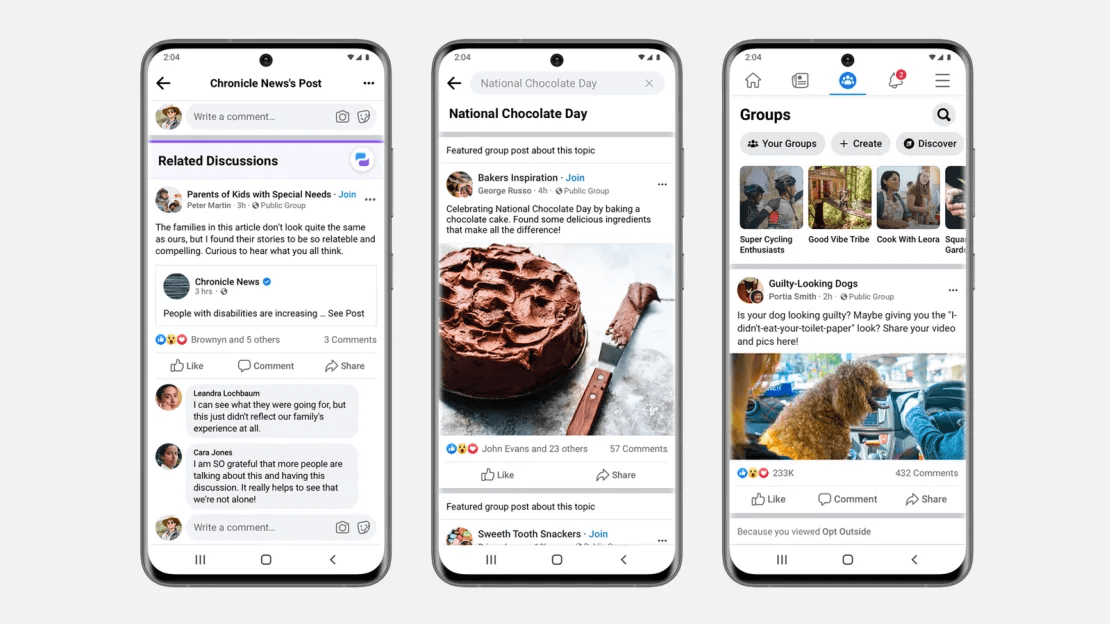
Shopify downsides: Shopify is best suited for people selling physical products. If you just need a website for your brand or blog, Shopify isn’t the best fit. It’s also not the best choice for creators selling digital products like courses,
ebooks
, memberships, and brand communities. Additionally, Shopify has a complex pricing structure with transaction fees on all plans unless you use their payment gateway.

Shopify pricing:

  • Shopify Lite: $9/month

  • Basic: $29/month, online credit card rate: 2.9% + $0.30, transaction fee if not using Shopify payments: 2%

  • Shopify: $49/month, online credit card rate: 2.6% + $0.30, transaction fee if not using Shopify payments: 1%

  • Advanced: $299/month, online credit card rate: 2.4% + $0.30, transaction fee if not using Shopify payments: 0.5%

  • Shopify Plus: Custom plans starting at $2000/month

3. WordPress

WordPress is free, open-source website-building software that’s popular among bloggers and business owners alike. There are two ways you can use WordPress to build your website:

Self-hosted WordPress: With a self-hosted WordPress site, you’ll purchase a domain, sign up for website hosting, and install WordPress yourself. Check out this article to learn more about signing up for
website hosting
.

From there, you can add your favorite themes, tools, and plugins to make your website function the way you need. Because WordPress is a content management system (CMS), it’s a good choice for creators and bloggers who share lots of content with their followers.

Managed
WordPress.com
website: Your second option is to build your website with
WordPress.com
for managed hosting. They’ll handle your hosting so you don’t have to choose a third-party provider.

WordPress.com
offers two plans: WordPress Free and WordPress Pro.

You can set up a simple website with 1GB of storage on the free version, but you cannot connect custom domains, install plugins, or monetize your site through ads or product sales. Additionally, WordPress will display its own ads on your free website, and you can’t disable this unless you upgrade to the Pro plan.

With the WordPress Pro plan, you can connect your own domain, install plugins, use premium themes,
sell your own products
, and earn money from advertising if you choose to do so. You’ll get 50GB of storage and access to behind-the-scenes parts of your website for greater customization. WordPress Pro hosted on
WordPress.com
costs $15 per month.

WordPress features:

  • Free, open-source site builder software

  • Self-hosted: You install WordPress yourself and pay for your domain and website hosting separately

  • WordPress.com
    hosting: Choose between the limited Free plan or the $15 per month Pro plan

  • Search engine optimization (SEO) tools
    to help your content rank

  • Ideal for website developers and creators with coding knowledge who want lots of customization options

WordPress benefits:The biggest plus of using WordPress is how customizable it is. There are over 50,000 free and paid plugins you can use for maximum functionality, and there are seemingly endless themes to give your site a unique look and feel. Because WordPress is popular, it’s easy to find third-party resources, tutorials, and videos to help you learn the platform.

WordPress downsides: On the flip side, WordPress has a steep learning curve. You may need to hire a web developer to get everything set up, and you’ll be responsible for keeping everything updated and working correctly.

WordPress is not an all-in-one solution. You’ll need to use a separate service or plugin for managing email,
selling courses
, creating memberships, and
running your affiliate program
.

Finally, even though the base software is free, you’ll need to pay for hosting, your domain, and other tools to get your website up and running. Depending on your needs, this could cost more than an all-in-one platform.

Managed
WordPress.com
pricing:

Self-hosted WordPress pricing:

  • The WordPress software is free and open-source

  • You’ll pay for web hosting, domain registration, and any premium themes or plugins that you want to use

4. Wix

With Wix, you can create a storefront, blog, or business website using a drag-and-drop page builder. Set up your site quickly with modern templates and upgrade as needed to unlock more features.

Like Shopify, Wix comes with handy tools for selling physical products. Sell print-on-demand and dropship products, subscriptions, and even gift cards for your online store.

Business plans include online booking functionality, event and ticket management, and special tools for hotel owners, restaurants, and fitness professionals.

Wix also offers a limited free plan if you only need a simple site. Free plans have prominent Wix branding that can only be removed by upgrading to one of their premium plans.

Wix features:

  • Drag and drop editor and website builder

  • 800+ templates, including blank templates if you want to build from scratch

  • Ecommerce store for selling products and services

  • Sell digital products like files, PDFs, images, audio, and videos

  • 24/7 customer care on all plans

  • Wix Artificial Design Intelligence (ADI)

  • For developers: Velo by Wix is a development platform where you can build web applications

Wix benefits: Wix’s drag and drop website builder is intuitive, even if you’re not tech-savvy. You can also get help from Wix’s unique Artificial Design Intelligence (ADI) tool, which uses artificial intelligence to design a custom site for your brand.

If you sell physical products, there are native ecommerce integrations for dropshipping, gathering customer reviews, and running loyalty programs on higher-tier business plans. You can also send automated abandoned cart emails on all business plans.

Wix downsides: On the Free plan, you cannot remove loud Wix branding from your site. To disable Wix ads, you’ll need to be on the Combo plan ($16 per month) or higher. Wix also limits website storage space on all plans. This could be a problem for creators like videographers and
photographers
who want to showcase their work.

Wix website plans:

Wix business plans:

5. Webflow

Webflow is a code-free website builder, ecommerce platform, and content management system. Webflow has powerful website design features for makers who want to start with a blank slate, but there are over 100 templates available if you need some guidance. You can even add interactive webpage elements and animations.

Through Webflow’s ecommerce tools, you can sell physical products, digital products, and services. Display unique product fields to highlight the most important information for buyers and create a customized checkout process–even if you don’t know how to code.

Webflow features:

  • No coding required

  • Ecommerce tools for selling products and services

  • Content management system

  • Interactive features like movement, animations, and scroll progress

  • Native SEO tools

  • Flexible templates (unlike Squarespace, where the templates are more rigid)

  • Backend website hosting through AWS

Webflow benefits: Webflow has a Free plan where you can build your own website, add up to 50 CMS items, and use up to 1GB of bandwidth. There are paid CMS plans, ecommerce plans, and workplace plans with different attributes so you can choose the best option for your needs.

If you sell products, your customers can pay through Stripe, PayPal, Apple Pay, or Google Pay.

Webflow downsides: Because Webflow offers so much flexibility, it could be overwhelming for someone who just wants to set up a simple website for their business. Having unlimited customization options isn’t always better.

Additionally, there are limits on bandwidth, number of CMS items, number of products, annual sales volume, monthly visitors, and number of website pages on almost all plans.

For example, Webflow’s $42/month Standard ecommerce plan has a limit of 500 items and a cap of 50K annual sales volume.

The $84/month Plus ecommerce plan has a limit of 1,000 items and 200K annual sales volume.

The $235/month Advanced plan doesn’t have an annual sales volume limit, but you’re still limited to 3,000 items.

Webflow website pricing:

  • Starter: Free

  • Basic: $15/month

  • CMS: $20/month

  • Business: $45/month

Webflow ecommerce pricing:

  • Standard: $42/month

  • Plus: $84/month

  • Advanced: $235/month

6. Weebly

Weebly is an ecommerce platform and website builder owned by Square. With Weebly, you can choose from customizable templates and use their drag and drop builder to make your site shine.

Weebly has blogging tools for sharing content, an App Center for adding extra functionality, and analytics so you can track how your site is performing.

On the ecommerce front, Weebly includes shipping resources, inventory management features, gift cards, customer reviews, and an automatic tax calculator.

Weebly features:

  • Drag and drop website builder

  • Add custom CSS, HTML, and code

  • Hosting included

  • Buy your domain directly through Weebly

  • Community, chat, email, and phone support

  • App Center for connecting additional extensions and integrations

Weebly benefits: The Weebly website builder is user-friendly and suitable for beginners who don’t have extensive website experience. If you plan to sell products, Weebly offers many of the same ecommerce features as Squarespace for a lower cost.

All plans, including the free plan, come with a shopping cart, unlimited products, inventory management, item options, item badges, and coupons. Weebly also provides users with tools to edit images directly in Weebly, saving you a step in your workflow.

Weebly downsides: On Weebly’s Free plan, there are storage limitations and you can’t sell digital products. Weebly will also display Square ads on Free and Personal plans, so you’ll need to upgrade to Professional or Performance to remove these.

Weebly pricing:

  • Free

  • Personal: $9/month

  • Professional: $16/month

  • Performance: $29/month

7. Duda

With Duda, you can create modern websites for yourself or clients. The page editor is straightforward, and Duda comes with a wide selection of elements for customizing your site.If you hope to use Duda for ecommerce, you won’t be disappointed. There are no transaction fees, you can accept 40 different payment methods, and you can sell subscriptions on the Advanced and Unlimited plans.

One thing that sets Duda apart from other popular website builders is that it includes client management and collaboration tools for professional web designers and agencies. You can see all your projects in one place and quickly build, maintain, and deploy Duda websites for your customers in just a few clicks.

Duda features:

  • Lots of templates

  • Edit the mobile version and desktop version of your site separately for different looks

  • Create a membership area

  • Get more functionality using the Duda App market

  • Create your own widgets and automation rules

Duda benefits: With Duda, you can build websites for your own business or for your clients, all under one roof. Start with one of their templates or create a unique design from scratch. You can also make reusable website sections to use across multiple pages and projects.

Duda downsides: Duda doesn’t offer a free plan, and the paid plans can be pricey. If you use Duda for ecommerce, the Standard and Advanced add-ons limit the number of products you can sell. Also, there are no
newsletter
or email marketing tools built-in, so you’ll need to integrate with another platform to get this functionality.

Duda pricing:

  • Basic: $19/month

  • Team: $29/month

  • Agency: $59/month

  • Custom

Add on ecommerce pricing:

  • Standard: $8/month (100 products)

  • Advanced: $22/month (2500 products)

  • Unlimited: $49/month (unlimited products)

Which alternative to Squarespace is right for me?

Best free alternatives to Squarespace:

  • Podia: You can build a full website with unlimited pages, minimal Podia branding, and no storage limitations on the Free plan.

  • Wix: You can build a website with Wix branding and up to 500MB of storage and bandwidth on the Free plan.

  • Weebly: You can build a website with Weebly branding and up to 500MB of storage on the Free plan.

Best Squarespace alternatives for selling physical products:

  • Shopify: They provide tools to help fulfill orders, ship products, manage inventory, issue refunds, and track finances.

  • Wix: You can print on demand, dropship products, manage inventory, and ship your items.

Best alternatives to Squarespace for selling digital products:

  • Podia: Sell online courses, digital downloads, community memberships, webinars, coaching, and memberships in addition to running your website.

  • WordPress: Third-party apps and plugins make it possible to sell digital products and create a community. These tools usually come with an extra cost.

Best Squarespace alternatives for bloggers:

  • Podia: Podia includes a full blogging feature on the free plan with unlimited posts

  • WordPress: This is an open-source content management system that can be customized to meet your blogging needs.

  • Webflow: This content management system comes with SEO features and hosting.

Best platforms for running a web design business or agency:

  • Duda: Collaborate with customers, send previews, and design custom reusable elements.

  • Webflow: Build and manage website projects, collaborate with team members, and bill clients through the Webflow dashboard.

Best all-in-one alternative to Squarespace: Podia

With Podia, you can create a full website on our Free plan. It’s the best website builder for creators who want customization without the overwhelm, and for anyone who dreams of building a virtual home base for their entire creative business.

Design a beautiful website, sell your work, build community, and share your story. At Podia, we’ll help you make it happen, and we can’t wait to see what you create.

Build your free Podia website today
.

Entrepreneurship7 best Squarespace alternatives for building a beautiful website (Features & pricing)Find a Squarespace alternative with the functionality you need to build the perfect site, grow your audience, and sell more!

Software Stack Editor · July 11, 2024 ·

Find a Squarespace alternative with the functionality you need to build the perfect site, grow your audience, and sell more!

Jump ahead

In this article

Whether you’re a new creator or a seasoned pro, there’s a good chance your business needs a website. Entrepreneurs already wear many hats, so it’s important to find a website builder that’s easy to use and headache-free.

Squarespace is a popular option because you can design and build a website without knowing how to code. Squarespace provides a variety of website templates, and you can also set up an online store, highlight your work in a digital portfolio, or start a blog.

But Squarespace has some limitations, and it isn’t the right fit for everyone. In this article, we’ll cover the pros and cons of this popular website building platform, as well as seven Squarespace alternatives to consider if it doesn’t suit your needs.

Squarespace pros and cons

First, let’s look at some benefits and shortcomings of Squarespace.

Squarespace pros

Website templates: When you build a website with Squarespace, you’ll get access to several templates to jumpstart your site design.Squarespace offers specialized themes for portfolio websites, ecommerce shops, blogs, service-based businesses, and other use cases. You can also buy third-party templates if you want a different look.

Ecommerce tools: If you’d like to sell products and services from your website, Squarespace has three plans with ecommerce functionality.You can also accept bookings and appointments through Squarespace’s scheduling tool, available for an additional fee.

Membership area: For an additional cost, you can use Squarespace to build a membership area for your brand. Members can enjoy exclusive files, videos, premium content, and virtual events. Your membership area can be free or paid, and you can add unlimited members.

Email marketing tools: Want to stay in touch with your audience? Squarespace has an
email marketing
add-on with email design layouts to make your messages feel cohesive with your website. This feature is available for an extra fee.

Squarespace cons

Difficult to use: Squarespace markets itself as easy, but many users find that the site editor is harder to use than expected. Some settings and elements can only be adjusted on individual pages and others must be tweaked in the Site Styles area, which is located in a different section of your Squarespace dashboard.

For example, here are the steps you’d need to take to restyle a button on your home page:

  1. On the Squarespace home screen, click “Pages” and select your home page.

  2. Select the “Edit” button in the top left corner.

  3. Click the pencil icon next to the button you’d like to change.

  4. Change the button text, link destination, button size, and alignment, then click “Done”.

  5. Return to the Squarespace home screen and click “Design”.

  6. Select the “Site Styles” tab.

  7. Click “Buttons” to change the style, shape, and padding.

  8. Select “Colors” to change the color palette across your site.

  9. Select “Fonts” and scroll down to the “Buttons” section to change settings like font family, text weight, letter spacing, and text transform for all buttons across your site.

That’s a lot of steps just to tweak one button. When you’re new to Squarespace, navigating between pages, elements, and style settings can be confusing and time-consuming.

Limited customizations: While templates offer a nice starting point, many users feel that the customization options are too narrow with Squarespace. The website builder is simple for non-developers, but the catch is that you can only edit certain aspects of your site.

The core blocks that make up most theme designs are rigid, and making changes beyond what’s offered in the style editor requires some coding knowledge. You’ll be fine if you need to swap out text, pictures, and colors, but changing fine details gets tricky.

Not ideal for selling digital products: While it’s possible to sell digital products on Squarespace, the ecommerce tools and extensions are mainly geared toward
selling physical products
. The maximum file size you can sell is 300MB.

You can only offer one file per digital product listing, but you can zip files together if the total stays under 300MB. You can’t offer variations for digital items, nor can you sell digital products as subscriptions.

Complicated pricing structure: If you’d like to use some of Squarespace’s advanced features like email marketing, memberships, or scheduling, you’ll need to pay extra fees each month.Here’s a look at the Squarespace pricing plans and add-ons:

Squarespace pricing:

Squarespace membership area pricing (add-on):

  • Starter: $10/month (+7% transaction fee)

    • 5 hours of video storage

    • 1 member area

  • Core: $20/month (+4% transaction fee)

  • Pro: $40/month (+1% transaction fee)

Squarespace email pricing (add-on):

  • Starter: $7/month

    • 3 campaigns per month

    • 500 emails per month

  • Core: $14/month

    • 5 campaigns per month

    • 5,000 emails per month

    • Automations

  • Pro: $34/month

    • 20 campaigns per month

    • 50,000 emails per month

  • Max: $68/month

    • Unlimited campaigns

    • 250,000 emails per month

Squarespace scheduling pricing (add-on):

  • Emerging: $15/month

  • Growing: $25/month

  • Powerhouse: $50/month

Here’s how this could play out by the numbers:

Suppose you wanted to build a website with ecommerce functionality, a membership area, and email marketing. You’d pay $33 per month for the core Business plan, $10 per month for the Starter membership plan, and $7 per month for the Starter email plan.

Your total would be $50 per month plus transaction fees, just for the introductory offerings in each category. Simply put, Squarespace’s pricing structure is complex, and you may end up with a hefty price tag to get everything you want.

Up next, we’ll explore seven Squarespace alternatives that might fit the bill instead.

7 best Squarespace alternatives

1. Podia

Podia is an all-in-one platform for running your business where you can create a stylish website in no time. The best part? It’s 100% free to
build your website on Podia
.

Podia’s free website builder gets top marks for ease of use, and you don’t have to know code to make your site look amazing. You can make as many web pages as you need and even create standalone sales pages and landing pages to promote your offerings.

There are over a dozen different website sections to choose from, and within each section, you can customize the content (like title, description, button text, and what content to include) and the design (like orientation, layout, style, color, and background image).

You can style each content block with just a few clicks to get a totally different look and layout.
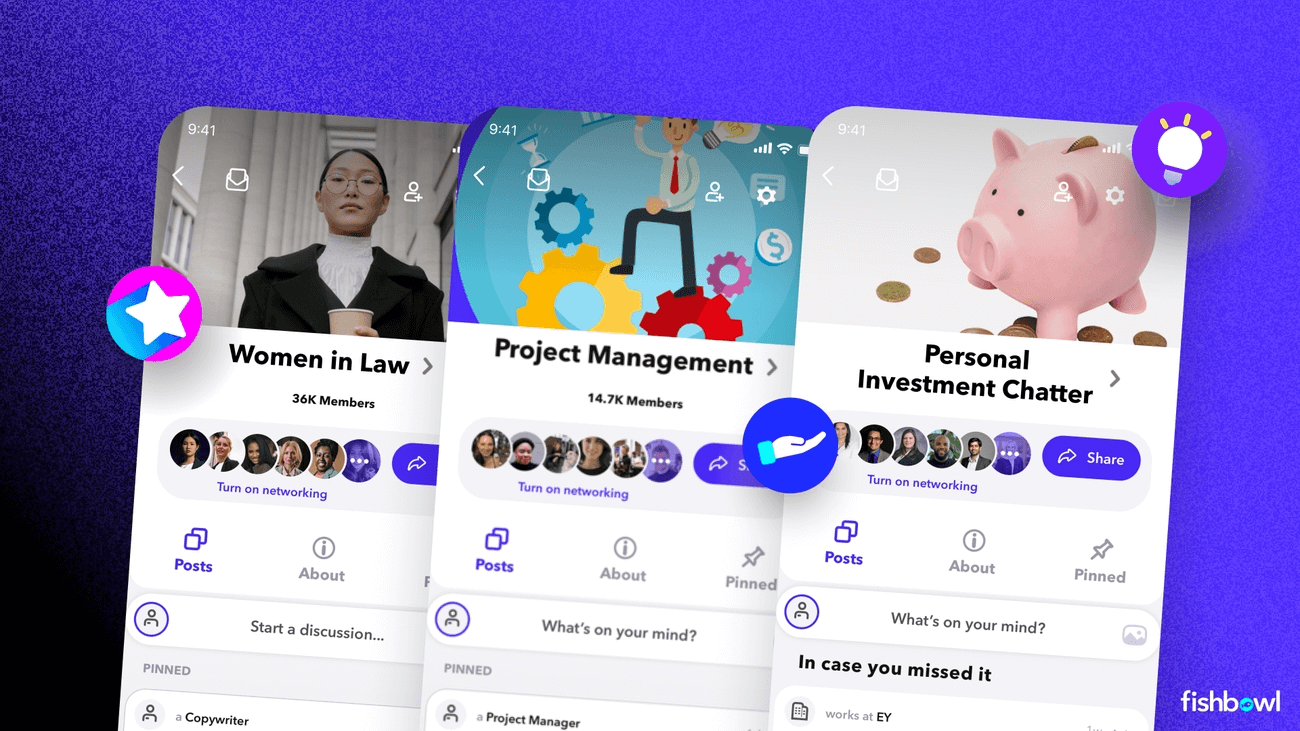
But don’t just take our word for it. According to Podia creator and
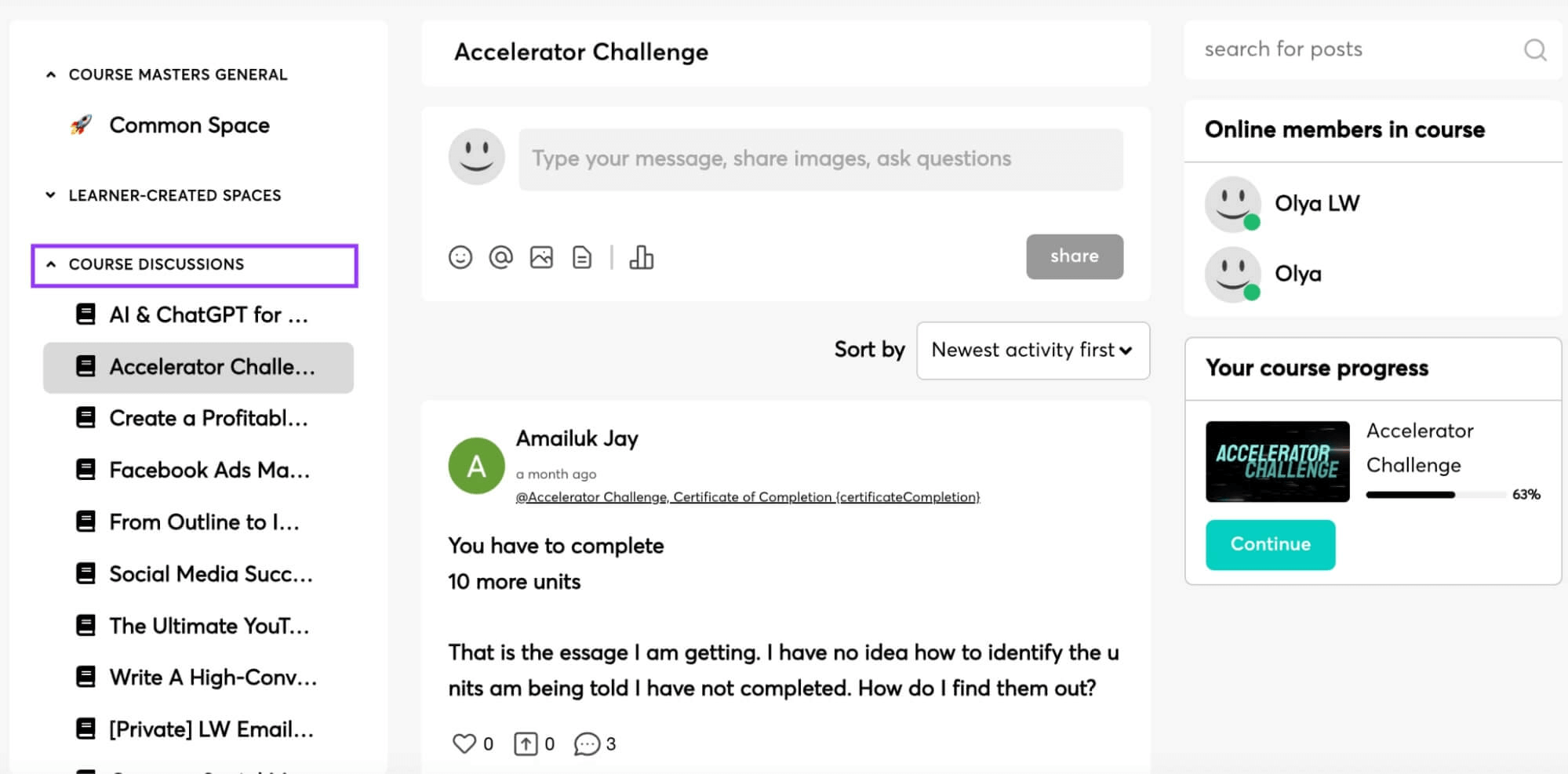
Flex Lessons
founder
Joseph D’Amico
, “Podia makes website building so fun. I feel like I could set up a site in an afternoon, and it would look great. And there’s something to be said for how pretty it is. It’s the best-looking one by far.”

The cherry on top? Podia’s free-forever plan comes with a complete website, unlimited landing pages, blogging, and the ability to
sell one digital download
and
one coaching product
. Essentially, you can build a powerful and profitable online presence without opening your wallet.

And as your business grows, you can upgrade to one of our affordable paid plans to sell unlimited digital downloads,
online courses
,
webinars
, memberships, free or paid communities, and coaching, all from your Podia dashboard.

Bottom line: With Podia, you can build a fantastic website, sell your work, and run your entire business for a fraction of the price of Squarespace.

Podia features:

  • Complete website builder with unlimited pages (including
    sales pages
    and
    landing pages
    )

  • Sell unlimited courses, digital downloads, webinars, membership communities, and coaching/services on Mover and Shaker plans

  • Built-in email marketing, affiliate marketing, and customer messaging

  • Unlimited bandwidth (content and video) on Mover and Shaker plans

  • Podia hosts your website for you

  • Top-notch
    customer support

Podia pricing
:

  • Free plan (10% transaction fee): Includes a website, community, one digital product, and one coaching service

  • Starter: $9/month or $4/month when paid annually (8% transaction fee)

  • Mover: $39/month or $33/month when paid annually (5% transaction fee)

  • Shaker: $89/month or $75/month when paid annually

Learn more about how Podia compares to Squarespace
.
Build your website for free on Podia
, or
check out our video demo
to see these features in action.

Get your free Podia account

Join the 150,000+ creators who use Podia to create websites, sell digital products, and build online communities.

Sign up free

2. Shopify

Shopify is a popular ecommerce platform for selling physical products online. With Shopify, you can build an entire website or online storefront to showcase your creations.

To start, pick a theme that matches your brand. There are dozens of templates to choose from that are organized by business type and industry. Customize your site using Shopify’s drag and drop editor to make your page just right.

From there, you can add products and sell online, in-person, or through your social media channels. Shopify can help you track your finances, fulfill orders, handle shipping, manage inventory, issue refunds, and learn about your business through analytics.

Shopify features:

  • Full website on Basic plans and above

  • Website templates

  • Sell products online or in-person through Shopify’s point of sale system

  • Tools for managing logistics

  • Built-in Shopify payment processor

Shopify benefits: Shopify comes with free and paid themes you can use to customize your website. For those offering physical products, Shopify provides a suite of tools to make the selling process a breeze. If you want to keep in touch with your customers, Shopify email is available on all plans. The first 10,000 emails each month are free, and after that, you’ll pay $1 per $1,000 additional emails sent.

Shopify downsides: Shopify is best suited for people selling physical products. If you just need a website for your brand or blog, Shopify isn’t the best fit. It’s also not the best choice for creators selling digital products like courses,
ebooks
, memberships, and brand communities. Additionally, Shopify has a complex pricing structure with transaction fees on all plans unless you use their payment gateway.

Shopify pricing:

  • Shopify Lite: $9/month

  • Basic: $29/month, online credit card rate: 2.9% + $0.30, transaction fee if not using Shopify payments: 2%

  • Shopify: $49/month, online credit card rate: 2.6% + $0.30, transaction fee if not using Shopify payments: 1%

  • Advanced: $299/month, online credit card rate: 2.4% + $0.30, transaction fee if not using Shopify payments: 0.5%

  • Shopify Plus: Custom plans starting at $2000/month

3. WordPress

WordPress is free, open-source website-building software that’s popular among bloggers and business owners alike. There are two ways you can use WordPress to build your website:

Self-hosted WordPress: With a self-hosted WordPress site, you’ll purchase a domain, sign up for website hosting, and install WordPress yourself. Check out this article to learn more about signing up for
website hosting
.

From there, you can add your favorite themes, tools, and plugins to make your website function the way you need. Because WordPress is a content management system (CMS), it’s a good choice for creators and bloggers who share lots of content with their followers.

Managed
WordPress.com
website: Your second option is to build your website with
WordPress.com
for managed hosting. They’ll handle your hosting so you don’t have to choose a third-party provider.

WordPress.com
offers two plans: WordPress Free and WordPress Pro.

You can set up a simple website with 1GB of storage on the free version, but you cannot connect custom domains, install plugins, or monetize your site through ads or product sales. Additionally, WordPress will display its own ads on your free website, and you can’t disable this unless you upgrade to the Pro plan.

With the WordPress Pro plan, you can connect your own domain, install plugins, use premium themes,
sell your own products
, and earn money from advertising if you choose to do so. You’ll get 50GB of storage and access to behind-the-scenes parts of your website for greater customization. WordPress Pro hosted on
WordPress.com
costs $15 per month.

WordPress features:

  • Free, open-source site builder software

  • Self-hosted: You install WordPress yourself and pay for your domain and website hosting separately

  • WordPress.com
    hosting: Choose between the limited Free plan or the $15 per month Pro plan

  • Search engine optimization (SEO) tools
    to help your content rank

  • Ideal for website developers and creators with coding knowledge who want lots of customization options

WordPress benefits:The biggest plus of using WordPress is how customizable it is. There are over 50,000 free and paid plugins you can use for maximum functionality, and there are seemingly endless themes to give your site a unique look and feel. Because WordPress is popular, it’s easy to find third-party resources, tutorials, and videos to help you learn the platform.

WordPress downsides: On the flip side, WordPress has a steep learning curve. You may need to hire a web developer to get everything set up, and you’ll be responsible for keeping everything updated and working correctly.

WordPress is not an all-in-one solution. You’ll need to use a separate service or plugin for managing email,
selling courses
, creating memberships, and
running your affiliate program
.

Finally, even though the base software is free, you’ll need to pay for hosting, your domain, and other tools to get your website up and running. Depending on your needs, this could cost more than an all-in-one platform.

Managed
WordPress.com
pricing:

Self-hosted WordPress pricing:

  • The WordPress software is free and open-source

  • You’ll pay for web hosting, domain registration, and any premium themes or plugins that you want to use

4. Wix

With Wix, you can create a storefront, blog, or business website using a drag-and-drop page builder. Set up your site quickly with modern templates and upgrade as needed to unlock more features.

Like Shopify, Wix comes with handy tools for selling physical products. Sell print-on-demand and dropship products, subscriptions, and even gift cards for your online store.

Business plans include online booking functionality, event and ticket management, and special tools for hotel owners, restaurants, and fitness professionals.

Wix also offers a limited free plan if you only need a simple site. Free plans have prominent Wix branding that can only be removed by upgrading to one of their premium plans.

Wix features:

  • Drag and drop editor and website builder

  • 800+ templates, including blank templates if you want to build from scratch

  • Ecommerce store for selling products and services

  • Sell digital products like files, PDFs, images, audio, and videos

  • 24/7 customer care on all plans

  • Wix Artificial Design Intelligence (ADI)

  • For developers: Velo by Wix is a development platform where you can build web applications

Wix benefits: Wix’s drag and drop website builder is intuitive, even if you’re not tech-savvy. You can also get help from Wix’s unique Artificial Design Intelligence (ADI) tool, which uses artificial intelligence to design a custom site for your brand.

If you sell physical products, there are native ecommerce integrations for dropshipping, gathering customer reviews, and running loyalty programs on higher-tier business plans. You can also send automated abandoned cart emails on all business plans.

Wix downsides: On the Free plan, you cannot remove loud Wix branding from your site. To disable Wix ads, you’ll need to be on the Combo plan ($16 per month) or higher. Wix also limits website storage space on all plans. This could be a problem for creators like videographers and
photographers
who want to showcase their work.

Wix website plans:

Wix business plans:

5. Webflow

Webflow is a code-free website builder, ecommerce platform, and content management system. Webflow has powerful website design features for makers who want to start with a blank slate, but there are over 100 templates available if you need some guidance. You can even add interactive webpage elements and animations.

Through Webflow’s ecommerce tools, you can sell physical products, digital products, and services. Display unique product fields to highlight the most important information for buyers and create a customized checkout process–even if you don’t know how to code.

Webflow features:

  • No coding required

  • Ecommerce tools for selling products and services

  • Content management system

  • Interactive features like movement, animations, and scroll progress

  • Native SEO tools

  • Flexible templates (unlike Squarespace, where the templates are more rigid)

  • Backend website hosting through AWS

Webflow benefits: Webflow has a Free plan where you can build your own website, add up to 50 CMS items, and use up to 1GB of bandwidth. There are paid CMS plans, ecommerce plans, and workplace plans with different attributes so you can choose the best option for your needs.

If you sell products, your customers can pay through Stripe, PayPal, Apple Pay, or Google Pay.

Webflow downsides: Because Webflow offers so much flexibility, it could be overwhelming for someone who just wants to set up a simple website for their business. Having unlimited customization options isn’t always better.

Additionally, there are limits on bandwidth, number of CMS items, number of products, annual sales volume, monthly visitors, and number of website pages on almost all plans.

For example, Webflow’s $42/month Standard ecommerce plan has a limit of 500 items and a cap of 50K annual sales volume.

The $84/month Plus ecommerce plan has a limit of 1,000 items and 200K annual sales volume.

The $235/month Advanced plan doesn’t have an annual sales volume limit, but you’re still limited to 3,000 items.

Webflow website pricing:

  • Starter: Free

  • Basic: $15/month

  • CMS: $20/month

  • Business: $45/month

Webflow ecommerce pricing:

  • Standard: $42/month

  • Plus: $84/month

  • Advanced: $235/month

6. Weebly

Weebly is an ecommerce platform and website builder owned by Square. With Weebly, you can choose from customizable templates and use their drag and drop builder to make your site shine.

Weebly has blogging tools for sharing content, an App Center for adding extra functionality, and analytics so you can track how your site is performing.

On the ecommerce front, Weebly includes shipping resources, inventory management features, gift cards, customer reviews, and an automatic tax calculator.

Weebly features:

  • Drag and drop website builder

  • Add custom CSS, HTML, and code

  • Hosting included

  • Buy your domain directly through Weebly

  • Community, chat, email, and phone support

  • App Center for connecting additional extensions and integrations

Weebly benefits: The Weebly website builder is user-friendly and suitable for beginners who don’t have extensive website experience. If you plan to sell products, Weebly offers many of the same ecommerce features as Squarespace for a lower cost.

All plans, including the free plan, come with a shopping cart, unlimited products, inventory management, item options, item badges, and coupons. Weebly also provides users with tools to edit images directly in Weebly, saving you a step in your workflow.

Weebly downsides: On Weebly’s Free plan, there are storage limitations and you can’t sell digital products. Weebly will also display Square ads on Free and Personal plans, so you’ll need to upgrade to Professional or Performance to remove these.

Weebly pricing:

  • Free

  • Personal: $9/month

  • Professional: $16/month

  • Performance: $29/month

7. Duda

With Duda, you can create modern websites for yourself or clients. The page editor is straightforward, and Duda comes with a wide selection of elements for customizing your site.If you hope to use Duda for ecommerce, you won’t be disappointed. There are no transaction fees, you can accept 40 different payment methods, and you can sell subscriptions on the Advanced and Unlimited plans.

One thing that sets Duda apart from other popular website builders is that it includes client management and collaboration tools for professional web designers and agencies. You can see all your projects in one place and quickly build, maintain, and deploy Duda websites for your customers in just a few clicks.

Duda features:

  • Lots of templates

  • Edit the mobile version and desktop version of your site separately for different looks

  • Create a membership area

  • Get more functionality using the Duda App market

  • Create your own widgets and automation rules

Duda benefits: With Duda, you can build websites for your own business or for your clients, all under one roof. Start with one of their templates or create a unique design from scratch. You can also make reusable website sections to use across multiple pages and projects.

Duda downsides: Duda doesn’t offer a free plan, and the paid plans can be pricey. If you use Duda for ecommerce, the Standard and Advanced add-ons limit the number of products you can sell. Also, there are no
newsletter
or email marketing tools built-in, so you’ll need to integrate with another platform to get this functionality.

Duda pricing:

  • Basic: $19/month

  • Team: $29/month

  • Agency: $59/month

  • Custom

Add on ecommerce pricing:

  • Standard: $8/month (100 products)

  • Advanced: $22/month (2500 products)

  • Unlimited: $49/month (unlimited products)

Which alternative to Squarespace is right for me?

Best free alternatives to Squarespace:

  • Podia: You can build a full website with unlimited pages, minimal Podia branding, and no storage limitations on the Free plan.

  • Wix: You can build a website with Wix branding and up to 500MB of storage and bandwidth on the Free plan.

  • Weebly: You can build a website with Weebly branding and up to 500MB of storage on the Free plan.

Best Squarespace alternatives for selling physical products:

  • Shopify: They provide tools to help fulfill orders, ship products, manage inventory, issue refunds, and track finances.

  • Wix: You can print on demand, dropship products, manage inventory, and ship your items.

Best alternatives to Squarespace for selling digital products:

  • Podia: Sell online courses, digital downloads, community memberships, webinars, coaching, and memberships in addition to running your website.

  • WordPress: Third-party apps and plugins make it possible to sell digital products and create a community. These tools usually come with an extra cost.

Best Squarespace alternatives for bloggers:

  • Podia: Podia includes a full blogging feature on the free plan with unlimited posts

  • WordPress: This is an open-source content management system that can be customized to meet your blogging needs.

  • Webflow: This content management system comes with SEO features and hosting.

Best platforms for running a web design business or agency:

  • Duda: Collaborate with customers, send previews, and design custom reusable elements.

  • Webflow: Build and manage website projects, collaborate with team members, and bill clients through the Webflow dashboard.

Best all-in-one alternative to Squarespace: Podia

With Podia, you can create a full website on our Free plan. It’s the best website builder for creators who want customization without the overwhelm, and for anyone who dreams of building a virtual home base for their entire creative business.

Design a beautiful website, sell your work, build community, and share your story. At Podia, we’ll help you make it happen, and we can’t wait to see what you create.

Build your free Podia website today
.

  • « Go to Previous Page
  • Page 1
  • Interim pages omitted …
  • Page 22
  • Page 23
  • Page 24
  • Page 25
  • Page 26
  • Interim pages omitted …
  • Page 35
  • Go to Next Page »

Get your Software Stack together. softwarestack.tech

Software Stack

© 2024–2025 - Software Stack is a trading name of SouthwestCIO Limited ac ompany registered in England & Wales 11319049

  • Knowledgebase
  • Home
  • About Us
  • Contact Us