• Skip to primary navigation
  • Skip to main content
software stack logo

Software Stack

Get your Software Stack together

  • Knowledgebase
    • All Categories
    • Accounting Software
    • Automation & Workflow Software
    • Customer Relationship Management
    • E-Commerce Shopfronts & Payments
    • Marketing Automation
    • Online Courses & Membership
    • Project Management
    • Surveys & Forms
    • Web Hosting
  • Home
  • About Us
  • Contact Us
  • Show Search
Hide Search

Online Learning & Community

How to Prompt ChatGPT – 4 Ways to Use AI to Grow Your Membership Site

Software Stack Editor · April 3, 2025 ·

Picture of Haiden Hibbert

Haiden Hibbert

I’m a Content Manager at MemberSpace helping entrepreneurs and creators sell digital products.

If you’re running a membership site, chances are you’re juggling a lot—creating content, doing the marketing, building community, managing members, answering emails… the list goes on.

And if you’re feeling stretched thin, this post is for you.

Let’s walk through some real-world ways to prompt ChatGPT to save time, boost creativity, and grow your membership business.

Launch your membership site!

The easiest way to accept membership payments or one-time charges for digital products like online courses, communities, content libraries, and more — all from your own website!


Start selling now

Get started for free! 5 minutes to set up.

Table of Contents

How to Prompt ChatGPT

Before we get into the fun stuff, we need to talk about how to actually use ChatGPT in a way that gets you helpful results.
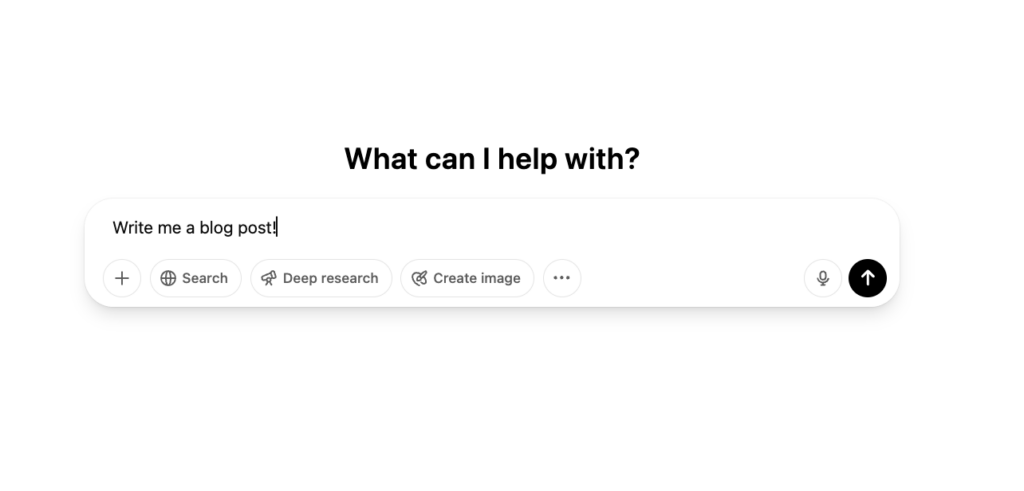
Prompting chatgpt

Because if you just type something like “Write a blog post,” you’ll probably get something super generic.

The trick is giving ChatGPT the right context — things like:

  • Who your audience is
  • What you want the content to do
  • How you want it to sound

It’s kind of like giving direction to a new team member. The clearer you are, the better the output. Don’t be afraid to be specific.

Prompting Cheat Sheet

Whenever you write a prompt, try to include:
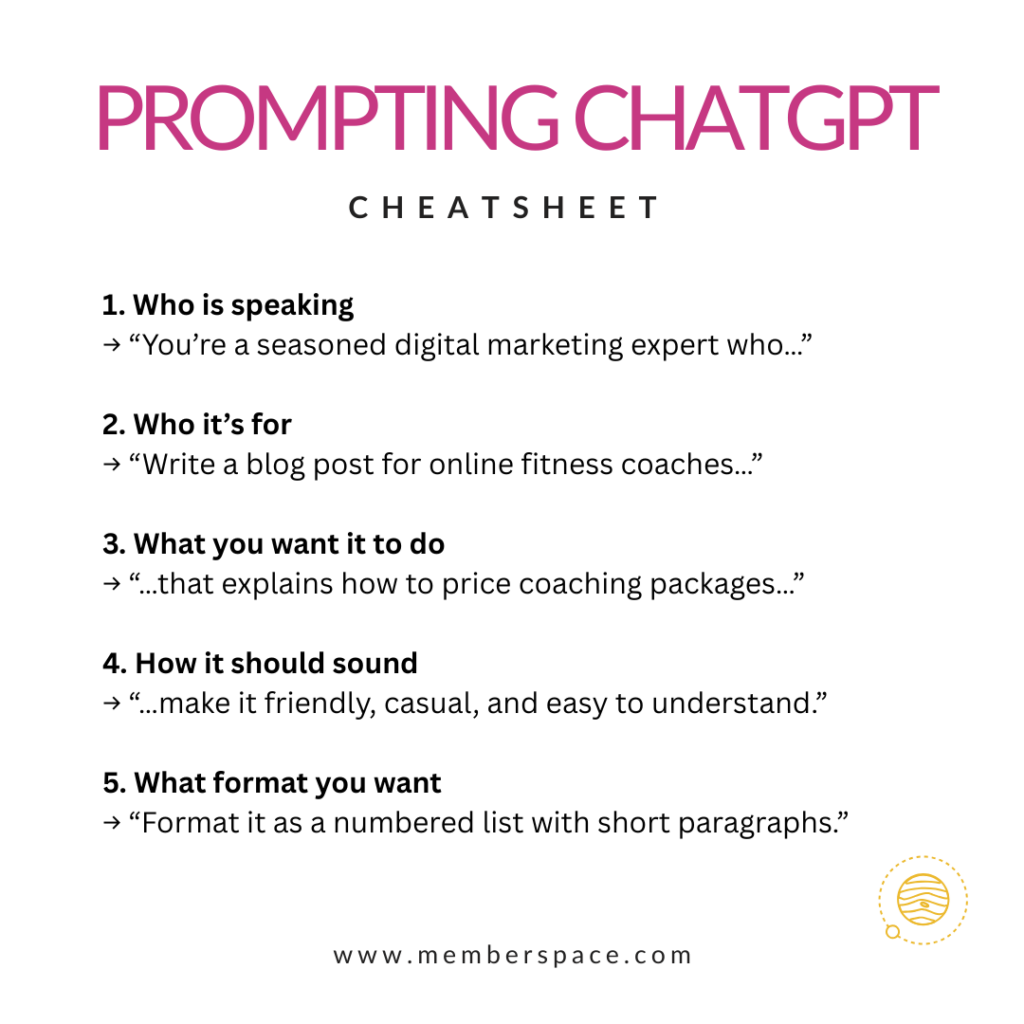
prompting chatgpt cheatsheet

Optional extras:

  • Add word count 
  • Include example content or links for reference
  • Ask for multiple variations to choose from

Use ChatGPT for Market Research

Before you launch anything new — like an online course, a bonus, or even just a blog post — you need to understand what your audience wants.

ChatGPT can be super helpful here.

It won’t give you live data like a survey would, but it can help you brainstorm:

  • Common pain points
  • Big goals or desires
  • Reasons people might hesitate to join your membership or purchase your product
  • Language your audience actually uses
  • Ways to position your offer more clearly

Try this prompt:

“Act as a market researcher. I run a membership for new online coaches. What are the top 10 challenges they might have when starting out, and how could a membership help with each one?”

You can even follow up and ask for ideas on how to position your membership to match those struggles and goals.

Brainstorm Fresh Content Ideas

Once you understand what your audience wants, the next step is figuring out what to actually create for them.

That could mean:

  • A new piece of content for your content library
  • A themed challenge for next month
  • A lead magnet to grow your email list
  • A bonus resource for a higher-priced tier
  • Or even an entire new membership tier

The good news? You don’t have to come up with everything from scratch.

How to Prompt ChatGPT for New Content Ideas

Here are a few real examples of how you might prompt ChatGPT to generate helpful, usable ideas fast:

→ Idea: Plan a new monthly content drop

“I run a membership for freelance designers. Give me 5 new content drop ideas I could create this month. Include the title, content type (e.g. tutorial, template, guide), and one-sentence description for each.”

→ Idea: Break up content by skill level

“Group these 12 content topics into beginner, intermediate, and advanced categories for a membership that helps health coaches grow their business.”

→ Idea: Refresh a topic you’ve already covered

“I’ve already taught a lesson on building a client onboarding process. What are 5 new angles or formats I could use to revisit that topic in a fresh way?”

→ Idea: Get help organizing your content into a learning path

“Act like a curriculum designer. I run a membership that teaches watercolor painting. Create a content roadmap that introduces members to beginner techniques, then builds into more advanced lessons.”

→ Idea: Turn scattered ideas into something cohesive

If you’ve got a bunch of content ideas floating around in your head (or sitting in a messy Google Doc), just paste them into ChatGPT and say:

“Organize these into a content plan for the next 3 months. Suggest a theme for each month, and group the content ideas accordingly.”

Create eBooks and Downloadable Guides

Writing long-form content like an ebook or downloadable guide can take forever.

But ChatGPT makes the process way easier.

Start by asking it to outline the sections based on your topic. Once you like the structure, you can have it draft each section one by one.

Here’s an example of how to prompt ChatGPT for this use case:

“Outline a five-section ebook called ‘How to Build a Consistent Content Plan for Your Membership Site,’ then write the full copy for section one.”

This is great for lead magnets, paid downloads, or member-only resources. And you can always tweak the language afterward to match your tone and voice.

You can even give it a blog post or course module and ask it to turn that into a polished guide.

Repurpose Content You Already Have

This might be my favorite way to use ChatGPT — turning old content into new content.

If you’ve already got:

  • Blog posts
  • Recorded workshops
  • Course lessons
  • Long newsletters
  • Instagram captions

…you can feed that into ChatGPT and ask it to repurpose it into all kinds of formats.

Some ideas:

  • Turn a blog post into 3 Instagram captions
  • Turn a workshop into a downloadable PDF
  • Break up a long lesson into short emails
  • Turn a podcast transcript into a blog post
  • Convert your FAQs into a helpful resource page

Prompt example:

“Turn this blog post into 5 Instagram carousel ideas with short captions and engaging hooks.”

This helps you squeeze more value out of the content you’ve already created — without reinventing the wheel.

Final Thoughts

The goal here isn’t to hand over your business to a robot. It’s to get support where you need it most, save time, and focus more on serving your members.

And don’t forget to save that prompting cheat sheet!

For more growth tips, sign up for our free newsletter, The Membership Blast. You’ll get actionable growth tips and insights that are working right now for membership businesses. 

AI-Enhanced iVideo: create interactive videos with AI assistance

Software Stack Editor · April 3, 2025 ·

At LearnWorlds, we’ve always believed in the power of interactive videos. We pioneered a feature that allowed educators, course creators, and trainers to go beyond passive content and turn videos into dynamic learning experiences. But we knew we could take it even further. With our latest update, we’re introducing AI-enhanced interactive video, a groundbreaking improvement …

Continue

The post AI-Enhanced iVideo: create interactive videos with AI assistance appeared first on LearnWorlds.

52 Lead Magnet Ideas for Online Business Creators, Coaches, and Consultants

Software Stack Editor · April 2, 2025 ·

image

In Teachable’s 2025 Business Creator Shift Report, 22% of established creators cited lead generation as their most urgent challenge. This isn’t because they aren’t creating content, but because that content isn’t turning into new revenue. It’s a pain point even large companies have. A well-built lead generation system doesn’t begin with a lead magnet that sits passively on your site. The best lead magnets function as a strong lead qualifier, a value test, and a first step toward meaningful, scalable monetization. 

Lead magnets are a positive-sum game. You get a qualified lead email. Your lead gets a valuable piece of content or tool that helps them solve an immediate problem.

Email remains the most cost-effective channel in digital marketing, outperforming ads, SEO, and social media on return. According to HubSpot, email still brings in $36 for every $1 invested. This statistic only tells part of the story. Email is effective when your audience is qualified, focused, and ready to move toward a deeper engagement.  

For creators already earning and ready to scale, including coaches, consultants, and other knowledge-driven businesses, lead magnets help you:

  • Build a direct communication channel independent of social platforms
  • Connect each subscriber to a structured journey towards your core offer
  • Attract people who engage, rather than click once and disappear

What follows is a curated list of 52 lead magnet formats/examples designed for revenue-conscious creators. Each idea is ready to apply, easy to build from your existing materials, and aligned with long-term business outcomes.

Pro-tip: Combine these ideas with your own expertise, then use the following AI prompt to kickstart the creation of a powerful lead magnet:

When I give you my topic and content, run the sequence below.

*sequence*
You are a lead generation strategist helping [your audience type, e.g., online coaches, consultants, or course creators] create a lead magnet that attracts qualified prospects who are ready to [desired outcome, e.g., scale their business, improve conversion rates, or prepare for a premium coaching program].

The lead magnet will be in the form of a [format: e.g., diagnostic quiz, mini-training, workbook, template, checklist, etc.].Write it to achieve the following goals:
*Qualify leads by identifying if they are ready for [your paid offer type: e.g., coaching, online course, membership, service].
*Deliver immediate value and position me as a trusted expert.

Naturally bridge into a next step such as a discovery call, free trial, or purchase of my main offer.

My niche is: [insert your niche].
My audience's biggest pain points are: [list top 2-3]. 
My audience’s current stage of business: [briefly describe: e.g., generating $5k+ monthly but struggling to scale].

Please create:
*An engaging lead magnet title.
*A brief description of its purpose and what it helps with.
*A detailed outline or draft of the lead magnet content.
Suggested CTA to naturally transition into my main offer.

{{aiprompts-component=”/blog-shortcodes/blog-popup”}}

52 lead magnet ideas

1. 6-Figure offer planner

Format: PDF Workbook or Interactive Notion Template
Purpose: Help prospects design and structure a premium course, program, or coaching offer

Where to Use It:

  • As a follow-up to free webinars or workshops
  • Exit intent pop-up for coaches, consultants, and educators
  • Lead-in to a mini-course on course creation

Examples:

  • Coach: “Design Your Signature Coaching Program” defines the path to a $5K+ offer.
  • Course Creator: “Flagship Course Builder” walks through structuring a course worthy of premium pricing.
  • Consultant: “High-Ticket Offer Blueprint” helps structure done-for-you or hybrid offers.

This planner walks prospects through mapping out a high-ticket offer, defining transformation, pricing, deliverables, and packaging. It pushes them to elevate from underpriced services or content to scalable, high-value offers.

2. Discovery call script

Format: Fillable Google Doc, PDF, or CRM-integrated template
Purpose: Guide conversations that qualify leads and align services with business outcomes

This resource provides a structured approach to your first call with a potential client. Rather than improvising, the script ensures you ask the right questions in the right sequence, revealing readiness, budget, pain points, and implementation capacity. It also helps filter non-buyers before they enter your pipeline.

Use this lead magnet to show prospects you’ve already built a process. That positions your service as a structured investment, not a casual offer.

Where to Use It:

  • Opt-in before booking a consultation
  • Included in a “Working With Me” starter kit
  • Paired with a lead qualification checklist

Examples:

  • Sales Coach: “Consultation Flow Framework”, a script that highlights goals, objections, and buying timelines
  • Web Development Agency: “Website Discovery Call Template”, questions around functionality, user flows, and scope validation
  • Marketing Consultant: “Revenue-Focused Discovery Script”, evaluates conversion goals, historical performance, and KPI clarity

This tool functions as both a positioning asset and a conversion tool. It shortens your sales cycle and raises the perceived value of your service before the proposal ever lands.

3. Intake form template

Format: Google Form, Notion doc, Typeform, or Airtable template
Purpose: Automate onboarding and gather essential data to qualify, segment, and scope effectively

An intake form creates structure before the work begins. It filters out misaligned prospects, surfaces key project details, and reduces back-and-forth in the sales process. For consultants and creators offering services, this tool doubles as both a pre-sale screener and a post-sale onboarding system.

Used correctly, your intake form isn’t just for organization, it shapes how prospects view your professionalism, process, and capacity. It also creates a natural handoff to client-facing deliverables.

Where to Use It:

  • Embedded in a booking flow for coaching or consulting sessions
  • Sent automatically post-opt-in using Teachable email or a connected CRM
  • Linked from your services page as a pre-qualification filter

Examples:

  • Content Strategist: “Pre-Engagement Brief”, covers content goals, current platforms, brand voice samples, and traffic sources
  • Business Operations Consultant: “Workflow Audit Intake”, maps out team roles, SOP status, and tool usage
  • Design Studio: “Creative Kickoff Questionnaire”, covers visual direction, project timeline, asset inventory, and revision expectations

Well-structured intake forms save time upfront and lay the foundation for high-quality delivery. When used as a lead magnet, they also function as filters, bringing in only those clients ready to move forward.

4. Diagnostic quiz

Format: Scored quiz via Typeform, ScoreApp, Interact, or custom-built inside a course platform
Purpose: Segment leads by skill level, readiness, or problem type to tailor your follow-up offers

A diagnostic quiz gives prospective clients a self-assessment that delivers instant clarity while giving you actionable data. This format works especially well when you offer multiple programs, coaching tiers, or consulting paths. It acts as a filter and recommendation engine at the same time.

The strongest diagnostic quizzes don’t just assign scores, they frame the results as a starting point for further transformation. Each score category should point to a specific product, offer, or consultative next step.

Where to Use It:

  • Promoted in your bio link or pinned social post
  • As an embedded opt-in on your services page
  • At the start of a product funnel as a segmentation tool

Examples:

  • Productivity Consultant: “Where Are You Losing Time?”, segments business owners into operational bottlenecks (workflow, delegation, tech)
  • Mindset Coach: “Decision Fatigue Diagnostic”, identifies decision-making blocks and recommends a planning tool or 1:1 session
  • Brand Strategist: “Brand Consistency Scorecard”, evaluates tone, visuals, and content alignment across platforms

This tool positions your service as custom-fit rather than one-size-fits-all. It gives the prospect a result they can use now, and sets up your deeper solution as the next step.

5. Before/After transformation roadmap

Format: One-page PDF, slide deck, or annotated visual framework
Purpose: Visually show the transformation your client or student will experience across clear milestones

This resource outlines the full customer journey, starting from the most common pain points and moving through key phases of change. It helps future clients understand what they’re investing in and when they can expect results. It also positions you as a guide with a defined process.

Use it to demystify your offer, reduce hesitation, and set expectations before a call or course signup.

Where to Use It:

  • As an opt-in from a waitlist page or webinar
  • Sent in your email funnel before a sales page
  • Delivered post-lead magnet to upsell a higher-tier offer

Examples:

  • Fitness Coach: “Strength Progression Map”, 12-week journey from baseline metrics to peak performance
  • HR Consultant: “Hiring Process Maturity Model”, five phases from reactive hiring to a fully integrated recruitment system
  • Art Instructor: “Creative Skill Builder Timeline”, tracks visual improvement from beginner sketches to portfolio-ready illustrations

A roadmap shifts the focus from features to outcomes. When prospects see the entire arc laid out, they’re more likely to commit to the full journey.

6. 7-day self-assessment challenge

Format: Daily prompts delivered via email or hosted inside a course module
Purpose: Build habit formation and daily engagement while qualifying your most committed leads

A short, time-boxed challenge invites participation while also segmenting your audience by behavior. Those who engage consistently are more likely to convert. It also gives you multiple touch points across a week to demonstrate your framework, tools, and guidance style.

Each day should introduce one core question, reflection, or action. At the end, offer a clear path into your program or service for those who completed the challenge.

Where to Use It:

  • Evergreen email sequence triggered by opt-in
  • Embedded in a free course preview inside Teachable
  • Paired with a downloadable workbook or progress tracker

Examples:

  • Workflow Consultant: “Inbox to Zero in 7 Days”, daily audits of systems, tools, and priorities
  • Photography Instructor: “Composition Skills Assessment”, a photo prompt each day, plus scoring rubric
  • Mindfulness Coach: “Focus Reset”, daily behavioral check-ins to track attention, triggers, and reflection practices

Challenges create rhythm and urgency. They also identify your most engaged subscribers, giving you a strong base for follow-up.

7. Mini training: “What to do before hiring a coach”

Format: 10–20 minute video or short-format mini course
Purpose: Prequalify leads and answer objections before they enter your funnel

This training creates alignment before a sales conversation. It gives potential clients the clarity they need to approach coaching with the right expectations, logistics, mindset, outcomes, and scope. It also educates them on your methodology, so you spend less time justifying your process later.

The goal is to reduce the time between interest and enrollment by providing the answers they’re already searching for.

Where to Use It:

  • Linked in your social bio or onboarding email
  • Offered as a post-lead magnet upsell or unlock
  • Shared in a webinar funnel before a pitch

Examples:

  • Career Coach: “Goal Clarity & Commitment Prep”, guides prospects through planning, reflection, and role exploration
  • Public Speaking Coach: “Session Prep Video”, shows how to select a speech, assess a room, and clarify intent
  • Health Coach: “Coaching ROI Calculator Walkthrough”, walks viewers through common outcomes and expectations from coaching engagement

This format handles education and positioning at the same time. It also frames your offer as a thoughtful partnership, not a commodity.

{{aicurriculum-component=”/blog-shortcodes/blog-cta”}}

8. PDF: Top 10 mistakes in your niche

Format: Curated PDF or short-form guide with annotated commentary
Purpose: Demonstrate expertise by highlighting common pitfalls and offering actionable corrections

This asset identifies the most frequent missteps your ideal clients make before they work with you. It offers quick wins through correction while framing your service or product as the logical next step for deeper support. This format is especially effective for drawing a line between casual learners and high-intent buyers.

The most effective mistake guides don’t just list problems, they contextualize them, show the cost of leaving them unresolved, and preview your methodology for fixing them.

Where to Use It:

  • As a lead magnet in a blog post or social campaign
  • In a paid ads funnel to attract mid-funnel leads
  • Offered as a bonus resource inside a free training or webinar

Examples:

  • Marketing Consultant: “Top 10 Launch Mistakes That Flatten Revenue”, focuses on targeting, offer positioning, and pre-launch sequencing
  • Sales Coach: “10 Proposal Errors That Kill the Deal”, addresses unclear ROI, scope confusion, and follow-up missteps
  • YouTube Strategist: “10 Growth Mistakes New Creators Keep Repeating”, covers algorithm signals, pacing, and viewer retention

This asset positions you as a pattern recognizer, someone who sees what others miss, and knows exactly how to correct course.

9. Proposal template

Format: Fill-in-the-blank document in Google Docs or Notion, editable and brandable
Purpose: Equip leads with a ready-to-use structure to pitch or price their own work, or understand your process

A proposal template acts as both a utility and a soft sales tool. It allows your audience to streamline how they communicate value, while simultaneously showing how you scope and price your services. For B2B consultants or creative professionals, this magnet draws in high-intent prospects who need structural clarity before making purchasing decisions.

Include example language, pricing logic, and formatting guidance to increase perceived value.

Where to Use It:

  • Embedded in your service page or LinkedIn call-to-action
  • Sent as a bonus in your email nurture sequence
  • Shared with prospective clients before your discovery call

Examples:

  • Web Developer: “Website Redesign Proposal Template”, sections for scope, timeline, deliverables, and payment structure
  • Business Consultant: “Client Pitch Proposal Kit”, includes ROI framing, process stages, and service bundles
  • Trainer or Facilitator: “Team Development Proposal”, builds out session plans, learning outcomes, and onboarding flow

This resource allows your prospects to immediately apply your thinking. It also lowers friction when they’re deciding whether to hire you, or follow your process themselves.

10. Objection-handling script

Format: Script PDF or worksheet broken down by objection type and use case
Purpose: Equip your audience, or your own sales team, with calm, confident responses to the most common buying hesitations

This lead magnet is built for direct application. It reduces friction in the sales process by preemptively answering objections around pricing, timing, results, or decision-maker buy-in. Whether used as a self-coaching tool or shared with teams, the script reinforces your authority while showing how to maintain integrity under pressure.

Objection-handling scripts are especially powerful for coaching, consulting, and service providers where conversions hinge on live or one-to-one interaction.

Where to Use It:

  • Lead magnet from a sales-focused blog post or video
  • Mid-funnel asset inside an email automation series
  • Add-on to a discovery call or pricing page

Examples:

  • Career Coach: “Salary Negotiation Script”, handles counteroffers, scope increases, and timeline objections
  • E-commerce Consultant: “Cost, Time, and Tech Objections Toolkit”, addresses startup hesitation and platform fatigue
  • Strategic Advisor: “Budget Conversation Flow”, clarifies value, urgency, and investment risk

This tool helps your audience speak with confidence. It also reinforces the clarity and structure of your offer before they even reach your pitch.

11. First lesson free (Hosted on Teachable)

Format: One unlocked lesson inside your Teachable course
Purpose: Offer a clear preview of your teaching style and course value before purchase

Instead of sharing your entire outline or making abstract claims about transformation, show the process in action. Offering the first full lesson for free demonstrates your delivery, structure, and value while building comfort and familiarity with your platform.

This approach is especially useful for course creators who want to lower the barrier to entry while maintaining perceived value. Prospects aren’t downloading a PDF, they’re stepping into your system.

Where to Use It:

  • Embedded in your course sales page as a “try it now” experience
  • Shared in launch announcements or email warmups
  • Linked in your content as a proof point or soft pitch

Examples:

  • Finance Educator: “Budgeting Mindset Reset”, teaches foundational terms and shifts decision-making habits
  • SEO Specialist: “Keyword Strategy Foundations”, walkthrough of basic research setup using real data
  • Watercolor Artist: “Getting Started with Materials”, live video setup showing brush types and basic color blending

This format builds trust through real interaction. It’s also an easy entry point into your paid curriculum, without discounts or delayed delivery.

{{trial-component=”/blog-shortcodes/blog-cta”}}

12. Mini Course or Workshop

Format: 30–60 minute training hosted on Teachable or embedded as a gated video series
Purpose: Offer a focused, outcome-specific experience that previews your deeper curriculum or consulting method

A mini course is structured to solve one problem in one sitting. It establishes your credibility, demonstrates your process, and creates enough transformation to open the door to a higher-ticket offer. Unlike generic webinars, this format is outcome-driven and directly connected to your primary offer.

Use this lead magnet to segment serious learners from passive browsers. Treat it as both a teaching tool and a sales qualifier.

Where to Use It:

  • As a front-end funnel to a paid course or membership
  • Bonus opt-in for your email newsletter
  • Standalone free product inside your Teachable school

Examples:

  • Public Speaking Instructor: “Your Elevator Pitch in 30 Minutes”, script, record, and practice a high-impact intro
  • Productivity Coach: “Time-Blocking for Creators”, build a working schedule from scratch
  • Designer: “Typography Basics”, interactive walkthrough of font pairings and layout principles

Mini courses work best when paired with automated follow-up that leads into your next offer. They attract learners looking for transformation, not just content.

13. PDF workbook excerpt-only

Format: Select pages from your full course workbook or client-facing materials
Purpose: Let prospects sample your methodology while positioning the full version as the logical upgrade

This magnet works well for creators who already have a workbook or curriculum in place. By sharing a high-value excerpt, you give prospects something tangible to work through while raising interest in your complete offer.

The goal is not to give away the entire system, but to showcase the clarity and utility of your teaching.

Where to Use It:

  • Opt-in on a course landing page
  • Shared via email prior to a live cohort launch
  • Downloadable preview inside a free module

Examples:

  • Yoga Instructor: “Mobility Tracker Workbook”, includes daily logs and movement sequences
  • Business Coach: “Quarterly Planning Toolkit”, shares vision-setting and reverse-engineering templates
  • Illustration Educator: “Sketch Development Pages”, practice exercises and ideation tools

This format invites engagement without overwhelming the user. It also builds credibility by showing your content isn’t theoretical, it’s immediately useful.

14. Cheat sheet for your main course

Format: One-page reference guide formatted as a printable or digital resource
Purpose: Give students or prospects a fast-access tool they’ll return to repeatedly, reinforcing your expertise

Cheat sheets distill your core framework into a format that’s quick to review and easy to apply. They work well as a teaser for a full course, or as an opt-in that introduces your approach without requiring hours of content.

These assets also create high visibility, prospects often print or save them, keeping your brand in regular view.

Where to Use It:

  • As a pop-up opt-in on a blog post or course info page
  • Inside a welcome sequence as a bonus
  • Shared during a webinar as a real-time reference

Examples:

  • Content Marketing Educator: “Content Frequency Guide”, lists optimal post cadence by platform
  • Speech Coach: “Pre-Talk Prep Sheet”, body language, vocal warm-ups, and pacing cues
  • Baking Instructor: “Ingredient Ratio Quick Chart”, helps students adjust recipes with confidence

Cheat sheets become part of the student’s workflow. They also act as a reminder of the larger system you teach, and why the full course might be the next best step.

15. Study guide

Format: Structured document summarizing key concepts, frameworks, or terms for review and retention
Purpose: Help your audience master foundational material while introducing your educational model

Study guides serve creators in technical, skills-based, or academic niches. They function as reference points before, during, or after a deeper training experience. When used as a lead magnet, they support comprehension while previewing the depth of your core product.

This format works well when your teaching involves terminology, models, or sequential learning.

Where to Use It:

  • Prerequisite material for your course or workshop
  • Downloadable asset from a blog post or YouTube video
  • Follow-up gift after a webinar or live Q&A

Examples:

  • Digital Ads Instructor: “Facebook Ads Metrics Guide”, defines CTR, ROAS, AOV, and more
  • Life Skills Coach: “Mindset Shift Frameworks”, summarizes models for thought reframing and behavior change
  • Language Teacher: “Grammar Reference Sheets”, rules, sentence structure, and common errors

This magnet builds trust by providing real instructional value. It also sets the tone for what kind of structure, support, and specificity prospects can expect in your full offer.

16. Flashcards (Downloadable or Printable)

Format: Pre-formatted PDF or digital tool (e.g. Anki, Quizlet, Notion)
Purpose: Offer a repeatable, low-friction way for learners to reinforce terminology, frameworks, or concepts

Flashcards work best for content-heavy or memory-based subjects where repetition builds confidence. They’re simple to create, quick to use, and effective for long-term retention. This format signals a commitment to structured learning and supports your credibility as a methodical educator.

Flashcards also serve as high-utility micro-content, something learners can return to regularly, even after they enroll in a full course.

Where to Use It:

  • Bonus download from a YouTube tutorial or podcast episode
  • Pre-course opt-in asset to introduce key terms
  • Offer during a webinar or workshop as a takeaway

Examples:

  • Coding Instructor: “HTML & CSS Syntax Flashcards”, tags, attributes, and visual examples
  • Nutrition Educator: “Macro & Micro Nutrient Flashcards”, food group breakdowns and functional benefits
  • Music Teacher: “Music Theory Cards”, intervals, chord names, and key signatures

These work well when your content lends itself to pattern recognition or terminology. When done right, they signal to your audience that you’ve thought about how they learn, not just what you’re selling.

17. Pre-course checklist

Format: One-page checklist (printable or digital) with optional calendar or goal-tracker integration
Purpose: Prepare leads for success by showing them exactly how to get ready before they start your course or coaching program

This checklist helps subscribers organize logistics, gather tools, or mentally prepare for the structure and demands of your full offer. It can also prevent unnecessary drop-off by resolving uncertainty before it shows up.

This format doesn’t just improve onboarding, it also increases perceived value. When a creator has a prep checklist, they demonstrate process, clarity, and professionalism.

Where to Use It:

  • Delivered immediately after lead magnet opt-in
  • Linked from your course sales page or email nurture sequence
  • Presented as part of a “Getting Started” bundle

Examples:

  • Self-Publishing Coach: “Book Launch Readiness Checklist”, from manuscript finalization to audience outreach
  • Photography Instructor: “Camera Setup and Workspace Checklist”, from lens cleaning to lighting prep
  • Branding Consultant: “Client Reflection Checklist”, covers business goals, visual direction, and ideal customer clarity

This checklist bridges the gap between intention and action. It also subtly signals that your course is built for execution, not just exploration.

18. Grading rubric (for skills-based courses)

Format: Structured rubric table showing progression from beginner to advanced across key skill categories
Purpose: Define what success looks like across specific performance areas, helping learners self-assess and level up

A grading rubric offers clarity for creators teaching performance-based or project-based skills. It removes guesswork from learning outcomes and supports both internal accountability and external benchmarks. For coaches or instructors offering feedback, it standardizes evaluation and supports scalable growth.

This magnet works well when your offer includes multiple levels, certifications, or progressive mastery.

Where to Use It:

  • Embedded in your free mini course or intro module
  • Shared in a free Facebook group or community space
  • Linked as a download from a tutorial or training email

Examples:

  • UX Design Mentor: “Usability Testing Rubric”, criteria like clarity, accessibility, and interaction logic
  • Creative Writing Coach: “Short Story Rubric”, scores on structure, character arc, pacing, and editing
  • Vocal Performance Instructor: “Singing Assessment Matrix”, pitch control, breath management, expression, and consistency

Rubrics function as a roadmap and a progress tracker. They elevate your perceived rigor and invite the learner into a growth path they can measure.

19. Private podcast series

Format: Audio-only mini series (3–7 episodes), gated via email opt-in or course enrollment
Purpose: Build intimacy and trust by teaching through audio, perfect for mobile-first, time-conscious audiences

A private podcast creates a one-on-one experience. Listeners absorb your voice, tone, and ideas in an environment that feels personal and high-touch. For busy professionals or always-on-the-go creators, this format fits seamlessly into their daily habits.

The most effective private podcast series are thematic. They solve one core problem or frame one major shift over several short episodes.

Where to Use It:

  • Lead magnet promoted through LinkedIn, Instagram, or newsletter
  • Part of a welcome series for new subscribers
  • Linked from your blog as an alternate format for high performers

Examples:

  • Founder Coach: “Scaling Without Hiring”, a five-part audio guide to restructuring your offers and energy
  • Remote Team Consultant: “Async Communication Best Practices”, deep dive on Slack, Notion, and documentation culture
  • Designer-Educator: “Design withPurpose”, narrative-style audio on balancing aesthetics, accessibility, and conversion

Private podcasts offer ongoing value while keeping you top of mind. They work well for high-ticket offers where trust and clarity play a central role in conversion.

20. Launch roadmap

Format: Visual timeline or step-by-step PDF outlining phases of a product, course, or service launch
Purpose: Provide structure and sequencing for creators preparing to go live with a new offer

A launch roadmap answers the “when” and “in what order” questions your audience often struggles with. It reduces decision fatigue and gives creators confidence in their next steps. By outlining a clear pre-launch, launch, and post-launch flow, you also position yourself as someone who understands the business mechanics, not just the creative side.

This magnet is ideal for audiences who already have an offer in development but feel overwhelmed by how to organize and deploy it.

Where to Use It:

  • As a lead-in to a paid product or service related to launches
  • Embedded in a blog post or video about launch strategies
  • Shared as a bonus in a live cohort or waitlist funnel

Examples:

  • Course Creator Coach: “30-Day Launch Checklist”, breaks down content prep, tech setup, and email campaigns
  • App Consultant: “MVP-to-Launch Roadmap”, tracks tasks from beta testing to marketing rollout
  • E-commerce Educator: “Online Store Launch Timeline”, from product photography to checkout optimization

This format resonates with business owners who value planning but need outside structure. It also sets the tone for working with you long term.

21. Swipe file (designs, captions, copy, etc.)

Format: Curated PDF, Google Drive folder, or Notion hub with labeled examples and context
Purpose: Offer ready-to-use inspiration and proven formats for faster content creation

Swipe files reduce creative friction and eliminate guesswork. They’re especially valuable for creators working across multiple content platforms or campaign types. This magnet saves time and helps your audience understand not just what works, but why it works.

Use it to reinforce your ability to reverse-engineer results. Add context to each example so it feels like a toolkit, not just a collection.

Where to Use It:

  • From content about creative process or content strategy
  • Bonus resource inside a free course or lead nurture sequence
  • Featured in your link-in-bio or pinned content on social

Examples:

  • Social Media Strategist: “30 High-Engagement Captions”, categorized by goal: conversation, save, share, or click
  • Copywriting Mentor: “Sales Page Swipe File”, headline frameworks, bullets, and CTA language with annotations
  • Brand Designer: “Palette + Layout Swipe Kit”, branded color combos and modular design examples

Swipe files build immediate trust. They show your eye for what works, and your ability to systematize creativity.

22. Lightroom presets (for photographers and other creatives)

Format: Downloadable preset files for Adobe Lightroom with installation instructions
Purpose: Give creators a time-saving tool to apply consistent visual style across photos

Lightroom presets function as both a practical resource and a creative teaser. They’re particularly effective for visual brands, influencers, photographers, and product-based businesses that rely on cohesive content. This format is high-value, easy to showcase visually, and quick to implement.

Presets can also lead into deeper offers like photo editing tutorials, content planning workshops, or visual branding packages.

Where to Use It:

  • From Instagram stories, reels, or TikTok content
  • Embedded in a blog post about branding or photography
  • Shared via email as a reward for completing a challenge or campaign

Examples:

  • Lifestyle Blogger: “Warm & Minimal Presets”, for a clean, high-light aesthetic
  • Wedding Photographer: “Romantic Pastels Pack”, for soft skin tones and bright natural lighting
  • Real Estate Educator: “Crisp Interiors Presets”, ideal for listing photos, walkthroughs, and staging shots

This resource gives immediate visual transformation, making it ideal for creators selling the promise of professional-grade content.

23. Watercolor brush guide (for artists)

Format: Illustrated PDF or short tutorial video showing the function of different brushes and strokes
Purpose: Educate aspiring artists or workshop participants on tools of the trade, building confidence before a project or course

A brush guide acts as an on-ramp for new students while showcasing your teaching style and attention to detail. It’s especially effective in art, illustration, or hand-lettering spaces where tools directly affect outcomes. The guide sets expectations and removes the overwhelm of choosing supplies.

This format works well as a precursor to product-based workshops or course launches involving specific techniques.

Where to Use It:

  • As an opt-in from your YouTube tutorial or Instagram live
  • Intro resource in your Teachable course or free module
  • Lead magnet for affiliate-linked supplies or materials lists

Examples:

  • Watercolor Instructor: “Brush Basics for Beginners”, round vs. flat, dry vs. wet-on-wet, plus sample strokes
  • Children’s Book Illustrator: “Character Design Brush Guide”, hair, fabric, and texture stylization tools
  • Creative Workshop Host: “Stationery Brush Breakdown”, for floral illustration, lettering, and embellishment

This resource builds momentum. It sets your students up to succeed from the first stroke, while anchoring you as the expert who makes complex tools feel usable.

24. Music sample pack (for musicians)

Format: Downloadable ZIP folder of royalty-free loops, stems, or audio clips
Purpose: Provide creative building blocks that reduce production time and spark new project ideas

A sample pack gives musicians, podcasters, and multimedia creators access to high-quality assets they can immediately use in their own work. This magnet attracts leads who value professional sound and efficient workflows. It also positions you as a source of polished, production-ready material, especially useful if you sell audio tools, templates, or training.

Include usage rights, suggested applications, and basic licensing details to add perceived value.

Where to Use It:

  • Promoted on your website, Bandcamp, or YouTube channel
  • Bonus asset from a music theory or production course
  • Part of a podcast or video production toolkit

Examples:

  • Electronic Music Producer: “EDM Starter Pack”, bass lines, vocal samples, and beat loops
  • Podcast Coach: “Intro & Outro Audio Kit”, background music, transitions, and spoken lead-ins
  • Cinematic Composer: “Ambient Scoring Pack”, pads, drones, and mood-based stingers

Sample packs signal both expertise and generosity. They attract working creatives and demonstrate that your knowledge translates into tangible results.

25. Printable coloring sheet

Format: PDF or PNG file formatted for home printing, tablet use, or classroom download
Purpose: Offer a low-pressure creative experience that showcases your artistic style and subject matter

Coloring sheets are lightweight, accessible, and highly shareable. They perform well as top-of-funnel magnets for illustrators, wellness creators, art educators, and family-focused entrepreneurs. This format introduces new audiences to your work while giving them something they can interact with right away.

If you run art-based courses or sell printables, this asset creates a logical step toward your deeper catalog.

Where to Use It:

  • Download from an Instagram or Pinterest post
  • Opt-in from a blog about art, parenting, or mindfulness
  • Gift for email subscribers during a seasonal campaign

Examples:

  • Mindfulness Coach: “Mandalas for Stress Relief”, designed for calm, repetitive coloring
  • Children’s Illustrator: “Animal Adventures Pack”, line drawings for preschool or elementary-age kids
  • Brand Artist: “Logo Concept Sheet”, inspired by your visual identity work, with patterns and icons to color

This format works best when it reflects your core style. It’s also an opportunity to turn casual browsers into buyers who appreciate your design sensibility.

26. Canva template

Format: Editable link to a custom-designed Canva template, paired with usage instructions
Purpose: Save your audience time on content creation while reinforcing design best practices

A Canva template solves two major pain points: blank page syndrome and inconsistent branding. Whether you offer marketing strategy, visual design, or online growth services, this asset lets your subscribers apply your principles in their own workflows. Templates often outperform static PDFs in engagement because they’re editable, visual, and directly tied to results.

Use this magnet to demonstrate visual clarity and reinforce your expertise without requiring additional tools.

Where to Use It:

  • Embedded in a lead magnet funnel for content creation or branding
  • Offered during a free training or product preview
  • Downloadable from a blog post about visual content strategy

Examples:

  • Social Media Coach: “Instagram Carousel Template Pack”, drag-and-drop layouts with engagement prompts
  • Webinar Consultant: “Slide Deck Starter Kit”, designed for clarity, hierarchy, and pitch alignment
  • Blogging Strategist: “Pinterest Pin Template”, optimized for visibility and click-through

Canva templates prove you understand not just what looks good, but what works across channels. They create daily use and long-term trust.

27. Video tutorial: How I made this

Format: 5–10 minute screen recording or voiceover walkthrough of a project, deliverable, or workflow
Purpose: Reveal your process in real time and showcase your skill without overproduction or polish

A behind-the-scenes tutorial is one of the fastest ways to build credibility. It shows how you work, what tools you use, and how you think through each step. Unlike a structured course lesson, this format feels spontaneous and real, which makes it compelling and trustworthy.

Use this lead magnet to turn a finished product into a teachable moment. Let viewers see your decisions, edits, and pivots as they happen.

Where to Use It:

  • Offered as an opt-in from YouTube, TikTok, or email
  • Shared on a course preview page as a free module
  • Embedded in a case study or blog post about your process

Examples:

  • Food Blogger: “Recipe Walkthrough: Sheet Pan Dinners”, explains ingredient swaps and cooking time logic
  • UX Designer: “Wireframe to Final Mockup”, uses Figma to show how visual decisions evolve
  • Lettering Artist: “From Sketch to Vector”, screen-recorded breakdown using Procreate and Illustrator

This format turns transparency into a strategy. It builds trust without needing a polished studio setup.

28. Behind-the-scenes of a creative process

Format: Mini video, annotated photo gallery, or visual walkthrough PDF
Purpose: Show how a project unfolds from concept to completion, highlighting your method, tools, and decisions along the way

This resource gives your audience insight into the layers of creative thinking they don’t normally see. It positions you as both an expert and a systems thinker. The goal is not just to inspire, but to demonstrate a repeatable approach your audience can learn from or hire.

Behind-the-scenes content resonates especially well with visual creators, makers, and service providers who want to emphasize depth and intentionality.

Where to Use It:

  • As a subscriber-only blog post or bonus lesson
  • Shared in a “project breakdown” series on email or LinkedIn
  • Embedded inside a portfolio or service sales page as context

Examples:

  • Filmmaker: “My 5-Step Production Process”, photo series from storyboard to post-editing
  • Fine Artist: “Canvas Prep to Final Stroke”, showcases material choices, color mixing, and layering technique
  • Packaging Designer: “From Sketch to Shelf”, timeline of prototypes, dielines, and brand voice integration

This format reinforces your creative judgment and makes your process part of your value proposition.

29. (Non-AI) prompt calendar

Format: Monthly calendar or spreadsheet with 30+ prompts for content creation, journaling, or skill-building
Purpose: Eliminate indecision and support daily consistency across your audience’s creative or strategic work

A prompt calendar acts as both a system and a motivator. For creators trying to post regularly, journal daily, or complete a skill challenge, this tool gives them the structure to follow through. Each prompt nudges them toward reflection, visibility, or small wins.

This format is ideal for audience segments who are stuck in planning mode and need built-in momentum.

Where to Use It:

  • Downloadable from a content strategy blog or training
  • Sent in a welcome email sequence as a bonus
  • Shared during a 30-day challenge or mini community sprint

Examples:

  • Content Coach: “30-Day Reels & Storytelling Calendar”, a prompt per day mapped to growth, trust, and offer positioning
  • Journaling Educator: “Mindset Reset Calendar”, each prompt targets a belief, decision, or challenge
  • Photography Instructor: “Daily Composition Challenge”, photo ideas tied to lighting, framing, and color

Prompt calendars support habit formation and surface strong, shareable output. They position you as the source of both inspiration and accountability.

30. Bundle of past work samples

Format: Curated portfolio of client work, creative projects, or case studies in PDF or web gallery format
Purpose: Build trust through proof, demonstrating your style, process, and client outcomes

A curated sample pack serves two functions: it validates your authority and gives potential clients a sense of how your work feels in practice. It’s more than a showcase, it’s a filter for alignment. When presented well, this asset speeds up sales conversations by removing ambiguity around scope and results.

Add context to each sample, what the goal was, what you delivered, and what impact it had.

Where to Use It:

  • Linked in service pages or project-based funnels
  • Sent as a follow-up after a discovery call
  • Used as a downloadable asset to qualify inquiries

Examples:

  • Ghostwriter: “Top Blog Posts Bundle”, each with a short commentary on tone, structure, and audience targeting
  • Designer: “Brand Kit Samples”, logos, typography, and visual guides from different niches
  • Videographer: “Mini Documentary Collection”, links or files with notes on editing decisions and creative direction

This magnet works especially well when your prospects are comparison shopping. It moves them from “Who can do this?” to “You’re the one who already has.”

31. AI tool generator (e.g. quiz builder, copy prompter)

Format: Spreadsheet, form, or no-code tool powered by AI scripts or structured logic
Purpose: Give your audience a fast, repeatable way to produce a result, based on your framework

A micro-generator simplifies a task your audience repeats often. This could be writing subject lines, generating quiz questions, or structuring affirmations. The real value isn’t just in the automation, it’s in how your logic shapes what the tool produces.

This format bridges your expertise with your audience’s daily workflow. It’s not about novelty; it’s about speed, quality, and consistency.

Where to Use It:

  • Lead magnet for a marketing or curriculum design audience
  • Bonus resource for a mini course or membership
  • Embedded in a Notion or Airtable workspace

Examples:

  • Curriculum Developer: “Course Quiz Builder”, auto-generates quiz questions based on module topics
  • Email Strategist: “Subject Line Generator”, uses voice tone + offer type to return tailored options
  • Mindset Coach: “Daily Affirmation Builder”, selects intention + goal area to output a ready-to-use statement

Generators function like assistants that run on your thinking. They scale your process, and build dependency on your logic.

32. ROI calculator

Format: Interactive spreadsheet or web-based calculator using prebuilt formulas
Purpose: Help your audience quantify the return on a strategy, product, or service before making a purchase decision

An ROI calculator makes your value tangible. It takes abstract benefits and converts them into potential revenue, savings, or time recaptured. This tool works well in any offer where financial or operational impact is part of the promise. When customized properly, it becomes a sales asset that reinforces your business case, before the pitch.

You control the variables and logic, so the output reflects your methodology, not just raw math.

Where to Use It:

  • Embedded on a course or service sales page
  • Included in an onboarding funnel to pre-qualify high-ticket leads
  • Shared during webinars, masterclasses, or launch events

Examples:

  • Sales Funnel Strategist: “Lead Generation ROI Tool”, projects added revenue from funnel conversion improvements
  • Fitness Coach: “Cost of Inaction Calculator”, compares monthly habits to long-term health outcomes and expenses
  • Green Business Consultant: “Sustainability Upgrade ROI”, models energy savings across typical small office use

This magnet attracts buyers who are analytical, risk-averse, or managing budgets. It helps close the gap between interest and financial commitment.

33. Pricing estimator

Format: Spreadsheet, calculator, or form-based logic tool with built-in pricing formulas
Purpose: Filter serious leads by providing transparent pricing logic before custom proposals or calls

A pricing estimator manages expectations and reduces time spent on non-buyers. It allows prospects to understand how your pricing works, based on scope, features, timeline, or volume. For consultants, freelancers, and service providers, this tool improves the sales process by aligning budget and deliverables upfront.

Unlike static pricing tables, an estimator adjusts to the user’s selections, giving them a sense of control while reinforcing your process.

Where to Use It:

  • On your service inquiry page or booking flow
  • Shared post-webinar or during launch events
  • Gated as a “serious inquiry” magnet

Examples:

  • Web Designer: “Site Feature Estimator”, users select homepage, ecommerce, blog, and CRM integrations
  • Video Producer: “Project Scope Calculator”, estimates cost by footage length, editing complexity, and turnaround time
  • Brand Consultant: “Identity Refresh Estimator”, price estimate based on deliverables like logo, brand book, and messaging audit

This tool helps you qualify leads and remove pricing ambiguity, while also reinforcing the professionalism of your offering.

34. “Find your course idea” quiz

Format: Interactive quiz that maps user responses to viable course topics based on strengths, audience, and positioning
Purpose: Solve indecision by leading creators to a focused, validated course topic

This quiz guides experienced creators who are ready to scale, but unsure what to teach first. It connects their existing expertise with audience demand, bridging the gap between knowledge and monetization. Each outcome should correspond with a specific course format, funnel structure, or launch pathway.

Use this magnet to segment leads by niche, readiness, or product type.

Where to Use It:

  • In your lead generation funnel for course creation products
  • Paired with a webinar or challenge about offer development
  • Shared in content about monetizing expertise or validating ideas

Examples:

  • Content Coach: “What Kind of Course Should You Launch First?”, results link to mini course, signature program, or coaching hybrid
  • Business Strategist: “Course Topic Clarity Quiz”, results mapped to high-ROI pain points
  • Creative Mentor: “Teach What You Know”, quiz segments based on skill type, audience size, and existing content

This quiz does more than deliver clarity, it builds trust by demonstrating that you understand your audience’s skills and their business goals.

35. Content repurposing flowchart

Format: Visual PDF or interactive map showing how one content asset can be transformed into multiple formats
Purpose: Help creators stretch their output, grow their reach, and reduce burnout from creating net-new content

A repurposing flowchart solves a high-friction problem: how to stay visible without constantly producing from scratch. This asset shows your method for multiplying content across platforms, increasing efficiency, and maximizing audience exposure. It’s a strategic magnet for creators who feel overextended or underleveraged.

This tool also leads naturally into offers like memberships, automation tools, or full content systems.

Where to Use It:

  • Shared after a workshop or masterclass on content planning
  • Embedded in your blog or YouTube content around consistency
  • Lead magnet for content marketing, brand building, or audience growth offers

Examples:

  • YouTube Strategist: “One Video, Ten Touchpoints”, flowchart maps clips, reels, carousel posts, blog summaries, and emails
  • LinkedIn Consultant: “Long-Form Content Repurposing Map”, turns a post into polls, carousels, video clips, and lead magnets
  • Podcast Coach: “Audio Repurposing Flow”, diagram for transcripts, quote graphics, reels, and email segments

Repurposing systems offer instant perceived value because they extend what creators already have. When mapped clearly, they become an obvious next step toward your higher-tier systems.

36. Notion or Airtable template

Format: Shareable link to a pre-built workspace for content, task, or client management
Purpose: Help your audience organize their workflow, centralize data, and streamline operations using a customizable tool

These templates reduce cognitive load and operational friction. They work especially well for creators and consultants who need structure but don’t have time to build systems from scratch. When your audience uses your exact process, via your template, you create long-term stickiness and authority.

This magnet leads naturally into offers like premium dashboards, tech stack audits, or consulting packages.

Where to Use It:

  • Embedded in your lead magnet funnel for systems, ops, or productivity content
  • Offered after a webinar about client onboarding or content planning
  • Shared on social with walkthroughs of how it’s used

Examples:

  • Social Media Manager: “Weekly Content Planner”, columns for platform, format, topic, CTA, and media links
  • Business Consultant: “Client Pipeline Tracker”, sorts leads by stage, next action, and deal size
  • Podcast Host: “Episode Production Board”, tracks guest outreach, editing status, and promotion schedule

Notion and Airtable templates become part of your audience’s daily tools. That kind of integration builds trust, and opens the door for long-term engagement.

37. Email swipe file

Format: PDF or document containing pre-written email sequences categorized byPurpose
Purpose: Help creators write better emails faster, using tested structures for launches, follow-ups, or list nurturing

An email swipe file removes blank-page pressure and teaches by example. It delivers immediately usable assets while reinforcing best practices like tone, pacing, and conversion structure. For creators managing their own list, this tool offers both time savings and skill building.

Use this magnet to segment subscribers by offer type, email platform, or funnel stage.

Where to Use It:

  • Offered during a lead magnet funnel tied to list growth or digital product sales
  • Bonus in an email marketing course or workshop
  • Shared on a thank-you page as an upgrade from a checklist or guide

Examples:

  • Course Launch Strategist: “5-Email Launch Sequence”, pre-cart, open-cart, social proof, urgency, final day
  • Consultant: “Proposal Follow-Up File”, three email templates with different angles: reminder, value framing, deadline nudge
  • Coach: “Nurture Series for Cold Leads”, weekly emails designed to rebuild connection and invite re-engagement

Swipe files are easy to implement and easy to upgrade. They also let your subscribers experience the kind of structured thinking they’ll find in your paid material.

38. 11-Day email challenge

Format: Automated daily email sequence with micro-tasks, prompts, or mindset shifts
Purpose: Build trust and habit-forming momentum across a short, focused time frame

An 11-day challenge gives your audience a rhythm. It drives daily action and reinforces the value of small wins. By anchoring each day around a specific prompt or task, you train subscribers to expect consistency from you, while leading them toward a deeper offer.

This format works best when the challenge supports an outcome that directly relates to your course, coaching, or product.

Where to Use It:

  • Main opt-in on your homepage or blog
  • Evergreen funnel connected to a mini course or paid upsell
  • Shared as a social post CTA or “start anytime” onboarding path

Examples:

  • Wellness Coach: “Boost Your Energy in 11 Days”, hydration, sleep, movement, and focus habits
  • Business Coach: “Validate Your Offer in 11 Steps”, daily tasks for refining messaging and collecting feedback
  • Art Instructor: “11 Days of Daily Sketching”, practice prompts and confidence-building activities

Challenges are interactive by design. They give your audience a structured win, and give you a clear opportunity to offer the next step once trust is built.

39. 30-day Instagram content calendar

Format: Editable content calendar with daily post prompts and optional caption starters
Purpose: Help creators stay consistent and on-brand while reducing time spent planning social content

This lead magnet solves a universal problem: “What do I post today?” It also positions you as a strategic thinker, not just someone who posts, but someone who builds visibility onPurpose. Each prompt can be tied to a business goal, growth, trust, or conversion, making the calendar both creative and strategic.

Use this magnet to open the conversation around content batching, audience engagement, and platform strategy.

Where to Use It:

  • Embedded in your content strategy blog, video, or workshop
  • Offered as a download from a reel, carousel, or story
  • Included in a systems or marketing funnel for coaches or creators

Examples:

  • Fitness Creator: “Home Workout Reels Calendar”, daily movement clips tied to different muscle groups or goals
  • Consultant: “Authority Content Plan”, 30 prompts for positioning posts, testimonials, and behind-the-scenes insights
  • Food Blogger: “Daily Recipe Teasers”, post ideas mapped to ingredients, seasons, or dietary tags

Content calendars don’t just help your audience stay visible, they show you understand how daily actions compound into long-term growth.

40. “Tools I use” resource guide

Format: Curated PDF, Notion list, or webpage with tool names, links, and brief descriptions
Purpose: Save your audience time by sharing the vetted tools that power your business, workflow, or content creation

This magnet reduces research fatigue. For creators and consultants trying to scale, knowing what tools to use, and why, adds instant value. The key is context: describe how each tool supports your goals, integrates into your systems, or solves a real problem.

This format also opens opportunities for affiliate links, product partnerships, or deeper systems-based offers.

Where to Use It:

  • Downloadable from your tech stack blog post or setup video
  • Part of your onboarding sequence for clients or students
  • Bonus resource after a lead magnet about systems or automation

Examples:

  • Remote Work Coach: “My Digital Nomad Stack”, VPN, password manager, productivity apps, co-working tools
  • Video Editor: “My Editing Toolkit”, editing software, plug-ins, file organization tools, and royalty-free asset sources
  • E-commerce Coach: “Online Seller Tools Guide”, platform, payment processors, fulfillment software, and product mockup apps

This guide positions you as both a practitioner and an operator, someone who makes smart decisions behind the scenes.

41. Trello board for project planning

Format: Shareable Trello template board with pre-built columns, cards, and checklists
Purpose: Give your audience a hands-on way to organize, visualize, and complete a repeatable process

A pre-built board turns your method into a system. It shows your audience how to move from idea to execution using clear stages and visual workflow. For creators managing launches, client onboarding, or team collaboration, this tool becomes a trusted part of their weekly routines.

It also demonstrates your operational thinking, beyond inspiration, you’re offering implementation.

Where to Use It:

  • Opt-in from a launch planning guide or systems blog post
  • Offered after a live session or training about execution strategy
  • Shared in a course module as a student success tool

Examples:

  • Course Creator Coach: “Course Launch Trello Board”, tracks planning, content creation, email sequence, and tech setup
  • PR Consultant: “Media Outreach Trello Board”, stages include pitch prep, outreach, follow-up, and publication tracking
  • Creative Director: “Client Project Board”, onboarding, briefing, design, revision, delivery

Templates like this create long-term stickiness. Your audience uses them regularly, and associates your brand with clarity and progress.

42. One-page strategy map

Format: Visual PDF or digital whiteboard snapshot mapping out business, brand, or content strategy pillars
Purpose: Help your audience connect high-level vision with day-to-day action across multiple areas of their work

A strategy map offers clarity. It takes fragmented efforts, branding, product, messaging, growth, and pulls them into one visible system. For creators scaling a business, this is a powerful way to plan holistically and act intentionally.

This format is ideal for coaching, consulting, and teaching offers that involve planning, reflection, or structure.

Where to Use It:

  • Part of a welcome sequence for course or coaching subscribers
  • Downloadable from a live session or podcast episode
  • Lead magnet for brand positioning, offer development, or growth planning funnels

Examples:

  • Brand Consultant: “Business Identity Map”, audience, values, tone, visual strategy, content direction
  • Life Coach: “Whole Self Alignment Map”, tracks personal goals across relationships, finance, health, and growth
  • Content Creator: “Editorial Planning Canvas”, maps themes, frequency, repurposing flow, and call-to-action structure

This magnet blends vision with action. It helps your audience zoom out, make smarter decisions, and see how all the parts of their business fit together.

43. Productivity system template

Format: Pre-built productivity framework in Notion, Trello, Asana, or Google Sheets
Purpose: Give creators a proven structure to manage tasks, time, and focus without starting from scratch

This asset addresses one of the most consistent ICP pain points: time. A strong productivity system doesn’t just organize, it reduces overwhelm and drives execution. Your version of productivity becomes the system they adopt. That creates deeper buy-in when you introduce additional offers or coaching.

Focus on clarity, repeatability, and quick integration.

Where to Use It:

  • Opt-in for your workflow-related content or programs
  • Shared inside a lead nurture series or follow-up funnel
  • Used as a foundational asset in a mini course or coaching program

Examples:

  • Executive Coach: “Morning + Evening Routine Board”, habit tracking, goal review, and journaling space
  • Operations Consultant: “Team Task Planner”, assignments by team member, deadlines, and status stages
  • Creative Freelancer: “Project Lifecycle System”, from inquiry to delivery, including revision logs and final invoicing

System templates show that you don’t just deliver value, you deliver structure. And structure sells.

44. 3-step sales funnel walkthrough (PDF)

Format: Visual guide or annotated funnel diagram with copy samples and conversion strategy
Purpose: Simplify funnel-building by giving your audience a proven framework they can replicate or adapt

A 3-step funnel walkthrough removes the guesswork around what happens after someone opts in. It shows how to guide prospects from free offer to paid product using clear milestones: lead magnet → nurture → offer. For time-strapped creators, this resource provides a plug-and-play foundation they can customize.

Use this lead magnet to reframe your value as strategic, not just creative.

Where to Use It:

  • Opt-in from a blog post or training about course or service funnels
  • Embedded in your email marketing course or coaching program
  • Follow-up asset from a webinar, live session, or product demo

Examples:

  • Marketing Consultant: “Info Product Funnel Map”, starts with a checklist lead magnet, nurtures with a 3-email sequence, and closes with a mini course pitch
  • Coach: “Discovery Call Funnel Walkthrough”, uses a quiz as the entry point, followed by testimonials and a booking CTA
  • E-commerce Mentor: “Starter Store Funnel Guide”, opt-in to discount code, nurture with product education, convert through urgency-based promo

This resource helps your audience visualize and build a system. When done right, it becomes the first step toward platform migration, automation, or coaching engagement.

45. Free access to a community trial

Format: Timed access (7–14 days) to a private group, cohort, or membership forum
Purpose: Let prospective members experience your interactive ecosystem before committing to a paid plan

Community trials give leads the chance to observe how your group operates, what you post, how support works, and who else is inside. It’s a powerful magnet for programs centered on peer learning, accountability, or coaching. Rather than selling community through description, you offer direct experience.

Make the onboarding frictionless and the value unmistakable.

Where to Use It:

  • Offered from your course sales page or email funnel
  • Follow-up to an onboarding challenge, webinar, or lead magnet
  • Shared in DM conversations or post-consultation recap emails

Examples:

  • Course Creator: “Join My VIP Community for 7 Days”, includes access to group chats, resource threads, and live Q&A
  • Mastermind Host: “Accountability Sprint Preview”, access to check-in posts, templates, and peer coaching
  • Fitness Coach: “Challenge Group Trial”, daily thread participation and intro Zooms during a 7-day challenge cycle

Trials showcase your culture, not just your content. When members engage with each other and see your presence firsthand, they’re more likely to stay and invest.

46. Digital planner sample

Format: Select pages or sections from your full digital planner, designed for tablet or print use
Purpose: Give your audience a preview of your planning system, building trust and interest in the full product

Digital planners are tactile experiences in a digital format. Sharing a sample lets leads test the format, usability, and layout, while reinforcing the intention behind the structure. Whether you’re selling templates, coaching, or full productivity products, this sample becomes the gateway.

Pair it with usage instructions or a walkthrough to increase implementation.

Where to Use It:

  • Opt-in from a product page, YouTube video, or productivity workshop
  • Embedded in a free Notion setup or planning module
  • Shared in stories, reels, or carousel posts as a link-in-bio CTA

Examples:

  • Academic Coach: “Semester Planning Sample”, weekly views, assignment trackers, and reading logs
  • Executive Coach: “Quarterly Goal Tracker Preview”, includes milestone mapping, review prompts, and habit tracking
  • Wedding Planner: “Venue + Vendor Organizer Sample”, budget table, contact info tracker, and priority list

Planner samples not only demonstrate your system, they invite ongoing engagement with your process, turning one download into a long-term workflow.

47. Vision board kit

Format: Downloadable bundle of digital collage templates, inspirational prompts, and image sets
Purpose: Help your audience clarify and visualize future goals while anchoring those goals in actionable categories

A vision board kit adds structure to an otherwise abstract exercise. Rather than a vague collage of ideas, your version can connect visual inspiration to strategic categories, business, personal, creative, or financial. This tool appeals to both intuitive and tactical learners when executed withPurpose.

Use this asset to frame future-planning as a precursor to transformation, and your offer as the bridge.

Where to Use It:

  • As part of a New Year campaign or quarterly planning series
  • Opt-in from a personal development workshop or creative challenge
  • Shared as an onboarding step before a coaching program or strategy call

Examples:

  • Mindset Coach: “Life Vision Board Starter Pack”, includes goal prompts, mood board templates, and digital layout files
  • Startup Consultant: “Business Clarity Kit”, brand values, company culture, and revenue vision framing
  • Creative Entrepreneur: “Pinterest-Style Vision Kit”, includes visual libraries for lifestyle, product, and brand themes

This kit turns aspiration into structure. It’s ideal for coaches and creators who teach transformation but want to start with visualization.

48. Survey with auto-response analysis

Format: Survey form connected to an automated email response based on the user’s input
Purpose: Collect valuable audience insights while delivering personalized feedback in return

This magnet turns market research into a lead conversion tool. You gather data on your audience’s stage, goals, or challenges, and they receive an immediate, structured analysis based on their responses. The perceived value is high because the feedback feels personalized, even when it’s built from conditional logic.

You position yourself as someone who doesn’t guess, you diagnose.

Where to Use It:

  • Opt-in for a coaching or service-based offer
  • Shared in a social callout asking for feedback or input
  • Embedded in a pre-launch waitlist or validation campaign

Examples:

  • Health Coach: “Lifestyle Habits Survey”, respondents get a personalized tip and a link to a habit tracker
  • Brand Consultant: “Brand Maturity Survey”, response email outlines where their brand falls across positioning, visuals, and voice
  • Leadership Mentor: “Leadership Style Quiz”, each style receives a detailed profile with strengths and growth prompts

This magnet creates both segmentation and credibility. You learn what your audience needs, while they experience your thinking in action.

49. Toolkit download (PDF + links)

Format: Curated PDF with clickable resources, tools, templates, and step-by-step instructions
Purpose: Deliver a comprehensive starter pack that helps your audience take fast, confident action toward a defined goal

A toolkit magnet balances curation and direction. It shows your audience what to use, why it matters, and how to apply it to their work. For creators navigating new platforms, formats, or systems, this type of resource saves hours of trial and error.

Use it to showcase your taste, your method, and your ability to streamline complexity.

Where to Use It:

  • Opt-in from a content-heavy blog post or video tutorial
  • Shared in a lead nurture series connected to systems or marketing
  • Offered after a workshop as a tactical implementation asset

Examples:

  • Content Strategist: “Content Repurposing Toolkit”, apps, workflows, and templates to turn one post into five formats
  • Finance Consultant: “Small Business Budget Toolkit”, expense tracker, invoicing software, and monthly review checklist
  • Music Educator: “Digital Music Creation Kit”, recommended plug-ins, free DAWs, tutorial links, and starter project templates

Toolkits position you as a filter, someone who has already vetted the noise and handed over the best parts.

50. Framework diagram (with explanation video)

Format: Visual diagram of a proprietary method, plus a short explainer video (hosted in Teachable or embedded)
Purpose: Clarify your unique process so prospects can see how your method solves their problem, step-by-step

Your framework is your product’s operating system. When visualized well, it differentiates you from other coaches, consultants, or educators by naming your process and assigning meaning to each phase. The paired video allows you to speak directly to the viewer, building trust in your clarity and confidence.

Use this magnet when your audience needs more than inspiration, they need structure.

Where to Use It:

  • Embedded in your product sales page as a free preview
  • Shared in a funnel focused on results, not just benefits
  • Offered as a lead magnet from a blog or training post

Examples:

  • Time Management Coach: “RESET Productivity Framework”, Reassess, Eliminate, Systemize, Evaluate, Track
  • Sales Consultant: “CONVERT Framework”, each letter tied to a sales behavior or decision point
  • Design Educator: “COLOR Method”, Composition, Opacity, Layering, Originality, Refinement

Frameworks elevate your offer from a collection of tips to a method with momentum. The video builds trust and primes the audience for implementation.

51. Sample nurture email sequence

Format: Pre-written series of 3–7 emails with subject lines, body copy, and recommended send schedule
Purpose: Give your audience a proven way to build trust, drive engagement, and transition from opt-in to offer

This magnet solves a mid-funnel problem: what to say after someone signs up. It helps creators communicate without overthinking or stalling. Each email should serve aPurpose, educate, relate, invite, and convert.

You reinforce your expertise by showing exactly how to move someone from interest to action.

Where to Use It:

  • Bonus in a course on list building, automation, or course creation
  • Offered from a blog post about audience engagement
  • Shared as a download post-webinar or during a free challenge

Examples:

  • Business Coach: “7-Day Trust Builder Sequence”, delivers quick tips, story-based proof, and a low-barrier offer
  • Career Consultant: “Job Hunt Email Series”, shares positioning, market insight, and resume-focused CTA
  • Photographer: “Portfolio Engagement Series”, emails that educate, showcase style, and invite consultations

This resource becomes the starting point for automation. It shows that your business doesn’t just teach, it operates with clarity and intent.

52. Meta-magnet: Lead magnet builder template

Format: Step-by-step guide or interactive template that helps your audience plan and execute their own lead magnet
Purpose: Teach your audience how to build lead magnets, by giving them one they can customize and launch

This magnet creates a self-replicating cycle. If your audience includes coaches, course creators, or service providers who also need to grow lists, this template gives them a head start. Instead of abstract strategy, you provide a fill-in-the-blanks tool that helps them launch fast.

Pair it with prompts, examples, and visual structure to maximize usability.

Where to Use It:

  • Main opt-in for your list-building or audience-growth funnel
  • Embedded in a mini course on digital product creation
  • Shared on LinkedIn, Substack, or Twitter as a call to action

Examples:

  • Marketing Coach: “Lead Magnet Blueprint”, selects format, title, CTA, and delivery platform
  • Copywriting Educator: “Fast-Track Lead Magnet Worksheet”, with prompts for hooks, angles, and follow-up emails
  • Online Business Mentor: “Launch Your First Freebie”, includes tracking dashboard and conversion goals

The meta-magnet proves you know how to teach action. That makes the next pitch even easier.

How to create your own lead magnet in under 24 hours with content you already have

As we mentioned earlier, most experienced creators are already sitting on assets they haven’t yet packaged, transcripts from coaching calls, client onboarding information, content outlines, repurposed blog posts, YouTube videos, and podcast transcripts. Creating lead magnets from content you currently own, significantly speeds up the process.

All you will need to do is structure the content and align each asset with a next step in your paid offer. The goal is to format first, build fast, then distribute with intention.

Step 1: Choose your format strategically

Start with the outcome you want to create for your lead. Your lead magnet should demonstrate what it’s like to work with you, learn from you, or apply your frameworks to a real problem. The goal here is to prove relevance. The format should deliver one useful result, or A-B transformation. That result should naturally connect to your deeper solution.

Here are the most effective formats for business creators focused on list growth and client acquisition.

  • Digital downloads: PDF guides, templates, workbooks, scripts, or diagnostic forms
  • Interactive tools: Quizzes, calculators, scoring rubrics, or intake surveys 
  • Multimedia previews: A sample course lesson hosted on Teachable, a short training video, or an audio session

If you already have a course, clip a lesson and offer it as a preview. If you’re a consultant, share the exact form you use to qualify new clients. If you run a coaching practice, turn a repeated conversation into a self-assessment or intake checklist.

Step 2: Build with speed using AI tools you already trust

Once you’ve chosen your format, use generative AI tools, like ChatGPT, Claude, or Gemini AI to complete key parts of the creation process. These tools should function as productivity partners, not content engines. Their role is to reduce time spent on structure, formatting, and draft development, so you can reserve your attention for subject matter expertise and positioning.

Use text-based AI tools to complete:

  • A clear outline that introduces the resource and leads into your offer
  • Conversion-focused copy including subject lines, confirmation emails, and opt-in landing page content
  • Formatting for PDFs, checklists, workbooks, or response guides

Use visual or code-based tools to:

  • Create simple calculators, quizzes, or decision trees that sort leads by need
  • Structure templates inside Canva, Notion, or Airtable using repeatable logic
  • Standardize formatting across branded materials (color schemes, layout, typography)

If you’re creating a diagnostic quiz, for example, prompt your AI assistant to draft tiered responses linked to next-step offers. If you’re offering a swipe file, ask it to organize your best-performing headlines or design snippets into a usable format with labeled sections.

Think of AI output as a base layer. Layer on your voice, your experience, and your context. When the lead magnet is ready, test it for clarity. Ensure every element answers one specific question: What decision does this move the person closer to?

Step 3: Publish and promote with a clear path to your core offer

Your lead magnet becomes valuable once it reaches the right audience. That reach should be intentional and built into the existing channels you already manage. Be careful not to introduce new friction or complex setup work.

How to distribute your lead magnet inside a system that supports scale:

Host it inside your Teachable school

Add your asset as a digital download, a free mini course, or a sample lesson. This keeps access controlled, trackable, and aligned with your other offerings. If your magnet connects to a course, use that structure to deliver a preview that builds trust.

Automate the delivery and email sequence

Map a short sequence that introduces the resource, confirms value, and positions the next logical step, such as booking a call, joining a full course, or subscribing to a deeper program.

Embed promotion across content workflows you already run

Add it to the end of blog posts, email newsletters, podcast scripts, or presentation decks. Use placements where attention is high and context is relevant. Mention the magnet inside a course module. Add it as a low-cost upsell post-checkout. Link it in pinned comments, bios, and slide decks used in live webinars.

Your lead magnet is a fixed asset that compounds over time. 

With Teachable, you reduce admin, increase conversions, and build a business that grows, on your terms. If you haven’t started yet, launch your free Teachable school and publish your first lead magnet today.

FAQs for lead magnets

What is a lead magnet and why does it matter for established creators?

A lead magnet is a resource that turns passive attention into qualified leads. For business-ready creators, it acts as the entry point to your sales funnel, driving list growth and positioning your offer.

How can I create a lead magnet quickly if I already have content?

Most creators already have assets like templates, frameworks, or client tools. This guide shows you how to package those into a lead magnet within 24 hours, using simple formats like PDFs, quizzes, or mini-courses.

Do lead magnets have to be free to work?

No. Creators often use low-cost or “tripwire” lead magnets to filter for high-intent subscribers. Teachable’s checkout system supports both free and paid lead magnets seamlessly.

What types of lead magnets work best for consultants and coaches?

Checklists, quizzes, mini trainings, and proposal templates are highly effective. They qualify leads, demonstrate your process, and naturally guide prospects toward higher-ticket offers.

How do I automate delivery and follow-up using Teachable?

Teachable lets you host the lead magnet, automate access, and trigger follow-up emails directly. You can also integrate your favorite email service provider for advanced segmentation and automated nurture sequences.

‍

‍

‍

A buyer’s guide to email newsletter platforms for solo business owners and creators

Software Stack Editor · April 2, 2025 ·

Everyone in the world seems to be building an email newsletter. And here you are! Looking for an email newsletter platform.

But with so many options out there — Podia, Mailchimp, Flodesk, Substack, Kit, Beehiiv — how do you know which one is right for you? When every platform claims to be the best, who do you believe?

Here’s the thing: choosing an email newsletter tool isn’t just about sending emails. You also need a platform that gives you the flexibility to create, market, and sell whatever you want as your business grows — so you can turn your newsletter into real revenue.

In this guide, we’ll walk you through:

  • Why your email tool should do more than just send emails

  • What features you really need to build a business around your newsletter

  • A comparison between all-in-one platforms and standalone email newsletter tools so you can make the right choice for your business

By the end, you’ll have a clear roadmap for choosing an email platform that not only delivers newsletters but also helps you build on your creative work.

With Podia, your email newsletter is automatically connected to your website, products, customers, and sales data, so you don’t have to wire up a bunch of tech. Get your 30-day free trial today to start building your online business.

What other email newsletter buying guides miss

A lot of email newsletter buying guides only focus on email features. Which technically makes sense… because they’re email newsletter buying guides.

  • Beehiiv, Ghost, and Substack have paid newsletters and paywalled content

  • Mailchimp is a go-to for basic email marketing with a free plan

  • Kit (formerly ConvertKit) has complex email automations

  • Flodesk has beautiful templates

And so on…

While this is helpful, this approach misses the bigger picture.

Your newsletter alone likely isn’t your whole business. If you only focus on sending email, which most newsletter tools will do well, you might not notice what features they lack. And these missing pieces can cause tension as you grow.

  • Beehiiv, Ghost, and Substack don’t support selling other types of digital products or courses

  • Mailchimp doesn’t have monetization features, so you’ll need to connect more tools to make money with your list

  • Kit and Flodesk don’t include your website or blog, so again, you’ll need extra integrations

The truth is, pretty much any modern newsletter platform can help you share great emails with your list. But what about when you want to grow? Are you going to learn (and pay for) new tools every time you have another idea, or can you make what you want in one place that’s already connected to your newsletter?

In this buying guide, we’re going beyond pressing send. Instead, we’ll cover all the things you need to build a thriving online business that’s anchored by a profitable and scalable email newsletter.

If you’re looking for a detailed platform comparison, you can check out this article for our top 3 email newsletter platforms, plus 10 alternatives.

What you really need when building a business around your email newsletter

To grow your online business, you need:

  • Email newsletter features to connect and nurture your list

  • Monetization features and digital products to make money with your list

  • Marketing features to find new subscribers and customers

You can find all-in-one tools that do everything above or standalone tools if you prefer to go piece-by-piece, but these three elements give you plenty of flexibility as you grow.

#1 Easy newsletter features

Okay, the obvious one right at the top. It should be simple to set up a beautiful newsletter, and you should be able to send as many messages as you want without running into arbitrary limits.

Look for an email newsletter tool that lets you customize your emails and choose your own colors, layouts, and designs. Templates are great for getting started faster, and ideally, you’ll be able to save your design preferences and work from past emails to save time.

You should also be able to get people onto your list with newsletter sign-up forms. Your email sign-up forms should be customizable, so they match your branding and look cohesive on your website.

In addition to looking great, you should also be able to control who gets each email. Sometimes you might want to message all newsletter subscribers, subscribers who’ve bought a product, subscribers who have clicked a link in a previous email, or another subset of your audience. Your email newsletter tool should make this information readily available and give you plenty of options for tagging, segmenting, and filtering your people.

Finally, it’s also important to have email analytics to learn what resonates with your audience. Learning how many people opened, clicked, or bought from a particular message gives you valuable information about what your audience likes so you can create even better content for them.

It’s one thing to build a great newsletter, but to earn money from your newsletter, you also need monetization tools. There are a few ways you can turn your newsletter into a source of income for your business, regardless of list size:

Charge for newsletter access: With a paid newsletter, your subscribers pay a one-time, monthly, or annual fee to get exclusive newsletter content from you, delivered straight to their inboxes.

Create a membership community with your newsletter: Going one step further, you can also create a membership community area in addition to your newsletter. Paying newsletter subscribers also get exclusive content, digital products, and space to interact. This lets you provide more value for your subscribers and charge higher prices.

Sell digital products and courses: You can also sell digital products, like courses, webinars, and downloads to your email audience. Tell people about your products in your newsletters or create automated campaigns that run after a new subscriber joins to let them know what you have to offer.

Offer 1:1 coaching or services: Your subscribers are on your list because they like what you have to say, so they might also be interested in paying for more of your time in a 1:1 setting. Coaching and customized services can be a great way to give subscribers more support and make an impact.

To see newsletter monetization in action, take a look at Swiss Innovation Academy. Several times a month, Daniele shares a story, new content, and bonuses with his audience, and his emails also include information about paid products they might be interested in.

He uses Podia for his email newsletter, website, blog, and digital products because “you have everything under one roof, no synching, no no-code setups between different services. In just a few clicks, I have a newsletter sent to 8,000+ people.”

Swiss Innovation Academy newsletter page

How to create a paid newsletter in Podia

You can set up a paid newsletter for your audience in Podia using a community membership product.

  1. Create a community plan for premium newsletter subscribers. You can let them pay monthly or annually, and you can include products with their subscription.
  2. In Podia Email, create your newsletter and filter your audience so you send it only to people who have purchased your premium community plan.
  3. Podia keeps track of all of this data for you automatically so it’s easy to only send your premium newsletter to paying members.

Podia paid newsletter

In addition to offering paid newsletters and other digital product types, you should also be able to add upsells, coupons, waitlists, and presales to your business. All of these selling features can be used alongside your email newsletter to help you close more sales.

Send special coupons to people who haven’t bought a particular product yet, give waitlist members early access to your cohort program, or send a testimonial request to people who have already purchased something from you.

This is a big benefit of having everything in one tool — you can easily see who is paying for what and customize your newsletters accordingly.

Learn how to send your newsletter to certain subsets of your audience in Podia in this help doc.

#3 Marketing features

Your email newsletter is a fantastic marketing tool for your business, but you also need to promote your newsletter to attract new subscribers. That’s why you should look for a newsletter tool that comes with landing pages, blogging, and lead magnets for lots of opportunities to get discovered.

At the very minimum, your newsletter deserves a proper landing page. This page should tell prospective subscribers what they can expect from your emails, like how often you’ll send and what topics you cover.

Writer, coach, and podcaster Jessica Stipanovic does this on her website by adding a “Newsletter” page in the top header navigation. It’s easy to find the page, and visitors can see exactly what they’ll get if they sign up.

Jessica Stipanovic newsletter

If you enjoy writing — which I’m guessing you do if you want to start an email newsletter — a blog is another great way to reach more people and bring them into your business.

When someone is looking for information about your niche, there’s a good chance they’ll turn to search engines. If you have lots of blog content about your topic, they could naturally find your blog posts. And if you have an email sign-up form on those blog posts, even better, because you know those readers are already interested in the very topics you write about.

For instance, Monica Verma from Monica Talks Cyber publishes blog posts based on her newsletters and has an email sign-up form at the top and bottom of each article. Someone reading this post is a great fit for her newsletter, and it’s easy for them to join for more of her work.

Monica Talks Cyber blog post email signup form

This also works with lead magnets, or free resources that you give away in exchange for people’s email addresses.

Lead magnets can be mini courses, ebooks, video trainings, or any other freebie that makes sense for your audience. (We’ve got a dozen lead magnet ideas in this post!) Add your lead magnet to your blog posts, website, social media bio links, and video captions, and watch your list grow with ideal audience members.

Lead magnet examples Road Trip example

When your email newsletter, monetization, and marketing features all work together, you can build a system where you’re consistently finding new subscribers, bringing them in with great email content, and sharing paid products that are aligned with their interests.

Best of all, you can run most of this system automatically, so your workload doesn’t get unmanageable as your list grows.

Some platforms have all these features in one place, and some require extra integrations to make this happen. In the next section, we’ll break down what type of tool is best for your business.

From brick and mortar to $3K in sales online

Brittney Ellers thought her industry required in-person interactions, but she recently created and launched an online coaching program that brought in $3K in sales! She found her clients through her email newsletter.

“When I launched my first LIVE course (with pre-recorded content and live guidance/coaching components), I did an email sequence with a waitlist and was able to sign up 3 women from my email list — making my first $3K through online coaching. My profession as a pelvic physical therapist has traditionally been stuck in the 1:1 brick and mortar model, and this win expanded my earning potential/capacity. It blew my mind!”

For Brittney, having her newsletter, marketing, and monetization already connected made it easy to follow new ideas as her business evolved.

Once you know what you need in an email newsletter platform — great email tools, monetization options, and built-in marketing — you face another big decision:

Do you want an all-in-one platform that gives you everything in one place, or do you prefer to mix and match different tools that integrate with each other?

The case for all-in-one platforms

With an all-in-one platform like Podia, everything is already connected. Your email list, digital products, website, and sales data all live in one place, which translates to:

  • Less tech setup: No need to duct-tape different tools together with integrations.

  • Fewer subscriptions and payments: One tool means one bill, so you don’t have to manage multiple software costs.

  • Everything is connected for you: Your email, sales, and audience data are automatically linked, so you can send personalized messages without exporting spreadsheets or syncing lists manually.

When everything is built to work together, you can spend more time creating and selling instead of troubleshooting tech.

That’s what Kat and Kev from The Spain Pathway found when building their business. They say, “I was trying to do so much individually that it was taking so much time. [With an all-in-one] I could focus my efforts on helping others move abroad.”

The case for standalone tools

If you love customizing every part of your workflow, you might prefer to use specialized tools for different needs. Your lineup would probably look something like this:

  • A dedicated email platform for sending newsletters

  • A digital product platform for selling courses and downloads

  • A separate checkout system for handling payments

  • A website builder to create your online presence and blog

  • Additional software for managing affiliates

  • And various third-party apps to connect everything

This approach can work well if you have a very specific tech stack in mind and don’t mind keeping track of multiple tools and subscriptions. But it also comes with trade-offs.

You’ve got a lot more up-front setup, and you’ll need to manage integrations, updates, and potential compatibility issues long-term. You’ll likely end up paying more since you’ll need a separate plan for every tool you use, and you’ll also be responsible for making sure your audience info and sales data goes where it needs to go.

If you know you need code-level customizations and highly specific features, piece-by-piece is worth considering. But after watching +150,000 solo entrepreneurs and creators build businesses on Podia, we hear time and time again that simplicity is the name of the game.

That’s why Geoff Fry from Snare Drum Essentials joined Podia, saying, “It’s easy to use, payments are straightforward, and the fees are more affordable compared to other platforms I’ve tried. Podia has made it simple for me to build a steady stream of residual income while focusing on creating content.”

Want to see how an all-in-one platform can streamline your business? Try Podia free for 30 days.

When finding the best email newsletter platform, focus on what you need to build your business

As you start your newsletter, think about how it plays a part in your bigger business. How will you get new people to join? How will you monetize? Can you make other products as your business evolves?

You can find standalone tools that just manage your email newsletter, but for many solo creators, an all-in-one option means fewer tech headaches, lower prices, and more time to make content you love.

You can read reviews of specific email newsletter platforms in this article, but if you’re still on the fence, I encourage you to give Podia a try. We have a 30-day free trial, and you can use all email newsletter features, and build your website, blog, landing pages, and digital products all under one roof.

I can’t wait to see what you make.

Meet LearnWorlds at Learning Technologies 2025

Software Stack Editor · April 1, 2025 ·

📍Learning Technologies | ExCeL London | Booth M40 📅 23–24 April 2025 Come meet us at Learning Technologies 2025. See our powerful platform in action and join our CEO, Panos Siozos, as he shares practical L&D strategies that actually work—drawn from real-world wins of our customers. LearnWords: The best of both worlds The agility of …

Continue

The post Meet LearnWorlds at Learning Technologies 2025 appeared first on LearnWorlds.

Last day to file taxes in 2025

Software Stack Editor · March 31, 2025 ·

Okay, we admit it: tax season might not be the most exciting time of the year, but for online business owners (especially content creators, coaches, and consultants), it’s a prime opportunity to get your financial house in order. 

That being said, it’s no surprise that 64% of small business owners report feeling stressed during tax season. Between juggling deadlines, deciphering forms, and avoiding penalties, it’s easy to see why this time of year can feel overwhelming. 

The good news is that with proper preparation, you can stay ahead of the curve. So in this article, we’ll unpack why tax deadlines matter, what you need to know about filing taxes as a creator, and how to stay organized to avoid unnecessary stress and expenses.

Why tax deadlines matter for creator businesses

It goes without saying that tax deadlines aren’t just arbitrary dates on a calendar; they’re legal obligations that can have a significant impact on your financial stability. Take the deadlines seriously; they’ll keep you in good standing with tax authorities and help you avoid unnecessary penalties and interest.

Avoid financial penalties 

An obvious reason to respect tax deadlines is simply so you don’t have to pay fines and fees. Missing a tax deadline can cost you more than just a slap on the wrist; it can mean penalties that eat into your hard-earned profits. The IRS charges a failure-to-file penalty of 5% of your unpaid taxes for every month your return is late, up to 25%. That’s not even counting the interest that accrues daily on unpaid balances. 

For creators juggling multiple income streams, these penalties would siphon away money that could be reinvested in your business. So staying ahead of deadlines ensures that your profits stay in your pocket, not in Uncle Sam’s.

Maintain your business reputation 

A lesser-remembered reason to respect tax deadlines is that, for creator businesses, credibility is everything. Tax delinquencies can damage your reputation, especially if you’re seeking collaborations, partnerships, or funding. A clean financial record signals professionalism and responsibility, traits that are very valuable in the competitive world of online business.

Related: Download our business tax glossary of terms to know

Tax deadlines and where to find them

Staying on top of tax deadlines is one of the simplest ways to keep your business running smoothly. Here’s a breakdown of the key dates and where to find the resources you need to stay informed.

Federal tax deadlines

If you’re a sole proprietor or single-member LLC, your tax filing deadline aligns with individual tax filings: April 15. 

If your business is structured as a partnership or S corporation, the deadline is earlier: March 15. 

Deadlines falling on weekends or holidays are often moved to the next business day. Keeping track of these dates ensures you’re always prepared, so mark them on your calendar (and set advance reminders) to save yourself from last-minute stress. 

Additionally, businesses with fiscal years that don’t follow the calendar year will have different deadlines, usually the 15th day of the fourth month following their fiscal year-end. Be sure to check in with the IRS website or a tax professional to confirm the dates relevant to your situation.

Tax filing deadlines / irs.gov

Quarterly estimated tax deadlines

As a creator, you’re likely considered self-employed, which means the IRS expects you to pay taxes quarterly. These payments cover income and self-employment taxes, spreading the financial burden across the year. The deadlines are:

  • April 15
  • June 15
  • September 15
  • January 15 (of the following year)

Not paying enough throughout the year can result in underpayment penalties, so use tools like the IRS Estimated Tax Calculator to stay on top of your quarterly obligations.

State and local tax deadlines

Don’t forget about state and local taxes! Each state has its own tax filing requirements and deadlines. For example, California’s Franchise Tax Board might have different due dates than the IRS. Check your state’s Department of Revenue website to ensure you’re compliant with local regulations on everything from income taxes to sales taxes on digital products.

What happens if you miss the tax deadline?

Missing a tax deadline can have serious financial and operational repercussions, but there are ways to recover and minimize the damage. Here’s what to expect and how to act fast.

Late Filing Penalties 

As mentioned earlier, the IRS imposes penalties for late filings. In addition to the failure-to-file penalty, there’s also a failure-to-pay penalty, which starts at 0.5% of your unpaid taxes per month and can go up to 25% of your unpaid balance. These penalties add up fast, so even if you can’t pay in full, filing on time reduces these penalties and shows the IRS you’re making an effort.

Filing for an extension 

If you’re running behind, file as soon as possible to stop the penalty clock. You can also request an extension using Form 4868, which grants you an additional six months to file. Keep in mind, though, that this doesn’t extend your payment deadline. You’ll need to estimate your tax liability and pay at least 90% of what you owe by the original due date can help minimize penalties. 

Filing taxes as a creator business

As a creator, your tax filing needs may differ from those of traditional businesses. From managing diverse income streams to claiming business expenses, here are some key considerations to keep in mind.
Common tax forms for creator businesses

Creator businesses often deal with a variety of tax forms, and staying organized is key. Some of the most common forms include:

  • Schedule C: Used to report income or loss from a sole proprietorship. This is where you list income and deductions.
  • 1099-NEC: Received from clients who pay you $600 or more for freelance work.
  • 1099-K: Issued by online payment platforms like PayPal or Stripe, if you meet the reporting threshold.

Keeping these forms organized throughout the year makes filing much smoother.

Deductions to maximize savings

One of the perks of running a creator business is the ability to claim deductions that reduce your taxable income. Key deductions include:

  • Home office deduction: If you use part of your home exclusively for business, you can deduct a portion of your rent, utilities, and other expenses.
  • Equipment and software: Cameras, microphones, editing software, and other tools of the trade are essential for many creators and fully deductible.
  • Travel expenses: Business-related travel, including flights and accommodation, can also be written off.

By keeping detailed records and receipts, you can maximize these deductions and keep more money in your pocket.

Related: 5 total beginner tips for understanding and managing small business finances

How Teachable Pay can simplify tax prep

Managing your finances as a creator can be challenging, but tools like Teachable Pay are designed to make it easier. Here’s how:

You can track earnings with Teachable Pay: Teachable Pay provides detailed reports of your earnings, eliminating the need to manually track multiple revenue streams. With everything in one place, preparing your tax return becomes a breeze.

You can simplify reporting and compliance: When tax season rolls around, Teachable Pay’s exportable reports can be handed directly to your accountant or imported into tax software. This reduces the risk of errors and saves time during tax preparation.

Related: 7 reasons teachable:pay can help you sell more confidently

Tools and resources to help meet deadlines

Staying on top of tax deadlines requires the right tools and resources. Here are some recommendations:

Tax preparation software 

Tools like TurboTax, H&R Block, and QuickBooks Self-Employed are excellent for small business owners. They guide you through the filing process step-by-step and help identify deductions you might have missed.

Professional tax help

If your tax situation is complex, consider hiring a CPA who specializes in small businesses or creators. They can provide tailored advice and ensure your filings are compliant with federal, state, and local regulations.

Pro tip: Find a CPA who works with or is a tax attorney. This helps to avoid misinterpretation of tax law vs what’s on the IRS.gov website.

IRS and government resources 

The IRS website offers a ton of tools, including an Estimated Tax Calculator and an Interactive Tax Assistant. State tax websites also provide valuable information specific to your location.

Related: Manage your finances with teachable:pay & BackOffice

Final thoughts on filing taxes

Despite popular belief… tax season doesn’t have to be stressful! By planning ahead, staying organized, and taking advantage of the right tools, you can meet your deadlines with confidence. Remember, filing on time isn’t just about avoiding penalties: it’s about setting your business up for long-term success.

Whether you’re a seasoned creator or new to the game, the key to stress-free tax filing is preparation. Start early, use resources like Teachable Pay, and don’t hesitate to seek professional advice. With the right approach, you can focus on what you do best (building your business and creating great content) while also keeping your finances on track. So take the time to plan now, and you’ll thank yourself when tax season rolls around.

FAQs About Tax Deadlines

Do you still have to file taxes by April 15?

Yes, the standard tax filing deadline is April 15. However, if it falls on a weekend or holiday, the deadline is typically extended to the next business day.

What is the latest time you can file taxes?

You can file your taxes up until midnight on the due date (usually April 15) if you file electronically. Paper filings must be postmarked by the deadline.

Can I still file my taxes after the deadline?

Yes, you can file taxes after the deadline, but you may face late filing penalties and interest on unpaid taxes. If you expect a refund, there are no penalties for late filing, but it’s best to file as soon as possible.

Is there a deadline to file for a tax refund?

Yes, you must file your tax return within three years of the original deadline to claim a refund. After this period, the IRS will no longer issue a refund for that year.

‍

LMS implementation: The guide plan for your business success in 2025

Software Stack Editor · March 28, 2025 ·

Employee training and development are essential for staying competitive, yet 70% of companies [1] struggle to equip their workforce with future-ready skills. Using a learning management system (LMS) can help, but only when you implement it correctly. So, how can you make sure you’re using an LMS to support – rather than hinder, your training …

Continue

The post LMS implementation: The guide plan for your business success in 2025 appeared first on LearnWorlds.

How to Repurpose Content into a Sellable Course

Software Stack Editor · March 26, 2025 ·

image

If you’re a content creator who’s killing it on social media already, you may not have realized this… but the content you’ve already spent hours perfecting can do more than just rack up likes. It can actually become the basis of your next revenue stream. 

We’re talking about repurposing content, which isn’t just about recycling material; it’s about strategically using what’s already working to create something bigger, better, and (most importantly) sellable. 

Your Instagram post that sparked a 100-comment discussion? That’s a course module waiting to happen! Your thread on X (formerly Twitter) that went viral? It’s halfway to becoming an in-depth masterclass. The knowledge is already there; you just need to package it into a structured, valuable learning experience.

And we can help. 😉

In this guide, we’ll walk you through the process of repurposing your best-performing social media content into a sellable course. Whether you’re a YouTuber, Instagram educator, TikTok strategist, or LinkedIn thought-leader, let’s break down how to identify the right material and compile it into a high-quality course that generates revenue.

{{coursepricing-component=”/blog-shortcodes/blog-popup”}}

Why repurposing content is a game-changer for creators

The beauty of repurposing is that you don’t have to start from scratch! If you’ve already built a social media following, you’ve likely tested different content formats, figured out what connects with your audience, and established a niche. So instead of reinventing the wheel, you can take what’s already working and turn it into a structured learning experience.

Some of the biggest benefits include:

  • Saves time and effort: Instead of spending months creating new course materials, you can refine and expand on existing content.
  • Proven engagement: You already know what your audience loves. Why not capitalize on that?
  • Increases revenue potential: Instead of relying solely on ad revenue, sponsorships, or affiliate marketing, you’ll have a direct income stream from course sales.
  • Strengthens your authority: A course establishes you as an expert in your field, helping you attract even more opportunities.

Now, many creators hesitate to launch a course because they assume it requires months of scripting, filming, and editing. While that assumption is valid, you can definitely cut that time in half by making the most of what you’ve already created. 

Because when you’re working with content that’s already been tested, refined, and validated, you cut down on production time significantly… which also means you can go from concept to launch in weeks instead of months. So while other creators are still wrestling with their first module, you’ll be making sales.

Related: How to create a course outline with real examples

Choosing the right content to repurpose

To be clear, not all content is worth repurposing; some posts perform better than others, and you want to focus on what’s already resonating with your audience. The trick is to identify your most valuable, evergreen content: the posts and videos that continue to drive engagement, spark discussions, and solve real problems for your ideal customer.

So to identify your strongest content:

  • Check analytics on each platform: Look at likes, shares, saves, comments, and watch times. High engagement indicates that your audience found the content valuable.
  • Review audience interactions: Did certain posts spark a lot of questions? Those topics may need deeper explanation… which makes them perfect for a course.
  • Identify recurring themes: If you find yourself discussing the same topic over and over, that’s a sign it could be turned into a comprehensive learning experience.

→ Pro tip: focus on evergreen topics 

Trendy content might give you short-term engagement, but evergreen content builds long-term revenue. If your content is tied to a fleeting trend (hello, Instagram algorithm updates), it’s probably not the best fit for a course.

Instead, look for content that covers timeless skills, strategies, and knowledge. A post explaining how to optimize YouTube titles for clicks is solid. A TikTok breaking down last month’s social media trends is… not quite as solid.

Examples of evergreen content:

  • “How-to” posts (like “How to Monetize a YouTube Channel”)
  • Strategy breakdowns (like “My 5-Step System for Instagram Growth”)
  • Educational deep dives (like “The Psychology of Viral Content”)

If a piece of content continues to bring in new audience members long after it was posted, it’s probably a great candidate for repurposing.

Related: How to launch your first course in three days using the Teachable AI curriculum generator

How to structure your course using repurposed content

Even though you’ll be using content you already created, you still might feel a little intimidated about how to put together your course. After all, a successful course isn’t just a collection of posts; it needs a logical flow that guides students through a transformation. Let’s take a look at how you might approach this.

Mapping out course modules

The goal here is to take your best content and organize it into a clear, step-by-step learning experience that leads your students from the basics to advanced concepts.

Begin by grouping similar content together into modules or sections that follow a clear learning path. For example, if you have multiple Instagram posts about personal branding, these can be combined into an introductory module on brand identity. From there, you can expand into more detailed lessons on audience engagement, content strategy, and monetization techniques. 

So you can see how you can begin structuring your content in a way that gives students a well-rounded and organized learning experience.

Consider putting your content together like this:

  1. Introduction and course overview: What students will learn and why it matters.
  2. Fundamentals: The core principles behind your topic.
  3. Strategy and application: How to apply the knowledge in real-world scenarios.
  4. Advanced insights: Next-level tips and strategies.
  5. Action steps and resources: Workbooks, templates, or challenges to reinforce learning.

Adding value through supplementary content

Now keep in mind that while social media is concise in nature due to platform limitations, a course gives you more room to deliver an in-depth experience. 

So to increase the value of your course, supplement your repurposed content with additional learning materials like:

  • Actionable takeaways so that each module includes a clear next step for students.
  • Workbooks, templates, and other plug-and-play resources so students can apply what they learn.
  • Exclusive videos or Q&A sessions that deliver personalized insights beyond what’s available for free.
  • Interactive elements such as quizzes or exercises to reinforce learning.
  • Case studies and real-world examples that illustrate key concepts.
  • Community access so students can connect with each other and you, or receive live coaching.

These additions help differentiate a paid course from free content, while ensuring that students receive a comprehensive learning experience.

Related: How to come up with your profitable course idea

Use Teachable to repurpose your content into a course

If you’re serious about turning content into a reliable income stream, you need the right tools. Teachable makes it easy to upload, organize, and sell your courses, all in one place.

Some key features include:

  • Drag-and-drop course builder: No coding, no tech skills required, no headaches.
  • Built-in video hosting: Say goodbye to needing a separate video platform.
  • Sales page customization: Convert visitors into buyers with built-in landing pages.
  • Easy payment processing: Make sales easily and without hassle.
  • Student engagement tools: Keep learners engaged with quizzes, discussions, and progress tracking.

Teachable has everything you need to turn your best ideas into a high-converting course.

And beyond a course platform, there are several tools that can assist with repurposing content efficiently; here are a few faves:

  • Notion or Trello: Organize content ideas and outline course structures.
  • Descript: Convert video content into text-based lessons through transcription.
  • Canva: Design high-quality visuals and downloadable resources.

These tools reduce manual work and help creators optimize their workflow when developing a course.

{{trial-component=”/blog-shortcodes/blog-cta”}}

Common mistakes to avoid

One of the biggest mistakes creators make is packing too much content into their courses. More isn’t always better, and if students feel overwhelmed, they’re less likely to complete (or recommend) your course.

So the fix is to keep lessons focused and actionable, and break down complex topics into bite-sized lessons that are easy to follow. Give students just enough to learn, apply, and see results.

Also remember that repurposed content must be tailored for educational use. Simply uploading social media posts without context can leave learners feeling lost. To create a great learning experience, make sure that your content is structured, well-explained, and supported with helpful exercises.

Take action

So by now, I hope you can see that you don’t need to start from scratch to create a sellable online course! By repurposing your best social media content, structuring it into a learning experience, and making the most of tools like Teachable, you can launch your course quicker and easier than you probably thought.

Because you’ve already invested time and energy into producing high-quality content for social media… don’t let it get buried by new posts and changing algorithms. Instead, start reviewing your analytics, identify your top-performing content, map out a simple course structure… and take the leap! 

Your audience (and your bank account) will thank you.

Digital Ownership 101: A Guide for Creators

Software Stack Editor · March 26, 2025 ·

image

Think about your favorite social media platform. Now imagine waking up one morning and finding out your account is gone. No warning, no appeal, just poof… years of content and connections wiped out overnight. 

Sounds terrifying, right? Yet, this happens all the time. Creators who rely solely on social media to run their businesses are actually taking a huge risk. The reality is simple: if you don’t own the platform, you don’t really own your content.

That’s why hosting your content independently is one of the smartest moves you can make. Instead of depending on algorithm-driven platforms, you can build a space that belongs to you: a website, an email list, a course platform like Teachable. Hosting your content outside of social media gives you full control over your audience and how you connect with them. 

So in this article, we’ll break down why relying only on social media is risky, how you can start taking control of your content, and what tools will help you make the transition. If you want a sustainable business that isn’t at the mercy of frequently-shifting social platforms, keep reading!

{{aiprompts-component=”/blog-shortcodes/blog-popup”}}

The problem with relying solely on social media platforms

Social media is a powerful tool, but it’s also unpredictable. If your business depends entirely on social platforms, you’re leaving your success in the hands of companies that don’t have your best interests in mind. Let’s take a look at why this is risky.

Algorithm changes affecting visibility

Ever notice how one month your posts are doing great, and the next, it’s like you’re invisible? That’s the magic of social media algorithms. They decide who sees your content, when they see it, and how often. And they change constantly. A strategy that worked last week might be completely useless today.

Take Instagram, for example. In 2016, it shifted from a chronological feed to an algorithm-based system, prioritizing content based on “relevance;” creators who relied on organic reach suddenly saw engagement plummet.

There have been countless changes to Instagram’s algorithms since then, and Instagram is not the only platform that switches things up; TikTok has similarly tweaked its algorithm over the years, shifting from rapid viral growth to prioritizing watch time. And YouTube has changed its recommendation system so often that even long-time creators struggle to adapt. 

For businesses and content creators, this can be a serious issue. If your income depends on social media traffic, an algorithm shift could mean fewer views, fewer sales, and less engagement. Without a strategy for hosting content independently, your business is at the mercy of decisions made by social media platforms whose goals don’t always align with yours.

Risks of account bans or restrictions

Social media platforms are notorious for banning or restricting accounts, often without warning. Whether it’s due to an accidental violation of community guidelines, a mass report attack by bots, or just being on the wrong side of a policy change, losing access to your account can be devastating, especially if it’s your main source of income.

Consider the case of creators who built six-figure businesses on TikTok, only to have their accounts banned without explanation. Some recover their accounts, but many don’t, leaving them scrambling to rebuild their audience.

This is why digital ownership matters. If you don’t have an alternative way to reach your audience, getting shut out of your account can feel like starting over from scratch. But when you own your content, no external platform can take it away from you.

Related: What is an algorithm? A 2025 guide for creators

What digital ownership means for creators

So when we talk about digital ownership, what exactly do we mean? Let’s take a look.

Full control over content and monetization

When you host your content on a website, course platform, or email list, you decide:

  • How your content is distributed
  • How you engage with your audience
  • How you monetize your work

Unlike social media, where platforms take a cut of your earnings, independent hosting allows you to set your own prices, run promotions, and keep 100% of your revenue. For instance, a creator selling a course on Teachable keeps more profits than one relying on YouTube ad revenue.

Building direct relationships with your audience using email marketing

Would you rather have 100,000 social media followers or 10,000 engaged email subscribers? If you answered the latter, you are correct!

Because the truth is that social media followers belong to the platform, while email subscribers and website visitors belong to you. And sure, you might have 100,000 followers on Instagram… but if only 2% of them see your posts, then they aren’t as valuable as an email subscriber.

Emails land directly in inboxes, not in a crowded feed competing with memes and viral videos. Plus, an email subscriber is a direct connection; they’ve chosen to hear from you, making them far more engaged than the average social media follower.

If you’re looking for a great example, marketing expert Seth Godin built his brand through email newsletters instead of social media, which gives him direct, uninterrupted access to his audience whenever he wants to reach them. Because of this, he’s been able to nurture relationships, offer personalized experiences, and create a long-term business model that isn’t dependent on algorithms.

Related: Why the TikTok Creator Fund shuddering matters

How to start hosting your content outside of social media

Okay, so if you’re ready to start owning your content outside of social media, the first step is to choose your platform for independent hosting. 

A big part of that decision depends on your business model. Here’s a breakdown:

  • Online courses and memberships: Teachable, Kajabi, Thinkific
  • Email marketing and newsletters: ConvertKit, Substack, Mailchimp
  • E-Commerce and digital downloads: Shopify, Gumroad
  • Community platforms: Circle, Mighty Networks

For example, Teachable is a great platform for course creators and digital educators looking to host their own content while having full control over pricing, access, and monetization. If you primarily create written content, a blog or newsletter can help build a strong audience. If your focus is community engagement, a membership site could be a great option. The key is choosing a platform that you control, not one that can shut you down at any moment.

→ Pro tip: How to transfer your existing content

You might be internally screaming at the thought of moving years’ worth of content off of social media and onto a new platform. The good news is that you don’t have to abandon social media completely, and you don’t have to start from scratch. 

Here’s how to repurpose content on your own platform:

  1. Turn social media posts into blog content. Compile your Instagram captions or LinkedIn posts into long-form articles and publish them on your website
  2. Convert video content into courses. If you’ve been sharing valuable insights on YouTube or Instagram, consider packaging that content into a paid course on Teachable.
  3. Use social media to build your email list. Offer a freebie (like an eBook or webinar) in exchange for email signups.

The goal isn’t to quit social media entirely; it’s to use it as a tool to drive people to your owned platforms.

Related: Repurpose your content into an online course

Benefits of diversifying your content strategy

It should be super clear by now that there are huge benefits to diversifying where your content lives online. Let’s take a look at a few of the main ones. 

Cross-platform content reach

Instead of being tied to a single platform, spread your content across multiple platforms so you can benefit from:

  • Your website (SEO traffic)
  • An email list (direct engagement)
  • Online courses or paid communities (monetization)

By using multiple channels, if one platform underperforms, the others can still drive traffic and engagement. This keeps your business steady, even when trends shift.

Reduced dependency on any single channel

Building your business on a platform you don’t own is risky. Social media should be a tool, not your entire strategy. The more control you have, the safer your business is.

A great example is the bloggers who started on WordPress years ago; they’re likely still thriving, while Vine influencers disappeared when the app shut down. Or consider the TikTok creator with 500K followers but no email list or website; if TikTok bans their account, they’ll lose everything overnight. So if you want long-term stability, you need ownership.

Related: Plan your course content—the ultimate guide

Tools for building and owning your content hub

If you’re ready to take control of your content, here are some essential tools that can help:

  • Website hosting: WordPress, Squarespace
  • Email marketing: ConvertKit, ActiveCampaign
  • Online courses and memberships: Teachable, Podia
  • Community and engagement: Discord, Circle

These tools let you take control of your content, connect with your audience directly, and generate income on your terms.

Real-life success stories

Every creator’s journey looks a little different, but the ones who take control of their content tend to build the most sustainable businesses. Here are a few examples of people who made the shift from social media dependency to content ownership, and saw their businesses thrive because of it.
Example 1: A fitness coach who took control of her income

For years, Sarah built her brand on Instagram, posting free workout content and relying on brand deals to make money. It worked… until it didn’t. A sudden algorithm change cut her engagement in half. Her sponsored deals dried up, and she realized she needed a better plan.

Instead of chasing reach, she launched an online fitness program using Teachable. She promoted it through her email list and a private membership group, turning followers into paying customers. The result is a stable, predictable income that wasn’t tied to Instagram’s algorithm. Now, instead of worrying about likes and views, she focuses on growing her own business on her own terms.

Example 2: A YouTuber who moved beyond ad revenue

Matt ran a successful YouTube channel teaching people how to invest. He made money from ads, but as YouTube’s monetization policies shifted, his revenue became unpredictable. Some months were great; others, not so much.

To fix this, he launched a paid community where members could get exclusive content, live Q&As, and investment breakdowns. His audience was happy to pay for the extra value, and he finally had a reliable income stream that didn’t fluctuate with YouTube’s algorithm.

Example 3: A blogger who turned readers into customers

Lisa loved writing about personal finance, but she was frustrated with the inconsistency of social media traffic. Some blog posts took off; others barely got seen. She knew she needed a better way to connect with her audience.

She started building an email list, offering a free budgeting guide as an incentive. Over time, that email list became the foundation of her business. She launched ebooks, online workshops, and a membership site, all promoted through her newsletter. Now, her business thrives with or without viral blog posts.

→ Pro tips and lessons learned from digital entrepreneurs:

  1. Start small: You don’t need to leave social media; just use it strategically.
  2. Build an email list early: This is the foundation of content independence.
  3. Focus on quality, not just reach: A small but engaged audience is more valuable than millions of passive followers.

Related: How to effectively plan your online course content

Overcoming challenges of content independence

Taking control of your content sounds great, but it’s not always easy. If you’ve been relying on social media, the transition to independent hosting comes with a few hurdles. 

Here’s the quick version of common hurdles and solutions:

  • Time investment: This is solved by batching content and repurposing existing material.
  • Technical barriers: This is solved by starting with beginner-friendly tools like Teachable or ConvertKit.
  • Audience migration: This is solved by offering exclusive content to encourage sign-ups.

The challenges may feel deeper than that, though. Let’s take a look at a few common fears and how to handle them:

Challenge 1: “It feels overwhelming to start”

Moving content off social media sounds like a massive project. And honestly? It can be… if you try to do it all at once. But you don’t have to. The best approach is to start small.

Pick one thing. Maybe it’s setting up an email list and sharing a weekly newsletter. Maybe it’s launching a simple digital product. The key is to start somewhere and build from there. Every creator you see running their own platform started with one small step.

Challenge 2: “I don’t have time for this”

Running a business is already a lot of work. Adding another thing to your plate might seem impossible. But consider this: how much time do you spend trying to “beat the algorithm” or create content that fits fluctuating platform trends?

Shifting even a fraction of that time toward content that you own (whether that’s writing emails, building a course, or creating evergreen content for your website) means that you’re working toward something lasting. Instead of chasing short-term reach, you’re building long-term stability.

Challenge 3: “What if my audience doesn’t follow me?”

Some creators worry that if they move away from social media, their audience won’t come with them. And sure, some won’t. But the people who truly connect with your content? They’ll follow you anywhere.

The key is to make it worth their while. Give them a reason to join your email list or community. Offer exclusive content, deeper insights, or just a more direct connection. Your most engaged audience members will gladly sign up… and those are the ones you want to reach anyway.

The bottom line: 

No one is saying you should abandon social media entirely. It’s a great tool for discovery. But if your entire business depends on platforms you don’t control, you’re taking a huge risk. The creators who succeed in the long run are the ones who own their content, their audience, and their income. The sooner you start making the shift, the stronger your business will be.

Related: Everything you need to know about content monetization

Conclusion: Take control of your digital footprint

Relying on social media to run your business is like renting an apartment with no lease: sure, it works for now, but at any moment, the landlord can kick you out. By owning your content, you’re building something lasting.

Because digital ownership is the future for content creators. Instead of depending on unpredictable social media platforms, it’s smarter to invest in your own space. Whether it’s a website, online course, or email list, taking control of your content gives you stability, autonomy, and long-term success.

So if you haven’t started hosting your content outside of social media yet, now is the time. Take the first step today; if you start with Teachable, you can both own your content and monetize it, without worrying about algorithm changes!

How To Use YouTube For Lead Generation

Software Stack Editor · March 26, 2025 ·

image

YouTube is more than just a place for viral videos and entertainment; it’s actually a major source of lead generation. If you’re an online course creator, this platform can go a long way in helping you build an engaged audience, connect with potential students, and convert views into enrollments. With over 2.5 billion active users and ranking as the second-largest search engine, YouTube offers an incredible opportunity to position yourself as an expert while generating leads on autopilot.

But simply posting videos won’t cut it. You need a strategy that takes advantage of YouTube’s unique search and engagement algorithms while also leading viewers down a well-structured funnel that guides them from casual watchers to enrolled students.

Because if you do it right, your YouTube videos can attract leads while you sleep. So in this guide, we’ll break down how you can make your YouTube channel churn out sale after sale.

{{socialmedia-component=”/blog-shortcodes/blog-popup”}}

Why YouTube is a powerful lead generation tool

Listen, if you’re not leveraging YouTube for lead generation, you’re leaving serious potential on the table. Unlike fleeting social media posts, YouTube videos actually have staying power; they continue attracting views (and leads) long after publishing. 

But what makes YouTube truly stand out is its search engine capabilities and the natural way it moves people through the buyer’s journey toward making a purchase.

Understanding YouTube’s search engine capabilities

Like we said earlier, YouTube operates like a search engine, ranking content based on keywords, watch time, engagement, and click-through rates. Users actively search for solutions to their problems, and if you position your videos correctly, your content can appear in front of them at just the right moment.

And unlike traditional social media platforms, where content disappears in hours, YouTube videos can work for you for years. If you create evergreen content (like how-to guides, industry insights, or educational explainers), your videos will continue to generate views (and leads) long after they’re uploaded. That’s a long-term investment in your business that can bring in consistent traffic without constant effort.

The buyer’s journey on YouTube

Understanding how potential students move through the buyer’s journey on YouTube is key. Here’s what it typically looks like:

  • Awareness stage: A viewer searches for a solution (“how to start a podcast”) and finds your video.
  • Consideration stage: They watch, like, and subscribe. They start seeing more of your content in their feed.
  • Decision stage: They opt into your free resource, join your email list, and eventually sign up for your course.

So your job is to create content that meets them at every stage, building trust and strategically providing value along the way.

Related: A lead magnet strategy to give your audience what it wants

Creating a YouTube strategy for course promotion

A scattered approach to YouTube won’t drive leads. Instead, you need a content strategy that matches up with your audience’s needs and search behaviors. So from identifying pain points to setting up your videos for engagement, this section will show you how to create a lead-focused YouTube strategy that actually gets results.

Understanding your audience and pain points

Successful YouTube creators don’t just make videos; they solve problems. Before you start filming, ask yourself: 

  • What is my audience struggling with? 
  • What do they need help with? 
  • What topics would they stop scrolling for?

After you’ve explored those questions, use tools like these to dig deeper into what your audience wants:

  • YouTube’s Autocomplete: Start typing a keyword in the search bar, and YouTube will show you what people are already searching for.
  • Google Trends: See what topics are growing in popularity over time.
  • AnswerThePublic: Find frequently asked questions in your niche.

Once you understand what your audience truly needs, you can create high-value content that directly speaks to those needs. For example, if your course teaches email marketing for small businesses, creating videos like “The Top 5 Mistakes Killing Your Email Open Rates” or “How to Write Emails That Actually Convert” will attract the right audience and position you as an authority. 

Structuring video content for maximum engagement

A well-structured video keeps people engaged, increases watch time, and improves your chances of converting viewers into leads. 

Here’s a great format for your videos:

  1. The hook (first 10 seconds): Start strong. Pose a question, share a bold statement, or tease a valuable takeaway. Example: “Most online course creators struggle with lead generation. Today, I’m going to show you a strategy that fixes that.”
  2. The value (main content): Teach, explain, or demonstrate in a way that keeps viewers watching. Use visuals, storytelling, and real-life examples to make your content engaging.
  3. The CTA (call to action): Guide them to the next step, whether it’s downloading a free resource, signing up for a webinar, or joining your email list. Example: “Want my free YouTube lead generation checklist? Grab it in the description!”

Remember, YouTube rewards high watch time, so make sure your content is highly watchable from start to finish.

Related: Lead magnet ideas and templates for the ultimate content upgrade

Optimizing your YouTube channel for lead generation

A well-optimized YouTube channel does more than look good; it makes it easier for audiences to discover your channel, engage with it, and buy things from you. 

So from SEO tactics to compelling CTAs, let’s take a look at the best ways to turn your channel into a lead-generating asset.

Keyword optimization for discoverability

You could create the best video ever, but if no one finds it, it won’t generate leads. That’s where YouTube SEO comes in. Here’s how to get your videos discovered:

  • Use keywords strategically: Include primary and secondary keywords in your title, description, and tags (e.g., “How to Use YouTube to Generate Leads | YouTube Lead Generation Tips”).
  • Transcripts matter: Upload transcripts to improve accessibility and searchability. Also remember that YouTube scans captions for keywords, so ensure your spoken content naturally includes important terms.
  • File name optimization: Instead of “video1.mp4”, rename it to something like “youtube-lead-generation-tips.mp4”.

Best practices for thumbnails, descriptions, and CTAs

A well-optimized channel setup makes it easier to convert casual viewers into active leads.

  • Thumbnails: Make them bold, clear, and attention-grabbing. Avoid clutter; focus on one main idea.
  • Descriptions: The first two lines should feature your CTA and key links before the “See More” cutoff.
  • CTAs that drive action: Use end screens, pinned comments, and YouTube Cards to direct viewers to your lead magnet.

Optimizing the videos in your channel like this makes it easy for viewers to take the next step.

Lead magnet ideas to encourage course signups

Okay, so let’s talk about your lead magnet. Not all lead magnets are created equal; the best ones are high-value, easy to access, and relevant to your video’s topic.

Here are a few that work like a charm:

  • Free course previews: Give them a sneak peek at what they’re missing.
  • Downloadable checklists: Think worksheets, templates, checklists, and cheat sheets that complement your video topic.
  • Live Q&A sessions: Host exclusive Q&A sessions that require email sign-up.
  • Private community access: Offer a members-only space to continue the conversatio.

How to promote lead magnets in your videos

A lead magnet won’t generate leads if no one knows it exists! Here’s how to make sure viewers actually click on it:

  • Mention it early in the video.
  • Drop the link in the video description and pinned comment.
  • Engage with comments to encourage sign-ups.
  • Use YouTube Cards and End Screens to direct them to your offer.

Related: 10 proven and powerful strategies to market online courses with a YouTube channel

Analytics and iteration

If you’re not tracking your results, you’re flying blind. YouTube’s analytics tools offer valuable insights into how your content is performing… and more importantly, how to improve it. Let’s take a look at how to use YouTube metrics to monitor and to refine your strategy based on real data.

YouTube Studio metrics to track

Understanding analytics helps you refine your content and conversion strategy. Here are the most important metrics to monitor:

  • Watch time: The longer viewers watch, the more YouTube favors your content. High watch time signals valuable, engaging content that keeps people hooked.
  • CTR (click-through rate): How effective are your titles and thumbnails? A low CTR means people aren’t clicking, and you might need stronger visuals or more curiosity-driven titles.
  • Lead conversion rate: How many viewers actually sign up for your lead magnet? If this number is low, your CTA might need better placement, a clearer offer, or stronger incentive.

Making data-driven content improvements

If something isn’t working, change it. Try the following:

  • A/B testing thumbnails: Create two thumbnail versions and track which one drives more clicks.
  • Tweaking titles: Test different wording, length, or curiosity-driven phrasing to increase CTR.
  • Adjust posting schedules: Post when your audience is most active for higher engagement.
  • Experiment with video length: Sometimes shorter videos perform better; other times, long-form content wins. Look at audience retention data to see what’s working.
  • Repurpose top-performing videos: Turn top videos into YouTube Shorts, Instagram Reels, or blog content to expand reach.

By continually analyzing what works best, you can attract more leads, and improve conversions over time.

Related: The ultimate guide to YouTube Shorts monetization & strategies

Final tips for success on YouTube

We’ve said it before, and we’ll say it again; while YouTube may look like it’s just a video platform, it can be a lead generation machine when used correctly. 

So by optimizing your channel, delivering value-packed videos, using strategic lead magnets, and guiding viewers through the buyer’s journey, you can turn casual viewers into people ready and willing to buy from you.

Do you already have a YouTube channel but don’t have an online course yet? Teachable’s free trial makes launching a course easy, so why not start today? Start implementing these strategies now, and watch your views turn into leads… and your leads turn into sales!

Top 7 LMS for sales training in 2025

Software Stack Editor · March 26, 2025 ·

How does higher revenue sound? What about better sales efficiency, enhanced customer satisfaction, and happier sales teams? These are just some of the benefits you can get when investing in sales training. Sales training can increase win rates by 29% [1], and as teams have shifted from selling in person to selling remotely, they need …

Continue

The post Top 7 LMS for sales training in 2025 appeared first on LearnWorlds.

Top 7 LMS for sales training in 2025

Software Stack Editor · March 26, 2025 ·

How does higher revenue sound? What about better sales efficiency, enhanced customer satisfaction, and happier sales teams? These are just some of the benefits you can get when investing in sales training. Sales training can increase win rates by 29% [1], and as teams have shifted from selling in person to selling remotely, they need …

Continue

The post Top 7 LMS for sales training in 2025 appeared first on LearnWorlds.

How to teach yoga online and scale your practice (without working 24/7)

Software Stack Editor · March 25, 2025 ·

Teaching yoga is your passion — but turning it into a sustainable, full-time business can feel like a stretch. There are only so many hours you can teach in a day, and only so many students you can fit into your studio. Eventually, your income hits a ceiling, and burnout starts to creep in.

That’s why more yoga instructors are moving their businesses online. In this guide, we’ll cover:

  • Why teaching online can help you scale your business without burnout

  • How to turn your yoga business into an online yoga business

  • The simple system you can use to find more clients and customers for your programs

In less time than you think, you can complement your in-person yoga classes with digital products and online sessions, working with students all over the world and creating consistent, recurring revenue streams.

You can build a beautiful online yoga business with Podia. Podia supports live and pre-recorded courses, yoga memberships, and 1:1 sessions. You can also build your yoga studio website, blog, and email list — all in one place. Start your 30-day free trial today.

I want to grow my yoga business, but the burnout is real

You got into yoga to help people feel better, not to end up exhausted yourself. Between driving to studios, managing class schedules, filling workshops, and trying to grow your student base, it’s easy to feel like you’re constantly in motion — and not the mindful kind.

When your income is tied to how many classes you can teach in a week, scaling your business is really tough. You’re stuck trading time for money, and the only way to earn more is to do more. That’s not exactly what you imagined when you started this path, and it’s probably not sustainable long-term.

But what if your classes could keep working for you, even when you’re not actively teaching? What if your yoga business could grow without requiring more of your time and energy?

That’s where teaching yoga online comes in.

As an online yoga teacher, you can offer live virtual classes and sell replays of your previous classes so students everywhere can access them anytime. Your audience base is significantly bigger, and you can repurpose the hard work you’ve already done so it brings you money while you’re doing other things.

I just did a quick search through our database for “yoga” and found over 200 entrepreneurs selling all kinds of yoga programs like courses, memberships, 1:1 sessions, and yoga teacher training resources.

One of these business owners is Rachel from Ahimsic Health Yoga. Thanks to her online yoga sessions, Rachel was able to move to another country and keep her business going without losing income.

She says, “I teach Zoom classes and store pre-recorded classes for my members. I also run online yoga and meditation courses. I’ve created my dream, an online yoga platform that I can take anywhere in the world with me!”

Ahimsic Health Yoga

Simply put, there are so many ways you can set up your business to match your style and passions, and you can get everything up and running in a weekend.

Here are the three things you need to do to set up your yoga business, as well as an easy system you can follow to find new customers on autopilot — so you can make money while you meditate.

And sidenote: Podia is a great option for teaching yoga online because everything is included, so you can focus on your practice instead of managing a bunch of tech.

As Abby Turner of Yoga Traveler Online puts it, “It saves me so much time to have all my business in one site — programs, website, email marketing, and blog! I love to watch my membership grow because of Podia!”

But these steps work no matter what tools you use, so if you have other platforms you prefer, have at it!

How to teach yoga online step by step

To have a successful online yoga business, you need a digital product, like an evergreen course or live video class that people can join. You’ll also need a business website to tell people who you are and what you do, as well as an email list for finding and connecting with new students.

Step 1: Set up your yoga offers and digital products

First, think about what kind of virtual classes you’d like to offer. There are lots of different ways you can format this based on your preferences and the type of yoga you teach.

Live or pre-recorded webinars: Offer webinars if you want to teach live classes online and then sell the replay recording as an on-demand option after the class is over. This is the closest option to a traditional yoga class where people come together at a set day and time. But the benefit is that you have unlimited “studio” space, and you can keep selling your webinar after it’s over by uploading a video replay.

For example, International School Functional Yoga Teachers runs periodic webinars that students and yoga practitioners can join. Customers can sign up for the live session or buy it after the date has passed to access a replay. They also sell a membership that includes access to all past webinar recordings for a monthly fee.

International School Functional Yoga Teachers

Online courses: Another option is to create a course with lots of yoga videos and flows that your students can work through at their own pace. You can make different courses for different ability levels, yoga disciplines, or focus areas, and you have the option to bundle them together into bigger offers.

Kathy Cook from Desa Yogi Iyengar Yoga does this by offering a variety of online courses and workshops that cover different topics like heart health, spine care, and posture. She also has a bundle where students can save 30% when they buy all six course programs together.

Desa Yogi Iyengar Yoga bundle

Yoga membership community: You can set up a community membership where members get access to a library of videos they can watch at their own pace. Your community can include a live element where people can join a Zoom or video call for real-time sessions, and you can make free and paid tiers with different content on each tier.

Andrea Russell runs a yoga and wellness business with a large yoga membership program. Her membership has +200 on-demand class recordings that people can watch anytime, and they can join unlimited live classes for as long as they’re a member.

Andrea Russell Sanctuary Membership

1:1 Coaching: We also see online yoga teachers offering private coaching sessions to work with clients on their yoga technique, mindfulness, meditation, or other projects. You can offer one-time sessions for private yoga classes or create a bundle of coaching sessions for ongoing support.

Suzanne Martin offers 1:1 Vedic coaching sessions where students can get questions answered and discuss their holistic well-being. Clients can also book personalized Ayuryoga sessions online or at her in-person studio.

Suzanne Martin Yoga Vedic coaching

Sell digital downloads: Another option is to make guides, ebooks, journals, or printable cards with yoga positions or affirmations for your students. This is a great way to supplement your yoga classes and training materials, and you can also use these resources as upsells or add-ons to give your clients more value.

Teach Yoga for All, for example, has yoga teacher trainings and workshops geared toward instructors, healers, and students. They also sell an ebook of meditation scripts and prompts that other yoga teachers can use in their practice.

Teach Yoga for All ebook

As your business grows, you may want to experiment with all of these product types, but let’s start with something simple.

Pull out your phone, film a short yoga session, and upload the video as a digital product. Then you can add a price and description, and press publish to make it live. You’re officially online!

Step 2: Create your online yoga website

Next, you need one cohesive place to tell everyone about your yoga business. I recommend making a website because you can customize it however you want, and you’ll have plenty of space to talk about your products, classes, and teaching philosophy.

You can also share information about your in-person classes (times, studio address, booking info) and other programs you offer, like retreats.

It may be tempting to skip the website and rely on social media or YouTube, but this can limit you. You don’t really own your audience on a third-party platform, and algorithms can change at any time. With a website, you have a distraction-free space to connect with customers that’s fully in your control.

If this is your first time building a website, keep it simple.

Here’s a quick 5-page layout you can set up:

  • Homepage: This is the main page of your website, and it should include information about you and your yoga story, featured products/classes, and an email sign-up form.

  • About: Here you can go more in-depth about your experience and certifications. You can also answer FAQs and let people know how they can contact you.

  • Online Yoga: On this page, share all your virtual programs so people can buy them and participate any time they want.

  • In-Person Yoga: If you offer in-person classes along with your virtual ones, create a page with information, like your class schedule and studio address.

  • Blog: If you enjoy writing, a blog is an awesome way to expand your reach and find new customers. Share written articles or embed YouTube videos, audio files, podcasts, or other types of media to turn casual website visitors into paying customers.

Take a look at this yoga business website by Mirabelle D’Cunha. Mirabelle offers online and in-person yoga classes, corporate programs, meditation sessions, and workshops. She uses a blog to share her expertise and connect with new readers.

Mirabelle also links her main pages in her header navigation so her visitors can easily find what they’re looking for.

Mirabelle D'Cunha blog page

For your website, start with a simple layout using the five pages above, and you can always add more as your business grows.

Step-by-step guide: How to set up your website in Podia

Step 3: Set up your email list

Next, you’ll add an email list to your business. This is important because your email list or newsletter gives you a consistent way to stay in touch with your students.

When you post on platforms like Instagram, YouTube, and TikTok, you’re competing with thousands of other yoga creators. But your email list? That’s a space you own.

You can talk directly with people who are interested in what you have to offer, and let them know about any upcoming classes, events, and products you’re making. It’s a powerful tool for making sales and building bonds with your students long into the future.

To set this up, you’ll need an email marketing tool. (If you’re using Podia, email marketing is built in and free for your first 100 subscribers.)

Your email list is essentially just a list of people who have said they want to receive emails from you, and to get people to join, you can add a newsletter sign-up form to the website you set up in Step 2.

You can also add your sign-up form to your link in bio, blog posts, or anywhere else you’ve got an online presence. (We’ll talk about how to get even more people onto your list in the next section.)

Here’s a look at how Suzanne Martin gets signups for her newsletter. On key pages of her website, she has a sign-up box that tells people to sign up for information about upcoming classes, retreats, and workshops, as well as special offers.

Suzanne Martin Yoga newsletter sign up

It’s also important to think about what to include in your newsletter. You can share information about your live classes and virtual classes, new programs you’re building, promotions for your evergreen products, links to blog posts and YouTube videos, or other helpful tips and advice your audience would enjoy.

Decide on an email cadence, like once a week or once a month, and go ahead and set up a calendar reminder now so you don’t forget to send it.

Your newsletter goes out to the people who have opted to hear from you, and it’s a great way to stay in touch with your most engaged fans. It’s also a key ticket to building recurring revenue in your business without the hassle, which is what we’ll talk about in the next section.

Finding customers for your online yoga business (while you sleep)

When you’re teaching yoga in person, students probably find you by walking by or seeing your studio on Google Maps. With a virtual yoga business, you lose out on foot traffic and map visibility, but you also open up your classes to anyone, anywhere in the world.

So, how do you find these seemingly endless droves of eager students?

You build a system where you give away something for free (called a lead magnet) in exchange for a website visitor’s email address. Then you send an automated series of emails that tell them all about you, your virtual yoga business, and what you offer.

Over time, you point them to your paid products and sessions, and all this runs behind the scenes while you’re teaching, creating, or enjoying some well-deserved time off.

Here’s how to set this up in Podia:

  1. Create your free lead magnet. There are tons of ideas you can use for your lead magnet in this guide, but an obvious one is to give away a free on-demand video class. Record a video of yourself doing a yoga flow or tutorial so viewers can see your teaching style.

  2. Add your product. Next, you’ll add a new digital download product and upload your yoga video. Give your free training a title and description, then set the pricing to “Free email delivery”. This will let your audience sign up and watch your video instantly, and they’ll also be added to your email list.

  3. Make a landing page for your lead magnet. This page should tell people why they should sign up for your freebie and what benefits they’ll get from your program. You can link to this page anywhere you have an audience, like your social media bios, video captions, website footer, and blog posts.

  4. Set up an automated sales funnel. After someone signs up for your freebie, automatically enter them into an email campaign that runs over the next few days. This series should give them info about you and your business and also point them toward your paid programs. You can say something like, “Hey, if you enjoyed my free class, I actually offer more classes as part of this course/membership/bundle/etc. You should check it out if you’d like to continue working together.”

  5. Keep sending regular newsletters. After they’ve completed your sales funnel, they’ll also be on your list to receive your newsletter with product updates and promos. Even if they don’t buy right away, they could be a client in the future.

Related post: How to build a sales funnel for your online business in Podia

This funnel gradually takes people from strangers to students without being too salesy or pushy. You’re giving away something for free and building trust, and if they like what you have to offer, they can join your digital programs without a bunch of manual work from you.

And the best part is the more you share your lead magnet, the more the system grows. There’s no limit to the number of people you can work with, so share that lead magnet far and wide to get more fans, more subscribers, and ultimately more paying customers.

Teaching yoga online gives you space to grow without maxing out your workload

If you’re looking for ways to reach more students without being limited by location and time, teaching yoga online could be a good way to expand your business.

With an online element, you have space to grow with digital products, courses, live virtual sessions, coaching, memberships, and pre-recorded classes. And it doesn’t necessarily require more work on your end because after you’ve made your products, you can build a system for finding new customers on autopilot.

You can set everything up in Podia, the all-in-one platform for solopreneurs and small business owners. Your website, digital products, courses, landing pages, email list, newsletter, and customer details are all connected in one tool, so scaling is as simple as Adho Mukha Svanasana.

Start your 30-day free trial of Podia today to start building your dream online yoga business. We can’t wait to see what you make.

Frequently Asked Questions

Can I teach yoga from home?

Absolutely! Teaching yoga from home allows you to reach students worldwide through live virtual classes and recorded sessions. This approach not only broadens your audience but also enables you to generate income without being confined to a physical studio.

What’s the best platform to teach yoga online?

Podia is an excellent platform for teaching yoga online because you can offer live and pre-recorded yoga classes, online courses, memberships, and one-on-one sessions. With Podia, you can also build your yoga studio website, blog, and email list—all in one place.

How do I start an online yoga business?

To start an online yoga business, begin by creating digital products such as online courses, memberships, or coaching sessions. Next, set up a website to showcase your offerings and provide a seamless experience for your students. Finally, focus on marketing, like blogging, posting on social media, and growing your email list with a free lead magnet, to grow a student base for your digital yoga offers.

How do I get more clients for my online yoga classes?

To attract more clients to your online yoga classes, you can use this simple sales funnel to reach new people, get to know them, and bring them into your business. Create a free lead magnet (such as a free mini course or free yoga class) that people can get when they join your email list. Build an automated email campaign that tells new subscribers about your business and yoga philosophy. Then let them know about your paid products and continue sharing value, all on autopilot.

Best LMS Software for Creators & Small Businesses (2025 Guide)

Software Stack Editor · March 24, 2025 ·

The best LMS software for creators and small businesses in 2025

How to choose the right platform to scale revenue, streamline admin, and deliver better student outcomes

Creators, coaches, and consultants have turned education into a growth engine. If you sell digital products like courses, coaching programs, or memberships, you already know the importance of a strong learning experience. But scaling that experience—without adding more to your plate—takes more than talent. It takes the right tools.

A Learning Management System (LMS) gives you the structure to build and grow a modern education business. You can deliver content, track student progress, manage payments, and create new revenue streams—all from one place.

The best LMS platforms focus on more than just content delivery. They help you:

  • Serve more students without working more hours
  • Automate admin tasks like tax handling, enrollments, and payouts
  • Personalize the learning experience using AI and engagement tools
  • Create repeat revenue using subscriptions, memberships, or communities
  • Scale your business without needing a tech team

This guide explains how LMS platforms work, how to choose one that aligns with your business model, and which platforms to consider in 2025. We reviewed over a dozen options, but only a few support what creator-educators actually need: time-savings, monetization, student engagement, and flexibility.

Let’s break it down.

{{trial-component=”/blog-shortcodes/blog-cta”}}

Why choosing the right LMS matters

Online education isn’t a trend anymore. It’s a proven business model. Since the boom of remote learning and digital content in recent years, creators and small business owners have built entire revenue streams around their knowledge.

But growth brings complexity.

If you started with one course and a simple sales page, you probably managed it with a handful of tools. Maybe a checkout plugin, an email list, and some downloadable files. But as your business grows, those disconnected systems start to slow you down.

At some point, you need a platform that works like a partner.

An LMS helps you go from launching to scaling. Instead of piecing things together, you can create a seamless experience for both you and your students. You can manage everything, course delivery, payments, taxes, analytics, community, etc., inside one system.

The right LMS can help you:

  • Save hours every week by automating time-consuming admin
  • Build stronger student relationships with structured and engaging content
  • Create new revenue streams through subscriptions, coaching, or digital downloads
  • Feel confident about compliance with built-in tools for tax handling and data protection
  • Protect your business by owning your audience and monetizing directly

If you already have an engaged audience, the next step is building a business that scales without burning you out. That starts with choosing an LMS designed for modern creator-educators—not corporate HR teams or universities.

LMS trends shaping 2025

The LMS market keeps evolving fast. According to The Business Research Company, the market will reach $44.68 billion by 2029, growing at a compound annual growth rate (CAGR) of 18.1%. But this growth isn’t just about bigger budgets. It’s about platforms adapting to what modern creators and small businesses actually need.

Here are the top LMS trends shaping 2025, and how they help you build a smarter, more scalable business:

AI-powered personalization

LMS platforms now use artificial intelligence to help you create better online learning structures, dynamic learning paths, suggest relevant content, and adapt to each student’s progress. This creates a more engaging experience that keeps students learning and buying from you.

Mobile-first learning

More students consume content on their phones. The best LMS platforms now prioritize responsive design, app-based access, and on-the-go learning. This helps you meet your audience wherever they are.

Business system integrations

LMS platforms in 2025 connect directly with CRMs, email tools, and finance systems. These integrations reduce manual work and give you a full view of your sales, marketing, and student success in one place.

Recurring revenue models

Subscription-based learning is no longer optional. Leading platforms now support memberships, digital communities, and bundled offerings to help creators build predictable income.

No-code and low-code content tools

You no longer need to hire a developer or designer to launch professional content. New LMS platforms offer intuitive builders, AI-powered editors, and drag-and-drop tools to help you create courses and coaching programs faster.

Automation across the board

From auto-enrollment to payment processing and student onboarding, automation is now standard. These tools save you time, reduce errors, and create a better experience for your students and your team.

As you evaluate LMS options, look for platforms that embrace these trends with real-world features. The right tech should grow with your business and make your day-to-day easier, not harder.

How to choose the right LMS

A practical framework to find the best fit for your business

With so many platforms on the market, choosing the right LMS can feel overwhelming. But once you understand what matters most to your business, the decision becomes much simpler.

{{trial-component=”/blog-shortcodes/blog-cta”}}

Use this five-step process to evaluate each option based on what you need today—and where you want your business to go.

1. Define your goals and audience

Start by clarifying what success looks like for your learning experience. Do you want to teach a course, run live coaching, launch a membership, or build a digital library of downloads? Then identify who you’re serving. Are they paying customers, employees, or community members?

Ask yourself:

  • What kind of content will I deliver (video, text, quizzes, downloads)?
  • Who will use this platform—just me, or my team too?
  • What kind of learner experience do I want to create?

2. Prioritize your must-have features

Once you know your goals, look for features that match them. Pay special attention to areas that save time and improve your student experience.

Look for:

  • A clean, easy-to-use course builder
  • Mobile-friendly student access
  • Payment and tax handling built into the platform
  • Built-in student engagement tools (like quizzes or certificates)
  • Support for coaching, downloads, or memberships
  • Integrations with your existing tools (email, CRM, analytics)

3. Evaluate platform reliability and support

LMS software isn’t just a tool. It’s infrastructure. Choose a platform that offers reliable uptime, data protection, and responsive support.

Check for:

  • Verified compliance with regulations (like GDPR or SOC 2)
  • Active help center and documentation
  • Fast, helpful customer support
  • Transparent pricing with no hidden fees

4. Compare and test your top options

Once you’ve narrowed your list, create a side-by-side comparison. Use a checklist or scorecard to rate how well each option supports your needs. Most platforms offer a free trial or demo. Use that time to build a sample course or workflow and see how it performs.

Ask:

  • Is the platform easy to navigate?
  • Can I build what I need without outside help?
  • Do the tools feel intuitive or frustrating?
  • Can my students find and complete content easily?

5. Plan your launch and scaling roadmap

Choosing your LMS is only the beginning. Think about how you’ll implement it, what content you’ll launch first, and how you’ll market it. A good platform should not only support your first product, but grow with you as you expand into coaching, community, or additional courses.

Before committing, confirm:

  • How easily you can add new products or offerings
  • Whether the platform supports subscriptions or bundles
  • How it integrates with your website and marketing tools
  • What your next 6 to 12 months of growth might look like

Choosing the right LMS is an important decision. With the right system in place, you’ll spend less time managing tech and more time teaching, growing, and building real relationships with your audience.

The 15 best LMS platforms for 2025

We evaluated dozens of platforms and narrowed it down to the top 15 that help you grow, automate, and monetize effectively in 2025. While many LMS options serve enterprise teams or higher education, only a few are built for independent creators and small business owners with serious goals.

Here are the platforms worth your attention, starting with the one designed specifically for modern business creator-educators.

Teachable

Best for: Creators, coaches, and consultants who want to scale with less admin

Teachable gives you everything you need to create and sell courses, coaching, and digital products—without hiring a team or writing a single line of code. It offers AI-powered course creation, automatic tax and payment handling, and direct integrations with tools you already use.

You can deliver engaging learning experiences with quizzes, certificates, and drip content, while keeping everything on-brand. With flexible pricing models and support for one-time payments, subscriptions, or memberships, Teachable helps you grow revenue and protect your time.

TalentLMS

Best for: Corporate teams and SMBs needing fast setup

TalentLMS makes it easy to build training programs for teams and organizations. It supports compliance tracking, certification, and role-based content delivery. Its drag-and-drop builder and multilingual options help businesses scale internal training quickly.

Docebo

Best for: Large businesses with AI-focused personalization needs

Docebo uses machine learning to personalize learning paths, recommend content, and track learner behavior at scale. It’s a better fit for enterprises running complex training programs across departments or global teams.

Articulate 360

Best for: Instructional designers and L&D teams building custom courses

Articulate 360 offers powerful authoring tools like Storyline and Rise. It’s ideal for creators building highly customized, multimedia-rich learning content—especially when paired with an internal LMS or SCORM-compliant system.

360Learning

Best for: Teams building peer-led, collaborative learning experiences

360Learning blends course creation with social learning features like peer feedback, upvoting, and group challenges. It works well for businesses training internal teams or customer-facing roles.

Absorb LMS

Best for: Compliance-heavy teams and workforce development

Absorb LMS supports complex organizational training with strong compliance features, including audit trails, certification paths, and robust reporting. It fits larger companies managing regulatory or safety training.

Litmos

Best for: Companies focused on security and structured learning programs

Litmos is a mobile-first LMS that offers a library of pre-built compliance courses, enterprise integrations, and secure access management. It serves highly regulated industries like finance, healthcare, and manufacturing.

iSpring Learn

Best for: Sales and customer service training with quick content turnarounds

iSpring Learn converts PowerPoint content into interactive learning and supports gamified experiences. It’s useful for small teams building training around products or onboarding workflows.

EdApp / SC Training

Best for: Frontline and deskless teams who learn on mobile

EdApp delivers bite-sized microlearning content through a sleek, mobile-first interface. With built-in gamification and push notifications, it keeps learners engaged on the go.

Sana

Best for: Companies looking to augment internal knowledge with AI

Sana isn’t a full LMS but offers AI tools to turn internal documents into searchable learning hubs. It works best as a layer on top of existing training systems or knowledge bases.

Blackboard Learn / now Anthology

Best for: Academic institutions and universities

Blackboard Learn supports higher education with integrations for student information systems, gradebooks, and formal academic assessment tools. It’s designed for structured curricula and classroom-based learning models.

MoodleCloud

Best for: Institutions or nonprofits needing customization on a budget

MoodleCloud offers the flexibility of open-source LMS software without needing your own server. It suits organizations with technical teams that can manage setup and customization.

WizIQ

Best for: Live virtual classrooms and hybrid teaching

WizIQ specializes in live, instructor-led learning with features like whiteboarding, breakout rooms, and webinar hosting. It’s useful for educators combining live instruction with recorded content.

Tovuti LMS

Best for: Businesses seeking a visually polished, feature-rich LMS

Tovuti combines drag-and-drop course creation with gamification, social learning, and customizable branding. It offers flexibility for companies creating interactive, learner-centric environments.

HowToo

Best for: Small teams or consultants creating branded, interactive learning at scale

HowToo is a visual, drag-and-drop LMS designed for ease of use and fast content creation. It supports SCORM compliance, advanced accessibility, and interactive design features. Consultants and small businesses use HowToo to deliver internal training or client-facing learning without hiring a developer.

This list gives you a range of options, but if you’re an established creator looking to save time, grow revenue, and stay in control of your business, only a few platforms truly fit.

Final recommendations for creators and small businesses

Choosing an LMS is a strategic move for your business. The right platform helps you serve more students, automate busywork, and scale your offerings without sacrificing quality or burning out.

For creators and small business owners, here’s where to focus:

✅ For growing creators with an engaged audience

You’ve already built momentum. You’re ready to package your expertise into courses, coaching, or memberships that generate real revenue. You need tools that save time, support flexible content types, and handle the business side—payments, taxes, student engagement—without custom code or outside help.

Best choice: Teachable

Teachable gives you an intuitive builder, automation tools, and a platform designed specifically for creator-led education businesses. It supports multiple product types, built-in monetization, and time-saving features like automatic tax handling and team payouts.
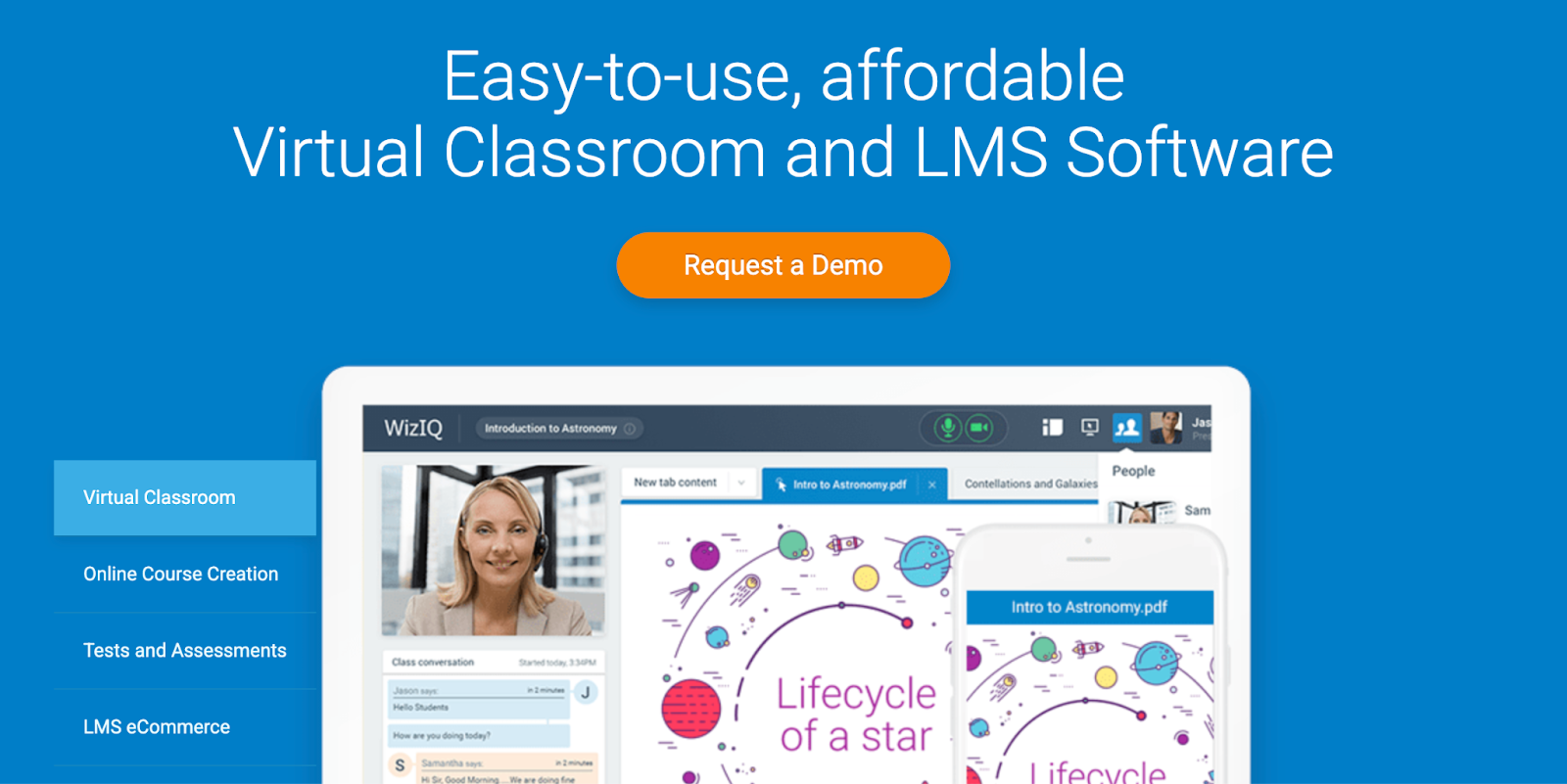
{{trial-component=”/blog-shortcodes/blog-cta”}}

✅ For consultants delivering client training

If you’re building repeatable learning programs for teams or clients, look for platforms that support branded experiences, flexible content, and strong analytics. You may also need white-labeling or compliance tools.

Top picks: TalentLMS, Tovuti, HowToo, Teachable

✅ For businesses with internal training needs

When your focus is onboarding employees or delivering internal skill-building, prioritize tools that support user management, compliance tracking, and integration with HR or CRM systems.

Top picks: Absorb LMS, Docebo, SAP Litmos, Teachable

✅ For academic institutions or nonprofits

If you’re delivering structured programs with institutional oversight, consider platforms that offer advanced grading, academic integrations, or open-source flexibility.

Top picks: Blackboard Learn, MoodleCloud

No matter what stage your business is in, the right LMS should make growth easier—not more complicated. Look for tools that respect your time, help you serve your audience, and allow you to scale with confidence.

🎯 Ready to start building?
{{trial-component=”/blog-shortcodes/blog-cta”}}

 Frequently asked questions about choosing the best LMS software

1. How do I choose the right LMS?

Start by identifying your business goals. Are you selling courses, offering coaching, building a membership, or training a team? Look for an LMS that matches your delivery style and supports the features you need: automation, engagement tools, payment handling, and scalability. Make sure the platform integrates with your existing tools and fits your level of technical comfort. Try a demo or free trial to see how it actually feels to build and teach with it.

2. How much does an LMS cost?

Pricing varies depending on features and scale. Most platforms charge monthly or annual fees, starting around $30 to $100 per month for creators and small teams. Higher-tier plans—especially those with subscriptions, advanced automation, or white-labeling—can range from $200 to $500+ per month. Be sure to factor in transaction fees, add-ons, and any costs for integrations or additional users.

3. What features should I prioritize as a creator or coach?

Look for tools that save time and support growth. This includes an easy course builder, flexible product types (courses, coaching, downloads), mobile-friendly design, and built-in payments. Engagement tools like quizzes and certificates help retain students. Bonus points if the platform handles taxes, payouts, and integrations for you.

4. Can I use an LMS to sell coaching or digital products, not just courses?

Yes. Many LMS platforms, including Teachable, support multiple product formats—like coaching sessions, memberships, and downloadable resources. This flexibility lets you diversify your offerings and increase revenue without switching platforms.

5. Do I need technical skills to use an LMS?

Most modern LMS platforms are no-code or low-code, meaning you can build and launch products without hiring a developer. Choose a platform with drag-and-drop tools, templates, and a straightforward dashboard. If you’re already using tools like email marketing or payment systems, make sure your LMS integrates smoothly with them to avoid extra setup work.

‍

‍

.

‍

‍

‍

How to build a membership site that drives real recurring revenue for your solo business

Software Stack Editor · March 22, 2025 ·

Building a membership website can be a great way to turn your audience into customers and build a recurring revenue stream. But building a successful membership is the kind of project that takes time and continued effort to get right.

Off the bat, you’ll have to decide on your initial membership model and pricing, what kinds of exclusive content you want to provide, and which membership platform to use for your members-only area.

But you’ll also need to think about finding new members, building your landing pages, setting up email marketing, and ways to scale with additional products as your business grows.

In this article we’ll walk you through:

  • The things you need to build a membership site today

  • How you can set up your membership to drive revenue for your business today and in the future

  • Best practices from Podia customers who are building successful businesses around their membership site

By the end of this guide, you’ll have everything you need to get straight to the end goal: recurring revenue and a healthy online business.

Podia is an all-in-one tool where you can build a membership site that’s automatically connected to your website, digital products, blog, email list, and customer data. Start your free trial today.

What you need to build a (profitable) membership site

A lot of people who set up membership sites make the mistake of only focusing on the membership and forget to make a game plan for everything else that goes into it.

You can build the best membership in the world, but if no one finds it, you won’t make any sales. That’s why you also need to think about your website, sales pages, email marketing, and ways to get fresh eyes on your work, in addition to your membership content.

The most successful memberships have a system in place to attract people to the membership long term. This runs on autopilot so you can focus on providing value for your members and enjoying the space you’ve created.

After watching thousands of Podia users set up profitable memberships, here’s a quick rundown of what this system could look like:

  • First, an easy one. Set up your membership area with some great starter content and a community area where your members can connect.

  • Next, build a landing page that you can use to promote your membership to your audience and tell people what to expect.

  • Create a free lead magnet about a topic that’s related to your membership. Share the lead magnet with your audience and throughout your business to grow your email list.

  • As people sign up for your email list via your free lead magnet, run an automated sales funnel where you offer helpful advice and pitch your membership to new subscribers.

  • Finally, as your business grows, consistently add new membership content and create additional products like courses, coaching, and packages to increase sales.

If this sounds like a lot, you’re not alone. But here’s another thing we learned from those thousands of successful Podia customers:

You don’t have to get everything perfect from day one.

Instead, focus on choosing a platform that will help you do all of this when the time is right, without having to switch tools or pay for tons of integrations. (We obviously throw our hand up for that! You can start your 30-day free trial here.)

That way you can experiment and adapt as your business and audience grow, and you won’t be limited in what you can make.

Here’s how to set everything up.

Setting up your membership site and content area

The first thing to do is to set up your actual membership product, including your first few pieces of content. What you make depends on the kind of membership you’re building — some are more content heavy while others are more community focused — but the main thing is that new members should have at least a few things ready for them when they join.

Start by adding 2–3 pieces of content or resources to your membership. These can be courses, downloads, templates, webinars, discussion prompts, or upcoming calendar events that your members get access to.

If you want there to be an interactive community element, seed your community with prompts and insights so newcomers have things to engage with. An “introduce yourself” thread (with your own intro!) is a great place to start.

To get some ideas for your membership, take a look at how these two businesses format their programs:

The Marketing Club membership by Jen and Brittany is geared towards business owners who want help with digital marketing and social media. It includes weekly accountability work sessions, live digital marketing workshops, a monthly content planning party, and quarterly marketing bootcamps.

Members also get access to Jen and Brittany if they have questions and a community of fellow entrepreneurs for collaboration and networking.

The Marketing Club membership

The Legalmiga Library by Taylor M. Tieman, Esq. also has a membership element, but this one focuses more on content. When a small business owner signs up, they get access to a library of resources, workshops, contract templates, and self-study courses for the duration of their membership.

Legalmiga Library membership library card

Whether you decide to lean more toward interactive events or more toward content and resources in your membership, you should also think about how often you’ll add more material, and what your next few posts might be.

You don’t have to make everything just yet, but plan at least the next month of content so you aren’t in a scramble once your membership goes live.

After you’ve added your membership content to your platform of choice, you also need to add your plans and pricing.

To keep it simple, start with just one tier with a monthly or annual payment option. As you go, you can add more tiers with different types of exclusive content if it makes sense to do so.

Create a landing page to convert visitors into customers

Next, your membership needs a sales page. This landing page is likely the first place people will really get the low down on your product, so use the space to tell them what’s included and what they’ll get out of it.

A few things to include on your landing page:

  • A detailed breakdown of what’s included in your membership, and how often new content is added

  • A short about you section so that visitors can learn about who you are and what you do

  • Testimonials from previous customers (If you don’t have this for launch, ask your first few members to share their feedback and add it to your page later)

  • FAQs to address common concerns and give more information

  • If your offer is time-sensitive, you can also embed countdown timers or create seat limits to drive urgency

To get some ideas for your landing page, check out this one by Andrew Lane.

Design Hacker Andrew Lane Sprint

This page is for a 30-day sprint, and he includes his personal background overcoming common issues his target audience is facing, a detailed description of where they’ll be after the sprint, and lots of past client reviews. He’s also embedded a countdown timer in the page to drive urgency.

To set up a landing page like Andrew’s in Podia, head to the help center to see how to customize your product sales pages and embed countdown timers.

Build a sales funnel to reach new members on autopilot

You’ve got your membership and your sales page to promote it, so now let’s connect those pieces with your audience. You can do this through an automated sales funnel, and if you set it up right, this could bring you new members long into the future.

First, create a free lead magnet or resource that you give away in exchange for an email sign up. This can be something like an ebook, checklist, workshop, or quick training video, and you can see a dozen more lead magnet ideas in this article.

To keep things simple, you can even share one piece of content that’s included in your membership to show people what to expect, like a preview. Simple and quick is key here, because when someone opts-in to your freebie, you’ll also automatically get them on your email list.

Then you can run an automated email sequence to nurture that relationship and point people toward your paid membership. Here are some ideas for what you can include, spaced out over a few days so you stay top of mind.

  • Day 0: Welcome new subscribers to your business and remind them where they can access their free resource.

  • Day 1: Share some information about you and the business, including how you got started and your experience overcoming any pain points they might also be experiencing.

  • Day 2: Share a helpful tip, resource, or blog post to give them a quick win.

  • Day 3: Send readers a soft pitch for your membership, letting them know what is included and what other people are saying about it.

  • Day 4: Share another helpful tip, resource, or blog post to continue building trust.

  • Day 5: Give your full sales pitch for joining the membership. (Hint: You can always use the copy from your sales page as a starting point.)

  • Day 10: A few days later, share a reminder only with people who haven’t signed up yet. You can share a coupon or bonus offer if you want to sweeten the deal. (A shameless plug: Podia keeps track of who has what product for you so you can easily message the right people.)

If they don’t purchase after your automated intro sequence, no stress. You’ve still got this person on your email list, and you can continue to share newsletters and other product updates as your business grows. And the more people you have on your list, the more potential customers you’ll have to build your membership.

And speaking of getting more people on your list, don’t forget to share your lead magnet or newsletter sign-up form anywhere you have an audience, like on your social media channels, in your link in bio, in blog posts, and on your website.

Case Study: Building a social media content membership with Brittany Hardy

If you want to see how all this works together, look at how Podia Pro and marketing expert Brittany Hardy set up her social media content membership for a niche industry.

Within the membership, subscribers can get industry-specific social media captions and content for the month, released monthly.

The lead magnet that points them to the membership is one month of social media content done for them. They sign up and are instantly redirected to a landing page that has all 30 days of captions and editable Canva images ready to go.

That page also has a callout that lets them know they can get even more months of content when they join the membership. There’s a link where they can subscribe monthly or annually, right then and there. This is great because if they’re happy with their free sample, there’s very little friction to join the full product.

If they don’t sign up, that’s fine too, because they’re still on the email list. So at the end of each month, Brittany can email everyone who signed up for the freebie but didn’t sign up for the paid membership and let them know that the next month of content is about to be released. If they want access, now’s the time to join.

Scale with new content and products

Once this is moving, you’ve got a solid foundation to regularly bring new customers to your business. But there are a few more things you can do to scale your membership and keep the revenue flowing.

Add new content to your membership often so it becomes more valuable and makes people want to stay subscribed. Also, you can email people who haven’t purchased your membership whenever you add new stuff as a little self-promo-without-feeling-too-salesy option.

Add more products to your business that complement your membership. Could you make a coaching program, or online courses, or a webinar series around the same topic as your membership? If so, that could be a way to get more sales. Not everyone wants to sign up for a recurring subscription, but they might be interested in a one-time workshop or “pick my brain” session, so don’t leave that money on the table.

Add upsells at checkout. An upsell is a product or service that people can get at a discount, but only if they buy it right away when they’re checking out. This is a great way to increase your total order value for each sale you make. (See how to set up upsells for your membership in this help doc.)

Blog about topics related to your membership. What questions come up in your membership again and again? Write public blog posts that address these issues and then link to your lead magnet or paid membership within the blog post content. The more content you can create for your target audience, the more opportunities you have to get them onto your list and into your full business system.

For instance, Thibaut from Guitar Plug and Play writes great blog posts about learning to play guitar and includes this section at the bottom of each article.

Guitar Plug and Play

It has three options for going back to the blog, joining the free course, or signing up for a paid masterclass. This is a great way to make sure anyone who lands on his posts also can get on the email list or even make a purchase.

Learn how to set up your blog step by step in this help doc.

The more great products, blog content, upsells, and membership materials you add, the easier it will be for your ideal customers to find you and enjoy your business.

Case Study: Anatomy of a 6-figure membership business with Rob Williams

Podia Pro and entrepreneur Rob Williams built a six-figure membership business that consistently brings in revenue and new customers.

Robert’s system starts with a landing page-style homepage for his website that clearly explains what people get out of the membership. There’s nothing in the website’s header (to reduce distractions), and he uses a simple layout that clearly outlines the target pain point of his audience.

Robert Williams FOLYO home page

He also has several blog posts that target keywords his ideal audience would be looking for. These articles provide tons of value and answer their questions, while also pointing people to even more value in the paid programs.

Robert Williams FOLYO blog post articles

In the footer of every blog post, Robert includes a free preview of what readers could get in the paid membership, and if someone signs up for the lead magnet, they’ll automatically be added to his email list where he can run automated sales funnels.

Robert Williams FOLYO footer

That simple system is how Robert built a 6-figure membership business.

He says: “Over the years I’ve wasted countless hours designing my website, redesigning it, adding a bunch of useless features… and ultimately ended up ripping it all out. Full disclosure: my website is now generating about $13.75K per month. It really only requires a few pages, and I run no ads or do any social media. It’s really just my website targeting a few high-value keywords that my offering is perfect for.“

How to set up a profitable membership site as a solo business owner

To set up a profitable membership site, you’ll need great membership content (obviously), but in order to get more sales with ease, you should also have:

  • A platform that lets you add all kinds of membership content, products, and posts

  • A customizable landing page where you can share information about your program, testimonials, FAQs, and what your members can expect

  • A sales funnel that takes people from free lead magnet, to email list, to automated email campaign, to paid membership on autopilot

  • A plan to scale with new content, more product types, and blogging to reach even more people and increase your total order value

With these in place, you’ll have the freedom and flexibility to grow your business however you like, all while your membership happily chugs along earning you money.

And if you need a place to house your shiny new membership site, give Podia a try.

Podia has your membership, website, blog, email marketing, digital products, and audience data all in one tool, so you don’t have to make a ton of plugins and integrations talk to each other. You can use Podia free for 30 days, so start your profitable membership business today.

From onboarding to mastery: Crafting a scalable user adoption strategy

Software Stack Editor · March 21, 2025 ·

Are you looking for strategies to improve user engagement from day one? You’re in the right place—this blog post will give you an actionable, effective user adoption plan. User adoption is more than just getting people to sign up. It’s about ensuring they find value in your product and keep using it long-term. A good …

Continue

The post From onboarding to mastery: Crafting a scalable user adoption strategy appeared first on LearnWorlds.

Custom elearning content development for modern training in 2025

Software Stack Editor · March 21, 2025 ·

As I look back on how training evolved, I’m happy to realize that in the end, online training is what you make of it. Through custom learning development, you lead the way toward what online education will look like for you—and for everyone else. Now imagine we’d still be creating one-size-fits-all courses. We’d be stuck …
Continue

The post Custom elearning content development for modern training in 2025 appeared first on LearnWorlds.

How To Presell An Online Course Before You Build It

Software Stack Editor · March 20, 2025 ·

How To Pre-Sell An Online Course Before You Build It

Software Stack Editor · March 20, 2025 ·

image

What if you could launch your course and start earning revenue while building a community of excited learners—all before you ever hit “record” on your first lesson?

More and more creators are turning to pre-selling as a smarter, leaner way to validate their course ideas and generate real income upfront. Instead of spending weeks (or months) building a course that might sell, they’re flipping the script—using surveys, social content, and strategic offers to get paid before they build.

In this guide, we’re breaking down how to pre-sell your course using Teachable.

You’ll hear directly from creators who’ve done it—some making up to $45,000 in pre-sales alone—and we’ll walk you through the exact steps they followed to make it happen.

We’re keeping it real, practical, and packed with takeaways you can start using today.

Let’s dive in.

{{trial-component=”/blog-shortcodes/blog-cta”}}

Why creators are turning to pre-selling online courses

Let’s be honest—depending on brand deals and ad revenue can feel like a rollercoaster. One canceled partnership or slow month, and suddenly your income takes a hit. 

That’s exactly what happened to creator Jack Appleby.

[embedded content]

So he tried something different: he pre-sold a course—and made $45,000 in just 30 days.

Pre-selling gave Jack financial freedom, creative control, and proof that people wanted what he had to teach. That’s the power of selling before you build.

Why pre-selling online courses works:

  • It validates demand before you spend time creating content
  • It generates income upfront to fund production
  • It reduces refund risk (you’re setting expectations early)
  • It builds community and buzz before your course even launches

Action step:

  • Choose a course topic based on your existing content or expertise
  • Set an early-bird timeline and discounted price
  • Offer something extra—like a bonus lesson or live Q&A—to encourage early signups

How to figure out what course to create (without guessing)

Creating a course can feel overwhelming—especially when you’re stuck asking, “What should I even teach?” The good news? You don’t have to guess.

The smartest creators don’t start with a finished product—they start with a conversation.

Jack Appleby, didn’t brainstorm in a vacuum. He went straight to his audience and asked them directly.

[embedded content]

And it worked. By crowdsourcing course ideas from his community, Jack made sure his offer was something people were actually excited to buy.

Here’s how you can do the same:

Ask the right questions: Instead of saying “What should I teach?” focus on questions that reveal real behavior, preferences, and needs.

Think about asking questions such as:

  • What’s your biggest challenge right now in [your niche]?
  • Have you ever purchased an online course before? What made you buy it?
  • What kind of learning format do you prefer—video, PDFs, live sessions?
  • How much time can you realistically commit to learning each week?
  • What price point feels reasonable for a course on this topic?

Make it easy to respond: Use tools your audience is already comfortable with: Instagram polls, LinkedIn surveys, Google Forms, or Typeform. Keep the questions short, focused, and easy to complete in under 5 minutes.

People are more likely to complete your survey if they get something in return. You could offer:

  • A free digital download
  • An exclusive guide or cheat sheet
  • Early access to the course
  • A discount or limited-time bonus

Start spotting patterns: Once your responses start rolling in, look for recurring themes. 

Is everyone struggling with time management? 

Are most people new to your topic? 

Does your audience lean toward self-paced formats over live workshops?

This is where things get exciting—because your course idea starts taking shape based on real data, not assumptions.

Action step:

  • Share it on your most active platforms and email list
  • Offer a simple incentive to encourage responses
  • Block off 30 minutes to analyze the data and sketch out your course outline

How to turn your existing content into a pre-sell-ready course

Creating a course doesn’t have to start with a blank Google Doc. In fact, the course you’re trying to map out might already exist—in your content archive.

If you’ve ever posted a short explainer, a how-to tutorial, or a behind-the-scenes breakdown, guess what? You already have the bones of a great course.

[embedded content]

Jack realized that one of his most popular videos—something he’d already shared publicly—could be reworked into a full, in-depth curriculum. All it took was expanding on what he’d already taught in short form.

Here’s how to reverse-engineer your best content into a course your audience will pay for:

Break it down into modules: Take a single how-to or educational post and split it into 4–5 core sections. Each one can become its own lesson or module inside your course.

Add depth and exercises: What would you really say if you had more than 90 seconds to teach that concept? Use examples, templates, scripts, or assignments to build out the content.

Use Teachable’s draft mode to build as you go: You don’t need to publish all your content right away. You can keep lectures in “Draft” status during the pre-sale period—and add a “Welcome” module to greet early students and set expectations.

Action step:

  • Identify 1–2 high-performing content pieces that could become your course foundation
  • Use those pieces to outline your modules
  • Load the structure into Teachable—even if the content isn’t finished yet

How to sell your course with stories, not hard sales tactics

The biggest misconceptions about selling online courses? 

You need to become a full-time marketer to make it work. Not true.

[embedded content]

Instead of hard-selling, Jack used personal stories—some funny, some emotive, all true—to highlight the value of his course and connect with potential buyers.

Here’s what worked:

  • Sharing a real story about how personal branding got him a $200K job offer
  • Mentioning that former coworkers, friends, and even old teammates were buying his course
  • Telling his audience why he believes in the product, not just what it includes

Most importantly, Jack shared authentic moments that led people to say: “I want that result too.”

Action step:

  • Brainstorm 3–5 short stories tied to your course topic
  • Turn each one into a post, short video, or email
  • Include a link to your course and a reminder of any early-bird offers

You don’t need slick marketing tactics. You need stories your audience will relate to.

Why preselling your online course builds loyal customers

Sure, pre-selling helps you generate income upfront—but the benefits go beyond just making money.

When you invite people into your course early, you’re actively inviting them to build with you. In a very real sense, you’re bringing them behind the scenes into your creative process and allowing them to shape your products with you.

[embedded content]

Customers from your pre-sale period will give you feedback, ask questions, and cheer you on before the course is even live.

What preselling creates:

  • A built-in feedback loop while you’re still building
  • Higher engagement because students are financially (and emotionally) invested
  • Momentum on launch day, with students who feel like insiders

And when you’re using a platform like Teachable, it’s easy to set this up. You can create a private Slack or Discord group for early adopters, send out weekly updates as you build, or even host a live check-in before launch.

Action step:

  • Add a community element to your pre-sale strategy
  • Set expectations for how students can connect or provide input
  • Use feedback from this group to improve your course before it launches

Start pre-selling your course using Teachable

Pre-selling flips the traditional course launch on its head. You don’t need weeks of content ready. You don’t need a massive audience. And you definitely don’t need to do it all alone.

You need a validated idea. A plan. And a willingness to build in public—with your audience right there alongside you.

Begin pre-selling your course and start a new income stream today on Teachable.

{{trial-component=”/blog-shortcodes/blog-cta”}}

How to choose the best learning management software for your business in 2025

Software Stack Editor · March 20, 2025 ·

If you asked me what goes into the perfect learning management software (LMS), I’d say flexibility, scalability, and ease of use. But these are just starting points. In 2025, your company needs an LMS that meets changing training needs, with complete integration into existing tools. Be it training courses for employees, onboarding new hires, or …

Continue

The post How to choose the best learning management software for your business in 2025 appeared first on LearnWorlds.

  • « Go to Previous Page
  • Page 1
  • Interim pages omitted …
  • Page 9
  • Page 10
  • Page 11
  • Page 12
  • Page 13
  • Interim pages omitted …
  • Page 35
  • Go to Next Page »

Get your Software Stack together. softwarestack.tech

Software Stack

© 2024–2025 - Software Stack is a trading name of SouthwestCIO Limited ac ompany registered in England & Wales 11319049

  • Knowledgebase
  • Home
  • About Us
  • Contact Us