• Skip to primary navigation
  • Skip to main content
software stack logo

Software Stack

Get your Software Stack together

  • Knowledgebase
    • All Categories
    • Accounting Software
    • Automation & Workflow Software
    • Customer Relationship Management
    • E-Commerce Shopfronts & Payments
    • Marketing Automation
    • Online Courses & Membership
    • Project Management
    • Surveys & Forms
    • Web Hosting
  • Home
  • About Us
  • Contact Us
  • Show Search
Hide Search

Clickfunnels

7 Proven Retail Sales Strategies For 2024

Software Stack Editor · April 1, 2024 ·

The post 7 Proven Retail Sales Strategies For 2024 appeared first on ClickFunnels.

Want to take your retail business to the next level in2024?

Here are seven proven retail sales strategies that can help you do that:

Table of Contents:
  • #1. Invest in the Quality of Your Perennial Sellers
  • #2. Create Cross-Sells for your Perennial Sellers
  • #3. Create Upsells for Your Perennial Sellers
  • #4. Create Offers for Your Perennial Sellers and Draw Attention to Them
  • #5. Create Seasonal Offers and Draw Attention to Them
  • #6. Train Your Store Employees to Upsell and Cross-Sell at the Cash Register
  • #7. Incentivize Your Store Employees to Proactively Sell Your Products

#1. Invest in the Quality of Your Perennial Sellers

Look at your historical sales data.

What products continue to sell well year after year?

These are your perennial sellers that you should invest in:

  1. Look at the customer feedback on these products.
  2. Do competitive research to see how your products compare to similar products that your rivals offer.
  3. Figure out how to significantly improve the quality of these products while maintaining healthy profit margins. 

If your perennial sellers are significantly better than similar products in other retail stores, your customers will start recommending them to their families, friends, and colleagues all on their own!

Example: Women’s Clothing Store

Let’s say that you have a women’s clothing store that primarily caters to professional women between the ages of 25 and 35.

After looking at the data, you realize that office wear is your best-selling category, with classic pencil skirts and classic shirts being your perennial sellers.  

If you then invest in making your pencil skirts and shirts the best in that price range, that quality increase won’t go unnoticed by your customers.

They will probably start recommending your pencil skirts and shirts to other professional women who work office jobs.

Word-of-mouth, whether negative or positive, tends to snowball, so if you can create the best product in that price range, you will likely see a steady increase in sales over time due to word-of-mouth. 

#2. Create Cross-Sells for your Perennial Sellers

Your perennial sellers are the products that continue to sell well year after year.

It makes sense to take advantage of that sales volume and create cross-sells and upsells for them.

A cross-sell is an offer that is complementary to the offer that the potential customer has already accepted.

McDonald’s famous “Would you like fries with that?” is a classic cross-sell example.

Look at each of your perennial sellers and ask yourself: what products would complement this product?

You may already have products that you can use as cross-sells or you may need to add new products to your inventory specifically for that purpose. 

Example: Shoe Store

Let’s say that you have a shoe store.

Depending on the type of shoes that you sell, you could cross-sell socks, shoe care products, wool felt insoles, and so on. 

For example, if you find out that classic black leather shoes are one of your perennial sellers, you can cross-sell shoe polish designed specifically for black leather shoes.

#3. Create Upsells for Your Perennial Sellers

We also recommend creating upsells for your perennial sellers whenever possible. 

An upsell is an offer that is an upgrade on the offer that the potential customer has already accepted.

McDonald’s infamous “Would you like to supersize that?” is a classic upsell example.

Creating upsells can be trickier than creating cross-sells but here are the three most popular approaches to upselling:

  • Upsell more of that product
  • Upsell a better version of that product
  • Upsell a subscription for that product

Note that you also need to offer a better price relative to what they are getting!

Example: Health and Fitness Store

Let’s say that you have a health and fitness store.

You analyze your historical data and realize that organic acerola cherry vitamin C powder is one of your perennial sellers. 

You can:

  1. Upsell more of it at a better price – Say, if your perennial seller is the 500g package, you can upsell a 1kg package at a better price per kilogram.
  2. Upsell a subscription at a better price – Say, if the perennial seller package should last someone three months assuming that they don’t exceed the recommended dose, you can upsell a quarterly subscription at a better price per kilogram. 

Keep in mind that the better the price per kilogram, the more appealing your upsell is going to be!

#4. Create Offers for Your Perennial Sellers and Draw Attention to Them

You shouldn’t only sell products, you also want to create offers. But what’s the difference between the two?

A product is just that, an item that you sell. Meanwhile, an offer is a solution to a specific problem that is packaged in an appealing way.

So think about common problems that your customers are struggling with and see how you can create solutions for them with offers centered around your perennial sellers.

Once you have an offer, you should display it prominently, draw attention to it with poster stands and pitch it to customers directly when it makes sense. 

Example: Travel Store

Let’s say that you have a travel store. 

Backpacks are your perennial sellers and you cross-sell travel accessories like travel belts, tech tool cases, packing cubes, etc. 

If one of your customer segments is newbie travelers who are preparing for their first big trip and come in to buy a backpack, you can create an offer designed specifically for them.

Consider that they may not be aware that all these travel accessories exist. Say, they may not know what packing cubes are so they are not going to seek them out by themselves. 

You can create an offer that includes your best backpack plus travel accessories and is significantly cheaper than buying all of these items separately.

Then, if you see someone looking at backpacks, you can chat with them to learn what kind of trip they are preparing for.

If it’s their first big trip, you can show them the backpack, explain the value of all these accessories, and pitch them your offer.

#5. Create Seasonal Offers and Draw Attention to Them

You also want to create seasonal offers centered around two types of products:

  1. Seasonal perennial sellers that continue to sell well on a particular season year after year.
  2. Trendy items that are in vogue that season but may go out of fashion next year.

Obviously, investing resources in proven products makes more sense, so you should start with seasonal perennial sellers.

But if there’s some craze sweeping your industry, you can capitalize on it by creating an offer centered around it!

Example: Grocery Stores

Let’s say that you have a grocery store in a country with a cold winter.

Ginger-lemon-honey tea is a perennial seasonal hit in northern latitudes as evidenced by its ubiquity in restaurants and coffee shops. 

You could take advantage of this trend by:

  1. Creating a ginger-lemon-honey tea kit that includes one piece of ginger, one lemon, and a few packets of honey.
  2. Prominently displaying this tea kit at the checkout area and using a poster to draw attention to it. 

There are a lot of people who would love to make ginger-lemon-honey tea at home but when they go to the grocery store after work, they may be too exhausted to look for the ingredients. 

But if you create a tea kit and put it in front of them, they might buy it because it’s so easy: all they need to do is put it in their shopping cart. 

Offers like that can have great profit margins because consumers are willing to pay for convenience!

#6. Train Your Store Employees to Upsell and Cross-Sell at the Cash Register

If you want your store employees to be effective at selling, you need to provide sales training. 

Most importantly, you want to teach them how to upsell and cross-sell customers at the cash register.

Create upsell and cross-sell scripts that your employees can use and then instruct them to use these scripts with every customer who wants to buy one of your perennial sellers.

You also want to teach your store employees to be proactive, chat with customers, figure out what problem they are trying to solve, and then help them find a solution. 

Encourage the floor staff to pitch customers upsells, cross-sells, and special offers but only when that makes sense.

Emphasize that they should always put the customer’s needs first. What would they recommend to a family member or a friend in the same situation?

#7. Incentivize Your Store Employees to Proactively Sell Your Products

Let’s be real:

Trying to sell something to someone can feel really awkward if you are new to it. 

This means that if you tell your store employees to be proactive about selling your products, they will probably avoid it as much as possible.

Sure, they might make some performative effort when they know that you are watching, but they probably won’t go beyond that. Why?

Because there’s nothing in it for them: they get all the downside (awkwardness), you get all the upside (extra revenue).

That’s why it’s so important to not just train but also incentivize your employees to sell your products. 

The exact details will vary from business to business but you want to create a system where you either pay them commissions or set up some sort of revenue share arrangement.

It doesn’t have to be anything crazy but it has to provide an opportunity to make extra money every month on top of their base salary. 

Obviously, you need to watch your margins, so make sure that the math works before you announce this reward system!

Bonus: Create a Loyalty Program With Amazing Perks

Loyalty programs can be a great way to increase sales. But simply having one isn’t enough. You need to make sure that it comes with amazing perks.

Here are some ideas:

  • Reward customers for each purchase with store points or store “money” that they can then use towards future purchases. 
  • Offer exclusive deals to your loyalty program members that are not available to anyone else. 
  • Celebrate your loyalty program members’ birthdays by offering them a free product or a service.
  • Host free events for your loyalty program members. This can mean activities, lectures, Q&A sessions with interesting people, etc.
  • Partner with other businesses to get your loyalty program members better deals. Say, if you run a health and fitness store, you can partner with a local gym so that your loyalty program members could get one month for free.

We also recommend investing in setting up a machine learning-based product recommendation system and integrating it with your email marketing software.

That way, you will be able to automatically send your loyalty program members personalized product recommendations based on their purchase history!

Want to Protect Your Business From the “Retail Apocalypse”?

You have probably heard of the so-called “retail apocalypse” that started in the early 2010s and accelerated during the Covid-19 pandemic. 

Some researchers have called this narrative into question and argued that this phenomenon has been exaggerated. 

However, there’s no denying that consumers are increasingly favoring online shopping over going to brick-and-mortar stores.

The e-commerce share of retail sales has been steadily increasing for well over a decade now and it’s projected to continue to grow in the foreseeable future: 
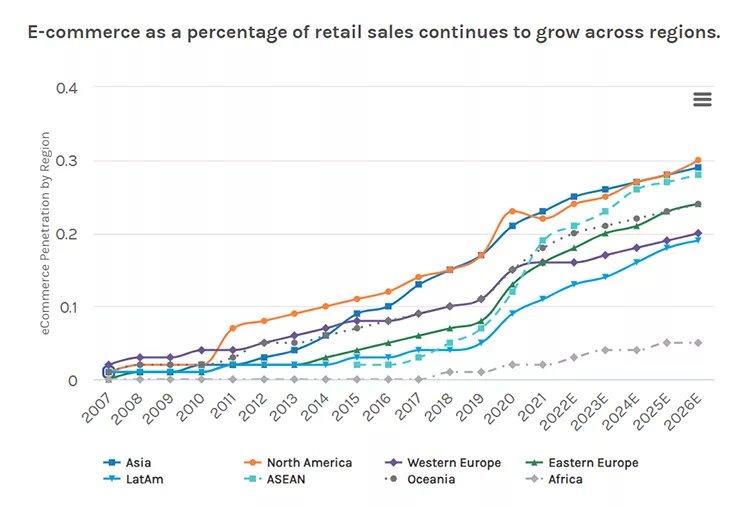
E-commerce as a percentage of retail sales continues to grow across regions, chart.

The reality is that no retail company is safe from the retail apocalypse. So how can you protect yourself from it?

You can do that by building an e-commerce business. That way, should you ever need to close all your brick-and-mortar stores, you will have your online store to fall back on. 

And this probably isn’t news to you. Maybe you already have an online store set up. It’s probably safe to say that at this point, most established retail companies do.

But we have noticed that a lot of those companies aren’t taking the e-commerce side of their businesses as seriously as they should. 

It’s not just about having an online store, it’s about growing it and ideally getting it to the point where its revenue exceeds that of your brick-and-mortar stores. 

But how can you do that?

Grow Your Online Store FAST With Sales Funnels!

Our co-founder Russell Brunson used sales funnels to take ClickFunnels from zero to $100M+ in annual revenue in less than a decade.

He is widely considered to be one of the top sales funnel experts in the world and has taught thousands of entrepreneurs how they can use sales funnels to grow their businesses.

His best-selling book “DotCom Secrets” covers everything you need to know in order to build a sales funnel for your online store. 

You can get this book from Amazon where it currently has over 2,500 customer reviews and a 4.7 star rating. 

Or you can get it directly from us for FREE.

All we ask is that you cover the shipping.

So what are you waiting for? 🧐

@russellbrunson

They say you shouldn’t pick favorites… But this book is my favorite in the secrets trilogy 🙂

♬ original sound – Russell Brunson – Russell Brunson

Get “DotCom Secrets” for FREE!

Thanks for reading 7 Proven Retail Sales Strategies For 2024 which appeared first on ClickFunnels.
53 Marketing Funnel Templates To Grow Your Business Fast

Software Stack Editor · March 28, 2024 ·

The post 53 Marketing Funnel Templates To Grow Your Business Fast appeared first on ClickFunnels.

Business is war. Every day is another battle. Some of those battles lead to victory while others lead to loss and failure. But no one ever said that business would be easy, right? It’s not. It takes hard work. Perseverance. Grit. Tenacity. And an ability to understand how to grow your business fast. After all, money does love speed. So what’s the fastest way to grow your business? Marketing funnels. That’s how.

The right marketing funnel can transform a business overnight. It can take you from defeated and depleted, to battle-ready and victorious. And building marketing funnels isn’t difficult. It’s easy. Especially when you use the right marketing funnel templates combined with a drag-and-drop editor to build your funnels fast.

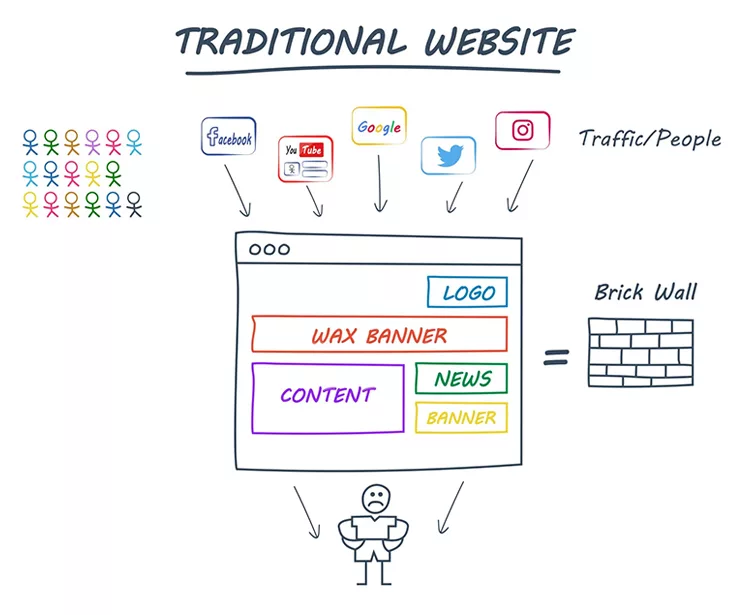
Now, if you don’t know what marketing funnels are, let me back up for a minute. Most businesses have websites. They’re like virtual storefronts filled with nicknacks. Some websites just offer information. Others allow you to buy products or services. Other websites allow you to do all of the above. But marketing funnels are different. And each marketing funnel has a single solitary mission in mind.

Marketing funnels offer a direct approach to lead generation, sales, and conversions. They don’t overwhelm you like websites. And whether you call them marketing funnels, sales funnels, purchase funnels, or customer funnels, they’re all the same thing. They might have different names but they all have one sole directive in mind. That’s it. They don’t confuse you by providing many paths. Instead, they’re direct. To the point. And that’s why marketing funnels convert browsers into buyers like clockwork.

What Are Marketing Funnel Templates?

No matter what business you’re in, marketing funnels offer the path of least resistance. You’re not waging war trying to find new leads or make more sales. Instead, you’re magnetizing prospects and compelling them to come to you. They arrive ready and willing to buy whatever you’re selling. It completely changes the game in business.

The longer you wait to build a marketing funnel, the longer you’ll feel immersed in full-scale war in your business. The best part? Building a marketing funnel isn’t hard. It’s not some complicated feat. It’s not like waging a never-ending battle. That’s because it doesn’t require a computer science degree or advanced web development knowledge. Nope. Not whatsoever. All you need to do is use the right software with the right marketing funnel templates.

All you have to do is pick the objective. Either you need more leads, more sales, or you need to get your customers to spend more money. Once you understand the objective you need, all you have to do is pick the right marketing funnel template for the job. Once you select the right template, just use a simple drag-and-drop editor to add, delete or move elements on the screen. And voila. Your marketing funnel is complete.

Defining Your Approach

The first step is to pick your objective. Most people start out with leads. That’s because every business needs more leads. Leads create customers and generate sales. And if you have no leads then you have no one to sell to. It’s as simple as that. But if lead generation is your objective, you must pick an approach. And there are many approaches to generating leads with marketing funnels. That’s both daunting and exciting at the same time.

Each approach is slightly different because it gives you a different type of lead. Some approaches can generate a lot of leads fast. But those leads might not be high-quality leads. They could just be people wanting freebies or to waste your time. That’s bound to happen. But other approaches create high-quality leads. This exists for every objective across the board. Depending on your approach you will always get a different kind of lead or customer.

This makes sense when we look at funnels in general. After all, funnels are designed to filter prospects down through various stages. During that filtering process, prospects will exit your funnel. In the end, you’ll be left with a small percentage of those who entered at the top of the funnel. For a deeper explanation of how this works, read this.

All of these approaches have one primary fundamental driving force. And that is this concept of reciprocity. All human behavior is based on reciprocity. It’s tit-for-tat. In game theory, that also means that actions are matched with similar actions during all interactions. If someone gives you value, you feel indebted and want to return that value. That’s part of who we are as humans. And it’s the key ingredient that makes marketing funnels so effective.

Lead Generation Marketing Funnels

There are many ways that you can generate leads online. Some of these methods give you low-quality leads. Others result in high-quality leads. That just means there is more intent to buy what you’re selling. If what you’re selling solves a problem they’re experiencing, and they believe that your solution will solve their problem, that’s a high-quality lead. Getting a lead to that point is the goal.

After all, you’re in business to solve problems, right? Your products or services are the solutions to the customer’s problem. That’s the basis for making money. Period. But to get to that point, you need leads who are experiencing those problems. We call these leads problem-aware. In other words, “cold traffic.” Cold traffic is simply the level of awareness that they have in you and what you’re selling.

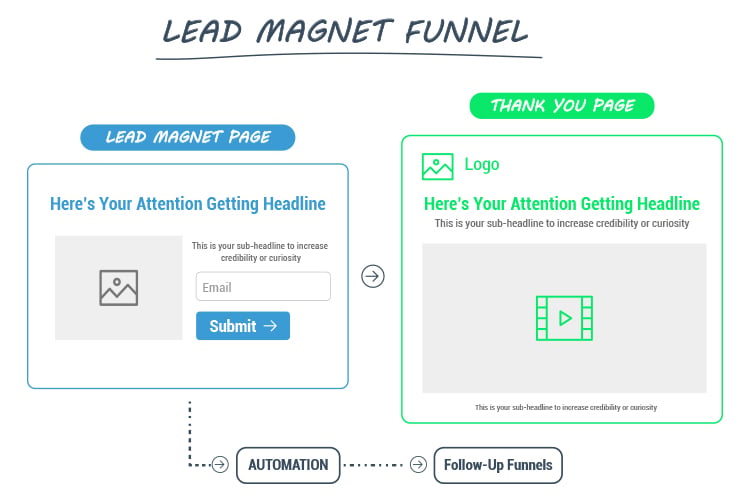
Now, the trick is to learn how to attract a cold-traffic audience to generate high-quality leads. We do this with marketing funnels designed to magnetize and attract leads. How? By creating a lead magnet that helps solve the problem they’re experiencing. Then place that lead magnet inside of a lead generation marketing funnel.

All you need is the right marketing funnel template for the job. This could be a squeeze page funnel, a reverse squeeze page funnel, a bridge funnel, a lead magnet funnel, a survey funnel, an “ask campaign”, and others. Each of these marketing funnels are slightly different. But they’re all designed to help you generate more leads for your business.

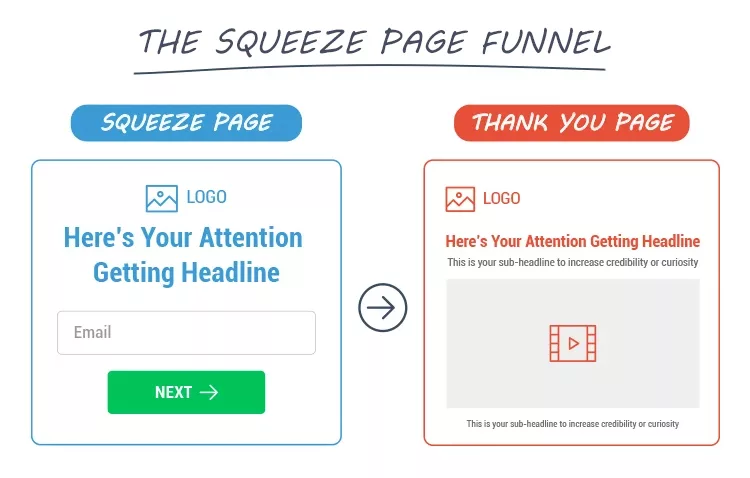
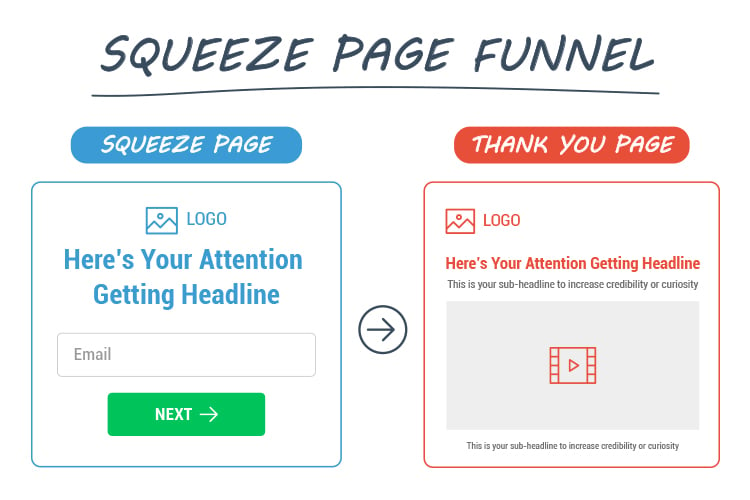
Squeeze Page Funnels

Squeeze pages are one variation of lead generation funnels. They’re designed to squeeze contact details before delivering value. The value can be anything from a lead magnet to a video, a report, or a simple answer to a question. These are typically designed with a great hook (headline) that creates curiosity. Curiosity is what drives people to click and fill out their details.

The first step of the squeeze page is always to have a headline that hooks a prospect in. Typically, the headline has to be compelling enough for them to provide their contact details. We call this headline a hook because it’s designed to hook a prospect just like you would hook a fish. It’s like fishing because that’s what you’re doing. You’re casting out a rod and line, attempting to catch a prospect on your hook.

View Template

Install Template

View Template

Install Template

View Template

Install Template

Reverse Squeeze Page

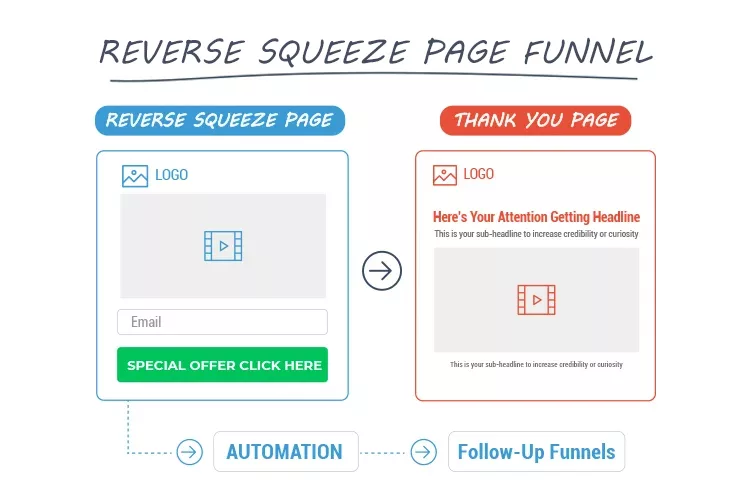
A Reverse Squeeze Page is similar but with a twist. Squeeze page funnels will get you a lot of leads. But those leads might not be quality leads. Sometimes people just want your free offer. And that’s going to happen no matter what. To avoid that, especially if you’re selling high-ticket services or premium products, you should use a Reverse Squeeze Page. These deliver the value first before asking for contact details.

Reverse Squeeze Pages result in a high-quality lead because they deliver value upfront. This creates reciprocity. But it also weeds out people who might not be the right fit for your offer. You can use any of the lead squeeze funnels above and reverse them to create reverse squeeze pages. All you’re doing is loading something valuable at the front such as a video.

Affiliate Marketing Funnel Templates

Bridge funnels are designed to help you generate leads. These are typically used to make money as an affiliate. Affiliates use bridge funnels in affiliate marketing all the time because it helps them collect contact details before forwarding prospects to affiliate offers. Otherwise, blindly sending prospects to affiliate links will not help you grow your business or build an email list.

These bridge funnel templates typically have three steps. The first step is the squeeze page designed to hook a prospect and gain their interest. Once you have their interest you send them to the bridge page where you deliver some value. On the bridge page is the affiliate link that forwards them to the affiliate offer. The affiliate offer is the final step but more happens along the way.

Every successful marketing funnel includes some form of communication. That’s the basis for a marketing funnel. It allows you to communicate with the prospect. This layer of communication is important because it helps you form a bond and build trust with the prospect. You do that by sharing stories, being vulnerable, and delivering value. That’s important to do across the board no matter what type of marketing funnel you’re using.

Affiliate Marketing Funnel Template

Install Template

View Template

Install Template

Install Template

View Template

Install Template

Hero Funnels

Hero funnels allow you to generate leads because they target the traffic you don’t control. Keep in mind that when you run ads you control that traffic. But when someone watches a video you made or visits your social media profiles, you don’t control that traffic. But your goal is to convert the traffic you don’t control into traffic you own. Traffic you own are simply contacts that are now on your email list.

Hero funnels invite a contact into your world. They’re typically found in profile links on social media platforms. They might be the link in your YouTube channel or TikTok profile. They’re all designed to generate leads by providing something of value. They can be structured as squeeze pages or reverse squeeze pages.

Hero Marketing Funnel Template

Install Template

View Template

Install Template

View Template

Install Template

Tripwire Funnels

The concept behind a tripwire is simple. Get the customer to spend a small amount of money with you first. Then, as long as you deliver a lot of value, they’ll be inclined to spend more money with you later. This also follows the Law of Consistency. That states that a person wants to stay consistent with their prior thoughts and behaviors. That’s what makes tripwires so powerful.

In a two-step tripwire, the initial contact details are saved in the first step without leaving the page. On the second step, they enter their payment details. This typically works for low-ticket offers. The best part? Even if they don’t complete the payment step, you’ve now secured their contact details. This allows you to generate a lead in the first step even if the customer leaves before completing their purchase.

Book Funnels

Any free-plus-shipping offer works great with two-step tripwires. Book funnels are a primary example of that. Most savvy entrepreneurs know the power behind the word “free”. That’s why they often give away a book for free, but charge for the shipping. This does two things to hijack the brain. The first is that the word free is a powerful motivator. And you can ethically use it in this instance. That’s because you’re giving the book away for free but charging for the shipping.

The second thing that this does is that it allows you to capitalize on the Law of Consistency. People will always stay aligned with their actions. As long as you blow them away with value at this level, they will gladly ascend and pay you more money for your higher-priced products and services. That’s the way it works.

Install Template

View Template

Install Template

View Template

Install Template

View Template

Cart Funnels

Cart funnels are designed to bring the magic of marketing funnels to a shopping cart experience. But this is no typical shopping cart. And why should it be? Marketing funnels convert at a higher rate than traditional shopping carts. And they ensure to maximize the amount of money that a customer spends. That happens through upsells and downsells. It also happens through one-time offers, order bumps, and more.

Sometimes a cart funnel will display multiple products. Other times it will only display one product. Either way, when you click any of the products, you’re launched into a marketing funnel solely designed to sell you that product and present any upsells and downsells related to it. That makes it powerful because you’re not adding and deleting things from your cart. You’re purchasing one product but are moving through a marketing funnel journey.

View Template

Install Template

View Template

Install Template

View

Install Template

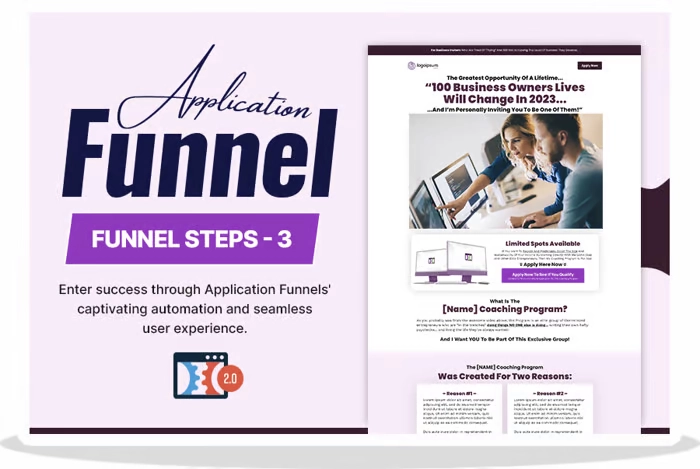
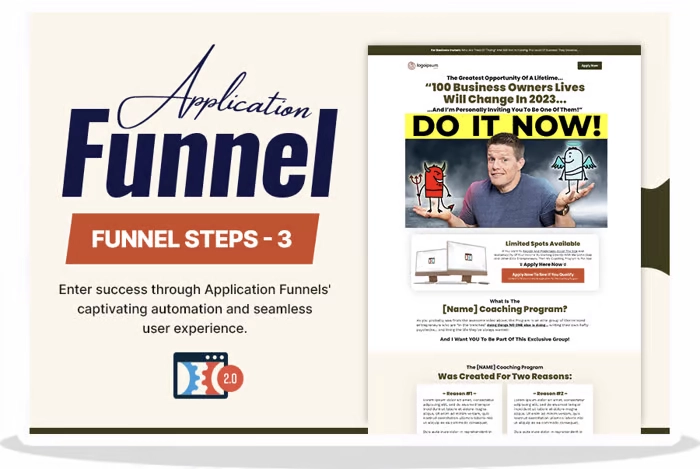
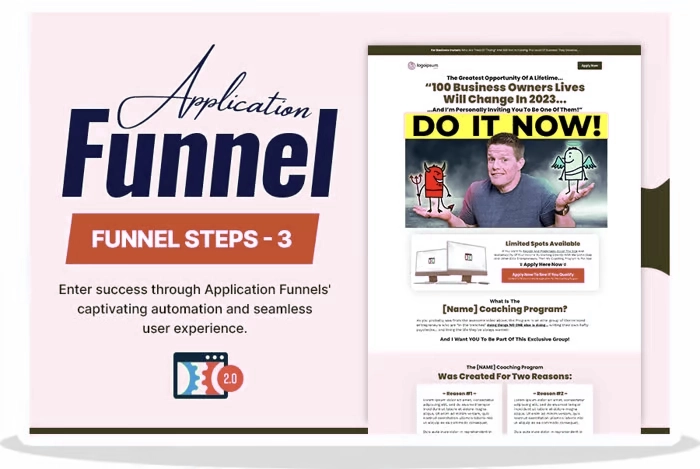
Application Funnels

Application funnels are powerful marketing funnels that allow you to sell high-ticket services and premium products with ease. These marketing funnel templates typically feature a reverse squeeze page at the front. This allows you to generate leads. Once they submit that form they land on an application page. The application page forces a prospect to qualify themselves. They must answer questions to prove they are the right fit for the product or service being offered.

These marketing funnel templates for applications take the guesswork out of narrowing down prospects. That’s because you only have to take an application to the next step when they’re the right fit. You can jump on the call with them only if they fit your criteria. All you need to do is ensure you create the right type of questions in your application.

View Template

Install Template

View Template

Install Template

View Template

Install Template

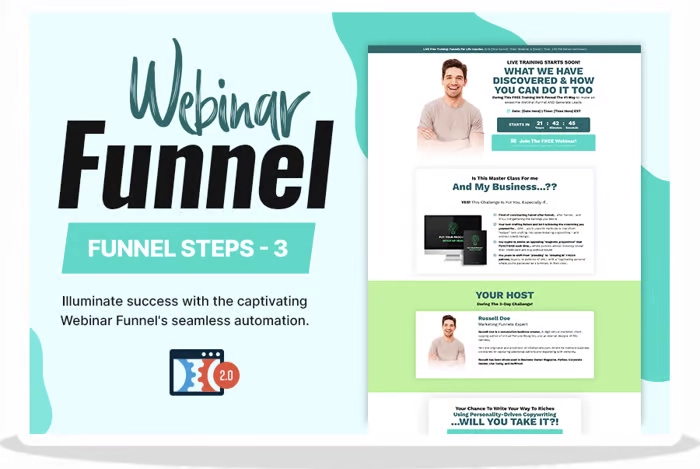
Webinar Marketing Funnel Templates

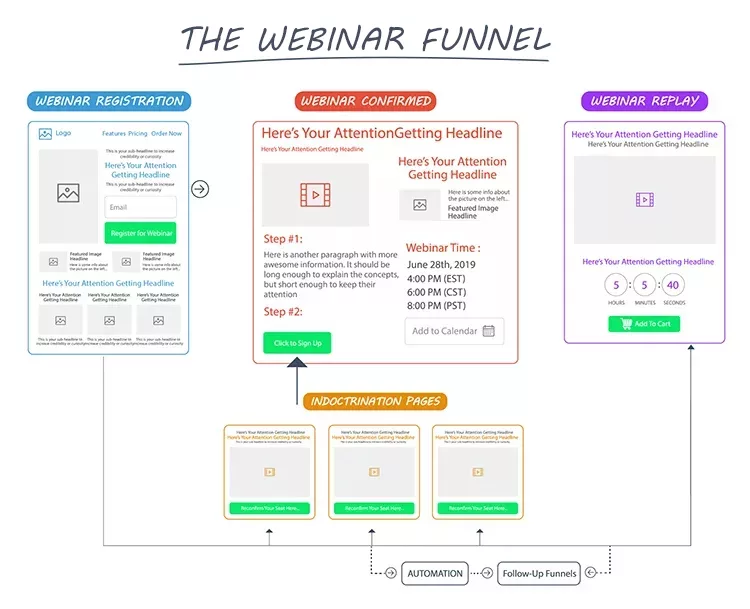
Webinars are presentations used to sell high-ticket products and services. These are typically used to sell coaching, online courses, membership sites, premium product installation, consulting, and more. Webinars are typically 90 minutes or longer. They’re used to transform the limiting beliefs of prospects holding them back from purchasing.

You can set up a webinar using many existing marketing funnel templates to speed up the process. Most of the work is done for you. You can either do a live webinar or an automated webinar. To understand how to structure a webinar the right way then read this book. Webinars are intricate presentations that take a lot of effort to create. But they’re also one of the fastest ways you can grow your business and increase sales overnight.

Install Template

View Template

Install Template

View Template

Install Template

View Template

Video Sales Letters

Video sales letters (VSL) allow you to convey ideas and concepts in long form. When done the right way, these can be powerful sales tools for any business. These marketing funnel templates allow you to quickly launch your VSL to your audience without worrying about all the tech behind it. This makes it easy to change out elements, update text, and ensure that the VSL appeals to your specific audience.

If you have a long-form sales letter already, you can quickly transform it into a video. You can also have both the video and the long-form letter on the page at the same time. This allows you to appeal to both types of audiences. Some like to consume content in video form. So you’ll appeal to those people. Others like to digest content in written form. Having both allows you to appeal to both types of people. And it makes your landing page much more appealing overall.

Install Template

View Template

Install Template

View Template

Install Template

View Template

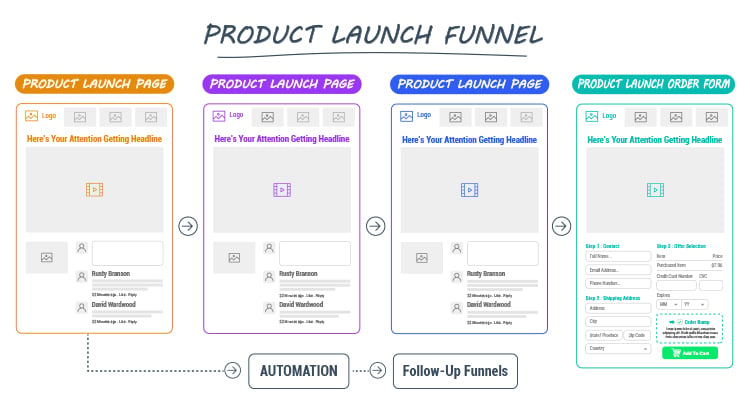
Product Launch Funnels

If you have an existing audience, consider doing a product launch. This funnel type allows you to launch a new product to an existing audience by using a proven formula. The formula is called the Product Launch Formula. It involves daily emails to your audience priming them for the launch. On the final day, you launch the product and use psychological tactics like urgency and scarcity to ensure a high conversion rate.

Urgency means that the offer is only valid for a brief period. And you’ll let the audience know that the cart will only stay open for so long. Scarcity is created if you only allow a certain number of people to purchase your offer. But you must do this authentically or you’ll lose the trust of your audience. Once the cart is closed the offer is complete. This spurs sales because people always want what they can’t have.

View Template

Install Template

View Template

Install Template

View Template

Install Template

Thanks for reading 53 Marketing Funnel Templates To Grow Your Business Fast which appeared first on ClickFunnels.
6 Winning B2B Sales Strategies To Crush It

Software Stack Editor · March 28, 2024 ·

The post 6 Winning B2B Sales Strategies To Crush It appeared first on ClickFunnels.

What do the most successful B2B sales teams all have in common?

If you were to put some of the world’s most successful B2B sales teams under a microscope, it’s probably a lot more than you think.

You’d find that a large portion of their success doesn’t actually revolve around sales, at all.

Instead, it revolves around how you (as the business owner) use marketing to put the right prospects on the tee — so your sales team can bring them into the fold.

And if you’re looking to crush it with your B2B sales strategies, you’re in the right place.

In this guide, we’re going to break down 6 of the strategies that the world’s most successful sales teams all have in common so you, as the business owner, can line them up with hot prospects.

This all starts with the first strategy and how you manage accounts in your market.

Account-Based Marketing (ABM)

If you’re not familiar with the term, Account-Based Marketing means you’re concentrating your efforts on specific target accounts within a market.

Instead of focusing on broad-reaching marketing campaigns that target large groups of potential customers, account-based marketing tailors your marketing message and sales efforts to individual accounts or groups of accounts.

When you take this approach, you’re able to personalize your marketing campaigns, giving you a significantly higher impact.

That means you’re more efficiently utilizing your marketing resources — while getting even better results from each of your campaigns.

To start using an account-based marketing approach, there are a few steps you’ll need to take.

First, you’re going to need to identify high-value accounts.

This can be done by looking at past data and your existing customers.

You can also figure out who these high-value accounts are through comprehensive market research.

The key is to understand who in your market would deliver the highest customer lifetime value (CLV).

Then, once you’ve identified them, you’ll need to start creating a list of stakeholders at those companies.

Identify who the decision makers are, their influencers, and anyone else who might play an active role in the buying process.

Take note of their specific roles, responsibilities, and the pain points that would have them moving closer to working with a company like yours.

Then, once you know who you need to be talking to, the next step is creating custom landing pages dedicated to them.

You can put together landing pages on your website that’s tailored to each specific target account.

These landing pages showcase how your product or service specifically solves the pain points that they’re feeling right now.

When you compare this approach to broad-targeted marketing, you can start to see why it’s as effective as it is.

Instead of hitting the broad market with a broad pain point, hoping that someone with that pain point will raise their hand, you’re getting a lot more targeted with your message.

That increased targeting lets you drive deeper into each of the pain points, getting incredibly specific, letting people know the message is specifically for them — and nobody else.

The next step would be actively reaching out to your target accounts through multiple channels.

Each of the decision-makers you identified in earlier steps can be contacted before they actually see your ads and come into your ecosystem.

You can reach out to them on major social media platforms, like LinkedIn, Instagram, Twitter (X), or even Facebook, or through email to begin the conversation.

You can also put together highly targeted ads or direct mail marketing campaigns to reach out to them.

But getting in touch with them before they see your ads is a great way to begin indoctrinating them into how you can help solve their biggest pain points.

Then, when they start seeing your ads, they’ll be reminded again and again how you can help.

This type of account management is INSANELY effective when done the right way — and when done by the right types of businesses.

It may not necessarily work for all B2B businesses but there are some it’s incredibly effective for.

For businesses, where a single client deal represents significant revenue, using an account-based management approach, works really well.

The personalized approach can increase the likelihood of closing large deals.

For companies that operate in niche markets with a limited number of potential clients, account-based management allows for a deep focus on those few prospects, maximizing chances of success.

It also works amazingly well for B2B tech companies that often sell complex, high-value products or services with long sales cycles.

Think of companies that sell financial services, pharma, or manufacturing-related products.

For these longer sales cycles, account-based management can help shorten the sales cycle by personalizing the approach to each prospect.

When you take this approach, though, you’re able to use marketing to put highly targeted prospects into your sales team’s pipeline — dramatically increasing their close rate (and your revenue).

Educational Selling

Another sales approach you can have your team take is educational selling.

It’s an approach that focuses on providing valuable information, insights, and guidance to potential customers, helping them make informed decisions and solve their problems.

Some of the world’s largest companies take this approach — and it works incredibly well.

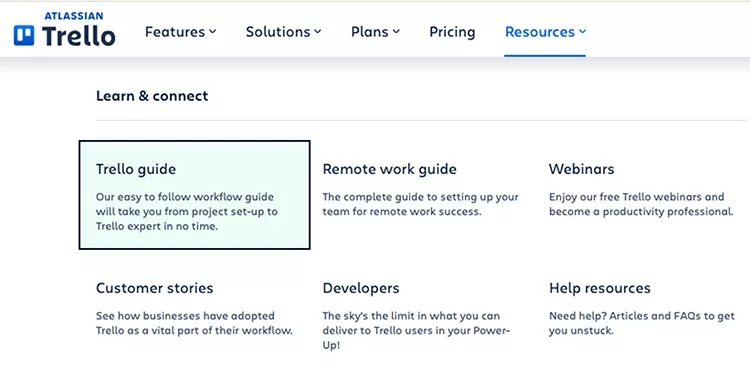
For instance, you’ve probably heard of Trello before.

One of the ways they’ve gained so much market share so quickly is through educational selling.

They know exactly who has a problem that Trello can solve and then market directly to them.

Once that prospect is in their ecosystem, they begin educating the prospect on why the problems exist, what solving the problem looks like (the end result), and how to use Trello to solve it right now.

Take a look at the screenshot below to see what it looks like in action:

Educational Selling, Trello example.

By taking this approach, though, prospects don’t realize they’re actually being sold.

By the time they end up on a sales page or on a sales call, they’ve already made the decision that they want to solve the problems Trello identified — and that they want to use Trello to do it.

They don’t just use their blog and text-based guides to educate people, though.

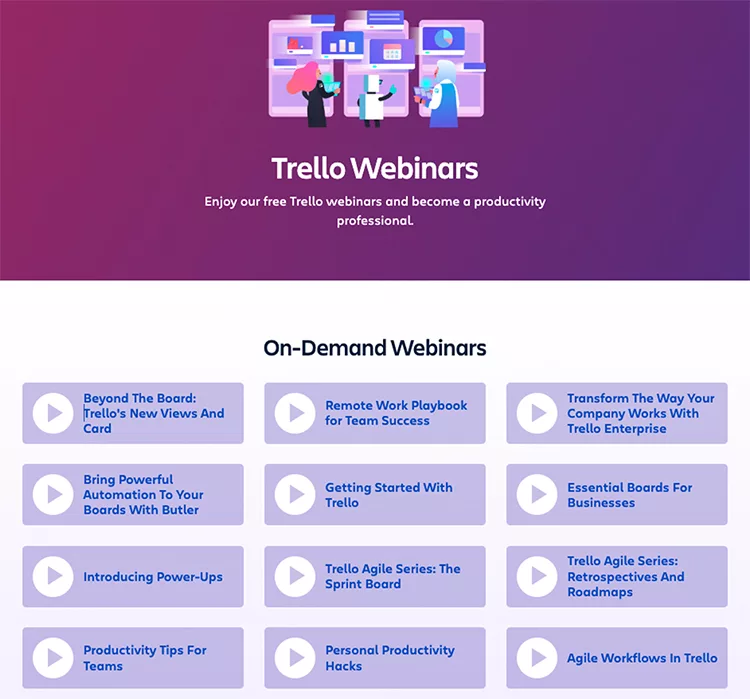
Trello takes it one step further by hosting purely educational webinars, breaking down different features of the software, the problems each of those features solve, and who can benefit most from them.

Each of these pre-recorded webinars can be watched at any time, making it easy for people to get access to the information right away.

Take a look at the webinars they host:

Trello Webinars example.

So while the webinars are purely educational in nature, again, people don’t realize they’re actually making a buying decision.

Trello doesn’t have to “hard sell” them on using the software.

With an educational selling approach, they’re not actually selling.

Instead, the customer is buying.

In your own business, you can take this same approach to help people buy — so your sales teams don’t have to hardcore sell people on the offer.

It makes the entire sales process significantly smoother.

And it scales.

Since people want to feel in control of their decisions and confident in their ability to make the right choices, empowering prospects with knowledge and guidance leans into their psychological needs.

It helps them feel competent in their decision-making and autonomous in their choice to engage with a particular solution or vendor.

When you’re taking this approach, though, you want to focus more on the customer’s journey.

You need to understand your target audience’s unique needs, pain points, and decision-making process.

Map out their journey from awareness to consideration to decision and then create content that addresses their specific questions and concerns at each stage.

Then you can leverage multiple formats and channels, diversifying your education selling efforts by using different media, like blog posts, whitepapers, webinars, podcasts, and video tutorials.

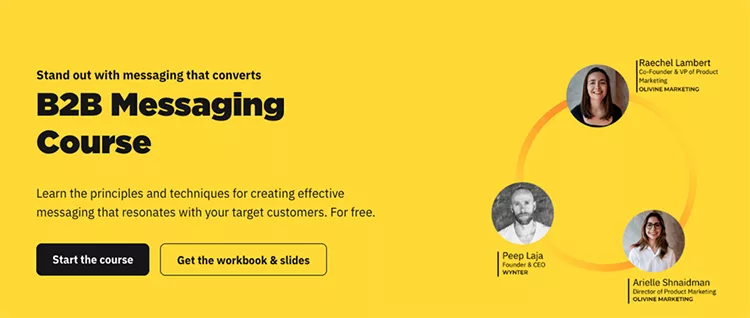
For example, Wynter has so many different formats:

Wynter, B2B messaging course example.

In the example above, they’re offering a full course, workbooks, and slides.

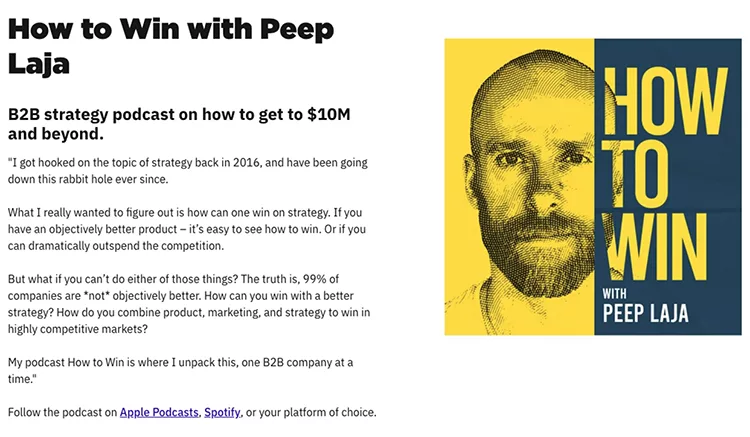
In the example below, they’re offering podcasts.

Wynter, How to win with Peep Laja example.

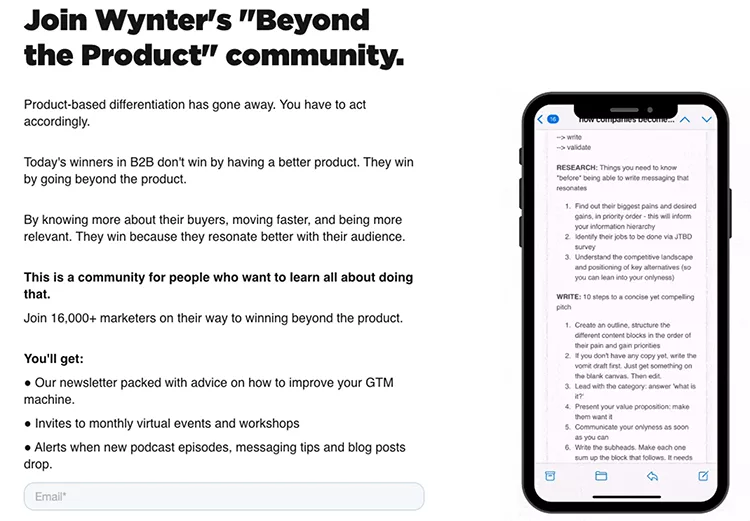
Then, in this example, they offer full community access to potential prospects.

Using an educational selling process can take cold, skeptical prospects and turn them into warm prospects on sales calls, asking the right questions, and making it easier for your team to close.

The key, though, is understanding the pain points your prospects are facing, the questions they’ll ask, the problems they want to solve, and how your specific offer solves those problems for them.

When you’ve mapped that out — and then begin creating content around it — you’ll make your sales team even more effective.

Referral Programs

A strategy that’s incredibly popular with eCommerce companies is a referral program.

It doesn’t just work for those companies, though.

B2B services and companies can also use referral programs to dramatically improve their revenue.

Even though it’s a B2B offer, they’re still humans and the same principles of social proof and trusting recommendations apply to them.

In a B2B setting, though, peer-to-peer conversations can be even more powerful.

When a business owner or executive recommends something to their colleagues or industry contacts, the sales cycle tends to be a lot shorter because the recommendation is personalized.

Think about someone in your close network sharing a post on LinkedIn.

In it, they talk about a problem they were having in their business — one that you’re having right now.

They also talked about stumbling onto a company that helped solve the problem, what it looked like working with them, and what the solution looks (and feels) like after the fact.

If you were facing that same problem, what do you think you would do?

Chances are, you’re going to reach out to them to find out more — or start digging in and searching for the company yourself.

But, by that point, you’re already 80% sold.

The only thing you need to learn, from there, is whether or not they can actually help you solve the problem and if your experience will be similar to the one you saw in the LinkedIn post.

(That’s where educational selling comes in and does the heavy lifting!)

Getting started generating referrals doesn’t have to be rocket science.

You can send an email out to your existing clients right now, asking if they may know anyone who would want an experience similar to theirs.

Here’s a quick template you can use:

Hi [Customer Name],

As one of our most valued customers, your satisfaction is our top priority. We’re thrilled that you’ve had a positive experience with our [product/service] and have seen [specific benefit or metric] as a result.

We would greatly appreciate it if you could refer any colleagues or business contacts who might also benefit from our [product/service]. As a token of our appreciation, we’re offering [incentive] for every successful referral.

If you know someone who could benefit from our [product/service], simply reply to this email with their contact information, and we’ll take care of the rest.

Thank you for your continued support and trust in [Your Company].

Best regards,

[Your Name]

[Your Company]

And that’s it.

But if you want to take this strategy one step further, you’ll also want to build a landing page that makes it even easier to refer people to you.

You can use a tool like ClickFunnels 2.0 to build your landing pages, making it easy to create links that your customers can share — and a page where future customers can get all of the information they’re going to need in order to decide whether or not they want to work with you.

Click here to start your free 14-day ClickFunnels 2.0 trial if you’re not already using it!

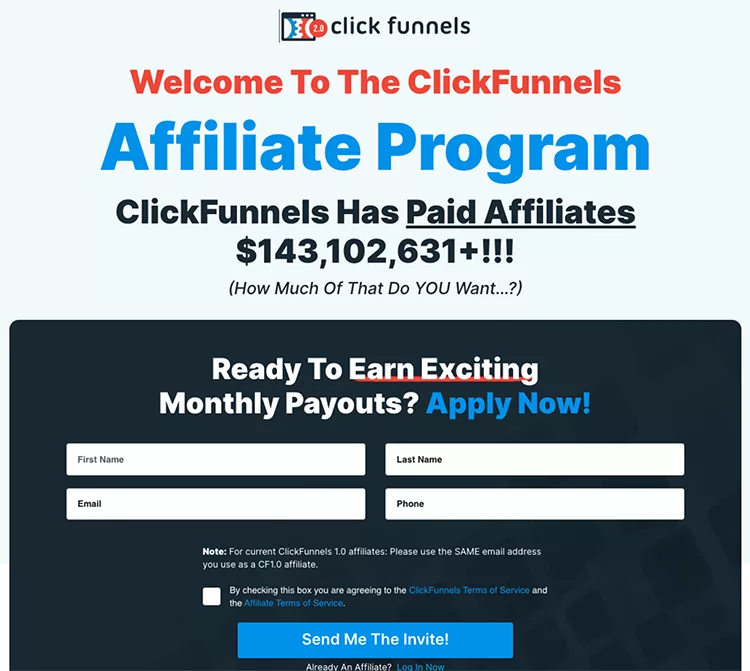
Once you create the page, you can even incentivize people to give you referrals.

Here’s how we do it at ClickFunnels:

Incentivize people to give you referrals, Clickfunnels program affiliate example.

Once you have that in place, you can also do personalized outreach to begin speaking with referrals.

You want to make sure you understand what the prospect is looking to do, whether or not you can help them, and leverage the relationship that you have with the person who referred them.

Here’s a template you can use to start that conversation:

Subject: [Referring Customer] recommended we connect

Hi [Referred Business Contact],

[Referring Customer] mentioned that you might be interested in learning more about our [product/service], which has helped them achieve [specific benefit or metric].

I’d love to schedule a brief call to discuss how we might be able to help [Referred Business] see similar results.

Are you available for a 20-minute introductory call next week?

Best regards,

[Your Name]

[Your Company]

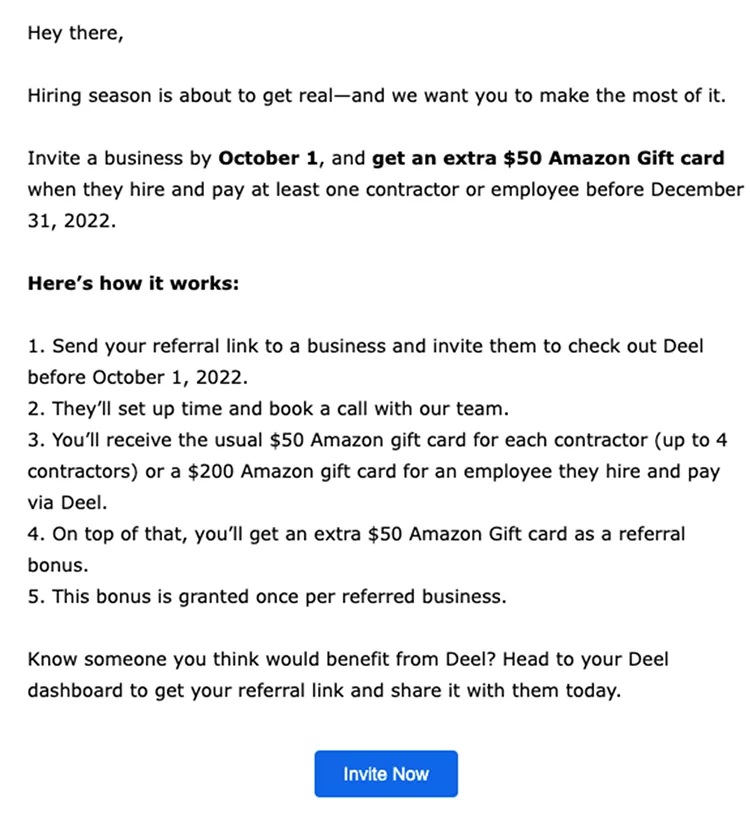
To see what that looks like in motion, check out this example from Deel:

Super simple, but incredibly effective.

Partnership And Collaboration

Establishing strategic partnerships with other businesses and collaborating with key partners can be another great way to grow your B2B sales revenue.

It gives you a relatively smooth way to expand your market, whether that’s regionally or through a specific customer segment.

It also gives you increased credibility by pairing with someone who is already trusted.

Not to mention you can pool together your resources so 1 + 1 actually equals 3.

And when it comes to these partnerships, there are 3 different types you can explore.

1) Reseller Partnerships: One company will sell another company’s products or services to its own customer base, expanding the real sales potential for both parties.

Here’s an example from HubSpot and Sprocket Digital:

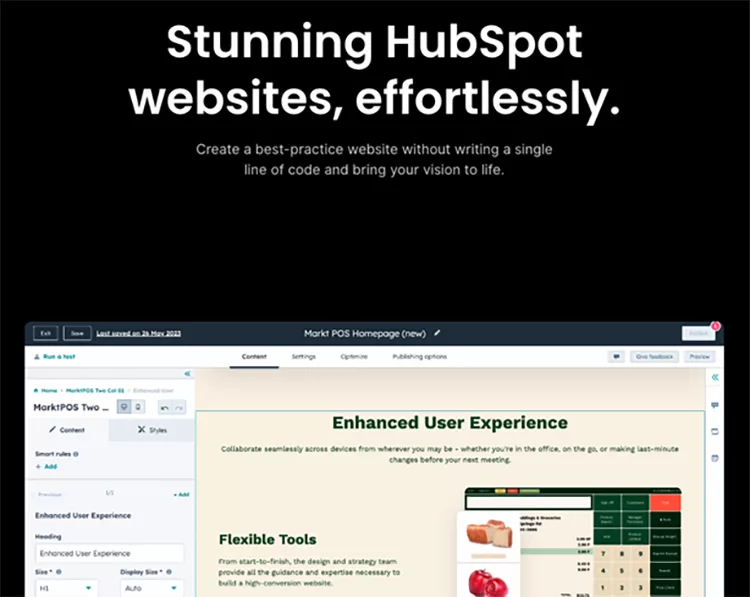
Partnership And Collaboration, Hubspot and Sprocket Digital example.

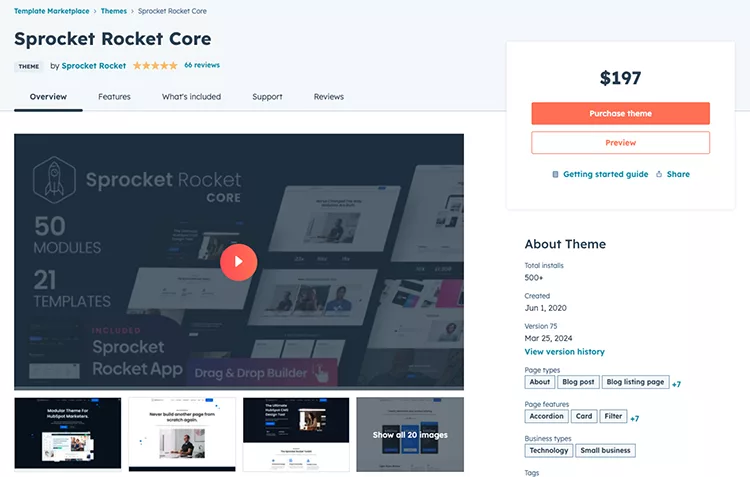
In this example, Sprocket Digital is a digital marketing agency that resells HubSpot’s marketing, sales, and service software to its clients.

They help them implement and optimize their use of the HubSpot platform.

Sprocket Digital is a digital marketing agency that resells HubSpot’s marketing, sales, and service software to its clients, Sprocket Rocket Core package example.

2) Integration Partnerships: Companies collaborate to integrate their products or services, creating a more seamless and valuable experience for their shared customers.

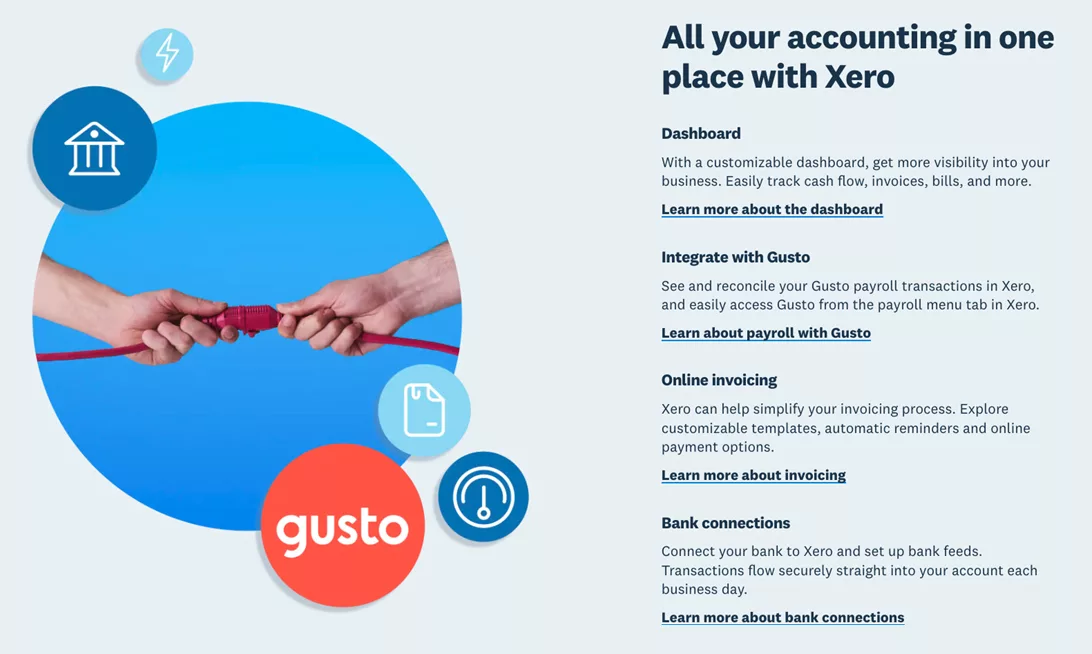
For instance, Xero (an accounting company) partners with Gusto (a payroll company) to benefit both of their audiences.

Xero offers accounting services while Gusto handles payroll.

Integrating together makes Xero’s life easier while generating even more customers for Gusto.

All your accounting in one place with Xero, example. Xero (an accounting company) partners with Gusto (a payroll company) to benefit both of their audiences.

3) Co-Marketing Partnerships: Collaborating on joint venture marketing activities, such as webinars, content creation, or events, can help you reach a wider audience and generate more leads.

For this type of partnership, you can use a tool like ClickFunnels 2.0 to make life easier.

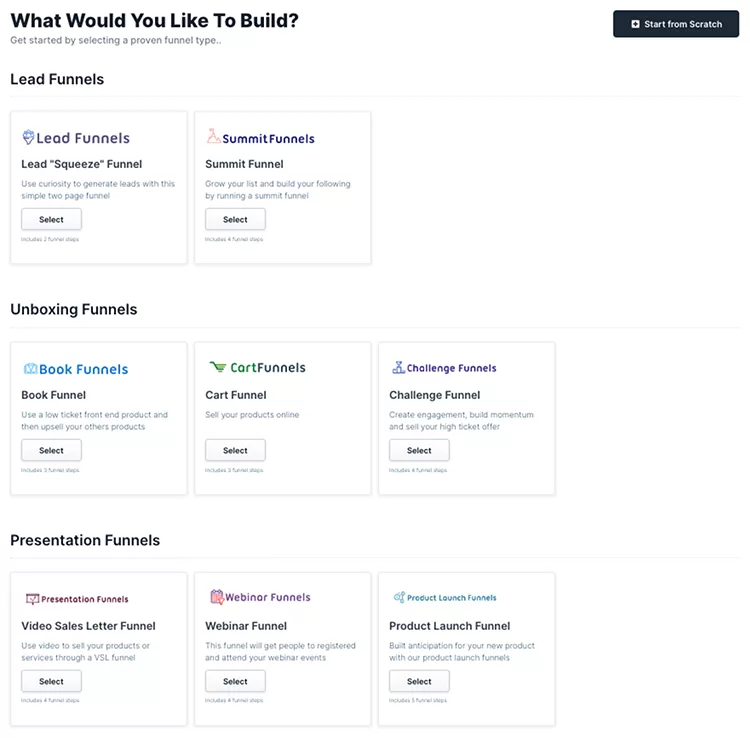
For instance, with ClickFunnels, you can set up the specific funnel you want to JV on and have it up and running in as little as an hour:

Clickfunnels dashboard, What would you like to build example.

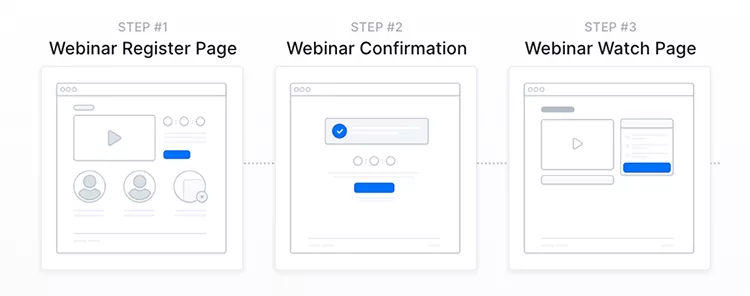
With a webinar collaboration, the funnel is already built, ready for to you plug your assets in:

Clickfunnels webinar collaboration steps, example.

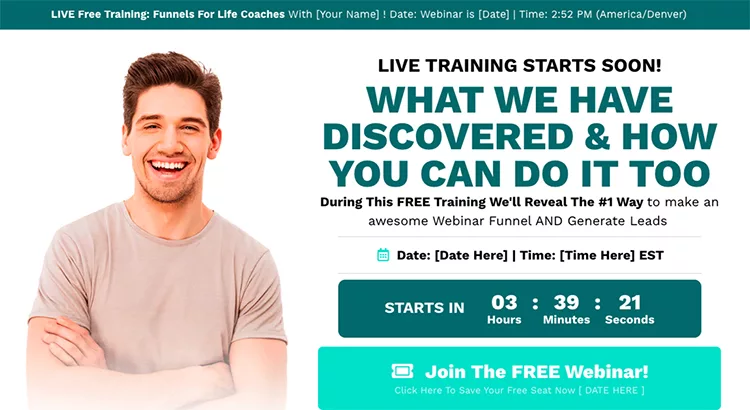
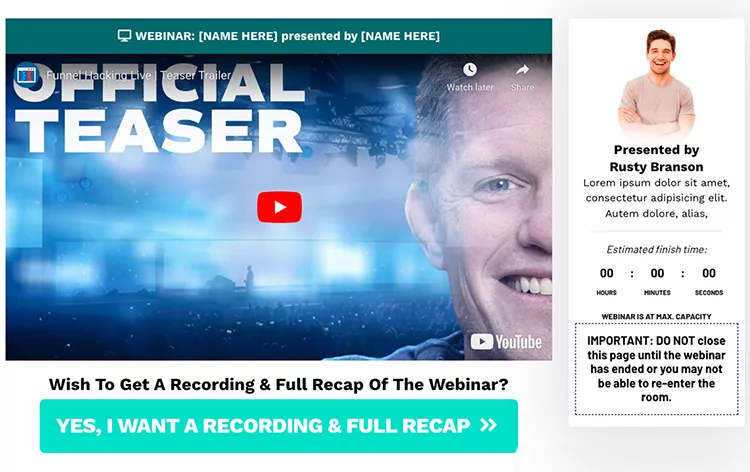
Then, you can announce it to your audiences and start getting people registered:

What we have discovered & how you can do it too, free webinar example.

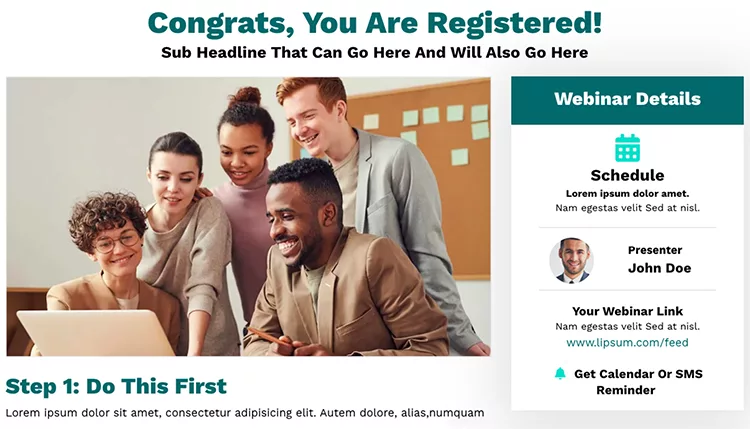
Once they’re registered, they’ll be notified with the details on how to join the webinar while it’s live:

Congrats, you are registered, webinar example.

As the webinar goes live, you can educate your audience on the problems you solve:

You can educate your audience on the problems you solve. Recording & Full Recap webinar options, example.

And this all happens inside of ClickFunnels without needing to hire a developer.

If you aren’t already using ClickFunnels 2.0, click here to start your free 14-day trial now.

To get started with these partnerships, look for companies that offer products or services that aren’t your direct competition.

These partners should target a similar customer base but not cannibalize your own offers.

A great example would be a catering company partnering with an event rental service.

Or a marketing agency partnering with a web development firm.

But these partnerships can help you experience explosive growth because, remember, 1+1 normally equals 2 until you partner and collaborate with complementary companies.

Then 1+1 = 3.

Create An Email Sales Sequence

When you have new leads coming into your ecosystem — before they get to a sales call — you want to make sure you’re taking time to warm them up.

One of the best ways to do this is with an email sequence.

It’s a series of emails that will be sent to new leads and helps educate and indoctrinate them into your specific process.

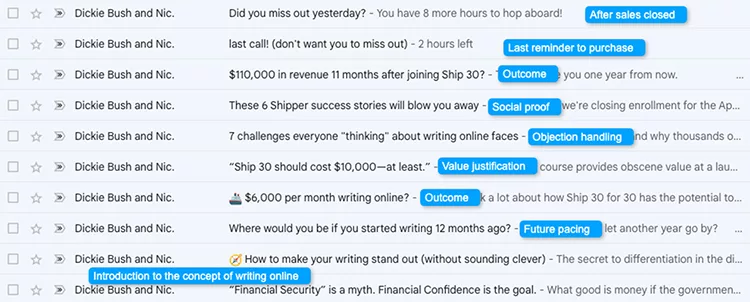
To give you an example, take a look at this sequence from Ship30for30:

Create An Email Sales Sequence

These emails don’t have to be super complicated, either.

If you understand your customer’s journey, the pain points they want to solve, the problems they’re experiencing that cause those pain points, and what they believe the solution should look like, you have everything you need to build a high-converting sequence.

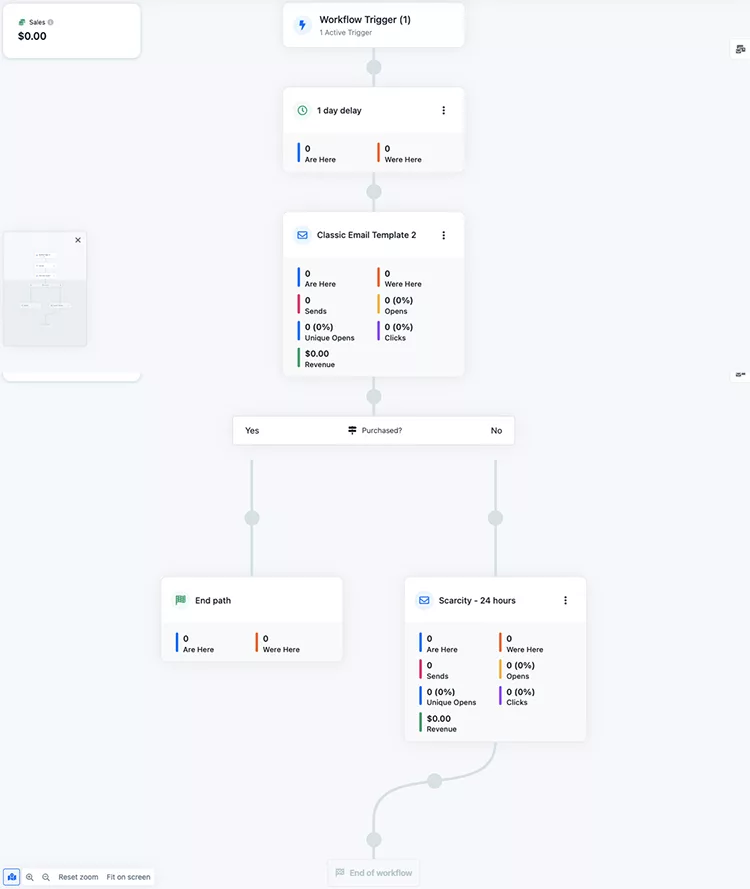
When you’ve mapped this out, you can build the sequence inside ClickFunnels 2.0:

Clickfunnels email automation dashboard, example

Each of the emails inside your workflow will be fully automated based on the rules you set.

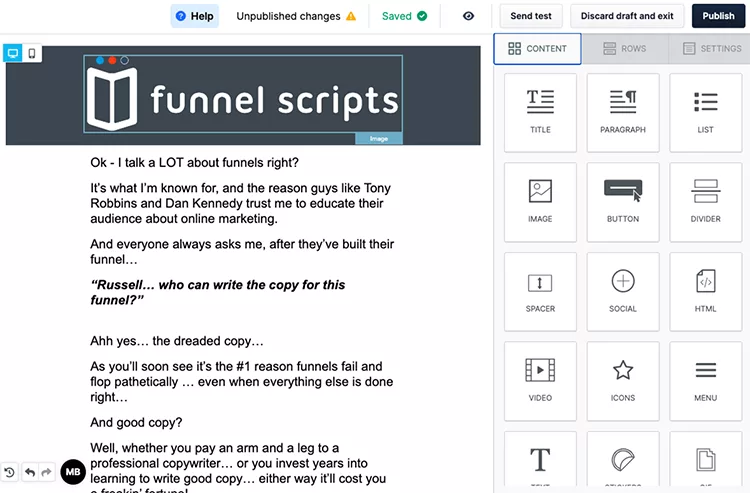
Then you can use the built-in drag-and-drop editor to fully customize each of the emails you send.

Use the built-in drag-and-drop editor to fully customize each of the emails you send. Clickfunnels dashboard, example.

Live Or Recorded Demos

Now, to really seal the deal with your sales team, using live or recorded demos is one of the best ways you can convert a potentially skeptical prospect into a new customer.

Since, a lot of times, people haven’t moved forward because they’re simply unsure of what the process of working together actually looks like.

You can offer live demos where your sales team offers what you do and answers questions.

Or you can use a pre-recorded demo that covers the most commonly answered questions & objections.

Here’s an example of a pre-recorded demo:

Live Or Recorded Demos

Pre-recorded demos work great for driving pre-qualified leads that are ready to buy onto your sales team’s calendars.

However, if they require a bit more personalized approach, using a blend of both pre-recorded and live can be a great way to get deals done.

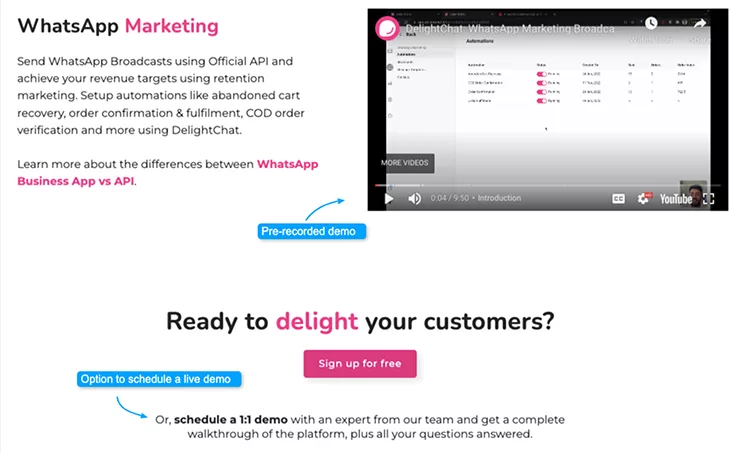
The blended approach is how WhatsApp closes deals:

WhatsApp Marketing ready to delight your customers, example.

They offer a pre-recorded demo and then give people an option to speak to someone on a call in case they have other questions that the demo didn’t cover.

However, if you’re early on in your business development and can’t answer all of your prospect’s questions or handle their objections with a recorded demo, you can offer a live demo.

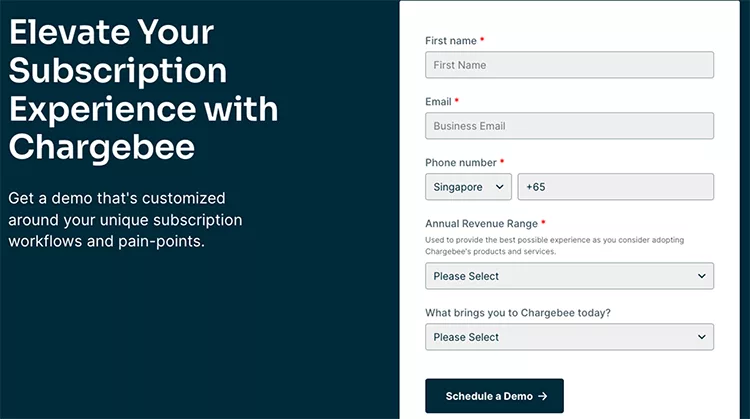
Chargebee relies on live demos to help grow their sales:

Chargebee, live demo example.

And now that you’ve seen these strategies, it’s time to start looking around you.

Think about the world’s biggest (and most successful) sales teams and look into the strategies they’re using.

Chances are, you’re going to see each of the strategies on this list.

This means you’ll want to start actually implementing each of the strategies we’ve just given you.

Start by focusing on account-based marketing and customizing your approach to the market.

Then begin mapping your customer’s journey so you can implement educational selling and automated email sequences that take cold, skeptical leads and convert them into warm prospects on sales calls.

Establish strategic partnerships with the right companies so you can start pooling resources and sharing your audiences.

Then, use ClickFunnels to manage your email marketing and referral program so you’re driving more warm leads into your sales ecosystem with less effort (and less money).

When you do this, your B2B sales strategies will go from struggling to crushing and your sales team will love you for having their calendars packed with customers that are ready to buy right now.

Thanks for reading 6 Winning B2B Sales Strategies To Crush It which appeared first on ClickFunnels.
Write Awesome Copy That Converts – 7 Copywriting Tips For 2024

Software Stack Editor · March 28, 2024 ·

The post Write Awesome Copy That Converts – 7 Copywriting Tips For 2024 appeared first on ClickFunnels.

Want to take your copy to the next level in 2024?

Here are seven copywriting tips that can help you do that…

Table of Contents:
  • #1. Clearly Define Your Target Audience
  • #2. Conduct Extensive Customer Research
  • #3. Focus on a Specific, Achievable Result That You are Confident You Can Deliver
  • #4. Speak to Your Dream Customers In Their Own Language
  • #5. Use This Headline + Subheadline Combo
  • #6. Add More Curiosity to Your Headlines
  • #7. Provide as Much Social Proof as You Can

#1. Clearly Define Your Target Audience

You should start by defining your target audience using the demographic traits of your dream customers. Why?

Because it’s impossible to write persuasive copy if you don’t know who exactly you are trying to persuade to buy your product or service. 

As the saying goes, if you try to appeal to everyone, you’ll end up appealing to no one!

Demographic Traits

Demographic traits are objective facts about your dream customers such as:

  • Sex
  • Age
  • Ethnicity
  • Nationality
  • Education level
  • Occupation
  • Job title

Of course, not all of these traits are going to be relevant to every company.

You need to figure out which demographic traits matter the most in the context of your business. 

The Pareto Principle aka the 80/20 Rule

If you already have an established business, we recommend looking at your historical sales data. Who are the people buying your product?

Ideally, you want to analyze your sales data using the Pareto principle, also known as the 80/20 rule:

“For many outcomes, roughly 80% of consequences come from 20% of causes.”

While the exact ratio may not be 80/20, it’s quite likely that a minority of your customers are generating the majority of your revenue. 

See if you can identify the demographic traits that these lucrative customers have in common and then zero in on this segment in your marketing and sales messaging. 

This can help you increase your revenue by bringing in more of these lucrative customers. 

Of course, if you are just starting out, you may not have enough historical sales data to implement this advice. 

In that case, you will need to make your best guess when defining your target audience. Who is the most likely to benefit from your product or service?

And keep in mind that defining your target audience doesn’t mean that you are banning everyone who doesn’t fit that description from buying your products and services. 

It simply means that you are going to be focusing on that particular demographic in your marketing and sales messaging. 

Everyone else is still welcome to purchase your products and services. So there’s no need to feel guilty about “excluding” anyone!

What if Your Business Serves Several Distinct Customer Segments?

If your business serves several distinct customer segments and there either isn’t one clear “lucrative” segment or you don’t want to niche down to catering exclusively to it, we recommend creating a separate sales funnel for each segment.

Meaning, you should clearly define each segment using its demographic traits, do customer research on it and then create marketing and sales messaging tailored to that segment’s unique needs. 

Say, if you are in a health and fitness niche and your business caters to both sexes, you will almost certainly have better conversions if you create one sales funnel for men and another sales funnel for women instead of having a single sales funnel for everyone. 

#2. Conduct Extensive Customer Research

The better you understand your target audience, the easier it will be to write copy that converts.

That’s why we recommend conducting extensive customer research:

Analyze Customer Feedback

If you have an established business, you have probably received customer feedback in the form of emails, reviews, support tickets, and so on. 

Go through all that feedback and see what you can learn from it. If there’s too much of it for you to read, use a text analytics app to analyze it (more on that later). 

Use Email Marketing to Learn More About Your Dream Customers

Your welcome email provides an opportunity to learn more about your target audience. 

Ask new subscribers what is the biggest challenge that they are currently struggling with and encourage them to respond.

Alternatively, you can send a separate email with that question right after the welcome email and use the subject line “just one quick question…” or something similar.

When a new subscriber responds with an answer about their biggest challenge, make sure to reply to their message and thank them.

If you get the sense that they may be open to telling you more about whatever it is that they are struggling with, you can ask them a follow-up question!

Talk to Your Dream Customers One-on-One

Consider going to events that your dream customers attend and striking up casual conversations with the people there.

Don’t try to sell anything to anyone, simply ask questions and listen to their answers. You might be surprised by how much you can learn when you show interest in what people have to say!

Read Niche Discussion Forums

Niche forums are absolute gold mines for customer research because that’s where people go to ask questions, vent about their struggles, and argue over controversial topics.

You can start with Reddit. Find subreddits related to your niche, sort posts by “Top” and “All Time” and then read through the first page of search results (not just the posts but also the comments). 

Doing that should give you a pretty solid understanding of what problems your dream customers are struggling with, how they feel about those problems and how they are trying to solve them. 

By the way, if you add the word “old” to a subreddit’s address, it will be shown in Reddit’s old user interface, which many people prefer to the new one. 

Say, if you are in the fitness niche and want to check out the main fitness subreddit, you can use either old.reddit.com/r/fitness (old interface) or reddit.com/r/fitness (new interface). 

Facebook is another great place for customer research because no matter what niche you are in, you can probably find a bunch of Facebook communities (“groups”) related to it. 

Unlike Reddit, Facebook requires people to use their real names, which means that joining these communities can also help you better understand the demographic makeup of your target audience. 

Finally, there are also old-school, standalone niche forums. They have been declining in popularity but there still are some popular ones out there.

Follow Niche Influencers on Social Media

Who are your dream customers following on social media?

You should follow the same influencers. It can be a great way to learn what resonates with your target audience.

Popular social media influencers also tend to be thought leaders in their niches so following them can help you stay up to date with the latest trends. 

Keep an Eye on Niche Social Media Hashtags

Once you start following niche influencers, you will see what niche hashtags they are using in their posts. You want to keep an eye on those hashtags. That can provide insight into what your dream customers think about specific topics.

Consume Niche Content

You should be consuming the same niche content that your dream customers are consuming. 

That can mean:

  • Reading niche blogs
  • Listening to niche podcasts
  • Watching niche YouTube and TikTok channels

We recommend also reading the comments.

Also, if there’s a discussion forum associated with a popular niche blog, podcast, or YouTube channel, you want to keep an eye on the conversations happening there as well. 

Say, if a particular podcast that your dream customers are listening to has a subreddit, make sure to check it out. 

Finally, see what books are popular among your dream customers and then read both the books and the Amazon and Goodreads reviews. 

Use Text Analysis

Text analysis is a machine learning technique designed to analyze large quantities of textual data in a short period of time.

You can use text analytics software to uncover insights that you couldn’t get to by just reading stuff.

Say, a good text analytics app can analyze all customer support chats and then summarize that data in a detailed report that highlights the overall emotional sentiment, common words and phrases and so on. 

Isn’t All This a Bit Much?

We understand that this amount of customer research may seem excessive. 

But you need to keep in mind that customer research is the foundation of all effective copywriting.

If you understand your dream customers on a deep level, you will be able to write persuasive copy even if you don’t consider yourself to be much of a copywriter. 

Meanwhile, if you don’t understand your dream customers at all, you won’t be able to write copy that converts. No amount of writing talent or copywriting skill can help in that situation. 

So invest in laying a solid foundation first. Yes, customer research can be tedious, but there’s no way around it. And you’ll see how valuable it is once you start writing copy!

#3. Focus on a Specific, Achievable Result That You are Confident You Can Deliver

If you want your copy to be persuasive, consider promising a specific result that:

  1. Seems achievable to your dream customers
  2. You are confident you can deliver

Example: “$0 to $1K Per Month” Landing Page

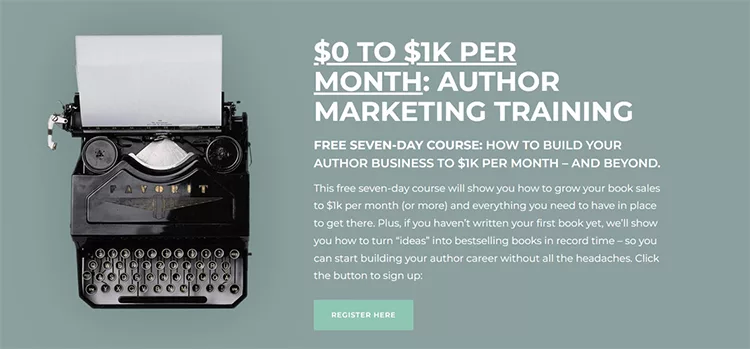
Nick Stephenson, a best-selling author who now teaches other writers how to sell more books, has a free course called “$0 to $1k Per Month: Author Marketing Training”. 

That’s a specific result that looks achievable to amateur writers!

Author Marketing Training, “$0 to $1K Per Month” Landing Page.

#4. Speak to Your Dream Customers In Their Own Language

Doing customer research should help you learn the language of your dream customers: the exact words, phrases, and metaphors they use to express themselves.

When you are writing copy, you want to speak to them in their own language by using the same words, phrases, and metaphors that they use. 

Example: “6 Principles to Learn the Basics of Design” Landing Page

Marketing Examples provides a great example of this approach:

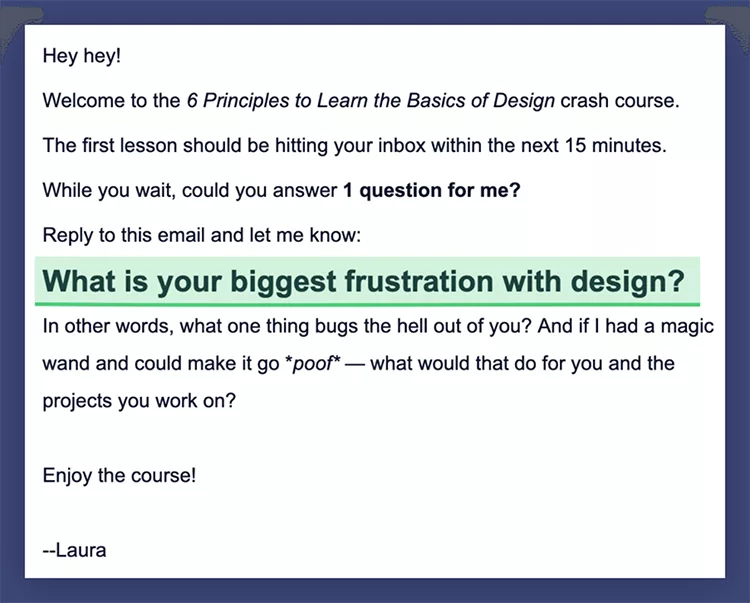
Design Academy asks every new email subscriber what is their biggest frustration with design. Look at the email copy that encourages people to vent. 

“6 Principles to Learn the Basics of Design” Landing Page

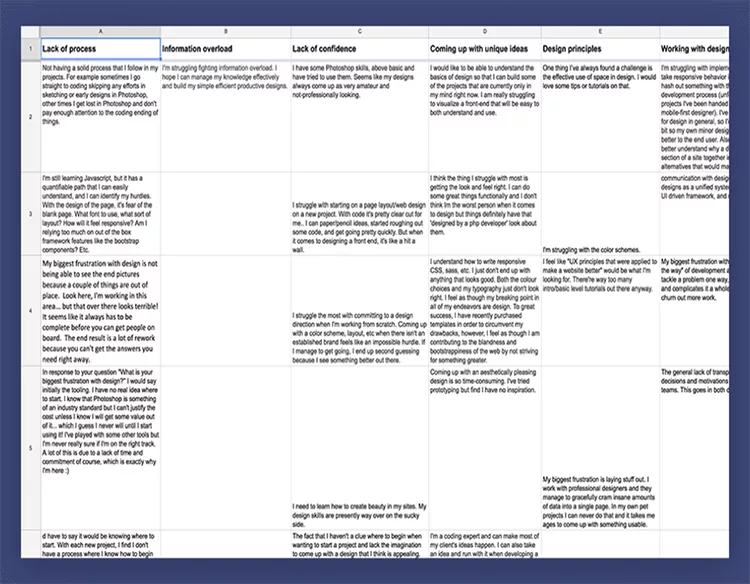
They have a huge Google sheet where they record all responses to that question.

Huge Google sheet where they record all responses to that questions.

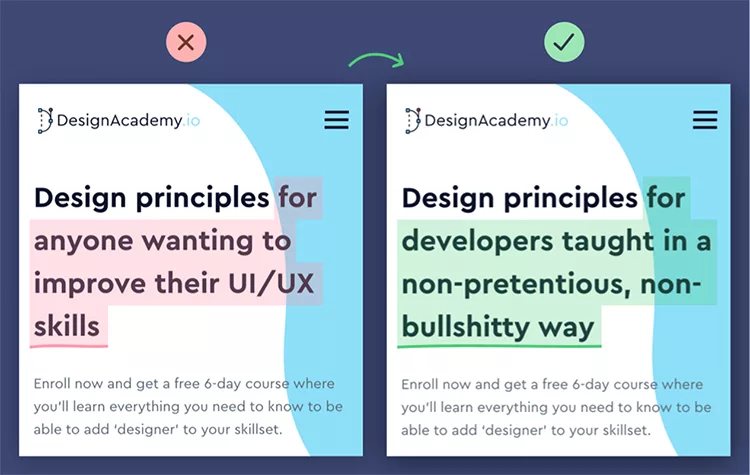
Then they use what they learned to speak to their dream customers in their own language:

Design Academy.io copy examples.

This is what we meant when we said that customer research is the foundation of all effective copywriting.

“Design principles for anyone wanting to improve their UI/UX skills” may seem like a more appropriate headline at first glance.

After all, your high-school English teacher probably wouldn’t appreciate you using words like “non-bullshitty”, especially in the business context. 

But “Design principles for developers taught in a non-pretentious, non-bullshity way” is what resonates with their target audience of developers who want to learn UI/UX design.

If your dream customers complain about your competitors being “pretentious” and “bullshitty”, you should use those exact words in your headline!

#5. Use This Headline + Subheadline Combo

We recommend using this headline + subheadline combo:

  • Headline that emphasizes the main benefit of your offer. 
  • Subheadline that provides more information about your offer. 

If your headline grabs someone’s attention, they will almost certainly read the subheadline as well. 

This gives you an opportunity to convey the most important information about your offer in a matter of seconds!

Example: “Double Your Freelancing Rate” Sales Page

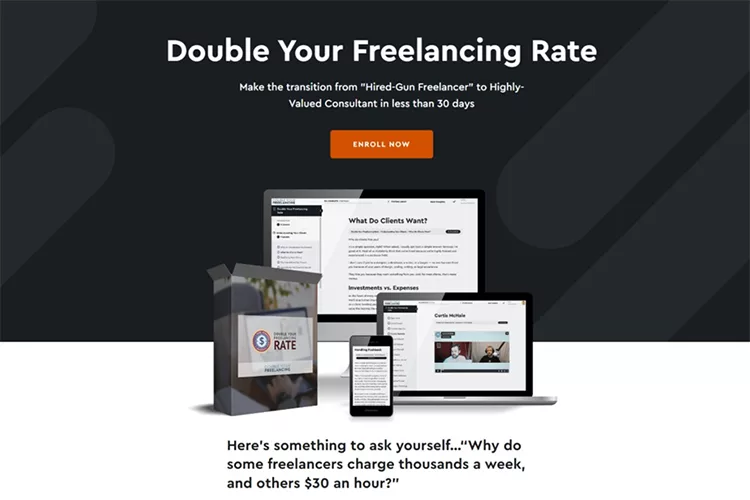
Double Your Freelancing uses this approach on the sales pages of their flagship course, “Double Your Freelancing Rate”.

Headline: “Double Your Freelancing Rate”.

Subheadline: “Make the Transition from the “Hired-Gun Freelancer” to Highly-Valued Consultant in Less Than 30 Days”.

“Double Your Freelancing Rate” Sales Page

#6. Add More Curiosity to Your Headlines

If you teach people how to get a specific result, you should be careful to not give away too much in your headline. Why?

Because if they look at the headline and feel like they already know what you are going to say, they won’t feel the need to check out your offer. 

If your landing page or sales page isn’t converting, find a way to add more curiosity to its headline. It can do wonders for your conversion rate!

Example: Webinar Funnel

Our co-founder Russell Brunson is widely considered to be one of the top sales funnel experts in the world.

Once, a member of his Inner Circle mastermind came to him and asked for help with his webinar funnel. 

Apparently, his cost-per-registration was $24.85, which is insanely expensive. But then only 22.4% of those people would actually show up for the webinar!

Simply put, the math wasn’t working and he didn’t know what to do. 

Russell looked at his webinar registration page and suggested adding more curiosity to the headline.

Here’s the original headline:

“How to Add 6 Figures To Your Web Design Business By Copying My Secret Method For Helping Companies Get More (Real) 5-Star Reviews WITHOUT Selling, Spending Lots of Time or Money”

And here’s the revised headline:

“How I Added 6 Figures to My Web Company By Adding This One Easy to Offer Service THAT DOESN’T Require Cold Calling, Spending Lots of Time, Money or Require Extra Resources”

The key difference between these two headlines is this: the original headline gives away the exact method that he teaches while the revised one doesn’t. 

What were the results?

  1. His cost-per-registration decreased from $24.85 to $5.84
  2. His show-up rate increased from 22.4% to 31.7% 

Pretty crazy considering that this was the only change he made!

#7. Provide as Much Social Proof as You Can

Social proof can be extremely powerful so you want to provide as much of it as you possibly can.

The best social proof is customer testimonials, ideally in the form of email and social media screenshots.

The reason why screenshots work so well is that they look authentic. Remember that testimonials need to not only be real but also look real!

Of course, if you want to use a screenshot of someone’s email message or a social media post as a testimonial, you need to get their permission first.

Video testimonials can also work really well, though it may be harder to obtain them as producing them requires some effort on the part of the customer.

Example: ShipFast Sales Page

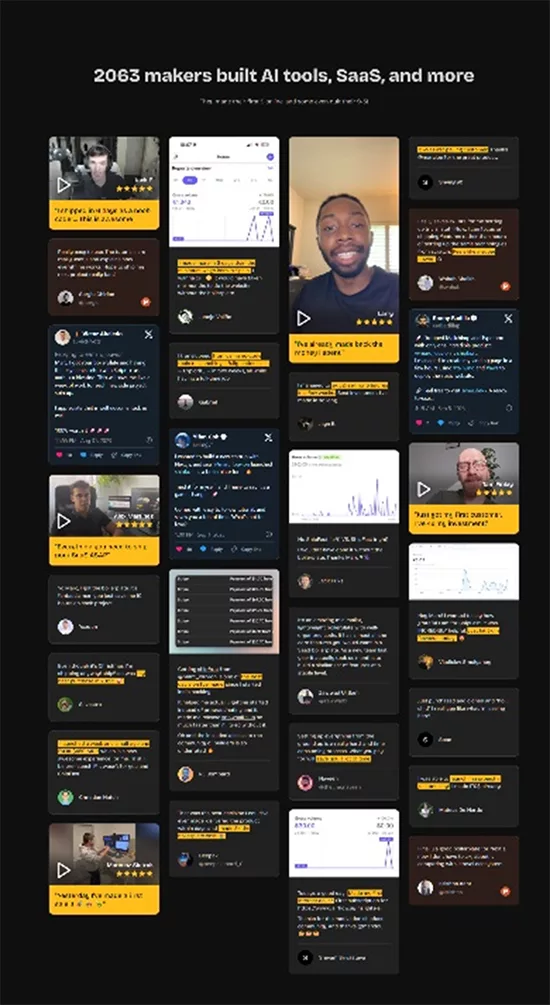
Marc Lou features a ton of social proof on his ShipFast sales page. Note how authentic all these testimonials look!

ShipFast Sales Page

Want to Learn How to Write Copy That CONVERTS?

You can have a great product but if you can’t convey its value to your target audience, you will lose out to competitors with inferior products but better copy.

That’s why if you are serious about building a business, you need to learn copywriting. 

In fact, we would argue that it’s the single most important entrepreneurial skill.

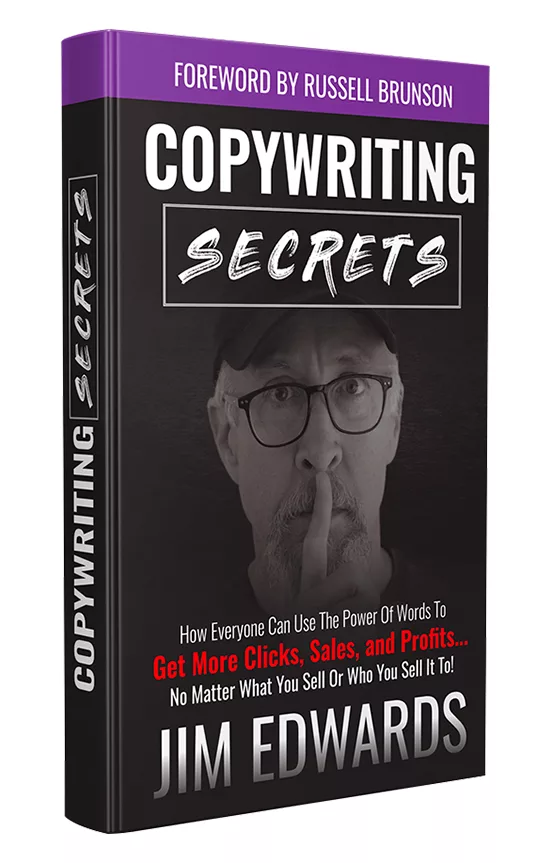
Our friend Jim Edwards, who is a world-class copywriter and the person that our co-founder Russell goes to for copywriting advice, wrote a book for busy entrepreneurs just like you.

“Copywriting Secrets” covers everything you need to know in order to start writing copy that converts. 

This book is available on Amazon where it has over 1,800 reviews and a 4.7 star rating.

But you can also get a copy directly from Jim for FREE.

All he asks is that you cover the shipping!

“Copywriting Secrets” Book

Get “Copywriting Secrets” for FREE!

Thanks for reading Write Awesome Copy That Converts – 7 Copywriting Tips For 2024 which appeared first on ClickFunnels.
6 Game-Changing Restaurant Marketing Strategies

Software Stack Editor · March 27, 2024 ·

The post 6 Game-Changing Restaurant Marketing Strategies appeared first on ClickFunnels.

Keeping your restaurant packed even when it’s not a Friday or Saturday doesn’t have to feel like you’re rolling a boulder up a hill.

With the right marketing strategies, you can keep your tables full, and servers busy, and keep your happy customers coming back for more.

When done properly, you can even get them to refer your restaurant to other people.

If you’re looking for ways to get more people to come to your restaurant, you’re in the right place.

In this guide, we’re going to break down 6 game-changing restaurant marketing strategies that keep you from wasting time, money, and energy filling your tables.

By the time you’re done reading, you’ll know exactly what to do right now to start laying the foundation for month-over-month growth in your restaurant.

And it all starts with making sure you’re showing up where people are looking for you.

Create a ‘Google My Business’ Listing

Right now, when someone’s in the mood to go out to a new restaurant, one of the first things they’re going to do is search for “restaurants near me” in Google.

If you’re not showing up in these search results, it’s near impossible to get those people sitting down at one of your tables.

These search results are generated from restaurants who have a Google My Business listing.

If you aren’t familiar with what Google My Business is, it’s a free tool you can use to manage your online presence on Google — helping their algorithm make it easy for you to show up in the search results.

When you set up your Google My Business listing, you can increase your visibility on both Google Search and Google Maps.

This helps you connect with more people in your area.

When someone searches for “restaurant near me”, it’s a hyper-targeted search that lets you know they’re specifically looking for a business like yours.

On top of being more visible, a Google My Business listing also gives you a chance to start collecting more reviews — which leads to even more people seeing your listing.

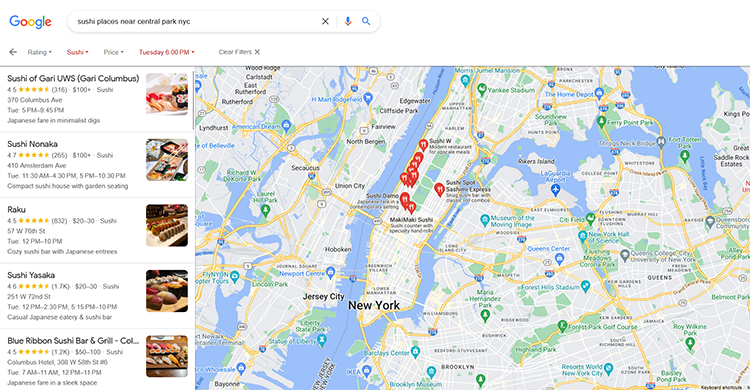
Here’s an example of what a search that contains Google My Business listings looks like:

Screenshot of a Google Maps search for sushi places near Central Park, NYC. List on the left shows 5 sushi restaurants, map on the right has red pins for sushi locations. Central Park is visible in the center.

You can see, if someone is looking for a sushi place near them and you haven’t already created your listing, you’re missing out on a huge opportunity.

If you haven’t already created your Google My Business listing, you can get started now by going to https://www.google.com/business.

Once you’ve created your listing, the next step will be to optimize it so that it appears in the searches you want it to appear in.

That means you’ll need to fully fill out your profile, including everything from your contact details, hours of operation, location, what you serve, pricing, etc.

You’re also going to want to include photos of what you serve.

(Remember, we eat with our eyes first!)

Include photos of the ambiance of your restaurant as another way to grab attention when you’re showing up in the search results.

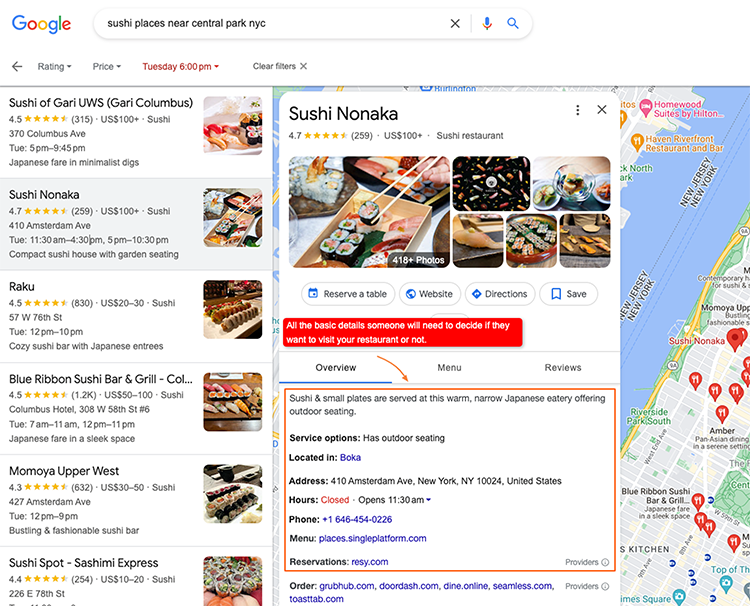
When you do it right, your listings will be full-featured and give your potential visitors everything they need to decide whether or not they want to visit your restaurant.

Here’s what a full-featured Google My Business listing looks like:

After you’ve set up your listing, the next step is to start encouraging your patrons to leave a review.

These reviews can help your listing appear higher in the search results.

As you start getting reviews, you also need to make sure you’re responding to each and every one of them, ESPECIALLY if they’re negative reviews.

When you start doing this, it will pad out your listing, give the algorithm more insight into what you do and who you serve, and give potential patrons a way to check you out before they visit.

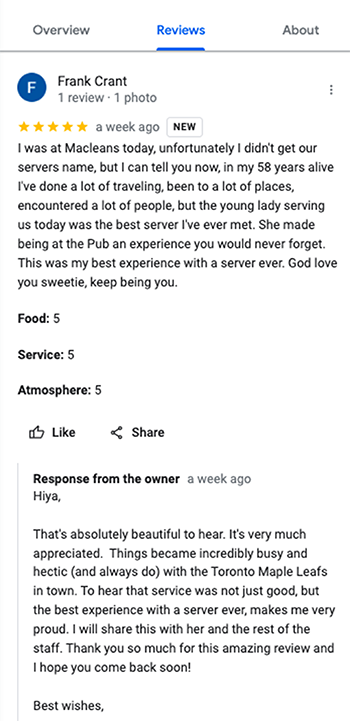
Here’s what these reviews look like on your listing:

Screenshot of a 5-star Google review by Frank Crant, praising a server named Maggie's service at Macleans. The review rates Food, Service, and Atmosphere all 5 stars, with a reply from the owner expressing gratitude.

Don’t make the same mistake that most restaurant owners make with their negative reviews.

Respond to all of them so future patrons can see how you handled the situation.

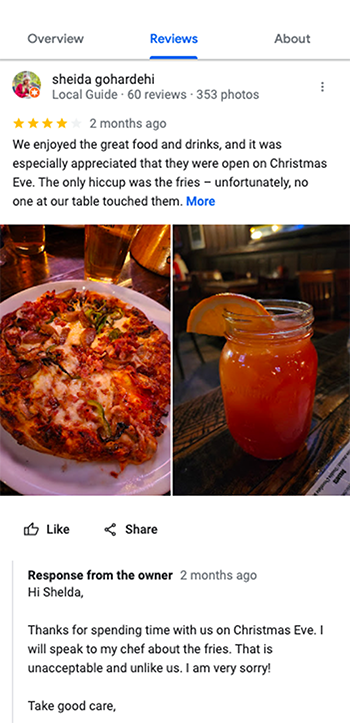
Here’s an example of a great response to a negative review:

A user review shows a pizza, fries, and a drink. Text indicates the food was enjoyed, with a comment on untouched fries. Business owner responds, apologizing for the issue with the fries.

If future patrons see that you respond positively to negative reviews, the chances of them visiting your restaurant dramatically improve.

The key to utilizing your Google My Business listing revolves around these reviews.

When patrons are in your restaurant, you want to encourage them to leave a review letting people know how their visit went.

You can do this by putting QR scan codes on your receipt or incentivizing their participation with a discount during their next visit.

Your focus should definitely be on getting creative with how you go about obtaining reviews — and how you go about responding to them when you get them.

As a general rule of thumb, there’s two factors that determine how high you rank in the Google My Business search results: how close you are to the person and how many reviews you have.

When you’re closer to where the person is searching, you tend to rank higher for them.

However, when you have more reviews than your competition, you can push them down in the search results, making sure that you’re the top listing.

Collaborate With Local Influencers

Another great way to drive more business into your restaurant is through collaborating with local influencers.

These influencers can help spread the word about how amazing your food is and how great your ambiance is — essentially making you a local “must-visit” restaurant.

Becoming well-known in your local area is one of the easiest ways to ensure your long-term success.

If you aren’t familiar with influencer marketing, it’s a partnership or collaboration between your restaurant and popular social media personalities, where they’ll promote your business.

In exchange for this promotion, they’ll typically require payment of some sort.

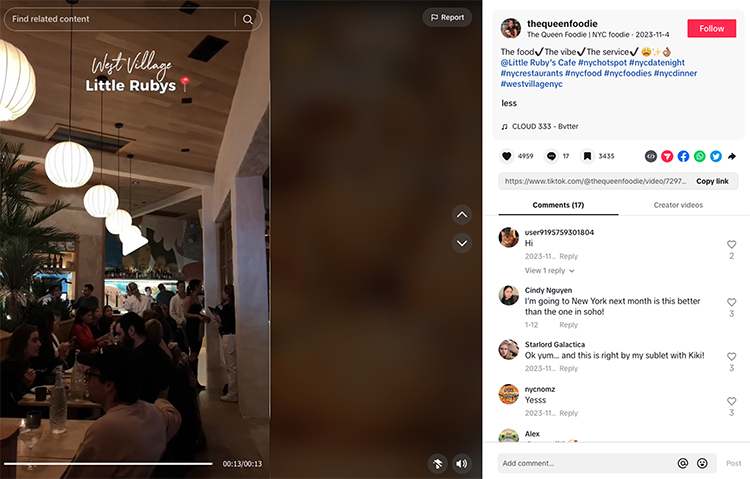
Here’s an example of a collaboration between an influencer and a restaurant:

A crowded and lively restaurant with people dining at tables and sitting at a bar. The image is from a social media post highlighting Little Ruby's in West Village as a recommended food spot.

Collaborating with influencers can be incredibly effective at helping grow your restaurant.

They already have a built-in audience that may be interested in visiting your business, which gives you instant access to a wider audience as quickly as possible.

With recommendations, though, with the added visibility you also get increased credibility.

Think about what happens when you ask someone for a recommendation.

You tend to trust it, right?

With these collaborations — and the recommendations you receive — the influencer’s audience will inherently trust the recommendation being made to them.

Then, as a bit of icing on the cake, you get new content you can use on your own social media pages.

And it all starts with finding influencers who may be open to promoting your restaurant.

To get started, you’ll want to do a search on your favorite social media platforms using keywords or hashtags you think they’ll use to describe restaurants like yours.

Many times, you’ll find that they’ve already done collaborations with other restaurant owners.

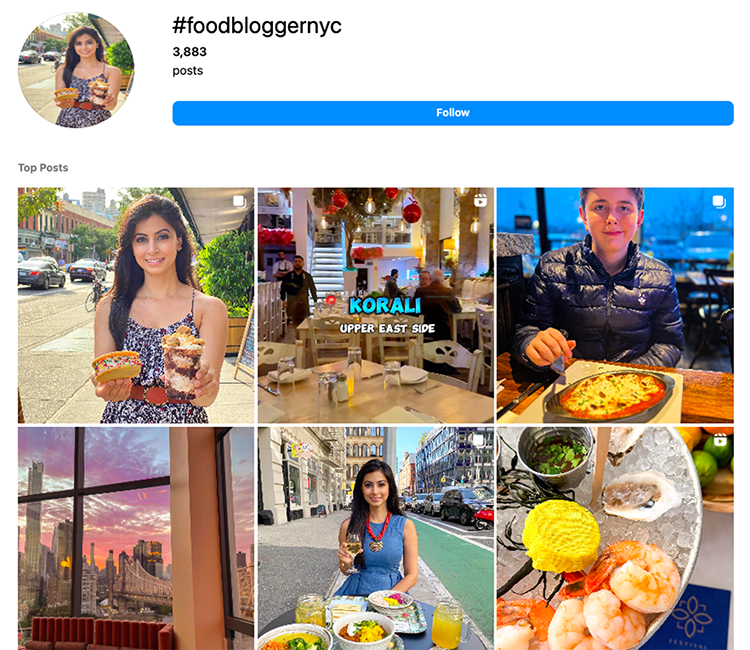
Here’s an example from the “#foodbloggernyc” search on Instagram:

A collage of food blogger photos shows meals in restaurants, scenic views, and the blogger posing with food.

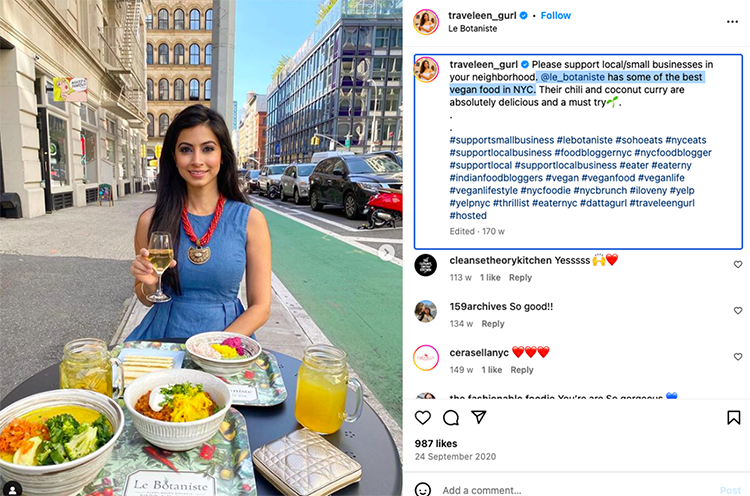
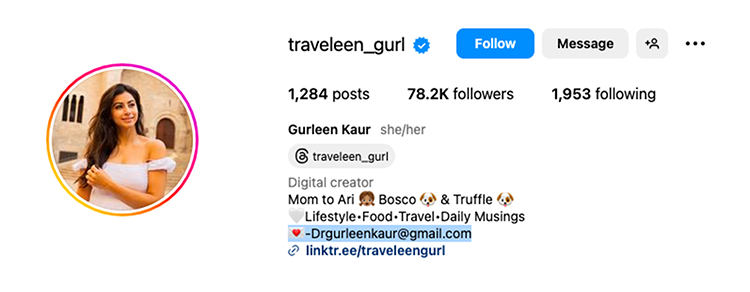
To help you see what these collaborations could look like, let’s take a peek at one of their posts.

Below, you’ll see that they’re already promoting a restaurant in their post.

That means the chances of them being open to collaborating with you are pretty high.

A woman sits at an outdoor café table with various dishes and drinks, looking at the camera. Text on the image encourages supporting small local businesses and praises the café's vegan food.

When you click through and take a look at their profile, you can see that they’ve built a healthy following already.

With more than 78,000 followers, if you collaborated with them, you may be able to convert some of those followers into patrons for your restaurant.

Screenshot of an Instagram profile for user traveleen_gurl, who has 1,284 posts, 78.2K followers, and is following 1,953 accounts. The bio includes personal and professional information.

You’ll also notice they’ve included their email directly on their profile.

You can use it to reach out to them in an effort to start your collaboration.

If they don’t have their email available, you can also send them a direct message.

When you do, you’ll want to let them know what you’re reaching out for, what you hope to accomplish together, and how to move the conversation forward.

To help you get started, here’s a quick template you can use:

Hey, [name]!

I’m reaching out from [restaurant name], and I’ve got to say, I’m a huge fan of your work on Instagram. Your posts tell stories, and that’s the kind of authenticity we love. It’s been inspiring to see your interaction with your followers, and it’s pushing us to step up our own social media presence.

We’re in the business of serving up soul food that speaks to the heart, with a focus on [your mission statement]. I’d be thrilled to have you come over, try our dishes, and explore how we might team up for something awesome.

If this sounds like something you’d be into, please reach out at [emailaddress] or call me at [phone number]

After you’ve sent them a message, you’ll want to comment on a few of their posts.

And when they start responding, they’ll likely have a specific set of terms that will need to be met before they’re open to collaborating with you.

In most cases, that’s a form of payment.

You can offer them an invitation for free meals, or vouchers for them and their family in exchange for making posts about your restaurant.

In some cases, if they have a large audience for instance, you may even offer direct payment in exchange for shoutouts and other content related to your restaurant.

The extra reach that you get (and the new patrons) is worth it, though!

Collaborate With Strategic Partners

Another type of collaboration you can do is with strategic partners in your local area.

By partnering with other businesses that aren’t your direct competition, you can work out deals, specials, and exchanges where you send them visitors — and, in return, they send you new visitors, too.

The key to making this strategy work, though, is making sure you’re partnering with complementary businesses, NOT your direct competition.

These partnerships could range from working with local farms and breweries to bakeries and even other restaurants.

If you have local creators in the food space, partnering with them can help you gain more exposure, too.

To see what this looks like in action, take a look at the example below:

Promotional image for a Six-Hand Dinner event featuring caricatures of three chefs, with details about the event date, location, and how to make reservations at Akuna Restaurant in Ho Chi Minh City.

In this example, a local creator — called the foodnewsagency — is promoting a dinner mashup between multiple different restaurants in the area.

Pretty cool idea!

(If you don’t already have one of these in your area, starting one could give you amazing reach!)

The goal of these mash-ups is to share co-branded menu items and products.

And while they’re extremely effective at introducing new people to your menu items, they’re not the only type of collaboration you can do.

You can also do joint events or pop-ups.

For instance, if there’s a local arts and crafts fair happening in your city, you can run a pop-up booth in the fair and introduce people to your menu items.

Or you can connect with other restaurant owners to do social media cross-promotions and social media takeovers.

Your creativity really is the limit when it comes to partnering and collaborating with strategic partners.

To help get your wheels spinning, check out this example:

In the example above, you can see an Instagram post from PLANTA, showcasing their collaboration with Nicole Berrie on a new Kimchi Firecrackers menu item.

Then, when you check out Nicole Berrie’s Instagram profile, you can learn more about collaborating with her on projects.

Instagram profile of a digital creator named Nicole Berrie with 104K followers, 4,280 posts, and 1,703 following. Bio mentions her as a body harmony author, plant-based recipe creator, and founder of Bonberi Mart.

There are a few things to be learned about the collaboration between Nicole Berrie and PLANTA.

First, the collaboration works because they’re both targeting trendy, health-conscious people.

PLANTA gets to tap into that audience because Nicole Berrie is a cookbook author, and recipe creator, and happens to own a Korean mart that sells kimchi.

Second, it creates excitement by offering an exclusive, limited-time menu item that isn’t available anywhere else.

Third, because they share similar target audiences, PLANTA gets promoted to Nicole Berrie’s 104,000 followers, dramatically expanding their reach.

All that is happening because of a win-win collaboration between a restaurant and a local Korean mart owner / social media influencer.

PLANTA is known for collaborating with other businesses and influencers like this.

Here’s another example from a joint venture between them and Fancy Peasant:

You can see from the comments and likes how much traction the collaboration received:

Two women in a kitchen prepare a dish together. Ingredients and kitchen tools are on the counter. Text overlay in the image contains various social media captions and comments.

PLANTA even promoted the collaboration on their website — extending both their reach and Fancy Peasant’s reach:

Advertisement for PLANTA x Fancy Peasant collaboration featuring a table set with a plant-based meal. Text offers a 20% discount with code PLANTAXFANCY20 and mentions an exclusive e-book with recipes.

There are a few reasons this collaboration is as effective as it is.

The biggest reason is because both PLANTA and Fancy Peasant share similar target audiences.

They’re both looking to attract the attention of people who are seeking plant-based recipes and products.

By offering 20% off of all purchases for PLANTA and Fancy Peasant, the campaign raises awareness for both brands while driving more customers at the same time.

Then, exclusive menu items and nourishing, plant-based angles align perfectly with Fancy Peasant’s brand, making it easy for her to create new content her audience wants to see — while getting paid.

Creating scenarios like this make it profitable for restaurant owners to work with influencers, especially when you look at long-term business growth.

Increasing your follower count (with the right people) helps your business’s credibility while increasing your reach, giving you more opportunities to convert people into new customers down the road.

The big takeaway here is that restaurants can partner with brands and relevant personalities that share their values and target audience to help drive awareness through a special offer.

Email Marketing

Now, while each of the strategies we’ve just given you works AMAZINGLY well for generating buzz and grabbing attention for your restaurant, there’s one small problem…

…the attention you gather isn’t actually yours — yet.

In the case of your Google My Business listing, you’re hoping that someone sees your restaurant first and wants to visit it instead of one of your competitors.

In the case of collaborations on social media platforms like Instagram, your audience will always be on Instagram and you’ll always be at the whims of the algorithm.

Will the algorithm show your content to them today? Will they see someone else’s content, instead?

Only the developers of the algorithm know, for sure.

So while it’s highly recommended that you set up your Google My Business listing and properly optimize it to show up high in the search results and that you do collaborations with other businesses and social media influencers, it’s even more recommended to actually capture the attention you’re generating.

When you capture the attention you’re generating and get it onto a platform that you own and control, you can almost guarantee that you’ll get your content in front of your audience.

The easiest way to do this is through email marketing.

When you move the audience you’re building on other platforms over to your own email list, you have a direct line of communication with them.

On top of that, it’s incredibly cost-effective and gives you an opportunity to target your message directly to them without algorithms getting in the way.

To get started, the first step you’ll need to take is to include a signup form on your website.

You want to make sure you’re giving people a reason to sign up.

That could be special discounts or even VIP treatment.

Then, you want to make sure you’re only collecting the information you need. In most cases, that will be their email and possibly their name.

When you attempt to collect too much information out of the gate, you’ll decrease your conversion rate and get fewer people signing up to your email list.

To see what this looks like in action, here’s a great example of a signup form:

Popup on a website offering a $15 discount on a $30 purchase at Stan's Donuts & Coffee in exchange for email sign-up. The background shows a tray of assorted donuts.

When people enter their information on the form, they’re able to receive a $15 discount code.

Here’s another example that offers VIP access instead of a discount:

A VIP Access newsletter sign-up form with fields for an email address and a subscription button, promising preferential pricing, special events, early bookings, and more.

Then, when it comes time to email your list, there are quite a few different types of emails you can send.

For instance, here’s a great welcome email example from Starbucks:

Promotional flyer titled “Welcome to a Stars-Filled Journey” offering perks: 1-for-1 drinks, 50% off app drink, $2 off purchase, free drink customization, and 10% off online store with spending limits.

By welcoming people onto your list, you can give them access to different members-only perks.

One of which we’ll talk about later in this guide.

For now, though, if you aren’t already building your email list, you can use a tool like ClickFunnels 2.0 to build your landing page, sign-up form, and email the audience you’re building.

Click here now to start your free 14-day ClickFunnels 2.0 trial.

When you do, you’ll be able to easily create and edit your emails using the built-in ClickFunnels 2.0 drag-and-drop email editor:

You’ll also be able to fully automate your email marketing campaigns, making it easy for you to send new subscribers their welcome email and claim their members-only perks:

A visual representation of an automated workflow showing steps triggered by an action, including email templates, delay timers, and decision points, culminating in an end path or a scarcity step.

You can also build campaigns specific to different events throughout the year.

For instance, Cracker Barrel runs special holiday promotions to drive even more business into their restaurants during the holiday season:

A Christmas promotional flyer for Heat n' Serve meals with step-by-step ordering instructions. Features images of holiday dishes and details on serving sizes for family dinners.

If you offer special holiday discounts or menu items, you can promote these to your email list:

Promotional Starbucks poster featuring three new iced drink offerings: Vienna Creamy Latte, Honey Plum Pure Matcha Latte, and Peach Plum Pearls Oolong, accompanied by text detailing the flavors.

To help get your wheels spinning even more, here’s a list of email types you can run right now:

  • Weekly or Monthly Newsletter: Share upcoming menu items, updates on your restaurant, and events happening in your area where you’ll be
  • Share limited-time offers
  • Highlight customer reviews, press mentions, and awards
  • Feature behind-the-scenes content or staff highlights
  • Include recipes or cooking tips to provide even more value
  • Announce exclusive deals, coupons, and discounts for subscribers
  • Promote gift cards, catering services, or private event options
  • Offer a loyalty or rewards program for frequent visitors

And so many more.

You can also send out event invites to special events like wine tastings, live music nights, chef’s table dinners, or even collaborations with other strategic partners.

When you have your own email list, you’re only limited by your creativity.

If your audience may benefit from what you want to send or may be entertained or educated by your content, send them an email letting them know!

Introduce Loyalty Programs

Each of the strategies we’ve discussed so far serve a couple major purposes.

The first is to raise awareness and generate buzz and attention for your restaurant.

The second is to be able to stay in contact with people once you’ve gotten their attention.

But when you’re focused on the long-term growth of your restaurant, you want to implement strategies that can keep people coming back again and again.

One of the easiest ways to do this is through a loyalty rewards program.

These programs reward your most loyal patrons with special perks, benefits, and discounts each time they visit.

They help you get more repeat customers — because it’s easier to retain a customer once you’ve gotten them than it is to find a new customer.

Your most loyal patrons will also bring their friends and family into your establishment, giving you even more opportunities to turn them into long-term fans and loyal advocates.

There are a few different types of reward systems you can use, too.

For instance, Starbucks uses a points-based system.

Every purchase that a patron makes earns them points, which they can then redeem for free food or drinks down the road.

Here’s an example of the Starbucks points program:

Infographic showing Starbucks rewards with various star levels for free drink upgrades, discounts, and free items. Levels: 20 stars (free upgrade), 40 stars ($2 off regular drink), 60 stars (free drink), 100 stars ($10 off drink/food), 160 stars (Gold member perks).

With the Starbucks points program, patrons have access to multiple different tiers — Green & Gold.

Depending on their tier, they get access to more (or better) benefits.

As a loyalty member, they get free refills, birthday rewards, and other special perks.

Then, taking this one step further, when patrons are using the Starbucks app, they get increased convenience, easy tracking of their loyalty points, and even easier redemption.

Another great example of a loyalty program is the Chick-fil-A program:

Image showing a restaurant rewards program with benefits: points per dollar spent, free guac on signup, birthday reward, double points, early access to items, and exclusive insider info.

With Chick-fil-A, patrons can earn points for every dollar they spend and then redeem those points for food and brand merchandise.

They offer a similar multi-tier structure to Starbucks, ranging from Red, Silver, and Signature, with increasing benefits as patrons elevate through each tier.

Here’s how Chipotle operates its loyalty program, offering patrons a way to use their points toward food, merchandise, or even giving back to a charity:

A promotional graphic from Chipotle showcasing: a free points system, sustainable apparel, and a charity option to support the National Young Farmers Coalition by redeeming points.

Panera Bread’s “MyPanera” takes its loyalty program to the next level.

Not only does it offer a similar points-based system but it also includes surprise rewards.

Patrons are able to earn rewards for every visit they make plus they can receive personalized rewards based on their personal preferences.

Then, Panera offers them a free birthday treat and early access to new menu items:

Promotional banner for Panera's MyPanera Rewards & Unlimited Sip Club highlighting benefits: free pastry and delivery, personalized rewards, birthday reward, and endless drinks with Unlimited Sip Club.

Once you have your loyalty program in place, you’ll want to start promoting it.

This can be on your website, your social media profiles, to your email list and at your checkout or on your receipts as guests pay their bill.

Advertising your program using these free strategies will help drive more patrons to use it.

The more you let people know about your loyalty program, the more they’re going to use it.

And every time they use it, they’re in your restaurant either increasing the number of points they have or redeeming points they’ve earned.

Introduce Gift Cards

Once you’ve started building loyal brand advocates (and rewarding them for it), the next strategy you can use to grow your restaurant is gift cards.

Giving your patrons the ability to purchase gift cards is a great way for them to introduce people they know to your restaurant — giving you even more new patrons.

A HUGE perk for gift cards, though, that many restaurant owners don’t think about, is that these are advanced cash for your business.

Each gift card you sell injects cash into your business now and then gets redeemed later.

On top of acquiring new customers (and getting paid to do it), gift cards also help increase your visibility and give you a ton of branding opportunities.

They’re one of the most convenient types of gifts your patrons can give, especially when they may not know the recipient’s preferences.

The recipient will have the option to pick and choose what they want to order and when they want to use the card.

These can be physical cards that you offer in your restaurant, or they can be digital cards offered through your website (or funnel, if you’re using ClickFunnels 2.0).

Here’s an example of a digital gift card from Girl & The Goat:

Screenshot of the Girl & The Goat gift card purchase interface. User can select type, recipient, and customize the email. Card values range from $5 to $500 in $1 increments, with a limit of $1,000 per order.

When it comes to designing and rolling out your gift cards, there’s 3 things you need to do.

The first is designing attractive cards.

You want to incorporate your branding elements and visuals so that the recipient can immediately recognize your business.

You can also think about using different designs for holidays or other special occasions. 

Then, you’ll want to create a structure for your gift card pricing and denominations.

You can choose from either fixed amounts (like $10, $20, $50, etc.) or custom amount options.

You’ll need to set minimum and maximum limits, too.

After that, you’ll have to establish gift card policies.

You can apply expiration dates to cards that are ordered, as well as determine different redemption methods — in-store, online, mobile, etc.

Make sure that you clarify the terms and conditions of the gift card so people who are purchasing understand when and how they can use them.

Once you have all of that in place, the next step is promoting your new gift card program.

Letting people on social media know about it (and the perks they can get by using it) is a great way to get the ball rolling.

Three people are sitting at a table in a restaurant, laughing and chatting over a meal. The background includes large windows and a festive holiday decoration.

The combination of all 6 of these strategies, though, when put together, makes for a healthy foundation for growing your restaurant month-over-month.

Get started by claiming your Google My Business listing.

Then spend a bit of time looking for influencers and strategic partnerships in your area.

Once you’ve found them, make sure you’re making the most of the attention you’re generating by using ClickFunnels 2.0 to get them onto your email list.

After, you get an opportunity to wow them with your menu items and service, turning them into loyal brand advocates for your business — the type that use loyalty programs and purchase gift cards.

When you do this, you can experience the type of growth that most restaurant owners want to experience, without racking your brain figuring out how to pull it off.

Thanks for reading 6 Game-Changing Restaurant Marketing Strategies which appeared first on ClickFunnels.
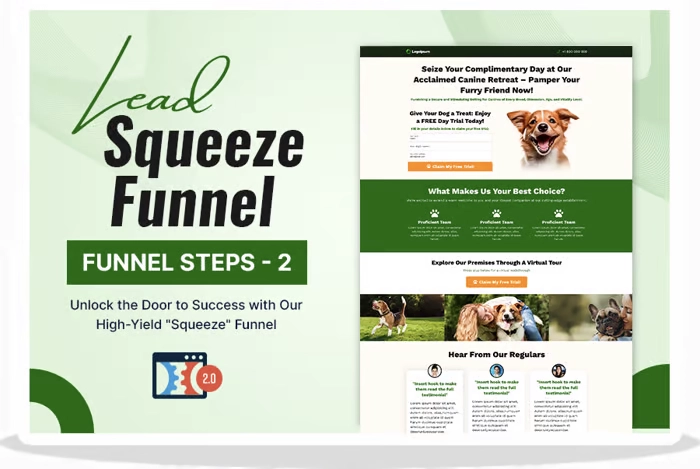
12 Ways To Make Money Using Marketing Funnels

Software Stack Editor · March 26, 2024 ·

The post 12 Ways To Make Money Using Marketing Funnels appeared first on ClickFunnels.

Consumer behavior is shifting. Transforming. Evolving. All thanks to this thing we call the Internet. As the Web grows and expands, marketing channels are changing. Ad costs are ballooning. And more importantly, attention spans are waning. It’s no longer simple and easy to make money marketing your online business. It’s far harder to compete when countless businesses are all vying for attention. Companies have deep pockets and limitless budgets. You can’t compete with that. That’s why it’s not a speed game. It’s a long haul. And you must be in it to win it.

Businesses must adapt to not only survive today but to thrive. Fierce competition will do that. But it’s more than that. Much more. It’s about understanding and tapping into consumer behavior. Many think it’s still a one-off game of running ads hoping and praying for conversions. Those businesses experience a slow and steady death. Instead, the ones that win leverage the inherent power of marketing funnels to make money.

Marketing funnels allow you to win the long game. They enable you to leverage human psychology in novel and innovative ways. They tap into the core levers that drive us as human beings. And they enable you to make money by harnessing the underlying consumer behavior that makes us all tick. The truth is this. We don’t want to buy random products from companies or people we don’t know. Nope. We want to buy from those we know, like and trust. We want to connect and feel that we’re understood. That’s the real secret to making money in business today.

How To Make Money Using Marketing Funnels

So what are marketing funnels? If it’s your first time hearing about marketing funnels, here’s the scoop. Marketing funnels take the customer on a predefined journey that turns browsers into buyers fast. Some call them marketing funnels while others call them sales funnels. But they’re also called purchasing funnels. Consumer funnels. And customer funnels. It doesn’t matter what you call them, it’s all the same thing. But that doesn’t make them any less relevant. In fact, marketing funnels are the most important tool you can use to make money in your business today.

It doesn’t matter if you have a simple side hustle, you own a brick-and-mortar “boring” business, you own a big business, or no business at all. If you want to make any money online, you must understand how marketing funnels work. And you must learn how to use them to attract and convert customers like clockwork. But if you think that marketing funnels are like websites, you’re mistaken. They’re not like websites. Websites are a dying breed. They have too many choices that overwhelm us. Nope. Marketing funnels are not like websites all all.

Marketing funnels are laser-focused. They offer a finite approach. A direct journey from Point A to Point B. That’s the foundation of their magic. But marketing funnels do much more than that. They allow you to tap into the heart of humans by connecting on a deeper level. That’s because they drive people to join your list, allowing you to communicate and share stories. This allows prospects to get to know you. It forms trust and builds rapport. And eventually, it helps seal the sale. Not always quickly or instantly. But over time. That’s the real magic of marketing funnels.

1—Make Money Using Affiliate Marketing Funnels

Affiliate marketing is the art of making money by selling the products or services of other companies. Each sale tied back to you results in a commission. That means you don’t have to create the products or services yourself. All you need to do is understand how to market them and get others to buy those products or services. It’s not simple. It takes a deeper understanding of the mechanics of marketing.

Sure, making money as an affiliate is hard. We all know that, right? That’s because most people try to do affiliate marketing the wrong way. They blast links left and right. They hound family and friends. And instead of attracting people, they repel them away. That’s not how you do it. Instead, you need an affiliate marketing funnel. It needs to deliver value and collect contact details before sending them to the affiliate offer.

Affiliate marketing funnels are also known as Bridge Funnels. Bridge funnels allow you to collect contact details and add a person to your email list before forwarding them to the affiliate offer. These are specifically designed to help you form a bond and develop a relationship with the prospect. This way, you can connect with them on a deeper level and sell them more products and services down the road. You’re not just limited to a single offer.

2—Lead Generation Business

Leads are a vital part of any business. Leads are valuable contacts who will potentially buy down the road. And every business needs more leads. That’s where lead-generation businesses come into play. You can build an entire business and start making money from marketing funnels through lead generation. All you need to do is to create lead-generation funnels to generate leads. You can use those leads in your business or sell them to other businesses.

To create a lead-generation business using marketing funnels you’ll need a high-converting landing page with a problem-solving lead magnet. Your lead magnet must address a problem that the prospect is currently struggling with. And it must deliver an enormous amount of value to the prospect. It should help them solve all or part of the problem. When you do that, it increases your authority and the level of trust a prospect has in you. And that sets them up to pay for the implementation of the solution.

Most people think that giving away the farm is not the right move. If you solve a prospect’s problem, why would they pay you any money after that? That’s where most are wrong. Delivering value upfront builds reciprocity. Reciprocity is goodwill. A prospect now has respect for you. That’s because you delivered an organized solution to their problem. That doesn’t mean they want to implement that solution themselves. Sure, maybe some of them will. But a large majority of those people will want to pay for the implementation of the solution. That’s just how it works.

3—High-Ticket Application Funnels

Another way to make money with marketing funnels is to use an application funnel. Application funnels allow you to sell high-ticket services and premium products. It invites the prospect to apply to purchase or join whatever it is that you’re offering. This could be a coaching program, consulting, mastermind, premium product installation, and so on. This applies to many areas of business. Application funnels work great because they force prospects to pre-qualify themselves. It allows you to weed out most of the prospects that will waste your time.

The best way to approach an application funnel (especially for high ticket) is to create a reverse squeeze page instead of a squeeze page. The two are a little different. A squeeze page asks for contact details upfront. Afterward, it delivers the value. Reverse squeeze pages deliver the value first. And then it asks for contact details. This typically results in a higher quality lead but a lower number of conversions. This is far more useful for high-ticket products and services.

4—Two-Step Tripwire Funnels

Two-step tripwire funnels are powerful money-making machines. They leverage buyer psychology and consumer behavior in a few unique ways. The first way is by substantially lowering the risk threshold by offering a low-ticket product. Most people are willing to pay a small amount of money for a product from someone they don’t know rather than a high-ticket product. This allows you to blow the prospect away with value to ensure securing a high-ticket sale down the road.

Another way two-step tripwire funnels leverage buyer psychology is through the Law of Consistency. If someone is willing to pay you a small amount of money now, they’re far more likely to pay you a higher amount. And, since this is broken up into two steps, they must click a button as a micro-commitment to move from step one to step two. Micro-commitments are important in sales. It gets the prospect performing the action you intend them to perform.

Another important benefit of a two-step tripwire marketing funnel is that if they don’t complete the sale but move to the second step you still walk away with their details. Once you have their contact details you can invite them back to complete their purchase by using automation. The contact details allow you to deliver value through email communication. And it helps you build rapport with that prospect. Remember that people want to buy from others they know, like and trust. This reinforces that concept heavily.

5—Online Surveys Funnels

Online surveys also allow you to leverage important human behavior cues. You can make money with survey funnels because filling out a simple survey is a low-friction method for lead generation. People will gladly answer multiple-choice questions on a survey funnel if it means providing some insight into a problem they’re struggling with. It also reinforces micro-commitments because they’re constantly clicking buttons to get to the next step.

Online surveys allow you to train prospects to engage in behavior that compels a sale down the road. Clicking buttons and filling out forms is an important part of human behavior linked to purchasing. That’s what makes online surveys so powerful. Use the online surveys to deliver real value and then begin sharing stories with the prospect. That allows you to sell them something down the road. This is a powerful marketing approach and goes well beyond the one-click interaction most companies implement to solicit purchases with paid ads.

6—Sales Letter Funnels

Sales letters are expertly written to help induce a sale. The best sales letters can explode a business overnight. They’re powerful, thought-provoking, emotion-inducing letters that identify the pain and agitate it before presenting a solution. The solution is right there for the taking on the page. Great sales letters require great copywriting. But if you can put together a sales letter, you can make a lot of money with this type of marketing funnel.

Frameworks exist for creating great sales letters. You must know and understand your prospect implicitly. You need to know all about them and what makes them tick. And what keeps them up at night? This way, you can get into the prospect’s mind to determine how you can approach the sales letter the best way so that it speaks directly to the prospect. This is really the key. Know the prospect first and the problem they’re experiencing. Then, design a sales letter that harnesses those details and presents a solution.

Effective sales letters do much more than that. They help to minimize risk by presenting risk-reversal methods such as money-back guarantees. Great sales letters also help to bake in social proof by providing testimonials, endorsements, and so on. And the best sales letters that are the most effective are at the heart of an irresistible offer.

7—Book Marketing Funnels

Most book marketing funnels are two-step tripwire funnels with a twist. Most of them offer the book for free. The twist is that you have to cover shipping. The word “free” is powerful in marketing because it gets prospects to take action. When combined with some form of urgency, it propels prospects toward a sale. Why? Because people often need a reason to take action. They won’t always take action on their own accord. But when you combine a free-plus-shipping offer with some impending deadline, it’s a powerful combination.

For example, this book uses a free-plus-shipping offer to drive sales. The book is offered for free. And it’s one of the best-selling marketing books of all time. The only caveat is that you have to pay for shipping. And people will gladly pay for shipping when they’re receiving something of value like that. The book has a retail price because it’s being sold on Amazon and typically retails for around $18 for the paperback.

8—Webinar Funnels

Webinars are presentations. They’re used to sell products and services at a higher price. Companies use them to sell online courses, membership site access, coaching, masterminds, and more. Webinars are used to help shift a prospect’s beliefs to induce a sale. Beliefs often stand in the way of a sale. That’s because everyone has beliefs based on prior experiences. Our real-world experiences help shape the very beliefs that hold us back from buying something.

Beliefs can revolve around the vehicle (the product), internal beliefs (lack of capability), and external beliefs (i.e. lack of time and money). The goal of a webinar is to reshape those beliefs by using the power of stories. Stories help to replace beliefs by hijacking the mind. Combined with social proof and a great offer, webinars can help you make a lot of money in any type of business.

9—Product Launch Funnel

The Product Launch Formula was created by Jeff Walker. It helps to illuminate the path for launching a new product to an existing audience. If you have an existing audience, this marketing funnel might be a great way for you to roll out a new product or service to that audience. It works over the course of multiple days. The first few days are designed to deliver valuable content and information. This sets the stage for the sale later on.

On the last day, the product is launched. The audience is told that the launch will only be for a limited time or for a limited number of people. This creates urgency and scarcity. During that time the cart is opened. And the audience is informed that the cart will only remain open for a limited period or until some other metric is met. This creates a fear of missing out, which propels sales even further.

10—Summit Funnels

Summit funnels allow you to bring a bunch of experts in an industry together to deliver value to an audience. The summit is typically given away for free to anyone who joins it live. They can watch the entire event live and all you need to do is interview the experts and ask them questions. This helps create authority and reciprocity amongst your audience. At the end of the summit, you can invite participants to purchase a product or service you offer.

Summits can also become the product itself. For people who cannot attend live, you can sell the recordings of the summit. Those recordings can be sold in any marketing funnel, along with upsells within the funnel. Upsells could include things like coaching, consulting, masterminds, and more. The best part? These can be done virtually. Meaning that you don’t need to rent out a venue or deal with event production whatsoever. That makes a virtual summit very affordable to launch.

11—Funnel Marketplace

You can generate passive income in the funnel marketing place by selling your funnel designs to others inside of the funnel marketplace. That means that you only have to do the work one time and you get paid repeatedly for it. And if your funnel designs are good then you can certainly make money with marketing funnels using this approach. You can research some of the existing templates for sale here. Look at the templates that have solid reviews and reverse engineer those. Make your designs better.

Millions of businesses have marketing funnels. That opens you up to a huge target audience of those who might be willing to purchase your funnel designs. You’ll need to do some form of promotion to get the word out. And you’ll need to collect some reviews before your funnel designs take off. But it’s well worth it since you mostly have to do the work once and get paid repeatedly for it.

12—Freelancing

Companies everywhere need marketing funnels. After all, marketing funnels offer the best way for a business to make money. That’s because they’re laser-focused. They drive prospects down a predefined path that helps increase leads, sales and revenue. They also help boost the average amount of money that customers spend with a business. Marketing funnels are great overall. And if you know how to build a marketing funnel you can make money as a freelancer helping others.

You can use any of the freelancing websites. Sites like Upwork, Freelancer, and Fiverr. You can use these sites to bid on projects and offer your services to others. You can use predesigned templates and a drag-and-drop editor to design these marketing funnels. Meaning that you don’t need to be a web developer to make money doing this. There’s no complex code to write or any servers to set up. It’s simple and easy when you use marketing funnel software to build these funnels.

Thanks for reading 12 Ways To Make Money Using Marketing Funnels which appeared first on ClickFunnels.
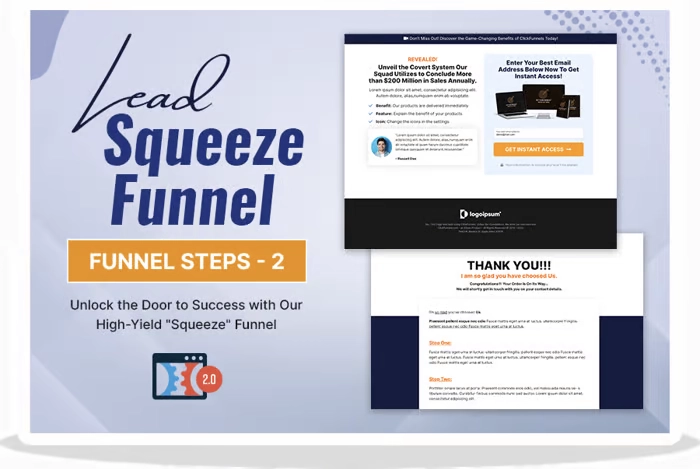
8 Highly Effective Strategies For Increasing Sales Performance

Software Stack Editor · March 26, 2024 ·

The post 8 Highly Effective Strategies For Increasing Sales Performance appeared first on ClickFunnels.
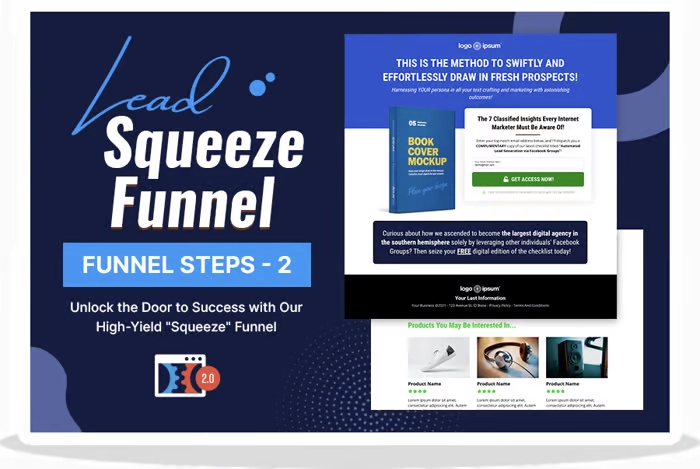
Want to help your salespeople make more sales?

Here are eight highly effective strategies for increasing sales performance…

Table of Contents:
  • #1. Streamline Your Sales Process
  • #2. Be Realistic About Hiring Trade-Offs
  • #3. Look for These Three Traits When Hiring Salespeople
  • #4. Provide Extensive Sales Training to New Salespeople
  • #5. Set Realistic Expectations with People Who Don’t Have Any Previous Sales Experience
  • #6. Set an Annual Sales Target then Divide it into Quarterly Sales Targets
  • #7. Set Daily, Weekly and Monthly Cold Outreach Quotas and Hold Your Salespeople Accountable
  • #8. Do Quarterly Reviews to Help Your Sales Team Stay On Track Towards Their Annual Sales Target

#1. Streamline Your Sales Process

We recommend starting with documenting your entire sales process, examining it for inefficiencies and then addressing those inefficiencies.

If you haven’t taken measures to streamline your sales process before, the chances are that you will be able to increase your sales performance simply by automating repetitive tasks that are currently taking up valuable salespeople’s time. 

Here are some automation ideas:

  • Set up a customer relationship management (CRM) system. CRM apps can help you get organized, centralize all the information you have on each contact and keep track of everything that’s happening in your sales pipeline.
  • Create a lead scoring system for your business. Analyze your sales data, figure out what leads that convert into customers have in common, and then use those common traits to develop a lead scoring system. 

    It doesn’t have to be anything fancy, you can simply rank incoming leads on a scale of 1 to 3, with 1 being the least likely to convert and 3 being the most likely to convert. This can be automated with CRM software. 

    Once you have a lead scoring system, encourage your salespeople to prioritize leads that are the most likely to convert into paying customers. Ideally, you want to use CRM software to automatically assign leads to salespeople and put the highest-scoring leads at the top of each salesperson’s lead list. 

  • Use Zapier to automate your workflow. Zapier allows you to connect various web apps in your workflow with each other and automate repetitive tasks such as data entry.

All this can help you free up salespeople’s time so that they can spend more of it on cold outreach, discovery calls, and product demos!

#2. Be Realistic About Hiring Trade-Offs

Every entrepreneur has to navigate this trade-off when hiring salespeople:

  • People who don’t have any previous sales experience will work for less but will require more training and be less effective at closing sales. They will also be more likely to quit. 
  • People who do have previous sales experience will require less training and be more effective at closing sales but they will also expect to be paid more, both in terms of base salary and in terms of commissions. 

This means that if you want to build a high-performing sales team, you will need to invest in either teaching your salespeople the skills they need to succeed in sales or in hiring salespeople who already have those skills.

It’s important to accept that there’s no way around this trade-off. Remember: you get what you pay for!

#3. Look for These Three Traits When Hiring Salespeople

So how can you know if someone with no previous sales experience has the potential to become a successful salesperson?

You can’t look at their sales track record because they don’t have any. But you can select for traits that are predictive of doing well in sales.

Here are the three most important traits:

  • Perseverance. Do they have experience in persevering through hardship? This can mean doing well in school despite coming from an underprivileged background, competing in sports, completing a large personal project, learning a complex skill, etc. 
  • Willingness to learn. Do they have experience in getting feedback on their performance and then making adjustments based on that feedback? Any activity where they had to learn a complex skill under someone else’s supervision is a good sign that they are likely to be coachable.
  • Career-oriented mindset. Are they interested in building a career in sales or are they simply looking for a job to pay the bills? Ideally, you want to hire career-oriented people. 

Looking for these three traits should help you identify candidates who won’t quit after their first terrible cold call, who will be able to improve based on your feedback and who will appreciate the opportunity to get their foot in the door despite having no previous sales experience!

#4. Provide Extensive Sales Training to New Salespeople

If you want your new hires to perform well, you need to provide extensive sales training as a part of your onboarding process.

Here’s what your sales training should include:

  • Psychology of persuasion training. Sales is just persuasion applied in the business context so it makes sense to start by discussing Robert Cialdini’s seven principles of persuasion that he covers in his book “Influence, New and Expanded: The Psychology of Persuasion”. 
  • Sales theory training. Cover the most popular sales frameworks, ways to overcome objections, popular sales closes, etc. with special emphasis on techniques that have been proven to be effective for selling your product.
  • Target audience training. Introduce your target audience aka your dream customers. Go over both their demographic and psychographic traits. Explain what they are struggling with and how your product can help them solve that problem. 
  • Product training. Introduce your product. Discuss its features, use cases, and limitations. Encourage your salespeople to go through its most common use cases so that they’d have hands-on experience with it. 
  • Cold call training. Provide a cold calling framework that your salespeople should follow. Organize a cold call roleplaying session so that they can practice that framework. 
  • Discovery call training. Provide a discovery call framework that your salespeople should follow. Organize a discovery call roleplaying session so that they can practice that framework. 
  • Product demo training. Provide a product demo framework that your salespeople should follow. Organize a product demo roleplaying session so that they can practice that framework.

Roleplaying sessions should be conducted using the same medium that your salespeople are going to use for the real thing (e.g. they should practice cold calls by actually calling each other on the phone).

Record those roleplay calls, analyze them, and give each salesperson feedback on their strengths, weaknesses, and what they can do to improve. 

#5. Set Realistic Expectations with People Who Don’t Have Any Previous Sales Experience

If someone doesn’t have any previous sales experience, it’s probably safe to say that they have no idea what they are getting themselves into.

New salespeople often quit within the first few months because they can’t handle the amount of rejection that they need to go through in order to close a single sale.

And the ones that stick with it often don’t improve as fast as they could because they start procrastinating on cold calls in an attempt to delay the pain of the rejection. 

One way to deal with this is to set realistic expectations during the onboarding process. 

Tell your salespeople that they need to be mentally prepared for the fact that the first few months are going to be difficult. Dealing with rejection after rejection after rejection is going to feel terrible.

But the more cold calls they make, the more rejections they will get and the less each rejection will sting. Eventually, they will become so desensitized that it won’t bother them anymore.

After you are done explaining all this, ask them to commit to making 1,000 cold calls no matter what. They can quit after that but not before.

The chances are that by the time they make their 1,000th cold call, they won’t want to quit anymore. They will have reached that point of being completely desensitized to rejection. This can help you reduce new hire turnover.

Plus, the more cold calls they make, the more practice they will get, and the faster their performance will increase. So it makes sense to encourage them to get their first 1,000 cold calls out of the way as quickly as possible!

#6. Set an Annual Sales Target then Divide it into Quarterly Sales Targets

You want to set an annual sales target so that your salespeople would have a concrete goal to work towards.

Look at your current sales pipeline conversion rates:

  • What percentage of cold calls convert into discovery calls?
  • What percentage of discovery calls convert into product demos?
  • What percentage of product demos convert into sales?

In theory, the most straightforward way to double sales would be to double cold calls but in practice, you need to see whether that’s realistic. Can your sales team handle the increased workload across the entire pipeline?

Remember that 2x more cold calls means 2x more discovery calls mean 2x more product demos (assuming the conversion rates stay the same). 

Moreover, it’s not just the sales team that’s going to see an increased workload, it’s everyone involved in dealing with clients (e.g. 2x more sales means 2x more customer support tickets).

Play with the numbers to see what can be achieved given the constraints of your business and work out an annual sales target that is realistic. Once you have an annual sales target, break it down into quarterly sales targets. 

Just make sure to account for any seasonal variations in sales that you can predict based on your historical sales data. Say, if Q3 has always been slow for your company, take that into consideration when setting a sales target for it.

#7. Set Daily, Weekly and Monthly Cold Outreach Quotas and Hold Your Salespeople Accountable

Figure out how many cold calls your salespeople need to make to reach your quarterly targets using the current sales pipeline conversion rates.

Then set daily, weekly, and monthly cold outreach quotas and tell your sales team to focus on meeting those quotas no matter what.

Make sure to hold everyone accountable by reviewing their cold outreach numbers at the end of every day, week, and month.

That way, if one of your salespeople starts falling behind, you will spot it immediately and hopefully will be able to help them get back on track.

Also, tell your salespeople that at the end of each quarter, their performance will be evaluated primarily on whether or not they met their cold outreach quotas. 

The reality is that they don’t have complete control over how many sales they make so it would be unfair to judge them based on that.

However, they do have complete control over their cold outreach numbers!

#8. Do Quarterly Reviews to Help Your Sales Team Stay On Track Towards Their Annual Sales Target

You want to conduct quarterly reviews with your sales team to discuss the progress they have made toward their annual sales target.

Here are the two main things that you should focus on:

  • Did they reach their quarterly sales target?
  • Did they meet their daily, weekly, and monthly cold outreach quotas?

If the answer to both questions is yes, then it’s a sign that the plan is working as expected and they should keep doing what they are doing. 

Meanwhile, if they met their cold outreach quotas but didn’t reach their quarterly target, it must mean that your sales pipeline conversion rates have decreased. 

Your salespeople will probably have insight into why the plan didn’t work as expected. Ask them what’s going on.

It’s important that you work together with them to figure out what the issue is and how to fix it.

Missing one quarterly target is not the end of the world but your sales team needs to get back on track ASAP if they want to reach their annual sales target!

Want to Learn How to Scale Sales FAST?

Our co-founder Russell Brunson took our company from zero to $10M in annual revenue in just one year.

Then, he grew it to 100M+ in annual revenue in less than a decade without taking any venture capital.

He’s a great salesman but it’s simply not possible to achieve that kind of explosive growth by cold calling potential customers and pitching them your products one-on-one.

And keep in mind that when he and his co-founder Todd Dickerson launched ClickFunnels in 2014, they were funding the whole thing themselves. 

They didn’t have the money to hire a bunch of salespeople right from the get-go!

So what did Russell do to grow our company so fast?

The answer is simple:

  1. He built sales funnels
  2. He drove traffic to those sales funnels

Since then, he has taught thousands of entrepreneurs around the world how they too can grow their businesses with sales funnels. Want to learn from him?

The best place to start is his best-selling book “DotCom Secrets”. 

It’s available on Amazon where it has over 2,400 reviews and a 4.7 star rating. But guess what?

You can also get a copy directly from us for free. All we ask is that you cover the shipping!

So what are you waiting for? 🧐

@russellbrunson

They say you shouldn’t pick favorites… But this book is my favorite in the secrets trilogy 🙂

♬ original sound – Russell Brunson – Russell Brunson

Get a FREE Copy of “DotCom Secrets”

Thanks for reading 8 Highly Effective Strategies For Increasing Sales Performance which appeared first on ClickFunnels.
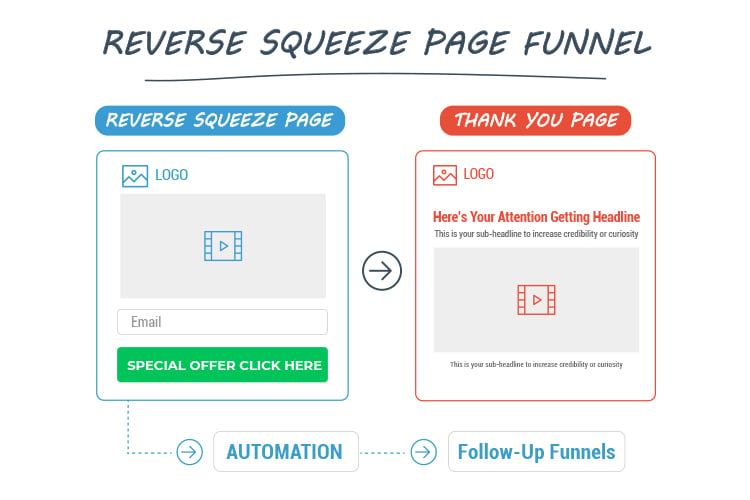
5 Lead Generation Templates That Kick Butt In 2024

Software Stack Editor · March 26, 2024 ·

The post 5 Lead Generation Templates That Kick Butt In 2024 appeared first on ClickFunnels.
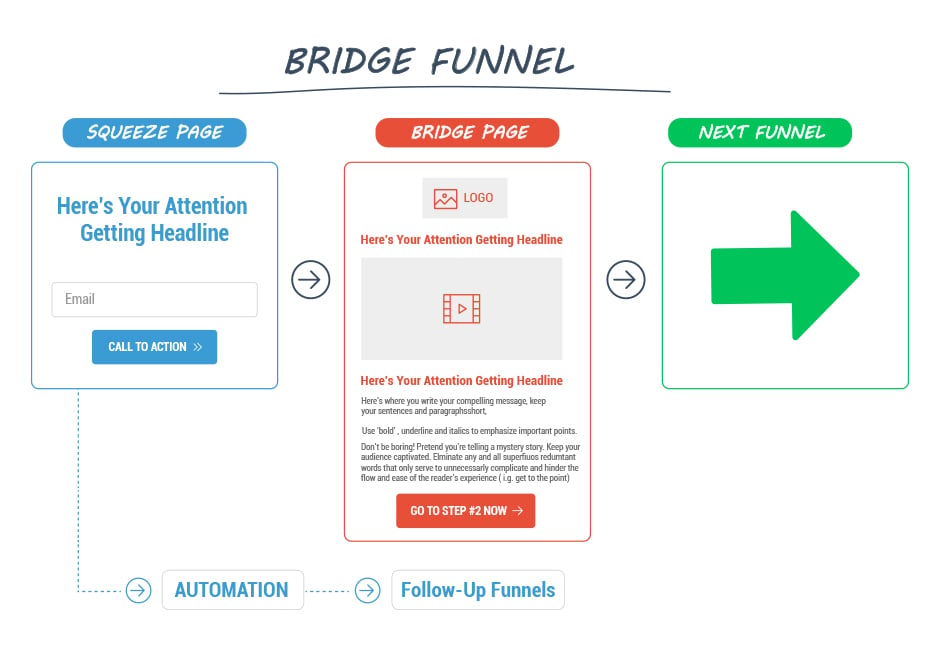
Want to take your lead generation to the next level in 2024?

Today we are going to share five lead generation templates that can help you do that!

Table of Contents:
  • #1. The Homepage Funnel
  • #2. The Survey Funnel
  • #3. The Squeeze Page Funnel
  • #4. The Reverse Squeeze Page Funnel
  • #5. The Webinar Funnel 
  • Funnel Hacks That Can Help You Maximize Conversions

#1. The Homepage Funnel

The homepage funnel allows you to meet potential customers’ expectations by having a traditional website and effectively converting them into leads with a lead generation funnel. You get the best of both worlds!

Here’s what its structure looks like:

  1. A 2-step opt-in form on your homepage where you present your lead magnet and encourage the potential customer to get it. 
  2. A thank you page where you thank potential customers and let them know what they should expect next. 

Make sure to place the opt-in form above the fold. It should be the first thing that people see when they come to your website.

We also recommend adding an exit-intent pop-up to your homepage. If the visitor is about to leave anyway, you have nothing to lose by pitching them your lead magnet one last time. 

The Homepage Funnel

#2. The Survey Funnel

The survey funnel is designed to help you figure out who the visitor is. 

This funnel has two main use cases: 

  1. Qualifying leads so that you could then provide a quote based on their answers. This can work well for businesses that offer custom, project-based pricing. 
  2. Qualifying leads so that you could then direct them to a sales funnel for a product or service that is the best match for them. This can work well for businesses that serve several distinct customer segments.

In either case, the first page of the survey funnel should be a survey page with lead-qualifying questions.

What you should do next will depend on the use case. 

Survey Funnel Use Case #1: Qualifying Leads So that You Could Provide Them With a Quote

You should take the potential customer to the thank you page, thank them for taking the survey, and tell them that you are going to send them their quote via email. End that email with a call to action encouraging them to book a free consultation with you and direct them to your appointment booking page. 

If the quote you provided is within their budget, they will probably want to talk to you. This free consultation gives you an opportunity to learn more about their situation, determine if they are a good match for your business and potentially close the sale. 

This approach has the additional benefit of disqualifying those who cannot afford your services. If you send someone a quote that is outside their budget, they will probably move on instead of booking a call and trying to negotiate a lower price. 

That can help you avoid wasting time on people who simply don’t have the means to hire you!

Survey Funnel Use Case #2: Qualifying Leads So that You Could Direct Them to an Appropriate Sales Funnel

Once you have identified what customer segment the potential customer belongs to, you should take them to the first page of the appropriate sales funnel.

Typically, this would mean sending them to a lead magnet landing page that features a free offer designed specifically for that customer segment. 

Survey Funnel

#3. The Squeeze Page Funnel

The squeeze page funnel is the most popular lead generation funnel out there.

Here’s what its structure looks like:

  1. A squeeze page where you present your lead magnet and encourage the potential customer to get it.
  2. A thank you page where you thank potential customers and let them know what they should expect next. 

This funnel can work well for pretty much any business. It’s also the easiest one to build so we would recommend starting here!

The Squeeze Page Funnel

#4. The Reverse Squeeze Page Funnel

The reverse squeeze page funnel has the exact same structure as the regular squeeze page funnel. So what’s the difference between them?

With the regular squeeze page funnel, the potential customer needs to provide their email address in order to access free value. 

Meanwhile, with the reverse squeeze page funnel, the potential customer can get some free value without having to provide their email address.

A reverse squeeze page should feature a free video that they can watch without having to opt in. 

You can either use that free video to create an emotional connection, build trust, and establish your credibility by sharing your story.

Or you can use it to give the potential customer a taste of the free value that is behind the opt-in wall.

With the former approach, you want to share how you were struggling with the same problem that the potential customer is struggling with, how you overcame that problem, and how you can help them do the same. 

With the latter approach, you want to give them a solution to a small problem that is part of a larger problem that your lead magnet addresses. 

In either case, you should end the video by encouraging them to get your lead magnet. 

This funnel can work really well for coaching businesses and for info product businesses that sell online courses!

The Reverse Squeeze Page Funnel

#5. The Webinar Funnel 

The webinar funnel is a lead generation funnel where you use a webinar as your lead magnet.

Here’s what its structure looks like.

  1. A webinar registration page where you explain what your webinar is about and encourage the potential customer to register for the event.
  2. A registration confirmation page where you confirm that their registration was successful and explain what they should expect next.
  3. A webinar page where the potential customer can watch your webinar live.

You might also want to consider adding a webinar replay page so that people who couldn’t make it to the live event could watch the playback.

We recommend making the replay available for a limited time only. Say, you can make it available for 72 hours.

This way, you’ll add an element of urgency to your webinar funnel. That should help you get more people to watch the playback. Without the urgency, they might say to themselves “I’ll watch it later” but then never get around to it. 

Also, while you can automate this funnel right from the get-go with a pre-recorded webinar, it’s best to start with live ones. Why?

Hosting live events gives you an opportunity to interact with your audience and get direct feedback from the attendees, which you can then use to improve your webinar. 

Ideally, you want to host a live webinar at least once a week for an entire year before automating this funnel. This will give you plenty of time to optimize your webinar for maximum conversions!

The Webinar Funnel 

Funnel Hacks That Can Help You Maximize Conversions

Funnel Hack #1: Have an Amazing Lead Magnet

Your lead magnet is the most important factor that will determine the conversion rate of your lead generation funnel. 

After all, if the potential customer isn’t interested in your free offer, they won’t give you their email address. 

Moreover, your lead magnet also serves as a free sample of the value that the potential customer can expect from your paid offers. 

If they give you their email address in exchange for your lead magnet but are then disappointed by it, they won’t be interested in buying your products and services. 

This means that your lead magnet is the foundation of not just your lead generation funnel but also of your entire sales funnel. So how can you create a lead magnet that converts?

Our friend Alex Hormozi, an entrepreneur and investor who reached $100M net worth by his early 30s, advises creating a lead magnet that provides a complete solution to a narrowly defined problem. 

That way, you will help the potential customer solve a real problem, even if that problem is small. 

This will help you build trust and set the stage for your upcoming paid offer pitch. 

Here’s how Alex explains it:

Funnel Hack #2: Make Sure that Your Lead Magnet Headline Piques Curiosity

Our co-founder Russell Brunson is widely recognized as one of the top sales funnel experts in the world. 

Here’s what he learned from looking at thousands of sales funnels: the #1 reason funnels don’t convert is copy. 

And one of the most common copywriting issues that he sees is a lack of curiosity. But what does that mean?

You can have an amazing lead magnet but it won’t convert if you fail to pique the potential customer’s curiosity. 

That’s why you want to give away just enough information to intrigue the potential customer so that they would feel compelled to learn more.

It’s crazy how adding more curiosity to your landing page headline can drastically increase your conversion rate.

For example, one of Russell’s friends was struggling to get his webinar funnel to convert so he came to Russell for advice.

His funnel metrics were horrible: he was spending $24.85 per registration but only 22.4% of the people who registered for the webinar would show up. 

Here’s what his webinar registration page headline looked like:

“How to Add 6 Figures To Your Web Design Business By Copying My Secret Method For Helping Companies Get More (Real) 5-Star Reviews WITHOUT Selling, Spending Lots of Time or Money”

Russell advised him to add more curiosity to his headline.

Here’s the revised version:

“How I Added 6 Figures to My Web Company By Adding This One Easy to Offer Service THAT DOESN’T Require Cold Calling, Spending Lots of Time, Money or Require Extra Resources”

See how the first headline gave away that his webinar was about getting customer reviews but the second one didn’t?

This meant that if people wanted to learn how he added six figures to his business, they had to attend the webinar!

Adding more curiosity to the headline was the only change he made. What were the results?

  1. His cost per registration dropped from $24.85 to $5.84.
  2. His show-up rate increased from 22.4% to 31.7%.

Once again: all he did was change the headline. Everything else stayed exactly the same. That’s how powerful curiosity is!

Funnel Hack #3: Add Social Proof to Your Lead Magnet Landing Page 

We also recommend adding social proof to your lead magnet landing page.

Ideally, you want to feature a testimonial from someone who has benefitted from your lead magnet. It should include the person’s name, photo, and a Twitter handle if they have one. 

Alternatively, you can feature a general endorsement from someone whom your dream customers are familiar with and respect (e.g. a thought leader in your niche). 

You also want to mention relevant education, credentials, and accomplishments in your landing page copy.

Finally, if you have received media coverage, consider displaying “As Seen On” media badges. 

All this should boost your credibility in the eyes of potential customers and increase the conversion rate of your lead magnet landing page. 

Build Your First Lead Generation Funnel in Just Five Days!

Let’s be real:

Building a lead generation funnel from scratch can seem like a daunting task. 

That’s why we created our 5 Day Lead Challenge where our co-founder Russell Brunson and his special guests will walk you through it step-by-step.

This challenge is completely free and includes access to everything you need to build your first lead generation funnel. 

All Russell asks is that you commit to:

  1. Showing up every day
  2. Watching the main lesson
  3. Doing the homework assignment

If you make this commitment and follow through with it, you will have a fully functional squeeze page funnel five days from now. 

So what are you waiting for? 🧐

Join Our 5 Day Lead Challenge Today

P.S. This challenge is completely FREE!

Thanks for reading 5 Lead Generation Templates That Kick Butt In 2024 which appeared first on ClickFunnels.
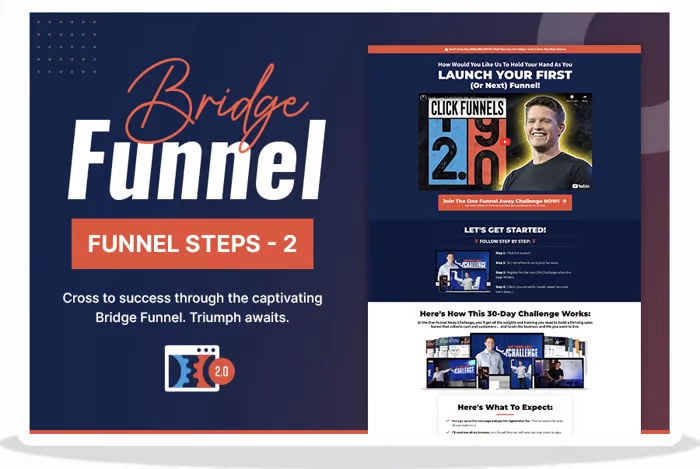
Sales Funnel Stages: The Journey From Browser To Buyer

Software Stack Editor · March 23, 2024 ·

The post Sales Funnel Stages: The Journey From Browser To Buyer appeared first on ClickFunnels.
The Internet is growing. Expanding. Swelling. Billions of people are online, swarming across vast digital webs. Those numbers create fierce competition. And it makes it harder by the day to capture someone’s attention. But that’s the name of the game—attention. We’re hunting for a sliver of attention from our future buyers. So how do we capture that attention? And how do we take that attention, bottle it up, and convert it into credit-card-in-hand buyers ready to snatch up whatever it is that we’re peddling? We take them through four sales funnel stages to convert browsers into buyers like clockwork. That’s how.

Sales funnels are like whimsical virtual devices. They were created long ago as competition on the web heated up. Back then, organic traffic on search engines was booming. It was easy to rank your pages on Google, leading to a flood of traffic, leads and sales. But as things heated up and more people realized the amount of money being made, things shifted. Ad costs rose. Search engines clamped down. And it became harder to create profitable ad campaigns. But sales funnels changed all of that. They revolutionized our ability to make money online by taking potential customers on a journey. That journey spans across multiple stages inside of a sales funnel.

Sales funnels are not like websites. They’re different. Much different. Websites are just a mishmash of data. They’re useless portals for the most part. That’s because they have no direction. No focus. Sales funnels are different. They’re direct and to the point. Like a laser beam. If you don’t have a sales funnel, you must build one now. On average, they convert at 137% higher than websites. That’s a drastic difference. And it could mean the difference between profitability and bankruptcy for a business. And when you learn how to take prospects across four sales funnel stages, you can turn that attention into cold-hard cash, day in and day out.

How Do Sales Funnel Stages Work?

To understand how sales funnel stages work, you must understand the overall temperature of traffic. Traffic is defined as individuals on the internet. Some traffic is cold. Those are people who are completely unaware of you and what you offer. Cold traffic is sometimes aware of the problems they face. We call this problem-aware. That’s an important distinction in marketing because based on the level of awareness a prospect has, the communication should vary. That means that you can’t speak to cold traffic the same way you do to warm traffic.

Warm traffic is aware of you. They may also have already shown an interest in what you do. Meaning that there are variations of temperature even within warm traffic. Some warm traffic even has a desire in what you sell. Warm traffic is beyond problem-aware. They’re sometimes solution-aware or even product-aware. They might know that there is a solution out there for their problem. And they may even know that you’re selling a product that might also solve their problem. This distinction is important because it changes how you communicate with a prospect.

Sales funnels are important because they take prospects through stages from cold and completely unaware to buyer-ready hot traffic. Once someone purchases from you they move from warm traffic to hot traffic. They’re your buyers. That’s also important because we can often get warm traffic to purchase low-ticket products or services from us easily. Sometimes we can even get cold traffic to do the same. But hot traffic is important because we can ascend hot traffic higher and higher to get them to spend more money with us. As long as we deliver real value at every level, we can ascend the buyer higher and higher on the value ladder.

Traffic Types

The goal of any sales funnel is to convert traffic into leads and sales. That makes sense, right? It’s the foundational model that encompasses everything. After all, random people floating around the internet won’t make you money. What will make you money are the people who enter your sales funnels (aka marketing funnels). However, there’s a distinction between the traffic that’s outside of your sales funnels. It’s not just the temperature of the traffic. It’s the type of traffic.

Zooming out, there are three types of traffic. The first type is traffic that you don’t control. These are random people floating around out there who might at some point become aware of you. They might see a social media post, a YouTube video, read a blog post, listen to a podcast, or become aware some other way. This is traffic you don’t control because you have no say over when or how they become aware. The traffic we don’t control is the most random type of traffic. It gives us very little insight or ability to interact with these people.

Then there’s traffic we do control. This is far more clear. It’s traffic that reaches our sales funnels directly from ads. We control the flow by paying for ads on various platforms. But whether it’s traffic we control or don’t control, the goal is always to convert those into traffic we own. The traffic we own are the people who enter our funnels by raising their hands. They provide their contact details and show an interest. They’re on our email lists, allowing us to communicate with them. And that’s how we move people across the various sales funnel stages. Through communication.

Stage 1—Awareness

Whether you call it attention or awareness, it’s the same. The goal is to capture someone’s awareness. Picture it like this. You go fishing and want to catch certain types of fish. To do that you need specific kinds of bait. You’ll never catch certain kinds of fish with the wrong bait. They just won’t bite. The same thing applies to prospects. You’re going fishing for prospects by putting bait out there on the Internet. The type of bait you put out will impact the quality of prospects you catch. This might sound like some abstract concept but I assure you that it’s not.

Awareness is the first sales funnel stage because it’s where everything begins. Remember that awareness can come from traffic we control and don’t control. The only way to truly capture that traffic is through a sales funnel. When it’s traffic we don’t control, we have to ensure there’s a link of some kind into a lead generation funnel that has the right bait. The traffic you control and run ads to is more obvious. Not the traffic you don’t control. But every single platform you create content should have some type of lead generation funnel that provides the bait to catch the right kind of fish. That’s how it works.

Remember that cold traffic is often problem-aware. That’s why you must create bait that tackles the problem and provides a solution. And the right kind of bait attracts the right kind of prospect. Meaning that if you position your bait (aka lead magnet) the right way, you will attract the right kind of prospects. For example, if you sell a high-ticket coaching service, you don’t want to attract broke college students. That makes sense, right? They can’t afford a high-ticket coaching service. But entrepreneurs with established businesses likely can.

Stage 2—Interest

Interest begins when a person raises their hand. That means they give you their contact details in exchange for some piece of value. Often that’s a lead magnet. But it can take on many shapes and sizes. For example, a lead magnet can just be a 15-minute consultation as opposed to a freebie that we send out. It can also be a free 5-minute massage in a shopping mall. All lead magnets are designed to capture your interest. Afterward, it’s the job of the business owner to take you from awareness to the next sales funnel stage of desire.

When someone displays an interest and exchanges their contact details, you add them to your email list. That allows you to communicate with the prospect. Without communication, it’s hard to move them across the various stages. And the better you communicate, the more likely you’ll convert a browser into a buyer. To do this you have to share stories. Stories are woken into the fabric of society. If you can share stories the right way, you can invoke emotion and solicit a sale. This doesn’t mean you have to be a master storyteller. You just need to know how to use stories to sell.

You’ll need a software platform like this one if you want to build all of this out without any coding knowledge. Otherwise, you’ll find it hard to build a sales funnel that moves prospects through these sales funnel stages. That’s because your sales funnel must connect to your lead magnet with a lead generation form. And that lead generation form must move people onto your email list. You can do all of that with the proper sales funnel builder.

Stage 3—Desire

The third stage of a sales funnel is desire. Desire is where you make the prospect hungry to buy whatever you’re selling. This happens through communication. It happens with story-selling. Stories are used to help build rapport and invoke emotion in the prospect. The better you can tell stories the right way, the more likely you’ll get prospects to buy. Think about it this way. A prospect is where you were years ago before you started the journey into solving the problem they’re facing. And you can use stories to help shift their belief systems on what is possible.

Desire doesn’t happen instantly. Yes, you have to share stories. But you also have to provide proof that what you’re selling works. Okay, maybe it worked for you. That’s obvious. What if it doesn’t work for them? Do you have social proof? What testimonials can you provide? How can they authenticate that what you’re saying is true? Desire is multi-faceted. It’s not just the stories we tell. Desire comes from many directions. But the more you’re able to layer these on, the more likely the prospect will come to an epiphany similar to the one that you reached when you started your journey.

The better you are at creating desire in the mind of the prospect, the more likely you’ll be to sell. Remember that most people don’t buy something on the first touch. It takes, on average, seven interactions before someone purchases something. That’s also why sales funnels are so crucial. They provide an arena for multiple interactions with the prospect. And the more you get in front of that prospect, the more likely they’ll buy the thing you’re selling. It’s as simple as that.

Stage 4—Action

The desired goal is action. Whatever action you want the prospect to take is the end goal of a funnel. That’s where it leads. Different sales funnel types have different actions. Some are designed to generate leads. Others are designed to make you money by generating sales. And others are designed for different goals like getting prospects to fill out applications or signing up for a webinar presentation. It doesn’t matter what the action is, you have to design your sales funnels in the right way to lead prospects here.

The beauty of sales funnels is that they are designed with a single purpose in mind. They’re not like websites. They don’t overwhelm you with choices. Nope. They lead you down one intended path. One goal. One result. That’s all. And that’s why sales funnels convert so well. But to get prospects to move into this stage, they have to believe that your solution will work for them. It’s not just a matter of presenting your solution. They must believe that it works first before they’ll take action. It’s not just about creating the desire. Yes, the desire must be there. But desire doesn’t move them across the goal line.

To do that we must use things like urgency and scarcity. These are some of the fundamental tenets of sales funnels and the selling process. People will not always take action unless you give them a reason to take action. For example, when you see a sale about to end it compels you to purchase. That’s urgency. There’s a countdown clock or some other impending deadline. Scarcity works in a similar way. If there are only a few things left in the store you’ll rush to buy it. Amazon shows you this from time to time when it says that only a certain number are left in stock. But you must use authentic urgency and scarcity. Don’t try to trick the prospects. That will backfire.

How To Build Your First Sales Funnel

To implement these sales funnel stages in real life you have to build a sales funnel. And at the very front of your sales funnel is your bait. It’s your lead magnet. And it must be very good. Otherwise, people won’t move from the first sales funnel stage of awareness to the second stage of interest. Interest means they’ve given you their contact details. Your sales funnel will have many different parts. But you can’t build one unless you start. You have to begin somewhere.

The best part? You can build a sales funnel without any coding skills. You don’t need to be a web developer to create a sales funnel. All you need is the right type of sales funnel software. Once you have that you can use premade templates and a drag-and-drop editor to create your sales funnel. It’s not complicated beyond understanding how to move a mouse and type. That’s it. If you can do that then you can build a sales funnel with this sales funnel builder.

How To Find The Right Sales Funnel Templates

Building a sales funnel is easy when you have the right templates. The right templates can make your life a whole lot easier. You can use them to quickly launch any type of sales funnel. Templates exist for squeeze pages. Squeeze pages are lead-generation funnels designed to squeeze the contact details out of a prospect. They also exist for webinars, application funnels, tripwire funnels, and more. There’s a sales funnel template for every type of sales funnel.

All you have to do is pick the right template for the right situation. Sometimes, funnels are designed to ascend customers higher to spend more money with you. Other times they’re designed to simply boost sales or generate leads. You don’t have to reinvent the wheel here. All you have to do is pick the right template for the right situation. Then use a drag-and-drop editor to move elements around the page. You can change colors, words, and so on. Then, roll out your sales funnel and start testing it. That’s the only way to determine if your sales funnel is working or if some part of it is broken and needs to be fixed.

Thanks for reading Sales Funnel Stages: The Journey From Browser To Buyer which appeared first on ClickFunnels.
55 Ways To Make Money From Home

Software Stack Editor · March 22, 2024 ·

The post 55 Ways To Make Money From Home appeared first on ClickFunnels.
There are many ways that you can make money today. You can make it online, offline and from home. You can make it fast or slow. In your sleep, while traveling, or while you work at a full-time job. Most know that the choices are endless. But it’s easy to feel stuck. Trapped. Overwhelmed. Unsure of where to go or what to do. You see others raking in the cash while you struggle. So the question is this. How can you actually make enough money from home to at least quit your day job?

Thanks to the Internet, we can live and work from anywhere. That’s the beauty of the world today. But human beings are habitual. We’re steeped in our daily routines. We don’t often dissect what others are doing to make money from home because we’re so immersed in our day-to-day lives. But what if things could be different? What if you didn’t have to struggle at a soul-depleting 9-to-5 job anymore? And what if your side hustle could become your main hustle? How would that change things for you?

Look, I’m not saying it’s easy to become a millionaire while working from home. That’s not the case at all. But if you’re looking to make enough money not just to survive but to thrive, especially with all the opportunities that exist online today, you have choices. Lots and lots of choices. So what ways work best? Is this about finding some work-from-home job or can you actually make money from home while working for yourself?

How To Make Money From Home

Working from home and actually making real money requires discipline. And most people lack the discipline to do what it takes to generate an income. It also requires a willingness to try things and fail fast. This isn’t about lingering. It’s about adapting and pivoting. Yes, you can earn money in many different ways. But not all of those ways will pay you enough to buy you back your freedom. After all, most want time-freedom, right? The ability to be your own boss and call your own shots. That’s the dream, isn’t it?

But the threshold here isn’t that high. You can easily make money from home if you put your mind to it. You can launch an online business or provide a service to others without spending a small fortune on inventory or goods. Pick something that you’re passionate about and it won’t feel like work. It won’t feel like an all-day grind or a never-ending hustle when you actually love the thing you’re doing. That’s really what it’s all about. And that’s far more fulfilling than working a job for a boss that you can no longer stand.

Set some goals and put in the work. Launch that small business you’ve always wanted to start or go out there and buy a boring business that already generates an income. The important thing is this. Don’t be afraid to fail and try again. The biggest thing standing in your way is time. Do you have the time to figure out how to make real money in ways you’re not used to doing it? Instead of earning a paycheck while working for a boss who’s often ungrateful for all the work you do, find the time to figure out different ways to generate an income.

1—Sales Funnel Building

The most important single concept you can learn when it comes to making any money at all are sales funnels. These are magical little devices that are designed to help you generate leads and make sales all day and night long on autopilot. You can build sales funnels for your business. Or you can design them and sell them in the funnel marketplace to generate passive income. Either way, sales funnels are the biggest key to making any amount of money from home.

2—YouTube

YouTube is not the easiest way to make money. Most people know that. But it is one of the best ways that you can earn and be your own boss. And you don’t need to show your face to make money from YouTube. Plenty of people make millions of dollars per year from faceless YouTube channels. That doesn’t mean you will. It only means that there is massive potential there. YouTube has some of the best CPMs anywhere out there. But it often requires years of devotion and hard work before it starts producing any real amount of money.

3—Graphic Design

The field of graphic design isn’t dead. Not whatsoever. Companies will always need a graphic designer. Yes, even with the rise of AI. And you can make money as a graphic designer. You could do it while working from anywhere in the world. Pick one area of graphic design and specialize in that. Hunt for clients on social media, LinkedIn, Facebook, and freelance websites like Upwork or Freelancer, through email marketing and any other way that you possibly can. And supercharge your results by building a sales funnel to generate leads for your business.

4—Prompt Engineering

Prompt engineering is the way of the future. The workforce in the future will look far different than it does today. That’s because AI will replace most of the labor market. That’s why the future will require different skill sets like prompt engineering. Understanding how to ask AI the right questions is important. The right questions can produce exponentially better results than the wrong questions. It really does boil down to understanding how to talk to machines. For now at least.

5—Affiliate Marketing

Affiliate marketing is the art of promoting affiliate links to an audience. That’s why to make money as an affiliate you’ll need some kind of an audience somewhere. It could be an email list, a following on social media, a YouTube audience, or anything else. If you don’t have an audience you could always run paid ads. But the way to really succeed as an affiliate is to use a bridge page. Bridge pages connect the affiliate offer to your email list. This way you can continue to market to those prospects and they won’t disappear forever after clicking your links.

6—Online Courses

Online courses allow you to share your knowledge and your wisdom with the world. You can create online courses in just about every area of business or life. If you have a skill, know a second language, can play a musical instrument, or you’re knowledgeable in any other field then consider creating an online course. You can easily make money from home by selling online courses through platforms like Udemy, Teachable and others. You can also build the entire course with this online course builder and do all the marketing yourself. This way, you won’t have to share your income with another platform.

7—Digital Products

Digital products offer a proven way of making money from home. To succeed, create a digital product that solves a pressing problem. And ensure you know the person experiencing that problem. Understand who they are so that you can best solve their problem. Your digital product should provide an effective solution to that problem. When it’s done, create a sales funnel designed to sell your digital product. And create a lead magnet inside of a lead generation funnel to generate leads. The lead magnet should solve part of the problem that the digital product solves.

8—Web Development

If you’re a web developer or have some web development skills, then consider doing this full time from home. You can make a lot of money as a web developer. Especially when you find the right clients. And you can do this from anywhere you live. Many areas of web development can help you earn a respectable income. Things like website development, sales funnel customization, database-driven applications, and more. You can find clients from the typical freelancing sites or you can create a lead generation funnel to hunt for clients.

9—Digital Marketing

One way to make money is to do digital marketing. You can help other companies grow their businesses. You can also help entrepreneurs or individuals looking to start a business or launch a side hustle. Digital marketing can mean many things like managing paid ads, running email campaigns, and much more. If you’re good at digital marketing, you can earn money doing this from home or anywhere around the world. The focus here should be on finding new clients. Create an application funnel with a lead magnet and schedule phone calls with prospects. That’s one of the best ways you can sell high-ticket digital marketing services.

10—Real Estate

You can make money in real estate in many different ways. And you can do it easily from home. The first way is to wholesale real estate. Wholesaling just means that you’re flipping contracts. You find a distressed seller and negotiate a low purchase price. Then, you can assign that contract to a cash buyer for a fee. Typical fees range from thousands to tens of thousands of dollars and up. It all depends on the region and the discount you can get on the purchase price. Other ways are to do fix-and-flips, long-term rentals, and more.

11—Blogging

Blogging is a proven way to make money from home. But it isn’t an easy way. Blogging takes time and patience. It requires discipline to get your content to rank. To succeed as a blogger you must also find ways you can make money from your blog. That could be by posting affiliate links inside of your blogs. It could also be by allowing advertisers to directly sponsor your blog. It could also simply be running Google Adsense ads. You’ll need a substantial audience to make good money. But it’s worth the hustle.

12—Live Streaming

Live streaming has exploded in popularity. And people of all ages are streaming from their computers at home in hopes of building a sizable audience and making money. Live streaming means that you need to be in front of the camera. You also have to be engaging and entertaining. You won’t make money if you’re boring. Can you live stream? What will you talk about? You can use platforms that are rising in popularity such as Kick. You can also stick with platforms that have been around for a long time like Twitch.

13—Social Media

There are many ways that you can make money from social media. The most popular way is to launch a social media marketing agency. That means you’re helping other businesses increase exposure and make sales from social media. If you’re good at social media, then consider doing this. Create a professional-looking profile by spending time on your posts. That’s important to others. To solicit others you must create a hero funnel. A hero funnel is a type of lead generation funnel. Then, add that link to your profile. And use direct messaging and other outreach tools to get clients.

14—Copywriting

Every business needs to write great copy. They must do that to attract and retain customers. If you’re good at writing copy then consider doing copywriting to make money. Depending on your level of skill, you could earn a lot of money as a copywriter. Some get paid exorbitant fees. Others seem to struggle while begging for work. Focus on writing copy that connects on a deeper level. To do that you should use the Pain-Agitation-Solution (PAS) framework. Identify the pain, agitate it, then present a solution.

15—Book Writing

Books will always be in demand. And today, you can easily self-publish a book on any topic. You don’t need a publisher or the approval of a publishing house to do it. All you have to do is write a good book. You can write a non-fiction book about any topic that helps people solve a problem. It can educate and inspire them. And you can publish that book on Kindle Direct Publishing (KDP). That’s Amazon’s publishing arm for its platform. If you love writing then this is an obvious way to make some money. But it won’t happen fast.

16—Narrate Audiobooks

You can narrate audiobooks on a platform called ACX. ACX feeds into Audible, which is also owned by Amazon. Audible is the repository for most of the world’s audiobooks. But most people don’t know that they can narrate audiobooks for others and get paid doing it. You can take two approaches when doing this. The first is to narrate audiobooks and get paid an hourly rate. They call it a per-finished hour rate. That means you have to do all the narration and editing, and only get paid for the length of the audiobook. The other way is to do a royalty share, which is ideal. But those deals might be harder to find.

17—Email Marketing

One of the best ways you can make money is to do email marketing. To do email marketing you need an email list. If you don’t have an email list then start one today. Right now. Stat. Because the most important asset you can have in business is your email list. Period. Nothing else even comes close. Your email list is your audience. It’s also one of the most intimate forms of communication. You can sell directly to your email list or use your email list to pitch affiliate offers.

18—Auction Management

Auction management involves sites like eBay. You manage auctions for other people who don’t want the hassle of selling their items on eBay. Customers ship items to you and you manage those listings and ensure they get sold. And in return you make a percentage of the purchase price of that product. If you’re familiar with eBay then this is a great way to make money. It requires little to no overhead costs outside of getting the word out that you can help others manage their auctions on sites like eBay.

19—Merchandising

Today, merchandising is a big business. But the beauty is that most people can sell branded products by using popular Print-on-demand services like Printful and Printify. These platforms allow ordinary, everyday people to create merchandise lines. And it requires little to no investment on your part outside of marketing to get the word out. You don’t have to buy expensive machines, warehousing, deal with shipments, or anything else. You simply have to create the designs and sync those designs with a popular ecommerce platform like Shopify or Amazon.

20—Website Testing

Although websites are dying a slow and painful death, companies are still paying others to test their websites. Website testing is a niche that allows ordinary people to make money from home by simply testing out websites and providing feedback. For example, a site like User Testing is used by many companies to gain feedback on their websites and landing pages. If you enjoy testing out sites and providing feedback, you could make a bit of money doing this.

21—Translations

Do you speak a second language? Are you fluent in that language? If so, you could always do translations to make money. Although there are AI systems to do translations, there’s still nothing like a human translation of text. Especially when it’s an important piece of content that needs to be translated. Although AI is catching up, you can still actually earn some money doing translations. You can use a site like Translate.com to get paid doing translations.

22—Online Notary

In the United States, a notary helps witness a signature. This is used in real estate transactions, wills, and other situations where you must verify the person signing the document. And thanks to the Internet, you don’t always have to appear in person. You can actually do online notarizations. You can make money doing this by becoming a mobile notary. Many companies offer certification to notaries but the biggest one is called the National Notary Association (NNA).

23—Freelancing

Many people earn a living as freelancers. You can live and work anywhere in the world and do freelancing. Many sites are devoted to uniting freelancers with people who need work done. Sites like Upwork, Freelancer, Fiverr, and many others can help you do this. If you’re skilled in any professional area, then consider freelancing to make money. Some freelancers make a lot of money. Especially freelancers with in-demand skills like web development, Web3, search engine optimization, and more.

24—Newsletters

You can write newsletters and build an audience of paying newsletter subscribers to make money. This one will require some real work and skill. You must be knowledgeable in your field. And you have to have a great offer if you want to sell paid newsletters. But you can also do free newsletters and use that opportunity to promote existing products or services that you sell. You can also use them to promote affiliate offers and even get other businesses to pay you to advertise in your newsletter. You’ll need a substantial audience to make any serious money but it’s well worth the investment of time.

25—Membership Sites

Membership sites offer recurring revenue month after month. This allows you to make money on autopilot. You’re not struggling to find new customers every month if you don’t want to. And you can build membership sites with zero coding skills or web development know-how using this membership site builder. Come up with an idea or concept where you can drip out high-value content regularly. That’s the basis for a membership site. Design a great lead magnet with a high-converting landing page to ensure your membership site succeeds.

26—Vending Machines

Vending machines provide a great opportunity to make money. That’s because most businesses and areas could use vending machines. They add value to the area by keeping customers happy. For example, hospital waiting rooms are a great location for vending machines. So are schools and other public facilities. But you can place them in many businesses. And most businesses will gladly let you place vending machines in their stores as long as you maintain them. Meaning that you won’t have to pay a commission to place them there.

27—Boring Businesses

Most of the hard work of building a business occurs at the beginning. And after all that work, some business owners just want out. They don’t want to keep operating a business. That’s where you can swoop in and buy some of these businesses. And if you can find so-called boring businesses, you can make a lot of money very quickly. That’s because you’re simply stepping into the business once it’s fully operational. It has customers and employees. It operates day in and day out. These are typically the most common types of businesses that most people overlook. Places like tanning salons, gyms, laundromats, and so on.

28—Website Flipping

You can flip entire websites today for a profit. All you need to do is go to a site like Flippa or Empire Flippers and search for an online business for sale. These businesses have traffic, leads, and sales. They’re fully functioning websites that are making money. All you need to do is purchase the site. Then, increase its traffic and sales to sell it for more. If you have digital marketing skills, then this is perfect for you. It’s an ideal way to make money from anywhere in the world.

29—Host Webinars

Webinars are presentations made online. They can either be live or automated. Webinars are used to sell high-ticket services and premium products such as high-end furniture installations, solar panels, and more. Webinars are used by some of the biggest businesses to increase sales and revenue fast. They offer one of the best methods for helping break false beliefs that hold prospects back from completing a sale. This is important for products and services ranging anywhere from $1,000 to upwards of $100,000. You can learn more about how you can create a profitable webinar here.

30—Product Launches

Product launches allow you to roll out a new product to an existing audience. If you have an audience somewhere they consider doing this. You’ll need an email list. And the way it works is that you start sending out daily emails over the first four days. On the fifth day, you launch your offer and tell people that the cart will be open for a short period. That creates urgency. During the rush to sign up or buy, you inform people that the cart is closing soon. Then, actually close the cart so that it’s an authentic product launch. This helps reinforce trust in you as a business or a marketer.

31—Lead Generation Business

Every business on the face of the earth needs leads to survive. Leads are essential for keeping the lights on because they’re the source of sales. Without leads, you can’t expect to make money in a business. That’s why lead generation businesses are vital. They generate leads that are sold to businesses. For example, Zillow is a lead-generation business. They generate endless leads that can then be sold to real estate agents, mortgage companies, insurance companies, and more. If you’re good at generating leads, consider launching a lead generation business to make money.

32—Search Engine Marketing

Search Engine Marketing (SEM) involves paid ads to drive traffic to a site. Companies use it to increase their traffic. And you can help companies manage their SEM by managing paid ads. You can do this on a platform like Google Ads by doing search marketing ads, retargeting ads, display ads, video ads and more. You’ll need a great landing page for a lead generation offer that’s proven to convert. Then, it’s just a matter of getting the right eyeballs to reach that page. You can get paid a good amount of money to do this. Especially if you’re very good at it.

33—Gaming

Today, you can make money just by playing video games. It’s literally that easy. You can play video games on many platforms like Twitch and actually make money doing it. All you need to do is build an audience while playing video games on one of these streaming services. You can also do live gaming on platforms like YouTube, Kick, and others.

34—Video Editing

Today, video editing is an important skill to have. Short-form videos have now taken over on many platforms like TikTok, YouTube Shorts, Snapchat, and more. If you have video editing skills you can use those skills to make some money. Find clients looking for video editing services. You can do that by building out a lead generation funnel and promoting it on social media. Appeal to business owners who don’t have the time to edit short-form videos because they’re busing running their business.

35—Transcribing

You can make money by transcribing audio and video. You can use a site like Rev and many others. Although there are AI transcription tools, human transcription is still the most accurate. And companies are willing to pay for this service. You can transcribe legal proceedings, insurance calls, and more. Although you won’t make a fortune doing this, it’s something you can easily do from home to make a little bit of extra cash.

36—Peer-to-Peer Lending

Peer-to-peer lending services are all over the Internet. It allows you to lend out a bit of money to others and make a small interest rate. Platforms like Prosper and Lending Club allow you to determine who your money is loaned out to. Depending on the amount of money you put up for lending, you could make a sizable income from this method. It does take money to make money with peer-to-peer lending. Do your research and assess the risks of lending your money to others through these platforms.

37—Handmade Products

You can sell handmade products on sites like Etsy or Handmade and make some extra side cash. You can even make this your primary source of income and build it into a big business. If you enjoy crafting handmade products then this is perfect for you. You’ll need to find a good source of customers for your store, which is what most people find challenging. If you’re active on social media, you can use it to showcase how much time and effort you put into your products. And it can be used to drive sales.

38—Take Online Surveys

Online surveys will not make you rich. But you can take online surveys from anywhere in the world. You can even do it on your lunch break, before work, or after work. It doesn’t take a large investment of time. But it is one quick and easy way to make a little bit of money. You can use websites like Inbox Dollars and Swag Bucks to take online surveys. These two offer the most potential for earning with surveys out of all the other sites out there.

39—Flip Sneakers

You can flip sneakers for a profit. Apps like StockX and GOAT allow you to buy and sell sneakers quickly. You’ll get exposure to a wide audience by using apps like this. You can also find sneakers for sale in department stores and resell them. You can also be the first in line for releases that have low inventory, then sell those on StockX.

40—Sell Used Clothing

You can sell your used clothing on sites like ThredUp and PoshMark. If you have a lot of clothes sitting around your house that you want to get rid of then consider doing this. You can also hit the thrift stores and find great deals to resell online. If you find vintage scores, you can also try to sell those on sites like eBay and OfferUp.

41—Invest In REITs

Real Estate Investment Trusts (REITs) allow you to earn money passively through an investment vehicle that’s tied to the real estate market. Your investment is into a company that usually has cash-producing assets in real estate. These could be residential properties, commercial buildings, or industrial flex space. Two types of REITs exist. The first is a Mortgage REIT. And the second is an Equity REIT.

42—Create Apps

Even if you don’t know how to code, you can build apps for companies. These no-code apps are simple and straightforward to build on many platforms that offer this service. Sites like Glide and Bubble allow you to build no-code apps. They might not have all the features you want, but they offer a templated approach to creating these apps.

43—Search Engine Optimization

SEO is a high-level skill you can use to make money from home in many ways. You can either use SEO to rank content on the internet. That content should be designed to sell something. It could be a piece of content that promotes a product or a service. And it can also be content that promotes an affiliate program. You can also make money in SEO by starting an SEO company to help other companies rank their content on search engines. However, SEO is not easy. And most companies approach it the wrong way by using shady tactics and shortcuts to rank. Learn how to do it the right way and you’ll succeed over time.

44—ATM Business

ATMs are everywhere you turn. But not every business has an ATM that needs one. And ATMs will pay you a transaction fee for every time someone uses them to withdraw cash. This transaction fee is small but it adds up over time. You can approach different businesses and ask them to place an ATM in their store. Some will want rent. Others will allow you to place an ATM there simply because it adds more value to their business.

45—Do Voiceovers

If you have a good voice, you can make money doing voiceovers. Many companies are constantly hiring individuals to help them with voiceovers in many applications. This is not just about doing voice acting for movies, shows, or commercials. You can actually get gigs doing voiceovers for promotional videos, YouTube, pre-rolls, and more. You can use sites like Upwork and Fiverr to find clients.

46—Vacation Rental Management

You can manage vacation rentals and make money without ever leaving your home. Vacation rental management involves helping property owners secure guests for their vacation properties. They can be homes, condos, townhomes, or apartments anywhere in the world. Most owners don’t want to deal with the hassle of managing vacation rentals. That’s where you come in. You can use existing vacation rental sites to help find guests. You can also find local staff in the area of the property to clean the property and provide help when the guests need it.

47—Create Music

You can create songs and melodies online that you offer to others for a profit. You can license music on many of the popular music platforms. For example, sites like Epidemic Sound and others allow you to offer your music on their site to creators. Creators can use these songs for many applications. They can be used in YouTube videos, promo reels, as part of an intro to a commercial, and so on. If you enjoy making music then you should consider doing this.

48—Snapchat

You can make money on an app like Snapchat in many different ways. The first is if you have over 50,000 followers. You can monetize your views in the Snap Stars Program. You can also help other companies grow their Snapchat following. Plus, you can promote products and services on Snapchat or even run affiliate offers. You must do this with tact or risk getting banned. However, Snapchat appeals to a wide, younger demographic. So you must keep that in mind when trying to push certain products or services on the platform.

49—Fortnite Maps

Some creators are making a lot of money from home by building Fortnite maps. Fortnite is a popular game played by millions of people from around the world. Fortnite has something called the Creator Economy, which has payouts. If your maps are being used by a lot of players, it could generate thousands of dollars per month in income.

50—Launch Podcast

Podcasts are very popular these days. You can use podcasts to grow a business in any niche, promote other brands, and build authority in a niche. Podcasts where you share stories and events from your life can also build a strong bond with your audience. It creates rapport because it’s an intimate platform where people are listening directly to you and what you have to say. You can also use podcasts to push affiliate offers, sell digital products, promote online courses, and more.

51—Rent Your Driveway

Most people don’t know this but you can actually rent out your driveway to others. This allows you to make money from home with your home (no pun intended). If you live in a busy area or you have a parking spot in a garage in the middle of a downtown metropolis, you can earn money doing this. Apps like JustPark and even Spacer allow you to make money doing this. It helps if you live near a city center, beach, airport, arena or other busy area.

52—Car Rentals

You can rent out your car on popular apps like Turo to make a bit of extra cash. Turo allows you to turn your vehicle into a cash-producing asset. Some owners on Turo purchase multiple vehicles, each making them some extra income each month. Turo does take work and there is some headache involved in dealing with renters, late returns, tickets, and damages. However, it is well worth the time invested. This is especially useful if you have an extra vehicle that’s getting little usage.

53—Amazon FBA

Amazon FBA has been one of the most popular ways to make money online for some time now. Long ago, the Amazing Selling Machine was an online program that catapulted the notion of selling on Amazon into the stratosphere. Most of the products you see sold on Amazon are actually sold by third-party sellers. They sell everything under the sun. You can supplements, fitness equipment, kitchen products, and more. You’ll need to find a good manufacturer and figure out all the logistics. Amazon takes a healthy cut of the profits. But there is just so much buyer demand on Amazon that it’s hard to compete with a platform like that for online sales.

54—Sell Used Electronics

You can sell your used electronics such as mobile phones, tablets, and laptops for quick cash. You can use platforms like Swappa and also Gazelle to sell them fast. And if you can find cheap electronics for sale at thrift shops, garage sales, and estate sales, you can turn around and flip them for a profit by using these platforms.

55—Flip Cars

If you have some extra cash that allows you to invest in cars, you can always flip cars. You can find distressed sellers looking to sell you their vehicle at a reduced rate. You can then clean up that vehicle, then turn around and sell it for a profit. Used vehicles can be found in many places online and offline. Learn the art of negotiation and move quickly when you spot a good deal.

Thanks for reading 55 Ways To Make Money From Home which appeared first on ClickFunnels.
The 14 Best Copywriting Tools For 2024

Software Stack Editor · March 22, 2024 ·

The post The 14 Best Copywriting Tools For 2024 appeared first on ClickFunnels.
Want to take your copy to the next level in 2024?

Here are the 14 best copywriting tools that can help you with that:

Table of Contents:
  • #1. Ahrefs
  • #2. AnswerThePublic
  • #3. BuzzSumo
  • #4. Hemingway Editor
  • #5. Clearscope
  • #6. Grammarly Premium
  • #7. Headline Hacks
  • #8. Sharethrough Headline Analyzer
  • #9. Copyscape 
  • #10. Hootsuite
  • #11. Meta Ad Library
  • #12. Really Good Emails
  • #13. Copywriting Examples
  • #14. Notion
  • Want to get ALL of Your Ads, Emails, and Sales Pages Written WITHOUT Having to Hire an Expensive Copywriter? 

#1. Ahrefs

Ahrefs

Ahrefs is one of the most popular SEO tools out there.

This software is widely considered to be the industry standard among online marketers who specialize in search engine optimization. 

Features

Here are some of the Ahrefs’ most noteworthy features:

  • Site audit feature that you can use to scan your website for potential SEO problems.
  • Keyword explorer feature that you can use to discover promising keywords.
  • Content explorer feature that you can use to research content ideas and find link building opportunities.
  • Site Explorer feature that you can use to research your competitors, learn about their strengths and weaknesses, and understand their SEO strategy.
  • Rank tracker feature that you can use to monitor your ranking progress for your target keywords.
  • Dashboard that you can use to get a high-level overview of the performance of all your SEO projects. 

Pricing

Ahrefs has four pricing plans:

  1. Lite plan at $99/month that provides essential data for small businesses and hobby projects. 
  2. Standard plan at $199/month that is perfect for freelance marketers.
  3. Advanced plan at $399/month that provides more data and tools for in-house marketing teams. 
  4. Enterprise plan that starts at $999/month that is custom and ideal for marketing agencies and large companies.

You can get 2 months for free if you choose to pay annually.

Ahrefs doesn’t seem to have a free trial but you can sign up for its Webmaster Tools to get free limited access to Site Explorer and Site Audit features. 

Best For: Search Engine Optimization 

We highly recommend investing in Ahrefs if you are serious about search engine optimization. It’s arguably the best SEO tool on the market!

#2. AnswerThePublic

AnswerThePublic

AnswerThePublic is a search listening tool that can help you understand what is important to your dream customers.

Features

Here are some of the AnswerThePublic’s most noteworthy features:

  • Free keyword research tool that you can use to see what questions people are typing into Google, Bing, YouTube, and Amazon search engines. 
  • Search listening feature that you can use to monitor specific keywords.
  • Data comparison feature that you can use to see how Google searches around a particular topic have changed over time. 
  • Data visualization feature that you can use to export data and present it to other people in a way that is easy for them to understand. 

Pricing

AnswerThePublic has three pricing plans:

  1. Individual plan at $9/month that is best suited for entrepreneurs, consultants and small businesses. You can also pay a one-time $99 fee for lifetime access. 
  2. Pro plan at $99/month that is best suited for marketing agencies and in-house marketing teams that need to monitor specific business search terms. You can also pay a one-time $990 fee for lifetime access. 
  3. Expert plan at $199/month that is best suited for in-house marketing teams that need to monitor their brand’s reputation. You can also pay a one-time $1990/month fee for lifetime access.

AnswerThePublic offers a 7-day free trial. 

Best For: Search Listening

AnswerThePublic can be a valuable customer research tool to add to your arsenal because popular search terms provide insight into the psychology of people who use them. 

As the company explains on their website, sometimes people search for mundane stuff like “How do I remove paper jam” but other times their searches reveal their gut-wrenching fears and secret hankerings. 

This app gives you access to all that data!

#3. BuzzSumo

BuzzSumo

BuzzSumo is a content marketing tool that can help you come up with content ideas that resonate with your dream customers.

Features

Here are some of the BuzzSumo’s most noteworthy features:

  • Content discovery feature that you can use to browse topics, trends, and forums. This can help you generate content ideas.
  • Content research features that you can use to access insights from a huge data set of billions of articles and social media posts. 
  • Influencer research feature that you can use to look beyond vanity metrics and find people who have engaged audiences, genuine authority and real influence. 
  • Online monitoring feature that you can use to track brand mentions, keep an eye on your competitors, and stay up to date with the latest developments in your industry. 

Pricing

BuzzSumo has four pricing plans:

  1. Content Creation plan at $199/month that is best suited for freelance marketers and marketing agencies.
  2. PR and Comms plan at $299/month that is best suited for marketing agencies that need to do media outreach and monitor media coverage. 
  3. Suite plan at $499 that is best suited for large companies with in-house marketing teams.
  4. Enterprise plan at $999/month that provides access to everything that BuzzSumo has to offer. 

You can save 20% if you choose to pay annually. 

BuzzSumo offers a 30-day free trial. 

Best For: Discovering Trending Topics

BuzzSumo can be helpful to copywriters who want to capitalize on the latest trends in their industries. 

#4. Hemingway Editor

Hemingway Editor

Hemingway Editor is an editing tool designed to help writers improve the readability of their content. 

Features

Here are some of the Hemingway Editor’s most noteworthy features:

  • Readability score feature that shows you the grade level of your content.
  • Style feature that highlights potential stylistic issues such as adverb and passive voice use, complicated phrases, hard-to-read sentences, and so on.
  • Rewriting with AI feature where AI rewrites your text for you to make it more readable.

Pricing

Hemingway Editor has three pricing plans:

  1. Individual 5K plan at $10/month that includes 5,000 AI sentences per month.
  2. Individual 10k plan at $15/month that includes 10,000 AI sentences per month. 
  3. Team 10k plan at $15/month that includes 10,000 AI sentences per month and allows you to manage licenses for your team on a single bill. 

There’s also a free 14-day trial with up to 200 sentence corrections. 

Best For: Improving Readability

Hemingway Editor can help you improve the readability of your copy so that big words and complex sentences won’t get in the way of conversions. 

#5. Clearscope

Clearscope

Clearscope is a content optimization tool designed to help writers optimize SEO content. 

Features

Here are some of the Clearscope’s most noteworthy features:

  • Content score where your content gets graded on a scale from A++ to F-. This makes it easy to understand how your content compares to the content that is currently ranking for your target keyword. 
  • Word count information that shows you the word count of your content and the typical word count of the content that is currently ranking for your target keyword. 
  • Readability score that shows you the grade level of your content and the typical grade level of the content that is currently ranking for your target keyword. 
  • Semantic keyword scores show you how many times you have mentioned related keywords in your content and how many times the same related keywords are typically mentioned in the content that is currently ranking for your target keyword. 

Pricing

Clearscope has three pricing plans:

  1. Essentials plan at $199/month that is best suited for freelancers and solopreneurs.
  2. Business plan at $599/month that is best suited for marketing agencies and in-house content teams.
  3. Enterprise plan with custom pricing that is best suited for large companies. 

There doesn’t seem to be a free trial.

However, the billing is monthly and there’s no minimum contract so you can cancel your Clearscope subscription at any time. 

Best For: Optimizing Content for Search Engines

Clearscope can help you increase the likelihood of ranking for your target keyword. 

#6. Grammarly Premium

Grammarly Premium

Grammarly is a popular proofreading app.

Features

Here are some of the Grammarly’s most noteworthy features:

  • Proofreading feature that you can use to check your spelling, grammar, and style. 
  • Tone feature that describes the tone of your content and provides suggestions on how to adjust it if the current tone doesn’t match what you have in mind for that piece. 
  • Writing suggestions feature where you get tips on how to improve your content.
  • AI writing partner feature where you can ask AI to rewrite your content.
  • Plagiarism detection feature that can help you catch accidental plagiarism where a fragment of the text that you wrote matches a fragment of some other text that has already been published online.

Pricing

Grammarly has three pricing plans:

  1. Free plan that is best suited for writers who only need basic proofreading features.
  2. Premium plan at $12.50/month (billed annually) that is best suited for writers who need to write in a specific tone. 
  3. Business plan at $15/member/month (billed annually) that is best suited for content teams that must ensure that all content is written in their brand’s tone and complies with its style guide. 

There doesn’t seem to be a free trial but you can sign up for a free plan if you want to check out the app’s core functionality. 

Best For: Proofreading

Grammarly is widely considered to be one of the essential tools of the trade by professional writers. It’s arguably the best proofreading app out there!

#7. Headline Hacks

Headline Hacks

“Headline Hacks” is a free cheat sheet that features proven headline formulas that are based on the headlines used by some of the most popular media outlets in the world. 

Best For: Writing Headlines

“Headline Hacks” is an excellent resource for beginner copywriters who want to learn how to write better headlines. Master these formulas first, then start improvising to create your own style!

#8. Sharethrough Headline Analyzer

Sharethrough Headline Analyzer

Sharethrough Headline Analyzer is a free tool designed to help you optimize your headlines. 

Its headline quality score is based on a complex linguistic algorithm that takes into account more than 300 variables.

You also get an engagement score and an impression score. Interestingly, these scores can be deflexive, meaning that what increases one score may decrease the other.

The app also highlights the strengths of your headline and provides suggestions on how to make it better. 

Best For: Optimizing Headlines 

Sharethrough Headline Analyzer is arguably the best headline optimization tool out there. We recommend running your headlines through it to see how you can improve them. 

#9. Copyscape 

Copyscape

Copyscape is a plagiarism detection tool suite. 

Products

Copyscape has three core products:

Free Text Comparison Tool 

You can use this free comparison tool to compare two articles or two web pages and see if there’s any duplicate text and if so what’s the duplicate text percentage. 

Copyscape Premium

You can use this tool to compare texts against web content to see if there’s duplicate text. 

If Copyscape detects duplicate text online it will show you the websites where it’s featured and what percentage of the text you provided is duplicated on each website.

Copysentry 

Copysentry is a plagiarism protection tool that enables you to monitor the web for plagiarized content. 

You can set daily or weekly web scans and get email notifications when new copies of your content appear. If you need to look up old instances of plagiarism, you can access historical data. 

If you are dealing with more than one case of plagiarism, the software makes it easy to keep track of all ongoing cases and your responses to them.  

There’s also a feature that allows you to whitelist specific websites so that Copysentry would ignore them. 

This can be helpful if you have given permission to someone to republish your content and don’t want to get notifications every time they do so. 

Pricing

Copyscape Premium costs $0.03 per search for up to 200 words and then an additional $0.01 per extra 100 words. 

This app follows a pre-paid pay-as-you-go model where you need to put money in your account in advance and then the cost of each search you run gets deducted from your account balance.

There’s a helpful feature where you need to manually approve searches that cost more than your price-per-search limit (e.g. more than $0.20).

This ensures that you always know how much a search will cost before running it. 

Copysentry Standard (weekly protection) costs $4.95/month for up to 10 pages and then $0.25 for each additional page.

Meanwhile, Copysentry Professional (daily protection) costs $19.95/month for up to 10 pages and then $1/month for each additional page. 

Best For: Detecting Plagiarism

Copyscape can help you avoid accidentally plagiarising other people’s content. 

Moreover, it can also help you avoid accidentally plagiarising yourself, which can become an issue if you have been publishing content on the same topics for a long time. 

This is important because Google doesn’t like duplicate content and having it on your website can make it more difficult for you to rank for your target keywords.

#10. Hootsuite

Hootsuite

Hootsuite is an all-in-one social media marketing platform that has everything you need to build, manage, and grow a social media following. 

Features

Here are some of the Hootsuite’s most noteworthy features:

  • OwlyWriter AI feature that you can use to generate social media captions, get content ideas, and increase your reach by recreating your top-performing posts without using duplicate text.
  • Social media content timing feature that can help you figure out the best time to post based on your own historical data. 
  • Social media scheduling feature that you can use to plan, schedule, and publish content for all your platforms from a single dashboard.
  • Social media engagement features that you can use to boost various engagement metrics.
  • Social media analytics feature that you can use to see your social media metrics for all your platforms in one place.
  • Social media inbox management feature that you can use to respond to comments, messages, and customer support inquiries.
  • Social listening features that you can use to find out what people are saying about you, learn about the latest industry trends, and keep an eye on your competition. 

Pricing

Hootsuite has three pricing plans:

  1. Professional plan at $99/month (billed annually) that is best suited for influencers, content creators, and freelance marketers. 
  2. Team plan at $249/month (billed annually) that is best suited for marketing agencies and in-house marketing teams. 
  3. Enterprise plan with custom pricing that is best suited for large companies. 

Hootsuite offers a 30-day free trial but if you skip it you will get a 20% discount on your chosen plan. 

Best For: Social Media Copywriting

Hootsuite can help you understand what content resonates with your audience, enable you to produce that type of content consistently, and provide you with the tools you need to maximize its impact in terms of reach and engagement. 

#11. Meta Ad Library

Meta Ad Library

Meta’s official Ad Libary is an ad search engine that allows you to search:

  • Ads that are currently running on Meta’s properties including Facebook and Instagram.
  • Ads that have run anywhere within the European Union in the past twelve months.
  • Ads related to social issues, politics, or elections that have run in the past seven years. 

You can set the location, choose the ad category, and then use either the name of the advertiser or a specific keyword to search ads.

Search results will show you all relevant ads that are currently running on Meta’s properties, which platforms they are running on, and how many other ads are using the same creative and text, plus some additional information. 

Best For: Ad Copywriting Inspiration

Got stuck writing ad copy?

Meta’s Ad Libary can be a great place to get some ad copywriting inspiration! 

#12. Really Good Emails

Really Good Emails

Really Good Emails is a free database of over 10,000 marketing emails.

These emails are organized in these easy-to-browse categories:

  • Behavioral. This category includes abandoned cart emails, engagement and re-engagement emails, customer appreciation emails, and more. 
  • Enhancement. This category includes interactive emails, countdown emails, video and GIF emails, and more. 
  • Inaugural. This category includes activation emails, welcome emails, onboarding emails, and more.
  • Industry. This category includes a wide variety of industries from pet supplies to marketing to real estate. 
  • Miscellaneous. This category includes confirmation and verification emails, deactivation and renewal emails, cancellation emails, and more. 
  • Promotional. This category includes product launch emails, sales emails, winback emails, and more. 
  • Punctual. This category includes alert emails, reminder emails, apology emails, and more. 
  • Seasonal. This category includes Halloween emails, Black Friday and Cyber Monday emails, Christmas and New Year emails, and more. 

There’s also a paid app that you can use to create an email library, organize those emails into collections, and share them with your team and clients.

This app comes with a 14-day free trial and costs $9/month.

Best For: Email Copywriting Inspiration

Really Good Emails is a great tool for email copywriters.

Whenever you have to write a marketing email and need some inspiration, you can use its database to look up similar emails. 

You can also browse it to see how popular brands are approaching email marketing, study their emails, and learn from them.

#13. Copywriting Examples

Copywriting Examples

Marketing Examples is a collection of various marketing examples with short commentary from the site’s founder Harry Dry. There’s also a weekly newsletter.

Meanwhile, Copywriting Examples is its sister project that features copywriting examples. It’s just screenshots without commentary.

You can sort these copywriting examples by:

  • Type. This category includes a header, story, features, social proof, lead magnet, and ad copy examples. 
  • Style. This category includes simple, creative, rhetorical, contrast-driven, conversational, and outcomes-based copy examples. 
  • Audience. This category allows you to choose between B2B and B2C copy examples.

This sorting feature can be really helpful if you are struggling with something specific and need inspiration.

Say, if you can’t come up with a compelling headline + subheadline combination for your offer, you can go to Copywriting Examples, sort by type “Header” and browse the header copy examples.

Best For: Copywriting Inspiration

Both Marketing Examples and Copywriting Examples are great for copywriting inspiration!

#14. Notion

Notion

Notion started out as note-taking software and then evolved into a collaboration platform for teams.

However, it has stayed true to its note-taking roots and remains one of the most popular note-taking apps out there. 

Notion can work well for pretty much anything that requires taking notes: jotting down random ideas, organizing your recipe collection, plotting your seven-volume epic fantasy series, you name it. 

Moreover, if you are only interested in the note-taking functionality of this app and don’t need the team collaboration features, you can sign up for the free plan that was designed specifically for that use case.

Best For: Creating Your Swipe File

A swipe file is a collection of copywriting examples that copywriters use for inspiration. 

The previously mentioned tools Headline Hacks, Really Good Emails, and Copywriting Examples are public swipe files. 

Public swipe files like that are great but every copywriter should also build their own swipe file that is tailored to their needs.

Notion is a great app for this!

Want to get ALL of Your Ads, Emails, and Sales Pages Written WITHOUT Having to Hire an Expensive Copywriter? 

Our co-founder Russell Brunson took our company from zero to $100M+ in annual revenue in less than a decade. You know what he credits his success to? 

Not software. Not funnels. Not marketing. Copywriting! 

“Copywriting is what made me rich… 

It has more impact on how much money you make with your company than anything else.”

Entrepreneurs love to obsess about ad targeting, funnel structures, and conversion rate optimization. But guess what?

The #1 reason why sales funnels don’t convert is COPY. 

This means that if you want your sales funnel to convert…

You either need to hire a world-class copywriter to write copy for you which can be extremely expensive. 

OR

You need to become a world-class copywriter yourself which will take you at least a decade.

BUT WAIT!

What if there was a third option?

Funnel Scripts is a software developed by our friend and colleague Jim Edwards who is a world-class copywriter and the author of the best-selling book “Copywriting Secrets”. 

With this app, you can get your ads, emails, and sales pages written for you in as little as 10 minutes.

All you need to do is fill out a questionnaire about your business, choose the type of copy that you want and it will generate it for you. Sounds crazy but it’s true!

If you want to learn more about this revolutionary software, you can watch this free web class where Russell and Jim explain everything and demonstrate exactly how it works:

Watch “Funnel Scripts: The Case AGAINST Copywriters” Now

P.S. This web class is completely FREE. So what are you waiting for? 🧐

Thanks for reading The 14 Best Copywriting Tools For 2024 which appeared first on ClickFunnels.
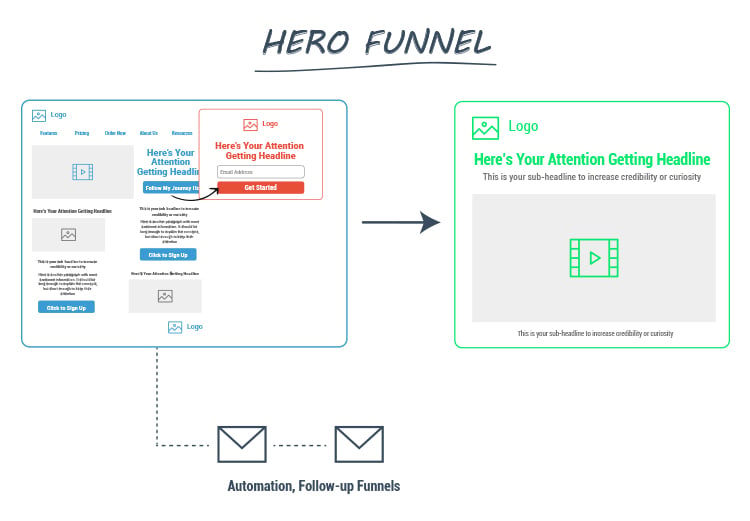
How To Start An Online Business And Make Money

Software Stack Editor · March 21, 2024 ·

The post How To Start An Online Business And Make Money appeared first on ClickFunnels.
You’ve always had a dream. A burning desire. The passion to do something more. To be more. To build a business from the ground up. It’s etched into your brain. Ever since you were a child you could see it clearly in your mind’s eye. You could picture it vividly. Like a lucid memory come to life, you could see yourself as the boss—El Jefe. The head honcho in charge. The mere thought gives you goosebumps. It sends chills running up and down your spine just thinking about life as a successful business owner.

But time plays tricks on us. And that dream of owning a business that you’ve had for ages is fading fast. Today, it feels like a fantasy. Like a distant picture in black and white, it withers away with time. You’ve always wanted to fulfill your dreams to start that business. But something has been holding you back. Something’s standing in your way. The fear of failure will do that to you. It’ll stamp out your dreams and rob you like a thief in the night. And with each passing day, it feels like a little part of you is chipping away. Disintegrating. Shrinking. Dimming like a star losing its luster.

The truth? Many people want to start an online business. But it isn’t that easy. It’s not as straightforward as snapping your fingers and deciding one day that enough is enough. You can’t just get fed up and walk away from a job that’s helping you survive, right? Or can you? But what if you fail? What if you can’t make it? What’ll happen to your house or your car? How will you feed your kids? That thought keeps you up at night. And it holds you back from starting that online business you’ve always wanted to start. But there’s no time like the present moment for a change. To begin. To start anew. The best time is always NOW.

Want To Start An Online Business?

If you want to start an online business you must plan. You must plot. Scheme. Envision. And come up with a strategy to grow that business. Is it easy? Nope. Most people fail. But some make it through to the other side. They succeed. They make that dream of owning an online business a reality. And you can too. You can start an online business in any industry or niche and succeed as long you adhere to a few fundamental principles that govern online marketing success. It’s straightforward. Simple, even. There’s a process you must go through. It takes work and effort. But with the right offer to the right market, you could just smash it out of the proverbial ballpark.

What type of business will you start? Where do you even begin? How do you build this so-called business and set yourself up for success? The truth? Most people fail in business because they’re slow out of the gate. Like a tortoise, they tiptoe forward with unease. But money loves speed. And if you want to succeed, you must focus on the right things. It’s not about perfecting your product or service. Yes, it must be good enough to solve the problem your customers are experiencing. But starting an online business and actually succeeding involves much more than that.

To succeed in business, it’s not just about your product or your service. You could have the best product under the sun. You could have the most unbelievable service known to man. But what happens if no one knows about it? What happens when you don’t spend your time marketing that business? If you fail to gain the right amount of attention from the right people, your business will flop. And attention is the name of the game. You must get attention from the right people. And you must understand how to capture and harness that attention by taking the customer on a journey.

Where Do You Begin?

So where do you start? Let’s say for a moment that you’re ready to launch that online business. It could be a small business, a boring business, a big business, or anything in between. What’s the right move? How do you begin? Do you need capital to launch your business? And how do you actually get people to give you money? You see, most people who start a business go about it the wrong way. They think of an idea then they start obsessing over that idea. They tinker and toil day and night creating a product or a service that represents that idea. But that’s not the right way to approach it.

Instead, think about it this way. What problem can you solve? And who can you solve it for? That’s the real way to start a business. People will pay for results. So if you can solve a real problem that people are experiencing, they will gladly pay you day and night. Now ask yourself this question. What is a problem you can solve? And who’s experiencing that problem? That’s the basis for everything. As long as you can solve that problem and solve it the right way for that person, you’re in business. You don’t need a fancy website or logo to begin. You just need to start solving problems.

I know. I know. It sounds basic, right? Just go out there and solve problems. It can’t be that easy, can it? Well, that’s the basis of it. And if you take that approach, everything else will be easier. Much easier. Start with the problem and the person experiencing that problem. And ensure that the person experiencing that problem has the money to pay you to solve it. Meaning that you shouldn’t start solving problems for broke college students. Solve problems for people who can afford to pay you to solve those problems.

Step 1—What Problems You Can Solve?

Companies and people face problems every single day. They face them in every area of business and life. Your job? Find the right problem you can solve for the right person. And get the attention of the people experiencing that problem. When you’re just starting it means that you have to actually prove that you can solve their problem. To do that you need something called a lead magnet. A lead magnet helps a prospect solve the very problem you claim to solve. And you give it away for free as part of a lead generation funnel.

When you give something of value that can solve a person’s problem it creates authority. In their mind, you become an authority. After all, you are. You know how to solve their problem. But you’re probably thinking this is odd, right? If you solve their problem through a lead magnet, they won’t need your help. But that’s not the case. At least not for all of the people. Sure, some of them will disappear. And that’s okay. You still gave them value. But a small percentage of them won’t disappear. Nope. On the contrary. They’ll pay you for implementation. They’ll buy the product or service you’re selling.

Create An “Ask Campaign”

You could be an expert in an industry or niche. But that doesn’t mean you understand all the problems people are struggling with. It might be something you haven’t thought about. I’m not talking about general problems. I’m talking about specific problems your customer is facing. You might not know all of them. And by knowing the problems you can devise products and services designed to tackle those problems. It could be something so obvious that you simply miss it. That’s why you need to create an Ask Campaign.

The Ask Campaign allows you to ask your audience directly what they’re struggling with. The concepts are simple. And it often involves a bribe (an “ask”). You can create an Ask Campaign and send it out via email if you have an email list. You can also run ads to a landing page with your Ask Campaign. And you can create polls or posts on social media and take many other approaches. The point is that you must ask the audience what problems they’re struggling with. This allows you to find out what specific things your audience is struggling with.

Step 2—Identify Your Dream Customer

Beyond the problem is the individual experiencing the problem. Who is the individual experiencing that problem? What do they look like? Sound like? Dress like? Where do they live? How many kids do they have? Where do they hang out during the day? What worries keep them up at night? What are some of their biggest pain points? In other words, who is your “dream customer” exactly? It’s an important distinction. You don’t want to chase the wrong person?

But not every individual is your ideal or “dream” customer. Some aren’t willing to pay to solve problems. Others try to do it themselves first. When you identify your dream customer, you have a clear picture in your mind of who you’re speaking to. And that’s important because it sets the stage for everything else. You’ll want to talk to this person like you speak to an old friend. That’s why you must know who they are inside and out. It’s an important

Step 3—Create Your Offer

When you know the problem and you know the customer, you’re almost there. Those two elements are necessary for creating an online business and actually making money. They’re necessary for creating the offer. But don’t get this twisted because the offer is a crucial component. It must be valuable. Very valuable. The offer must be so valuable that it’s irresistible. If you can create an offer like that, then you have a business.

Keep in mind that your offer isn’t the product or service. The offer comes first because it is the solution to your customer’s problem. How can you create an offer that solves that problem? And how can you do it in a way that delivers tremendous value? That’s the real question. Too many people rush into business without strategizing. This isn’t about taking months or years to create some software platform. It’s not about drafting lengthy business plans. Nope. Not at all.

The foundational success of a business has everything to do with the offer. If your offer cannot solve the problem your customer is facing, then you don’t have a business. You have a job. And you don’t want a job, do you? After all, you’ve worked a job your whole life. Now it’s time to run a real business that solves real problems for real people. That’s how you’re going to make so much money that it makes your head spin. That’s your ticket to success.

Step 4—Generate Leads

To succeed in business you need leads. You need people to sell to. Knowing your customers and their problems is one thing. Creating the offer is another. But you must now get in front of those customers. To do that you need leads. They’re vital. And to generate leads you need to create something of value. We call this a lead magnet. A lead magnet is a free offer of some kind. It could be as simple as a free consultation or as intricate as a free trial to a software platform.

The lead magnet must help your customer solve their problem (or part of it). And don’t worry about giving away the so-called farm. When you can prove that you can solve a problem for your customers and deliver real value through a free offer, it creates instant trust and authority. They now view you as a person capable of solving their problem. And people gladly pay for implementation. Sure, some will take the information and run with it. That’s expected to happen. But a small portion will pay you for the implementation of the solution.

Remember that information is free. And it’s everywhere. But organized information is different. People don’t want to be bothered hunting for or scouring for information. They’re busy living their lives. And that’s where you come in. That’s how you make money by solving their problems. Your offer is the solution to the problem they’re struggling with. And as long as you pick the right people with the right problems, you can make a lot of money fast.

Step 5—Build A Sales Funnel

No online business is complete without a sales funnel. If you don’t know what a sales funnel is then read this. You can think of sales funnels almost like websites. Except they’re much different than websites. Websites are old and stodgy. Dead and decomposing. They were useful in the early days of the Internet. But not anymore. Not since things have become hotly competitive. It’s no longer enough to just have a website. You need an actual sales funnel.

Websites lack focus. There’s just too much going on there. Sales funnels are different because they’re laser-focused. They’re designed to take customers down a pre-defined journey. They help solicit the sale because they go far beyond a single interaction. That’s because sales funnels are designed to capture a prospect’s contact details first and foremost. Then, they’re designed to create rapport and build a bond with that prospect. It’s not a single interaction. They’re not just random people lost on a website.

Building a sales funnel isn’t complicated. You can easily build one here without any web development skills or coding knowledge. They’re designed to grow your online business fast. To increase sales and boost revenue. Most importantly, they’re designed to maximize the average amount of money customers spend with you. Sales funnels have things like order bumps, one-time offers, upsells, down-sells, subscriptions, and more. If you don’t have a sales funnel in business, you can’t expect to succeed. Not in today’s market that is.

Step 6—Get Traffic

Once everything is set up you need to get traffic. You can drive traffic in many ways. But the point is to pick one traffic strategy and run with it. You could drive traffic from social media. Paid ads. SEO. Email list swaps. YouTube videos. And more. Most people struggle with traffic for a reason. That’s because it’s hard to get attention today. Attention is awareness and to get people aware of you either takes a lot of hard work or money. Sometimes both.

However, no business is complete without a solid traffic strategy. You must drive traffic to your offers. And you must be able to capture that traffic and convert it into leads. How will you do that? What methods will you use? Will you collaborate with others or do it yourself? Should you hire an agency or try to do it all in-house? Once you find a traffic strategy that works, double down and go all in. Traffic will create leads, which will eventually help you make money.

Step 7—Build Relationships

You can’t expect to start an online business without building relationships with prospects and customers. We do this through email marketing. Use email to share stories, build rapport, and create a bond between you and the prospect. You help them break limiting beliefs holding them back from buying the thing you’re selling. And that’s important. Because the prospect is oftentimes where you were right before you went on the journey of solving the problem that you solved. By sharing those stories, you create a bond.

This isn’t complicated. Stories are at the heart of humans. They’re woven into the fabric of time. And when used the right way those stories can help to scale your online business to the moon. Remember that email is one of the most intimate forms of communication. When we send an email we’re reaching a person directly. It’s not the same as an ad or a social media post. That’s why you must use emails wisely. And don’t be afraid to communicate. After all, the more you get in front of a prospect, the more likely they are to buy what you’re selling.

Thanks for reading How To Start An Online Business And Make Money which appeared first on ClickFunnels.
18 Ways To Make Money From Your Laptop

Software Stack Editor · March 19, 2024 ·

The post 18 Ways To Make Money From Your Laptop appeared first on ClickFunnels.
The mornings bring pain. Discomfort. Unease. You don’t welcome the day. You dread it. At night, while everyone at home is fast asleep, your mind spins. It races a million miles a minute. Money problems will do that to you. They’ll make you lose sleep and dread the day. You often wonder how others seem to have it all figured out. They seem to know how to make money. It’s like a walk in the park for them. But not for you. You’re drowning in a sea of debt. Suffocating. It’s a slow and painful financial death. And you’re sick of it.

What about those other people? The ones who seem to have it so easy? What makes it so easy for them to make money? How do they always seem to be traveling and living life to the fullest while you’re stuck in a life-sucking job that you hate? Look, making money isn’t easy. Not when you’re struggling to survive. Not when your back is against the wall. And especially not when you make barely enough money to get by. But what if I told you there was another way? A different route? A way to make money from your laptop? In your sleep? While traveling? Would you believe me?

Can You Really Make Money From Anywhere?

The truth? You can make money from anywhere. You can make money from your phone or your laptop. From a remote tropical island or a bustling metropolis. And you can certainly do it in any industry or niche. You know that you can deep down inside. But something is holding you back. Something keeps getting in your way. And you just can’t figure it out. That doesn’t mean you’re incapable of making money online, offline or from home. It just means that there’s a mental block. A lack of belief, if you will. After all, we all have the potential to make millions (if not billions). Every single one of us.

But this isn’t about some pep talk. I’m not here to cheer you up. I’m here to lay the groundwork in front of you. To give you a roadmap. To be a guide. And to help you navigate this murky money-making landscape that seems to make us all get lost in a digital Bermuda-esque triangle. Is it hard to make money from your laptop or your phone? No. It’s not. But I won’t sit here and tell you that it’s easy. It may be simple. But not easy. And there’s a big difference between the two.

How To Make Money From Your Laptop

The laptop lifestyle is intoxicating. When you close your eyes you can just picture it. A remote sugary-sanded beach. Towering coconut palms swaying in the cool breeze. The gentle sounds of waves caressing the shore. You can just smell the saltwater in the air. Picture it. You’re lying on a lounge chair sipping a frozen umbrella-topped drink without a care in the world. You close your eyes as your phone dings. Another sale. You glance briefly. A thousand-dollar purchase. The ninth one today.

Is this just some pipe dream or can you actually make money from your laptop? Can you earn enough cash to not only survive but to thrive? Yes, you can. As long as you believe. Belief is the core of everything. And not just the belief in some specific way to make money. People make money in every niche doing and selling just about anything. From real estate, to graphic design, web development, copywriting and everything else under the sun. Nope. That’s not the kind of belief we’re talking about. I’m talking about your belief in you.

Once you believe that you can do something you’re nearly there. And I do mean nearly. We’re talking most of the way. But what happens when you don’t believe you can do it? What happens when negative beliefs get in your way? We all know how that goes. It’s a spiral straight down to the bottom. And it hurts because deep down you know that it’s belief that’s getting in your way. But if you can just overcome that even for a brief moment, a world of possibilities opens up. That’s where the real magic happens.

#1—Build Sales Funnels

Sales funnels offer a proven way to make money from your laptop. Whether you call them sales funnels, marketing funnels, business funnels, customer funnels, or purchase funnels, it’s all the same thing. Think of them like magical little money-printing machines. A virtual ATM that spits out cash. I’m not saying that it’s easy to make money with sales funnels. All I’m saying is that there is a proven and simple process.

Sales funnels allow you to cut through all the noise online. They help capture awareness, create interest, stir up desire, and solicit action. These four stages take the prospect on a journey from a browser to a buyer. That’s why sales funnels convert at 137% higher (on average) than websites. So if you want to make real money then build sales funnels.

You can build sales funnels to sell a product or service. To generate leads. For applications to masterminds or coaching programs. You can build them to get people to register for webinars. To sell subscriptions. And to get customers to spend more money with you. There are sales funnels for every single application. And the biggest businesses in the world use simple sales funnels to increase sales, boost revenue and grow their businesses fast. It doesn’t matter if you have an online business, a small business, a side hustle, a big business or no business at all. Use sales funnels.

#2—Launch YouTube Channel

YouTube is one of the best ways to make money online. But it’s certainly not the easiest. YouTube takes time. It takes time to shoot videos and edit them. If you’re passionate about making videos then launch a YouTube channel. It’ll help you generate passive income once you’ve monetized your channel. That’ll happen after you pass 1,000 subscribers and also attain other metrics such as 4,000 public watch hours in the past 365 days.

Most people don’t want to start a YouTube channel because they think they need to show their face. But there are plenty of faceless YouTube channels with millions of subscribers. Some have tens of millions of them. One popular YouTube channel that’s faceless is called, Be Amazed. Be Amazed is an educational channel that uses video clips, animations and voiceovers to create their videos. The videos are engaging and entertaining. Those are two important factors for getting views.

YouTube channels require you to build an audience. But once that audience is built you can tap into them to help sell products or services, promote affiliate links, and more. The goal is to stay in one lane and build your audience in a specific niche. Whatever niche you decide to build your audience in should be the one you stick to.

#3—Flip Real Estate Contracts

There is money to be made in real estate. Lots of money. Real estate produces the most millionaires across the board in every region on earth. And to make money in real estate does not mean you have to be a real estate agent or do fix and flips. You can simply flip real estate contracts. We call this wholesaling real estate. It’s a viable way to make money in real estate in the United States and a select few other countries. It all depends on how the real estate laws work in those areas.

Two approaches exist for this. The first approach is a traditional wholesale contract. That means finding a distressed seller. You can use expired listings, pre-foreclosure lists, tax liens, or look for other distressed signs on the exterior of the property. Once you find a property, contact the owner and make a deal to purchase at a reduced rate that’s at least 30% below market minus any potential repairs that need to be made. Then, you can go out and find cash buyers in the area using many tools.

Wholesalers make money by flipping the contracts to cash buyers. However, reverse wholesaling works more efficiently. That’s because you’re finding the cash buyers in an area first and asking them what kind of properties they’re looking for. Then, you go out and find those specific types of properties. This is a form of arbitrage. It works because you’re lining up the cash buyers first. You don’t need to hunt for them after you have a deal in hand.

#4—Graphic Design

Companies will always need graphic design. That makes it an in-demand skill. If you’re skilled at design, then you can certainly make money as a graphic designer. To be a graphic designer you must understand some of the popular programs like Photoshop and Illustrator. While many programs allow you to do graphic design, those two are the most popular. And those programs now have AI tools built into them. That makes your job as a graphic designer far easier.

To find graphic design clients you can use any of the freelancing websites. You can use Upwork, Fiverr, Freelancer, and others. You can also build out a sales funnel that helps you sell your graphic design services. To do that you should approach graphic design from a problem-solution standpoint. That means you must identify a problem people are experiencing with graphic design and then present a solution.

Although that might sound confusing, it’s straightforward. The best people to target are business owners and entrepreneurs because they have the need and the money to pay for graphic design. That’s an important distinction. Then, ask yourself what problem they’re facing. Maybe it’s the problem of not having enough designs or creatives for social media posts. Maybe it’s a lack of good graphics on their landing pages. Whatever it is, figure that out first. Then present your solution to that problem.

#5—Edit Videos

Videos are an important part of business today. Especially short-form videos. If you have a knack for editing videos you can make money doing it for others. Businesses around the world need videos for many purposes. They need short-form videos for social media. They also need long-form videos for YouTube. And they need promotional videos for landing pages too. Entrepreneurs also need videos. Even people who just have side hustles. So the options are limitless for how many people need good video editing.

You can find video editing clients on popular freelancing websites. You can also tap into your network on LinkedIn. And you can ask friends on Facebook. You can even launch a video editing service that gives people unlimited video editing for a flat fee. Since so many people need videos today, a service like that might become very popular.

You can also build a sales funnel for your video editing services. Create a great lead magnet at the front end that helps people solve a problem. Educate them and teach them how to do something. Then, you can sell the implementation. People will gladly pay you because you delivered real value to them. You opened their eyes and taught them something. That’s why sales funnels work so well. It doesn’t go for the direct sale always. Instead, it takes prospects through a journey. And that’s an important distinction.

#6—Narrate Audiobooks

You can make money from your laptop by narrating audiobooks. It’s simple and straightforward to do. And you can use a platform called ACX to do audiobook narrations. ACX is owned by Amazon and it’s the primary platform used by Audible. And you don’t need any credentials or experience to make money with audiobook narrations. All you need is a good mic and a great voice. If people like the sound of your rehearsal script, they might be included to hire you.

Narrating audiobooks on ACX is straightforward. All you need to do is audition. Get a good mic and read a simple script. That’s all it takes. And you can make money in two different ways. The first way is that you can get paid per finished-hour of work. So if the finished audiobook is 5 hours long, you’ll get paid for 5 hours. It doesn’t matter how long it takes you to actually finish recording and editing that audiobook.

The other way you can make money is through a royalty-share agreement. Typically, this splits the revenue down the middle for the author and the narrator. That’s harder to come by unless you’re dealing with a newer author. Established authors are less likely to offer a royalty-share agreement. They’ll simply pay you per-finished hour. Either way, they’re both good. But the royalty-share agreement could deliver passive income for years to come.

#7—Affiliate Marketing

Making money as an affiliate delivers real freedom to those who don’t want to run a business. As an affiliate, you don’t need a product or a service. All you need is some kind of audience somewhere. Affiliate marketing provides the perfect opportunity to earn money from your laptop or your phone. And you can do it from anywhere in the world. But you do need an audience you can market to. That audience needs to either be an existing one or it must be created.

An existing audience means that you either have an email list, a YouTube audience, followers on social media, or elsewhere. This allows you to market directly to them. The best way is to do it through email marketing. Because, when you already have an email list, you can speak directly to those people. You don’t need to hunt for an audience. It already exists. And you’re not struggling with any of the existing filters that exist between you and those people.

Affiliate marketing is really all about promoting affiliate links. You need an audience to promote to. But the best way to build that audience is to create a bridge page. The bridge page links your affiliate offer with a lead-generation component. This allows you to build your list and communicate with the prospect even after they click the link. This way, if they don’t join the affiliate program, you can still market to them via email with the hopes of getting them to join at a later date.

#8—Social Media Management

Social media binds us all. It’s the medium that connects everyone and everything on the planet. But one thing most businesses lack is a social media presence. After all, most business owners are busy working in their business instead of working on it. That presents an opportunity. The lack of a social media presence is a problem for business owners. They know they need to have a presence and to post more often, but they don’t. That’s where you come in.

Can you make money on social media? Sure. You can do it in many ways. But the best and fastest way you can make money is to offer social media management. Social media management means that you take over posting on a social media account. And those posts are designed to help increase traffic, leads and sales for a business. They’re not random posts. They must educate and entertain. Create awareness. Invoke emotion. And solicit action.

Social media isn’t for everyone. But if you’re good at social media, consider doing this for others. Create a professional profile first. Then, make sure you have a link on your profile to a hero page. A hero page is just a lead generation funnel that allows you to capture a prospect’s information. This way, you can schedule calls and communicate with that person in the future.

#9—Create Online Courses

Online courses are a great way that you can share your knowledge and wisdom on a large scale. And it’s a great way to make money from your laptop. You can do it without leaving home or while you’re traveling off to some remote destination. It doesn’t matter where you are because you can track your sales from your phone. However, to create an online course you must be skilled at solving a particular problem. The more skilled you are at solving that problem the better you can help others to do the same.

For example, you might be skilled at web development. In that case, you can create courses about building applications in different languages. You may be be skilled at a language and can teach an innovative way of learning that language. It could be a musical instrument, a trade, or something else. It doesn’t matter as long as you’re good at that thing. Because, if you’re not good at solving that problem it’ll be hard to make money from a course teaching people how to do it.

To create your online course you can use an existing platform like Udemy or Teachable. You can also build the entire online course in this online course builder here. This gives you more control over your course and the promotion of it. It also allows you to make more money without sharing it with one of the course platforms out there. You’ll need to find a good way to generate leads and make sales with your online course. Create a powerful lead magnet that helps solve part of the problem they’re experiencing. And make it available inside of a lead generation funnel.

#10—Copywriting

Copywriting is a great way to make money. And you can do it from anywhere in the world. Especially from a laptop. But copywriting is a skill that not many people have. Although there are clients at every level, to maximize your income as a copywriter you have to be really good at your craft. Some copywriters can demand $50,000 for a single sales letter. That’s because a single sales letter can move millions of dollars in products or services. And the copy is at the core of that success.

Sure, the best copywriters can make a lot of money. But what about the average copywriter? It all depends. Companies of all sizes need to hire copywriters and not all of them can afford to hire the best. That means there is a lot of demand for copywriting. Copy is used on landing pages, sales funnels, email communications, product descriptions, and everywhere else. So it’s an integral part of sales.

You can find copywriting clients on freelancing websites. You can also tap into your network on LinkedIn or Facebook. And you can build out a sales funnel for finding copywriting clients. Some copywriting services like this one do copywriting for a flat fee. So that’s always an option going forward. Either way you look at it, you need experience before finding actual clients. But when you do have experience, this is something you can do from anywhere in the world.

#11—Sell Digital Products

Digital products offer an incredible opportunity to make money today. You can sell them and create them from anywhere. It doesn’t take much to create a digital product. But it does create a high desire to deliver real value and solve a persistent problem. People will pay you a lot of money to solve a problem for them. That’s always been the case. But digital products are particularly important because there’s no fulfillment involved outside of an email. There’s no boxing, shipping, or hassling with returns.

That doesn’t mean it’s easy to make money with digital products. It just means that it’s much simpler to do so than with physical products. There’s no inventory to purchase or warehousing involved. You just have to create something that is highly valuable. And it must be something that a person is willing to pay money for because it solves a real problem that they’re facing.

What types of digital products can you create? You can make cheat sheets to help people pass an exam or figure out how to enhance a skill. It provides a shortcut for them to learn. You can make checklists, PDF guides, video tutorials, and more. The type of product doesn’t matter. What matters is that it actually helps them solve the problem.

#12—Email Marketing

Email is a powerful means of marketing. It’s an intimate form of communication. You can use email to share stories and build rapport with prospects. That makes it very effective in sales. And one of the most important things that you can do in business is to build up your email list. You can do that with a lead generation funnel and a powerful lead magnet. If you don’t have one of those think about the type of problem that you want to solve and create a lead magnet around solving that problem.

Email marketing is often used in conjunction with sale funnels. Once you create awareness and generate interest by getting someone to raise their hand, you can generate desire and solicit action through email. Email is powerful when done right. But most people don’t know how to use email marketing to make money. Instead of attracting, they repel prospects.

To do email marketing the right way, you have to get vulnerable. You have to share stories that help form a deeper connection with the prospect. Oftentimes, the prospect is where you are right now before you started your journey. So you can use that insight to share stories that shift their beliefs. That helps drive conversions. If you want to learn more about email marketing, then read this book.

#13—Digital Marketing

Many people are using digital marketing to make money. Digital marketing comes in all shapes. It can simply be paid ads management. Meaning that you are managing a company’s ads for them. It can also be other forms of marketing such as helping to create a customer avatar, building out lead magnets, or spearheading other forms of marketing.

Today, we live in a very digital world. And companies are using the Internet to find new customers. This will only accelerate into the future. That’s where you come in. You can launch a digital marketing agency and make money from anywhere in the world. Certainly from your laptop. And maybe even from your phone. Especially when you’re using social media to find new clients.

Digital marketing can also be search engine marketing. That’s not just SEO. It’s also SEM. Search marketing can take on a lot of forms and not just direct search ads. Many other ways exist including retargeting, in-content ads, in-stream ads, and more. It’s a big genre with a lot going on. And it’s certainly not difficult to find clients for your digital marketing agency. Especially when you use the right lead-generation funnels.

#14—Do Print-on-Demand

Print-on-demand (POD) is a popular niche. You can sell all types of POD products. But the point here is that you never have to manufacture, store, or ship the products yourself. POD platforms like Printful and Printify do all the work for you. It’s very low friction in terms of the amount of effort it requires. The primary work here is in finding the customer. They do everything else. It requires far less effort than launching your own affiliate product.

You can sell POD products in all categories. However, the popular type today is the merchandising category. That means shirts, hats, hoodies, and so on. You’ll need to create vector artwork and upload that art to the POD platform. Then, you can generate mockups of the products. And you can use those mockups to sell them.

Most POD platforms integrate with popular selling apps. You can use Shopify, Amazon, and many others to sell your POD products. Plus, you can branch out into selling mugs, posters, pillows, phone cases, and more. All of these are branded with your branding. They include your logo. It’s your business, except you’re not responsible for actually creating and shipping the products.

#15—Launch A Membership Site

Membership sites offer recurring revenue. You can create a membership site in any niche. And then you can track that progress from your phone or your laptop. That means you can manage it from anywhere that has an internet connection. The question is this. What type of membership site should you launch? It should be any membership site that delivers real value and helps people solve a problem they’re struggling with.

That problem could simply be an information problem. Maybe they lack information on what stocks or crypto to trade. It could also be a training problem. They might lack training to solve a problem that they’re struggling with in your industry. It could also simply be a knowledge problem. Maybe they lack the proper knowledge or insights into sales and marketing. And solving that for them would help increase their sales and grow their business.

You can create membership sites for all types of problems. But remember this. Membership sites must be maintained. They’re not difficult to build. You can actually use this membership site builder to build them. But they must be maintained and kept up. You can’t just create it and leave it. You have to continuously add to it and engage with your customers. Especially in certain scenarios.

#16—Vacation Rental Management

Vacation rental management is a mainstream business idea that you can do from anywhere in the world. You don’t have to be present or in the same city to be in this business. And you can certainly use your laptop to make money with this type of business. Vacation rental management is a simple marketing play. You’re helping to market and promote properties. The hope is that you get a booking and can secure a commission.

Depending on what market you choose and the caliber of properties you go with, vacation rental management can be very lucrative. Consider this. People spend hundreds of thousands of dollars for a single week at a vacation rental in the most sought-after destinations in the world. Especially during the peak seasons. That allows you to make a lot of money. After all, it takes the same amount of effort to manage low-priced vacation rentals that it does to manage luxury vacation rentals.

You can use the standard sites to promote your vacation rentals. You can list them on VRBO, Airbnb, and other places. However, the best approach is to build microsites and promote those microsites using SEO. This allows you to maximize your potential return. After all, organic marketing is the most relevant form of marketing. And if you can master that, you can make limitless amounts of money.

#17—Blogging

You can blog from anywhere in the world. And you can use this skill to make money from anywhere. That doesn’t mean it’s easy to make money. It just means that the process is simple. It requires hard work and effort. And it requires creativity. Blogging isn’t just about spewing knowledge or information. People can get that anywhere. Blogging is about allowing your creative juices to flow. It’s about engaging and entertaining people.

The best bloggers are empathetic. They speak from the heart because they’ve been through the wringer. All of the ups and downs in life have impacted them. And their voice shines through. You can create a personal blog or you can blog across many platforms to earn money. Pick one industry or topic and stick with it as much as possible. That’s how you’ll grow your blog fast and make the most amount of money possible.

When you blog, you can make money through affiliate marketing or by selling products and services that you’ve created. You can promote your online courses, sell digital products, build your email list, and much more. It takes time for a blog to gain traction. But once it does, it provides the freedom and security you need to really enjoy life.

#18—Search Engine Optimization

Search Engine Optimization (SEO) is a specialized skill that many chase but few ever truly attain. Most SEOs think that it’s about tricks and employing shady tactics. Some use AI to generate content and PBNs to help create artificial link-building. That’s not how real SEO works. But for those who do attain this skill, the world is their oyster. Because organic traffic is highly relevant and leads to higher conversions. That’s because everyone knows it’s difficult to rank organically on Google. And if you rank organically then your stuff must be good.

You can certainly make money from anywhere in the world when you’re good at SEO. So if there’s one skill to acquire it’s definitely this one. You can help other companies rank their content, sell more products, get more signups, and generate leads with the right approach to SEO. That doesn’t mean that it’s easy. SEO is probably one of the hardest ways you can make money because it takes a lot of time. And it takes the right approach. It’s not about gaming the system. It’s about creating high-value content that actually helps people out.

You can also use SEO to rank content in affiliate marketing. It can be used to help you generate more leads for any affiliate offer. You can also use it to sell digital products, enhance digital marketing efforts, and more. There are many applications in business where SEO is crucial. And an investment in SEO is one of the highest-returning investments in business behind email marketing. Learn and study this skill if you care about earning real money online.

Thanks for reading 18 Ways To Make Money From Your Laptop which appeared first on ClickFunnels.
The Complete Beginner’s Guide – Start Selling Online In 2024

Software Stack Editor · March 19, 2024 ·

The post The Complete Beginner’s Guide – Start Selling Online In 2024 appeared first on ClickFunnels.
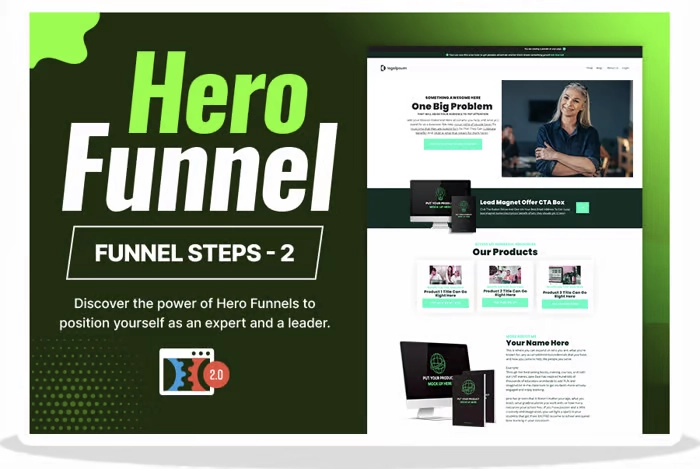
Want to start selling online?

Here’s our comprehensive guide for complete beginners:

Table of Contents:
  • Step #1: Decide What to Sell
  • Step #2: Choose the Right Market
  • Step #3: Do Customer Research
  • Step #4: Create an Offer
  • Step #5: Create a Lead Magnet
  • Step #6: Build a Sales Funnel
  • Step #7: Start Driving Traffic to Your Sales Funnel!

Step #1: Decide What to Sell

What Is Your Unfair Advantage?

As a first-time entrepreneur, you are probably underestimating just how much “business stuff” you’ll need to learn and how difficult it’s going to be to get your company off the ground. 

Now consider this: if you go into a market that you are completely unfamiliar with, you’ll need to acquire relevant domain knowledge in addition to the aforementioned business skills.

In theory, that is doable but in practice, it would be extremely difficult because you’d be competing against people who have both the business skills that you lack and the domain knowledge that you lack. 

That’s why we recommend taking stock of your current skills and knowledge to see where you might have an unfair advantage against your competition. 

We are assuming that you are an adult which means that you have been alive for at least 18 years. This means that there must be something that you have at least some expertise in. 

Maybe you have been doing gymnastics since you were 7 years old. Maybe you have spent a decade working in a particular industry and know it inside and out. Maybe you are an experienced hiker and camper. 

Things like that may not seem like a big deal to you because you are probably used to them and take them for granted. But domain expertise like that can give you an unfair advantage in business if you can figure out how to monetize it!

Sell Something That People Are Already Buying

In our culture, entrepreneurship is associated with innovation but that is not how you should think about it if you have never built a business before.

Once again, you are probably underestimating how much business stuff you’ll have to learn and how difficult it’s going to be to get your company off the ground. 

That’s why your focus as a first-time entrepreneur should be learning how to run a business. And the best way to do that is by selling something that already has proven demand. 

Once you acquire business experience and build a track record of launching, managing, and growing profitable companies, then you can start experimenting with innovative ideas if you still want to.

But until you reach that point in your entrepreneurial journey, forget about “building the next Facebook” and just focus on selling something that already has proven demand.

Being a first-time entrepreneur is already hard enough as it is, there’s no need to make it even harder by pursuing crazy ideas!

The Pros and Cons of Various Business Models

Now let’s take a closer look at the three most popular online business models: selling services, selling digital products, and selling physical products. 

Selling Services 

Pros: 

  • Low startup costs – In a lot of cases, all you need is a marketable skill and an email account that you can send cold emails. 
  • Straightforward marketing – You can start reaching out to your dream clients immediately via cold email. If you send 100 cold emails a day, you will land your first client sooner or later. “The Cold Email Manifesto” by Alex Berman is a great book on this.
  • High profit margins – You can have high profit margins if you keep overhead costs low and package your service well. 

Cons: 

  • Clients from hell – Dealing with clients can be a headache until you learn to set realistic expectations, maintain boundaries, and negotiate well. 
  • Selling services requires sales skills – You will need to learn how to close sales in person or via video calls.
  • Scaling service businesses requires employees – You will inevitably hit a ceiling on how much work you can take on as a solopreneur and will have to either accept it or start hiring people to scale your business beyond it. 

Suitability for first-time entrepreneurs: We would argue that this is the best business model to start with because low startup and overhead costs mean low financial risk. 

That being said, if you have poor social skills or are struggling with social anxiety, this business model may not be the best fit for you due to the necessity of interacting with clients. 

Of course, you can always look at it as an opportunity to get out of your comfort zone!

Selling Digital Products

Pros:

  • Low startup costs – You can produce digital products at zero or low cost, promote them for free on social media, and distribute them using software that only costs a few hundred bucks a month. 
  • High profit margins – Due to low production and distribution costs digital products can have insanely high profit margins. This means that getting to the break-even point with them is relatively straightforward. 

    Say, if you have a $7 ebook and can figure out how to sell 100 copies of it every month, you should be able to not just break even but make a few hundred bucks in profit. 

    And sure, you won’t be able to flex your lifestyle on Instagram with that amount of money but it can help you cover a part of your rent, pay for your groceries or simply go straight into savings. It’s not much but it’s a start! 

  • Tempting impulse purchases – You don’t need to have exceptional copywriting and marketing skills to make some money with $7 ebooks. 

    At that price point, all you have to do is pique someone’s curiosity and they might buy your ebook on impulse because why not, it’s just seven bucks. This is especially true if you have a no-questions-asked 30-day refund policy. 

Cons: 

  • Getting started will take time – Creating a digital product, figuring out the marketing and making your first sale will take time regardless of the product or the marketing strategy. 
  • Getting your business off the ground without paid ads will take a long time – You can promote your digital product for free with social media marketing but building an audience that is sizable enough for you to generate a decent amount of revenue will probably take at least a few years. 
  • No guarantee that anyone will buy it – There’s no guarantee that you will make any money with your digital product. It might turn out to be a complete flop. 

Suitability for first-time entrepreneurs: Selling digital products can work well for first-time entrepreneurs provided that you don’t mind either spending money on ads or growing your business slowly via social media marketing. 

It can be a great option for people who don’t like the idea of personally interacting with customers and would rather sell their products through completely automated sales funnels. 

Selling Physical Products

Pros: 

  • Tons of business opportunities – You can build a business by simply taking some mundane everyday item and creating a premium, high-quality version of it. There’s a lot of money to be made by selling high-quality socks, backpacks, toothbrushes, and so on.

Cons: 

  • High startup cost – Starting an e-commerce business requires a significant amount of startup capital, especially if you want to manufacture your own products instead of going the dropshipping route.

    And if you intend to do dropshipping, you should be prepared to spend money on ads in order to test various product ideas until you find a winner. 

  • Low profit margins – Physical products have low profit margins because they are expensive to produce, store, and deliver to customers. But what exactly do we mean by “low”?

    In ecommerce, 10% profit margins are pretty typical but lower margins such as <5% are not uncommon. 

  • Hard to differentiate yourself – Speaking of dropshipping, it tends to be a race to the bottom because everyone is selling the exact same stuff from AliExpress. 

    This means that your business has no moat: you are selling a commodity and anyone who can figure out how to sell it for less can come and take your market share. 

    Moreover, online shoppers are catching on to the fact that they can do a reverse image search, find the exact same product on AliExpress, and order it directly from there!

Suitability for first-time entrepreneurs: We would advise against selling physical products unless you can produce them yourself with low overhead costs.

Say, if you are an experienced knitter and want to open an online store where you sell your hand-made wool socks, then sure, go for it. 

Other than that, you can play with dropshipping if you want to learn more about e-commerce, but when it comes to making money you’d almost certainly be better off selling services or digital products. 

Step #2: Choose the Right Market

Alex Hormozi is an entrepreneur, investor, and author who reached $100M+ net worth by his early 30s. 

He also happens to be a ClickFunnels user and is one of the winners of our Two Comma Club C award.

We give this award to entrepreneurs who earn between $25M and $100M in revenue within funnels built with our software!

Choose the Right Market

In his best-selling book “100M Offers” Alex explains how to choose the right market using these four criteria:

  • Pain – You want to target people who are dealing with a painful problem that they are eager to solve.
  • Purchasing power – You want to target people who have a high purchasing power and are able to pay a premium price for your products and services.
  • Easy to reach – You want to target people whom you can easily reach with your marketing campaigns. 
  • Growth potential – You want to make sure that this market is growing and is projected to continue to grow in the foreseeable future. 

Think very carefully about all this because the market that you choose will be one of the major factors that will determine the profit potential of your business. 

For Example:

Let’s say that you took stock of your skills and knowledge and realized that you have enough fitness experience to help other people lose weight and get in shape. 

You then evaluated potential business models and decided to start selling a personal training service.

Pretty much everyone wants to be healthier, get fitter, and look better but you need to be strategic when choosing a market. 

Say, you can sell the exact same personal training service to broke college students and to Silicon Valley tech workers who are making six figures a year. 

Who do you think will pay you more, be more committed, and get better results?

Step #3: Do Customer Research

The most effective salespeople in the world are the ones who understand their dream customers the best. 

That’s why we recommend doing customer research before you start working on your offer.

Here are the three best ways to learn more about your target audience:

  • Talk to your dream customers – Nothing beats talking to potential customers one-on-one so seek out opportunities to do that. Simply ask them questions and listen to what they have to say. You can learn a lot by letting people talk. 
  • Follow online discussions that your dream customers are participating in – This can mean keeping an eye on Twitter hashtags, registering to online forums, following relevant subreddits, etc. 
  • Consume the content that your dream customers are consuming – This can mean reading blogs, listening to podcasts, watching YouTube videos, etc.

Finally, if you can afford text analytics software, consider investing in it.

You can use it to analyze vast quantities of textual data such as all tweets that feature a particular hashtag. This can help you uncover insights that you wouldn’t have been able to uncover otherwise.

Needless to say, the closer you are to your target demographic, the more context you will have and the less customer research you will need to do. 

That’s why “scratch your own itch” is such a common business advice. It’s much easier to understand your target audience when you belong to that demographic yourself!

Step #4: Create an Offer

Your offer is how you package the product or service that you sell. 

The basic formula for creating an irresistible offer is this: 

High Value + Low Price = Irresistible Offer

As Alex Hormozi puts it, it all boils down to creating an offer that is so good that people would feel stupid saying no. 

You can watch this presentation where he explains how to do that:

We also recommend reading Alex’s book “$100M Offers” which is a comprehensive guide to creating irresistible offers. 

Step #5: Create a Lead Magnet

A lead magnet is a freebie that you offer to the potential customer in exchange for their email address.

But it’s not 2005 anymore. People don’t get excited about random digital junk. Giving away some low-effort PDFs won’t get you anywhere. 

Your lead magnet needs to provide value if you want it to work. But what does that mean?

Alex Hormozi argues that a lead magnet should offer a complete solution to a narrowly defined problem. 

That way, it will actually help the potential customer solve a concrete problem and therefore provide real value. 

If you are selling a service then you can use that service itself as a lead magnet and then follow it up with a sales pitch for a package or a subscription. 

Say, Hormozi gives an example of how a masseuse could use a $10 massage as a lead magnet and then sell $100 massage packages to those leads.

Meanwhile, if you are selling a digital product, you can create a lead magnet that provides a solution to a smaller problem that is part of a larger problem that your product addresses. 

Say, if you sell a $7 ebook where you teach people how to have more success with online dating, you could give away a PDF with three tips for improving one’s dating profile.

If someone implements your tips and gets more matches, they will probably want to learn more and will buy your ebook.

We want to emphasize that your lead magnet is going to serve as the foundation of your entire sales funnel.

If you want your sales funnel to convert you need to make sure that your lead magnet exceeds all expectations!

Step #6: Build a Sales Funnel

Okay, so what’s a sales funnel?

A sales funnel is a system designed to convert visitors into leads, leads into customers, and customers into repeat customers. It can be either partially or completely automated.

Partially Automated Sales Funnels

With a partially automated sales funnel, you drive traffic to your funnel and:

  1. Automatically convert those visitors into leads by persuading them to give you their email addresses in exchange for your lead magnet. 
  2. Manually reach out to them and schedule discovery calls with them. 
  3. Close sales on those discovery calls.

Completely Automated Sales Funnels

With a completely automated sales funnel, you drive traffic to your funnel and:

  1. Automatically convert those visitors into leads by persuading them to give you their email addresses in exchange for your lead magnet.
  2. Automatically convert them into customers by pitching them your products and services via automated email sequences. 

Should You Use a Partially or a Completely Automated Sales Funnel?

Typically, selling services requires a partially automated funnel because you need to talk to potential clients in order to close sales. 

Meanwhile, both digital and physical products – with the exception of high-ticket items – can be sold through completely automated sales funnels. 

The Most Effective Way to Sell Anything Online: The Value Ladder Sales Funnel

There are several popular sales funnel models out there but we believe that the most effective one is the Value Ladder sales funnel.

It was designed by our co-founder Russell Brunson who then used it to grow ClickFunnels to $100M+ in annual revenue. 

Here’s how Russell explains it:

The Most Basic Variation of the Value Ladder Sales Funnel: The Squeeze Page Funnel

You can build a basic Value Ladder sales funnel with just your lead magnet and your main offer and then add more offers over time as your business grows.

We recommend using the squeeze page funnel for that because it’s extremely versatile and can work well for pretty much any business.

Step #7: Start Driving Traffic to Your Sales Funnel!

Once you have your sales funnel, it’s time to start driving traffic to it.

We recommend learning how to run social media ads because paid advertising allows you to put your lead magnet in front of your dream customers and get immediate market feedback.

Choose a Facebook ads course and go through it. Udemy has frequent sales where you can pick up courses for just $15-$20. 

Once you learn the basics of running Facebook ads, create an ad campaign designed to promote your lead magnet and start running it with a small daily budget. 

It probably won’t work right away so keep tweaking it until it does. If you can’t make it work, come up with a better lead magnet.

Be prepared to burn money on ads until you learn how to run them profitably. Consider it a tuition fee that you need to pay in order to master this invaluable online marketing skill!

Build and Launch Your First Sales Funnel In Just Five Days!

We understand that building a sales funnel from scratch may seem like a daunting task. 

That’s why we created our Five Day Lead Challenge where our co-founder Russell Brunson and his special guests will walk you through the entire process step-by-step.

In this super practical, hands-on online workshop you will:

  • Learn more about sales funnels
  • Create your lead magnet
  • Build your sales funnel
  • Set up an automated email sequence
  • Launch your funnel

…in just five days.

This challenge is completely free, we’ll even give you a free trial of our software. You won’t have to spend any money to build and launch your first sales funnel.

All Russell asks is that you commit to showing up every day, watching the main lesson, and completing the homework assignment. Can you do that?

If you make this commitment and follow through with it then in just five days you’ll have a fully functional sales funnel. 

So what are you waiting for? 🧐

Join Our Five Day Lead Challenge Today

Thanks for reading The Complete Beginner’s Guide – Start Selling Online In 2024 which appeared first on ClickFunnels.
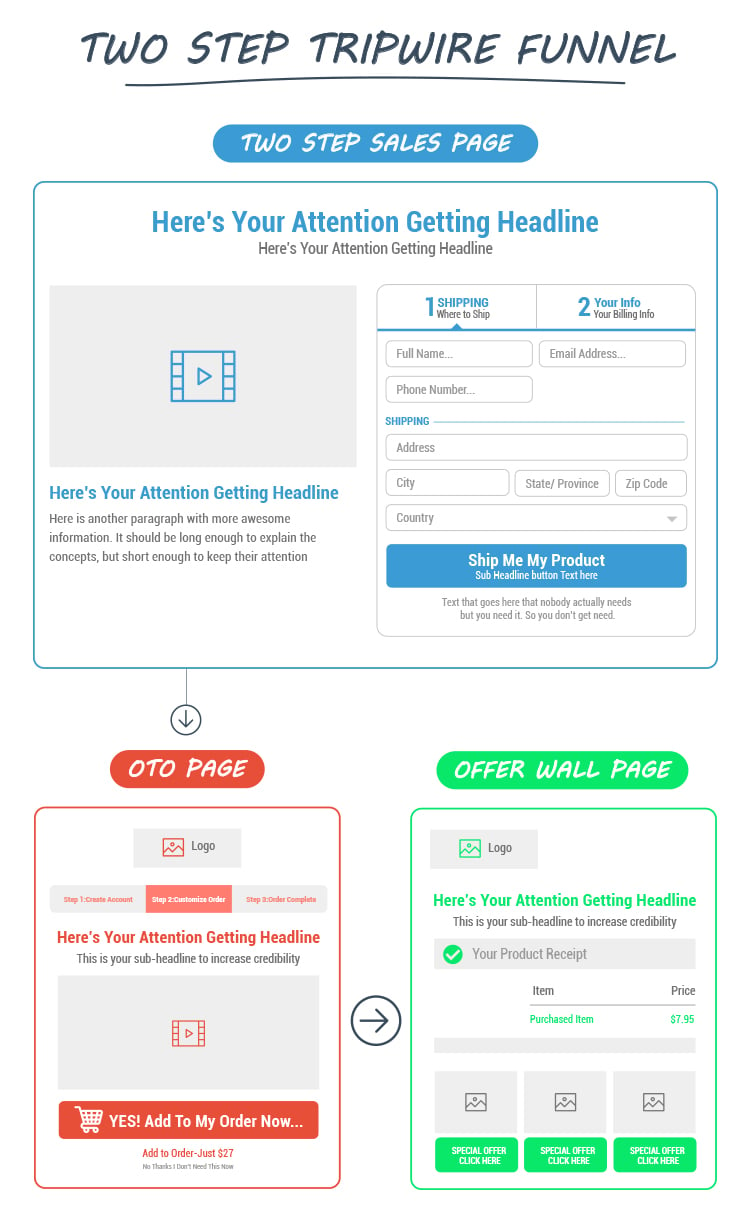
Top 10 Ways To Make Money Copywriting

Software Stack Editor · March 18, 2024 ·

The post Top 10 Ways To Make Money Copywriting appeared first on ClickFunnels.
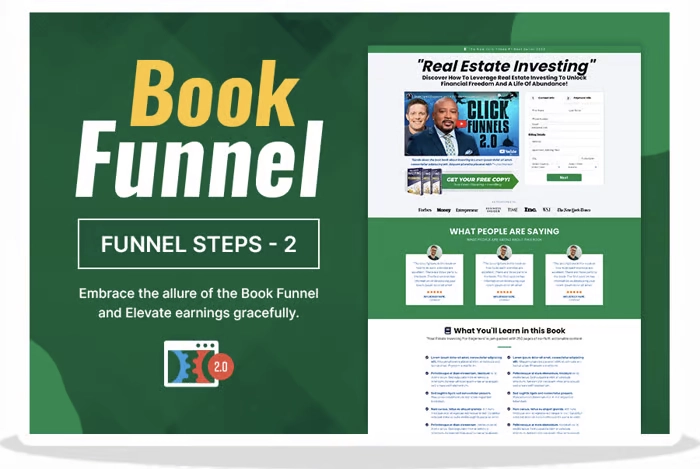
Words are weapons. They can be locked and loaded. You can fire them at will to attain the objective of your choice. Words can be used to persuade other people. But they can also be used to repel. Yes. The words you use matter. Especially in business. Words can help attract customers. To magnetize them. To generate leads. And to make money hand over fist.

Every copywriter understands this. They know that words are weapons. They can be used like atomic bombs. Those bombs can be dropped to obliterate the competition in any market. The truth? Expert copywriting can propel a business forward unlike anything else. Why? Because words are at the heart of everything. They’re part of every piece of communication a prospect sees.

These concepts aren’t new. Everyone knows that copywriting can help you make money. Lots of money in many ways. It can help you make money in your sleep. From your phone. While traveling. In real estate. As a web developer. In graphic design. Or as any kind of freelancer. Copywriting can help you make money as an affiliate. And every other way possible.

How To Make Money As A Copywriter

Copywriters are a dime a dozen. They come from all walks of life. Everywhere you turn you’ll find another person claiming to be a copywriter. But good copywriters are few and far between. And the top copywriters? You’ll be hard-pressed to find experts at their craft. And when you do they won’t come cheap. The world’s best copywriters know that they can charge exorbitant fees for killer copy.

That doesn’t mean you can’t make money as a copywriter. There are companies at all levels with all budgets. As long as you’re good enough at your craft you can make money copywriting. You just have to understand where to look and how to approach things. This isn’t just about earning an hourly wage. Sure, you can do that. You can easily get a job as a copywriter if you’re good. But this isn’t about that. This is about earning far more money than working for a meager hourly wage.

Other avenues exist for making real money with copywriting. I won’t tell you they’re easy. They’re not. But if you’re a good copywriter, you have options. If you’re not? You can certainly learn. There’s nothing wrong with that. You can find plenty of courses about how to be a great copywriter. But there’s nothing that will help you more than real-world experience.

Actual boots-on-the-ground experience is irreplaceable. Invaluable. It allows you to learn copywriting in a different way. That does mean getting a job as a copywriter. And that’s fine. There’s nothing wrong with that. Will you make a lot of money with a full-time job as a copywriter? Maybe. But it’s likely you won’t unless you’re the best of the best.

What Is Copywriting?

Before finding ways to make money with copywriting, let’s explore the topic. The question? What is copywriting? At the end of the day, what does it boil down to? And what does it mean to be a copywriter? What objective does a copywriter achieve? A copywriter has a single and sole purpose in any business. And that is to increase conversions.

The goal of a copywriter is to create content across different communication channels. And that content must be designed to optimize conversions. Those conversions can be of many types. They can be lead conversions that are generated from a lead magnet or a lead generation funnel. The conversions may also be sales conversions of direct purchases. They can be application conversions with content designed to get more people to fill out applications. And so on.

Many conversion objectives exist. And the sole purpose of a copywriter is to maximize those conversions no matter what medium or channel they stem from. To do that you must first understand the customer. A great copywriter can get deep inside the mind of a customer. They know who they are implicitly. And I do mean right down to the very fiber of their existence.

That’s because you must understand the customer to understand their problem. Their problem is at the core of everything you do as a copywriter. The problem is the basis for increasing sales, boosting revenue and ensuring you maximize the average order value of every sale. Once you understand the problem, you can create copy designed to target that problem. And to sell the products or services the business offers that solve that problem. That’s it. That’s what copywriting is.

1—Freelancing

One obvious way to make money as a copywriter is to do freelancing. Freelancing means that you’re hunting for clients on existing platforms like Upwork, Freelancer, and even Fiverr. That doesn’t mean you’re going to rake it in. Those platforms have plenty of competition. And most who hire freelancers rely on their reviews. If you don’t have an existing track record, you’ll find it hard to compete.

Freelancing can make you good money as long as you stick it out. You’ll need to bid on jobs constantly. And you have to ensure your best work is portrayed in your portfolio. Learn the fundamentals of copywriting first before you hunt for real clients. Take classes and educate yourself. Find successful copywriters and devour their content.

2—Digital Products

To make real money in copywriting (or in any other profession) you must disconnect your ability to generate revenue from your time. Working for clients directly is rewarding but also time-consuming. It’s also taxing on the mind. It requires a lot of creativity and effort. That leaves you with very little energy at the end of the day. That’s why digital products are the key to making money as a copywriter.

If you understand copywriting and you have a proven track record, consider turning your knowledge into a digital product. Digital products can take on many styles, shapes and forms. They can be intensive, in-depth videos, cheat sheets, PDF documents, case studies, and more. It’s up to you to create something of real value. Make sure that it directly solves a problem a prospect is experiencing.

3—Online Courses

Online courses allow you to share extensive information about a topic. It’s the perfect medium for teaching any form of copywriting. You can explain all the ins and outs of how to write copy that sells. You can dive deep into how to position content the right way to create true desire in the prospect. And you can explain the art of persuasion and how to trigger a buying frenzy with psychological levers like urgency and scarcity.

Online courses are one of the best ways you can create value and earn money online. It disconnects your revenue generation from your time. It allows you to scale your capability to make money by building a product you can sell over and over again. Plus, online courses are not difficult to build. You can use a course builder like this one to build and promote the entire online course yourself.

4—Sales Funnels

Sales funnels allow you to take your knowledge of copywriting and turn it into a profitable business. A sales funnel is like a magic money-making machine. It allows you to sell any product or service by leveraging a proven marketing model called AIDA. This allows you to Attract (A) prospects, create (I) Interest, build (D) Desire and compel (A) Action.

You can easily build sales funnels with a sales funnel builder. It can propel your existing business to higher conversions or you can use it to create and sell new products and services. You can build many sales funnel types for copywriting. You can create application funnels to find clients, webinar funnels to run a presentation, or you can use it to create a tripwire offer.

5—Affiliate Marketing

Many copywriters turn to affiliate marketing to make money. Especially copywriters who are familiar with SEO. Affiliate marketing is an ideal way for copywriters to make money. You can build bridge pages designed and written to help convert visitors with ease. Bridge pages allow you to capture contact details before forwarding them to the affiliate offer.

Affiliate marketing boils down to the promotion of affiliate links. It helps to have an existing audience somewhere. Whether that’s an email list, a YouTube audience, a social media following, or something similar. But you can still make money as an affiliate even without a list. You’ll need to use the power of paid ads to do that.

6—Sales Letters

Sales letters are one of the most powerful weapons in the arsenal of any copywriter. Sales letters are long-form letters designed to help sell a prospect something. They’re written to persuade and create true desire in a prospect to purchase. When approached the right way a sales letter can make you a lot of money as a copywriter.

You can create sales letters for businesses or you can create them for any product or service you decide to sell. You can build a sales letter into a sales funnel to supercharge your money-making capabilities. Sales letters that are well-written understand the prospect implicitly. And they understand the problem. The framework often used for sales letters is called PAS. It stands for Pain-Agitation-Solution. You highlight the pain, agitate it, and then you present the solution.

7—Ghostwriting

Ghostwriting is the art of writing for others. Except you’re writing as them and it can happen across many mediums. You can ghostwrite an entire book for someone or do something as simple as a blog post. You can ghostwrite emails and other forms of communication. Copywriters who are skilled in their craft can act as the voice of someone else to help them free up time to do other things in their business.

You can find ghostwriting clients in many ways. Talk about your writing skills on platforms like LinkedIn or Facebook. You can reach out to people in your network or even find ghostwriting jobs on platforms like Indeed or other similar sites. You’ll need to know the person and their business inside and out to ghostwrite. Depending on the application, you’ll also need to know the customer and their problem.

8—Newsletters

Newsletters allow you to share your knowledge and insight with an audience. You can create a newsletter in any industry or niche and build a real following. Newsletters help you convey ideas and concepts with ease. It provides a recurring way to share stories and insights with an attentive audience. And you can use that newsletter to sell any product or service you have to offer.

Newsletters can be paid or free. When building out a free newsletter, you’ll have to find some way to monetize it. You can use affiliate relationships, sell products or services, or approach it in many other ways. Paid newsletters will require you to deliver real value regularly. It takes time and consistent energy. But it is well worth it.

9—Membership Sites

Membership sites allow you to share wisdom and real-time information with customers regularly. This works best when you’re dealing with content that requires freshness. For example, membership sites about stocks, bonds and crypto are popular. You can share insights and wisdom into market movers. You can also build membership sites about other ever-changing topics such as SEO, online marketing, sales persuasion, and more.

As a copywriter, you have the power of persuasion and storytelling. You can use that to build emotion-inducing content. This is not just to give people updates in an industry or niche. This is also for helping to sell and get customers to spend more money with you. Membership sites also allow you to generate recurring revenue that keeps going even after the first purchase is complete.

10–Coaching

While many ways exist to make money copywriting, coaching offers one of the highest revenue-generating opportunities. You can do private coaching or group coaching. Private coaching allows you to make more money from an individual client. However, it requires more of your time for that client. On the other hand, group coaching allows you to compress your time by helping many people at one time. If you can charge a lot of money for group coaching then that should be where you start.

To coach others you must be skilled at your craft. You can teach people how to become great copywriters. And you can also teach business owners the process behind creating great copy that sells. After all, every business needs more leads and sales. And copywriting is at the heart of every lead generation and purchase decision a customer makes. So people are always willing to pay a lot to learn this skill.

Thanks for reading Top 10 Ways To Make Money Copywriting which appeared first on ClickFunnels.
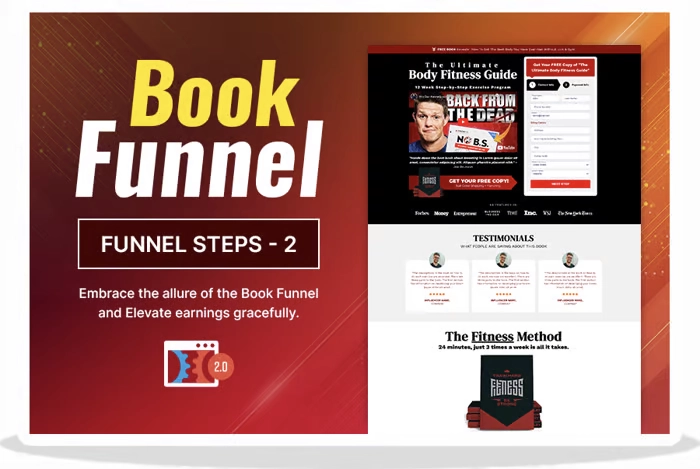
5 Marketing Funnels To Help You Make Money Fast

Software Stack Editor · March 14, 2024 ·

The post 5 Marketing Funnels To Help You Make Money Fast appeared first on ClickFunnels.
The alarm blares. It’s 4:30 am. Outside? Pitch black. And everyone in the house is still sound asleep. But the incessant sound forces you to wake up. Your eyes dart open to another day. Another dollar. Another fire to put out. Less money and more problems. You wonder when it will end. Maybe never? You desperately want to go back to sleep but you know you can’t. You have to wake up. There’s just no other choice. No other options. But you chose this life. It didn’t choose you.

At this point, you’re used to it all. That’s because you’re an entrepreneur. Hard work is ingrained in you. It’s part of every fiber of your being. You’re not afraid to work hard. Nope. Not whatsoever. But we all know that making more money or growing your business isn’t just about hard work. It’s not just about putting in that sweat equity. Nope. It’s about way more than that. It’s about leverage. And it’s about finding the right tools and the right people to help catapult you to success. Tools like marketing funnels that are designed to capture and convert leads like clockwork.

Why Marketing Funnels Work

Marketing funnels are well-oiled virtual machines. They help you make more money and grow your business fast. Very fast. But most don’t know what they are. They have no idea what marketing funnels are capable of. Nope. They’ve never heard of marketing funnels. So what are they? Marketing funnels offer a predefined path for prospects to take. They move people from cold and unaware of who you are, to hot and ready to buy whatever you’re peddling.

Yes, marketing funnels are that important. They’re the foundation of the world’s most successful businesses. Think about it this way. The world’s biggest businesses are like icebergs. You can only see a small portion of them when you’re above water. But when you dive deep into the sea you can see that iceberg stretching thousands of feet down. It’s colossal. Massive. That’s because what you see at sea level is just the tip of the proverbial iceberg. Success runs far deeper than that.

What Are Marketing Funnels?

Marketing funnels are sometimes called sales funnels. Some even call them business funnels, customer funnels or purchase funnels. All of them refer to the same concept and the same principles. Marketing funnels are designed to help move prospects across numerous stages. Those stages are designed to take them from being completely unaware of who you are, to the highest possible awareness.

Marketing funnels aren’t new. They actually date way back. But they’ve recently grown in popularity thanks to one man. He’s led the revolution into marketing funnels. And has singlehandedly killed off websites. After all, websites are a thing of the past. If you’re trying to grow your business with a website then you’re approaching things the wrong way. Websites have way too many choices and too many things going on. Marketing funnels take a different approach. They’re laser-focused.

Why Marketing Funnels?

Marketing funnels guide the prospect toward a single intended action. It has one goal in mind. That’s it. And it’s because of that singular focus that marketing funnels can explode a business quite literally overnight. Just take a look at some of the Two Comma Club Award winners. Two Comma Club awards are given to people who’ve made over a million dollars with a single marketing funnel in a given year. But wait, there’s more. Two Comma Club X awards are given to those with a marketing funnel that’s made over $10 million in a given year.

Think about that for a moment. What would a million-dollar marketing funnel do for your business right now? What about a ten-million-dollar funnel? Could it change the course or trajectory of your business? Of course it can. Marketing funnels are that powerful because they work. They tap into the underlying psychology that drives us as human beings. They’re not based on one-off transactions. They’re designed to foster and develop relationships with prospects. To invoke emotions. Solve problems. And convey trust.

1—Lead Magnet Funnel

Every business needs leads. Every last one of them. Not a single business can tell you that they don’t want more leads. After all, leads are at the very heart of a successful company. Without leads, you can’t have sales. And without sales, you can’t increase your revenue or grow your business. That much is pretty clear, right? That’s why a lead magnet funnel is one of the most vital marketing funnels you could ever build. And if you don’t have a marketing funnel designed to capture leads, then every day will feel like a struggle.

So what is a lead magnet? A lead magnet is one type of lead generation funnel. Lead magnets are used to target specific customers based on the problem they’re experiencing. The lead magnet offers a solution to the problem. It allows prospects to solve at least part of the problem. Maybe not the whole problem. And lead magnets are frequently used in the first stage of a marketing funnel. That stage is where a prospect is problem-aware. That means they’re aware of the problem they’re experiencing.

Lead magnet funnels are powerful because they deliver real value. And when you deliver value in the form of a solution to a prospect, you create authority. It also creates reciprocity. Reciprocity is simply the feeling of indebtedness that a person feels to another who gave them value. When you give someone value they will naturally feel indebted to you. That’s just the way human beings work. That’s why a lead magnet funnel should be the first marketing funnel you build for your business.

Squeeze Pages

Lead magnet funnels can take on a few different forms. The first form is called a squeeze page. A squeeze page typically asks for a prospect’s contact details. In exchange, it offers the lead magnet. The lead magnet is sent via email after the prospect provides their information. It’s a direct exchange. And squeeze pages are very simple in nature. They usually have a headline, an image, a small description, and a call-to-action button. The button is usually designed to submit the form with the contact details.

Reverse Squeeze Pages

Another type of funnel you can use for a lead magnet is a reverse squeeze page funnel. Reverse squeeze pages are designed to deliver the value first and then take the contact details. This works best with long-form videos that help establish authority and invoke emotion. It establishes trust and creates reciprocity on the front end. All of that happens long before you ever ask for contact information.

So why use a reverse squeeze page rather than a squeeze page? In some cases, it’s more effective. Although conversions are lower, the conversions that do happen often result in a much higher quality lead. If you sell premium products or services this is an effective way to generate leads. You won’t get as many leads as you would with a typical squeeze page funnel. But you will get much higher quality leads than you would elsewhere.

2—Survey Funnel

Surveys are powerful marketing funnels because they rely on the principle of micro-commitments. When a prospect answers a survey question they make a very small micro-commitment. As they continue answering questions they commit further. At the end, they’re asked for contact details to share the survey results with them. The reason why they provide it is not just to discover the results of the survey. They’re following the Law of Consistency. The Law of Consistency states that people stay aligned with their prior actions and beliefs.

Typically, without a sales funnel builder, surveys like this might be difficult to create. They would normally require web development skills and coding. That would include setting up a server, creating the hosting account, and arranging all the code to make it work. You would connect that to a database, an email provider, and so on. Luckily you no longer need to do all of that. You can simply launch a premade survey funnel template and use a drag-and-drop editor to arrange the entire thing. And it requires zero coding skills.

Surveys are followed up with email marketing. Once that person is on your email list you can communicate with them. That’s the beauty of survey funnels. They offer a low-friction method for acquiring a contact. And they allow you to segment your list. If you have a specific question where the answer helps you categorize the prospect into one list or another you can better communicate with them. You can better understand their problem and create an email sequence that talks more directly to them. This is very powerful in email marketing.

3—Application Funnel

An application funnel allows you to accept an application before jumping on a phone call with a prospect. This allows you to weed out those who want to waste your time from those who are qualified to speak to you. When you sell a high-ticket service or a premium product, this type of marketing funnel can propel your business forward. Why? Because it flips the script on prospects. It forces them to self-qualify. And that’s important in terms of selling products and services at the higher end of the market.

Application funnels can also be used to grow coaching services, masterminds, and more. If your business falls into any of these categories then consider setting up an application funnel using one of these premade sales funnel templates. This allows you to get up and running very quickly. If you don’t already have a sales funnel builder then consider using one. This takes all the tech work out of the process. There’s no need for coding or web development. It all happens through a simple user interface.

Application funnels typically have a reverse squeeze page at the front. This helps create a higher-quality lead. That’s because you’re delivering value upfront instead of asking for the contact information first. Once they proceed, they move to the actual application page where they fill out the answers to your questions. Those questions should be designed to help you filter and weed out those who may not fit your ideal customer profile.

4—Tripwire Funnel

Everyone knows what tripwires are. In real life, a tripwire is tripped when an event occurs. The tripwire is usually in the form of an alarm. It activates a security measure. However, in the marketing funnel world, a tripwire is a little bit different. Tripwires are designed to help reduce the perceived risk a customer has when purchasing a product. It also helps to reinforce the Law of Consistency with small micro-commitments. This is very similar to the psychology behind survey funnels.

This type of marketing funnel is actually called a two-step tripwire funnel. That’s because there are two steps. The first step is the tripwire. It’s a low-ticket offer that packs a lot of value. In the first step, they fill out basic details like contact info. Once they move to the next step that information is saved as a lead. Meaning that if they don’t fill out the payment details in step two then you haven’t lost that contact. You can now communicate with them if they abandon the page.

How It Works

Tripwire funnels work great not just because it’s a low-ticket offer. Tripwires typically have things like order form bumps. An order form bump is a little checkbox you can check to add another product to the checkout experience. For example, in a free-plus-shipping funnel where it’s a free book and they just cover the shipping, the order form bump might be the audiobook version. However, the real magic happens once they move to the next step.

Marketing funnels like this one have what are called OTO pages. That stands for one-time offers. Some call these upsells. But when you call them an OTO then something interesting happens. It creates scarcity. Meaning that the customer will never see that offer again. For example, if they have to pay $14.97 for shipping out a free book, $37 might be the audiobook price in the order form bump, and the OTO might be a $97 home study course.

However, you can do multiple OTOs in the same funnel. Plus, if they decline an OTO, you can present a different offer in the form of a down-sell. The down-sell is also an OTO but the offer changes. It could be something less expensive or that solves a different part of the problem they’re experiencing. This allows you to boost your average cart value. And that’s what makes marketing funnels like this so powerful.

5—Webinar Funnel

Years ago, before webinars existed there were teleseminars. You called into a teleseminar. And you listened to a speaker give a presentation. At the end, you were invited to buy the thing they were peddling. Today, teleseminars are a thing of the past. And now webinars are front and center. But what is a webinar and what do you use it for? Webinars are presentations that you give to a group of people all revolving around one important statement.

Webinars are powerful because they help shift a prospect’s false beliefs. Look, we all harbor false beliefs about why something won’t work out for us. We’ve all had experiences in the past. And those experiences have shaped how we look at things. And the webinar is designed to reshape those beliefs that hold us back from buying. It’s done by replacing the stories we tell ourselves about why something won’t work out, with stories of situations where it did work out.

Webinars Break False Beliefs

For example, webinars help break false beliefs about a particular product. Let’s say that you don’t believe SEO works because you’ve had bad experiences with it. A webinar is designed to show how it works (and it really does work by the way). Okay, let’s say you now believe SEO works, maybe you don’t believe it will work for you. Maybe you’re not capable of pulling it off. Well, that’s the next false belief to shatter. Then, maybe you think it works and that it could work for you, but you just don’t have the time or the money to pull it off. Once again, a webinar is designed to shatter that false belief.

While this might seem complicated from the outside looking in, it’s not. There’s a formula for doing this and you can read about it in this book. This is by far one of the most powerful marketing funnels you could build for your business. Not only to make more money. But to really grow your business by leaps and bounds. There’s a formula for creating a Perfect Webinar. It’s not rocket science. It just takes a willingness to try, fail, and then keep trying again and again until you figure it out.

Thanks for reading 5 Marketing Funnels To Help You Make Money Fast which appeared first on ClickFunnels.
25 Legit Ways To Make Money Now

Software Stack Editor · March 13, 2024 ·

The post 25 Legit Ways To Make Money Now appeared first on ClickFunnels.
In 1849, the California Gold Rush was in full swing. It was a frenzy. A race. People from all walks of life flooded the area. All of them were there for one reason and one reason only—to make money. They mortgaged their properties. Said their farewells. And they left behind every semblance of normal everyday life just for a mere chance at unearthing a mountain full of gold.

They had hopes. Aspirations. Dreams. They wanted to make money and make it in a big way. To strike it rich. These so-called prospectors panned for gold day and night. Most of them failed to make money. They failed to strike it rich. Some worked day and night to no avail. And most ran out of money long before they discovered a single ounce of gold.

However, not everyone searched for gold during that time. Some took a different approach. Instead of panning for gold, they sold pick axes, shovels and pans. They sold all the tools people needed to hunt for that buried treasure. They knew their chances of finding gold were slim. And they knew the level of effort it took to labor day and night. So they decided to make money a different way.

Everyone has a different take on what works. It never means that one is better than the other. Some people who embarked in search of gold did strike it rich. Others gave up easily. Some people who sold tools to the prospectors did well. Others struggled amid all the competition. However, those who really made money in the end were the ones who didn’t give up.

How To Make Money Now

Today, we live in a different era. It’s a time and place far different than it was back in 1849. The world has changed. Everyone knows that, right? And the rush to strike it rich has now evolved and morphed. Today, our world is very much a digital one. We are all interconnected thanks to this thing we call the Internet. And the rush to make money now is happening online. Not offline.

However, some things haven’t changed. People still rush to make money by chasing the newest thing. Others fail and give up easily. Some try to make money in proven ways. Others try to sell tools to those looking to get rich. Although the mediums have changed the concepts and principles remain the same. And the important thing is this. You must find a way to make money that works and go all in.

This isn’t about dabbling. It’s not about trying something for a brief period and then giving up. If you want to make money now (and make it fast) you have to go all in. That’s what life is about. You can’t just push a little bit here and there. You can’t just take weeks or months off or retreat with your tail between your legs when things don’t work out. That’s not how you’ll make money.

If you’re serious about making money (and I assume you are) then you must double down. You have to find something that works and double down. You must work hard and you must work smart. Find leverage. Create systems and processes. There are so many ways you can earn. Don’t get discouraged when things don’t work out right away. Don’t call it quits like many of the prospectors who gave up too soon or the shovel sellers who faced fierce competition. That’s not how you win. That’s how you lose.

Leverage Your Time

There are layers to success. And if we look at those who are good at making money we can peel back the layers to discover what works. What will you find? Leverage. Leverage is the key to success in any endeavor. And by leverage, I mean the amplification of time and effort. Since your time is limited, to make money now you have to leverage your time.

During the Gold Rush, some people understood the concept of leverage. They knew their time was limited so they arranged their affairs in a way to leverage their time. How? They formed consortiums. Partnerships. Hired help. And some made a lot of money very quickly. That’s the beauty of leverage. Instead of doing it all yourself, you must find ways you can leverage your time.

Time leverage amplifies your efforts. It helps you double down on your skills. Today, we live in a different world than in 1849. But the concepts and principles are the same. And people are still trying to make money. But this time the Gold Rush isn’t a physical thing. It’s a rush to make money in different ways. To do it online. In their sleep. From their phones. While traveling. And many other ways.

It doesn’t matter how you choose to make money. What matters is that you leverage your time. Most entrepreneurs try to take on too much. That leads to frustration and overwhelm. Instead, you must find leverage. Create systems and processes. Form consortiums and partnerships. That gives you leverage. And leverage is what you’ll need if you’re serious about striking it rich in today’s Gold Rush.

1—Sales Funnels

Today, a different kind of Gold Rush exists. It’s no longer a play for precious metals. You don’t have to head out west to strike it rich. What you must do is understand one important concept—sales funnels. Sales funnels are like magic little money-printing machines. They work. Especially when you understand the mechanics behind implementing them the right way.

Whether you call it a sales funnel, a marketing funnel, or something else, it’s all the same. Sales funnels help businesses generate more leads and make more sales. They’re direct and to the point. Unlike websites. So to make money now (and to make it fast) you have to build sales funnels. You can build them for a business, a product, a service, or build them for other people.

You can build lead generation funnels to generate leads, application funnels for high-end services, webinar funnels for presentations, tripwire funnels to sell low-ticket products, and so on. There’s a sales funnel for every application. If you don’t know what a sales funnel is then learn. That’s where today’s Gold Rush is happening.

2—Vacation Rentals

Vacation rentals are booming. No matter what you hear this is a big business and a great opportunity to make money now in today’s world. The best part? You don’t need to be in a highly sought-after vacation destination. People are always traveling. As long as you live in an urban area you can do well with vacation rentals. And it doesn’t need to be a high-end home or apartment. It just needs to be well cared for.

If you have a home or even a room in your home this makes a lot of sense. You can rent out your entire place easily on sites like Airbnb or VRBO. You’ll need to take great photos and maybe even some videos. Write an alluring description that invokes emotion. And take the time and put attention toward the smaller details.

You can also make money by helping others rent out their properties. Vacation rental management firms typically make anywhere from 10% to 40% of the gross rental rate. That’s a substantial margin. A huge rake. Especially when you’re talking about high-end homes. Does it require work? Effort? Headache? Yes. All of the above. But it is well worth it.

3—YouTube

YouTube is dominating the video game. It’s everywhere. On every device. And YouTubers with substantial followings are making millions of dollars per month. That doesn’t mean you will. It just means that the potential is out there to make money now. But you must be willing to put in the work and the effort. It takes sacrifice and time. But the payoffs are well worth it.

To make money on YouTube you need to pick a niche and stick to it. Successful YouTubers upload consistently. They don’t just do one video and then wait around for months. You have to be consistent if you want to grow your following. YouTube will monetize your channel after you hit 1,000 subscribers and 4,000 public watch hours over a year.

YouTube has one of the highest CPMs (cost per thousand views) of any platform. It ranges anywhere between $5 to $18 for 1,000 views on YouTube. However, you can only make that money once you’ve hit the monetization threshold. And you don’t even need to show your face. There are plenty of faceless YouTube channels that are crushing it like Be Amazed.

4—Real Estate

More millionaires are created in real estate than in any other industry. And there’s no time like today to make money in real estate. To pull this off you can take many approaches. The first is to buy rental properties. You can find good deals, fix them up and rent them out to long-term tenants. This is a hands-free approach to real estate.

You can also fix and flip real estate. Depending on what the real estate market looks like, there’s always money to be made flipping homes. If you’re passionate about real estate you should consider doing this. And it works in just about any region or area in most countries in the world. Not just in the United States.

Another way to earn money in real estate is to wholesale properties. This allows you to make money without putting up cash or risking your credit. You never have to deal with bank loans when you wholesale real estate either. All you have to do is find a distressed property, put it under contract, and then flip that contract to a cash buyer.

5—Freelancing

Freelancing is popular around the world. Freelancers can make money while living in remote destinations, while traveling, or even on the side. You can start an online business as a freelancer to earn some extra cash. Or it can be a full-time gig. It offers flexibility to those who need it most. You can do it in your free time or around the clock. It’s entirely up to you.

You can earn money as a freelancer with varying trades. You don’t need to be a web developer to make money as a freelancer. What you do need is to have in-demand skills that are needed by the marketplace today. That applies across the board. And you can find these freelancing gigs on many sites like Upwork, Freelancer, and also post your gigs on Fiverr for sale.

You can also freelance by designing sales funnel templates for customers. Sales funnels are in high demand. And designing sales funnels doesn’t require any coding background or web development skills. It only requires a keen eye for design. You can work directly with customers to help them or you can design the sales funnel templates and sell them in our marketplace here.

6—Digital Products

Digital products allow you to solve problems for numerous people by creating something where you do the work once but you get paid repeatedly. That’s the essence of passive income. Digital products can be created to solve all types of problems. You must understand the problem you’re solving and the person you’re solving it for. That’s the foundational requirement for creating a great digital product.

Digital products are not difficult to make. But they do take some planning and organizing. You can sell those digital products on many platforms. For example, for an easy approach to selling them you can use a platform like Etsy. Etsy allows you to sell digital products of all types. However, the best way to sell a digital product is to create a sales funnel for it.

For example, you could create a lead generation funnel that offers a lead magnet to solve part of the problem. Then, once you have that prospect’s contact information you can promote your digital product as a more over-arching solution to solving that problem. And you can build rapport through email marketing to deliver even more value and sell them more things down the road.

7—Digital Marketing

Every business needs help with marketing. Even businesses that can afford to hire in-house marketing staff don’t always have the expertise to do all forms of marketing. And digital marketing can come in many shapes and sizes. It all boils down to what you want to do. What are you passionate about? And what problem can you best solve?

After all, digital marketing is all about solving problems. And the bigger the problem you can solve the more money you can make. Most companies have one of three problems. They either have a traffic problem, a sales problem, or a conversion problem. If you’re an expert at solving one of those problems then you can help that company make more money. In turn, you’ll make more money. It’s as simple as that.

Digital marketing can be anything from search engine optimization, to paid ads management, landing page design, sales funnel development, and more. You can find digital marketing clients on social media, through direct outreach, by tapping into your network, and more. There are many ways you can find clients. You just need to be actively looking.

8—Copywriting

Copywriting is a skill that few have but many profess to have. Copywriting is a vital skill for businesses. But most don’t realize the importance of it so they don’t invest in hiring great copywriters. There’s a huge difference between a good copywriter and a great copywriter. The difference is staggering. Because it can change the trajectory of a business almost instantly.

A good copywriter can help you keep the lights on whereas a great copywriter can help explode sales, increase conversions, and scale your business fast. It’s really that important. So if you’re good at copywriting the world is your oyster. You can earn a lot of money by writing great copy. Not just for others. But also for yourself.

Think about it this way. If you can create hard-hitting copy you can sell anything to anyone. All you need to do is set up a simple landing page and write copy that connects on a deeper level with prospects that are facing some problem that you can solve. That’s all it takes.

9—Artificial Intelligence

Artificial intelligence is taking over. It’s slowly creeping into everyday life. The signs are clear. But that’s not a bad thing. After all, AI can make life much easier. Especially in the future when it’s truly interwoven into everything. And today, you can use AI to make money now. You don’t need to wait until AI is part of everyday life. It’s there waiting to be used.

For example, you can help companies with prompt engineering. Prompt engineering simply means that you’re creating AI prompts for systems like ChatGPT and Gemini that produce real results. Prompt engineering can help you understand and tackle a problem you’re having. It can also help businesses solve more complex problems. You can import data, feed it video and audio, and so on.

You can offer prompt engineering services to businesses for a fee. Simply build out a lead magnet that provides various prompts and then solicits your prompt engineering services. You can also use AI to generate images on Midjourney, create videos, and more. It can help you schedule your day, simplify tasks, and so on.

10—Lead Generation

Every business needs leads. Every single one of them. There’s not a business out there that doesn’t need more leads right now. And no business would turn down additional leads. As long as those leads are qualified, you’ll make money. The more qualified those leads and the higher the quality, the more likely a business will continue working with you in the future to secure more leads.

To make money with lead generation you can approach it in many ways. You can approach it as a transactional service that you offer to existing businesses. If you can help a business generate qualified leads they will gladly pay you for it. All you need to do is reach out to local businesses to find one willing to work with you.

You can also approach this differently by creating a lead generation funnel for your business. Whatever product or service you sell, generating qualified leads will help you sell more. That makes sense, right? And you can also set up a lead generation marketplace where you generate leads then offer them to the highest bidder.

11—Online Courses

Online courses are a great way to make money today, tomorrow and well into the future. Why? Because online courses allow you to share your knowledge and wisdom with the masses. And you can charge a lot of money for a high-quality online course. If you’re good at what you do and you can document that in a course, you can certainly sell a lot of those.

The beauty of online courses is that they allow you to disconnect your time from your ability to make money. Time is always the limiting factor. And although creating an online course is time-consuming, once it’s done you can sell it over and over again. That can generate passive income for years and years to come for you and your family.

You can sell your online course on numerous platforms. You can use traditional platforms like Udemy and Teachable. And you can also set up the online course and sell it directly. This approach allows you to generate far more income. It also gives you more control over the pricing of your course. You can use our online course builder to create and manage your course with ease.

12—Affiliate Marketing

Affiliate marketing is the act of selling products and services being sold by other companies. Affiliates make money by tracking their sales through unique links that are generated for them. And it’s a surefire way to make money if you don’t want to create a product or service yourself. Affiliate marketing can also be done from anywhere in the world. You’re tied to any specific location.

However, affiliate marketing isn’t easy unless you know what you’re doing. If you have an existing audience somewhere then you can likely do well as an affiliate. But it’s not guaranteed. You’ll need a substantial email list, a social media following, a YouTube audience, or some other viable audience to help you promote those affiliate links to make real sales.

The best affiliate programs are often offered by software companies. For example, ClickFunnels has a popular affiliate program that has paid out over $140 million to its affiliates. Software companies also often pay out recurring affiliate commissions. That means you get paid every month as long as customers don’t cancel.

13—Content Creator

Want to make money as a content creator? Many people enjoy making content. But not everyone understands how to convert their content into money-making workhorses. Content creators around the world are all vying for our attention. So this is not a simple way to earn a living. But once you get going, it can produce a substantial income.

Pick a platform to create content on. Any platform. And build your content around a specific topic to grow your audience. If you’re in business, pick the industry you’re in or the problems people face. You can do voiceovers if you don’t want to appear on camera. But it’s more challenging never to appear. You’ll need to appear at least some of the time.

Content creators who grow a substantial audience can make money from views, brand deals, and more. You can pick and choose the companies you work with. And the beauty is that you can do it from anywhere in the world. You’re not tied down to a particular location. You can go anywhere and be anywhere.

14—Social Media Management

Social media management is the art of helping others manage their social media presence. Most businesses are on social media but don’t leverage social media the right way. They don’t use it to grow their businesses or make sales. Instead, they post randomly and their following stays stagnant. So if you’re good at social media consider doing social media management.

How much money can you make doing social media management? It all depends. How good are you? If you can move the needle and help companies sell products and services fast then you’ll make a lot of money eventually. Maybe not instantly or quickly. You’ll need to build a roster of clients and develop relationships with those clients over time so that they refer others to you.

To start doing social media management make sure your social profile is clean and professional looking. Then, create a hero funnel that you can drop a link to from your profiles. The hero funnel is a lead generation funnel where people can provide basic contact details to stay in touch with you. If your content is compelling, people will join your list and you can set up phone consultations to hopefully secure those clients.

15—Coaching

Coaching is a premium service you can offer to others who need help solving a specific problem. If you’re an expert in a given field then coaching could help you earn a lot of money fast. To become a coach you should build out an application funnel. That allows you to take applications from people for your coaching services.

You can use applications to weed out those who might just want to waste your time or can’t afford your services. Once you receive an application you can schedule a call with that person to see if it’s a good fit. You can either offer private coaching or group coaching. Group coaching allows you to impact more people in the same amount of time.

Depending on your goals either approach might be right for you. But to become a coach you must be visible. People must know you exist. And you must capture their attention and awareness. That isn’t easy today. Once you do, make sure that they enter your world through some form of a lead magnet before they see your coaching application form.

16—Blogging

If you love writing then try your hand at blogging. Blogging requires a lot of time and effort. It’s not easy by any measure. But it is a simple process of staying consistent and sharing valuable insights and knowledge in a specific industry or niche. If you have expertise doing something consider starting a blog and sharing your experiences with others.

To succeed at blogging you must find your voice. That isn’t easy for everyone. Some are afraid of what others will think. Will they judge you? Will they laugh? Maybe. But that doesn’t matter. Especially if you’re passionate about writing. It’s simply one way to connect with others. Some like video, others like audio, and still some like to just write.

You can use existing platforms to blog such as Medium or WordPress. You can also launch a private blog on a custom domain. That will take a little more time to get up and running. But a private blog on a custom domain gives you more credibility in the long run. You can either use affiliate links, sell products, or run ads to make money blogging. You can also do all of the above.

17—Amazon FBA

Amazon is the world’s largest store. Everyone is familiar with them. But did you know that most products sold on Amazon are sold by third-party sellers? And you can sell any number of products on Amazon. The best way to approach it is to start a private-label brand. There is so much pent-up buyer demand on Amazon that conversions are far easier than direct-to-consumer.

Direct-to-consumer isn’t for the faint of heart. If you decide to go direct you need a sales funnel to help you increase the average order value and ensure you get conversions. Amazon doesn’t face those problems because they have hundreds of millions of existing problems. You just get to piggyback off of a powerful brand to sell your products. But you do have to pay a fee, of course.

To start on Amazon just go to Amazon Seller Central and set up an account. Find a unique product you can sell. You’ll need to purchase your inventory from a supplier who can create it for you. There are many moving parts and pieces. Plus, you’ll need to run ads on Amazon PPC to get things off the ground. But it is well worth it over time.

18—Print-on-Demand

Print-on-demand (POD) is a popular niche for merchandising products. It’s easy to launch a POD brand. That’s because you don’t need expensive machines, storage facilities, employees or anything else for that matter. All you need to do is create the designs using vector art (or hire someone to do it). Then, just upload those designs to one of the POD platforms like Printful or Printify.

When you run a POD business you can make money incredibly fast. As in right now. Why? Because once you set up a front-end shop, you’re off to the races. Just promote that shop to an audience somewhere and watch the sales role in. This works best if you have an existing audience. If you don’t, you can run paid ads, use social media or take other approaches.

POD works almost like a middleman. You’re not creating the product. You don’t have to store it or ship it. But you do need to market that product and make sure it sells. POD platforms do the rest of the legwork for you. That makes it ideal to operate a POD business even if you have a full-time job. That’s because you can largely manage it from your phone once everything is up and running.

19—Podcasting

Podcasting is the new radio. It allows people to consume content while doing many other things. That makes it easy to listen to podcasts. You can do it while you’re driving, at the gym, grocery shopping, and so on. And podcasting can make you a lot of money. So if you have a good voice you should consider launching a podcast.

Your podcast either has to be very entertaining or highly informative. If you’re going for entertainment that’s one thing. But if you want to build a real business around your podcast then speak to your ideal customer. If you have a business then you know your customer (or you should know them at least). And you should know their problem. Think of the podcast as delivering added value to help solve that problem.

Podcasting can help you create authority and set you up for big wins. It can help you grow your audience and sell products and services directly to your audience. Speak to the customer and the problem. Build rapport. Share stories. And over time your audience will grow. As your audience grows, so will the income you can generate from your podcast.

20—Boring Businesses

You don’t need to focus solely on making money online. You can buy a boring business in your local area. Boring businesses can make a lot of money if you understand how to manage them. Most of these businesses are in industries that are not at risk from online sellers. They’re often safe and protected. That doesn’t mean they are invincible. But they can help you make money now.

Boring businesses off an immediate money-making solution. And they don’t necessarily require a lot of capital to purchase. Most owners of boring businesses want to out for simple reasons. They want to spend more time with their kids, retire, move to another city, and so on. There are many reasons why they want out. It doesn’t matter why they do. All that matters is that you can negotiate the purchase through creative means.

What kinds of boring businesses can you buy? For example, coin-operated laundromats. After all, people always need to do laundry, right? You can also buy a tanning salon. Tanning salons offer recurring revenue through subscription models. So do gyms, yoga studios, and other similar businesses. And if you’re knowledgable at marketing you could take that boring business to the next level, accelerate its sales, and eventually resell it for a hefty profit.

21—Streaming

Streaming has exploded onto the scene. What was once a novelty is now a mainstream source of income for many around the world. And some streamers are raking it in. They make more money than professional athletes, singers and actors. This is a legitimate way you can create a sizable income no matter where you live.

The difficulty in streaming is this. You must be entertaining. if you’re boring then forget about it. No one wants to watch someone who’s boring. Plain and simple. That makes sense, right? That doesn’t mean you need to fabricate drama in your streams. It only means that you must be interesting and engaging. Speak with your audience. Interact. And do things that captivate your audience.

Some streamers do IRL streaming. They stream in real life. That means that a camera follows them around at all times. You don’t need to do that. But you can. Most streamers typically just stream from their homes. Many of them stream while playing games. Others do it while just chatting. It all depends on what interests you most.

22—Product Flipping

Thanks to the internet you can flip products left and right. For example, you can hit local thrift shops and find clothing. You can then sell those clothes on platforms like ThredUp and PoshMark. You’ll need to hunt for the best deals. But it is possible to do and it’s being done by many people day in and day out. But clothes are just one thing you can flip.

You can also head out to local garage sales and estate sales to find products. You can then list those products for sale on platforms like eBay and OfferUp. If you can find great deals you can secure a hefty profit. It’s a quick and easy way to make money without directly exchanging your time for money or working an hourly wage.

Used electronics are another category common with product flippers. You can purchase used phones on Facebook Marketplace and resell them on many platforms. You can also quickly unload them through sites like Gazelle. And you can flip sneakers on platforms like StockX. The options are limitless. All you need to do is be willing to grind and put in the work.

23—Vending Machines

Vending machines offer a viable business model. They’re simple to manage and a vending machine business isn’t too expensive to get off the ground. If you have some savings you should consider starting a vending machine business. All you need to do is place those vending machines in local businesses. Most of those businesses will gladly allow you to place them there as long as they are properly maintained. That means you don’t need to pay a commission to place your vending machines there.

Owning a vending machine business does require maintenance. You must refill those machines as they’re depleted. You’ll need a truck and equipment to move large boxes and crates around. You can always hire out for many of those things later on. But it doesn’t require that much effort. And you can certainly make money just as fast as you can get those vending machines purchased.

Many people start with vending machines because they are simple to get off the ground. Put together a simple contract once you purchase those machines and head out to local businesses. Look for highly trafficked areas you can place them in. Schools, hospitals, and around town squares are ideal locations for vending machines.

24—Graphic Design

Graphic design is a skill that not many have. Even with the rise of AI, you can still make money as a graphic designer. People are still looking to work directly with someone who can help to execute their vision. Although AI isn’t there yet it might be there soon. Even then, you can help to reduce some of your workload by leveraging AI in existing programs such as Photoshop and Illustrator.

For example, you can use AI in Adobe Photoshop right now to help speed up certain aspects of graphic design work. You can select an area and type in a prompt to generate images, icons, and graphics. The technology is breathtaking. But it does still have a long way. And companies are always looking to work directly with individuals who can do the work for them.

Some people are just old school and they need a point of contact. If you’re a good graphic designer you can work directly with companies on existing platforms to find work. You can also build out a sales funnel for a problem that most people struggle with who are looking for good graphic designers. Either way, you can still make a lot of money doing this.

25—Rideshares

If you want to make a bit of cash on the side then consider doing rideshares. If you have a car this makes perfect sense. Rideshares offer an easy way to make money. Especially if you live in a bustling metropolis where people need transportation and rides all the time. Most cities do have rideshares. But some countries have banned certain platforms from operating.

Ridesharing will be possible until driverless vehicles take over most of the ridesharing apps. When that happens it’ll be harder to make money doing this. However, you can also opt to use ridesharing platforms like Uber to deliver food through Uber Eats. The two go hand-in-hand. If you don’t want to deal directly with passengers, then you can simply deliver food through the same apps.

Most platforms have specific requirements about driving records and vehicles used before approval. Make sure that you check with the platform to see what you need to operate an Uber. Some will require you to have an LLC or a business account to accept rides. Others are more lenient. It depends on the platform and geographic region.

Thanks for reading 25 Legit Ways To Make Money Now which appeared first on ClickFunnels.
Sales Funnel vs Website: 7 Major Differences

Software Stack Editor · March 12, 2024 ·

The post Sales Funnel vs Website: 7 Major Differences appeared first on ClickFunnels.
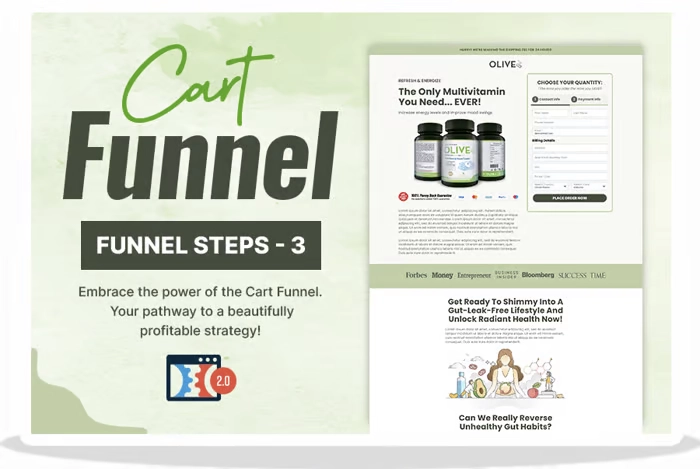
Websites were once novel and unique. They were simple online destinations. Digital realms. Informational hubs. They were teeming with activity. This was long ago. Back then, the world was slowly coming online. And our print-filled world was shifting to a digital one. That pace quickened with the rise of mobile. And what once seemed like a slow and steady evolution has accelerated at breathtaking speed.

Over the years, websites evolved. They shifted from purely informational sources to interactive virtual destinations. Browser advances allowed websites to grow and mature. It led to major changes. Online shopping became a reality. The rise of Amazon. Shopify. Social media apps. Online gaming. And more. Today, an even newer era of AI and automation is dawning.

However, traditional websites lost their luster over time. Their sheen wore off. That’s because websites overwhelm us with choices. They flood our periphery with little focus or direction. There’s so much going on with websites. To the untrained eye, this seems like the norm. But it’s not. And over the years websites have weathered and aged. They’re no longer new or novel. They’re stodgy and old.

Today, entrepreneurs understand that websites are dead. They no longer drive the new economy. In its place? Sales funnels. These magical little machines are transforming the topography of online lead generation and sales. They’re ushering in the dawn of a new era of money-making and business growth. So why are sales funnels so important? And what are the major differences between a sales funnel vs a website?

Sales Funnel vs Website: What’s The Difference?

Sales funnels are far different than websites. They’re not the same. Not whatsoever. There are major differences between sales funnels and websites. Sure, most people know what a website is. After all they’ve been around for ages. But not everyone knows what a sales funnel is. So what’s the big difference between the two?

To explain the difference, let me paint a picture. Imagine this for a moment. You’re driving in the dark. It’s pitch black. You’re in an unknown area that you’ve never been to. And up ahead the road splits. There’s a fork. The signs are clear but they’re dimly lit. So you take the path on the right. Then, you come to another fork in the road. This time there are 3 directions you can go in. Which one do you take?

Eventually you get lost. You have no idea how to get to where you’re heading. Your phone won’t connect and your navigation won’t load. Eventually you decide to turn around and leave. It’s not worth your time. You’re overwhelmed and frustrated. Sound familiar? It’s the experience most of us have with websites. After all, they overwhelm you with choices. There’s no clear direction or path.

Sales funnels are different. They’re direct and to the point. There’s only one path on that road at night and it leads straight to your destination. No forks in the road. No turns or onramps. And no exits. It’s a straight shot. A direct flight. That’s a sales funnel. It has pure focus with one intended path and outcome for your visit. That’s it. And that’s the reason why sales funnels work so well.

1—Direction

If it hasn’t yet clicked, websites lack focus. They lack direction. When you look at a sales funnel compared to a website, the differences are as clear as day. The reason why sales funnels convert at 137% higher than websites on average is for this reason. When you visit a sales funnel there’s no confusion on what you’re there to do. There’s only one intended action.

It’s like being on a single flight that takes off from exactly where you live and lands exactly at the destination where you’re heading. You’re not changing planes or getting off. There’s no stopovers. And that’s important for many reasons. Why? Because human beings are easily overwhelmed. Especially when we’re presented with too many choices.

Thanks to real-time everything, we experience overwhelm easily. We’re not used to waiting for things. We want them now. Pronto. Immediately. We don’t want to wait or delay our gratification. After all, human focus is dwindling. And our attention spans are shorter than that of a goldfish. We want what we want and we want it now. That makes sense, right?

That’s why websites are dead. They lack direction. There’s no focus. You’re overwhelmed with choices and options. Where do you click? What do you do? You’re flooded with information and you eventually decide that it’s all too much. And just like driving on the dark road at night with too many forks you eventually decide to turn around and go back home.

2—Process

Sales funnels and websites are founded on two entirely different processes. Let me explain. Websites have many choices. There might be a place to sign up for a newsletter or even download a lead magnet. But there also might be a place to buy a product or schedule a service. And all of this exists on the same website.

Sales funnels go through an entirely different process that’s inherent to the nature of their existence. Sales funnels are designed to convert. But they’re also designed to increase the cart value (or average order value) of a customer. And that’s important today for many reasons. So much has changed recently with ad platforms and privacy regulations that it’s no longer feasible to send traffic to a website.

When you send traffic to a website (even an e-commerce site) you’re swimming upstream. There’s heavy competition. Ad costs are swelling and rushing like whitewater rapids. And retargeting is becoming increasingly difficult with time. You can’t just hope and pray that a conversion happens. You must instead trust the process of a sales funnel.

The process of a sales funnel is far different than a website. Websites rely on a singular interaction whereas sales funnels foster relationships over time. Sales funnels help build rapport with prospects. They infuse stories. Social proof. They rely on the age-old adage of problem-solving. And they incorporate irresistible offers at their very core.

3—Structure

Unlike websites that have many options, sales funnels are structured differently. Yes. Tey have focus. There’s a singular direction. But that’s not the entire story. Sales funnels incorporate important components such as one-click upsells and down-sells. This allows you to spend more money to acquire a customer because the cart value naturally increases.

Sales funnels are also structured to achieve different goals. For example, some sales funnels are designed to generate leads. They can be squeeze page funnels or even reverse squeeze page funnels. These typically revolve around a very powerful landing page and an offer for a lead magnet. A lead magnet is a valuable problem-solving goodie that you give away for free.

Other sales funnels are structured to accept applications for high-ticket services or premium products. They behave in a certain way geared for that function. Still other websites are designed as 2-step tripwires with offers so good that it’s hard to pass up. Tripwire funnels might have order bumps and self-liquidating offers.

Sales funnels exist for every scenario. And they’re uniquely structured to fulfill one purpose. They’re conversion-getting machines. No matter what business you’re in, you must have a sales funnel that revolves around a great offer. While there is a lot that goes into sales funnels, the right structure for the right scenario is a critical driver of conversions.

4—Results

It’s no secret that sales funnels drive results. That’s the reason why so many businesses are switching to them. Especially in today’s day and age where website conversions are declining even further. That makes sales funnels vital in business. That’s because they produce results. They generate leads. Make sales. Increase conversions. And much more.

When you compare sales funnels to websites the differences are overwhelming in terms of results. To the tune of 137% more in favor of sales funnels across the board. When it comes to lead generation, webinar sign ups, purchases, upsells, and everything else, sales funnels convert better. Always. They’re hands down the single most important tool in your sales arsenal.

The trouble? Most businesses don’t know what sales funnels are. They don’t have a sales funnel and don’t understand the results it can produce. But the proof is in the pudding. Many sales funnels make it into the Two Comma Club and the Two Comma Club X. That means that they made over $1 million in a single year from a single funnel, or $10 million in a single year from a single funnel, respectively.

Even more sales funnels make $25 million to $100 million in a year. And there’s a reason for that. Sales funnels deliver results. That’s because they’re singular in focus. There’s one path forward and one path only. You’re not faced with choices or options. There’s no overwhelm. You either move forward or not. That’s it. Plain and simple.

5—Revenue

One of the core components that makes sales funnels so much more viable than websites is the revenue generation model. When comparing a sales funnel with a website, funnels win every time. They generate far more revenue than websites. That’s because funnels offer a more direct approach to traffic, leads and sales. They can easily convert browsers into buyers.

Sales funnels generate far more revenue because they concentrate on acquiring the prospect and developing a relationship with that person. It’s not just a one-off transaction. That’s also why sales funnels can generate higher revenue numbers than websites. They’re also often used to sell products and services that cost substantially more money.

Sales funnels are also used in webinars. Webinar funnels are a big driver of revenue because webinars are designed to sell high-ticket digital products and services. Webinars are used to sell anything from online courses, to membership site access, to coaching, masterminds, and more. And you can implement a webinar funnel quickly.

Another type of sales funnel that drives revenue are application funnels. Application funnels are also used to sell things like coaching and masterminds. And sometimes they are combined with webinar funnels. Applications work great because they force the prospect to prove why they’re a good fit to work with you.

6—Offers

One core part of sales funnels are offers. And not just any kind of offer. We’re talking about mouth-watering, irresistible offers that are impossible to pass up. Websites might have landing pages but they often fail to incorporate offers the right way. And that’s another reason why there’s such a big difference between sales funnels and websites.

Sales funnels and offers go hand in hand. They’re fused together like white on rice. It’s no different. Offers are at the core of sales funnels because when it’s executed the right way an offer is the core of a sales funnel. There’s always an offer. It could be an offer to generate a lead or fill out an application. It could also be an offer to register for a webinar or purchase a tripwire product.

There’s always an offer. And the better you understand how to implement an irresistible offer, the more likely your sales funnel will succeed. Most sales funnels fail for one of three reasons. It’s either the offer, the copywriting, or the design. All three elements must be there. But the offer is the core of all of it. The better you execute on the offer the more likely your sales funnel will succeed.

To build an offer you must understand the customer and their problem implicitly. The offer must be positioned in a way that maximizes the likeliness of solving that problem. And the more you can convince the customer that you understand their problem and can solve it, the more likely they’ll buy. These concepts are at the very heart of a sales funnel.

7—Psychological

Psychological tactics in sales funnels refer to persuasion. Not deception. Yes, you do see websites attempting to use psychological tactics like urgency. For example, there could be a countdown to a sale that’s going on for a website. However, sales funnels bake these tactics into the entire experience implicitly. They’re part of what makes sales funnels convert so well.

The first psychological tactic is the Law of Consistency. People want to be consistent with their prior behavior. That’s why lead magnets are used to first generate a lead. It’s a matter of clicking and agreeing to give out your basic details that ultimately sets the stage for a sale later down the road. This also applies to survey funnels where people fill out surveys. The mere act of filling out surveys reinforces the Law of Consistency.

Other psychological tactics are often used in sales funnels as well. Urgency is one tactic. There’s often an impending deadline somewhere. This often happens in product launch funnels and other instances where an offer is shutting down. Urgency is an important driving factor of human behavior because we all want what we can’t have (or eventually can’t have).

Another tactic used in sales funnels is scarcity. Sales funnels usually put a cap on the number of people allowed in a webinar or who can sign up during an enrollment period for an online course. As long as it’s authentic scarcity, people will clamor to buy. These are just some of many of the reasons why sales funnels perform so much better than websites.

Are Sales Funnels Hard To Build?

Sales funnels used to be hard to build before the introduction of ClickFunnels. Back then it would cost thousands (or tens of thousands) of dollars to put together a high-converting sales funnel. You needed developers and designers to work together. Systems needed integration. Payment platforms. Email providers. The works. That’s not the case anymore.
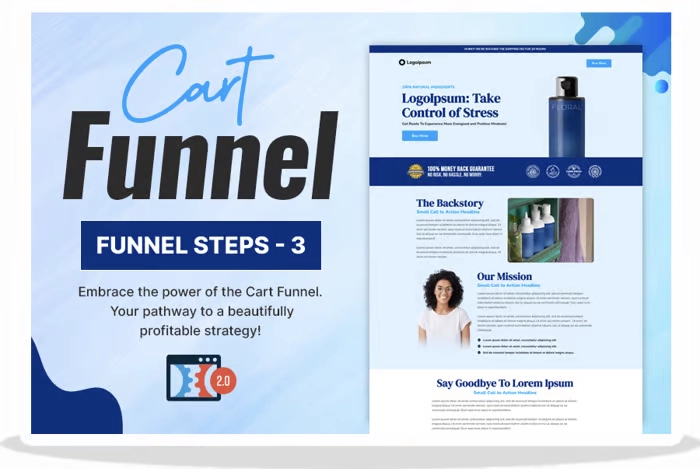
Today, sales funnels are easy to build. Thanks to our sales funnel builder you can build them in no time at all. You can use premade templates and a drag-and-drop editor to build sales funnels very quickly. It requires zero web development or coding skills. And you can often launch a sales funnel in a single afternoon as long as you understand the basic principles and components that drive successful funnels.

What Are The Stages Of A Sales Funnel?

Sales funnels have four primary stages. This is according to the AIDA marketing model that was coined by an advertising pioneer named, E. St. Elmo Lewis. In the AIDA model four primary stages exist. And these four stages dictate where a prospect currently is within a sales funnel.

If you think about it this way, the funnel looks very much like a physical funnel. It’s wide at the top and it’s narrow at the bottom. At the top is where traffic filters in from numerous sources. For traffic to show up there needs to be Awareness (A). They might see your post on social media, watch your video on YouTube, read a blog post, see an ad, or show up any other number of ways.

However, awareness is not enough. They need to show an Interest (I) in whatever it is that you’re saying. That’s the key. Interest makes them raise their hand. Awareness just gets them to show up. Interest means that they’re filling out a contact form, downloading a lead magnet, submitting an application, or something similar.

Desire (D) is created by communicating with that prospect through email marketing. This builds rapport and establishes a relationship. To do this you share stories, social proof, and show vulnerability. Often, the prospect is where you were when you first started your journey. So it becomes relatable to them. That’s where the true power of sales funnels shines.

The final stage is Action (A). That’s when they do the thing intended to be done. They purchase the product, sign up for the course, enroll in coaching, download a lead magnet, and so on. There are many intended actions. And the whole point of the funnel is to guide the prospect toward that intended action. When done the right way, it can set your sales ablaze like a wildfire. Yes, it’s that powerful.

Thanks for reading Sales Funnel vs Website: 7 Major Differences which appeared first on ClickFunnels.
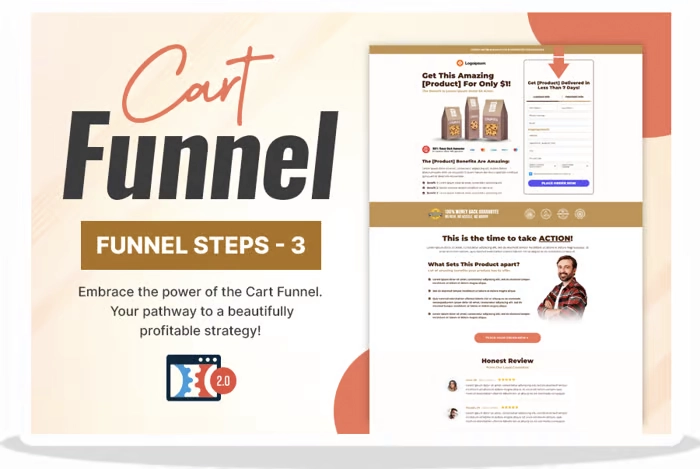
8 Ways To Make Money As A Graphic Designer

Software Stack Editor · March 11, 2024 ·

The post 8 Ways To Make Money As A Graphic Designer appeared first on ClickFunnels.
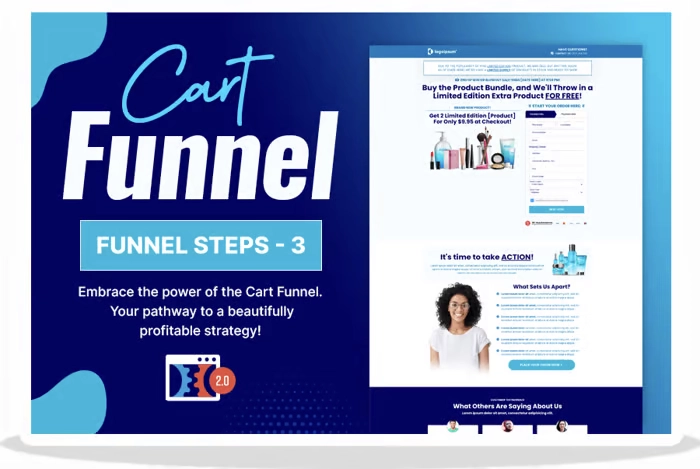
You’re a graphic designer. You see the world differently. You’re creative. Innovative. You harbor an innate ability to connect the dots where others cannot. You craft and concoct wild-eyed graphics that rival the imagination. Your unique approach to design allows you to see what others often fail to see. Colors flow like rivers through your mind. They ebb and flow like the tides that rise and fall over time.

Yes. Graphic designers are far different. But that difference is both a blessing and a curse—a Catch-22. That’s because your creativity often masks your practicality. You can design and create effortlessly. But that same passion overwhelms your practicality. It takes a front seat to your ability to make money as a graphic designer in a profession you love. But love doesn’t always pay the bills, right?

It’s okay to love design and be creative. That doesn’t mean you have to go out and get a “real job”. It only means that, as a graphic designer, you must find real ways to make money. And there are many ways to make a lot of money (and to make it fast) when you stop and look. Although AI is taking over, graphic designers can still make boatloads of money. You just need to know where to look.

How To Make Money As A Graphic Designer

When you step back to look at it there are many ways you can earn a substantial income. This isn’t about making a few dollars here or there. It isn’t about taking on five-dollar gigs to earn enough to buy a cup of coffee. Nope. This is about cashing in. And you can definitely cash in as a graphic designer. You don’t need to be a design prodigy to do it. You only need to follow one of the paths blazed before you.

After all, you’re not the first graphic designer to struggle with making money. And you certainly won’t be the last. The best part? Many have paved the way. So many graphic designers are making a lot of money. And not just the so-called cream of the crop. Anyone willing to put in the work and understand a few of the fundamental concepts that allow you to earn.

Look at it like this. Your time is limited. You don’t have much. It’s finite. Not unlimited. So to make real money as a graphic designer you have to find ways to compress time. This is not just about working for a meager hourly salary. Sure you can do that if you want to. This is more about working once and getting paid over and over again. That’s where the real magic happens.

It doesn’t matter if you’re a graphic designer, web developer, video editor, or you’re in any other profession. You can make a lot of money as long as you understand this concept. It’s all about doing the work once and getting paid repeatedly. We call that passive income. But passive income isn’t easy to pull off as a graphic designer. Especially when you have bills to pay and endless obligations. But it is the best path forward.

1—Sales Funnel Templates

One way to make a lot of money as a graphic designer is to design templates for sales funnels. Sales funnels are these magical little machines that virtually print money for businesses. Millions of businesses around the world use them. And there’s always a raging demand for high-quality sales funnel designs. The best part? You don’t need to be a coder or a web developer to set these up.
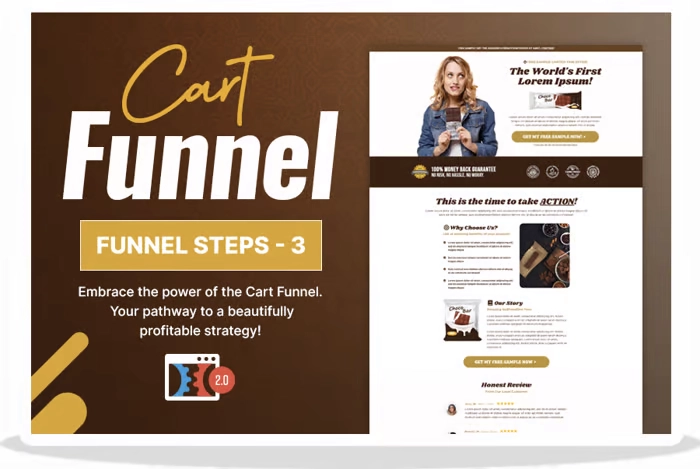
All you need to do is use existing premade sales funnel templates to initiate your design creations. The drag-and-drop editor makes it simple to move parts and pieces around. You can easily change colors, fonts, add shapes and images, and so on. The beauty is that you can do the work once and get paid repeatedly for it. How? Through the funnel marketplace.

Designing sales funnels is a simple approach to making money in the graphic design field. It allows you to channel your passion into a money-making opportunity. While sales funnels are one of the best ways to make money online today, most sales funnel designs are underwhelming. And by creating beautiful designs you can help many businesses that are struggling with this design problem.

Once you get the hang of it you can design sales funnels for all types of situations. You can design landing pages like squeeze pages or reverse squeeze pages. You can design application funnels. Webinar funnels. 2-step tripwire funnels. Hero pages. Affiliate bridge pages. And all of the above. Create stellar designs and watch your income skyrocket.
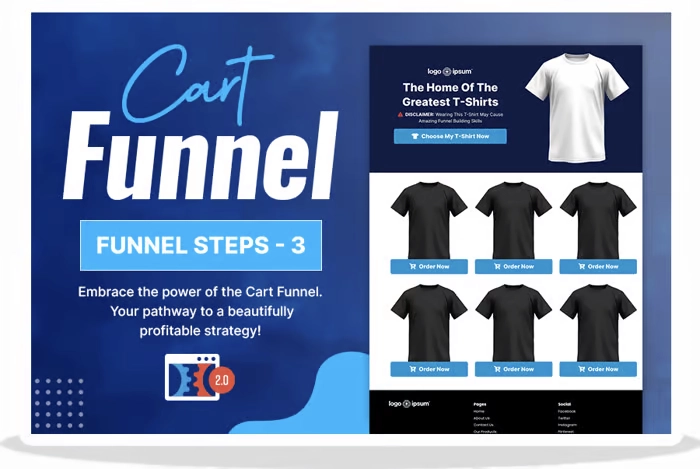
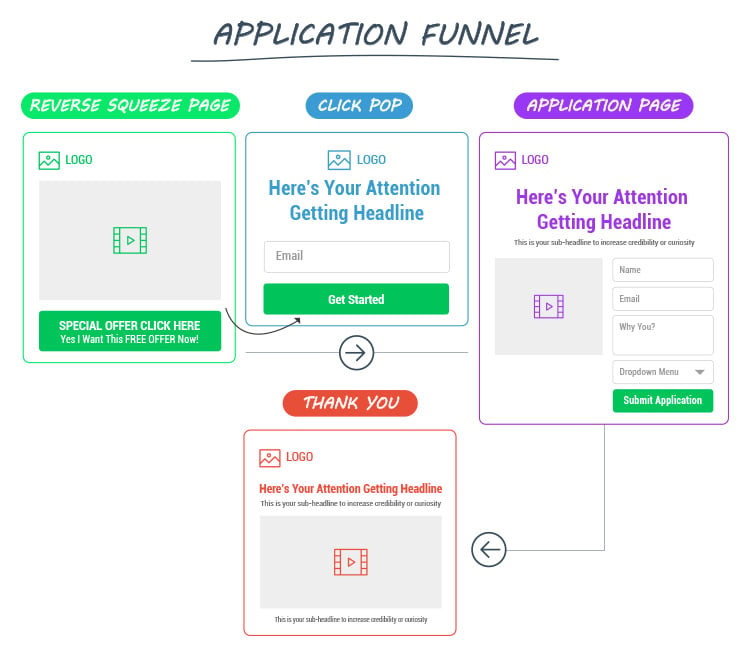
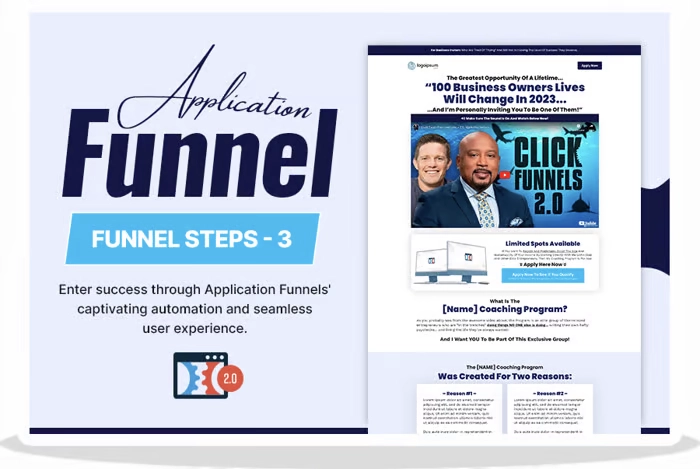
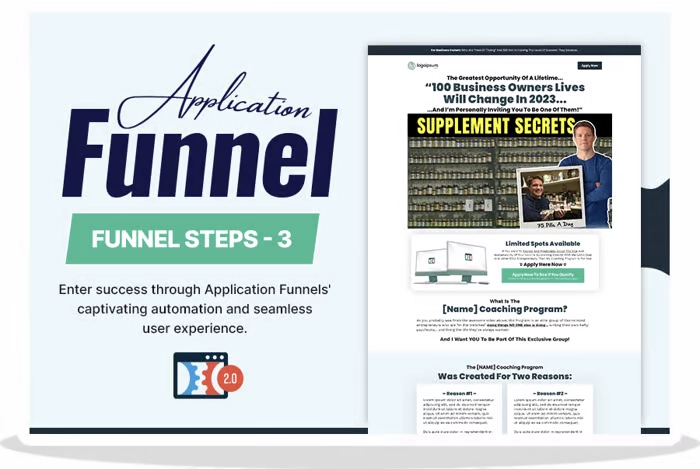
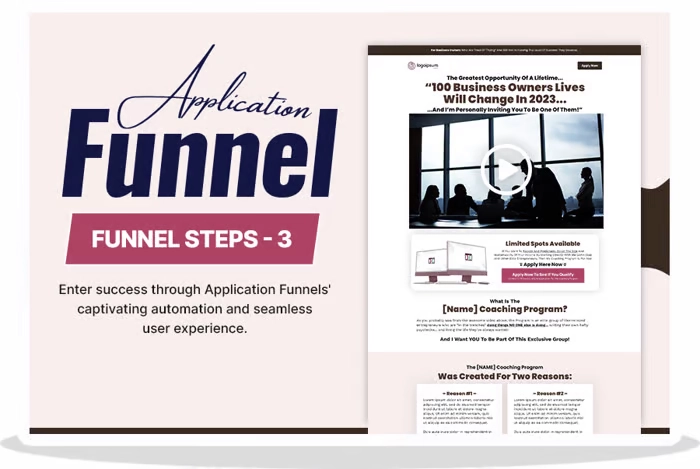
2—Create Digital Fonts

Fonts are beautiful. Classic. They can be serifed or non-serifed. Cursive. Block. They can take on all shapes and sizes. Digital fonts are important in design because you can convey design style with ease. When you’re designing something geared toward the luxury market you can use a luxurious font. For kids? You can use fun fonts.

While most don’t know it you can design and sell fonts in many marketplaces. This is not the easiest way to make money as a graphic designer. But if your font actually gets footing, it could take off and sell like hotcakes. You’ll need to ensure adoption and promote that font if you want to make money selling it. But the time and effort is worthwhile.

You can design your fonts in Adobe Illustrator and sell them in many font marketplaces like MyFonts. This allows you to do the work once and get paid repeatedly. If you understand how to create fonts consider creating them and selling them online. Although you don’t need to be a graphic designer specifically to do this, it helps.

Because you need to understand how to create vector art in a program like Adobe Illustrator. Vector art is the basis for fonts because it can be scaled without losing clarity or being pixelated. You can also learn the basics of graphic design and then try your hand at creating fonts. It takes some creativity and a willingness to try different approaches to see what works best.

3—Tutor Students

You can also tutor students in graphic design to make money. You can tutor them in all aspects of graphic design. You can tutor them in the basic concepts and principles. You can delve into the concepts and principles that drive color theory, or teach them how to use certain shapes to emphasize designs. And you can tutor them to use specific programs such as Photoshop, Illustrator, and others.

Tutoring is a great way to make money when you need to earn some fast and don’t want to wait for one of your passive income streams to kick in. It doesn’t take much effort to do this especially if you’re a seasoned graphic designer. You can use a platform like Varsity Tutors or Tutor.com to find students that you can tutor in graphic design.

Tutoring is an easy way to make money. But it does limit you based on your time. Meaning that you can only earn as much as you can work. You’ll also need to collect great feedback if you want to get the best tutoring clients. It takes time and a lot of effort but it is well worth it. Especially if you’re passionate about teaching others.

4—Online Courses

One of the best ways that you can make money is to create online courses. Online courses allow you to turn your knowledge and your skills into an actual income. And they allow you to make money while you sleep. In other words, you can generate passive income through online courses. That doesn’t mean it’s easy. But the concepts behind it are simple.

You can create a graphic design course that teaches students all the tricks of the trade. And you can sell that online course in many ways. You can use existing platforms like Udemy, Teachable, Kajabi, and others. But if you want to make more money with your online course, then you should build it yourself on a custom domain. And you should do it using an online course builder like this one. This way, you get all of the income it generates.

When you build your online course on a custom domain it also looks far more professional. And you don’t need to be a web developer to do this. You only need to use premade templates and a drag-and-drop editor. It’s the same way you would create sales funnel templates. The same software. All you need to do after that is to promote your course.

To promote your online course you need a good lead magnet on a landing page. That lead magnet must know the prospect’s problem. And it must agitate their pain. The lead magnet presents a solution to the problem and a way to alleviate the pain. It’s different for every industry. You must be creative and come up with a good hook. Once they download your lead magnet, build rapport through email marketing.

5—YouTube Channel

Can you make money with a YouTube channel? And can you do it as a graphic designer? If so, what would you create your videos about? The best part about graphic design is that it’s a highly visual trade. You can easily film yourself using popular software programs like Adobe Photoshop, Illustrator, and others. And you can use that as an opportunity to teach others about design.

If you don’t want to show your face you don’t have to. That’s the beauty of teaching graphic design. It’s visual and you can simply show your screen. All you have to do is create a voice-over or speak as you work on the project or teach people how to do certain things. You can teach people how to edit photos, create illustrations, or do any number of other things.

However, YouTube is not a quick way to make money. It takes time to build an audience on YouTube. And it takes dedication. You must commit to weekly uploads and ensure that your content is highly engaging. You must keep people’s attention and get them to watch as much of the video as possible. Because that’s an important ranking factor for your video.

You can monetize your videos on YouTube once you hit a certain threshold. Typically, you’ll need about 1,000 subscribers and 4,000 public watch hours in a year. You can also use YouTube shorts as a way to spur your channel’s growth. Plus, you can use YouTube to make money in other ways. You can use it to sell online courses, do affiliate marketing, promote digital products, membership sites, and more.

6—Digital Products

Another approach to making money is to create digital products. What kind of digital products can you create? The choices are limitless. The best digital products help people solve problems. Think about the problems people have in terms of graphic design and create a digital product that solves one of those problems.

Digital products can be sold day and night on autopilot. They’re typically sold through sales funnels. You can even create digital products quickly by using Private Label Rights (PLR) products. PLR allows you to sell other people’s products using a white-label approach. That means that you take something that’s already created and slap your branding on it and sell it as your own product.

PLR is one of the quickest ways to create digital products that make money in any industry or niche. For example, you can sell icon packs, UI elements or kits, Photoshop templates or actions, illustrations, vector art for logos, and more. There are many approaches you can take. Either way you approach it make sure that you create some sort of lead generation offer to help sell that digital product.

7—Freelancing

One way you can earn money is to simply do freelancing. Freelancing as a graphic designer is simple. That’s because there’s always a demand for good graphic design. All you need to do is get on one of the popular freelancing sites like Upwork or Freelancer and start bidding on projects. You’ll need to build up your profile and collect good feedback. That’ll happen over time. In the beginning, it will simply be a grind.

Freelancing is always a great way to make money. But it does limit you to your time. Since your time is limited, you should try to supplement any freelancing with other methods that allow you to disconnect your time from your ability to earn money. That’s where the real magic happens. Use your graphic designing skills to create great products that can be sold again and again.

You can also create a custom ecosystem for finding freelancing clients. You could build a sales funnel designed to accept applications from clients. We call this an application funnel. This way you flip the tables on the clients. It means that you’re vetting your clients and getting them to prove they’ll be the right fit to work with. This weeds out a lot of people when done the right way.

8—Theme Design

You can design themes and sell them in multiple marketplaces. Theme design is ideal for a graphic designer. It allows you to do the work once and get paid repeatedly. Again, this should be the aim. So if you’re good at designing themes, consider doing this. What kind of themes can you design? You can do WordPress themes, WebFlow templates, generic website themes, and more.

You can sell your themes on Envato, TemplateMonster, ThemeForest, and many other sites. It takes time to build up the ratings of a theme for sale. As long as the theme is good people will leave you great feedback. You can also find different ways to promote your themes to help spur initial sales and reviews. You can use paid ads, social media marketing, set up a sales funnel, do email marketing, find affiliates, and more.

Theme design doesn’t require a lot of work if you’re already an established graphic designer. However, some theme design and setup might require some light web development skills. You must understand how to put the theme together in a way that makes it simple for others to implement that theme. Aside from that, it’s very straightforward.

Thanks for reading 8 Ways To Make Money As A Graphic Designer which appeared first on ClickFunnels.
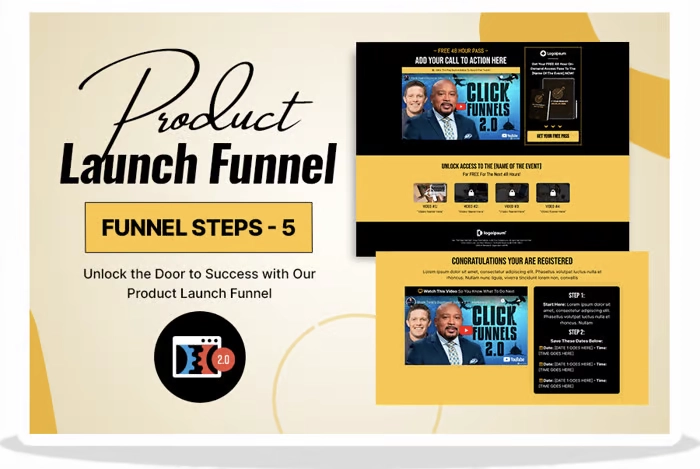
  • « Go to Previous Page
  • Page 1
  • Interim pages omitted …
  • Page 9
  • Page 10
  • Page 11

Get your Software Stack together. softwarestack.tech

Software Stack

© 2024–2025 - Software Stack is a trading name of SouthwestCIO Limited ac ompany registered in England & Wales 11319049

  • Knowledgebase
  • Home
  • About Us
  • Contact Us