• Skip to primary navigation
  • Skip to main content
software stack logo

Software Stack

Get your Software Stack together

  • Knowledgebase
    • All Categories
    • Accounting Software
    • Automation & Workflow Software
    • Customer Relationship Management
    • E-Commerce Shopfronts & Payments
    • Marketing Automation
    • Online Courses & Membership
    • Project Management
    • Surveys & Forms
    • Web Hosting
  • Home
  • About Us
  • Contact Us
  • Show Search
Hide Search

Clickfunnels

Create Evergreen Funnels Without Losing the Human Touch

Software Stack Editor · October 28, 2025 ·

The post Create Evergreen Funnels Without Losing the Human Touch appeared first on ClickFunnels.

As an entrepreneur, you know the power of automated sales funnels to generate leads and drive sales. However, you might worry about losing the human touch when building evergreen funnels. The challenge lies in scaling your sales process while still providing a personalized, engaging experience for each customer.

The good news is that you don’t have to choose between automation and authenticity. You can create a system that runs smoothly without losing the human connection that makes your business memorable. Evergreen funnels combined with innovative strategies and tools help you unlock new potential.

  • What Is an Evergreen Funnel?
  • The Key to a Personal Touch in Evergreen Funnels
    • 1. Use Personalized Emails for Engagement
    • 2. Offer Value Through Every Step
    • 3. Create Human-Centered Landing Pages
    • 4. Use Video and Interactive Elements
  • How to Choose the Right Software for Evergreen Funnels
    • Page Creation Made Easy
    • Automation That Works for You
    • Strong Integrations
    • Data That Guides Improvement
  • Build Your Evergreen Funnel Today

What Is an Evergreen Funnel?

An evergreen funnel is an automated sales process that generates leads, nurtures prospects, and drives sales without requiring manual intervention. It’s evergreen because it isn’t tied to a specific date or launch.

With funnel-building software, you can create evergreen landing pages and email sequences that run on autopilot. A visitor finds your page, signs up for a free resource, and gets helpful emails over time. Step by step, some of those prospects turn into paying customers.

Evergreen funnels can be incredibly effective. However, many businesses build them in a way that feels mechanical and impersonal. If you’re trying to scale, you can’t afford to sacrifice the authenticity and connection that made your business successful in the first place.

The Key to a Personal Touch in Evergreen Funnels

So, how can you create an evergreen sales funnel that feels personal and tailored to your customers? The following strategies will help you get the best of both worlds—automation and connection:

1. Use Personalized Emails for Engagement

Imagine someone teaching you advanced marketing tactics while you’re still figuring out how to write your first email. You’d feel frustrated and left behind, right? That’s exactly how your audience feels, too.

Make segments by grouping people based on what they downloaded, how long they’ve been on your list, or what stage of business they’re in. Someone who just discovered you needs foundational advice, while someone following you for six months might be ready for more advanced tips.

You can also reference the specific thing they downloaded or the problem they mentioned when they signed up. If someone grabbed your client onboarding checklist, start your following email with “Since you’re working on streamlining your client process…” It shows you remember what they care about and makes the email feel relevant to their situation.

2. Offer Value Through Every Step

Funnels are often synonymous with aggressive selling, and therein lies the issue. Focusing on making sales frequently causes businesses to lose sight of helping customers solve real problems.

To change this, focus on being genuinely helpful at every step. Ask yourself what you can give your audience instead of what you can get.

For example, you can offer a helpful guide when someone first finds you, share actionable tips in your follow-up emails, and provide case studies that show what’s actually possible. Each interaction should leave them better off than before.

3. Create Human-Centered Landing Pages

Your coaching landing page or product sales page should reflect your brand’s personality and communicate directly with your audience. Even though the page is automated, the design and messaging should still feel personal.

Elements that can help you build connection and trust:

  • Your Story: Share why you created your product or service and what problem it solves. People want to know the person behind the business, so don’t be afraid to go deeper into your journey and what drives you to help others.
  • Real Client Results: Include specific success stories with names and details rather than generic praise. “Sarah increased her revenue by 40% in three months” is much more compelling than “This program changed my life.”
  • Conversational Copy: Skip the corporate jargon and write like you’re talking to a friend. Use “you” and “I” language, ask questions, and address their specific concerns in a natural and approachable way.

4. Use Video and Interactive Elements

Incorporating video and interactive elements is another powerful way to keep the human touch in your evergreen funnel. These tools allow you to engage with your audience more directly and make them feel like they’re interacting with a real person.

You can post a short video on your landing page addressing your visitors directly. Introduce yourself and explain what they can expect from your funnel. Interactive elements like quizzes, surveys, or simple polls can make your funnel more engaging.

How to Choose the Right Software for Evergreen Funnels

Building an evergreen funnel starts with software that runs the system without constant oversight. The right tool balances automation with flexibility so your funnel keeps bringing in leads and sales long after it goes live.

Page Creation Made Easy

Choose software that lets you build landing pages, sales pages, and thank-you pages without technical skills. A drag-and-drop editor gives you control to design pages that fit your brand and launch quickly.

Automation That Works for You

Your funnel depends on automation sending the right message at the right time. Look for tools that handle email sequences, track behavior, and trigger follow-ups based on actions. That way, your funnel keeps moving people forward without extra work.

Strong Integrations

Strong integrations keep your funnel running smoothly. The software should connect with email platforms, payment processors, scheduling tools, and larger marketing automation platforms you may already use. Reliable connections mean every step, from sign-up to purchase, works without gaps.

Data That Guides Improvement

An evergreen funnel should get better over time. Pick software with built-in testing and analytics so you can see what’s working and what needs adjusting. Precise data lets you refine pages and emails in a way that steadily improves results.

Build Your Evergreen Funnel Today

Evergreen funnels keep sales consistent, but what matters most is maintaining a human connection. Even with automation in place, people respond to messages that feel personal and genuine. 

Set up your software, launch the first version, and get a feel for how your audience interacts. Use the insights to refine your messaging and the data to improve each step of the funnel.

Try ClickFunnels for Free Today!

Thanks for reading Create Evergreen Funnels Without Losing the Human Touch which appeared first on ClickFunnels.
Turn Your Ebook Landing Page into a 24/7 Sales Machine in 7 Steps

Software Stack Editor · October 23, 2025 ·

The post Turn Your Ebook Landing Page into a 24/7 Sales Machine in 7 Steps appeared first on ClickFunnels.

Is your ebook landing page not converting visitors into customers the way you hoped? You’re not alone. Most ebook landing pages collect a few emails and then…nothing. People download the free resource and disappear, never to be heard from again.

The problem isn’t that people don’t want what you’re offering. It’s that most landing pages are set up like dead ends instead of doorways. When you optimize your ebook landing page, visitors find a clear path through your sales process.

So how do you turn your ebook landing page from a simple download into a customer-generating system?

  • 1. Capture Leads with an Irresistible Offer
  • 2. Set Up Email Automation
  • 3. Include a Strong Call-to-Action (CTA)
  • 4. Use the Ebook as a Gateway to More Products or Services
  • 5. Select a Proven Funnel Template
  • 6. Integrate Email Marketing for Seamless Automation
  • 7. Optimize the Funnel for Maximum Conversions
  • Easy Page Creation
  • Built-in Email Automation
  • Proven Templates
  • Performance Tracking

1. Capture Leads with an Irresistible Offer

The first step in turning your ebook landing page into a sales machine is creating an offer you can’t ignore. People are tired of generic “ultimate guides” that promise everything and deliver nothing. Give them something specific that solves a real problem they’re facing right now.

Instead of “Download our free marketing ebook,” try “Get the 5-step email sequence that converted 40% of our leads into paying customers last month.” When visitors can picture exactly how your ebook will help them, sharing their email address becomes an easy decision.

Pro tip: Include a snippet or preview of your best content right on the landing page. Your visitors are more inclined to trust you with their contact information when they see the quality up front.

2. Set Up Email Automation

Once a lead enters their details to download your ebook, you can instantly trigger a series of automated emails to nurture them further. These touchpoints could include:

  • A welcome email thanking them for downloading the ebook
  • A follow-up email offering additional resources or content related to the ebook
  • A special offer on a paid product or service that complements the ebook

The key is to nurture the relationship over time by providing consistent value through automation. This will keep you in front of your prospects and build trust without any additional work on your part.

3. Include a Strong Call-to-Action (CTA)

Are you using boring, generic CTAs like “Download Now” or “Submit”? No wonder people grab your ebook and disappear.

If you want visitors to stick around and eventually become customers, your CTA needs to paint a picture of what they’ll achieve.

For example:

  • “Get the framework that doubled my revenue in 90 days.”
  • “Start building your email list this week.”

These CTAs work because they focus on the transformation people want. In terms of getting people to take action, showing them the end result is much more effective than just telling them what button to click.

4. Use the Ebook as a Gateway to More Products or Services

Once someone downloads your ebook, they become a warm lead. In other words, they’ve gone through your content and are ready to hear about what else you offer. Use the opportunity to introduce them to your other offerings by:

  • Setting up a follow-up email sequence that showcases your main service
  • Offering a special discount on your course for ebook downloaders
  • Inviting them to a free consultation or strategy call

The idea is to ensure that the funnel leads the visitor to higher-value offers after they engage with the ebook. Some businesses even add an upsell funnel or order bump after the opt-in to extract even more revenue from the funnel.

5. Select a Proven Funnel Template

Funnel templates are a great starting point, and many funnel builders offer pre-built ebook funnel templates designed for maximum conversions. These templates are tested and optimized to help you convert traffic into leads and sales quickly. Simply customize them with your branding, offer, and messaging to get started.

6. Integrate Email Marketing for Seamless Automation

Your funnel should include automated emails that deliver the ebook and guide people to the next step. Set up a series of follow-up emails that provide additional value, share customer success stories, or introduce your paid services. You can also set up behavior-based triggers that send different emails based on what people click or download.

7. Optimize the Funnel for Maximum Conversions

The key to turning your ebook landing page into a 24/7 sales machine is continuously optimizing your funnel. Track how users interact with your landing page, A/B test different versions of your copy or CTA, and monitor your conversion rates. The more you tweak and improve, the better your funnel will perform.

How to Choose a Funnel Builder for Your Ebook Landing Page

When you’re ready to turn your ebook landing page into a sales machine, you need the right tools to make it happen. Look for a platform that can handle everything from building your pages to automating your follow-up sequences.

Easy Page Creation

You want a drag-and-drop builder that lets you create professional landing pages without coding or hiring a designer. The faster you can get your funnel live, the sooner you can start capturing leads and generating revenue.

Built-in Email Automation

Your funnel builder should integrate seamlessly with email marketing tools so you can set up automated sequences that nurture leads without manual work. This is what turns a simple download into ongoing sales opportunities.

Proven Templates

Starting from scratch takes forever. Look for a platform with pre-built templates optimized for conversions. You can customize them to match your brand and launch quickly instead of spending weeks designing from scratch.

Performance Tracking

You need clear data on what’s working and what isn’t. Look for analytics that show you conversion rates, email open rates, and where people are dropping off in your funnel. You should also be able to test different versions of your pages to improve results over time.

The right funnel builder handles all these pieces in one platform, so you’re not juggling multiple tools or trying to make different systems work together.

Stop Letting Your Ebook Sit There Like a Digital Paperweight

You’ve put work into creating that ebook. Don’t let it become another forgotten download on someone’s computer.

Pick one strategy from this article and implement it this week. Maybe it’s rewriting your CTA to focus on outcomes, or setting up a simple three-email follow-up sequence that introduces your main service.

Start with whatever feels most doable right now. You’ll know you’re on the right track once you see people sticking around after the download.

Video

Infographic

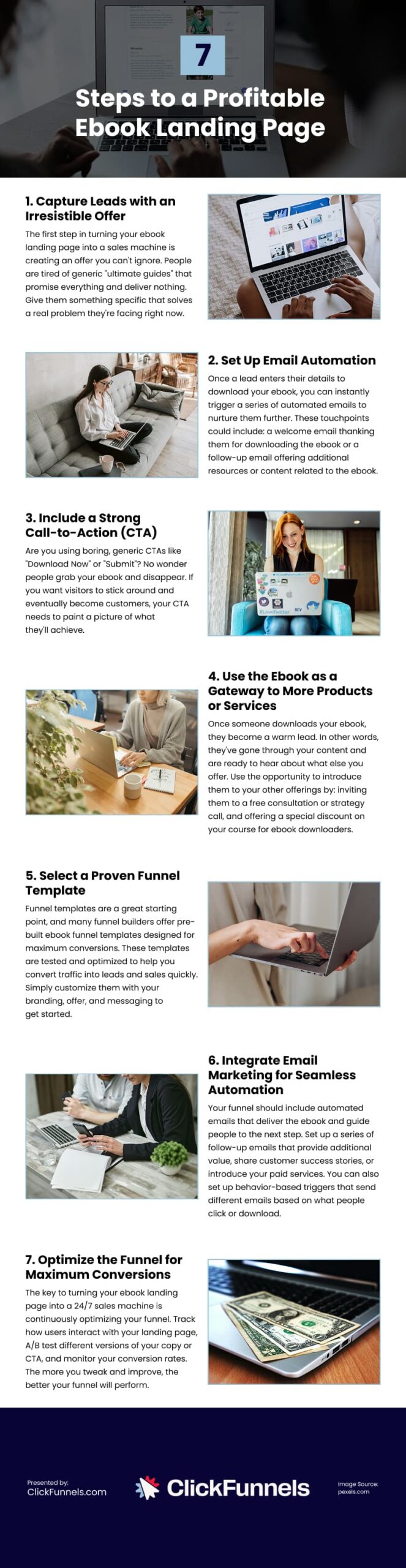
You’re not alone if your ebook landing page isn’t converting visitors into customers. With the right strategy, it can become an effective sales tool. Learn how to turn your ebook into a key part of your marketing funnel with the steps in this infographic.

7 Steps to a Profitable Ebook Landing Page Infographic

Get “DotCom Secrets” for FREE!

Thanks for reading Turn Your Ebook Landing Page into a 24/7 Sales Machine in 7 Steps which appeared first on ClickFunnels.

Automate Repeat Sales with Your Online Store Builder

Software Stack Editor · October 21, 2025 ·

The post Automate Repeat Sales with Your Online Store Builder appeared first on ClickFunnels.

Getting customers to buy from you once is hard enough. Getting them to come back and buy again? That’s where most e-commerce stores struggle, and it’s also where your biggest opportunities lie.

Most store owners put all their energy into attracting new customers while their previous buyers quietly move on to competitors. But repeat customers spend more, buy more frequently, and cost far less to convert than first-time visitors.

The good news is you don’t have to manually chase down every customer with follow-up emails and special offers. Using your online store builder , you can automate the entire process of bringing customers back.

  • Why Automate Repeat Sales?
    • 1. Saves Time and Effort
    • 2. Increases Revenue Without Extra Effort
    • 3. Builds Stronger Customer Relationships
  • How to Automate Repeat Sales Using Your Online Store Builder
    • 1. Create a Customer Loyalty Program
    • 2. Set Up Abandoned Cart Automation
    • 3. Automate Follow-Up Email Sequences
    • 4. Implement Subscription-Based Models
    • 5. Leverage Upselling and Cross-Selling Automation
  • 6 Steps to Create a Funnel for Repeat Sales
    • 1. Choose Your Automation Platform
    • 2. Map Out Your Customer Journey
    • 3. Set Up Your Email Sequences
    • 4. Create Your Offers
    • 5. Test and Launch
    • 6. Monitor and Improve
  • Start Building Your Automated Sales System

Why Automate Repeat Sales?

It’s no secret that retaining customers is often more cost-effective than constantly seeking new ones. According to one study, 1 increasing customer retention by just 5% can lead to an increase in profits of 25% to 95%. But how do you achieve this consistently?

The answer is automation. When you automate your repeat sales process, you create an effortless way for customers to return and make additional purchases. Instead of spending hours on customer outreach, you can create an automated sales funnel that nurtures relationships and leads customers back to your store.

Let’s break down the key benefits of automating repeat sales:

1. Saves Time and Effort

Manual follow-up is exhausting. You’re constantly trying to remember who bought what and when to reach out again. With automated systems, your store handles all of this for you. It sends thank-you emails, recommends related products, and reaches out with special offers—no more sticky notes or reminders cluttering your desk.

2. Increases Revenue Without Extra Effort

Automating repeat sales means your store works for you even when you’re not actively managing it. You can create funnels that re-engage previous customers with tailored offers, bundles, and promotions, increasing your revenue with minimal extra effort.

3. Builds Stronger Customer Relationships

Automation helps you stay connected with customers between purchases. It sends helpful tips about products they bought, care instructions, styling ideas, or early access to new items that might interest them. This consistent engagement keeps your brand at the forefront of your customers’ minds and makes them feel valued.

How to Automate Repeat Sales Using Your Online Store Builder

Automating repeat sales might sound complicated, but the right tools simplify it. Here are some creative ideas for your automated sales system:

1. Create a Customer Loyalty Program

One of the most effective ways to encourage repeat sales is by setting up a loyalty or rewards program. Your online store builder can help you create a system that rewards customers for their purchases.

For example, it can:

  • Award points for every purchase customers can redeem for discounts or free products.
  • Send automated email reminders about points balances and available rewards.
  • Offer bonus points for customers who reach certain spending milestones.

When customers see they’re earning something with each purchase, they’re more likely to return and shop more with you.

2. Set Up Abandoned Cart Automation

Many customers add items to their cart and leave without completing the purchase. Abandoned cart funnels help you automatically follow up with these customers to bring them back and complete their order.

Abandoned cart automation works by:

  • Sending a friendly reminder email a few hours after someone leaves items in their cart
  • Following up with incentives like free shipping or a small discount to encourage completion
  • Creating urgency with a final time-limited offer before the items are removed

Since these customers already showed interest by adding products to their cart, they often just need a gentle nudge to complete their purchase.

3. Automate Follow-Up Email Sequences

It’s important to keep customers engaged with your brand beyond the first purchase. Use your online store builder to set up automated email sequences that nurture the relationship post-purchase. These can include:

  • Thank-you emails: Show appreciation for their purchase and offer a coupon for their next order.
  • Product recommendations: Suggest related products based on their previous purchases.
  • Exclusive promotions: Send limited-time offers or early access to new products for returning customers.

These emails keep your customers engaged with your brand. They are more likely to return and buy again.

4. Implement Subscription-Based Models

A subscription funnel can help you automate repeat sales by offering products that customers routinely need. For example, if you sell skincare products, coffee, pet food, or supplements, customers can sign up to receive them automatically every month or quarter.

With your online store builder, you can set up a subscription service with automated billing, product delivery, and renewal reminders. This creates predictable recurring revenue while making it convenient for customers to get their essentials.

5. Leverage Upselling and Cross-Selling Automation

Automating upsell and cross-sell offers is another powerful way to increase repeat sales.

Once a customer makes a purchase, the system can:

  • Offer a more expensive or premium version of the product they just bought.
  • Suggest related products that enhance or complement their original purchase.

This process works particularly well when your online store builder is integrated with your sales funnel system. With all your customer data, purchase history, and automation tools in one place, creating offers that feel timely and relevant to each customer becomes easier.

6 Steps to Create a Funnel for Repeat Sales

Creating an automated system for repeat sales is easier than you think. Here’s how to set it up step by step:

1. Choose Your Automation Platform

Pick funnel software that handles both your online store and email automation in one place. This makes it easier to track customer behavior and create relevant follow-ups based on what people actually buy.

2. Map Out Your Customer Journey

Think about what happens after someone makes their first purchase. Do they need tutorials on how to use the product? When would they likely need to reorder? Plan out the touchpoints that make sense for your specific business.

3. Set Up Your Email Sequences

Create automated emails for different scenarios: welcome messages for new customers, follow-ups after purchases, and re-engagement emails for people who haven’t bought recently. Keep them helpful rather than pushy.

4. Create Your Offers

Design special offers for repeat customers like loyalty discounts, early access to new products, or bundle deals. Make these offers feel exclusive to encourage customers to keep buying from you.

5. Test and Launch

Start with one simple automation, like a thank-you email series after purchase. Test it with a small group first, then expand to other automated sequences once you see it working.

6. Monitor and Improve

Check your results regularly to see which emails get opened and which offers convert best. Use this data to refine your sales funnel automation and make it more effective over time.

Start Building Your Automated Sales System

You’ve got the blueprint, now it’s time to choose your tools. Choose a platform that can handle your online store, email automation, and customer tracking all in one place.

Most platforms offer free trials, so you can test the features before committing. Use that trial period to set up one complete automation sequence and see how it performs with real customers. The sooner you start, the sooner you’ll have a system working behind the scenes to grow your revenue.

1 https://hbr.org/2014/10/the-value-of-keeping-the-right-customers

Get HELP Building Your Ecommerce Funnels Now!

Thanks for reading Automate Repeat Sales with Your Online Store Builder which appeared first on ClickFunnels.
Lead Management Made Easy with Sales Funnel Automation

Software Stack Editor · October 16, 2025 ·

The post Lead Management Made Easy with Sales Funnel Automation appeared first on ClickFunnels.

So, you know that manually following up with leads is eating up too much of your time. However, you’re not sure how to automate without losing the personal connection. Makes total sense, especially when you’re already juggling a dozen other priorities. Let’s not add “master lead automation” to your packed schedule.

Sales funnel automation creates a process that nurtures leads consistently while you focus on what you do best. We’ll walk through how automation transforms lead management, what features actually matter, and how to get started without overwhelming yourself.

  • What Is Sales Funnel Automation?
  • Key Features of Sales Funnel Automation
    • 1. Automated Email Sequences
    • 2. Lead Segmentation
    • 3. One-Click Upsells and Order Bumps
    • 4. Dynamic Follow-Ups
  • Why Sales Funnel Automation Is the Key to Better Lead Management
    • 1. Consistency and Reliability
    • 2. Time Savings
    • 3. Better Conversion Rates
    • 4. Clear Performance Data
    • 5. Scalability
  • The Reality of Managing Leads Without Automation
  • Take Your Lead Management to the Next Level with Funnel Automation

What Is Sales Funnel Automation?

Sales funnel automation is a system that does all your lead follow-up work for you. You’ve seen an automated sales funnel in action if you’ve ever signed up for a free guide online and received a series of helpful emails over the next few days.

It typically works like this:

  • Lead capture: You build an online course, a checklist, or another valuable asset to give away in exchange for people’s email addresses. 
  • Lead nurturing: Once someone opts in, the system sends them helpful content while sharing relevant offers based on their interests.
  • Conversion: When someone’s ready to buy, your funnel presents the right offer at the right time. This can be your main service, an online course, or a consultation call.
  • Follow-up: After someone becomes a customer, the automation continues with welcome messages, helpful resources, and occasional offers for additional services.

The best part? The system is efficient and self-sustaining. Set it up once and it’ll keep working whether you’re with clients, sleeping, or on vacation.

Key Features of Sales Funnel Automation

1. Automated Email Sequences

The magic happens with automated email sequences. You can nurture your leads at every stage, providing value, answering questions, and encouraging action. From delivering a free guide to sharing success stories and offering discounts, these emails keep your leads engaged without you lifting a finger.

2. Lead Segmentation

Not all leads are the same. Your funnel knows this.

Sales funnel automation lets you break up your leads according to their actions or interests. Each person gets content that matters to them. If someone downloads an ebook on fitness, your funnel automatically sends follow-up emails about fitness coaching or other relevant offers.

3. One-Click Upsells and Order Bumps

An automated system can automatically offer buyers related services or products at checkout (like upgrades, complementary services, or additional training). Customers get more value. Plus, you increase your revenue without extra work.

4. Dynamic Follow-Ups

Even better, the system keeps the conversation going, whether someone bought from you or not. People who purchase get helpful onboarding content and occasional offers for additional services.

And, those who haven’t bought yet? They continue getting valuable content that builds trust and keeps you at the top of their minds when they’re ready to make a decision.

Why Sales Funnel Automation Is the Key to Better Lead Management

Here’s why you should consider automating your sales funnel:

1. Consistency and Reliability

Automated email sequences provide every lead with the same quality follow-up. It doesn’t matter whether they’re your first contact of the day or your hundredth. You’re not accidentally forgetting people or sending inconsistent messages. This reliability helps build trust with prospects.

2. Time Savings

Funnel automation handles routine follow-ups automatically. You get to focus on closing deals and growing your business instead of spending hours writing individual emails or tracking who needs what.

3. Better Conversion Rates

Automated systems catch leads that might otherwise slip away. The system nurtures people based on their specific interests and keeps them engaged until they’re ready to buy. Consistent follow-up often turns interested prospects into customers.

4. Clear Performance Data

Aren’t you tired of guessing why your sales are up one month and down the next? Automation gives you real answers. You can see which emails people open, what links they click, and where they drop off in your process.

5. Scalability

Sales funnel automation lets you capture and convert more leads without hiring more staff or increasing your workload. It’s designed to grow with your business, making it the ideal tool for scaling operations.

The Reality of Managing Leads Without Automation

Manual lead management can feel like playing whack-a-mole with your inbox. Every time you think you’re caught up, five more leads pop up, each at a different stage of interest, each needing a slightly different approach. You’re constantly switching between your CRM, email, calendar, and that sticky note system you swore you’d abandon months ago.

Here are the most common challenges that come up:

  • Lost hours: Following up with every lead individually takes hours you could spend on growing your business or serving existing customers.
  • Missed leads: Without a system tracking everything, promising prospects get lost in the shuffle.
  • Inconsistent communication: Some leads get your best pitch, others get a rushed response. Their experience can vary wildly depending on how busy you are that day.

As your business grows, these problems multiply. What worked when you had five leads a week becomes completely unmanageable at fifty. The solution is implementing a sales funnel automation system that handles initial follow-ups, lead scoring, and nurturing sequences so you can focus on having actual sales conversations with qualified prospects.

Take Your Lead Management to the Next Level with Funnel Automation

The benefits of sales funnel automation are undeniable. It’s time to implement it in your business to reap the rewards.

Start by mapping out your current process and identifying which tasks eat up most of your time. Then, automate those repetitive follow-ups and nurturing sequences using funnel builder software.

Stop pulling your hair out over missed follow-ups. Put the right automation system in place, and start converting more leads into customers with timely, targeted content.

Build Your Lead Magnet Funnels With ClickFunnels. Try for Free!

Thanks for reading Lead Management Made Easy with Sales Funnel Automation which appeared first on ClickFunnels.

Personalize Your Marketing with Automated Self-Assessment Funnels

Software Stack Editor · October 16, 2025 ·

The post Personalize Your Marketing with Automated Self-Assessment Funnels appeared first on ClickFunnels.

Personalization in marketing is no longer just a nice-to-have feature; it’s a must. Your leads and customers expect tailored experiences that speak directly to their unique needs and desires. But how do you scale personalized marketing without dedicating countless hours to one-on-one communication?

Enter automated self-assessment funnels. These funnels allow you to gather valuable data from leads, automatically segment them based on their responses, and deliver personalized offers, content, and recommendations—all on autopilot. This system ensures you’re speaking directly to your customers, guiding them through a journey that feels custom-made just for them.

In this blog, we’ll explain automated self-assessment funnels, why they’re a game-changer for your marketing strategy, and how you can implement them in your business to boost engagement and conversions.

  • What Is an Automated Self-Assessment Funnel?
  • The Benefits of Using Automated Self-Assessment Funnels
    • Higher Engagement and Interaction
    • Hyper-Personalization at Scale
    • Saves Time and Effort
  • How Automated Self-Assessment Funnels Work for Different Industries
    • 1. Coaching and Consulting Businesses
    • 2. E-commerce and Retail
    • 3. Digital Products and Courses
  • How to Create Your Own Automated Self-Assessment Funnel
    • Step 1: Choose the Right Platform
    • Step 2: Design Your Self-Assessment
    • Step 3: Set Up Email Sequences
    • Step 4: Optimize and Test
  • Personalize Your Marketing with Automated Self-Assessment Funnels

What Is an Automated Self-Assessment Funnel?

An automated self-assessment funnel is a marketing strategy that uses quizzes, surveys, or assessments to gather insights about your leads, automatically segment them, and deliver personalized content or product recommendations based on their responses. It is a highly interactive and engaging way to guide leads toward a product or service that fits their exact needs.

Here’s how it works:

  • Lead Capture—Your funnel begins by offering a self-assessment, quiz, or survey that entices visitors to share information about themselves. Sometimes, it’s as straightforward as asking a few questions to understand audience pain points, preferences, or goals.
  • Data Collection & Segmentation—As leads fill out the assessment, the data they provide automatically segments them. Based on their answers, they can be grouped into categories such as “high interest,” “nurturing required,” or “ready to buy.” Automation is key. You don’t have to analyze and categorize each lead manually.
  • Personalized Follow-Up—Once segmented, your funnel can automatically deliver customized content, offers, or product recommendations based on the lead’s specific responses. For instance, if someone answers a quiz and indicates they need a particular service, the funnel can send an email offering that service or guiding them to relevant product pages.
  • Conversion—By the time a lead reaches the end of your funnel, they’ve gained valuable insights and personalized recommendations, increasing their likelihood of converting into a paying customer.

The Benefits of Using Automated Self-Assessment Funnels

Higher Engagement and Interaction

Whether it’s by answering questions or assessing their own needs, you create a truly interactive experience when you let leads actively participate in their journey. Self-assessment funnels engage users on a deeper level, making them feel personally involved and understood. And the more engaged your leads are, the more trust they build in you, increasing the chances they’ll move forward in your funnel.

For example, imagine a coaching business that invites prospects to take a quiz about their current challenges. As they work through the quiz, they gain valuable insights into their situation, which naturally builds trust in your expertise and encourages them to take the next step with you.

Hyper-Personalization at Scale

Personalized marketing is now a game-changer in how consumers make decisions. Automated self-assessment funnels help you tailor offers and messaging based on each lead’s answers, without the hassle of manually segmenting them. You can deliver hyper-relevant content and offers that speak directly to their needs, boosting your chances of converting them into customers.

For example, a fitness coach might ask leads about their goals, such as weight loss, strength training, or improving flexibility. Based on those responses, the funnel automatically presents workout programs or training plans that perfectly match what the leads are looking for.

Saves Time and Effort

Traditional marketing strategies often demand a lot of manual effort—think personal emails, phone calls, or consultations. Automated funnels, however, save you time by handling much of the lead qualification and segmentation for you. Gather the same valuable insights that would typically take hours of one-on-one interaction. You gain more free time to focus on growing your business.

How Automated Self-Assessment Funnels Work for Different Industries

Automated self-assessment funnels aren’t limited to one type of business or industry. Whether in coaching, e-commerce, digital products, or any other field, you can customize these funnels to suit your needs. Let’s break down how to use self-assessment funnels in different industries:

1. Coaching and Consulting Businesses

For coaches and consultants, self-assessment funnels are dynamic tools for uncovering a lead’s pain points and tailoring offerings accordingly. Whether you provide one-on-one coaching or group programs, these funnels help you pinpoint each lead’s unique challenges and position your services as the ideal solution.

For example, a business coach might use a self-assessment quiz to help prospects identify their biggest business hurdles. Based on their responses, the funnel can recommend the perfect next step: a free consultation, an upcoming webinar, or a paid coaching package.

2. E-commerce and Retail

In e-commerce, a self-assessment funnel helps segment visitors by their preferences and purchase behavior. Customers answer a quiz about the types of products they’re interested in. Then, you can automatically deliver targeted offers that match their tastes, boosting the chances of a sale.

For example, a clothing store might use a style quiz where customers select their favorite colors, clothing types, or occasions. The funnel then directs them to tailored product pages, exclusive discounts, or curated collections designed just for them based on their responses.

3. Digital Products and Courses

Self-assessment funnels enable digital product creators or course providers to segment users based on goals and expertise levels. Then, you can offer the right product or course tailored to their needs, whether that’s an introductory program or advanced training.

Imagine a digital marketing expert who designs an assessment funnel asking potential students about their experience and business goals. Based on their answers, the funnel can recommend beginner courses or advanced modules, helping guide them smoothly through their learning journey.

How to Create Your Own Automated Self-Assessment Funnel

Creating your automated self-assessment funnel is simple and only takes a few steps:

Step 1: Choose the Right Platform

Look for a platform that offers drag-and-drop funnel builders, customizable templates, and integrations with email marketing tools, especially one that excels as a lead generation funnel solution.

Step 2: Design Your Self-Assessment

Create an engaging, interactive self-assessment or quiz that asks the right questions to help segment your leads. Align the questions with your business goals and target audience needs. Keep it short, with no more than 5-7 questions.

Step 3: Set Up Email Sequences

After the assessment, create automated email sequences that deliver personalized content or offers based on the lead’s answers. You can also segment the leads and trigger different email sequences based on their responses to increase the relevance of your messaging.

Step 4: Optimize and Test

Like any funnel, your self-assessment funnel needs constant optimization. Monitor your funnel’s performance, A/B test different questions, offers, and follow-ups, and continuously refine your messaging to improve conversions.

Personalize Your Marketing with Automated Self-Assessment Funnels

Targeted engagement is at the heart of effective e-commerce marketing automation, helping you deliver the right message at the right time without lifting a finger.

Automating your self-assessment funnels is one of the most powerful ways to personalize your marketing efforts and drive conversions. Create an engaging and relevant experience that nurtures relationships and boosts sales by tailoring offers and content to each lead’s unique needs.

You built a dream. Now build it a funnel, and watch your leads move seamlessly toward a purchase with personalized, automated guidance every step of the way.

Video

Infographic

Personalized marketing builds trust and drives conversions, but manually customizing experiences can be time-consuming. Automated self-assessment funnels simplify the process. Check out this infographic for step-by-step guidance.

4 Steps to Build an Automated Self-Assessment Funnel Infographic

Join Thousands of Degree-Free Entrepreneurs. Get Your Clickfunnels Account Now.

Thanks for reading Personalize Your Marketing with Automated Self-Assessment Funnels which appeared first on ClickFunnels.

Smart Segmentation Strategies for Your New Sales Funnel

Software Stack Editor · October 14, 2025 ·

The post Smart Segmentation Strategies for Your New Sales Funnel appeared first on ClickFunnels.

One of the most powerful ways to boost engagement and conversions when launching a new sales funnel is by automatically segmenting your leads. Unlike traditional funnels that send the same message to everyone, automated segmentation lets you treat each lead like an individual, delivering precisely what they need, exactly when they need it.

Automated funnel segmentation divides your leads into different groups based on their behavior, interests, and where they are in the funnel. Instead of blasting generic emails, you tailor your messaging, offers, and follow-ups to ensure every interaction provides real value to the right people.

In this blog, we’ll explore why automated funnel segmentation matters, how it works, and why it’s a must-have strategy for boosting your sales funnel’s performance. Plus, we’ll share how the right tools can help you implement segmentation seamlessly, turning more leads into paying customers.

  • Why Funnel Segmentation Is Essential for Sales Funnels
    • 1. Higher Engagement
    • 2. Improved Conversion Rates
    • 3. Better Lead Nurturing
  • How Automated Funnel Segmentation Works
    • Step 1: Lead Capture and Behavior Tracking
    • Step 2: Assigning Leads to Segments
    • Step 3: Automated Email Follow-ups Based on Segmentation
  • Benefits of Automating Funnel Segmentation
    • Saves Time and Increases Efficiency
    • Better Decision Making
    • Scalability
    • Increased Revenue
  • How to Simplify Automated Funnel Segmentation with the Right Tools
    • 1. Built-in Segmentation Features
    • 2. Simple Email Automation
    • 3. A/B Testing
    • 4. Analytics and Insights
  • Automate Your Sales Funnel Segmentation Today

Why Funnel Segmentation Is Essential for Sales Funnels

Segmentation in your sales funnel is like having multiple funnels running at the same time, without all the extra work. It’s a smart way to ensure that your leads receive the right message, at the right time, and in the right format. Here’s why funnel segmentation is so critical for your success:

1. Higher Engagement

When you segment your audience, you unlock the power to deliver truly personalized experiences. Instead of sending generic messages to everyone, your tailored content, offers, and solutions match each lead’s unique interests and behavior.

For example, suppose someone downloads your free ebook on a specific topic. You can then follow up with emails focused on related content or products, for a message that connects better. This targeted approach is precisely what an AI sales funnel builder helps you automate, so every lead feels seen and valued.

2. Improved Conversion Rates

Sending the right message to the right lead significantly improves your chances of converting them. By automating funnel segmentation, you can deliver the most relevant offers at the most opportune time. Whether offering a discount, a free consultation, or a special bonus, the chances of conversion increase when the offer aligns with the lead’s specific needs or stage in the funnel.

3. Better Lead Nurturing

Effective lead nurturing starts with knowing exactly where your leads are in their journey. Are they just discovering your business, are they curious, or are they ready to buy? Automated segmentation ensures every lead gets the right message at the right time.

For example, you can send educational content to someone just entering your funnel and exclusive offers to those ready to purchase. This creates a seamless, personalized experience that builds trust and guides leads through your automated marketing funnel more smoothly and effectively.

How Automated Funnel Segmentation Works

Automating segmentation in your funnel is all about setting up rules based on lead behavior and preferences. Such parameters could include actions like clicking a link, downloading a free offer, making a purchase, or showing interest in a particular product. These actions trigger automated responses that directly lead to different parts of your funnel.

Here’s how automated segmentation works in a typical sales funnel:

Step 1: Lead Capture and Behavior Tracking

The first step is capturing your leads. Examples include opt-in forms, free ebook downloads, or webinar sign-ups. Once the lead enters your funnel, your software tracks their behavior: which pages they visit, what emails they open, and what links they click. This information allows you to segment leads based on their actions.

Step 2: Assigning Leads to Segments

Once you have behavioral data, you can automatically assign leads to specific segments. For example:

  • Leads who visit a pricing page might be segmented as “hot leads” and moved to a special offer sequence.
  • Leads who click on a product demo video could be segmented to receive a follow-up with additional product details.

 This process ensures that each lead receives a targeted and relevant experience, increasing their chances of converting.

Step 3: Automated Email Follow-ups Based on Segmentation

Once your leads are segmented, you can set up automated email sequences that send the right message at the right time. For example, a lead who downloaded an ebook may receive a series of educational emails, building trust and providing more value. A lead who clicked on a product link might receive follow-up emails with specific product offers or testimonials to move them closer to purchasing.

Benefits of Automating Funnel Segmentation

Saves Time and Increases Efficiency

One of automation’s primary benefits is that it eliminates the need for manual segmentation. Nurture leads without manually monitoring their behavior by setting up automatic triggers and email sequences.

Better Decision Making

Automated segmentation helps you make better decisions about your marketing strategy. Gain valuable insights into what works and what doesn’t by tracking how different segments of your leads respond to various offers and content. These data-driven decisions help improve your funnel’s overall performance.

Scalability

Managing all the different leads and prospects manually becomes increasingly complex as your business grows. Automated segmentation allows you to scale your efforts, ensuring every lead receives a personalized experience, even with thousands of leads in your funnel.

Increased Revenue

Stop casting a wide net and hoping for the best. Segmenting your leads helps you offer products or services relevant to your audience. Presenting offers to the right people at the right time leads to higher sales and more revenue.

How to Simplify Automated Funnel Segmentation with the Right Tools

Using the right platform to create and automate your sales funnel can make a huge difference for coaches and businesses of all kinds. A good funnel builder simplifies automated funnel segmentation through:

1. Built-in Segmentation Features

Create segments based on specific behaviors like page visits, link clicks, or form submissions. Automatically send leads to different email sequences or offers based on their actions, ensuring they receive the most relevant content.

2. Simple Email Automation

Never miss an opportunity to engage your leads. Easy-to-set-up email automation allows you to create labor-saving email sequences for each segment.

3. A/B Testing

Built-in A/B testing tools let you experiment with different versions of your funnel and discover which segments respond best to specific offers. Testing helps you continuously refine your segmentation and boost conversions.

4. Analytics and Insights

Access to detailed analytics lets you track your funnel’s performance. See how each segment performs, make data-driven decisions, and improve your funnel over time.

Automate Your Sales Funnel Segmentation Today

Go from aspiration to activation. Start turning every lead into a loyal customer by delivering the perfect message at the ideal time.

Automated funnel segmentation is a game-changer for businesses looking to increase conversions and improve lead management. The right tool allows you to automatically segment your leads and nurture them through personalized email sequences, which helps maximize your funnel’s effectiveness and save valuable time.

Video

Infographic

Automated lead segmentation is a powerful way to increase engagement and conversions within your sales funnel. The right funnel-building platform makes it easy for coaches, entrepreneurs, and businesses of all sizes. Explore the infographic to discover ways to simplify automated funnel segmentation.

4 Ways to Simplify Automated Funnel Segmentation Infographic

Book – Expert Secrets

Thanks for reading Smart Segmentation Strategies for Your New Sales Funnel which appeared first on ClickFunnels.

The Risk of ‘Set and Forget’ in Your Marketing Funnel Automation

Software Stack Editor · October 9, 2025 ·

The post The Risk of ‘Set and Forget’ in Your Marketing Funnel Automation appeared first on ClickFunnels.

Automating your marketing funnels can save you time, increase conversions, and streamline your sales process. It’s tempting to set up your funnel, hit the “launch” button, and forget about it, letting the automation do all the work. After all, one of the main benefits of automation is that it runs in the background, giving you freedom to focus on other aspects of your business.

But the “set and forget” is a dangerous mentality for your marketing funnel. While marketing funnel automation can run your sales process on autopilot, you should constantly monitor, test, and optimize for the best results.

Without ongoing adjustments, your funnel may become outdated, inefficient, or ineffective. You can start to lose conversions or customer satisfaction.

Let’s dive into why “set and forget” can be risky for your funnel automation. We’ll show you how to stay on top of your marketing systems to ensure continuous growth and success.

  • Why “Set and Forget” Is a Dangerous Mindset
    • Changing Customer Behavior
    • External Market Changes
    • Lack of A/B Testing
    • Missed Opportunities for Lead Nurturing
  • How to Keep Your Funnel Automation Effective and Fresh
    • 1. Regularly Monitor and Analyze Your Funnel’s Performance
    • 2. Run Consistent A/B Tests
    • 3. Keep Your Content Up to Date
    • 4. Adapt to New Tools and Technology
    • 5. Engage with Your Leads Post-Purchase
  • Why Funnel Automation Tools are Essential for Scaling
    • 1. Easy Funnel Creation
    • 2. Advanced Analytics and Reporting
    • 3. Built-In Email Automation
    • 4. Flexible Integration Options
  • Don’t Let “Set and Forget” Sabotage Your Funnel

Why “Set and Forget” Is a Dangerous Mindset

The goal of automating is to save time and scale your business. However, once you’ve created your funnel, assuming it will keep working indefinitely can be tempting. Unfortunately, this approach can lead to several issues that hinder your funnel’s effectiveness over time.

Changing Customer Behavior

Customer preferences, behaviors, and interests are constantly shifting. Just because your funnel crushed it when you first launched doesn’t mean it’ll perform at that same level forever. Your audience evolves. Their needs, pain points, and buying habits change, and your funnel needs to evolve with them.

For example, your original email sequence may have hit all the right notes with your audience. It got clicks, conversions, and real momentum. But your audience will eventually crave different content, new formats, or updated offers. Engagement and conversions can drop if your funnel doesn’t adapt.

External Market Changes

The market never sits still. Competitors drop new offers, trends shift overnight, and new platforms or tech can change how your audience discovers and engages with content. You can easily fall behind if your funnel doesn’t evolve with the landscape.

Automated funnels are powerful, but they aren’t set in stone. They need to be flexible enough to ride the wave of market trends and shifts in consumer behavior. That means checking in, adjusting, and staying current.

Let’s say a new social platform suddenly takes off and your ideal audience flocks to it. You’re leaving money and momentum on the table if your funnel doesn’t capture that traffic through fresh content, new entry points, or platform-specific offers.

Lack of A/B Testing

One of the biggest benefits of funnel automation is the ability to test and optimize everything. A/B testing lets you experiment with different parts of your funnel—headlines, offers, email copy, call-to-action buttons—so you’re not just guessing what works but proving it with data. You’ll miss out on those crucial insights that drive better results if you treat your funnel like a one-and-done setup.

For example, imagine your funnel starts with an opt-in page. You can quickly see what gets more signups by testing two opt-in page variations, one with a bold headline and the other with a softer, more benefit-focused message. Without A/B testing, you’re flying blindfolded and likely leaving conversions on the table.

Optimization isn’t a one-time task; it’s an ongoing advantage. Keep testing and tweaking, so your funnel can keep improving.

Missed Opportunities for Lead Nurturing

Just because someone opts into your funnel doesn’t mean they’re ready to buy on the spot. That’s where lead nurturing comes in. It’s one of the most potent (often overlooked) parts of a successful automated funnel.

Send follow-up emails and lead nurturing sequences. These keep potential customers engaged, build trust, and guide them towards buying on their timeline.

It’s normal for a lead to check out your offer but not buy immediately. Without ongoing follow-up, a person can forget all about you. But with automated nurturing emails like reminders, value-packed content, or a time-sensitive incentive, you stay on their radar and increase the chances they’ll return when they’re ready to say yes.

How to Keep Your Funnel Automation Effective and Fresh

So, how can you avoid the pitfalls of “set and forget” and ensure your funnel remains a powerful tool for generating leads and sales? Here are five strategies to keep your sales funnel continuously optimized, no matter the industry:

1. Regularly Monitor and Analyze Your Funnel’s Performance

Track your funnel’s performance and analyze key metrics like conversion, bounce, and email open rates. Reviewing your funnel’s data regularly allows you to identify any areas that need improvement. Look for patterns, weaknesses, or bottlenecks preventing leads from converting. Adjust accordingly.

2. Run Consistent A/B Tests

Continuously A/B test the various components of your funnel, such as landing pages, email copy, and call-to-action buttons. This will help you identify the most effective strategies and refine your funnel to increase conversions over time. Regular testing ensures that your funnel stays relevant and optimized.

3. Keep Your Content Up to Date

Review and update your funnel’s content regularly to ensure it stays fresh and relevant to your audience. This includes revising your emails, replacing outdated offers, and ensuring your landing page copy aligns with current trends and customer interests. Doing this aligns your funnel with your audience’s evolving needs.

4. Adapt to New Tools and Technology

Marketing tools and platforms evolve constantly. New technologies, integrations, and features can help improve your funnel’s effectiveness. For instance, integrating Facebook ad funnels or using the latest email automation tools can enhance your funnel’s ability to nurture leads and drive conversions. Stay informed about new tools and trends to stay ahead of the curve.

5. Engage with Your Leads Post-Purchase

Your funnel shouldn’t stop once a customer has completed a purchase. Use post-purchase emails to nurture customer relationships, offer additional resources, or ask for feedback. You build brand loyalty and increase the chances of repeat purchases by continuing to engage with your customers after the sale.

Why Funnel Automation Tools are Essential for Scaling

A powerful funnel automation platform can help you build, monitor, and optimize your sales funnels, whether you’re a coach, running an e-commerce brand, or scaling any other type of business.

The right tool makes managing every moving part of your funnel easier, even as your audience and offer stack grow. Here’s what to look for:

1. Easy Funnel Creation

A user-friendly drag-and-drop editor lets you build professional, high-converting funnels in just a few clicks. With a wide selection of templates tailored to different business models—coaching, e-commerce, or digital products—you can quickly set up a funnel that fits your goals without needing design or coding skills.

2. Advanced Analytics and Reporting

Robust analytics tools give you the insights to track your funnel’s performance and make smart, data-driven decisions. From conversion tracking and A/B test results to detailed lead behavior, these tools help you understand what’s working and what needs improvement to continuously optimize your funnel for better results.

3. Built-In Email Automation

Email automation makes it easy to set up sequences that nurture leads, follow up consistently, and build strong relationships over time. With the proper setup, your leads continue to move through the funnel without needing constant manual input. You save time while keeping engagement high.

4. Flexible Integration Options

A good funnel automation platform integrates seamlessly with a wide range of third-party tools, like email marketing services, CRM systems, and payment gateways. You can manage every part of your funnel smoothly from one centralized place.

Don’t Let “Set and Forget” Sabotage Your Funnel

Automation is a total game-changer, but here’s the truth: you can’t just build your sales funnel automation and forget it. Funnels need love, testing, and tuning to keep firing on all cylinders.

Keep an eye on how things are performing, try new ideas, and stay connected with your leads. That’s how you “build it smart, scale it fast” to turn your funnel into a growth machine that keeps your business moving forward.

Start Your ClickFunnels 14-Day Free Trial Now!

Thanks for reading The Risk of ‘Set and Forget’ in Your Marketing Funnel Automation which appeared first on ClickFunnels.

6 Automated Funnel Myths That Are Killing Your Conversions

Software Stack Editor · October 7, 2025 ·

The post 6 Automated Funnel Myths That Are Killing Your Conversions appeared first on ClickFunnels.

Automated marketing funnels are a game-changer for scaling your business and boosting conversions. But let’s be real, there’s a lot of noise out there. And with that comes many myths that make funnels seem more complicated or less effective than they actually are.

The truth is, these misconceptions can seriously hold you back. Whether you fear tech, think automation feels impersonal, or believe funnels are only for “big” businesses, none of it tells the full story.

In this blog, we’re breaking down the seven most common myths about automated marketing funnels and setting the record straight. You’ll get a clearer picture of how funnel automation really works and why it’s one of the most powerful ways to nurture leads, drive sales, and scale with less stress.

  • Myth 1—Automated Funnels Don’t Work for Small Businesses
    • The Truth—Automation Is for Every Business
  • Myth 2—Automated Funnels Are Impersonal
    • The Truth—Automation Can Be Highly Personalized
  • Myth 3—Funnels Are Only for E-Commerce Businesses
    • The Truth—Funnels Work for Any Business Model
  • Myth 4—Setting up an Automated Funnel Is Too Complicated
    • The Truth—Building a Funnel Is Easy With the Right Tools
  • Myth 5—Once It’s Set Up, You Can Forget It
    • The Truth—Funnels Need Ongoing Optimization to Convert
  • Myth 6—Automation Means Losing Control
    • The Truth—Automation Enhances Your Control and Focus
  • Why You Should Embrace Funnel Automation

Myth 1—Automated Funnels Don’t Work for Small Businesses

Many small business owners hesitate to implement automated marketing funnels because they believe automation is only for large corporations with big budgets. They worry that computerized systems might be too complicated or costly to set up for smaller businesses.

The Truth—Automation Is for Every Business

Automated funnels are incredibly scalable and can work for businesses of all sizes. Whether running a local service business or a small e-commerce store, it can help you streamline your marketing process. Businesses of all sizes can set up funnels, track leads, and nurture them through the sales journey—all without a large team or complicated infrastructure.

Automation doesn’t have to be expensive or complicated. In fact, it can save small businesses time and money by eliminating repetitive tasks, reducing human error, and allowing you to focus on more critical aspects of your business.

Myth 2—Automated Funnels Are Impersonal

Another common myth is that automated funnels are cold and robotic, making the customer experience feel impersonal. Some think automation means sending generic messages that won’t resonate with their leads.

The Truth—Automation Can Be Highly Personalized

The beauty of automated funnels is that they can be personalized and tailored to your leads’ specific interests, behaviors, and actions. For example, with email marketing automation, you can segment your leads and send them messages based on their previous interactions with your business. You can customize your offers, content, and even timing based on where each lead is in the sales journey.

With the right automation tools, your messages can feel personal and human while saving time. Create a customized experience that builds trust, engagement, and conversion by combining automation with targeted personalization.

Myth 3—Funnels Are Only for E-Commerce Businesses

Some believe that automated marketing funnels are only helpful for e-commerce businesses or companies selling physical products.

The Truth—Funnels Work for Any Business Model

This assumption is far from the case. Funnels can benefit any type of business, whether you offer services, digital products, or consulting.

While e-commerce businesses often use funnels to sell products, service-based businesses can also benefit from automated funnels. For instance, a coaching sales funnel can nurture potential clients, offer free content like webinars or consultations as lead magnets, and ultimately guide leads toward signing up for a coaching package.

Funnels are versatile and built to fit your business model. Whether offering a free ebook, a digital course, or an exclusive consultation, a funnel works behind the scenes to do the heavy lifting. It automatically captures leads, nurtures trust, and turns prospects into paying clients. For coaches and service-based businesses, that means more growth with less grind.

Myth 4—Setting up an Automated Funnel Is Too Complicated

Another common misconception is that creating an automated funnel is too complex and requires technical knowledge you don’t have. The idea of coding or designing an entire system can be intimidating to those without a tech background.

The Truth—Building a Funnel Is Easy With the Right Tools

Thanks to innovative funnel-building software, setting up a lead generation or sales funnel for your business is straightforward and requires no coding skills. These tools come with pre-built templates, drag-and-drop editors, and simple integrations, making funnel creation accessible even for beginners.

With these user-friendly tools, you can quickly build and launch a funnel, set up automated email sequences, and start capturing leads without any hassle. You don’t need to be a tech expert to implement an automated marketing funnel that works effectively for your business.

Myth 5—Once It’s Set Up, You Can Forget It

Some people think the work is done once their automated funnel is live. Just set it and forget it, right? Others believe funnels are just for collecting leads; the job is over once someone enters the funnel.

The Truth—Funnels Need Ongoing Optimization to Convert

Automated funnels do save time by running in the background, but they’re not a “one-and-done” solution. To really make them work, you need to track performance, test different elements (like subject lines, CTAs, and upsell offers), and use that data to refine your approach.

And here’s the bigger picture: funnels aren’t just about generating leads; they’re about converting them. That means every stage of your funnel, from the welcome email to the post-purchase follow-up, should work toward a sale (and even a repeat sale). With the right AI funnel builder software, you can automate smarter, personalize better, and improve results over time.

Myth 6—Automation Means Losing Control

Some business owners fear implementing funnel automation means losing control over their leads, customers, or content. They worry that relying too much on automation could result in missed opportunities for personal connection or individualized follow-up.

The Truth—Automation Enhances Your Control and Focus

Funnel automation doesn’t leave you out of the loop. It gives you more control over your sales process. By automating follow-ups, lead nurturing, and communication, you can spend more time focusing on what really matters: building relationships, refining your offers, and improving your customer experience.

Automation gives you more control over when and how you engage with leads. You can set up triggers to send messages at just the right time, ensuring your leads are engaged and moving through the funnel toward conversion.

Why You Should Embrace Funnel Automation

Automated marketing funnels can completely transform your business. You can streamline lead generation, nurture relationships, and boost conversions, all while saving time and effort. By understanding the true power of automated funnels, you can implement systems that allow you to scale without sacrificing personal connection or quality.

It’s time to ditch the myths and finally build a funnel that matches the vision you have for your business. You built a dream—now build it a funnel.

Click Here to Build Your AI Funnel For Free!

Thanks for reading 6 Automated Funnel Myths That Are Killing Your Conversions which appeared first on ClickFunnels.

Keep Your Multi-Offer Funnel Friendly With Automation

Software Stack Editor · October 2, 2025 ·

The post Keep Your Multi-Offer Funnel Friendly With Automation appeared first on ClickFunnels.

Managing a multi-offer funnel can be a tricky balancing act. It’s easy to overwhelm your audience and lose the sale. But with the right automation in place, you can keep your funnel clean, your message clear, and your leads moving.

Next-level automation helps you deliver the right offer to the right person at the right time without manually pulling the strings. That means more personalized experiences, better conversions, and a whole lot less friction for both you and your customers.

In this post, we’ll show you how to use automation to make your multi-offer funnel smoother, smarter, and way more effective. You’ll be able to sell more without doing more.

  • What Is a Multi-Offer Funnel?
  • Why Automation Is Essential for Multi-Offer Funnels
    • 1. Personalizes the Customer Experience
    • 2. Keeps Leads Engaged
    • 3. Saves Time
    • 4. Increases Conversion Rates
    • 5. Improves Funnel Consistency
  • How to Set Up Automation in Your Multi-Offer Funnel
    • 1. Start with Segmentation
    • 2. Set Up Triggered Emails and Sequences
    • 3. Automate Time-Based Offers
    • 4. Employ Upselling and Cross-Selling
    • 5. Implement Lead Scoring and Retargeting
  • What to Look for in an Automated Multi-Offer Funnel
    • Easy Funnel Creation
    • Email and Automation Integrations
    • Pre-Built Funnel Templates for Multi-Offer Funnels
    • A/B Testing and Analytics
    • Smart Tagging for Personalized Follow-Ups
  • Scale Your Business with Smart Automation

What Is a Multi-Offer Funnel?

Unlike traditional funnels that focus on a single offer, multi-offer funnels provide several options to customers. They choose the product or service that best fits their needs.

For example, you might use a multi-offer funnel to present a low-ticket offer to new leads. Then, upsell them on a mid-ticket product after their initial purchase. And, finally, offer a high-ticket coaching package to buyers ready for a premium experience.

The most challenging part of a multi-offer funnel? Keeping it simple and personal without losing your mind (or leads). That’s where automation steps in. The right approach and tools can have you up and funneling in a day, delivering personalized offers that convert without the headache.

Your funnel builder keeps everything organized behind the scenes, guiding visitors through multiple offers smoothly, without confusion or drop-off. That translates to fewer missed opportunities and more conversions, all with less manual hustle.

Why Automation Is Essential for Multi-Offer Funnels

Managing a multi-offer funnel without sales funnel marketing automation can quickly become a headache. From segmenting leads to managing follow-up emails and tracking offers, it’s easy for things to get lost in the shuffle. Smart automation simplifies this process, ensuring each lead sees the right offer at the right time.

Here are the top five reasons why automation is essential for multi-offer funnels:

1. Personalizes the Customer Experience

With automation, you can segment your leads based on their behavior and interests, ensuring they only see the most relevant offers. For example, suppose a lead is interested in a low-ticket product. Automated flows can guide them to an upsell or related product in the purchasing sequence. These personalized offers are more likely to convert, as they feel tailored to the individual’s needs.

2. Keeps Leads Engaged

A multi-offer funnel can become overwhelming if you don’t properly nurture your leads. Automation allows you to send timely, automated follow-up emails, reminding leads of their previous interactions with your offers and gently guiding them to a purchase. By staying engaged with your leads at the right time, automation helps maintain interest without becoming pushy or intrusive.

3. Saves Time

Instead of manually managing each lead and offer, automation does the heavy lifting for you. Automated email sequences, upsell triggers, and post-purchase follow-ups allow you to focus on more important tasks like improving your products, content, and business strategy.

4. Increases Conversion Rates

Automation makes sure that leads don’t slip through the cracks. Automated follow-ups, abandoned cart recovery, and personalized content delivery increase your chances of converting leads into customers by pushing the right offers at the right time. For example, your system automatically prompts someone who bought a low-ticket item with an upsell for a complementary mid-ticket product.

5. Improves Funnel Consistency

When juggling multiple offers, it’s easy for messaging, timing, or follow-up steps to become inconsistent. It’s especially true as your funnel grows. Automation ensures every lead receives a consistent experience, no matter when or how they enter your funnel. Automation helps you build trust, reinforce your brand, and reduce the chances of leads getting mixed messages or falling through the cracks.

How to Set Up Automation in Your Multi-Offer Funnel

Setting up automation in your multi-offer funnel doesn’t have to be difficult. Use these five steps to automate the process and keep your funnel user-friendly:

1. Start with Segmentation

Before you can automate your funnel, you need to segment your leads. Divide them into categories based on their interests, behaviors, or previous purchases. For example, a lead downloading a free ebook gets added to a group interested in low-ticket products. A lead who purchases a product moves to a group for upselling higher-value offers, and so on.

2. Set Up Triggered Emails and Sequences

Automated email sequences are a critical part of funnel automation. Trigger an email sequence that nurtures leads based on their actions once they enter your funnel. For instance, if they download your free ebook, send them a series of emails offering related products or providing additional educational content.

3. Automate Time-Based Offers

Set up automation to trigger limited-time offers based on when someone enters your funnel. You’re adding urgency without manually tracking timing—perfect for flash sales, bonuses, or early-bird deals that motivate action and keep momentum high.

4. Employ Upselling and Cross-Selling

Once a lead has purchased, automation kicks in to offer them complementary products. Set up automated order bumps, one-click upsells, or even time-sensitive offers to maximize each customer’s value without manual intervention.

5. Implement Lead Scoring and Retargeting

Lead scoring allows you to track how engaged your leads are and which stage of the funnel they are in. With automation, you can use retargeting ads or personalized emails to move leads through the funnel based on their score. For example, someone interacted with a low-ticket offer but hasn’t purchased. You can trigger retargeting ads or email reminders to encourage them to complete the purchase.

What to Look for in an Automated Multi-Offer Funnel

Not all funnel software is created equal. Look for the following capabilities when determining which funnel software is best for your business.

Easy Funnel Creation

Creating a sales funnel—whether for coaching, services, or multiple offers—doesn’t have to be complicated. With drag-and-drop builders and customizable templates, you can design a funnel that matches your brand and guides your audience without needing any technical skills.

Email and Automation Integrations

Pick a modern funnel tool that integrates easily with platforms like ActiveCampaign, Mailchimp, and others, making automating email sequences, follow-ups, and reminders simple. This keeps leads engaged across multiple offers and ensures no opportunity falls through the cracks.

Pre-Built Funnel Templates for Multi-Offer Funnels

Many platforms now offer pre-designed funnel templates built explicitly for multi-offer flows. Whether selling low-ticket items, online courses, or high-ticket coaching programs, you can start with a proven layout and adapt it to fit your strategy.

A/B Testing and Analytics

Testing is key to funnel optimization. Look for tools that allow you to easily A/B test headlines, CTAs, and offer placements. Real-time analytics give you the clarity to see what’s working, what’s not, and where to improve for better conversions.

Smart Tagging for Personalized Follow-Ups

With the right automation tools, you can tag leads based on their actions, like what they clicked, downloaded, or skipped. That means your follow-up emails, offers, and next steps can feel personal without you manually sorting every lead. It keeps your funnel responsive and relevant, helping you move people forward without missing a beat.

Scale Your Business with Smart Automation

Automating your multi-offer funnel with the right tools can dramatically improve your efficiency, increase conversions, and scale your business faster. An AI sales funnel builder helps streamline everything from email sequences to upsells and retargeting, while creating a personalized journey for every lead that enters your funnel.

Whether you’re a coach, running an e-commerce site, or growing another type of business, using a multi-offer funnel allows you to automate lead capture, optimize your offer flow, and scale with far less manual effort.

Ready to get started?

Start automating your multi-offer funnel to generate more leads, conversions, and revenue with less effort—because “Your funnel, your future.”

Try ClickFunnels for Free Today!

Thanks for reading Keep Your Multi-Offer Funnel Friendly With Automation which appeared first on ClickFunnels.

Create a Landing Page Without a Full Website (Fast and Easy)

Software Stack Editor · September 30, 2025 ·

The post Create a Landing Page Without a Full Website (Fast and Easy) appeared first on ClickFunnels.

You don’t need to build an entire website to start getting sales, leads, or signups. In fact, building a website right out of the gate is one of the biggest mistakes new entrepreneurs make.

The process not only takes weeks of your time, but also costs thousands in design and development fees before you even know if your business idea will work.

The best strategy is to set up a landing page that converts visitors into customers. With a landing page creator, you can build one in minutes without writing code.

In this blog, you’ll learn how to create a landing page fast, what makes it effective, and why you don’t need a full website to start winning online.

  • Why You Don’t Need a Full Website to Launch
  • The Simplicity of Funnel-Based Landing Pages
  • What to Include on Your Landing Page (and What to Leave Out)
  • Speed Is Your Secret Weapon
  • Test First. Expand Later.
  • Don’t Let “I Need a Website” Slow You Down

Why You Don’t Need a Full Website to Launch

There’s a common misconception that every online business needs a traditional website with a homepage, about page, blog, navigation menu, and all the bells and whistles. But unless you’re running a full-blown content brand or e-commerce store with hundreds of SKUs, that setup slows you down.

Your goal right now isn’t to inform. It’s to convert. And websites aren’t built to convert. They’re built to explore. Every menu option, blog post, or social link is another potential exit point from your page. That’s the opposite of what you want when trying to get someone to take action.

A landing page strips out the noise. It focuses your visitor’s attention on one thing: your offer.

So if you’re trying to book appointments, grow your email list, pre-sell a course, launch a webinar, or even validate a new product, a single landing page is more than enough to get results. And it’s faster to build.

The Simplicity of Funnel-Based Landing Pages

Creating landing pages used to require coding skills and design experience. But now with modern funnel builders, you can create one in minutes without any technical knowledge.

The process works like this: you choose a template that’s already proven to convert, customize it with your content, and publish it. That’s it.

The templates give you options like email signup forms, product sales pages, webinar registration, and free download offers. Each one is designed to get visitors to take one specific action.

What to Include on Your Landing Page (and What to Leave Out)

Most people try to cram everything onto their landing page. Their entire life story, every product feature, links to their social media. This TMI confuses visitors, and they leave without taking action.

Instead, include only what moves someone toward your goal:

  • A clear headline that explains what you’re offering
  • A simple explanation of how it helps them
  • Proof that it actually works (testimonials, reviews, results)
  • One obvious button that tells them exactly what to do next

Leave out everything else. No navigation menu. No links to other pages. No secondary offers. If it doesn’t help someone say yes to your main offer, it doesn’t belong on your landing page.

Speed Is Your Secret Weapon

Every day you spend tweaking a website is a day you’re not selling. That’s why landing pages give you such an advantage.

Let’s say you have an idea for a free challenge. Instead of waiting to build an entire site to promote it, you can spin up a landing page in a few minutes, write three simple emails, and launch. You’ll get traffic, signups, and data before buying a domain name.

That’s the power of moving fast with intent. You don’t need to be “perfect” to go live. You just need a clear message and a landing page that captures it.

Test First. Expand Later.

Starting with a landing page lets you find out if people want what you’re selling before you spend months building a website.

You know your message needs work if nobody signs up for your offer. You can change your headline, try a different angle, or pivot to something else entirely. Testing various elements one at a time takes minutes with a landing page instead of weeks with a full website.

But if people do sign up, you know you’re onto something. You can add more pieces like email follow-ups, thank you pages, or additional products. This is how you build a business based on what actually works (not what you think might work).

Don’t Let “I Need a Website” Slow You Down

While your competitors are still choosing fonts and debating whether to include a blog, you can already start collecting customers with a simple landing page.

Think about it. Every day you spend building a website is a day you’re not testing your offer with real people.

A landing page lets you get feedback from actual customers in days. You’ll know if your pricing is right, if your message resonates, and if people actually want what you’re selling.

Stop overthinking funnel creation. Launch your landing page with a simple page creator and start getting real results.

Video

Infographic

You don’t need an entire website to start generating sales, leads, or signups; launching with a landing page is often a smarter choice for new entrepreneurs. This infographic outlines the steps to build a landing page without a complete website.

6 Steps to Build a Landing Page Without a Full Website Infographic

Try ClickFunnels for Free, and Build Your Landing Page in Minutes

Thanks for reading Create a Landing Page Without a Full Website (Fast and Easy) which appeared first on ClickFunnels.

Why AI Funnel Builders Are a Game-Changer for Funnel Creation

Software Stack Editor · September 25, 2025 ·

The post Why AI Funnel Builders Are a Game-Changer for Funnel Creation appeared first on ClickFunnels.

Building a high-converting funnel used to take weeks. You had to map every step, write every word, test every layout, and hope it all worked when traffic finally hit.

But now, thanks to AI funnel builders, you can construct that high-converting funnel with a lot less effort.

You may worry that AI will replace your voice or make everything sound generic. But it actually speeds up your workflow and gives you what you need to stay focused, creative, and ready to launch faster.

Let’s look at how an AI funnel builder works and why more people are using it to build better funnels in less time.

  • The Slow, Old Funnel-Building Process
  • What AI Funnel Builders Do
  • Benefits of Creating Your Sales Funnel with AI
    • Learns From Your Prompts
    • Allows You to Create More Without Burnout
    • Helps You Overcome Copywriting Blocks
  • Personalization at Scale
  • How to Get Started with an AI Funnel Builder
  • Trade Grind for Growth

The Slow, Old Funnel-Building Process

Before AI, you had to wear a dozen hats to get your funnel live. You were the strategist, the designer, the copywriter, the optimizer. Even if you used a tool to simplify the design process, you still had to supply every word, every structure, and every conversion tactic yourself.

That kind of setup works, eventually. But it’s painfully slow. You’d spend days researching your market, more days writing headlines that might work, and weeks testing different page layouts to see what actually converted.

That’s where AI enters the picture.

What AI Funnel Builders Do

AI funnel builders take your basic business information and give you a finished sales funnel. They work by:

  • Asking simple questions about your product and target customers
  • Creating the funnel structure and page flow automatically
  • Writing headlines, sales copy, and call-to-action buttons for you
  • Setting up the entire conversion process from start to finish
  • Delivering a complete funnel ready for traffic in minutes

You get everything you need without spending weeks writing copy or figuring out page layouts. Edit and customize to match your brand. The foundation is already built for you.

What used to require hiring copywriters, designers, and funnel experts now happens automatically with AI assistance.

Benefits of Creating Your Sales Funnel with AI

An AI funnel builder offers a range of advantages to those looking to launch a profitable offer. For instance, it:

Learns From Your Prompts

AI funnel builders get better every time you use them. They take your inputs and start learning what works for your style.

For example, the more you write in a certain tone or structure, the more the AI adapts to match it. If your audience responds better to questions in headlines or short, punchy intros, the system starts leaning that way.

You can also reuse what worked. Pull in past funnels, tweak the offer, and have a new version ready in minutes. The AI remembers what performed well and helps you build on it.

Allows You to Create More Without Burnout

If you’ve ever tried to run more than one funnel at once, you know how draining it gets. Each offer needs its own copy, pages, emails, automations, upsells, and tracking. Do that a few times over, and it’s a fast track to burnout.

AI funnel builders take that pressure off. You can clone what worked, update the parts that need changing, and launch new funnels without doing everything from scratch.

You still have control, but the heavy lifting is handled. No more late nights rewriting the same headline five different ways.

Helps You Overcome Copywriting Blocks

Writing copy requires more than clarity. You need to tap into emotion, handle objections, and move people to act.

AI helps at every turn. Based on your offer, audience, and goal, it writes headlines, bullet points, and full sections using proven copywriting formulas like AIDA and PAS. Review, edit, and make it your own. In short, you’re never stuck staring at a blank screen.

Personalization at Scale

The more specific your message, the better it converts. However, one version of your funnel rarely works for different customer segments.

AI helps you adjust your online sales funnel for each audience without rebuilding from scratch. You can swap out headlines, calls-to-action, or testimonials depending on where someone came from or what they’re interested in.

One visitor might see a message about speed. Another sees a message about value. Both feel like you’re speaking directly to them. That’s personalization at scale. And AI makes it possible without extra tools or custom development.

How to Get Started with an AI Funnel Builder

You don’t need to know code or marketing to build with AI. Here are five steps to get started:

  1. Answer setup prompts: Tell the funnel-builder what you’re selling, who it’s for, and what action you want people to take.
  2. Review the draft funnel: The tool generates the funnel layout, including copy, pages, and flow from start to finish.
  3. Edit and personalize: Make small changes to match your tone, brand, and offer. The structure is already optimized.
  4. Add your integrations: Connect your email, payment, or scheduling tools so your funnel works from start to finish.
  5. Launch and improve: Publish your funnel and start testing. Use the built-in data to see what’s working and refine as you go.

Trade Grind for Growth

The days of spending weeks building a single funnel are over. Now, you can create professional sales funnels with AI assistance in just a few hours.

There’s a learning curve with any new technology. However, the advantages are too significant to ignore.

Don’t continue building funnels the slow way. Let AI handle this part so you can focus on growing.

Click Here to Build Your AI Funnel For Free!

Thanks for reading Why AI Funnel Builders Are a Game-Changer for Funnel Creation which appeared first on ClickFunnels.

The Shift from Product Grids to Sales Funnels in E-commerce

Software Stack Editor · September 23, 2025 ·

The post The Shift from Product Grids to Sales Funnels in E-commerce appeared first on ClickFunnels.

Does your e-commerce site have a product grid? You know that layout where dozens of products fill the page in neat little rows?

Then you might be losing sales without even knowing it.

You see, when faced with too many choices, customers don’t buy more. They buy less. Often, they don’t buy at all.

E-commerce sales funnels solve this by guiding customers step by step. Instead of wandering around a huge store alone, customers get personal guidance from start to finish.  

  • Why Product Grids Are Failing Modern Buyers
  • What an E-commerce Sales Funnel Does Differently
  • How Funnels Fix Abandoned Carts and Bounce Rates
  • Why Funnels Work Better for Mobile-First Shoppers
  • From Grid to Growth: A Funnel-Based E-commerce Strategy
  • Why Big Brands Are Quietly Switching to Funnels
  • Grids Are Optional. Funnels Are Essential.

Why Product Grids Are Failing Modern Buyers

Product grids worked when online shopping was new. People had time to browse and compare. But modern buyers shop differently.

Your customer is accustomed to personalized experiences. Netflix shows them the perfect movie. Amazon recommends products based on their history. Spotify creates playlists just for them.

Then they visit your e-commerce site and see 50 random products in a grid. Not only does that feel impersonal, but it also makes your brand look outdated and unprofessional compared to the modern experiences they’re used to.

What an E-commerce Sales Funnel Does Differently

An e-commerce sales funnel places customers into a step-by-step buying process.

First, it identifies the customer’s needs through questions or browsing behavior.

Then it shows them the best product for their situation and explains why it’s perfect for them.

Finally, it handles your audience’s concerns and guides them to purchase.

There are no overwhelming choices or confusing options. Instead, customers get clear direction at every step.

How Funnels Fix Abandoned Carts and Bounce Rates

Cart abandonment happens when customers get stuck or confused during the buying process. Maybe they can’t figure out which size to pick. Perhaps they’re unsure if the product is right for them, or they hit an unexpected shipping cost at checkout.

Sales funnels prevent friction by addressing concerns upfront. They show size guides early, explain what the product does, and display all costs before customers start checking out.

When customers have all the information they need to make a confident decision, they’re much more likely to complete their purchase than abandon their cart. 

Why Funnels Work Better for Mobile-First Shoppers

Most e-commerce traffic now happens on mobile devices. And mobile users scroll.

Funnels are built for that scroll-based behavior. They tell a story from top to bottom. Each section adds emotional weight, keeps interest high, and encourages decisions.

Product grids on mobile? They compress down into endless pages of thumbnails and tiny text. It’s a terrible user experience and one that drives customers away.

If you’re currently losing mobile traffic to bounce rates, consider replacing your product grids with funnel-based pages that work better on phones.

From Grid to Growth: A Funnel-Based E-commerce Strategy

Shifting from a product grid to a funnel model doesn’t mean you need to rebuild your entire store overnight. It means creating a conversion path for your best offer and letting it lead the charge.

You can still have a store backend. But you’ll drive traffic to the funnel first. That’s where the sale is earned.

With an online funnel builder, you can build that path in just a few hours:

  • Create a landing page with a strong hook and product promise.
  • Add a benefit-driven product section with emotional copy and imagery.
  • Insert video testimonials, reviews, or guarantees to build belief.
  • Include a checkout experience that’s fast, focused, and friction-free.
  • Use one-click upsells to maximize value without hurting conversion.

Why Big Brands Are Quietly Switching to Funnels

Big brands were the first to embrace product grids and massive online catalogs. But recently, they’ve been quietly changing how they run their advertising. That’s because funnels allow them to control what customers see and when they see it.

For example, Apple might advertise the iPhone on social media, but when you click the ad, you don’t go to their main website with all their products. You land on a page showing only that specific cellphone model with a clear buy button. This way, customers can’t get distracted by iPads, MacBooks, or other products. They focus on the one thing they want the customer to buy.

Funnels reduce wasted clicks and allow you to squeeze more out of your ad budget. As a bonus, they also provide the data that helps you test headlines, offers, and layouts in real time.

Grids Are Optional. Funnels Are Essential.

Funnels are a necessity in a world where customer attention spans are shrinking and competition is growing. Using them early gives you a better chance to capture market share before your competitors figure out what you’re doing.

Take a good look at your current conversion and bounce rates. Compare them to what they could be with a focused, step-by-step sales process.

Smart businesses are already making the switch from product grids to sales funnels. The question is: will you be one of them, or will you watch from the sidelines as they take your customers?

Get HELP Building Your Ecommerce Funnels Now!

Thanks for reading The Shift from Product Grids to Sales Funnels in E-commerce which appeared first on ClickFunnels.

Mini Course vs. Flagship Course: Which Should You Create First?

Software Stack Editor · September 18, 2025 ·

The post Mini Course vs. Flagship Course: Which Should You Create First? appeared first on ClickFunnels.

You want to create an online course, but you’re stuck on a crucial decision: should you start small with a mini course or go big with a full program?

It’s not a trivial question. Choose wrong, and you’ll either spend three months building something nobody wants or create something so basic it barely moves your business forward.

The truth? There’s no universal right answer. What works depends on where you are right now. Do you have an audience already asking for help? Are you proven in your field? Do you need quick wins or long-term authority?

Let’s look at both options, figure out what each one does for your business, and help you pick the one that makes sense for your situation.

  • What Is a Mini Course?
  • What Is a Flagship Course?
  • Why a Mini Course Might Be the Smarter First Step
  • When to Skip Straight to a Flagship Course
  • What You Need to Get Started
    • Course Creation Software
    • Sales Funnel Builder
    • Payment Processor
    • Email Marketing Platform
  • Build Your Funnel Next
  • Start Where You Are, Build What Makes Sense

What Is a Mini Course?

A mini course is a short, focused training that solves one specific problem for your audience. Think 2–5 hours of content that delivers a complete result.

You’re not trying to teach everything you know. Pick one pain point your market has and create a course that fixes it quickly. It could be something like, “Build Your First Landing Page in 90 Minutes” or “Write Converting Email Subject Lines.”

Mini courses work great in your marketing funnel because they serve multiple purposes. They can generate revenue, prove your expertise, and warm up prospects for your bigger offers. You can use them as:

  • Lead magnets
  • Low ticket front-end products
  • Stepping stones to higher-priced courses

What Is a Flagship Course?

Your flagship course is your complete transformation package. It’s the high-ticket program that walks your customer from A to Z.

This course is longer, more comprehensive, and often includes support elements like coaching calls, community access, or detailed frameworks. You build it once, and it becomes the core of your scalable revenue engine.

A flagship course is ideal when you:

  • Already have audience demand for a more comprehensive solution
  • Have a proven framework or methodology
  • Want to establish your authority and justify premium pricing
  • Are ready to build a complete funnel around a signature offer

Why a Mini Course Might Be the Smarter First Step

Building a big course without knowing if people want it is risky. You could spend months creating content, only to discover you missed the mark.

A mini course eliminates that risk by letting you:

  • Test your idea quickly without a huge time investment.
  • Discover what your audience actually wants to learn
  • Generate revenue while you plan your bigger course
  • Build a list of buyers who trust your teaching

People who buy and complete your mini course become your best prospects for bigger offers. They’ve already gotten results with your methods and know your teaching style works.

The best part? You can build a complete sales funnel around a mini course in days. All you need is a simple landing page, basic email sequence, and payment processing.

When to Skip Straight to a Flagship Course

How do you know when to skip mini courses entirely and build your big course first?

Go straight to a flagship course if people are already asking you to teach them everything you know. Maybe you’re a consultant and clients want your complete process. Or you have a social media following asking for comprehensive training.

The big advantage? More money per sale. A flagship course can sell for more than a mini course.

Don’t spend months building the entire course upfront, though. Sell it first, then create it. Put up a sales page describing the transformation you’ll deliver. If people buy, you know you’re onto something. Then build the course with real paying customers giving you feedback.

What You Need to Get Started

Regardless of your chosen path, you’ll need a few key tools to launch successfully.

Course Creation Software

Course creation software hosts and delivers your content. Look for a funnel-building platform that handles video hosting, student progress tracking, and mobile access.

Sales Funnel Builder

A sales funnel builder with landing pages, checkout processes, and email sequences helps convert visitors into students.

Payment Processor

You’ll need a way to handle transactions securely and manage refunds or payment plans.

Email Marketing Platform

An email marketing platform helps you nurture leads and communicate with students throughout their journey.

The good news? You don’t need anything fancy to start. Pick simple, reliable tools that handle the basics well. You can always upgrade as you grow.

What’s better is that you don’t need a different platform for each individual function. Find one platform that handles most of the above.

Build Your Funnel Next

Launching your course without a funnel is like setting up shop in the desert and hoping people wander in. You need a clear path that captures leads, nurtures belief, and converts wanderers into paying students. That’s exactly what a funnel does.

Whether launching a mini course or a flagship program, you need:

  • A compelling landing page that hooks attention and sells the outcome
  • A checkout experience that encourages fast action (order bumps, urgency, guarantees)
  • A follow-up sequence to reinforce value and build momentum

Don’t let tech hold you back. With a user-friendly funnel builder, you can drag-and-drop your way to a beautiful, optimized funnel that does all of the above.

Start Where You Are, Build What Makes Sense

You aren’t choosing either a mini course or a flagship course for forever. Most successful course creators end up with both.

If you’re just starting out or testing a new topic, begin with a mini course. Prove the concept, learn from your students, then expand into something bigger.

If you already have demand and people asking for your complete system, skip straight to the flagship course. You can always create smaller courses later.

The key is getting started. Pick the option that fits where you are right now, build a simple sales funnel around it, and launch. You’ll learn more from one real course launch than months of planning.

Start Your ClickFunnels 14-Day Free Trial Now!

Thanks for reading Mini Course vs. Flagship Course: Which Should You Create First? which appeared first on ClickFunnels.

Fuel Your Main Funnel with Targeted Lead Generation Sales Funnels

Software Stack Editor · September 16, 2025 ·

The post Fuel Your Main Funnel with Targeted Lead Generation Sales Funnels appeared first on ClickFunnels.

Your central sales funnel converts well when it gets the right leads. The problem? Most businesses dump cold traffic directly into their main funnel and wonder why conversions suck.

Your funnel is only as powerful as the fuel you give it. And that fuel? Leads.

But not just any leads. You need targeted, primed, and pre-qualified leads. That’s where lead generation funnels come in.

Think of your chief funnel like a high-performance engine. If you’re not feeding it quality input—leads already interested, warmed up, and ready to buy—it doesn’t matter how slick your funnel looks or how many upsells you’ve added. It won’t convert the way it could.

That’s why a network of smaller, more focused lead gen funnels can completely transform your sales outcomes. When you create these entry points strategically, they do more than generate traffic. They build belief, frame your offer, and send hot prospects into your dominant funnel primed to convert.

Let’s break down how to build lead gen funnels that plug into your master system and set the whole thing on fire (in a good way).

  • Create Targeted Micro-Funnels
  • Choose the Right Lead Magnet for Each Funnel
  • Let Email Automation Bridge the Gap
  • Monitor and Optimize the Funnel Chain
  • Funnel Stacking: More Leads, Better Conversions
  • Start Small, Build Big

Create Targeted Micro-Funnels

The key to a powerful lead generation funnel is specificity. Broad messaging might attract views, but it rarely converts. Your job is to build micro-funnels that speak directly to a subset of your audience.

Let’s imagine you’re a coach offering business mentorship. Instead of one general lead funnel, you could build:

  • A funnel for startup founders with free resources on early-stage growth
  • A funnel for 9-to-5 professionals thinking about quitting
  • A funnel for creatives looking to monetize their work

Each lead funnel provides insight into what that person wants, needs, and is willing to pay for. By the time they hit your primary funnel, they already know you understand their specific situation and have the solution they need.

Choose the Right Lead Magnet for Each Funnel

Each of your targeted micro-funnels needs its own lead magnet. Don’t use the same freebie for different audiences. They have different problems and ways of communicating.

Match your lead magnet to the specific pain point of each funnel:

For startup founders struggling with early growth: “The 7-Day Customer Acquisition Plan (Get Your First 50 Customers)”

For 9-to-5 professionals planning their exit: “The Side Business Starter Kit (Launch Without Quitting Your Job)”

Each lead magnet should solve one urgent problem for that specific audience in 15 minutes or less. When they finish, they should naturally think, “If this free resource helped this much, what could their paid program do?”

Let Email Automation Bridge the Gap

Don’t send your new leads straight to your main funnel. They need a bridge between downloading your lead magnet and seeing your main offer.

Set up a 3-email sequence that runs automatically:

  • Email 1 (immediately): Deliver the lead magnet and give them one quick tip to implement right now.
  • Email 2 (next day): Share a short case study or result from someone who solved the bigger problem your primary offer addresses.
  • Email 3 (two days later): Introduce your leading solution and invite them to check it out.

Keep each email focused on one thing. Don’t overwhelm your reader with multiple calls to action or lengthy explanations.

The email funnel warms them up gradually. By email 3, they understand the bigger picture. They are more likely to consider your main offer instead of dismissing it.

Monitor and Optimize the Funnel Chain

The more entry points you have, the more data you can track. This gives you the advantage of refining not just your central funnel but your entire lead generation ecosystem.

Track these key metrics for each funnel:

  • Opt-in rate on your lead magnet landing page
  • Email open rates in your follow-up sequence
  • Click-through rate to your primary sales funnel
  • Conversion rate once they hit your main offer

This data lets you know which funnels bring in the best prospects and which need fixing.

Are people opting in but not clicking through to the next step? Tweak your follow-up sequence.

Are your lead magnets attracting the wrong crowd? Test a different angle.

Are particular lead funnels converting better than others? Double down on the messaging that’s working.

Funnels aren’t static; they’re systems. The proper funnel builder lets you monitor, adjust, and improve every piece of that system in real time.

Funnel Stacking: More Leads, Better Conversions

What happens when each of your lead generation funnels is doing its job?

You start seeing consistent, high-quality traffic pouring into your main offer. This is called funnel stacking: layering multiple lead sources that feed the same core sales funnel.

Start your stack with your best-performing funnel. Once it’s converting consistently, clone it and adjust the messaging for a slightly different audience. This strategy can help you multiply your exposure, increase your reach, and stabilize your revenue.

Start Small, Build Big

Stop trying to attract everyone with one generic funnel. You know your audience has different segments with different problems.

Pick your best customer type. Build one targeted lead generation funnel that directly addresses their biggest pain point. Get it working, then build the next one.

Each funnel becomes a pipeline of prospects who already trust you understand their situation. No more hoping cold visitors will somehow convert on your main business funnel.

Try ClickFunnels for Free, and Build Your Landing Page in Minutes

Thanks for reading Fuel Your Main Funnel with Targeted Lead Generation Sales Funnels which appeared first on ClickFunnels.

How Funnels Make Selling Easy for Introverted Entrepreneurs

Software Stack Editor · September 11, 2025 ·

The post How Funnels Make Selling Easy for Introverted Entrepreneurs appeared first on ClickFunnels.

If you’re an introvert and new to the game, the idea of selling might feel like a high-pressure nightmare. Face-to-face pitches, phone calls, and networking events can all sound draining.

You’re not alone. A huge percentage of business owners identify as introverted. But here’s the truth: You don’t have to change who you are to succeed in sales. You just need the right system to speak for you. That’s where sales funnels come in.

Sales funnels for new entrepreneurs not only automate tasks, but they can also automate conversations. They do the qualifying, persuading, and converting for you, so you can focus on creating value instead of forcing awkward sales interactions.

When you use funnels, you stop chasing leads and start attracting them. You stop selling in real-time and start selling on your terms.

  • Ditch the Small Talk and Scale with Systems
  • Funnels Turn Conversations into Content
  • Why Selling Through Funnels Feels Safer
  • Pre-Qualify Without the Awkwardness
  • Let Your Funnel Reflect Your Personality
  • Less Pitching, More Teaching
  • Selling Doesn’t Have to Be Loud to Be Effective
  • Build Quietly But Sell Powerfully

Ditch the Small Talk and Scale with Systems

One of the biggest challenges as an introvert is the energy cost of constant outreach. Every call, meeting, or pitch eats away at your focus and leaves you drained. Even if you’re good at selling, doing it live can feel like a performance you don’t want to keep repeating.

A funnel changes that completely.

Your funnel becomes your 24/7 sales rep. Funnels allow you to:

  • Greet new visitors with a clear, concise message
  • Tell your story
  • Share your offer
  • Build trust through testimonials
  • Handle objections
  • Deliver the perfect call-to-action

—all without you saying a word in real-time.

No more selling live over and over again. Build the funnel once and let it do the talking. Spend your energy creating great products, refining your messaging, and showing up where it matters most.

Funnels Turn Conversations into Content

Introverts often excel at writing, planning, and deep thinking. Funnels are a perfect match for that kind of strength. Rather than crafting spontaneous pitches or persuasive speeches on the spot, you can script your message exactly the way you want it once.

You decide the sequence: what someone sees first, what comes next, and how they move from curious browser to excited buyer. You control the narrative. There are no interruptions, unexpected questions, or pressure to “think on your feet.”

This control allows you to deliver your best message every time, no matter who’s watching, when they’re watching, or where in the world they are.

Why Selling Through Funnels Feels Safer

Even the most confident introvert can freeze up when it comes to closing the sale. There’s something deeply uncomfortable about putting yourself out there and risking rejection, especially when it’s face-to-face.

Funnels remove that emotional friction.

When you build a funnel, the ask is baked into the structure. You’re not “pushing” a sale. You’re guiding someone toward a solution. By the time your call to action (CTA) shows up, your audience already knows, likes, and trusts you. They’re ready to take the next step.

You don’t have to battle your nerves every time you want to make an offer. The funnel makes the offer for you, with confidence, consistency, and zero hesitation.

Pre-Qualify Without the Awkwardness

If you’re in a coaching or service-based business, you know the pain of hopping on calls with people who aren’t a fit. It’s not just awkward; it’s also a waste of time.

Funnels solve that problem by letting you pre-qualify leads automatically. Through simple form steps, quizzes, or application flows, you can filter for people who are actually ready to buy, not just curious or confused. This means fewer calls, more conversions, and less energy spent chasing dead ends. You talk to the right people at the right time, and let your funnel handle the rest.

Let Your Funnel Reflect Your Personality

A great funnel doesn’t have to be loud, flashy, or aggressive. But it should feel like you. If you’re calm, thoughtful, and clear, your funnel should be too. In fact, the best-converting sales funnels often come from people who are great listeners, deep thinkers, and empathetic communicators.

When you build a funnel for business that mirrors your natural style, your web presence becomes an extension of your personality, not a departure from it. You’re not trying to become someone else. You’re simply building a system that lets you show up as your best self, without draining your social battery.

Your brand feels authentic, your message stays consistent, and your audience connects with you in a way that feels genuine, not performative.

Less Pitching, More Teaching

One of the biggest advantages introverts often have is the ability to educate first and sell second.

Whether through a webinar, a mini-course, or a free downloadable guide, you can position your expertise in a way that builds trust. Deliver real value upfront, on your own schedule, without pressure or posturing.

When people feel educated, they feel empowered. And when they feel empowered, they’re more likely to buy. Sales funnels for new entrepreneurs let you lead with education and passion, so you attract serious buyers instead of skeptics.

Selling Doesn’t Have to Be Loud to Be Effective

The myth that you need to be outgoing to succeed in business is just that—a myth. Some of the world’s most powerful brands, strategies, and sales engines are built quietly behind the scenes by people who prefer solitude over spotlights.

As an introverted entrepreneur, your strength is in your intentionality. You don’t need to charm a room or dominate a conversation. You need an innovative, scalable system that speaks for you.

Funnels give you that system. They let you sell at scale without losing your voice, your values, or your sanity.

Build Quietly But Sell Powerfully

If selling has ever felt like the most challenging part of your business, it’s time to stop struggling and start automating. You don’t need to “overcome” your introversion. You need a funnel that lets your message shine without the anxiety of constant performance.

You built a dream. Now build it a funnel that works for you—one that turns your ideas, offers, and expertise into a system that sells while you focus on what you do best: creating, serving, and growing your business at your pace.

Join Thousands of Degree-Free Entrepreneurs. Get Your Clickfunnels Account Now.

Thanks for reading How Funnels Make Selling Easy for Introverted Entrepreneurs which appeared first on ClickFunnels.

5 Ways Your Funnel Builder is Slowing You Down

Software Stack Editor · September 9, 2025 ·

The post 5 Ways Your Funnel Builder is Slowing You Down appeared first on ClickFunnels.

You’re working hard to grow your business. You’ve got the offers, an audience, and a vision. But somehow, your funnel builder keeps getting in the way. Pages take forever to build. Integrations break. You spend hours troubleshooting when you should be selling. Sound familiar?

The truth is, the wrong funnel builder doesn’t just slow you down; it quietly strangles your momentum. And if you’re here, you’re probably feeling the drag.

You didn’t start your business to become a tech support rep. You started it to share your knowledge, create impact, and earn a living doing what you love. But if your funnel platform constantly adds stress instead of removing it, it’s time for a serious upgrade.

Let’s break down the warning signs and show you how the right builder for funnels can finally give you the growth, simplicity, and speed you’ve been missing.

  • 1. You’re Spending More Time Building Than Selling
  • 2. Integrations Don’t Function As They Should
  • 3. You’re Chained to Tech Support
  • 4. You’re Trying to Optimize With Starter Features
  • 5. You’re Not Actually Building Funnels
  • Switching Funnel Builders is the Upgrade You Need
  • Make Your Funnel Builder Work for You

1. You’re Spending More Time Building Than Selling

Piecing together multiple tools to build and run one funnel? You’re not alone. Many marketers start out using a Frankenstein setup: a page builder here, an email tool there, and a checkout plug-in duct-taped to the side.

It might work for a while, but over time, things get messy. You start chasing down support tickets for tools that don’t talk to each other. You delay launches because you’re stuck configuring settings you don’t fully understand. And every little tweak turns into a weekend project.

The longer this goes on, the more time, energy, and missed sales it costs.

If you’re stuck in this mess, it’s time to switch to a funnel builder that ends the chaos. You need a single place to build your funnels, manage contacts, run automation, process payments, and track performance. One funnel to rule them all means you can spend more time doing what actually grows your business—marketing and selling.

2. Integrations Don’t Function As They Should

Most funnel builders focus on how things look. But good design isn’t enough. You need a builder for funnels that helps you think and act like a marketer.

Innovative funnel software layers conversion logic into every function. From strategic page flow to high-converting templates, it moves your audience from curiosity to customer. You’re not just dragging boxes onto a page. You’re building a selling system.

When your current tool doesn’t guide you with proven frameworks, you’re forced to guess. You end up with pretty pages that don’t convert.

If you find yourself stuck at “looks good” but not “performs well,” then it’s time to use a builder that understands the psychology of sales funnels, not just pixels and padding.

3. You’re Chained to Tech Support

When you’re in the middle of a launch and something breaks, you need help now. Not tomorrow. Not two business days from now.

If your funnel builder offers vague tutorials and a generic help desk, you’re left spinning your wheels when things go sideways. That’s not just frustrating, it’s dangerous to your bottom line.

What you need is a system that provides detailed training, a responsive support team, and a massive community of funnel builders who’ve been where you are and can help you out.

4. You’re Trying to Optimize With Starter Features

Your business has grown, but has your funnel builder?

Maybe you started with a tool that was cheap and simple. But now that you’re ready to scale, you find yourself limited by what it can do. You can’t create advanced automations, run upsells and downsells, or segment your list how you want.

If every next step you want to take turns into a “not available on your plan” message, you’re not set up for growth. You’re trapped.

Innovative funnel software scales with you. Whether running one funnel or ten, launching a webinar series or selling high-ticket coaching, you have the tools you need when you need them. You don’t have to bolt on a dozen apps to make it work. It’s all built in and built to grow with you.

5. You’re Not Actually Building Funnels

Here’s a simple but powerful question: Are you building actual funnels or just pretty pages?

A lot of so-called funnel builders are really just glorified page editors. They give you the surface-level tools to make things look nice, but lack the strategic depth to help you drive conversions.

Using a funnel-first tool means everything starts with a goal—opt-ins, sales, webinars, or applications. You start with an outcome, then build backwards. Each page is a purposeful step in a strategic journey designed to guide your prospect from where they are to where you want them to go.

If your current tool makes it easy to create pages but not easy to produce results, you’ve outgrown it. You don’t need another page builder. You need a funnel builder that thinks like you do.

Switching Funnel Builders is the Upgrade You Need

You might worry that switching builders will slow you down or cause you to lose progress. But in reality, staying with the wrong platform is what’s really costing you.

Every day you spend on a clunky, confusing builder is a day you’re not fully executing. Every week you delay a launch because your platform is uncooperative is a week of missed revenue. Every conversion you lose because of poor layout, slow load times, or checkout glitches is money left on the table.

Switching to a sales funnel software should be straightforward as long as you’ve found the right one. Choose the builder with hundreds of proven templates, pre-built automations, and step-by-step training so you can import your ideas and launch faster than you imagined. You’re not starting over. You’re finally starting smart.

Make Your Funnel Builder Work for You

You need a tool built for dreamers and doers—one that works as hard as you do, removes friction, and gives you speed, strategy, and support all in one place.

The right platform isn’t just a builder; it’s your business accelerator. It helps coaches, creators, consultants, and e-commerce sellers go from stuck to scaling.

So, stop struggling with the wrong funnel builder. Start building funnels that grow your business the way you’ve always imagined.

One Funnel Away

Thanks for reading 5 Ways Your Funnel Builder is Slowing You Down which appeared first on ClickFunnels.

Boost Affiliate Commissions With a Smart Funnel Strategy

Software Stack Editor · September 9, 2025 ·

The post Boost Affiliate Commissions With a Smart Funnel Strategy appeared first on ClickFunnels.

Are you an affiliate marketer looking to boost your commissions, cut through the noise, and scale your income faster? Then, one decision can change everything: using a funnel instead of a basic link. 

Because let’s be honest, sending cold traffic straight to a product page is a gamble. You’re banking on impulse clicks, minimal friction, and a hope that your audience doesn’t bounce. But you can flip that model on its head by turning scattered clicks into structured sales conversations. Instead of relying on one-shot conversion attempts, guide your audience through a proven journey that builds trust and drives action.

Funnel marketing provides plenty of benefits and gives affiliate marketers like you the tools, structure, and speed to win bigger in today’s crowded online space. Let’s look at ways to boost your affiliate commissions with a funnel.

  • Gain Control Over the Pre-Sell Experience
  • Monetize Leads Even Without a Purchase
  • Split Test to Optimize Your Earnings
  • Layer in Bonuses That Boost Your Affiliate Appeal
  • Focus on Strategy and Not the Tech
  • Build an Evergreen Affiliate Engine
  • Future-Proof Your Affiliate Business
  • Build an Empire

Gain Control Over the Pre-Sell Experience

Affiliate platforms often limit your ability to customize pages. You get a link (maybe a few banner options), and you’re expected to drive sales with that. Building a funnel for your affiliate links allows you to control the entire pre-sell journey.

Using innovative funnel software, you can create opt-in pages that grab attention, value-driven bridges that educate, and follow-up sequences that nurture leads over time. You’re no longer sending traffic directly to someone else’s page; you’re building a branded micro-experience that warms up leads before they ever see the offer.

This pre-sell advantage lets you qualify traffic, position the product as the solution to a real pain point, and earn more trust, all before the sale even happens. That trust translates to higher conversions and more commissions in your pocket.

Monetize Leads Even Without a Purchase

With traditional affiliate marketing, it’s game over if someone clicks your link but doesn’t buy. However, when building a sales funnel for affiliate marketing, you can construct an email list from your affiliate traffic, and that list becomes your long-term asset.

Here’s how it works: You drive traffic to a lead magnet or opt-in page. They enter their email. Then, you follow up with them through an automated sequence, offering bonus content, product walkthroughs, testimonials, and multiple affiliate offers over time.

That means even if someone doesn’t convert right away, you still have the chance to nurture the relationship and promote again. It’s not a one-time shot; it’s a full-on affiliate funnel that keeps working long after the first click.

Split Test to Optimize Your Earnings

Most affiliate marketers guess which angles or headlines convert. Sales funnel software lets you test it for yourself.

Whether experimenting with two versions of a headline, two different bonus offers, or even two different types of lead magnets, the right funnel software lets you split test every element. You see real-time performance stats, understand what’s converting best, and make data-backed decisions.

This optimization power puts you in a different league. You’re no longer a promoter. You’re a strategist. And as your funnel evolves, so do your results.

Layer in Bonuses That Boost Your Affiliate Appeal

Ever wonder why some affiliate marketers crush leaderboards while others barely break even? One of the biggest differentiators is bonus stacking.

Work with funnel software that allows you to build custom bonus pages to showcase extra value when someone buys through your link. Think: templates, swipe files, private trainings, or exclusive coaching sessions. You position yourself not just as an affiliate, but as an expert guide.

These bonuses often tip the scales in your favor, especially when customers compare multiple affiliates promoting the same product. Perceived value skyrockets when your bonuses live inside a member area or post-purchase delivery funnel.

Focus on Strategy and Not the Tech

One of the biggest roadblocks for affiliate marketers is the tech—pages, links, autoresponders, and upsells. It’s a lot to juggle, but the right software simplifies everything.

You don’t need to install plugins, manage hosting, or patch together tools. Invest in a tool with drag-and-drop pages, built-in opt-ins, one-click upsells, split testing, email integration, and more, all in one place. You’ll be able to launch campaigns faster and make changes without hiring a developer.

And with pre-built funnel templates designed specifically for affiliates, you don’t need to start from scratch. Plug in your branding, your content, and your links and launch.

Build an Evergreen Affiliate Engine

Great affiliate marketers don’t chase commissions. They build systems that produce sales day after day, even when they’re not actively promoting. With the right sales funnel builder for affiliate marketing, you can:

  • Create automated webinar funnels that pre-sell products on autopilot
  • Launch evergreen sequences that re-engage your email list
  • Clone your best-performing funnels to tweak them for different affiliate products

Each funnel you build becomes a digital asset that compounds over time and continues to generate revenue without manual effort. Go from hustling for every sale to engineering recurring income.

Future-Proof Your Affiliate Business

Affiliate platforms and product offers can change. Payouts shrink. Policies shift. Even top programs sometimes disappear overnight. That’s why building on someone else’s platform alone is risky.

There are many different funnel marketing options out there for your business. Still, when you build your affiliate sales funnel with a tool like ClickFunnels, you build it on your terms. You own the audience, the funnel, the emails, and the brand experience. That makes you adaptable.

If one product shuts down, you can plug another into your funnel. If an affiliate network pivots, you can relaunch with something new. Your funnel is portable, scalable, and customizable. That’s the definition of future-proofing.

Build an Empire

Convert higher, build trust faster, create brand authority, and turn passive links into active selling systems. If you want to stand out in a crowded affiliate market, then build an actual business, not just a list of links.

A well-built funnel turns every step into an opportunity: to guide, sell, and scale. With the right tools in place, growth doesn’t feel like a grind; it feels like momentum.

Join CF Affiliate Program

Thanks for reading Boost Affiliate Commissions With a Smart Funnel Strategy which appeared first on ClickFunnels.

How to Maximize Coaching Sales With Smart Upsells

Software Stack Editor · September 4, 2025 ·

The post How to Maximize Coaching Sales With Smart Upsells appeared first on ClickFunnels.

If you’re coaching clients and selling your programs online, you already know the power of a solid coaching sales funnel. You’ve built trust, established authority, and got people saying yes. But at some point, you feel it—that nagging sense that you’re missing revenue opportunities. Your funnel is “working,” but it isn’t working hard enough.

That’s where an upsell funnel steps in. The question isn’t if you should add one—it’s when.

Introduce an upsell too early, and you risk confusing or overwhelming your leads. Wait too long, and you miss the momentum of a buyer who is ready to move forward. Timing, structure, and clarity matter. The right upsell fits seamlessly into your coaching process instead of complicating it.

  • When to Launch Your Upsell Funnel
    • 1.   You’ve Proven Product-Market Fit with Your Core Offer
    • 2.   You Notice Your Clients Want More Support
    • 3.   You’re Ready to Scale Without Booking More Calls
    • 4.   You’re Consistently Hitting a Revenue Ceiling
    • 5.   Your Tech Stack Supports Funnel Expansion
  • Smart Ways to Add an Upsell Funnel to Your Coaching Offers
  • Upsells Are About More Than Revenue
  • You’re Building a Business, Not Just Selling a Session

When to Launch Your Upsell Funnel

So, how do you know when to launch your upsell funnel? Let’s walk through the signs, strategies, and best practices for bringing this funnel into your coaching business profitably and purposefully.

1.   You’ve Proven Product-Market Fit with Your Core Offer

Before you even consider an upsell, your core coaching offer has to convert. That means consistent sales, predictable feedback, and a consistent track record of real transformation.

When your main offer delivers results—and buyers keep saying “yes”—you’ve earned the right to offer more. That’s when an upsell isn’t just extra revenue. It’s an added service to your client.

Your upsell doesn’t need to be a massive course or another full program. It could be as simple as a bonus call, a done-for-you add-on, or a group coaching upgrade. What matters is that it deepens the transformation you’ve already promised.

2.   You Notice Your Clients Want More Support

One of the best signals that it’s time to introduce an upsell funnel is demand from your current buyers. When clients finish your initial program and ask, “What’s next?”—that’s your cue.

You might hear questions like:

  • Do you offer 1:1 coaching after this?
  • Can I get help applying this to my specific situation?
  • Is there a way to go deeper into one module?

These aren’t just compliments. They’re clues. The key is to build your upsell into your initial funnel. Don’t wait until a program ends. Offer the upsell at the moment of highest momentum—right after they say yes to your first offer. That’s when trust is strongest, attention is highest, and belief is fresh.

By placing the upsell after the first purchase, you ride the wave of your buyer’s confidence and create a frictionless path to a higher-tier experience.

3.   You’re Ready to Scale Without Booking More Calls

If your coaching model depends entirely on live sessions, your time becomes your limit. The more people you help, the less time you have. It’s not scalable or sustainable.

An upsell funnel lets you scale the value of your offer without scaling your calendar. Maybe you have a self-paced course that expands your live program. Or perhaps you record deep-dive workshops and offer them as on-demand training. You could even offer exclusive templates, swipe files, or session replays that complement your coaching.

When you automate those upsells through a funnel, you sell once and deliver infinitely. Your clients get more transformation, and you reclaim your time.

4.   You’re Consistently Hitting a Revenue Ceiling

Most coaching businesses eventually plateau. You fill your calendar. You raise your prices. You add more calls. And then, you stall out. It’s not that your offer doesn’t work. It’s that your current structure can’t grow.

An upsell funnel breaks that ceiling by increasing your average cart value. You’re no longer relying on more clients to grow. You’re increasing the value of each client you already attract.

When implemented properly, even a $47 or $97 upsell can multiply your revenue without adding sales calls or customer support. Over time, that increase compounds into a six or seven-figure business model.

5.   Your Tech Stack Supports Funnel Expansion

Introducing an upsell funnel is easier than you think if you already use a funnel builder. You don’t need a complicated system. You can introduce an upsell without rewriting your whole funnel with one-click upsells, dynamic thank-you pages, and integrated email sequences. Just drop in a new page, link the offer, and start testing.

And with A/B split testing built in, you can find the perfect upsell message, price point, and design without guessing.

Smart Ways to Add an Upsell Funnel to Your Coaching Offers

To make your upsell funnel seamless and persuasive, consider these tested approaches:

  • Offer a premium version of your current offer (e.g., a 1:1 package)
  • Provide implementation assets (templates, SOPs, frameworks)
  • Introduce a related micro-course or training
  • Bundle access to a community or mastermind
  • Include future discounts for next-level programs

The key is to make your upsell feel like the next logical step in their transformation, not a random add-on. Align your copy, design, and timing to guide your buyer deeper, not sideways.

Upsells Are About More Than Revenue

Here’s what you may not realize about upsells: a great upsell isn’t just about the money. It’s about maximizing impact.

When someone chooses to work with you, they’re making an emotional commitment. They’re saying, “I trust you to help me solve this.” A well-designed upsell says, “Let’s go further together.” That’s why the best upsell funnels feel natural and not salesy. They’re based on relationship, not manipulation. And they’re structured to reward your best clients with more clarity, tools, and access, not just more content.

You can create long-term loyalty instead of one-time customers if you think of your upsell funnel as a way to elevate your buyer’s journey.

You’re Building a Business, Not Just Selling a Session

When your coaching business relies entirely on new client calls, you’re always chasing the next lead. But when you introduce an upsell funnel that aligns with your brand, method, and mission, you build something more stable and scalable.

That’s when your business stops depending on your time and starts growing on its own.

If you’ve validated your offer, built trust with your audience, and want to scale without burnout, then now is the time to introduce an upsell funnel. Not someday. Not “once you’re ready.” Today.

Try ClickFunnels for Free Today!

Thanks for reading How to Maximize Coaching Sales With Smart Upsells which appeared first on ClickFunnels.

5 Signs You Need to Upgrade Your Free Book Sales Funnel

Software Stack Editor · September 2, 2025 ·

The post 5 Signs You Need to Upgrade Your Free Book Sales Funnel appeared first on ClickFunnels.

A free book funnel is a smart way to launch your brand, grow your email list, and build instant credibility. You offer real value up front—your best ideas, your story, your framework—and in return, attract leads who genuinely connect with you. As you keep building sales funnels that connect deeper with your audience, you open more doors for growth.

But eventually, the funnel that got you off the ground might start holding you back.

If you’re wondering whether your free book funnel has hit its limit, you’re not alone. Every funnel reaches a point when it needs a serious upgrade—from a simple lead magnet to a full business system. If you notice any of the signs below, that time might be now.

  • 1. You’re Getting Leads, But Not Enough Conversions
  • 2. You’re Relying Too Much on Organic or Paid Traffic Alone
  • 3. You’ve Outgrown Your Initial Offer
  • 4. Your Funnel Is Missing Automation or Follow-Through
  • 5. You’re Ready to Scale or Sell Something Bigger
  • Don’t Let a Great Funnel Become a Limiting One

1. You’re Getting Leads, But Not Enough Conversions

Your funnel is telling a story: opt-ins are steady, but sales? Not so much. That’s a red flag that your funnel has hit a plateau. Your free book is getting interest, but your value ladder is too shallow if folks get stuck at the “free + shipping” step.

The free book gets you in the door, but it’s not the whole storefront. Once someone reads your book, they need a next move. If your funnel ends at “Thanks for ordering,” you’re missing out on a huge chance to lead them into your course, community, coaching, or higher-ticket offer.

Time to upgrade your funnel journey. Add one-click upsells. Launch a nurture email sequence. Test a backend offer that delivers on the transformation your book promised.

2. You’re Relying Too Much on Organic or Paid Traffic Alone

In the early days, you might have relied on paid ads or your organic following to drive traffic to your book sales funnel. But long-term, that’s not sustainable unless every click leads to ROI.

Spending more on ads than you’re making in backend offers? Hit a ceiling with your social reach? Then, it’s time to upgrade your funnel so it monetizes better.

This doesn’t mean reinventing your entire funnel. It means optimizing the parts that generate revenue. Build out a proper thank-you page that sells your next offer. Add webinar or calendar booking steps for those ready to go deeper. Leverage retargeting with more personalized upsells or testimonials.

Having your funnel sell multiple offers, not just a book, stretches your ad spend further. It makes your funnel more profitable, whether the traffic is warm or cold.

3. You’ve Outgrown Your Initial Offer

Let’s be real: the book you launched with might have been your best content at the time. However, you’ve likely grown, refined your message, and developed new frameworks. Your original funnel might harm your perceived credibility if your book no longer reflects the depth of your expertise or the transformation you now deliver.

Upgrading here doesn’t mean ditching your book. It means making your book the gateway to a bigger, bolder journey.

Think of this as your moment to reposition. Maybe now your ideal customer is no longer a beginner; they’re someone ready to invest at a higher level. Your funnel should reflect that evolution. Use the book as bait, but let your upsells, follow-ups, and design reflect your premium transformation.

4. Your Funnel Is Missing Automation or Follow-Through

You’re operating in slow motion if you’re still manually following up with leads, sending one-off emails, or managing each sale by hand. A strong funnel does more than collect email addresses. It nurtures, educates, sells, and scales on autopilot.

Upgrading your funnel means turning it into a true engine of growth. Set up email automations that trigger based on behavior. Did they open the book? Did they click a link? Did they watch the bonus video?

Add deadline funnels for your time-sensitive offers. Use segmentation to tailor your next steps based on what they’ve seen or purchased. That way, you create a personalized experience without slowing down your momentum.

5. You’re Ready to Scale or Sell Something Bigger

The free book funnel is often a proof of concept. But once it works—once people are buying and telling you they want more—the smartest thing you can do is build “more.”

That might mean launching a group coaching program that expands on the book, packaging your insights into a full-scale course or certification, or using your funnel to drive traffic to a webinar that sells a premium offer.

Whatever your version of “more” looks like, your upgraded funnel needs to reflect it. That means reworking your thank-you page, adding video sales letters, refining your email sequences, and creating a real value ladder that matches where your business is headed.

Don’t Let a Great Funnel Become a Limiting One

The free book funnel is a powerful launchpad, but it’s not meant to be the ceiling of your business. It’s meant to be the starting line. If you’ve proven your offer, built a list, and delivered real value, your next move is to scale, to make a funnel that reflects everything you’ve become—an expert, a guide, a brand.

Upgrade your book funnel, and you’ll unlock more revenue, more automation, and more freedom. Because the right funnel doesn’t just sell a book—it builds an empire.

Book – Traffic Secrets

Thanks for reading 5 Signs You Need to Upgrade Your Free Book Sales Funnel which appeared first on ClickFunnels.

Use Funnels to Convert Walk-Ins into Online Customers

Software Stack Editor · August 28, 2025 ·

The post Use Funnels to Convert Walk-Ins into Online Customers appeared first on ClickFunnels.

Walk-in retail customers are great, but what happens when they walk out the door? If you’re not capturing their interest beyond their visit, you’re leaving money on the table. In today’s digital-first world, that’s not just a missed opportunity. It’s a growth killer.

Whether you run a retail shop, salon, gym, or local service, foot traffic alone won’t cut it. You need a system that turns those face-to-face moments into lasting online relationships. That’s precisely where funnels come in.

Funnels keep you connected, automate follow-up, and guide your walk-ins toward online sales, bookings, or memberships, all without extra effort. If you want repeat customers, not one-timers, it’s time to get a funnel working for you.

Here’s how funnels can help you turn quick visits into scalable revenue.

  • Why Walk-In Traffic Is Only Step One
  • Capture First, Convert Later
  • Nurture the Relationship with Email Automation
  • Let Your Funnel Do the Selling
  • Use Special Offers to Move Offline Buyers Online
  • Measure What Matters
  • Don’t Let Walk-Ins End at the Door

Why Walk-In Traffic Is Only Step One

It feels good when people walk through your door, but the real opportunity happens after they leave. If you’re not capturing their information, you’re just hoping—hoping they remember you, hoping they come back, hoping they don’t choose a competitor next time.

Funnels flip the script. They turn every walk-in into the start of a journey, not the finish line.

When someone walks into your space, your goal isn’t just to serve them. It’s to give them a reason to stay connected. Whether they buy something or not, you should offer them a way to keep the conversation going.

Capture First, Convert Later

The first step is collecting contact information in a way that feels natural and non-invasive. This can be as simple as:

  • A sign-up form for a freebie (like a discount, guide, or free sample)
  • A giveaway or contest entry form at the checkout counter
  • A QR code on signage or receipts that leads to a lead capture funnel

Once they opt in, they’re no longer just walk-ins. They’re part of your audience, and your funnel can take over.

Choose a funnel builder that allows you to create lead capture pages, email sequences, and follow-up flows, turning initial interest into something far more powerful: engagement.

Nurture the Relationship with Email Automation

After someone enters your funnel, don’t hit them with a hard sell. Remember, they’ve met you in person and likely already trust you a little. Your job now is to build on that trust and keep the conversation going.

Customer funnels let you do exactly that. Use email automation to deliver a series of short, helpful, and personal emails that do three things:

  • Remind them who you are and what you offer
  • Show them how you solve specific problems or improve their life
  • Invite them to take simple next steps (like ordering online or joining a membership)

Personal emails create familiarity and position you as their go-to, even when they’re not nearby. Your funnel builder should make building and scheduling these sequences easy. And every walk-in customer should get a consistent, automated experience that deepens the connection over time.

Let Your Funnel Do the Selling

Your funnel doesn’t need to be aggressive. It needs to be a beacon, guiding your visitors towards the next logical step.

Instead of saying “Buy now!” in every message, use your physical product sales funnel to teach, inspire, and offer value. Show how your product or service fits into your customer’s life. Offer tips, how-tos, or behind-the-scenes content that builds belief in what you do.

Then, when the moment is right, include a clear and natural call to action. Maybe it’s a limited-time online discount, a “VIP” list for early access, or simply an invitation to explore your online catalog.

When your customer reaches that CTA, they’ll already feel connected and more likely to say yes.

Use Special Offers to Move Offline Buyers Online

One smart way to encourage repeat business is to incentivize online behavior. After a walk-in visit, your funnel can deliver:

  • A coupon code for an online-only deal
  • A free bonus for signing up for a subscription
  • A thank-you gift for referring friends via email

These offers don’t just drive new revenue; they train your audience to keep engaging with you beyond the storefront. When your customers realize they can continue the experience online, they’ll come back not just for another visit but for another funnel interaction.

Measure What Matters

The beauty of a funnel is that you can track every click, open, and conversion. Unlike word-of-mouth or printed flyers, you’ll know precisely how your funnel performs. Are walk-ins opening your emails? Are they using your discount codes? Are they buying more over time?

Your funnel builder should show you what’s working and what’s not so you can adjust, improve, and grow with clarity. This data-driven approach ensures that your funnel isn’t just a feel-good effort. It’s a measurable strategy that builds your business from the inside out.

Don’t Let Walk-Ins End at the Door

You work hard to bring people through your doors. Don’t let those interactions end with a smile and a receipt. Give them a next step and a reason to stay connected. Give them a funnel.

Turning walk-ins into email subscribers, repeat buyers, and loyal fans means your business can grow even when your doors are closed.

Funnels aren’t just for online brands. They’re for local businesses ready to build deeper relationships, create predictable revenue, and future-proof their growth. It’s time to build momentum, not roadblocks.

Infographic

Funnels turn casual walk-ins into lasting customer relationships by maintaining connections after the visit. By capturing visitor information and using automated emails, businesses can guide customers toward online sales, bookings, or memberships. Explore this infographic for effective strategies to transform walk-ins into online buyers.

7 Funnel Strategies to Turn Walk-Ins into Online Buyers Infographic

Start Your ClickFunnels 14-Day Free Trial Now!

Thanks for reading Use Funnels to Convert Walk-Ins into Online Customers which appeared first on ClickFunnels.

  • Page 1
  • Page 2
  • Page 3
  • Interim pages omitted …
  • Page 11
  • Go to Next Page »

Get your Software Stack together. softwarestack.tech

Software Stack

© 2024–2025 - Software Stack is a trading name of SouthwestCIO Limited ac ompany registered in England & Wales 11319049

  • Knowledgebase
  • Home
  • About Us
  • Contact Us