• Skip to primary navigation
  • Skip to main content
software stack logo

Software Stack

Get your Software Stack together

  • Knowledgebase
    • All Categories
    • Accounting Software
    • Automation & Workflow Software
    • Customer Relationship Management
    • E-Commerce Shopfronts & Payments
    • Marketing Automation
    • Online Courses & Membership
    • Project Management
    • Surveys & Forms
    • Web Hosting
  • Home
  • About Us
  • Contact Us
  • Show Search
Hide Search

CRM

11 best email marketing tools for restaurants in 2025

Software Stack Editor · October 23, 2025 ·

Email marketing for restaurants can be challenging with all its unique responsibilities.

You’re managing fluctuating customer traffic, promoting time-sensitive specials and events, coordinating reservations across multiple channels, competing for attention in crowded local markets, and building loyalty programs that keep diners coming back.

Boost Opens & CTRs with HubSpot’s Free Email Marketing Software

Email marketing tools solve these problems by automating reservation confirmations, segmenting customers by dining preferences and visit frequency, and promoting specials when customers are most likely to book.

The right platform helps you fill tables during slow periods, increase average order values, and turn one-time visitors into regulars.

In this guide, you‘ll find a detailed comparison table of 11 email marketing platforms, feature breakdowns for each tool, benefits specific to restaurants, a step-by-step selection guide, and answers to common questions.

Here’s what matters: restaurants using email marketing can see an average of 3-5x ROI, with targeted campaigns driving up to 25% more repeat visits.

HubSpot is used by restaurant groups worldwide—from single-location eateries to multi-unit chains—who rely on the platform’s integrated CRM and marketing automation to increase reservations and build customer loyalty.

Table of Contents

  • What is email marketing for restaurants?
  • Comparison Table: Best Email Marketing Software for Restaurants
  • Best Email Marketing Software for Restaurants
  • Benefits of Email Marketing Software for Restaurants
  • 10 Important Features for Restaurant Email Marketing Software
  • How to Choose an Email Marketing Tool for Restaurants (Step-by-Step)
  • How to Create Email Marketing Campaigns for Restaurants
  • Frequently Asked Questions
  • Meet HubSpot, the Top Email Marketing Choice for Restaurants

What is email marketing for restaurants?

Email marketing for restaurants is a key way to stay connected with diners through targeted campaigns. You use it to promote daily specials, announce new menu items, send reservation reminders, share exclusive offers, celebrate customer birthdays, and drive traffic during slow periods with strategic promotions.

Comparison Table: Best Email Marketing Software for Restaurants

Email Marketing Tool

Best For

Key Features

Pricing

Average Rating

HubSpot

Multi-location restaurant groups

Free CRM, reservation tracking, loyalty automation, revenue attribution

Free; Available with Marketing Hub; Starter $9/month per seat

4.4/5

Mailchimp

Independent restaurants and cafes

Templates, automation, segmentation, journey mapping

Free; Essentials $13/month

4.3/5

Constant Contact

Restaurants prioritizing ease of use

Drag-and-drop builder, event marketing, live support

Starts at $12/month

4.0/5

ActiveCampaign

Restaurants needing advanced automation

Guest scoring, SMS integration, conditional workflows

Starts at $15/month

4.6/5

Klaviyo

Restaurants with online ordering

Advanced segmentation, predictive analytics, revenue tracking

Free; Email $45/month

4.6/5

Brevo

Growing restaurant groups needing SMS

Email + SMS, transactional emails, unlimited contacts

Free; Starter $8.08/month

4.5/5

Omnisend

Restaurants with e-commerce components

Omnichannel automation, product recommendations

Free; Standard $11.20/month

4.5/5

Square Marketing

Restaurants using Square POS

Native POS integration, automated campaigns, customer insights

Starts at $45/month

4.3/5


Toast Marketing

Restaurants using Toast POS

Toast POS integration, guest data sync, automated campaigns

Custom pricing

4.5/5

Moosend

Budget-conscious restaurants

Unlimited emails, automation, landing pages

Free; Pro $9/month

4.6/5

GetResponse

Restaurants hosting events

Webinar/event hosting, automation, conversion funnels

Email $15/month

4.2/5

Best Email Marketing Software for Restaurants

Here are the top email marketing platforms that work well for restaurants, cafes, bars, and hospitality businesses.

1. HubSpot

hubspot email marketing

Source

Best For: Multi-location restaurant groups that need CRM, marketing automation, and reservation tracking in one platform

Key HubSpot Features:

  • Free CRM with guest profile management – Track every customer interaction from first reservation to repeat visits, dietary preferences, favorite dishes, and spending patterns. Everyone on your team sees the same up-to-date guest information.
  • Automated loyalty campaign workflows – Create email sequences that reward repeat visits, celebrate customer milestones, and re-engage guests who haven’t dined in 30-60-90 days without manual work.
  • Revenue attribution by location and campaign – See which email campaigns drive reservations, online orders, and in-store visits. Connect your marketing directly to revenue by location, day part, and promotion type.

HubSpot Pricing:

  • Marketing Hub Free: $0 (email marketing, forms, landing pages, CRM)
  • Marketing Hub Starter: $9/month per seat
  • Marketing Hub Professional: $800/month
  • Marketing Hub Enterprise: $3,600/month

View detailed pricing

2. Mailchimp

mailchimp email marketing templates

Source

Best For: Independent restaurants and cafes that want easy-to-use automation with food and beverage templates

Key Mailchimp Features:

  • Restaurant-specific templates – Launch promotions quickly with email designs built for daily specials, happy hour announcements, and seasonal menu reveals without design skills.
  • Guest journey mapping – Visualize the complete diner experience from first visit to loyal regular, spot communication gaps, and find opportunities to increase visit frequency.
  • Behavioral automation – Send targeted emails based on what customers do—reservation bookings, online orders, email clicks—to follow up at the right time without manual sending.

Mailchimp Pricing:

  • Free tier (limited capabilities)
  • Essentials: $13/month
  • Standard: $20/month
  • Premium: $350/month

View detailed pricing

3. Constant Contact

constant contact email marketing

Source

Best For: Restaurants that want simple email marketing with strong customer support and event promotion tools

Key Constant Contact Features:

  • Drag-and-drop email builder – Create professional restaurant emails without coding. Simple interface makes launching promotions fast, even during busy service hours.
  • Event marketing integration – Promote and manage wine tastings, chef dinners, live music nights, and private events with registration, confirmations, and reminders in one place.
  • Real-time reporting dashboard – Monitor campaign performance with clear visuals showing opens, clicks, and reservations without complex analytics.

Constant Contact Pricing:

  • Lite: $12/month
  • Standard: $35/month
  • Premium: $80/month

View detailed pricing

4. ActiveCampaign

activecampaign

Source

Best For: Restaurants that need sophisticated automation and guest scoring for VIP programs and personalized marketing

Key ActiveCampaign Features:

  • Advanced guest scoring – Automatically identify your highest-value customers based on visit frequency, average check size, and email engagement to create VIP experiences and exclusive offers.
  • Conditional workflow automation – Create email sequences that adapt based on guest responses, dining preferences, and visit patterns with different paths for first-timers versus regulars.
  • Integrated SMS – Coordinate email and text campaigns for time-sensitive communications like same-day table availability, last-minute reservations, and weather-related closures.

ActiveCampaign Pricing:

  • Starter: $15/month
  • Plus: $49/month
  • Pro: $79/month
  • Enterprise: $145/month

View detailed pricing

5. Klaviyo

klaviyo email marketing

Source

Best For: Restaurants with online ordering and delivery that need advanced segmentation and revenue attribution

Key Klaviyo Features:

  • Predictive analytics for restaurants – Identify guests likely to churn, predict future order values, and recommend menu items based on past orders using machine learning algorithms.
  • Advanced segmentation with 350+ criteria – Create specific guest segments based on order history, dietary preferences, spending patterns, and visit frequency for hyper-targeted promotions.
  • Revenue attribution tracking – See exactly how much revenue each email campaign generates from dine-in reservations, online orders, and delivery to prove marketing ROI.

Klaviyo Pricing:

  • Free: $0 (250 contacts)
  • Email: Starting at $45/month
  • Email + SMS: $60/month

View detailed pricing

6. Brevo

brevo emails marketing

Source

Best For: Growing restaurant groups that need email and SMS in one platform with pricing based on sends, not contacts

Key Brevo Features:

  • Unified email and SMS for restaurants – Coordinate text reminders with email promotions from one interface to confirm reservations via SMS while promoting specials via email.
  • Transactional email capabilities – Automatically send reservation confirmations, online order receipts, and gift card purchase confirmations with reliable delivery.
  • Unlimited contacts on paid plans – Build large customer databases without escalating costs since pricing is based on emails sent, not contact count—ideal for growing email lists.

Brevo Pricing:

  • Free: $0 (300 emails/day)
  • Starter: $8.08/month
  • Business: $16.17/month
  • Professional: $449.08/month
  • Enterprise: Custom pricing

View detailed pricing

7. Omnisend

omnisend email marketing

Source

Best For: Restaurants with merchandise, meal kits, or packaged goods that need e-commerce email marketing

Key Omnisend Features:

  • Omnichannel workflow automation – Create unified customer journeys that combine email, SMS, and push notifications based on guest behavior for consistent messaging across channels.
  • Product recommendation engine – Automatically suggest menu items, merchandise, or meal kits based on previous orders to increase average order value through personalized recommendations.
  • Campaign booster feature – Automatically resend campaigns to non-openers with different subject lines to give each promotion a second chance and increase overall reach by 10-15%.

Omnisend Pricing:

  • Free: $0
  • Standard: $11.20/month
  • Pro: $41.30/month

View detailed pricing

8. Square Marketing

square marketing email marketing

Source

Best For: Restaurants using Square POS that want native integration with their point-of-sale system

Key Square Marketing Features:

  • Native Square POS integration – Automatically sync customer data from your POS system, including purchase history, visit frequency, and favorite items without manual exports or third-party connectors.
  • Automated campaign triggers – Set up emails that automatically send after customer visits, on customer birthdays, or when guests haven’t visited in 30 days based on actual POS data.
  • Customer insights from POS data – Segment guests based on real purchase behavior, average check size, and visit patterns pulled directly from your point-of-sale system.

Square Marketing Pricing:

  • Free
  • Square Plus: $49/month
  • Square Premium: $149/month

View detailed pricing

9. Toast Marketing

toast email marketing

Source

Best For: Restaurants that want deep integration with their restaurant management system

Key Features:

  • Toast POS integration – Sync guest data directly from Toast POS, including order history, preferences, allergies, and visit frequency for highly personalized marketing campaigns.
  • Automated guest communication – Send triggered emails and SMS based on Toast data, including post-visit thank you messages, birthday offers, and win-back campaigns for lapsed diners.
  • Loyalty program integration – Connect email campaigns to Toast loyalty program data to promote point balances, reward redemptions, and tier achievements that drive repeat visits.

Pricing:

  • Custom pricing based on restaurant size and needs
  • Contact Toast for a quote

View detailed information

10. Moosend

moosend

Source

Best For: Budget-conscious restaurants that want powerful automation at low cost

Key Features:

  • Unlimited email sending – Send as many emails as needed without per-message charges, making it economical for frequent promotions like daily specials and happy hour announcements.
  • AI-powered subject line optimization – Improve open rates with AI that analyzes performance and suggests improvements based on millions of campaigns to make your promotions stand out.
  • Landing page builder included – Create campaign pages for event registrations, online ordering promotions, and gift card sales to consolidate tools and reduce costs.

Pricing:

  • Free: $0
  • Pro: $9/month
  • Enterprise: Custom pricing

View detailed pricing

11. GetResponse

getresponse

Source

Best For: Restaurants hosting cooking classes, wine tastings, and special events that need event management

Key GetResponse Features:

  • Integrated event hosting – Manage virtual cooking classes, wine tastings, and chef demonstrations for up to 1,000 participants without separate event software.
  • Conversion funnel builder – Create complete marketing funnels with landing pages, email sequences, and event registration that guide diners from awareness to booking.
  • Autofunnel templates – Launch campaigns faster with pre-built templates for restaurant promotions that take minutes instead of hours to set up and deploy.

Pricing:

  • Starter: $15.58
  • Marketer: $48.38
  • Creator: $56.58

View detailed pricing

Benefits of Email Marketing Software for Restaurants

Fill tables during slow periods.

Stop relying on walk-ins during off-peak hours. Email marketing software promotes strategic offers during slow day parts and days of the week. Restaurants increase weekday lunch traffic significantly by using targeted slow-period promotions. Send timed campaigns that reach customers when they’re planning their meals.

Build a loyal regular customer base.

Email keeps you top of mind and turns first-time visitors into regulars. Automated loyalty campaigns reward repeat visits and celebrate milestones. Restaurants increase repeat visit frequency through strategic email loyalty programs. Create VIP experiences that make guests feel valued.

Increase average order values.

Identify high-value menu items and promote them to the right customers at the right time. Restaurants boost average check sizes by 20-30% using AI-powered systems like personalized menu recommendations in email. Suggest appetizers, premium entrees, and desserts based on past ordering behavior.

Reduce no-shows and cancellations.

Automated reminder emails and SMS reduce forgotten reservations. Restaurants decrease no-show rates with automated confirmation and reminder sequences. Send reminders 24 hours before reservations with easy modification options.

Generate revenue from your email list.

Turn your customer database into a revenue channel. Email campaigns drive reservations, online orders, gift card sales, and merchandise purchases. See exactly which promotions generate the most revenue and optimize accordingly.

10 Important Features for Restaurant Email Marketing Software

  1. POS integration – Sync customer data from your point-of-sale system automatically
  2. Reservation system integration – Connect with OpenTable, Resy, or proprietary booking systems
  3. SMS capabilities – Send text messages for time-sensitive promotions and confirmations
  4. Segmentation by dining preferences – Target customers based on dietary needs, favorite dishes, and visit patterns
  5. Automated birthday campaigns – Trigger special offers on customer birthdays automatically
  6. Mobile optimization – Display properly on smartphones where 75% of restaurant emails are opened
  7. A/B testing – Test subject lines, send times, and offers to improve performance
  8. Behavioral automation – Trigger follow-ups based on reservations, orders, and website visits
  9. Revenue attribution – Track which campaigns drive reservations and online orders
  10. Event marketing tools – Promote and manage special events, tastings, and private parties

How to Choose an Email Marketing Tool for Restaurants (Step-by-Step)

Step 1: Map your restaurant marketing workflows.

Document all customer touchpoints, including reservation confirmations, post-visit thank-you messages, birthday offers, loyalty rewards, event promotions, daily specials, seasonal menu launches, and win-back campaigns for lapsed customers. Identify what’s manual and what could be automated.

Step 2: Identify must-have features based on your restaurant type.

Quick-service restaurants need online ordering integration and mobile optimization. Fine dining establishments need a reservation system integration and VIP guest management. Restaurant groups need multi-location capabilities and centralized reporting. List your absolute requirements versus nice-to-haves.

Step 3: Compare ease of use and team fit.

Test platforms during free trials. Can your team create campaigns independently between service shifts, or will you need ongoing support? Constant Contact and Mailchimp suit beginners. ActiveCampaign and HubSpot offer more power but require more expertise.

Step 4: Check cost at scale.

Calculate costs as your customer database grows over 12-24 months. Some platforms charge per contact, others per email sent. Project your list size (including email captures from reservations, WiFi signups, and loyalty programs) and check pricing at that volume. Include costs for SMS messaging.

Step 5: Choose a flexible platform — like HubSpot

Pick a platform that scales without forcing you to migrate later. HubSpot supports restaurants from single locations through multi-unit chains with one unified platform. Start with the free tier, then upgrade as you grow — no data migration required.

How to Create Email Marketing Campaigns for Restaurants

Define your campaign goal and target audience.

Set a clear objective before creating content. Are you filling tables during slow periods? Promoting a new menu? Building your loyalty program? Generating gift card sales? Re-engaging lapsed customers? Clear goals guide everything from subject lines to offers.

Segment your customer list.

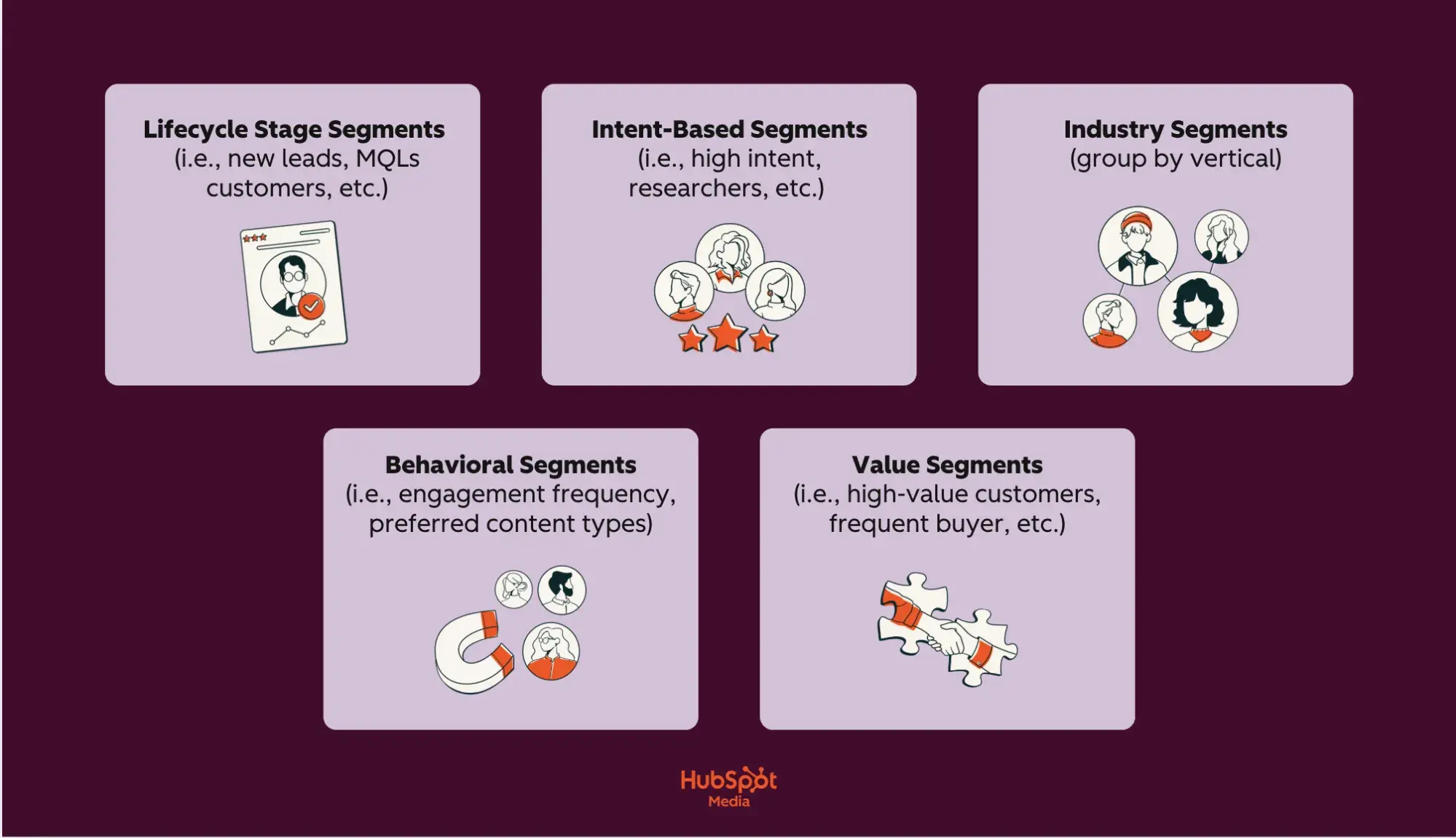
Divide contacts into targeted groups: first-time visitors versus regulars, lunch versus dinner customers, dietary preferences (vegetarian, gluten-free, etc.), high spenders versus value seekers, and inactive guests. [Segmented restaurant campaigns] [generate 65% higher open rates] [than generic broadcasts].

Design appetizing, mobile-optimized templates.

Build templates that showcase your food beautifully while displaying properly on smartphones (where 75% of restaurant emails are opened). Use high-quality food photography, single-column layouts, clear hierarchy, and large tap-friendly buttons for reservations.

Write subject lines that drive action.

Communicate value and urgency immediately. Examples: “Tonight Only: 20% Off All Wine,” “Your Birthday Dinner is On Us,” “New Fall Menu Just Dropped,” or “Table for 2 Available This Saturday.” Keep subject lines under 40 characters and include time-sensitive language.

Include one clear call-to-action.

Direct recipients toward one primary action: make a reservation, order online, buy a gift card, register for an event, or redeem an offer. Multiple CTAs create confusion. Place your primary CTA prominently with contrasting colors and action-oriented text.

Set up automated follow-up sequences.

Configure triggered follow-ups based on guest behavior. Send thank you emails within 24 hours of dining. Follow up with review requests 2-3 days later. Create win-back campaigns for guests who haven’t visited in 30-60-90 days with escalating offers.

Monitor performance and adjust timing.

Track opens, clicks, reservations, and revenue generated. Test different send times to find when your customers are most likely to engage. Many restaurants see best results sending lunch promotions Tuesday-Thursday mornings and dinner promotions Thursday-Friday afternoons.

Frequently Asked Questions

What is the best email marketing tool for restaurants?

HubSpot is the best email marketing tool for restaurants because it combines email, SMS, CRM, and reservation tracking in one platform.

The free tier includes unlimited contacts, email marketing, forms, landing pages, and CRM—accessible for single-location restaurants and small chains. Multi-location groups benefit from revenue attribution that connects campaigns to reservations and online orders by location.

Restaurant groups using HubSpot increased repeat customer visits through automated loyalty campaigns and personalized offers.

What features should I look for in email marketing tools for restaurants?

Look for POS integration, reservation system integration, SMS capabilities, segmentation by dining preferences, automated birthday campaigns, mobile optimization, behavioral automation, A/B testing, revenue attribution, and event marketing tools.

POS integration automatically syncs customer data without requiring manual exports. SMS capabilities matter for time-sensitive promotions and reservation confirmations. Mobile optimization is essential because 50-60% of emails are opened on mobile devices.

Is HubSpot good for restaurants?

Yes, HubSpot is excellent for restaurants. It provides a single platform for marketing, reservations, and guest management, specifically designed for hospitality businesses. The free CRM tracks every customer interaction, including visit history, favorite dishes, dietary restrictions, and spending patterns.

Marketing automation enables the creation of workflows for reservation confirmations, post-visit thank-you messages, and loyalty rewards, eliminating the need for technical expertise.

Multi-location restaurant groups increased online ordering revenue by using HubSpot’s automated campaigns and segmentation. Single locations start free, then scale up as they grow.

How much does email marketing software for restaurants cost?

Email marketing software costs $0-$3,600+ monthly, depending on customer database size, features, and restaurant scale. Free tiers support typically 250-1,000 contacts with basic features.

Entry-level paid plans cost $12-$ 29 per month for under 1,000 contacts. Mid-market restaurants with 2,500-5,000 contacts typically spend $50-$ 200 per month. Large restaurant groups with 10,000+ contacts invest $ 500-$3,600+ per month.

Some platforms charge per contact, others per email or SMS sent—compare carefully as your list grows.

How can restaurants build their email lists?

Build email lists through WiFi signup forms that require email addresses for access, table-side tablet signups offering birthday rewards, reservation system integrations that automatically capture emails, point-of-sale prompts during checkout, website popups offering first-visit discounts, social media contests requiring email entries, and in-store signage promoting loyalty programs.

Restaurants grow email lists 3-5x faster using multiple capture points throughout the customer journey. Always provide clear value in exchange for email addresses.

Meet HubSpot, the Top Email Marketing Choice for Restaurants

HubSpot combines email marketing, SMS, CRM, and reservation tracking into a single platform designed specifically for hospitality businesses. Over 184,000 businesses trust HubSpot worldwide because it eliminates the need for multiple disconnected tools.

Key HubSpot Features for Restaurants:

  • Unified guest database and marketing platform – Manage every customer interaction from first reservation to 50th visit, including dietary preferences, favorite dishes, allergies, and spending patterns in one system that everyone accesses.
  • Automated reservation and loyalty workflows – Create email and SMS sequences triggered by reservations, visit milestones, and guest behavior using drag-and-drop automation with conditional logic—no technical expertise required.
  • Multi-location revenue attribution – Track which campaigns drive reservations, online orders, and in-store visits by location, day part, and promotion type to see exactly what’s working.

HubSpot’s Impact on Restaurants:

Multi-location restaurant groups increased repeat customer visits with HubSpot’s automated loyalty campaigns that reward visit frequency and spending milestones.

Restaurants using HubSpot generated more online ordering revenue by segmenting customers by order history and sending personalized menu recommendations.

Independent restaurants reduced no-show rates by using HubSpot’s automated confirmation and reminder sequences via email and SMS. Restaurant chains saved 15 hours weekly per location by automating birthday offers, post-visit thank you messages, and win-back campaigns.

HubSpot’s free tier offers complete CRM and email marketing capabilities without requiring a credit card. Paid tiers start at $9 per month and scale up to enterprise solutions, featuring advanced analytics, multi-location reporting, and API integrations with major POS and reservation systems.

Ready to fill more tables and build customer loyalty? Get started with HubSpot’s free platform or schedule a demo to see how it works for restaurants like yours.

12 best email marketing tools for accounting firms in 2025

Software Stack Editor · October 23, 2025 ·

Email marketing for accounting firms comes with unique challenges. You’re dealing with strict compliance requirements, seasonal workload swings during tax season, complex financial information that needs to be communicated clearly, and client relationships that can span decades.

Boost Opens & CTRs with HubSpot’s Free Email Marketing Software

Email marketing tools solve these problems by automating tax deadline reminders, segmenting clients by service type, and keeping you connected with clients year-round—not just during tax season. The right platform helps you stay top-of-mind, cross-sell advisory services, and generate more referrals without adding hours to your day.

In this guide, you‘ll find a detailed comparison table of 12 email marketing platforms, feature breakdowns for each tool, benefits specific to accounting firms, a step-by-step selection guide, and answers to common questions. Here’s a stat worth noting: email marketing delivers an average ROI of $42 for every dollar spent, with professional services firms often seeing even higher returns.

HubSpot is used by accounting firms worldwide — from solo practitioners to multi-partner CPA practices — who rely on the platform’s integrated CRM and marketing automation to increase client engagement and cross-sell advisory services.

Table of Contents

  • What is email marketing for accounting firms?
  • Comparison Table: Best Email Marketing Software for Accounting Firms
  • Best Email Marketing Software for Accounting Firms
  • Benefits of Email Marketing Software for Accounting Firms
  • 10 Important Features for Accounting Email Marketing Software
  • How to Choose an Email Marketing Tool for Accounting Firms (Step-by-Step)
  • How to Create Email Marketing Campaigns for Accounting Firms
  • Frequently Asked Questions
  • Meet HubSpot, the Top Email Marketing Choice for Accounting Firms

What is email marketing for accounting firms?

Email marketing for accounting firms is how you stay connected with clients through targeted campaigns. You use it to send tax deadline reminders, share regulatory updates, deliver financial planning tips, announce new services, and maintain relationships during the off-season when client interaction naturally drops off.

Comparison Table: Best Email Marketing Software for Accounting Firms

Email Marketing Tool

Best For

Key Features

Pricing

Average Rating

HubSpot

Multi-partner firms needing CRM integration

Free CRM, marketing automation, client portals, revenue tracking

Free; Available with Marketing Hub; Starter $9/month per seat

4.4/5

Mailchimp

Small to mid-size CPA practices

Templates, automation, segmentation, journey mapping

Free; Essentials $13/month

4.3/5

ActiveCampaign

Firms needing advanced automation

Lead scoring, SMS integration, conditional workflows

Starts at $15/month

4.6/5

Constant Contact

Practices prioritizing ease of use

Drag-and-drop builder, live support, event marketing

Starts at $12/month

4.0/5

Brevo

Growing firms needing SMS + email

Email + SMS, transactional emails, unlimited contacts

Free; Starter $8.08/month

4.5/5

Drip

Advisory firms with complex journeys

Visual workflows, behavioral tracking, revenue tracking

Starts at $39/month

4.4/5

AWeber

Solo practitioners and small firms

Templates, autoresponders, list management

Free; Lite $14.99/month

4.2/5

GetResponse

Firms hosting educational webinars

Webinar hosting, automation, conversion funnels

Email $15/month

4.2/5

Klaviyo

Firms serving e-commerce clients

Advanced segmentation, predictive analytics, attribution

Free; Email $45/month

4.6/5

Moosend

Budget-conscious practices

Unlimited emails, automation, landing pages

Free; Pro $9/month

4.6/5

Campaign Monitor

Firms with multiple practice areas

Multi-brand management, custom templates

Lite €9.90/month

4.1/5

Kit

Accounting educators and creators

Visual automation, subscriber tagging, digital products

Free; Creator $33/month

4.4/5

Best Email Marketing Software for Accounting Firms

Here are the top email marketing platforms that work well for accounting firms, CPA practices, and tax advisors.

1. HubSpot

hubspot

Source

Best For: Multi-partner accounting firms that need CRM, marketing automation, and client portal features in one platform

Key HubSpot Features:

  • Free CRM with client pipeline management – Track every client interaction from consultation to tax prep to advisory services. No spreadsheets required, and everyone on your team sees the same up-to-date information.
  • Compliance-ready email templates – Send professional communications using templates designed for financial services. They maintain the right tone, include disclaimers where needed, and present complex information clearly.
  • Revenue attribution by service line – See which email campaigns generate tax clients, advisory engagements, and consulting projects. Connect your marketing directly to billable hours and revenue.

HubSpot Pricing:

  • Marketing Hub Free: $0 (includes email marketing, forms, landing pages, and CRM)
  • Marketing Hub Stater: $9/month per seat
  • Marketing Hub Professional: $800/month
  • Marketing Hub Enterprise: $3,600/month

View detailed HubSpot pricing

2. Mailchimp

mailchimp

Source

Best For: Small to mid-size CPA practices that want easy-to-use automation with professional templates

Key Features:

  • Professional services templates – Launch client communications quickly with email designs built for tax reminders, financial tips, and regulatory updates. No design skills needed.
  • Client journey mapping – Visualize the complete client experience from inquiry to tax filing to year-end planning. Spot gaps in your communication and find opportunities to engage.
  • Behavioral automation – Send targeted emails based on what clients do—website visits, email clicks, form submissions. Follow up at the right time without manual work.

Pricing:

  • Free
  • Essentials: $13/month
  • Standard: $20/month
  • Premium: $350/month

View detailed Mailchimp pricing

3. ActiveCampaign

activecampaign

Source

Best For: Accounting firms that need sophisticated automation and client scoring for complex service models

Key Features:

  • Advanced client scoring – Automatically prioritize high-value prospects based on email engagement, website behavior, and inquiry history. Focus on leads most likely to become long-term advisory clients.
  • Conditional workflow automation – Create email sequences that adapt based on client responses, service types, and engagement. Different paths for tax-only clients versus full-service relationships.
  • Integrated SMS – Coordinate email and text campaigns for time-sensitive communications like tax deadline reminders and appointment confirmations.

Pricing:

  • Starter: $15/month
  • Plus: $49/month
  • Pro: $79/month
  • Enterprise: $145

View detailed ActiveCampaign pricing

4. Constant Contact

constant contact

Source

Best For: CPA practices that want simple email marketing with strong customer support

Key Features:

  • Drag-and-drop email builder – Create professional emails without any coding. Simple interface makes campaign creation fast, even during busy tax season.
  • Event marketing integration – Promote and manage CPE events, client appreciation gatherings, and financial planning seminars. Registration, confirmations, and reminders all in one place.
  • Real-time reporting dashboard – Monitor performance with clear visuals showing opens, clicks, and engagement. Quick assessments without diving into complex analytics.

Pricing:

  • Lite: $12/month
  • Standard: $35/month
  • Premium: $80/month

View detailed Constant Contact pricing

5. Brevo

brevo

Source

Best For: Growing accounting firms that need email and SMS in one platform with pricing based on sends, not contacts

Key Features:

  • Unified email and SMS – Coordinate text reminders with email notifications from one interface. Simpler than managing multiple platforms.
  • Transactional email capabilities – Automatically send engagement confirmations, document receipts, and invoice notifications. Reliable delivery for critical client communications.
  • Unlimited contacts on paid plans – Build large client databases without escalating costs. Pricing based on emails sent, not contact count.

Brevo Pricing:

  • Free: $0
  • Starter: $8.08/month
  • Standard: $16.17
  • Professional: $449.08
  • Enterprise: Custom pricing

View detailed Brevo pricing

6. Drip

drip

Source

Best For: Advisory-focused firms managing complex client journeys with behavioral tracking

Key Drip Features:

  • Visual workflow builder – Design complex email sequences with an intuitive interface. Map client journeys from consultation to ongoing advisory relationships.
  • Behavioral tracking and tagging – Monitor client interactions across email, website, and content. Automatically tag based on behavior for hyper-personalized follow-up.
  • Revenue tracking integration – Connect campaigns to client acquisitions and service upgrades. See which marketing efforts generate the highest-value relationships.

Drip Pricing:

  • Email: Starting at $39/month (2,500 contacts)
  • Pricing scales with contact list size

View detailed pricing

7. AWeber

aweber

Source

Best For: Solo practitioners and small firms that want simple, reliable email marketing

Key AWeber Features:

  • 700+ email template library – Choose from pre-designed professional templates for tax reminders, financial tips, and newsletters. Fast campaign creation without custom design.
  • Autoresponder sequences – Set up automated follow-ups after consultations, tax filing, or inquiries. Consistent communication without manual sending.
  • List segmentation tools – Organize clients with unlimited tags based on service type, engagement, and lifecycle stage. Target specific segments easily.

AWeber Pricing:

  • Free: $0
  • Lite: $15/month
  • Plus: $30/month
  • Done for You: $30/month

View detailed AWeber pricing

8. GetResponse

getresponse

Source

Best For: Accounting firms using educational webinars for CPE courses and thought leadership

Key GetResponse Features:

  • Integrated webinar hosting – Conduct live events for up to 1,000 participants. Tax planning workshops, software tutorials, and regulatory updates without separate webinar software.
  • Conversion funnel builder – Create complete marketing funnels with landing pages, email sequences, and webinar registration. Guide prospects from interest to consultation.
  • Autofunnel templates – Launch campaigns faster with pre-built templates for professional services. Minutes instead of hours for tax season promotions.

GetResponse Pricing:

  • Starter: $15.58/month (1,000 contacts)
  • Marketer: $48.38/month
  • Creator: $56.58/month
  • Enterprise: Custom Pricing

View detailed GetResponse pricing

9. Klaviyo

klaviyo

Source

Best For: Accounting firms serving e-commerce clients that need advanced segmentation and revenue attribution

Key Klaviyo Features:

  • Predictive analytics – Identify high-value clients and predict future service needs using machine learning. Target clients most likely to buy advisory services or refer business.
  • Advanced segmentation with 350+ criteria – Create specific client segments based on service history, engagement, revenue, and lifecycle stage. Hyper-targeted communications.
  • Revenue attribution tracking – See exactly how much revenue each campaign generates. Connect marketing directly to client acquisitions and service upgrades.

Pricing:

  • Free: $0 (up to 250 contacts)
  • Email: Starting at $45/month (based on contacts)
  • Email + SMS: Starting at $60/month

View detailed Klaviyo pricing

10. Moosend

moosend

Source

Best For: Budget-conscious practices that want powerful automation at low cost

Key Features:

  • Unlimited email sending – Send as many emails as needed without per-message charges. Economical for frequent tax reminders and year-round client education.
  • AI-powered subject line optimization – Improve open rates with AI that analyzes performance and suggests improvements based on millions of campaigns.
  • Landing page builder included – Create campaign pages for service promotions and consultation bookings. Consolidates tools and reduces costs.

Pricing:

  • Free: $0 (up to 1,000 subscribers)
  • Pro: $9/month (unlimited emails)
  • Moosend+: Custom pricing
  • Enterprise: Custom pricing

View detailed Moosend pricing

11. Campaign Monitor

campaign monitor

Source

Best For: Accounting firms with multiple practice areas that need separate branding for different services

Key Features:

  • Multi-brand management – Organize different practice areas in one account. Separate branding, templates, and contacts for tax prep versus wealth management versus business advisory.
  • Custom template designer – Create branded email templates that maintain consistent firm identity. Build recognition and trust through cohesive messaging.
  • Time zone sending – Deliver campaigns in recipients’ local time zones. Optimize engagement for firms serving clients across regions.

Pricing:

  • Lite: €9.90/month
  • Essential: €24.30/month
  • Premier: €132/month

View detailed Campaign Monitor pricing

12. Kit

kit

Source

Best For: Accounting professionals creating educational content and courses for audience building

Key Kit Features:

  • Visual automation builder – Design email sequences with an intuitive interface. Easy to create complex nurture sequences for prospects at different stages.
  • Subscriber tagging system – Organize audience by interests like tax planning, business advisory, estate planning, or retirement. Deliver targeted content that matches preferences.
  • Digital product delivery – Sell and deliver tax guides, financial checklists, and courses directly through the platform. Revenue streams beyond traditional services.

Kit Pricing:

  • Newsletter: $0
  • Creator: $33/month
  • Creator Pro: $66/month (advanced features)

View detailed Kit pricing

Benefits of Email Marketing Software for Accounting Firms

Automate tax deadline communication.

Stop manually reminding clients about deadlines. Email marketing software automatically notifies clients of upcoming tax deadlines based on their service type. Accounting firms reduce last-minute document submissions by 40% using automated deadline reminders. Your staff saves 8-12 hours weekly on outbound calls.

Stay connected year-round.

Email keeps you top-of-mind during slow seasons. When client interaction drops between tax deadlines and year-end planning, strategic email campaigns maintain engagement. Share financial tips, regulatory updates, and advisory insights.

Cross-sell advisory services.

Identify clients ready for additional services by tracking who engages with your advisory content. Accounting firms increase advisory service adoption by using behavioral email triggers. Turn tax-only clients into full-service relationships.

Generate more referrals.

Systematic referral campaigns encourage satisfied clients to recommend your firm. Firms generate more qualified leads with automated referral sequences as automation formalizes a highly successful, but often passive, form of marketing. Time your requests after positive experiences, such as successful tax outcomes.

Make data-driven decisions.

See which campaigns generate consultations, service upgrades, and referrals. Replace guesswork with concrete metrics: open rates, click-throughs, conversions, and revenue attribution. Prove marketing ROI to partners and justify continued investment.

10 Important Features for Accounting Email Marketing Software

  • Tax deadline automation – Trigger campaigns based on federal, state, and local tax calendars
  • Client segmentation by service type – Target tax-only clients differently from advisory relationships
  • CRM integration – Sync data with practice management software to eliminate duplicate entry
  • Compliance-friendly templates – Use professional formats appropriate for financial services
  • Document sharing integration – Connect to secure client portals without email attachment risks
  • Mobile optimization – Display properly on smartphones where 67% of emails are opened
  • A/B testing – Test subject lines, send times, and content to improve performance
  • Behavioral automation – Trigger follow-ups based on opens, clicks, and website visits
  • Landing page builder – Create consultation booking pages without web developers
  • Revenue attribution – Connect campaigns to client acquisitions and service revenue

How to Choose an Email Marketing Tool for Accounting Firms (Step-by-Step)

Step 1: Map your client communication calendar.

Document all recurring touchpoints throughout the year: tax season communications, quarterly reminders, year-end planning, CPE events, regulatory updates, and financial education content. Identify what’s manual and what could be automated.

Step 2: Identify must-have features based on your practice.

Tax-focused practices need deadline automation and seasonal scheduling. Advisory-focused firms need sophisticated nurturing and behavioral tracking. Multi-service practices need advanced segmentation. List your absolute requirements versus nice-to-haves.

Step 3: Compare ease of use and team fit.

Test platforms during free trials. Can your team create campaigns independently, or will you need ongoing support? Constant Contact and AWeber suit beginners. ActiveCampaign and HubSpot offer more power but require more expertise.

Step 4: Check cost at scale.

Calculate costs as your database grows over 12-24 months. Some platforms charge per contact, others per email sent. Project your list size (active clients, prospects, and referral sources) and check pricing accordingly. Include costs for add-ons like SMS or landing pages.

Step 5: Choose a flexible platform — like HubSpot.

Pick a platform that scales without forcing you to migrate later. HubSpot supports accounting firms from solo practitioners through multi-partner practices with one unified platform. Start with the free tier, then upgrade as you grow—no data migration required.

How to Create Email Marketing Campaigns for Accounting Firms

Define your campaign purpose and audience.

Set a clear goal before creating content. Are you promoting tax prep before deadlines? Educating about new regulations? Announcing expanded services? Nurturing leads? Reactivating dormant clients? Clear objectives guide everything else.

Segment your client list.

Divide contacts into targeted groups: business versus individual clients, tax-only versus advisory, active versus inactive, high-value versus standard service. Segmented campaigns generate 58% of all revenue

Design professional, mobile-optimized templates.

Build templates that maintain your brand while displaying properly on smartphones (where 67% of emails are opened). Use single-column layouts, clear hierarchy, professional colors, and large buttons.

Write clear subject lines with specific value.

Communicate relevance immediately. Examples: “Q4 Estimated Tax Payment Due December 15,” “New 2025 Tax Law Changes Affecting Your Business,” or “Ready for Year-End Tax Planning?” Keep subject lines under 40 characters.

Include one clear call-to-action.

Direct recipients toward one primary action: schedule consultations, download guides, register for webinars, or upload documents. Multiple CTAs create decision paralysis. Place your primary CTA prominently with contrasting colors.

Set up automated follow-up sequences.

Configure triggered follow-ups based on behavior. Send reminder emails to non-openers after 2-3 days with different subject lines. Follow up on clicks with additional information. Create abandoned booking sequences to recover 15-25% of incomplete scheduling.

Monitor performance against benchmarks.

Track opens, clicks, conversions, unsubscribes, and revenue. Compare against professional services benchmarks (24% open rate, 3.2% click-through rate). Identify what works and replicate it in future campaigns.

Frequently Asked Questions

What is the best email marketing tool for accounting firms?

HubSpot is the best email marketing tool for accounting firms because it combines email, CRM, client portals, and automation in one platform. The free tier includes unlimited contacts, email marketing, forms, landing pages, and CRM—accessible for solo practitioners and small firms.

Multi-partner practices benefit from revenue attribution that connects campaigns to client acquisitions and service upgrades. Accounting firms using HubSpot increased client retention rates through automated year-round engagement.

What features should I look for in email marketing tools for accounting firms?

Look for tax deadline automation, client segmentation by service type, CRM integration, compliance-friendly templates, document sharing integration, mobile optimization, behavioral automation, A/B testing, landing page builders, and revenue attribution.

Tax deadline automation ensures timely reminders without manual work. CRM integration eliminates duplicate data entry. Mobile optimization matters because 81% of consumers prefer to use their smartphones to open and respond to emails.

Is HubSpot good for accounting firms?

Yes, HubSpot is excellent for accounting firms. It provides one platform for marketing, sales, and client service—designed for long-term professional relationships.

The free CRM tracks every client interaction over multiple years. Marketing automation enables the creation of workflows for tax reminders, client education, and advisory promotions, eliminating the need for technical expertise.

Multi-partner accounting practices increased advisory service adoption by using HubSpot’s behavioral email triggers. Solo practitioners start free, then scale up as they grow.

How much does email marketing software for accounting firms cost?

Email marketing software costs $0-$3,600+ monthly, depending on database size, features, and practice scale. Free tiers support 250-1,000 contacts with basic features. Entry-level paid plans cost $12-$ 29 per month for under 1,000 contacts.

Mid-market firms with 2,500-5,000 contacts typically spend $50-200 monthly. Large, multi-partner practices with 10,000+ contacts invest $ 500-$3,600+ monthly. Some platforms charge per contact, others per email sent—compare carefully as your list grows.

How can accounting firms improve email deliverability rates?

Use double opt-in for new contacts, remove inactive subscribers regularly, authenticate your domain with SPF and DKIM records, avoid spam trigger words, send consistent volumes, segment for relevance, personalize sender names, and monitor bounce rates.

Aim for 95%+ inbox placement and under 0.1% spam complaints. Only email people who opted in, and provide clear value in every communication.

Meet HubSpot, the Top Email Marketing Choice for Accounting Firms

HubSpot combines email marketing, CRM, client communication, and service tracking into one platform designed for professional services. Over 184,000 businesses trust HubSpot worldwide because it eliminates the need for multiple disconnected tools.

Key HubSpot Features for Accounting Firms:

  • Unified CRM and marketing platform – Manage every client interaction from consultation to tax prep to advisory engagements in one system. No duplicate entry, and everyone sees the same current information.
  • Tax season automation workflows – Create email sequences triggered by tax deadlines, client service dates, and engagement milestones. Drag-and-drop automation with conditional logic—no technical expertise required.
  • Client portal integration – Provide secure document sharing, two-way messaging, and engagement tracking through integrated portals that connect to your email campaigns.

HubSpot’s Impact on Accounting Firms:

Multi-partner accounting practices increased client retention rates with HubSpot’s year-round engagement campaigns beyond tax season. CPA firms using HubSpot generated more advisory service revenue by identifying tax-only clients ready for expanded services.

Accounting practices reduced client acquisition costs by using HubSpot’s integrated platform that eliminated separate CRM, email, and portal subscriptions. Solo practitioners saved 12 hours weekly by automating tax reminders, document follow-ups, and referral requests.

HubSpot’s free tier gives you complete CRM and email marketing without a credit card. Paid tiers start at $9 monthly per seat and scale up to enterprise solutions with advanced analytics, custom reporting, and API integrations.

Ready to transform your accounting firm’s client communication? Get started with HubSpot’s free platform or schedule a demo to see how it works for firms like yours.

5 best email marketing tools for real estate businesses in 2025

Software Stack Editor · October 23, 2025 ·

Real estate professionals face unique challenges when it comes to staying top-of-mind with clients, nurturing leads through long sales cycles, and managing relationships with both buyers and sellers simultaneously.

Boost Opens & CTRs with HubSpot’s Free Email Marketing Software

Email marketing addresses these challenges by enabling agents and brokerages to deliver personalized property listings, market updates, and timely follow-ups that keep prospects engaged throughout their home-buying or selling journey.

This post provides a comprehensive comparison of the best email marketing tools for real estate businesses, including detailed feature breakdowns, pricing information, and a structured guide to help you choose the right platform. We’ll compare tools and share how HubSpot has successfully aided businesses like Avison Young, a global real estate advisor with over 5,000 employees, with increased CRM adoption from 23% to 90% in four months using its integrated email marketing and platform.

Table of Contents

  • What is email marketing for real estate?
  • Email Marketing Tools for Real Estate Comparison Table
  • Best Email Marketing Software for Real Estate Businesses
  • Benefits of Email Marketing Software for Real Estate
  • 7 Important Features for Real Estate Email Marketing Software
  • How to Choose an Email Marketing Tool for Real Estate (Step-by-Step)
  • How to Create Email Marketing Campaigns for Real Estate
  • Frequently Asked Questions
  • Meet HubSpot, the Top Email Marketing Software for Real Estate Companies

What is email marketing for real estate?

Email marketing for real estate enables agents and brokerages to build relationships with prospective buyers, sellers, and past clients through targeted campaigns. Real estate email marketing automates property alerts, market updates, and nurture sequences that guide leads through extended decision-making processes while maintaining consistent touchpoints that drive referrals and repeat business.

Email Marketing Tools for Real Estate Comparison Table

Email Marketing Tool

Best For

Key Features

Pricing

Average Rating

HubSpot

Full-service real estate marketing with CRM integration

Drag-and-drop builder, property listing automation, lead scoring, CRM integration

Free plan available; Marketing Hub starts at $15/month

4.4/5

Mailchimp

Small agencies needing basic email campaigns

Template library, basic automation, audience segmentation

Free for up to 500 contacts; paid plans from $13/month

4.3/5

Constant Contact

Agents prioritizing ease of use and templates

Real estate-specific templates, list management, event marketing

Plans from $12/month

4.0/5

ActiveCampaign

Brokerages requiring advanced automation

Complex automation workflows, CRM features, lead scoring

Plans from $29/month

4.6/5

BombBomb

Video-focused real estate marketing

Video email integration, tracking analytics, mobile app

Plans from $33/month

4.5/5

Best Email Marketing Software for Real Estate Businesses

Selecting the right email marketing platform can transform how real estate professionals nurture leads and close deals. The following tools offer features specifically valuable for real estate workflows.

HubSpot

hubspot email marketing dashboard - showing drag-and-drop editor and real estate campaign templates]

HubSpot is best for: Real estate agents and brokerages seeking comprehensive marketing automation with integrated CRM capabilities

Key HubSpot Features:

  • Smart Content & Personalization – HubSpot enables real estate professionals to deliver property recommendations based on client preferences, budget parameters, and location interests, ensuring every email feels personally curated rather than mass-distributed.
  • Automated Lead Nurturing Workflows – The platform automates follow-up sequences for open house attendees, property inquiry responses, and buyer journey stages, allowing agents to maintain consistent contact without manual intervention.
  • Integrated CRM & Deal Tracking – HubSpot connects email campaigns directly to contact records and deal pipelines, giving real estate teams visibility into which properties generate the most engagement and which clients are closest to making decisions.

HubSpot Pricing:

  • Free plan: Up to 2,000 email sends per month with basic CRM, forms, and email marketing
  • Marketing Hub Starter: $15/month per seat
  • Marketing Hub Professional: Starting at $890/month (includes 3 seats)
  • Marketing Hub Enterprise: Starting at $3,600/month (includes 5 seats)

Learn more about HubSpot

Mailchimp

mailchimp campaign builder

Best For: Independent agents and small real estate teams needing straightforward email campaigns with minimal setup

Key Mailchimp Features:

  • Pre-built Real Estate Templates – Mailchimp provides ready-to-use templates designed for property showcases, market updates, and open house announcements, reducing design time for busy agents.
  • Basic Automation Sequences – The platform supports simple automated welcome series and follow-up emails for new leads, though workflows are less sophisticated than enterprise alternatives.
  • Audience Segmentation Tools – Mailchimp allows real estate professionals to segment contacts by location, price range, and property type, enabling more targeted messaging than one-size-fits-all broadcasts.

Mailchimp Pricing:

  • Free plan includes up to 500 contacts and 1,000 monthly email sends
  • Essentials: $13/month for 500 contacts with basic automation
  • Standard: $20/month for 500 contacts with advanced automation and A/B testing
  • Premium: $350/month for 10,000 contacts with advanced segmentation

Learn more about Mailchimp

Constant Contact

constant contact email marketing

Best For: Real estate professionals prioritizing user-friendly interfaces and industry-specific email templates

Key Constant Contact Features:

  • Real Estate Template Library – Constant Contact offers dozens of professionally designed templates specifically for property listings, market reports, and client newsletters, streamlining campaign creation.
  • Event Marketing Integration – The platform includes built-in tools for promoting open houses and client events, complete with registration management and automated reminder emails.
  • List Growth Tools – Constant Contact provides sign-up forms and landing pages that help real estate agents grow their contact database through website integration and social media promotion.

Constant Contact Pricing:

  • Lite: $12/month for 500 contacts with basic email features
  • Standard: $35/month for 500 contacts with automation and event marketing
  • Premium: $80/month for 500 contacts with advanced features and SEO tools
  • 60-day free trial and 30-day money-back guarantee

Learn more about Constant Contact

ActiveCampaign

active campaign email marketing

Best For: Growing brokerages requiring sophisticated automation and detailed lead scoring capabilities

Key ActiveCampaign Features:

  • Advanced Automation Workflows – ActiveCampaign enables complex, multi-step nurture sequences that respond to specific behaviors like property page visits, price range searches, and email engagement patterns.
  • Predictive Lead Scoring – The platform assigns scores to contacts based on engagement and behavior, helping real estate teams prioritize high-intent buyers and sellers for immediate follow-up.
  • Conditional Content Blocks – ActiveCampaign displays different property listings within the same email based on recipient preferences, creating personalized experiences without building multiple campaign versions.

ActiveCampaign Pricing:

  • Lite: $29/month for 1,000 contacts with basic automation
  • Plus: $49/month for 1,000 contacts with CRM and advanced automation
  • Professional: $149/month for 2,500 contacts with predictive sending
  • Enterprise: Custom pricing with dedicated support

Learn more about ActiveCampaign

BombBomb

bombbomb video email interface - showing video recording and tracking dashboard

Best For: Real estate agents leveraging video to build personal connections and showcase properties

Key BombBomb Features:

  • Simple Video Email Creation – BombBomb allows agents to record and send personalized video messages directly through email, creating face-to-face connections that text-only emails cannot achieve.
  • Video Tracking Analytics – The platform notifies agents when recipients watch their videos and tracks engagement metrics, enabling timely follow-up when prospects show interest.
  • Mobile Recording App – BombBomb provides a mobile application that lets real estate professionals record and send video emails from property locations, offering authentic, on-site perspectives.

BombBomb Pricing:

  • Core: $36/month (billed annually)
  • Core + Copilot: $56/month (billed annually)
  • Enterprise: Custom pricing

Learn more about BombBomb

Benefits of Email Marketing Software for Real Estate

Email marketing software solves critical challenges that real estate professionals face daily:

  • Automated Lead Nurturing – Real estate email platforms maintain consistent contact with prospects throughout extended buying and selling timelines, ensuring agents remain top-of-mind without requiring manual follow-up for every lead.
  • Personalized Property Matching – Modern email marketing tools deliver customized property recommendations based on client preferences, search behavior, and budget parameters, increasing relevance and engagement compared to generic listing blasts. Email marketing has an average conversion rate of 1.4% in real estate, outperforming many other digital channels.
  • Scalable Client Communication – Email automation enables individual agents and small teams to communicate with hundreds or thousands of contacts simultaneously, providing large-brokerage capabilities without proportional staffing increases. eXp Realty uses HubSpot to communicate with more than 90,000 agents across 24 global locations through a single unified platform.
  • Performance Tracking & Optimization – Real estate email platforms provide detailed analytics on open rates, click-through rates, and property interest patterns, allowing agents to refine their messaging based on data rather than guesswork.
  • Relationship Maintenance at Scale – Automated birthday messages, home anniversary notes, and market update newsletters keep past clients engaged for future referrals and repeat business without overwhelming agent schedules.

7 Important Features for Real Estate Email Marketing Software

When evaluating email marketing platforms for real estate businesses, prioritize these capabilities:

  1. CRM Integration – Seamless connection between email campaigns and contact databases ensures agents can track communication history, property interests, and transaction stages without switching between multiple systems.
  2. Property Listing Automation – Tools that automatically generate and distribute emails featuring new listings save significant time and ensure timely market updates reach interested buyers.
  3. Behavioral Segmentation – Advanced segmentation based on property type interests, price range, location preferences, and engagement patterns enables highly targeted messaging that resonates with specific buyer or seller profiles.
  4. Mobile-Responsive Templates – With over 60% of emails opened on mobile devices, real estate email templates must display property photos and details flawlessly across all screen sizes. 73% of homebuyers use mobile devices to search for properties, making mobile optimization essential.
  5. A/B Testing Capabilities – Testing different subject lines, property descriptions, and call-to-action buttons helps real estate professionals optimize campaign performance based on actual recipient behavior.
  6. Lead Scoring & Prioritization – Platforms that assign engagement scores help agents identify and prioritize hot leads who are actively searching and engaging with content versus passive contacts.
  7. Automated Drip Campaigns – Pre-built nurture sequences for buyer journeys, seller timelines, and past client re-engagement ensure consistent communication without requiring manual campaign launches.

How to Choose an Email Marketing Tool for Real Estate (Step-by-Step)

Follow this structured process to select the email marketing platform that best fits your real estate business:

Step 1: Map your current workflows.

Document how you currently manage client communication, property marketing, and lead follow-up processes. Identify pain points like manual follow-up tasks, difficulty tracking client property interests, or time-consuming campaign creation that an email platform should solve.

Step 2: Identify must-have features.

Determine which features are non-negotiable for your business model. Solo agents might prioritize ease of use and templates, while growing brokerages often require CRM integration, team collaboration tools, and advanced automation capabilities.

Step 3: Compare ease of use and team fit.

Evaluate platform interfaces to ensure your team can effectively use the tools without extensive training. Request demos or free trials to test campaign creation, automation setup, and reporting interfaces before committing.

Step 4: Check cost at scale.

Calculate total costs as your contact database grows. Some platforms offer attractive entry pricing but become expensive at higher contact volumes, while others provide better value for growing businesses.

Step 5: Choose a flexible platform — like HubSpot.

Select a platform that grows with your business and integrates with other tools in your marketing stack. HubSpot provides real estate businesses with email marketing, CRM, landing pages, and analytics in a unified platform, eliminating the need to connect multiple disconnected tools. Real estate businesses, such as Havenpark Communities, closed 6,000 deals and decreased deal cycle time-to-close by 51% using HubSpot’s integrated platform between 2019 and 2021.

How to Create Email Marketing Campaigns for Real Estate

1. Define your campaign objective.

Establish clear goals for each campaign — whether generating open house attendance, promoting new listings, nurturing long-term buyer relationships, or soliciting seller leads—before designing content or selecting recipients.

2. Segment your audience strategically.

Divide your contact database into meaningful groups based on factors like buyer versus seller status, price range interests, neighborhood preferences, and stage in the transaction process to ensure relevant messaging.

3. Design mobile-optimized templates.

Create email templates that showcase property images beautifully on smartphones and tablets, with clear calls-to-action that are easy to tap and text that remains readable without zooming.

4. Personalize property recommendations.

Use available data about client preferences, past property views, and stated interests to curate property selections that feel hand-picked rather than mass-distributed, increasing engagement and response rates.

5. Automate follow-up sequences.

Build automated workflows that send timely follow-up messages after open houses, property inquiries, or listing alerts, maintaining momentum without requiring manual sends for every interaction.

6. Test and refine your approach.

Continuously test subject lines, send times, content formats, and calls-to-action, using performance data to optimize future campaigns for higher open rates and conversions.

Frequently Asked Questions

What is the best email marketing tool for real estate?

HubSpot stands out as the best email marketing tool for real estate businesses because it combines email automation with CRM capabilities, lead scoring, and property listing management in a single platform. Real estate professionals using HubSpot benefit from integrated tools that track every client interaction from initial email engagement through transaction close, eliminating data silos between marketing and sales activities.

What features should I look for in email marketing tools for real estate?

Real estate email marketing tools should include CRM integration for client relationship tracking, automated property listing distribution, behavioral segmentation for targeted messaging, mobile-responsive templates, lead scoring to prioritize hot prospects, and drip campaign capabilities for long-term nurturing. Advanced platforms also offer A/B testing, video email integration, and detailed analytics showing which properties generate the most interest.

Is HubSpot good for real estate?

HubSpot excels for real estate businesses of all sizes. The platform provides real estate agents and brokerages with email marketing, contact management, deal pipeline tracking, and reporting tools that work together seamlessly. HubSpot’s free tier offers sufficient functionality for individual agents getting started, while paid tiers scale to support large brokerages with complex automation needs. Avison Young increased CRM adoption from 23% to 90% in four months using HubSpot, now tracking 95% of North American revenue on the platform. Havenpark Communities decreased deal cycle time-to-close by 51% and closed 6,000 deals between 2019 and 2021 using HubSpot’s integrated marketing and sales workflows.

How much does email marketing software for real estate cost?

Email marketing software for real estate ranges from free plans suitable for new agents to enterprise solutions costing several thousand dollars monthly. Entry-level options like HubSpot‘s free plan, Mailchimp’s free tier (up to 500 contacts), and Constant Contact ($12/month) serve individual agents and small teams. Mid-tier solutions like ActiveCampaign ($29-$149/month) and BombBomb ($36-$56/month) offer more advanced automation. Growing brokerages should budget $50-$500 monthly depending on contact volume and feature requirements.

Can email marketing help real estate agents generate more leads?

Email marketing generates real estate leads through consistent nurturing of prospects, automated property alerts that keep agents top-of-mind, and strategic content that positions agents as market experts. Real estate professionals using email marketing maintain relationships with past clients who become referral sources, re-engage cold leads through targeted campaigns, and convert website visitors into qualified prospects through email capture and follow-up sequences. TenantBase achieved 3x revenue growth year-over-year using HubSpot’s email marketing and CRM capabilities.

Meet HubSpot, the Top Email Marketing Software for Real Estate Companies

HubSpot provides real estate professionals with comprehensive email marketing tools that integrate seamlessly with contact management, deal tracking, and analytics capabilities. The platform enables agents and brokerages to scale their marketing efforts without sacrificing personalization or relationship quality.

Key HubSpot Features for Real Estate:

  • Unified CRM & Email Platform – HubSpot eliminates the need to sync data between separate email and contact management systems, giving real estate teams complete visibility into every client interaction, property interest, and deal stage.
  • Smart Property Recommendation Automation – The platform delivers personalized property listings based on client behavior and preferences, ensuring every email feels curated rather than generic.
  • Lead Scoring & Pipeline Management – HubSpot assigns engagement scores to contacts and tracks their progress through customizable deal pipelines, helping real estate teams prioritize high-intent prospects and forecast closings.

Avison Young increased CRM adoption from 23% to 90% in four months by implementing HubSpot’s CRM Platform, consolidating four separate CRMs while tracking 95% of North American revenue. Havenpark Communities closed 6,000 deals, increased deal volume by 100%, and decreased deal cycle time-to-close by 51% using HubSpot between 2019 and 2021. Real estate businesses using HubSpot improve lead response times through automated workflows that trigger immediate follow-up when prospects engage with property listings or submit inquiry forms.

Ready to see how HubSpot can transform your real estate marketing? Get started with HubSpot today or explore HubSpot for Real Estate.

8 best email marketing tools for HVAC companies in 2025

Software Stack Editor · October 23, 2025 ·

The HVAC industry often means juggling emergency calls, seasonal demand spikes, and fierce local competition. When your schedule‘s packed during summer heatwaves and winter chills but crickets in spring, staying top-of-mind with customers is critical. That’s where email marketing for HVAC companies delivers.Boost Opens & CTRs with HubSpot’s Free Email Marketing Software

Email marketing generates $36–$40 for every $1 spent, making it still one of the most cost-effective marketing channels. In fact, email marketing has an average ROI of 4200% for HVAC companies specifically.

But any old email tool won’t cut it for HVAC companies.

You need tools to handle appointment reminders, seasonal maintenance campaigns, and equipment replacement nurturing without being too technical. The right software automates follow-ups, segments customers by system type, and tracks which campaigns actually fill your calendar.

This guide breaks down the best email marketing platforms built for HVAC companies like yours (i.e. HubSpot), complete with pricing, must-have features, and how to pick the right one for you.

Note: Heating and air conditioning company Viessmann orders increased by 12% and revenue increased by 15% while using HubSpot.

Table of Contents

  • What is email marketing for HVAC companies?
  • Benefits of Email Marketing Software for HVAC Companies
  • 6 Important Features for Email Marketing Software for HVAC Companies
  • Comparison Table: Email Marketing Tools for HVAC Companies
  • Best Email Marketing Software for HVAC Companies
  • How to Choose an Email Marketing Tool for HVAC Companies (Step-by-Step)
  • How to Create Email Marketing Campaigns for HVAC Companies
  • Frequently Asked Questions About Email Marketing for HVAC Companies
  • Meet HubSpot: The Top Email Marketing Choice for HVAC Companies

What is email marketing for HVAC companies?

Email marketing for HVAC companies involves using targeted email campaigns to stay connected with customers from the initial installation of their equipment or service through annual maintenance to eventual replacement.

Unlike spray-and-pray advertising, email marketing for HVAC companies segments customers by equipment age, service history, or property type, then sends personalized messages when relevant and appropriate.

For HVAC contractors, this includes automated appointment reminders, seasonal tune-up campaigns, filter change alerts, and equipment replacement nurturing sequences. The goal? Keep your schedule full year-round while building the customer relationships that turn one-time service calls into lifetime maintenance contracts. HubSpot’s free email marketing tools are a great choice for HVAC companies.

Benefits of Email Marketing Software for HVAC Companies

So, why do HVAC companies need email marketing software exactly? There are a handful of benefits.

Automates Year-Round Customer Communication

HVAC demand fluctuates wildly with seasons, but your customer relationships shouldn’t. Email automation keeps you connected during slow periods while nurturing future equipment replacement opportunities.

hubspot workflows dropdown highlighting how to create a new email; email marketing for hvac companies

Source

HubSpot’s workflows, for example, automatically trigger seasonal maintenance reminders, filter replacement alerts, and tune-up campaigns based on customer equipment age and service history—ensuring no customer falls through the cracks when your schedule lightens.

Segments Customers for Targeted Campaigns

Not every customer needs the same message. I mean, homeowners with 15-year-old systems need equipment replacement nurturing, while commercial clients with maintenance contracts need different touchpoints than residential one-time service customers. The right email marketing tool for HVAC companies will enable this.

HubSpot’s CRM-powered segmentation lets you create customer lists based on equipment type, property classification, service history, and dozens of other criteria, then automate targeted campaigns that speak to each segment’s specific needs.

Tracks Marketing ROI

Traditional HVAC advertising (radio spots, direct mail) leaves you guessing which channels drive results. Email marketing shows exactly which campaigns drive bookings and revenue.

HubSpot Marketing Hub connects every email to your CRM, attributing appointments and revenue directly to specific campaigns.

hubspot email marketing analytics dashboard showing engagement and delivery rates; email marketing for hvac companies

Source

You’ll know whether your spring tune-up campaign generated 15 appointments worth $3,000 or your equipment replacement series closed $45,000 in system installations.

Builds Maintenance Contract Recurring Revenue

One-time service calls keep you busy, but maintenance contracts create predictable recurring revenue that smooths seasonal volatility. Email nurturing converts one-time customers into contract holders.

HubSpot lets you create automated sequences that educate customers about preventative maintenance benefits, showcase contract member advantages, and gradually move customers toward enrollment—turning transactional relationships into long-term partnerships.

Integrates with Existing Business Tools

Your email platform shouldn’t live in isolation from your scheduling software, CRM, and other business tools. It should speak and work along with them without much manual effort on your part.

HubSpot natively integrates with ServiceTitan, Jobber, Housecall Pro, and hundreds of other platforms HVAC contractors already use. Customer data syncs bidirectionally, so your CRM always reflects email engagement, and your email campaigns are personalized automatically based on scheduling system data.

Now that you know why you need email marketing software, let’s dig into what you should look for.

6 Important Features for Email Marketing Software for HVAC Companies

Customer Segmentation and List Management

No two HVAC customers are alike. They can differ dramatically in equipment age, property type, and service needs.

Robust segmentation lets you send filter replacement reminders only to customers with specific unit types, target commercial property managers separately from homeowners, and identify systems approaching replacement age.

HubSpot lists let you segment by basically any trait or activity logged in your CRM, and if they’re active, they’ll automatically update based on any changes, keeping segments current as customer situations change.

Appointment-focused Automation Workflows

Generic automation templates don’t address HVAC-specific customer journeys. Look for platforms that let you build workflows around service appointments, seasonal maintenance windows, and equipment lifecycle stages.

While not HVAC specific out-of-the-box, HubSpot’s visual workflow builder allows you to create sequences like quote request → follow-up email → phone call reminder → closed deal → maintenance reminder → filter replacement → equipment replacement nurturing over multiple years.

Mobile-optimized Templates

Your techs and customers are on the go. They’re accessing email primarily on phones, not desktop computers. In fact, 65% of all email opens now happen on mobile devices. This means responsive design is non-negotiable. You need an email marketing tool that has it built in.

HubSpot’s email templates automatically adjust for smartphone screens, ensuring your seasonal campaigns and appointment reminders display perfectly regardless of device. You can also preview what your emails look like on a variety of devices before scheduling or sending.

CRM Integration for Complete Customer Visibility

Email campaigns inform better service delivery when you know what your customers have been through with your company — what services they’ve received, what emails and conversations they’ve had. An integrated CRM means every email, form submission, and website visit appears in the customer profile alongside service history, so you can use it to inform your marketing.

HubSpot’s unified platform eliminates data silos. Your marketing team sees service history while your techs reference email engagement before arriving on-site.

Local Service Business Templates and Assets

Starting with a blank canvas can waste time that contractors don’t have. Having pre-built templates handy for seasonal tune-ups, maintenance reminders, and equipment replacement campaigns help cut this time and keep things moving quickly.

HubSpot provides service business templates you customize with your branding, stock images of HVAC equipment, technicians, and satisfied customers. This eliminates the need for custom photography.

Analytics That Connect Emails to Revenue

Opens and clicks matter less than appointments booked and revenue generated. Look for platforms that attribute business outcomes to specific campaigns.

HubSpot’s robust analytics connect every email to CRM data, showing exactly which campaigns drove quote requests, maintenance bookings, and equipment sales, plus lifetime value of customers acquired through each marketing channel.

Comparison Table: Email Marketing Tools for HVAC Companies

Email Marketing Tool

Best For

Key Features

Pricing

HubSpot Marketing Hub

Full-service HVAC companies wanting CRM integration

Marketing automation, CRM integration, landing pages, and advanced segmentation

Free plan available; Starter at $15/month (1,000 contacts)

ServiceTitan Marketing Pro

HVAC contractors using ServiceTitan FSM

Native ServiceTitan integration, equipment-based segmentation, revenue attribution

Add-on to ServiceTitan subscription; contact for pricing

Housecall Pro Campaigns

Small to mid-size HVAC businesses using Housecall Pro

Built-in automation, SMS + email, Mailchimp integration

Included with Housecall Pro plans starting at $49/month

Jobber + Mailchimp

HVAC contractors using Jobber FSM

Mailchimp integration, customer data sync, automated campaigns

Jobber from $69/month + Mailchimp from $13/month

Mailchimp

Small HVAC businesses getting started

Drag-and-drop builder, basic automation, landing pages

Free plan available; Essentials at $13/month (500 contacts)

AWeber

HVAC businesses prioritizing automation

Smart designer, automated tagging, subscriber segmentation

Free plan available; Lite at $15/month (500 contacts)

ActiveCampaign

Mid-size HVAC companies needing complex workflows

Advanced automation, CRM features, predictive sending

Lite at $29/month (1,000 contacts)

MailerLite

New HVAC businesses

Website builder, landing pages, clean interface

Free plan available; Growing Business at $10/month (1,000 contacts)

Best Email Marketing Software for HVAC Companies

1. HubSpot Marketing Hub

HubSpot Marketing Hub’s strength lies in connecting marketing campaigns directly to your customer database (CRM). This allows you to see exactly which content drives appointments to inform your email campaigns, use customer behavior to segment lists, and improve your targeting.

hubspot email editor; potential email marketing tool for hvac companies

Best For: Full-service HVAC companies wanting integrated marketing automation and customer management in one platform.

Key HubSpot Marketing Hub Features:

  • CRM-powered segmentation – Target customers based on equipment age, service type/ history, location, or property type using data that automatically syncs from your customer database. Send filter replacement reminders only to customers with specific unit types.
  • Automation – Build sophisticated, automated drip campaigns that nurture leads from quote request to installation without manual follow-up. HubSpot’s drag-and-drop builder makes creating multi-step workflows simple.
  • AI-powered generation & personalization – HubSpot is no stranger to “personalization tokens,” but Breeze takes this to the next level, enabling you to not only generate email copy from scratch but also use CRM data to make it feel truly personal to the recipient. This is important in Loop Marketing.
  • Unified customer timeline – Every email interaction appears alongside service calls, quotes, and previous jobs in one customer profile in HubSpot. Your technicians can reference communication history before arriving on-site or even while there to give them a better idea of what clients know or don’t know.

HubSpot Marketing Hub Pricing:

  • Free: Includes email marketing, forms, and basic CRM
  • Starter: $15/month (1,000 contacts, 3 users)
  • Professional: $800/month (2,000 contacts)
  • Enterprise: $3,600/month (10,000 contacts)

View detailed HubSpot pricing

2. ServiceTitan Marketing Pro

ServiceTitan Marketing Pro is one of the only email marketing tools built natively inside field service management (FSM) software. This eliminates data sync headaches and allows you to use existing customer, job, and equipment data to power hyper-targeted email campaigns.

servicetitan email editor; email marketing for hvac companies

Source

Best for: HVAC contractors already using ServiceTitan who want email marketing powered by their FSM data; new, small teams that want to streamline their technology toolkit.

Key ServiceTitan Marketing Pro Features:

  • Audiences – Thanks to its native location within ServiceTitan, you can create audiences based on equipment age, unsold estimates, expiring memberships, or service history without exporting data. Everything updates automatically in real-time from your existing ServiceTitan database to help you hyper-target your email campaigns.
  • True revenue attribution – Track which emails drive actual booked jobs and revenue, not just opens and clicks. ServiceTitan connects every email to call data and completed jobs for genuine ROI measurement.
  • Set-and-forget automation – Build dynamic audiences that automatically update as customer situations change. For example, your “aging equipment” campaign automatically adds customers when their systems hit 10 years old. You can also automate these emails to send based on when the trait is triggered.

ServiceTitan Marketing Pro Pricing:

  • Available as add-on to ServiceTitan subscription (Contact for pricing details)
  • Free trial periods are sometimes available

Learn about ServiceTitan Marketing Pro

3. Housecall Pro Campaigns

Housecall Pro brings email, SMS, and direct mail marketing into the Housecall Pro field service platform. The Marketing Center consolidates campaign creation, scheduling, and performance tracking, where contractors already manage jobs, eliminating the need to juggle separate marketing tools.

housecall pro email editor; email marketing for hvac companies

Source

Best For: Small to mid-size HVAC businesses using Housecall Pro for field service management.

Key Housecall Pro Campaigns Features:

  • Seamless data sync – Create email and SMS campaigns directly in Housecall Pro without switching platforms. Customer data syncs automatically from your job history and scheduling system.
  • Automated campaign flows – Set up trigger-based sequences for job completion follow-ups, seasonal promotions, and maintenance reminders. Eligible customers enter your funnel automatically based on criteria you define.
  • Mailchimp integration – Need advanced design capabilities? Sync your Housecall Pro customer lists and tags to Mailchimp for sophisticated template creation while maintaining basic campaigns in Housecall Pro.

Housecall Pro Campaigns Pricing:

  • Included with Housecall Pro plans starting at $59/month (Basic)
  • Essentials plan ($149/month) includes advanced marketing features
  • 14-day free trial available

Explore Housecall Pro Campaigns

4. Jobber + Mailchimp Integration

Jobber integrates with Mailchimp to provide email marketing capabilities for contractors using Jobber’s field service management platform. While not as seamless as native solutions like ServiceTitan Marketing Pro, the integration syncs customer data between platforms for targeted campaigns.

The integration syncs contacts from Jobber into Mailchimp to allow you to send emails and postcards and even reach new customers through Facebook and Instagram ads.

Best For: HVAC contractors using Jobber FSM who need email marketing without switching platforms.

Key Jobber + Mailchimp Features:

  • Automatic customer data sync – Automatically sync your Jobber customer list to Mailchimp, maintaining up-to-date contact information without manual exports. Tags and customer properties are transferred for segmentation.
  • Job-based triggers – Use Jobber data to create Mailchimp segments based on service history, then automate follow-up campaigns and seasonal reminders through Mailchimp’s automation builder.
  • Dual-platform management – Manage jobs and scheduling in Jobber while handling email design, automation, and analytics in Mailchimp’s specialized interface.

Jobber + Mailchimp Pricing:

  • Jobber: Mailchimp available with Grow plan, starting at $149/month, free 14-day trial available
  • Mailchimp: Free plan available; Essentials at $13/month (500 contacts)

View Jobber pricing | View Mailchimp pricing

5. Mailchimp

Mailchimp remains the go-to starter platform for small businesses, and that includes HVAC contractors. Its familiar interface and extensive template library make creating professional campaigns straightforward, though automation features require upgrading from the free tier.

mailchimp email editor; email marketing for hvac companies

Source

Best For: Small HVAC businesses getting started with email marketing on a limited budget

Key Mailchimp Features:

  • Pre-built service business templates – Choose from templates designed specifically for service seasonal campaigns and appointment reminders, that can then be customized with your branding in minutes.
  • Basic automation workflows – Set up welcome series for new customers and abandoned form follow-ups (though advanced segmentation requires paid plans).
  • Landing page builder – Create dedicated pages for seasonal promotions without needing a developer, driving traffic from local ads directly to conversion.

Mailchimp Pricing:

  • Free: Up to 500 contacts, 1,000 monthly emails
  • Essentials: $13/month (500 contacts)
  • Standard: $20/month (500 contacts)
  • Premium: $350/month (10,000 contacts)

View Mailchimp pricing

6. AWeber

AWeber earned a strong reputation in HVAC circles for its powerful automation capabilities and intuitive subscriber management. HVAC Webmasters recommends AWeber for its Smart Designer, automated tagging, and ability to track multiple segmentations within a subscriber list.

aweber email editor; email marketing for hvac companies

Source

Best For: HVAC businesses prioritizing automation and customer segmentation

Key AWeber Features:

  • Smart Designer automation – Create professional email campaigns quickly using AI-powered design suggestions that adapt to your brand and previous campaigns.
  • Advanced tagging system – Automatically tag customers based on behaviors (opened seasonal campaign, clicked maintenance offer) enabling sophisticated follow-up sequences.
  • Canva integration – Design stunning graphics directly within AWeber using built-in Canva compatibility, perfect for creating seasonal promotion visuals.

AWeber Pricing:

  • Free: Up to 500 subscribers, paid plans start at $12.50/month up to 500 subscribers.

View AWeber pricing

7. ActiveCampaign

ActiveCampaign delivers enterprise-level automation at mid-market pricing. The platform‘s CRM features and conditional workflows handle complex customer journeys that typical contractors can’t manage manually.

activecampaign email editor; email marketing for hvac companies

Source

Best For: Growing, mid-size HVAC companies looking for complex automation workflows and CRM functionality.

Key ActiveCampaign Features:

  • Conditional automation logic – Build workflows that adapt based on customer actions. For example, if they open an AC tune-up email but don’t book, you can automatically send a limited-time discount three days later.
  • AI templates – With ActiveCampaign’s AI Brand kit, you can import colors, fonts, and logos directly from your website, then use them to generate on-brand email templates, content, and images. This is great for teams that may not have a designer or developer on staff and want something unique.
  • Predictive sending – Machine learning determines the optimal time to send emails to each customer based on their historical open patterns, improving engagement rates.

ActiveCampaign Pricing:

  • Lite: $15/month
  • Plus: $49/month
  • Professional: $79/month
  • Enterprise: $145/month

View ActiveCampaign pricing

8. MailerLite

MailerLite delivers a surprisingly robust feature set at budget-friendly pricing, wrapped in one of the cleanest interfaces in email marketing.

mailerlite email editor; email marketing for hvac companies

Source

Best For: New HVAC businesses building their first email marketing system

Key MailerLite Features:

  • Easy-to-use content blocks – Create professional campaigns without design experience using a variety of dynamic content blocks (i.e. quizzes, surveys, countdown clocks, gallery, etc) in a drag-and-drop editor.
  • Automated workflows – Whether it’s delivering a simple educational resource or a full sales funnel, you can set up your campaign and forget it with MailerLite’s automation.
  • We’ve even got templates to fast-track your way to automated success!
  • Landing page templates – Launch seasonal promotion pages that align with your emails quickly using pre-built templates optimized for conversions.

MailerLite Pricing:

  • Free: Up to 1,000 subscribers, 12,000 monthly emails
  • Growing Business: $10/month (1,000 subscribers, unlimited emails)
  • Advanced: $21/month (1,000 subscribers)
  • Enterprise: Custom pricing (100,000+ subscribers)

View MailerLite pricing

How to Choose an Email Marketing Tool for HVAC Companies (Step-by-Step)

Step 1: Map your customer journey and communication needs.

Before comparing platforms, document how customers progress from first contact through years of service relationship.

What emails do prospects receive after requesting quotes? How do you nurture equipment replacement over the 10-15 year system lifecycle? When do you send maintenance reminders, filter replacement alerts, seasonal tune-up campaigns?

Mapping these touchpoints identifies must-have automation capabilities. HubSpot’s journey mapping tools visualize customer progression while its workflow builder automates every stage.

Step 2: Identify must-have features for your business model.

Feature priorities differ for residential-only contractors versus commercial HVAC companies, versus hybrid businesses.

Residential contractors need strong homeowner segmentation and seasonal campaign automation while commercial-focused companies require account-based features for managing property managers and facility teams. Companies selling equipment online need e-commerce integration.

List the non-negotiables for your specific business before comparing platforms. HubSpot’s modular approach lets you start with basic email marketing, then add CRM, sales, and service tools as your needs evolve.

Step 3: Make sure it works with your existing tech stack.

Your email platform must connect with tools you already use (i.e. scheduling software, CRM, phone system, accounting platform). Manual data entry between systems wastes time and increases the risk of human error.

That said, consider whether your email marketing tool options offer native integrations with your scheduling system or require third-party connectors like Zapier.

HubSpot maintains hundreds of native integrations with tools HVAC contractors actually use, plus an open API for custom connections.

Step 4: Compare total cost as your customer list grows.

Most email platforms charge per contact, with costs escalating as your database expands. Make sure that, as you grow, you can still afford your tool.

Calculate pricing at your current list size, then project costs at 2,500, 5,000, and 10,000 contacts to avoid surprises. Also, compare what’s included at each tier, as some platforms lock automation, CRM, or advanced segmentation behind expensive upgrades.

HubSpot’s transparent pricing includes free CRM for unlimited contacts, with email marketing starting at just $15/month for 1,000 marketing contacts.

Step 5: Choose a flexible platform that grows with your business.

Early on, you need basic email functionality (i.e. appointment follow up) but as your HVAC business expands, you’ll likely need more robust campaigns which use marketing automation, CRM, customer service tools, and sales pipeline management.

Platforms that force you to migrate when you outgrow them cost time and money. Look for solutions that scale from startup to enterprise without switching systems.

HubSpot’s unified platform combines free CRM with optional Marketing Hub, Sales Hub, Service Hub, and Operations Hub — all working together as your business grows.

One Richmond HVAC contractor saw impressive upward trends in website visits after implementing HubSpot’s integrated platform, demonstrating the value of choosing a scalable solution from the start.

How to Create Email Marketing Campaigns for HVAC Companies

Regardless of which email marketing platform you choose, here are some basic steps you can follow to create your first campaigns.

1. Define campaign objectives and success metrics.

Establish clear, measurable goals for each email campaign before creating content. This gives you direction on your messaging and segmentation and something to help you evaluate how you’re doing.

HubSpot’s campaign management tools enable setting specific goals, such as appointment bookings or consultation requests, tracking performance against those targets in real time, and calculating ROI by attributing revenue directly to specific campaigns.

Pro tip: Keep a Seasonal Campaign Calendar

HVAC businesses live and die by seasons. Plan campaigns 3-6 months in advance around key periods: spring AC preparation, summer emergency service availability, fall heating system checks, winter freeze protection tips, and off-season equipment replacement opportunities.

Scheduling these campaigns to reach customers 2-4 weeks before peak demand will help you get ahead of the competition. HubSpot’s campaign planning tools let you build entire seasonal strategies, assign workflows, and track performance across related emails in unified dashboards.

2. Build your target list.

Email marketing effectiveness depends on targeting the right customers with relevant messages.

Start by importing existing customers from your scheduling software if needed. Then segment according to your goals. Perhaps this means targeting a specific geographic region, equipment type, or even residential versus commercial.

Whatever the traits may be, HubSpot’s lists tool can import contacts from spreadsheets or directly from your CRM, while active lists automatically update based on customer behaviors and attributes.

3. Create email content.

With your goals and list complete, now’s the time to write your email or emails. AI tools like HubSpot’s Breeze can help you draft this copy, even right within the email tool.

4. Test your email on mobile.

With most emails opened on smartphones, responsive design isn’t optional.

Choose or create templates for your campaign that automatically adjust to screen size and mobile behaviors. This means including clear calls-to-action with large, thumb-friendly buttons linking to your booking page and eliminating clutter.

HubSpot’s email builder shows you how your email will appear on a variety of devices. It also provides service business templates you can customize with your branding. This ensures a professional appearance across all devices without the need for design expertise.

5. Set up your automated workflow.

Rather than manually sending, build an automated sequence that triggers based on customer actions or dates.

Essential workflows for HVAC may include:

  • new customer welcome series
  • seasonal maintenance reminders
  • filter replacement alerts
  • appointment confirmations and reminders
  • post-service follow-up and review requests
  • multi-year equipment replacement nurturing.

HubSpot‘s workflow builder uses drag-and-drop logic to create sophisticated sequences. For example, if a customer opens a spring tune-up email but doesn’t book, an early-bird discount is automatically sent three days later.

6. Track performance and optimize based on results.

Monitor which campaigns drive actual appointments and revenue, not just email metrics. Test subject lines, send times, offers, and calls-to-action to improve conversion rates. Review unsubscription patterns to identify content customers don‘t want.

Track customer lifetime value by acquisition source to understand which campaigns attract your most valuable customers. HubSpot’s marketing analytics connect email engagement to appointments booked and revenue generated, showing exactly which campaigns fill your calendar and grow your business.

Frequently Asked Questions About Email Marketing for HVAC Companies

What is the best email marketing tool for HVAC companies?

This depends on your needs, but HubSpot Marketing Hub stands out as the top email marketing choice for HVAC companies because it combines powerful automation with an integrated CRM that tracks customer relationships from first contact through years of service history.

HubSpot connects marketing campaigns directly to your customer database, appointment scheduling, and revenue attribution, unlike standalone email platforms and in-FSM email tools.

This unified approach means you can segment customers by equipment age and service history, automate seasonal campaigns based on CRM data, and get performance analytics to improve each campaign.

One HVAC contractor used HubSpot’s automated drip campaigns to upsell existing customers on their membership program, generating several new leads and signups in the early stages.

For contractors already using field service management software, ServiceTitan Marketing Pro and Housecall Pro Campaigns offer native integrations that eliminate data sync challenges.

What features should I look for in email marketing tools for HVAC companies?

Prioritize platforms with robust customer segmentation (e.g. equipment type, age, property type), appointment-focused automation workflows, mobile-optimized templates, CRM integration, and analytics that connect emails to actual revenue.

HVAC-specific needs include seasonal campaign scheduling, maintenance reminder automation, equipment lifecycle tracking, and integration with scheduling software like ServiceTitan or Jobber.

HubSpot excels in all these areas while adding unified customer profiles that show email engagement alongside service history, creating seamless handoffs between marketing and service teams.

Is HubSpot good for HVAC companies?

Absolutely. HubSpot serves HVAC companies extremely well because it solves the industry’s core marketing challenges: staying connected during slow seasons, nurturing long-term equipment replacement opportunities, converting one-time customers into maintenance contract holders, and tracking marketing ROI accurately.

Multiple HVAC companies have documented strong results with HubSpot. Aermec North America, an HVAC manufacturer, increased website traffic by 1,377% after implementing HubSpot’s Marketing Hub, while Viessmann, a heating and air conditioning company, increased new leads by 16% year-over-year using HubSpot’s customer-centric approach and content strategy.

How much does email marketing software for HVAC companies cost?

Email marketing costs typically range from free plans with limited contacts to $15-50/month for small HVAC businesses and $100-800/month for larger operations, depending on the tool, your contact count, and features needed.

Most platforms charge per contact tier, escalating costs as your database grows. HubSpot offers exceptional value with free CRM and email marketing, paid plans starting at just $15/month for 1,000 contacts, and transparent pricing that scales predictably as your business grows.

Can email marketing help fill my HVAC schedule during slow seasons?

Yes, email marketing is great at combating seasonal volatility that plagues HVAC businesses.

Strategic campaigns keep you top-of-mind during shoulder seasons while nurturing future opportunities. For instance, you can launch off-season equipment replacement campaigns targeting customers with aging systems when your installation schedule has availability. Send pre-season maintenance reminders 4-6 weeks before peak demand to fill your calendar before competitors. Promote maintenance contracts during slow periods to create recurring revenue streams.

A 2024 Blue Corona client campaign sent a “Beat the Summer Rush” AC maintenance email to existing customers, generating 122 service appointments in two weeks with zero paid advertising spend.

HubSpot’s automation ensures these campaigns deploy consistently without manual effort, while CRM integration identifies exactly which customers need outreach based on equipment age and service history.

Meet HubSpot: The Top Email Marketing Choice for HVAC Companies

HubSpot combines email marketing automation with a powerful CRM platform explicitly designed for service businesses like HVAC contractors. Unlike standalone email tools that operate in isolation, HubSpot creates a unified system where marketing campaigns, customer data, and service operations work together seamlessly.

Why HVAC Companies Choose HubSpot

  • Integrated CRM – Track every customer interaction (emails, calls, service appointments, equipment history) in unified profiles that marketing and service teams both access, eliminating data silos between departments.
  • Robust automation abilities – Build sophisticated email sequences that nurture customers from quote request through installation, maintenance reminders, and eventual equipment replacement without manual follow-up at each stage.
  • Mobile-optimized templates and a drag–and–drop builder— Create professional campaigns quickly using service business templates that automatically adjust for smartphone screens.
  • Revenue attribution and campaign analytics – Connect every email to appointments booked and revenue generated, seeing exactly which campaigns fill your calendar and grow your business, rather than vanity metrics like opens and clicks.
  • Seamless integration with HVAC scheduling software – Even if not using the native CRM, HubSpot has native connections with ServiceTitan, Jobber, Housecall Pro, and hundreds of other platforms contractors use. This syncs customer data bidirectionally so your systems always stay current.

Many real HVAC companies have achieved measurable results with HubSpot.

Viessmann increased new leads by 16% year-over-year, partner numbers jumped 14%, and revenue grew 15% using HubSpot’s customer-centric approach and hubs rather than one-off tools like Mailchimp. And one Richmond-based HVAC contractor generated several new membership program signups through HubSpot’s automated upsell campaigns targeted at existing customers.

Ready to see how HubSpot can work for your HVAC business? Start with the free CRM and basic email marketing tools, then scale into advanced automation as your needs grow. Get started with HubSpot today and transform how you stay connected with customers year-round.


7 best email marketing tools for lawyers in 2025

Software Stack Editor · October 23, 2025 ·

Law firms face unique marketing challenges in 2025. Lawyers balance strict ethical guidelines with the need to maintain client relationships, generate referrals, and attract new business in an increasingly competitive market. Email marketing delivers an average return of $36 for every $1 spent, making it one of the most cost-effective channels for legal professionals.

Boost Opens & CTRs with HubSpot’s Free Email Marketing Software

The right email marketing platform helps law firms automate client communications, nurture leads through the intake process, and stay top-of-mind with referral partners without sacrificing billable hours.

HubSpot powers email marketing for law firms worldwide. Legal firm Campmany Abogados increased its visitor-to-lead conversion rate from below 1% to 4% and boosted client numbers by 7X in just four months. This article compares the top seven email marketing tools that help lawyers automate client communications and grow their practices, read more to find the right one for your business.

Table of Contents

  • What is email marketing for lawyers?
  • Comparison Table: Email Marketing Tools for Lawyers
  • Best Email Marketing Software for Lawyers
  • Benefits of Email Marketing Software for Lawyers
  • 7 Important Features for Lawyer Email Marketing Software
  • How to Choose an Email Marketing Tool for Lawyers (Step-by-Step)
  • How to Create Email Marketing Campaigns for Lawyers
  • Frequently Asked Questions
  • Meet HubSpot, the Top Email Marketing Software for Lawyers

What is email marketing for lawyers?

Email marketing for lawyers involves strategic communication with current clients, prospective clients, and referral sources through targeted email campaigns that effectively reach and engage these audiences. Law firms use email marketing to nurture leads through the client intake process, share legal insights that demonstrate expertise, provide case updates, and maintain relationships that generate referrals. Effective email marketing for lawyers combines compliance with legal advertising rules, data privacy protection, and personalized messaging that builds trust.

Comparison Table: Email Marketing Tools for Lawyers

Email Marketing Tool

Best For

Key Features

Pricing

Average Rating

HubSpot

Law firms needing CRM integration

All-in-one platform, advanced automation, CRM sync, analytics

Free plan; paid from $15/month

4.5/5

Mailchimp

Solo practitioners and small firms

User-friendly interface, templates, basic automation

Free plan; paid from $13/month

4.4/5

ActiveCampaign

Firms requiring advanced automation

Sophisticated workflows, segmentation, CRM features

From $29/month

4.5/5

Constant Contact

Event-driven legal marketing

Event management, social media integration, simple interface

From $12/month

4.1/5

Brevo

Budget-conscious small firms

SMS marketing, transactional emails, automation

Free plan; paid from $25/month

4.5/5

GetResponse

Firms with webinar needs

Webinar tools, landing pages, automation

From $19/month

4.3/5

Moosend

Budget-conscious small law firms

Intuitive interface, automation, reporting

Free plan; paid from $9/month

4.7/5

Best Email Marketing Software for Lawyers

Choosing the right email marketing platform helps lawyers maintain consistent communication with clients and referral partners while focusing on billable work.

1. HubSpot

hubspot email marketing for professional business email hosting

HubSpot is best for: Law firms seeking an all-in-one marketing and CRM solution

HubSpot provides email marketing tools integrated with customer relationship management designed to help law firms automate marketing while managing client relationships effectively. A Houston-based law firm improved team productivity by 25% and decreased time spent on non-billable activities by 40% after implementing HubSpot.

Key HubSpot Features:

  • Integrated CRM and Email Platform – HubSpot combines contact management with email marketing, allowing lawyers to track every client interaction from initial contact through case completion without switching between systems.
  • Legal-Specific Workflows – Create automated email sequences for client onboarding, case status updates, and post-case follow-ups that maintain communication without manual effort.
  • Advanced Segmentation and Personalization – Target specific practice areas, case types, or client stages with personalized content that demonstrates relevant expertise and builds trust with potential clients.

HubSpot Pricing:

  • Free plan: Up to 2,000 email sends per month with basic CRM, forms, and email marketing
  • Marketing Hub Starter: $15/month per seat
  • Marketing Hub Professional: Starting at $890/month (includes 3 seats)
  • Marketing Hub Enterprise: Starting at $3,600/month (includes 5 seats)

Learn more about HubSpot

2. Mailchimp

mailchimp email marketing

Best For: Solo practitioners and small law firms with limited budgets

Mailchimp offers user-friendly email marketing tools that simplify campaign creation for lawyers without extensive marketing experience. Mailchimp’s versatility, integrations, and ease of use make it a solid option for law firms seeking CRM-linked email marketing.

Key Mailchimp Features:

  • Legal Practice Management Integration – Direct integration with Clio, MyCase, and PracticePanther automatically syncs new contacts, enabling immediate marketing to potential clients.
  • Drag-and-Drop Email Builder – Pre-designed templates and intuitive editing tools allow lawyers to create professional emails quickly without design expertise.
  • Audience Segmentation – Organize contacts by practice area, case type, or client status to send targeted communications that maintain relevance.

Mailchimp Pricing:

  • Free plan includes up to 500 contacts and 1,000 monthly email sends
  • Essentials: $13/month for 500 contacts with basic automation
  • Standard: $20/month for 500 contacts with advanced automation and A/B testing
  • Premium: $350/month for 10,000 contacts with advanced segmentation

Learn more about Mailchimp

3. ActiveCampaign

active campaign email marketing

Best For: Law firms requiring sophisticated automation and client nurturing

ActiveCampaign delivers powerful automation capabilities that enable law firms to create complex client journey workflows. ActiveCampaign combines email marketing, automation, and CRM functionalities seamlessly, making it ideal for lawyers seeking integrated marketing solutions.

Key ActiveCampaign Features:

  • Advanced Marketing Automation – Build sophisticated drip campaigns that guide potential clients through consultation scheduling, document submission, and retainer agreement processes automatically.
  • CRM with Pipeline Management – Track leads through intake stages while automating follow-up communications based on client actions and engagement levels.
  • Predictive Sending – ActiveCampaign’s AI determines optimal send times for each recipient, increasing open rates and engagement with legal marketing content.

ActiveCampaign Pricing:

  • Lite: $29/month for 1,000 contacts with basic automation
  • Plus: $49/month for 1,000 contacts with CRM and advanced automation
  • Professional: $149/month for 2,500 contacts with predictive sending
  • Enterprise: Custom pricing with dedicated support

Learn more about ActiveCampaign

4. Constant Contact

constant contact email marketing

Best For: Law firms hosting seminars, CLEs, and client events

Constant Contact specializes in event marketing alongside email campaigns, making it valuable for law firms that regularly host educational events. Constant Contact helps businesses automate personalized emails based on customer interactions, including cart abandonment features that can be adapted for service inquiries.

Key Constant Contact Features:

  • Event Management Tools – Create invitations, manage registrations, sell tickets, and handle check-ins for legal seminars, continuing legal education events, or client appreciation gatherings.
  • Social Media Integration – Schedule posts to Facebook, LinkedIn, and Instagram directly from the platform while creating coordinated marketing campaigns across channels.
  • List Growth Tools – Use text message sign-ups, Google ads integration, and Facebook lookalike targeting to expand your contact database with qualified prospects.

Constant Contact Pricing:

  • Lite: $12/month for 500 contacts with basic email features
  • Standard: $35/month for 500 contacts with automation and event marketing
  • Premium: $80/month for 500 contacts with advanced features and SEO tools
  • 60-day free trial and 30-day money-back guarantee

Learn more about Constant Contact

5. Brevo

brevo email marketing

Best For: Small law firms needing email and SMS communication

Brevo combines email marketing with SMS capabilities, allowing law firms to reach clients through multiple channels while maintaining budget-friendly pricing.

Key Brevo Features:

  • Transactional Email Capabilities – Send automated appointment confirmations, case status updates, and document receipt notifications that keep clients informed throughout their legal matter.
  • SMS Marketing Integration – Reach clients via text message for time-sensitive communications like court date reminders or urgent document requests.
  • Advanced Contact Segmentation – Create detailed contact segments based on practice area interest, case status, or engagement history to deliver highly relevant communications.

Brevo Pricing:

  • Free plan includes 300 emails per day
  • Starter: $25/month for 20,000 emails
  • Business: $65/month for 20,000 emails with marketing automation
  • Enterprise: Custom pricing with advanced features

Learn more about Brevo

6. GetResponse

Best For: Law firms conducting educational webinars

GetResponse provides comprehensive marketing tools including webinar hosting, making it ideal for attorneys who educate potential clients through online presentations.

Key GetResponse Features:

  • Built-in Webinar Platform – Host up to 100 attendees in educational webinars about legal topics, generating leads while demonstrating expertise in your practice area.
  • Landing Page Builder – Create high-converting landing pages for case evaluation forms, consultation bookings, or downloadable legal guides without coding knowledge.
  • Automation Workflows – Design email sequences triggered by webinar attendance, consultation requests, or website behavior to nurture leads effectively.

GetResponse Pricing:

  • Email Marketing: $19/month for 1,000 contacts
  • Marketing Automation: $59/month for 1,000 contacts with advanced automation
  • Ecommerce Marketing: $119/month for 1,000 contacts with e-commerce features
  • 30-day free trial available

Learn more about GetResponse

7. Moosend

Best For: Budget-conscious small law firms

Moosend delivers powerful email marketing features at competitive prices, making advanced automation accessible to solo practitioners and small firms.

Key Moosend Features:

  • Intuitive Email Editor – Design professional legal marketing emails with drag-and-drop simplicity and responsive templates that display correctly on all devices.
  • Behavioral Automation – Trigger email sequences based on client actions like form submissions, email opens, or link clicks to nurture leads effectively.
  • Real-Time Analytics – Track email performance with detailed metrics including opens, clicks, and conversions to refine legal marketing strategies.

Moosend Pricing:

  • Free plan for up to 1,000 subscribers
  • Pro: $9/month for 500 subscribers with unlimited emails
  • Enterprise: Custom pricing with advanced features
  • 30-day free trial on paid plans

Learn more about Moosend

Benefits of Email Marketing Software for Lawyers

Email marketing platforms address specific challenges law firms face in maintaining client relationships and generating new business:

Time Efficiency Through Automation – Lawyers maintain billable hour requirements while automated email sequences nurture leads, update clients on case progress, and maintain relationships with referral sources without manual effort for each communication.

Cost-Effective Lead Generation – Email marketing generates one of the highest ROIs in digital marketing at $36 return for every $1 spent, making it more economical than paid advertising while delivering targeted messages to qualified prospects interested in specific legal services.

Compliance and Professionalism – Purpose-built email marketing platforms help lawyers maintain ethical compliance by managing opt-in consent, providing clear unsubscribe options, and maintaining professional communication standards required by bar associations.

Client Relationship Management – Integrated CRM features track every client interaction, ensuring lawyers stay informed about client needs, follow up consistently, and provide attentive service that generates referrals and positive reviews.

Measurable Marketing Performance – Detailed analytics reveal which practice areas generate the most interest, which messages resonate with potential clients, and which campaigns drive consultation bookings, enabling data-driven marketing decisions.

7 Important Features for Lawyer Email Marketing Software

When selecting email marketing software, lawyers should prioritize features that address the unique needs of legal services marketing:

  1. Legal Practice Management Integration – Seamless connection with practice management software like Clio, MyCase, or PracticePanther eliminates double data entry and ensures marketing communications stay synchronized with client records.
  2. Advanced Segmentation Capabilities – Organize contacts by practice area interest, case type, referral source, or client status to deliver highly relevant content that demonstrates expertise in specific legal matters.
  3. Compliance and Privacy Features – Built-in tools for managing consent, providing clear opt-out options, and protecting sensitive client information help maintain ethical standards and data privacy regulations.
  4. Automated Workflow Builder – Create sophisticated email sequences for client onboarding, case updates, post-case follow-ups, and referral nurturing without sending each message manually.
  5. Mobile Optimization – 36.6% of emails are opened on smartphones daily, making mobile-responsive design essential for reaching clients who check email primarily on mobile devices.
  6. High Deliverability Rates – Strong sender reputation and technical infrastructure ensure legal marketing emails reach client inboxes rather than spam folders, maximizing campaign effectiveness.
  7. Detailed Analytics and Reporting – Track open rates, click-through rates, and conversion metrics to understand which legal topics interest potential clients and which calls-to-action drive consultation bookings.

How to Choose an Email Marketing Tool for Lawyers (Step-by-Step)

Follow this systematic approach to select email marketing software that fits your law firm’s specific needs:

Step 1: Map your current communication workflows.

Document how your firm currently communicates with leads, clients, and referral sources. Identify repetitive communications that could be automated, such as consultation confirmations, new client onboarding emails, case status updates, or referral partner newsletters.

Step 2: Identify must-have features.

Determine which features are essential versus nice-to-have based on your practice. Solo practitioners may prioritize ease of use and affordability, while larger firms might require multi-user access, advanced segmentation, and CRM integration with existing practice management software.

Step 3: Compare ease of use and team fit.

Test platforms during free trials to evaluate interface intuitiveness, template quality, and whether your team can use the software effectively without extensive training. Consider how much time team members can realistically dedicate to email marketing beyond billable work.

Step 4: Check cost at scale.

Review pricing tiers carefully, as costs increase significantly with contact list growth. Calculate total cost including contact limits, monthly email sends, and additional fees for features like SMS marketing or inbox preview testing.

Step 5: Choose a flexible platform — like HubSpot.

Select software that grows with your firm and integrates with other tools you use. Legartis reduced cost per lead by 75% and increased the number of marketing qualified leads by 20X using HubSpot’s integrated platform, demonstrating how comprehensive solutions deliver superior results as firms scale their marketing efforts.

How to Create Email Marketing Campaigns for Lawyers

Effective email marketing campaigns for lawyers follow a structured approach that builds trust while demonstrating legal expertise.

Define campaign goals.

Establish specific objectives for each email campaign, whether generating consultation bookings, educating potential clients about specific legal matters, maintaining relationships with past clients who might refer new business, or staying top-of-mind with referral sources.

Build your email list ethically.

Collect email addresses through website forms, consultation requests, networking events, and existing client relationships. Ensure clear opt-in consent and provide transparent information about email frequency and content to maintain compliance with CAN-SPAM, GDPR, and bar association rules.

Segment your audience.

Divide contacts into meaningful groups based on practice area interest, current client status, referral source type, or engagement level. Send targeted content that addresses specific legal needs rather than generic messages to your entire database.

Create valuable content.

Develop emails that provide genuine value through legal insights, answers to common questions, case study succaries, or practical guidance. Avoid legal jargon that confuses non-lawyers and focus on clear explanations that demonstrate expertise while remaining accessible.

Design professional templates.

Use responsive email templates that maintain professional appearance across desktop and mobile devices. Include your firm’s branding, clear calls-to-action, and proper legal disclaimers about attorney-client relationships.

Test and optimize.

Conduct A/B tests on subject lines, sending times, and content approaches to identify what resonates with your audience. Monitor metrics like open rates, click-through rates, and consultation bookings to continuously improve campaign performance.

Maintain consistent communication.

Establish regular sending schedules that keep your firm top-of-mind without overwhelming recipients. Most law firms find success with monthly newsletters supplemented by targeted campaigns for specific practice areas or timely legal developments.

Frequently Asked Questions

What is the best email marketing tool for lawyers?

HubSpot stands out as the best email marketing tool for lawyers because it integrates CRM, email marketing, and automation in a single platform. Campmany Abogados increased its visitor-to-lead conversion rate from below 1% to 4% and boosted client numbers by 7X using HubSpot. For budget-conscious solo practitioners, Mailchimp offers excellent value with practice management software integrations, while ActiveCampaign provides sophisticated automation for firms with complex nurturing needs.

What features should I look for in email marketing tools for lawyers?

Prioritize practice management software integration, advanced segmentation by practice area and case type, compliance features for managing consent and privacy, automation for client onboarding and case updates, mobile optimization for clients checking email on smartphones, high deliverability rates to ensure messages reach inboxes, and detailed analytics to track which campaigns generate consultations. CRM capabilities help track every client interaction for better relationship management.

Is HubSpot good for lawyers?

Yes, HubSpot excels for legal practices of all sizes. A Houston-based law firm improved productivity by 25% and decreased non-billable time by 40% using HubSpot. The platform combines contact management, email marketing, automation, and analytics in one system, eliminating the need to switch between multiple tools. HubSpot’s free CRM makes it accessible to solo practitioners, while paid tiers scale effectively as firms grow. The platform integrates with legal practice management software and provides workflows specifically designed for client intake, case management, and referral nurturing.

How much does email marketing software for lawyers cost?

Email marketing software costs vary significantly based on features and contact list size. Free plans exist from HubSpot, Mailchimp, and Brevo for small contact lists with basic features. Entry-level paid plans start around $10-20/month for 500 contacts but increase substantially as lists grow. Mid-tier plans with automation typically range from $30-60/month, while enterprise solutions can exceed $100/month. Consider total cost including contact limits, monthly send volumes, and additional fees for features like SMS, inbox preview, or additional users. Most platforms offer free trials to test functionality before committing.

What are the compliance considerations for lawyer email marketing?

Lawyers must comply with multiple regulations when conducting email marketing. CAN-SPAM Act requires accurate sender information, clear opt-out mechanisms, and truthful subject lines. GDPR applies when emailing EU residents and requires explicit consent and easy data access. Bar association rules vary by jurisdiction but generally prohibit false or misleading communications, require legal disclaimers, and may restrict testimonials. Always include unsubscribe links, use professional language, avoid guaranteeing outcomes, and maintain clear records of consent. Email marketing platforms typically provide built-in compliance tools, but lawyers remain responsible for ethical advertising practices.

Meet HubSpot, the Top Email Marketing Software for Lawyers

HubSpot provides the comprehensive platform law firms need to automate marketing, manage client relationships, and grow their practice efficiently.

Why Lawyers Choose HubSpot:

  • All-in-One CRM and Marketing Platform – HubSpot eliminates the need for separate tools by combining contact management, email marketing, automation, landing pages, analytics, and client communication in one integrated system that saves time and reduces complexity.
  • Legal Industry Success – Campmany Abogados increased its lead conversion rate to 4% and boosted client numbers by 7X in four months using HubSpot, while another law firm improved team productivity by 25% and decreased time on non-billable activities by 40%.
  • Scalable Pricing for All Firm Sizes – Start with HubSpot’s free CRM and email marketing tools, then upgrade as your firm grows and your marketing needs become more sophisticated.

HubSpot empowers law firms to automate client communication while maintaining the personal touch that builds trust and generates referrals. The platform enables lawyers to focus on billable work while sophisticated automation nurtures leads, updates clients, and maintains relationships with referral sources.

Ready to see how HubSpot can transform your law firm’s marketing? Get started with HubSpot today and join thousands of legal professionals who have streamlined their client communication and grown their practice with the industry’s leading all-in-one platform.

The Ultimate Investment Proposal Guide

Software Stack Editor · October 23, 2025 ·

An investment proposal is your chance to showcase your business to potential investors and secure the funding you need to grow.

Translating deep company knowledge into a compelling pitch that builds investor confidence takes a clear structure and strategic approach. Done well, it answers every question and secures the capital you need.

In this guide, you’ll discover what makes up a successful investment proposal and how to write one that convinces investors to back your business.

Key takeaways from investment proposal

  • An investment proposal outlines your market opportunity and financial forecast so investors feel confident funding you.

  • It builds credibility by telling them a data-backed story about the problem you solve, your unique solution and your growth plan.

  • To write a successful proposal, research your market deeply and present a clear business strategy.

  • A CRM like Pipedrive helps you manage investor outreach like a sales pipeline. Try it free for 14 days and see how it streamlines the fundraising process.

What is an investment proposal?

An investment proposal is a formal document or pitch deck a business presents to potential investors to secure funding.

The goal is to make a compelling case for why your company is a valuable investment. A strong proposal achieves this by outlining your plan, market opportunity and how you’ll use the funds to generate a solid return on sales.

When done well, an investment proposal helps you:

  • Raise capital. It’s a professional tool for unlocking the financing needed for business expansion, new hires or product development.

  • Clarify your strategy. Writing a proposal forces you to analyze your business goals and model, strengthening your overall plan.

  • Build credibility. A well-researched proposal shows investors you’re serious and have a clear vision for the future.

To achieve these benefits, your proposal needs to contain the essential sections every investor expects to see.

Recommended reading

https://www-cms.pipedriveassets.com/Components-of-a-lean-business-plan.png

9 crucial components of a lean business plan: the SMB guide

What should an investment proposal include?

Your investment proposal should guide an investor through your brand story, from the big picture to the finer details.

While the exact structure will vary from business to business, here are the essential sections and what they need to cover:

Investment proposal section

Purpose and key information

Executive summary

  • Grabs the reader’s attention by summarizing your mission statement, the funding you need and the expected return

Company overview

  • Introduces your business, explaining what you do, your legal structure and any achievements to date

  • Shows investors what your business is about and who you are

Problem and solution

  • Clearly defines the pain point your target customer type faces and why your product or service is the ideal solution

  • Proves that there’s a real need for what you offer

Market research

  • Shows that you’ve done your homework on your industry

  • Details your target audience profile, the size of the target market and your competitive advantage over other businesses

The team

Marketing and sales plan

Financial reporting

  • Presents your past financial performance (if any) and sales forecasts for the next few years

  • Includes income statements, balance sheets and cash flow projections

Funding request

  • Clearly states how much money you’re asking for

  • Provides a breakdown of how you’ll use the funds (e.g., 40% for product development, 30% for marketing and 30% for new hires)

Remember that your investment proposal format doesn’t have to be overly formal.

Many small businesses use pitch decks and PowerPoint presentations to keep things brief.

Your free investment proposal template

In the next section, you’ll learn how to create a business investment proposal. To streamline the process, download our free investment proposal sample.

Download Pipedrive’s free business proposal template

Want to put together a persuasive business proposal for your next client? Download this customizable business proposal template for free.

Once you’re ready to draft the final document, you can write it out and add your branding.

How to create an investment proposal in 6 steps

Creating a strong proposal begins with research and planning, then drafting the core sections and polishing the final document.

Follow these six steps to turn your business idea into a professional, investor-ready proposal.

1. Define your strategy and target investors

Before writing, you must decide who you’ll ask for money from and how much you need.

Since a real estate investment proposal will target a completely different type of sponsorship than a nonprofit proposal, this needs serious thought.

You’ll need to:

  • Research and identify the right investors for your business

  • Determine a specific and justifiable funding amount

  • Create a master outline to guide your writing process

It’s crucial to get your strategy right from the start. Your funding source determines your investors’ expectations, their level of involvement and your company’s future.

Target investors who fit your specific business stage and industry perfectly. The two most common types for sales SMBs are angel investors and venture capital (VC) firms:

Angel investors

Venture capital firms

Who they are: Wealthy entrepreneurs who are investing their own money.

Who they are: Professional firms investing other people’s money from a large fund.

Investment size: Typically smaller, between $25,000 and $500,000.

Investment size: Much larger. Usually $1 million and up.

What they look for: A great team and a promising idea, often in an industry they know well.

What they look for: Proven traction, a large investment opportunity and a clear path to a strong return on investment (ROI).

Involvement: Can be very hands-on as a mentor or completely hands-off.

Involvement: Almost always take a board seat and are a highly involved stakeholder in the company’s strategy.

Finding the right investors takes research. Create a target list by:

  • Using corporate social platforms like LinkedIn and Crunchbase to find investors who have funded similar companies in your industry

  • Attending local industry and startup networking events to meet investors and other founders

  • Asking for warm introductions through your existing network – this is the most effective way to get a meeting

Once you know your target, you need a specific and justifiable asking amount. Your goal is to secure enough finance to operate and grow for the next 12–18 months, which is known as your “runway”.

To calculate your ask, create a detailed budget that includes all projected expenses for that period. Think about salaries, sales and marketing, operating costs and unexpected expenses.

Finally, with your target investor and funding goal clear, create a master outline for your proposal.

This roadmap keeps you focused and ensures the final document flows logically. Include all the key sections listed in the table above.

When you finish this step, you should have a clear plan, a target and a structure to follow.

2. Conduct market and competitor research

To convince investors, you need to use complex data to prove that a paying market exists for your product and that you have a clear advantage over the competition.

The next step is to:

  • Find credible data to define your market size

  • Build a detailed profile of your ideal target customer

  • Analyze your competitors to find your unique advantage

Investors need objective, third-party proof that your opportunity is significant. The standard way to present this is by using the TAM, SAM, SOM model:

TAM, SAM, SOM framework

What it means

Total addressable market (TAM)

The entire global demand for a product or service, which represents the biggest possible picture of the market

Serviceable available market (SAM)

The segment of the TAM that your business can realistically target with your products and sales channels

Serviceable obtainable market (SOM)

The specific part of your SAM that you can immediately target in the next three to five years

Start by looking for credible reports and statistics from reliable sources.

  • Industry reports: Search for market research reports from firms like Gartner, IBISWorld or Statista.

  • Government data: Use official sources for customer demographic and economic data that can help define your customer base.

  • Bottom-up analysis: You can also build your own estimate. Multiply the number of potential customers you can reach by the average annual revenue you expect from each customer.

Once you’ve defined the market, show investors you know precisely who you’re selling to. A business that targets everyone is less appealing, so you need a detailed customer persona.

The persona should be a snapshot of your ideal buyer.

  • Demographics: Age, location, job title and income.

  • Goals and challenges: What they’re trying to achieve and what’s in their way.

  • Pain points: The urgent problems that your product solves.

  • Where to find them: The social media platforms, blogs or forums they use.

After defining your market and customer, analyze the competition. A competitive matrix is the best way to compare your business to others and highlight your unique advantage.

Here’s an example:

Investment Proposal Pipedrive competitive advantage

Your market analysis should help you pinpoint your unique selling proposition (USP) – what you do better than anyone else for your target customer.

3. Write your core narrative: Company, problem and solution

With your research complete, it’s time to tell investors who you are and why your solution is worth funding.

During this phase, you’ll:

  • Introduce your company name, mission and values

  • Frame the problem from the customer’s perspective

  • Present your solution and focus on its unique benefits

Start by drafting the company overview section. It should set the stage and define your business’s identity and purpose.

A great way to do this is by defining your mission and vision:

Along with these statements, provide the essential facts about your business, like:

  • Your company’s legal name and structure

  • Your location and founding date

  • A brief origin story or a few of your most important milestones to date

With that written down, frame the problem you solve. Investors need to see that the pain is widespread and costly, which creates a clear business opportunity.

Quantify the problem to show its scale and impact:

  • How many people does it affect? For example, “over 10 million US-based SMBs still rely on manual spreadsheets rather than CRM solutions.”

  • What is the economic cost? For example., “…costing them an estimated $50 billion annually in lost productivity.”

  • Why are existing solutions failing? For example, “current software is too expensive, too complex or not designed for service-based businesses.”

After establishing a clear problem, present your solution as the answer. Avoid technical jargon and focus on the value you create:

This section is also where you’ll state the USP you identified during the research stage. After reading it, investors should see who you are and why you’re uniquely positioned to win.

4. Frame your go-to market plan to prove profitability

In the go-to-market section, you prove you have a credible engine for turning an investor’s capital into profits.

You need to:

  • Frame your pricing strategy to show its value and profitability

  • Present your marketing plan as a predictable system for attracting customers

  • Outline your sales process and show it’s efficient and scalable

Your pricing strategy is the first piece of evidence. Show investors that you’ve chosen the right model to maximize customer lifetime value (LTV) and ensure predictable revenue streams.

Investment Proposal Pipedrive pricing model

Choosing a standard, justifiable model gives investors confidence. Here are some key examples:

Pricing strategy

Best for (+ examples)

Subscription

SaaS companies and services that need recurring revenue.

Examples: Pipedrive, Microsoft 365

One-time purchase

Physical goods, software licenses and digital downloads.

Examples: Office equipment or legal document templates

Freemium

Products that attract a large user base with a free offering, then upsell later.

Examples: Slack, Trello

Usage-based

Services where costs scale with the number of interactions or transactions.

Examples: Stripe (charges per transaction) and some email marketing plans

Next, show how your business plan guides the customer acquisition funnel. Investors want to see how putting “X” dollars in at the top produces “Y” qualified leads out of the bottom.

Define your marketing channels and use specific metrics (like customer acquisition cost) to prove your marketing is a wise investment.

Finally, present your sales process as a well-oiled machine that’s efficient and ready to scale. Investors need to see that if they invest, your sales team has the know-how to handle an increased volume without breaking.

A repeatable process gives investors confidence that you can grow reliably. Outline how your sales team addresses each of these stages:

Using a customer relationship management (CRM) system like Pipedrive shows investors you have a single source of truth for all sales data. You can forecast funding accurately and prove your business is ready for growth.

With Pipedrive, you can build a dedicated investor pipeline to track outreach and progress, using custom fields and reporting to monitor every stage. Your pipeline might look something like this:

Investment Proposal Pipedrive investor pipeline

Once you’ve set up your pipeline, attach proposals and pitch decks to deals to keep everything organized. Share real-time progress updates with stakeholders and build long-lasting investor relations.

5. Build your financial projections

The financial section proves your plan is profitable by forecasting future revenue and outlining the assumptions behind your numbers.

In this step, you’ll:

  • Prepare your key financial statements

  • Create a three-to-five-year financial forecast

  • List the main assumptions that justify your projections

Investors want to see data that clearly shows your company’s financial health.

Investment Proposal Pipedrive financial projections

If you have an operating history, get up to three years of these statements ready for due diligence:

Financial statement

Purpose

Income statement

Shows your revenues, costs and profitability over a period of time

Balance sheet

Gives investors a snapshot of your assets, liabilities and equity at a single point in time

Cash flow statement

Shows how cash moves in and out of your business

Your proposal itself shouldn’t include all the detailed statements. Instead, present a high-level summary table showing the big picture and your growth trajectory.

The table shows key metrics like your revenue report, gross profit, operating expenses and net income.

Most importantly, it lists the core assumptions that you based your forecast on. They should be direct, like:

  • We will grow sales by 40% year-over-year by hiring two new sales reps

  • Our customer acquisition cost will be $250, based on current Google Ads performance

  • Our gross margin will hold steady at 70%, matching our historical average

You also need to outline your potential exit strategy. Investors need to see how they will get a return on their financial support, typically within a 5–10-year timeframe. Usually, you’ll plan for another company to buy you out or sell shares on the stock market.

You don’t need a specific buyer, but showing you understand these options proves you are thinking about the long-term return for your investors.

Pipedrive in action: To secure funding, you must prove your business is scalable. Accentuate, a marketing agency, struggled to scale its sales process, limiting its revenue potential.

It began using Pipedrive to organize its sales workflow and track every deal, creating a sales model that grew revenue by 1,000% over four years. This quantifiable growth proves to investors that a business is ready to scale.

With your financial projections complete, the final step is to bring everything together.

6. Assemble the final sections and review

The final sections of your project proposal build an investor’s confidence that you can execute your plan.

In this step, you’ll:

Create a short bio for each key team member to show your team has the relevant experience to execute your plan and overcome challenges.

Each bio should focus on:

  • Relevant experience – highlight past successes, especially in the same industry or in a startup environment

  • Key skills – mention specific skills that are critical to the business (e.g., software engineering or sales management)

  • Roles and responsibilities – clearly state each person’s job in the company

Investors also need to see a strategic plan for their money. Vague statements like “for business growth” won’t get you funded. Instead, you need a clear idea of what you’ll spend it on.

Here’s an example investment plan for a $500,000 funding request:

Funding area

What we’ll do

Product development ($200,000 – 40% allocation)

Hire two senior software developers

Sales and marketing ($150,000 – 30% allocation)

Launch Google Ads campaigns and hire a sales representative

Operating costs ($150,000 – 30% allocation)

Cover 18 months of software subscriptions, rent and inventory

You should also list the key milestones this funding will help you achieve to connect the investment to tangible results. For example, it might help you reach 10,000 users or achieve $500,000 in annual recurring revenue.

The executive summary is the final piece you’ll write, even though it comes first in your proposal.

A one-page overview of your proposal hooks investors and convinces them to read past the cover page.

Review your completed sections and pull the most potent point from each, including your mission, problem, solution, market size and asking amount.

Once your draft is complete, use this final checklist to polish it to a professional standard:

Business investor proposal area

Key question to ask

Story and flow

Does the proposal tell a clear and compelling story from start to finish?

Clarity and tone

Is the language simple, confident and jargon-free?

Design

Is the document clean and easy to read?

Feedback

Has a trusted advisor or mentor reviewed it for weaknesses?

Proofreading

Have you checked every line for typos and grammatical errors?

Your completed proposal is the key to getting a meeting. Now it’s time to win the funding.

Recommended reading

https://www-cms.pipedriveassets.com/Crowdfunfing-for-small-business.png

Crowdfunding for small business: a practical financing guide (and free campaign checklist)

How to present your proposal to investors

A confident and well-prepared presentation secures your business funding for the future.

The following tricks will make your presentation far more effective:

  • Practice the 10-minute pitch: Investors are busy. Try to deliver your core pitch in 10 minutes, leaving the rest of the time for questions and discussion.

  • Lead with the story, follow with data: Don’t open with metrics. Hook them emotionally with a relatable story about the problem your business solves.

  • Read the room: Pay close attention to body language and engagement. If an investor seems particularly interested in one area, spend more time there.

  • Prepare for hard questions: Investors will be skeptical. Treat tough questions as an opportunity to address concerns and demonstrate your expertise.

  • Define the following steps: End the meeting by stating what will happen next, whether it’s a follow-up meeting or a timeline for their decision.

A successful presentation is about building rapport and demonstrating credibility and trustworthiness.

The proposal provides the facts, but your presentation provides the conviction, which is the final step in making your investment case.

Recommended reading

https://www-cms.pipedriveassets.com/Startup-Business-plan.png

How to write a lean startup business plan: a step-by-step guide

Investment proposal example for SMBs: Buffer

Buffer, a social media tool, used a pitch deck to raise $500,000 in 2011. It’s the perfect investment proposal example for SMBs because it focuses on clarity and proof:

Investment proposal example Buffer business model

Here’s what made its pitch so effective:

  • Clear and relatable problem: Buffer engaged investors with a simple question about a universal business challenge: “How do you use social media to drive traffic?” This made the need for a solution obvious.

  • Visual solution: The company used a simple screenshot instead of a wordy explanation, quickly demonstrating the product’s value.

  • Data-driven traction: It presented complex numbers (users, sales revenue, growth) as the ultimate proof. This approach immediately reduced risk and built credibility by showing that people had already paid for the product.

  • Simple business model: Buffer explained how the company makes money, answering the investor’s core question about profitability and proving the model was ready to scale.

Investment proposal example Buffer metrics

Now that you have the blueprint, the next section will walk you through how to research and write each part to build a clear and persuasive proposal.

Recommended reading

https://www-cms.pipedriveassets.com/Essential-competitive-analysis-guide.png

The essential guide to competitive analysis (including template)

Investment proposal FAQs

  • The key difference is the audience and the goal.

    A business proposal aims to win a client, while an investment proposal aims to secure funding from an investor.

  • Writing a thorough proposal can take anywhere from two to six weeks.

    While the writing might only take a week, conducting market research, building financial projections and strategizing takes time.

  • There’s no difference between the two.

    Both proposals refer to a document presenting a business case to secure capital from investors.

Final thoughts

An excellent investment proposal organizes your plan, tells your story and gives investors confidence to fund your business. It does the hard work of explaining your business on paper, freeing you up to focus on your pitch.

Whether you’re just starting or looking to grow an existing company, a strong proposal is the tool that helps you raise the money you need.

Start managing your investor pipeline today with a free 14-day trial of Pipedrive.

The buyer persona gap that’s costing you customers and making your marketing less authentic [+ the fix]

Software Stack Editor · October 23, 2025 ·

Buyer personas are a foundational component of many brands’ marketing strategy. Personas often serve as a blueprint that guides marketing campaigns, customer journeys, and even product development.

Download Our Free Buyer Persona Guide + Templates 

Even though buyer personas are highly effective, they often miss the helpful context that marketers need to effectively serve the various identities their ideal customers possess. As a result, personas aren’t converting certain consumers at the rates that they could be.

In this post, I’ll share where traditional buyer personas miss the mark and how to fix it.

Table of Contents

  • The Gap in Most Buyer Personas
  • Consumer identities are often part of their decision-making process.
  • How to Make Your Buyer Personas More Effective

The Gap in Most Buyer Personas

As an inclusive marketing strategist and consultant, I work with my clients to audit various components of their customer experience. This often includes reviewing and providing feedback on their creative briefs as they work on creating campaigns. It also involves getting consumer feedback on what they make.

Whenever I flag materials that can be improved regarding consumers with specific identities, brands have included specific buyer personas in their creative brief.

carmen is an aspiring creator who dreams of going full-time. she built her audience through written posts and image-based content, but knows platforms now prioritize video. since she doesn't have the budget now to outsource, she's looking for affordable tools that let her produce high-quality, professional-looking content herself. she often learns new skills through youtube tutorials, creator communities, and from observing design elements from creator videos on social. she gravitates toward brands that feel approachable, supportive, and align with her values.

However, the execution of the materials wasn’t as successful. That’s often because the personas lacked the depth of information about the various identities of the consumers that the brand wanted to reach.

And as a result, the corresponding campaigns often fail to effectively engage consumers who are part of underrepresented and underserved communities that also fit the buyer persona profile. That’s a missed opportunity. Getting it right makes buyers feel seen, supported, and like they belong.

Here are some examples of challenges that arise with personas that lack specificity. I should note that these are all complaints I’ve heard directly or seen consumers commenting on in various channels:

  • Magazine covers that don’t have plus-sized people featured.
  • General market ads that don’t feature any Hispanic consumers.
  • Website pages that don’t take into account accessibility features to support consumers with disabilities.
  • Ads that feature people from underrepresented and underserved communities but lack cultural intelligence elements. The messaging doesn’t speak to their needs or objectives.
  • Visual imagery that features people from underrepresented and underserved communities in a stereotypical way.

Consumer identities are often part of their decision-making process.

sonia thompson inclusive brand coach

Every consumer has identities that influence what they buy and who they buy from, whether they know it or not.

For instance, I’m a Black woman. I’m left-handed. I follow a gluten-free diet for health reasons. My husband is a Spanish-speaking immigrant. And, together, we have a mixed-race bilingual child. As both a consumer and a business owner, at least one of these aspects of my identity influences what I buy in more instances than not.

For example, as a business owner, I often look for success stories from other business owners who “look like me.” After relocating to the U.S. from Buenos Aires, when we went to buy a car, my husband and I chose our salesperson based on whether or not they spoke Spanish. When I buy clothes, dolls, and toys for my daughter, I intentionally look for options where the images reflect girls who have curly hair and match her skin tone.

Other consumers don’t have the choice of considering their identity when it comes to making buying decisions. That’s because societal influences shape their experiences. How others respond to and/or engage with them is different. That’s especially true when compared to others who fit what has traditionally been considered the “mainstream.”

To illustrate, I worked with a client who had both service providers and the end consumers in their customer base. During research, we often heard from service providers that aspects of their identity (including race/ethnicity and gender) impacted the way they were treated while doing their work.

The service providers’ identities did not impact how well they were able to perform at their craft. But, their identities sometimes impacted the kinds of experiences they had with others. That wasn’t the case for people with identities that were part of the “mainstream”.

As consumers, our identities are a core part of who we are. Most consumers don’t compartmentalize or separate their identities when it comes to the buying process — even if marketers aren’t necessarily considering or infusing identity effectively into personas.

For buyers, their identity is so ingrained that they might not even realize how much it is a part of their decision-making process. And if marketers don’t ask about it during research, their identities may never come up as a point of consideration.

Therein lies the disconnect between many buyer personas and the consumers they are intended to represent.

Marketers must remember that the customers they serve are both consciously and unconsciously looking to answer this fundamental question when engaging with your brand: Is this product for someone like me?

That someone like me could be a variety of things:

  • A solopreneur.
  • Someone who isn’t tech savvy.
  • Someone who is neurodivergent.
  • Someone who speaks English as a second language.
  • A woman.
  • Someone with a bigger body frame.
  • Someone with textured hair.
  • Someone with kids.
  • Someone without kids.
  • Someone who is single.
  • Someone who is married.
  • Someone who practices Hinduism.
  • A gay male.
  • An immigrant.
  • Someone with a disability.
  • Someone who is 53.

And the list goes on and on.

If a consumer doesn’t feel like what you have to offer is for “someone like them,” they will move on to something or someone else.

Brands face a challenge: They must clearly and quickly communicate that their offering is for the specific identities of people who face the problem they solve. To meet this need, marketers need to call out those identities and acknowledge them in personas.

So even though a neurodivergent consumer fits one of your buyer persona categories to a tee, that doesn’t mean he will feel seen, supported, or like he belongs with your brand. That’s especially true if your personas don’t mention any aspects of his identity.

How to Make Your Buyer Personas More Effective

One of the core tenets of customer acquisition is choosing the specific identities you want to serve as customers. By infusing those identities into your buyer personas, you’ll set your brand up with the foundation needed to effectively serve all the consumers you want to target.

There are two ways you can approach this.

1. Add identity layers within your personas.

This involves taking your existing personas and adding more of the identity-based context. The extra information will help marketers execute on campaigns.

It’s always a good idea when data can inform the identity-based layers you want to include. So whatever data you can access about your ideal consumers from an identity standpoint, dig into it.

If you can’t access that data from your own internal or third-party data sources, consider sourcing this type of information from surveys, 1:1 interviews, or other direct engagements. That way, you can start to build the layers of the identities into your buyer persona profiles.

Once you have more specifics about what the identities are, be intentional about clearly and quickly communicating that what you have to offer is “for people like them” throughout your customer journey.

Here’s what adding in more identity-based information could look like for Creator Carmen.

Carmen is an aspiring creator who dreams of going full-time. She built her audience through written posts and image-based content, but knows platforms now prioritize video. Since she doesn't have the budget now to outsource, she's looking for affordable tools that let her produce high-quality, professional-looking content herself. She often learns new skills through YouTube tutorials, creator communities, and from observing design elements from creator videos on social. She gravitates ward brands that feel approachable, supportive, and align with her values.

Carmen is an aspiring creator who dreams of going full-time. She built her audience through written posts and image-based content, but knows platforms now prioritize video. Since she doesn't have the budget now to outsource, she's looking for affordable tools that let her produce high-quality, professional-looking content herself. She often learns new skills through YouTube tutorials, creator communities, and from observing design elements from creator videos on social. She gravitates toward brands that feel approachable, supportive, and align with her values.

Carmen is an aspiring creator who dreams of going full-time. She built her audience through written posts and image-based content, but knows platforms now prioritize video. Since she doesn't have the budget now to outsource, she's looking for affordable tools that let her produce high-quality, professional-looking content herself. She often learns new skills through YouTube tutorials, creator communities, and from observing design elements from creator videos on social. She gravitates toward brands that feel approachable, supportive, and align with her values.

These facts alone might be helpful to include in the narrative. But if a marketing team doesn’t know how being visually impaired, an Afro-Latina, or speaking English with a Spanish preference potentially influences Carmen, that information isn’t useful.

Marketers need to understand how identity factors impact these three versions of Creator Carmen’s decision-making process and buyer journey.

My recommendation is to infuse more nuanced information into your personas like this:

Then, supplement your identity-related challenges, frustrations, and wishes with supporting documentation. The extra information serves as a guidebook of what’s different about Creator Carmen’s experiences because of her disability versus a Creator Carmen who doesn’t have one. You can then show up well for the various versions of Creator Carmen you want to reach.

Customer interviews, focus groups, social listening, and other secondary sources can help you gain the cultural intelligence you need about identity.

2. Build identity-specific personas.

You might find that there are times when having a buyer persona specific to certain identities is helpful. However, the success of a persona depends on what your suite of buyer personas looks like or how they’re categorized.

This works well in the instances where it’s necessary to create specific products, features, communications, experiences, and even core messaging.

For instance, let’s say one of your product offers includes a customer segment of children under the age of 18. The needs, experiences, expectations, and ethics associated with how a brand communicates with them would be sufficiently different. With these constraints, it could be harder to make personas with identity-specific layers.

Here’s another example for you. In this video, email marketing strategist Eman Ismail explains how her Muslim faith identity has impacted her experiences at business events. Brands that host any kind of event and want to create a space where Muslim attendees feel seen, supported, and like they belong could benefit from creating a separate identity-specific persona.

You can listen to my entire conversation with Eman here on this episode of the Inclusion & Marketing podcast.

It’s time to make your personas more effective.

Buyer personas are powerful, but only when you create them to operate at their full potential. Move beyond traditional buyer personas to incorporate important elements of identity that your ideal customers are using to make buying decisions.

The payoff: more authentic campaigns, more conversions, and greater impact.

What is RFM? The Ultimate Guide

Software Stack Editor · October 23, 2025 ·

Gaining strong customer insights doesn’t have to be complex. The RFM model provides SMB marketers with a simple, data-driven way to segment their customer base and find the best growth opportunities.

In this guide, you’ll learn how RFM analysis works, see practical examples of how businesses apply it to marketing strategies and discover ways to act on these insights.

Key takeaways for RFM

  • RFM stands for recency, frequency and monetary value and offers a simple way to segment customers by purchasing behavior.

  • RFM analysis helps SMBs identify their best customers, spot at-risk accounts and improve loyalty through data-driven marketing.

  • By transforming raw transaction data into actionable insights, RFM enables SMBs to personalize marketing, boost profitability and optimize resources.

Use Pipedrive to track customer insights and run targeted campaigns for your customer segments – try it free for 14 days.

What is RFM analysis?

The RFM model, which measures recency, frequency and monetary value, is a tool for segmenting customers to identify top buyers, understand purchasing behavior and guide marketing strategies.

RFM analysis is a simple way for businesses to evaluate customer behavior based on the following factors:

  • Recency. How recently the customer made their last purchase.

  • Frequency. How often they buy from your business in a given period.

  • Monetary value. How much the customer spends.

By scoring customers on these three factors, small businesses can quickly identify their most valuable customers and pinpoint areas for improvement in loyalty.

For small and mid-sized businesses, RFM is especially useful because it helps prioritize limited time and resources.

As a customer segmentation method, RFM identifies which customers are worth nurturing, which are likely to respond to upsell offers and which would benefit from re-engagement activities.

For example, a local coffee subscription service might find that customers who ordered within the last month, purchase regularly and spend more than average are its most valuable group.

As a result, the company could target that group with exclusive offers to boost loyalty.

Recommended reading

https://www-cms.pipedriveassets.com/B2B-Market-Research.png

B2B market research explained: techniques and tips for growing businesses

How RFM analysis works

RFM analysis is a structured method for turning customer data into practical insights.

It begins by scoring recency, frequency and monetary value, then grouping customers into clear segments.

Calculating RFM scores

To calculate an RFM score for individual customers, assign a score for each factor in the model. Many businesses use a 1–5 scale, with 5 representing the strongest performance.

Here’s an example of how a company might score each factor based on its business model:

Factor

Scoring example

Recency

Customers who bought very recently get high scores:

  • Purchased within 30 days = 5

  • Purchased within 90 days = 3

  • Purchased more than 180 days ago = 1

Frequency

Frequent repeat buyers score higher:

  • 10+ purchases = 5

  • 4–6 purchases = 3

  • 1 purchase = 1

Monetary value

High-spending customers earn higher scores:

  • Total spend above $1,000 = 5

  • Total spend between $300 and $600 = 3

  • Total spend below $100 = 1

A simple formula for an overall RFM score is:

Recency score + Frequency score + Monetary score = RFM score

The higher a customer’s total RFM score, the more likely they are to do business with the company again in the future.

This simple visualization illustrates how a company might approach its customers in light of RFM analysis.

RFM Analysis Model

Combining the scores for recency, frequency and monetary value creates a picture of customer engagement that marketers can use to make strategic decisions.

Creating customer segments

Once you have RFM scores for your customers, the next step is to group them into segments. Many businesses categorize their customers as follows:

  • High-value customers. Top scorers across all three elements of the RFM model. These are loyal, active and profitable buyers who should receive VIP treatment or exclusive offers.

  • Medium-value customers. Customers with a steady but smaller number of transactions. Discounts or special offers may encourage these customers to buy more and become high-value customers in the future.

  • At-risk customers. Strong spenders or frequent buyers in the past who have not made a recent purchase. They may respond well to win-back campaigns.

  • New customers. Recent buyers with low frequency and monetary value. They need to be nurtured to encourage repeat purchases.

  • Inactive customers. Low recency, low frequency and low monetary value buyers. While some may be lost, selective reactivation offers can still work.

With customers categorized in this way, you can make better-informed decisions about which marketing activities to invest in for each group of customers.

Making RFM metrics actionable

Scoring and segmenting buyers gives you a structured view of your customer base, but it’s important to prepare this data for action. Here are three practical ways to do that:

  1. Spreadsheets and manual methods. Spreadsheets, such as Excel or Google Sheets, work well with a small customer base. You can calculate RFM scores using simple formulas and filter the results by segment to identify your most valuable customers.

  2. Charts and graphs. Visualizing your RFM data can make customer behavior easier to see and understand. For example, a bar chart can show whether your number of high-volume customers is growing or shrinking.

  3. CRM platforms like Pipedrive. For larger customer bases, CRMs enable SMB marketers to scale RFM segmentation without manual work. In Pipedrive, you can automate follow-ups, set reminders for at-risk customers and build targeted campaigns around high-value groups.

Once your RFM data is organized, you can start connecting the insights to your marketing strategies and customer engagement efforts.

Download Your Sales and Marketing Strategy Guide

Grow your business with our step-by-step guide (and template) for a combined sales and marketing strategy.

How to apply RFM insights to SMB marketing

Once you’ve completed the analysis, it’s time to implement the findings around RFM, meaning you apply the insights to your SMB marketing activities. Here’s how.

Designing campaigns for different customer segments

RFM segmentation provides the insight you need to tailor promotions and communication to different customer groups.

Instead of sending the same message to everyone, businesses can adjust their marketing campaigns to match customer needs.

For example, a B2B SaaS company offering analytics software might offer incentives to different customer segments as follows:

Customer segment

Marketing activity

Best customers

These customers get early access to new products, VIP offers and invitations to loyalty programs.

Medium-value customers

These customers receive targeted marketing campaigns with bundled pricing to optimize profitability.

New customers

These customers receive a personalized onboarding sequence that highlights quick wins, accompanied by a discount code for their next purchase.

SMB marketers can also use RFM insights to improve customer retention and support reactivation activities.

Improving retention and reactivation

When the RFM model flags at-risk or inactive customers, businesses can act in real time to re-engage these users and combat customer churn:

  • At-risk customers. Personalized marketing, such as tailored email marketing reminders, special offers or feature updates, could win them back.

  • Inactive customers. Re-engagement emails and targeted marketing campaigns may reactivate some inactive users.

SMBs can use RFM segmentation to create data-driven marketing strategies that optimize customer experience, strengthen customer loyalty and increase long-term profitability.

Download the State of Sales and Marketing Report for 2024/2025

Get your report

5 best practices for RFM analysis

To get the most value from RFM analysis and avoid common mistakes, marketers in SMBs should follow these five best practices.

1. Keep scoring simple

RFM metrics don’t need to be complicated to be effective.

Many small businesses fall into the trap of over-engineering their scoring system with too many brackets or weighted formulas.

In reality, a basic scale of 1–5 for recency, frequency and monetary value is usually enough to identify the most critical segments:

  • Loyal customers

  • At-risk customers

  • Inactive groups

The key is to choose thresholds that make sense for your customer base. For e-commerce businesses, frequency might be measured in terms of purchases per month, while a B2B software firm might measure it in terms of renewals or feature usage.

2. Pay attention to smaller segments

Although it can be tempting to focus on the top customers or the largest groups in your database, RFM segmentation may reveal smaller groups with significant potential.

For example, a group of recent, new customers could become repeat customers if they receive targeted marketing campaigns early in their journey.

A large segment that’s shrinking could indicate risk. Fewer loyal customers may be an early sign of declining customer engagement or a poor product fit.

By noticing these signals, you can optimize marketing efforts and protect customer lifetime value (CLV).

3. Consider wider context when interpreting scores

RFM scores are only as useful as the context you give them.

To interpret the data effectively, you need to benchmark the scores against your own customer base rather than industry averages.

For instance, for a SaaS platform where the average client logs in less than once per week, high frequency might mean four or more logins per month. However, an e-commerce store with repeat customers who buy weekly would set a much higher bar for this figure.

It’s also important to consider complementary marketing metrics when reviewing RFM scores.

Combining behavioral segmentation with other data, such as customer demographics or engagement survey results, can help uncover why users behave the way they do.

This data-driven approach ensures your marketing strategies target the right groups with the right messages at the right time.

Download our customer journey map template

Start mapping your customer journey with our free customer journey template.

4. Prioritize privacy and ethical considerations

RFM segmentation relies on data about customer transactions and purchasing behavior.

Businesses must handle this information responsibly to comply with GDPR and other relevant privacy regulations.

Best practices in this area include:

  • Only collecting the data you need for relevant marketing campaigns (e.g., a B2B e-commerce retailer might use RFM metrics to identify at-risk customers and send them a reminder email about items left in a cart)

  • Being transparent about how customer data is used

  • Avoiding over-personalization that could feel invasive (e.g., referencing a customer’s purchasing history in detail)

  • Ensuring real-time data storage and processing are secure

These best practices aren’t just about compliance. Handling data responsibility also helps build customer satisfaction and brand trust.

5. Update RFM calculations regularly

Because customer behavior changes over time, marketers should regularly update their RFM calculations to ensure they continue to work with up-to-date and helpful insights.

There’s no single best-practice timeframe for updating RFM scores. However, e-commerce businesses may need to do so monthly to keep pace with purchasing cycles.

B2B SaaS companies, on the other hand, may only need quarterly updates, since subscription renewals and feature usage follow longer timelines

Updating your RFM score regularly allows you to identify shifts in customer engagement, such as loyal customers becoming inactive or new customers moving into the high-value segment.

Recommended reading

https://www-cms.pipedriveassets.com/Customer-Persona.png

A step-by-step guide to creating effective customer personas

How Pipedrive brings RFM insights to life

Pipedrive makes it easier for small businesses to conduct RFM analysis and put the insights into practice.

Instead of managing spreadsheets manually, SMB marketers can track high-value customers and set automated follow-up tasks to maintain customer engagement.

With Pipedrive, you can create targeted marketing campaigns for customer segments identified through RFM analysis.

Pipedrive in action: Marketing agency NJ Media has used Pipedrive to identify a new niche market with high returns – and win seven new clients within it. Using Pipedrive’s email automation to personalize emails and warm up prospects, the agency has reduced its sales process from 20–40 days to an average of 11 days.

You can also use Pipedrive to automate outreach sequences such as email marketing, renewal reminders or reactivation campaigns.

Pipedrive in action: Corporate education company Trainify uses Pipedrive’s Campaigns software to automate its email outreach, combining its CRM and email marketing in a single solution to save the company two hours of admin time each week.

Pipedrive makes it easy to monitor RFM metrics in real time, with visual dashboards that highlight changes in customer behavior.

Now, let’s examine how a company might conduct RFM analysis and use Pipedrive to act on the insights gained from this exercise.

An example of RFM analysis in action with Pipedrive

Imagine a SaaS company offering accounting and invoicing software.

Following RFM analysis, the CMO sees that clients with both high recency and high monetary value are enterprise accounts due for renewal.

In Pipedrive, the CMO uses Campaigns to create and schedule personalized marketing emails for this customer segment, highlighting premium features.

What is RFM Pipedrive personalized marketing campaign

The CMO also uses Pipedrive to set reminders for the account management team to follow up with these customers and discuss their upcoming renewal.

What is RFM Pipedrive activity scheduling

Meanwhile, the CMO flags the company’s at-risk customers for reactivation in Pipedrive. This designation triggers an outreach sequence in the software that includes a customer email with a discount code and a follow-up call task for account managers.

What is RFM Pipedrive outreach sequence

With automated workflows and real-time customer insights, Pipedrive helps SMBs act on RFM analysis to strengthen retention, boost reactivation and drive growth.

Recommended reading

https://www-cms.pipedriveassets.com/Psychographic-segmentation-in-marketing.png

A practical guide to psychographic segmentation in marketing for SMBs

FAQs about RFM

  • Unlike other segmentation methods, RFM analysis focuses on customer behavior.

    It provides data-driven insights that are simple, actionable and effective for designing targeted marketing campaigns and improving customer retention.

  • Yes. Any business with customer transactions can use RFM analysis and benefit from the insights it offers.

  • While you don’t have to use a CRM to conduct RFM analysis, a CRM like Pipedrive makes it far easier to streamline RFM segmentation, track metrics in real-time and automate follow-ups.

Final thoughts

RFM analysis turns raw customer transactions into clear insights that small businesses can use to optimize their marketing efforts, improve customer retention and increase profitability.

With a CRM like Pipedrive, you can automate RFM segmentation, monitor metrics in real-time and ensure that your loyal customers, at-risk accounts and new buyers all receive the right level of attention. Start your free 14-day Pipedrive trial today.

12 best email marketing tools for automotive businesses in 2025

Software Stack Editor · October 22, 2025 ·

Email marketing needs in the automotive industry are unique. Dealerships, repair shops, and automotive service centers face challenges that differ significantly from those in other sectors.

These challenges include managing long sales cycles that span months, coordinating service appointment reminders based on mileage and time intervals, and maintaining customer relationships that generate repeat business over decades rather than weeks.

Boost Opens & CTRs with HubSpot’s Free Email Marketing Software

Email marketing tools solve these industry-specific challenges by automating service reminders, segmenting customers by vehicle type and purchase history, scoring leads based on engagement levels, and integrating with dealership management systems to create seamless customer experiences.

This comprehensive guide includes a detailed comparison table of the top 12 email marketing platforms, in-depth feature breakdowns for each tool, benefits specific to automotive operations, important features to prioritize, a step-by-step selection guide, and actionable FAQs.

Email marketing delivers an average ROI of $36 for every dollar spent, making platform selection a critical business decision.

HubSpot is used by automotive businesses worldwide, including multi-location dealership groups, independent repair shops, and automotive parts retailers who leverage the platform’s integrated CRM and marketing automation to increase lead conversion rates and service appointment retention.

Table of Contents

  • What is email marketing for automotive businesses?
  • Comparison Table: Best Email Marketing Software for Automotive Businesses
  • Best Email Marketing Software for Automotive Businesses
  • Benefits of Email Marketing Software for Automotive Businesses
  • 10 Important Features for Automotive Email Marketing Software
  • How to Choose an Email Marketing Tool for Automotive Businesses (Step-by-Step)
  • How to Create Email Marketing Campaigns for Automotive Businesses
  • Frequently Asked Questions
  • Meet HubSpot, the Top Email Marketing Choice for Automotive Companies

What is email marketing for automotive businesses?

Email marketing for automotive businesses is a digital communication strategy that enables dealerships, repair shops, and automotive service centers to nurture customer relationships through targeted campaigns.

Automotive companies utilize email marketing to send service reminders, promote vehicle inventory, announce special offers, and maintain customer engagement throughout the lifecycle.

Comparison Table: Best Email Marketing Software for Automotive Businesses

Email Marketing Tool

Best For

Key Features

Pricing

Average Rating

HubSpot

Multi-location dealerships needing CRM integration

Marketing automation, free CRM, landing pages, revenue attribution

Free; Available with Marketing Hub; Starter $9/month per seat

4.4/5

Mailchimp

Small to mid-size independent dealerships

Templates, automation, segmentation, journey mapping

Free; Essentials $13/month

4.3/5

ActiveCampaign

Businesses requiring advanced automation workflows

Marketing automation, lead scoring, SMS integration

Starts at $15/month

4.6/5

Constant Contact

Dealerships prioritizing ease of use

Drag-and-drop builder, event marketing, live support

Starts at $12/month

4.0/5

Brevo

Growing businesses needing SMS + email

Email + SMS, transactional emails, automation

Free; Starter $8.08/month

4.5/5

Klaviyo

Automotive parts retailers and e-commerce

Advanced segmentation, predictive analytics, revenue attribution

Free; Email $45/month

4.6/5

GetResponse

Automotive businesses hosting webinars

Webinar hosting, automation, conversion funnels

Email $15/month

4.2/5

Omnisend

Automotive aftermarket retailers

Omnichannel automation, product recommendations

Free; Standard $11.20/month

4.5/5

Moosend

Budget-conscious automotive businesses

Unlimited emails, automation, landing pages

Free; Pro $7/month

4.6/5

Campaign Monitor

Agencies managing multiple dealerships

Client management, custom templates, white-label reporting

Lite €9.90/month

4.1/5

AWeber

Small repair shops and service centers

Email templates, autoresponders, list management

Free; Lite $12.50/month

4.2/5

Kit

Automotive content creators and influencers

Visual automation, subscriber tagging, landing pages

Free; Creator $33/month

4.4/5

Best Email Marketing Software for Automotive Businesses

The following platforms represent the top email marketing solutions specifically suited to automotive industry needs including service reminder automation, vehicle-based segmentation, CRM integration, and long-term customer relationship management.

1. HubSpot

hubspot

Source

Best For: Multi-location dealerships and automotive groups requiring integrated CRM, marketing automation, and sales enablement in one unified platform

Key HubSpot Features:

  • Free CRM with Unlimited Contacts – Track every customer interaction from initial inquiry through vehicle purchase and ongoing service appointments without paying for basic CRM functionality, eliminating the need for separate database management tools that create data silos in automotive businesses
  • Visual Workflow Automation Builder – Create sophisticated service reminder sequences, lead nurturing campaigns, and customer retention workflows using drag-and-drop automation with conditional logic that adapts based on vehicle ownership, service history, and engagement patterns
  • Revenue Attribution Reporting – Connect email campaigns directly to vehicle sales and service appointments with closed-loop reporting that shows which marketing efforts generate actual dealership revenue, enabling data-driven budget allocation decisions

HubSpot Pricing:

  • Marketing Hub Free: $0 (includes email marketing, forms, landing pages, and CRM)
  • Marketing Hub Stater: $9/month per seat
  • Marketing Hub Professional: $800/month
  • Marketing Hub Enterprise: $3,600/month
  • View detailed HubSpot pricing

2. Mailchimp

mailchimp

Source

Best For: Small to mid-size independent dealerships seeking user-friendly automation with pre-built automotive templates and intuitive campaign creation

Key Mailchimp Features:

  • Pre-Built Automotive Templates – Launch professional campaigns quickly using industry-specific email designs optimized for vehicle promotions, service reminders, and dealership announcements without requiring design expertise or custom development
  • Customer Journey Mapping – Visualize and optimize the complete customer experience from initial lead inquiry through vehicle purchase and service appointments, identifying gaps in communication and opportunities for engagement
  • Behavioral Automation Triggers – Automatically send targeted emails based on customer actions, including website visits, email clicks, and form submissions, ensuring timely follow-ups that match the automotive sales cycle timing.

Mailchimp Pricing:

  • Free
  • Essentials: $13/month
  • Standard: $20/month
  • Premium: $350/month
  • View detailed Mailchimp pricing

3. ActiveCampaign

activecampaign

Source

Best For: Automotive businesses requiring sophisticated automation workflows with advanced lead scoring and multi-touch nurturing campaigns that match complex sales cycles

Key ActiveCampaign Features:

  • Advanced Lead Scoring System – Automatically prioritize hot prospects based on email engagement, website behavior, and interaction history, enabling sales teams to focus efforts on customers most likely to purchase or schedule service appointments
  • Predictive Sending Optimization – Leverage machine learning to automatically send emails at optimal times for each individual customer based on their past opening behavior, increasing open rates by delivering messages when recipients are most likely to engage
  • Integrated SMS Marketing – Coordinate email and text message campaigns within unified workflows for appointment confirmations, last-minute service reminders, and time-sensitive vehicle promotions that require immediate customer action

ActiveCampaign Pricing:

  • Starter: $15/month
  • Plus: $49/month
  • Pro: $79/month
  • Enterprise: $145
  • View detailed ActiveCampaign pricing

4. Constant Contact

constant contact

Source

Best For: Dealerships and repair shops prioritizing ease of use with extensive customer support, including live chat and phone assistance for teams with limited marketing experience

Key Constant Contact Features:

  • Drag-and-Drop Email Builder – Create professional automotive emails without coding knowledge using an intuitive visual builder that simplifies campaign creation for busy dealership staff who need to launch promotions quickly
  • Event Marketing Tools – Promote and manage test drive events, vehicle reveal parties, and customer appreciation sales with integrated event registration, automated confirmations, and reminder sequences that increase attendance rates
  • Real-Time Reporting Dashboard – Monitor campaign performance with clear visualizations showing open rates, click-throughs, and conversions, enabling quick performance assessments and campaign optimization decisions

Constant Contact Pricing:

  • Lite: $12/month
  • Standard: $35/month
  • Premium: $80/month
  • View detailed Constant Contact pricing

5. Brevo

brevo

Source

Best For: Growing automotive businesses needing email and SMS marketing in one platform with pricing based on emails sent rather than contact list size

Key Brevo Features:

  • Unified Email and SMS Platform – Coordinate text message appointment reminders with email follow-ups from a single interface, reducing tool complexity and ensuring consistent customer communication across channels without managing multiple platforms
  • Transactional Email Capabilities – Automatically send service confirmations, appointment receipts, and purchase documentation with reliable delivery infrastructure that ensures critical customer communications reach recipients promptly
  • Unlimited Contacts on Paid Plans – Build large customer databases without escalating costs since Brevo charges based on emails sent rather than contact quantity, making it economical for dealerships maintaining extensive customer lists

Brevo Pricing:

  • Free: $0
  • Starter: $8.08/month
  • Standard: $16.17
  • Professional: $449.08
  • Enterprise: Custom pricing
  • View detailed Brevo pricing

6. Klaviyo

klaviyo

Source

Best For: Automotive parts retailers and e-commerce businesses in the aftermarket sector requiring advanced segmentation and revenue attribution

Key Klaviyo Features:

  • Predictive Analytics Engine – Identify high-value customers and predict future purchase behavior using machine learning algorithms that analyze past buying patterns, enabling targeted campaigns to customers most likely to make repeat purchases
  • Product Recommendation Engine – Automatically suggest relevant automotive parts and accessories based on previous purchases and browsing behavior, increasing average order value by showing customers items that complement their vehicle needs
  • Revenue Attribution Tracking – Track exactly how much revenue each email campaign generates with detailed attribution reporting that connects marketing efforts directly to sales, proving email marketing ROI to stakeholders

Klaviyo Pricing:

  • Free: $0 (up to 250 contacts)
  • Email: Starting at $45/month (based on contacts)
  • Email + SMS: Starting at $60/month
  • View detailed Klaviyo pricing

7. GetResponse

getresponse

Source

Best For: Automotive businesses incorporating webinars into their marketing strategy for virtual vehicle walkthroughs, maintenance tutorials, and customer education

Key GetResponse Features:

  • Integrated Webinar Hosting – Conduct live virtual events for up to 1,000 participants, including vehicle reveals, maintenance workshops, and Q&A sessions, without requiring separate webinar software, streamlining event marketing from promotion through execution
  • Conversion Funnel Builder – Create complete automated sales funnels combining landing pages, email sequences, and webinar registrations that guide prospects from initial interest through vehicle purchase or service bookin.g
  • Autofunnel Templates – Launch marketing campaigns faster using pre-built funnel templates designed for lead generation and sales conversion, reducing setup time from hours to minutes for automotive promotions

GetResponse Pricing:

  • Starter: $15.58/month (1,000 contacts)
  • Marketer: $48.38/month
  • Creator: $56.58/month
  • Enterprise: Custom Pricing
  • View detailed GetResponse pricing

8. Omnisend

omnisend

Source

Best For: Automotive aftermarket retailers requiring omnichannel marketing automation that combines email, SMS, and push notifications

Key Omnisend Features:

  • Omnichannel Workflow Automation – Create unified customer journeys that seamlessly combine email, SMS, and push notifications based on customer behavior, ensuring consistent messaging across channels while maximizing engagement through customers’ preferred communication methods
  • Product Picker for Personalization – Build targeted campaigns featuring specific automotive parts and accessories with visual product selectors that simplify campaign creation and ensure promotional accuracy without manual HTML coding
  • Campaign Booster Feature – Automatically resend campaigns to non-openers with different subject lines, effectively giving each message a second chance to reach customers and increasing overall campaign reach by 10-15%

Omnisend Pricing:

  • Free: $0 (up to 250 contacts, 500 emails/month)
  • Standard: $11.20/month
  • Pro: $41.30/month
  • View detailed Omnisend pricing

9. Moosend

moosend

Source

Best For: Budget-conscious automotive businesses seeking powerful automation capabilities at competitive pricing with unlimited email sending

Key Moosend Features:

  • Unlimited Email Sending – Send as many emails as needed without per-message charges on all paid plans, making it economical for automotive businesses running frequent service reminder campaigns and promotional communications to large customer databases
  • AI-Powered Subject Line Optimization – Improve email open rates using artificial intelligence that analyzes subject line performance and suggests improvements based on patterns from millions of campaigns across industries
  • Landing Page Builder Included – Create dedicated campaign landing pages for vehicle promotions and service specials without purchasing additional tools, consolidating marketing technology and reducing monthly software expenses

Moosend Pricing:

  • Free: $0 (up to 1,000 subscribers)
  • Pro: $9/month (unlimited emails)
  • Moosend+: Custom pricing
  • Enterprise: Custom pricing
  • View detailed Moosend pricing

10. Campaign Monitor

campaign monitor

Source

Best For: Marketing agencies managing email campaigns for multiple automotive dealership clients requiring white-label reporting and client portals

Key Campaign Monitor Features:

  • Client Management System – Organize multiple dealership accounts within one master agency dashboard, enabling efficient campaign management across clients while maintaining separate branding, templates, and contact databases for each location
  • White-Label Reporting – Generate branded analytics reports for dealership clients showing campaign performance metrics without Campaign Monitor branding, presenting professional insights that reinforce agency value
  • Time Zone Sending – Automatically deliver campaigns to recipients in their local time zones, optimizing engagement for dealership groups with locations across multiple regions by ensuring emails arrive during business hours

Campaign Monitor Pricing:

  • Lite: €9.90/month
  • Essential: €24.30/month
  • Premier: €132/month
  • View detailed Campaign Monitor pricing

11. AWeber

aweber

Source

Best For: Small automotive repair shops and independent service centers requiring simple, reliable email marketing with extensive educational resources

Key AWeber Features:

  • 700+ Email Template Library – Choose from pre-designed automotive templates optimized for service reminders, promotional offers, and customer newsletters, eliminating the need for custom design work and accelerating campaign launch times
  • Autoresponder Automation – Set up automated email sequences that deliver scheduled follow-up messages after service appointments, vehicle purchases, or initial inquiries, ensuring consistent customer communication without manual sending
  • Tag-Based Subscriber Management – Organize customers using unlimited tags based on vehicle type, service history, and preferences, enabling targeted campaigns to specific customer segments without creating duplicate contact lists

AWeber Pricing:

  • Free: $0
  • Lite: $15/month
  • Plus: $30/month
  • Done for You: $30/month
  • View detailed AWeber pricing

12. Kit

kit

Source

Best For: Automotive content creators, YouTubers, and influencers building audiences around car culture and automotive education

Key Kit Features:

  • Visual Automation Builder – Design email sequences using an intuitive visual interface that shows subscriber paths through automation workflows, making it easy to create complex nurture sequences for automotive content subscribers
  • Subscriber Tagging System – Organize audience members based on interests such as specific vehicle brands, performance modifications, or restoration projects, enabling highly targeted content delivery that matches subscriber preferences
  • Digital Product Delivery – Sell and automatically deliver digital products like automotive guides, maintenance checklists, and video courses directly through the platform, creating revenue streams beyond traditional advertising

Kit Pricing:

  • Newsletter: $0
  • Creator: $33/month
  • Creator Pro: $66/month (advanced features)
  • View detailed Kit pricing

Benefits of Email Marketing Software for Automotive Businesses

Automated Service Reminder Delivery

Email marketing software eliminates manual reminder calls by automatically sending maintenance notifications based on purchase dates and mileage intervals. Automotive businesses using automated service reminders reduce no-show rates by 25-35% while saving staff 10-15 hours weekly on outbound calling. Customers receive timely reminders for oil changes, tire rotations, and inspections without requiring service advisor intervention.

Improved Lead Conversion Through Nurturing

Email platforms enable systematic lead nurturing that keeps prospects engaged throughout the extended automotive sales cycle, which averages 90-120 days. Automated follow-up sequences deliver relevant content, vehicle information, and promotional offers at optimal intervals, increasing lead-to-sale conversion rates.

Enhanced Customer Lifetime Value

Email marketing maintains ongoing relationships with customers between service visits and vehicle purchases, increasing retention and repeat business.

Automotive businesses utilizing strategic email campaigns experience significant increases in customer lifetime value through enhanced service appointment adherence, increased accessory sales, and optimized vehicle trade-in timing.

Data-Driven Marketing Decision Making

Modern email platforms offer detailed analytics that show which campaigns generate appointments, sales, and revenue, enabling evidence-based budget allocation.

Automotive businesses replace guesswork with concrete metrics, including open rates, click-through rates, conversion tracking, and revenue attribution that prove marketing ROI to stakeholders.

Scalable Customer Communication

Email software enables automotive businesses to communicate with thousands of customers simultaneously at a fraction of the cost of traditional direct mail. Platforms enable personalized messaging at scale, where each recipient receives content relevant to their vehicle, service history, and preferences while maintaining operational efficiency.

10 Important Features for Automotive Email Marketing Software

  1. Service Reminder Automation – Trigger maintenance notifications based on purchase dates, mileage intervals, and service history without manual scheduling
  2. CRM Integration – Sync customer data between email platforms and dealership management systems to eliminate duplicate data entry
  3. Vehicle-Based Segmentation – Target customers by vehicle make, model, year, trim level, and ownership status for relevant campaign messaging
  4. Lead Scoring – Automatically prioritize hot prospects based on email engagement, website behavior, and dealership visit history.
  5. Mobile Optimization – Ensure emails display correctly on smartphones where 81% of customers prefer to open their emails.
  6. A/B Testing – Test subject lines, send times, content variations, and calls-to-action to continuously improve campaign performance
  7. Workflow Automation – Create complex multi-step sequences with conditional logic that adapts based on customer actions and responses
  8. Landing Page Builder – Design campaign-specific landing pages for vehicle promotions and service specials without web development resources
  9. SMS Integration – Coordinate text message and email campaigns for time-sensitive communications like same-day appointment availability
  10. Revenue Attribution – Track which campaigns generate vehicle sales, service appointments, and parts revenue with closed-loop reporting

How to Choose an Email Marketing Tool for Automotive Businesses (Step-by-Step)

Step 1: Map your customer communication workflows.

Document all current customer touchpoints, including initial inquiries, test drive follow-ups, purchase confirmations, service reminders, maintenance notifications, trade-in alerts, and loyalty communications.

Identify which communications are currently handled manually and which could benefit from automation. Understanding your complete communication ecosystem reveals which platform features will deliver the most significant operational impact and efficiency gains.

Step 2: Identify must-have features based on business type.

Determine essential features based on your automotive business model. Dealerships prioritize CRM integration, lead scoring, and inventory-based segmentation. Repair shops require service reminder automation and appointment booking integration.

Parts retailers need e-commerce features and product recommendation engines. Create a prioritized feature list that distinguishes between absolute requirements and nice-to-have capabilities to guide platform evaluation.

Step 3: Compare ease of use and team technical fit.

Evaluate your team’s marketing technology experience and available training time. Platforms like Constant Contact and AWeber suit teams with limited technical skills, as they prefer intuitive interfaces.

ActiveCampaign and HubSpot offer more advanced capabilities but require a higher level of expertise. Test platform interfaces during free trials to assess whether team members can independently create campaigns without extensive ongoing support.

Step 4: Check cost at scale over 12-24 months.

Calculate the total cost of ownership as your contact list grows. Some platforms charge per contact while others charge per email sent, creating dramatically different cost structures at scale.

Project your list size 12-24 months into the future and calculate pricing based on that volume. Include costs for required add-ons, such as SMS messaging, additional users, or advanced features that may necessitate tier upgrades.

Step 5: Choose a flexible platform — like HubSpot.

Select a platform that scales with your business growth without requiring disruptive migrations. HubSpot supports automotive businesses from startup through enterprise scale with a unified platform that eliminates the need for multiple disconnected tools. The platform’s free tier enables businesses to start immediately with email marketing and CRM, then seamlessly upgrade to marketing automation, sales enablement, and customer service features as needs evolve without data migration.

How to Create Email Marketing Campaigns for Automotive Businesses

Choose your campaign objective.

Define the specific goal for each campaign before building content. Common automotive objectives include generating service appointments, promoting vehicle inventory, announcing sales events, nurturing new leads, reactivating dormant customers, or encouraging referrals. Clear objectives guide content creation, call-to-action selection, and success metrics that determine campaign effectiveness.

Segment your audience by relevant criteria.

Divide your contact list into targeted groups based on vehicle ownership, purchase history, service needs, and engagement levels. Effective segments include customers due for service, recent vehicle purchasers, leads interested in specific vehicle types, customers with vehicles over 100,000 miles, and high-engagement email subscribers. Segmented campaigns generate 58% higher open rates than generic broadcasts.

Design mobile-optimized email templates.

Build email templates that display properly on smartphones since 61% of automotive emails are opened on mobile devices. Use single-column layouts, large tap-friendly buttons, concise subject lines under 40 characters, and clear calls-to-action above the fold. Test emails across multiple devices and email clients before sending to ensure consistent rendering.

Write compelling subject lines and preview text.

Craft subject lines that immediately communicate value and relevance to recipients. Effective automotive subject lines include specific benefits, create urgency, personalize with vehicle information, or ask questions that spark curiosity. Preview text should complement the subject line by providing additional context that encourages opens.

Include clear calls-to-action.

Direct recipients toward a single primary action per email, such as scheduling a service appointment, viewing vehicle inventory, claiming a promotional offer, or reading educational content.

Place primary calls-to-action prominently, using contrasting button colors and action-oriented text such as “Schedule Service,” “View Inventory,” or “Claim Offer.”

Set up automated follow-up sequences.

Configure triggered follow-up emails based on recipient behavior. Send reminder emails to non-openers after 2-3 days with different subject lines. Follow up on email clicks with additional information related to the content that was clicked. Create abandoned booking sequences when customers start but don’t complete appointment scheduling, recovering 15-25% of incomplete bookings.

Monitor performance and optimize.

Track key metrics including open rates, click-through rates, conversion rates, unsubscribe rates, and revenue generated.

Compare campaign performance against automotive industry benchmarks of 22% open rates and 2.5% click-through rates. Identify top-performing subject lines, content types, and send times, then replicate successful elements in future campaigns while testing continuous improvements.

Frequently Asked Questions

What is the best email marketing tool for automotive businesses?

HubSpot is the ideal email marketing tool for automotive businesses because it combines email marketing, CRM, marketing automation, and sales enablement into a single, integrated platform.

HubSpot enables automotive businesses to manage complete customer lifecycles from initial inquiry through vehicle purchase and ongoing service appointments without switching between disconnected systems.

The platform‘s free tier includes unlimited contacts, email marketing, forms, landing pages, and CRM functionality, making it accessible for businesses of any size. Multi-location dealership groups benefit from HubSpot’s attribution reporting, which connects marketing campaigns directly to vehicle sales and service revenue, thereby proving ROI.

What features should I look for in email marketing tools for automotive businesses?

Automotive businesses should prioritize service reminder automation, CRM integration, vehicle-based segmentation, lead scoring, mobile optimization, workflow automation, landing page builders, A/B testing, SMS integration, and revenue attribution in email marketing tools.

Service reminder automation ensures customers receive timely maintenance notifications based on purchase dates and mileage intervals without manual intervention. CRM integration syncs customer data between email platforms and dealership management systems, eliminating duplicate data entry and ensuring information accuracy.

Vehicle-based segmentation enables targeted campaigns by make, model, year, and service history for relevant messaging. Lead scoring automatically prioritizes hot prospects based on engagement patterns, helping sales teams focus efforts efficiently. Mobile optimization is essential since 61% of automotive emails are opened on smartphones.

Is HubSpot good for automotive businesses?

HubSpot is excellent for automotive businesses because it provides a unified platform that manages marketing, sales, and customer service in one system, specifically designed for managing long customer lifecycles.

Automotive businesses benefit from HubSpot‘s free CRM that tracks every customer interaction from initial website visit through vehicle purchase and ongoing service appointments. The platform’s marketing automation enables sophisticated workflows for service reminders, lead nurturing, and customer retention campaigns, eliminating the need for technical expertise.

HubSpot‘s closed-loop reporting shows which marketing campaigns generate actual vehicle sales and service appointments, enabling data-driven budget allocation. Service departments reduced no-show rates by using HubSpot’s automated reminder campaigns.

Single-location dealerships start with HubSpot’s permanently free tier, while multi-location groups leverage enterprise features that scale with business growth.

How much does email marketing software for automotive businesses cost?

Email marketing software for automotive businesses costs between $ 0 and $3,600+ per month, depending on the contact list size, required features, and business scale. Most platforms offer free tiers that support 250-1,000 contacts, with basic email and automation features sufficient for small repair shops and single-location dealerships.

Entry-level paid plans cost $12-$ 29 monthly for businesses with fewer than 1,000 contacts that need templates and basic automation. Mid-market automotive businesses with 2,500-5,000 contacts and marketing automation requirements typically spend between $50 and $ 200 per month.

Enterprise dealership groups with 10,000+ contacts and advanced needs, including lead scoring, revenue attribution, and API integrations, invest $500-3,600+ monthly. Pricing structures vary significantly: some platforms charge per contact while others charge per email sent, making cost comparison essential before selection.

How can automotive businesses improve email deliverability?

Automotive businesses improve email deliverability by using double opt-in confirmation, maintaining list hygiene through regular removal of inactive subscribers, authenticating email domains with SPF and DKIM records, avoiding spam trigger words in subject lines, sending consistent email volumes, segmenting lists for relevance, and monitoring bounce rates.

Email platforms with robust deliverability infrastructure maintain strong relationships with major inbox providers and proactively monitor sender reputations.

Automotive businesses should strive for inbox placement rates above 95% and maintain spam complaint rates below 0.1% by sending emails only to customers who have explicitly opted in and providing clear value in every communication.

Meet HubSpot, the Top Email Marketing Choice for Automotive Companies

HubSpot delivers the most comprehensive email marketing solution for automotive businesses by unifying marketing automation, CRM, sales enablement, and customer service in one integrated platform. Over 184,000 businesses across 120 countries trust HubSpot to manage their complete customer lifecycle without requiring multiple disconnected tools that create data silos and operational inefficiencies.

Key HubSpot Features for Automotive Businesses:

  • Unified CRM and Marketing Platform – Manage every customer interaction from initial website visit through vehicle purchase and ongoing service appointments in one system that synchronizes data automatically, eliminating duplicate entry and ensuring every team member accesses current customer information
  • Visual Marketing Automation Builder – Create sophisticated email workflows for service reminders, lead nurturing, and customer retention campaigns using drag-and-drop automation with conditional logic that adapts based on vehicle ownership, service history, and engagement patterns without requiring technical expertise
  • Closed-Loop Revenue Attribution – Track which email campaigns generate vehicle sales, service appointments, and parts revenue with detailed reporting that connects marketing activities directly to dealership revenue, proving ROI and enabling data-driven budget allocation decisions

HubSpot’s Proven Impact on Automotive Businesses:

Automotive dealership groups increased lead conversion rates by implementing HubSpot’s integrated marketing and sales platform that eliminated gaps between lead generation and sales follow-up.

Multi-location automotive businesses reduced marketing technology costs by 38% consolidating five separate tools into HubSpot’s unified platform while simultaneously improving campaign performance. Service departments using HubSpot decreased no-show rates through automated reminder campaigns that coordinate email, SMS, and CRM notifications.

Independent dealerships increased customer lifetime value by utilizing HubSpot’s retention workflows, which maintain engagement between service visits and vehicle purchases.

HubSpot’s permanently free tier offers complete access to CRM and essential email marketing features, eliminating credit card requirements and enabling automotive businesses to start immediately with no financial risk.

Paid tiers scale affordably from $20 per month for starter features to enterprise solutions supporting complex, multi-location operations with advanced analytics, custom reporting, and dedicated support.

Ready to transform your automotive email marketing and drive measurable business growth? Get started with HubSpot’s free email marketing and CRM platform or schedule a personalized demo to see how HubSpot delivers results for automotive businesses like yours.

9 best email marketing tools for dentists in 2025

Software Stack Editor · October 22, 2025 ·

Running a successful dental practice requires more than fluoride, free toothbrushes, and clinical expertise.

Between managing patient appointments, following up on treatment plans, and regulatory concerns, dental practices face unique marketing challenges, and analog outreach methods often fall short of tackling them.

Boost Opens & CTRs with HubSpot’s Free Email Marketing Software

Thankfully, email marketing offers a scalable channel to stay top-of-mind, educate patients, and boost retention across hygiene, referrals, or specialty procedures by automating appointment reminders, personalizing treatment follow-ups, and segmenting patients based on their dental health needs.

In fact, the average email open rate for dental practices hovers around 40%, showing email marketing is a highly effective avenue in the industry. But where do you start?

This article provides a comprehensive comparison of email marketing solutions built for dental practices (including HubSpot). You’ll find detailed feature breakdowns, verified pricing information, a side-by-side comparison, and a step-by-step guide to choosing the right platform.

Table of Contents

  • What is email marketing for dentists?
  • Benefits of Email Marketing Software for Dentists
  • 7 Important Features for Dental Email Marketing Software
  • Comparison Table of Best Email Marketing Tools for Dentists
  • Best Email Marketing Software for Dentists
  • How to Choose an Email Marketing Tool for Dentists (Step-by-Step)
  • How to Create Email Marketing Campaigns for Dentists
  • Frequently Asked Questions About Email Marketing for Dentists
  • Meet HubSpot, the Top Email Marketing Choice for Dentists

What is email marketing for dentists?

Email marketing for dentists enables dental practices to send digital targeted messages to patients and prospects. This includes appointment reminders, treatment follow-ups, recall notifications for cleanings (all with HIPAA compliance), oral health education, and promotional campaigns for cosmetic procedures. Email marketing helps dental practices maintain consistent patient engagement while reducing no-shows and increasing treatment acceptance rates.

Benefits of Email Marketing Software for Dentists

Email marketing software addresses critical challenges dental practices face in patient communication and practice growth. Here’s how the right platform transforms dental practice operations:

Better Patient Segmentation

Organizing patients by treatment needs, demographics, visit history, or engagement behavior helps you better target your contacts with messaging that truly resonates and drives action.

HubSpot’s advanced segmentation allow dental practices to create both static and dynamic patient lists that you can use to promote things like orthodontic services to families with teenagers, cosmetic procedures to adults aged 35-55, or dental implant consultations to seniors. In fact, companies have cut their time creating lists and segmenting contacts by 50% using HubSpot.

However, it’s important to note that your email marketing tool must be HIPAA-compliant (like HubSpot) to target and email patients based on any health or medical history data. (More on this shortly.)

Reduced No-Show Rates

Automated appointment reminders (like the one below) significantly decrease missed appointments, which cost dental practices an average of $150-200 per occurrence in lost revenue and schedule disruptions.

appointment reminder example of email marketing for dentist

Appointment reminder workflows with a HIPAA-compliant tool like HubSpot can integrate with practice management systems to automatically send confirmation emails upon booking, followed by strategically timed reminders at 48 hours and 24 hours before appointments.

Appointment reminders have been shown to reduce no-shows by up to 40%.

Improved Patient Retention

Regular communication keeps patients engaged between visits, encourages consistent preventive care, and builds camaraderie, directly impacting practice revenue and patient health outcomes.

Dental practices can send care tips, team updates, host contests, or even send birthday wishes like the orthodontist below:

birthday greeting example of email marketing for dentist

Increased Sales

Educational email campaigns that explain procedures, address common concerns, and showcase results can help patients feel more confident about recommended treatments , particularly high-cost ones like implants or cosmetic work.

Here’s an example of a newsletter from the same orthodonist:

newsletter example of email marketing for dentist

HubSpot Content and Marketing hubs can aid the delivery of this kind of content through automated drip emails. Practices can share targeted educational content, patient testimonials, and even financing information, all of which can help patients make more informed purchase decisions.

Enhanced Practice Efficiency

Automating routine communications frees up staff time previously spent making phone calls and sending manual reminders, allowing them to focus on higher-value activities like in-office patient care.

HubSpot’s versatile workflows, for example, can automate consistent, transactional communication (e.g., appointment confirmations, pre-appointment instructions, and insurance reminders) thanks to its HIPAA compliance without requiring staff intervention.

This reduces administrative burden while improving communication consistency and timeliness.

7 Important Features for Dental Email Marketing Software

When evaluating email marketing platforms for your dental practice, prioritize these essential features that directly impact patient communication effectiveness and practice growth:

HIPAA-Compliant Infrastructure and Security Standards

Protecting patient information is legally mandatory for dental practices and any healthcare providers under HIPAA regulations. And a lot of email initiatives like appointment reminders and campaigns based on patient history depend on this.

To be HIPAA-compliant, email platforms must maintain specific security standards and sign Business Associate Agreements to send messages including or relating to protected health information (PHI).

screenshot showing hubspot's hippa compliance in email marketing for dentist

Source

HubSpot offers Business Associate Agreements for enterprise-level plans and maintains the security infrastructure necessary to communicate patient information safely (i.e. encryption, access controls, and audit logging).

Note: HIPAA compliance is unnecessary for sending general marketing emails that do not include specific health information.

Automation

The ability to automatically send pre-appointment reminders at strategic intervals reduces no-shows, improves schedule efficiency, and eliminates staff time spent making manual reminder calls.

HubSpot’s automated emails integrate seamlessly with practice management systems like Dentrix and Eaglesoft, so practices can trigger confirmation emails upon booking, followed by reminders at 48 hours, 24 hours, and even same-day.

Your HubSpot emails can also include personalization, such as patient names, appointment times, and specific pre-appointment instructions for different procedure types.

Segmentation and List Management

Grouping patients by treatment history, age, last visit date, procedure interest, insurance status, or engagement behavior enables targeted, relevant communication that drives higher engagement and conversion rates (though this requires HIPAA compliance).

For instance, perhaps you could send emails about braces to preteen patients or resources on denture care to elderly patients.

HubSpot’s segmentation tools allow dental practices to create patient lists based on multiple criteria. Dynamic lists can also automatically refresh segments as patient data changes.

screenshot showing hubspot's active list segmentation in email marketing for dentist

Source

Read: Customer Segmentation: How to Segment Users & Clients Effectively

Mobile-Responsive Email Templates and Design

Over 60% of emails are opened on mobile devices, making mobile optimization essential for ensuring appointment details, treatment information, and practice updates display correctly and remain actionable on smartphones and tablets.

Great email marketing tools like HubSpot provide mobile-optimized templates specifically designed for healthcare communications.

HubSpot’s drag-and-drop editing ensures any staff member can create professional, mobile-friendly emails without coding skills, while its preview tools show exactly how emails appear across different devices before sending.

Check out HubSpot’s free email templates.

A/B Testing and Optimization Capabilities

Testing different subject lines, send times, content variations, and calls-to-action helps optimize email performance and identify what resonates best with your specific patient base.

HubSpot’s built-in A/B testing allows dental practices to experiment with up to five variations simultaneously, automatically determining winning versions based on open rates, click rates, or custom goals.

Seamless Integration with Practice Management Software

Bidirectional data flow between email marketing and scheduling systems prevents duplicate data entry, ensures patient information stays synchronized, and enables automation based on practice management system events like appointments, completed treatments, or outstanding balances.

HubSpot connects with leading dental practice management platforms, including Dentrix, Eaglesoft, Open Dental, and Curve, through native integrations and API connections.

This allows it to automatically synchronize patient demographics, appointment history, and treatment information to enable sophisticated segmentation and personalization without manual data exports.

Comprehensive Reporting, Analytics, and ROI Attribution

Understanding which campaigns drive results helps refine marketing strategy and justify marketing spend to practice owners and stakeholders.

HubSpot’s analytics dashboard can track email opens, clicks, appointment bookings, and revenue attribution with clear visualization, providing visibility into which campaigns generate the highest ROI, which patient segments are most responsive, and how email marketing contributes to overall practice growth.

Comparison Table of Best Email Marketing Tools for Dentists

Email Marketing Tool

Best For

Key Features

Pricing

HubSpot

Dental practices seeking all-in-one patient management

AI-powered personalization, appointment workflows, patient segmentation

Free plan available; Marketing Hub Starter at $15/month; Professional at $800/month

Mailchimp

Small practices with basic email needs

Email templates, basic automation, audience segmentation

Free for up to 500 contacts; Essentials from $13/month

Constant Contact

Practices focused on event marketing

Event management, social media integration, list segmentation

Starting at $12/month for up to 500 contacts

ActiveCampaign

Practices with complex automation requirements

Advanced automation, CRM integration, predictive sending

Starting at $29/month for 1,000 contacts

AWeber

Solo practitioners and small teams

Drag-and-drop builder, autoresponders, landing pages

Free for up to 500 subscribers; Pro from $12.50/month

Kit

Practices with content marketing strategies

Landing pages, visual automation, subscriber tagging

Free up to 1,000 subscribers; Creator from $25/month

Drip

Practices with sophisticated patient journeys

E-commerce focus, multi-channel campaigns, custom workflows

Starting at $39/month for 2,500 contacts

Campaign Monitor

Practices valuing design and brand consistency

Template builder, journey designer, analytics

Starting at $11/month for 500 contacts

Moosend

Cost-effective option for growing practices

Marketing automation, landing pages, reporting

Free for up to 1,000 subscribers; Pro from $9/month

Best Email Marketing Software for Dentists

Choosing the right email marketing platform can transform how your dental practice communicates with patients. Here are the top solutions designed to meet the unique needs of dental professionals.

1. HubSpot

HubSpot is the most comprehensive email marketing solution for dental practices, combining robust automation with an integrated CRM and practice management capabilities.

Unlike competitors that focus solely on email delivery, HubSpot provides a complete patient engagement ecosystem that tracks every interaction from initial inquiry through ongoing care. This makes it the ideal choice for practices that want to eliminate data silos and streamline operations. It’s also HIPAA-compliant, unlike many other popular email marketing tools.

screenshot showing hubspot's drag-and-drog editor for email marketing for dentist

Source

Best For: Dental practices of all sizes that want to consolidate patient communication, appointment scheduling, and marketing automation in one unified platform while maintaining complete visibility into patient engagement.

Key HubSpot Features:

  • AI-Powered Email Creation and Personalization – HubSpot’s Breeze can generate email content for different patient segments, from routine cleaning reminders to cosmetic dentistry promotions, while personalization tokens automatically insert patient-specific details like names, appointment dates, and treatment history. This saves hours of manual work while increasing relevance.
  • Automation – With HubSpot workflows, practices can create sophisticated, automated email sequences for a variety of events (i.e. appointment reminders, post-treatment follow-ups). This helps ensure no patient falls through the cracks without requiring staff intervention.
  • Integration and Segmentation – HubSpot seamlessly connects with leading dental software including Dentrix, Eaglesoft, and Open Dental so it can synchronize patient data automatically. From there, its segmentation abilities enable targeting based on treatment history, last visit date, demographics, or custom criteria for highly relevant messaging.

HubSpot Pricing:

HubSpot offers a free CRM with basic email marketing capabilities, including email creation, contact management, and simple automation. Marketing Hub Starter begins at $15 per month (billed monthly) with expanded email features and removes HubSpot branding.

Marketing Hub Professional costs $800 per month (annual billing) and includes advanced automation, A/B testing, and comprehensive reporting. Marketing Hub Enterprise is $3,600 per month (annual billing) for larger practices requiring sophisticated patient journey mapping and multi-location management. Learn More.

2. Mailchimp

Mailchimp has established itself as one of the most recognizable names in email marketing, offering an accessible entry point for dental practices new to digital marketing. Its intuitive drag-and-drop interface and extensive template library make it easy for non-technical staff to create professional-looking emails. It is, however, not HIPAA-compliant.

screenshot showing mailchimp's editor for email marketing for dentist

Source

Best For: Small dental practices or solo practitioners who need straightforward email campaigns with minimal complexity. It can be useful for newsletters and basic appointment reminders rather than sophisticated patient journey automation.

screenshot showing mailchimp's analytics for email marketing for dentist

Source

Key Mailchimp Features:

  • Pre-Built Healthcare Templates – With Mailchimp, dental practices can access hundreds of customizable email templates specifically designed for healthcare providers. These include clean layouts optimized for appointment reminders, health tips, and service announcements.
  • Basic Automation and Scheduling – This allows you to set up simple emails like a welcome for new patients and automated birthday greetings, and special offers with minimal ongoing management effort.
  • Audience Segmentation and Tags – With this, you can group patients by demographics, engagement levels, enabling more targeted and relevant communications.

Mailchimp Pricing:

Free plan available for up to 500 contacts with 1,000 monthly email sends and basic features. Essentials plan starts at $13 per month with 5,000 contacts, removing Mailchimp branding and adding basic automation. Learn more.

3. Constant Contact

Constant Contact differentiates itself through robust event marketing capabilities and exceptional customer support. While its email features are solid, the platform’s real strength lies in its event management tools and reputation for responsive customer service.

screenshot showing constant contact's editor for email marketing for dentist

Source

Best For: Dental practices that regularly host community events like oral health seminars, open houses, or patient appreciation days and need integrated event registration, ticketing, and promotion alongside standard email marketing. Also, for practices investing in multi-channel marketing.

Key Constant Contact Features:

  • Built-In Event Management System – For practices that hold events, Constant Contact allows you to create event registration pages, manage attendee lists, send automated confirmations and reminders, and track RSVPs all within the same platform.
  • Social Media Integration and Posting – Automatically share email campaigns across Facebook and Instagram to reach patients through multiple channels, while also scheduling social posts directly from the platform. This is helpful for maintaining a multi-channel presence that is essential with loop marketing.
  • Contact List Management and Segmentation – Easily import patient contacts from spreadsheets or practice management systems, manage opt-ins and unsubscribes to maintain compliance, and create targeted lists based on patient attributes for more relevant communications.

Note: Constant Contact is not inherently HIPAA compliant, but it can be made so. Learn more here.

Constant Contact Pricing:

Core plan starts at $12 per month for up to 500 contacts with unlimited email sends, basic automation, and event management. Plus plan begins at $35 per month with advanced automation, dynamic content, A/B testing, and social media scheduling. Learn more.

4. ActiveCampaign

ActiveCampaign excels in sophisticated marketing automation and CRM functionality, making it ideal for multi-location dental practices or specialty practices with complex patient journey requirements. ActiveCampaign is HIPAA compliant.

screenshot showing active campaign's editor for email marketing for dentist

Source

Best For: Multi-location dental practices, specialty practices, or growing practices with complex patient journey requirements.

Key ActiveCampaign Features:

  • Advanced Automation Builder with Conditional Logic – Create sophisticated patient communication workflows that adapt based on treatment, appointment history, email engagement, and website behavior, enabling truly personalized patient journeys that respond dynamically to individual actions.
  • Predictive Sending and Machine Learning – Machine learning algorithms determine the optimal time to send emails to each individual patient based on their historical engagement patterns, automatically scheduling messages when they’re most likely to be opened and read.
  • Integrated CRM with Deal Tracking – Built-in CRM functionality tracks patient interactions across email, website visits, and appointment scheduling. Deal pipelines help manage high-value treatments like implants or orthodontics from initial consultation through completion.

ActiveCampaign Pricing:

Starter plan starts at $15 per month for up to 1,000 contacts with email marketing, marketing automation, and basic CRM. Plus plans begin at $49 per month, adding landing pages, Facebook audiences, and contact scoring. Learn more.

5. AWeber

AWeber has built its reputation on reliability and excellent customer support, making it a comfortable choice for solo dental practitioners and small practices that prioritize ease of use. The platform delivers solid email marketing fundamentals without overwhelming users with complexity. It is particularly newsletter-friendly.

screenshot showing aweber's editor for email marketing for dentist

Source

Best For: Solo dental practitioners and small practices seeking user-friendly email marketing with strong customer support and straightforward functionality rather than complex automation or advanced features.

Key AWeber Features:

  • Intuitive Drag-and-Drop Email Builder – Create professional patient emails without technical skills using a visual editor with pre-built content blocks. This makes it easy for staff members to design newsletters, appointment reminders, or promotional campaigns.
  • Autoresponder Series and Time-Based Triggers – While not as robust as other tools. AWeber does allow users to set up automated welcome sequences for new patients, promotions, or educational content. AWeber is not HIPAA compliant, so you can’t send appointment or health-related emails.
  • Newsletter AI: This is a feature unique to AWeber. It uses artificial intelligence to learn your voice and draft highly engaging newsletters that you can then edit and schedule.

AWeber Pricing:

Free plan for up to 500 subscribers with basic email marketing features, one list, and AWeber branding. Pro plan starts at $12.50 per month for 0-500 subscribers with unlimited email sends, removes branding, and adds automation. Learn more.

6. Kit (formerly ConvertKit)

Kit caters specifically to users with content marketing strategies, making it well-suited for dental practices that publish blogs, educational newsletters, or oral health resources to attract and nurture patients.

Its subscriber-centric approach and visual automation builder appeal to practices that view email marketing as part of a broader content strategy rather than just transactional communication.

screenshot showing kit's editor for email marketing for dentist

Source

Best For: Dental practices that prioritize using blogs, educational newsletters, and oral health resources to attract new patients, establish thought leadership in their community, and nurture existing contacts to purchase.

Key Kit Features:

  • Visual Automation Builder – Easily create email sequences using an intuitive visual interface and logic that adapts based on subscriber actions like link clicks or form submissions.
  • Tagging and Dynamic Segmentation – Organize patients by interests such as cosmetic dentistry, orthodontics, or preventive care using tags rather than rigid lists. Then, dynamic segmentation automatically updates as patient interests evolve allowing highly targeted messaging.
  • High Deliverability – It’s easy to get sent to the spam folder these days. Kit has an impressive delivery rate of 99.8% and a healthy reputation with email providers that helps your emails actually get seen.

Note: Kit is not HIPAA compliant, so you cannot include sensitive patient health information.

Kit Pricing:

Free plan available for up to 1,000 subscribers with unlimited landing pages, forms, and broadcasts, though without advanced automation. Creator plan starts at $25 per month for 1,000 subscribers, automated funnels, and sequences. Learn more.

7. Drip

Drip positions itself as an e-commerce CRM with sophisticated multi-channel capabilities, making it particularly valuable for dental practices with multiple revenue streams (i.e. selling dental health products) and complex patient retention strategies.

screenshot showing drip's editor for email marketing for dentist

Source

Best For: Dental practices with sophisticated patient retention strategies, multiple revenue streams from both services and products, and the desire to coordinate messaging across email, SMS, and on-site channels.

Key Drip Features:

  • Multi-Channel Campaign Orchestration – Coordinate email, SMS, and on-site messaging to guide patients through treatment decisions using unified workflows, ensuring consistent messaging across touchpoints and the ability to reach patients through their preferred communication channel.
  • Custom Workflow Builder with Advanced Logic – Design patient journeys that respond to specific triggers with complex conditional logic enabling highly personalized experiences based on multiple behavioral and demographic factors.
  • Revenue Tracking and Analytics Dashboard – Monitor which campaigns drive treatment acceptance and calculate the financial impact of email marketing efforts with clear revenue attribution, providing visibility into marketing ROI that justifies investment and guides strategy refinement.

Note: Drip is not HIPAA compliant, so you cannot include sensitive patient health information.

Drip Pricing:

Plans start at $39 per month for up to 2,500 contacts with unlimited email sends and full platform access, including automation workflows and revenue tracking. Pricing scales with contact volume. Learn more.

8. Campaign Monitor

Campaign Monitor emphasizes beautiful design and brand consistency, appealing to dental practices that want every patient communication to reflect professional polish.

screenshot showing campaign monitor's editor for email marketing for dentist

Best For: Dental practices that prioritize brand consistency and visually appealing patient communications as part of their premium positioning, particularly upscale practices focusing on cosmetic dentistry.

Key Campaign Monitor Features:

  • Professional Template Builder with Brand Control – Design branded emails that reflect your practice’s visual identity with advanced customization options, custom fonts, and precise layout control, ensuring every patient communication reinforces brand recognition and professional image.
  • Visual Journey Designer for Patient Workflows – Map out patient communication flows visually and implement automated touchpoints based on behavior and time, creating sophisticated nurture sequences for high-value treatments that guide patients through decision-making processes.
  • Dynamic Content: Use your customer data to create dynamic content that delivers the right message at the right time to your contacts.

Note: Campaign Monitor is not HIPAA compliant, so you cannot include sensitive patient health information.

Campaign Monitor Pricing:

Basic plan starts at $11 per month for 500 contacts with unlimited email sends, basic automation, and analytics. Unlimited plan begins at $29 per month for 500 contacts with time zone sending, advanced segmentation, and countdown timers. Premier plan available with custom pricing for advanced features, priority support, and dedicated account management. Pricing scales with contact volume.

9. Moosend

Moosend delivers powerful marketing automation capabilities at affordable pricing. While less known than competitors like Mailchimp or Constant Contact, the platform punches above its weight class in features, offering automation, segmentation, and reporting tools typically found in much more expensive solutions.

screenshot showing moosend's editor for email marketing for dentistSource

Best For: Cost-effective option for growing dental practices seeking powerful automation capabilities at an affordable price point, particularly practices transitioning from basic email tools to more sophisticated marketing.

Key Moosend Features:

  • Affordable Advanced Automation – Access sophisticated workflow automation typically found in premium platforms at a fraction of the cost, enabling automated promotions, holiday greetings, etc. without the high monthly fees of competitors.
  • Real-Time Reporting and Analytics Dashboard – Monitor email performance metrics including opens, clicks, and appointment bookings to optimize campaign effectiveness, with clear visual dashboards that make data accessible even for non-technical staff members.
  • A/B Testing: Experiment with different copy and visuals in your emails and pick the version that resonates most with your audience to achieve the best results.

Note: Moosend is not HIPAA compliant, so you cannot include sensitive patient health information.

Moosend Pricing:

Free plan available for up to 1,000 subscribers with basic email marketing features and one list. Pro plan starts at $9 per month for unlimited emails, automation workflows, landing pages, and reporting with no subscriber limit. Learn more.

How to Choose an Email Marketing Tool for Dentists (Step-by-Step)

Selecting the right email marketing platform ensures your dental practice communicates effectively with patients while supporting practice growth goals. Follow these steps to make an informed decision:

1. Map your communication workflows and patient touchpoints.

Begin by documenting every patient touchpoint from initial inquiry through ongoing care, identifying which communications happen manually today that could be automated.

Common dental practice workflows include:

  • New patient welcome sequences introducing your team and services
  • Appointment confirmation emails sent immediately after booking
  • Pre-appointment reminders at 48 hours and 24 hours before visits
  • Post-treatment care instructions delivered after procedures
  • Recall campaigns for patients due for cleanings
  • Educational sequences for high-value treatments like implants or cosmetic procedures.

Understanding your complete communication flow helps identify which platform features matter most for your specific practice needs.

Remember, any transactional emails related to your contact’s health require a HIPAA-compliant tool — that includes appointment reminders. Only general marketing emails like blog articles, promotions, holiday greetings, etc., can be sent without this compliance.

It is common to use multiple tools to cover all your bases, but HIPAA-compliant tools like HubSpot streamline your email marketing toolbox to just one.

2. Identify must-have features based on practice priorities.

Based on your workflow map, prioritize essential capabilities to reap the most immediate value to your practice.

Most dental practices require appointment reminder automation to reduce no-shows, patient segmentation to enable targeted messaging, mobile-responsive templates for optimal viewing on all devices, and integration with existing practice management software to avoid duplicate data entry.

Determine whether you need advanced features like SMS capabilities for multi-channel reminders, webinar hosting for patient education, sophisticated patient journey automation for complex treatment nurturing, or e-commerce functionality if selling oral care products.

HubSpot provides comprehensive features that address common dental practice needs including automation, segmentation, integrations, and analytics without requiring multiple disconnected tools.

3. Evaluate ease of use and team capability.

Consider who will manage email marketing in your practice (i.e. front desk staff, marketing coordinator, or practice manager) and their comfort with learning new technology.

Work with them to test free trials and demos to see how quickly they can create campaigns, set up automation workflows, and interpret results without help.

The ideal platform enables existing staff to execute marketing initiatives easily and without consistent support.

HubSpot’s intuitive drag-and-drop interface, thorough documentation, support, and training courses in HubSpot Academy allow dental teams to become proficient quickly, even without previous marketing technology experience.

4. Calculate total cost at scale and hidden fees.

Compare pricing as your patient database grows. Many platforms appear affordable at low contact volumes but become expensive as your practice expands.

Factor in costs for additional features like extra user seats, email volume limits and overage charges, SMS messaging credits, and integration costs for connecting practice management software.

Consider the value of integrated functionality versus purchasing separate tools for CRM, landing pages, automation, and analytics, which adds complexity and total cost.

HubSpot’s transparent pricing structure and included features often prove more cost-effective than piecing together multiple solutions, particularly when accounting for staff time spent managing disconnected systems.

5. Choose a flexible platform like HubSpot that grows with your practice.

Select a platform that scales with your practice and adapts to changing marketing needs rather than one you’ll quickly outgrow.

HubSpot serves dental practices ranging from solo practitioners just starting with email marketing to multi-location groups with sophisticated patient acquisition funnels.

Dental practices implementing HubSpot report 25% improvement in new patient appointments within the first six months and a 40% increase in positive reviews, demonstrating the platform’s effectiveness for dental-specific communication needs and patient relationship management.

How to Create Email Marketing Campaigns for Dentists

Successfully implementing email marketing requires strategic planning and consistent execution. If you’re just getting started, here are some basic steps you can follow to set up a basic email marketing campaign for a dental practice. Refine as needed for your specific goal and messaging.

1. Define campaign objectives and success metrics.

Establish clear, measurable goals for each email campaign before creating content. This gives you direction and something to help you evaluate how you’re doing.

Common dental practice objectives include:

  • filling schedule gaps with short-notice appointment campaigns
  • promoting seasonal services like teeth whitening before wedding season or holidays
  • increasing hygiene appointment attendance among lapsed patients
  • educating patients about new technology like same-day crowns or digital impressions
  • driving consultations for high-value treatments like implants or orthodontics.

HubSpot’s campaign management tools (and HIPAA compliance) enable setting specific goals like appointment bookings or consultation requests, tracking performance against those targets in real-time, and calculating ROI by attributing revenue directly to specific campaigns.

2. Build and segment your patient database.

Organize your patient database into groups based on shared characteristics or behaviors.

This could mean last visit date, age group, treatment history, geographic location, insurance status, and engagement level to identify potential campaign ideas and improve relevance and response rates.

HubSpot’s sophisticated list features enable complex filtering. Dynamic lists even automatically update as patient data changes, ensuring segments stay current without manual maintenance.

3. Design mobile-optimized email templates.

Create visually appealing, on-brand emails that display correctly and remain functional across all devices, particularly smartphones, where most people read email.

Include clear, easy-to-click calls-to-action, use concise copy that communicates value quickly since patients scan rather than read thoroughly, incorporate practice branding elements like logos and colors for consistency and recognition, and optimize images to load quickly even on slower mobile connections.

HubSpot’s drag-and-drop email builder includes a library of mobile-responsive templates specifically designed for healthcare providers. This allows even non-technical staff to create professional emails, while also showing you a real-time preview of how the email will appear on desktop, tablet, and mobile devices.

4. Set up automated workflow sequences.

Set up the automated sequence that triggers your email send. This could be based on patient actions, practice management system events, or time intervals, ensuring communication without any additional manual effort.

HubSpot’s visual workflow builder makes it simple to design, test, and launch sequences with drag-and-drop logic.

5. Personalize content using patient data.

Customize email content using available patient information to increase relevance, engagement, and response rates through targeted messaging.

Include patient first names, sure, but also go beyond that. Reference their specific upcoming appointments with date, time, and provider details, mention their treatment history to acknowledge ongoing care relationships, recommend services based on previous procedures or stated interests, and adjust messaging tone based on patient demographics like age or family status.

Modern buyers are savvy to “first name” personalization tokens, but incorporating deeper details cut through the noise. They make your emails feel like they were actually written specifically for that person. (This is an important piece of Loop Marketing).

In addition to HubSpot’s personalization tokens, it’s smart content features can display entirely different content blocks to different segments within the same email campaign.

6. Test campaign variables and optimize performance.

Continuously improve email effectiveness through systematic testing of different elements like subject line, call-to-action, design, and messaging.

HubSpot’s A/B testing capabilities allow you to test up to five variations of subject lines, content, or send times simultaneously, automatically determining winning versions and applying those insights to future campaigns for continuous improvement.

7. Monitor results and refine strategy.

Regularly review campaign metrics to understand what resonates with patients, which segments are most responsive, and how email marketing contributes to practice growth. This may include, but is not limited to:

  • Tracking open rates to gauge subject line effectiveness and sender reputation
  • Monitoring click-through rates to assess content relevance and calls-to-action effectiveness
  • Measuring appointment bookings and consultation requests attributed to specific campaigns
  • Calculating overall ROI by comparing campaign costs against revenue generated from attributed appointments
  • Analyzing unsubscribe and complaint rates to ensure messaging remains welcome and relevant

HubSpot Reporting consolidates these metrics into visual charts and graphs, enables filtering by segment or campaign type to identify patterns, and provides year-over-year comparison showing growth in email marketing effectiveness over time.

Frequently Asked Questions About Email Marketing for Dentists

What is the best email marketing tool for dentists?

The best tool depends on your specific needs, but with its comprehensive suite of integrated marketing and business growth tools and HIPAA compliance alongside its email offerings, HubSpot is hard to top.

It combines powerful automation, sophisticated patient segmentation, and practice management integration in one unified platform rather than requiring multiple disconnected tools and protecting patient data. What features should I look for in Email Marketing Tools for Dentists?

Essential features for dental email marketing include:

  • Automation
  • Patient Segmentation
  • HIPAA-compliance and security
  • Mobile responsive design
  • Bi-directional integration with practice management software like Dentrix and Eaglesoft
  • A/B testing
  • Analytics

HubSpot delivers all these features in a unified platform with transparent pricing, eliminating the need for multiple disconnected tools that create data silos and complicate operations.

Is HubSpot good for dentists?

Yes, HubSpot is excellent for dental practices of all sizes seeking comprehensive patient communication and practice growth solutions that go beyond basic email marketing.

The platform serves solo practitioners just starting with digital marketing, growing practices ready for automation and segmentation, and multi-location dental groups requiring sophisticated patient journey management, with scalable features that adapt to specific needs and practice size.

Many dental practices report significant improvements in patient retention rates, treatment acceptance for high-value procedures, operational efficiency through automation, and overall practice growth after implementing HubSpot for their email marketing and patient relationship management needs.

How much does email marketing software for dentists cost?

Email marketing software pricing for dental practices ranges from free plans with basic features to enterprise solutions costing several thousand dollars monthly, with pricing typically based on contact database size, number of email sends, and feature sophistication.

HubSpot offers flexible pricing starting with a completely free CRM including basic email marketing suitable for practices just beginning digital communication. Paid plans start at $15 a month.

Can email marketing help reduce dental appointment no-shows?

Absolutely. Email marketing significantly reduces no-show rates through appointment reminders sent at strategic intervals before scheduled visits, addressing one of dental practices’ most costly operational challenges.

Research indicates that practices using automated email reminders reduce no-shows by 30-50% compared to relying solely on phone calls or no reminders, translating to thousands of dollars in recovered revenue monthly for typical practices.

HubSpot’s appointment reminder workflows integrate with practice management systems to automatically send multiple touchpoints.

Meet HubSpot, the Top Email Marketing Choice for Dentists

HubSpot stands out as the premier email marketing solution for dental practices seeking to transform patient communication and accelerate practice growth through sophisticated yet accessible marketing technology.

Unlike specialized email tools that require separate systems for patient tracking, scheduling coordination, and analytics, or basic tools that lack the automation capabilities dental practices need, HIPAA-compliant HubSpot provides a unified platform that streamlines all aspects of patient engagement while maintaining complete visibility into marketing effectiveness and ROI.

Key HubSpot Features for Dental Practices:

  • Comprehensive Automated Workflow Capabilities – Design sophisticated patient communication sequences triggered by appointments, treatment completions, time-based intervals, or patient behaviors, ensuring consistent engagement throughout the patient journey without manual effort from staff, including new patient onboarding, appointment reminders, post-treatment follow-ups, recall notifications, and treatment-specific education sequences.
  • Advanced Patient Segmentation and Personalization – Create unlimited patient segments based on treatment history, demographics, last visit date, engagement behavior, insurance status, and custom criteria to deliver highly relevant messaging that drives action, with dynamic lists that automatically update as patient data changes and personalization tokens that customize every email with patient-specific information.
  • Seamless Practice Management Integration – Connect effortlessly with leading dental software including Dentrix, Eaglesoft, Open Dental, and Curve to automatically synchronize patient demographics, appointment schedules, treatment history, and other critical data, eliminating double entry and enabling automation workflows that trigger based on practice management system events.
  • AI-Powered Content Creation and Optimization – Generate personalized email content for different patient segments using HubSpot’s Breeze, dramatically reducing time spent writing campaigns while maintaining quality and relevance, with AI also optimizing send times, subject lines, and content recommendations based on historical engagement patterns.

Dental practices using HubSpot’s email marketing platform experience 25% more new patient appointments within the first year.

Ready to see how HubSpot can work for your dental practice? Get started with HubSpot today and transform how you connect with patients, fill your schedule, and grow your practice through strategic, automated email marketing that delivers measurable results.

6 best email marketing tools for higher education businesses in 2025

Software Stack Editor · October 22, 2025 ·

Higher education institutions face unique communication challenges in 2025. Between recruiting prospective students, engaging current learners, maintaining alumni relationships, and coordinating with faculty, colleges and universities need robust email marketing solutions that can handle complex, multi-audience campaigns while delivering personalized experiences at scale.

Boost Opens & CTRs with HubSpot’s Free Email Marketing Software

Email marketing remains the most preferred communication channel for prospective students during the college application process, with 55% preferring email over text messages (33%). The education industry also achieves an average email open rate of 28.5% — among the highest across all sectors — making email marketing an essential tool for enrollment management and student engagement.

This guide compares the best email marketing software for higher education institutions in 2025, including detailed feature breakdowns, pricing information, and recommendations to help you choose the right platform for your college or university.

Table of Contents

  • What is email marketing for higher education?
  • Email Marketing Tools for Higher Education Comparison Table
  • Best Email Marketing Software for Higher Education Businesses
  • Benefits of Email Marketing Software for Higher Education
  • 6 Important Features for Higher Education Email Marketing Software
  • How to Choose an Email Marketing Tool for Higher Education (Step-by-Step)
  • How to Create Email Marketing Campaigns for Higher Education
  • Frequently Asked Questions
  • Meet HubSpot, the Top Email Marketing Software for Higher Education Companies

What is email marketing for higher education?

Email marketing for higher education is a strategic communication approach that colleges and universities use to connect with prospective students, current students, alumni, donors, and faculty through targeted email campaigns. Email marketing enables institutions to nurture leads through the enrollment funnel, share important academic updates, promote campus events, and maintain long-term relationships with their community while tracking engagement and measuring campaign effectiveness.

Email Marketing Tools for Higher Education Comparison Table

Email Marketing Tool

Best For

Key Features

Pricing

Average Rating

HubSpot

Universities seeking integrated CRM and marketing automation

Free CRM, advanced automation, multi-channel campaigns, robust analytics

Free plan available; Paid plans start at $15/month

4.5/5 (G2)

Mailchimp

Institutions with basic email needs and large contact lists

Drag-and-drop editor, audience segmentation, pre-built templates

Free for 500 contacts; Paid plans start at $13/month

4.4/5 (G2)

Constant Contact

Schools needing event management and ticketing

Event registration tools, social media integration, automated welcome emails

Plans start at $12/month for 500 contacts

4.1/5 (G2)

ActiveCampaign

Colleges requiring advanced automation and CRM features

900+ automation templates, predictive analytics, sales automation

Plans start at $15/month for 1,000 contacts

4.5/5 (G2)

Omnisend

Institutions focused on ecommerce and course sales

Multi-channel campaigns, ecommerce integrations, SMS marketing

Free for 250 contacts; Paid plans start at $16/month

4.6/5 (G2)

Envoke

Canadian universities requiring CASL compliance

Data stored in Canada, advanced consent management, CASL compliance

Plans start at $69 CAD/month for 2,500 contacts

4.8/5 (Capterra)

Best Email Marketing Software for Higher Education Businesses

Understanding the right email marketing platform can transform how your institution communicates with students, prospects, and stakeholders. Here are the six best solutions tailored for higher education needs.

HubSpot

hubspot email marketing for professional business email hosting

HubSpot is best for: Universities seeking an all-in-one CRM and marketing automation platform with advanced analytics

HubSpot provides higher education institutions with a comprehensive platform that unifies marketing, admissions, and student service processes. The platform enables colleges and universities to attract prospective students, convert inquiries into applications, and nurture relationships throughout the student lifecycle.

Key HubSpot Features:

  • Free CRM integration – HubSpot offers a free CRM that enables admissions teams to track every interaction with prospective students from initial inquiry through enrollment, ensuring no lead falls through the cracks
  • Marketing automation workflows – HubSpot automates personalized email sequences based on prospect behavior, enabling institutions to send targeted content at optimal times in the enrollment journey
  • Advanced analytics and reporting – HubSpot provides dashboards that track campaign performance, lead sources, and conversion rates, allowing marketing teams to demonstrate ROI and make data-driven decisions
  • Landing page and form builders – HubSpot includes tools to create high-converting landing pages for program information, virtual tours, and application starts without requiring technical expertise
  • Multi-channel campaign management – HubSpot coordinates email, social media, and paid advertising campaigns from a single platform, ensuring consistent messaging across all touchpoints

HubSpot Pricing:

  • Free plan: Up to 2,000 email sends per month with basic CRM, forms, and email marketing
  • Marketing Hub Starter: $15/month per seat
  • Marketing Hub Professional: Starting at $890/month (includes 3 seats)
  • Marketing Hub Enterprise: Starting at $3,600/month (includes 5 seats)

Mailchimp

mailchimp email marketing

Best For: Institutions with straightforward email marketing needs and large subscriber lists

Mailchimp delivers user-friendly email marketing tools with an extensive template library and straightforward campaign creation process. The platform serves higher education institutions that prioritize ease of use and need to manage large contact databases.

Key Mailchimp Features:

  • Extensive template library – Mailchimp offers hundreds of pre-designed email templates suitable for recruitment campaigns, student newsletters, and alumni communications, reducing design time
  • Audience segmentation – Mailchimp enables institutions to segment contacts based on demographics, behavior, and engagement history to deliver targeted messages to prospective students versus current students versus alumni
  • A/B testing capabilities – Mailchimp allows institutions to test subject lines, send times, and content variations to optimize open rates and click-through rates
  • Social media advertising integration – Mailchimp creates retargeting ads on Facebook and Instagram based on email campaign data, extending reach to prospective students across multiple platforms

Mailchimp Pricing:

  • Free plan: 500 contacts, 1,000 monthly email sends
  • Essentials plan: Starting at $13/month for 500 contacts (10x contact limit for monthly sends)
  • Standard plan: Starting at $20/month for 500 contacts (12x contact limit for monthly sends)
  • Premium plan: Starting at $350/month for 10,000 contacts (15x contact limit for monthly sends)
  • Nonprofit discounts: 15% off annual plans

Constant Contact

constant contact email marketing

Best For: Colleges and universities that regularly host campus events and need integrated event management

Constant Contact specializes in event marketing tools alongside traditional email marketing features, making it valuable for institutions that coordinate open houses, alumni events, webinars, and campus tours.

Key Constant Contact Features:

  • Built-in event registration – Constant Contact enables institutions to create event pages, collect RSVPs, manage attendee lists, and process ticket payments directly within the platform, eliminating the need for third-party event tools
  • Automated event reminders – Constant Contact sends automated email reminders to registered attendees before events, reducing no-shows for campus tours and information sessions
  • Social media posting – Constant Contact schedules and publishes social media posts across multiple platforms to promote events, programs, and campus news alongside email campaigns
  • Customizable email templates – Constant Contact provides themed templates for various occasions including enrollment deadlines, scholarship announcements, and academic calendar reminders

Constant Contact Pricing:

  • Lite plan: $12/month for 500 contacts (basic email marketing and event management)
  • Standard plan: $35/month for 500 contacts (includes automation, A/B testing, and segmentation)
  • Premium plan: $80/month for 500 contacts (adds SEO tools, ads management, and advanced analytics)
  • 30-day free trial available

ActiveCampaign

active campaign email marketing

Best For: Institutions requiring sophisticated automation workflows and predictive analytics

ActiveCampaign provides advanced marketing automation and CRM capabilities that enable higher education institutions to create complex, behavior-based email sequences that respond to prospect actions in real-time.

Key ActiveCampaign Features:

  • 900+ automation workflow templates – ActiveCampaign offers pre-built automation sequences for common higher education scenarios including application nurture campaigns, admitted student engagement, and re-enrollment outreach
  • Predictive analytics – ActiveCampaign uses machine learning to identify which prospects are most likely to enroll, allowing admissions teams to prioritize outreach to high-intent leads
  • Conditional content – ActiveCampaign dynamically changes email content based on recipient attributes such as intended major, campus location interest, or application status
  • Lead scoring – ActiveCampaign assigns scores to prospects based on engagement behaviors like email opens, website visits, and form submissions, helping admissions counselors identify warm leads

ActiveCampaign Pricing:

  • Starter plan: $15/month for 1,000 contacts
  • Plus plan: $49/month for 1,000 contacts
  • Professional plan: $79/month for 1,000 contacts
  • Enterprise plan: $145/month
  • 14-day free trial available

Omnisend

omnisend email marketing

Best For: Universities with online course sales and ecommerce components

Omnisend focuses on multi-channel marketing automation with strong ecommerce integrations, making it suitable for institutions that sell online courses, professional development programs, or branded merchandise.

Key Omnisend Features:

  • Multi-channel campaigns – Omnisend coordinates email, SMS, and push notifications in unified campaigns, enabling institutions to reach prospective students through their preferred communication channels
  • Ecommerce platform integrations – Omnisend integrates with Shopify, WooCommerce, and other ecommerce platforms to track online course purchases and trigger relevant follow-up communications
  • Abandoned cart recovery – Omnisend automatically sends reminder emails to prospects who started but didn’t complete course registrations or merchandise purchases
  • Product recommendations – Omnisend suggests related courses or programs to enrolled students based on their purchase history and browsing behavior

Omnisend Pricing:

  • Free plan to send 500 emails/month up to 250 contacts
  • Standard plan: $11.20/month up to 500 contacts
  • Pro plan: $41.20/month for 2,500 contacts (adds advanced reporting and priority support)
  • Pricing scales with contact list size

Envoke

invoke email marketing

Best For: Canadian universities requiring CASL compliance and data sovereignty

Envoke specializes in serving Canadian higher education institutions with compliance-focused email marketing that meets Canadian Anti-Spam Legislation (CASL) requirements while storing data within Canada.

Key Envoke Features:

  • Automated CASL compliance – Envoke automatically manages consent tracking, opt-in confirmations, and unsubscribe processes to ensure compliance with Canadian anti-spam legislation
  • Data stored in Canada – Envoke hosts all contact data on Canadian servers, addressing data sovereignty requirements for Canadian public institutions
  • Multi-department management – Envoke enables universities to create separate subaccounts for different departments while maintaining centralized oversight and brand consistency
  • Higher education templates – Envoke provides email templates designed specifically for university communications including recruitment, student services, and alumni relations

Envoke Pricing:

  • Pro plan: Starting at $69 CAD/month for 2,500 contacts with unlimited email sends
  • Pay-as-you-go option available (store unlimited contacts, pay per email sent)
  • Custom pricing for larger institutions
  • Free migration services from other platforms

Benefits of Email Marketing Software for Higher Education

Email marketing platforms deliver measurable advantages that directly support enrollment goals and student engagement objectives.

Streamlined Enrollment Management

Email marketing software enables institutions to automate prospect nurture campaigns from inquiry through enrollment. Universities using marketing automation track prospective students through each stage of the enrollment funnel, automatically sending relevant content based on application status and demonstrated interests. This systematic approach increases conversion rates while reducing manual workload for admissions staff.

Enhanced Personalization at Scale

Higher education institutions serve diverse audiences with varying needs—prospective undergraduates, graduate students, international applicants, transfer students, alumni, and parents each require tailored messaging. Email marketing platforms segment contacts based on dozens of attributes and behaviors, enabling institutions to deliver personalized content to thousands of recipients simultaneously. In a 2024 EAB study, 93% of students said that receiving a personalized message from a college would encourage them to explore a school further.

Data-Driven Decision Making

Email marketing software provides detailed analytics on campaign performance, including open rates, click-through rates, and conversion metrics. Higher education marketing teams use this data to identify which messages resonate with prospective students, which recruitment channels generate the highest-quality leads, and how marketing efforts directly contribute to enrollment numbers. This visibility enables institutions to allocate budgets more effectively and demonstrate marketing ROI to leadership.

Improved Alumni Engagement

Email marketing platforms help institutions maintain long-term relationships with alumni through targeted communications about networking events, donation campaigns, and career opportunities. Automated workflows enable universities to send personalized birthday messages, graduation anniversary emails, and updates about developments in alumni’s fields of study, strengthening lifetime connections to the institution.

Efficient Multi-Campus Communication

For university systems with multiple campuses or online programs, email marketing software ensures consistent branding while allowing customization for local audiences. Centralized platforms enable marketing teams to create templates that individual campuses can personalize with location-specific details, events, and program information.

6 Important Features for Higher Education Email Marketing Software

When evaluating email marketing platforms for your college or university, prioritize these essential capabilities.

  • Advanced segmentation and targeting: Higher education institutions need to segment audiences by multiple criteria including prospective versus current student status, academic program interest, campus location, application stage, engagement level, and demographic factors. Robust segmentation enables admissions teams to send relevant messages to engineering prospects versus liberal arts prospects, undergraduate applicants versus graduate school candidates, and engaged prospects versus those who haven’t opened recent emails.
  • Behavior-based automation: Email automation triggered by specific actions delivers timely, relevant messages that move prospects through the enrollment journey. Essential automation triggers include form submissions, website page visits, email engagement, event registrations, and application milestones. For example, when a prospect downloads a program brochure, automation can trigger a follow-up email series about financial aid, campus life, and application deadlines.
  • CRM integration and contact management: Email marketing platforms should integrate seamlessly with student information systems and CRM databases to ensure accurate, up-to-date contact information. This integration enables admissions staff to view complete prospect histories including email engagement, website activity, and personal interactions in one centralized location. Bidirectional data sync ensures that status changes in the SIS automatically update email segments.
  • Mobile-optimized templates: With 90% of teachers accessing email on smartphones, mobile optimization is non-negotiable. Email marketing platforms must automatically adjust layouts, images, and text for mobile devices while maintaining visual appeal and functionality. Preview features should show how emails appear on various devices before sending.
  • Robust analytics and reporting: Higher education marketing teams need detailed metrics beyond basic open and click rates. Essential reporting includes lead source attribution, conversion tracking through the entire enrollment funnel, engagement scoring, A/B test results, and revenue attribution for paid programs. Dashboards should visualize trends over time and enable teams to compare campaign performance across different audiences and time periods.
  • Compliance and data security: Email marketing platforms must support data privacy regulations including FERPA, CAN-SPAM, GDPR, and CASL. Features should include consent management, automated unsubscribe processing, data encryption, and audit trails. For institutions subject to specific data sovereignty requirements, platforms must offer appropriate data storage locations.

How to Choose an Email Marketing Tool for Higher Education (Step-by-Step)

Selecting the right email marketing platform requires careful evaluation of your institution’s specific needs and growth plans.

Step 1: Map your workflows.

Document all email communications your institution currently sends including prospective student nurture campaigns, current student updates, alumni newsletters, event promotions, and internal communications. Identify which workflows are manual versus automated, where bottlenecks occur, and which messages achieve the highest engagement. This assessment reveals which platform features will deliver the most value.

Step 2: Identify must-have features.

List the essential capabilities your institution requires such as CRM integration, automation complexity, segmentation depth, event management, SMS capabilities, or analytics sophistication. Determine which systems the email platform must integrate with including your student information system, admissions CRM, event management tools, and payment processors. Prioritize features that directly support enrollment goals or significantly reduce staff workload.

Step 3: Compare ease of use and team fit.

Evaluate how intuitive each platform is for your team’s skill level. Request demos or trials to test the email builder, automation workflow creator, and reporting interface. Consider whether your team will need extensive training or can start using the platform immediately. Assess whether the platform requires technical expertise or offers visual, drag-and-drop interfaces accessible to non-technical users.

Step 4: Calculate cost at scale.

Look beyond starting prices to estimate costs as your contact database grows. Factor in the number of contacts you’ll manage in 1-2 years, expected email send volumes, additional features you may need later, and costs for add-ons like SMS marketing or premium support. Some platforms charge based on contacts while others charge based on email sends; determine which pricing model aligns better with your usage patterns.

Step 5: Choose a flexible platform — like HubSpot.

Select a platform that can scale with your institution’s growth and adapt to evolving communication strategies. HubSpot enables higher education institutions to centralize marketing, admissions, and student service processes in one powerful CRM platform. The University of Wyoming leveraged HubSpot’s flexible platform to grow from basic email campaigns to sophisticated marketing automation that increased lead volume by 26% and conversion rates to 18% year-over-year while providing the data-driven insights needed to justify marketing investments to leadership.

How to Create Email Marketing Campaigns for Higher Education

Developing effective email campaigns requires strategic planning and thoughtful execution.

Define your campaign goals and target audience.

Establish specific, measurable objectives for each campaign such as increasing information session registrations by 20%, improving application completion rates by 15%, or driving 500 prospective students to specific landing pages. Identify the precise audience segment that should receive the campaign including characteristics like prospective undergraduate versus graduate students, specific program interests, geographic regions, and current stage in the enrollment journey.

Develop compelling subject lines and preview text.

Create subject lines that clearly communicate value and create urgency without resorting to spam trigger words. Incorporate personalization tokens like recipient name, program of interest, or application deadline. Write preview text that complements the subject line by providing additional context or reinforcing the call to action. Test multiple subject line variations to identify which approaches generate the highest open rates among higher education audiences.

Design mobile-responsive email templates.

Build email templates with single-column layouts that adapt seamlessly to mobile screens. Use clear hierarchy with prominent headlines, concise body text, and obvious call-to-action buttons. Limit image file sizes to ensure fast loading on mobile devices. Preview emails on multiple devices and email clients before sending to verify proper rendering.

Personalize content based on recipient data.

Use merge fields to insert recipient-specific information including name, program of interest, campus location, and application status. Implement conditional content that displays different sections based on recipient attributes such as showing undergraduate-specific information to undergrad prospects and graduate program details to graduate school candidates. Reference previous interactions like “Thank you for attending our virtual tour” or “We noticed you downloaded our financial aid guide.”

Craft clear calls-to-action.

Include a single, prominent call-to-action that aligns with your campaign goal such as “Register for an Information Session,” “Complete Your Application,” or “Schedule a Campus Visit.” Use action-oriented button text that creates urgency. Ensure CTA buttons are large enough to tap easily on mobile devices and use contrasting colors that stand out from surrounding content.

Schedule strategic send times.

Analyze historical email engagement data to identify when your audience most frequently opens and clicks emails. For higher education audiences, prospective students check email multiple times daily with 88% checking at least once per day. Consider sending emails during weekday afternoons when prospective students review college information or weekend mornings when they have more time to engage with content.

Monitor performance and optimize future campaigns.

Track key metrics including open rates, click-through rates, conversion rates, and unsubscribe rates. Compare performance across different audience segments to identify which messages resonate with which groups. A/B test variables like subject lines, send times, email length, and CTA placement. Use insights from each campaign to refine future messaging and improve overall effectiveness.

Frequently Asked Questions

What is the best email marketing tool for higher education?

HubSpot provides the most comprehensive solution for higher education institutions seeking to integrate marketing, admissions, and CRM capabilities in one platform. HubSpot offers free CRM functionality, advanced marketing automation, robust analytics, and seamless integration with student information systems. The University of Wyoming increased lead volume by 26% and improved conversion rates to 18% using HubSpot’s platform, demonstrating measurable ROI for enrollment marketing efforts.

What features should I look for in email marketing tools for higher education?

Essential features include advanced audience segmentation to target different prospect types, behavior-based automation triggered by actions like form submissions or website visits, CRM integration to maintain complete prospect records, mobile-optimized templates to reach prospects on smartphones, detailed analytics to measure campaign effectiveness, and compliance tools to manage consent and data privacy. Additional valuable features include event management capabilities, SMS marketing for multi-channel campaigns, and A/B testing to optimize message performance.

Is HubSpot good for higher education?

HubSpot excels for higher education institutions because it unifies marketing, admissions, and student service operations in one integrated platform. Five graduate schools at the University of San Diego replaced Salesforce with HubSpot, saving admissions teams 2-4 hours per week through automated workflows and streamlined processes. HubSpot‘s free CRM tier makes it accessible for smaller institutions while enterprise features support large university systems. The platform’s reporting capabilities enable marketing teams to demonstrate ROI by tying advertising spend directly to enrolled students, which is essential for securing continued budget support.

How much does email marketing software for higher education cost?

Email marketing software pricing for higher education varies significantly based on contact list size, feature requirements, and send volumes. Entry-level plans start around $12-15 per month for 500 contacts with basic features. Mid-tier plans with automation and advanced segmentation range from $35-80 per month for 500 contacts. Enterprise solutions for large universities with tens of thousands of contacts can exceed $3,600 per month. Many platforms including HubSpot offer free plans with limited features, and numerous providers extend educational discounts to accredited institutions. Evaluate total cost of ownership including potential overages, add-on features, and integration costs.

What are the best practices for email marketing in higher education?

Successful higher education email marketing prioritizes personalization based on prospect interests and application stage, leverages automation to deliver timely messages at critical enrollment decision points, segments audiences to ensure relevance, optimizes for mobile devices where most emails are opened, includes clear calls-to-action that guide prospects toward next steps, tests subject lines and content variations to improve performance, monitors compliance with data privacy regulations, and measures ROI by tracking conversions from inquiry through enrollment. Since 55% of prospective students prefer email communication during the application process, maintaining consistent, valuable email touchpoints throughout the enrollment journey significantly influences enrollment decisions.

Meet HubSpot, the Top Email Marketing Software for Higher Education Companies

HubSpot provides higher education institutions with the most comprehensive marketing, admissions, and CRM platform to attract prospective students, nurture leads through the enrollment journey, and maintain lifelong relationships with students and alumni.

Why HubSpot Excels for Higher Education:

  • Unified CRM and marketing automation – HubSpot consolidates all prospect and student information in one database, enabling seamless coordination between marketing campaigns and admissions outreach while providing complete visibility into every interaction from initial inquiry through graduation
  • Free tier with powerful features – HubSpot offers a free CRM with email marketing capabilities up to 2,000 sends per month, landing pages, and forms, making sophisticated marketing tools accessible to institutions of all sizes
  • Scalable platform that grows with institutions – HubSpot supports everything from small liberal arts colleges to major university systems with enterprise-grade features including advanced automation, predictive analytics, and multi-campus management

Proven Results in Higher Education:

The University of Wyoming increased lead volume by 26% and improved conversion rates to 18% year-over-year using HubSpot‘s marketing automation and analytics. The university leveraged HubSpot’s dashboard capabilities to demonstrate to leadership how marketing investments translated directly into enrolled students.

Five graduate schools at the University of San Diego replaced their previous CRM with HubSpot, saving admissions teams 2-4 hours per week through automated email sequences and streamlined event management while gaining visibility into prospect engagement that enabled personalized advising appointments.

University College Dublin Professional Academy used HubSpot to scale from zero to 8-figure revenue in three years, doubling their close rate from 10% to 20% by leveraging data-driven insights and streamlined communication processes that HubSpot enabled.

Ready to see how HubSpot can transform your institution’s email marketing and enrollment management? Get started with HubSpot today and experience the platform that helps higher education institutions attract more qualified prospects, convert more applicants, and demonstrate clear marketing ROI to leadership.

9 Best Online Reputation Management Software

Software Stack Editor · October 22, 2025 ·

Reputation management software helps you nurture your business while strengthening your brand reputation.

You respond faster to reviews, track mentions and check sentiment trends from a single dashboard – turning feedback into growth opportunities.

This article will show which tools work best for local businesses, growing SMBs and multi-location companies. You’ll also discover ways to maximize your reputation management investment with your CRM.

Key takeaways from reputation management software

  • Reputation management software helps you manage your online presence by tracking reviews and mentions from one dashboard.

  • Local and growing businesses use these tools for automated review collection and unified customer messaging across platforms.

  • Multi-location businesses leverage reputation management software for centralized control and bulk management across all regions.

  • Pipedrive’s CRM improves customer satisfaction using customer history and automating follow-ups – start a free 14-day trial today.

What is online reputation management software?

Reputation management tools track how customers perceive your business across online channels.

They pull information from review sites, social media and news outlets into a central dashboard to show what people say about your business online.

Your online reputation can directly impact how much money you make.

When potential customers want to buy from you, they don’t just look at your website. They also search for online reviews, check your Google Business Profile (GBP) and scan your social media.

Customers have endless options, so they can choose a competitor with better reviews and a stronger brand visibility.

Having software to track your online presence is just one component of reputation management. The diagram below shows how it fits into your overall strategy:

reputation management software platform management

Online reputation tools monitor several key areas:

  • GBP and Google Reviews

  • Social media platforms (e.g., Facebook, X and Instagram)

  • Review sites (e.g., Yelp, TripAdvisor and industry-specific platforms)

  • News articles and blog mentions

  • Forum discussions and Q&A sites

For example, say someone leaves a review on Yelp at midnight. The software sends you a notification email or text alert. You can respond promptly, showing customers you care about their experience.

Here are some other customer pain points that reputation management software solves:

Pain point

Benefit/solution

You spend hours each week checking review sites manually.

Automated monitoring tracks all platforms in real time.

You have blind spots where mentions slip through unnoticed.

Complete coverage catches every new review and social mention.

You can’t observe customer patterns by checking feedback.

Analytics show trends and changes in customer sentiment over time.

You lack data to make informed reputation decisions.

Detailed reports guide your strategy with hard numbers.

Online reputation tools solve real business problems that cost you time and money. You get automated systems that streamline operations while focusing on growing your business.

Recommended reading

https://www-cms.pipedriveassets.com/Delight-the-Customer.jpg

10 reliable ways to delight the customer and amplify customer loyalty

9 best online reputation management software

Choosing the right reputation management software depends on your business size and challenges.

Local shops need different features than growing small business owners or multi-location companies looking to scale. Each tool excels in certain areas while falling short in others.

The table below shows nine recommendations for SMBs with a summary of features and pricing:

Reputation management software

Summary

Podium

Key features:

Best for: Unified customer communication

Pricing: Starts at $399 per month for two locations

Broadly

Key features:

Best for: Automated review collection

Pricing: Starts at $299 per month

Yelp for Business

Key features:

Best for: Restaurant and service businesses

Pricing: Free without ads or upgrades

Birdeye

Key features:

Best for: Growing companies overall

Pricing: Starts at $299 per month for one location

ReviewTrackers

Key features:

  • Reputation scorecard metrics

  • AI smart responses

  • Automated request campaigns

  • Sentiment breakdown analysis

Best for: Review analytics and insights

Pricing: Starts at $89 per month for one location

Brand24

Key features:

Best for: Social listening and brand monitoring

Pricing: Starts at $199 per month

Trustpilot

Key features:

Best for: Multi-location reviews

Pricing: Starts at $299 per month

Yext

Key features:

Best for: Business listings management

Pricing: Starts at $4 per week

Social Places

Key features:

Best for: Franchise businesses

Pricing: Starts at $1,800 for 100 locations

Next, you can explore each tool in more detail below.

Reputation management tools for local businesses

Local businesses compete in a specific geographic area where word of mouth travels fast and GBP reviews can make or break your success.

Example: A local law firm gets a negative GBP review about client communication, which could influence potential clients searching for legal services nearby within days. Without quick response tools, that single review costs them new client inquiries.

Local businesses need tools with:

  • GBP review monitoring and response tools

  • SMS messaging for direct communication

  • Automated review requests after service

  • Integration with local platforms (e.g., Yelp and Facebook)

Local customers value personal connection and immediate responses. The three tools below excel at review management for these specific local business needs.

1. Best for unified customer communication: Podium

reputation management software podium reviews

Podium consolidates all your customer conversations into one dashboard.

You handle website chats, text messages, social media and review responses from a single inbox.

Say an accounting firm gets reviews on Google and Yelp. They also get messages on Facebook or email about appointments. Instead of switching between platforms, you can handle everything from Podium’s dashboard.

Podium’s AI responds to new leads across all channels. You can send sales invoices, start video calls and automatically ask for reviews from over 24 platforms.

What users say about Podium

Nicole, an office manager, notes the positive impact of Podium on company processes:

Using Podium for our business has streamlined our Customer Care so much! Our team is able to work together to quickly answer customers, day or night. Being able to track and follow up on conversations, both phone calls and texts, helps keep our documentation in order.

Michelle, a quality assurance nurse, mentions limited bulk messages as a drawback:

I like that it is easy to add or delete a contact and that you can send bulk messages out. Still, I really do not like that we only have so many bulk messages.

The bulk messaging limits affect automatic marketing campaigns. Since you can’t send promotional SMS to all your customers simultaneously, you must batch campaigns over several days.

Despite this limitation, Podium excels at unified customer conversations. You get organized tracking for every customer engagement, regardless of where customers choose to reach you.

2. Best for automated review collection: Broadly

reputation management software broadly reviews

Broadly increases your review generation by targeting customers when they’re most satisfied.

For example, when a property management firm onboards a tenant, Broadly can send an automated review request. This is when positive customer experiences are fresh in their minds, so the firm likely gets a good star rating.

Beyond sending review requests via text or email, Broadly updates your business info on 40+ directory sites. It also uses AI to create your social media posts and answer reviews.

What users say about Broadly

Amy, a director of public relations, explains the results of using Broadly:

I have seen a noticeable increase in positive reviews posted since we started implementing Broadly. We also appreciate the option for guests to provide unfavorable feedback, so we have the opportunity to offer a resolution before they post to the online forums.

She also provides feedback when it comes to customization:

I do wish we had more accessibility to edit/design the email automation sent to our clients when a request for review is delivered.

While the email templates lack customization options, Broadly compensates for this with strong local SEO tools. It helps you track your rankings while recommending keywords you can use to help customers find you online.

3. Best for restaurant and service businesses: Yelp for Business

reputation management software yelp business

Yelp for Business connects you with 2.5 million daily visitors actively searching for local businesses.

Customers can request custom quotes directly through a Yelp profile. If a company asks an IT services business for network setup pricing, that’s a warm lead. They’re ready to hire.

Like in a GBP, you update your hours, photos and business information from one dashboard. You also get analytics on page views and customer interactions like phone calls, website clicks and quote requests directly from Yelp.

What users say about Yelp for Business

Khara, a digital marketing SEO analyst, approves of the tool’s simplicity:

I love the interface of Yelp and how simple it is to navigate around the platform. The menus are neatly arranged on the sidebar and don’t have confusing sub-menus. It provides a high-level metric overview of the ad spend, impressions, clicks, click-through rate, cost per click and what period you’d like to see.

Still, reporting has limitations:

I wish that Yelp could have a lot more sophisticated reporting… The current reports are in CSV, and I wish to have an option to have them in PDF as well. Under the performance tab, you are able to see user views by desktop and mobile. This is great and all, but it would be better if you could filter out just the mobile or just the desktop.

Beyond free features like profile management and quote requests, Yelp Ads let you reach more customers with targeted advertising. When someone visits a competitor’s Yelp page, your ad can appear there to capture their attention.

Recommended reading

https://www-cms.pipedriveassets.com/Customer-Interaction-Management.jpg

Delight customers and grow your business: Why customer interaction management is vital

Reputation management tools for growing companies

Growing SMBs need to track more than mentions on social media and review platforms. They need advanced reporting to understand trends and collaboration tools for your team.

Example: A growing B2B software company needs to track industry conversations and analyze sentiment. This practice becomes critical as it expands into new markets with different competitors. Spreadsheets and manual monitoring can’t keep up with this complexity.

Scaling businesses require reputation management tools with:

  • Multi-channel monitoring beyond review sites

  • Advanced reporting and competitive benchmarking

  • Team features for coordinated responses

  • Social listening to catch all mentions

  • CRM integration for customer data

Growing companies face different challenges from local businesses. They serve broader markets and compete with bigger brands.

The tools below handle the complexity that comes with business growth.

4. Best overall for growing companies: Birdeye

reputation management software birdeye calendar

Birdeye handles growing companies’ online presence with AI-powered automation.

For instance, a SaaS startup with a growing online presence may receive feedback from reviews, social media, customer surveys and emails. Birdeye pulls conversations from these customer touchpoints into one dashboard, so nothing gets missed, even as the customer base expands.

Birdeye uses AI for different parts of your business. The Insights AI feature reads customer feedback and tells you what to improve, while Competitors’ AI shows how you stack up against other companies. Additionally, Listings AI optimizes your business profiles across directories.

What users say about Birdeye

Bailey, a volunteer coordinator, shares her positive experience:

The most helpful thing about Birdeye is the calendar view! I like how you can see the week in full and see how often you are posting! I also like the AI-recommended times to post for the most engagement, which is very helpful when trying to make sure you are reaching an audience.

Marketing supervisor Alex explains that some features, like review tracking, have gaps:

One challenge we’ve noticed is that when a customer edits their review, it doesn’t always prompt or flag that the review has changed.

Beyond scheduling and review monitoring, Birdeye has a Reviews AI feature that A/B tests different ways to ask customers for reviews. Experiment with different message styles and see what gets the best response rates to actively refine how you gather feedback.

5. Best for review analytics and insights: ReviewTrackers

reputation management software reviewtrackers dashboard

ReviewTrackers provides actionable insights and customer sentiment analysis to understand your market position and customer satisfaction trends.

With the request campaigns feature, you can ask customers for reviews at an optimal time (e.g., after purchases or service completion). The reputation scorecard gives you a quick look at your ratings, response times and review volume.

For example, a software company’s scorecard in ReviewTrackers may show a 4.2-star rating, 18-hour response time and 127 total reviews this month. It can compare these metrics against three competitors to see where to improve.

ReviewTrackers also provides you with AI smart response templates. You can generate responses based on the sentiment and content of the review.

What users say about ReviewTrackers

Hannah, a social media community manager, appreciates the following features:

I like the sentiment breakdown, the ability to organize reviews for easy response.

Still, she feels limitation affects her ability to conduct detailed analysis:

Wish I could look at the sentiment by restaurant and track specific reviews. Wish there was less emphasis on response time, or the ability to turn it off.

Beyond sentiment analysis, ReviewTrackers also tracks where you appear in local search results compared to competitors. You can see which search terms help customers find your business and improve your search engine rankings in each location.

6. Best for social listening and brand monitoring: Brand24

reputation management software brand24 dashboard

Brand24 monitors what people say about your brand across the internet, not just review sites.

The AI-driven anomaly detector spots sudden spikes in mentions that could signal a crisis. You also get sentiment analysis, showing whether people feel positive or negative about your brand.

Say a marketing software company gets mentioned on blogs or Reddit. Brand24 captures every reference. When someone complains about pricing on a forum, the company gets an alert and can respond before the negative sentiment spreads.

Brand24 also finds influencers in your industry and measures your share of customer voice against competitors. You can track hashtags to see which campaigns work best.

What users say about Brand24

Eduardo, a marketing director, comments on the improved interface:

The new design of the analytics tab is a solid improvement – it feels more intuitive and helps visualize insights more clearly. We’ve also noticed better segmentation when managing multiple projects, which is a big plus for our team.

He also mentions that language support needs work:

It would still be great to have full Spanish support across the dashboards and PDF reports. Also, being able to export a single consolidated PDF that includes all active projects… would significantly improve efficiency.

In addition to the interface updates, Brand24 provides topic analysis that shows trending conversations in your industry. You get real-time alerts when noteworthy mentions happen so you can quickly protect your reputation.

Reputation management tools for multi-location businesses

International or multi-location businesses must maintain brand consistency across dozens or hundreds of locations.

They need to watch the performance of each specific location and respond to local customers appropriately.

This creates unique problems that single-location businesses don’t face. You’re managing reputation at scale while keeping quality control.

Example: A commercial real estate agency with 50 offices across regions receives conflicting info. Some offices respond within hours, while others take days. This inconsistency confuses business clients and damages the brand’s reputation.

Multi-location businesses need tools with:

  • Centralized dashboard for all locations

  • Bulk management and response capabilities

  • Location-specific reporting

  • Templates with local customization

  • Local SEO for each location

The tools below are built for companies that run many locations.

7. Best for multi-location reviews: Trustpilot

reputation management software trutspilot interface

Trustpilot lets multi-location businesses manage reviews for all their stores from one place.

You handle unlimited locations under one account while keeping your brand message consistent.

A B2B consulting firm with offices in 15 cities can set different access levels in Trustpilot. For example, local office managers can handle local reviews, while regional directors view performance across their three-office territory.

Each location automatically collects its reviews, aided by the system tagging reviews with the correct store information. Moreover, you can see how each location performs from your main dashboard.

The AI review spotlight feature reads through all your reviews and finds patterns and trends across every location.

What users say about Trustpilot

Maral, a marketer, likes the simple setup:

The interface is very user-friendly. It’s easy to integrate with e-commerce and easy to manage replying to customer reviews

Still, email customization feels limited to head of CRM Suzanne:

Can’t customize the appearance of the review email, so feels very separate from the rest of the customer journey.

Even with this caveat, Trustpilot is among the world’s most popular websites. When customers search for your business on Google, your Trustpilot profile often shows up in results. This visibility improves your brand awareness and brings in more customers.

8. Best for business listings management: Yext

reputation management software yext dashboard

Yext keeps your business information accurate across 200+ online platforms from one dashboard.

Agencies serving franchise businesses benefit from this centralized approach. When their client’s restaurant chains change business hours across locations, the agency updates the details once in Yext.

The new information automatically appears on Google, Yelp, Facebook and other platforms for all 50 stores in real time.

Yext also automatically finds and removes duplicate listings. Remember, multiple listings for the same location confuse customers and hurt your search rankings.

What users say about Yext

Peter, a project administrator, mentions the usefulness of bulk features:

I like how I am able to do bulk updates to my listings inside the platform. I manage over 300 listings and being able to upload them all at once is very efficient. I also like that I can upload hours for listings efficiently. I also like the timely syncs that are reflected to the external listings (Google, Facebook, Yelp, etc.).

According to Jenna, a general manager, navigation can be confusing:

Some functions are counterintuitive. Have to go through different knowledge gaps to get to the same place.

Beyond day-to-day reputation management, Yext structures your business data for new AI search tools like Google Gemini and Bing Copilot. This keeps your brand visible as search technology changes.

9. Best for franchise businesses: Social Places

reputation management software social places

Social Places has reputation management tools specifically for franchises and multi-location businesses.

An insurance company, for example, can use the white-label tools. When customers get review requests emails, they see the insurance company’s logo and branding. This keeps everything looking consistent and helps build customer trust.

The tool allows you to manage listings, ads, social media and reviews for all your locations from the all-in-one platform. AI handles bulk updates across hundreds of locations automatically, so you don’t have to log into different pages for each location.

What users say about Social Places

Kristen, a social media digital manager, highlights the key features:

The GoListings, Ads and social media audits features are definitely the most impactful for our business. It’s super easy to use, and if you’re not familiar with it, the team is great at onboarding!

She feels some features still need work:

The filter feature on the dashboard can sometimes be a bit buggy and I’ve struggled with it a few times, but the support team is always quick to help when users get stuck or if there’s a system issue.

With Social Places, you get three different levels of reporting. Listing reports track the store performance, reputation reports check reviews and social reports measure social media engagement.

Each reputation management tool handles different aspects of your online presence, from review collection to social listening. Your CRM can amplify these efforts by turning reputation insights into stronger customer relationships.

Recommended reading

https://www-cms.pipedriveassets.com/Brand-Positioning.png

What is brand positioning: The ultimate guide with 4 examples

How to use Pipedrive to complement your reputation management

With Pipedrive’s CRM (customer relationship management) software, you can complement your reputation management efforts by improving customer satisfaction.

When a customer leaves a negative review, you can turn this experience into an opportunity for stronger relationships.

Here’s how to do it.

Create a dedicated pipeline for problem resolution

Set up a pipeline for customers who had bad experiences or left negative reviews. This would work like a ticketing system that tracks each issue from discovery to resolution.

The pipeline keeps every problem organized. You never lose track of unhappy customers or forget to follow up on their concerns.

reputation management software pipedrive pipeline view

Your negative reviews pipeline might include stages like:

  • Issue found – you discover a customer complaint or negative review

  • Investigate – your team researches what went wrong

  • Offer solution – you propose how to fix the problem (e.g., discount, refund, replacement, etc.)

  • Fix issue – you resolve the customer’s problem

  • Follow up – you contact the customer about changing the review

Each stage represents a clear step in your problem-solving process. Your team knows exactly where each issue stands and what needs to happen next.

Access the deal or contact view for context

Your customer representative can check the contact or deal view to see the full customer story. They will see purchase history, previous interactions and any other support tickets.

reputation management software pipedrive deal view

With this context, it’s easier to solve the problem faster and ensure customer service quality assurance. Instead of asking customers to repeat their story, your rep already understands their relationship with your business.

Pipedrive in action: Healthcare provider Eye Hospital Denmark struggled to track patient information across its large customer base. Important details would get lost between departments. This led to missed appointments and service issues.

With Pipedrive, the hospital now centralizes all patient data. Staff can access relevant information and provide better customer support.

Moreover, automations and integrations with existing systems simplify day-to-day workflows. This streamlines processes and cuts repetitive tasks.

The hospital reduced patient no-shows by 50% and achieved a 0% failure rate in ordering lenses within one year.

Request reviews with the AI email writer

Pipedrive’s AI email writer can help you create messages based on your customer information.

After closing a deal, you can send a personalized email asking customers to share their experience. In the email, you can include a link to direct them to your preferred review platform (e.g., Yelp, GBP or Trustpilot).

With the AI email writer, you can select the tone, email length and specify the context. This automated approach makes collecting reviews easier for your business.

You can even consult the AI email generator to handle delicate situations, such as requesting a review update after resolution:

reputation management software pipedrive email content

If you want to boost your open rates, you could include incentives in your email subject. Small rewards like discount codes or loyalty points motivate customers to leave feedback.

Turn Maybe Into Yes With These Killer Follow Up Email Templates

These customizable follow up email templates will help you boost your chances of breaking through to your busiest prospects.

Pipedrive complements your reputation management efforts by organizing customer issues and automating review collection.

You solve problems faster while generating more positive reviews, which creates a complete system for protecting and improving your online presence.

Online reputation management software FAQs

  • Start by determining the type of business you run (e.g., local business, growing company or multi-location presence).

    Check this guide to see which tools work best for you.

    Once you know which tools fit your needs, sign up for free trials or request product demos.

    Talk to their sales teams to see which one feels right for your business.

  • No, reputation management software can’t remove authentic customer feedback – including negative reviews.

    The tools primarily help you watch, respond to and request reviews. They can, however, flag fake or inappropriate reviews for potential removal.

  • You can flag fake reviews using reputation management software, though you can’t automatically delete reviews you don’t like.

    Most platforms have policies against fake reviews. Google, Yelp and Facebook will remove reviews that violate their guidelines after you report them.

Final thoughts

Reputation management software helps you manage your online reputation. You can track reviews and mentions across channels – and respond faster.

Local businesses often need communication and review collection tools. Growing businesses need advanced analytics and social listening. Multi-location businesses benefit from centralized dashboards and bulk management features.

Pipedrive’s CRM can work alongside these tools to create a better customer experience. Start a free trial today to improve your client interactions and build trust.

5 Effective Team Capacity Planning Tips for SMBs

Software Stack Editor · October 22, 2025 ·

Imagine delighting customers by finishing more projects on time without overworking staff.

Team capacity planning helps small businesses achieve more with limited resources, prevent employee burnout and make data-backed hiring decisions.

In this article, you’ll learn what team capacity planning is and how it works. You’ll also find a free team capacity planning template and five best practices to guide your efforts.

Key takeaways from team capacity planning

  • Team capacity planning calculates how much work your team can complete in a given timeframe and whether a new project is feasible.

  • Use one of three capacity planning methods – lead, lag and match – depending on your business type, size and goals.

  • Consider planned vacations, non-project work and skill levels to create an accurate estimate.

  • Technology like Pipedrive’s CRM and work management tools improves planning and increases capacity. Try it free for 14 days to centralize data and automate workflows.

What is team capacity planning?

Team capacity planning is the process of determining how much work your team can realistically complete within a given period.

It helps small and medium-sized businesses (SMBs) maximize limited resources and tight budgets by efficiently using each employee’s time.

A good team capacity planning process goes beyond simple headcounts, factoring in sales skills, availability, paid time off (PTO) and the complexity of each project to ensure timely completion.

Consider a small software development agency with 15 developers. Rather than assuming each engineer contributes 40 hours per week, a good project manager will account for the fact that:

  • Sales meetings take up one-fifth of the workday

  • Junior developers work at a slower rate than senior developers

  • Staff vacation days impact project deliverability

  • Context switching between different projects slows work

As a result, the team’s capacity might be closer to 400 hours per week than 600. Knowing this, the project manager can meet deadlines and manage workplace stress.

Business owners can calculate capacity by hand or using dedicated capacity planning tools like Jira. Your customer relationship management (CRM) platform or project management software might also work, but more on that later.

Capacity planning vs. resource planning:

While people often use these two terms interchangeably, they serve different but complementary purposes.

– Capacity planning determines the amount of work your team can complete. It’s a way to analyze whether you have sufficient resources to handle anticipated workloads.

– Resource planning determines who will complete the work. It’s the process of identifying, acquiring and allocating specific resources to particular projects or tasks.

Now that you know what capacity planning is and what it looks like in a small B2B company, it’s time to learn why it’s crucial for all small businesses looking to increase efficiency.

Recommended reading

https://www-cms.pipedriveassets.com/Key-operations-strategy-elements.png

The ultimate guide to operations strategy planning

What are the benefits of capacity planning for SMBs?

While capacity planning may seem like another administrative task to add to your to-do list, it helps your team save time, increase efficiency and boost sales.

Here’s why the latest research shows capacity planning is a must for small businesses.

Stop employee burnout

Team capacity planning reduces burnout risk in small teams by increasing workload visibility and helping managers schedule work thoughtfully.

Burnout is a growing problem for small businesses with lean teams and a limited capacity to absorb extra work. Recent research finds that 82% of employees are at risk of burnout – a crisis costing companies up to $5 million per year.

Team capacity planning is a team management strategy that factors in planned vacations and non-project activities to improve work-life balance and job satisfaction.

Boost productivity and profitabilit

Research by Employment Hero finds that while 74% of small business leaders and employees find that productivity has increased with tech empowerment, one in three small businesses operates in “survival mode” without the ability to grow or innovate.

team capacity planning employment hero statistic

Team capacity planning fixes this misalignment by helping small businesses allocate limited resources efficiently, ensuring each team member focuses on tasks best suited to their skills and availability.

Make better hiring decisions

Hiring the right people matters in cash-strapped small businesses, yet McKinsey finds that the most appropriate people aren’t in 20% to 30% of critical roles in many organizations.

Not only does capacity planning improve resource allocation, but it also helps SMBs move from reactive hiring to a roadmap based on actual needs.

Team capacity planning helps you stop responding to urgent issues and start growing by balancing workloads and allocating resources efficiently.

There’s more than one methodology to get your workloads on track. You’ll learn about the three most common capacity planning methods next.

Recommended reading

https://www-cms.pipedriveassets.com/Personnel-management.jpg

Personnel management: definition, importance and emerging trends

Which type of team capacity planning should you use?

You can use three strategies when planning team capacity: lead, lag and match planning.

This table quickly summarizes the key differences between each type of resource capacity planning:

Capacity planning strategy

Description

Lead capacity planning

  • A proactive approach that anticipates growth and seasonal spikes

  • Gives you a competitive edge by preparing for increases in demand

  • Risks overcapacity and comes with higher upfront costs

Lag capacity planning

  • Ideal for conservative companies and those with limited budgets

  • Offers a cost-effective strategy that manages risk

  • Poor recruitment can be a bottleneck for businesses and may put your company at a disadvantage

Match strategy planning

  • A balanced approach to capacity planning

  • Encourages efficient resource use and adaptability

  • Complex to implement and relies on accurate forecasting

Here’s more information to help you choose a strategy that aligns with your work, business model and risk tolerance.

1. Lead capacity planning

What it is: Lead capacity planning builds bandwidth ahead of anticipated demand. It’s an aggressive approach that ensures resources are available when sales opportunities arise. Although costs increase in the short term, you capitalize on customer needs and demand without delay.

Who it’s best for: Fast-growing companies like startup teams or those in highly competitive markets.

2. Lag capacity planning

What it is: Lag capacity planning is a more conservative approach that adds capacity only after demand materializes. It reduces financial risk but requires an efficient hiring and onboarding process to meet demand.

Who it’s best for: Companies with tight cash flow and those operating in industries with readily available talent.

3. Match strategy planning

What it is: Match strategy combines elements of both lead and lag strategies, with companies making incremental adjustments based on internal data and market signals. It’s a balanced approach that requires accurate sales forecasting but optimizes resource allocation.

Who it’s best for: Well-established companies with moderate growth rates.

Example: An IT services company uses sales data and market trends to make quarterly hiring decisions. It maintains resource allocation rates at 85% and adjusts capacity in small increments rather than making significant workforce changes.

Once you’ve decided on your project planning approach, use the free template below to assess your team’s capacity.

Recommended reading

https://www-cms.pipedriveassets.com/The-Flexible-Work-Effect-on-Well-being.png

The flexible work effect on well-being: transforming lives and workplaces

Download Pipedrive’s team capacity planning template

You don’t need to start from scratch when planning your team’s capacity. Pipedrive’s ready-made template has space for key information about your project, resource demands and team capacity.

This free template is the fastest way to get started, whether preparing for your next project, undertaking a new initiative or implementing agile team capacity planning.

How to plan your team’s capacity

Strategic planning is an ongoing process you should perform when a new project comes in.

Here’s a process you can follow using the template above to avoid guesstimations and improve accuracy.

Define the deliverables

You’ll need a clear picture of what you’re delivering before you can plan your team’s capacity.

Defining an upcoming project’s requirements, deadlines and deliverables will help you understand how work will impact your team’s capacity and what adjustments you need to make.

Gather the following information about the project:

A standardized project intake form will accelerate this process. Use it to ensure you don’t miss relevant information.

Here’s what a complete entry might look like in the template:

team capacity planning project intake

By capturing this information upfront, you can set realistic short-term deadlines, manage stakeholder expectations and prioritize projects effectively.

Forecast resource demand

Next, calculate the resources you’ll need to complete the project. Estimating how much effort each task takes transforms planning from guesswork into a data-driven exercise.

Specifically, you’ll want to estimate how much time each employee needs to complete their work.

Follow these steps to make an accurate estimate:

  • Break down projects into specific tasks and activities

  • Estimate the effort required for each component

  • Identify skill requirements and experience levels needed

  • Build in buffers for unexpected challenges based on risks, deadlines and employee dependability

Here’s how to compile the above information in the template:

team capacity planning resource demand

You don’t have to use hours to measure resource demand. If you’re capacity planning for agile teams, you can use sprints or story points instead.

Calculate your team’s current capacity

Knowing how many hours your team has available is just as crucial as knowing how many hours you need. It will prevent you from overcommitting resources, help you maintain sustainable utilization rates and avoid a “feast or famine” environment.

Assess your team’s day-to-day capacity to determine how much work they can take on.

Take into account the following when calculating your team’s capacity:

  • Total available hours (team size × working hours)

  • Planned absences (vacation, holidays, training, sick leave)

  • Non-project time (meeting productivity, administrative work, email)

Here’s what a complete team capacity plan might look like:

team capacity planning team utilization rate

Calculate each team member’s resource utilization rate by dividing their accounted-for hours (assigned hours, planned absences and non-project hours) by their total available hours and multiplying by 100.

For example, Sarah’s utilization rate would be:

Utilization rate = (120 + 40 + 80) ÷ 480 × 100 = 50%

Measuring utilization rate avoids the risk of burnout by ensuring you don’t overload employees with work.

Measure and close the gap

Now, you can compare your forecasted demand with current available capacity to assess a project’s feasibility, prioritize work and maximize resource allocation.

Your team will rarely have the exact capacity required to undertake a project, which will mean careful planning on your part.

You’ll likely have one of the following scenarios for each employee:

Outcome

Description

Capacity surplus

Excess capacity compared to demand, which creates an opportunity for additional projects.

Capacity deficit

More demand than capacity, which means a risk of missed deadlines or burnout if you don’t increase resources.

Skill mismatches

Enough capacity, but the wrong skill mix.

Timing conflicts

Adequate capacity but poor distribution across timelines.

In the example above, both Tom and Emily have a capacity surplus. They’ll be able to complete their design work by the given deadline.

Raj, the developer, only has 106 hours of capacity next quarter. He’s in a capacity deficit, which means Sarah will need to make one of the following adjustments to complete the work on time:

  • Hire additional team members

  • Delay Raj’s lower-priority projects

  • Reduce project scope

  • Increase project timelines

  • Reduce non-project time

Once you’ve planned your team’s capacity, use the following best practices to optimize your efforts and reap even greater results.

Download your guide to managing teams and scaling sales

The blueprint you need to find a team of superstars and build a strong foundation for lasting sales success

5 best practices to improve team planning and availability

While a thorough and effective capacity planning process will help you accurately predict demand and allocate available resources, the following best practices will help you push your efforts further.

Use these five tips to streamline planning, optimize allocation and increase your team’s capacity.

1. Centralize information in a project management app

The foundation of effective capacity management is centralized, real-time data. Use project management tools to centralize information from spreadsheets, emails and other business apps in one location to improve accuracy and efficiency.

Pipedrive’s Projects combines project management and CRM functionality into a single platform. You can use it instead of purchasing expensive capacity planning software.

Here’s what the platform looks like:

Team capacity planning Pipedrive Projects

Use custom fields to align Pipedrive with your resource management process or mirror your work intake form for even faster data entry. Create sub-tasks when you break work down and assign team members relevant tasks.

How Pipedrive helps

Mobility service provider (EMSP) and charge point operator (CPO) Blulinc uses Pipedrive Projects to manage installations and reclaim 30% of its team’s time.

It sets checkpoints within each project to forecast and address issues. This practice also lets the team learn from previous work to streamline future projects. Pipedrive’s automation features have also reduced the repetitive work the team performs.

We need to be on top of the installations because we have a lot of competition in the market. The other companies take about 4–6 weeks to finish off the project, while we can deliver the solution in about 2 weeks or even faster.

Cihan KrandaFounder, Blulinc

Read the full case study to learn more.

With Projects, you get a single source of truth for project data and real-time visibility into your team’s workloads and availability.

2. Improve internal communication

Better sales communication directly improves the accuracy of your capacity planning efforts by providing real-time insights into team availability and project status.

No one knows workloads better than front-line staff, so encourage honest conversations about current projects and workloads. Scheduling time each week to sit down and discuss capacity is even better.

Use Pipedrive’s native integration with communication platforms like Slack and Outlook to never miss a message.

Alternatively, you can use the notes section of each task to add project updates and other notifications.

Team capacity planning Pipedrive notes

Setbacks happen, employees get sick and scopes increase, but good communication that highlights these issues immediately will help you get your project back on track faster.

3. Use automations to automate workflows

Non-project work, like administrative tasks, repetitive processes and manual data entry, poses some of the biggest threats to team capacity. Workflow automation can dramatically reduce this burden and free up capacity for value-creating activities.

For example, in Pipedrive, you can use pre-defined triggers to automatically move projects through pipeline stages when tasks are complete.

The CRM comes with several ready-made workflow templates, or you can create your own using the automation flow below:

Team capacity planning Pipedrive workflow automation

Workflow automation reduces non-project workloads and reduces human error, allowing your team to focus on delivering projects rather than the busy work of managing them.

4. Learn from past projects

Experience is a great teacher, so analyze previous projects to refine your future capacity estimates. You’ll identify patterns, improve estimation accuracy and optimize resource allocation.

Pipedrive’s custom reports, insights and dashboards make it simple to manage performance in real time and analyze it when completed.

How Pipedrive helps

Pipedrive’s Insights feature helps Combat Ready analyze sales team performance and identify winning patterns that canimprove future results.

The team tracks key sales metrics, such as lead numbers and sources, as well as business-specific information – for instance, the number of people attending a training course and where products need to be collected.

“The statistics part helps us track habits and behaviors,” explains founder Remo Ojaste.

Read the full case study to learn more.

Use the platform’s notes functionality to document successful strategies or issues that caused capacity to become stretched. That way, it’s easy to refer back when planning your next project.

5. Use your capacity plan to make data-backed hiring decisions

Your capacity plan provides the data you need to make informed decisions about when to hire, what skills to prioritize and whether to choose permanent staff versus contractors.

For example, if your developer is constantly in a capacity deficit, hiring additional support makes sense.

Once you’ve identified a skills shortfall, use Pipedrive’s custom pipelines to build an applicant tracking system. Assign each process stage (applied, interviewed, offered, accepted, etc.) to different pipeline stages and create new deals for applicants.

Here’s what your pipeline could look like:

Team capacity planning Pipedrive recruitment

You can even use Pipedrive’s automations to create interview reminders and integrate online meeting tools like Zoom and Teams so staff can run interviews without leaving the platform.

Case study: How Pipedrive helps Socionomera reduce admin work

Socionomera, an authorized staffing company, uses Pipedrive to manage the recruitment process in a competitive market. It can use the platform to search for candidates with the right skills and automatically remove those who don’t – sending them an automatic rejection letter.

The company also uses Projects to give candidates access to the resources they need, such as login credentials and time reporting systems and Smart Docs to send digital contracts.

Thanks to Pipedrive, the team has seen a 5x reduction in administrative work and has been named the third-fastest-growing company in Sweden.

In every aspect, Pipedrive is saving us a lot of time. Many, many hours. The ability to automatically remove unqualified or unsuitable candidates from the system makes our whole process more efficient.

Damir SabaniFounder and CEO, Socionomera

Read the full case study to learn more.

By using Pipedrive to monitor the entire inbound recruiting process, you can stay on track, shorten hiring times and increase capacity as quickly as possible.

Recommended reading

https://www-cms.pipedriveassets.com/blog-assets/employee-referral.png

What are employee referrals? Definition, guide and best practices

Team capacity planning FAQs

  • Team capacity planning determines how much work your team can complete within a given timeframe.

    It accounts for factors like skill levels, availability and planned absences to set achievable workloads and ensure timely project completion.

  • The five key steps of capacity planning are:

    1. Define the deliverables. Clarify project requirements, deadlines, dependencies and risks.

    2. Forecast resource demand. Break down projects into individual tasks and estimate how long each task will take.

    3. Calculate your team’s current capacity. Assess available work hours after planned absences and non-project work.

    4. Measure the gap. Compare demand against capacity to identify surpluses or deficits.

    5. Allocate resources accordingly. Assign tasks, adjust timelines, prioritize projects or hire as necessary to balance workloads.

  • An example of team capacity planning is a SaaS company assigning tasks based on realistic estimates of a project’s complexity and each developer’s skills.

    Realising the agency is in a capacity deficit ahead of upcoming projects, the owner hires three contractors to increase available resources and complete work on time – boosting team and sales productivity.

Final thoughts

Mastering team capacity planning is vital for small businesses that want to meet deadlines, boost productivity and foster sustainable growth.

By mapping project demands against your team’s workload, availability and skills, you can improve decision-making, prevent burnout and optimize resource allocation.

Pipedrive’s project management and workflow automation capabilities are ideal for centralizing workload data and reducing non-task hours. Try Pipedrive free for 14 days to plan efficiently and increase your team’s capacity.

Starting a new business? Here are the AI tools I would use when building from scratch

Software Stack Editor · October 21, 2025 ·

Building a business has never been easier, but the landscape is also more competitive. The difference between success and failure often comes down to how quickly you can execute. You need to understand your market and know how to scale your operations. AI tools can help you get off the ground.

Download Now: Free AI Agents Guide

If I had to rebuild my business from scratch today, I’d lean heavily into AI tools to make the process faster, smarter, and more efficient than ever before.

Here‘s exactly how I’d approach rebuilding from zero, and the specific AI tools that would make it possible.

Table of Contents

  • Two Approaches to AI Business Building
  • Essential AI Tools for Modern Business Building

Two Approaches to AI Business Building

Approach 1: Use LLMs to flesh out your ideas.

Every entrepreneur needs to know their niche. If you don’t have a unique angle, you’ll never stand out in the crowded market. So, you need to be specific. I’d approach it like a research sprint using AI tools to cut through the noise and find real opportunities.

AI tools allow you to organize and vet your ideas. You can start a conversation with ChatGPT or OpenAI’s advanced voice mode and flesh out all your different ideas through the discussion. I would ask things like:

  • What are the pros and cons of this idea?
  • Do you see potential downsides to this?
  • What would you change about the idea?

This lets you freeflow. Later, you’ll have the conversation saved in your ChatGPT dashboard, so you can look back at the conclusions. Next, tell it to summarize what you’ve discussed and give you a list of the top ten ideas for cool companies.

From there, you can use other AI tools to research and validate your ideas.

My Next Wave co-host Nathan Lands adds a spin to this approach. He says, “I would go do some Perplexity searches and see if there are existing companies in the areas that I’m interested in.” Look at the websites of those companies and copy/paste them into ChatGPT to start your research into industries you’re not familiar with.

The Step-by-Step Process for Validating Business Ideas

Once you’ve got a list of your top ten business ideas, you’ll need to test those ideas with an audience to see which one sticks.

To do that, I suggest a tool like Mixo, which can rapidly build a website with a single prompt. With Mixo, you can create a few test sites that you can show to a focus group. You can show potential buyers a real mockup to see what they’re more likely to spend money on. The steps below can help you get started.

  • Give Mixo the details about the software products you’re considering. Based on that idea, Mixo will create a landing page for you with images and copy.
  • Have it create ten different websites — one for each idea you’re interested in. Make sure each website has an email opt-in box so people can join the product’s waitlist.
  • Buy ads on Facebook, Google, Twitter, or whichever platform your potential users hang out on. You should get ads for each landing page. Then, whichever one has the most interest via the waitlist, go make that product.
  • When you release the product, hit up the people who joined that specific waitlist. Since you’ve already generated an email list beforehand, you’ve got your first marketing campaign ready to go.
  • And of course, also email the other nine lists and let them know you didn’t make the product they signed up for. If the products are similar, you can ask them to check out the one you actually made.

Now that you have the idea, it’s time to build out relevant features. Whatever you decide to build, you’ll want to use AI to analyze the features that should be included or excluded. To start, I recommend finding products that already exist that are close to your idea. You can then riff off of them to build yours. Here’s the step-by-step process.

  • Find reviews in places like Reddit or Trustpilot, or any place where you can gather comments, reviews, and feedback.
  • Copy and paste everything you find into Claude. Then, ask for a sentiment analysis to understand what people love or hate about the product. When you build your version of the product, make it better than the one that exists.
  • For marketing, lean into those differences. If people love a feature, highlight that feature in your campaigns. If they hate something or are asking for a feature to be added, then add that functionality.

Approach 2: Scale your content with AI.

If I were starting a new business now, I would focus on content creation. There’s more opportunity than ever to influence LLMs and dominate AI overviews with specific, bottom-of-the-funnel keywords.

AI can help you create the content you need to get in front of your customer — wherever they’re at. Here’s how I would do it:

  • Pick a niche topic that you’re really excited about. I would pick something I have some experience with that I can talk about myself. If you dive down into sub-niches, there’s unlimited potential.
  • Use AI to help with ideation. Right now, I constantly use Perplexity and Claude in my AI stack. Use those tools to research your niche until you understand that universe inside and out.
  • Create as much content around those topics as possible. AI can help you outline those posts or even write them for you.
  • Expand into multimedia. Let’s say I want to do a video about making 3D walkthroughs of houses for a real estate product. I can ask Claude how I should make the video. What’s the flow? What camera do I need? How can I hold people’s attention? It will generate an outline for me, and I can follow those notes to make sure I hit all the beats.
  • Use AI tools to speed up the production process. For example, TimeBolt can locate all the silences and then remove them from short-form videos. That’s hours saved.

Essential AI Tools for Modern Business Building

Building a business used to require massive upfront investment, months of development, and teams of specialists. Today, you can validate an idea, build a working prototype, and start acquiring customers faster than ever before — if you know which tools to use.

Let’s dive deep into the tools I find most helpful.

Perplexity: Validating Ideas With Speed

AI tools for building a business, perplexity, matt wolfe

Perplexity is a large language model, like ChatGPT or Claude, but it also searches the internet whenever you ask it a question. I find Perplexity’s informed responses hard to beat. You can ask Perplexity what people are searching for right now, what they’re struggling with, or what content they want. This will help you zero in on a niche where you can make an impact.

You can also use Perplexity to find information that web scraping tools can’t get to. If there’s nothing on the website to scrape, it finds reviews from Reddit or TechCrunch, and then tells me what the tool is all about. I’ve used this process to discover product details for my we,bsite Future Tools.

Cursor, Repilt, and Firebase: Managing Your Product and Website

If you’re launching a new business, these three software create the perfect tech stack. You can build a product, create a website, and keep everything up-to-date easily.

ai tools for building a business, cursor, future tools, matt wolfe

Source

It all starts with Cursor, an AI code editor that can help you build your software faster. The biggest benefit? Cursor uses your entire code base for context, so the output is accurate and integrates into the larger system.

With retrieval augmented generation (RAG), Cursor looks through the text of all your uploaded files and uses that information to complete the code and improve accuracy in the software you’re creating.

Now, you need to build a website that attracts buyers and keeps customers in the loop about your offering. Replit moves you from idea to website, all with AI. Replit’s Cursor integration allows you to automatically link any product changes to your website, eliminating any duplicate work.

ai tools for building a business, replit, future tools, matt wolfe

Source

Replit manages the front end, and Firebase takes care of the backend. Firebase can help handle your hosting and keep your databases organized. This tool also handles single sign-in, using existing accounts like Google or Apple, so you don’t have to worry about login functionality.

AI tools for building a business, firebase

Source

So, with Cursor to write the code, Replit to host the front end, and Firebase to host the back end, you’ve got an integrated AI approach for building your business.

NotebookLM: Creating Well-Researched Content

ai tools for building a business, notebooklm, matt wolfe

NotebookLM is an AI research assistant that can read your sources and help you write, summarize, and brainstorm all in one place. ⁠

I use this to get breakdowns of complex academic papers so I can quickly and easily understand the information. NotebookLM can also create mini-podcasts from the documents. I can use those summaries later when creating my own content.

Even in the age of AI, your business needs a face.

AI can help you in every step of building your business. But, your human presence and brand are still essential.

As people are inundated with AI-generated content and avatars, they’ll look for real humans. When I click on a YouTube video and hear an AI voiceover, I hit the back button immediately because I assume it’s low-effort content. I want to hear a human explain things to me.

So, you need to showcase your real voice and unique personality to build trust. Your content will need a face in content creation. They should get to know and build a bond with you personally.

I keep that human element front and center at Future Tools. I personally curate every tool that goes on the site. I use AI to scrape the product details so I can easily review the tool before it goes up, but each recommendation has my authentic stamp of approval. AI and personalized content are totally compatible — and totally necessary going forward.

Leveraging AI Tools to Build Your Business

Now you have my actionable tech stack, so you can start building your business today. For more actionable insights and industry trips on how AI can power your business, check out The Next Wave Podcast.

Complete CRM in the Life Sciences Industry Overview

Software Stack Editor · October 21, 2025 ·

Life sciences companies face growing pressure as managing HCP relationships, patient data and compliance becomes increasingly complex.

A CRM built for the life sciences industry turns these challenges into opportunities by connecting every stakeholder and automating critical workflows.

In this article, you’ll learn how life sciences CRMs help SMBs streamline operations, optimize engagement and deliver patient-centric results while staying compliant and ready to scale.

Key takeaways for CRM in Life Sciences

  • A CRM in life sciences helps SMBs manage compliant, data-driven relationships with HCPs, HCOs and patients.

  • Automation tools and connected workflows reduce manual effort, helping teams focus on patient care and stakeholder engagement.

  • Integrations across marketing, communication and reporting systems create a unified ecosystem that supports end-to-end visibility and compliance.

  • Pipedrive gives life sciences teams a simple, scalable way to stay organized. Try it free for 14 days.

What is a CRM in life sciences?

CRM in life sciences is a customer relationship management (CRM) system that biotech, pharmaceutical, medical device and diagnostics companies use to track customer interactions and ensure regulatory compliance.

Unlike a general or sales-focused CRM platform, it helps teams manage fewer but more important relationships with healthcare professionals (HCPs), healthcare organizations (HCOs) and patients while staying compliant with strict rules.

For small and mid-sized life sciences companies, the right CRM gives a clear view of customer engagement without adding extra complexity.

The system links sales, marketing and patient support teams through automation and secure data sharing.

CRM in Life Sciences Pipedrive What is a CRM?

The right platform can also ensure shared data complies with the Health Insurance Portability and Accountability Act (HIPAA), the General Data Protection Regulation (GDPR) and other local privacy laws.

For example, a general CRM might track a sales rep’s meetings and email history. A life sciences CRM adds layers like approved content sharing, adverse event reporting and audit-ready records to meet healthcare regulations.

A CRM in the life sciences industry brings people, data and workflows together. It helps companies manage outreach, support key opinion leaders (KOLs) and improve engagement strategies across every channel while keeping compliance simple.

Recommended reading

https://www-cms.pipedriveassets.com/CRM-Experience.png

What is CRM experience? Create more delightful customer experiences

Why CRM matters for life sciences

CRMs in the life sciences industry are essential for managing every relationship that drives growth.

Gartner highlights that traditional CRMs, which focus solely on sales force automation, no longer meet the outreach needs of life sciences companies.

Modern life sciences companies need connected, data-driven systems that help them engage HCPs, HCOs and patients with accuracy and trust.

Why it matters:

  • Regulations, privacy laws and regional rules make it hard to manage data across markets without a connected system

  • New digital tools like telehealth, artificial intelligence (AI) and mobile apps have raised expectations for real-time, personalized engagement

  • Silos between marketing, sales and medical teams limit collaboration and reduce the impact of every customer touchpoint

A modern CRM built for life sciences brings all of this together.

For example, a medical device company can use a CRM to connect its sales and support teams, enabling them to share product training sessions, maintenance logs and customer feedback automatically.

This transparency helps sales reps understand usage patterns and allows service teams to anticipate needs. It also ensures compliance teams can track every interaction from a single, verified record.

Turn Maybe Into Yes With These Killer Follow Up Email Templates

These customizable follow up email templates will help you boost your chances of breaking through to your busiest prospects.

What are the core features to look for in a life sciences CRM?

Small and mid-sized companies need CRM tools that simplify complex work without adding extra cost or heavy infrastructure.

Unlike enterprise systems built for global pharma, SMBs benefit most from flexible, easy-to-use CRMs that still meet strict compliance and data security standards.

The goal is to balance functionality with efficiency so teams can focus on building strong HCP and patient relationships rather than managing technology.

Below are some of the key features to look out for:

CRM feature

Why it matters

Compliance and security

Keeps sensitive patient and HCP data protected and can help meet HIPAA and global privacy laws.

HCP and KOL management

Tracks key relationships, interactions and preferences to support more targeted outreach.

Segmentation and targeting

Helps tailor campaigns and messages to specific HCP, HCO or patient groups.

Omnichannel communication

Connects email, video and in-person touchpoints so every interaction stays consistent.

Analytics and dashboards

Provides real-time insights for better decision-making and performance tracking.

Integration with Enterprise Resource Planning (ERP) and marketing automation

Reduces data entry, aligns commercial operations and improves reporting accuracy.

For SMBs, these features create a powerful yet practical foundation for growth. A well-chosen life sciences CRM turns daily operations into connected workflows, making it easier to engage customers without adding complexity.

Pipedrive in action: Serenis, an online mental health platform, used Pipedrive to stay connected with patients and therapists as the company grew.

By automating workflows and improving team visibility, Serenis reduced admin work and delivered a more personal care experience. Read the full case study to see how they scaled faster with Pipedrive.

Recommended reading

https://www-cms.pipedriveassets.com/How-to-keep-operations-running-with-Healthcare-workflow-automation.png

Healthcare workflow automation: what it is and why you need it

How a CRM supports sales, marketing and patient engagement

For SMBs in life sciences, a CRM helps sales reps, marketers and patient support teams work together using the same data and insights.

This alignment makes it easier to deliver consistent, high-quality experiences for HCPs and patients and make data-driven decisions.

Let’s take a closer look at some specific use cases across a life sciences organization.

Sales teams: tracking visits and building stronger HCP relationships

Sales in life sciences are built on trust, not transactions.

A CRM helps reps manage complex HCP relationships, track visits and follow up at the right time without missing key details.

It keeps all meeting notes, emails and approved content in one place so teams can stay organized.

For example, a biotech sales rep can review a doctor’s history, plan the next visit and log outcomes all from the same dashboard.

How a CRM helps sales teams:

  • Tracks HCP interactions, field visits and sample deliveries in real time

  • Automates reminders and follow-ups for faster, more consistent outreach

  • Keeps all communication and materials compliant with industry standards

  • Shows past activity so reps can personalize each visit and build stronger relationships

Tip: Use Pipedrive’s automation and field sync features to follow up with leads faster and spend more time engaging HCPs.

Marketing teams: delivering targeted campaigns for HCPs and patients

Marketing in life sciences relies on precision and compliance.

A CRM helps marketing teams segment audiences, manage consent and send approved content through the right channels. It ensures every campaign aligns with regulatory standards while still feeling personal and relevant.

For example, a biotech company launching a new therapy can use its CRM to segment HCPs by specialty, region and prescribing history. It can then deliver custom messages to help each segment understand how the new therapy meets their specific needs.

For smaller life sciences companies, this means marketing can move at the speed of digital without risking compliance.

How a CRM helps marketing teams:

  • Segments HCPs, HCOs and patients based on specialty, region or engagement history

  • Automates email campaigns and event outreach with pre-approved materials

  • Tracks engagement and feedback across channels to refine future campaigns

  • Connects marketing data with sales insights for a complete view of performance

Tip: Align marketing workflows with your compliance team before launching a campaign. Building approved templates and automated review steps into your CRM keeps outreach fast and consistent.

Patient support programs: improving adherence and communication

A CRM helps teams manage support programs, track progress and communicate with patients in ways that feel personal.

For example, a pharma company running a treatment adherence program can use a CRM to schedule check-ins, log outcomes and flag potential follow-up needs.

How a CRM helps patient support teams:

  • Tracks each patient’s progress and touchpoints through the full care journey

  • Automates reminders for medication, appointments or follow-up communication

  • Stores notes and data securely to maintain HIPAA compliance

  • Gives teams visibility into patient outcomes for better support and insights

Tip: Use your CRM to centralize patient communication. A single source of truth helps teams coordinate faster, reduce confusion and create a smoother patient experience.

Operations: keeping reporting accurate and compliance-ready

Operations teams are the backbone of any life sciences organization.

They handle the data, documentation and reporting that keep everything running smoothly.

A CRM helps teams collect and organize information from every department, ensuring that compliance reports, audits and performance reviews are quick and reliable.

For example, a medtech company can use a CRM to track device distribution, document adverse events and generate ready-to-share reports for regulators.

How a CRM helps operations teams:

  • Centralizes data from sales, marketing and patient programs for consistent reporting

  • Automates audit trails and documentation for faster compliance checks

  • Tracks adverse events and medical inquiries to ensure issues are resolved quickly

  • Provides dashboards that give real-time insight into commercial operations and performance

Tip: Try Pipedrive’s automated reporting templates and shared dashboards to simplify compliance checks and ensure consistent performance data.

Power your life sciences CRM strategy with Pipedrive

Disclaimer: In the United States, any system that handles protected health information must meet HIPAA standards. Pipedrive isn’t HIPAA compliant, so you shouldn’t store patient names, medical details or other sensitive health information in the platform.

For SMBs in the life sciences, teams need a platform that’s simple enough to use every day yet powerful enough to manage complex relationships, workflows and compliance requirements.

Pipedrive offers that balance by providing growing life sciences organizations with the tools to connect with HCPs, HCOs and patients while keeping operations lean and compliant.

Let’s look at some ways Pipedrive helps bring structure, insight and workflow automation to life sciences engagement.

1. Create a unified view of HCP and patient relationships

Keeping track of every relationship is one of the most challenging parts of working in life sciences.

Pipedrive solves this by giving teams one place to see every interaction, note and follow-up in a clear, visual pipeline.

When a new contact is added, Pipedrive stores all communication history, meeting details and documents in a single view.

You can see how to set up a sales pipeline in this video:

Customizing pipelines makes it easy for anyone on the team to understand the full relationship before the next interaction.

Filters and custom fields help segment contacts by specialty, region or engagement type so teams always know where each relationship stands.

Note: While Pipedrive is ideal for managing relationships with healthcare organizations (HCOs) and professionals (HCPs), it shouldn’t store protected patient data.

For companies that manage patient programs, we recommend integrating Pipedrive with a HIPAA-compliant patient management or EHR system to securely handle sensitive information.

2. Automate for compliance and follow-ups

With Pipedrive, everyday admin tasks like assigning new leads, scheduling calls and logging follow-ups happen automatically.

Automation helps smaller life sciences companies stay efficient while maintaining accurate records for compliance and reporting.

When someone shows interest in your services, Pipedrive’s Leads Inbox captures their details so your team can respond quickly.

Here’s a deeper look at using Leads Inbox:

Using LeadBooster or custom API tools, new customers or patients appear instantly, triggering the next steps, such as assigning a consultant or scheduling a call.

You can also tag contacts with labels like “Clinic” or “Hospital buyer” to make sorting and follow-up easier.

The Advanced Stem Cell Institute is a great example of automating follow-ups.

The clinic used Pipedrive to connect sales, scheduling and patient communication in one platform. By doing so, it’s been able to reach out to about 25 more patients per day and boost conversions.

According to Erez Illouz, Treatment Coordinator and Regenerative Medicine Consultant:

“Once we’ve scheduled a patient for a consultation, our conversion rate is 68%. Some patients do not qualify past this point. For the ones that do, after they have received their treatment recommendations our conversion rate is 89%.

This could not be done without Pipedrive helping us sort our leads, automatically schedule activity reminders and keep our staff on track to not lose any details for each patient during the process.”

3. Connect to your existing marketing and communications tools

For life sciences companies, the real power of CRM lies in its ability to integrate seamlessly with other systems.

Sales, marketing and operations teams all rely on different tools, such as email marketing platforms, patient management software or documentation tools.

Without integrations, data stays siloed and teams waste time switching between apps or duplicating work.

Pipedrive’s Marketplace offers hundreds of integrations that simplify this process.

crm in life sciences Pipedrive Marketplace

Teams can connect their CRM with tools they already use for marketing, automation and communication without complex development.

Popular integrations for life sciences teams include:

  • Zapier for connecting patient care management or scheduling systems

  • Google Workspace for syncing calendars, emails and meeting notes

  • QuickBooks for handling invoice creation and tracking

The benefits of this approach are clear in the story of Eye Hospital Denmark.

The hospital used Pipedrive integrations to connect its CRM with patient journal systems, automate reminders and link marketing tools.

These integrations helped reduce appointment no-shows by 50% and eliminated errors in lens ordering, achieving a 0% failure rate.

As Kristian Mejlvang, Eye Hospital Denmark’s Marketing Manager, explained:

“We chose Pipedrive because of its intuitive, clever design, its simple UI and lead generating abilities. Pipedrive is not a heavy system: unlike Salesforce or Microsoft Dynamics 365, Pipedrive is easy to use and has a simple approach to building activities.

Being part of the health/medical industry, the system is suitable because it allows us to connect to several other vital systems, such as patient journal systems.”

What are the challenges of implementing a CRM in life sciences?

CRM solutions can transform how life sciences companies operate, but they also present a few challenges to plan for.

Understanding these risks helps teams set realistic expectations, choose the right tools and avoid common roadblocks during rollout. Here are some of the top concerns to be aware of:

  • High upfront cost. While modern CRMs like Pipedrive offer affordable pricing, setup and customization can still require time and budget. Smaller life sciences companies may have to balance investments in software with training and compliance needs.

  • User adoption barriers. If teams view a CRM as extra work instead of support, adoption rates tend to fall. Training and clear workflows are key to showing value early.

  • Integration with legacy systems. Many life sciences organizations still rely on older patient or ERP systems. Connecting these securely to a new CRM can be complex without API support or integration tools.

  • Evolving regulatory requirements. Data privacy laws like HIPAA and GDPR change often. CRMs must adapt quickly so organizations can maintain compliance without the need for constant manual checks.

  • Data quality issues. Inconsistent or outdated information weakens the CRM’s impact. Clean data management and regular audits help ensure accurate insights and trustworthy reports.

By addressing these challenges early, SMBs in the life sciences industry can build a CRM system that works smoothly, supports compliance and enhances the customer experience.

CRM in life sciences FAQs

  • CRM (customer relationship management) in healthcare refers to strategies and systems that manage interactions between healthcare providers, patients and partners.

    CRM supports outreach, scheduling and communication while ensuring secure, compliant data handling.

  • A medtech CRM focuses on device sales, service and training, while a pharma CRM manages drug promotion, clinical coordination and approved content.

    Both prioritize compliance and data accuracy, but serve different industry-specific workflows.

  • The key feature is a unified, compliant data hub that provides all teams with accurate, audit-ready information.

    A central database ensures secure communication, reliable insights and easier compliance reporting.

  • CRM systems connect sales, marketing and operations into one workflow. They automate tasks, improve collaboration and enable personalized engagement with HCPs and patients while ensuring compliance.

Final thoughts

With the right CRM, small and medium-sized life sciences companies can simplify workflows, stay compliant and build stronger relationships that drive lasting growth.

Pipedrive gives your team a simple, scalable way to manage outreach, automate follow-ups and track results across every touchpoint. Try Pipedrive free for 14 days.

Why SurveyMonkey’s Marketing Leader Says Your Foundation Is Broken

Software Stack Editor · October 20, 2025 ·

The way most marketing teams approach AI is probably the way I approach my inbox at 4:59 PM on a Friday.

With reckless optimism and zero follow-through.

But Katie Miserany, SurveyMonkey’s Chief Communication Officer and SVP of Marketing, thinks the real problem isn’t AI — it’s that most marketers have forgotten a fundamental truth: Just because you can talk about something doesn’t mean you should.

Click Here to Subscribe to Masters in Marketing

Katie M. SurveyMonkey

Katie Miserany

Chief Communications Officer and SVP, Marketing at SurveyMonkey

  • Claim to fame: Miserany’s proud accomplishment isn’t a single launch or campaign… It’s the people. She’s felt fortunate to meet, hire, and mentor incredibly talented people who’ve chosen to follow Katie from team to team and company to company. Miserany told me, “Building workplaces people want to join again and again tells me I’m creating environments where people can grow, do their best work, and feel genuinely supported. That’s the kind of legacy that makes me proud.”

Lesson one: Stop doing random acts of marketing.

Remember the TikTok ban? 

SurveyMonkey’s team was excited. Almost immediately, they knew they needed to hop on the trend by conducting a survey on how people were feeling about TikTok.

(I can relate. I remember sitting in an airport lounge writing a panic-induced blog post on the TikTok ban because HubSpot felt we should cover it, too.) 

And just as Miserany’s team prepared to launch their findings… TikTok released its own study.

“Guess what the media covered?” Miserany says with a laugh. “It was TikTok’s study.”

Emily Kramer (a Masters in Marketing alum) has a phrase for this temptation to jump on every trending topic just because you can. She calls it “random acts of marketing.”

And Miserany doesn’t think it’s going to cut it anymore. 

“To scale in this new chapter of B2B marketing, the foundation needs to be stronger. You can’t do random acts of marketing. You need to set your foundation, understand your customers’ needs, and then have the discipline and discernment to only build from that foundation instead of chasing shiny things,” she tells me. 

More volume without a strong foundation? That’s just noise.

Lesson two: Build your foundation first, then repeat it everywhere.

When she was the senior director at Sheryl Sandberg’s Foundation, Miserany worked on a campaign aimed at getting men to be allies to women in the workplace. 

She and her team did something that most marketers would find agonizing: They spent forever in the planning phase.

“You’re a small organization… So you would think the temptation would be to just start running [with something],” Miserany tells me. 

But instead, “we spent so long beating the idea up.” 

They asked themselves: What’s the cost of doing this? What’s the cost of not doing it? 

Once they’d meticulously nailed down their vision for the campaign, execution felt “almost effortless.” Even better, it made consistency possible. 

The team created something called “the well” — a document that outlined exactly how they were supposed to talk about everything. If something was called “stunning” in the well, you couldn’t call it “gorgeous.” You stuck to the script, and you had to make a real case for deviating from it.

“The repetition of this exact language is really important for breaking through,” Miserany explains. 

“And then you need all of your channels doing the same exact thing to have any hope of someone seeing it, recognizing it, remembering it, [and] feeling good about your brand.”

The lesson for leaders: Spend time to nail the planning and trust your marketers to tell the right story every time. 

Lesson three: Try scaffolding. 

Miserany gets frustrated when she sees good marketing ideas executed in a vacuum.

Her solution? What she calls scaffolding. 

Recently, SurveyMonkey’s brand leader chatted with Miserany about the opportunity to do a sponsorship at F1. 

But the idea didn’t fully excite Miserany until she heard what could go along with it — like a conference, a webinar, and a follow-up email nurture campaign.

“An F1 sponsorship sounds cool, but it doesn’t really get me that excited about the potential for the business until you can scaffold it with all these other things and surround it with different tactics and different storytelling, to make it helpful to our customers.”

The takeaway for SMB marketers? Before launching any campaign, ask yourself: What else can we build around this? How can we turn one good idea into an integrated experience that surrounds our prospects in a way that’s actually helpful?

Because in a world where everyone has access to AI and can crank out content, the brands that break through won’t be the ones doing more isolated tactics. They’ll be the ones doing fewer things, better.

Bonus: The SurveyMonkey feature SMB marketers are sleeping on.

Before we wrapped, Miserany told me something that surprised me: You can use SurveyMonkey to survey people you don’t know.

Want to test logo designs? Ask about product preferences? Validate a business idea? You can reach a targeted audience (including specific industries, locations, or demographics) without hiring an expensive research firm.

Click Here to Subscribe to Masters in Marketing


Why most go-to-market playbooks fail internationally — and what to do instead

Software Stack Editor · October 20, 2025 ·

I first worked across borders in the mid‑90s, interpreting Spanish calls for AT&T. What struck me then — and what still holds today — is how quickly things break down when people assume their way of working is universal. Fast‑forward nearly three decades, after leading international growth at HubSpot and advising companies from Google to SaaS startups, I’ve seen the strongest domestic strategies fall flat abroad.

Download Now: Free Marketing Plan Template [Get Your Copy]

Here’s what I see happen over and over again: Teams think they’re being global, but they’re still defaulting to the comfort of their home market. Proximity bias and familiarity creep in quietly, and the playbook that worked so well at home suddenly stops delivering.

At HubSpot, I introduced the idea of going “global-first,” a mantra we repeated often. The idea was straightforward: stop treating international as an afterthought, because the tactics that work in your home market rarely carry you into the next one. The mindset has to evolve from the start.

So, where do teams go wrong with international expansion, and what should they be doing instead? Let’s break it down.

Table of Contents

  • The Shared Language Problem That’s Sabotaging Your Global Strategy
  • Where Teams Go Wrong with International Expansion
  • Building a Global-first Approach That Actually Works

The Shared Language Problem That’s Sabotaging Your Global Strategy

One of the first hurdles I see in global expansion is surprisingly simple. People don’t speak the same language about what they’re trying to do.

Before teams can even talk strategy, they need a shared vocabulary. Too often, people use terms like translation, localization, and globalization interchangeably, as if they mean the same thing. They don’t, and confusing them leads to wasted money and misaligned expectations.

Here’s how I break it down:

  • Translation = adapting the message, or ensuring the meaning carries across, even if the words change.
  • Localization = adapting the experience, or putting the full customer journey in context and going beyond text on a page.
  • Internationalization = adapting the code. Here, infrastructure choices, like hard-coding U.S. dollars, can create barriers.
  • Globalization = adapting the strategy or mindset. This is the deepest layer and re quires rethinking strategy for each market rather than applying the same playbook everywhere.

table showing four international business processes and what each adapts: localization adapts experience, translation adapts message, internationalization adapts code, and globalization adapts framework.

These distinctions matter because what appears to be a simple “localization problem” is often something much deeper. I’ve watched teams waste months trying to fix translation issues. Meanwhile, the real problem was a missing market strategy. Once everyone understands what these terms actually mean, you stop throwing money at the wrong things.

Where Teams Go Wrong with International Expansion

Companies continue to make the same mistakes when they expand internationally. Once you understand the framework above, these become obvious.

Forgetting About Go-to-market Fit

Most leaders understand product-market fit, but few think about go-to-market fit. Just because you see website traffic from another country doesn’t mean there’s a business opportunity there.

I’ve seen multiple companies assume it was time to invest in India after seeing traffic spikes from the country. But when we looked closer, those visitors weren’t willing to pay U.S. prices, we didn’t accept rupees, and we had no local payment processing. Traffic didn’t equal opportunity. Without adjusting pricing and infrastructure, there was no go-to-market fit.

At HubSpot, we ran into the same issue when launching our CRM in Latin America. The product resonated, but HubSpot hadn’t adjusted pricing for local economies, so only enterprise buyers could afford it. Product-market fit existed, but go-to-market fit was limited to the wealthiest segment.

Assuming One Strategy Fits All Markets

When HubSpot rolled out changes to our partner program, someone asked me to localize an announcement email into Japanese. It seemed simple at first, but upon reviewing the email, we noticed it included several links pointing to dependent assets, including a video, 10 blog posts, seven web pages, and more.

What appeared to be a straightforward job turned out to be a localization project that would have cost tens of thousands of dollars.

So, I asked the obvious question: How many partners do we have in Japan? Turns out, fewer than 10, and they were all in Tokyo. Instead of this big, elaborate campaign, we just invited them to our Tokyo office to walk them through the changes in person. It was less work for everyone and a better fit for a culture that values face-to-face relationships.

I ran into a similar challenge with our website.

When we were expanding to Japan, people wanted to translate our entire U.S. website. But our U.S. site was built for a market where we‘re already established. We’re a public company that people know. In Japan? Nobody had heard of us. Why would we need this complex site with all our partner integrations and advanced features when people didn’t even know who we were yet?

I found the playbook that works for a market leader doesn’t make sense when you’re just planting roots in a new region.

Trying to Localize Everything

Another mistake is assuming that teams have to localize every asset for every market. This mindset often leads to sprawling projects that drain time and money without making much difference to local buyers. In reality, a handful of high-value assets usually cover most customer needs.

I always encourage teams to ask what’s essential at this stage in the market. Initially, it may be just a clear landing page, pricing guidance, or localized onboarding materials. You don’t need to mirror your entire U.S. website or replicate every blog post to build credibility in a new region.

Focusing on Translation Instead of Adaptation

Translation isn’t just about words. What matters is whether the message lands with people in another culture.

When HubSpot entered the Japanese market, we realized our CRM lacked a crucial feature for the region: business card scanning. In Japan, business cards are central to professional relationships, and every local CRM offers business card scanning. To succeed, we partnered with Sansan to integrate this capability into HubSpot.

I still have a box of Japanese business cards from that time. I never had cards for the U.S. market, but I absolutely needed them for Japan because proper presentation matters so much there. That small but telling detail illustrates how adaptation goes beyond language.

Building a Global-first Approach That Actually Works

Knowing what not to do is just the beginning. The real challenge is building something that actually works.

building a global-first approach that actually works

Make global-first a mantra.

When I joined HubSpot, one of the first things I realized was that global thinking needed to be part of daily decision-making. To make it stick, I started calling it “global-first” and brought it up constantly — in meetings, on our company wiki, and whenever I talked to executives.

I invited colleagues who cared about international growth to act as ambassadors and help spread the word. We even set up a Slack channel for our “global-first” community, so people across offices could connect and share ideas.

Eventually, people started using the phrase without me having to push it. New employees would hear it from their teammates and start saying it too. That’s when I knew it was becoming an integral part of how we worked.

What you call it doesn’t really matter. What matters is making global thinking a fundamental part of how your company operates. At HubSpot, we used “global-first,” but I’ve also seen other companies adopt phrases like “global-ready” or “think global.”

Even small companies can benefit by doing this early. The sooner you set global thinking as a norm, the more naturally it grows with the business.

Think of each new market like a startup.

Each new market is like starting a small business inside your company. You don’t have brand recognition, customer stories, or established partners yet. Success depends on staying close to customers. That means talking with them often, listening carefully, and letting their feedback guide your next steps.

Start simple, move quickly, build relationships, and grow from the ground up.

Hire people with international experience and curiosity.

If I could give only one piece of advice, it would be to hire people who bring an international perspective. They might have lived abroad, speak several languages, or grown up in a multicultural household. Equally important is curiosity about other cultures.

Build this into your job descriptions and hiring practices. Make it a requirement, not just a nice-to-have. We don’t talk about international diversity nearly enough, but it has a tangible impact on growth. People with global mindsets naturally make decisions that strengthen global strategy.

Give local voices power.

Local teams are closest to the customer, yet their voices often get drowned out by headquarters. You have to be intentional about amplifying them.

At HubSpot, we created two programs to address this:

  • International Helm (iHelm): A monthly meeting where executives heard directly from local teams about their specific market needs. Because international was our fastest-growing segment, it was easier to advocate for resources.
  • The Tomodachi Program: A buddy system connecting team members across geographies. Tomodachi means “friend” in Japanese, and the program started to help our Japan team build relationships across the company. It was simple but powerful: 30-minute calls between colleagues in different countries to share knowledge and make connections.

These informal connections are crucial. When people have personal relationships across markets, they’re more likely to consider global implications in their daily decisions.

Understand your maturity stage in each market.

Don’t let aspiration cloud reality. I always advise teams to be honest about their current market position. Are people even aware you exist? Are they considering you but haven’t made a purchase yet? Or are you already established and just trying to optimize your operations?

Your tactics need to match that reality, not where you wish you were.

Adapt the product, not just the messaging.

You can only do so much with marketing changes. Sometimes, you actually need to change your product to fit how people work in different countries. This could involve accepting local payment methods, integrating with widely used software, or adjusting your workflows to align with local business practices.

Build partnerships and trust, especially in relationship-driven markets.

In a lot of Asian markets, who you know matters more than what your product does. You need government approval and the right introductions. Beyond that, people have to believe you‘re in it for the long haul. American companies often miss this because we’re used to more transactional relationships. Getting the right partnerships can make or break your entry into these markets.

Use ecosystem shortcuts strategically.

There are shortcuts to going global, especially for small businesses. Instead of building presence in each country from scratch, you can use platforms where customers already are. Launch on Amazon or Etsy for instant reach across multiple countries, or tap into partner ecosystems like the HubSpot App Marketplace.

One company I advised, Lottie Dolls in Ireland, used this approach to reach customers worldwide and get distribution they would have struggled to establish on their own.

Knowing When Your Global-first Mindset Is Working

The real test of an international strategy is whether it strengthens the company as a whole. Expansion shouldn’t be a side project or a box to check. It should contribute directly to goals like diversifying revenue, sharpening the product, or staying ahead of competitors.

At HubSpot, international growth always connected back to company-wide targets. Too often, I see businesses chase new markets because of a traffic spike or a handful of prospect requests. That reactive approach usually wastes time and resources. The companies that get it right tie international moves to clear objectives from the start.

When it’s working, you see it clearly. Local insights shape product decisions. International colleagues move into leadership roles. Perspectives from abroad guide major choices.

Too many companies still think they can put off international until they‘re “ready.” But by then, you’ve already built so many assumptions and biases into your product and processes that going global becomes this massive, expensive undertaking.

Start thinking globally from the beginning. It doesn‘t mean you have to launch everywhere at once. Instead, you design things knowing you’ll eventually expand beyond your home market. That makes everything else so much easier.

AI email subject lines that drive 3x more revenue and actually convert [+ exclusive insights]

Software Stack Editor · October 20, 2025 ·

Email subject lines determine whether your carefully crafted campaigns ever see the light of day — yet most marketers still rely on gut instinct and basic A/B testing to choose them. What if you could predict which subject lines will resonate with your audience before hitting send? AI email subject line optimization makes this possible by analyzing millions of data points from your actual subscribers’ behavior, automatically testing variations, and continuously learning what drives engagement.

Download Now: Full-Stack AI Marketing Toolkit

But here’s what most articles won’t tell you: there’s a massive difference between using a basic AI generator to brainstorm subject lines and implementing true AI optimization. When this optimization occurs in HubSpot’s Marketing Hub with Breeze AI, you are not only testing subject lines but also creating a smart system that understands your audience and adapts to their behaviors.

This guide shows you how to use AI to create subject lines that increase revenue, not just open rates. You’ll learn how to:

  • Set up governed workflows that maintain your brand voice
  • Create testing frameworks that go beyond simple A/B splits
  • Measure real business impact rather than vanity metrics

Whether you’re sending 1,000 emails a month or 10 million, these strategies will help you turn your weakest subject lines into your strongest revenue driver, whether you send 1,000 emails a month or 10 million.

Let’s dive in.

Table of Contents

  • What is AI email subject line optimization?
  • How to Optimize Email Subject Lines with AI
  • How to Safeguard Deliverability and Compliance During AI Subject Line Optimization
  • How to Optimize AI Subject Lines in HubSpot
  • Frequently Asked Questions (FAQ) About AI Subject Line Optimization
  • AI Email Subject Lines Make Email Marketing Easier

What is AI email subject line optimization?

AI-driven email subject line optimization is a data-driven process that utilizes machine learning to continuously test, analyze, and refine email subject lines based on actual recipient behavior and engagement patterns.

Unlike simple AI generation tools that only create subject line ideas, proper optimization involves automated testing across multiple variations, real-time performance prediction, and ongoing refinement based on your specific audience’s response data.

Most marketers confuse AI subject line generators with true AI optimization systems — but they’re as different as a calculator is from a financial advisor. Here’s the difference between the two:

  • AI generation: Creates subject line ideas based on prompts (one-time output)
  • AI optimization: Tests variations, learns from results, and automatically improves future performance (continuous improvement cycle)

While generators simply create clever text options based on your prompts, optimization platforms like HubSpot’s Marketing Hub establish data-driven workflows that continuously test, learn, and improve subject line performance based on actual revenue results.

Additionally, AI-driven email subject line optimization requires an integrated CRM system, automated testing infrastructure, and performance analytics that work together to drive measurable business outcomes — not just creative suggestions.

If you’re still wondering about why AI optimization is the way to go, check out these core benefits that might sway your decision:

  • It processes thousands of data points per campaign to predict performance
  • It runs unlimited A/B tests simultaneously without manual setup
  • It learns your unique audience preferences over time
  • It scales personalization across millions of subscribers instantly
  • It reduces campaign prep time from hours to minutes

Now, these benefits sound impressive, but you may wonder how this technology actually delivers such results in practice. Here’s a closer look at how AI email subject line optimization actually works:

  • Strategy input: You define campaign goals, brand guidelines, and target segments
  • Intelligent generation: AI creates 10-20 variations based on historical performance data
  • Predictive scoring: Each variation gets scored for likely open rate before sending
  • Automated testing: System deploys multivariate tests to sample audiences
  • Performance analysis: AI tracks opens, clicks, and conversions in real-time
  • Continuous learning: Winners inform future campaigns, building a knowledge base

AI optimization amplifies your marketing expertise rather than replacing it. You maintain control over brand voice, messaging strategy, and creative direction while AI handles the heavy lifting of testing and data analysis.

Think of it like this: AI is your assistant who remembers every subject line that’s ever worked for your audience and applies those insights instantly.

Why Platform Integration Matters

When AI optimization happens within HubSpot’s Marketing Hub, it connects seamlessly with your contact database, behavioral triggers, and analytics dashboard. This integration means AI can:

  • Access complete customer lifecycle data (for smarter personalization)
  • Trigger optimized subject lines based on user behavior
  • Track performance across all touchpoints, not just opens
  • Apply learnings across teams and campaigns automatically

But proper optimization requires more than just powerful technology — it needs governance and measurement to ensure consistent and compliant results. Therefore, adequate optimization includes guardrails to maintain brand consistency, such as:

  • Approval workflows before deployment
  • Brand voice parameters that flag off-message content
  • Performance benchmarks that track improvement over time
  • ROI measurement connecting subject lines to revenue

Pro tip: Ready to move beyond basic AI generation to complete optimization? Get started with HubSpot’s Email Marketing Software and Breeze AI to elevate your subject lines from guesswork to data-driven success.

Now that you understand the foundation of AI-powered subject line optimization and its critical components, let’s explore practical implementation. The following section will walk you through the exact steps to set up, configure, and deploy AI optimization in your email marketing workflow, turning these concepts into measurable results for your campaigns.

How to Optimize Email Subject Lines with AI

a screenshot of a HubSpot-branded image of a lilac and burgundy flowchart that details the AI subject line optimization process, with the hubspot media logo in the bottom center of the image

As stated above, AI-driven email subject line optimization enhances your email marketing by utilizing machine learning to test, analyze, and automatically refine subject line performance based on recipient behavior and revenue data.

This process goes far beyond simple text generation — HubSpot’s Marketing Hub connects AI optimization directly to your CRM database, enabling personalized testing across segments while tracking actual conversions, not just opens. However, successful AI optimization relies on one key factor: clean, well-organized contact data. This allows the system to understand your audience’s preferences and behaviors.

Before diving into the technical setup, let’s first establish the foundation that makes AI optimization possible: properly prepared email segments and data.

How to Prepare Email Segments and Data

Preparing email segments and data for AI subject line optimization involves organizing your contact database into meaningful groups based on shared characteristics and ensuring all contact information is accurate, current, and properly formatted.

This preparation is crucial because AI learns from patterns in your data. It’s simple: clean, well-segmented data leads to subject lines that can increase open rates; in contrast, messy data yields generic and ineffective results that hinder engagement.

Data and Segments to Use to Get the Best AI Subject Lines

The most effective AI subject lines come from four key data categories that help the AI understand recipient context and intent:

Essential segmentation categories:

  • Lifecycle stage data: Where contacts are in their customer journey (subscriber, lead, customer, evangelist),
  • Behavioral signals: Email engagement history, content downloads, website visits, and purchase frequency.
  • Demographic attributes: Industry, company size, role, location, preferred language.
  • Intent indicators: Product interests, support tickets, cart abandonment, and trial status.

Why do these fields matter? Well, AI uses them to predict which emotional triggers and value propositions will resonate with users. Here’s a breakdown of the essential segments you’ll need to create for optimal AI performance:

a screenshot of a HubSpot-branded image of a lilac and burgundy chart highlighting essential segments for ai email optimization, with the hubspot media logo in the bottom center of the image

  • Lifecycle stage segments: New leads (education-focused), MQLs (benefit-driven), customers (loyalty-focused), at-risk (re-engagement).
  • Intent-based segments: High intent (visited pricing page), researchers (downloaded guides), comparison shoppers (viewed competitors).
  • Industry segments: Group by vertical to match terminology and pain points.
  • Behavioral segments: Engagement frequency, preferred content types, and typical purchase patterns.
  • Value segments: High-value customers, frequent buyers, and dormant accounts.

Each segment should contain at least 1,000 contacts for statistically significant AI learning. Smaller segments can be initially combined into broader categories, which can then be refined as more data is collected. AI uses these segments to identify which subject line elements — such as urgency, personalization, benefit statements, and questions — are most effective for each group.

Your Go-To Data Hygiene Checklist (Before AI Implementation)

Now, clean data is, as I’m sure you’ve realized, non-negotiable for AI performance. Thus, your Smart CRM should maintain:

  • Standardized formats: Consistent date formats, proper capitalization, no special characters in names.
  • Complete records: Fill critical fields (email, first name, lifecycle stage) for at least 80% of contacts.
  • Updated information: Remove bounced emails monthly, update job changes quarterly.
  • Unified profiles: Merge duplicate contacts to prevent conflicting signals.
  • Permission status: Clear opt-in/opt-out records for compliance.

Here’s the thing: When your data lives in a Smart CRM, AI can access the complete customer picture — not just email metrics but also sales interactions, support tickets, and website behavior. This unified view means AI can generate subject lines that reference a contact’s recent support case resolution, their upcoming renewal, or their browsing history, creating relevance that standalone email tools can’t match.

Pro tip: HubSpot’s Email Marketing Software with Breeze AI automatically segments your Smart CRM data and maintains hygiene standards while generating subject lines that speak directly to each segment’s needs.

How to Design AI Subject Line Prompts with Brand Voice Guardrails

Designing AI subject line prompts with brand voice guardrails involves creating structured instructions that tell AI exactly how to write in your brand’s unique style, while automatically preventing off-brand language. This systematic approach ensures that every generated subject line sounds authentically “you,” regardless of who creates it or which campaign it supports.

Additionally, it converts AI-generated writing into your brand’s consistent voice, ensuring message quality remains consistent across thousands of variations. Don’t believe me? Well, here’s a complete list of reasons why you should:

  • AI structured prompts generate 20+ on-brand variations in seconds versus hours of manual writing
  • AI structured prompts create and maintain a consistent voice across all teams and campaigns
  • AI structured prompts generate and prevent compliance violations and inappropriate language automatically
  • AI structured prompts generate, learn, and improve from approved/rejected patterns
  • AI structured prompts generate scale personalization without losing brand authenticity

With these benefits in mind, the key to unlocking AI’s full potential lies in crafting the proper prompt structure from the start. A well-designed prompt template acts as your blueprint for consistent, high-performing subject lines that maintain your brand voice while exploring creative variations.

That said, let’s review a proven template that top marketers use to generate subject lines that actually convert.

The Best Prompt Template for Subject Line Ideation

Creating an effective prompt template is like programming your AI with your brand’s DNA — it ensures every generated subject line reflects your unique voice while exploring creative angles you might never have considered.

The following template has been refined through millions of successful subject line generations across industries, providing the perfect balance of structure and flexibility. By filling in these specific components, you enhance generic AI suggestions into on-brand subject lines that consistently outperform those created manually.

  • Role definition: Start by establishing the AI’s identity and expertise. “You are [Company Name]’s email marketing specialist who understands our [industry] customers and writes subject lines that [core brand attribute, e.g., ‘inspire action through friendly expertise’]”
  • Tone parameters: Specify exactly how you communicate. “Professional yet approachable, confident without arrogance, helpful rather than salesy, using everyday language instead of jargon”
  • Audience context: Include subscriber details. “Writing for [segment]: [job title] at [company size] companies who [key challenge/goal]. They value [core priorities] and respond best to [communication style]”

Pro tip: Always follow these brand do’s and don’ts:

  • DO: Use action verbs, reference specific benefits, and include numbers/data
  • DON’T: Use all caps, excessive punctuation (!!!), clickbait phrases, competitor mentions
  • NEVER: Make unsubstantiated claims, use fear tactics, include profanity or slang

The Best Prompt template for On‑Brand Rewrites

An on-brand rewrite prompt template is a structured framework that transforms generic or underperforming subject lines into compelling, brand-aligned versions while maintaining compliance and deliverability standards. So, whether you’re refining AI-generated drafts or updating legacy campaigns, this step-by-step process ensures every subject line reflects your brand personality, avoids spam triggers, and fits within optimal character limits.

Here’s a universal on-brand rewrite template that’ll adapt any subject line into a high-performing, on-brand message:

  • Step one: Share brand and voice parameters. Include tone (i.e., “professional yet warm,” or “knowledgeable without condescension”), personality traits (3 to 4 traits, i.e., “helpful, innovative, trustworthy, approachable”), and reading level (i.e., “8th grade, avoiding technical jargon”)
  • Step two: Give AI rewrite instructions. 1) Maintain the core message about [main topic/offer], 2) Rewrite in our brand voice that is [tone description], 3) Include [required element — e.g., percentage, deadline, benefit], 4) Start with [preferred opening — action verb, question, number].
  • Step three: Be sure to supply AI with words to avoid. Never use: FREE, GUARANTEE, LIMITED TIME, ACT NOW, URGENT, $$$, 100%, RISK-FREE, WINNER, CONGRATULATIONS, CLICK HERE, BUY NOW, SAVE BIG, SPECIAL OFFER.
  • Step four: Specify your output format. Clarify how many variations you’d like/need and what different emotional triggers you’d like to target (logic, urgency, curiosity, benefit, social proof).
  • Step five: Finalize length constraints. Ideally, subject lines should be a maximum of 7 words (scanning ease), mobile displays should have a maximum of 45 characters (optimal mobile display), and preview text suggestions should be no more than 90 characters.

Personalize AI-Generated Subject Lines with CRM Tokens

CRM personalization tokens are dynamic placeholders that automatically pull specific information from your customer database — like names, company details, or recent actions — into AI-generated subject lines, creating individually customized messages at scale. This combination of AI-generated content with CRM data enables you to send millions of unique subject lines that appear personally written.

To help you understand the full impact of this powerful combination, here’s a brief overview of the benefits of AI and CRM token personalization:

  • AI and CRM token personalization generate unique subject lines for every contact automatically
  • AI and CRM token personalization maintains relevance by referencing real customer data
  • AI and CRM token personalization scales to millions of contacts without manual work
  • AI and CRM token personalization updates dynamically as CRM data changes
  • AI and CRM token personalization prevents errors from manual personalization attempts

Now, understanding when to use individual tokens versus broader segment personalization is crucial for maintaining authenticity while maximizing engagement. Here’s how to choose the right personalization approach:

  • Dynamic tokens are most effective when you have clean, complete data and a clear connection between the personalization and your message. Use dynamic tokens when you have complete, accurate data (95%+ field completion), the information directly relates to email content, and personalization adds genuine value beyond novelty.
  • Segment-level personalization is more effective for testing new approaches or when data quality varies. Choose segment-level personalization instead when data fields are incomplete (under 70% populated), you’re targeting broad audiences with similar needs, or when industry and role matter more than individual details.

Moreover, the depth of personalization should align with the level of your relationship with the subscriber. Here are a few examples of token use across different lifecycle stages and industries.

  • Start new subscribers with minimal tokens to build trust: “Welcome! Your marketing toolkit awaits.”
  • Active leads respond well to moderate personalization that’s personal but professional: “[firstname], see how [company] uses AI for email.”
  • Loyal customers deserve full personalization that maximizes relevance: “[firstname], your [product] renewal saves [discount_amount].”
  • For at-risk accounts, use strategic tokens that create emotional connection: “[[firstname]], we’ve missed you since [last_login_date].”

Ready to combine AI intelligence with CRM personalization? HubSpot’s Content Hub with Breeze AI automatically pulls CRM tokens into AI-generated subject lines, creating perfectly personalized messages that drive more engagement.

Personalization Patterns That Scale

Scalable personalization patterns are reusable subject line frameworks that combine AI-generated content with strategic token placement to create thousands of unique, relevant messages without requiring manual customization for each recipient.

These patterns serve as templates, allowing AI to fill in the creative elements. At the same time, CRM tokens provide individual context, enabling you to maintain personal relevance across millions of emails while reducing production time.

To help you get started, check out this list of token patterns for welcome, upgrade, renewal, and re‑engagement:

  • Welcome Series Patterns: New subscribers need progressive personalization that builds from generic to specific as trust develops. Start with minimal tokens and increase personalization depth over the series.

Pattern 1 (First Touch): “Welcome! Your [product category] journey starts here”

Pattern 2 (Day 3): “[firstname], ready to explore your [most viewed feature]?”

Pattern 3 (Day 7): “[company] teams love this [product] feature”

Pattern 4 (Day 14): “[firstname], unlock your personalized [product] roadmap”

  • Upgrade Campaign Patterns: Upgrade patterns should emphasize specific value based on current usage and demonstrate clear ROI. Use behavioral tokens that demonstrate your understanding of their needs.

Pattern 1 (Usage-Based): “[firstname}}, you’ve outgrown [current plan] – here’s what’s next”

Pattern 2 (Feature-Focused): “Unlock [requested feature] in [higher plan] today”

Pattern 3 (Savings-Driven): “[company] qualifies for [discount]% off [upgrade plan]”

Pattern 4 (Peer Comparison): “Companies like [company] save [hours] with [premium feature]”

  • Renewal Campaign Patterns: Renewal patterns should reinforce the value received and make continuation feel natural and beneficial. Refer to their actual usage and success metrics whenever possible.

Pattern 1 (Value Reminder): [firstname], you’ve achieved [metric] with [product] this year.”

Pattern 2 (Loyalty Reward): “[company]’s renewal includes [bonus feature] free”

Pattern 3 (Deadline-Driven): “[firstname], lock in your rate before [date]”

Pattern 4 (Success Story): “Continue your [percentage]% growth with [product]”

  • Re-engagement Campaign Patterns: Re-engagement patterns need to acknowledge absence without guilt while offering clear reasons to return. Focus on what’s new or what they’re missing rather than dwelling on their inactivity.

Pattern 1 (Soft Return): “[firstname], see what’s new in [product] since [last login]”

Pattern 2 (FOMO-Based): “[Number] [company] teammates are using [feature] daily”

Pattern 3 (Value Reset): “We’ve added [number] features you requested, [firstname]”

Pattern 4 (Direct Incentive): “[firstname], come back for [specific benefit or discount]”

Pro tip: Start by creating 3 to 4 patterns per campaign type and test them across small segments before deploying them fully. Document which token combinations work best for each customer segment and lifecycle stage, then use Breeze AI to automatically apply personalization patterns across your entire database.

A/B Test Subject Lines with AI

Now that you’ve mastered scalable personalization patterns, it’s time to let data determine which variations drive the best results. This can be done one way and one way only: with A/B testing.

AI-powered A/B testing for subject lines is a systematic process that automatically generates multiple variations, simultaneously tests them across audience segments, and uses machine learning to identify winning patterns that can be applied to future campaigns.

Here’s how you implement A/B testing for your AI-optimized subject lines:

Start with a clear hypothesis: Every successful test starts with a clear hypothesis about what will improve performance. Your hypothesis should be specific and measurable, such as “Adding urgency tokens will increase open rates by 20% for cart abandonment emails” rather than vague goals like “improve engagement.”

Define your testing variables: Select 4-5 specific elements to test systematically:

Tone Variables: Professional vs. conversational, formal vs. casual, urgent vs. relaxed, emotional vs. logical

Benefit Variables: Feature-focused vs. outcome-focused, individual vs. team benefits, immediate vs. long-term value

Structure Variables: Question vs. statement, number-led vs. text-only, single vs. multiple benefits, short vs. detailed

Personalization Variables: No tokens vs. first name vs. company name vs. behavioral tokens, single vs. multiple tokens

Create a structured testing timeline: Follow this 6-day plan for optimal results:

  • Day 1 (Planning): Define hypothesis, select variables, generate 20 AI variations, set success metrics (minimum 20% improvement)
  • Day 2-3 (Initial Test): Send to 10% of segment (minimum 1,000 contacts per variant), monitor early indicators
  • Day 4-5 (Validation): Test the top 5 performers on an additional 20% of the segment, confirm statistical significance
  • Day 6 (Full Deploy): Send winner to remaining 70%, document patterns for future use

Let AI generate and prioritize variants: AI analyzes your historical data to create intelligent variations, not random combinations. For a webinar promotion testing urgency, AI might generate:

  • “Last chance: Web design workshop tomorrow” (high urgency)
  • “Reserve your web design workshop seat” (low urgency)
  • “Only five spots left in tomorrow’s workshop” (scarcity urgency)
  • “Final call for web design training” (moderate urgency)

Run tests with proper statistical significance: Ensure each variant reaches at least 1,000 contacts for reliable data. (Test for a minimum of 24 hours to account for different opening behaviors. Use 10% audience splits for initial testing, 20% for validation, and 70% for final deployment.)

AI transforms your testing variables into intelligent variations rather than random combinations. Additionally, it analyzes your historical campaign data to understand which elements typically resonate with your audience, then generates variations that explore promising new combinations while avoiding patterns that have previously failed.

However, proper optimization comes from understanding why specific variants won, not just which ones performed best. Here’s how you can analyze results and apply learnings systematically:

  • Document pattern insights, such as “questions outperformed statements by 32%” or “subject lines under 40 characters had 28% higher opens,” to build a knowledge base of what works for your specific audience.
  • Create a “failed patterns” list to avoid repeated testing of consistently poor performers, like all-caps words or excessive punctuation.
  • Update your prompt libraries with specific instructions based on test results, such as “For webinar promotions, always lead with a question” or “B2B segments respond 40% better to outcome-focused benefits.”
  • Modify segment playbooks to reflect personalization preferences discovered through testing, such as “Enterprise clients: use company name tokens,” while “SMB clients: use first name only.”

Pro tip: When setting up email A/B testing in Marketing Hub, use the automated winner selection feature to deploy your best performer without manual intervention

Variant Set Design

Creating a comprehensive variant matrix ensures you’re testing multiple dimensions simultaneously while maintaining brand consistency across all variations. This structured framework generates 16 to 20 testable variants from just 4 to 5 core variables, maximizing learning from each test cycle.

Use this planning matrix to guide your variant test design for your next email marketing campaign:

Segment

Tone Variant

Structure Variant

Personalization Level

Benefit Focus

Example Output

New Leads

Welcoming

Question

None

Educational

“Ready to master email marketing basics?”

New Leads

Professional

Statement

First name

Educational

“[firstname], your email marketing guide is here”

New Leads

Casual

Number-led

None

Outcome

“5 ways to triple your email opens today”

New Leads

Urgent

Statement

Company

Quick win

“[company] can boost engagement 40% now”

Active Users

Conversational

Question

Product mention

Feature

“Want to unlock [product]’s hidden features?”

Active Users

Professional

Statement

First name + product

ROI

“[firstname], [product] saved users $2M this year”

Active Users

Excited

Number-led

Behavioral

Time-saving

“You’re 3 clicks from saving 5 hours weekly”

Active Users

Direct

Statement

Company

Competitive

“[company] outperforms competitors by 47%”

At-Risk

Empathetic

Question

First name + timeframe

Re-engagement

“[firstname], what’s changed since [last_login]?”

At-Risk

Urgent

Statement

Product

Loss aversion

“Your [product] benefits expire in 48 hours”

At-Risk

Casual

Number-led

None

New features

“17 new features added since you left”

At-Risk

Professional

Question

Company

Value reminder

“Is [company] still interested in 3X growth?”

VIP/Enterprise

Executive

Statement

Company + metrics

Strategic

“[company]: Q4 performance report ready”

VIP/Enterprise

Consultative

Question

Full personalization

Partnership

“[firstname], ready to discuss [company]’s 2025 roadmap?”

VIP/Enterprise

Data-driven

Number-led

Industry benchmark

Competitive insight

“[industry] leaders increased revenue 62% using this”

VIP/Enterprise

Exclusive

Statement

Custom token

Premium access

“[account_type] exclusive: Early access approved”

Lastly, here are a few best practices to maximize your variant testing effectiveness:

  • Be sure to start by selecting 4 to 5 variants per segment that represent different combinations from your matrix. Never test all variants simultaneously, as this dilutes statistical significance.
  • Ensure each variant differs meaningfully in at least two dimensions to maximize learning potential. Track which combinations perform best for each segment, then use these insights to refine your matrix for the next testing cycle.

With your variant matrix established and initial tests deployed, the real optimization power comes from systematically applying what you learn. Next, let’s walk through how to create an iteration loop that continuously improves your subject line performance.

Iteration Loop

An iteration loop in AI subject line optimization is a continuous improvement cycle where AI analyzes test results, identifies winning patterns, and automatically generates new hypotheses for the next round of testing. This self-improving system upgrades one-time tests into compounding knowledge that gets smarter with every campaign.

AI goes beyond simple winner/loser identification to uncover the underlying patterns that drive performance. It analyzes multiple dimensions simultaneously — examining how tone, length, personalization, and timing interact to influence open rates across different segments.

To build your iteration cadence, establish a weekly rhythm that maintains momentum without overwhelming your team or audience. Here’s an outline you can follow:

  • Monday: AI analyzes weekend test results and generates an improvement summary.
  • Tuesday: Review AI proposals and select 3-5 for next test cycle.
  • Wednesday: Deploy new tests to segments that have not been recently tested.
  • Thursday-Friday: Monitor early indicators and prepare next iteration.
  • Weekend: Let tests run for maximum data collection.

For instance, AI might discover that urgent language increases opens by 32% for cart abandonment emails but decreases them by 18% for educational content, or that first-name personalization works for B2C but reduces trust in B2B communications.

Then, it creates pattern reports that highlight unexpected correlations: “Question-based subject lines perform 41% better when combined with numbers” or “Emojis increase opens for users under 35 but only when placed at the beginning of the subject line.” These insights would typically require weeks of manual analysis to uncover, but thanks to AI’s data-driven capabilities, they are automatically surfaced within 48 hours of test completion.

Now that your iteration loop is continuously improving subject line performance, it’s crucial to measure the real business impact of these optimizations beyond just open rates. Let’s examine how to track and attribute revenue gains directly to your AI-powered subject lines.

Measure impact from AI-generated subject lines.

Measuring the impact of AI-generated subject lines requires tracking performance metrics across multiple touchpoints, from initial opens to final conversions, to understand the actual business value beyond vanity metrics.

The Metrics Ladder for Subject Line Success

Start with open rate as your baseline quality signal, but understand it’s just the first step in measuring impact. A reasonable open rate (25-35% for most industries) indicates your subject line resonated, but quality indicators within opens reveal deeper insights:

  • Are the right people opening your emails?
  • Do opens happen within 24 hours of sending?
  • Are mobile versus desktop ratios healthy for your audience?

These quality signals reveal whether your AI-generated subject lines attract engaged readers or just curious clickers.

Then, move beyond open to measure clicks to priority links — the specific CTAs that drive business value. Track not just the overall click rate, but also clicks to your primary conversion points, such as:

  • Demo requests
  • Pricing pages
  • Purchase buttons

Pro tip: If opens increase but priority clicks decrease, your subject lines might be misleading readers.

Building Custom Dashboards for Ongoing Measurement

To track and optimize your AI subject line performance, create custom dashboards that visualize subject line performance across segments and time periods for actionable insights.

Your primary dashboard should display:

  • Subject line variant performance (showing all tested versions)
  • Segment-specific open rates (revealing which groups respond best)
  • Engagement velocity (how quickly emails are opened)
  • Revenue attribution (connecting opens to purchases)

Set up automated weekly reports that highlight winning patterns and flag underperforming segments needing attention.

Then, build a secondary dashboard for testing insights that tracks:

  • Hypothesis success rate (which assumptions proved correct)
  • Variable impact analysis (which elements drive the most significant lifts)
  • Segment preference patterns (how different groups respond to personalization)
  • Seasonal performance trends (when specific approaches work best)

This testing dashboard becomes your optimization roadmap, showing exactly where to focus future efforts.

Creating Your “Plays That Won” Library

Building a comprehensive library of winning subject line patterns transforms scattered test results into a strategic asset that compounds in value over time.

Think of it as your team’s playbook — a centralized repository where every successful formula, proven pattern, and performance insight lives, ready to be deployed across future campaigns. This documentation will ensure that the lessons learned from thousands of sends don’t disappear when team members change roles or campaigns evolve, but instead become institutional knowledge that drives consistent improvement.

Here’s how to build and maintain your winning plays library effectively:

  • Document every successful subject line pattern in a searchable library that becomes your competitive advantage.
  • Organize winning plays by category: segment (enterprise vs. SMB), campaign type (promotional vs. educational), emotional trigger (urgency vs. curiosity), and performance metric (best for opens vs. clicks).
  • In your “plays that won” documentation, include specific subject lines, performance metrics, test dates, and contextual notes about why it worked.

For each winning play, document the complete formula, such as “For cart abandonment emails to engaged users, combining first name + specific product + time limit achieves X% open rates.”

Then, do the following:

  • Include failed variations to prevent repeated testing of losing patterns
  • Update your library monthly, retiring outdated plays and adding new discoveries
  • Share highlights with your team quarterly to ensure everyone benefits from accumulated learnings

How to Safeguard Deliverability and Compliance During AI Subject Line Optimization

Safeguarding deliverability during AI subject line optimization involves implementing automated checks and manual reviews to ensure that every generated subject line meets legal requirements, avoids spam triggers, and maintains a sender’s reputation while still achieving performance goals.

This protective schema prevents the deliverability drop that occurs when aggressive optimization ignores compliance rules, maintaining inbox placement rates above 95% while still achieving 30 to 40% open rate improvements through AI optimization.

If you’re serious about maintaining high deliverability while optimizing aggressively, here’s an essential compliance checklist for AI-generated subject lines:

  • Avoid deceptive phrasing: Never use “RE:” or “FWD:” unless genuinely replying or forwarding. Prohibit false urgency (“Account expires today” when it doesn’t) or misleading offers (“Free iPhone” for a contest entry). AI sometimes generates creative but deceptive lines — always verify claims are accurate.
  • Limit excessive punctuation: Use a maximum of one exclamation point per subject line. Avoid multiple question marks (“Really???”) or dollar signs (“$$$”). Prevent all-caps words except established acronyms (CEO, USA, NASA).
  • Avoid risky spam triggers: Block high-risk phrases including “Act now,” “Limited time,” “Congratulations,” “You’ve won,” “Risk-free,” “No obligation,” and “Click here.” Replace with specific, truthful language: “Ends December 31” instead of “Limited time.”
  • Keep promises made in subject lines: If your subject line mentions “50% discount,” the email must prominently feature that exact discount. Mismatched promises can cause higher spam complaints and violate FTC truth-in-advertising regulations. Document subject line claims for verification.

Another significant aspect of email marketing is following CAN-SPAM best practices. The CAN-SPAM Act mandates specific requirements that any email subject line must follow, with violations carrying penalties up to $53,088 per email:

  • Subject lines must accurately reflect email content — no bait-and-switch tactics
  • Cannot use deceptive subject lines to trick recipients into opening
  • Must clearly identify promotional messages (though subject line identifiers aren’t required)
  • Include a valid physical address and unsubscribe mechanism in the email body
  • Honor opt-out requests within 10 business days

Configure your AI to flag potentially non-compliant subject lines for legal review, especially those mentioning health claims, financial promises, or competitive comparisons.

Lastly, here are a few general tips that I’ll leave you with to protect your sender reputation while scaling AI optimization:

  • Follow email deliverability best practices by implementing authentication protocols (SPF, DKIM, DMARC) that verify your sending authority
  • Maintain list hygiene by removing hard bounces immediately and re-engaging dormant subscribers before removal
  • Monitor sender reputation through HubSpot’s Email Marketing Software weekly
  • Document every compliance violation for AI retraining — each caught issue prevents thousands of future abuses through machine learning
  • Create an incident response plan (if spam complaints spike above 0.1%, pause all campaigns immediately, identify problematic subject lines, remove affected patterns from AI generation, and submit reputation repair requests to major ISPs)

Now that you understand how to optimize safely within compliance boundaries, let’s explore the specific steps to implement these strategies directly within HubSpot’s CRM, where automation and safeguards work in tandem seamlessly.

How to Optimize AI Subject Lines in HubSpot

Optimizing AI subject lines in HubSpot combines Breeze AI’s generation capabilities with Marketing Hub’s testing infrastructure to create, personalize, and automatically deploy winning subject lines based on real performance data.

Step-by-Step AI Subject Line Optimization in Marketing Hub

1. Go to Marketing Hub.

Begin by navigating to Marketing > Email in your HubSpot portal and create or select your email campaign.

a screenshot of hubspot’s portal 53, showcasing a landing page advertising breeze ai, next to a left-sided menu of all of hubspot’s CRM tools


 a screenshot of hubspot’s portal 53, showcasing a landing page advertising breeze ai, next to a left-sided menu of all of hubspot’s CRM tools

2. Find your email campaign.

a screenshot of hubspot’s marketing hub CRM, highlighting its marketing email campaign library and active campaigns within it

a screenshot of hubspot’s marketing hub CRM, highlighting its marketing email campaign library and active campaigns within it

3. Edit your subject line with Breeze.

Click the subject line field to write a subject line. Then, generate alternate, AI-optimized subject lines with HubSpot’s AI — this activates Breeze’s generation interface.

Input your campaign goal, target segment, and key message, then click “Generate” to create 3 AI-powered options instantly.

a screenshot of hubspot’s email marketing software, highlighting how to optimize email subject lines using ai within the HubSpot CRM

Quick Start Workflow

A quick start workflow for AI subject line optimization is a six-step process that takes you from segment selection to performance review, enabling you to launch your first AI-optimized campaign while establishing a repeatable system for continuous improvement.

The following streamlined approach combines HubSpot’s segmentation tools with Breeze’s AI-generation capabilities to produce tested, personalized subject lines:

a screenshot of a HubSpot-branded image of a lilac and burgundy flowchart that highlights a quick start workflow for AI subject line optimization, with the hubspot media logo in the bottom center of the image

  • Step one: Select tour target segment. Navigate to Contacts > Lists in HubSpot and choose a segment with at least 2,000 contacts for statistical validity. Start with an engaged segment (opened 3+ emails in the last 30 days) for the best initial results — document segment characteristics: lifecycle stage, average order value, and engagement frequency for AI context.
  • Step two: Run your AI prompt. Open your email editor and click “Generate with AI” in the subject line field. Input your prompt template: “Create subject lines for [segment] promoting [offer/content] with [tone] that drives [goal].” Then, generate 15-20 variations and select the top 5 that align with your brand voice and campaign objectives.
  • Step three: Apply personalization tokens. Click “Personalization” and add relevant tokens to your selected variations. For B2B, use [company] and [firstname]; for B2C, use [firstname] and [recent_purchase]. Set fallback values (“Valued Customer” for missing names) and preview token rendering across your segment.
  • Step four: Add compelling preheader text. Write preheader text that complements, not repeats, your subject line. Aim for 90 characters that expand on the value proposition. If your subject line poses a question, the preheader should provide a hint at the answer. Test preheader visibility across Gmail, Outlook, and Apple Mail previews.
  • Step five: Launch your A/B test. Select “Create A/B test” and configure: 20% sample size (10% per variant), 24-hour test duration, open rate as winning metric, and automatic winner deployment. Enable Breeze’s predictive scoring to see estimated performance before sending. Schedule for your segment’s optimal send time based on historical engagement data.
  • Step six: Review results and document learnings. After 48 hours, access Reports > Email Analytics to analyze complete performance metrics. Document winning patterns: which emotional trigger performed best, optimal length for this segment, and personalization impact on clicks. Add successful formulas to your prompt library and failed patterns to your exclusion list.

Frequently Asked Questions (FAQ) About AI Subject Line Optimization

Do emojis in subject lines help or hurt?

Emojis can increase open rates when used strategically. Test emojis with younger demographics and B2C audiences first, ensuring they display correctly across all email clients and devices.

Pro tip: Place emojis at the beginning or end of subject lines for maximum visibility. Avoid them in professional services, healthcare, or financial communications where they may reduce credibility. Always A/B test emoji versus non-emoji versions for your specific audience.

What is the best subject line length in practice?

Here’s what you should know about optimizing subject line length for maximum impact:

  • Keep subject lines between 30-50 characters (6-10 words) for optimal mobile display
  • Place your most important keywords within the first 30 characters since mobile devices truncate longer text
  • Pair concise subject lines with compelling preheader text that adds context without repetition
  • Test shorter variations (under 40 characters) for mobile-first audiences and slightly longer ones for B2B desktop readers

How should I balance personalization with privacy and trust?

Check out these recommendations for balancing personalization with subscriber privacy and trust:

  • Use personalization tokens sparingly. Limit to first name and relevant purchase history or preferences.
  • Match the personalization level to the relationship stage (i.e., minimal for new subscribers, more in-depth for loyal customers).
  • Avoid using location data or browsing behavior in subject lines, as this can be perceived as invasive.
  • Focus on value-based personalization, such as “Your exclusive offer,” rather than behavior-based personalization, like “Items you viewed.”

How do I adapt subject lines for different lifecycle stages?

Use the following lifecycle stage segmentation to adapt your AI-generated subject lines to each customer’s journey stage:

Lifecycle stage mapping:

  • New subscribers: Welcome-focused, educational tone (“Getting started with…”)
  • Active customers: Benefit-driven, exclusive offers (“Unlock your member rewards”)
  • At-risk users: Re-engagement with urgency (“We miss you—here’s 20% off”)
  • Churned customers: Win-back with new value (“What’s changed since you left”)

Adjust urgency, personalization depth, and offer types based on the psychology of each stage.

Pro tip: Within HubSpot’s Email Marketing Software, you can create customizable lifecycle stages based on your customer base.

How do I keep AI outputs on brand across teams?

Create a central prompt library in your content management system with:

  • Approved brand voice examples
  • Forbidden words
  • Tone guidelines

Additionally, implement approval workflows for AI-generated content before deployment, and use HubSpot’s Content Hub to set guardrails that automatically flag off-brand language. Then, schedule quarterly reviews to refine prompts based on performance data and ensure consistency as your brand evolves.

AI email subject lines make email marketing easier.

AI-powered subject line optimization represents a fundamental shift in how we approach email marketing. By implementing the strategies outlined in this post, you’re not just “improving open rates”; you’re building an intelligent system that learns your audience’s preferences, maintains brand consistency at scale, and directly connects email performance to revenue growth.

The combination of HubSpot’s integrated CRM with Breeze AI creates a feedback loop where every sent email makes the next one smarter, transforming what was once your most time-consuming task into an automated competitive advantage. Plus, whether you’re a solo marketer sending weekly newsletters or an enterprise team managing complex multi-segment campaigns, the tools and techniques covered here scale to meet your needs.

Ready to stop guessing and start knowing what subject lines will drive results? Begin your free trial of HubSpot’s Marketing Hub with Breeze AI today (because when AI and human expertise work together, the only limit is how fast you’re willing to grow).

Enterprise generative AI tools that actually work

Software Stack Editor · October 17, 2025 ·

  • TL;DR: Enterprise generative AI tools are advanced software platforms designed to automate and enhance marketing, sales, and customer service at scale.
  • The best tools integrate with your CRM, unify customer data, and support secure, governed workflows.
  • To choose the right solution, focus on proven use cases, integration depth, governance controls, and measurable ROI. Start with a clear rollout plan, align teams, and use a selection matrix to compare vendors.

Generative AI tools like ChatGPT have changed individual work, but using them in a company causes many challenges. Teams copy-paste customer data into external interfaces, but the outputs lack context from your CRM, and there’s no audit trail when something goes wrong. Security teams raise red flags, compliance officers demand answers, and leadership questions whether the technology is ready for production use.

Access Now: Free AI Content Creator [Free Tool]

The gap between consumer AI and enterprise AI isn‘t just about features. It’s about integration, governance, data sovereignty, and the ability to prove measurable business outcomes. Enterprise generative AI tools help by integrating AI into your workflows and systems, allowing safe large-scale AI deployment.

This guide provides production-proven use cases, a vendor evaluation matrix, a practical rollout plan, and a governance checklist. We‘ll even show how platforms like HubSpot’s Breeze AI integrate these capabilities into marketing, sales, and service workflows.

Table of Contents

  • Best Generative AI Tools for Enterprise
  • Enterprise Gen AI Use Cases
  • How to Choose the Right Enterprise Gen AI Tool
  • How to Integrate a Gen AI Platform With Your Enterprise Tech Stack
  • Frequently Asked Questions About Enterprise Generative AI Tools

Enterprise Gen AI Use Cases

Enterprise generative AI tools deliver measurable value when applied to specific, repeatable workflows. Here’s how leading organizations deploy these tools across marketing, sales, and customer service.

Marketing Use Cases

1. Content Generation at Scale

Marketing teams use generative AI to create blog posts, social media content, email campaigns, and landing page copy that fits the brand voice and targets different audience segments. The difference between consumer and enterprise tools shows up in brand consistency controls, approval workflows, and the ability to ground content in your actual customer data.

What I like: Tools that connect to your CRM can use real customer interactions, sales call pain points, and product usage patterns to create relevant content.

2. Personalization Engines

Rather than creating one-size-fits-all campaigns, generative AI analyzes customer behavior, engagement history, and firmographic data to generate personalized messaging, subject lines, and calls-to-action for each recipient. This moves beyond simple merge tags to genuinely adaptive content.

3. SEO and Search Optimization

Enterprise AI tools analyze search intent, identify content gaps, and generate SEO-optimized content that addresses specific queries your target accounts are asking. They can also optimize existing content for better search visibility and suggest internal linking strategies.

Pro tip: AI workflow automation is more effective when generative AI tools can trigger actions based on content performance and adjust campaigns according to engagement data.

4. Campaign Analysis and Reporting

Instead of manually pulling data from multiple platforms, generative AI synthesizes campaign performance across channels, identifies patterns, and generates executive summaries with actionable recommendations. This goes beyond basic merge tags to truly adaptive content.

Sales Use Cases

5. Intelligent Email Sequencing

Sales teams use AI to craft personalized outreach sequences that reference specific pain points, recent company news, and mutual connections. Enterprise tools ground these emails in CRM data, ensuring accuracy and relevance rather than generic templates.

Best for: Teams that need to personalize outreach at scale without sacrificing the quality that comes from manual research.

6. Meeting Preparation and Briefings

Before every call, generative AI compiles account history, recent interactions, open opportunities, and relevant market intelligence into a concise briefing. This eliminates prep work and ensures reps enter conversations fully informed.

7. Proposal and RFP Responses

Writing proposals typically requires pulling information from multiple sources, past proposals, product documentation, and case studies. Generative AI assembles customized proposals by analyzing RFP requirements and matching them to your capabilities, significantly reducing turnaround time.

What we like: Tools that maintain a knowledge base of past successful proposals and can identify winning patterns in your responses.

8. Call Transcription and Analysis

Enterprise AI tools transcribe sales calls, identify key moments, extract action items, and update CRM records automatically. They also analyze conversation patterns to identify what top performers do differently and surface coaching opportunities.

Pro tip: Generative AI in sales works best when integrated directly into the tools reps already use, eliminating context switching and increasing adoption.

9. Deal Intelligence and Forecasting

By analyzing pipeline data, win/loss patterns, and deal progression, generative AI provides early warning signals about at-risk deals and suggests specific actions to move opportunities forward.

Customer Service Use Cases

10. Knowledge Base Automation

Rather than manually creating and maintaining help articles, generative AI analyzes support tickets, identifies common questions, and generates comprehensive knowledge base content. It also keeps articles current by suggesting updates based on recent ticket trends.

11. Intelligent Ticket Routing and Triage

AI analyzes incoming support requests, extracts key information, determines urgency, and routes tickets to the appropriate team or agent. This reduces response times and ensures customers reach the right expert faster.

12. Response Drafting and Suggested Replies

Service agents receive AI-generated response drafts based on ticket content, customer history, and knowledge base articles. Agents can accept, edit, or regenerate suggestions, dramatically reducing handle time while maintaining quality.

What we like: Systems that learn from agent edits to improve future suggestions, creating a continuous improvement loop.

13. Sentiment Analysis and Escalation

Generative AI monitors customer interactions across channels, identifies frustration or churn risk, and automatically escalates critical issues to senior support staff or account managers before small problems become major incidents.

14. Self-service Chatbots and Virtual Agents

Modern AI-powered chatbots move beyond rigid decision trees to understand natural language, access your knowledge base and CRM, and resolve common issues without human intervention. They escalate to human agents when needed, passing along full context.

Pro tip: The most effective implementations of generative AI and customer centricity use unified customer data to ensure AI responses are informed by purchase history, support history, and account status.

15. Customer Feedback Synthesis

Instead of reading hundreds of survey responses, chat transcripts, and reviews manually, generative AI identifies themes, sentiment trends, and actionable insights that inform product and service improvements.

How to Choose the Right Enterprise Gen AI Tool

Selecting the right enterprise generative AI platform requires evaluating capabilities beyond impressive demos. Here’s what actually matters in production environments.

how to choose the right enterprise gen ai tool

Integration Depth

Enterprise generative AI tools automate and enhance marketing, sales, and customer service workflows most effectively when they connect natively to your core systems. Surface-level integrations via API create maintenance overhead and data sync issues. Look for tools that embed directly into your CRM, marketing automation platform, and customer service software.

Why this matters: When AI tools access unified customer data in real-time, they generate more accurate outputs, eliminate manual data transfer, and reduce security risks. A CRM-first approach means every AI interaction is grounded in actual customer context, not generic training data.

Data Governance and Security

Best enterprise generative AI tools integrate with CRM and core business systems while maintaining strict data controls. Evaluate how tools handle:

Data residency and sovereignty: Where is your data processed and stored? Can you specify geographic constraints to meet regulatory requirements?

Access controls and permissions: Does the tool respect your existing role-based access controls, or does it create a new permission system that requires separate management?

Audit trails and observability: Can you track what data was accessed, what prompts were used, and what outputs were generated? This becomes critical for compliance and troubleshooting.

Data retention and deletion: How long are prompts and outputs stored? Can you enforce retention policies consistent with your existing data governance framework?

Pro tip: Governance controls mitigate risk and ensure accuracy in generative AI outputs by creating layers of verification before information reaches customers or makes decisions.

Extensibility and Customization

Every enterprise has unique workflows, terminology, and business logic. The right platform allows you to:

  • Fine-tune models on your data to improve accuracy for domain-specific tasks
  • Create custom prompts and workflows that encode your business processes
  • Build proprietary agents that combine multiple AI capabilities
  • Integrate with specialized tools and data sources specific to your industry

Agent Capabilities

Understanding when to use different types of AI assistance matters. Breeze Copilot assists with in-flow AI guidance and automation across teams by providing suggestions and drafts that humans review. Autonomous agents handle end-to-end processes with minimal supervision, like automatically responding to common support tickets or enriching lead data.

The best platforms support both copilot and agent modes, letting you match the level of automation to task complexity and risk tolerance. They also provide orchestration capabilities that let multiple specialized agents work together on complex workflows.

Observability and Continuous Improvement

Production AI systems require monitoring beyond traditional software metrics. Look for platforms that provide:

  • Confidence scores on AI-generated outputs
  • Feedback mechanisms that let users flag inaccurate or unhelpful responses
  • Analytics on how AI suggestions are being accepted, edited, or rejected
  • A/B testing capabilities to compare different prompt strategies or model configurations

This observability enables continuous improvement and helps you identify where AI adds value versus where it creates friction.

Pricing Model Clarity

Enterprise generative AI pricing models vary dramatically across vendors. Common structures include:

Per-user pricing: Fixed cost per seat, regardless of usage intensity. Predictable but potentially expensive if only some users leverage AI heavily.

Usage-based pricing: Charges based on API calls, tokens processed, or outputs generated. Scales with actual consumption but requires monitoring to prevent runaway costs.

Hybrid models: Combines base platform fees with usage-based components, balancing predictability and flexibility.

What to watch for: Hidden costs for training, customization, premium models, or data storage. Ask vendors for representative customer consumption patterns to inform your forecasts.

Support and Partnership Approach

Enterprise AI deployments succeed or fail based on the vendor’s ability to support change management, provide technical guidance, and adapt to your evolving needs. Evaluate:

  • Availability of technical account management and implementation specialists
  • Quality of documentation, training resources, and certification programs
  • Responsiveness of support channels and issue resolution timeframes
  • Vendor’s product roadmap and commitment to enterprise features

The Unified Data Advantage

Unified customer data reduces implementation risk and time to value by eliminating the need to replicate information across systems or build complex data pipelines before AI can be useful. When your generative AI platform sits on top of your CRM rather than alongside it, you get:

Faster time to value: No lengthy data migration or integration project required before seeing results. AI works with your existing data from day one.

Higher accuracy: AI outputs are grounded in actual customer records, reducing hallucinations and irrelevant suggestions.

Simpler governance: Data access controls, retention policies, and audit requirements are already in place. AI respects existing governance rather than requiring new frameworks.

Better user adoption: Teams don’t need to learn new interfaces or switch between systems. AI assistance appears in their existing workflows.

HubSpot Smart CRM serves as a unified data layer for enterprise AI tools, connecting marketing, sales, and service data in one platform that Breeze AI can access securely.

Here are proven platforms organized by primary use case, with a focus on production-ready capabilities and enterprise-grade features.

Here are proven platforms organized by primary use case, with a focus on production-ready capabilities and enterprise-grade features.

Tool

Primary Use Case

Key Strengths

Best For

Integration Approach

HubSpot Breeze AI

Marketing, Sales, Service

Native CRM integration, unified customer data, Claude connector

Teams wanting AI embedded in existing workflows without separate vendors

Native to HubSpot platform

Jasper

Marketing Content

Brand voice consistency, approval workflows, content templates

Large marketing teams producing high-volume content across channels

API integrations

Copy.ai

Marketing & Sales Copy

Campaign automation, multi-channel generation

Demand gen teams running integrated campaigns

API integrations

Gong

Sales Intelligence

Conversation analysis, deal risk identification, rep coaching

Sales orgs focused on call analysis and performance optimization

Integrates with major CRMs

Outreach

Sales Engagement

Sequence optimization, predictive analytics, email generation

Inside sales running high-volume outbound campaigns

Native sales engagement platform

Intercom

Customer Service

AI chatbot (Fin), workflow automation, knowledge base integration

Teams wanting automated resolution for routine inquiries

Standalone with integrations

Zendesk AI

Customer Service

Intelligent triage, sentiment analysis, multi-channel support

Large support orgs with complex routing needs

Native to Zendesk platform

Anthropic Claude

Cross-Functional

Complex reasoning, long-context analysis, high accuracy

Knowledge work requiring nuanced judgment and document analysis

API access

Microsoft Copilot

Productivity

Office 365 integration, Microsoft Graph access

Enterprises invested in Microsoft 365 ecosystem

Native to Microsoft apps

Google Gemini

Productivity

Google Workspace integration, collaborative AI

Organizations using Google Workspace

Native to Google apps

Marketing Tools

1. HubSpot Breeze AI

Breeze integrates directly into HubSpot’s Marketing Hub, providing AI capabilities across content creation, campaign optimization, and analytics without leaving your CRM.

It serves many functions, like the AI Email Writer, which generates personalized campaign content based on contact properties and engagement history. Breeze Copilot appears throughout the platform to suggest next actions, draft social posts, and optimize landing pages.

What I like: Native integration with HubSpot Smart CRM means all AI suggestions are grounded in unified customer data, reducing generic outputs. The Claude connector brings advanced reasoning capabilities to complex marketing tasks.

HubSpot Breeze AI is best for: Teams already using HubSpot who want to add AI capabilities without integrating separate tools or managing additional vendors.

2. Jasper

Jasper specializes in brand-compliant content generation at scale, with features for maintaining consistent voice across large content teams. The platform includes brand guidelines enforcement, approval workflows, and templates for common marketing assets.

Best for: Large marketing teams producing high volumes of content across multiple channels who need strong brand controls.

3. Copy.ai

Copy.ai focuses on sales and marketing copy with workflow automation features. The platform includes campaign builders that generate complete multi-channel campaigns from a single brief.

Best for: Demand generation teams running integrated campaigns across email, social, and paid channels.

Sales Tools

4. Breeze Prospecting Agent

Breeze prospecting agent for sales

Breeze assists sales teams with email generation, meeting prep, call transcription, and deal insights. The AI analyzes conversation patterns, suggests next steps, and automatically updates CRM records based on interactions. Sales reps access these capabilities directly in their inbox, on calls, and within deal records.

What I like: Tight integration with Sales Hub means AI suggestions consider deal stage, contact role, account history, and team best practices automatically.

Breeze Prospecting Agent is best for: B2B sales teams who want AI assistance that improves with use by learning from your specific sales motions and successful patterns.

5. Gong

Gong analyzes sales conversations across calls, emails, and meetings to identify deal risks, coach reps, and surface winning behaviors. The platform transcribes calls, extracts key moments, and tracks how opportunities progress based on conversation content.

Best for: Sales organizations focused on conversation intelligence and using call analysis to drive rep performance.

6. Outreach

Outreach embeds AI throughout its sales engagement platform, providing sequence suggestions, email generation, and predictive analytics about which outreach strategies work best for different personas and segments.

Best for: Inside sales teams running high-volume outbound campaigns who need data-driven insights into what messaging resonates.

Customer Service Tools

7. Breeze Customer Agent

Breeze powers the Service Hub knowledge base by auto-generating help articles from ticket patterns, suggesting content updates, and drafting agent responses based on previous resolutions. The AI chatbot handles common inquiries by accessing your knowledge base and customer history, escalating complex issues to human agents with full context.

What I like: Service Hub’s knowledge base works as a single source of truth that both AI and human agents reference, ensuring consistent responses across channels.

Best for: Service teams looking to scale support without proportionally scaling headcount, using AI to handle routine inquiries while humans focus on complex issues.

8. Intercom

Intercom’s Fin AI chatbot uses GPT-4 to answer customer questions by referencing your knowledge base, past conversations, and help documentation. The platform includes workflow automation and hands-off resolution for common support scenarios.

Best for: Teams wanting a powerful AI chatbot that handles a high percentage of routine inquiries without extensive training or maintenance.

9. Zendesk AI

Zendesk integrates AI across ticketing, knowledge management, and agent assistance. Features include intelligent triage, sentiment analysis, response suggestions, and automated article generation based on ticket trends.

Best for: Large support organizations with complex ticket routing needs and multiple support channels requiring unified AI capabilities.

Cross-Functional Platforms

10. Anthropic Claude

Claude excels at complex reasoning tasks, long-context understanding, and maintaining accuracy across extended conversations. Enterprises use Claude for tasks requiring nuanced judgment, such as analyzing contracts, synthesizing research, or drafting detailed technical documentation.

What I like: Strong instruction following and lower hallucination rates make Claude particularly valuable for tasks where accuracy is non-negotiable. The extended context window handles lengthy documents without summarization loss.

Best for: Knowledge work requiring deep analysis, complex reasoning, or processing lengthy documents where accuracy and thoughtfulness matter more than speed.

11. Microsoft Copilot

Microsoft Copilot embeds across the Office 365 ecosystem, providing AI assistance in Word, Excel, PowerPoint, Outlook, and Teams. The platform accesses your Microsoft Graph data to ground responses in your organization’s documents and communications.

Best for: Enterprises heavily invested in Microsoft 365 who want AI capabilities embedded in their existing productivity suite.

12. Google Gemini for Enterprise

Gemini integrates across Google Workspace, providing AI capabilities in Docs, Sheets, Gmail, and Meet. The enterprise version includes data governance controls, admin oversight, and the ability to ground responses in your organization’s Google Drive content.

Best for: Organizations using Google Workspace as their primary productivity platform who need enterprise controls around AI usage.

How to Integrate a Gen AI Platform With Your Enterprise Tech Stack

Successful integration requires a methodical approach that balances speed with stability. Here’s how to deploy enterprise generative AI tools without disrupting existing workflows.

1. Audit your current data architecture.

Before integrating any AI platform, map where your customer data lives, how it flows between systems, and what quality issues exist. Identify your systems of record for customer information, understand data duplication and inconsistency issues, document integration points and data flows, and assess data quality and completeness in each system.

What if your data is fragmented across different tools? Start with a CRM-first data alignment approach rather than attempting to integrate everything at once. Focus on ensuring your CRM contains authoritative customer records, then connect AI tools to that single source of truth. This pragmatic path delivers incremental wins while avoiding the delays of large-scale data consolidation projects.

2. Define your integration approach.

Choose between native integrations provided by your AI platform, custom API integrations for proprietary systems or unique requirements, middleware solutions for connecting disparate systems, and embedded AI where the platform itself includes AI capabilities (like Breeze within HubSpot).

Native integrations typically offer the deepest functionality with the least maintenance overhead. Embedded AI eliminates integration entirely by building AI into the platforms you already use, which is why platforms like HubSpot that combine CRM, marketing, sales, and service capabilities with native AI deliver faster time to value.

3. Establish data governance before deployment.

Set clear policies for what data AI systems can access, how outputs should be reviewed before reaching customers, and who can use different AI capabilities. Implement technical controls including role-based access that mirrors existing CRM permissions, data masking for sensitive fields like payment information, audit logging for all AI interactions, and retention policies for prompts and outputs.

These governance controls should be in place before rolling out AI to production users, not added afterward.

4. Start with a focused pilot.

Rather than attempting organization-wide deployment, begin with a single high-value use case and a small team. Choose a workflow where AI can deliver measurable improvement, success metrics are clear, and the team is eager to adopt new tools.

Run the pilot for 30-60 days, gathering quantitative metrics on efficiency gains, quality improvements, and user satisfaction alongside qualitative feedback about what works and what creates friction.

5. Build integration patterns that scale.

As you expand from pilot to broader deployment, establish reusable patterns for common integration needs. Document how to connect AI tools to different data sources, create standardized prompt templates for recurring tasks, build feedback loops that improve AI performance over time, and establish monitoring dashboards that track AI usage and outcomes.

These patterns accelerate subsequent rollouts and ensure consistency across teams.

6. Train teams on prompt engineering.

The quality of AI outputs depends heavily on input quality. Provide training on crafting effective prompts, understanding when to provide more context versus letting AI infer, recognizing and flagging AI hallucinations or errors, and editing AI outputs rather than accepting them wholesale.

Teams that understand how to work effectively with AI extract far more value than those who view it as a black box that either works or doesn’t.

7. Establish continuous improvement processes.

AI platforms improve with use, but only if you create feedback mechanisms that capture learning. Implement regular reviews of AI output quality, analysis of which suggestions users accept versus reject, A/B testing of different prompt strategies, and model fine-tuning based on your specific use cases.

The most successful enterprises treat AI integration as an ongoing optimization process rather than a one-time implementation project.

Frequently Asked Questions About Enterprise Generative AI Tools

How do we prevent hallucinations without slowing down teams?

The solution involves layered controls rather than a single mechanism.

Trusted source grounding: Configure AI tools to prioritize your knowledge base, CRM data, and verified documentation. When AI pulls from authoritative sources you control, hallucination risk drops significantly.

Prompt standards: Establish templates for common tasks that instruct AI to admit uncertainty, request clarification when needed, and cite sources for factual claims.

Graduated review levels: Match review requirements to risk. Internal summaries need no review, customer-facing content gets agent review, and high-risk communications require specialist approval.

Agent guardrails: Implement rules that prevent autonomous agents from taking actions above certain risk thresholds without human approval, such as spending limits or customer communication boundaries.

Continuous evaluation: Regularly sample AI outputs and track accuracy over time. This identifies where additional controls are needed without slowing every workflow.

The key insight: different workflows tolerate different error rates. Design governance to match actual risk rather than applying uniform restrictions everywhere.

How should we budget for enterprise generative AI?

Enterprise generative AI pricing models create budgeting challenges because consumption patterns are unpredictable initially.

Understand your pricing model: Clarify whether you’re paying per user, per usage (API calls, tokens, outputs), or hybrid. Ask vendors for representative consumption patterns from similar customers.

Start with a pilot budget: Allocate budget for a 60-90 day pilot with defined scope. Measure actual consumption, extrapolate based on planned rollout, and build in a buffer for higher adoption.

Implement monitoring: Set up dashboards tracking consumption against budget in real-time with alerts when usage exceeds thresholds. This prevents surprise costs and identifies optimization opportunities.

Forecast with governance: Your governance controls directly impact costs. Systems requiring human review will consume less than autonomous agents operating continuously.

Consider opportunity cost: Compare AI costs against the labor cost of performing tasks manually. If AI reduces a two-hour process to fifteen minutes, the productivity gain typically far exceeds usage costs.

Most enterprises find that AI costs represent a small fraction of efficiency gains, but the shift to consumption-based pricing requires different budgeting processes.

When should we use a copilot versus an autonomous agent?

Use copilots when:

  • Tasks require human judgment that’s difficult to encode
  • Errors would damage relationships or create compliance issues
  • Teams are learning and AI serves as training support
  • Output quality benefits from human expertise
  • Regulations mandate human review

Use autonomous agents when:

  • Tasks are highly repetitive with clear success criteria
  • Volume exceeds human capacity
  • Speed matters more than perfection
  • The process is well-documented with minimal edge cases
  • You have sufficient data to measure agent performance

Examples in practice:

Copilot: Drafting sales emails where reps review and personalize before sending. AI provides structure, humans control tone and timing.

Agent: Automatically enriching leads with firmographic data. The process is mechanical, errors are non-critical, and review would create bottlenecks.

Copilot: Generating knowledge base articles where experts review for accuracy before publishing.

Agent: Routing support tickets based on content analysis, with confidence scores triggering human review for ambiguous cases.

Many enterprises start with copilots to build trust, then gradually shift appropriate workflows to autonomous agents as confidence grows.

How long does a typical enterprise rollout take?

Enterprise generative AI rollouts follow predictable phases, though timelines vary based on complexity and governance needs.

Phase 1: Assessment and Planning (4-8 weeks)

Define success metrics, audit data architecture, establish governance framework, select platform, and identify pilot teams.

Gating criteria: Clear use case with metrics, executive alignment, governance documented.

Phase 2: Pilot Implementation (6-12 weeks)

Configure integrations, set up access controls, train pilot team, launch with monitoring, and gather feedback.

Gating criteria: Measurable value demonstrated, user satisfaction above threshold, no critical security issues.

Phase 3: Iterative Expansion (3-6 months)

Roll out in waves, refine workflows based on learnings, expand integrations, and build training programs.

Gating criteria: Previous wave shows sustained value, training scaled, support team ready.

Phase 4: Organization-Wide Deployment (6-12 months from start)

Deploy to all teams, establish AI governance centers of excellence, and measure business impact.

What extends timelines:

Data issues: Fragmented customer data or poor quality adds 8-16 weeks if not addressed upfront.

Governance complexity: Heavily regulated industries require extensive controls, adding 4-8 weeks.

Integration challenges: Legacy systems or complex customizations can add months.

Change management: Resistance or inadequate training slows adoption significantly.

Organizations that treat deployment as change management rather than purely technology see faster adoption, even if initial rollout takes longer.

What if our data is fragmented across tools and platforms?

Data fragmentation is the norm for enterprises. Customer information lives in CRM, marketing automation, support platforms, billing systems, and departmental spreadsheets. This doesn’t prevent AI adoption—it just requires a pragmatic approach.

Start with your CRM as the hub: Focus on ensuring your CRM contains authoritative customer records. Connect AI tools to that single source of truth first. This delivers immediate value while avoiding multi-year consolidation projects.

HubSpot Smart CRM serves as a unified data layer for enterprise AI tools by connecting marketing, sales, and service data in one platform. When Breeze AI accesses this unified view, outputs are grounded in complete customer context.

Pursue incremental integration: After establishing your CRM hub, add integrations progressively based on value. Connect your support platform second to ensure AI sees customer issues. Add product usage analytics third to inform outreach. Each integration delivers incremental value.

Accept some manual input: For hard-to-integrate data sources, consider whether occasional manual input is acceptable. Five minutes of prep for important calls with manual context may be more pragmatic than complex integrations.

Leverage AI for data quality: AI can identify missing information in customer records, suggest corrections to inconsistent data, and enrich records by extracting information from emails and call notes. This creates a virtuous cycle where AI improves the data that makes it more effective.

Plan your long-term architecture: Map data sources, identify redundancy, define authoritative systems for each data type, and create a phased alignment plan. AI adoption accelerates when your data strategy supports it.

The key insight: waiting for perfect data creates opportunity cost. Start with the data you have, deliver value quickly, and use early wins to justify comprehensive data alignment.

Ready to deploy enterprise generative AI?

The gap between experimenting with AI and deploying it successfully across your enterprise comes down to integration, governance, and a clear implementation plan. The tools exist, the use cases are proven, and organizations that move deliberately but decisively are building sustainable advantages.

Whether you’re just beginning to explore enterprise generative AI or ready to scale beyond pilot projects, the framework in this guide provides a practical path forward. Focus on unified customer data, establish governance that balances control with velocity, and match your deployment approach to organizational readiness.

Can music influence what we buy? To find out, I dove into the psychology of music

Software Stack Editor · October 16, 2025 ·

In the first episode of my Nudge podcast, I interviewed the fantastic psychologist Dr. Adrian North, who conducted one of the seminal studies on the psychology of music.

Download Now: Free Marketing Plan Template [Get Your Copy]

Back in 1997, the researchers stocked an English supermarket with four types of French and German wines, all similarly matched in cost, dryness, and sweetness. For two weeks, the store speakers either played German oom-pah music or French accordion music. North and his colleagues would switch the music daily and measure the effect on sales.

Turns out, 83% of wine buyers bought French wine when the accordion music was playing, while 65% of buyers picked German bottles when the Bavarian music was on.

North interviewed these buyers as they left the store, but no one claimed the music had an effect on their purchase — yet it clearly did.

marketing psychology, how music matching influenced wine purchases

Is the connection between music and buying behavior still relevant?

North’s study had some important results, but it’s worth noting that this study is almost three decades old and has a relatively small sample size of just 82 people.

So, are the findings still relevant today?

Well, in 2017, researchers at Montclair State University found that playing Italian music in a university cafeteria increased sales of their Italian dish (chicken parmesan). When playing Spanish flamenco tunes, they increased sales of paella.

It’s clear that music does seem to shape what we buy. And maybe even what we want to eat?

Indeed, during a recent trip to Paris, I couldn’t help but stop at the local boulangerie each morning for a coffee and croissant. Thinking back, I realized that they routinely played French café-style music. Perhaps that’s what drew me in.

What else can music influence? Turns out, quite a lot …

In his book Pre-Suasion, Robert B. Cialdini writes that music made children 3x more likely to help their peers. Similarly, in Get It Done, Ayelet Fishbach shared how music can increase gym reps by 50%. And Nick Kolenda’s work in Imagine Reading This Book shows that sad music makes exciting life landmarks feel further away.

Yet, the study on music that’s arguably most influential involves (more) supermarket shoppers.

In Ronald E. Milliman’s study (aptly titled “Using Background Music to Affect the Behavior of Supermarket Shoppers”), he monitored the flow of shoppers as they navigated a supermarket in the southern U.S. Over nine weeks, he found that customers spent 38% more when slow music (60 BPM) was played compared to fast music (108 BPM).

marketing psychology, how music influenced shopping

Milliman and his team concluded that the pace of the music influenced the speed of the shoppers. In other words, a slow tempo slowed down the pace of shopping, giving the customers more time to buy. Compelling, right?

In his wonderful book Sensehacking, Charles Spence desperately tried to find companies that have applied this insight into music and tempo (and were willing to talk about it).

One of the few public examples is Chipotle.

According to Spence, Chipotle carefully controls the tempo of the music in all of its 3,500+ stores. They deliberately play faster music at busy times of the day to speed up their customers and shorten the long lines.

Chipotle’s in-house DJ is quoted as saying, “The lunch and dinner rush have songs with higher BPMs because we need to keep the customers moving.”

During the quieter periods, the store plays slower tunes to keep customers lingering and keep the store busy.

So, the next time you find yourself chomping down on your lunchtime burrito or reaching for that bottle of German wine, take a minute and ask yourself: “What music is playing right now?”

  • « Go to Previous Page
  • Page 1
  • Page 2
  • Page 3
  • Page 4
  • Interim pages omitted …
  • Page 97
  • Go to Next Page »

Get your Software Stack together. softwarestack.tech

Software Stack

© 2024–2025 - Software Stack is a trading name of SouthwestCIO Limited ac ompany registered in England & Wales 11319049

  • Knowledgebase
  • Home
  • About Us
  • Contact Us